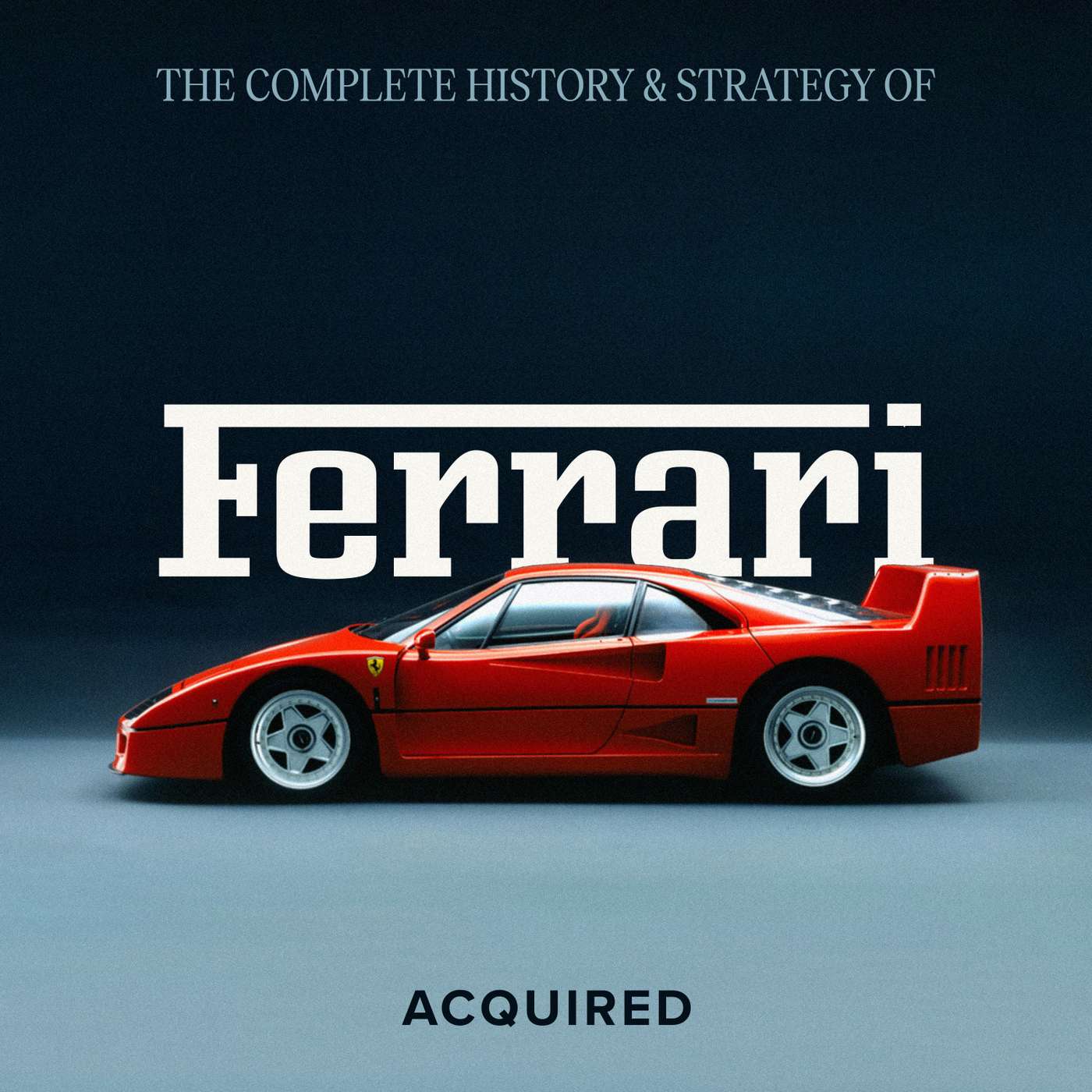
About this episode
Ferrari’s story is told as a mix of scarcity, racing mythology, and tightly managed brand identity. The episode opens with how few cars Ferrari ships—“around 14,000 per year”—and how “About 80% of them are earmarked specifically for people who already own a Ferrari.” It then traces Enzo Ferrari’s path from early racing and coachbuilding to Scuderia Ferrari, the prancing horse, and Rosso Corsa. Later chapters cover the Fiat era, Montezemolo’s turnaround, and modern luxury economics—“Ferrari has 50% gross margins.”
Ferrari is the pinnacle of luxury scarcity — across its entire 79-year history, the company has sold just 330,000 cars at an average price today of $500,000. For context, Hermès sells that many Birkins and Kellys roughly every 2 years, and Rolex moves that many watches every 3 months. And yet this ultimate luxury product also lives under the same roof with a widely beloved professional sports team… one with 400 million rabid fans from all walks of life who live and die by the Scuderia’s performance every F1 race weekend! How is it possible that these two seemingly contradictory customer bases can coexist within the same company? And far from destroying each other’s value, only reinforce it? The answer, it turns out, is a beautiful, bloody, tragic and romantic opera that spans two families and three generations — and just might be one of the best tales we’ve ever told on Acquired. Buckle up for the story of Ferrari.
Sponsors:
Many thanks to our fantastic Spring '26 Season partners:
Links:
- Sign up for email updates, get out takeaways and research photos from each episode, and vote on future topics!
- Our Ferrari "episode preview" in WSJ
- Enzo Ferrari by Luca Dal Monte
- Seeing Red on IMDb
- Go Like Hell by A.J. Baime
- Stephen Wilmot's great WSJ piece on Ferrari
- Ferrari factory tour
- Worldly Partners' Multi-Decade Ferrari Study
- All episode sources
Carve Outs:
- Ford v Ferrari
- Maison Wheat sweaters
- Craighill scissors
- Amazon grocery service
- Travelpro Altitude backpack
More Acquired:
- Get email updates and vote on future episodes!
- Join the Slack
- Check out the latest swag in the ACQ Merch Store!
00:00:00 Start
00:01:08 Intro
00:06:11 Enzo Ferrari's Early Life & Tragedies (1898-1919)
00:12:39 Scuderia Ferrari: Enzo's Racing Dream (1920-1933)
00:25:08 The Prancing Horse & Ferrari's Branding
00:35:41 First Ferrari Road Cars & Le Mans Victory (1947-1949)
00:51:31 F1 & The Tragedies of Enzo's Life (1950s)
01:14:03 Ford vs. Ferrari: The Le Mans Rivalry (1963-1966)
01:21:24 Enzo Sells 50% to Fiat (1969)
01:29:10 Luca di Montezemolo's Return to F1 Glory (1971-1976)
01:52:40 Ferrari's "Pepsi Challenge" and how Luca rescued the company (1991)
02:27:41 Post-IPO Ferrari: New Models & Growth (2015-Present)
02:48:24 The FUV Purosangue & Model Range
03:07:16 Ferrari Luce: The EV Future with Jony Ive
03:12:37 Ferrari Today by the Numbers
03:29:39 Analysis
03:50:04 Carve-Outs + Thank Yous
Note: Acquired hosts and guests may hold assets discussed in this episode. This podcast is not investment advice, and is intended for informational and entertainment purposes only. You should do your own research and make your own independent decisions when considering any financial transactions.
Ferrari
"Ben: Okay, David. So the question, do you have a favorite Ferrari? David: Ooh, that's a tough one. I would never actually want to get behind the wheel of it, but I think I gotta go with the F40. Ben: Of course."
Ferrari is a famous Italian maker of very expensive, very fast sports cars. Even people who will never own one usually know the name because Ferrari is treated more like a dream or status symbol than ordinary transportation.
Ferrari is the Italian high-performance car marque founded by Enzo Ferrari and defined by exotic road cars, Formula 1 racing heritage, and extreme scarcity. What makes Ferrari distinctive is that it sells relatively few cars while maintaining outsized cultural status and some of the strongest margins and brand power in the auto industry.

Ferrari F40
"Ben: Okay, David. So the question, do you have a favorite Ferrari? David: Ooh, that's a tough one. I would never actually want to get behind the wheel of it, but I think I gotta go with the F40. Ben: Of course."
The Ferrari F40 is one of the most famous Ferraris ever made. People love it because it looks wild, goes extremely fast, and feels much more intense and less comfortable than a normal road car.
The Ferrari F40 is Ferrari's raw, twin-turbocharged V8 halo car from the late 1980s and is famous for being the last model personally approved by Enzo Ferrari. Its stripped-out, race-bred feel and dramatic performance made it one of the defining supercars of its era.

1957 Ferrari 250 Testarossa
"David: Yes. Yes. How about you? Ben: I actually have two. One is the car from Charles Leclerc's wedding. David: Ooh. Ben: 1957 250 Testarossa and the car from Ford versus Ferrari. That 1966 330 P3 is just beautiful."
This is an old Ferrari race car from the 1950s, built to go very fast for long races. It is famous because it is beautiful, rare, and tied to Ferrari's golden racing years.
The 1957 Ferrari 250 Testarossa is a front-engine V12 Ferrari sports racer built for endurance competition, not just road use. It is one of Ferrari's most historically important and valuable cars because of its racing success and its iconic pontoon-fender design.

1966 Ferrari 330 P3
"David: Yes. Yes. How about you? Ben: I actually have two. One is the car from Charles Leclerc's wedding. David: Ooh. Ben: 1957 250 Testarossa and the car from Ford versus Ferrari. That 1966 330 P3 is just beautiful."
This was a Ferrari race car from the 1960s, built to compete in major long-distance races. People remember it because it looks stunning and comes from Ferrari's famous rivalry with Ford.
The 1966 Ferrari 330 P3 is a mid-engine V12 prototype race car created for top-level endurance racing during Ferrari's battles with Ford. It matters because it represents Ferrari at its most romantic and competitive, with beautiful bodywork and direct ties to the Le Mans-era rivalry dramatized in popular culture.
Charles Leclerc
"David: Yes. Yes. How about you? Ben: I actually have two. One is the car from Charles Leclerc's wedding. David: Ooh. Ben: 1957 250 Testarossa and the car from Ford versus Ferrari. That 1966 330 P3 is just beautiful."
Charles Leclerc is a famous racing driver who competes for Ferrari. Mentioning him helps place Ferrari in today's racing world, not just its old history.
Charles Leclerc is a modern Ferrari Formula 1 driver and one of the brand's most visible contemporary ambassadors. In Ferrari discussions, his name signals the company's ongoing connection between road-car mystique and top-level racing celebrity.
brand recognition
"Even Porsche ships 22 times the number of cars that Ferrari does. And yet, even though almost nobody owns a Ferrari, only about 180,000 people globally, they have among the highest brand recognition. I would argue that over a billion people know what a Ferrari is."
Brand recognition means how many people know what a brand is. Ferrari has a lot of it because even people who never plan to buy one still recognize the name and image.
Brand recognition is a marketing measure of how many people can identify a brand by name, logo, or reputation. In Ferrari's case, it helps explain how a company can sell very few cars yet occupy enormous space in global culture.
Hermès
"There are 10 times more Birkin and Kelly bags made each year over at Hermès than there are Ferraris, and there are 70 times more Rolexes made each year than there are Ferraris."
Hermès is the famous French luxury brand known for its Birkin and Kelly bags. The hosts keep comparing Ferrari to Hermès because both use scarcity and craftsmanship to justify extreme prices and keep demand higher than supply.
Hermès is the French luxury house used repeatedly as a comparison point throughout the episode. The hosts draw parallels between Ferrari and Hermès in terms of scarcity strategy, heritage craftsmanship, deliberate exclusivity, and the idea that both sell dreams as much as products.
Rolex
"There are 10 times more Birkin and Kelly bags made each year over at Hermès than there are Ferraris, and there are 70 times more Rolexes made each year than there are Ferraris."
Rolex is the famous Swiss watchmaker used as a reference point for luxury at scale. The hosts compare Ferrari to Rolex to help explain how both brands are exclusive without being totally out of reach, and how both become cultural status objects.
Rolex appears as a recurring luxury benchmark throughout the episode, both in scale comparisons (70× more Rolexes made than Ferraris per year) and as an analogy for perfect product-market fit — the hosts describe the Ferrari 355 as "a Rolex Submariner of Ferrari models."
FUV
"Ben: The paradoxes continue. People are dying for their SUVs, and yet they limit them to just 20% of total volume. David: Wait, what is this SUV of which you speak? Ben: I'm sorry, Ferrari Utility Vehicle, because they would never— David: Yes, the FUV, the Ferrari Utility Vehicle."
FUV is Ferrari's own name for its SUV-like vehicle. It's basically Ferrari trying to say, 'yes, this is practical by Ferrari standards, but it's still supposed to feel special and not ordinary.'
FUV stands for Ferrari Utility Vehicle, Ferrari's deliberately non-SUV label for the Purosangue. The term matters because it reflects Ferrari's branding strategy: acknowledge market demand for a utility-shaped vehicle while avoiding the mainstream, less exotic connotations of 'SUV.'
SUV
"Ben: The paradoxes continue. People are dying for their SUVs, and yet they limit them to just 20% of total volume. David: Wait, what is this SUV of which you speak? Ben: I'm sorry, Ferrari Utility Vehicle, because they would never— David: Yes, the FUV, the Ferrari Utility Vehicle."
An SUV is a taller, roomier vehicle like the kinds many families buy today. It stands out here because Ferrari built its reputation on exotic sports cars, not practical family-shaped vehicles.
SUV stands for sport utility vehicle, a body style that combines taller ride height, hatchback practicality, and a more commanding driving position than a typical sedan. In Ferrari's context, the term is notable because the brand long resisted the category as too ordinary or mass-market for its image.
Ford Motor Company
"Ben: Ford, here's another good one, makes 160 times the number of cars that Ferrari does, yet Ferrari has a higher market capitalization. They're worth more than the Ford Motor Company and Volkswagen."
Ford Motor Company is the business that makes Ford vehicles. In this story, it matters because Ford was trying to buy Ferrari and use racing to make the company seem more exciting.
Ford Motor Company is the corporate entity behind the Ford brand, and here it matters as a strategic buyer and industrial giant rather than just a carmaker. In the early 1960s, Ford's interest in Ferrari was part image-building, part racing ambition, and part corporate maneuvering that led to the famous Ford-versus-Ferrari rivalry.
market cap
"Ben: Ford, here's another good one, makes 160 times the number of cars that Ferrari does, yet Ferrari has a higher market capitalization. They're worth more than the Ford Motor Company and Volkswagen."
Market cap is the stock market's estimate of what a company is worth. When the hosts say Ferrari went from about $10 billion to around $90 billion, they mean investors started valuing Ferrari far more highly than before.
Market cap, short for market capitalization, is the total value of a public company's equity based on its share price times shares outstanding. For car companies, it is a way of showing how investors value the business, and Ferrari's unusually high market cap reflects how the market sees it more like a luxury brand than a typical automaker.
Stellantis
"And Honda and Stellantis and Mercedes-Benz. This company is worth so much more than most giant manufacturers. Ferrari makes all of their cars mostly by hand, inefficiently and one-off in a single town, Maranello, Italy."
Stellantis is the giant car company created when Fiat Chrysler joined with Peugeot's group. It's basically the modern umbrella company that now owns many of these brands.
Stellantis is the multinational automaker formed from the merger of Fiat Chrysler Automobiles and PSA Peugeot. It's relevant here as the eventual corporate home of many brands discussed in the segment, showing how Fiat's rescue efforts cascaded into today's industry structure.
one-off
"And Honda and Stellantis and Mercedes-Benz. This company is worth so much more than most giant manufacturers. Ferrari makes all of their cars mostly by hand, inefficiently and one-off in a single town, Maranello, Italy."
A one-off car is exactly what it sounds like: a car made only once for one customer. Instead of just picking colors and trim, the buyer can get a truly unique car.
In exotic-car manufacturing, a one-off is a unique car built as a single example for a specific client, often with bespoke bodywork and design details. Ferrari's one-off projects represent the extreme end of customization, where the buyer is commissioning something closer to coachbuilding than ordinary options selection.
Maranello
"And Honda and Stellantis and Mercedes-Benz. This company is worth so much more than most giant manufacturers. Ferrari makes all of their cars mostly by hand, inefficiently and one-off in a single town, Maranello, Italy."
Maranello is the town in Italy where Ferrari is based. Car people often mention it because it is closely tied to Ferrari's history, factory, and image.
Maranello is the Italian town that serves as Ferrari's home base, including its factory and much of its corporate identity. In automotive culture, saying 'Maranello' often stands in for Ferrari itself, much like a shorthand for the brand's manufacturing roots and mythology.
margins
"And they have the highest margins in the entire auto industry. Of the very few cars that they do make, this is my favorite one, David. About 80% of them are earmarked specifically for people who already own a Ferrari."
Margins are how much money a company gets to keep from each sale after paying its costs. Ferrari's are unusually high because people will pay a lot for the badge, rarity, and experience.
Margins are the share of revenue a company keeps as profit after costs, and high margins usually signal pricing power or operational advantage. Ferrari's margins are notable because they are unusually strong for an automaker, reflecting scarcity, brand prestige, and disciplined production limits.
Modena
"David Rosenthal, take us to Italy. David: Ooh. All right. Well, we start in 1898 in the medieval Italian town of Modena. With the birth of our hero, Enzo Anselmo Giuseppe Maria Ferrari, better known, of course, either by the name of the company he would found that bears his last name, Ferrari, or to his hundreds of millions of fans around the world simply as Enzo."
Modena is the Italian city where Enzo Ferrari was born. Car fans know it because the surrounding area is famous for legendary Italian car makers.
Modena is an Italian city in Emilia-Romagna that sits at the heart of Italy's Motor Valley and is closely linked to Ferrari's origins. It matters in automotive history because several iconic Italian performance marques and racing traditions are rooted in this region.
Enzo Ferrari
"We start in 1898 in the medieval Italian town of Modena. With the birth of our hero, Enzo Anselmo Giuseppe Maria Ferrari, better known, of course, either by the name of the company he would found that bears his last name, Ferrari, or to his hundreds of millions of fans around the world simply as Enzo."
Enzo Ferrari is the man who started Ferrari. He grew up in Italy, raced cars, then started his own racing team and eventually built cars that bore his name. He ran the company until near the end of his life in 1988.
Enzo Ferrari was the founder of Ferrari, born in Modena in 1898. A failed racing driver who became one of the most influential figures in automotive history, he is described throughout the episode as a natural-born entrepreneur and marketer — Italy's Steve Jobs — who built a company around desire, scarcity, and racing prestige.
Alfredo Ferrari Sr.
"his mother Adalgisa is a beautiful young woman. His father Alfredo is 12"
Enzo Ferrari's father, a metalworker in Modena. Source of the family adage that a company is "perfect when partners are odd and less than three."
Dino Ferrari (Enzo's brother)
"his older brother, who is named after his father — he's also named Alfredo, nicknamed Dino"
Enzo's older brother (full name Alfredo, nicknamed Dino). The family's "golden child," he enlisted in the Italian army during WWI and died of pneumonia. Enzo later named his own son Dino in his honor.
racing driver
"I am going to be a racing driver. And that dream does indeed come true, but probably not in any way that Enzo expected that night, because very shortly thereafter, World War I breaks out and two tragedies happen to Enzo in quick succession."
A racing driver is someone who competes in organized car races, not just someone who drives fast on the street. Back then, it often meant you also had to help make the whole effort happen, not just show up and drive.
A racing driver is a professional or semi-professional competitor in motorsport, distinct from an ordinary road-car driver. In Enzo Ferrari's era, the role often blended driving talent, mechanical sympathy, and the ability to secure a car and backing just to enter events.
Chrysler
"And today they own and control both Stellantis, which is the merged result of Fiat Chrysler and Peugeot. And they also own and control Ferrari. Don't worry, we'll get there. Ben: We'll get there. But not for, I mean, the better part of a century here."
Chrysler is an American car company. Fiat teamed up with it when Chrysler was struggling badly, and that deal became a huge part of Fiat's future.
Chrysler is the U.S. automaker Fiat partnered with during the financial crisis and later fully acquired. In this segment it matters as a corporate asset whose rescue and debt load transformed Fiat into Fiat Chrysler Automobiles and set up the need to unlock value from Ferrari.
CMN
"David: Yes. Yes. So back to Enzo here in 1918. Fiat, of course, rejects his job application because, again, he has no discernible skills. But Enzo is persistent, and in 1919, he lands a job at a new startup automobile company called CMN."
CMN was a small early Italian car company. It mattered because it gave Enzo his first real foothold in the car world and let him start racing.
CMN refers to Costruzioni Meccaniche Nazionali, an early Italian automobile company where Enzo Ferrari got one of his first jobs. Its importance is historical: it gave Enzo access to a sports car and a path into racing before he was noticed by bigger names.
gentlemen racers
"Drivers generally bought and raced their own cars, either because they were independently wealthy and successful and could afford their own staffs and mechanics to maintain these cars. These were folks known as gentlemen racers."
A gentleman racer is basically a rich hobbyist who races cars using his own money. Before modern professional racing took over, many competitors were people like that rather than paid team drivers.
Gentlemen racers were wealthy amateur drivers who funded their own participation in motorsport rather than earning a living as factory professionals. The term is important to Ferrari history because these affluent private competitors later became the natural customer base for Ferrari's early race and road cars.
motorsport
"They're these kinda like hustlers and dreamers who managed to glom on somewhere in the car industry and leverage that into entering races. But basically motorsport was this like passionate sort of privateer pursuit."
Motorsport just means car racing as a formal sport. In the era they are discussing, it was much more deadly than modern racing, which is why the hosts keep connecting it to tragedy.
Motorsport is organized competitive racing involving cars, from circuit racing to endurance and road races. In the 1950s, motorsport was dramatically more dangerous than today, with minimal safety standards for drivers, spectators, and racecourses.
Alfa Romeo
"Ben: Not organized professional racers on highly paid teams. David: Yes. So Enzo enters into this world and he does pretty well. Well enough not only to send some prize money back home to mom, but also to attract the attention of Alfa Romeo, which is Italy's other large car company at the time, although much, much smaller than Fiat."
Alfa Romeo is a historic Italian car brand known for sporty cars and racing. It matters here because it is the bigger company that starts to notice Enzo after his early racing efforts.
Alfa Romeo is the Italian car marque famous for its prewar racing pedigree, twin-cam engineering tradition, and emotional place in enthusiast culture. In Enzo Ferrari's story, Alfa Romeo is pivotal because it becomes the major manufacturer that recognizes his talent and gives him a bigger platform in racing.
privateers
"And Alfa has one of Italy and Europe's few, if not only, in-house racing teams. So even though most racing that is happening is privateers, Alfa has their own racing team, which is pretty unique for Europe at the time."
A privateer is basically an independent racer who buys a race car and runs it themselves, instead of racing for the official factory team. Think of it as a customer race effort.
In motorsport, privateers are independent racers or teams who buy cars from manufacturers and compete without being the factory works team. The term matters here because early sports-car and Grand Prix racing often depended on wealthy customers buying competitive machines from specialist builders.
coachbuilders
"This is another really important point to understand about the car business at this point in time. For most companies, and especially car companies that were making sports cars, the actual bodies or the coaches were built and designed by third-party coachbuilders."
These were companies that made the visible shell of the car. The carmaker handled the mechanical parts, and the coachbuilder made the custom outside and interior structure.
Coachbuilders were specialist firms that created the bodywork for cars, especially before automakers became fully vertically integrated. Famous European cars were often a collaboration: one company supplied the chassis and engine, while another designed and built the body.
chassis
"The cars were just an engine and a chassis that the carmaker would deliver, and then the clients would go to a coachmaker like this one that Enzo is starting up and have them build the body to their taste and specifications that would go on top of, you know, the mechanics of the car."
The chassis is the main structure of the car underneath everything else. In racing, it matters because it affects how the car turns, grips, and works with the suspension and body.
The chassis is the car's structural and dynamic foundation—the platform that determines suspension geometry, rigidity, packaging, and much of the handling behavior. In Formula 1, a superior chassis can transform competitiveness, which is why Luca identifies Ferrari's over-focus on engines as a strategic mistake.
Scuderia Ferrari
"Scuderia Ferrari, which is the name that he gives to his new racing team"
"Stable of Ferrari." Enzo's racing team, founded 1929 as Alfa Romeo's outsourced factory squad. The SF on the shield logo. Today the oldest and most successful team in Formula 1.
prancing horse
"That is the SF that you see on the Ferrari shield everywhere. Yep. Ben: And for a team that would go on to adopt the prancing horse, I am loving the thick metaphor here with the stable and the— David: Oh, Enzo, as we shall see, is a natural-born marketer."
This is the horse logo Ferrari uses. It's the symbol most people instantly connect with Ferrari, like the swoosh for Nike or the apple for Apple.
The prancing horse is Ferrari's famous emblem, known in Italian as the Cavallino Rampante. It began as a racing symbol associated with Enzo Ferrari's team and became the central visual identity of Ferrari road cars and motorsport.
Maserati
"The prime example being Maserati right there in Modena... the Maserati brothers."
Modena-based luxury/sports carmaker founded by the Maserati brothers in 1914. Ferrari's longtime crosstown rival; later positioned by Sergio Marchionne as the "Tudor to Ferrari's Rolex."
Francesco Baracca
"back when Enzo was a promising young racing driver, one of his early fans"
Italian WWI fighter ace who painted a prancing horse on his plane. After Baracca's death his mother, the Countess Paolina, suggested Enzo adopt the symbol for good luck — it became the Ferrari logo.
Luca di Montezemolo
"So in our research, I spoke to Luca di Montezemolo, the legendary Ferrari chairman who would ultimately succeed Enzo, and really in many ways be his heir, as we will tell in this story. Ben: Important to note, different Luca, than the Luca who wrote the book, David, that most of this narrative is based on."
Luca di Montezemolo is a famous Ferrari leader from the modern era. He helped make Ferrari not just a car company, but a world-famous luxury brand.
Luca di Montezemolo is one of the most important modern figures in Ferrari history, known for leading the company during a major era of brand and business success. He is closely associated with Ferrari's transformation into a global luxury icon while preserving its racing-centered identity.
Rosso Corsa
"And then what's the other famous, you know, visual symbol associated with Ferrari? The red Ferrari red, Rosso Corsa, that he adopts here. And sure, you know, Ferraris are red because red was the assigned national racing color of Italy."
Rosso Corsa is the classic bright red linked with Italian race cars. Most people now think of it as 'Ferrari red,' even though it started as Italy's racing color in general.
Rosso Corsa, literally 'racing red,' is the traditional Italian national racing color. Ferrari adopted it so completely that the shade became culturally identified with Ferrari itself, even though it originally represented Italy in motorsport more broadly.
Lamborghini
"Italy's other luxury supercar company today, Lamborghini"
Italian supercar brand founded 1963 by tractor magnate Ferruccio Lamborghini, supposedly after a dispute with Enzo Ferrari. Today owned by Volkswagen Group; ~60% of sales are the Urus SUV.
Grand Prix racing
"So throughout the rest of the 1930s, the German state is supporting Mercedes and Auto Union, which would go on to become Audi today. And their cars are just dominating European Grand Prix racing. So Enzo and Ferrari are like sent out there, you know, by Alfa and the Italians to compete."
This was the highest level of major race-car competition in Europe before Formula 1 existed in its modern form. Winning there meant proving your cars and your country were the best.
Grand Prix racing refers to top-level circuit racing in Europe before the modern Formula 1 era. In the 1930s it was the premier international motorsport battleground for national prestige, manufacturers, and governments.
Audi
"Most other car companies, even the Porsches and the Audis and the Lamborghinis, a lot of the models that they're making are based on shared platforms."
Audi is an upscale car brand that belongs to a larger company family. The point here is that expensive-looking cars can still share a lot of their basic structure with other vehicles.
Audi is Volkswagen Group's premium German brand and is often deeply integrated into the group's shared engineering strategy. In this discussion, Audi represents how luxury brands can still use common architectures underneath different models.
Mercedes
"throughout the rest of the 1930s, the German state is supporting Mercedes and Auto Union, which would go on to become Audi today. And their cars are just dominating European Grand Prix racing."
Mercedes is the luxury German car brand. In this part of history, it was also a very powerful racing name, backed heavily by the Nazi government in prewar Europe.
Mercedes here refers to the German marque that was one of the dominant forces in prewar Grand Prix racing, backed by the German state in the 1930s. Its racing dominance is a major part of the competitive world Enzo Ferrari was trying to beat.
Auto Union
"throughout the rest of the 1930s, the German state is supporting Mercedes and Auto Union, which would go on to become Audi today. And their cars are just dominating European Grand Prix racing."
Auto Union was a group of German car companies that raced together in the 1930s. They were heavily funded by the German government and one of the main rivals Enzo Ferrari was up against. Today those brands make up Audi.
Auto Union was the German racing consortium of the 1930s formed from the merger of Audi, DKW, Horch, and Wanderer — the ancestor of today's Audi. State-backed by the Nazi government, Auto Union and Mercedes dominated Grand Prix racing in the pre-war era that Ferrari was trying to beat.
Auto Avio Costruzioni
"Like, he lost the rights to his own name for 4 years. David: Well, I mean, you know, he gave them up to the Italian government, essentially. So speaking of which, during the war, Enzo creates a new company to feed the Italian war effort that he names Auto Avio Costruzioni, Auto and Aviation Construction."
This was the business Enzo started when he wasn't allowed to use the Ferrari name yet. It was basically his workaround company before Ferrari could fully exist under his own name again.
Auto Avio Costruzioni was the company Enzo Ferrari created after leaving Alfa Romeo and temporarily losing the right to use the Ferrari name. It was effectively the bridge between his Alfa period and the later independent Ferrari company.
RACE (NYSE ticker)
"publicly traded on the New York Stock Exchange... best stock ticker ever"
Ferrari N.V.'s NYSE ticker symbol since its 2015 IPO. Often cited as the most fitting ticker in public markets.
Luigi Chinetti
"And then Enzo gets a visit from an old racing pal, an Italian but one who spent the war not in Europe, but in exile in America. Luigi Chinetti, the man who brings Ferrari to America."
Luigi Chinetti was Enzo Ferrari's old racing friend who became the first Ferrari dealer in America. He persuaded Enzo that rich Americans would love these cars — and he was right, which helped Ferrari survive its early years.
Luigi Chinetti was the Italian-American racing driver and Ferrari importer who introduced Ferrari to the American market. His partnership with Enzo was decisive: by convincing Enzo that wealthy Americans would pay a king's ransom for Italian exotics, Chinetti helped launch the export business that made Ferrari financially viable.
Brock Yates
"this is a quote here from Brock Yates's"
Longtime Car and Driver editor, creator of the Cannonball Run, and author of "Enzo Ferrari: The Man and the Machine" — the definitive English-language Enzo biography.
Car and Driver
"And when the war is over, Luigi goes back to Italy to visit Enzo, and he tells him about America. So this is a quote here from Brock Yates's biography of Enzo. Brock Yates was the longtime editor of Car and Driver magazine."
Car and Driver is a famous magazine about cars. Mentioning it tells listeners that the quote comes from someone respected in car writing.
Car and Driver is a major American automotive magazine, long influential in enthusiast media and car criticism. The mention matters because Brock Yates's connection to it signals that the hosts are quoting a well-known voice in automotive journalism.
non-compete
"That's false. Enzo was planning to anyway. There's no way that he really was gonna go into machine tools. Ben: I mean, by 1943, his non-compete is up and he's allowed to use the name again. And so, you know, the clock's ticking."
This is a legal agreement that says you can't go start a rival business right away. Here, it explains why Enzo Ferrari had to wait before putting the Ferrari name back on cars.
A non-compete is a contractual restriction that prevents someone from starting or operating a competing business for a set period. In Ferrari history, it's important because Enzo could not immediately use his own surname on cars after leaving Alfa Romeo-related arrangements.

Ferrari 166 MM Barchetta
"But yes, he did not sell a single car to a customer until 1948 when they introduced the Ferrari 166 Barchetta at the Turin Motor Show. And Luca Dal Monte in his biography writes, for Enzo Ferrari, the 166 MM Barchetta was a declaration of intent, a sports car with a sensual shape, as fast and powerful as it was beautiful and elegant."
This is a very early Ferrari model closely tied to racing. It shows how Ferrari's first customer cars were not just luxury toys—they were built to carry racing prestige.
The Ferrari 166 MM Barchetta is the more specific competition-oriented version of the early 166 and is one of the foundational Ferrari road-race cars. The 'MM' refers to Mille Miglia, underscoring Ferrari's core idea that its road cars should be capable of winning major races as well as impressing wealthy buyers.
Turin Motor Show
"But yes, he did not sell a single car to a customer until 1948 when they introduced the Ferrari 166 Barchetta at the Turin Motor Show. And Luca Dal Monte in his biography writes, for Enzo Ferrari, the 166 MM Barchetta was a declaration of intent, a sports car with a sensual shape, as fast and powerful as it was beautiful and elegant."
This was a big car show in Italy where companies revealed new models. For a young Ferrari, showing a car there was a way to tell the world, 'we're here.'
The Turin Motor Show was one of Italy's major auto exhibitions and historically a key stage for debuting important new cars. In Ferrari's early years, appearing there mattered because motor shows were where manufacturers announced themselves to buyers, press, and the broader industry.
concours d'élégance
"It was the foundation on which from that moment on, he would build every road model. Cars capable of winning races on circuits and roads all over the world, and at the same time, being the protagonist of the most prestigious concours d'élégance in the four corners of the earth."
This means a fancy car show where beautiful and important cars are judged. It's about elegance and prestige, not who is fastest around a track.
A concours d'élégance is a high-end judged exhibition of exceptional automobiles, emphasizing design, rarity, history, and presentation rather than outright speed. The phrase fits Ferrari perfectly because the brand has long sold cars that are meant to succeed both as racing machines and as objects of beauty.
Gianni Agnelli
"Italy's own most celebrated industrialist, Gianni Agnelli, the patriarch of the Agnelli family, which owns Fiat"
Patriarch of the Agnelli family that controlled Fiat for decades. One of Ferrari's first road-car customers; in 1969 he bought 50% of Ferrari from Enzo, with a secret agreement that took Fiat to 90% upon Enzo's death.
Le Mans
"he enters it in the first running of the 24 Hours of Le Mans"
Town in western France whose Circuit de la Sarthe hosts the 24 Hours of Le Mans endurance race. Site of Ferrari's first major international victory (1949) and Ford's 1-2-3 revenge in 1966.
24 Hours of Le Mans
"So he takes one of the 166s and he enters it in the first running of the 24 Hours of Le Mans to be run after World War II, the first, you know, postwar running of Le Mans. And the car that he takes— Enzo doesn't think the 166 is ready for Le Mans."
Le Mans is a very long race that lasts 24 hours straight. A car that wins there has to be fast, but also tough enough not to break while running hard for an entire day.
The 24 Hours of Le Mans is the world's most famous endurance race, run in France, where cars compete for a full day and night. Winning Le Mans is a major proof point because it tests speed, durability, fuel strategy, and team execution rather than just outright pace.
aerodynamics
"His comment is, I sell engines and the car I throw in for free. David: Yes, such a great quote. Ben: Another great one. Aerodynamics are for people who can't build engines. David: That's like that one, the AMD guy, Real Men Build Fabs."
Aerodynamics is about how air moves around a car. In racing, good aerodynamics can make a car faster and help it grip the track better, even without a more powerful engine.
In racing, aerodynamics is the science of shaping a car so airflow improves speed, stability, and downforce. The hosts are highlighting a major shift in Formula 1: Ferrari could no longer rely mainly on engine power because teams like Lotus were winning through superior aero and overall vehicle design.
mid-engine
"This is very, very different today. But in the early days, I mean, we're going to talk about Formula 1 here shortly, but in those early days of F1, other teams figured out, hey, you should probably move the engine to be a mid-engine, sort of above the rear axle."
Mid-engine means the engine sits more toward the middle of the car instead of all the way in the front. That can make the car feel better balanced and more agile, especially when driving fast.
A mid-engine layout places the engine behind the driver but ahead of the rear axle, concentrating mass near the center of the car. That usually improves balance and handling response, which is why it became the preferred layout for many high-performance race cars and later exotic road cars.
Lord Selsdon
"it's not like Canadian Lord Selsdon could just buy a 166 and drive it up to France"
British gentleman racer whose privately-owned Ferrari 166 MM, driven by Luigi Chinetti, won the 1949 24 Hours of Le Mans — Ferrari's first Le Mans victory.
tech transfer
"Like, yes, there is some tech transfer, I'm sure, from the Mercedes F1 team to AMG performance cars, but like, it's a tenuous connection."
This means race-team ideas making their way into normal cars. Sometimes that's real engineering, and sometimes it's more about borrowing prestige and a few useful tricks.
Tech transfer means engineering knowledge, materials, design methods, or systems moving from a racing program into production cars. In automotive marketing it's often invoked to suggest that a road car benefits from lessons learned in motorsport, even when the connection is indirect.
Formula 1 World Championship Series
"The new Formula 1 World Championship Series, as we talked about at great length on our Formula 1 episode. And Ferrari, of course, would become one of the founding teams and the only F1 team continuously operating from the beginning of the sport all the way through to today."
Formula 1 is the highest-profile kind of global race car competition, with purpose-built cars and famous teams. Ferrari's reputation is tied closely to being there from the start and staying in it ever since.
Formula 1 is the top tier of international single-seater circuit racing and has long been treated as the pinnacle of motorsport. In Ferrari's story, F1 matters because the company became a founding team and built much of its mystique around continuous participation from the championship's beginning.
Alberto Ascari
"in 1955, Alberto is killed practicing in a Ferrari"
Two-time F1 World Champion and son of Enzo's racing mentor Antonio Ascari. Enzo treated him as a surrogate son. Killed testing at Monza in 1955 at the same age his father had died.
replica
"Ben: But David, did you know it is the Ferris Bueller car, but the car you see on screen is actually not a Ferrari? David: Yes, it's a replica. And Ferrari sued the replica maker after the movie, right?"
A replica is basically a copy of a famous car, not the real thing. It may look similar, but it was built from other parts and is worth far less than an original.
In collector-car language, a replica is a vehicle built to imitate a more famous or valuable original model, often using a different chassis or drivetrain underneath. Replicas can look convincing on screen or at a glance, but they do not carry the historical authenticity or market value of the real car.
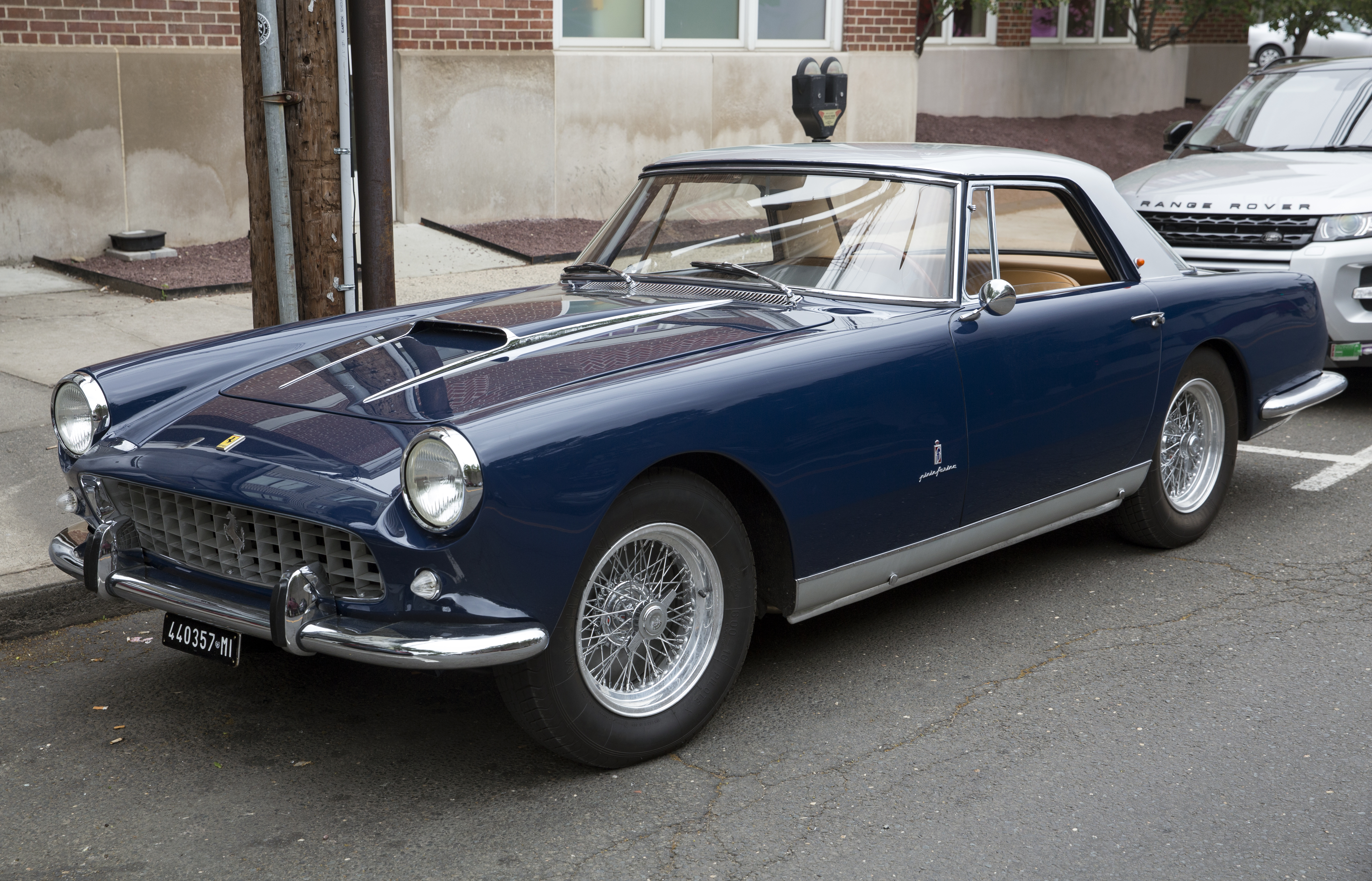
Ferrari 250 GT California
"Ben: Yeah, real production volumes. David: Yeah. And as we were alluding to earlier, this car is just stunning. No matter which variant of it you're looking at it, the, the one in Ferris Bueller's Day Off is a 250 GT California."
This is a very famous old Ferrari convertible that collectors consider incredibly beautiful and valuable. It is the car people remember from Ferris Bueller's Day Off, even though the movie used a fake version instead of a real one.
The Ferrari 250 GT California is one of Ferrari's most famous 1950s-60s road cars, built on the 250 series platform with a Colombo V12 and styled as an open-top grand tourer. It became especially iconic in pop culture through Ferris Bueller's Day Off, but in collector circles it is revered for combining classic Ferrari mechanicals with some of the most beautiful Pininfarina-influenced bodywork ever put on a road car.
Pininfarina
"It is truly, truly beautiful. And it was designed not by Enzo Ferrari, or even anybody who worked at Ferrari. It was designed by Battista Pinin— was his nickname— Farina and his Pininfarina coachbuilders."
Pininfarina is a famous Italian car design company. If Ferrari built the mechanical heart of many classic cars, Pininfarina often created the beautiful shape people fell in love with.
Pininfarina is the Italian design house and coachbuilder most closely associated with Ferrari's classic road cars. Its importance is not just styling polish: Pininfarina helped define the visual language of Ferrari for decades, making it one of the most influential names in automotive design.
Battista "Pinin" Farina
"designed by Battista Pinin— was his nickname— Farina and his Pininfarina coachbuild"
Founder of Pininfarina, the Turin coachbuilder that designed virtually every Ferrari road car for more than 60 years — from the 250 series through the LaFerrari. The "Jony Ive to Enzo's Steve Jobs."

Ferrari LaFerrari
"This was a multigenerational partnership that lasts all the way up until 2013. Ben: The LaFerrari? David: The LaFerrari Halo car was the first fully in-house designed Ferrari. And during those 61 years, I believe every single road-going production Ferrari except for one, I think, was designed by Pininfarina."
LaFerrari is Ferrari's ultra-exclusive hybrid supercar. It mixes a big gasoline engine with electric power to make an extremely fast flagship model.
The Ferrari LaFerrari is Ferrari's hybrid halo supercar, combining a naturally aspirated V12 with electric assistance in a limited-production flagship. It matters because it marked Ferrari's move into electrified performance at the very top of the lineup without abandoning the emotional appeal of a V12.
halo car
"This was a multigenerational partnership that lasts all the way up until 2013. Ben: The LaFerrari? David: The LaFerrari Halo car was the first fully in-house designed Ferrari. And during those 61 years, I believe every single road-going production Ferrari except for one, I think, was designed by Pininfarina."
A halo car is the showpiece car for a brand. It is the model meant to make the whole company look more exciting and advanced, even if very few people can actually buy one.
A halo car is a flagship model built partly to elevate the image of the entire brand, even if it sells in very small numbers. Automakers use halo cars to showcase technology, performance, and design leadership that then influences how buyers perceive the rest of the lineup.
Piero Ferrari
"current member of the Ferrari board of directors named Piero Ferrari"
Enzo Ferrari's illegitimate son with Lina Lardi. Italian law didn't recognize him as Enzo's heir until divorce was legalized in the 1970s. Today he owns ~10% of Ferrari and sits on the board.
Mille Miglia
"David: A tragedy is the only word that I can think of to describe it. So that was 1956. And then in 1957, at the Mille Miglia race in Italy— Ben: Which this race, this is this amazing, legendary race through Italy that ran 1,000 miles."
The Mille Miglia was a very long and famous race across Italy, not on a closed modern track but on regular roads. People loved it because it was exciting and beautiful, but it was also incredibly dangerous and deadly.
The Mille Miglia was a legendary 1,000-mile Italian road race run on public roads from 1927 to 1957. It became famous for combining glamorous cars and drivers with extreme danger, and the 1957 fatal Ferrari crash effectively ended the original event.
Carroll Shelby
"Ken Miles, who is a very famous race car driver, actually on the Ford and Shelby, the US side that we'll talk about about here shortly. His quote on this is, I'd rather die in a racing car than get eaten up by cancer."
Carroll Shelby was a famous American racing figure who helped Ford build cars that could beat Ferrari. He was known for making cars faster and more competitive.
Carroll Shelby was an American racer, constructor, and performance icon best known for developing high-performance Ford-backed race and road cars, including the Cobra and the GT40 program. In the Ford-Ferrari story, Shelby is central because he helped turn Ford's money into a race-winning effort at Le Mans.
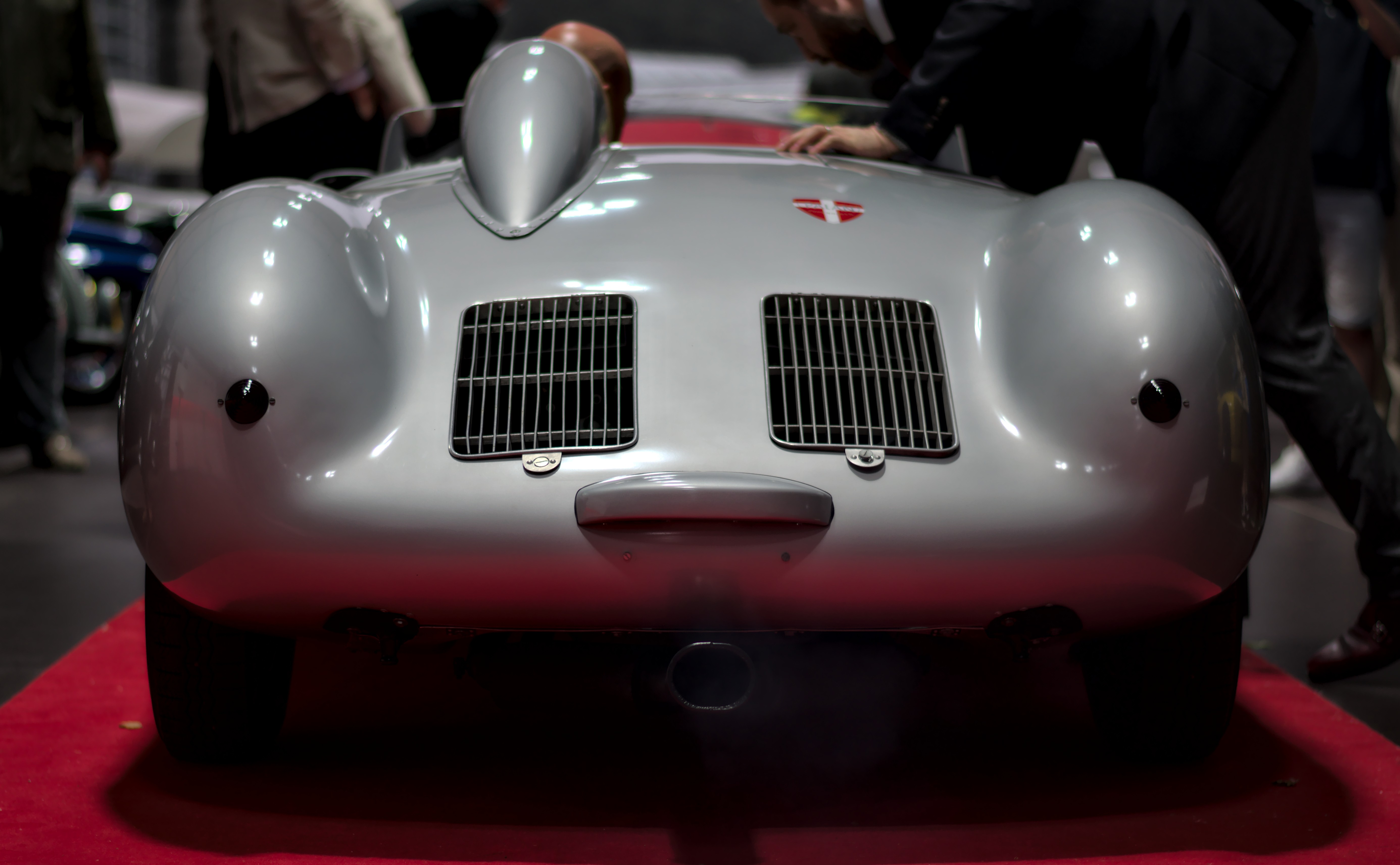
Porsche 550 Spyder
"This is part of the attraction. It only makes Enzo and his Ferraris more globally known, more romantic, more coveted. It's like for Porsche when James Dean died in the Porsche 550 Spyder, or in the modern era when Paul Walker died in the Carrera GT that made those cars legendary, that made people want them."
The Porsche 550 Spyder was a very small, very fast sports race car from the 1950s. People still talk about it because it was exciting, rare, and became famous after James Dean's fatal crash.
The Porsche 550 Spyder was a tiny, lightweight mid-engine Porsche race car built in the 1950s, famous for its low weight and nimble handling rather than brute power. It became culturally legendary in part because actor James Dean died in one, which permanently tied the model to danger and myth.

Porsche Carrera GT
"It's like for Porsche when James Dean died in the Porsche 550 Spyder, or in the modern era when Paul Walker died in the Carrera GT that made those cars legendary, that made people want them."
The Carrera GT is a very powerful, very demanding Porsche supercar. It's famous partly because of Paul Walker's fatal crash in one — which unfortunately made it more iconic.
The Porsche Carrera GT is the 2000s V10 supercar famous for its extreme driver demand and unforgiving behavior. The hosts use it alongside the Porsche 550 Spyder to illustrate how tragedy can paradoxically make a car more legendary and desirable.
Henry Ford II
"So in 1963, Henry Ford II, which notably this is the grandson of Henry Ford I"
"The Deuce" — grandson of Henry Ford and head of Ford Motor Company in the 1960s. Tried to buy Ferrari for $10M in 1963; when Enzo walked away at the finish line, Ford launched the GT40 program to "beat his ass" at Le Mans.

Lamborghini Miura
"David: Yes, I'm glad you brought up Lamborghini. Lamborghini had just launched the Miura, the Lamborghini Miura at this point in time, which was a truly excellent car. Yep. Like a better Ferrari than a Ferrari at the time."
The Miura was an early Lamborghini that looked wild and put its big engine behind the driver instead of in front. That setup helped make it one of the first cars people think of as a modern supercar.
The Lamborghini Miura is the car that established Lamborghini as a true Ferrari rival by popularizing the mid-engine V12 supercar layout for the road. Its transverse-mounted V12 behind the seats and stunning Marcello Gandini styling made it one of the defining exotic cars of the era, which is why the hosts call it 'a better Ferrari than a Ferrari' at the time.
rally car
"So in 1970, young Luca moves to New York City to go off to study international law at Columbia Law School. Around the same time, though, he's also pursuing another career as a rally car driver. Ben: Really?"
A rally car is a race car for rougher roads like gravel, snow, or narrow pavement stages, not a normal racetrack. It has to handle jumps, slippery surfaces, and long events in changing conditions.
A rally car is a competition car built for stage rallying, where drivers race one at a time on closed public-road or dirt-road sections rather than on a permanent circuit. Rally emphasizes traction, durability, pace notes, and loose-surface control, which is why the hosts joke that Ferrari and rallying rarely overlap.
oil crisis
"This is a pretty tough time for Ferrari here in the '70s. The oil crisis is underway. Any car with an engine size over 2 liters was taxed at an incremental 40% in Italy and throughout much of Europe. The whole sports car industry is basically in the dumps."
The oil crisis was a period in the 1970s when fuel became much more expensive and harder to get. That made powerful, fuel-hungry sports cars much harder to sell.
The oil crisis refers to the 1970s fuel shocks that raised fuel prices, disrupted economies, and hurt demand for thirsty high-performance cars. For Ferrari and other sports-car makers, it was especially damaging because large engines suddenly looked expensive and politically out of step.
Lotus
"This isn't just an engine sport anymore, or power. We're now in the era of Colin Chapman and Lotus and aerodynamics. Aerodynamics and the chassis is way more important. And the Ferrari team is stuck focused 100% on the engine."
Lotus is a famous British car and racing brand. Here, it stands for a smarter, more advanced way of building race cars that Ferrari needed to catch up to.
Lotus is the British marque and racing team associated with Colin Chapman, whose cars helped redefine Formula 1 around lightweight design, chassis innovation, and aerodynamics. In this segment, Lotus represents the new technical direction Ferrari had failed to match while remaining too engine-focused.
Niki Lauda
"It's so perfect. Ben: It is perfect. David: So Luca comes in as team manager and he revamps the team. He brings in great chassis folks. He brings in great aerodynamics folks, and the most important thing, he goes out and recruits Niki Lauda to come in as their number one driver."
Niki Lauda was a famous race driver who helped Ferrari start winning again. He was important because even a better car and team still need a great driver to get results.
Niki Lauda was Ferrari's lead Formula 1 driver during the mid-1970s revival and became one of the defining figures of the team's history. His recruitment matters here because Ferrari's turnaround was not just technical; it also required a top-tier driver capable of converting the rebuilt team into championships.
Constructors' Championship
"And in 1975, with the new team, the new approach, Luca as manager, Niki Lauda wins the Drivers' Championship for Ferrari, and Ferrari wins the Constructors' Championship, ending the 10-year drought. And there is great rejoicing."
This is the team title in Formula 1. Instead of rewarding one driver, it rewards the car maker and race team for how well their cars perform over the whole season.
In Formula 1, the Constructors' Championship is the season-long title for the team or manufacturer, based on points scored by its cars. It's distinct from the Drivers' Championship, which crowns an individual driver, so winning both signals that Ferrari had rebuilt not just a star driver lineup but the whole organization.
Drivers' Championship
"And in 1975, with the new team, the new approach, Luca as manager, Niki Lauda wins the Drivers' Championship for Ferrari, and Ferrari wins the Constructors' Championship, ending the 10-year drought. And there is great rejoicing."
This is the award for the best-performing driver over a full Formula 1 season. It means one person, not just the team, was the top winner that year.
The Drivers' Championship is Formula 1's season title for the individual driver who scores the most points. The hosts mention it to show how severe Ferrari's drought had become and how dramatic the turnaround was once Niki Lauda arrived.
Fiorano (Circuit Fiorano)
"in 1972... they actually build a full racetrack adjacent to Ferrari's headquarters that goes around Enzo's house"
Ferrari's private test track in Fiorano Modenese, built in 1972 around Enzo's farmhouse, immediately adjacent to the Maranello factory. Used for R&D, F1 development, and customer track experiences.
Nürburgring
"Ben: Horrific. David: Actually catching on fire at the Nürburgring. He's severely burned. He should have died. He does not die, and he wants to come back and race. He's in contention for the championship."
The Nürburgring is a famous racetrack in Germany. Car fans know it as one of the most difficult and dangerous tracks ever used for racing and testing.
The Nürburgring is a legendary German race circuit complex, especially famous for the long and dangerous Nordschleife layout. In Ferrari and F1 history, it is often mentioned because Niki Lauda's near-fatal 1976 crash there became one of motorsport's defining moments.
homologation
"They do mostly end with a whimper, not a bang. But there is one little bang. There absolutely is. His last car, Ferrari's first official supercar halo car. There were unofficial GTO homologation versions of race cars."
Homologation means a car company has to make some street versions of a race-focused car so racing officials will allow the race version to compete. That's why some rare road cars exist at all.
Homologation is the process of building enough road-legal versions of a race car, or race-derived model, to satisfy competition rules. When the hosts mention GTO homologation versions, they mean Ferraris created partly so the racing car could qualify under the rulebook.

Ferrari 250 GTO
"There were unofficial GTO homologation versions of race cars. And now those things sell at auction for like $40, $50 million or more. Ben: One of them sold for $70 million."
The 250 GTO is the most expensive car in the world. Ferrari built it in the early 1960s as a racing car, but its beauty and rarity made it one of the most sought-after objects on earth. One sold for $70 million.
The Ferrari 250 GTO is widely considered the most valuable car ever made — homologation specials built in the early 1960s for GT racing, one of which sold at auction for $70 million. It represents the origin of Ferrari's limited-production halo strategy: a car built ostensibly to qualify for racing, but destined to become the ultimate collector's object.

Ferrari F80
"It is a lot of carbon fiber, but not like cool-looking carbon fiber. David: No, like raw carbon fiber. Ben: This is the absolute minimum that we could ship. And David, to your point, point, this thing, while it is a supercar the same way that the F50 and the LaFerrari and the Enzo and the F80 are supercars, this is not a luxury supercar."
The F80 is one of Ferrari's ultra-rare top-tier cars, built in very small numbers and sold for millions. It matters because a single model like this can make a huge amount of money even though almost nobody will ever see one in person.
The Ferrari F80 is Ferrari's current limited-run flagship supercar, the kind of halo model the company uses to showcase its most advanced performance technology and extract enormous profit from a tiny production run. In Ferrari's business model, cars like the F80 matter far beyond their volume because they generate outsized revenue, margin, and prestige.

Ferrari F50
"It is a lot of carbon fiber, but not like cool-looking carbon fiber. David: No, like raw carbon fiber. Ben: This is the absolute minimum that we could ship. And David, to your point, point, this thing, while it is a supercar the same way that the F50 and the LaFerrari and the Enzo and the F80 are supercars, this is not a luxury supercar."
The F50 is a rare Ferrari supercar from the 1990s. What makes it special is that Ferrari gave it technology and feel much closer to a race car than most road cars get.
The Ferrari F50 is Ferrari's 1990s halo supercar, notable for using a Formula 1-derived naturally aspirated V12 in a road car. Its significance is that Ferrari positioned it as a more direct race-to-road statement than many other supercars of its era.
supercars
"It is a lot of carbon fiber, but not like cool-looking carbon fiber. David: No, like raw carbon fiber. Ben: This is the absolute minimum that we could ship. And David, to your point, point, this thing, while it is a supercar the same way that the F50 and the LaFerrari and the Enzo and the F80 are supercars, this is not a luxury supercar."
A supercar is a very expensive, very fast, attention-grabbing car. The point here is that not every quick electric car automatically feels as special or prestigious as a Ferrari.
A supercar is an exotic, very high-performance car that prioritizes speed, design drama, and exclusivity over practicality. In this segment, the hosts are distinguishing Ferrari's kind of status-heavy supercar from newer domestic Chinese EV performance cars that may be fast but don't yet carry the same heritage.
carbon fiber
"It is a lot of carbon fiber, but not like cool-looking carbon fiber. David: No, like raw carbon fiber. Ben: This is the absolute minimum that we could ship. And David, to your point, point, this thing, while it is a supercar the same way that the F50 and the LaFerrari and the Enzo and the F80 are supercars, this is not a luxury supercar."
Carbon fiber is a very light, very strong material often used in expensive performance cars. Car makers use it to save weight, which helps a car go, stop, and turn better.
Carbon fiber is a lightweight composite material used in high-performance cars to reduce mass while maintaining strength. In the F40, its use reinforces the car's uncompromising focus on low weight and race-car-like construction rather than luxury.

Ferrari Enzo
"while it is a supercar the same way that the F50 and the LaFerrari and the Enzo and the F80 are supercars, this is not a luxury supercar."
The Enzo is one of Ferrari's famous ultra-rare supercars, named after the founder. It was built to show off Ferrari's best technology and is now a prized collector's car.
The Ferrari Enzo is Ferrari's early-2000s halo supercar, defined by carbon-fiber construction, Formula 1-inspired electronics, and a naturally aspirated V12. It is one of the key modern examples of Ferrari's strategy of releasing occasional flagship cars that shape the brand far beyond their production numbers.
luxury strategy management
"But for the moment, when Enzo dies, the sort of slow-motion disaster just continues unabated. Fiat's attempt, their best solution to fixing the problem of the road car business, is to produce more road cars, which is the cardinal sin of luxury strategy management."
This means the business idea that luxury brands stay special by not making too much stuff. If you flood the market, the product can stop feeling rare and people may want it less.
In this context, luxury strategy management means running a luxury brand around scarcity, desirability, and pricing power rather than maximizing unit volume. The hosts call overproduction a 'cardinal sin' because making too many Ferraris weakens exclusivity, which is central to a luxury performance marque's value.

Lamborghini Countach
"Just as one example, Ferrari during these years before Luca comes back, Ferrari produced 7,000 Testarossas over the 7 years that the Testarossa was in production. Compare that to Lamborghini. Lamborghini only produced 2,000 Countaches during a period twice as long."
The Lamborghini Countach is one of the most famous old supercars, known for its wild shape and upward-opening doors. The hosts use it to show that Lamborghini kept its cars rarer than Ferrari did in that era.
The Lamborghini Countach is the poster-car supercar of the 1970s and 1980s, famous for its wedge shape, scissor doors, and longitudinal V12 layout. In this segment it serves as Ferrari's benchmark for exclusivity, because Lamborghini built far fewer Countaches than Ferrari built Testarossas.
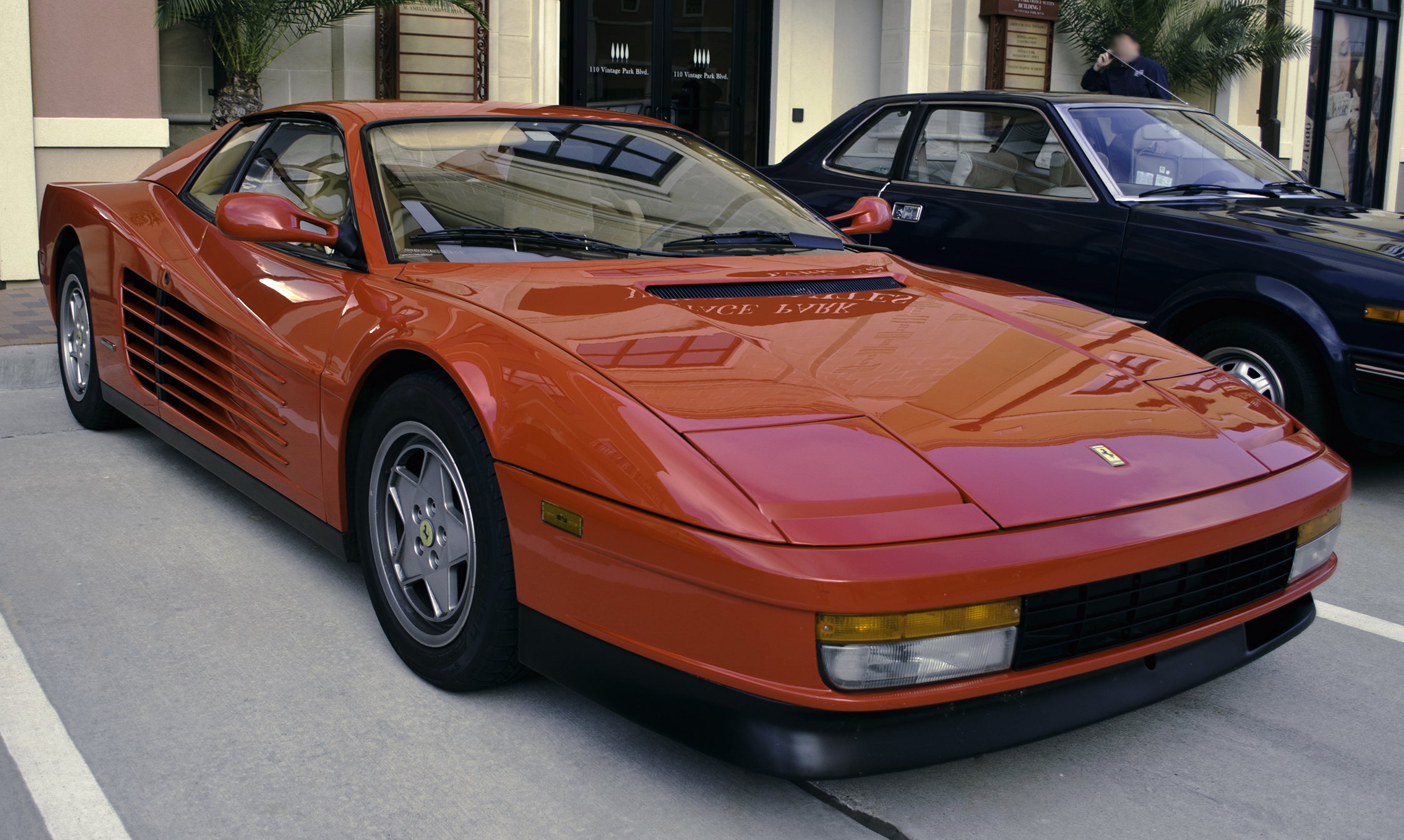
Ferrari Testarossa
"Ferrari during these years before Luca comes back, Ferrari produced 7,000 Testarossas over the 7 years that the Testarossa was in production. Compare that to Lamborghini. Lamborghini only produced 2,000 Countaches during a period twice as long."
The Testarossa is one of Ferrari's most recognizable cars from the 1980s — the wide, straked side intakes made it instantly distinctive. It sold in large numbers for Ferrari standards.
The Ferrari Testarossa is the iconic wide-bodied V12 grand tourer of the 1980s, one of Ferrari's most produced models of that era at 7,000 units over seven years. Its high volume compared to Lamborghini illustrated Ferrari's deliberately larger production scale during the Fiat years.

Ferrari 348
"He goes and he buys a 348, the flagship Ferrari sports car at the time, just to sort of see the state of things. Like, how bad was it really? I'm gonna go buy my own 348 and test it out. And Luca's actual quote on this is, the Ferrari 348 was a shit car."
The Ferrari 348 is a two-seat Ferrari sports car with the engine behind the seats. The hosts use it as proof of how bad Ferrari's road cars had become, because even Ferrari's own returning boss thought it was disappointing.
The Ferrari 348 is a late-1980s/early-1990s mid-engine V8 Ferrari that replaced the 328 and is notable for arriving in a troubled period for Ferrari road cars. In this segment it becomes a diagnostic tool for Montezemolo, who buys one and judges it harshly as evidence that Ferrari had lost both performance edge and character.
off the line
"It was the worst car we ever made. Everything was missing. It had no personality. It had no technology. It wasn't state of the art in anything. It had no power. It was all missing. He talks about when he was driving it, he would pull up to stoplights and try and race the other cars off the line and see how it would perform, you know, kind of drag race at stoplights."
This means how fast a car gets moving from a dead stop. It's the feeling of who jumps ahead first when the light turns green.
"Off the line" means a car's acceleration from a standstill, especially the first instant after launch from a stop. Enthusiasts use it to talk about launch performance, traction, gearing, and how quick a car feels in a short stoplight-style sprint.

Honda NSX
"So at the time, the Japanese sports car industry was on the rise and all the car enthusiasts were saying Ferrari's dead. The Italian carmakers are dead. The Japanese have taken over. Luca has the test drivers at Ferrari go out and buy a Honda NSX and do like his own version of the Pepsi Challenge."
The Honda NSX was a very fast sports car that was easier to drive and live with than many exotic cars of its time. People were shocked because a Honda was beating Ferraris in the areas Ferrari was supposed to own.
The Honda NSX was a mid-engine Japanese sports car that became famous for combining supercar performance with Honda-level usability and build quality. Its aluminum construction, approachable handling, and everyday reliability made it a benchmark that embarrassed some contemporary Ferraris, which is exactly why it matters in this story.
Michael Schumacher
"Jean Todt, team principal. Ross Brawn, race engineer. Michael Schumacher"
Seven-time F1 World Champion and the number-one driver of the Todt/Brawn-era Ferrari dynasty. Won five straight Drivers' Championships with Ferrari from 2000–2004.
Ross Brawn
"Jean Todt, team principal. Ross Brawn, race engineer. Michael Schumacher"
Legendary F1 technical director. Engineered Schumacher's dominant Ferrari cars 1997–2006. Later founded Brawn GP, which won both 2009 championships in its only season.
R&D
"I think they're pretty separate and they're sort of R&D. So they showed great restraint in never launching a Fiat Ferrari car or standardizing on platforms the way that the Volkswagen Group does."
R&D means the work companies do to invent and develop new products before they sell them. Here, the hosts are saying Ferrari and Maserati stayed fairly separate in that behind-the-scenes engineering work.
R&D stands for research and development, the engineering and design work that creates new vehicles, technologies, and components before production. In automotive discussions, it often signals how much brands share technical development versus staying independent.

Ferrari 355
"ultimately, as soon as possible, they kill it and replace it with the 355, which was just a glorious car."
The 355 was the Ferrari that fixed everything after a rough patch in the early '90s. It was more user-friendly, better built, and still felt exciting — exactly what Ferrari needed to sell again.
The Ferrari 355 was Luca di Montezemolo's pivotal turnaround car — the replacement for the troubled 348 that restored Ferrari's reputation in the mid-1990s. It accounted for 70% of Ferrari's sales by 1997 and is considered one of the brand's most perfectly resolved driver's cars.
Request an Explanation
Heard something you'd like explained? We'll add it to this episode.
Sign in to request explanations for terms you heard.
Want to learn more?
Browse our glossary for plain-English explanations of automotive terms, jargon, and concepts.
Help improve this episode
See something that's not quite right? Our annotations are AI-generated and can sometimes miss the mark. Click the flag icon on any annotation to suggest a correction.