It means there are too many cars sitting around compared to what people are buying right now. When that happens, car sellers usually have to offer deals to get rid of them.
It means there aren’t enough cars available for buyers. When supply is tight, it can be harder to find the car you want and prices may not drop as quickly.
This is how many cars are being leased instead of bought. If fewer people lease, it can change how fast car companies can sell cars and how soon those customers come back later to buy or lease again.
Negative equity means the car is worth less than what you still owe on it. So when you try to switch cars, you may have to deal with that “owes more than it’s worth” problem first.
Incentive dollars are the discounts or promotional money a car company offers to make a car cheaper. The idea is to get more people to buy, but if it’s not working, it’s a sign something else is wrong.
Day supply of inventory is a way to estimate how many days the cars on lots would last. If it’s high, it means there are too many cars and not enough buyers, so prices and incentives usually have to change.
Incentives are the deals a car company offers to help you buy or lease. If the incentives aren’t getting people to shop, it can mean the overall pricing or value still isn’t attractive enough.
Land Rover is one of the brands called out as having a lot of cars sitting around relative to sales. That usually means the company may need to offer bigger deals to move inventory.
Mitsubishi is included in the list of brands with lots of cars sitting on lots. That’s a sign sales aren’t keeping up, so incentives or price cuts may be needed.
Genesis is one of the brands mentioned as having too many cars on hand compared to demand. When that happens, brands often have to offer stronger discounts to sell them.
Jeep is one of the brands called out for having too many cars on hand. That usually means sales aren’t keeping up, so incentives or discounts may rise.
Dodge is mentioned as having a lot of inventory relative to sales. When cars sit too long, brands typically respond with bigger incentives to sell them.
Volkswagen is one of the brands said to have a lot of inventory compared to sales. When that happens, it often leads to more discounts to get cars moving.
Chrysler is one of the brands said to have inventory sitting longer than it should. That’s typically a sign sales are lagging, so incentives may increase.
“Day supply” is a way to measure how many days of car sales a dealership’s current inventory can cover. If it’s high, it means there are a lot of cars sitting around; if it’s low, the lots are closer to being sold out.
General Motors is a big car company that makes multiple brands of vehicles. Here, they’re mentioned because their sales performance affects how many cars are sitting in inventory.
Chevrolet is one of GM’s car brands. The host mentions it to show how many days of cars are available on lots, which can hint at whether prices may need to drop.
GMC is a GM brand, especially associated with trucks and SUVs. The host brings it up because the inventory numbers suggest how hard it might be to move vehicles without incentives.
Buick is a GM brand. The host cites Buick’s inventory “day supply” to suggest there are more cars sitting around longer than some other brands, which can lead to discounts.
“Base options” refers to the lowest-trim, lowest-cost versions of a vehicle as marketed by automakers. The host’s point is that even when brands advertise affordability, many buyers don’t actually purchase those entry-level configurations.
Cox Automotive is a company that collects and analyzes car-buying and pricing data. Here, they’re used as a source for the idea that the price you see in ads usually isn’t the price people actually end up paying.
KBB is a well-known car pricing guide. MSRP is the sticker “starting price” the manufacturer lists, and the host is comparing those numbers to show that real purchase prices are usually higher than the ad starting point.
The Toyota Corolla is a very common, affordable car. Here, they’re saying the price Toyota advertises isn’t what you usually end up seeing in the real average price.
The Chevrolet Trax is a small SUV/crossover. They’re pointing out that the advertised starting price is lower than the average price people end up paying.
The Toyota RAV4 is a compact SUV, meaning it’s a taller vehicle than a car and designed for everyday driving and family use. The podcast mentions its starting price (about $31,900) to show where it lands in cost. It’s often talked about because it’s a common choice for people who want an SUV without going too big.
They’re saying automakers advertise low prices, but what they actually make and stock tends to be more expensive. So customers end up seeing higher average prices than the ads suggest.
“3D surround cameras” are cameras around the car that combine their views. They help you see what’s around the vehicle, which is especially useful when parking or driving slowly.
Term
clear site ground
“Clear site ground” sounds like a camera feature that helps you see the ground better around the car. That can be really helpful when you’re off-road and can’t easily judge what’s under or in front of the tires.
“Driver assist features” are technologies that help the driver avoid problems. They can assist with things like staying in the lane or warning you about hazards, but you still have to drive.
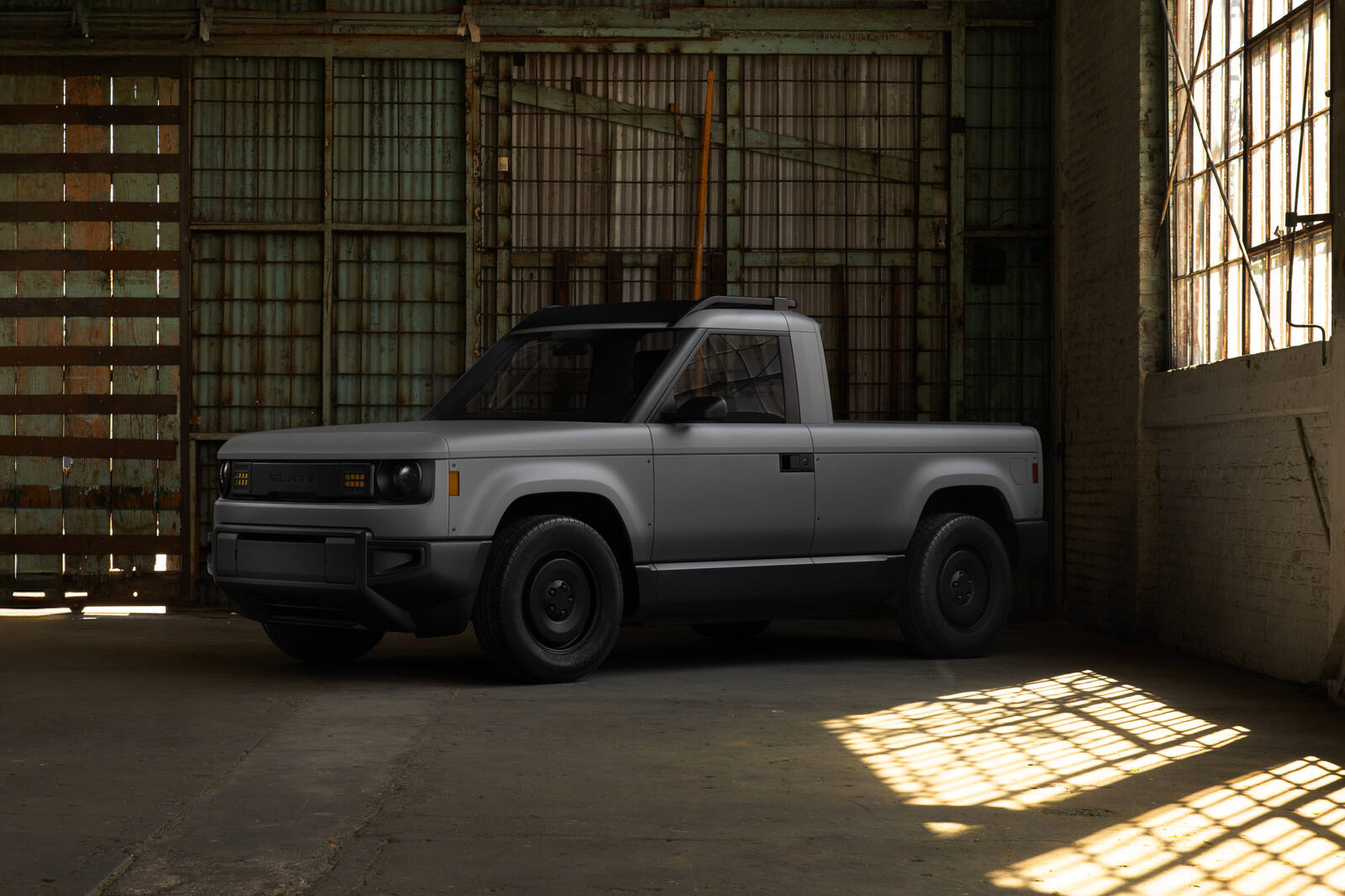
Slate is a newer car company the hosts are talking about. They say it’s tied to Jeff Bezos and connected to Carvana, and they’re focusing on how much its new electric truck costs.
Carvana is a company that sells cars directly to customers. The hosts are saying it has some kind of connection to Slate, which could change how the truck gets sold.
They’re talking about whether the company expects to profit on every vehicle it sells. The usual EV approach is to lose money at first and try to make it up later, so this claim is presented as unusual.
They’re discussing an electric pickup truck concept from Slate that’s meant to be as cheap as possible. The goal is a simple EV truck with fewer features so more people can afford it.
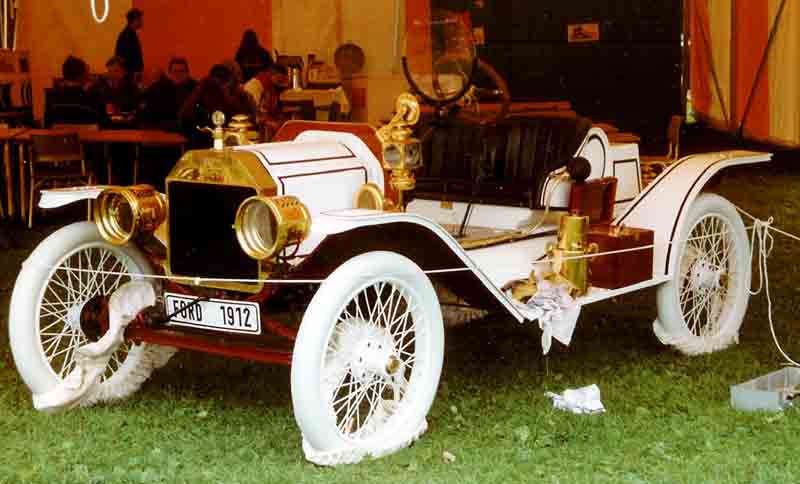
The Ford Model T is a very old car from the early days of automobiles. It’s famous because it was one of the first cars made in large numbers at a lower cost. The podcast brings it up as a historical reference point.
The Ford F-150 Lightning is a pickup truck that runs on electricity instead of gasoline. The podcast talks about how many people put down deposits very quickly, showing strong early interest. It’s a notable model because it brings electric power to a truck-style vehicle.
The Hyundai Venue is a small, budget-friendly SUV. “SE” and “Ultra Limited” are different versions of the same model, and they can have different features and prices.
“Cross shop” means you look at a few different cars from different brands before choosing one. They’re debating whether the same people will consider both models.
The Ford Ranger is a smaller pickup truck. The hosts mention it because it’s the kind of truck people associate with their younger years and may want again for nostalgia.
The Honda Element is a boxy, utilitarian crossover/SUV built around practicality and a distinctive “youthful” look. Here, the hosts say Honda is bringing it back, framing it as a nostalgia-driven product that can shift who buys and how pricing pressure plays out.
A nostalgic buyer is someone who wants a car because it reminds them of their past. In this segment, they’re saying nostalgia can pull in a different group of people and influence pricing.
“Downward pressure on pricing” means the market is pushing prices down. The hosts are saying that the mix of buyers and demand can affect how low prices go.
This is a Chevrolet midsize pickup truck. “Trail Boss” is a special version meant to handle rougher roads better than a basic model, and the caller is saying the buying process for it was fast and easy.
They’re talking about a tool that uses AI to help negotiate the car price. Instead of lots of haggling, it helps get to an agreed price and final paperwork faster.
Term
$49.99
They mention the price of the service they used—$49.99. The caller is saying that even after paying that, they still saved a lot on the truck deal.
Concept
negotiator finalized the numbers
They’re describing how once they agreed on the price, the remaining steps got completed so the final deal could be locked in. It’s basically about speeding up the “getting it done” part of buying a car.
“Out the door” means the full final price you pay at the dealership—everything included, not just the sticker price. It’s the number you want to compare between different offers.
LIVE
Check engine, ABS or maintenance light on, take the guesswork out of your warning lights
with O'Reilly Veriscan.
The service is free and provides a report with solutions verified by ASE certified master
technicians.
And if you need help, we could recommend a shop for you.
Ask for O'Reilly Veriscan today.
Oh, oh, oh, oh, O'Reilly Auto Parts.
One crunchy bite of her Hershey's Cookies and Cream Bar and I'm taken right back to
College Move-in Day.
I was a little overwhelmed by the newness of it all.
Boxes were everywhere, I needed a break from unpacking, but just as I was able to take
a breath and open my Hershey's Cookies and Cream Bar, my new roommate Rachel walked in.
I offered her a piece, but she said no.
Then after a beat, she said, actually, those are my favorite ones.
We left.
The ice was broken and we've been friends ever since.
Hershey's, it's your happy place.
It's noon here in Mentor City, New Jersey, in our nation's capital, Washington, D.C.,
and this is Carriage Live for Wednesday, June 24th with your host, me, Ray, hanging out
where I always hang out, my living room, and Zach, well, working out of the office again
today.
How are you doing today, handsome?
Doing fantastic, Dad.
Happy June 24th to you and everyone in our community who chooses to join us today.
Today's show, as always, is brought to you by us two knuckleheads back at CarEdge.com.
We've got an incredible team that supports our efforts for the past six going on seven
years, y'all.
We've been in the business of helping people buy cars, sell cars, protect cars, all things
excuse me, car related.
I encourage everyone, please go back to the website CarEdge.com.
Learn more about the ways that we can help you.
Importantly, you click on free consultation.
You can meet with our team.
We've got real awesome people on the team here, Justice and his crew.
Talk to our team, see how we can help you out.
If it's a good fit, we would love that opportunity.
Now, Dad, the big thing we're going to talk about this morning, it's actually going to
start with you.
This is insane, man.
One of our community members sent us this yesterday.
Folks, here is an article that was published in 19-20.
It's 1883 on October 8th on page 29 of the press of Atlantic City.
Dad, one of our community members sent this to us yesterday.
It takes two to make a trustworthy transaction.
We're going in the way back machine for the first story in today's CarEdge live episode.
Who is that man standing in front of Datsun trucks at Admiral Datsun?
It is none other than Papa Shupska.
Dad, what is this article from 1983?
What is going on here?
Well, notice, the first thing you notice, we're very transparent.
We would sell every truck over invoice.
That is hilarious.
Okay.
Yeah.
Wait a second here.
You look great, by the way.
You were born in 1951, right?
Yes.
So 1983, you're 32 in this photo?
And skinny.
Which is crazy because I'm 30 right now.
So it's like, wow, I'm you.
I'm you at that point in life.
You look great, Dad.
Well, thank you.
Over invoice.
So you guys put over invoice on the truck?
Well, that's because we had just run a sale and I don't remember if it was $100 over invoice
or $300 or whatever it was and the sale ended.
So I sent the lot attended out to scrape the windshield.
Well all he scraped off was the amount that we were going to charge over invoice.
So when the photographer said, let's get a picture of you standing in front of these
trucks.
Yes, absolutely.
We'll sell every one of these trucks over invoice.
We don't have a problem with that at all.
But I remember the press had sent out something asking for suggestions for stories and I said,
you ought to spend a day with a sales manager at an automobile dealership and well, they
did.
Dad, this is incredible.
We're going to talk about the automakers that can't lower prices fast enough.
The other thing that's tied to that is the announcement from Slate, the initial pricing
for their truck, which is absolutely crazy.
We're going to talk about that today.
But before we do, we have to spend a couple of minutes here because this is, for me, Dad,
one of the most humbling moments in our journey together building CarEdge, which is I had
no clue that this existed until yesterday.
Again, one of our community members found it and sent it to us.
He also sent some family tree related stuff to us, which was super touching and emotional
for me and my dad and I.
Excuse me.
It takes two to make a trustworthy transaction.
You in 1983, I guess what, five years into the business, we're talking to the local press
about why they should trust car dealers.
It's just overcoming public distrust is a challenge, he says, adding that each salesperson has
his or her own way of meeting that challenge.
I mean, there are just quotes from you everywhere in this article talking about how you're trying
to do it with a sense of humor and be self-deprecating.
This is everything that we're trying to do in the auto industry.
50 years later, almost, it's just what a moment, man, to demonstrate to the whole world that
this is not some facade, this is not BS.
You've been doing this your whole career.
What a cool moment for us to see this yesterday.
Obviously, I wanted to share it with everyone.
I was thinking after I saw this yesterday and I read it, and I was thinking, okay, this
is going to become my new reply comment to everybody that says, well, we ripped people
off for 43 years and now all of a sudden he's found a religion.
Well, apparently, I found it much earlier than that.
I realized that the way we sold cars was neither pleasant for those of us trying to sell them
or those who were trying to buy them.
I understood that early on.
I always wanted to make it different.
I honestly believed that we were in the entertainment business.
If people were going to spend that kind of money, damn it, they should have fun spending
it.
I mean, anytime you spend a big sum of money, you want to at least enjoy it.
When it comes to buying cars in so many cases, you know, you never met your grandfather,
my father.
He passed away long before you were ever thought of, but he was a dentist.
What do people say?
I'd rather get a root canal than buy a car.
Well, okay, my dad was a dentist and I ended up selling cars for a living.
They thought that was more painful buying a car than getting a root canal.
I knew that was wrong and had the change.
Well, thankfully, we're seeing some changes now, but we're not seeing enough.
Yeah, it's just so fascinating, so interesting.
For those of you that wants to take a peek, I wrote a little bit about this this morning
over on LinkedIn.
You can find me, Zach Shefska.
I was so touched by this.
I wrote something, shared it.
My dad had a really funny and kind comment.
You did it.
You reduced me to tears and, well, I love you for that.
That's it.
That's my car.
Oh, and don't stop ever.
I encourage everyone in our community to check out how this touched me and impacts the work
that we do here at CarEdge and everything related.
Anyway, we want to start the show with this.
What an incredible moment.
Yeah, really, really, really cool to see.
The big thing I wanted to talk about today, dad, is pricing of cars.
That goes as no surprise because we talk about this all the freaking time.
Now, the average transaction price of the average market of price for new cars this morning,
still hovering almost at $52,000.
But what's interesting here, dad, is we got the latest updated forecast from Cox Automotive.
And what you're going to see here for the expectations for the remainder of this year,
a lot of red arrows.
So I bring this up because we talk about it all the time, supply and demand.
Demand in the auto industry is down.
That's what this chart shows.
This is the mid-year refresh for their 2026 forecasts.
Car sales are just down.
I want everyone in the United States of America that tunes into this program and thinks about
buying a car to know that the car market is slowing down right now.
And this 3x3 grid, these nine squares show that with all the red arrows pointing down.
Now, you and I have had some interesting guests recently.
Obviously, we had Joe Lewis a while back with Mazda who has an oversupply of inventory.
We had Tyler from Ackerman Toyota earlier this week, and he has an undersupply of inventory.
So there's nuance here.
But there are certain automakers, Dad, that are seeing more red than they are black in
terms of the money that they're making.
And this chart shows at the highest level that it's happening pretty much across the
board in the auto industry right now.
Absolutely, it is.
I mean, I'm shocked that lease penetration rates are down.
That to me is one of the most important statistics that any of these manufacturers,
automakers would want to look at.
Because if they lease more cars to more customers, those customers are forced to do something
sooner rather than later.
You know, typically a lease is three years.
So the customer has to come back in the market in three years.
If you're putting them into a 67 or eight year loan, even if they wanted to
come back in three years, they can't because there's so much negative equity associated
with their vehicle.
So to see that lease penetration going backwards again, that should be a warning sign for the
automakers out there that perhaps they're spending their incentive dollars in the wrong
place.
Yeah, I think you're onto something here.
Well, now let's touch on, Dad, the vehicles right now or the manufacturers right now that
are feeling the pain the most.
And you know what chart I'm about to pull up.
It's the day supply of inventory.
We look at this all the time.
So the story here is there are a handful, about 10 manufacturers that have over a 100
days supply of inventory.
These are the automakers that are lowering prices, that are offering big incentives whose
dealers are feeling the pain most right now.
I know we're covering up a little bit there, but you can see it now.
Many with a 99 days supply almost there on the cusp of 100, Land Rover, Genesis, Mitsubishi,
Volkswagen, Buick, Chrysler, Ram, Jeep, Dodge, all of these brands have a 100 or or nearly
100 days supply of inventory, meaning that they're in a position where they are inundated
with inventory and not enough customers are buying them.
So that's the list here of these brands that are ultimately trying to move the metal because
there's pressure on them.
The prices have gotten too high and customers have refused to purchase.
And if you look at that first chart that you looked at, if I were any of those brands
or any of those automakers, I would be concerned because all the arrows are going in the wrong
direction.
And so sales are going to continue to soften.
So if sales are going to continue to soften and you have a 100 plus day supply of vehicles,
who are you selling them to?
I mean, there's just...
And may I say that every one of these manufacturers at the beginning of the year, we're saying,
well, we're going to increase market share.
We expect our sales to increase 10% this year or 7% or 12% or whatever it was.
Every one of these damn automakers was making these big ass claims as to what was going to happen.
Knowing full well, it wasn't going to happen.
And so we sit here today and if you're a Jeep dealer, what can you possibly be thinking?
How can you wander the North 40 that is overstocked with Jeeps and think to yourself,
all is good with the world?
Yeah, definitely.
It's not.
That's interesting because some brands are feeling this more than others.
Here's a chart that comes from the latest automotive news mid-year report.
And you can see we've got the market share and year over year sales for select brands here.
And look at that, dad.
Year over year, General Motors sales are actually off 5.1%.
You can see year over year sales over at Ford are off significantly.
Yes.
Similarly, at Tesla sales are off.
And so what that signals to me is there are certain brands that are feeling this a little bit more than others.
We talk about day supply of inventory.
It's interesting because obviously Ford wasn't one of the ones we had just mentioned,
but they're right there at a 93 day supply.
And General Motors with their sales being down is especially interesting because if I come here,
Chevrolet actually has a 72 day supply of inventory.
So there's a lot of pressure right now.
Now, Catalan-Rack only has a 62 day supply.
So which brands is it?
It looks like it's GMC and Buick because Buick is sitting at 113 day supply.
Yeah.
That'd be a lot of cars.
That is a lot of cars.
Now, one of the interesting things I think we also have to talk about that is the difference
between affordable options, which all these manufacturers are able to market the fact that
they actually do have affordable options and like, oh, Joe, we're going to come to you next.
Thank you.
That's incredibly kind.
But not a lot of people actually buy the base options that these manufacturers produce.
And we have some really interesting data here from Cox Automotive.
Let me pull this up on the screen.
You can see here the title of this slide.
Nobody buys base.
The advertised price and the purchased vehicle are almost never the same thing.
Look at this analysis that they did.
Yes.
We've got the KBB average MSRP versus the published base MSRP.
So manufacturers, Toyota can go out there and say for the Corolla starting at $22,150.
Yes.
But the average MSRP of a Corolla, they actually build $26,412.
The Chevy Trax, Chevrolet can come out and say starting at $21,600.
But the Chevy Trax in average has almost a $27,000 MSRP.
Look at this at the RAV4 down here at the bottom.
$31,900 base MSRP for a new RAV4.
OK.
Well, the ones that are on the market have an average MSRP of $41,472.
So this actually corroborates exactly what you've been saying forever,
which is the manufacturers say one thing and then build something else.
Isn't this chart, I was really grateful to see Cox Automotive publish this data.
Isn't this really fascinating?
It is.
You know, I've been saying forever that their actions don't match their words.
And then this is continuing proof of that.
I can also tell you that because people don't want to settle for the least
amount that they need, that it is difficult at best to get customers to buy
that $22,150 Corolla if it was actually on the lot or that $21,600 Trax.
Whenever, whenever and wherever I've worked, the base model vehicles
typically sat the longest because people just aren't willing to settle for
something that just fulfills their needs and does nothing for their wants.
Everybody wants more than what they need.
And when given the opportunity to buy only what they need, they choose not to.
And so for dealers who especially new car managers who are responsible for
turning inventory as quickly as humanly possible, one of the reasons they don't
order a lot of base, base vehicles is because they know those are the ones
that will sit the longest.
What would you do if your online store converted 36% more shoppers?
You could take 36% more vacation.
Another Pina Colada.
Yes, please.
Open a new retail location with 36% more square feet.
Fantastic.
Hire 36% more help.
You're hired and you're hired.
Shopify has the world's best converting checkout up to 36% better than other
e-commerce platforms.
What you do with those extra sales is up to you.
Switch to Shopify today at Shopify.com.
Slash listen and get a $1 trial Shopify.com.
Slash listen.
When the moments in your life are too important to miss, you can trust O'Reilly
auto parts to keep you and your plans on the road.
Our professional parts people can test your vehicle's battery and even give it
a charge if needed.
In most cases, we can install your new battery for free.
It's just one of the many services we provide at O'Reilly auto parts to ensure
life's best moments.
Don't find you stranded.
Every bold journey starts with a decision to go.
And if you're ready, the defender is to.
This is a vehicle built for more, whether you're heading off the grid or just
getting out of town for the weekend.
Defender is a true icon reimagined for a new generation.
Its rugged exterior is built from durable materials and tested in the toughest
conditions inside its modern, functional and refined with smart storage and
premium touches that keep you comfortable wherever the road leads.
It's packed with tech like 3D surround cameras, clear site ground and
rear views, driver assist features and an intuitive infotainment system.
With three models, the Defender 90, 110 and 130.
There's a defender for every kind of adventure from city streets to remote
trails. This is a vehicle that like you is capable of great things.
Explore the full Defender lineup at Land Rover USA.com.
Hey, I just Venmo'd you for rent.
Nice. Now I can instantly spend it, whether I'm checking out online with Venmo
or using the Venmo Devacore.
Say more.
More exactly.
Because the more you do with Venmo, the more you get like earning up to 5%
cashback with Venmo Stash on a bundle of brands.
So order more pizza.
The math demands it.
Get the Venmo debit card.
Venmo Stash bundle terms and exclusions apply.
See terms of Venmo.me slash stash terms.
Venmo check out not available at all merchants.
Venmo MasterCard is issued by the Bankor Bank NA.
That's actually if I may, dad.
That's actually another really interesting segue to this chart.
What's actually selling in 2026?
Sales are down.
That's the big story this morning is there are certain automakers who have a
tremendous oversupply of inventory and sales are down.
We always talk about supply.
Yes.
Demand.
Today's show is all about how demand for certain brands is down.
Here are the top 10 segments of vehicles and their sale change year over year.
So let's start on the right where you're seeing growth in sales is mid.
Mid-sized SUVs actually have increased sales about 5% year over year.
Mid-sized trucks just a little bit.
They're pretty much flat.
Mid-sized cars pretty much flat.
Every other segment of vehicle, in particular, dad, compact cars down 8% in
terms of sales year over year.
That kind of frustrates me because to your point about base, I'm correlating base
to compact like simple.
It would be the cheapest option, but not a lot of people are not enough people are
buying them or the story is there's not enough inventory out there for customers to go buy them.
I think it's twofold.
Not enough people are willing to admit that's all they can afford.
And so that's what they'll buy.
But I think the bigger story is that the people that are in the market are people
that can afford more and buy bigger, more expensive vehicles.
But full-size truck sales are even down, dad, 4% year over year.
Luxury mid-sized SUV sales are down.
You know, like we have to see it across the board.
I get it, but we also know that the average median household income for those
who are buying new cars is $150,000, which is almost double the average household
income, median household income in the United States.
So that suggests to me that if those who are buying have the money, they're not
necessarily going to be the ones that are looking at those base model vehicles or
those compact cars because they think in their heart of hearts, they don't have to.
And guess what?
In their heart of hearts, they're correct.
They don't have to.
The problem in my mind is convincing people who want more to figure out how to get
them to understand they are better off settling for less.
For sure.
That is part of this as well.
I will say Buffy's got a point.
There aren't enough choices in the compact car segment.
And I agree.
It hasn't been enough investment there.
We're going to talk about a big development there in just a few minutes.
Before we do from Lego, Joe, thank you.
Very, very, very generous.
We are touched by every time I get a contribution.
So thank you.
My dad is going there.
I am going there.
My dad and I are going there.
Are you going with me?
Are you going with my dad?
Are you going with my dad and me?
My dad and I at the beginning.
Let go, Joe, please, man.
I thought I made progress.
Don't worry about it.
But thank you, Lego.
Thank you, Joe.
For those of you that don't know, this is not a shtick.
This is not a joke.
This is I really struggle, excuse me, with my grammar of my dad and I.
So we're working on.
Me and my dad or my dad.
Yeah, whatever.
We're working on it.
Thank you, Lego.
Joe, very, very, very funny and very kind.
Dad, we cannot have a story today talking about automakers lowering prices fast enough
without talking about what Slate just announced.
Now, Slate, for those of you that are unfamiliar, is the Jeff Bezos backed
automaker that also now has a connection with Carvana, which is super interesting.
Slate just announced that the price for their new electric truck, 24
900 and fifty dollars.
There's CEO Peter R.C. told CNBC that every vehicle the company produces
will actually make them money, which is a crazy concept in the auto industry.
You've heard the CEOs of automakers say for a long time, we just need to lose
some money on these EVs and then eventually we'll make money.
And dad, I read that this Slate pickup truck that you're seeing right there.
Yeah, it is the exact same length as the Ford Ranger from what year?
How many years ago is it the exact same length as a Ford Ranger?
198435 years ago.
So what would that be?
1991
1990
Yeah, the same length as a Ford Ranger from 1990
What do you make of this, dad?
Do you see this as being a big disruptor in the auto industry has a lot of potential,
doesn't it? Well, I think it does.
I mean, there there are any number of people out there, especially in the comments
who say, just give me a bare bones vehicle.
I can roll up my own windows.
Do that, do that, do that.
And that's what a Slate EV pickup trucks going to be.
It is going to be as bare bones as you can get.
Yeah, the concept, the idea behind it is.
Once you have it, do whatever you want with it.
And, you know, if you you want to paint it because they come that gray color color.
Yeah, you know, it's it's it's like the Model T, the original Ford salesman.
Would you prefer it in black or black?
Because that was the only color they came in.
OK, so so the concept of having something under $25,000, $10 under $25,000.
Still counts.
It is. I think that will attract especially it will attract people that don't want
a lot of technology other than the fact that it's an EV.
OK, it doesn't necessarily have to have everything else that that that people
have grown in many cases to hate about cars today.
So do I think it could be a disrupter?
Well, for anybody who was the xirus of a of of the size of a Ranger pickup truck
in 1991, yes, those people are going to be coming out of the woodwork.
What options?
Let's put it to the test right now.
What options do shoppers have at a sub $25,000 price point?
I really I genuinely want to put this to the test.
I'm going to come over to car edge dot com.
I'm not going to do the search myself.
I'm actually just going to start a chat here.
What new car options are there at a sub 25 K price point?
Because I don't think there are a lot of death.
Of course, they're all a lot.
I want new.
It's a new I don't want used new any type of vehicle.
It could be could be some new yes, you could be catch might could be anything.
No, options are out there.
Yeah, because I think that Slate is entering into an area.
Yeah, let's see what comes up here.
I am so so intrigued.
Slate is entering into an area where, you know, for context here,
they have 180,000, not like we've seen this before,
180,000 reservations for this vehicle.
So like, OK, potentially, potentially a lot of demand.
And let's see, this is what they're competing with.
The answer is still coming in.
So here we go. OK.
So they have, you know, Ford had 150,000 lightning deposits
three seconds after they they they turned on your ability to put a deposit.
I think it was four seconds, actually, dad.
Four might have been four seconds.
Let's look what they're competing with.
Let's look at their competing with.
So here's what they're competing with.
I use the ask courage.
All right, so let's see.
Hyundai Venue SE Hyundai Ultra Limited Chevy Trax Trax.
Any other options here?
Kia K4.
Do you think, dad?
Yes, that this I mean, there's 400 and 69000 new vehicles
under 25000 miles, 25000 dollars.
Excuse me, you're saying lose Missouri.
Do you think Slate customers are going to be the same customer
that would have gone out there and bought a venue instead or an Alantra
instead of tracks instead of Kia K4 instead?
Maybe, but I also think they're bringing in.
I hate to see this comment all crap.
I think they're bringing in the reason I hate to see it,
because I want people to buy more affordable cars.
I think they're bringing in a new customer.
I think they're appealing to a totally new customer.
Yeah, they're a different customer, a different,
entirely different customer.
I don't think someone's out there,
cross shop and Hyundai venues and Slate pickups,
but maybe maybe they will just because they're looking sub 25 K.
I don't think so.
I think in my heart of hearts, this is what I honestly believe.
Let's hear it.
It is going to attract a nostalgic buyer.
What do I mean by that?
Somebody that's looking for inexpensive,
not highly technological transportation
that reminds them of their youth.
Small pickup trucks like the Ford Ranger were pretty popular.
Mazda had had their version of it.
You know, Nissan had everybody had one.
I saw today that that Honda is going to bring back the element.
Yeah, that's another big story we should probably cover.
And and and we had an element.
Why? Because it just it seemed so odd and different.
And and so we bought one.
We thought, you know, and I hated that vehicle after I got it.
But a lot of these things bring about a nostalgic buyer.
So young people.
Might look at the slate and go, it's not for me.
Older people, 45 to my age group, perhaps,
are going to look at the slate and say, that would be fun to to mess around with.
Yeah. So so I I I think it's an entirely
different buyer that it's going to attract.
That is downward.
It is downward pressure on pricing, no matter how you slice it.
And it is interesting because, yeah, here's the element from 2011.
And yes, we did have one of those growing up.
It was green.
What a lot of those Galapagos green.
We know what a weird weird car that was.
But that I think the place point of the elements probably not going to be,
you know, through the roof.
It should be pretty attainable.
So I mean, it's another example of these automakers looking for more
cheap options to put out their pork customers.
So I think what's going on with Slate is really, really interesting.
And it ties directly with what we've been talking about today.
How do you improve their increased demand?
You can either get more people into the market or I guess you got to get more
people into the market or take the people who are in the market and get them to buy.
I think Slate's probably accomplishing both.
Yeah.
And the the the beauty of Slate is I think once those vehicles are available
and and we have an opportunity to look at the data.
I think the average age of a Slate buyer will be significantly higher than people
would suspect.
And I think the income level of a Slate buyer will be through the roof,
but they will be buying the slate because for them, it'll just be like a fun vehicle
to mess around with and see what I can do to it.
That's a really interesting approach here.
And I wouldn't be surprised if you're right talking about being right.
We aren't always, but occasionally we are.
I wanted to take a second to thank Chris Anderson, one of our car edge
community members who left this review for us just the other day, Dad.
And I wanted to share it with you and our community.
Thank you for this, Chris.
I just want to let Zach and Ray know how much my wife and I appreciate what you have built here.
You have made the process of buying my new Chevy Colorado Trail Boss absolutely
painless and actually fun.
We used your AI negotiator for the $49.99 and saved at least $2,500.
Are you kidding me?
We did the entire deal basically from our kitchen table while eating chocolate
chip ice cream.
Literally once we had agreed on our out the door, the negotiator basically finalized
the numbers.
We went in last night after work and we were seriously out of the dealership with
the new Trail Boss in 21 minutes.
The absolute best start to finish truck deal we have ever done.
We are in Wisconsin and the dealership is 23 minutes from our doorstep.
Thank you to the entire CarEdge family.
Love seeing that.
Just put a huge smile on my face and is a friendly reminder, folks.
We've been doing this for seven, almost seven years now.
Not always perfect, always with some room for improvement.
And a lot of the time we help our community help our customers to learn
more back at CarEdge.com and see how we've been able to help people like Chris and others.
I mean, Dad, I was doing an analysis earlier.
I mean, thousands of cars get bought every single month thanks to CarEdge.
And it's a huge, humbling privilege to work we get to do.
And a great extension, if you missed the beginning of the show, of what my dad has
been doing for decades now.
We started today's show reflecting on a newspaper article that we were made
aware of from 1983 in the Atlantic City Press, the press of Atlantic City.
So what a fun day and what an awesome cause we get to continue to work on together.
Dad, I need to get that skinny again.
Could you, I mean, could you?
Could how much do you weigh?
I don't weigh myself often, but I think somewhere around 160 pounds, maybe
165 pounds. What do you weigh?
I weigh 200 on the nose today.
No. OK.
Literally in that picture, I was 150 pounds, 150 pounds.
OK, soaking wet right out of the shower.
It is just.
I mean, I had a jaw line you could see.
Yeah, you have very straight hair, which makes me wonder where I got my curly hair.
I don't know. Your mother had straight hair.
So I am I am not sure.
But I believe the postman in our neighborhood had curly hair.
I'm the average six.
OK, OK.
But but look at that.
I mean, a jaw line, an angular face.
Now that now it's like if you like round, it's a it's a face you can fall in love with.
But there's not an angle to be found on this face anymore.
I I maybe I should aspire to getting back to that playing weight in there.
I don't think it's your face of life, Dad.
You should aspire to be that skinny.
And yeah, I do think whatever makes you happy is what you should lean
into you've you've earned it.
You deserve it.
For those of you again, I mentioned it earlier in the show.
LinkedIn, I posted something about this because it made me very emotional to see
this article. It really, really did.
And so I encourage you to come over to LinkedIn, give it a read and of course a comment.
I love seeing all the comments and replying to folks.
And it means a lot when our community supports me in like the professional world of LinkedIn.
It's it's fun. It demonstrates to the auto industry like, oh, this car edge thing's real.
So really, really appreciate that.
And it definitely did make me emotional and tear up that it was.
It was crazy to see that yesterday.
So anyway, yeah, even I forgot about it.
Yeah, absolutely wild.
OK, let's call it a show.
We're back here tomorrow with more Car Edge Live.
Again, a friendly reminder on Friday, we're going to be doing Q&A.
So please, please, please tune in for tomorrow's news show.
But Friday is going to be Q&A.
Yeah, Dad. Well, what I would suggest is people start sending us questions
so that we can be a little bit ahead of the curve come come Friday.
Where do you want them sent to?
Email them to me.
Zach at CarEdge.com.
If you can just put in the subject line Friday show.
Yeah, Friday show.
Friday show would be great.
Yeah. And that way we can maybe get a head start on.
Love this. Love this for us.
Yeah. Or oh, my gosh, justice.
Come on, justice.
Or you can post them over on the community forum.
We'll take a peek there as well before the show.
CarEdge.com slash community.
What a wonderful day.
What a wonderful way to spend our time together.
Pop's really grateful for this and I'll do it all again tomorrow.
I'll be back. I promise.
I'll be back too. See you guys then.
Thank you, everybody. Love you, handsome.
Tires matter.
They're the only part of your vehicle that touches the road.
Tread confidently with new tires from Tyraq.
Whether you're looking for expert recommendations or know exactly what you want.
Go to Tyraq.com to see tire test results, tire ratings and consumer reviews.
And be sure to check out all the special offers.
Tyraq.com, the way tire buying should be.
Comcast is delivering extraordinary experiences in live sports
through the incredible broadcast and storytelling from NBC,
innovative and personalized viewing features on Xfinity and Peacock.
And the country's most reliable Wi-Fi.
Viewers can enjoy every game changing play faster and more seamlessly than ever.
All on a network built to deliver unforgettable moments as close to live as possible.
The ultimate experience for the American sports fan.
Learn more at Comcast Corporation dot com slash sports.
They say if you want to go fast, go alone.
But if you want to go far, go together.
At Amica Insurance, we know what matters most to you.
And we work even harder to protect it.
Together.
As a mutual insurance company, we're built for our customers and prioritize your needs.
Amica. Empathy is our best policy.
Visit amica.com and get a quote today.
Shell V-Power Nitro Plus fuels every drive with a fuel like no other.
It removes up to 100% of performance robbing deposits to rejuvenate your engine's performance.
That means more power when you need it and more performance with every drive.
Shell V-Power Nitro Plus Premium Gasoline.
More power, more performance.
Formulation unique to Shell.
In gasoline direct injection engine fuel injectors with continuous use of Shell V-Power Nitro Plus
Premium Gasoline compared to lower octane fuels.
Actual effects and benefits may be...
The critics have spoken.
World War II with Tom Hanks is a must watch.
It is on a scale no one's ever seen before.
An enormous accomplishment.
The world turned upside down.
It's global history on the grandest scale.
All wars change the world.
But none of them like the second World War II did.
Unlike any World War II docu-series before.
World War II with Tom Hanks.
New episode Monday at 8 only on History.
Next day on the app.
About this episode
Automakers can’t cut prices fast enough, and the hosts dig into why: inventory is piling up, lease penetration is sliding, and “nobody buys base” pricing doesn’t match what shoppers see in ads. They cite average new-car transaction prices near $52,000 and Cox Automotive/KBB data showing big gaps between MSRP and what’s actually built. The conversation spotlights Slate’s $24,950 electric truck, demand signals like 180,000 reservations, and even nameplate nostalgia like the Honda Element.
Today on CarEdge Live, Ray and Zach discuss the automakers who are feeling the pressure to sell cars ASAP. Tune in to learn more! Hosted by Simplecast, an AdsWizz company. See https://pcm.adswizz.com
for information about our collection and use of personal data for
advertising.