
These Automakers Can't Lower Prices Fast Enough | Episode 1096
About this episode
Automakers can’t cut prices fast enough, and the hosts dig into why: inventory is piling up, lease penetration is sliding, and “nobody buys base” pricing doesn’t match what shoppers see in ads. They cite average new-car transaction prices near $52,000 and Cox Automotive/KBB data showing big gaps between MSRP and what’s actually built. The conversation spotlights Slate’s $24,950 electric truck, demand signals like 180,000 reservations, and even nameplate nostalgia like the Honda Element.
oversupply of inventory
"[551.8s] Now, you and I have had some interesting guests recently. [554.5s] Obviously, we had Joe Lewis a while back with Mazda who has an oversupply of inventory. [558.5s] We had Tyler from Ackerman Toyota earlier this week, and he has an undersupply of inventory."
It means there are too many cars sitting around compared to what people are buying right now. When that happens, car sellers usually have to offer deals to get rid of them.
An oversupply of inventory means a manufacturer or dealer has more vehicles available than customers are currently willing to buy. That often pressures automakers to offer incentives or lower prices to move cars.
undersupply of inventory
"[558.5s] We had Tyler from Ackerman Toyota earlier this week, and he has an undersupply of inventory. [562.8s] So there's nuance here. [564.3s] But there are certain automakers, Dad, that are seeing more red than they are black in"
It means there aren’t enough cars available for buyers. When supply is tight, it can be harder to find the car you want and prices may not drop as quickly.
An undersupply of inventory means there are fewer vehicles available than customers want to buy. That can limit sales volume and sometimes keeps pricing firmer because demand is outpacing supply.
lease penetration rates
"[575.4s] Absolutely, it is. [577.0s] I mean, I'm shocked that lease penetration rates are down. [581.6s] That to me is one of the most important statistics that any of these manufacturers,"
This is how many cars are being leased instead of bought. If fewer people lease, it can change how fast car companies can sell cars and how soon those customers come back later to buy or lease again.
Lease penetration rate is the share of total vehicle sales that are done via leasing instead of buying. When it drops, it usually means fewer customers are choosing leases, which can affect how quickly automakers move inventory and how soon customers re-enter the market.
negative equity
"[607.5s] If you're putting them into a 67 or eight year loan, even if they wanted to [613.7s] come back in three years, they can't because there's so much negative equity associated"
Negative equity means the car is worth less than what you still owe on it. So when you try to switch cars, you may have to deal with that “owes more than it’s worth” problem first.
Negative equity is when you owe more on a loan or lease than the vehicle is worth. It can delay a customer from returning to the market because they may need to roll that gap into a new deal or pay it off first.
incentive dollars
"So to see that lease penetration going backwards again, that should be a warning sign for the automakers out there that perhaps they're spending their incentive dollars in the wrong place."
Incentive dollars are the discounts or promotional money a car company offers to make a car cheaper. The idea is to get more people to buy, but if it’s not working, it’s a sign something else is wrong.
Incentive dollars are manufacturer-funded discounts or promotional money used to reduce the effective price of a vehicle. Automakers use them to stimulate sales, but overspending without improving demand can be counterproductive.
day supply of inventory
"It's the day supply of inventory. We look at this all the time."
Day supply of inventory is a way to estimate how many days the cars on lots would last. If it’s high, it means there are too many cars and not enough buyers, so prices and incentives usually have to change.
Day supply of inventory is a metric that estimates how long current dealer inventory would last if sales keep running at the recent pace. Higher days supply means more cars sitting on lots relative to demand, which often pressures brands to discount or increase incentives.
incentives
"These are the automakers that are lowering prices, that are offering big incentives whose dealers are feeling the pain most right now."
Incentives are the deals a car company offers to help you buy or lease. If the incentives aren’t getting people to shop, it can mean the overall pricing or value still isn’t attractive enough.
In this context, incentives are marketing/financing offers (like rebates or special lease/loan terms) meant to increase sales. The discussion links incentives to inventory pressure—if incentives aren’t moving cars, the problem may be pricing or demand.
Land Rover
"Many with a 99 days supply almost there on the cusp of 100, Land Rover, Genesis, Mitsubishi, Volkswagen, Buick, Chrysler, Ram, Jeep, Dodge, all of these brands have a 100 or or nearly 100 days supply of inventory, meaning that they're in a position where they are inundated with inventory and not enough customers are buying them."
Land Rover is one of the brands called out as having a lot of cars sitting around relative to sales. That usually means the company may need to offer bigger deals to move inventory.
Land Rover is the luxury SUV brand mentioned as having close to 100 days supply of inventory. In the episode’s framework, that implies the brand has more vehicles than buyers at the moment, which can lead to stronger discounting.
Mitsubishi
"Many with a 99 days supply almost there on the cusp of 100, Land Rover, Genesis, Mitsubishi, Volkswagen, Buick, Chrysler, Ram, Jeep, Dodge, all of these brands have a 100 or or nearly 100 days supply of inventory, meaning that they're in a position where they are inundated with inventory and not enough customers are buying them."
Mitsubishi is included in the list of brands with lots of cars sitting on lots. That’s a sign sales aren’t keeping up, so incentives or price cuts may be needed.
Mitsubishi is named as one of the automakers near 100 days supply of inventory. In the episode’s sales-and-pricing logic, that suggests inventory is piling up faster than customers are buying.
Genesis
"Many with a 99 days supply almost there on the cusp of 100, Land Rover, Genesis, Mitsubishi, Volkswagen, Buick, Chrysler, Ram, Jeep, Dodge, all of these brands have a 100 or or nearly 100 days supply of inventory, meaning that they're in a position where they are inundated with inventory and not enough customers are buying them."
Genesis is one of the brands mentioned as having too many cars on hand compared to demand. When that happens, brands often have to offer stronger discounts to sell them.
Genesis is the luxury brand listed among manufacturers with roughly 100 days supply of inventory. The episode uses this to argue that inventory pressure is forcing price cuts and incentives.
Jeep
"Many with a 99 days supply almost there on the cusp of 100, Land Rover, Genesis, Mitsubishi, Volkswagen, Buick, Chrysler, Ram, Jeep, Dodge, all of these brands have a 100 or or nearly 100 days supply of inventory, meaning that they're in a position where they are inundated with inventory and not enough customers are buying them."
Jeep is one of the brands called out for having too many cars on hand. That usually means sales aren’t keeping up, so incentives or discounts may rise.
Jeep is listed among automakers with about 100 days supply of inventory. The episode interprets that as evidence of inventory overload and insufficient customer demand, which can drive price cuts.
Dodge
"Many with a 99 days supply almost there on the cusp of 100, Land Rover, Genesis, Mitsubishi, Volkswagen, Buick, Chrysler, Ram, Jeep, Dodge, all of these brands have a 100 or or nearly 100 days supply of inventory, meaning that they're in a position where they are inundated with inventory and not enough customers are buying them."
Dodge is mentioned as having a lot of inventory relative to sales. When cars sit too long, brands typically respond with bigger incentives to sell them.
Dodge is included in the list of brands near 100 days supply of inventory. In the episode’s argument, that suggests dealers are feeling the pressure because vehicles aren’t selling fast enough.
Volkswagen
"Many with a 99 days supply almost there on the cusp of 100, Land Rover, Genesis, Mitsubishi, Volkswagen, Buick, Chrysler, Ram, Jeep, Dodge, all of these brands have a 100 or or nearly 100 days supply of inventory, meaning that they're in a position where they are inundated with inventory and not enough customers are buying them."
Volkswagen is one of the brands said to have a lot of inventory compared to sales. When that happens, it often leads to more discounts to get cars moving.
Volkswagen is mentioned among brands with about 100 days supply of inventory. The episode frames this as a warning sign that pricing may be too high relative to customer demand.
Ram
"Many with a 99 days supply almost there on the cusp of 100, Land Rover, Genesis, Mitsubishi, Volkswagen, Buick, Chrysler, Ram, Jeep, Dodge, all of these brands have a 100 or or nearly 100 days supply of inventory, meaning that they're in a position where they are inundated with inventory and not enough customers are buying them."
Ram is mentioned as having a lot of inventory compared to sales. When that happens, the brand often needs to offer stronger deals to move vehicles.
Ram is named as one of the brands with roughly 100 days supply of inventory. In this episode’s framework, that implies dealers have more trucks than customers are buying at the current price/incentive level.
Chrysler
"Many with a 99 days supply almost there on the cusp of 100, Land Rover, Genesis, Mitsubishi, Volkswagen, Buick, Chrysler, Ram, Jeep, Dodge, all of these brands have a 100 or or nearly 100 days supply of inventory, meaning that they're in a position where they are inundated with inventory and not enough customers are buying them."
Chrysler is one of the brands said to have inventory sitting longer than it should. That’s typically a sign sales are lagging, so incentives may increase.
Chrysler is included in the group of automakers near 100 days supply of inventory. The episode uses this to suggest Chrysler is dealing with inventory pressure and weaker customer pull.
93 day supply
"but they're right there at a 93 day supply. And General Motors with their sales being down is especially interesting because if I come here,"
“Day supply” is a way to measure how many days of car sales a dealership’s current inventory can cover. If it’s high, it means there are a lot of cars sitting around; if it’s low, the lots are closer to being sold out.
“Day supply” is an inventory metric that estimates how many days of vehicle sales the current stock would last at the current sales pace. A lower day-supply number usually means tighter inventory, while a higher number suggests more cars sitting on lots and more pressure to discount or move inventory.
General Motors
"And General Motors with their sales being down is especially interesting because if I come here, Chevrolet actually has a 72 day supply of inventory."
General Motors is a big car company that makes multiple brands of vehicles. Here, they’re mentioned because their sales performance affects how many cars are sitting in inventory.
General Motors (GM) is a major automaker that owns brands like Chevrolet, GMC, and Buick. In this segment, GM is discussed in the context of sales trends and how that affects inventory levels on dealer lots.
Chevrolet
"if I come here, Chevrolet actually has a 72 day supply of inventory. So there's a lot of pressure right now."
Chevrolet is one of GM’s car brands. The host mentions it to show how many days of cars are available on lots, which can hint at whether prices may need to drop.
Chevrolet is a General Motors brand. In this segment, it’s used to illustrate inventory pressure via a “72 day supply of inventory,” implying how quickly cars are moving off lots.
GMC
"Now, Catalan-Rack only has a 62 day supply. So which brands is it? It looks like it's GMC and Buick because Buick is sitting at 113 day supply."
GMC is a GM brand, especially associated with trucks and SUVs. The host brings it up because the inventory numbers suggest how hard it might be to move vehicles without incentives.
GMC is a General Motors brand known for trucks and SUVs. Here, it’s mentioned as the likely brand behind a specific inventory situation (“62 day supply”), which is used to discuss how much pressure dealers/brands may feel to sell cars.
Buick
"It looks like it's GMC and Buick because Buick is sitting at 113 day supply. Yeah. That'd be a lot of cars."
Buick is a GM brand. The host cites Buick’s inventory “day supply” to suggest there are more cars sitting around longer than some other brands, which can lead to discounts.
Buick is a General Motors brand. The segment uses Buick’s “113 day supply” as an example of how long inventory could last, implying that Buick may face more pressure to lower prices or offer incentives to move vehicles.
base options
"between affordable options, which all these manufacturers are able to market the fact that they actually do have affordable options and like, oh, Joe, we're going to come to you next. But not a lot of people actually buy the base options that these manufacturers produce."
“Base options” refers to the lowest-trim, lowest-cost versions of a vehicle as marketed by automakers. The host’s point is that even when brands advertise affordability, many buyers don’t actually purchase those entry-level configurations.
Cox Automotive
"And we have some really interesting data here from Cox Automotive. Let me pull this up on the screen."
Cox Automotive is a company that collects and analyzes car-buying and pricing data. Here, they’re used as a source for the idea that the price you see in ads usually isn’t the price people actually end up paying.
Cox Automotive is a data and analytics company that tracks automotive retail and pricing trends. In this segment, the host cites Cox Automotive data to support the claim that buyers rarely pay the advertised “base” price.
KBB average MSRP
"We've got the KBB average MSRP versus the published base MSRP. So manufacturers, Toyota can go out there and say for the Corolla starting at $22,150."
KBB is a well-known car pricing guide. MSRP is the sticker “starting price” the manufacturer lists, and the host is comparing those numbers to show that real purchase prices are usually higher than the ad starting point.
KBB (Kelley Blue Book) is a pricing guide, and “MSRP” is the manufacturer’s suggested retail price. The host contrasts the “KBB average MSRP” with the “published base MSRP” to show that advertised starting prices often don’t match what buyers typically pay.

Corolla
"But the average MSRP of a Corolla, they actually build $26,412."
The Toyota Corolla is a very common, affordable car. Here, they’re saying the price Toyota advertises isn’t what you usually end up seeing in the real average price.
The Toyota Corolla is a high-volume compact sedan/hatchback that’s often used as a benchmark for mainstream pricing. In this segment, the host contrasts the Corolla’s advertised MSRP with the higher average MSRP actually built/sold, highlighting how real-world pricing can differ from marketing.

Chevrolet Trax
"The Chevy Trax, Chevrolet can come out and say starting at $21,600. But the Chevy Trax in average has almost a $27,000 MSRP."
The Chevrolet Trax is a small SUV/crossover. They’re pointing out that the advertised starting price is lower than the average price people end up paying.
The Chevrolet Trax is a small crossover that’s frequently marketed with a low “starting at” price. This segment compares that advertised starting price to the Trax’s higher average MSRP, illustrating the gap between what automakers claim and what transactions average out to.

Toyota RAV4
"...ge has almost a $27,000 MSRP. Look at this at the RAV4 down here at the bottom. $31,900 base MSRP for a ..."
The Toyota RAV4 is a compact SUV, meaning it’s a taller vehicle than a car and designed for everyday driving and family use. The podcast mentions its starting price (about $31,900) to show where it lands in cost. It’s often talked about because it’s a common choice for people who want an SUV without going too big.
The Toyota RAV4 is a compact SUV that’s commonly discussed for its balance of practicality, comfort, and broad everyday usability. In the podcast, it’s referenced with a base MSRP around $31,900, which frames it as a mainstream option in the SUV segment. It’s a frequent topic because buyers often compare it when shopping for a dependable, versatile family SUV.
manufacturers say one thing and then build something else
"So this actually corroborates exactly what you've been saying forever, which is the manufacturers say one thing and then build something else."
They’re saying automakers advertise low prices, but what they actually make and stock tends to be more expensive. So customers end up seeing higher average prices than the ads suggest.
This describes a pricing/production mismatch where automakers market vehicles as if they’ll be available near the advertised base price, but the mix of trims and options produced results in higher average transaction prices. The segment frames it as “actions don’t match their words,” supported by the chart data they reference.
3D surround cameras
"It's packed with tech like 3D surround cameras, clear site ground and rear views, driver assist features and an intuitive infotainment system."
“3D surround cameras” are cameras around the car that combine their views. They help you see what’s around the vehicle, which is especially useful when parking or driving slowly.
“3D surround cameras” refers to a multi-camera system that stitches views around the vehicle and can present them in a 3D-like perspective. The goal is to make low-speed maneuvering—like parking or tight off-road trail navigation—easier by showing obstacles from multiple angles.
clear site ground
"It's packed with tech like 3D surround cameras, clear site ground and rear views, driver assist features and an intuitive infotainment system."
“Clear site ground” sounds like a camera feature that helps you see the ground better around the car. That can be really helpful when you’re off-road and can’t easily judge what’s under or in front of the tires.
“Clear site ground” appears to describe a Land Rover feature that uses cameras to improve visibility of the ground directly in front of and around the vehicle. On off-road vehicles, this kind of camera-based view helps drivers judge obstacles, ruts, and clearance when visibility is limited.
driver assist features
"It's packed with tech like 3D surround cameras, clear site ground and rear views, driver assist features and an intuitive infotainment system."
“Driver assist features” are technologies that help the driver avoid problems. They can assist with things like staying in the lane or warning you about hazards, but you still have to drive.
“Driver assist features” are automated safety and convenience systems that help with tasks like steering support, adaptive cruise control, collision avoidance, or lane-keeping. They don’t replace the driver, but they can reduce workload and help prevent mistakes.

Defender 130
"With three models, the Defender 90, 110 and 130. There's a defender for every kind of adventure from city streets to remote trails."
The Land Rover Defender 130 is the biggest Defender version. It’s designed for maximum space while still being built for off-road adventures.
The Land Rover Defender 130 is the extended-wheelbase Defender with the most interior and cargo room of the three. It’s aimed at buyers who want Defender off-road styling and hardware but need maximum space for people, gear, or longer-haul travel.
Slate
"without talking about what Slate just announced. [1352.4s] Now, Slate, for those of you that are unfamiliar, is the Jeff Bezos backed [1356.4s] automaker that also now has a connection with Carvana, which is super interesting."
Slate is a newer car company the hosts are talking about. They say it’s tied to Jeff Bezos and connected to Carvana, and they’re focusing on how much its new electric truck costs.
Slate is an automaker described in the segment as being backed by Jeff Bezos. The hosts also mention a connection to Carvana, and they discuss Slate’s pricing for a new electric truck.
Carvana
"is the Jeff Bezos backed [1356.4s] automaker that also now has a connection with Carvana, which is super interesting."
Carvana is a company that sells cars directly to customers. The hosts are saying it has some kind of connection to Slate, which could change how the truck gets sold.
Carvana is mentioned as having a connection to the Slate automaker. In the context of car shopping, Carvana is known for selling vehicles directly to consumers, so a link like this can affect how a new EV is marketed and sold.
make them money
"There's CEO Peter R.C. told CNBC that every vehicle the company produces [1374.0s] will actually make them money, which is a crazy concept in the auto industry."
They’re talking about whether the company expects to profit on every vehicle it sells. The usual EV approach is to lose money at first and try to make it up later, so this claim is presented as unusual.
The hosts highlight a claim that every vehicle produced will be profitable (“make them money”). In auto-industry terms, this contrasts with the common EV strategy where companies accept losses on early EV sales and hope profits come later.
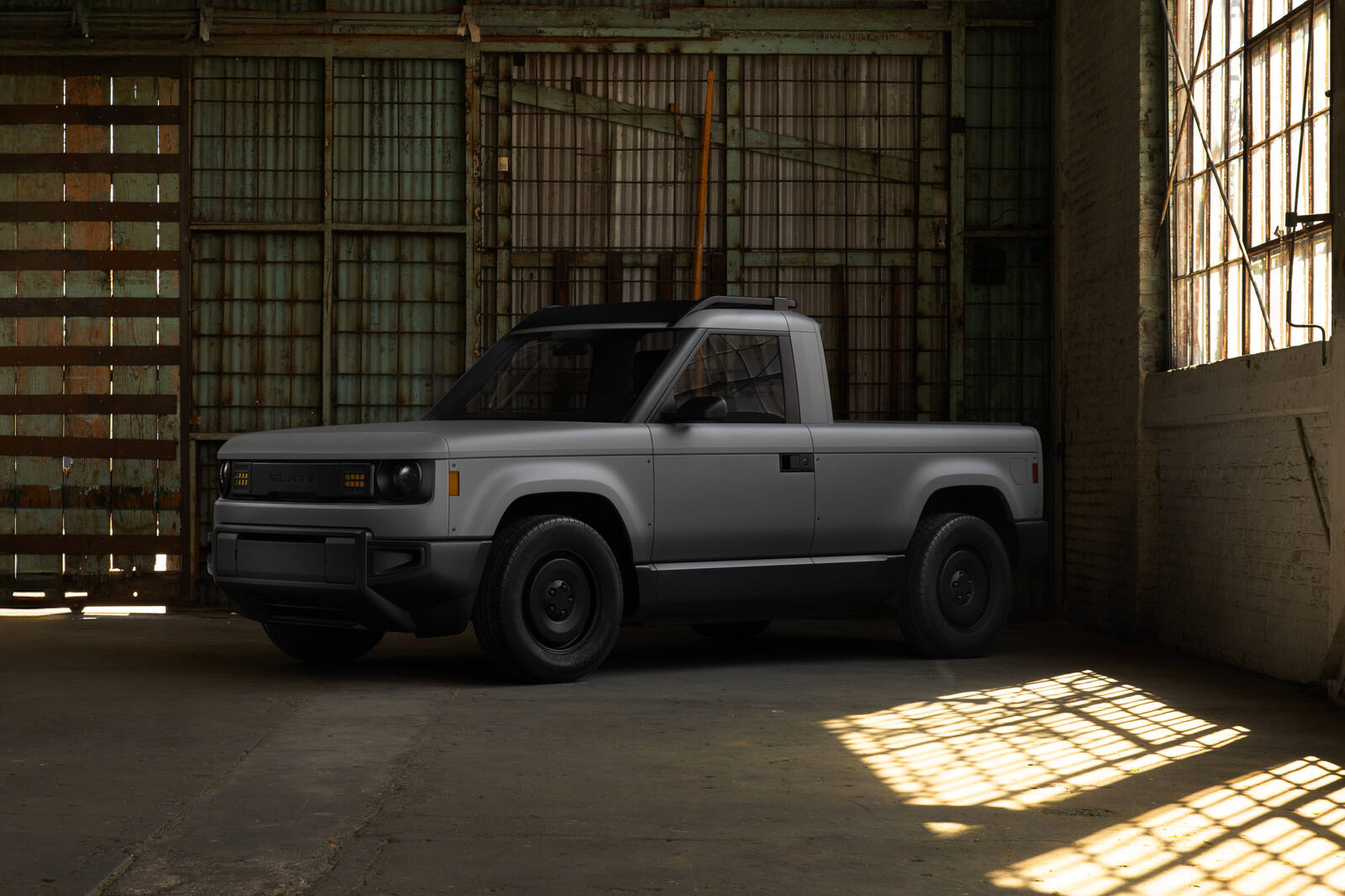
Truck Slate Ev
"And that's what a Slate EV pickup trucks going to be. It is going to be as bare bones as you can get."
They’re discussing an electric pickup truck concept from Slate that’s meant to be as cheap as possible. The goal is a simple EV truck with fewer features so more people can afford it.
The segment is talking about a Slate EV pickup truck concept aimed at being extremely affordable. The key idea is an EV pickup with minimal features (“bare bones”) to hit a low price target, rather than a fully optioned, tech-heavy truck.
EV
"And that's what a Slate EV pickup trucks going to be. It is going to be as bare bones as you can get."
EV means electric vehicle. It runs on electricity from a battery instead of using gasoline.
EV stands for electric vehicle, meaning the vehicle is powered by one or more electric motors instead of a traditional gasoline engine. In this context, the hosts are discussing an electric pickup truck designed to be affordable.
bare bones
"It is going to be as bare bones as you can get. Yeah, the concept, the idea behind it is."
“Bare bones” means the truck is built with only the most necessary features. The idea is to keep the price down by not adding lots of extras.
“Bare bones” here means stripping a vehicle down to essential equipment to reduce cost—fewer comfort/tech features and fewer options. In pricing-focused discussions, it’s a strategy to make the vehicle cheaper to buy and easier to produce at scale.
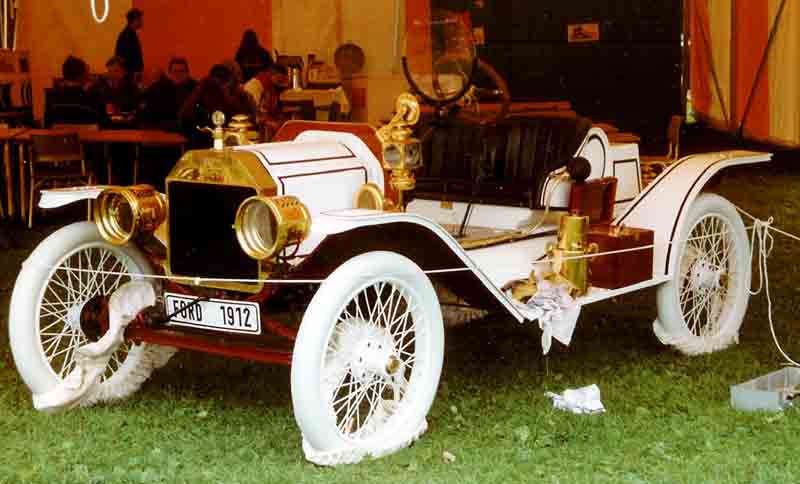
Ford Model T
"...or color. Yeah, you know, it's it's it's like the Model T, the original Ford salesman. Would you prefer it ..."
The Ford Model T is a very old car from the early days of automobiles. It’s famous because it was one of the first cars made in large numbers at a lower cost. The podcast brings it up as a historical reference point.
The Ford Model T is the early, iconic mass-produced car that helped make automobiles affordable and widely available. The podcast compares something to “the Model T” and references the original Ford salesman, which points to its historical significance. It’s discussed because it’s a benchmark for how Ford’s early marketing and production shaped the auto industry.
under $25,000
"So so the concept of having something under $25,000, $10 under $25,000. Still counts."
They’re talking about keeping the price below $25,000. That kind of price point can bring in buyers who normally wouldn’t shop for an EV.
The hosts are framing the discussion around a sub-$25,000 purchase threshold, which is a common “entry price” target in car pricing. Crossing that line can change which buyers consider the vehicle, because it competes more directly with cheaper non-luxury cars than with typical EVs.

Ford F-150 Lightning
"... go. OK. So they have, you know, Ford had 150,000 lightning deposits three seconds after they they they turne..."
The Ford F-150 Lightning is a pickup truck that runs on electricity instead of gasoline. The podcast talks about how many people put down deposits very quickly, showing strong early interest. It’s a notable model because it brings electric power to a truck-style vehicle.
The Ford F-150 Lightning is an electric version of the F-150 pickup, combining the practicality of a truck with an all-electric powertrain. The podcast mentions “150,000 lightning deposits” shortly after it was turned on, emphasizing how quickly demand formed. It’s discussed because it represents a major shift toward electric trucks and because early customer interest was unusually high.

Hyundai Venue SE Hyundai Ultra Limited
"Hyundai Venue SE Hyundai Ultra Limited Chevy Trax Trax."
The Hyundai Venue is a small, budget-friendly SUV. “SE” and “Ultra Limited” are different versions of the same model, and they can have different features and prices.
The Hyundai Venue is a subcompact crossover that’s often positioned as an affordable entry point in Hyundai’s lineup. In this segment, the host mentions a specific trim mix (“SE” and “Ultra Limited”), which matters because pricing and features can vary a lot by trim.

Kia K4.
"Any other options here? [1609.5s] Kia K4."
The Kia K4 is a Kia car model. They’re talking about it in the context of people shopping for cheaper cars under about $25,000.
The Kia K4 is Kia’s compact sedan offering, positioned as a lower-cost alternative in the brand’s lineup. In this segment, it’s mentioned as a shopping alternative to other sub-$25k vehicles, so the model name is tied to the pricing/target-customer argument.
cross shop
"I don't think someone's out there, [1649.7s] cross shop and Hyundai venues and Slate pickups, [1651.9s] but maybe maybe they will just because they're looking sub 25 K."
“Cross shop” means you look at a few different cars from different brands before choosing one. They’re debating whether the same people will consider both models.
“Cross shop” means comparing multiple brands or models before buying. Here, it’s used to argue whether shoppers who might have bought a Hyundai Venue (or similar) would also consider the Kia K4 when they’re targeting cars under $25k.
sub 25 K
"I don't think someone's out there, [1649.7s] cross shop and Hyundai venues and Slate pickups, [1651.9s] but maybe maybe they will just because they're looking sub 25 K."
“Sub 25 K” means “under $25,000.” They’re talking about buyers who are shopping in that budget range.
“Sub 25 K” is shorthand for “under $25,000,” a common price threshold used to define a buyer’s budget. The host uses it to frame which customers might be pulled into the market by lower-priced options.

Ford Ranger
"Small pickup trucks like the Ford Ranger were pretty popular. Mazda had had their version of it."
The Ford Ranger is a smaller pickup truck. The hosts mention it because it’s the kind of truck people associate with their younger years and may want again for nostalgia.
The Ford Ranger is a small pickup truck (a “mid-size” pickup in many markets) known for being practical and relatively affordable. In this segment, it’s used as an example of the kind of inexpensive, youth-associated truck that can attract nostalgic buyers.

Honda Element
"I saw today that that Honda is going to bring back the element. Yeah, that's another big story we should probably cover."
The Honda Element is a boxy, utilitarian crossover/SUV built around practicality and a distinctive “youthful” look. Here, the hosts say Honda is bringing it back, framing it as a nostalgia-driven product that can shift who buys and how pricing pressure plays out.
nostalgic buyer
"But a lot of these things bring about a nostalgic buyer. So young people."
A nostalgic buyer is someone who wants a car because it reminds them of their past. In this segment, they’re saying nostalgia can pull in a different group of people and influence pricing.
A “nostalgic buyer” is someone whose purchasing interest is driven by emotional connection to a vehicle they associate with their younger years. The hosts argue this kind of demand can change the buyer profile and affect pricing pressure.
downward pressure on pricing
"That is downward. It is downward pressure on pricing, no matter how you slice it."
“Downward pressure on pricing” means the market is pushing prices down. The hosts are saying that the mix of buyers and demand can affect how low prices go.
“Downward pressure on pricing” means competitive forces or market dynamics that push prices lower. The hosts connect it to how different buyers (including nostalgia-driven ones) can influence pricing outcomes.

Chevy Colorado Trail Boss
"You have made the process of buying my new Chevy Colorado Trail Boss absolutely painless and actually fun... We were seriously out of the dealership with the new Trail Boss in 21 minutes."
This is a Chevrolet midsize pickup truck. “Trail Boss” is a special version meant to handle rougher roads better than a basic model, and the caller is saying the buying process for it was fast and easy.
The Chevrolet Colorado is a midsize pickup, and the Trail Boss trim is aimed at off-road capability with tougher-looking styling and typically more off-road-focused hardware. In this segment, the hosts highlight how CarEdge’s process helped someone buy a new Trail Boss quickly and with less hassle.
AI negotiator
"We used your AI negotiator for the $49.99 and saved at least $2,500... once we had agreed on our out the door, the negotiator basically finalized the numbers."
They’re talking about a tool that uses AI to help negotiate the car price. Instead of lots of haggling, it helps get to an agreed price and final paperwork faster.
An “AI negotiator” here refers to software that helps structure and run the price negotiation process with the dealer. The point is to reduce back-and-forth and steer the deal toward a target price and final “out the door” number.
$49.99
"We used your AI negotiator for the $49.99 and saved at least $2,500."
They mention the price of the service they used—$49.99. The caller is saying that even after paying that, they still saved a lot on the truck deal.
The $49.99 is the stated cost for using the AI negotiator service mentioned in the segment. It’s relevant because it frames the deal economics: the caller claims the service fee was outweighed by the savings.
negotiator finalized the numbers
"Literally once we had agreed on our out the door, the negotiator basically finalized the numbers."
They’re describing how once they agreed on the price, the remaining steps got completed so the final deal could be locked in. It’s basically about speeding up the “getting it done” part of buying a car.
This describes a negotiation workflow where the buyer and dealer reach agreement, and then the remaining steps are handled to lock in the final deal figures. In car-shopping terms, it implies the process is aimed at getting to a signed, complete purchase total rather than endless revisions.
out the door
"Literally once we had agreed on our out the door, the negotiator basically finalized the numbers."
“Out the door” means the full final price you pay at the dealership—everything included, not just the sticker price. It’s the number you want to compare between different offers.
“Out the door” (often shortened to OTD) is the total price you pay to take the car home, including the vehicle price plus taxes, title, registration, and dealer fees. It’s a key number because it lets you compare deals on an apples-to-apples basis.
Request an Explanation
Heard something you'd like explained? We'll add it to this episode.
Sign in to request explanations for terms you heard.
Want to learn more?
Browse our glossary for plain-English explanations of automotive terms, jargon, and concepts.
Help improve this episode
See something that's not quite right? Our annotations are AI-generated and can sometimes miss the mark. Click the flag icon on any annotation to suggest a correction.