Tire tread is the grooves on the tire. They help the tire grip and move water away. But a tire can look okay and still be less grippy if the rubber is old.
The tire date code is a stamped manufacturing date (typically a week/year) on the sidewall. Checking it helps you estimate tire age even when tread looks fine. Age matters because rubber degrades over time, affecting grip.
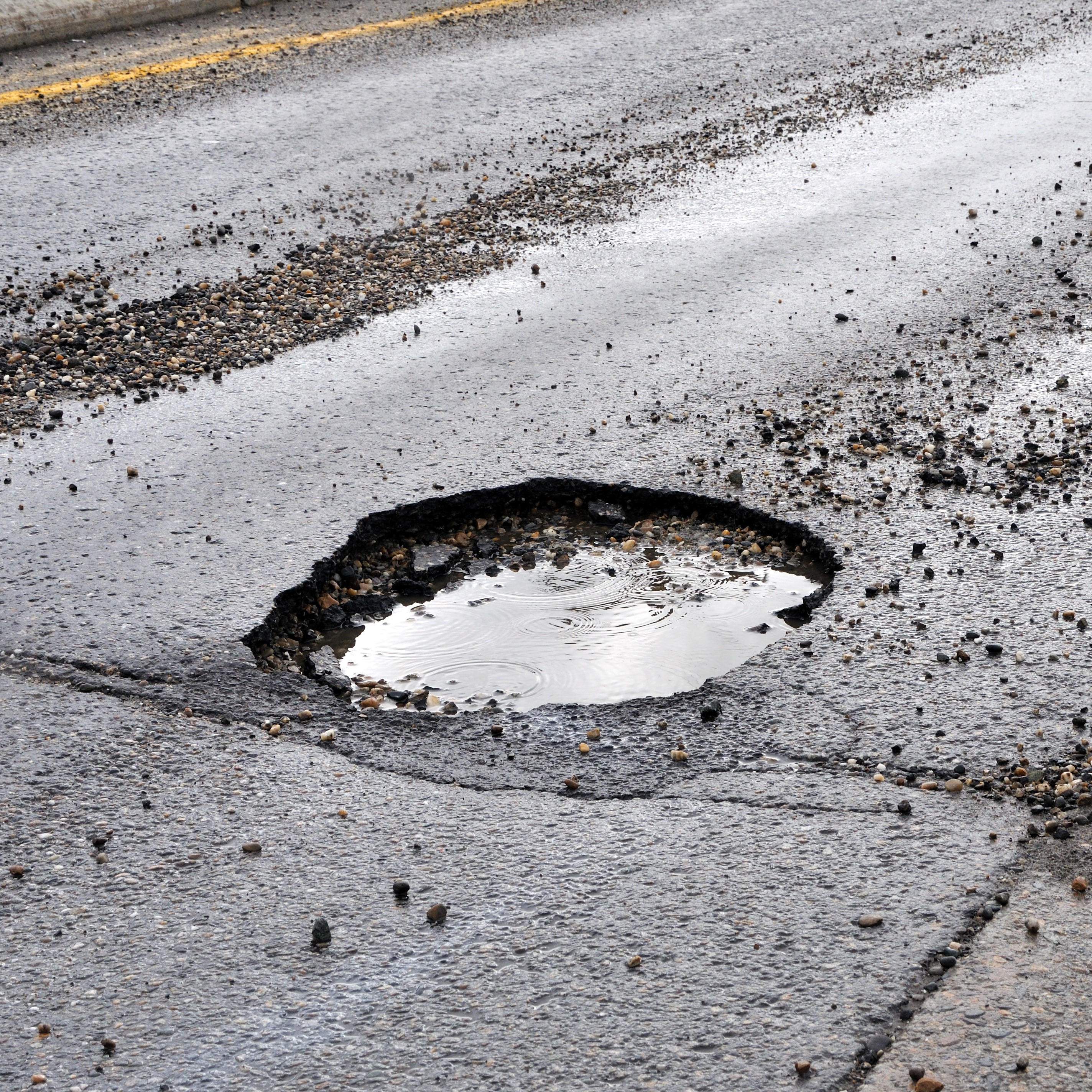
Potholes are holes in the road that usually get worse after freeze-thaw weather. Water gets in, freezes, and expands—then the pavement breaks. When it warms up, you often see more potholes.
When it gets cold, water in tiny cracks freezes and expands. When it warms up again, that weakened pavement breaks down faster and can turn into potholes.
If your car starts vibrating after hitting a pothole, something may be bent or damaged. It could be your tire/wheel or suspension parts, so it’s smart to get it checked.
An alignment makes sure your wheels are pointed the right way. After pothole or steering/suspension repairs, skipping alignment can make the car wear out tires faster and drive less smoothly.
A scan tool is a device a mechanic plugs into your car to “talk” to the computer. It can show error codes and sensor readings so they know what’s wrong.
They’re driving a 2011 Toyota Avalon. The squeak happens when they back up, and the mechanic is trying to figure out what part could be making the noise.
Corrosion here refers to surface rust that forms on brake rotors when moisture sits on them. It’s especially common after the car sits overnight or during seasonal changes, and it can cause intermittent squeaks that improve after braking.
Condensation is water that forms when the air and surfaces cool down or warm up. More moisture can cause a little rust on the brakes, which can squeak at first.
A bushing is a rubber or elastomer component that isolates vibration and allows controlled movement between parts. Drying or hardening can lead to squeaks or noises, especially when the vehicle’s forces change.
A coil spring is part of the suspension that helps support the car and smooth out bumps. If the rear one breaks, the back of the car can sit wrong and handle differently, so it usually needs a proper replacement.
If the wrong part is installed, the shop may have to fix it again. That costs more time and money, which is why getting the exact correct part matters.
Rust proofing is a treatment that helps stop your car from rusting. It usually involves putting a protective coating on spots that get hit by rain and road salt.
Electric cars are powered by batteries instead of gasoline engines. That means a mechanic’s job can change because the car systems are different and need different kinds of checks.
Cars can slowly rust as they age, especially if they’re exposed to salt or moisture. The speaker is saying corrosion isn’t just about the outside body anymore—it can affect other parts too.
Modern cars use computers to control many functions. That means mechanics often use diagnostic tools to find problems instead of only relying on feel and sound.
Fuel economy is how far the car can go on a given amount of fuel. Better fuel economy usually comes from smarter control systems and more efficient designs.
Horsepower is a way to describe how much power a car’s engine can make. People talk about it because it relates to how strong the car feels when you drive it.
They’re saying it’s not unusual anymore to bring in a car or truck with a ton of miles. With the right care, vehicles can keep going for a very long time.
If you take care of a car with regular checkups and services, it usually lasts a lot longer. Skipping maintenance is what tends to cause expensive problems later.
The speaker is saying you can still check tire pressure manually with a gauge even if the TPMS warning light is on. Manual checks are useful for safety, but the underlying TPMS fault should still be repaired so the warning system works again.
LIVE
Another Saturday in C.C. Oland has rolled around this one the first Saturday of spring, officially.
Time once again to talk a little bit about cars, your car, your truck, your van,
the problems you may be having, and you want to know what could be ailing before you bring it in for service,
your favorite dealer, your favorite shop. All you have to do is call Nick Stauffle,
or send him a text. Nick is an ASC certified technician at Lloyd's Automotive answering those questions.
He has done that for many years, along with his pal Dan. And Nick, good morning to you.
Good morning, Denny.
Hey, welcome to a one day of summer, this first day of Saturday of spring. How about that?
I was just listening to that forecast and wasn't it just last week we were talking about the impending snowstorm?
Yes, yes. In fact, we got a text about that and about tires. We'll get to.
But if you have any kind of a car, any kind, and you want to have a little bit of information before you bring it in for service,
or maybe you've always wanted to ask a car mechanic a question, whatever.
You don't have to be any motorhead or gearhead. We like to say to ask that question.
I know we have a lot of do-it-yourselfers there in the audience, but you don't have to be, certainly.
I wish I was, but I can do minimal stuff. But when I think about it, Nick, you and your crews are trained to do this,
your master mechanics, but there's not a whole lot of home. I do what yourself can do, right?
I mean, without the proper equipment, really.
Well, it definitely has changed. On the one front, there's a lot more resources.
You go online, you can watch videos, you can read the manuals, everything's at your fingertips.
The difficulty is the tools. They really made things more complex.
A lot more things than be raised in the air to be able to access and do the repairs.
So if you have the tools, you have the know-how, you have all the equipment by all means.
I love the fact that people still work on their cars, do-it-yourselfers, as we call them.
So if you're not and you're going to attempt it, just be cautious.
Just don't put yourself in a situation where you can't get back or can't break something or you're stranded, needing them in toes.
So if you do the research, you have the tools and you have the patience.
That's another big word, the patience to get through it. You can do more than you think.
You hit the nail on that head because I have used, like Google, a number of times.
Like, where's the air filter element on this particular vehicle or what not?
It's amazing the information that's out there. It's really helped me a lot doing my minimal work.
But in the meantime, why don't you call Nick or Tex Nick with any kind of a car care question we have.
And I always like to say do it sooner rather than later because Nick takes his leave about 7.45.
Our time goes by so quickly and we want to help you out as much as we can.
So call us Texas sooner rather than later. Here's the number for either 6514619226.
Here's a question that came in earlier this morning, Nick. In fact, it was in reference to the snowstorm we had recently.
This basically says that I have a 10-year-old car, 27,000 miles on it. It's an SUV, actually, they say.
And the tires are original, but I noticed that when the snow hit, it was a lot slipperier than I thought it used to be.
What can happen, and again, 27,000 miles on this SUV, original tires. We talk about this from time to time.
Tires get old even though they look like they've got a lot of tread, right?
Absolutely, you know, the salt, the sun, the heat, the cold will change that compound.
A lot of times make it harder, not as pliable, so it's not really gripping.
It's more just making contact with the road or the ice and snow.
Obviously, we know if you have that as much snow as we did, if you have very icy conditions, not a whole lot of things worked very well.
But in a traditional snowstorm, you should be able to get good traction and have control of the vehicle.
If not, the tires look okay.
When you're in for service, mention that to them.
They can check the date code on the tire.
If they are getting up there near a decade in this situation, it might be time to replace them just based on age, not just the fact that the war note.
You know, I was thinking, as I'm looking at this forecast earlier this morning, that if the weather folks are right,
and we're going to get at least near 76 degrees, I would imagine that's maybe creating a lot of more potholes, right?
I've seen a bunch already. How about you?
Yes, sir. That freeze thaw, as we know, you know, the things melt, refreeze at night, and that water makes its way into those cracks on the roadway.
It expands, separates the pavement.
We drive over and it just starts this process where it starts to chip away at it, and that's how the potholes are created.
Obviously, the roadwork will be able to repair them, but they too often need to wait for the frost to get out of the pavement for that to stick and hold.
So there's this next few weeks or a month, a little dicey where you can get a lot of these potholes, and they're trying to fix them or keep up with them, but sometimes it just can't.
So be cautious as we know we're supposed to get some rain.
If you see the puddle in the roadway, you can see the water, you just don't know how deep it is.
If it can be a few inch deep pothole, that can be very dangerous for a tire or a wheel or some of the steering suspension components of the car.
So just be careful in that case.
6-5-1-4-6-1-9-2-2-6, you can call in your question or text it.
Speaking of that, there's a text in reference to potholes.
They're not sure of it, but this listener here, she wants to know, what are the symptoms?
If I hit a pothole, what are the symptoms of damage that I may see if I haven't truly damaged my car?
Well, it's really any situation, something different.
Boy, I notice that the car's pulling this way or hearing a noise or I feel a vibration, something's different.
So if you notice something different, need to have it looked at, that different feeling or noise or sensation is your warning.
Something could get worse, it could stay as it is, but we don't know until you have it inspected.
So if you do hit a pothole, you notice a vibration or a feel or a noise, take it in, have them get a look at it, figure out what has happened,
make the remedy before you have more problems.
What kind of damage have you seen in vehicles over the years in your business?
Oh, what can happen?
The tires have a blowout, which at that point you're stranded, obviously.
You can damage the wheel, sometimes repairable, sometimes beyond repair.
Those lower control arms, ball joints, steering knuckle, tie rods, anything on that corner of the vehicle,
that jarring impact, wheel bearings are very common.
That impact can create damage and most often you can't go back, you know, you can't undo that.
So be very careful, you don't want to have that situation or that unfortunate situation.
So just be cautious.
Well, when something happens like somebody hits a pothole and do some kind of damage
and you guys repair it, is there, what's the word, an alignment?
Does that always happen after that kind of steering repair?
Yes, so when you do replace some of those steering suspension tires even, especially in situations where you had damages such,
you'll want to perform an alignment to make sure everything is squared away, aligned,
make sure those new components and parts are properly installed and make sure that they last the life of the vehicle.
The last thing you want to do is go and repair, replace some of these components,
have not had performed alignment in this, wear out your tires or whatever they've replaced too soon, have to do it again.
So that's an important part of that puzzle.
Yeah, interesting. Before we break, let's grab a phone call.
Gary is calling in from Greenfield, I believe, this morning.
Hey, Gary, good morning. What is your question for Nick?
I've got a 2013 Ford E350 Van, 507,000 miles.
The overspeed on the transmission quits working after several hours of driving.
The RPMs go from 1975 to 2975.
What do I do to not have this happen in the future and what is the fix?
Well, we're going to have to get some information there, probably access the computer.
It's a lot of driving, so I would also maybe suggest that you get it in that situation.
You know, prepare, talk to the dealership or shop, you take the vehicle to share that situation with the driver for several hours.
Obviously, they're not going to go drive your car for several hours.
So you might have to do that part for them.
Once it's in that scenario, that situation, maybe take it to the shop, grab one of them, have them go for a ride, bring their scan tool.
That's the key here.
That scan tool is going to record that data, figure out what is given up if there's a solenoid, if there's a temperature switch.
Something is happening where the computer is not happy, so it's put itself in a default where it's taken out of overdrive.
So we need to figure out which component isn't reading what it wants to see and figure out what's causing that.
And then, you know, obviously do the repair.
All right. Thank you, Gary.
Hang on, Nick. We're going to take a quick break.
Let's invite our listeners to join in.
Any kind of a car care question.
I'd love to hear from you, either by phone or by text, 6514619226.
Right now in the Twin Cities, we are at 45 degrees, and I'm looking at the predicted high today, near 76.
We'll see if we get there. Stay with us.
News Talk, A3O. This is WCCO.
Had a good Saturday morning.
You're welcome back to our car care show.
We're here. Thanks to next outfit.
Lloyd's on move for helping our listeners out.
Nick, speaking of help, if folks need the help of Lloyd's, how do we find you guys?
Yes, sir. As always, if you have a question, need some advice, don't hesitate.
We're always there to help you.
You can reach us at 651-228-1316.
If you're in St. Paul, you'll find us on the corner of Grandin Chasseworth.
That's 982 Grand Avenue.
And finally, check out our website. It's LloydsAutomotive.net.
We'll get you that info before Nick takes his leave, which is about 745.
Any kind of a car care question, let's hear from you.
6514619226.
Nick, let's grab a phone call. Kate, checking in from Brooklyn Park.
I believe this morning. Kate, good morning.
What is your question?
Hi, I have a 2011 Toyota Avalon.
And the car, when I back up, it squeaks and makes a lot of noise,
but it's intermittent. It's not all the time. What can be wrong?
Well, that's a good question. The squeaking and the person needs to give good clues.
Backing up, if you could also write down if it's oftentimes the first time of the day,
if you've been driving for a while, if it's been wet out, cold, warm, whatever you might have there,
those situations or scenarios can really help us figure out what's happening.
I suspect maybe something with the brakes, the first time of the day you back it up.
There's a little bit of that corrosion on the rotor surface.
We back up, we apply the brakes, we hear the squeaking, we start driving, it goes away.
That's not a problem that's very common, especially as the seasons change,
we'll get a little more condensation there.
If it's something that you're noticing when there's a load change,
meaning that the vehicle's shifting, maybe we have a bushing or a grommet that's starting to dry up a little bit
and that rubber's making some noise.
I would say, write it down, try to make it so when you take it in,
they can duplicate that scenario or that situation so they can pinpoint the problem.
But definitely, next time you're in for a service, mention it.
The last thing you want to do is ignore it or forget about it
and create more problems meaning something because more worn or damaged.
So, I don't think you're in any immediate issue because it's intermittent as you described,
but it's probably sometimes make note of have your shop or dealership take a look at it next time you're in.
Those intermittent ones are sometimes very frustrating to find,
but usually, and tell the service where the person at the shop everything that you can think of
of when it happens, more information the better.
Here's a question I bet you get a knick all the time.
I'm reading a text.
How do car repair services feel about customers bringing in their own parts?
Texter says, I have a broken rear coil spring on my SUV.
I can buy a new one online for almost $100 less than what the repair service quotes.
Of course, I'll pay the labor and miscellaneous shop fees to have the spring installed,
but I'd like to save a few dollars in the process.
Are there pros and cons of that depending on the shop?
That's true.
Typically, we don't, and that's a perfect example right there.
I found the coil spring online for less.
I can tell you that there's oftentimes a decal or some paint colorings on coil spring or a suspension code.
There could be five or six different variations of a coil spring on one make and model.
You have to buy one online.
They say it's the same, but it's not.
We installed in the vehicle, the handling, the way the vehicle operates,
the way the tires wear, all that is different at that point.
Now the job has to be redone.
We don't do it.
We don't get into it.
I know you can find everything online cheaper.
We all know that.
That's the world we live in, but it's not necessarily the same.
We spent a tremendous amount of time and effort to make sure we're putting light quality.
If not, OE parts back on the vehicle.
It's our job to make sure the vehicle is repaired for the long haul, not just to save a quick buck.
You can do that.
There's some places that might entertain that.
We just don't do it because over the years we've had too many bad scenarios and situations.
That being said also, there is some markup in the parts too.
I understand you could find something cheaper online, but we do have a little bit of margin.
So depending on the part and the part, I don't want to get into the details there,
but there's some markup on that, which is part of how the technicians and the shop survived.
It's not just labor, which is the source of the income for the business.
The parts are part of that also.
When you ask somebody and they say it's not part of their business practice,
that's just fine.
Some businesses might entertain it, but they might have to try to do extra labor.
I might think you find out that the price is the same in the end.
Having the shop do the homework, you're guaranteed to get the right part though.
So I would take that as a, take it for what it's worth.
You're going to put a party and you're going to back it up.
There's some nightmare scenarios over the years that we've gone through.
We've made the policy.
We just can't do it because there's too many situations.
It just doesn't work out.
And then it's somebody's partners are proud and they're frustrated and like, you know, it's just,
we don't do that anymore for sure.
Yeah. And I can see why.
6514619226 still have time for your car care question for Nick.
All right. Let me see if I can piece this text together.
This comes from Todd from Chalkabee.
2018 Toyota Highlander.
My push button four by four button shows engaged on my dash when I push it,
but goes off after about 30 seconds.
I'm not sure why does that mean my four by four is off and not working.
My quote snow button stays on when I use that on.
So I'm thinking it might need service.
I think that's a good start.
Typically when we have a push button where the indicator illuminates,
if it stays illuminated, that particular features operating working as it should.
If it starts to blink, if it goes off,
it's telling them something's not, it's not happy with something sort of shutting itself off.
So I would think you're right on taking in for service,
mentioning that to them.
They can confirm it.
You know, they can take a test drive.
They can take like once again, their scan tool,
which will give them the data that they need to figure out what's going on.
Here's one that we get from time to time.
And I remember commercials on radio and television for years.
A tester has whatever happened to all the rust proofing services.
We talk about that from time to time.
Seems to me newer cars, in my opinion, they don't seem to need it.
As long as you, you know, keep them washed.
What's the deal on rust proofing these days?
I think a lot of those parts are right.
I think the manufacturers have found better ways to coat the materials so they don't rust as much.
I think there's a car wash on every street corner that we utilize a lot more.
So we wash all that salt off, which is a big part of that.
And those products are still out there.
And I'm not going to, you know, I don't particularly use them.
I don't think it's necessary, but there's some, there's a market for them.
You know, I think what they do is a good thing.
I just don't know if it's fit for everybody, but it definitely has changed from years ago.
I can remember starting at the service station and a car would be a handful years old
and there ought to be rust coming out of those, those wheel wells.
And it's kind of amazing how quickly things used to, how things,
how things change over the years.
Oh, for sure.
All right, let's grab another phone call before we look at that forecast.
Scott calling in from St. Paul this morning.
Thank you, Scott.
What's your question for Nick?
Good morning, gentlemen.
Just a quick comment.
People bringing in their own parts.
The biggest advantage of allowing the shop to install their parts is warranty aspect.
Some offer lifetime warranty on the player part.
Sometimes it's better to have a warranty when installing the parts.
I just wanted to comment.
Yeah, that's a good point.
That's probably the biggest point, I guess.
That's true because a lot of these parts do come with lifetime or several years
or however many mile type warranty.
And if that were to fail, if the shop had not purchased it,
the manufacturer is not going to honor that warranty.
So there's a lot of different reasons.
I truly appreciate understand money's tight.
People try to be responsible, respect for the monies, but we are too.
We're not trying to be wasteful with your money.
We're trying to do the best we can to give you the best value to get your car back on the road.
Yeah, absolutely.
All right, Nick, hang on.
We're going to take a look at that summary forecast at least for a day.
And when we come back, we're going to answer more car care questions.
Keep in mind, Nick, we'll be leaving us about 745.
So don't wait.
We'd love to hear from you if you have any kind of a car care question.
Call us.
Text us 6514619226.
Weather straight ahead here.
Newstalk A3O.
This is WCCO.
Hey, good morning.
Welcome back to this portion of CCO's car care show.
Denny Long here along with Nick Stoffel from Lloyd's Automotive in St. Paul.
Nick, I'm looking at a text that we have a regular listener listen every week.
Thank you for that.
Any chance you are thinking of putting a shop in the Burnsville area.
I've been to one in St. Paul.
It's great, but it's a little longer drive.
All right.
I'd like to make mention at that point, since that listener brought it up,
that you probably won't be going to Burnsville.
You've got your hands full because not only Lloyd's Automotive on Grand Avenue.
We don't mention this, but there are a couple of other shops that you've jumped into, right?
There are in Burnsville.
I go shopping there often or get kids food from there, but that might be out of my work bubble.
I like to be able to be at any place I need to be within 10 minutes.
We do have two other locations.
The first one is Parkway AutoCare, which is in the corner of Ford Parkway and Snelling.
Then the most recent business that we purchased is called Longfellow Automotive,
which is right at Lake Street in the river there in the Longfellow neighborhood.
We're pretty excited.
Nick and I have our hands full now for sure.
As I mentioned off here, we're going to go get ourselves a little bit of training this next week.
Going from one to three, it's different.
It's kind of like kids. When you have one, it's two against one.
When you have two, you kind of play one takes one,
and then when you have three, all of a sudden you're outnumbered
and you got to figure out how to play a new kind of defense.
So we're excited, but we're slowly growing.
I'm not sure Burnsville's in the cards yet, but we'll see what happens.
Well, you and I talk off here a lot and you do have your hands full,
but the good news is, and those are just kind of inside information,
but you really have good people all around you,
which is how people become so successful.
You surround yourself with really good people and you have a great crew.
Crews, I should say.
We're very, very fortunate.
And like I said, we're going to get some help for us to help them do their jobs better,
because as you know, that chair that Jim now sits in,
I was probably sat in that chair for 20 years while Dan owned Lloyd's,
and then as we got the new location,
I kind of moved on and big Nick sat in that same chair for several years.
And now it's Jim's chair, so we're learning to evolve, promote within,
and hopefully we're doing it right and can keep a lot of people happily employed
and a lot of customers happily on the road.
You know, something we haven't talked about, and then I'm going to get back to another text,
is finding the right people.
We've said for years, and when we talked to Dan on the show,
this is really a great career for people maybe as parents and grandparents listening to the show.
If you have grandchildren or children that have that interest,
and getting into stuff and checking out how to fix this or how to fix that,
there's some great schools, and it's a great career.
Absolutely. One of my peers, I went and saw him, had a quick chat with him,
and he said, command you what our guidance conference would say now.
We weren't maybe the best students in high school, maybe a little unorthodox.
And four-year college is right for a lot of people out there,
but there's some of us that are a little bit different that maybe that wasn't the right path.
And this has worked out. I mean, I'm doing great.
I've worked for a good mentor for many, many years, had the opportunity to learn how to run a business from him,
opportunity to buy a business from him, and grow from there.
So I think the trades are a great place to go.
You get to learn with your hands.
I'm pretty sure AEI is not going to take away fixing a car or building a house or repairing something.
So I think our future is pretty bright.
And I think if you have a young person that's not the traditional student,
I think it's worth when you're doing those visits.
Check out some of the trade schools or the Votex schools,
because there are a lot of options out there that maybe you're not aware of
that could give that young person a really good, healthy, successful future.
You want to ask a mechanical question? You can still have time to do that.
6514619226.
Here's a question we haven't had for some time.
With all the electric cars, how has your business changed as far as being a mechanic?
Good question.
Well, the term grease monkey isn't quite what it used to be.
I can share that with you for sure.
You know, we talked about cars rusting out and rotting out.
And I would say that the components, not just the body of the vehicle have evolved.
There's just not as much of that grime.
There's still some.
You're going to get some dirt under your fingernails for sure.
But it's not what it used to be with the emission systems.
These cars run inside the shops.
You know, you can't hardly tell if there's anything running inside the shop
because, you know, every so often we'll get a vintage car in the shop and you fire it up
and everybody's, you know, get the doors open, get that car out because it's just so strong.
And I would say it's evolved so much over the last decade or two that the technology is fun.
There's a lot more computerization, which is exciting.
Seeing how we've refined and make maximizing the potential out of a vehicle is also really neat.
You know, the fuel economy, horsepower is always a fun thing.
So there's a lot of things going on there that make it exciting, interesting,
and really honestly, no two days are the same.
You know, we work at all, make some models.
Every manufacturer has a way of doing something just a little bit different,
which requires maybe a different thinking hand or different resource, different tools.
And that's what makes it fun and exciting that you get to work and you don't know what you're going to get.
And somehow we find every day to get through it all, which is kind of the magic about what we do,
but I wouldn't trade it for the world.
Well, we got a call earlier in the show.
I think his truck had something like 500,000 miles on it.
Is that not unusual to people bringing their vehicles for service, not with 50,000,
but maybe hundreds of thousands of miles?
That's not so unusual anymore, is it?
No, not at all.
I mean, I would say, always referencing when I started, you know, 100,000 miles,
it was like a magical milestone.
And now at 200,000 miles, I would still not consider replacing the vehicle.
You know, I still think there's a lot of life left in the mechanics of the engine transmission.
You know, you get up over that 300,000 miles or a certain vintage,
really what it kind of comes down to is that people are like, you know,
my car's 15 years old, it's got 250,000 miles on it.
I'm ready for a new one.
Well, you've earned it.
You've driven that vehicle a good life.
You pass it on to somebody else and they'll drive it until the wheels fall off, as they say.
So, you know, cars have changed.
If you do the maintenance, you can keep them on the road for a really long time.
Yes, you can.
It's time for one more call, Jeremy, calling in from St. Paul this morning.
Thank you, Jeremy.
What is your question this morning?
Good morning.
I have a 2019 Chevy Malibu with about 97,000 miles on it.
And I'm getting a service tire monitor system code thrown right now.
And I know what it is.
It's, you know, the electronic monitoring of the tire pressure.
And I wanted to know, I mean, I can drive, I believe I can drive with that and just use
the manual tire gauge pressure thing, but I want to get rid of the code.
That's my question.
How to.
Yeah, absolutely.
So when the tire light comes on, it's, as you mentioned, the system identifies a fault,
likely one of those four sensors in the wheels has the batteries worn out and it's not seeing
it.
So it's turning the light on.
You take it in for service.
They can do what we call ping each sensor, determine which one's not reading.
They can check the battery level of the others, replace the one that's faulty, reset it and
let's just stay off.
That light being on, keep in mind, you said you can check it with the manual gauge as
long as you do that.
What happens is that people see the light.
They ignore it.
A tire gets low.
We don't realize it.
And that's where we run into trouble.
So I would say best practice to get that, get that sensor replaced, get that light off
so therefore, you know, your tires always fall.
I'll tell you what, Nick, I think we're plum out of time.
And for those folks that need some assistance from Lloyd's Automotive and maybe a couple
of other shops, give us at least a number and how to, how to check out Lloyd's.
Yeah.
And before I said, I just want to say thank you, Denny.
It's been a good, a good, a good run here.
I appreciate everything.
If you do have a question for your car, I can always reach us at 651-228-1316.
If you're in St. Paul, we're at 982 Grand Avenue and you'll find all that information
and more at LloydsAutomotive.net.
We will check it out.
Thanks very much, Nick.
Have a good week.
Yes, sir.
You too, sir.
Next awful from Lloyd's Automotive, et cetera.
Now, get ready for Ted Ferrell's wine chat.
And then in the eight o'clock hour, we talk lawns and gardens with Julie Weisenhorn.
So get those lawn and garden questions ready for Julie next hour.
Here on Newstalk A3O, WCCO.
About this episode
Nick Stoffel (ASC-certified tech at Lloyd’s Automotive) fields listener questions on springtime car issues and what to watch for before service. He explains how “original” tires can lose grip due to age even with tread left, and why freeze-thaw cycles create potholes that can damage tires, wheels, and suspension. Callers also cover intermittent squeaky reverse/brake-related noises, transmission overdrive dropping out (scan-tool diagnosis), and push-button 4x4 indicators that shut off. The show also debates bringing your own parts, alignment after suspension work, and how EVs change shop work.
How to best handle repairs at home. How the elements impact tire tread. Preparing for potholes. What happens if your car hits a bad pothole? What could cause brakes to squeak? Can customers bring their own parts to a shop? Is rust proofing still necessary? How has the car mechanic business changed over the years? Ask our car care expert Nick Stoffel of Lloyds Automotive. Visit lloydsautomotive.net 651-228-1316.