Tire Tread Trouble, Pothole Problems, Squeaky Brake Solutions
About this episode
Nick Stoffel (ASC-certified tech at Lloyd’s Automotive) fields listener questions on springtime car issues and what to watch for before service. He explains how “original” tires can lose grip due to age even with tread left, and why freeze-thaw cycles create potholes that can damage tires, wheels, and suspension. Callers also cover intermittent squeaky reverse/brake-related noises, transmission overdrive dropping out (scan-tool diagnosis), and push-button 4x4 indicators that shut off. The show also debates bringing your own parts, alignment after suspension work, and how EVs change shop work.
do-it-yourselfers
"I know we have a lot of do-it-yourselfers there in the audience, but you don't have to be, certainly. I wish I was, but I can do minimal stuff. But when I think about it, Nick, you and your crews are trained to do this,"
They talk about people who work on their own cars. DIY can be fine, but you need the right tools and to be careful—especially with safety.
The episode addresses DIY car maintenance, emphasizing that it can be rewarding but requires the right tools and safety practices. Modern cars often need specialized equipment and procedures, so DIY success depends on matching the job to your skill level.
tire tread
"Tires get old even though they look like they've got a lot of tread, right? Absolutely, you know, the salt, the sun, the heat, the cold will change that compound."
Tire tread is the grooves on the tire. They help the tire grip and move water away. But a tire can look okay and still be less grippy if the rubber is old.
Tread is the patterned rubber on a tire that channels water and helps the tire grip the road. Even if tread depth looks fine, tires can lose grip when the rubber ages or hardens. That’s why tread alone isn’t always a reliable indicator of safety.
date code on the tire
"They can check the date code on the tire. If they are getting up there near a decade in this situation, it might be time to replace them just based on age, not just the fact that the war note."
The tire date code is a stamped manufacturing date (typically a week/year) on the sidewall. Checking it helps you estimate tire age even when tread looks fine. Age matters because rubber degrades over time, affecting grip.
potholes
"...if the weather folks are right, and we're going to get at least near 76 degrees, I would imagine that's maybe creating a lot of more potholes, right?"
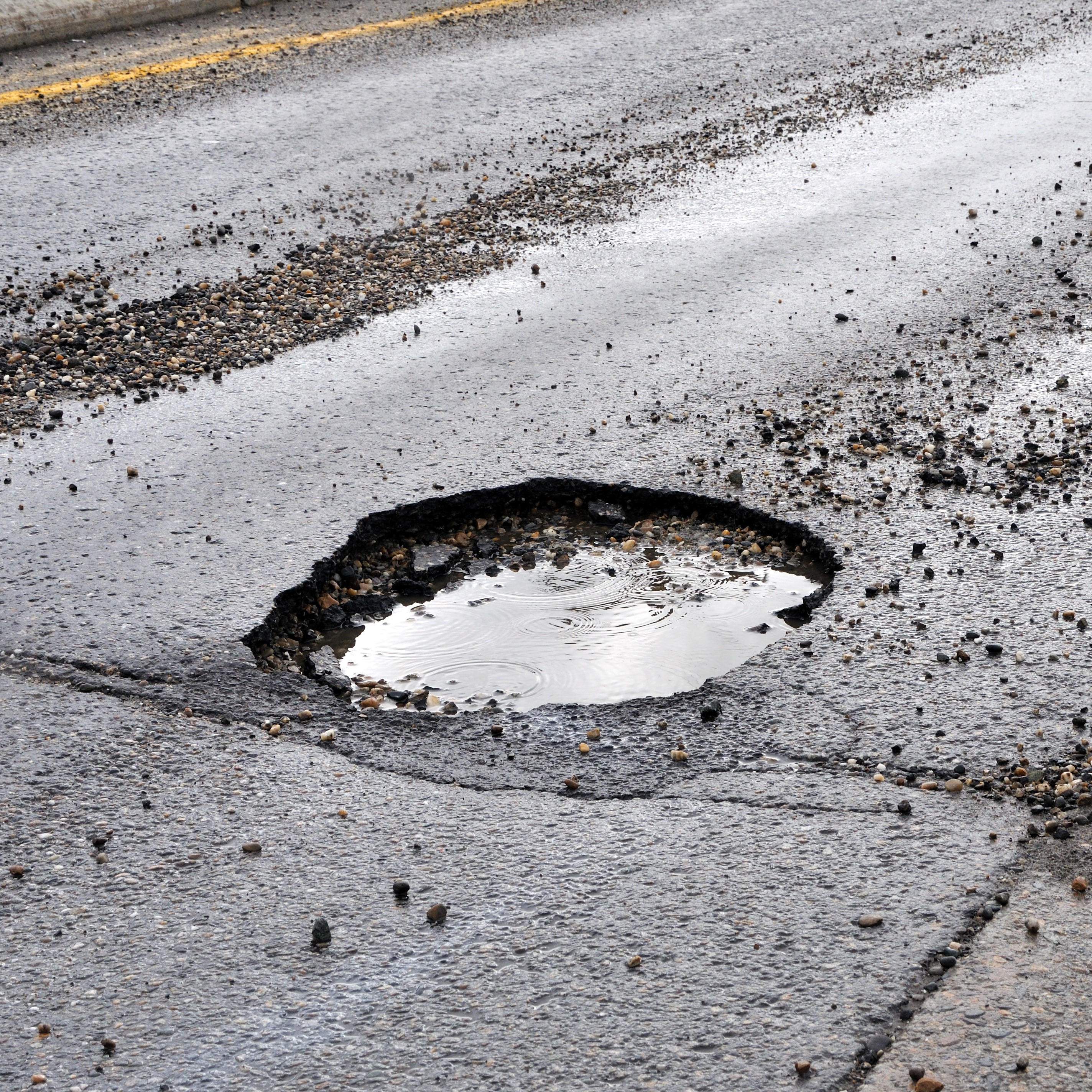
Potholes are holes in the road that usually get worse after freeze-thaw weather. Water gets in, freezes, and expands—then the pavement breaks. When it warms up, you often see more potholes.
Potholes form when water gets into pavement cracks, freezes and expands, and then thaws—breaking the road surface. Warmer temperatures after freeze-thaw cycles can accelerate damage and create more potholes. That’s why forecasts for milder weather often correlate with worsening road conditions.
freeze thaw
"Yes, sir. That freeze thaw, as we know, you know, the things melt, refreeze at night, and that water makes its way into those cracks on the roadway. It expands, separates the pavement."
When it gets cold, water in tiny cracks freezes and expands. When it warms up again, that weakened pavement breaks down faster and can turn into potholes.
Freeze-thaw cycles happen when water in pavement cracks freezes and expands, then thaws later. That expansion widens cracks and weakens the road surface, which accelerates pavement failure.
vibration
"Boy, I notice that the car's pulling this way or hearing a noise or I feel a vibration, something's different. So if you notice something different, need to have it looked at, that different feeling or noise or sensation is your warning."
If your car starts vibrating after hitting a pothole, something may be bent or damaged. It could be your tire/wheel or suspension parts, so it’s smart to get it checked.
Vibration after a pothole is a common sign of tire/wheel damage, bent components, or loss of balance. It’s also a clue that suspension or steering alignment may have changed, so inspection is warranted.
wheel alignment
"and you guys repair it, is there, what's the word, an alignment? Does that always happen after that kind of steering repair? Yes, so when you do replace some of those steering suspension tires even... you'll want to perform an alignment..."
An alignment makes sure your wheels are pointed the right way. After pothole or steering/suspension repairs, skipping alignment can make the car wear out tires faster and drive less smoothly.
After pothole damage or suspension/steering work, an alignment checks and adjusts the angles of the wheels so the car tracks straight. Without it, the vehicle can pull, handle poorly, and tires can wear unevenly or prematurely.
scan tool
"Once it's in that scenario, that situation, maybe take it to the shop, grab one of them, have them go for a ride, bring their scan tool. That's the key here."
A scan tool is a device a mechanic plugs into your car to “talk” to the computer. It can show error codes and sensor readings so they know what’s wrong.
A scan tool plugs into a car’s diagnostic port to read trouble codes and live sensor data. It helps a technician pinpoint what the computer is detecting and why the vehicle is acting up.
overdrive
"Something is happening where the computer is not happy, so it's put itself in a default where it's taken out of overdrive. So we need to figure out which component isn't reading what it wants to see and figure out what's causing that."
Overdrive is a gear that helps the engine spin slower when you’re cruising. If it gets disabled, your car may feel louder or rev higher than normal.
Overdrive is a higher gear ratio (typically used at steady speeds) that reduces engine RPM and improves efficiency. If the computer disables overdrive during a fault, the engine may run at higher RPM than usual.

2011 Toyota Avalon
"Hi, I have a 2011 Toyota Avalon. And the car, when I back up, it squeaks and makes a lot of noise, but it's intermittent."
They’re driving a 2011 Toyota Avalon. The squeak happens when they back up, and the mechanic is trying to figure out what part could be making the noise.
The caller’s car is a 2011 Toyota Avalon. In this episode, it’s used as the example for diagnosing an intermittent squeak when reversing.
corrosion
"There's a little bit of that corrosion on the rotor surface. We back up, we apply the brakes, we hear the squeaking, we start driving, it goes away."
Corrosion here refers to surface rust that forms on brake rotors when moisture sits on them. It’s especially common after the car sits overnight or during seasonal changes, and it can cause intermittent squeaks that improve after braking.
condensation
"That's not a problem that's very common, especially as the seasons change, we'll get a little more condensation there. If it's something that you're noticing when there's a load change..."
Condensation is water that forms when the air and surfaces cool down or warm up. More moisture can cause a little rust on the brakes, which can squeak at first.
Condensation is moisture that forms when temperatures change, such as during seasonal transitions. The host suggests more condensation can contribute to temporary rotor surface rust, leading to squeaks that go away after driving.
bushing
"...maybe we have a bushing or a grommet that's starting to dry up a little bit and that rubber's making some noise."
A bushing is a rubber or elastomer component that isolates vibration and allows controlled movement between parts. Drying or hardening can lead to squeaks or noises, especially when the vehicle’s forces change.
rear coil spring
"Texter says, I have a broken rear coil spring on my SUV. I can buy a new one online for almost $100 less than what the repair service quotes."
A coil spring is part of the suspension that helps support the car and smooth out bumps. If the rear one breaks, the back of the car can sit wrong and handle differently, so it usually needs a proper replacement.
A coil spring is a suspension component that supports the vehicle’s weight and helps control ride height and movement. A broken rear coil spring can affect handling and ride quality, and it’s important to replace the correct part for your exact vehicle.
job has to be redone
"Now the job has to be redone. We don't do it."
If the wrong part is installed, the shop may have to fix it again. That costs more time and money, which is why getting the exact correct part matters.
When the wrong suspension part is installed, the repair may need to be repeated to correct fitment or performance. Rework increases cost and time, and it’s one reason shops may prefer to source parts themselves.
rust proofing
"A tester has whatever happened to all the rust proofing services... What's the deal on rust proofing these days?"
Rust proofing is a treatment that helps stop your car from rusting. It usually involves putting a protective coating on spots that get hit by rain and road salt.
Rust proofing refers to applying protective coatings or treatments to a vehicle’s vulnerable areas (like underbody and wheel wells) to slow corrosion from moisture and road salt. The idea is to create a barrier that prevents rust from forming or spreading.
car wash
"I think there's a car wash on every street corner that we utilize a lot more. So we wash all that salt off..."
A car wash is a simple way to clean off dirt and salt from your car. In winter, washing helps keep salt from building up and causing rust.
Car washes are discussed here as a practical way to remove salt and grime from the vehicle. In winter climates, frequent washing helps reduce corrosion risk by clearing corrosive residue before it can sit and react with metal.
road salt
"So we wash all that salt off, which is a big part of that."
Road salt is what they spread on icy roads. It helps melt ice, but it can also make your car rust faster if it sits on the body.
Road salt is used on winter roads to lower the freezing point of water, but it also accelerates corrosion by promoting rust on exposed metal. That’s why washing the car soon after driving in salted conditions can reduce salt buildup.
wheel wells
"I can remember starting at the service station and a car would be a handful years old and there ought to be rust coming out of those, those wheel wells."
Wheel wells are the fender areas around your tires. They get a lot of road spray and salt, so they’re a common place for rust to start.
Wheel wells are the areas around the tires that collect road spray, dirt, and salt—making them common rust hotspots. The transcript’s mention of rust “coming out of those wheel wells” highlights how quickly corrosion can appear in older vehicles.
Lloyd's Automotive
"Welcome back to this portion of CCO's car care show. Denny Long here along with Nick Stoffel from Lloyd's Automotive in St. Paul."
This is the name of the auto shop Nick works with. When they mention it, they’re talking about a real place you could take a car for service.
Lloyd's Automotive is the shop Nick Stoffel is associated with on this segment. Listeners may want to know the local service provider being referenced when the hosts talk about tire, brake, and pothole-related issues.
Parkway AutoCare
"We do have two other locations. The first one is Parkway AutoCare, which is in the corner of Ford Parkway and Snelling."
This is another auto shop location they mention. They’re saying it’s near Ford Parkway and Snelling.
Parkway AutoCare is one of the additional locations mentioned for Lloyd’s Automotive. The hosts give a specific intersection, which helps listeners understand where this shop operates in the Twin Cities area.
Longfellow Automotive
"Then the most recent business that we purchased is called Longfellow Automotive, which is right at Lake Street in the river there in the Longfellow neighborhood."
This is the name of another auto shop they recently bought. They’re pointing out where it’s located in the Longfellow neighborhood.
Longfellow Automotive is described as the most recent business the hosts’ side purchased. The mention is relevant because it explains the shop’s expansion and where listeners can find service.
trade schools
"If you have grandchildren or children that have that interest, and getting into stuff and checking out how to fix this or how to fix that, there's some great schools, and it's a great career."
Trade schools teach job skills you can use right away. In the auto world, that usually means learning how to diagnose and fix cars with real tools.
Trade schools are programs focused on hands-on skills for specific careers, like automotive repair. For listeners, this is relevant because car care work often depends on practical training rather than a traditional four-year degree.
electric cars
"With all the electric cars, how has your business changed as far as being a mechanic? ... Well, the term grease monkey isn't quite what it used to be."
Electric cars are powered by batteries instead of gasoline engines. That means a mechanic’s job can change because the car systems are different and need different kinds of checks.
The rise of electric cars changes what a shop has to do because the powertrain and maintenance needs are different from gasoline vehicles. Mechanics often spend less time on engine-related work and more on high-voltage safety, battery health, and software/diagnostics.
grease monkey
"Well, the term grease monkey isn't quite what it used to be. I can share that with you for sure."
“Grease monkey” is an old nickname for a car mechanic. Today, a lot of the work is more about computers and diagnostics than just greasy repairs.
“Grease monkey” is a slang term for a mechanic, usually implying hands-on, dirty mechanical work. In modern shops, the phrase is less accurate because many jobs involve diagnostics, computers, and cleaner, more specialized systems.
cars rusting out and rotting out
"You know, we talked about cars rusting out and rotting out. And I would say that the components, not just the body of the vehicle have evolved."
Cars can slowly rust as they age, especially if they’re exposed to salt or moisture. The speaker is saying corrosion isn’t just about the outside body anymore—it can affect other parts too.
Rust and corrosion are major long-term failure modes for vehicles, especially in harsh climates or where roads are salted. The speaker notes that not only the body but other components have changed over time, which can affect how and where corrosion shows up.
computerization
"There's a lot more computerization, which is exciting. Seeing how we've refined and make maximizing the potential out of a vehicle is also really neat."
Modern cars use computers to control many functions. That means mechanics often use diagnostic tools to find problems instead of only relying on feel and sound.
Computerization refers to the increasing use of electronic control units (ECUs) and sensors to manage engine, drivability, and emissions. More computerization typically means more diagnostic work using scan tools and software rather than purely mechanical troubleshooting.
fuel economy
"You know, the fuel economy, horsepower is always a fun thing. So there's a lot of things going on there that make it exciting, interesting,"
Fuel economy is how far the car can go on a given amount of fuel. Better fuel economy usually comes from smarter control systems and more efficient designs.
Fuel economy is how efficiently a vehicle uses fuel, often improved through engine management, aerodynamics, and drivetrain calibration. The speaker groups it with horsepower as key metrics that make modern vehicles interesting to work on and tune.
horsepower
"You know, the fuel economy, horsepower is always a fun thing. So there's a lot of things going on there that make it exciting, interesting,"
Horsepower is a way to describe how much power a car’s engine can make. People talk about it because it relates to how strong the car feels when you drive it.
Horsepower is a measure of engine output and is commonly used to compare performance between vehicles. In a shop context, it often comes up alongside tuning, efficiency, and how modern electronics help maximize performance.
high-mileage vehicles
"Is that not unusual to people bringing their vehicles for service, not with 50,000, but maybe hundreds of thousands of miles? That's not so unusual anymore, is it?"
They’re saying it’s not unusual anymore to bring in a car or truck with a ton of miles. With the right care, vehicles can keep going for a very long time.
The discussion frames high mileage (hundreds of thousands of miles) as increasingly common for service customers. It highlights how modern vehicles can remain on the road longer when they’re maintained and repaired as needed.
maintenance
"So, you know, cars have changed. If you do the maintenance, you can keep them on the road for a really long time."
If you take care of a car with regular checkups and services, it usually lasts a lot longer. Skipping maintenance is what tends to cause expensive problems later.
The hosts are emphasizing that regular maintenance is what allows a vehicle to stay reliable for a very long time. In practice, that means keeping up with scheduled services so wear items don’t turn into major failures.
manual tire gauge pressure
"I can drive, I believe I can drive with that and just use the manual tire gauge pressure thing, but I want to get rid of the code."
The speaker is saying you can still check tire pressure manually with a gauge even if the TPMS warning light is on. Manual checks are useful for safety, but the underlying TPMS fault should still be repaired so the warning system works again.
Request an Explanation
Heard something you'd like explained? We'll add it to this episode.
Sign in to request explanations for terms you heard.
Want to learn more?
Browse our glossary for plain-English explanations of automotive terms, jargon, and concepts.
Help improve this episode
See something that's not quite right? Our annotations are AI-generated and can sometimes miss the mark. Click the flag icon on any annotation to suggest a correction.