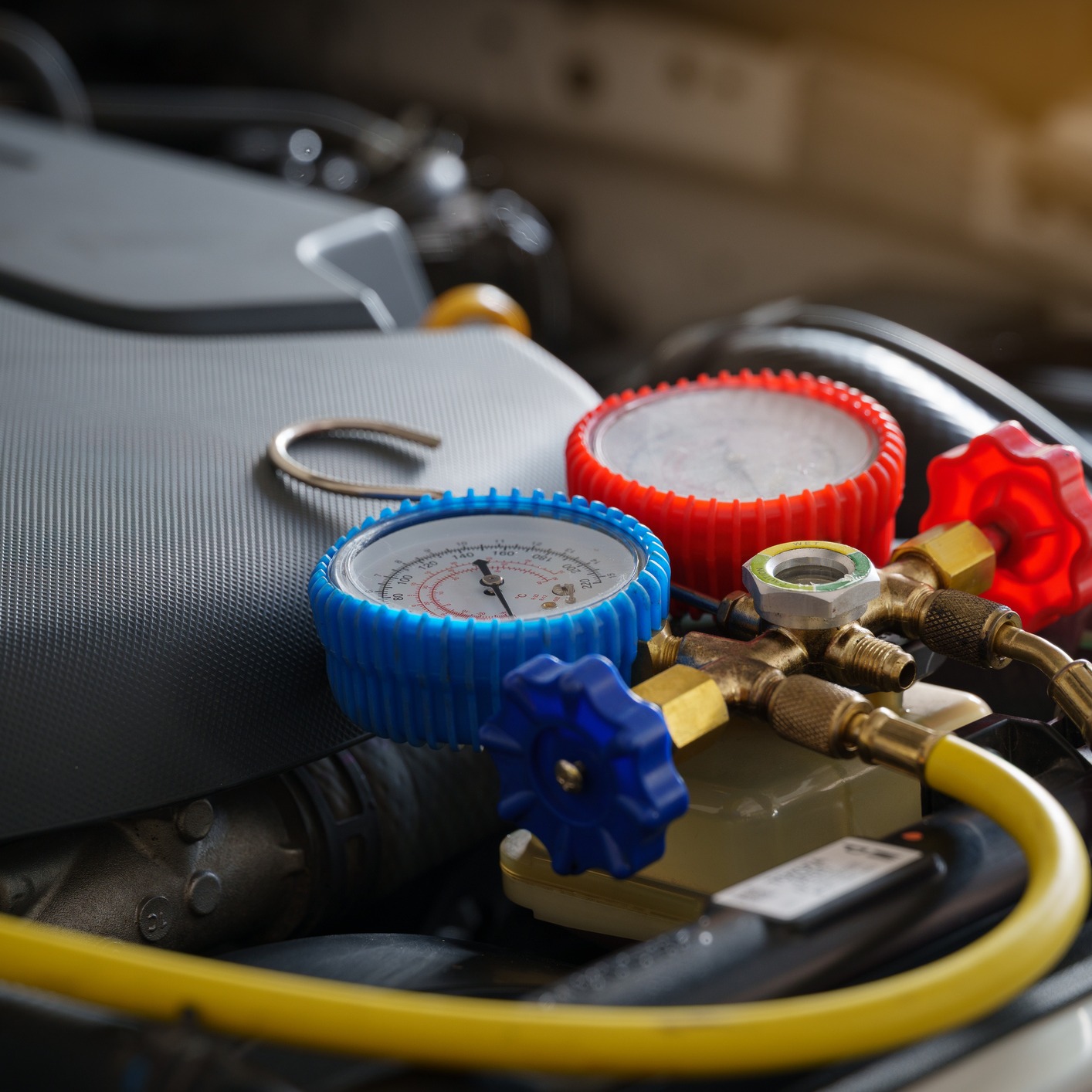
Keeping your A/C in check, hybrid engines, and more!
About this episode
Nick Stoppel from Lloyd’s Automotive walks through common summer A/C complaints and what’s actually normal. He explains why a steady drip near the passenger front wheel can be condensation from the HVAC drain, while wet passenger-side carpeting can signal a clogged drain box that may lead to mold. He also breaks down how A/C systems lose refrigerant over time, why proper diagnosis involves evacuating, weighing, and using dye to find leaks, and why “canned” refrigerant with sealant is often a bad idea. The show also touches on wheel bearing repacking on older vehicles.
air conditioning
"people call them, all people stop by that they think the car has a leak. And what it is, it's the condensation from us running the air conditioning to having a steady drip on the passenger side near the front wheel"
Car A/C doesn’t just cool the air—it also removes humidity. That water usually drips out under the car, so a little puddle or drip can be normal.
In a car, the air conditioning system cools the cabin and also removes moisture from the air. When it’s running, that moisture condenses and drains out of the vehicle, so a small drip can be normal.
drain
"There's a drain. And that drain lets it exit the vehicle onto the ground, like I said, by the passenger front right tire."
The A/C drain is the path that carries condensed water out of the cabin area and onto the ground. If the drain is blocked, water can overflow and leak into the passenger compartment instead of dripping outside.
HVAC system
"a lot of times those drains are part of the heating and cooling HVAC system. And that box can also collect some debris over years of use and time and age."
HVAC is the car’s heating and cooling system (plus the fan/airflow). If parts of it get clogged, water can back up and end up on the passenger floor.
HVAC stands for heating, ventilation, and air conditioning. In this context, the HVAC system includes the components and drain paths that manage both airflow and moisture, so clogged drains can cause water to leak into the cabin.
passenger floor
"my passenger floor is wet. What's going on here? Well, a lot of times those drains are part of the heating and cooling HVAC system... which can create mold."
If the passenger floor is wet, it often means water from the A/C system isn’t draining correctly. Leaving it wet can lead to mold, so it should be checked.
The passenger floor getting wet is a common symptom of a blocked or overflowing A/C drain or related HVAC drain components. It’s important because wet carpeting and insulation can promote mold growth.
mold
"you do need to have that dealt with because the lesson you want is a wet carpeting, wet insulation, which can create mold."
Mold is what can grow when the inside of the car stays wet. If the floor stays damp, it can become a health and odor problem.
Mold can grow when car interior materials like carpet and insulation stay damp for long periods. That’s why a water leak from the HVAC/A/C drainage needs to be addressed promptly.
cabin air filter
"When the cabin air filter, which is part of our regular maintenance, if that's neglected, that will get filled with stuff, cottonwood, stuff from the air, this filth, right?"
Your cabin air filter helps keep the air inside the car clean by filtering what comes through the vents. If it gets clogged, less air can move through, so the A/C or heater won’t feel as strong.
The cabin air filter is the filter inside a vehicle that cleans the air entering the HVAC system for the driver and passengers. If it’s neglected, it can clog with debris (like cottonwood and dust), restricting airflow and reducing heating and A/C performance.
refrigerant recharge
"And then as you mentioned, the refrigerant recharge know by design, the air conditioning system is sealed... over time... it starts to leak a little bit. Now, when that happens, we lose the recharge of the refrigerant, and then therefore the system doesn't work."
Refrigerant is the substance that makes your A/C actually cool. If it leaks out over time, the system can’t cool properly, so a shop may need to add the right amount back.
A refrigerant recharge is the process of adding the correct amount of refrigerant to the A/C system when it’s low. Because the system is sealed, leaks or component failures can slowly reduce refrigerant, causing the A/C to cycle oddly and cool inconsistently.
or-ring
"So over time, bumps and bruises and such have a lot of times we give about a weakness, a fatigued and o-ring, a component that can fail to the point where it starts to leak a little bit."
An O-ring is a small rubber seal that helps stop leaks. If it wears out, refrigerant can escape and your A/C won’t work right.
An O-ring is a rubber sealing ring used to prevent leaks at joints and connections. In an A/C system, a failing O-ring can allow refrigerant to seep out, leading to low refrigerant and inconsistent cooling.
evacuate the system
"Those situations, what we'd like to do is perform a series of tests. And what we're really trying to do is evacuate the system, determine the level of refrigerant that was in there."
Before refilling an A/C, a technician pulls out the old refrigerant and any unwanted air/moisture. That way the system can be charged correctly and work the way it should.
Evacuating the A/C system means removing refrigerant (and typically moisture/air) using a vacuum machine before recharging. This matters because the system needs the correct refrigerant amount and a clean, dry environment to work reliably.
tracer dye
"And the trick here is that we add a little bit of dye, a little tracer dye. So in the event that there is a leak... find that dye, and then you can pinpoint the source of the leak."
Tracer dye is a special additive that helps find where the A/C refrigerant is leaking. After the system runs, the dye shows the leak location so it can be fixed.
Tracer dye (often UV-reactive) is added to the A/C refrigerant so a technician can locate leaks later. After running the system, the dye circulates with the refrigerant and reveals the leak source.
sealant
"you buy one of those cans of that refrigerant with the sealant in it... those sealants can be extremely dangerous... it can plug up those ports or those little passages..."
Some A/C “recharge cans” include sealant, which is supposed to plug leaks. But if it doesn’t work as intended, it can block the A/C passages. That can make the air conditioner perform worse and cost more to fix.
A refrigerant sealant is an additive sold in “cans” meant to help stop leaks in an A/C system. The problem is that it can create clogs or restrictions in tight A/C passages, reducing refrigerant flow and cooling performance. That can turn a small leak issue into a larger repair.
undercharge
"And so if you overcharge it or undercharge it, it creates a whole different series of problems."
Undercharging means there isn’t enough refrigerant in the A/C system. When that happens, the air conditioner may not cool properly, and it can strain parts of the system. Again, it’s about getting the correct amount.
Undercharging an A/C system means adding too little refrigerant. With insufficient charge, the system may not reach proper pressures, so cooling performance drops and the compressor can be at risk. Like overcharging, it can create a cascade of A/C issues.
overcharge
"And so if you overcharge it or undercharge it, it creates a whole different series of problems."
Overcharging means you put in more refrigerant than the system is designed for. That can make the A/C act weird and not cool well, and it can even lead to bigger issues. The system needs the correct amount, not just “a can.”
Overcharging an A/C system means adding too much refrigerant. Because A/C performance depends on correct refrigerant charge, too much can cause abnormal pressures and reduced efficiency. It can also contribute to component stress and other failures.
weighing it and refilling it with the proper amount
"without removing what's in there, weighing it and refilling it with the proper amount, you're not going to get proper operation."
Instead of using a one-size-fits-all can, a proper A/C repair measures how much refrigerant the system actually needs. That helps the A/C work correctly and prevents adding too much or too little. It’s the more reliable way to recharge.
Correct A/C charging is done by measuring the refrigerant charge (often by weight) rather than guessing with a fixed-size can. This ensures the system gets the exact amount it needs for proper pressures and cooling. It also helps avoid the overcharge/undercharge problems mentioned.
evaporator
"when that refrigerant is running through the condenser or the evaporator, and that's where we get in the hot and the cold happening..."
The evaporator is the part inside the car that cools the air. Refrigerant passes through it and absorbs heat from the cabin. If flow is blocked, the A/C can’t cool as well.
The A/C evaporator is the heat-exchanger inside the cabin that absorbs heat from the air. Refrigerant flowing through it cools the air before it’s blown into the passenger compartment. If flow is restricted, the evaporator can’t absorb heat efficiently.
condenser
"when that refrigerant is running through the condenser or the evaporator... it can plug up those ports or those little passages, restrict and flow..."
The A/C condenser is the heat-exchanger that releases heat from the refrigerant to the outside air. The refrigerant flows through it, and if passages get restricted, the system can’t reject heat effectively. That leads to weak cooling.
wheel bearings repacked
"Nick, the first one says how important is it to have wheel bearings repacked in an old vehicle? Well, you don't hear that very often."
Wheel bearings help the wheel spin smoothly. “Repacking” them means taking them apart and putting in fresh grease so they keep working well instead of running dry or contaminated.
Repacking wheel bearings means removing the bearing from the hub, cleaning out old grease, and packing in fresh bearing grease. It’s a maintenance task that’s more common on older designs that aren’t sealed for life.
sealed assembly wheel bearing
"They started to make a sealed assembly wheel bearing, meaning that it didn't require maintenance. It was designed and built the last the life of the vehicle."
Some wheel bearings are built as sealed units, like a little grease-filled cartridge. Since they’re sealed, you typically don’t take them apart to add grease during normal maintenance.
A sealed assembly wheel bearing is a pre-assembled unit designed to keep grease inside and keep dirt/water out. Because it’s sealed, it’s intended to last the vehicle’s life and usually doesn’t get repacked like older bearings.
bearing grease
"the wheel bearings you actually take and pack new grease. And there's a little piece, a little tool that you can use that'll squeeze and force grease through that bearing to get the old grease out, good, fresh bearing grease into that."
Bearing grease is the lubricant inside the wheel bearing. Fresh grease helps the bearing spin smoothly and protects it from wearing out too fast.
Bearing grease is the lubricant packed into wheel bearings to reduce friction and protect metal surfaces from wear. Using fresh grease during repacking helps prevent overheating and premature bearing failure.
preload
"then we place the washer in the nut and kind of preload to get the right tension on it."
Preload is how “tight” the bearing is set when you put it back together. Getting it right helps the wheel spin smoothly and prevents extra wear.
Preload is the designed amount of tightness/force applied to a bearing when it’s assembled. Setting the correct preload helps ensure the bearing has the right internal clearance so it runs smoothly without being too loose or too tight.
shake down
"frequency, you know, advantage vehicle, I suppose it depends on how much is being driven, the condition, usually when we service those vehicles or when we use the service those vehicles, we do what we call like a shake down mean we're checking for loose steering and suspension components"
A “shake down” here means the mechanic checks the car for looseness by inspecting and moving key parts. It helps find problems early, like worn wheel bearings.
In this context, a “shake down” is an inspection routine where the technician checks for looseness in steering and suspension components. It’s used to catch issues like worn wheel bearings before they become more serious.
steering and suspension components
"we do what we call like a shake down mean we're checking for loose steering and suspension components, including the wheel bearings"
These are the parts that help the car steer and keep the wheels planted on the road. If something is loose or worn, the car can feel shaky or noisy, and the mechanic will check for that.
Steering and suspension components are the parts that control direction and manage wheel contact with the road. Loose or worn components can create symptoms like vibration, noise, and handling changes, and wheel bearings are included in that check.
free play
"we do what we call like a shake down mean we're checking for loose steering and suspension components, including the wheel bearings, if we notice excessive free play in those, we might recommend taking that apart"
Free play means there’s extra looseness you can feel or measure. If wheel bearings have too much free play, they’re likely worn and may need attention.
Free play is unwanted movement or looseness in a component beyond what’s normal. Excessive free play in wheel bearings is a sign of wear and can indicate the bearing needs to be serviced or rebuilt.
service interval
"So I would say I can't remember that. I want to say you should at 30,000 miles, but that seems [698.1s] almost like it was too long. If it's a vintage vehicle, you're driving it in the summer only, [703.3s] maybe it's every couple years when your service and they kind of take it apart and clean them up,"
A service interval is how often you’re supposed to do certain maintenance. For older cars, the schedule can change based on how much you drive and how you store it.
A service interval is the planned schedule for maintenance work, like when bearings or other components should be inspected, cleaned, or serviced. The right interval depends on how the vehicle is used and stored (for example, a classic driven only in summer).
letting that exhaust breathe
"you know, a couple of times a month at a minimum would be great because like we've talked in the [763.8s] past, you know, letting that exercise, letting that exhaust breathe, let those brakes warm up,"
The host is basically saying that if a car sits too long, the exhaust area can get stale or damp. Taking it out now and then helps keep things from getting worse while it’s parked.
This refers to the idea that periodically driving a car helps clear out moisture and stale conditions in systems like the exhaust. Even short drives can help keep components working and reduce issues that come from long periods of sitting.
hybrid engine
"And we do have another texture on the line here, Nick. Let's see. Can you explain how a [804.5s] hybrid engine works? When does the battery kick in and when is gas used? I was told that the battery"
A hybrid uses two ways to move the car: a gas engine and an electric motor. The car decides when to use the battery and when to use gas to keep performance and efficiency balanced.
A hybrid engine uses both an internal-combustion engine and an electric motor. Typically, the battery powers the electric motor for certain driving conditions, while the gas engine handles other situations—so the car can switch between power sources depending on speed, load, and battery state.
regenerative braking
"You know, there's regenerative braking, which means that we're slowing down. It's charging the battery."
When you slow down, the car can use the motion to make electricity instead of just using the brakes to create heat. That electricity helps recharge the battery.
Regenerative braking is how a hybrid or EV slows down while turning some of that motion back into electricity. That electricity is used to recharge the battery instead of wasting it as heat in the brakes.
drive cycles
"But it's going to depend on your drive cycles. If you're a lot more of an in-town driver, you know, last week, I think we"
Drive cycles are just how you drive day to day—stop-and-go versus highway cruising. Your hybrid’s computer reacts to that and chooses when to use gas or electricity.
A drive cycle is the pattern of driving—like how much time you spend accelerating, cruising, and stopping. Hybrid control systems use that pattern to decide when to run the combustion engine versus the electric motor and how aggressively to recharge the battery.
plug-in hybrid
"last week, I think we were talking about different types of hybrids in like a plug-in hybrid or the plug-in hybrid, typically that short charge, that, you know, six or eight mile charge you get on the overnight plug-in"
A plug-in hybrid is a hybrid you can charge by plugging it in. That lets it run on electricity for the first part of your trip, then it uses gas more later.
A plug-in hybrid (PHEV) is a hybrid that can be charged from an external power source, like an overnight plug-in. Because it starts with a higher battery charge, it can often drive several miles on electric power before the gas engine takes over more frequently.

2016 Ford Edge
"All right, next texture. I have a 2016 Ford Edge that just turned 100,000 miles. I'm going to have the powertrain fluids changed out."
The Ford Edge is a popular family crossover. At around 100,000 miles, people often debate how to service the transmission fluid—either a simple drain-and-fill or a more aggressive flush.
The Ford Edge is a mainstream crossover, and by 100,000 miles its drivetrain service schedule becomes a practical ownership question. In this segment, the focus is on whether to service the transmission with a drain-and-fill or a transmission flush.
transmission flush
"The shop is recommending a transmission flush. Most online opinions say a drain and fill is sufficient."
A transmission flush is when the shop tries to replace more of the old transmission fluid than just draining the pan. The goal is to get fresher fluid throughout the transmission.
A transmission flush is a service intended to exchange most or all of the transmission fluid in the system. Instead of only draining what’s in the pan, it pushes new fluid through so more of the old fluid is replaced.
powertrain fluids
"I'm going to have the powertrain fluids changed out. The shop is recommending a transmission flush."
Powertrain fluids are the fluids that help the car’s drivetrain parts work smoothly. In this case, the discussion quickly narrows to transmission fluid service.
Powertrain fluids are the lubricants and hydraulic fluids that keep the drivetrain components working—commonly including transmission fluid and other related fluids. The segment uses it as the umbrella term for what the owner plans to change at 100,000 miles.

Jeep Wrangler
"...about a coolant overflow container on a 2018 Jeep Wrangler. Those questions and more coming up after the bre..."
A Jeep Wrangler is a type of SUV that’s built for off-road driving. The coolant overflow container is part of the cooling system that holds extra coolant when the engine gets hot. If it’s discussed on a 2018 Wrangler, it’s usually because it helps keep the engine from running too hot.
The Jeep Wrangler is a rugged, off-road-focused SUV known for its simple, durable design and strong aftermarket support. In a car-care podcast, it often comes up because owners may deal with cooling-system components like overflow containers, especially on older model years such as the 2018. That’s why a discussion about a coolant overflow container can be important for preventing overheating and maintaining proper coolant levels.
coolant overflow container
"Coming up, we have a question about a coolant overflow container on a 2018 Jeep Wrangler. ... The coolant overflow container had to be replaced."
The coolant overflow container (also called the expansion tank) stores extra coolant as the engine heats up and expands. When the system cools down, it pulls coolant back in to maintain proper coolant level and pressure.
2018 Jeep Wrangler JL 3.6
"All right, Nick. We have a texter who says they have a 2018 Jeep Wrangler JL 3.6. The coolant overflow container had to be replaced."
This is a 2018 Jeep Wrangler (JL generation) with a 3.6-liter V6 engine. The question is about the cooling system—specifically the coolant overflow container—and why coolant might not drain normally when you open the radiator.
The Jeep Wrangler JL is the 2018-generation Wrangler, and the “3.6” refers to its 3.6-liter V6 engine. In this segment, the host discusses a coolant overflow container replacement and how coolant draining/refilling can be affected by trapped air.
radiator cap
"Now I need to replace the coolant, but when I open the radiator Peccock, nothing drains out. What's going on? ... Try removing the overflow cap with the radiator Peccock open."
The radiator cap controls the cooling system’s pressure and provides the sealed opening used for draining and refilling. If the cap is opened incorrectly or while the system is pressurized, you can get confusing results—like coolant not draining as expected.
vacuum
"I'm thinking maybe there's a little bit of a vacuum there. It's created having the one drain open at the bottom and the one source at the top open allow the air to work its way in, allow the coolant to work its way out."
In a cooling system, a “vacuum” can form when coolant is drained or when caps/valves are opened in a way that traps air. That vacuum can prevent coolant from flowing out until air can enter through the correct openings.
bleeding it out
"then when you refill it, look online, find the procedure for bleeding it out. The hardest thing people have ... you get an air pocket somewhere"
“Bleeding it out” is the process of removing trapped air from the cooling system after draining/refilling. Air pockets reduce coolant circulation, which can lead to poor cabin heat and uneven engine cooling.
air pocket
"The hardest thing people have ... you get an air pocket somewhere, and that air pocket can create a blockage, we'll call it, from the coolant working its way through."
An “air pocket” is a trapped bubble of air inside the cooling system that disrupts coolant flow. The host explains that it can create a blockage, preventing coolant from reaching parts of the system.
bleed all the air out of the system
"So, make sure you look online or find a resource to follow the procedure to bleed [1114.4s] all the air out of the system."
Bleeding means getting trapped air out of the cooling system. If air is trapped, coolant can’t circulate well, and the car may not cool properly.
“Bleeding” is the process of removing trapped air from a closed fluid system so the fluid can circulate properly. Air pockets can block coolant flow, which can cause overheating or poor temperature control.
check valve
"there might be a check valve that you can open to let some air out. So, just do a little research"
A check valve is like a one-way door for fluid. It helps keep coolant moving the right way, and it can be involved in procedures to get air out.
A check valve is a one-way valve that allows fluid to move in one direction while helping prevent backflow. In some service procedures, opening or manipulating a check valve can help release trapped air from the system.
electronic key
"I have a 2017 Honda Accord and it has an electronic key that allows you to lock and unlock the door [1148.5s] and open the trunk and so on."
An electronic key is the wireless fob you use to lock/unlock the car and open the trunk. If it fails, it might just need a battery—or it might need repair or reprogramming.
An electronic key (often a key fob) is a wireless transmitter that communicates with the car for functions like locking/unlocking and trunk release. When it stops working, the cause can be as simple as a weak battery or as involved as internal damage or required programming.
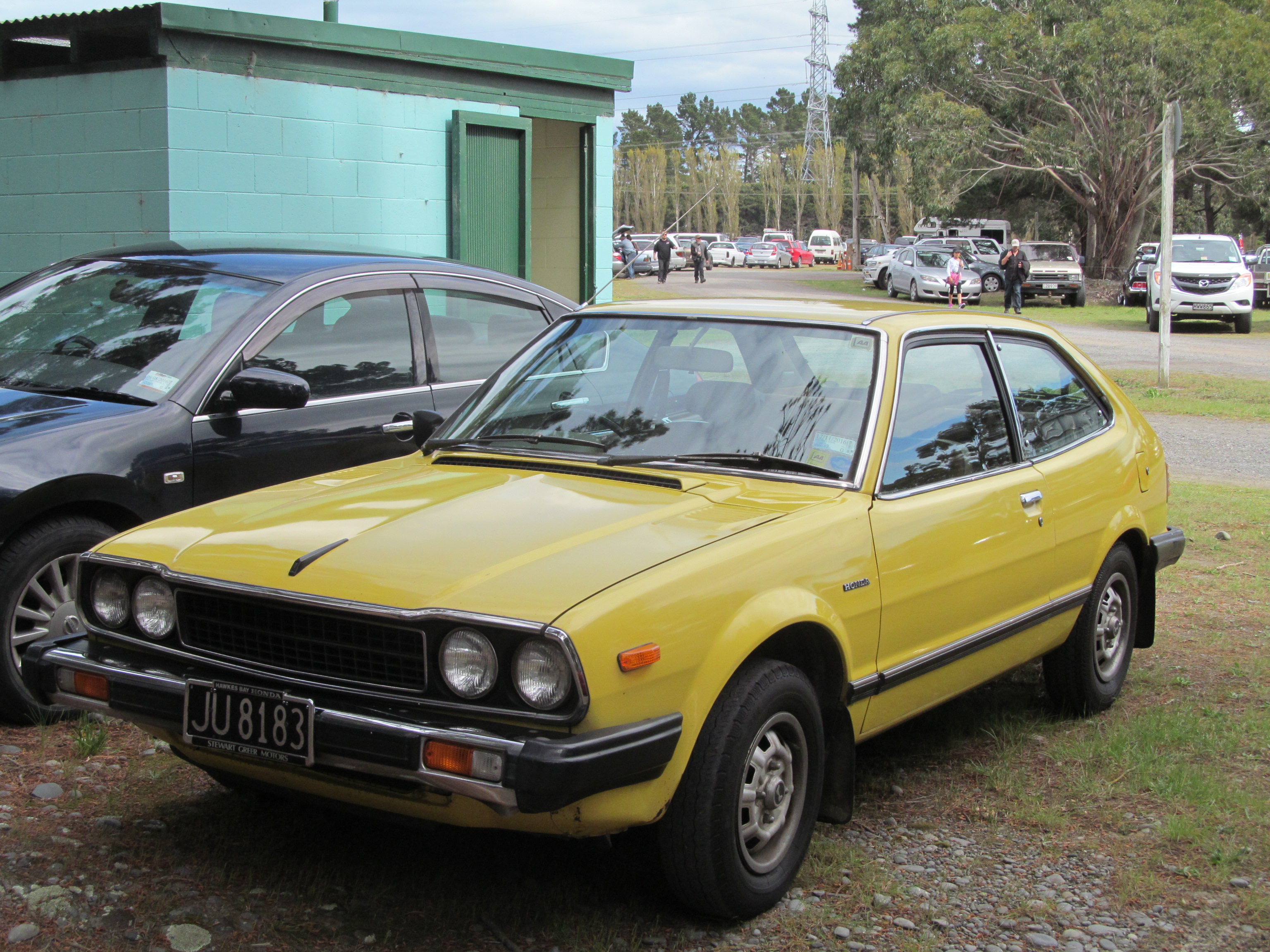
2017 Honda Accord
"I have a 2017 Honda Accord and it has an electronic key that allows you to lock and unlock the door [1148.5s] and open the trunk and so on."
This is a 2017 Honda Accord, and the caller’s issue is with the electronic key/key fob. The discussion is about whether a dealer replacement price is reasonable and what you can try before replacing the whole fob.
The Honda Accord is a mainstream midsize sedan, and this 2017 example is discussed specifically for its keyless entry “electronic key” (key fob). The episode focuses on why a dealer replacement can be expensive and what alternatives to try first.
key fobs
"I know those fobs can be very expensive. A lot of the costs, [1205.5s] if you look at the breakdown, might be to do with programming and initializing it"
Key fobs are the handheld transmitters used for keyless entry. They can fail due to battery depletion, water intrusion, corrosion, or internal electronic wear, and replacement costs often include programming to match the vehicle’s security system.
programming and initializing
"A lot of the costs, [1205.5s] if you look at the breakdown, might be to do with programming and initializing it to get it [1208.9s] made it up to your vehicle."
Programming is what makes the new key fob work with your specific car. The car has security rules, so it has to be set up to recognize the new fob.
Programming and initializing are the steps a dealer or locksmith performs to pair a replacement key fob with the car’s immobilizer/security system. Even if the hardware is new, the car still needs to recognize it before it will work.
security process
"Obviously, there's a security process there so that might have some [1213.7s] added cost."
The security process is the car’s anti-theft system that checks whether a key is allowed. That’s why replacement keys often need special setup to work.
The security process refers to the immobilizer/key authentication steps that prevent unauthorized keys from starting or operating the vehicle. Because of this, replacement keys often require dealer-level procedures rather than being plug-and-play.
aftermarket ones
"There are some aftermarket ones that you can get. I would caution there because you [1219.6s] can save some money, but you might not have the same quality or durability."
Aftermarket key fobs are cheaper third-party replacements. They might work, but quality and compatibility can be hit-or-miss, and you may still need setup.
Aftermarket key fobs are non-OEM replacements sold by third parties. They can be cheaper, but they may vary in durability and may not always integrate as smoothly with the car’s security/programming requirements.

2011 Rogue
"Is that I had the oil changed and I've had my tires rotated and balanced. It's a 2011 Rogue. I don't know what it was. It hasn't happened again, but what caused that or is it an issue?"
A 2011 Rogue is a Nissan SUV. The caller says it made a whistling sound while driving and then the car would quit when they pressed the brake at a stoplight, then start again later.
The Nissan Rogue is a compact crossover SUV, and the 2011 model is from the first generation of the Rogue. In this segment, the host is discussing a drivability issue (whistling noise and stalling) that happened in a warm-hot environment and then went away.
oil changed
"Is that I had the oil changed and I've had my tires rotated and balanced. It's a 2011 Rogue."
An oil change is when the shop replaces the engine oil. It keeps the engine lubricated, and in this call it’s mentioned because it happened around the same time as the problem.
An oil change is scheduled maintenance where the engine oil is replaced to remove contaminants and maintain lubrication. It’s mentioned here because the caller had it done before the issue, which helps the mechanic rule out recent work as the cause.
tires rotated and balanced
"Is that I had the oil changed and I've had my tires rotated and balanced. It's a 2011 Rogue."
Tire rotation moves tires to different positions on the vehicle to promote even tread wear. Tire balancing ensures the wheel/tire assembly spins smoothly by correcting weight imbalances—both are common service items the caller had done before the symptom appeared.
whistling noise
"Now, a whistling noise is a lot of times, if it's whistling itself, it's air. As we whistle ourselves, we're blowing through our mouths and creating a whistling sound. Something to do with the air intake, something with air working its way through the vehicle can make a whistling noise."
A whistling sound usually points to air moving where it shouldn’t or air flowing through a restriction. The important part is noticing when it happens (speed, temperature, driving situation) so the mechanic can find the cause faster.
A whistling noise in a car is often related to airflow—such as air moving through the intake system or a leak/obstruction that changes airflow. The host suggests it can be caused by something like a blockage or something shifting, and that the conditions when it happens are key diagnostic clues.
air intake
"Something to do with the air intake, something with air working its way through the vehicle can make a whistling noise."
The air intake is how the car pulls air in to feed the engine. If something blocks it or lets air leak in the wrong way, the car can make strange noises and may run differently.
The air intake is the path and components that bring outside air into the engine (or into the engine’s air system) for combustion and related functions. If airflow is restricted, blocked, or leaking, it can create unusual sounds like whistling and can affect how the engine runs.
diagnostic charge
"I would like to hear about what the cost is for having a problem diagnosed. Is it charged by the hour and is the diagnostic charge deducted from a repair when it is done?"
A diagnostic charge is what you pay when the mechanic spends time testing to figure out what’s wrong. The caller is asking whether that fee gets credited if you later do the repair.
A diagnostic charge is the fee a shop charges to investigate a problem—often using inspections and test procedures to identify the cause. Some shops apply the diagnostic fee toward the eventual repair, while others treat it as a separate cost.
scan tool
"What's factual is we plug our scan tool or our computer into the vehicle. It gives us data. It gives you a code."
A scan tool is a device a mechanic plugs into your car to see what the computer is reporting. It can show error codes and real-time sensor readings so they can diagnose the problem instead of guessing.
A scan tool is a diagnostic device that connects to a car’s onboard computer to pull stored fault information. It’s commonly used to read trouble codes and live sensor data so a technician can figure out what’s actually wrong.
trouble codes
"It gives us data. It gives you a code. It can give you readings of voltages, temperatures, pressures, all kinds of things."
Trouble codes are standardized diagnostic messages stored by the vehicle’s computer when it detects a fault. They help technicians narrow down the system (engine, emissions, hybrid systems, etc.) and then confirm the cause with additional tests.
voltages
"It can give you readings of voltages, temperatures, pressures, all kinds of things."
Voltages are electrical measurements that can indicate whether sensors, actuators, and wiring are operating within expected ranges. Diagnostic scan data often includes voltage readings to confirm power/ground and signal integrity.
temperatures
"It can give you readings of voltages, temperatures, pressures, all kinds of things."
Temperatures in scan data are sensor readings used to verify thermal conditions like coolant or intake temperatures. If a temperature sensor is wrong—or if a system isn’t reaching expected temps—it can point to the underlying fault.
pressures
"It can give you readings of voltages, temperatures, pressures, all kinds of things."
Pressures are measured quantities from sensors (like fuel, boost, or HVAC-related pressures) that indicate whether a system is operating correctly. Diagnostic readings of pressure help confirm whether the fault is mechanical, electrical, or control-related.
throwing parts at it
"you spend a little extra money properly diagnosing the vehicle versus doing what we call throwing parts at it,"
"Throwing parts at it" is a troubleshooting approach where a shop replaces components without confirming the root cause. It often wastes money because multiple parts can cause similar symptoms, and the real failure may be elsewhere.
Request an Explanation
Heard something you'd like explained? We'll add it to this episode.
Sign in to request explanations for terms you heard.
Want to learn more?
Browse our glossary for plain-English explanations of automotive terms, jargon, and concepts.
Help improve this episode
See something that's not quite right? Our annotations are AI-generated and can sometimes miss the mark. Click the flag icon on any annotation to suggest a correction.