
To upgrade your smartphone or not? That is the question!
About this episode
Vodafone’s regional coverage and roaming experience take center stage, with talkback callers weighing in on whether network upgrades are actually changing day-to-day life. The discussion then pivots to the smartphone upgrade question: whether premium phones feel similar, how Apple ecosystem and messaging apps affect switching, and when battery replacement makes more sense than buying new. CarPlay and aftermarket infotainment come up too—especially slow factory screens, wiring vs wireless setups, and using split-screen maps for rural driving.
embargo dropped
"you might have seen this morning at 6.10am, the embargo dropped on the all electric Ferrari Luce."
An embargo is like a “don’t talk about it yet” rule for reporters. When the embargo drops, it means the news is finally allowed to be published.
An “embargo” is a media restriction that prevents journalists from publishing details about a new product until a specific time. When the host says the embargo “dropped,” it means the press was allowed to share information about the Ferrari Luce.
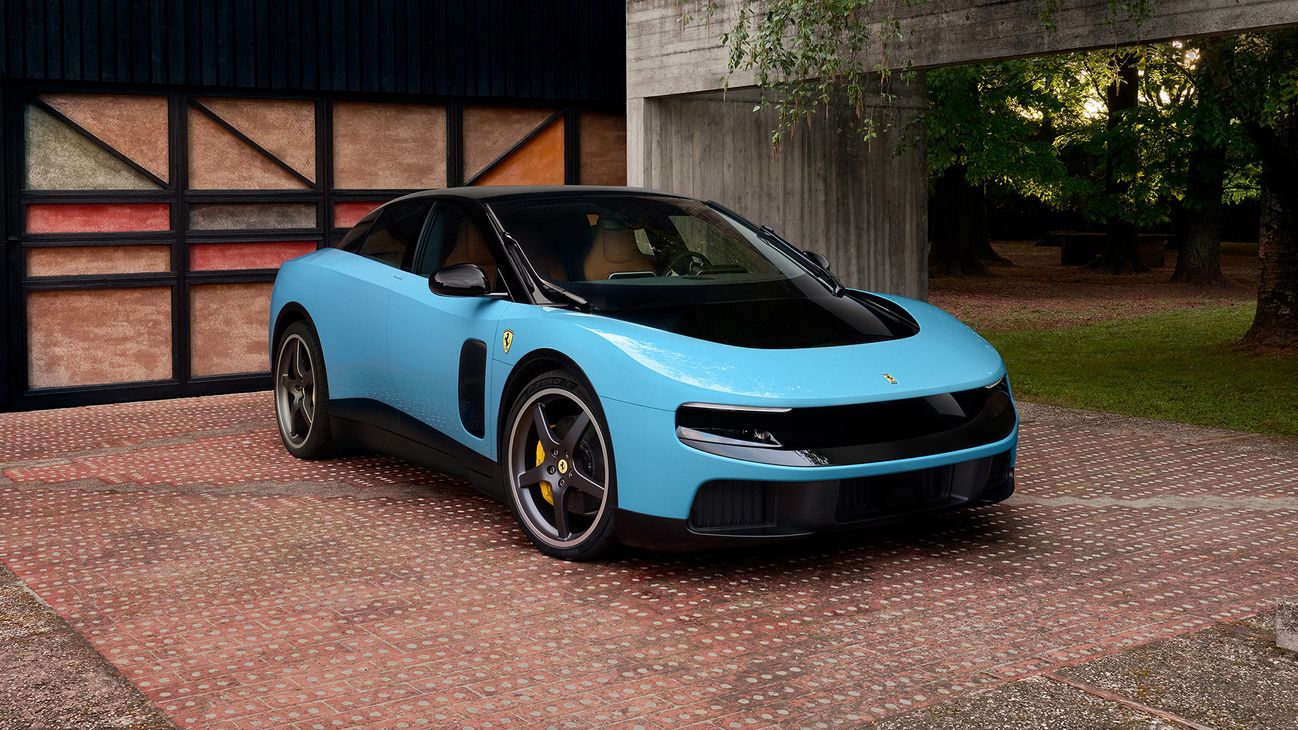
Ferrari Luce
"the embargo dropped on the all electric Ferrari Luce. This is the car I went and saw the kind of underpinnings of in Maranello last year with Ferrari."
Ferrari Luce is a Ferrari that runs on electricity instead of gasoline. The hosts are talking about it because it’s a big new reveal and people are debating how much it will cost.
Ferrari Luce is described as an all-electric Ferrari, meaning it’s powered by electric motors instead of a traditional internal-combustion engine. The episode frames it as a major new Ferrari product reveal, with listeners reacting to its rumored price and the fact that Ferrari is moving into full EV territory.
Maranello
"This is the car I went and saw the kind of underpinnings of in Maranello last year with Ferrari. And today they have shown the car."
Maranello is where Ferrari is based in Italy. The host is saying they saw parts of the new car’s engineering there before it was officially shown.
Maranello is the home of Ferrari’s headquarters and main production operations in Italy. The host mentions seeing the “underpinnings” of the Ferrari Luce there, tying the reveal to Ferrari’s internal development and engineering culture.

Porsche Taycan
"The Porsche Taycan is several 100000 dollars, as should this thing be, because it's a Ferrari."
The Porsche Taycan is an electric Porsche. The host brings it up to compare prices, basically saying that if the Ferrari Luce is that expensive, it wouldn’t be totally out of line with other top EVs.
The Porsche Taycan is Porsche’s all-electric performance sedan, and it’s used here as a pricing benchmark for the rumored cost of the Ferrari Luce. Mentioning the Taycan highlights that high-end EVs can already reach very high price points.
invited to buy
"The best of all Ferraris, you can't just turn up and buy. You have to be invited to buy them."
They’re saying Ferrari doesn’t always sell its most desirable cars like a normal dealership would. Instead, you may need an invitation or a special relationship with the brand to buy one.
The host is describing Ferrari’s allocation-style sales approach, where certain high-demand cars aren’t available through normal walk-in purchasing. Instead, buyers are selected or invited based on factors like prior ownership and relationship with the brand.
daily driver
"No, no, no, no. This is the potential daily driver Ferrari, although at a million bucks it's insane."
A daily driver is a car you’d use all the time for normal errands and commuting. Here, they’re saying this Ferrari is meant to be that kind of car, not just a rare collectible.
A daily driver is a vehicle intended to be used regularly for everyday trips rather than only for weekend track days or special occasions. In this context, the host is arguing that this Ferrari is meant to be usable day-to-day, even if the price is extreme.
modern electric Ferrari
"This is the car that says Ferrari, but says modern electric Ferrari. This is the car that a Ferrari, and I guarantee when the reviews come out, it's going to be a staggering."
This means a Ferrari that’s powered by electricity instead of a gas engine. The hosts are saying it might still drive like a Ferrari, but it won’t sound the same as the traditional ones.
“Modern electric Ferrari” refers to Ferrari’s shift toward an electric powertrain while trying to preserve the brand’s driving feel. The key idea is that an EV can still be tuned for handling and responsiveness, even if it won’t produce the classic Ferrari exhaust sound.
center of gravity
"This will handle like a Ferrari. This will handle beautifully on the road because of its center of gravity."
Center of gravity is basically where the car’s “weight balance point” is. If it’s lower, the car tends to feel more stable and easier to control when turning.
Center of gravity is the point where a car’s weight effectively acts. A lower center of gravity usually improves handling by reducing body roll and making it easier for the tires to keep grip during cornering.
how it will be received overall
"And it won't sound like a Ferrari, but it will sound unlike anything ever before. And that could be a game changer for the industry. So it's going to be fascinating to see how it's genuinely received overall."
They’re talking about whether people will like and accept this new Ferrari when reviews come out. It’s about overall reaction, not just what it looks like.
This is the segment’s discussion focus on whether the new Ferrari concept will be accepted by the public and reviewers. It frames the conversation around reception, not just specs or styling.
infotainment screen
"The center infotainment screen has a handle in front of it. You can just push and twist so it faces the passenger,"
An infotainment screen is the big touchscreen in the car. It’s where you control things like music, maps, and phone features.
An infotainment screen is the main in-cabin display that combines functions like navigation, media, phone integration, and vehicle settings. It’s a key part of modern car user experience and often reflects how “driver-focused” a brand wants to feel.
CarPlay
"I think you sent us a message about Wallace Android or Capital CarPlay? That's correct, yes. What are you looking at, and what advice can I give, if any? Well, I've got an IH35... but it's not a CarPlay or Android, but it's very slow."
CarPlay is a way to connect an iPhone to your car’s screen. It brings phone apps like maps, calls, and music into the car’s interface.
CarPlay is Apple’s in-car system that lets you connect an iPhone to the car’s infotainment screen. It typically provides a simplified interface for navigation, calls, and music, and it can feel faster and more responsive than older built-in systems.
Android
"Well, I've got an IH35... it's got the original map on there, but it's not a CarPlay or Android, but it's very slow."
They mean Android Auto, which is Google’s system for connecting an Android phone to the car. It shows compatible apps on the car screen so things work more smoothly.
In this context, “Android” refers to Android Auto—Google’s in-car platform that mirrors compatible phone functions onto the vehicle’s display. Like CarPlay, it’s meant to provide a more modern, phone-like interface than older factory infotainment.
original map
"and she's got the original, it's a 2015, it's got the original map on there, but it's not a CarPlay or Android, but it's very slow."
“Original map” implies the car is using its factory navigation data from when it was new. Older map databases can be slower to load and can also be outdated, which is why owners sometimes consider upgrading the infotainment system or adding CarPlay/Android Auto.
Waze
"So that the speed sign on Waze or Google, whatever you're using, appears in the bottom bottom right of screen, which is, you know, closer to the driver. Do you use Waze or Google?"
Waze is a GPS/navigation app that uses real-time info from other drivers. The speaker likes it because it can give heads-up alerts during a trip.
Waze is a navigation app that uses live traffic and community-reported information to suggest routes. In this segment, the speaker specifically values it for alerts while driving in rural areas.
"So that the speed sign on Waze or Google, whatever you're using, appears in the bottom bottom right of screen, which is, you know, closer to the driver. Do you use Waze or Google?"
Google Maps is a GPS navigation app that helps you get directions. The speaker is comparing it to Waze for how the information shows up while driving.
Google Maps is a navigation service used for route planning and turn-by-turn directions. Here it’s mentioned alongside Waze as another app that can display a speed-related sign on-screen.
Apple Maps
"And we use that with car play with Waze and Apple Maps, because we're Apple people."
Apple Maps is Apple’s GPS/navigation app. In this segment, it’s mentioned as another map app the speaker uses through the car’s connected display.
Apple Maps is Apple’s navigation app, used here as part of the speaker’s in-car setup via CarPlay. The point is that different map apps can be routed through the car’s screen for easier viewing while driving.
Bluetooth
"You pair them to Bluetooth. They kick in the wireless car play and then it's done."
Bluetooth is the wireless connection your phone uses to talk to your car. Pairing is the one-time setup that lets your car recognize your phone.
Bluetooth is a short-range wireless connection used here to pair the phone with the car’s system. Pairing is what lets the head unit recognize your phone so features like wireless CarPlay can start automatically.
head unit
"So actually the head unit, the 10-inch unit, only needs power."
The head unit is the main screen in the dashboard that controls things like music and phone features. It needs power to work.
The head unit is the car’s main infotainment/control screen and electronics (audio, media, and connectivity). In this segment, they’re emphasizing that the 10-inch head unit mainly needs electrical power to run.
12-volt power
"only needs power. So you only need to provide it with a little 12-volt power."
Cars usually run on a 12-volt electrical system. This means the device can be powered by tapping into the car’s normal 12V power instead of needing a special power source.
Most cars use a 12-volt electrical system, so accessories like an aftermarket head unit are typically powered from that system. The key point here is that the device doesn’t require a special high-voltage supply—just a connection to the car’s 12V.
auxiliary cable
"either an auxiliary cable, or you can tune it to the, like the FM,"
An AUX cable is a simple wire that carries audio from your phone to your car’s stereo. It’s one way to get the sound from CarPlay playing through the car speakers.
An auxiliary (AUX) cable is a wired audio connection that sends sound from a phone or adapter into the car’s audio system. In this context, it’s one of the ways to route CarPlay audio to the car speakers.
FM
"or you can tune it to the, like the FM, a little FM output normally they have to allow you to..."
FM is the normal radio band your car can tune to. Some setups can broadcast the phone’s audio over FM so you hear it through your car speakers.
FM refers to frequency modulation radio. Here, they’re describing an alternative audio-routing method: using an FM transmitter/output so the CarPlay audio can be received by the car’s radio on a chosen FM frequency.

Dodge Challenger
"...'ve been advocating hard for that because we're a challenger in this space and we want to advocate for consume..."
The Dodge Challenger is a performance car made by Dodge. It’s known for having strong acceleration and a sporty, loud style, and it’s built for people who want a fun driving experience.
The Dodge Challenger is a classic American muscle car built for straight-line performance and a bold, retro-inspired design. It’s often discussed in car podcasts because it represents a long-running performance formula—big power, comfortable daily usability, and a strong enthusiast following. If it came up in a conversation about “challenging” or standing out in a category, the name also naturally ties to that theme.
Request an Explanation
Heard something you'd like explained? We'll add it to this episode.
Sign in to request explanations for terms you heard.
Want to learn more?
Browse our glossary for plain-English explanations of automotive terms, jargon, and concepts.
Help improve this episode
See something that's not quite right? Our annotations are AI-generated and can sometimes miss the mark. Click the flag icon on any annotation to suggest a correction.