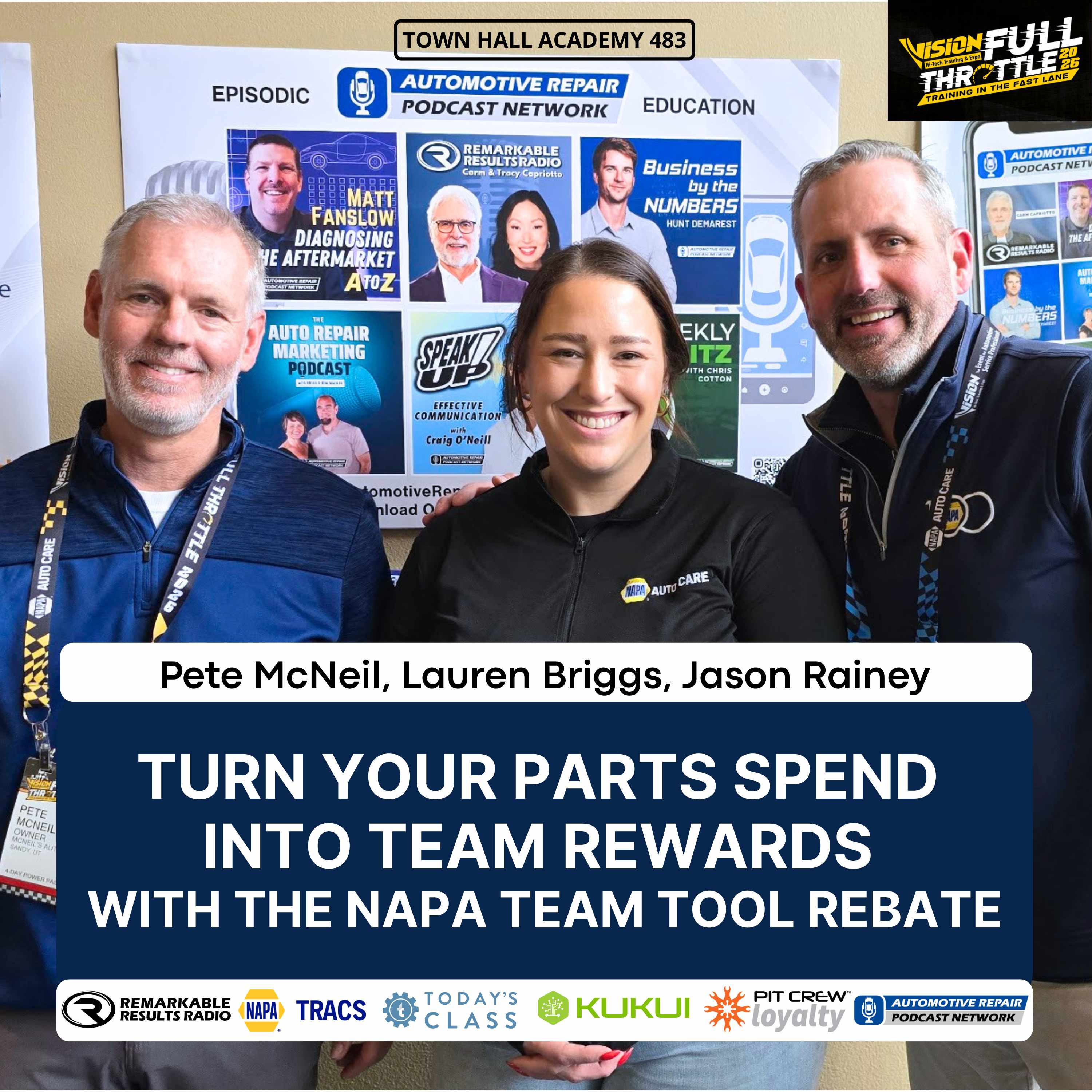
Turn Your Parts Spend Into Team Rewards with the NAPA Team Tool Rebate [THA 483]
About this episode
A NAPA Team Tool Rebate conversation turns into a practical look at how shops used the money to support technicians, strengthen culture, and even recruit for the future. One shop owner explains splitting the rebate across the team, treating it as earned rather than a holiday gift, and letting technicians choose tools that would make their jobs easier. The hosts also reflect on the first-year rollout, noting both the excitement and the communication lessons they want to improve next year.
Recorded live at the VISION 2026, host Carm Capriotto sits down with shop owner Pete McNeil and NAPA Auto Care leaders Jason Rainey and Lauren Briggs to break down the impact of the NAPA Team Tool Rebate program. Listen to a powerful real-world example of how the program can energize a team, strengthen culture, and reward performance in meaningful ways.
What You’ll Learn
- How the NAPA Team Tool Rebate program helps offset the high cost of technician tools while building a stronger shop culture
- How Pete McNeil turned a $13,000 rebate into a memorable, morale-boosting experience
- Why the shift from “tech tool rebate” to “team tool rebate” gives owners flexibility to reward the entire team, not just technicians
- Creative ways shops can use rebate funds, from individual tool purchases to shared equipment, and even community support like vocational schools
- How the program aligns the front and back of the shop, encouraging team-wide support of purchasing decisions
- What’s ahead for the program, including improved tracking, communication, and enhanced buying power through supplier partnerships
The NAPA Team Tool Rebate program is more than a financial incentive; it’s a strategic tool for building culture, driving alignment, and showing appreciation in a tangible way. When used intentionally, as demonstrated by Pete McNeil, it can transform routine business spending into a powerful investment in people, boosting morale, loyalty, and long-term shop success.
VISION Hi-Tech Training and Expo: https://visionkc.com/
Pete McNeil, McNeil’s Auto Care, Sandy and Riverton, UT. Pete’s previous episodes HERE
Lauren Briggs, Sales & Marketing Director. NAPA Auto Care. Lauren’s previous episodes HERE
Jason Rainey, Vice President NAPA Auto Care. Jason’s previous episodes HERE
Thanks to our Partner, NAPA TRACS NAPA TRACS will move your shop into the SMS fast lane with onsite training and six days a week of support and local representation. Find NAPA TRACS on the Web at http://napatracs.com/ Thanks to our Partner, Today's Class Optimize training with Today's Class: In just 5 minutes daily, boost knowledge retention and improve team performance. Find Today's Class on the web at https://www.todaysclass.com/ Thanks to our Partner, KUKUI Stop juggling multiple marketing tools. KUKUI’s integrated platform delivers 4x better website conversions, automated follow-up, and real-time ROI tracking. Get industry-leading customer support with KUKUI at https://www.kukui.com/ Thanks to our Partner, Pit Crew Loyalty You’re probably tired of chasing new customers who never return. We understand. Pit Crew Loyalty ends the one-and-done cycle, turning first visits into lasting, reliable revenue at https://www.pitcrewloyalty.com/ Connect with the...shop management system
"Hey, for over 30 years, Napa Tracks has made selecting the right shop management system easy"
A shop management system is the computer software a repair shop uses to keep track of work. It helps with things like scheduling jobs, writing estimates, and sending invoices.
A shop management system (SMS) is software that helps an auto repair shop run daily operations. It typically supports estimating, job tracking, scheduling, invoicing, and sometimes inventory and customer communication.
NAPA Tracks
"We'll prove to you that Tracks is the single best shop management system in the business. Find Napa Tracks on the web at N-A-P-A-T-R-A-C-S dot com."
NAPA Tracks is software for auto shops. It helps the shop organize and manage day-to-day work in one place instead of using lots of separate tools.
NAPA Tracks is a shop-management software product promoted by NAPA. It’s positioned as a centralized system to help automotive businesses run operations and manage shop workflows more efficiently.
Kukui
"Kukui's integrated platform, they deliver four times better website conversions, automated follow up and real time ROI tracking. Get industry leading customer support with Kukui."
Kukui is a marketing tool for businesses. The pitch is that it helps turn website visitors into customers, sends follow-up automatically, and shows how well marketing is working.
Kukui is presented as an integrated marketing platform for automotive businesses. In the segment, it’s used to drive website conversions, automate follow-up, and track marketing performance in real time.
website conversions
"Kukui's integrated platform, they deliver four times better website conversions, automated follow up and real time ROI tracking."
Website conversions are the “good actions” people take on your website, like signing up or requesting service. More conversions usually means more potential customers.
Website conversions are actions visitors take that indicate they’re moving toward becoming customers, such as filling out a form or requesting service. In marketing for auto shops, higher conversion rates typically mean more leads from the same amount of traffic.
automated follow up
"Kukui's integrated platform, they deliver four times better website conversions, automated follow up and real time ROI tracking."
Automated follow-up means the system sends messages to people automatically after they show interest. It helps you reach them quickly instead of waiting for someone to remember.
Automated follow-up refers to marketing messages sent automatically after a customer interaction, such as after a website inquiry. The intent is to contact leads promptly and consistently without relying on manual outreach.
real time ROI tracking
"Kukui's integrated platform, they deliver four times better website conversions, automated follow up and real time ROI tracking. Get industry leading customer support with Kukui."
Real-time ROI tracking means you can see how much money your marketing is bringing in while it’s happening. ROI is basically a “did this spend pay off?” score.
Real-time ROI tracking means measuring return on investment as marketing campaigns run, using up-to-date data. ROI (return on investment) compares what you spend to what you get back, helping shops decide which marketing efforts are actually paying off.
pit crew loyalty
"You're probably tired of chasing new customers who never return. We understand pit crew loyalty ends the one and done cycle turning first visits into lasting reliable revenue."
“Pit crew loyalty” here just means getting customers to come back. The idea is to turn a first visit into a long-term relationship.
“Pit crew loyalty” is a marketing metaphor in this segment, suggesting that customers should return and keep using the shop rather than making a single visit. It’s framed as turning first-time visits into repeat business.
one and done cycle
"We understand pit crew loyalty ends the one and done cycle turning first visits into lasting reliable revenue on the web at pitcrewloyalty.com."
A “one and done cycle” means customers come once and then stop coming back. The pitch is about changing that so customers return.
The “one and done cycle” describes a business pattern where customers visit once but don’t return. The segment contrasts this with strategies aimed at repeat visits and ongoing revenue.
Napa AutoCare
"Hello VP, Napa AutoCare and a million other things that you said yes to of late."
Napa AutoCare is a NAPA program that supports auto repair shops and technicians. The episode is basically saying NAPA offers more than just parts—it also supports how repairs are done.
Napa AutoCare is a NAPA-branded program/service focused on auto repair and maintenance support, often tied to technician training and shop operations. In this episode, it’s mentioned as part of the broader NAPA ecosystem the host is promoting.
Auto tech training
"Yeah. Auto tech training. Yeah, tracks."
Auto tech training is learning for mechanics—how to diagnose problems and fix cars correctly. The episode is highlighting that training as part of the bigger NAPA/industry push.
Auto tech training refers to structured education for automotive technicians, typically covering diagnostics, repair procedures, and new technology. The hosts mention it as a key area they’ve been discussing or promoting.
extended reality
"And so it's all about this whole new rebirth, intelligent, forward-moving, thinking, extended reality, augmented reality, all this stuff."
Extended reality (XR) is a way to use digital tech to make what you see feel more immersive—like adding computer graphics to the real world. In car training, it can help people understand repairs or systems more clearly.
Extended reality (XR) is an umbrella term for immersive technologies that blend the real world with digital content. It includes augmented reality (AR) and virtual reality (VR), and it’s increasingly used for training and visualization in automotive contexts.
augmented reality
"And so it's all about this whole new rebirth, intelligent, forward-moving, thinking, extended reality, augmented reality, all this stuff."
Augmented reality (AR) adds helpful computer graphics on top of what you’re already looking at. For mechanics, it can show instructions or parts information while they work.
Augmented reality (AR) overlays digital information—like labels, diagrams, or guidance—on top of the real-world view. In automotive training or repair, AR can help technicians visualize components, steps, or diagnostics while looking at the actual car.

Buick Century
"...his entire concept of moving into truly the 22nd century by involving the level of education"
The Buick Century is a mid-size car that was made by Buick. It was designed mainly for comfortable everyday driving, like commuting and family trips. People might mention it when talking about older cars and how cars used to be built and used.
The Buick Century is a mid-size sedan produced by Buick, positioned as a comfortable, family-oriented car for everyday driving. It’s often discussed in automotive history because it represents how American automakers designed mainstream vehicles for comfort and practicality during its production years. In a podcast, it may come up as an example of an older, more traditional approach to transportation and education-era life.
22nd century
"of moving into truly the 22nd century by involving the level of education through technology like you are"
They’re using “22nd century” to mean “really advanced and futuristic.” It’s a dramatic way to say car technology is moving fast.
The “22nd century” is used as a rhetorical way to emphasize how advanced and future-focused the technology in cars has become. It’s not a literal claim about the calendar—more about the pace of automotive tech.
rolling computers
"Cars are technical sensors, rolling computers. And now you're actually taking the technology"
They’re saying cars today are basically computers on wheels. Sensors collect information, and the car uses software to decide what to do next.
“Rolling computers” is a metaphor for modern cars being packed with electronic control units (ECUs) and sensors. Instead of being purely mechanical, many vehicle functions are managed by software that reads sensor data and controls systems accordingly.
technical sensors
"Cars are technical sensors, rolling computers. And now you're actually taking the technology"
Sensors are the car’s “sense organs.” They measure conditions and send that info to the car’s computer so it can adjust how the vehicle runs.
“Technical sensors” refers to the many sensors in a vehicle that measure things like temperature, pressure, wheel speed, and engine conditions. Those readings feed the car’s electronic systems so they can adjust operation in real time.
team tool rebate
"[255.0s] You're here so that you can tell us [257.1s] what's going on with the team tool rebate. [259.1s] Yeah. [259.5s] I mean, it was amazing getting to see"
A “team tool rebate” is basically a deal where a shop gets money back at the end of the year. That money can be used to buy tools and motivate the mechanics who work there.
A “team tool rebate” is a promotional program where a shop gets money back (often after spending on eligible parts or services) that it can use to buy tools and reward employees. In this episode, it’s framed as a year-end incentive that supports technicians and helps shops plan for the next year.
recruitment tool
"[261.2s] what a lot of our shop owners were able to do [264.0s] for their current technicians that are in their shop [267.1s] and they're using it as a recruitment tool [269.2s] to going into 2026."
A “recruitment tool” is anything a business uses to bring in new workers. In this case, the shop uses the rebate to offer better tools and incentives so technicians want to join and stay.
A “recruitment tool” is something a business uses to attract new employees. Here, the shop owners use the rebate-funded tools and rewards to make their workplace more appealing to current and prospective technicians.
Carlisle
"and the launch of this new Carlisle program [346.9s] and all of that,"
They mention Carlisle as the company running a new program. The key idea is that it’s a parts-industry promotion tied to how rewards or funds get handled.
Carlisle is referenced as the organization behind a “new…program.” In automotive retail contexts, Carlisle-type programs are usually manufacturer or supply-chain initiatives that support parts sales and customer incentives.
distribute the funds
"So how do you distribute the funds? [371.0s] How do you communicate the funds? [372.6s] How do you work through all of our sellers?"
They’re talking about how the rebate money gets handed out. It’s basically the process of deciding who gets the reward and when.
“Distribute the funds” refers to how incentive money is allocated once a rebate or program pool is created. In parts retail, this often involves rules for eligibility, timing, and which participating sellers or locations get credit.
communicate the funds
"[371.0s] How do you communicate the funds? [372.6s] How do you work through all of our sellers? [375.0s] Like it was a lot."
They also mention the need to clearly explain the rebate. That means telling people how it works and how they’ll get the reward.
“Communicate the funds” describes the operational side of incentive programs: explaining to sellers and participants how the rebate works, what actions trigger rewards, and how/when they’ll see the money. Clear communication is critical to program adoption and avoiding confusion.
work through all of our sellers
"How do you communicate the funds? [372.6s] How do you work through all of our sellers? [375.0s] Like it was a lot."
They’re describing the challenge of coordinating the program across many participating stores. It’s about making sure each store’s sales and rewards are tracked correctly.
“Work through all of our sellers” implies coordinating an incentive across multiple participating retailers or locations. For rebate programs, this typically means managing eligibility, tracking purchases, and ensuring each seller’s participation is properly recorded.
Venom Green
"[422.1s] and just Carlisle, Venom Green everywhere, [425.9s] Milwaukee tools, the wall tool. [427.8s] I mean, it was just-"
Venom Green sounds like a specific branded look/color they saw on the tools. They’re describing how noticeable the rewards were in the photos.
Venom Green appears to be a branded color or product line used on tools/equipment in the promotion photos. The speaker uses it like a recognizable visual theme (“everywhere”) to describe how prominent the rewards looked in the shops.
Milwaukee tools
"[422.1s] and just Carlisle, Venom Green everywhere, [425.9s] Milwaukee tools, the wall tool. [427.8s] I mean, it was just-"
Milwaukee is a tool brand. They’re saying the rebate helped shops get Milwaukee tools that teams could use and show off.
Milwaukee is a well-known power-tool brand, and here it’s mentioned as part of the tool rewards shops were using/displaying. The point is that the rebate program translated into tangible, recognizable equipment for teams.
communications in all the layers
"[449.4s] Now we know how we can apply to that. [452.7s] These are communications in all the layers, [455.1s] the toughest thing."
They’re talking about making sure the rebate message reaches people at every level in the shop. It’s not just one email or one person—it’s getting the info through the whole team.
“Communications in all the layers” refers to ensuring the message about the rebate/tool program reaches everyone involved—front-line shop staff, managers, and any other stakeholders. The speaker frames it as a multi-level execution challenge rather than a single announcement.
reward program
"[617.7s] When we found out that there was going to be some type of incentive... [625.0s] Our rep came in from our distribution center and let us know that the reward program indeed took place."
They’re talking about a program that gives rewards when you buy parts. They’re excited because the program was actually happening.
The hosts discuss a reward program tied to parts spending, including how they learned it was active and how the team used it. It’s essentially the incentive mechanism behind the episode’s theme.
distribution center
"[625.0s] Our rep came in from our distribution center and let us know that the reward program indeed took place."
A distribution center is a big warehouse that holds parts and sends them out when orders come in.
A distribution center is a warehouse facility where inventory is stored and then shipped out to stores or customers. In parts retail, it’s where parts are staged before delivery to the shop.
pico scope
"One bought a pico scope. Yeah. And those are the game changers, right?"
A PicoScope is a diagnostic tool that “shows” electrical signals from the car. Instead of just reading codes, it helps a mechanic see what the sensors and wiring are doing.
A PicoScope is a brand of automotive diagnostic oscilloscope. It lets technicians view electrical signals (like sensor waveforms) in real time to diagnose issues that a basic scan tool can’t show.
shop workflow optimization
"a representative consults with you [879.7s] to help optimize your shop's workflow, [882.4s] efficiency and profitability."
They’re talking about making an auto repair shop run more smoothly. That means organizing the work better so jobs get done efficiently and the shop can make more money.
The segment discusses improving how an auto repair shop runs day-to-day—how work moves through the shop, how efficiently jobs are handled, and how that affects profitability. It’s framed as something a local representative helps configure.
learning management system
"Yes, a learning management system tailored [901.3s] to each role in your company."
A learning management system is a digital training platform. It helps a company assign training to different employees and keep track of what they’ve completed.
A learning management system (LMS) is software used to deliver, organize, and track training content for employees. In this segment, it’s described as tailored to each role within the shop.
mobile first websites
"One login, one dashboard and mobile first websites that convert four times industry average."
Mobile-first means the website is built to be easy to use on a phone first. That matters because many people look up and book car service from their phones.
Mobile-first websites are designed to work primarily on phones, with the layout and features built for smaller screens first. Since many customers search and book from mobile devices, this can improve conversion rates for service scheduling.
industry average
"...mobile first websites that convert four times industry average. Smart, innovative CRM with automated follow up..."
They’re comparing their results to what most other shops usually get. It’s a way of saying “we do better than the typical average.”
“Industry average” is a benchmark used to compare performance against what’s typical across similar businesses. In this ad-style claim, it’s used to suggest their websites convert more customers than the typical shop’s results.
CRM
"Smart, innovative CRM with automated follow up, 24 seven online booking and real time ROI tracking."
CRM is software that helps a shop keep track of customers. It can also send follow-up messages automatically so customers don’t fall through the cracks.
CRM stands for customer relationship management. In auto repair, a CRM helps track customer interactions and can automate follow-ups (like reminders after an estimate or service) to improve repeat business.
online booking
"...24 seven online booking and real time ROI tracking. With 900 plus years of combined team experience..."
Online booking lets customers schedule their car service on the internet. It can mean fewer phone calls and more appointments because customers can book whenever they want.
Online booking is the ability for customers to schedule service through a website or app. For repair shops, it can reduce phone load and help fill appointment slots by making it easier for customers to book at any time.
ad spend
"most shop owners feel trapped spending on ads while half their first time customers never come back."
Ad spend is what the shop pays for ads to get customers. The point here is that loyalty can reduce how much you have to rely on ads.
Ad spend is the money a business spends on advertising to attract customers. The segment contrasts paying for ads with the goal of improving repeat visits so the shop doesn’t need to keep increasing ad budgets.
lifetime value
"Our clients cut that rate by up to 38%, raising lifetime value by more than 50%."
Lifetime value is basically how much money a customer is expected to bring in over time. If customers keep coming back, that number goes up.
Lifetime value (often shortened to LTV) is the total profit a business expects to earn from a customer over the entire time they stay a customer. In this context, improving customer loyalty increases LTV because customers return more often.
predictable revenue
"creating predictable revenue without extra ad spend."
Predictable revenue means the shop can expect more steady income. If customers keep coming back, the business isn’t starting from scratch every month.
Predictable revenue means the business can reasonably forecast income because customers return consistently. Loyalty programs and higher visit frequency make cash flow less dependent on new ad-driven customers.
shop's on board
"now everybody on the shop's on board because now the process is in place, right?"
They’re saying the whole shop is agreeing to follow the new process. Once everyone is on the same page, it’s easier to track spending and talk about how to improve.
This refers to getting the whole repair shop aligned with a new process—tracking purchases and using the results to guide conversations and decisions. It’s a change-management topic rather than a technical automotive concept.
technician team
"No doubt our technician team, knowing what they received is absolutely going to impact their support and commitment, both on the part side and on the tool side, right?"
They’re talking about the mechanics/repair techs in the shop. The idea is that when techs get the right parts and tools, they’re more motivated and more invested in the work.
The “technician team” refers to the people doing the hands-on repair work in the shop. The segment emphasizes that what technicians receive (parts and tools) affects their support and commitment.
service writers and service managers
"the parts purchases and the decisions that are made in the shop are done by the technicians, the service writers and the service managers. You're running the business, right?"
They mention two shop roles: the service writer who handles the paperwork and customer requests, and the service manager who runs the shop day-to-day. The point here is that these roles influence what gets bought and how the shop operates.
Service writers and service managers are key roles in an auto repair shop. Service writers handle customer communication and write up repair orders, while service managers oversee workflow, staffing, and shop operations.
front of shop, back of shop
"I don't know if it was Peter, you Jason said, front of shop, back of shop. Okay, the connectivity there and why it's important that there's a pull and a push."
“Front of shop, back of shop” means the customer side of the business versus the mechanic side. They’re talking about how the two areas need to work together.
The phrase “front of shop, back of shop” refers to separating customer-facing operations from the technician work area. The discussion ties this to “connectivity” and workflow—how information and incentives move between areas.
pull and a push
"Okay, the connectivity there and why it's important that there's a pull and a push. Are any of your service writers in this?"
They’re describing a two-way workflow. One part brings needs forward (“pull”), and the other part sends work or updates along (“push”) so the shop runs smoothly.
“Pull and push” describes two-way operational flow: pulling work or information forward based on demand, and pushing tasks or updates through the shop process. In service operations, it’s about keeping technicians supplied and communication moving.
technicians
"It's only technicians, I think I heard you say. Yeah, we purposely made sure it was to support the technicians."
Technicians are the mechanics who work on the car. They’re the ones doing the diagnosis and repairs, not the people handling customer paperwork.
Technicians are the people who actually diagnose and repair vehicles. In the context of shop operations, they’re the ones who use tools and equipment to perform the work described on the repair order.
shop owners
"that have an awful lot of shop owners out there that have two allowances and or something for their people."
“Shop owners” are the people who run an auto repair business. They’re the ones who decide how to spend money on parts and how to reward their team.
In this context, “shop owners” refers to people who run automotive repair or parts businesses. They often manage employee incentives and purchasing programs for parts and tools.
October through September
"And then for year two and on, it'll be October through September. They paid an October. It's nice because the owner needs to get it and know what it is and figure out what to do with it."
They’re talking about how the program counts its year. Instead of January–December, it runs from October to September, so the rebate rules depend on those dates.
This is describing a shop program’s operating year, where the “year” runs from October to September instead of the calendar year. That matters because rebates, credits, or eligibility windows are often tied to these program dates.
tool credit
"You know, guys, we do do a tool credit for our technicians, you know, we do it in a ticket format and we have a couple of tool trucks that they're allowed to redeem that."
A tool credit is like a store credit or voucher for tools. Instead of technicians paying everything out of pocket, the shop gives them credit they can use through a ticket system.
A “tool credit” is an internal or program-based amount of money/credit given to technicians for tools, rather than paying cash directly. The segment says it’s handled “in a ticket format,” implying a voucher-like process tied to purchases.
ticket format
"...we do it in a ticket format and we have a couple of tool trucks that they're allowed to redeem that."
They’re saying the credit is handled using a ticket or voucher. That makes it easier to track who gets what and to let certain vendors redeem it.
“Ticket format” here likely means the credit is issued and tracked using a ticket or voucher system. That usually helps a shop control eligibility, documentation, and redemption with specific vendors (like tool trucks).
tool trucks
"...we do it in a ticket format and we have a couple of tool trucks that they're allowed to redeem that. That's still going to go on."
Tool trucks are sales vans that come to shops with tools for people to buy. Here, they’re also the places where technicians can use their credit to get tools.
“Tool trucks” refers to mobile sales routes where tool brands/vendors bring inventory to shops for in-person purchasing and redemption. In this segment, they’re the approved channels where technicians can use the tool credit/rebate.
warranties
"So your warranties are going to go through the road. [1598.2s] So I have this really wild thought. [1601.2s] Anybody on their wish list, buy something for home"
They’re talking about warranties, meaning the promise that a product or repair will be covered if something goes wrong. The discussion suggests the program helps shops buy items that are warranty-backed.
In this segment, “warranties” appears to refer to warranty coverage tied to parts or repairs. The speaker implies that the rebate/reward program is part of how shops manage or encourage purchases that come with warranty-backed products.
service managers, service writers
"And that's why even with some shops [1626.0s] that elected to have service managers, service writers to it, [1629.0s] they did use that as a way to buy Christmas presents for dad."
These are job roles at a car repair shop. One person usually handles customer requests and paperwork for repairs, and another oversees how the shop runs so the work gets done.
“Service manager” and “service writer” are common roles in an auto repair shop. The service writer typically talks with customers and writes up repair orders, while the service manager oversees workflow, staffing, and job completion.
starter
"Like there's nothing sexy about a starter and alternator, right? Text like, OK, I got to have it."
The starter is the part that helps your engine start. It’s what “cranks” the engine when you press the start button or turn the key.
A starter is the electric motor that cranks the engine to get it running. When you turn the key or press the start button, the starter engages the engine’s flywheel until the engine starts and takes over.
alternator
"Like there's nothing sexy about a starter and alternator, right? Text like, OK, I got to have it."
The alternator keeps your car’s battery charged and powers the electrical stuff while you drive. If it goes bad, the battery can run down and the car may stall.
An alternator is the generator that powers the vehicle’s electrical system and recharges the battery while the engine is running. If it fails, the battery can drain quickly because the car no longer makes electricity on its own.
Wichita
"But you dropped the latest and greatest Carlisle, [1726.9s] Wichita or Milwaukee tool. [1729.0s] They go bananas over it."
Wichita is mentioned like a tool brand. The hosts are talking about different tool makers people like to buy.
Wichita is referenced here as part of a tool brand or tool line (paired with Milwaukee), suggesting a specific maker people associate with quality tools. The context is shopping for tools, not vehicle repair.
supplier creativity
"And I think it's all about the creativity of what you can do [1761.7s] with your supplier. [1763.0s] And every once in a while, I think we look at things as black [1764.9s] and white and they're really colorful."
They’re talking about working with a supplier in a creative way—using the relationship to make buying parts/tools more rewarding for the team.
The hosts discuss using a supplier relationship creatively—finding ways to turn parts/tool purchasing into something more engaging (like rewards or team incentives). It’s a business/marketing idea rather than a technical automotive concept.
Request an Explanation
Heard something you'd like explained? We'll add it to this episode.
Sign in to request explanations for terms you heard.
Want to learn more?
Browse our glossary for plain-English explanations of automotive terms, jargon, and concepts.
Help improve this episode
See something that's not quite right? Our annotations are AI-generated and can sometimes miss the mark. Click the flag icon on any annotation to suggest a correction.