A chief operating officer is the executive who focuses on running the company’s day-to-day operations. The hosts mention this because Mark Winterhoff used to be in that job at Lucid.
Mark Winterhoff is mentioned as the interim CEO of Lucid. Before that, he was the company’s COO, and the hosts say that role was removed after the new CEO arrived.
A vehicle recall is when an automaker asks owners to return vehicles to fix a safety or compliance problem. Recalls can be expensive and can also affect customer trust and production schedules, especially for smaller EV brands.
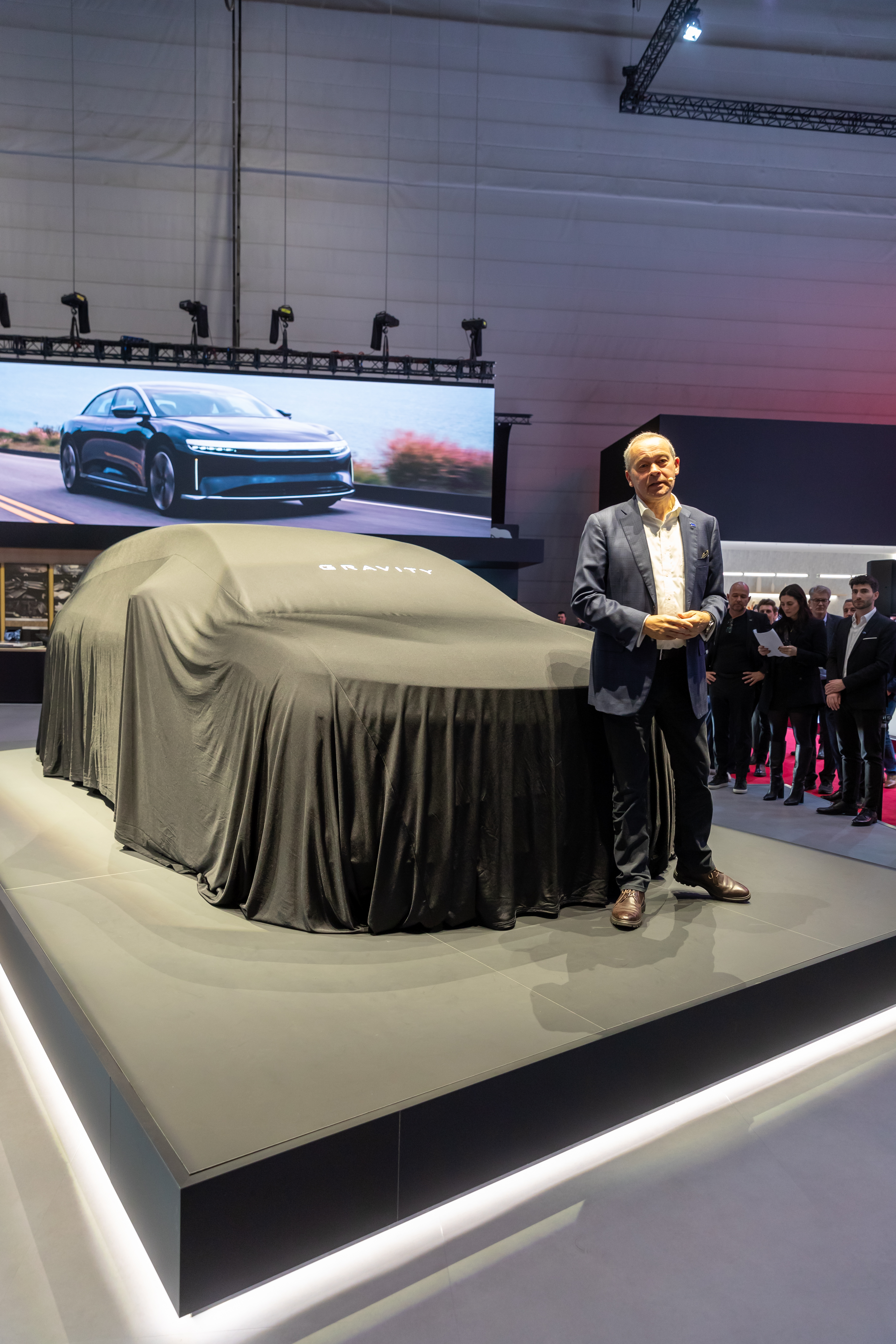
The Lucid Gravity is Lucid’s electric SUV. In this part, the host says it won a “luxury car of the year” award for 2026, which helps Lucid’s image—especially in Saudi Arabia.
AMP2 is mentioned as a new Lucid factory site in Saudi Arabia. It matters because building more capacity can help a company produce cars and stabilize its business.
The Lucid Air is one of Lucid’s electric cars (a sedan). Here it’s mentioned as a model whose “good stuff” Lucid wants to reuse when building the Cosmos.
Lucid Cosmos is a new electric car from Lucid that the host expects to be priced much lower than some of their other models. They also talk about when and where it would start being built and sold.
Car
Lucid Sapphire
Lucid Sapphire is a more expensive Lucid EV model mentioned as an example of a vehicle that would be unnecessary for low-stakes municipal tasks. The host contrasts its price with the idea that a cheaper model like gravity/Cosmos could still do the job.
Uber is working with Lucid on an autonomous ride-hailing (RoboTaxi) plan. The host is highlighting that this could mean a large number of Lucid EVs being bought for Uber’s service.
A RoboTaxi deal is basically a contract to provide cars for self-driving ride services. The host is saying Uber could buy a lot of Lucid EVs for that kind of service.
Neural is named as another partner in the RoboTaxi project along with Uber and Lucid. The host is treating it as part of the team needed to make the self-driving ride service work.
This is official permission to run self-driving ride services in a certain place. The host is saying it’s a positive step, but it doesn’t mean everything is ready yet.
The host says they got permission to run RoboTaxis in the San Francisco area. Getting permits is important because it determines whether the cars can operate there.
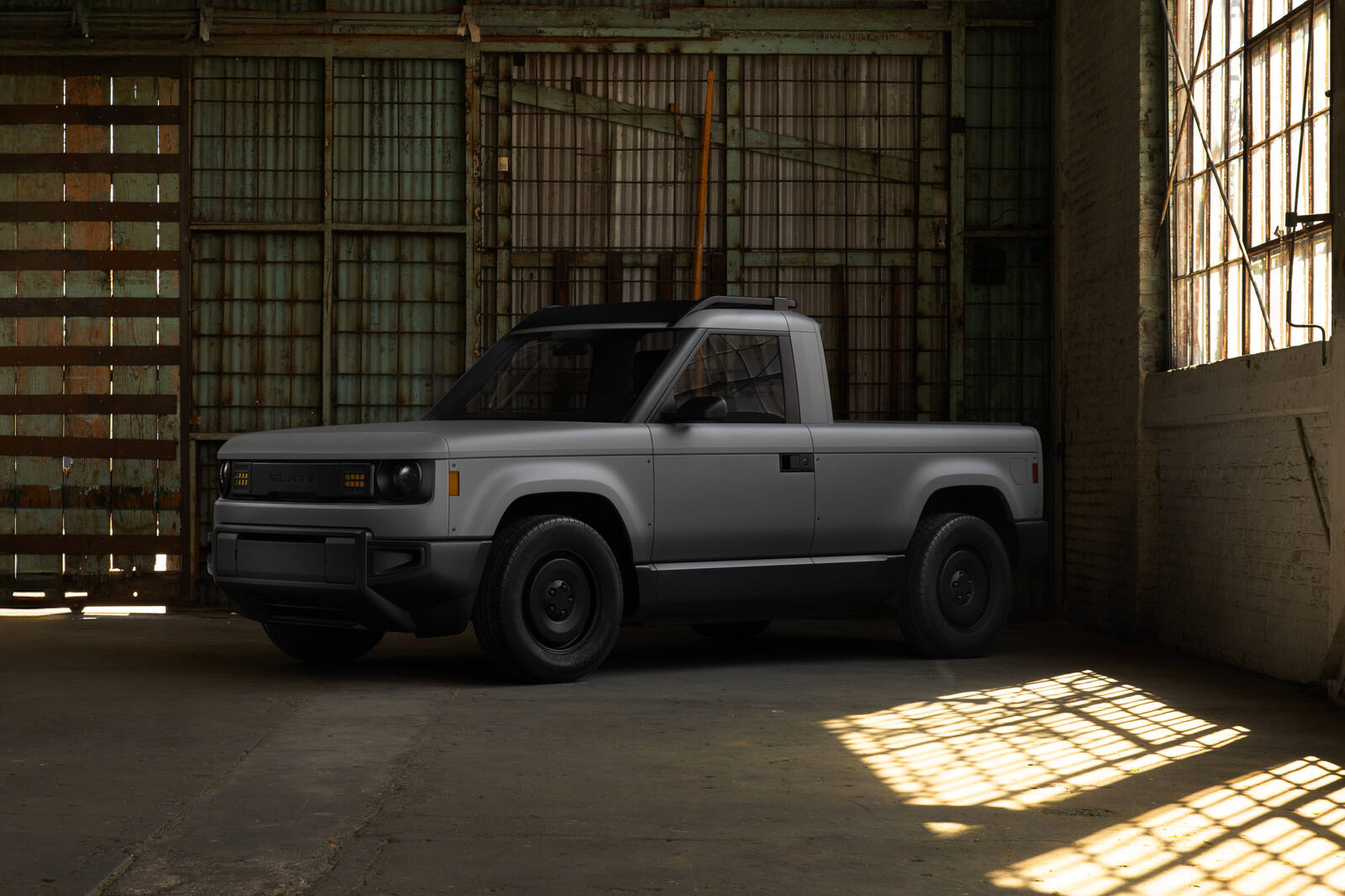
The podcast is talking about a pickup truck from a company that wants to sell affordable vehicles. It also mentions that the company doesn’t plan to sell that pickup in a certain place. That’s relevant because it affects where you can actually buy one.
Tariffs are taxes governments place on imported goods, and they can significantly change what consumers pay for vehicles. In this segment, the host uses tariffs to explain why an EV pickup’s Canadian price might rise enough that it competes differently against existing trucks.
A reciprocal tariff is a government tax on imported vehicles that’s meant to match or respond to another country’s taxes. In this case, it makes imported trucks more expensive in Canada.
The Ford Maverick is a small pickup truck. The host brings it up because its price is similar to the Slate’s expected Canadian price, and the Maverick can be bought with a hybrid option.
The Chevy Colorado is a pickup truck the host lists as competing in the same price range. The point is that tariffs could make the EV pickup cost more than people expect.
The Ford Ranger is another pickup truck the host says you could buy at a similar price. It’s part of the comparison showing what customers might choose instead.
Automatic windows means the windows go up and down with buttons, not by hand. The host is saying that buyers expect basic convenience features like this.
An initial production run is the first batch of cars a company builds when it starts making them for real. Early on, things can go wrong—like parts not arriving correctly, manufacturing problems, or battery issues.
Battery issues means problems with the EV’s battery pack—like reliability or how well it’s built and managed. The host is saying that batteries are one of the things that can cause trouble when a new EV starts production.
A trade agreement is a deal between countries about how products move across borders. The host is saying changes to that deal could affect tariffs and whether an EV pickup can be sold in Canada.
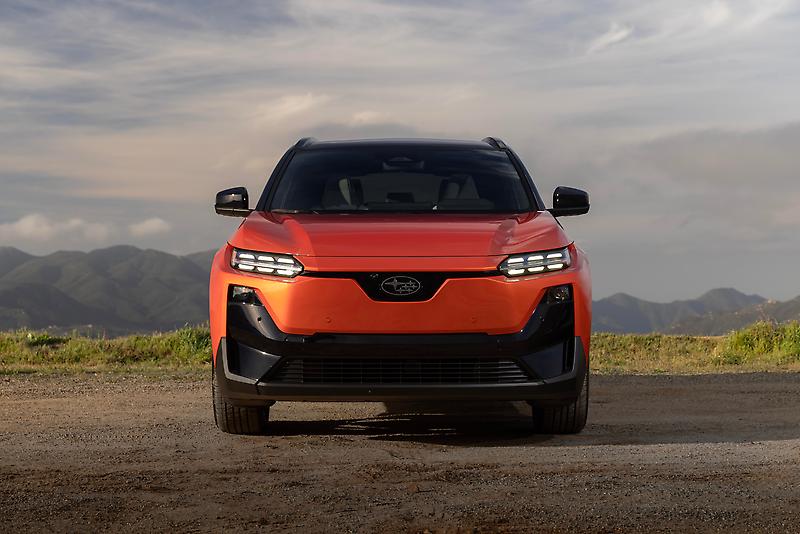
This is Subaru’s upcoming electric SUV. The host talks about how much it can carry, how far it can drive on a charge, and how fast it can charge, plus the phone/infotainment features.
The host compares the Subaru to the Tesla Model Y because it’s a common reference point for EV size and efficiency. They point out the Tesla gets more miles from a similar battery size.
Apple CarPlay lets you connect your iPhone to the car and use certain apps on the car’s screen. It’s meant to make navigation and music easier while driving.
The kilowatt-hour (kWh) number tells you how much energy the EV battery can hold. More energy usually means you can drive farther, but efficiency also matters.
“Battery tech” means how EV batteries are made and improved over time. Better battery tech can make batteries cheaper and let them store more energy for the same size.
Energy density is basically “how much battery power fits in the battery.” Higher energy density usually means more range without needing a larger battery.
“Margin” here means how much money a company keeps after it pays to build the car. If batteries get cheaper, it can be easier to make a profit on lower-priced EVs.
“Compact EVs” are smaller electric cars that are usually cheaper than big EVs. The host is saying they can still go far enough for many people while costing less to build.
Shorter range means you can drive fewer miles before the battery needs charging. It matters because it affects how often you’ll have to stop to charge.
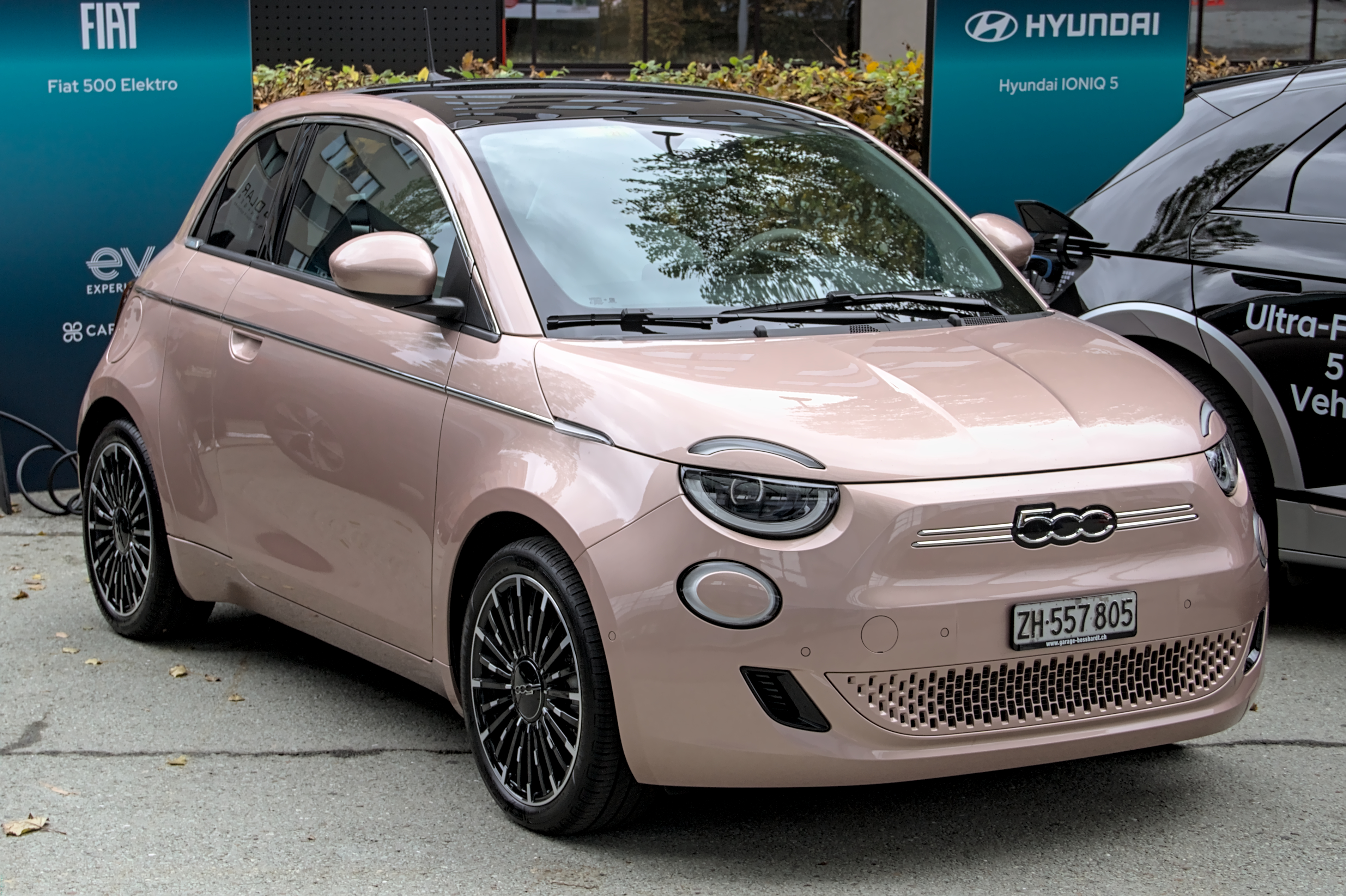
The Fiat 500E is the electric version of the Fiat 500. It’s designed to be cheaper, but that usually means a smaller battery, which means you can’t drive as far on a full charge.
Car
Fiat Topolino
The Fiat Topolino is a new small Fiat model the host says is coming to the US. The key idea in the episode is that smaller, cheaper EVs often trade range for price.
Car
Topolino
The Topolino is a very small electric car meant for short, simple trips. The host is saying it’s cheap because it’s more like a basic neighborhood vehicle than a normal street car.
A street legal upgrade is what you do so a vehicle can legally drive on public roads. The host says it changes the speed limit (and may make the battery last less long).
Golf cart classification means the vehicle is regulated more like a golf cart than a normal car. That usually limits where and how fast it can be driven, so it’s aimed at campuses and communities that already use golf carts.
Sun City is a community in Arizona where people often get around using golf carts. The host is saying a small, low-speed EV could work well in places like that.
A battery electric vehicle is a car that uses electricity stored in a battery to move. There’s no gas engine—so the battery’s condition is a big deal for how long the car can keep performing well.
An EV’s lithium-ion battery pack is the big battery made of many smaller battery cells. How you use it—especially charging and discharging—can affect how long it lasts.
In this context, physical pressure refers to mechanically constraining the battery pack or cells to reduce harmful internal movement during cycling. The idea is that controlling stress can slow down wear mechanisms that shorten battery life.
A pouch cell is a lithium battery cell that’s sealed in a flexible bag instead of a hard metal can. Because it can flex a bit, how much pressure it’s under can affect how well it lasts.
They kept the battery under a specific amount of pressure—181 psi (12.5 bar)—to keep the cell mechanically stable. The idea is that the battery ages differently if the pressure is too low or too high.
Cathode cracking means the battery’s positive electrode starts developing tiny cracks over time. That can make it harder for the battery to work well and can speed up battery aging.
The anode is the battery’s negative electrode. If conditions aren’t right during charging, lithium can build up there as metal, which is bad for battery life.
DC fast charging is the quick-charging method you use at many public chargers. Because it charges the battery quickly with high power, it can increase the chances of damaging processes like lithium plating.
Texas Instruments is a company that makes electronics used in many technical systems. Here, they’re working with researchers to help detect and reduce harmful battery effects like lithium plating.
They use things you can measure during charging—battery voltage, how long it’s been charging, and the battery temperature. Those measurements help an algorithm estimate whether lithium plating is happening.
Plating period is a calculated measure of how long the battery spends in the state where lithium plating is happening. Knowing that helps researchers judge how to prevent it.
Lithium plating is when a battery starts “putting down” lithium metal on the inside instead of storing it normally. It can happen when you charge too fast or the battery conditions aren’t right. That metal can damage the battery over time, making it wear out sooner.
The “Burrida Triangle” is a specific set of battery conditions where charging becomes risky. In that zone, the battery is more likely to form lithium metal deposits. The goal is to avoid those conditions while charging.
Constant current means the charger tries to push the same “amount of charge per second” into the battery. It’s simple and works for many cars, but it doesn’t adapt as well to the battery’s exact temperature and condition. That lack of adaptation can increase risk in some situations.
Constant voltage means the charger keeps the battery at a set voltage, and the charging rate gradually slows down. It’s a common charging method. But it may not be smart enough to prevent lithium plating under every battery condition.
A smart charging algorithm is software that “watches” the battery while it charges. It uses readings like temperature and voltage to decide how fast to charge. That helps avoid risky conditions that can wear the battery out.
Throttling the current means slowing down how much power the charger is sending into the battery. If the battery is in a risky state, reducing the current helps prevent damage. It’s like charging more gently instead of pushing full speed.
Battery degradation means the battery slowly gets worse with use. It can lose capacity, so it won’t hold as much charge. Certain charging conditions can make that wear happen faster.
Battery chemistry is what the battery is made of inside—its core materials and reactions. The segment says the proposal tries to help battery life without changing those materials. Instead, it focuses on smarter charging to reduce damage.
Dopants are extra materials added to the battery’s internal materials to change how it behaves. The segment says this approach doesn’t rely on adding those extras. Instead, it uses smarter charging to reduce problems like lithium plating.
A software update is a change to the EV’s computer settings. The segment suggests charging behavior might be improved by updating the charging control logic. That could help protect the battery without changing the battery itself.
LIVE
Hey, everybody, before we start this episode, I do need to let you know that for like the
first 10 minutes of this particular episode, I just gave everybody an update of what's
going on on the show, what's going on in my life, all that stuff.
So if this isn't, if that's not something you want to listen to, that's totally cool.
Skip ahead about 10 minutes and 30 seconds and we'll get right to the news.
So just FYI.
10 minutes and 30 seconds, skip ahead and you won't have to listen to all my nonsense.
Alright, everybody, let's go ahead and start the show.
Hello everyone and welcome to Killin' Water podcast about electric vehicles, renewable
energy, autonomous driving and much, much more.
My name is Bode and I am your host and I almost forgot what my own podcast was about.
So it's been a day, not necessarily a bad day, lots of stuff going on.
First off, we have a new Patreon supporter and that is Francis.
Francis, thank you so much for going to supportkilowatt.com.
In this case, Francis chose to support on Patreon over the other things, Supercast.
And I appreciate it.
Thank you for doing that, Francis.
As many of you know, all of the money goes back into the show and none of the money goes
to my pocket that comes from the Patreon, so very, very helpful.
So thank you very much for doing that.
Also, Jerbo looks like Jerbo increased his pledge, which Jerbo supports the show in several
different ways financially, so I really appreciate it.
But, you know, I only need one Jerbo, but I do appreciate you as always.
And I did send you an email asking some questions if you want to answer that.
You're more than welcome to.
Of course, and then I stumbled on a service called Refonic.
And what Refonic does is it aggregates reviews for podcasts, so I don't always go and look.
I can see, but I don't always go and look and see what everybody has said when they
reviewed the show on Apple or Spotify or whatever.
It's just, there's a lot of different steps to go to that, to do all of the different
services that you can review on.
And there's a service called Refonic that actually aggregates the reviews so you can
see them.
So I was actually very pleasantly surprised to see that there are several reviews across
multiple sites out there, so thank you to everybody who goes out and leaves a review
on the show.
It really does help.
And if you haven't done so yet and you want to, please go leave an honest review, even
if it's negative, go leave an honest review.
I would really appreciate that.
All right, it's kind of back and forth, whether I wanted to talk about this last thing in
I'm my mom and aunt aren't in the best of health and depending on how their their weeks
go kind of depends on how my week was in turn of mental health, in terms of mental health
I guess.
So my aunt is struggling at the moment and she seems to be getting better.
But just to kind of give you a little background, my aunt is only five years older than me.
My mom's only 18 years older than me.
So it's not like they are old, you know, my mom's still in her late sixties.
My aunt is in her mid fifties.
And you know, it's just kind of a bummer because when we grew up, she was more to me, she was
more like an older sister than an aunt or even a friend than an aunt.
And while we weren't didn't stay particularly close through adulthood because, you know,
Facebook didn't really exist.
And it was expensive for long distance calls.
You know, she's always somebody that I've always looked up to and admired and loved.
So anyway, when the show misses, it's usually because I'm just on the headspace to want
to be able to record.
And I don't know, I thought it would be a good or I was going back and forth whether
and I want to talk about it.
And I don't really want to go into great details on it.
But it's just if I miss a show, it's usually because I'm busy or one of those two things
has happened.
I get some bad news about my mom or my aunt or whatever.
And it's just very hard to muster up the energy to want to record or do anything for that
matter.
But I still throughout the week, I'm constantly working on the show and trying to make it
better.
And, you know, we did that little experiment a week ago where I did, you know, a Tesla
show and an EV, general EV news show that seems to be fairly well received.
So this week, I have a lot of EV news.
I don't have any Tesla news.
So I'll the next episode will be probably more of a Tesla heavy show, if not completely
Tesla and leave the EV news out.
There's just so much to talk about right now.
On July 4th, I was actually I crossed over to having yet less than a year left before
I can retire.
So in that time, I'm going to be retooling the show to try to make it to be profitable.
I would like to be able to not have to have a job that's outside of, you know, my side
job and and this, like I want this to be my main focus this show and beyond the post and
the shuffle playlist podcast, which we've started working on again as well.
In order to do that, you know, I got to find a way to kind of retool the show that that
makes it one interesting for people to want to actually listen and interact with and to
something that I can do like long term.
So yeah, I mean, like right over right now, if you look at my work weeks, my official
work weeks are that doesn't you don't even include podcasts in the work week.
But my official work weeks are typically between, we'll say 65 and 80 hours a week,
which most of that is done at a fire station and I can sleep some of that time.
So it's not like I'm somebody who really works 80 hours a week that that's a that's a huge
difference from what I'm doing.
I'm technically getting paid for over 80 hours a week, but I'm not always working hours a week.
I can watch TV at the fire station or just sit and stare at the wall if I need to.
It's like people who generally work 80 hours a week, they're working way harder than I am.
But yeah, I'm trying to trying to find out in the next year, because I'll probably retire
of September of 2027, kind of how best to tool the show so that it actually starts making
more money, you know, the show does pretty good.
It's not going to replace my my current salary for sure, but it is okay.
I need it to do much better if I'm just going to do this full time.
So with that, I am trying to figure out different ways to make the show more
lucrative, I guess financially sound is probably a better way to put it.
So just so you know, these are all things that I've been thinking about over the last
I don't know two or three months.
Sorry for that big dump.
I didn't think this wasn't supposed to out this wasn't supposed to be how this went.
So anyway, just so everybody's kind of peek behind the curtain, that's where we're at.
I do have some some ideas of where to go.
If you have suggestions, I would encourage you to email me bodibode at 918digital.com if you
think you know of a better way or if you have a suggestion on how to kind of tool the show to
to get more listeners.
Really, what it is is the folks that we have are pretty die hard.
And I love that.
And I certainly want to continue that.
I mean, we have we have enough people where it's very hard for me to keep up with like emails
and stuff like that or YouTube comments.
I owe a couple of people some YouTube comments.
So that's great.
And I'm getting to be on more shows.
So I'm going to go on the consumer guide podcast or car stuff podcast, which is by consumer guide.
I'm going to be on that next week, July 13.
And so that's cool.
Tom and Jill are awesome.
And I'm excited to be able to get a chance to sit down.
And Jill's not going to be on the day, but Tom's going to be on get a chance to sit down and chat
with them and introduce the show to more people.
So there's there's lots of things that we're we're trying here when I say we I mean the global
we me and whoever else wants to chime in to kind of grow the show.
Well, that's really what needs to happen is the show needs to be appeal to more people or be
presented to more people so the show grows.
And yeah, you know, we have some things with the DTNS folks planned and Tom and their team
has always been super supportive.
So well, one specific thing I'm going to be on a show called live with it.
And if you don't know what live with it is it's like a review show where people like actually
live with a product for a little bit and then they they give their take on it.
So I would highly encourage you to subscribe to that show.
I've learned a couple of different things, especially about podcasting stuff that's
been out there through live with it.
That's been the most helpful for me, but they do everything from, you know, robot
vacuums to little old the Amazon robot and not lots of other cool stuff.
So go subscribe to live with it.
Go subscribe to the car stuff podcast so you'll hear me when it comes out.
Okay, that was 10 minutes of just me.
Let's talk about actual show stuff here.
Man, I should probably put at the beginning of this episode.
You should skip ahead 10 minutes if you don't want to hear my nonsense.
I'm going to do that right now.
Hold on one second.
Okay, gave the little disclaimer up front.
So now we can start the show and I'm going to leave all this in
in an effort to be transparent.
Okay, let's start off with our EV news.
Like I said, no Tesla news for this episode.
Next episode will be more Tesla heavy.
Silvio Nopoli, totally butchering that name, is the new CEO of Lucid Motors.
Officially took over on June 1st and he has been making a number of changes.
Most notably Lucid is laying off 1500 employees
at the factory in Casa Grande, Arizona, amp one.
That's about 18% of their employees.
There is amp two, which is in Saudi Arabia.
And we'll talk about that here in a second.
It doesn't sound like they're laying off anybody from Saudi Arabia.
It's just the it's like a second shift at the Casa Grande plant here in Arizona.
And interim CEO, Mark Winterhoff, who was the chief operating officer,
he was supposed to once they had they got a new CEO,
Mark was supposed to go back to being the chief operating officer.
And they have now eliminated that position altogether.
So I don't know if Mark is staying with the company or if he is moving on.
I would imagine he is moving on and he'll probably be CEO of some other company.
If I had to guess, it'll probably be an EV company.
Now, as far as how Lucid did in Q2, 2026,
they posted a net loss of around a billion dollars.
In terms of production, they produced 5,500 cars.
They delivered 3,093 cars.
Initially, Lucid projected that they were going to deliver 28,000-ish cars for 2026.
And that number is being revised.
And I would imagine that number is being revised down, not up.
On top of that, when we're looking at bad luck for Lucid,
they had to recall 4,500 gravity SUVs.
And that's pretty much all of them, if not all of them.
This is all to say that Lucid is struggling.
You know, my general feelings about Lucid has been for a very long time
that as long as Saudi Arabia is willing to pay, Lucid will be okay.
And I don't see any signs of Lucid, you know, that agreement.
I don't see any cracks, right?
I think they're still going to be willing to float Lucid while they get things figured out.
But, you know, we're getting to a point where if Lucid doesn't actually start,
you know, making a profit or at least coming close to breaking even,
I could totally see a world where they're just completely owned by the Saudis.
And, you know, they'll do whatever they want with the name after that.
But, yeah, not great for Lucid, but they do have some things that are positives, you know.
As a general rule, Lucid is pretty well reviewed and in a fun, interesting twist.
The Lucid gravity was named the 2026 luxury car of the year, which is great except for,
it was in Saudi Arabia, which is probably true that still probably the world luxury car of the
year in Saudi Arabia, but also Saudi Arabia has a decent interest in promoting that car in their
country, especially with AMP2, their new factory in Saudi Arabia.
So, I just thought that was funny.
Now, on the other side of things, because they are going through it at the moment,
like I said, they're some positives.
They're sub $50,000 mid-sized EV called the Cosmos, which is going to look like a shrunken down
Lucid gravity, according to drawings.
This is going to be a super important vehicle for Lucid, and I think if they can, you know,
take what makes the air and the gravity great without, you know, some of the issues,
because some people have had to limit law of their cars, if they can take that Cosmos,
and they are assuming they can take what makes the air and the gravity great and put that in the
Cosmos, I think they're going to have a really compelling car, because I think the Lucid gravity
looks great. It's a little too much for me, but a $50,000 Lucid Cosmos sounds like it would be
a contender. My next EV, I would like it to be a pickup truck,
but I have seven more years before I buy a car, so Lucid had some time to figure this out,
but for me, for my purchasing decision, but I think this is going to be a pretty compelling car.
Now, initially, it sounds like production of the Cosmos will begin,
and initially, at their Amp 2 plant in Saudi Arabia, and somewhere between six to 12 months later,
we'll start to see that here in the US. So not a US first product, but, you know,
Saudi Arabia is a kingdom, and they can, what's the, they could subsidize this car
initially by the government buying it and giving it to government employees to drive around for
different things. Like, I don't think that somebody needs to be driving around in a $260,000 Lucid
Sapphire checking water meters, for instance, they could probably do that in a gravity and
still be good. Now, in other good news for Lucid, Lucid has that partnership with Uber
for the RoboTaxi deal, and that would mean 35,000 vehicles sold to Uber if everything goes right,
and those vehicles would be a mix between the Lucid gravities and the Cosmos. So
if everything goes right, that, I mean, that's a decent amount of cars, especially for Lucid,
a company that recently delivered 3,000 cars in Q2 2026. That's good news for them,
that that's a big partnership, and hopefully they're able to maintain that partnership
with Uber. And another little bit of good news is Uber and Lucid and Neural, which is the third
member of that partnership, they secured a permit for gravity RoboTaxi operations in San Francisco,
or in California, I don't know specifically for San Francisco, but a lot needs to happen
before their fortunes turn. But I think they have good engineers. One could argue that Peter
Rawlinson had maybe the focus Peter Rawlinson put on the company and the way that the direction
the company was going maybe wasn't the best, although he is the chairman of the board chair.
I don't know. I don't want Lucid to go away. So we'll keep an eye on it, but
there's your update. Now, we're going to go from a very expensive car company
to a very affordable car company. Slate Auto says that it has no plans to sell its pickup in Canada.
They didn't go into any detail as to why, but if I had two guesses, I would say the first
reason would be tariffs. Canada currently has a 25% reciprocal tariff on all vehicles that are
imported from the US. So that would bump the price of the slate up from 25,000 base price to
around $31,000 US, which is about 44,000 Canadian. And for that price point, you could get a Ford
Maverick or a Ranger or a Chevy Colorado. All of those vehicles are in that price point.
They are ice trucks or ice vehicles, except for the Maverick has a hybrid version, but they're all
ice vehicles. But they're also vehicles that have, you know, for that price point, automatic windows,
a radio, that kind of thing, the kind of things you expect to have in a car.
So the novelty of the slate and it being so much more affordable with that 25% tariff
isn't necessarily, it's not enough to pay the same price that you would for a Maverick, for instance,
and not get automatic windows, you know, the creature comforts that we're all used to.
Now, my second guess outside of tariffs is that the moment slate is about to start production.
And while they're starting production, on the surface, this truck doesn't have a lot to it,
so it should be easy to produce. However, there are a ton of different things that can go wrong
during your initial production run. You can have supplier issues, you can have manufacturing issues,
you can have different battery issues. There's just so much that could happen.
So my guess is that they're going to get through the US reservations and then they'll open it up
to other North American countries after that. It does not mean that it will never be in Canada.
At some point in time, we have a new or supposed to have a new agreement with trade agreement with
Mexico and Canada done, and whether it's like we're just going to put a rubber stamp on the
current trade agreement or we're going to completely renegotiate it, I have no idea what's
going to happen there. But once that changes, if it changes, there might be a road for the
slate to go to Canada for sure sooner than maybe what slate is, they haven't really indicated
anything, but sooner than when you think. But it really kind of depends on that trade agreement
that's expiring. And as far as we know at the moment, at best, it would, well I shouldn't
say at best. There's a good likelihood that it'll just stay as it is, the trade agreement,
and then there's a likelihood that it would get better or it could get worse. We'll kind of see.
And by the way, that's not just for slate. Automakers like to know things ahead of time
and I would guess that other North American automakers are waiting to make changes based on
that agreement as well. And the folks at the Car Stuff podcast, Jill and Tom did a great job
discussing this on their latest episode, which was out on the 6th of July. So I would go listen to
that if you want more information on that. Okeydoke. So next up we have the 2027 Subaru
Trailseeker EV. It starts at a very impressive $40,000. This car is a little bit smaller than
a Model Y. It's got, you know, 30 cubic feet of cargo space in the rear versus the Model Y having
a 31.3 cubic feet cargo space. But they're comparable in size. The Trailseeker does have
Apple CarPlay, Android Auto, 375 horsepower, you know, zero to 16, 4.3 seconds. That's faster than
my Model Y. It'll come in with a next port or it has an export, 150 kilowatts of charge. That's
a little slow. 74.7 kilowatt hour battery, which gets you 281 miles of range. They can definitely
start improving on some efficiencies with this car because, you know, the Model Y has
roughly the same size battery and has 320 miles of range. So there are some improvements that
could happen on Subaru's side. 3,500 pounds of towing. This car is reviewing very well.
So if you're looking for an EV, I would highly suggest taking a peek. It may not be for you,
but at least it deserves a look. And then on top of that, the 2027 Subaru Uncharted will start at
$35,000. So if you're looking for something that's even more affordable, take a look at the Uncharted.
I like the look of the Uncharted much better than I actually like the look of the Trailseeker.
For me, the Uncharted looks more like what a Subaru is supposed to look like. And I
understand that over time, you know, the design sense is supposed to change
what a Subaru look like when I was a kid in the 80s and 90s isn't what it should look like in 2026.
So I get that. But to me, I like the look of the Uncharted better than the Trailseeker.
But the interior of the Uncharted and Trailseeker are an absolute no for me. It feels like a Toyota
on the inside or it looks like a Toyota on the inside. And I just don't like the way the interior
of a Toyota is not coming on this podcast. I'm going to stop sucking up to them.
I'm just not a fan of Toyota's interiors. But yeah, if you are though, if you like that
cockpit feeling of kind of being what I would describe as in a fighter jet,
this might be something you enjoy. Oh, right. Let's see. We have a couple of community submissions.
First up, Jamie from Ireland. He sent along a Guardian article and European car makers are
moving from larger electric SUVs to smaller, more affordable EVs, which especially in Europe makes
a lot of sense. And there's a few different reasons for this move. First of all, initially when EVs
came out, it was very expensive to produce because of the battery. And in order for them to make money
or lose less money, they had to build in what would be considered in Europe a larger EV in North
America might be considered a medium to medium smaller EV in North America. But you know, they
now because of advances in battery tech, we have increased energy density with a decreased price.
There's less parts on an EV. So there's more opportunities for margin at those smaller
with those smaller compact EVs, you know, you might buy a car for 18 or 22,000 euros that
might have 180 or 200 miles of range, I'm sorry, in my head, maybe 300 kilometers of range. I'm
trying to do the conversion and I'm probably wrong there. But that's that's still like,
depending on what you're using the car for, that might be plenty for a lot of people and it's super
affordable. So, you know, they just makes more sense. And then just in general, I've been to
Europe a few times, and a larger as you be in Europe makes, in a lot of cases, no sense, right?
I tell these stories all the time. So if you've heard them, I haven't told them for a while. So
if you've heard them, just tune out for the next few seconds. But when my wife and I, like in 2008,
we were in Italy, and we were in a CC, we're looking for a place to park, you're not allowed to,
as a non local drive around that castle town. And what I read, or what I thought was an area
that would show more parking, that was not the case. I think it was telling us that we needed
to park where we intended done parking initially. But I ended up getting into the town of a CC
and driving around in this teeny tiny car. There were parts where people would actually
have to get up on what wasn't really a sidewalk, it was more like a little blocks, and they were
just kind of getting out of the way. It was exhilarating and terrifying at the same time.
But I pride myself now on being that stupid American that wasn't able to read the signs and
drove through like in a comedy, a castle town in Europe. But it was also a cool experience.
So I'm glad that I got to do it. I'm glad that I did not get a ticket. And I will never do it again.
I will know better now, but learn my lesson. And then in Siena, the same trip, and we were in the
same car, the parking to get into one of the sites, and I can't remember which one it was,
it was so tight that my wife had to get out first, and I parked, and then I had to crawl
through the car and exit out the back hatch. And it wasn't like this was not a situation where I
was being rude by blocking people in. That's how all the car, the parking was so narrow,
I don't have any idea how anybody else was able to get in and out of their cars except for going
through the hatch. Like there was that little room. So having a bigger car in those situations
doesn't make much sense. Now there's plenty of opportunities for, you know, long road trips
and stuff where a bigger car would be fine in those places in Europe. But then there's those
other cases that are not uncommon, where you have smaller roads and smaller parking and stuff like
that. Okay, anyway, so that's that. Back to, you know, the European automakers making smaller cars.
Another thing that's kind of putting pressure on them is the Chinese automakers. Chinese automakers,
as you know, are making a pretty big push into the EU. And the goal is for them is to expand
outside of China, right? And they're bringing these really affordable cars with compelling tech
into the European market, which is in turn putting pressure on the European automakers
to make more affordable vehicles. If you want to sell, like if you're selling a car for $35,000
and they can pay $22,000 for a car that's mostly comparable, maybe a little smaller,
maybe a little less range, but by and large comparable, it's going to be hard to convince
people to spend an extra 12 or 13,000 euros used to proper currency. It's going to be hard for them
to spend that extra money when this car is pretty good right now. So, and, you know, there's lots
of different reasons why you would buy the car from a European automaker over a Chinese automaker
and something that could be, you know, a local pride in manufacturing or maybe you work for the
company or whatever. There's lots of different reasons why, but I think for most people they're
shopping on price and value for money. And Chinese, it's hard to argue that the Chinese aren't giving
you a good price and value for money. Now, with all of that, we've kind of alluded to this a little
bit, there are some trade-offs and you have to be okay with a smaller car battery,
which gives you shorter range. So, it's up to the whoever's buying it to decide whether that
trade-off is worth it or not. Our next community suggestion or recommendation,
Alison shared and recommended this next story to me tonight as I was cooking dinner right
before I recorded the show. She's like, have you seen this? And I had not. So, if you haven't already,
go subscribe to Alison's podcast, No Silla Cast. It's a fantastic and there's a chit chat across
the pond. Just go to start with everything good begins with podfeed.com. So, go check out what
Alison is doing there. Now, in terms of the article she recommended, it's about a fiat and, you know,
I've kind of made my frustrations known with what Stellantis is doing with their
auto brands here in the US. They do, when it comes to the fiat brand, they do sell the fiat 500
and the 500E, which is the electric version of the 500 here in the US. It is pretty affordable. It's
got, you know, not a ton of range, but it's pretty affordable. And I see a couple of them around here
and there. There's another fiat model headed to the US. And this is the fiat Topolino. And it looks
very much like a fiat. And I've seen some like paint combinations that make it look
very Italian and cool. When I say very Italian, I mean, like, there was one where they had,
I don't think it was the Italian flag colors, but it was just very much, it looked very European
and very, very cool. I don't know how to explain it. But this car starts at under $14,000 US.
And you might be thinking to yourself, Oh, that's really cheap. What's the catch?
This car is certainly going to come with some compromises. And you are correct. So Topolino,
which I am butchering, because Italian, the Italian language is so beautiful, I do not
have the chops to make that sound cool. But the Topolino is Italian for little mouse. So this
is a small car as you can imagine for $14,000. It is a two seater. You do. This is so funny,
it was listed in the article, you do get a horn, you get sea pelts, and you get a windshield,
which is that those were the features listed in the article that I read.
It comes with a 5.4 kilowatt hour battery. You heard that correct, not 54, 5.4 kilowatt hour
battery. 46 miles of range. The top speed is 19 miles an hour. It's not technically street legal
in the US unless you pay for a street legal upgrade that will max the top speed out at 25
miles per hour. But we'll certainly reduce that range to something lower than 46 miles.
And technically, this is a golf cart. Again, if you pay for that, and I can imagine the upgrades
all that expensive, but if you pay for that upgrade, you could drive it on some city streets.
But this is really golf cart. It's classified as a golf cart, or it's in the same classification as
a golf cart. This would be really good for folks who live in a beach community or people who live
in communities like Sun City here in Arizona, where the residents drive golf carts from place to
place to place. I can also imagine if you have a large campus, like a large church or a university
or college, or even a large campus like Google or TSMC, which is building a factory in Arizona,
those kind of places, this might be a really good option for people to get from one place to
another on campus where they don't have to go on actual roads. But yeah, I really hope to see one
of these. You know, I don't know that they will be showing them off at CES, but if they are, I'll
let you know. Super cool looking cars. Alright, our final submission comes from Mark K in the UK.
I typically will just say somebody's first name, because I don't know if people want me
giving out their last names and things like that, but it was pointed out to me and rightfully so
that Mark is a pretty common name. So if I'm saying Mark in the UK, there could be several
marks in the UK that they give me this information. So the, and as a matter of fact, it came from a
mark in the UK that it's like, did I give you this story or not? And I was like, you know,
that makes sense. So Mark K in the UK will be how we refer to this mark. So Mark K in the UK,
he sent along a few articles for us today, starting off in June, battery electric vehicle
registrations in the UK were up nearly 30% overall, when you compare it to the new car market, right?
There were 64,440 battery electric vehicle registrations in June. And Tesla,
Tesla was actually 12,403 of those battery electric registrations. So out of 6440,
12,403 of those were Teslas, if I wasn't clear. Tesla's seen a little bit of a rebound in sales
across the UK and Europe. So if we look at June 2025 versus June 2026, they're up 42%. So great,
great news for battery electric vehicle registrations in Europe. Mark's take on this is
I think pretty accurate. He says, I think when countries reach 30% new registrations,
it's a pivot point for greater adoption. And I would tend to agree that with that. And the UK has
some pretty decent federal incentives or governmental incentives for buying EVs right now. So we'll see
you know, what happens as they are, you know, those incentives get phased out or maybe even
new incentives get put in, who knows. But I do think this is interesting. I do agree 30%
does seem like a pivot point. Okay, this is our final story. And this is partly Mark, partly me.
So I'll tell you which part is which. The first part is Mark. So researchers at the University
of Cambridge found that putting physical pressure on lithium ion battery packs,
that could double their lifespan or its lifespan. So when lithium ion batteries
are charged or discharged, they expand and contract one of the Cambridge folks in the
article compared it to breathing, which you know, that makes sense. And the repeated stress
of this expanding and contracting can contribute to cell degradation for a variety of different
reasons. So researchers built a device that applied a steady pressure to pouch cells. Now
they didn't do prismatic cells or cylinder cells, they were using pouch cells in this
in this study, or in this, I guess it was a study. And in order to maintain steady pressure,
they adjusted the the pressure to stay at 181 psi or 12 and a half bars to make sure that
the cell received that pressure constantly. So like I said, if you think about the cell
charging or discharging as like breathing, inhaling and exhaling, as the cell would charge up,
obviously the cell would swell a little bit. So maybe they needed to ease up on the pressure a
little bit. But as the cell was being discharged, they would need to increase pressure to keep it
at 181 psi. So hopefully that makes sense. This method causes issues if there's too much or too
little pressure. So there's a real Goldilocks sweet spot in order to make this work. So if there's too
little pressure, it actually accelerated cathode cracking. But if there's too much pressure,
it was more likely for lithium plating to occur on the anode. So the pressure really has, like I
said, to be in that sweet spot. Now, this is kind of where the mark recommendation and me digging
into this a little bit more starts to shift. And I was I didn't know what lithium plating was before
reading that term in the article. So I dug into it a little bit. And what happens is the lithium
ions will start to accumulate at the surface of the anode. And those little metallic deposits
can grow and start to restrict the flow of ions. And at its worst, this can turn into a safety
issue and, you know, cause some sort of catastrophic failure. At its best, it's going to affect your
performance and it's not going to affect it in a good way. It's going to be a negative effect on
your performance. And by the way, it's it sounds like most of this is due or occurs during DC fast
charging. So keep that in mind, because the University of Purdue researchers partnered with Texas
Instruments, and they're actually working on tools and algorithms to detect and mitigate the
plating. So the team invented their own algorithm or metrics for quantifying
lithium plating. And what they're measuring is voltage, time and temperature. And from that,
they're able to those are their observations. And from those observations, they're able to
find or determine like a plating period, plating power and plating energy. And all of this,
a lot of this, we don't need to get into a lot of detail, but they plot all of this on a graph,
and they will determine the right conditions for plating to occur. And this, you know,
there's like this sweet spot they call the Burrida Triangle, where lithium plating can occur. And
they just basically through the algorithms algorithm, they can track this. And a lot of this can be
mitigated through smarter EV chargers. Like I said, a lot of this happens when we're doing DC fast
charging, although when you're charging too slow, this can happen as well. But our traditional
charging infrastructure relies on like a constant current or constant voltage. And this delivers,
you know, this is good in terms of, you know, we're able to deliver this to as many cars as
will let us at this constant current. And, you know, it's not very smart, it's just delivering
electrons through the charger. So what researchers are proposing is using their smart charging
algorithm that they developed that will monitor the battery temperature, the voltage, and they'll
throttle the current accordingly. And by doing this, not only will they reduce the risk of
lithium plating, but according to researchers, these algorithms will also allow you to charge
twice as many times before you start seeing battery degradation. So, you know, this is,
you know, this is all done in lab, we'll have to kind of see how this is adopted by the auto
industry as a whole. But I think this is really cool. For a couple reasons. One is they're improving
battery technology without changing any battery chemistry, they're not adding dopants or any
of these other additives to the chemistry to make these things last longer or
make them more durable. They're using, you know, basically math to correct this problem,
math and physics. You know, like the University of Cambridge, you would obviously have to build
the car to be able to keep constant pressure on a battery pack. That would not be something that
you could issue over a software update. However, if you, if these algorithms work to reduce the
lithium plating, there could be an update to a charger in a car so that they can talk and they
can stay out of that Bermuda Triangle or that danger zone that would, that would encourage
lithium plating. So I don't know, there are lots of cool things coming down in terms of
cool ways that people are solving problems without necessarily needing to make big huge
swinging battery chemistry changes or form factor changes or anything like that. It's just like,
this is a simple math. So I think it's super cool. Hopefully you think it's super cool.
And that's all I got for you today. I managed to speak for 45-ish minutes, depending on if you
got ads or not. So, yeah, hopefully you enjoyed this episode. If you want to email me, it's
bodi, B-O-D-I-E, at 918digital.com. You can also find me on X at 918digital, although I'm,
I don't know, I say it out of habit. I don't really go on X all that often. I am on LinkedIn
quite a bit. So you can search for me. It's Bodi, B-O-D-I-E, Grim, G-R-I-M-M on LinkedIn.
And yeah, I go subscribe to Live With It. I'll put links in the show notes.
Go subscribe to Live With It. Go check out Allison's website. Everything Good starts
with podv.com, which is just podv.com. And go subscribe to the Car Stuff podcast.
I think I hit everything. Still, like, even though I missed the show last week,
still working on this nearly every single day and, you know, got some cool things,
we'll just say cool opportunities for the future. How about that?
All right, everybody, thank you so much for listening and I will talk to you all.
Thank you for listening.
About this episode
The host opens with a personal update—family health stress, show scheduling, and his plan to retire in September 2027—then pivots to EV news. He notes Lucid’s struggles under new CEO Silvio Nopoli: major layoffs at the Arizona plant, elimination of an executive role, a huge Q2 net loss, low production vs deliveries, and a recall of Gravity SUVs. Despite the financial pressure, Lucid still has positives like strong reviews and awards. The episode frames battery-life “pressure” as a theme, but the provided transcript mainly covers Lucid and show direction.
In this episode of Kilowatt, we dive deep into the shifting landscape of the electric vehicle industry, starting with major structural shakeups and layoffs at Lucid Motors under new CEO Silvio Napoli. We also unpack why Slate Auto is bypassing Canada for its highly customizable, budget-friendly electric pickup, alongside a detailed look at Subaru’s impressive new 2027 EV lineup featuring the Trailseeker and Uncharted. Overseas, European automakers are pivoting from massive SUVs to highly affordable, compact city EVs to counter a massive push from Chinese brands, while the UK celebrates an explosive month with battery electric vehicles capturing nearly 30% of the new car market. On the quirky side of things, we look at the ultra-compact Fiat Topolino coming to America—a tiny, low-speed cruiser that blurs the line between a beach-bound golf cart and a neighborhood EV. Finally, we explore groundbreaking battery breakthroughs from researchers at Cambridge, Purdue, and Texas Instruments who are discovering that physical pressure and smarter charging algorithms can completely reshape how we prevent cell degradation and extend EV lifespan.