
We Bought the Lowest Mileage Early Porsche 911 IN THE WORLD!
About this episode
Spike’s Car Radio kicks off with quick travel/legal talk in Panama, then jumps into a lineup featuring a Polestar 4 EV and a new Porsche 911. The centerpiece is an ultra-low-mileage early 911 with Dutch royal/police provenance—stored in a German warehouse “until 2006, undriven”—and identified by details like “that rear wiper.” Along the way, they compare preservation vs restoration, discuss Zenith triple-throat carbs, and connect the car’s police-spec visibility features to how it’s meant to be driven.

Polestar 4
"And I have the Polestar 4, which is behind us, new electric car, which is kind of cool. And we have a new 911, which is fantastic."
The Polestar 4 is an all-electric car from the Polestar brand. In this episode, they mention it as a new EV they’re excited to talk about.
The Polestar 4 is a modern electric crossover-coupe from Polestar, built around an EV powertrain instead of a gasoline engine. It’s notable here because the hosts frame it as a “new electric car,” making it part of the episode’s lineup alongside classic and enthusiast-focused choices.

Tesla Model Y
"So I get in the Tesla Model Y with Ard, and I like to make conversation because you get rated as a passenger."
The Tesla Model Y is an electric SUV/crossover. Here it’s just the ride-share car the host takes to get to the story.
The Tesla Model Y is a compact electric crossover that’s often used as an Uber/rideshare vehicle. In this segment it’s mentioned as the car the host got into while meeting the Uber driver.
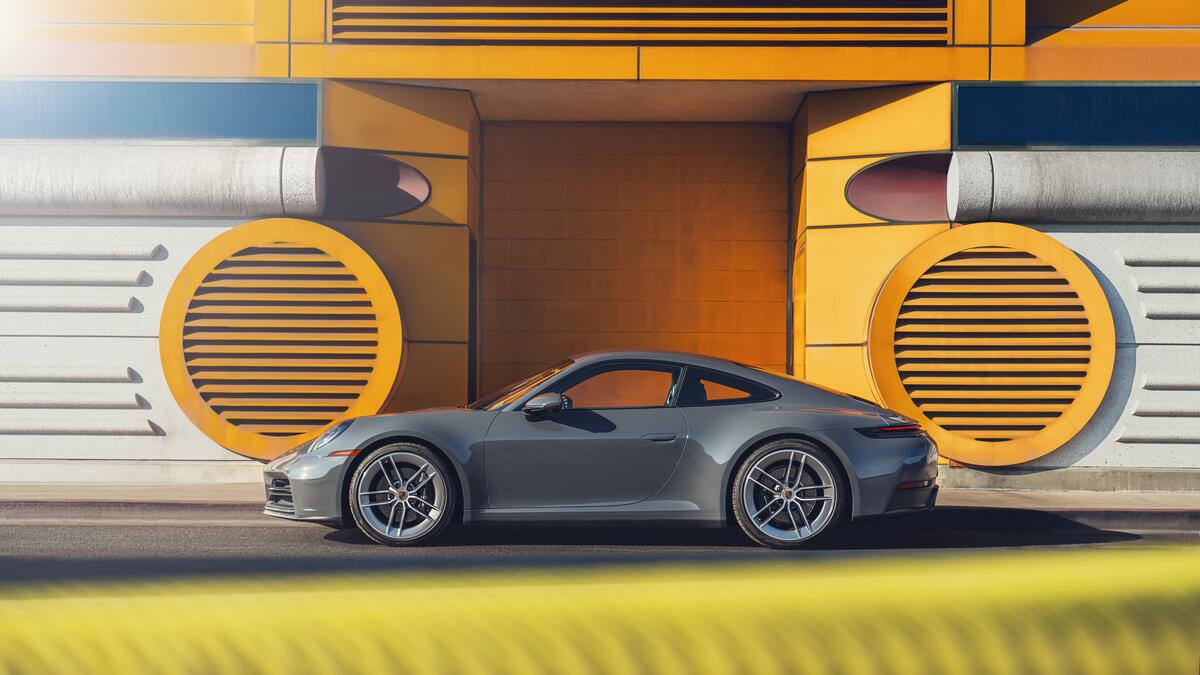
Porsche 911 (993 C2S)
"He goes, I like Porsches. I go, oh, you do? And he goes, yes. He goes, I have one Porsche, a 1998 993 C2S."
This is a specific older Porsche 911 generation. The “993” is famous because it’s the last 911 that still uses an air-cooled engine design. “C2S” is a particular version of that 911 with a bit more performance than the simplest trim.
The Porsche 911 (993) is the last air-cooled 911 generation, and it’s known for its classic 911 feel with modernized engineering. The C2S is a specific Carrera variant that typically pairs rear-wheel drive with a more performance-focused setup than the base C2.

Porsche 944
"Look, here's a picture. There's Ard. I brought him in. I didn't know what you had in here, Zuckerman, but I showed him the 944."
The Porsche 944 is a Porsche sports car with the engine in the front and the drive going to the rear. They mention it because it was one of the cars they showed off in the garage.
The Porsche 944 is a front-engine, rear-transaxle sports coupe that’s known for its near-50/50-ish balance and classic Porsche handling feel. In this segment, it’s mentioned as part of the garage lineup shown to a Porsche fan, highlighting the variety of Porsche-era cars they had on hand.
warehouse
"So this car never went to the Netherlands in the beginning. It was put in a warehouse and the factory sold it to a friend of Porsche."
They’re saying the car was stored away instead of being driven. Keeping a car in storage for years can help it stay in better shape, which is why it’s important in a low-mileage story.
A “warehouse” in this context is where the car is stored rather than being used on the road. Long-term storage can explain why a car has minimal wear and why its history matters to buyers.
undriven
"he puts it in a warehouse and keeps it there until 2006, undriven. With a little damage. It's a new 911 with a little ding in the corner. And it's an undriven 911."
“Undriven” means the car wasn’t really driven for a long time. That’s a big deal for collectors because it can keep the car in near-new condition and result in very low mileage.
“Undriven” here means the car was not used/operated for a long period, which helps preserve condition and keeps mileage extremely low. In collector-car stories, long storage can be a major reason a car remains “like new” even after many years.
Octane magazine
"He decides he's going to sell it. And he puts it in Octane magazine, where Jerry and Sam see it."
Octane magazine is a car enthusiast magazine. They’re saying the car was listed or spotted through that kind of collector-car publication.
Octane magazine is a well-known enthusiast publication that covers classic and modern performance cars. Mentioning it here signals that the 911 was advertised/discovered through the collector-car media ecosystem.
preservation feeling
"I drove this soon after he bought it and couldn't believe what I was driving. I was dry. I felt like again, that time traveler experience where I was driving a car out of the factory brand new that you can't replicate this feeling, this preservation feeling, right?"
They’re talking about the special feeling of a car that’s been kept original and hasn’t been heavily redone. Even if you restore a car really well, it may not feel the same as one that’s been preserved.
In enthusiast terms, a “preservation feeling” refers to the experience of driving a car that has been kept in its original, unmodified state with minimal wear. The hosts contrast that with restoration, arguing that even a high-quality restoration can’t fully recreate the feel of a time-capsule example.
rocker panel
"So for muddy boots, instead of having carpet, you see, and the little those little bins that are in front, those have vinyl. So you so you can see that in between the seat and the metal strip. That should be carpet on a regular car. That's vinyl for police wear and tear. It's on the other side."
The rocker panel is the lower part of the car’s side body. They’re pointing out that on the police version, a vinyl strip is mounted there instead of carpet to handle heavy use.
A rocker panel is the body panel along the lower sides of the car, between the front and rear wheels. In this segment, it’s where the vinyl strip sits on the police car, replacing carpet in the area that would normally get scuffed by boots.
rear wiper
"One, you would you could get on some other cars, but all Dutch police cars had that rear wiper that you see on the glass, which is absolutely fantastic."
A rear wiper is the wiper on the back window. They’re using it like a clue that the car is a Dutch police setup, and they say early 911s can have it too.
A rear wiper is a windshield wiper mounted to the rear glass, used to clear rain, dirt, and road grime. The hosts use it as a visual identifier of Dutch police cars, noting that the same feature also appears on early Porsche 911s.
passenger side mirror
"And then there is a passenger side mirror. If you're in the driver's seat, you do not see that mirror at all. If you were in the driver's seat, you wouldn't even know that mirror is there."
A passenger side mirror is the mirror on the right side (from the driver’s perspective). They’re saying the police car had a mirror set up specifically so the officer in the passenger seat could watch what was behind them.
A passenger side mirror is a mirror mounted on the passenger side to improve visibility for that seating position. Here, the hosts describe a special police configuration: the mirror is positioned so the police passenger can look behind, which changes what the driver can see from the driver’s seat.

Volkswagen Beetle
"So more than it being a police car, to us, it's just an ultra low mileage 9 11... So I learned this with the police a VW Beetle."
The Volkswagen Beetle is a classic small car. In this story, they mention it because it was used as a police car and had features that helped officers direct traffic.
The Volkswagen Beetle is a compact, air-cooled classic that became widely used worldwide, including by police departments. Here it’s mentioned as a reference point for how police cars were set up for traffic control and officer visibility.
ultra low mileage
"to us, it's just an ultra low mileage 9 11. Zip in on that odometer and let's look at the kilometers we have there."
“Ultra low mileage” means the car has been driven very few miles. That usually means less wear from driving, though some parts can still age over time.
“Ultra low mileage” means the car has been driven very little since new, which often helps preserve wear items like tires, brakes, and interior components. It’s especially meaningful on classic cars because many mechanical and rubber parts age even if they aren’t used much.
odometer
"Zip in on that odometer and let's look at the kilometers we have there."
The odometer is the gauge that shows how many miles (or kilometers) the car has traveled. People look at it to estimate how much the car has been driven.
An odometer is the instrument that records how far a vehicle has traveled. In classic-car buying, odometer readings are used to judge how much the car has actually been used versus how old it is.
Zenith triple throat carbs
"These are Zenith triple throat carbs. They run so good that, you know, if you were racing back in the day, you like those Zenith carbs because it gave you a lot more power."
These are carburetors made by Zenith. They help the engine mix fuel and air, and the “triple throat” design can improve how the engine responds and makes power.
Zenith triple-throat carburetors are carburetor setups that use three venturi “throats” to meter fuel and air into the engine. More airflow and better fuel metering can improve throttle response and power compared with simpler carb designs, which is why enthusiasts associate them with performance.
2.2 T
"he said, 'I don't need to tell you, Spike, the 2.2 T's are a sweet spot for a 9 11.' They certainly are."
“2.2 T” refers to a Porsche 911 with a 2.2-liter engine and the “T” trim designation. In 911 history, the 2.2 T is often viewed as a sweet spot because it balances classic character with strong performance for the era.

Porsche 356
"I drove Jerry's 356 Dutch police car the other day and it had the double rear view mirror in the center for the same reason..."
The Porsche 356 is an early Porsche sports car. They’re talking about it as a police car and explaining why it had certain visibility features for traffic control.
The Porsche 356 is Porsche’s early sports car, known for its lightweight, classic handling and its air-cooled design. In this segment it’s specifically referenced as a Dutch police car, including a visibility feature used for directing traffic.
double rear view mirror in the center
"I drove Jerry's 356 Dutch police car the other day and it had the double rear view mirror in the center for the same reason so that the other officer in the passenger seat could be there."
This is a special mirror setup with two mirrors in the middle. It helps more than one person in the car see behind them clearly, which can be useful for police work.
A “double rear-view mirror in the center” is a custom interior setup that effectively gives the rearward view to more than one occupant. In police-car use, it can help the passenger officer see traffic and coordinate actions.
traffic control
"But I've been told by our listeners that directing traffic was why this was a target, why the 356 was an open top. They could put their hands up or direct traffic..."
Traffic control means directing cars and pedestrians at busy spots. They’re saying the police-car design choices were meant to make it easier for officers to signal and see what’s happening.
Traffic control refers to directing vehicles at intersections or road incidents, often requiring clear visibility and quick hand/arm signals. The hosts connect this to why certain police cars were configured with open-top access or visibility-focused interior layouts.

Porsche 718
"You're driving this in the 356. I'm enjoying the 718. It's a really funny moment of car driving right now."
The Porsche 718 is a more modern Porsche sports car line (Boxster/Cayman). The hosts are basically saying they’re enjoying the newer 718 while someone else drives the older 356.
The Porsche 718 refers to the modern 718 Boxster/Cayman family, which uses a mid-engine layout and is known for its agile handling. Here, the host contrasts it with the older 356, emphasizing the fun of driving both eras back-to-back.
front boot
"I think we should take the target top off today. Yeah, let's do it. Yeah, for sure. It will fold up and fit right in that little front boot."
A “boot” is just the trunk. “Front boot” means the trunk space is in the front of the car instead of the back.
A “boot” is the trunk, and the “front boot” means the trunk space at the front of the car. This is especially common on mid-engine sports cars, where packaging leaves usable storage up front.
target top
"I think we should take the target top off today. Yeah, let's do it. Yeah, for sure."
This sounds like they mean a “Targa top,” which is a removable roof panel on some Porsche models. You can take it off to make the car feel more open to the air.
“Target top” appears to be a transcription error for “Targa top,” which is Porsche’s removable roof panel system used on Targa models. A Targa top can be removed or folded to open the cabin while keeping a roll-bar structure.
Le Mans
"Look at that poster in the 914 there. This is kind of a shot, a picture of full of regret, Zuckerman. Because not only that, but that 914 up there that won Le Mans in 1970."
Le Mans is a famous long-distance race in France where cars run for about 24 hours. “Winning its class” means it was the best in its group of cars, not necessarily the overall winner.
Le Mans refers to the 24 Hours of Le Mans endurance race in France, one of the most famous motorsport events in the world. Winning “its class” means the car competed in a specific category (based on rules like engine size and design) and finished first within that category.

Porsche 914 6 GT
"God damn it. Yeah. It's a 914 6 GT that just happened to win its class in Le Mans."
This is a special, rare Porsche 914 built for racing. The “6” means it uses a six-cylinder engine, and in the story they’re talking about its Le Mans success.
The Porsche 914 6 GT is a rare, track-focused Porsche 914 variant that swaps in a six-cylinder engine (the “6” part) and is associated with serious racing pedigree. In this segment, the hosts connect it to endurance racing success, specifically winning its class at Le Mans in 1970.
Canyon driving controversy in Southern California
"All right. I was going to do dear Zuckerman today, but there's a bit of a controversy in our car community here in Southern California... And one thing the CHP likes to do up there is they want to make sure no one crosses the double yellows."
They talk about a dispute in the local car scene in Southern California. It’s about people driving aggressively in canyon roads and the danger that creates.
The hosts discuss a local controversy involving a car-community figure who organizes drives with wealthy participants. The segment focuses on reckless driving behavior in Southern California canyons and the safety enforcement response.
CHP
"And one thing the CHP likes to do up there is they want to make sure no one crosses the double yellows."
CHP is California’s highway police. Here, they’re mentioned as watching for dangerous driving, like crossing the double yellow lines.
CHP stands for California Highway Patrol, the state agency that enforces traffic laws on California highways. In this context, they’re described as focusing on dangerous canyon-road behavior—specifically preventing drivers from crossing double yellow lines.
double yellows
"And one thing the CHP likes to do up there is they want to make sure no one crosses the double yellows."
“Double yellows” are the two solid yellow lines in the middle of the road. They usually mean you’re not allowed to pass or cross into the other lane.
“Double yellows” refers to double solid yellow centerline markings on the road, which generally indicate no passing and no crossing for oncoming traffic. The hosts use it as a shorthand for a key safety rule on curvy roads where head-on collisions are a major risk.
cross the mustard
"…filming people, but also talking to them and asking them not to, as he says, cross the mustard. Go ahead and play the rest of the leader…"
It’s slang for crossing a road line that you’re not supposed to cross—usually the line that separates you from oncoming traffic. The hosts are saying that behavior is dangerous and gets people hurt.
“Cross the mustard” is a slang way to say someone crossed a boundary line on the road—typically the centerline or a double-yellow—into oncoming traffic. In this context, it’s being used as a shorthand for dangerous passing or lane intrusion in the canyons.
Porsche 911 GT3 RS
"Did you see that awesome blue GT3 RS? Yeah, it's really nice."
The Porsche 911 GT3 RS is a super performance 911 meant for track driving. It’s the kind of car that looks and sounds special, and it’s often associated with very fast driving.
The Porsche 911 GT3 RS is a track-focused version of the 911, built around high-revving performance and aerodynamic downforce. It’s known for being extremely capable on road courses, which is why it stands out in a discussion about canyon driving and aggressive behavior.
canyon carving
"There are two sides. There's the Canyon Carver side of like, hey, let's just be safe if we're going to drive up there and not get our community in trouble."
“Canyon carving” means driving fast and smoothly on twisty mountain roads. People do it for fun, but it can be dangerous because those roads aren’t closed for racing.
“Canyon carving” refers to spirited driving on winding mountain roads, where drivers aim for smooth lines and quick transitions through corners. In enthusiast circles it can be framed as skillful driving, but it also carries a higher risk because roads are public and traffic/visibility can be unpredictable.
Vredestine tires
"So you've rented your judgment. All right. Let me talk about Vredestine tires right here... When I got it back to the hangar, I looked at the tires and they had Vredestine"
Vredestein makes tires. They’re known for good grip, including winter tires, and the hosts are talking about how the tires on that car looked and performed.
Vredestein is a tire brand known for performance and winter-focused tires. In this segment, the hosts are pointing out the specific tire look and model family (the “Ice Raider” reference) as part of the driving feel and traction story.

Mercedes-Benz 240D
"on this old Mercedes that we drove. What was that old Mercedes diesel that he had that with the little, the 230D? Yeah, the green one. 240D? Yeah. The green one. I drove that car."
The Mercedes-Benz 240D is an older Mercedes diesel. Diesels use glow plugs to help the engine start and run smoothly, especially when it’s cold.
Mercedes-Benz 240D is a classic diesel from the W123-era lineup, known for its simple, durable mechanical design and long-distance comfort. In the segment, the hosts focus on how it drives and specifically mention the glow plug system, which is central to starting and running a diesel in cooler conditions.
glow plug
"How was it? The glow plug. Glow plug. It was incredible. It was really an incredible driving experience."
A glow plug is a heating element used on diesel engines to warm the combustion chamber before starting. That heat helps diesel fuel ignite reliably, especially in cold weather, and it’s why the hosts associate the 240D’s starting/driving experience with “glow plug.”

Buick Century
"...age, European performance and design. More than a century of experience, a European brand engineered for pe..."
The Buick Century is a mid-size car made by Buick. It’s generally meant for comfortable everyday driving. The podcast mentions it in the context of Buick’s experience and design approach.
The Buick Century is a mid-size car from Buick’s lineup, typically positioned as a comfortable, family-oriented vehicle. The podcast context frames it around brand history and design, suggesting it’s being discussed as a representative model of Buick’s long-running approach. It’s relevant because the Century nameplate is tied to how Buick marketed mainstream cars over many years.
Polestar one
"So here it is, the Polestar four. You know what these guys are doing, Zuckerman? What? They're naming their cars in order, in sequence. Polestar one, Polestar two, Polestar three, and here we have Polestar four."
Polestar is using a simple numbering system for its cars. The number is meant to help you understand where each model fits in their lineup.
Polestar’s naming scheme is part of how the brand positions its lineup. Here, Spike explains that Polestar is naming models in sequence—Polestar 1, 2, 3, and now 4—so the number signals the place in the product family.
horsepower
"Let me go through some stats on this guy. 544 horsepower. It starts at $56,000."
Horsepower is a number that tells you how strong the car’s power is. Higher horsepower usually means the car can accelerate harder.
Horsepower is a measure of engine (or motor) power—how quickly the vehicle can do work. In EVs like the Polestar 4, horsepower is still used to describe the strength of the electric motors, which helps communicate how fast the car can accelerate.
range
"What kind of range do we have? We have 280 miles. And the best way to think about this car is it's the Viori or the Lululemon of electric cars."
Range is how many miles the electric car can go before it needs charging. It’s one of the biggest numbers people look at when buying an EV.
Range is how far an EV can drive on a full battery charge under stated conditions. Spike uses the Polestar 4’s range figure to help listeners judge whether it fits everyday driving and longer trips.

Bmw Ix
"Now, what you're asking yourself, what segment is this? What am I considering if I'm considering the Polestar four? Mechani V, BMW iX, SQ6 Audi, or maybe this guy."
BMW iX is BMW’s electric luxury SUV. They’re mentioning it as a rival you might compare against when shopping for a car like the Polestar 4.
BMW iX is BMW’s electric luxury SUV, and it’s used here as a comparison point for the Polestar 4. When Spike lists it alongside other EVs, he’s framing the Polestar 4 as competing in the same “consideration set” of premium electric vehicles.
sloping roofline
"So what did they do? They decided to take that sea pillar and that roof line and kind of make it slope down and look cooler, which they achieved and it looks really cool."
A sloping roofline means the roof angles down toward the back. It can look cooler, but it can also make the rear window smaller, so it’s harder to see behind you.
A sloping roofline is a styling choice where the roof tapers downward toward the rear. It can improve the car’s look and aerodynamics, but it often reduces rear window area and can make it harder to see out the back.
glass ceiling
"By the way, you've got one of those glass ceilings right there. You press a button, it lightens up and darkens up and you can see."
A glass ceiling is a glass roof section above you. Here, it sounds like it can switch between lighter and darker so the cabin feels brighter or more shaded.
A glass ceiling refers to a panoramic glass roof panel that can change how much light enters the cabin. In this segment, the host describes a feature that can lighten or darken the roof area at the push of a button.
rear view monitor
"What about looking back there? We have cameras. You'll see it. See that rear view mirror in the front seat. There are the cameras. When you're backing up, you can use your side mirrors, obviously, and that electronic rear view monitor right there to back up."
A rear view monitor is a screen that shows what the car’s rear camera sees. It helps you back up when it’s hard to see out the back window.
A rear view monitor is a screen that shows a live camera feed when you’re reversing. It’s used to compensate for limited rear visibility, especially on cars with sloped roofs or reduced rear glass.

Land Rover Range Rover
"... most cases, but you can see right there, see the Range Rover in the mirror right there. Can you tell the issue..."
The Range Rover is a large SUV made by Land Rover. It’s designed to drive comfortably on regular roads but still handle rough terrain. The podcast brings it up because it’s visible in the situation they’re describing.
The Land Rover Range Rover is a luxury SUV known for combining off-road capability with comfort and upscale features. In the podcast, it’s mentioned in a practical, observational way—appearing in a mirror while discussing an “issue,” which suggests it’s being used as a reference point in the story. That makes it relevant as a real-world vehicle that can show up in day-to-day driving situations.
3D versions of where the car is
"You know what I mean? I get one of those 3D versions of where the car is and it feels a little strange and claustrophobic, but it's not a deal breaker by any stretch of the imagination."
Some cars have a 3D “parking view” that shows where your car is relative to nearby objects. It can help you park, but it may not feel natural or clear when you’re backing up close to things. The host says it felt weird and cramped for them.
The speaker is referring to a 3D camera/parking visualization that shows the car’s position around you. These systems help with low-speed maneuvering, but they can feel awkward or provide less useful detail in tight spaces. In this case, it’s described as claustrophobic and not as confidence-inspiring as a real-world view.
kick underneath a license plate
"But I was told when I get close to the car, it's going to unlock, and then I have to kick underneath a license plate. And it's going to work here... But when you got your hands are full of shit. You don't want to be kicking a car like this."
Some cars let you open the rear hatch by kicking your foot under the license plate area. The host says it doesn’t work reliably, especially outside, so it becomes frustrating. They’d rather have a simple button on the key fob.
This describes a hands-free “kick-to-open” feature where you wave your foot under the rear license plate area to trigger the power liftgate. The speaker says it works inconsistently—especially outdoors and in certain light conditions—so it becomes an annoying extra step. They also note it’s inconvenient when their hands are full.
unlock
"But I was told when I get close to the car, it's going to unlock, and then I have to kick underneath a license plate. ... Outdoors, it doesn't work."
Here, “unlock” means the car automatically unlocks when it senses your key fob nearby. The host says the car unlocks, but the hatch-opening step doesn’t work reliably. So the whole process feels inconsistent.
In this context, “unlock” refers to keyless entry behavior: the car detects the key fob nearby and automatically unlocks. The speaker says it unlocks when they approach, but the kick-to-open function still fails. It’s part of the overall access workflow they’re criticizing.
key fob
"Like here's another example, like the key fob which unlocks the door. Sometimes I was all the way up to the door and it didn't unlock it and then I'm pushing the key against the car."
A key fob is the small remote you use to lock and unlock the car. The host is complaining that theirs didn’t always work right when they were at the door.
A key fob is the handheld remote used to lock/unlock a car and often start it. This segment describes a frustrating behavior where the fob sometimes fails to unlock until the host presses it again, highlighting how driver interaction depends on the car’s access system.
custom street-legal wagon build
"It appears to be okay. It appears to be a big red wagon mobile radio flyer. Hey, Phil, how are you? ... So this is a radio flyer. It's the whole chassis is a Ford Explorer."
They’re talking about a crazy custom wagon that can actually be driven on regular roads. They explain what it’s built from and how the trip went.
This segment focuses on a custom “radio flyer” wagon that’s been built to drive on public roads. The hosts discuss what it is, what it’s based on, and how it’s driven through traffic.

Ford Explorer
"So this is a radio flyer. It's the whole chassis is a Ford Explorer. I see."
A Ford Explorer is a real SUV. Here, they’re saying the big radio-flyer “wagon” is built on the Explorer’s main undercarriage, so it’s not just a toy—it uses the SUV’s real foundation.
The Ford Explorer is a mainstream SUV platform that can be used as a donor vehicle for custom builds. In this segment, the hosts say the whole chassis of the radio flyer wagon is based on a Ford Explorer, meaning the underlying structure and drivetrain layout come from that SUV.
Request an Explanation
Heard something you'd like explained? We'll add it to this episode.
Sign in to request explanations for terms you heard.
Want to learn more?
Browse our glossary for plain-English explanations of automotive terms, jargon, and concepts.
Help improve this episode
See something that's not quite right? Our annotations are AI-generated and can sometimes miss the mark. Click the flag icon on any annotation to suggest a correction.