
Rod Emory's Def Leppard Porsche Outlaw
About this episode
Rod Emory and the hosts trade shop updates and personal resets, then dive into how his team builds “outlaw” early-Porsche style cars with modern underpinnings. They cover a Def Leppard guitarist’s Baja Bug tribute, a Vivian Campbell Porsche project, and a 914 Outlaw in progress—plus the details that keep builds faithful (and what they refuse). The conversation also swings through classic-car event logistics, RaceDeck and Vettestine sponsorships, and practical collector-car buying advice.
tribute
"we finished building a technically a tribute to the original Baja Bug... And so we finished building the tribute to the original Baja Bug."
A “tribute” build is like building a modern version of an older car to honor it. They’re recreating the original Baja Bug’s idea after the original got destroyed.
A “tribute” build is a recreation or homage to an earlier car, usually keeping the look, spirit, and key details of the original. Here, they’re finishing a tribute to the original Baja Bug after the first one was totaled.
Amelia Island
"You know, we used to go to to Amelia Island. I mean, obviously we all go to Pebble Beach."
Amelia Island is a place in Florida where car enthusiasts go for classic-car events. The speaker likes it because it’s easier to enjoy than places with heavy traffic.
Amelia Island is a coastal area in Florida that hosts major classic-car events. In enthusiast circles, it’s especially associated with laid-back vintage-car touring and shows compared with busier big-city events.
Pebble Beach
"Oh, cool. You know, we used to go to to Amelia Island. I mean, obviously we all go to Pebble Beach."
Pebble Beach is a well-known California destination where people go for major classic-car events. The host is saying they also go there, but it can be more stressful because of traffic.
Pebble Beach is a famous California resort area best known for high-profile concours d’elegance events and luxury/performance car culture. The speaker contrasts it with Amelia Island, implying Pebble Beach is a more universally attended event but can be tiring due to traffic.
vintage car rally
"In fact, Zane Drew and I just did the vintage car rally back there in May and drove 1904 Osmobile Curved Ashes."
A vintage car rally is an organized driving event for older cars, usually with a route, scheduled stops, and a focus on enjoying the vehicles rather than racing. It’s a common format for early cars like the 1904 Oldsmobile Curved Dash.
ice racing tires
"Look, even the ice racing tires right there that are glowing red. Their site is so cool."
Ice racing tires are made for driving on ice. They’re designed to grip better on slippery winter surfaces than regular tires.
Ice racing tires are specialized tires designed for low-traction winter surfaces like ice and packed snow. They’re typically built with compounds and tread patterns that can maintain grip where normal road tires would slide.
Lago de Como
"I drove that in Lago de Como, probably on Vettestine tires. Not only do we sell Vettestine tires, we put them on our cars."
Lago de Como refers to Lake Como in Italy, a well-known scenic driving area. The host uses it as context for where they drove the car on the tires being discussed.
Vettestine
"Not only do we sell Vettestine tires, we put them on our cars. ... People write me and they say, I bought the tires. I love the tires, but it's really about the sidewalls."
Vettestine is a tire brand. In this segment, they’re saying the tires aren’t just about grip—they also look great, especially the sidewall design.
Vettestine is a tire brand being promoted in this segment. The hosts emphasize that it’s a heritage-focused, European-performance-oriented tire line, and they specifically talk about how the sidewalls look.
side walls
"People write me and they say, I bought the tires. I love the tires, but it's really about the sidewalls. How beautiful those sidewalls are."
The sidewall is the part of the tire on the outside edge, not the tread. It’s also where you often see the tire’s look and markings, and the host says that’s what they love here.
A tire sidewall is the outer wall of the tire between the tread and the bead. It’s important for tire construction and also carries branding/markings, and in this segment the host is praising the sidewall’s visual design.
outlaw cars
"But Vivian wanted one of our little outlaw cars that, you know, was very early period vintage looking."
An “outlaw” car is a custom classic that’s not trying to be exactly like it left the factory. It’s usually built to drive better or feel more exciting, while still keeping a cool vintage vibe.
“Outlaw” cars are enthusiast-built, non-stock projects that blend classic looks with modern drivability or performance tweaks. The key idea is that they’re intentionally not a factory-correct restoration—more like a personalized hot-rod interpretation of a classic.
patina donor car
"Only time I've ever bought anything from RM and they had a really great little car and it was a dope, like a full patina donor car."
A “donor car” is a car you buy to use as the source for parts or the base for a project. “Patina” means the natural wear-and-age look, so it sounds like the car already looked cool in an old-school way.
A “donor car” is a vehicle you buy mainly to harvest usable parts or use its body/chassis as the base for a new build. Calling it a “patina donor” suggests the donor already has desirable aged appearance, so it can contribute both parts and the vintage look.
RMS
"Only time I've ever bought anything from RM and they had a really great little car and it was a dope, like a full patina donor car."
“RM” is shorthand for an auction company that sells classic cars. They bought the project’s starting car from that auction.
“RM” refers to RM Sotheby’s, a major classic-car auction house. In this context, it’s where the speaker bought the donor Porsche.
pre-A
"we paid 90 grand for it or something because it's a pre-A, right? Yeah, yeah."
“Pre-A” here is an era/variant label used to distinguish earlier versions of the car from later updates. In enthusiast circles, these labels matter because early cars often have different exterior details and sometimes different baseline engineering before later improvements.
body bumpers
"we converted it to body bumpers. So, you know, because a 50 53 technically would have regular bumpers, but he wanted that early look with body bumpers."
“Body bumpers” means bumpers that are shaped to look like they belong to the car’s body, instead of standing out. It’s mostly about the look of the car’s front and rear.
“Body bumpers” are bumper designs that sit closer to the car’s body and often match the bodywork more closely than later, more protruding bumper styles. On classic cars, this is usually a visual-era detail that can change the look without necessarily changing the underlying performance hardware.
rear suspension
"But underneath the cars got, you know, big disc brakes and 9-11 rear suspension and rack and pinion steering, electric air conditioning."
Rear suspension is the system that connects the rear wheels to the car and controls how they move over bumps and during cornering. The segment ties it to the 911-based conversion, implying the builder chose a known, capable suspension layout to improve stability and drivability.
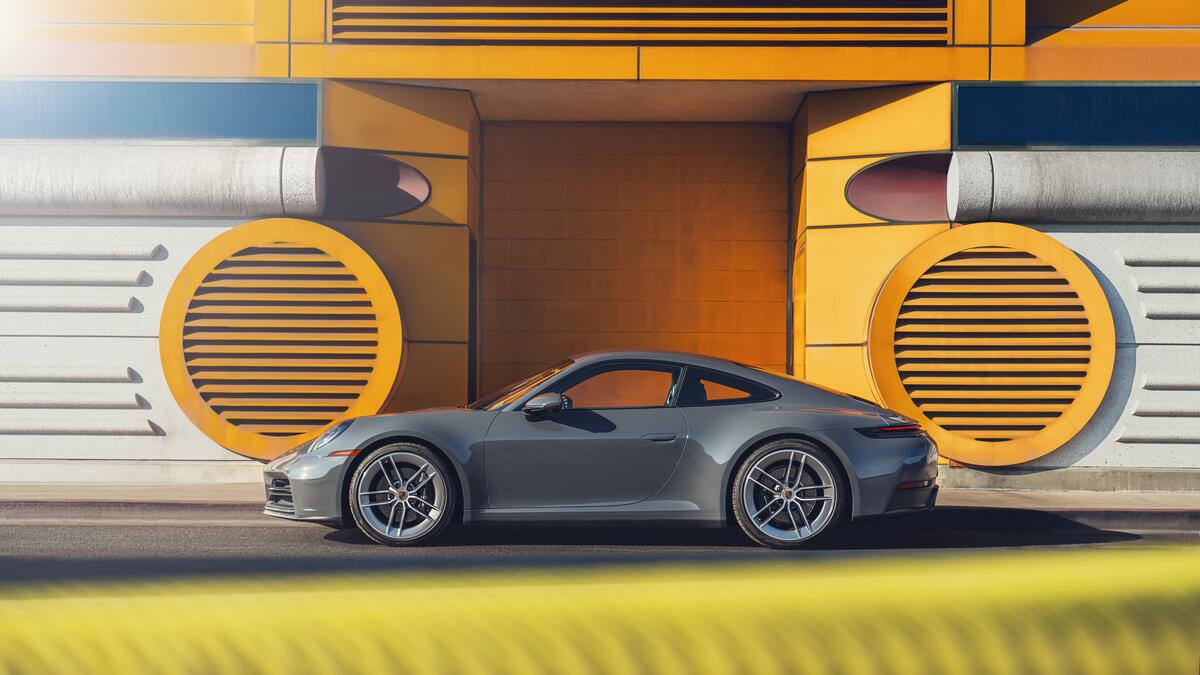
Porsche 911
"But underneath the cars got, you know, big disc brakes and 9-11 rear suspension and rack and pinion steering, electric air conditioning."
The Porsche 911 is Porsche’s famous sports car. Here, they’re saying the car was built with 911-style parts underneath to make it drive better.
Porsche 911 is the iconic rear-engine sports car line known for its distinctive handling and long-running evolution. In this segment, the hosts are describing a conversion where 911 components are used underneath another early Porsche, specifically to improve braking, suspension, and steering feel.
rack and pinion steering
"But underneath the cars got, you know, big disc brakes and 9-11 rear suspension and rack and pinion steering, electric air conditioning."
Rack-and-pinion steering is a steering system where a gear (“pinion”) moves along a straight bar (“rack”) to turn the wheels. It’s commonly praised for providing direct, precise steering feel compared with older steering designs, which is especially noticeable in a car built for stability and driving enjoyment.
fuel injected
"What is that 260 horsepower fuel injected, you know, big disc brakes."
Fuel injection is how the car feeds fuel into the engine using electronic controls. It helps the engine get the right fuel amount for smooth running.
Fuel injection is a system that delivers fuel to the engine using electronically controlled injectors rather than a carburetor. It helps the engine maintain the right air-fuel mixture across different speeds and temperatures.
big disc brakes
"What is that 260 horsepower fuel injected, you know, big disc brakes."
Disc brakes are the common braking system where pads squeeze a metal rotor to slow the car down. “Big” brakes generally mean stronger stopping power and better resistance to fade when braking hard.
Disc brakes use brake pads clamping onto a spinning rotor to slow the car. Calling them “big” usually implies larger rotors and/or calipers, which can improve braking power and heat handling.
Brewster green
"What color green did you say? So it's Brewster green. But if you get up close, we added some pearl to it..."
Brewster Green is a specific named paint color. They’re saying the newer version of that color can look a bit dull, so they added extra sparkle (pearl) to make it pop.
Brewster Green is a Porsche paint color name. The host also notes they added pearl to it because the newer factory Brewster Green can appear “too flat” without the extra sparkle.
added some pearl
"So it's Brewster green. But if you get up close, we added some pearl to it because... the factory... is a little bit too flat."
Pearl is a type of paint pigment that makes the color shimmer and look deeper. It helps the paint look more interesting as you move around and as the light changes.
“Pearl” in automotive paint refers to pearlescent pigments that create a shifting sparkle as light hits the surface. It’s often used to add depth and visual “flop” so the color doesn’t look flat in different lighting.
flop in the paint
"And the problem is when you, you know, if these cars are... don't have a little bit of flop in the paint, they can tend to look a little bit flat."
“Flop” is how paint changes color depending on the angle you’re looking at it. Good paint flop makes the color look richer and more dimensional.
“Flop” is the way a paint color changes appearance with viewing angle, typically shifting shade as light reflects differently. Pearlescent pigments can increase flop, making the car look more dynamic rather than flat.
basket weave seats
"Yeah, we did, we did kind of a dark red, like Bordeaux color interior. You know, with basket weave seats, speedster seats."
Basket weave is a seat fabric pattern that looks like a woven crisscross. It’s mostly about the look and feel, and it can also be more forgiving as the material ages.
Basket weave is a patterned upholstery fabric where threads are woven in a repeating crisscross texture. In seats, it’s mainly a visual and tactile choice that can also help hide wear compared with smoother materials.
speedster seats
"You know, with basket weave seats, speedster seats. That's beautiful."
“Speedster seats” means a sportier seat design used in Porsche speedster-style interiors. They’re usually shaped to hold you better during spirited driving, not just for everyday comfort.
“Speedster seats” refers to a specific seat style associated with Porsche speedster interiors—typically more supportive, often with distinctive bolstering and a sportier shape. The term is used here to describe the upholstery/seat design rather than a generic seat type.
German square weave carpet
"That's beautiful. Tan German square weave carpet."
This is describing the carpet’s pattern and color. “Square weave” means the fibers are woven into a tight, grid-like texture, and “tan” is the color.
“German square weave” describes a specific carpet weave pattern—square, tightly woven fibers that create a textured look. “Tan” is the color, and the host is using it to specify the interior’s materials and finish quality.
12 volts
"And, and, you know, Vivian being a music guy, we wanted to still retain that early radio in the center, which works and it's all, you know, 12 volts when it works."
Cars typically run on electricity at 12 volts. That’s the standard voltage used to power things like the radio and other electronics.
The car’s electrical system uses a 12-volt battery and wiring to power accessories like radios and audio components. When the host says “it’s all 12 volts when it works,” they mean the audio setup is designed to run on the standard automotive voltage rather than requiring a separate power system.
stealth amplifier
"But we also hid a sound stream, like a stealth amplifier and stereo underneath. [910.5s] Oh my God."
It’s basically a hidden car audio amp. The goal is to make the sound system better without it looking like you added a bunch of aftermarket gear.
A “stealth amplifier” is an audio power amplifier hidden inside the vehicle so the installation looks factory or unobtrusive. In this case, it’s paired with a hidden “sound stream” to improve audio without visibly changing the dash or center area.
steering wheel
"So what do they call that steering wheel? [914.8s] Derringer is Darrington."
The steering wheel is what you hold to steer the car. A smaller wheel can make steering feel quicker, while a larger one can feel more relaxed.
The steering wheel is the driver’s interface to the steering system, and its size affects leverage and steering feel. Here it’s discussed in millimeters, which is a common way enthusiasts compare wheel diameter for quicker or heavier steering response.
400 millimeters
"And, you know, the original steering wheels in these cars were 400 millimeters. [921.7s] So a little bigger."
They’re talking about the steering wheel’s diameter in millimeters. A 400 mm wheel is slightly larger, which can make steering feel a bit slower or require different effort than a smaller wheel.
Millimeters here refer to steering wheel diameter. The host contrasts the original wheel size (400 mm) with a smaller aftermarket/reproduction wheel (385 mm), which changes steering ratio feel and how much effort is required at the rim.
385
"So a little bigger. [922.4s] This is 385, so it's just a little smaller."
“385” is the wheel diameter in millimeters. A smaller wheel usually makes steering feel more responsive because you move your hands less to get the same steering change.
“385” is the steering wheel diameter in millimeters for the reproduction wheel being discussed. Compared with the original 400 mm wheel, the smaller diameter typically makes the steering feel quicker because the driver’s hand movement translates to less wheel rotation.
reproduction ones
"[924.7s] Is it an original one or a repro? [926.3s] No, this is one of the reproduction ones. [927.7s] That's good."
A “reproduction” part is a remake of the original design. In this case, they’re saying the remake is built stronger and doesn’t flex as much as the original.
“Reproduction ones” means aftermarket parts made to replicate an original equipment (OEM) design. The host implies the reproduction steering wheel is stronger than the original, which matters because wheel materials and construction affect stiffness and flex.
flex
"I love the original Darrington wheels, but they just flex too much. [936.4s] Yeah, they do."
Here “flex” means the steering wheel bends or moves more than you’d like when you turn it. Too much flex can make the steering feel less precise.
In steering-wheel context, “flex” refers to unwanted bending or give under load. The host says the original Darrington wheels “flex too much,” which can degrade steering precision and feel, especially during spirited driving.
basket weave BBS
"I don't want to have 15 colors of basket weave in the seat. No, that's a that's a tricky dance."
“Basket weave” is a patterned upholstery look—like the way a basket is woven. Car seats can use this pattern to add style, but too many colors or patterns can start to look cluttered.
“Basket weave” is a leather or fabric upholstery pattern that looks like interlaced strands, similar to a woven basket. In car interiors it’s used for texture and visual style, and it can be hard to keep from looking busy when combined with other colors or materials.
interior
"What have you ever been in this situation where, like, say, a Rodney Dangerfield comes in and goes, I want to do golf pants interior."
Here, “interior” means the inside of the car—things like the seats and upholstery. If someone wants a specific look, it usually shows up in the interior first.
In this context, “interior” refers to the cabin materials and design—especially the seats and upholstery. When custom colors and upholstery patterns are discussed, the interior is where those choices show up most directly.
build this
"So you just say, no, thank you, we're not going to build this. [1085.0s] Can you say at least what the what the thing was that made you go?"
Here, “build this” means the shop deciding not to make a specific customer-requested version of the car. They’re saying the brand has to stay consistent, because one wrong choice can hurt trust.
In this context, “build this” refers to the custom-car decision to refuse a customer’s requested spec. The speaker frames it as protecting the brand’s identity and avoiding a one-off mistake that could harm reputation.
sand cars
"I've got a Subaru in my sand car that I take out the sand dunes, but it doesn't belong in my 356. [1118.2s] They are a great engine, but just not for this application."
A sand car is a vehicle built for driving on sand dunes. The idea is that what works well for sand driving doesn’t necessarily work well for a classic street car like a Porsche 356.
A sand car is a vehicle set up for driving in sand dunes, typically with gearing, tires, and cooling suited to low-traction, high-load conditions. The speaker uses it to explain that a Subaru engine can be a good match for dune use, but not for a classic Porsche 356.
Gen-V throttle bodies
"So it looks carbureted, but it's, it's got Gen-V throttle bodies and, you know, MoTeC ECU."
Throttle bodies control how much air the engine can breathe. “Gen-V” just means a newer design/version that’s usually better calibrated for smooth driving.
“Gen-V throttle bodies” are the engine’s air-control units (one or more) that regulate how much air enters the intake. Newer generations typically improve airflow control and calibration, which helps with smoothness and response.
MoTeC ECU
"So it looks carbureted, but it's, it's got Gen-V throttle bodies and, you know, MoTeC ECU. So it runs just as good here as it does at 11,500 feet..."
MoTeC is a company that makes high-end engine computers. The ECU is the “brain” that controls how the engine runs so it can be smooth and responsive.
MoTeC is a well-known performance electronics brand, and “MoTeC ECU” means the engine is controlled by a MoTeC engine control unit. An ECU manages fuel, ignition timing, and throttle/air strategies to make the engine run correctly and efficiently.
155 amp alternator
"And the fact that it's 911 based, we can run the big 155 amp alternator, which means we can run electric air conditioning..."
The alternator charges the battery and powers electrical systems while the engine runs. A higher-amp alternator can support bigger electrical loads, like running air conditioning.
An alternator’s “amp” rating indicates how much electrical current it can produce. A “155 amp alternator” provides enough electrical output to run power-hungry accessories like electric air conditioning.
electric air conditioning
"...which means we can run electric air conditioning, which, you know, some people will say, oh, you know, you don't need air conditioning in these cars."
Electric air conditioning is A/C that runs using electricity. It lets you have modern climate comfort even when the rest of the car is set up differently than a stock factory system.
“Electric air conditioning” means the A/C system is driven by electrical power rather than relying on engine mechanical drive. This is often used in conversions or custom builds where packaging and accessory drive choices make electric operation practical.
amber fiberglass shroud
"So if you look, if you go back in Porsche's motorsport history, you know, once they developed the 911 type engine... they all ran that amber fiberglass shroud."
A shroud is a cover around part of the engine area. Here it’s described as amber fiberglass, and the host is saying it’s a styling detail inspired by Porsche race cars.
An “amber fiberglass shroud” is a heat/engine-bay cover made from fiberglass with an amber color. In this context, the speaker ties it to Porsche motorsport history as a visual cue and design tribute.

Porsche 911R
"So if you look, if you go back in Porsche's motorsport history, you know, once they developed the 911 type engine for cars like the 911R..."
The Porsche 911R is a famous, track-oriented 911 from Porsche’s racing past. The host mentions it because it’s tied to the development of the 911-style engine used in later race cars.
The Porsche 911R is a stripped-down, track-focused 911 variant from Porsche’s motorsport history. The speaker uses it to reference when Porsche developed the “911 type engine” that later race cars also carried forward in spirit.

Porsche 910
"...once they developed the 911 type engine for cars like the 911R and then the 910 race car 906's, you know, 917's, 910's, they all ran that amber fiberglass shroud."
The Porsche 910 is an older Porsche race car from the 1960s. The host brings it up because it’s part of the same racing history that inspired the engine-bay styling.
The Porsche 910 is a classic Porsche race car from the 1960s, associated with the brand’s early motorsport development. Here it’s mentioned as part of the lineage of cars that used the same amber fiberglass shroud look.
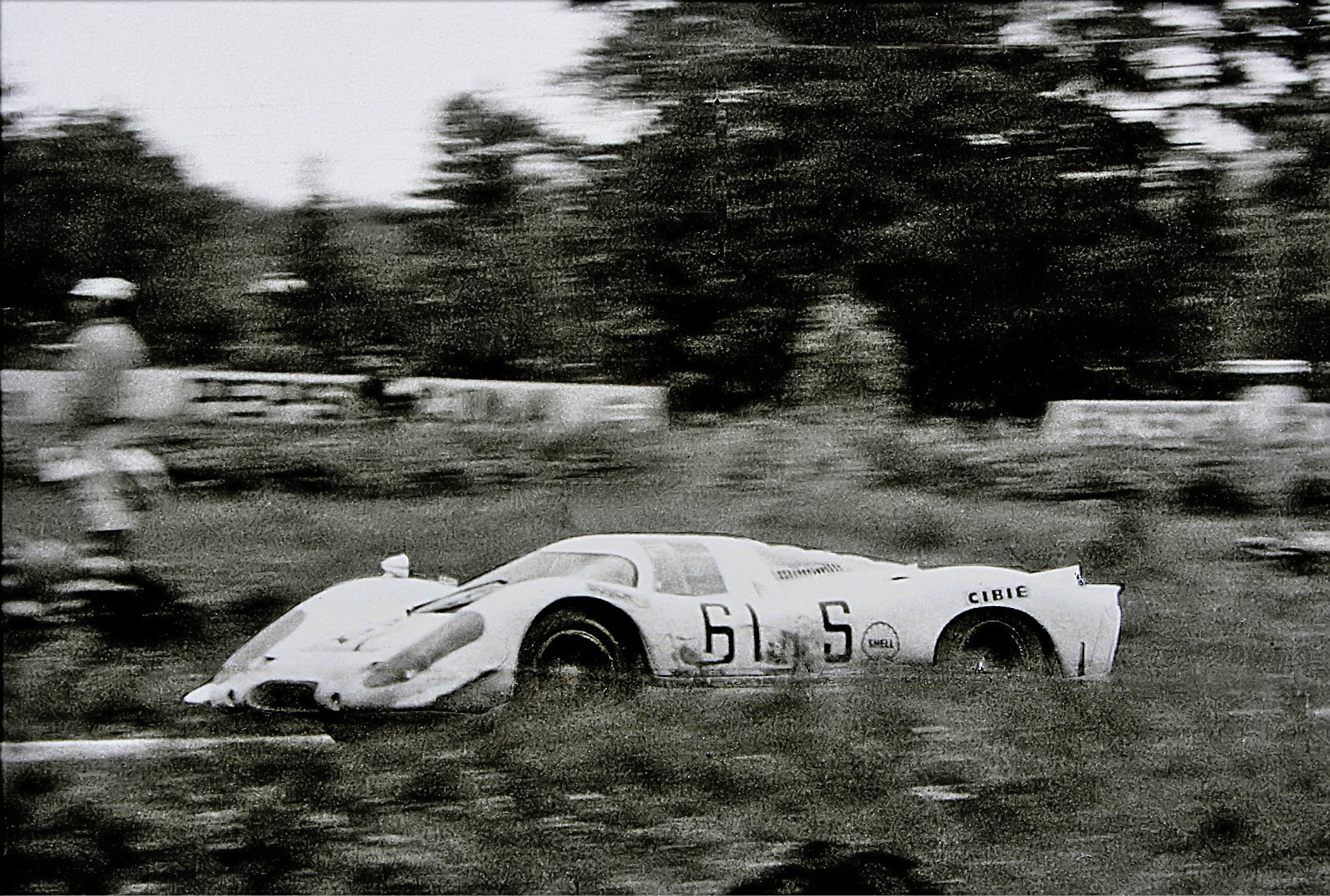
Porsche 917
"And so when I developed my engine... the one thing I wanted to do was, you know, just kind of pay tribute to the motorsport heritage of Porsche... the 917 when you opened it up..."
The Porsche 917 is a famous old Porsche race car from the 1960s. The host mentions it because they wanted a design detail that reminds you of that racing era.
The Porsche 917 is a legendary Le Mans–era race car known for its dominance and big-engine approach in the late 1960s. The speaker references it because the “amber fiberglass shroud” look is a motorsport heritage detail they wanted to echo.
freeway
"especially down here in LA and around this area, you don't want, you don't want to get on the freeway in a 45, 50 horsepower 356"
Here, “freeway” means a high-speed highway. The point is that a small, low-power car can feel strained when you need quick acceleration and steady speed.
In the context of car use, “freeway” implies sustained high-speed driving where you need enough power and traction to merge and maintain speed. The host uses it to contrast city cruising with the demands of highway acceleration.
three and a quarter inch wide wheels
"you don't want to get on the freeway in a 45, 50 horsepower 356 on three and a quarter inch wide wheels, you know, rims and little tiny tires."
Wheel width determines how wide the tire can be. Narrow tires usually have less grip and can feel less confident when you’re trying to accelerate on a fast road like a freeway.
Wheel width affects tire size and the contact patch—the area of rubber touching the road. Narrow wheels and tires can reduce grip and make it harder to accelerate confidently, which is why the host connects this setup to freeway usability.
Peterson Auto Museum
"We were all at the Peterson Auto Museum, maybe what, 34 months ago when Zuckerman and I debuted this car"
The Peterson Auto Museum is a well-known automotive museum in Los Angeles. The segment uses it as the event location where the car was debuted to a Porsche 356 club.
Porsche 356 SoCal Club debut
"when Zuckerman and I debuted this car to the 356 SoCal Club, or some organization down there, figuring there'd be a lot of folks down there that knew about it."
This segment centers on the car’s debut to the Porsche 356 SoCal Club (or a related local organization). It’s a narrative “where/when” moment that explains why local enthusiasts recognized the car’s history.
Chick Iverson
"our entry point is when Seinfeld bought it from Chick Iverson. And that's about, you know, that's the first time I heard the phrase Chick Iverson"
Chick Iverson is referenced as a dealership figure connected to the early ownership history of the car. The segment frames it as the place where the 356 was bought from, and later where the speaker’s family member worked.
Volkswagen
"where Chick Iverson, Volkswagen, Porsche was. Yeah, yeah."
Volkswagen is the German automaker mentioned in the dealership location context (“Chick Iverson, Volkswagen, Porsche”). It indicates the dealership’s multi-brand footprint rather than a specific performance or technical topic.
paint-to-sample program
"Porsche didn't really have a paint to sample program back then. You could order a special color, but it was a little bit different."
A paint-to-sample program is when a car company can make a custom paint color to match a specific sample. The speaker is saying Porsche didn’t offer this kind of official custom-color option back then, so special requests were handled differently.
A paint-to-sample program is a custom-color process where a customer provides a reference color (or requests a unique shade) and the manufacturer formulates paint to match. The speaker notes that Porsche didn’t have such a program in that era, so custom colors required a different workflow.
paint swatches
"Chick or the salesman would come back into the, into the body shop and have my grandfather start mixing colors and come up with paint swatches, and then they would send them to Germany."
Paint swatches are little sample pieces of paint used to check that the color is exactly right. The shop makes samples, then sends them to Porsche so the final car paint matches the customer’s chosen color.
Paint swatches are small, physical samples used to confirm a specific color before the final paint is applied. In this story, the body shop mixes colors, creates swatches, and sends them to Germany so Porsche can match the customer’s unique request.

Porsche 356
"This isn't, you know, a late C car. This is the very end of the 356 model. And the 911s were now being introduced."
The Porsche 356 was Porsche’s early classic model from the 1950s and early 1960s. It’s a big deal because it’s the predecessor to the 911, and this episode says the car is from the very last part of the 356’s production.
The Porsche 356 is the original post-war Porsche model, known for its lightweight design and early air-cooled layout. In this story, the speaker says the car is at the very end of the 356 model run, right as the 911 was being introduced.
open barge
"because back then the cars were transported on an open barge that came over on a kind of on a ship."
An open barge is a ship-like carrier that doesn’t fully enclose the cargo. The speaker is saying that because cars were shipped this way back then, they arrived with protective stuff that had to be dealt with on arrival.
An open barge is a type of cargo transport vessel without a fully enclosed container, which exposes vehicles to more environmental conditions during shipping. The speaker connects this to why cars arrived with protective coatings that needed to be removed carefully.
hoist
"my dad's job was to put the car up on a hoist and wash off all the, the wax"
A hoist is a car lift. The speaker says the dad would raise the car so he could clean it properly when it arrived at the dealership.
A hoist is a lift used to raise a car so the underside and lower body can be accessed. Here, it’s used when the new Porsche arrives at the dealership and the dad washes off shipping protection.
obsolete Porsche Parts
"And then he moved it over to my dad's shop, which was Porsche Parts Obsolete, which was a partnership between my dad and Chick. I see. And they were selling like new old stock obsolete Porsche Parts."
This means Porsche parts that are no longer made. The shop was selling leftover “new old stock” parts that were still in inventory even though Porsche had stopped producing them.
“Obsolete Porsche parts” refers to discontinued parts that are no longer produced by Porsche but may still be available as leftover inventory. The speaker’s point is that the shop sold new-old-stock (NOS) items that had become “obsolete” due to model changes or part supersession.
Porsche Parts Obsolete
"And then he moved it over to my dad's shop, which was Porsche Parts Obsolete, which was a partnership between my dad and Chick. I see. And they were selling like new old stock obsolete Porsche Parts."
Porsche Parts Obsolete is the name of the speaker’s dad’s shop, described as a partnership. The business specialized in selling discontinued Porsche parts as new-old-stock inventory.
new old stock
"And they were selling like new old stock obsolete Porsche Parts. And we had a warehouse in the back and the car would be stored in there."
“New old stock” parts are items that were made in the past but never got sold. They’re still unused, so they can be a way to get original-style parts for older cars.
New old stock (NOS) means parts that were manufactured earlier but never sold to customers, so they’re effectively “new” despite being from an older production run. In classic Porsche circles, NOS is valuable because it can be the closest thing to original equipment for discontinued components.

Volkswagen Beetle
"He had a VW Beetle that was made out of like wrought iron, you know, so it was a running, driving VW Beetle, but it was all wrought iron and some buses and a bunch of stuff."
A VW Beetle is the famous old Volkswagen “bug.” Here, they’re describing a weird custom version where the body was made from wrought iron, but it still ran like a real car.
The Volkswagen Beetle is the classic air-cooled VW with a rear-engine layout and a huge enthusiast following. In this story, the speaker emphasizes a highly unusual conversion: a Beetle made with wrought iron bodywork while still being running and drivable.
machine steel sill
"Well, I was going to ask you about two things in it. Yeah, that's fun. Go ahead, Jack, open up the driver's side door there and look at this, the machine steel sill. Is that what you call that stuff? That's the first thing everyone sees and goes, that's not original."
A “sill” is the metal part along the bottom of the car by the doors. If it’s described as “machine steel,” it likely means a custom or non-factory steel piece was used there, so people can tell it’s not original.
A sill is the structural panel along the bottom edge of the car’s body, near the doors. Calling it a “machine steel sill” suggests a fabricated/aftermarket steel reinforcement or replacement piece, which is why people notice it and assume it isn’t original.
parts manager
"Well, exactly. But but it came from the dealership. So my dad's job, when the cars, my dad became parts manager after he was the detail guy. Okay. And one of the jobs, the parts of the parts manager was to upsell the, the owner on a number of things, steering wheels,"
A parts manager is the person in a dealership who handles the parts department—what parts are stocked and sold. In this story, that role also involved encouraging customers to buy extra parts.
A parts manager runs a dealership or shop’s parts department—ordering inventory, managing stock, and coordinating sales of OEM and aftermarket components. Here, it’s relevant because the speaker says the job included upselling owners on additional items like steering wheels.
upsell
"Okay. And one of the jobs, the parts of the parts manager was to upsell the, the owner on a number of things, steering wheels,"
Upsell means trying to get the customer to spend more by buying extra or a better option. Here, it’s about encouraging the owner to add things like steering wheels.
Upsell is a sales tactic where a seller encourages a customer to buy a higher-value option or additional add-ons. In dealership parts departments, it often means steering buyers toward accessories or upgrades beyond the base purchase.
Durant mirror
"If you notice this car doesn't have like the typical Durant mirror that would normally be on a three foot six, right?"
“Durant mirror” is the host’s shorthand for a more typical mirror style associated with a different expected setup. In the segment, it’s used as a reference point so listeners can understand why the car’s mirror choice looks “wrong” at first glance but may actually be correct for that specific build.
Talbot mirror
"they're probably like, Oh, wait, it's got a, you know, it's got a Talbot mirror and it's got this other thing. It's not original. Yeah. Bullshit. It's original."
A Talbot mirror is a particular type of side mirror. The host is saying this car has the Talbot version instead of the more common mirror people expect, which helps explain what’s original versus what was added later.
A “Talbot mirror” refers to a specific style/brand of exterior mirror used on certain cars. Here it’s being contrasted with a more common “Durant” mirror, and the host uses it as evidence that the car’s mirror setup is period-correct (or at least intentionally specified).
machine turned thresholds
"They put the machine turned thresholds on it because Chick didn't want to have anybody scuffing the carpet coming in and out."
These are the decorative door-sill pieces you step over when getting in. They also help protect the carpet from getting scuffed by shoes.
“Machine turned thresholds” are door-sill/entry trim pieces with a machined, decorative finish. The host mentions them as a practical choice too—Chick didn’t want people scuffing the carpet when entering and exiting.
horn toggle
"I send a text to Sam's son, Gianni... and he goes, I believe that's a horn toggle. Ah, and he was right."
A horn toggle is a switch that changes the horn sound. The host learns it lets you pick between two different tones, like a deeper sound versus a higher “euro” style tone.
A “horn toggle” is a switch that changes how the horn sounds. In the segment, the host discovers it isn’t a kill switch and learns it selects between two horn tones—one deeper and one higher-pitched—suggesting a dual-tone setup.
factory installed
"I can't, I don't know if that was something that was factory installed or if it was something that was dealer installed."
“Factory installed” means the car left the manufacturer with that feature already fitted on the production line. The hosts contrast this with dealer-installed work, which can affect how original the car’s configuration is and how enthusiasts judge its authenticity.
dealer installed
"I've never seen that option, but that seems like dealer."
“Dealer installed” refers to modifications or options added by the dealership after the car was built. In collector-car circles, this can be a positive story (because it was done through the dealer) or a negative one (because it’s not as original as factory fitment).
horn ring
"So they must have wired one to the horn button for the horn ring and then wired the other one to that."
A horn ring is the part on the steering wheel you press to honk. On older cars it can be wired in a way that works with other horn controls to make different sounds.
A horn ring is the circular pad on the steering wheel that you press to sound the horn. On older cars, it’s often part of a more mechanical-looking horn arrangement, and the wiring can be set up so different tones are selected by different switches or toggles.
Cosmoline
"I believe that the majority of the cosmoline has been washed off of it... If you get underneath the haunches of this car, you'll see if you've run through it. You feel the cosmoline."
Cosmoline is a sticky, greasy coating used to keep metal from rusting while a car is stored or shipped. If you still see it, it usually means the car hasn’t been cleaned much yet.
Cosmoline is a thick, waxy rust-preventive grease used to protect vehicles and parts during storage or shipping. It can be wiped off during detailing, and the hosts use it as evidence that the car has been recently cleaned versus being left in its original protected condition.
unmolested
"This car is as unmolested as any car out there."
In enthusiast usage, “unmolested” means the car has not been modified or tampered with from its original condition. It’s often used to emphasize originality and preservation, especially for older cars with valuable period-correct details.
machine turned pieces
"sure, somebody could say, oh, but it's got those, you know, machine turned pieces, you know, but that's what makes the car even more special..."
“Machine turned pieces” are components finished with a lathe-like process to create precise, decorative circular patterns. On classic cars, these details are often part of the trim and can signal higher-end fitment or careful restoration/preservation.
ownership history
"Run the vin. Check the ownership history. Verify the paperwork because there are plenty of scams out there."
Ownership history is a timeline of who has had the car. It helps you spot suspicious patterns and confirm the car’s story matches the documents.
Ownership history is the record of who has owned a vehicle over time. For collector cars, it helps spot red flags like frequent flips, gaps in records, or inconsistencies with the car’s stated provenance.
993 component
"Every time you sign up for something, buy parts online, browse, bring a trailer at 2am or search for that impossible to find 993 component."
“993” is a specific Porsche 911 generation. When people say “993 component,” they mean a part made for that exact 911 generation, not just any 911 part.
“993” refers to the Porsche 911 generation from the 1990s (the 911 (993)). Mentioning a “993 component” highlights that enthusiasts often search for specific parts tied to that exact generation, since fitment and specs can differ between years.

Porsche 935
"...eah, just for a little while, I'd take one of the 935s out and put that crazy wacky thrift to six RSR th..."
The Porsche 935 is a race-focused version of a Porsche 911. It was made to compete in motorsport events, not just for everyday driving. People bring it up because it’s one of the more famous and intense Porsche race cars.
The Porsche 935 is a high-performance race car derived from Porsche’s 911 platform, built for endurance and competition use. It’s significant because it’s associated with serious motorsport success and is known for being extremely capable—and sometimes extreme—in how it’s set up for racing. It may be mentioned on a podcast when the host talks about iconic race cars and the appeal of driving or owning something purpose-built for track competition.
impact zone
"it would ruin everything that you love about a 356, you know, bumper heights and impact zones and, you know, safety."
Impact zones are parts of the car’s front and rear that are designed to crumple in a controlled way during a crash. New safety requirements can force those zones to be built differently than on classic cars.
“Impact zones” are engineered areas on a car designed to absorb and manage crash energy. Modern regulations often require specific deformation behavior, which can change how the front and rear of a car are structured compared with older designs.
bumper heights
"it would ruin everything that you love about a 356, you know, bumper heights and impact zones and, you know, safety."
Bumper heights are how high the bumpers are from the ground. Safety rules can require bumpers to be set at certain heights, which can change the shape of a car—especially an older design.
“Bumper heights” refers to how high a car’s bumpers sit relative to the ground, which is regulated in many markets. Those rules are meant to improve outcomes in low-speed impacts, but they can force changes that affect the look and proportions of classic cars.
A-pillars
"like the A pillars and, you know, some of that, that stuff that they have to know, I get it."
A pillars are the main metal posts at the front of the car that hold up the roof and support the windshield area. They’re important in crashes, so safety rules can force changes to them.
“A pillars” are the vertical structural supports at the front corners of a car’s cabin, next to the windshield. They’re critical for crash protection and rollover strength, so modern safety rules often require stronger or differently shaped A-pillars than older cars had.
Nick Shorsh
"Well, so Nick Shorsh that is involved with Audrain. I've built four cars for him already, and one for one of his partners, Mike."
Nick Shorsh is the person the host says he’s built several cars for. He’s also connected to the Audrain project mentioned right before the 914 discussion.
Nick Shorsh is described as being involved with Audrain and as the person the builder has already made multiple cars for. In this segment, he’s the key client/connector driving the Porsche 914 project.
Audrain
"We we are in the middle of a project for the Audrain guys. You know, when you say the Audrain guys, what does it mean?"
Audrain is the organization the host mentions as being involved in the project. It’s basically the group commissioning or coordinating these custom builds.
Audrain is referenced as the group behind a project the builder is working on. In this segment, it functions as the organizing context for the custom Porsche builds (including the potential 914 Outlaw).
Mike
"I've built four cars for him already, and one for one of his partners, Mike."
Mike is mentioned as Nick Shorsh’s partner. The host says he’s built a car for Mike too, in the context of the same project work.
Mike is mentioned as one of Nick Shorsh’s partners for whom the builder has also created a car. The name is used as a client/partner reference rather than a technical or historical figure.

Porsche 914
"his last project was a green 914 that he was starting to tinker with. So I switched and I'm using the donor car that was my dad's last, my dad's last car. So mid engine. Yeah. Perfectly balanced... We're going to simplify some of the things that make 914 a little clunky. ... if you look under the dash and you pull out the wiring harness on a 914, it takes up a trash can."
The Porsche 914 is a small sports car with the engine mounted in the middle of the car. Here, they’re saying the 914 is a bit awkward to work on because the wiring is crowded, so they want to make it simpler for their custom build.
The Porsche 914 is a mid-engine sports car known for its compact size and simple, lightweight layout. In this segment, they’re talking about how the 914’s packaging and wiring harness make it feel “clunky,” and how they plan to simplify it for an “Outlaw”-style build.
mid-engine
"using the donor car that was my dad's last, my dad's last car. So mid engine. Yeah. Perfectly balanced."
A mid-engine car puts the engine closer to the middle of the vehicle. That helps the car feel more balanced and easier to handle through corners.
A mid-engine layout places the engine closer to the center of the car, typically between the front and rear axles. That usually improves balance and handling because the car’s weight is distributed more evenly side-to-side and front-to-rear.
wiring harness
"We're going to simplify some of the things that make 914 a little clunky. They're, you know, if you look under the dash and you pull out the wiring harness on a 914, it takes up a trash can."
A wiring harness is basically the car’s electrical “wire bundle” that connects all the electronics. They’re saying the 914’s wiring is packed in tightly, which makes it feel cluttered to work on.
A wiring harness is the bundled set of wires and connectors that routes electrical power and signals throughout a vehicle. In older or compact cars like the 914, the harness can take up a lot of space and make interior work and troubleshooting more time-consuming.
Outlaws
"So we're just going to treat it a little bit more like one of our little Outlaws. That's really exciting."
“Outlaw” in Porsche circles usually refers to a restomod-style build philosophy: taking a classic Porsche and modifying it for modern usability and driving feel while keeping the character of the original. Here, they’re comparing treating the 914 more like their “Outlaw” builds to make it simpler and more driver-focused.
GT silver
"And if you use the right silver, it, it, you know, like I love the, the GT silver from 07 because it has a lot of pitch in it."
“GT silver” is a particular shade of silver paint associated with Porsche’s GT cars. They like it because it looks especially good and hides small scratches and chips better than some other silvers.
“GT silver” refers to a specific Porsche racing-inspired silver paint color used on some 911 GT models. They’re describing it as having more “pitch” (visual depth/flake effect), which makes the car’s body lines look better even when it’s dirty.
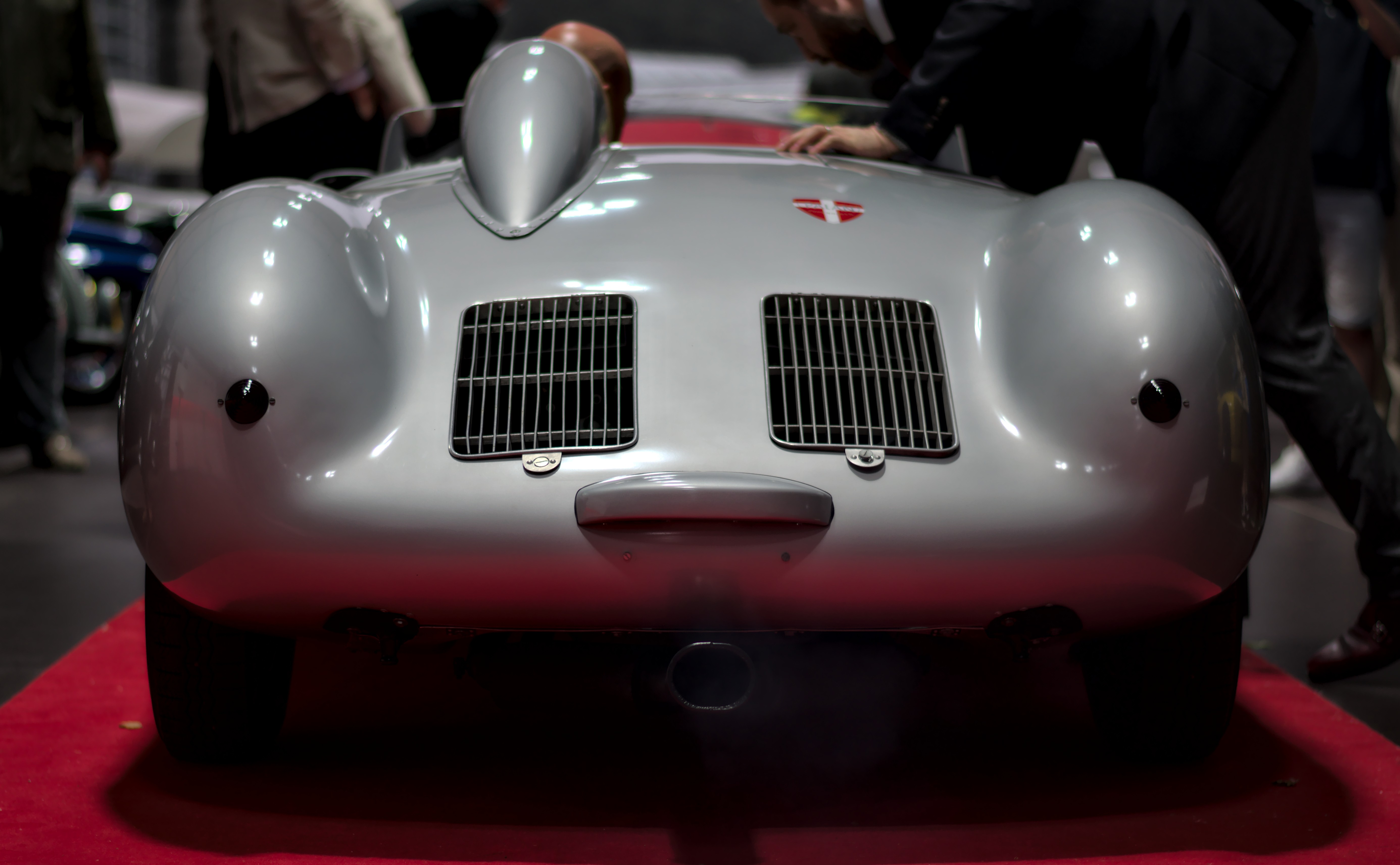
Porsche 550 coupe
"My, my personal little 55 coupe is silver with kind of a dark red kind of Bordeaux like, like Vivian too."
The Porsche 550 is a famous old Porsche race car from the 1950s. They’re talking about their own “55 coupe” and how they like silver because it reminds them of early Porsche racing cars.
The Porsche 550 is a classic 1950s Porsche race car, famous for its lightweight design and motorsport pedigree. In this segment, they mention their personal “55 coupe” as a silver car, tying the color choice to early Porsche racing aesthetics.
425 horsepower
"Ed Pink built a 425 horsepower, you know, fire breathing monster for it."
Horsepower is a number that tells you how strong the engine is. “425 horsepower” means the car’s engine is making a pretty high amount of power for its class.
Horsepower is a measure of engine power—how much work the engine can do over time. When someone says a build makes “425 horsepower,” they’re describing the output level the engine and supporting mods are targeting or achieving.
Ed Pink
"Ed Pink built a 425 horsepower, you know, fire breathing monster for it."
Ed Pink is a well-known Porsche engine builder and tuner in the classic Porsche community, associated with high-output air-cooled performance builds. In this segment, he’s credited with building a 425-horsepower engine for the speaker’s car.
Porsche literature swap meet at the Hilton
"And Zane started going with me when he was born, you know, we've always attended the Porsche literature swap meet at the Hilton every year."
They’re talking about a regular Porsche fan event where people trade Porsche-related items like books and memorabilia. The speaker says they’ve been going for years and met other enthusiasts there.
This refers to a recurring Porsche-focused gathering centered on trading literature and parts/collectibles, hosted at a Hilton venue. It’s mentioned as a regular community event that the speaker attends and where they met other Porsche enthusiasts.
die-cast cars
"the next thing you know, you have this box of hot wheels and little die cast cars. And Zane and I just always started collecting them."
Die-cast cars are toy model cars made from metal. People collect them because they look like real cars, including rare or unusual ones.
Die-cast cars are small model vehicles made by pouring molten metal into a mold, then finishing them for detail. Enthusiasts collect them because they often replicate obscure real cars and can be surprisingly detailed for their size.
Hot Wheels
"the next thing you know, you have this box of hot wheels and little die cast cars. And Zane and I just always started collecting them."
Hot Wheels is a well-known brand of small metal toy cars. Some older ones are collectible because they’re no longer easy to find.
Hot Wheels is a popular die-cast toy car brand known for lots of real-world-inspired models and fantasy variations. In collector circles, older releases can become harder to find and more valuable.
blueprint cabinets
"I came across these old blueprint cabinets, right? Because people don't have like blue, you know, back in the day, you know, architects and builders had all their blueprint prints in these cabinets."
Blueprint cabinets are old-style storage drawers for big paper plans. Here, the speaker uses them like a display case because the drawers fit toy cars well.
Blueprint cabinets are storage drawers used historically by architects and builders to keep large paper plans flat and protected. In this story, they’re repurposed as display storage because the dimensions conveniently fit Hot Wheels and other small die-cast cars.
Matchbox
"loading all of our hot wheels in there and our matchbox and our shukos and all the other little stuff."
Matchbox is a brand of metal toy cars. Collectors like them because they’re based on real vehicles and some versions are rare.
Matchbox is another major die-cast toy car brand, historically known for smaller, more realistic “everyday” vehicles. Collectors often track specific releases and variations the way car people track real models.
shukos
"loading all of our hot wheels in there and our matchbox and our shukos and all the other little stuff."
“Shukos” refers to Schuco, a European brand of metal toy cars. The speaker is saying they collect those more detailed European models too.
“Shukos” is a collector shorthand for Schuco die-cast toy cars, a German brand known for detailed models. The term matters here because it signals the speaker is collecting European die-cast lines, not just mainstream American toys.
die-cast collecting at shows
"That lit show, you know, when my boys were young, it was, I would always say to them, they've got stuff here that you'll never see again... hunting for those cars was a lot of fun."
They talk about how they used to go to events and vendor booths to hunt for rare toy car models. It was a fun way to discover unusual cars and build a collection.
The hosts discuss how car-themed toy/die-cast hunting at vendor booths became a fun ritual when the speaker’s kids were young. The segment focuses on finding obscure European models and buying them at events.

Volkswagen Bus
"...urope of the most obscure cars or the weirdest VW bus or, you know, I would always come out of that thi..."
The Volkswagen Bus is a type of van made by Volkswagen. It’s known for having lots of room and a recognizable look. People talk about it because it’s an unusual, memorable vehicle that can be used for everyday trips or trips with friends and family.
The Volkswagen Bus is a classic van known for its spacious interior and distinctive styling, originally designed for people and cargo transport. It’s often discussed because it became a cultural icon and is still popular with owners who want something practical with a lot of character. On a podcast, it may come up in the context of unusual or “weird” vehicles that stand out in the Volkswagen lineup.

Porsche 904
"Like if I'm building a car that's going to be inspired by an RSK or by a 904, then I can take one of those."
The Porsche 904 is an old Porsche race car from the 1960s. Here, the host is using it as a visual reference—like a “look at this” example—for how they want the front end of their project to be designed.
The Porsche 904 is a classic mid-1960s Porsche race car known for its lightweight, purpose-built design and strong motorsport heritage. In this segment, it’s used as a styling reference for how the host wants to shape the nose on a custom build.
bead blaster
"the skills, you know, a welder, somebody that can sew, run a bead blaster, somebody that can sand, sweep, somebody that will clean the bathroom."
A bead blaster is a machine that shoots tiny abrasive beads at a surface. People use it to clean metal and remove old paint or buildup before doing the next step of the work.
A bead blaster is a blasting tool that propels small abrasive beads at a surface to clean it or strip paint/rust. In a fabrication shop, it’s commonly used to prep metal before welding or finishing.

991.1 GT3 RS
"Well, I mean, what I personally have, I've got a 991.1 GT3 RS. Love that car. Love everything about that car."
This is a Porsche 911 GT3 RS from the 991.1 era. It’s the “track” version of the 911, made to feel very responsive and planted when you drive hard.
The Porsche 911 GT3 RS (991.1 generation) is a track-focused version of the 911 built around maximum grip and driver feedback. It’s known for being extremely sharp to drive, with a setup that prioritizes lap-time feel over comfort.

GT4 RS
"I've got a GT4 RS, which I love certain aspects about it, but there's certain things that, you know, I like my, my three much better."
This is a Porsche Cayman GT4 RS, which is a track-oriented version of the Cayman. It’s meant to be fun and precise, but the host says they like their other Porsches more.
The Porsche 718 Cayman GT4 RS is a high-performance Cayman variant built for track use, typically with a more focused chassis balance than a standard Cayman. The speaker is comparing how it feels versus their 911s, implying the GT4 RS has strengths but doesn’t match their preferred 911 experience.
Request an Explanation
Heard something you'd like explained? We'll add it to this episode.
Sign in to request explanations for terms you heard.
Want to learn more?
Browse our glossary for plain-English explanations of automotive terms, jargon, and concepts.
Help improve this episode
See something that's not quite right? Our annotations are AI-generated and can sometimes miss the mark. Click the flag icon on any annotation to suggest a correction.