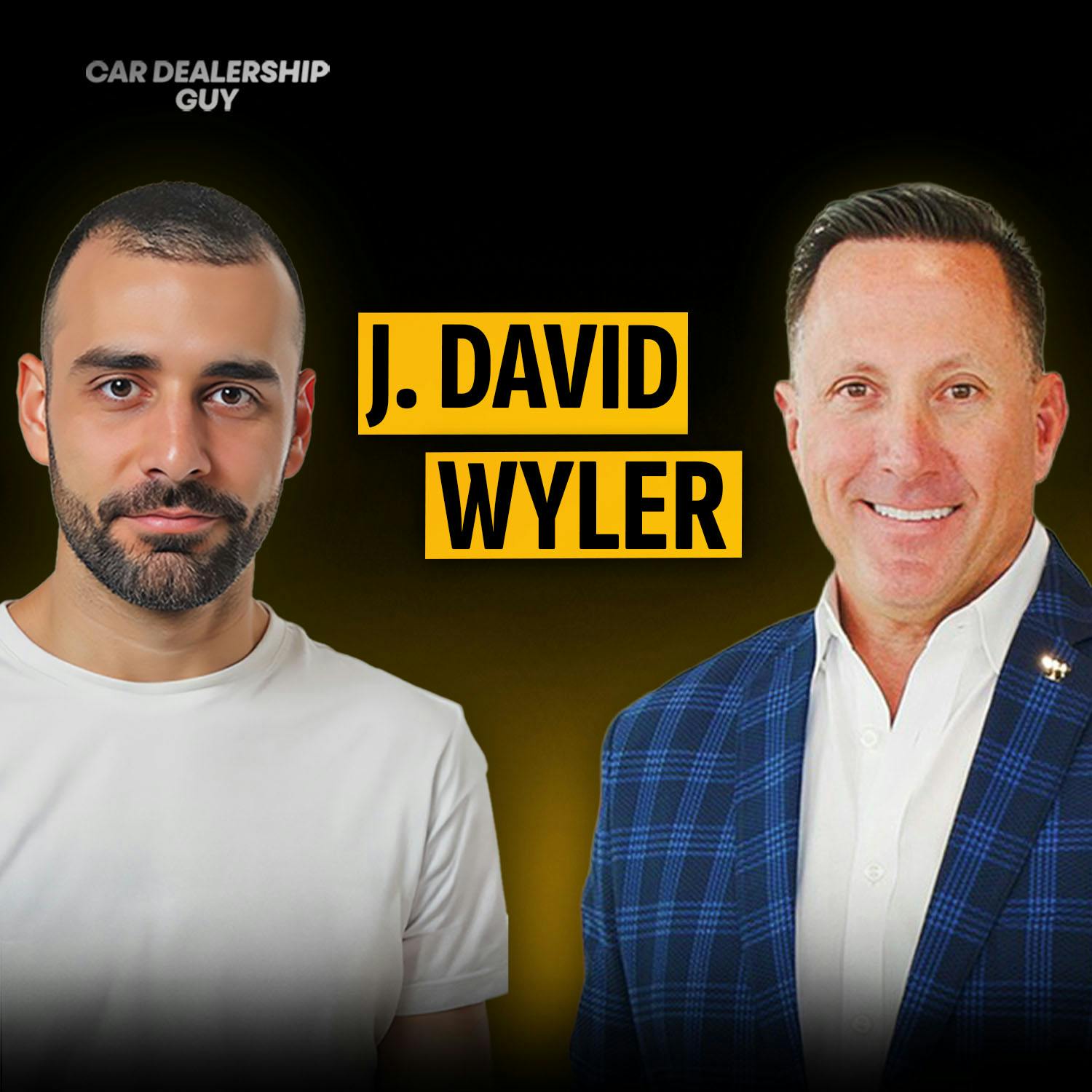
"We Fired All Our Managers!" — Lessons From a $500M Expansion (& What It Took to Make It Work) | David Wyler, CEO of Jeff Wyler Automotive Family
Car Dealership Guy Podcast
"We Fired All Our Managers!" — Lessons From a $500M Expansion (& What It Took to Make It Work) | David Wyler, CEO of Jeff Wyler Automotive FamilyCar Dealership Guy Podcast · Mar 3, 2026
The Subaru 360 is a very small and simple car made a long time ago in Japan. It was popular because it was cheap and easy to drive, especially when cars were expensive. People might talk about it to show how small cars can be useful.
I either hired the wrong person or I didn't coach you up.
We really make a big deal
out of wearing this out of this whistle
because it is a huge responsibility.
Yeah, you've really leaned in to that theme
and it seems like it's just part of your culture completely.
Okay, so tell me about what development programs
or tools do you provide your team?
I think there's many listeners right now
who are dealers who are growing.
And in general, you know, consolidation has only accelerated
in the past decade in this industry.
People are going bigger, getting bigger groups,
and you're seeing just, you know, education, training
as an overall investment.
People are, dealers are spending more time,
resources, effort into it.
So I'm curious, you make everyone coaches.
This is a theme that seems to permeate
throughout your entire organization.
What, how do you actually enable them to succeed
at their role so that you can acquire
a Midwestern auto group with, you know,
add all those rooftops to your group or whoever else?
What type of tools and resources do you provide?
That's a great question, Yossi.
So about the same time, we knew in order for us
to develop this culture, you know, of coaching
and practicing is what we like to call it.
We practice every single day.
In fact, so we'll video every F and I delivery
and we actually have game film.
We actually call it game film review, our F and I.
I've had a couple of conversations
about this recently on the podcast.
Yeah, and so, you know, it's like,
hey, we have game film review for these stores.
And so we'll review just like, you know,
a basketball team would have like,
hey, last night, why didn't you box this guy out?
You know, why didn't you move your feet?
What, why, you know, why were you,
why'd you have so many turnovers, right?
So we do that, but we give them a playbook.
We've got a sales playbook.
We've got a finance playbook.
We've got a service playbook.
And what's great is it literally is our playbook.
And again, Scott and I have worked together
for over 30 years of growing this company
where it is today and everybody that works here.
And again, we're not the smartest guys in the world.
And so what we decided to do,
let's say we started with sales.
What's the wiler way and how do we want to sell cars?
And how do we want to practice
and how do we want to coach our players?
And so we developed a team of about six or eight folks
from different brands, different locations.
And we developed internally our own sales process.
So it's not like an outside program.
This is something that we did together
that everybody bought in, right?
So I think we took probably the most respected coaches
from each of the locations on the sales side and said,
here's how the wiler way is going to present it
every single deal.
Here's the wiler way on our finance process.
Here's the wiler way on our service drive.
And every single person has our playbook
on how the Jeff Weiler Automotive family
executes each play.
When you look group-wide,
what are the biggest challenges?
Well, the biggest challenge right now for us
is this latest acquisition,
which is the integration of 250 employees,
14 new brands, which we haven't had
and integrating our culture, right?
And so our culture is unique.
And you see these guys come into your store
and they got these whistles and we're high five
and we're talking about game review.
Timid.
Yeah, we're talking about practicing
and I need you into the Urban Meyer conference room
or I need you into the Sparky Anderson conference room, right?
It could be a little daunting and overwhelming,
but again, that's what coaches do, right?
Coaches develop talent.
They develop talent.
And our last acquisition before Midwest Auditor Group
was 40 years ago.
It was seven stores.
We bought Mercedes Benz of Louisville
like two months before that.
And Mercedes Benz of Fort Mitchell,
like four years before that.
And out of those 10 dealerships,
all but one general manager at that time
is a head coach for us.
So I think people really want to embrace culture.
People, they wanna get better.
And they wanna be mentors.
They wanna be coaches and develop their own teams.
And so the biggest challenge for us right now,
Yossi, is instilling that culture,
that vernacular into the Midwest Auditor Group.
And it's gonna take some time, right?
I know a lot of the folks are bought in,
but I'm sure there's still a lot of folks
asking questions like, what are we doing with whistles?
Like, I don't get it.
I don't understand it.
I know there's been some aha moments
for some of our leadership over there,
which I'm really excited about.
This episode is brought to you by YSM Design.
Dealers, everyday construction pinches your service drive
as profits stuck in park.
YSM Design, your expert and automotive dealer architecture
helps dealer principles fixed and variable ops teams
turn facility work into bottom line lift.
EV readiness checks, OENM brand image updates
and new store requests, plus expansions and renovations
big or small with full architectural services end to end.
They keep decisions moving with instant renderings,
immersive 360s and lidar scans of your existing facility
to catch surprises early and speed approvals.
35 years in auto retail, 2000 plus designs,
repeat Fortune 500 clients and experience with nearly
every brand across almost every US state.
Get started today at ysmdesign.com,
call 4042-494555 or click the link in the show notes below.
Assume day one after the close,
I'm trying to put myself in your shoes, right?
What are the steps you've taken?
I've had conversations here with Lithia acquisitions,
where we spoke about what were the first steps you took
and how did they work?
And I have to imagine that you yourself
a student of the business,
you've clearly thought a lot about this.
This is a big, big acquisition.
How did you handle that?
And you mentioned cultural integration is a tough one,
but it's one that you're gonna crack.
So what did that look like for you to immediate
right after that acquisition happened?
And what do you do?
Other than, oh crap, what did I just get into?
Look at the bank account, look at the wire transfer.
Yeah, exactly.
That day after was really just kind of a sense of relief.
It really was.
I've done some of the heavy lifting, right?
Just in terms on the M&A side,
but I can't say enough for our folks
that administratively helped put the deal together, right?
I can't imagine having to deal
with 14 different OEMs and applications.
That's way above my mental capacity.
And then after closing in that next day,
it was just pure excitement of like, okay,
now we can go in there as a team,
as a team and we can go in and spread our culture
and we can coach everybody up.
It was really an exciting moment.
An incredible moment.
Yeah.
You know, I think about being in your dad's shoes
and seeing that kind of acquisition go down.
One thing that I haven't discussed a lot on this platform,
but I think about is how do you,
as the son of the founder,
separate your worth with the family versus,
you're the son at the end of the day,
but you're also the CEO.
And I think it's very challenging sometimes
where you feel like your worth is measured
by your success in the business.
At least I've felt that way before.
And I'm curious, you know,
you and your dad's relationship there, right?
Not every year is gonna be the highest of the highest
and some years are gonna be better than the worst.
And I'm curious how you manage that relationship.
I have to imagine other kind of family,
sons, daughters have probably maybe felt that,
but where you feel like you are,
like I said, you're running the business,
but you're also the son or the daughter.
Yeah, let me just first say,
my dad and I were best friends.
We have been forever and we'll always be best friends.
My dad, I think I mentioned earlier,
he's always been inclusive.
I just remember as a kid, he would take me to work.
He'd let me sit in sales meetings.
He'd let me sit in factory meetings, right?
He'd ask me questions.
What do you think, Dave?
What do you think about this?
What would you do?
He was also respectful in the fact, as I said,
he let me have failures, right?
And have successes.
And one thing that I see so much in the automobile business
and whether it's gen two or gen three is that gen one,
having a hard time letting go
and allowing their son or their daughter
to have successes and or failures.
I mean, the one thing my dad always told me is, man,
you know, I love you more than anything in this world.
I would do anything for you.
You're my best buddy.
But family's family and business is business.
And if you ain't getting it done on the business side,
you're gone.
And there's no nepotism in this company, Dave.
You're gonna have to work your tail off
and you're gonna have to prove not only to me,
but to everybody else that you have the ability to do this.
Not only did he do this to me, he did this to Scott.
And, you know, we navigated it.
And the one thing for me in particular,
and I know that folks that are gen two or gen three
are going through this.
And I tell this to my children.
The success that I've had or will have in the future,
the perception is that it's because you're dad.
It's because you're dad, Jeff Weiler, right?
And any failures that I have had
and that I will continue to make, well, that's on you, Dave.
That's because of you.
And if you accept that and you're okay with it,
I think that you'll be more successful.
And I didn't learn that for a long time.
And I think that's probably what made me so competitive
in the earlier days of my career is like,
I'm gonna show you that, you know, it's just not my dad,
you know, I can do this too.
So I love that.
And, you know, I've been so conflicted on bringing the,
like having a kid or child into business.
It's something I think about a lot
because I grew up that way.
And on one hand, it, you know, made me who I am
and I'm grateful for that.
And I was exposed to so much.
On the other hand, sometimes I say, wow,
I don't know if I'd want, you know,
my kids to go through this.
I think being in a dealership setting is,
you mentioned you were sat in those factory meetings.
You sat in other meetings,
but being exposed to real challenges like that
is so important for development.
And I put so much value on that.
And I also remember, I did notice
that you were with your son when I saw you in Vegas.
So I did take note of that.
You guys walked in together.
It seemed like, you know, he's right in there with you.
I said hello to you.
He right away introduced himself.
I noticed the little details, you know,
he shook a firm hand.
You guys, you know, it seems like
you're definitely mentoring him well.
How have you adopted or have you adopted
your dad's approach to parenting with the business?
Is your son involved to the extent that you were at his age?
How do you think about that?
I've got three boys.
I think they all three want to be in the business.
My oldest is involved in the business now.
He actually worked at Nissan North America
when he graduated college from the University of Miami.
He started on the wholesale side,
kind of like, I think he wanted to take the route
of my old man who started a Chevrolet Motor Division.
And so I've given him the opportunity to come in here.
And again, I've told him the same things
that I've just told you, right?
There's no nepotism in here.
And I love you more than anything in the world, son.
I do.
We talk every single day.
We FaceTime each other.
If I don't see him in person.
And there's a difference between running, you know,
a huge enterprise than it is being your son.
And you can have both, but there needs to be guardrails
and there needs to be expectations.
What second generation can and can't do,
we expect them, you know, to be the coaches
that everybody thinks that they should be, right?
Which means as a coach, you gotta be the first guy.
You gotta perform.
You gotta perform, but you gotta be the first guy
in the building, right?
And you gotta do everything that I'm asking you to do, right?
And I've gotta have all the answers.
And then I'm gonna be the last person
to leave the practice facility at night as well.
So it's a daunting challenge.
It's probably, there's probably more pressure,
more pressure probably on gen two than gen three.
I like to say, and I kinda kid that, you know,
with my dad sometimes, right?
And he's like, what are you talking about?
I stuck my neck out online and this and that.
And I'm like, I don't disagree with that,
but, you know, the pressure of having everybody think
that gen two is gonna fail in your business is daunting,
let alone gen three, right?
So it's a big task.
I see it.
I mean, by gen three, gen two has proven
that a transition is possible and doable.
So gen three, you know, you have some success
to lean on there, although statistically,
gen three is more likely to not work out
if you look at statistics, but who's looking at that?
I'm taking more interest in you now.
Like, what do people not know about you, right?
Someone listening, what is their,
let's peel the layers to the onion of David's eye.
What do people not know about you?
Well, I don't like to peel layers.
That would be the first thing you'll see.
That's what they don't know.
I'm this alpha guy, right?
I'm the CEO of one of the largest
privately held automobile dealerships.
I can't have any vulnerability, right?
Or emotions, but I do.
I am a human being, right?
You know, I care deeply about, you know,
all of our employees.
I really do.
I wanna make sure that they're taking care
of the families they're taking care of.
So I do have vulnerabilities.
You know, I'm just a guy that,
like the one thing that I love to do
is just be in the car business.
Like, I don't know that, like,
I'm the luckiest guy in the world that I'm my dad's son.
Like, I could have picked,
my dad could have been something else
and I would have been a creek.
I really would have, because there's nothing Yossi
that I can do other than sell cars.
Like, I'm pretty one dimensional.
I can't do anything else.
So I hit the jackpot when it came to my old man
being a car dealer,
because I can't do anything else.
One thing that I do know,
you know, I love my family.
I love my boys.
Like I said, I had the opportunity to coach them as kids.
Those are some of the best times
that I've ever had in my life.
I think you're underselling yourself.
I think you're more than one dimensional,
but we'll get there.
So tell me, what other interests do you have,
like health, religion, working out?
I'm curious, you know, what else,
how else you spend your time?
So, I love to golf.
I love to golf.
And I don't put a lot of work into golf,
but I love to golf.
And so if I can play golf, you know,
for nine holes or 18 holes and sneak out one day,
I'd love to do that.
It really frustrates me.
I kind of feel like, here's my vulnerable side
when it comes to like golf.
I'm not a very good golfer.
I'm like a 12 index.
And I think I'm afraid sometimes to practice at golf
because I don't practice at golf.
I would never go to the driving range.
I don't go to the driving range before I play golf.
And like, actually I'm kind of scared.
Like if I did practice and I didn't become a better golfer,
that scares me actually.
And so in the back of my mind,
because I think I have this fear of failing, right?
And so at work, you know,
I think effort is a huge part of your success.
And effort is only between you and you and nobody else.
And I think I relied on, you know,
maybe my personality of being able to sell cars
that made me not so much my golf swing.
So like it actually does kind of scare me.
And I've always thought about like, Dave,
why don't you just like for like two months,
like go to the track man and like bang balls
every single day for two months
and see what happens to your golf game.
And I'm scared to do it.
I think this episode was brought to you by CDG Recruiting.
The car dealership guy platform has direct access
to thousands of skilled professionals
in the dealership and automotive industries.
And so building on top of our free industry job board,
we've launched CDG Recruiting,
a hands-on white glove automotive recruiting service.
Whether you're looking to fill roles
in dealership management, the C-suite, FNI,
fixed stops, auto tech or SaaS,
we take the hassle out of hiring
by doing the heavy lifting for you.
It's easy.
Start by submitting a confidential talent request
on our website.
Next, we connect you with a dedicated talent expert
who will thoroughly understand your unique needs.
And finally, we present you with top notch candidates
who are ready to drive your business forward.
And here's the best part.
We vet and screen every candidate for you
so you don't have to.
And with our placement guarantee,
hiring through CDG Recruiting is 100% worry free.
Collectively, our team has decades of experience
and has successfully placed over 1,000 roles
in the automotive industry,
so you know you're in good hands.
If you're ready to find your next Rockstar employee,
try CDG Recruiting today by visiting cdgrecruiting.com
or clicking the link in the show notes below.
Again, that's cdgrecruiting.com.
I think it's super cool that you're cognizant of that
because years ago I read about Mark Zuckerberg
who every year he takes on a new challenge,
just like something random.
And one year he decided to learn like Mandarin Chinese
and one year then suddenly became like a UFC fighter.
And really, I mean, the guy is just a genius
and very stellar at what he does.
But that always inspired me.
And I've tried to do some of that since,
but this year, personally, I took on tennis.
He said, I wanna learn.
I've never picked up a racket in my life.
I was a wrestler in high school.
I wrestled, I played soccer, you know what I mean?
So never did any sport with that, but I said, let me try it.
And it was like super terrible for the beginning,
but I think I've gotten decent at it.
I really empathize with the feeling.
I think that it's cool that you're aware of that.
And I would say if I could leave an impact
on you and this podcast,
it would be just keep trying new things.
Cause it's just great, you know, you get out of your shell.
And the fact that you're already aware of that,
like you're like 80% of the way there.
And just try something new.
What am I gonna do, Yossi?
Am I coming back to you?
Just get back up and keep going, baby, let's go.
We can bring you back on a podcast.
It's great content.
The thing that I think catches people by surprise with me
is with my personality, I'm actually introverted, right?
I'm not like, I don't really wanna go out
and meet new people.
And, you know, it kind of gives me some anxiety to do that.
I'm a homebody, if I wanna go out.
You and me both.
Yeah, if I wanna go out, I'd rather just go out,
you know, with my wife, or I wanna go out with my wife
and kids.
And not every night, but I'd like to be in bed
by at the latest, 9.30, like every night.
If not, if I can get into bed by 8.30 one night,
I'm doing it.
And people are completely wigged out when they hear that.
And so when I'm in Vegas, it's so funny,
I go out there with our team and I'm like,
all right, tonight we're getting a table,
we're going to the club and they all laughing, man.
Because they know, they got no chance of doing.
Break the flow.
Incredible conversation.
You know, I know we spoke a lot about the family,
the business and one thing we didn't touch on
and I would like to touch on before we come to a close
is just your overall take on the trajectory of the industry
with where margins are going, volumes,
the brand mix that you have today,
new potential brands in the future.
What's your kind of, give me your executive summary,
the David Weiler executive summary of,
you know, how you view the direction of the business.
Yeah, so coming out of COVID, right?
Our company for one, we got stagnant
and we kind of just relied on COVID, right?
And in easy-
The tailwinds.
Yeah, the market just, the market was good.
We think we took things for granted.
We took our eye off the ball.
We didn't execute what the playbook said.
We didn't block, we didn't tackle fundamentally.
That's kind of what I like to say
because, you know, that blip in time,
it's never gonna happen again.
And so I think where we have been in 25
and what I think 26 is gonna be and moving forward,
it's gonna be the traditional Carbiz.
This is gonna be a grind, but it's gonna be tough, right?
This is not an easy business.
And so moving forward, we've got to roll up our sleeves.
We're gonna have to practice harder
than we've ever practiced before.
You know, I always like to say, like in an NFL game,
and this is kind of one of my canned speeches,
you know, to a group or to our team is like,
in an NFL game, think about this, Yossi,
like there are four quarters and they're 15 minutes each,
right?
And so that's an hour, that's an hour.
But if you actually look inside of an NFL game,
during, there's only probably like 11 minutes
worth of plays in an hour, right?
Of just live action, whether it's a running,
running play or special teams, you've got 11 minutes.
And so these professional athletes, all right,
are gonna play for an hour or a condensed 11 minutes.
And half of that is offense and half of that is defense.
And so that would be like five and a half minutes
for offense and five and a half minutes for defense,
that you would actually have live action.
And so what does a week look like for an NFL player
and how much time and effort and practice
do they put in for that one hour?
Think about that.
And for those, for those respective five and a half minutes.
Yeah, and so you're probably,
they're probably putting in with lifting,
practice, game film, they're putting in 50 hours a week,
right, conservatively.
And what are the coaches putting in?
The coaches are putting in more than that for a one hour.
And what are we doing in the retail car business?
We're gonna be open for how many hours a day,
how many hours a week,
and you'll see what's your practice schedule.
My practice schedule is a half hour a day.
It doesn't make any sense, does it?
Makes no sense on that correlation.
You're a professional salesperson,
you're a professional advisor, right?
And we're only practicing 30 minutes a day,
five minutes a day, 10 minutes, whatever the number is,
your return on what your professional game is
that day of eight hours,
I only put in 30 minutes for eight hours.
That doesn't correlate.
So that's some of the things that we've tried to change.
I love the look into the business
and how you think about it and how you lead the team.
And it seems like you're doing a great job
and you're bringing really just lots of cultures
is clear that you don't just say you mean it.
So I really do appreciate that.
David, any closing thoughts?
Appreciate you having me on.
I'd love to have you come up to our headquarters.
So you actually can see, you can feel.
Headquarters is in Cincinnati, right?
Yeah, headquarters is in Cincinnati.
In fact, we partnered years ago with a group
that actually built out and remodeled
college locker rooms and recruiting centers.
So you really went with the theme, wow.
Yeah, and so we literally have,
that's the same company actually has come in
and done our facility.
So it actually looks like a college.
I can imagine you're going home to your wife
and saying, listen, you're gonna think I'm crazy,
but I think this walk-in closet should have locker rooms.
Exactly.
Yeah, that's what she says to me.
She's like, yeah, you know I don't work for you, right?
Oh my God, love it.
David Weiler, what a conversation.
This is super fun.
Yeah, I'm excited for, you know, to air this
because it's really just, you know, you're very authentic
and I love having conversations with people like yourself
where you can really tell a real story
and understand the history, but also, you know,
how you think about operating today
and, you know, business life.
So incredible conversation.
Hopefully in the future I can have you here
down in Florida recording together.
Love to.
What's scheduling in advance and I'll make an app for sure.
Incredible.
David Weiler, Jeff Weiler, or JJ Dobb, automotive group.
That's right.
Thank you for commenting on the pod.
This was super fun.
Thanks, COC.
Appreciate you.
All right, hope you enjoyed that episode.
Please give the podcast a rating.
Consider subscribing to the show
and check the show notes for links to what we talked about.
Thanks for tuning in.
I'll see you guys next time.
About this episode
David Weiler, CEO of Jeff Weiler Automotive Family, shares insights on scaling a dealership group to over 50 locations with $500M+ in sales while maintaining culture and operational discipline. He emphasizes the importance of proximity-based growth within a 100-mile radius to avoid operational drag and foster strong market ownership. The conversation covers the shift from traditional managers to coaching roles, lessons from a major acquisition, and the evolution of marketing strategies rooted in the company's heritage. David also reflects on family legacy, deliberate acquisition choices, and the challenges of balancing growth with culture preservation.
Today I'm joined by David Wyler, CEO of Jeff Wyler Automotive Family.
We dig into why Wyler abandoned traditional corporate management in favor of a “coach” model, how a strict 100-mile acquisition rule protects execution, and why culture—not capital—is the only defensible edge left in consolidation.
David also unpacks his massive acquisition of the Midwest Auto Group, the lessons of stagnation during COVID, and what it really takes to scale a family business without losing its soul.
This episode is brought to you by:
1. YSM Design - YSM Design, your expert in automotive dealer architecture, helps dealer principals and fixed/ variable ops teams improve the bottom line with EV readiness checks, OEM brand image updates/new-store requests, and expansions or renovations—big or small—powered by instant renderings, immersive 360s, and LiDAR scans that reduce surprises and speed decisions; visit @ here or call 404-249-4555
2. Siro - Siro’s AI gives dealerships full visibility into every conversation. It records, transcribes, and analyzes in-person conversations. Proactively flagging compliance issues, missed revenue opportunities, and training gaps. Go to @ https://www.siro.ai/cdg to learn more
3. CDG Recruiting - Hire top dealership talent, fast. From sales managers to GMs and C-suite execs, we’ve placed over 1,000 roles across auto retail. Ready to scale without the hassle? Visit @ https://www.cdgrecruiting.com/ to get started.
Check out Car Dealership Guy’s stuff:
For dealers:
CDG Circles ➤ https://cdgcircles.com/
Industry job board ➤ http://jobs.dealershipguy.com
Dealership recruiting ➤ http://www.cdgrecruiting.com
Fix your dealership’s social media ➤ http://www.trynomad.co
Request to be a podcast guest ➤ http://www.cdgguest.com
For industry vendors:
Advertise with Car Dealership Guy ➤ http://www.cdgpartner.com
Industry job board ➤ http://jobs.dealershipguy.com
Request to be a podcast guest ➤ http://www.cdgguest.com
Topics:
08:20 Herb Chambers' advice on buying dealerships everywhere.
18:45 Why every single manager got fired and rehired.
24:20 The game film trick that fixed F&I managers.
25:55 How an internal playbook killed outside training programs.
31:40 The brutal truth about being a second-generation dealer.
39:55 Why practicing golf is actually terrifying.
46:05 What COVID really did to company performance.
46:55 The NFL analogy exposing every dealership's weakness.
Car Dealership Guy Socials:
X ➤ x.com/GuyDealership
Instagram ➤ instagram.com/cardealershipguy/
TikTok ➤ tiktok.com/@guydealership
LinkedIn ➤ linkedin.com/company/cardealershipguy
Threads ➤ threads.net/@cardealershipguy
Facebook ➤ facebook.com/profile.php?id=100077402857683
Everything else ➤ dealershipguy.com