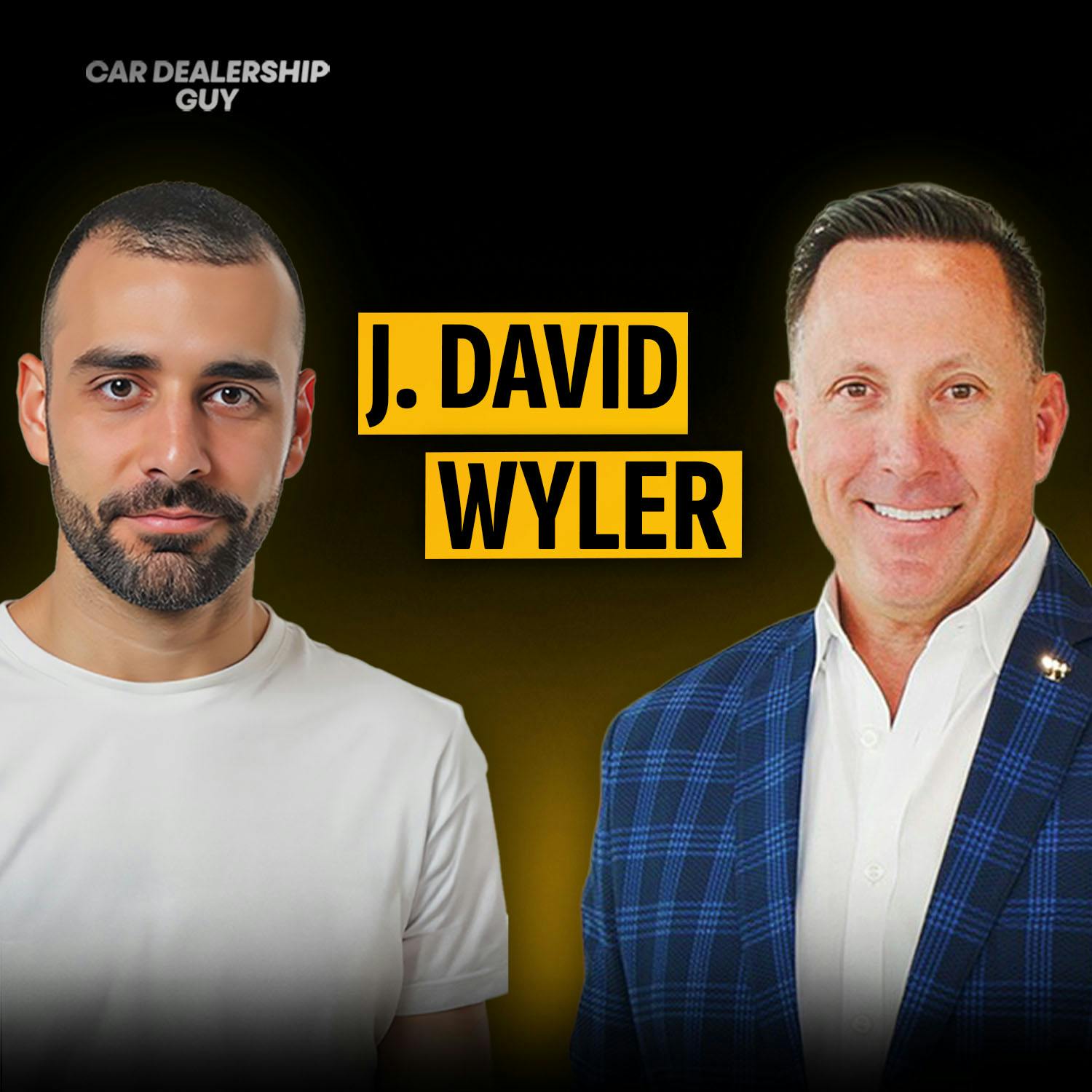
David Weiler, CEO of Jeff Weiler Automotive Family, shares insights on scaling a dealership group to over 50 locations with $500M+ in sales while maintaining culture and operational discipline. He emphasizes the importance of proximity-based growth within a 100-mile radius to avoid operational drag and foster strong market ownership. The conversation covers the shift from traditional managers to coaching roles, lessons from a major acquisition, and the evolution of marketing strategies rooted in the company's heritage. David also reflects on family legacy, deliberate acquisition choices, and the challenges of balancing growth with culture preservation.
Today I'm joined by David Wyler, CEO of Jeff Wyler Automotive Family.
We dig into why Wyler abandoned traditional corporate management in favor of a “coach” model, how a strict 100-mile acquisition rule protects execution, and why culture—not capital—is the only defensible edge left in consolidation.
David also unpacks his massive acquisition of the Midwest Auto Group, the lessons of stagnation during COVID, and what it really takes to scale a family business without losing its soul.
This episode is brought to you by:
1. YSM Design - YSM Design, your expert in automotive dealer architecture, helps dealer principals and fixed/ variable ops teams improve the bottom line with EV readiness checks, OEM brand image updates/new-store requests, and expansions or renovations—big or small—powered by instant renderings, immersive 360s, and LiDAR scans that reduce surprises and speed decisions; visit @ here or call 404-249-4555
2. Siro - Siro’s AI gives dealerships full visibility into every conversation. It records, transcribes, and analyzes in-person conversations. Proactively flagging compliance issues, missed revenue opportunities, and training gaps. Go to @ https://www.siro.ai/cdg to learn more
3. CDG Recruiting - Hire top dealership talent, fast. From sales managers to GMs and C-suite execs, we’ve placed over 1,000 roles across auto retail. Ready to scale without the hassle? Visit @ https://www.cdgrecruiting.com/ to get started.
Check out Car Dealership Guy’s stuff:
For dealers:
CDG Circles ➤ https://cdgcircles.com/
Industry job board ➤ http://jobs.dealershipguy.com
Dealership recruiting ➤ http://www.cdgrecruiting.com
Fix your dealership’s social media ➤ http://www.trynomad.co
Request to be a podcast guest ➤ http://www.cdgguest.com
For industry vendors:
Advertise with Car Dealership Guy ➤ http://www.cdgpartner.com
Industry job board ➤ http://jobs.dealershipguy.com
Request to be a podcast guest ➤ http://www.cdgguest.com
Topics:
08:20 Herb Chambers' advice on buying dealerships everywhere.
18:45 Why every single manager got fired and rehired.
24:20 The game film trick that fixed F&I managers.
25:55 How an internal playbook killed outside training programs.
31:40 The brutal truth about being a second-generation dealer.
39:55 Why practicing golf is actually terrifying.
46:05 What COVID really did to company performance.
46:55 The NFL analogy exposing every dealership's weakness.
Car Dealership Guy Socials:
X ➤ x.com/GuyDealership
Instagram ➤ instagram.com/cardealershipguy/
TikTok ➤ tiktok.com/@guydealership
LinkedIn ➤ linkedin.com/company/cardealershipguy
Threads ➤ threads.net/@cardealershipguy
Facebook ➤ facebook.com/profile.php?id=100077402857683
Everything else ➤ dealershipguy.com
"We represent every brand with the exception of Ford, Subaru, Lexus, and maybe some, some Highline folks like Aston and Clay."
Ford is a big car company from America that makes many types of cars and trucks. They have been around for a long time and are very popular.
Ford is a major American automotive manufacturer known for producing a wide range of vehicles including trucks, SUVs, and passenger cars. It has a long history and is one of the largest car companies in the world.
"We represent every brand with the exception of Ford, Subaru, Lexus, and maybe some, some Highline folks like Aston and Clay."
Lexus is a fancy car brand that makes comfortable and reliable cars. It's part of Toyota and is known for being smooth and high-tech.
Lexus is the luxury vehicle division of Toyota, known for its high-quality, reliable, and comfortable cars and SUVs. It competes with other luxury brands and is recognized for its smooth ride and advanced technology.
"some Highline folks like Aston and Clay. No Ford, I'm actually surprised to hear that."
Aston Martin is a fancy car company from Britain that makes fast and stylish sports cars. They are known for being special and often seen in movies.
Aston Martin is a British luxury sports car manufacturer famous for its elegant design and high-performance vehicles. It is often associated with exclusivity and has a strong presence in motorsports and popular culture.
"But he actually bought a Toyota store and lost his tail, like lost almost everything in two years."
Toyota is a big car company from Japan that makes many cars people trust for being reliable and easy to maintain.
Toyota is a major Japanese automotive manufacturer known for producing reliable and fuel-efficient vehicles. It is one of the largest car companies in the world.
"We bought Mercedes Benz of Louisville like two months before that. And Mercedes Benz of Fort Mitchell, like four years before that."
Mercedes-Benz is a famous car company from Germany that makes high-quality and fancy cars and trucks.
Mercedes-Benz is a German luxury automotive brand known for producing premium cars, trucks, and SUVs with a focus on quality, performance, and advanced technology.
"...isions moving with instant renderings, immersive 360s and lidar scans of your existing facility to cat..."
The Subaru 360 is a very small and simple car made a long time ago in Japan. It was popular because it was cheap and easy to drive, especially when cars were expensive. People might talk about it to show how small cars can be useful.
The Subaru 360 is a microcar produced by Subaru from 1958 to 1971, notable for being one of Japan's first mass-produced kei cars. Its small size and lightweight design made it affordable and practical during Japan's post-war economic boom. It might be discussed in the podcast as a historical reference or in relation to compact, efficient vehicle design.
""I've done some of the heavy lifting, right? Just in terms on the M&A side,""
M&A means when companies join together or one company buys another. In cars, it happens when car makers or parts companies team up or get bought.
M&A stands for mergers and acquisitions, which refers to the process of companies combining or one company purchasing another. In the automotive industry, this can involve car manufacturers or suppliers consolidating or acquiring others.
""I can't imagine having to deal with 14 different OEMs and applications.""
OEM means the original company that makes cars or car parts. For example, Ford or Toyota are OEMs because they build the cars.
OEM stands for Original Equipment Manufacturer, which refers to companies that produce parts or vehicles that are sold under another company's brand. In the automotive context, it usually means the car manufacturers themselves.
"He actually worked at Nissan North America when he graduated college from the University of Miami."
Nissan North America is the part of Nissan that sells and supports Nissan cars in the US and Canada.
Nissan North America is the regional division of the Japanese automaker Nissan, responsible for sales, marketing, and distribution of Nissan vehicles in the United States and Canada.
Herb Chambers' advice on buying dealerships everywhere.
Why every single manager got fired and rehired.
The game film trick that fixed F&I managers.
How an internal playbook killed outside training programs.
The brutal truth about being a second-generation dealer.
Why practicing golf is actually terrifying.
What COVID really did to company performance.
The NFL analogy exposing every dealership's weakness.
Select text to request an explanation
CDG circles signups are back open.
If you want to learn from the best dealers in the country,
this is the digital peer group where it happens.
Over 3,000 dealership rooftops represented.
Recent dealer-only conversations
include Stellantis acquisition caps, AI selection
and integration, pay plan revamps,
cooling new car sales,
used car sourcing strategies, and more.
Don't miss it.
Join us now at cdgcircles.com.
I'm this young, dumb, aggressive guy
and I'm wanting to just buy dealerships everywhere
and it really didn't quite register with me.
I had the opportunity to spend a couple of days
with Herb Chambers probably about 15 years ago
and I told him all the stores that we had
and kind of what my thoughts and growth plans were
and he said, no, no, no, no, no, no.
You want to own your market.
Today I'm joined by David Weiler,
CEO of Jeff Weiler Automotive Family,
a more than 50 rooftop powerhouse in the Midwest.
Consolidation is accelerating
and dealers are discovering that scale alone
doesn't create an edge, execution and culture do.
David breaks down why Weiler shifted
from managers to coaches,
how proximity-based growth avoids operational drag
and what a massive acquisition taught them about discipline.
If you're thinking about growth, succession
or protecting your culture as you scale,
this conversation matters.
A big thank you to our sponsors
for making this episode possible.
Ciro, YSM Design and CDG Recruiting.
And now let's get into the show.
David Weiler on the CDG podcast, David, welcome.
Yossi, how are you doing my man?
Thanks for having me.
Bummed we couldn't make this happen in person
but this will be a great conversation either way.
So I'm excited about it.
You know, one of the cool things that I noticed
about your group as I was doing my homework
is you've documented a lot of the history of the group.
So it actually makes my life very easy
because I'm like, oh, wow, I have a great,
just lots of resources to bring into this conversation.
Love the commercial.
I was actually gonna start off by asking you,
is it true that cars like eggs are cheaper in the country?
Yeah, well, that's a good question.
That's kind of what put our company on the map.
My dad started this in 1973
and he had never done television before
and when he decided to do television,
he needed a slogan.
And he actually worked for Chevrolet Motor Division
before he became a car dealer
and one of the car dealers that he called on
actually used that slogan,
Chevrolet's like eggs are cheaper in the country.
And he called up this guy said,
hey, Bob, you mind if I use that down here in Cincinnati?
And the guy said, I don't care,
I stole it from a guy in Scranton.
And so the rest is history.
And so, you know, our company hasn't used that slogan
probably in three decades, right?
But I was gonna say since January, 2023.
Exactly, people just still remember that slogan
and my dad's commercials, you know,
from the late 70s and the 80s.
But yeah, that's that kind of really what started in fact
when you bought a car from us,
you actually got a dozen eggs at delivery.
We would bring you a dozen eggs at delivery
just to kind of like, hey, here you go,
here's your dozen eggs when you bought a car
kind of tied in the whole thing.
Why don't you do that anymore?
Genuine question.
Well, we're not in the country anymore.
Yeah, we've got our 50 locations
and they're really not rural stores
the way our first store was.
And so cars like eggs were cheaper in the country.
I don't know that that really goes with maybe, you know,
if we wanna sell a Ferrari either, right?
So I think we've changed and evolved,
but primarily we're just not in the country.
And when you think of Jeff Weiler or Chevrolet,
you would think the east side of Cincinnati
and Batavia, Ohio.
And, you know, we just don't wanna be known
for that Chevrolet store on the east side of Ohio.
So that's kind of why.
You know, one of our biggest marketing pushes
in during my time as a dealer was,
and I've spoken about the story,
was actually buying closeout pallets of electronics
from New Jersey, right?
So things that Walmart got as returns or whoever,
this wholesaler would purchase it,
I would purchase from him,
he would drop off a pallet in our service department
and it would just be a bunch of random stuff.
And you should see the delight in customer's faces
when you put a random black and decker drill on the seat,
the driver seat, they open the door and they're like,
it's your gift or you put it in the trunk,
which we did a ton.
And the delight of just receiving something for free
that's just like practical and they didn't expect,
which is why I asked you that egg question
because there's just something so,
just so endearing about that thinking, oh wow,
I get, you know, eggs, milk.
I mean, again, milk maybe spoils a little quicker,
but I love the direction and the touch.
Yeah, you know, we really were a small country store,
it's 22 miles east of downtown Cincinnati.
And so I think people would come visit us
because of that slogan, right?
And then they literally were just so surprised
and had a huge smile on their face
when they did get that dozen eggs out of the refrigerator.
So there's a lot to be said.
We need more of that, we need more of that.
Well, tell me, so tell me a little bit about,
I wanna talk a lot about the transition with you,
you're today, you're the Helma CEO.
I wanna talk about just, you know,
that you've been around for just decades.
There's been a lot of change
and you're also clearly still very much on the offense.
I just made a really massive acquisition,
Midwestern Auto Group.
I wanna say that added over 500 million in sales,
I believe, to your group.
So that's, you know, very meaningful.
Clearly very acquisitive.
What's the, give us kind of the lay of the land today.
Tell us a little bit about your status of the group.
So, yeah, the Jeff Weiler Automotive family
we're based in Cincinnati, Ohio.
And we have locations throughout Ohio, Kentucky,
and Indiana.
And our farthest location from actually where I'm sitting
at our headquarters is 100 miles.
And we've got over 50 rooftops now.
We represent every brand with the exception of Ford,
Subaru, Lexus, and maybe some,
some Highline folks like Aston and Clay.
No Ford, I'm actually surprised to hear that.
Yeah, you know, that has been on my bucket list
for a long time.
And for whatever reason, it hasn't worked out.
I haven't had the opportunities,
and quite frankly-
We can solve that pretty quickly.
Yeah, there hasn't been a lot of transition.
There hasn't been a lot of turnover and Ford source, right?
It within our market.
And so we're pretty deliberate and disciplined
when it comes to our acquisitions
in terms of where we want to go, right?
So we have this loop around Cincinnati,
which is 100 miles.
And that's kind of where we want to stay.
And we're slowly growing and moving that radius farther out.
But we still think there's a lot of opportunity
within that radius.
And so love to have Ford, obviously Subaru's hot,
Lexus, who wouldn't want that,
but that's kind of where we stand right now.
We've got 2,500 employees that workforce
that I can't think the world of,
but that's really who we are and where we're located.
What kind of premium do you put on proximity?
You just mentioned the 100 mile rule that you have,
you know, roughly, let's call it a rule,
but you want to stay close.
I assume that's probably for operating leverage,
but you can tell me otherwise.
So what type of premium do you put on proximity?
Because I know that Midwestern deal wasn't cheap.
No.
And I see that smile.
There's a couple of things, right?
My dad grew up in Texas and came back to Cincinnati
where he actually graduated college,
but he grew up in Texas.
Went to Burgess High School in El Paso, Texas.
And as a younger car dealer back in the mid-80s,
he thought it would be a really good idea
to go back to El Paso and become a car dealer.
But he actually bought a Toyota store and lost his tail,
like lost almost everything in two years.
And so he had always taught me, right?
You need to be careful where you go.
And so I'm this young, dumb, aggressive guy
and I'm wanting to just buy dealerships everywhere.
And it really didn't really quite register with me.
I had the opportunity to spend a couple of days
with Herb Chambers probably about 15 years ago.
And I told him all the stores that we had
and kind of what my thoughts and growth plans were.
And he said, no, no, no, no, no, no, no.
You want to own your market.
You can pay more for your stores.
You can scale your assets, which are your people,
your inventory, your branding.
And then you've got kids coming to the picture
and there's something to be said, right?
For sleeping in your own bed every night, you'll see.
Instead of having to worry about your own airplane
and putting out a fire that's 1,000 miles away,
obviously inevitably in the car business,
you're gonna have issues to come up, right?
And so it's not a problem for me
to just get in a car and drive an hour and a half, right?
So that's kind of really where we've focused.
And so far it's worked out.
This is a hypothetical,
but if you were starting from scratch today,
would you do anything structurally different to the group?
You mentioned proximity.
It seems like that's still a core tenant of just a group.
And you like growing that way
and you put your money where your mouth is.
You just acquired Midwestern,
which is roughly a hundred miles away, driving distance.
Would you do something structurally different
if you were starting from scratch today?
I don't think so.
If we had a little Chevrolet store
that was outside of Fort Lauderdale,
40 years ago, I think our company
would be a little bit different, right?
With the size and the scope,
because I think your throughput in Florida
and the Southeast is bigger,
but you can't control those things,
but I don't think we would.
I'm six generation, Cincinnati, born and raised here.
I went to Miami of Ohio, which is 45 minutes from my office.
My wife's from here.
We raised our children here.
This is a wonderful place to raise a family.
And it's a wonderful place to do business.
I always like to say that in the Midwest
and in particular, Ohio, Kentucky, Indiana,
when things are going gangbusters right in the car business
and things are on an upward trajectory,
yeah, we feel that, right?
And then when things slow down, we feel it a little bit,
but we don't have, it's just kind of consistent
and steady as she goes and it's a grind,
but we're Midwesterners and we like to grind it out, I guess.
This episode is brought to you by Ciro.
Are your F and I managers compliant,
pitching every product 100% of the time?
For decades, dealerships have missed major risks
and incremental revenue because they don't know
what's really happening during customer conversations.
Now, Ciro's AI gives dealerships full visibility
into every conversation.
It records transcribes and analyzes in-person conversations,
proactively flagging compliance issues,
missed revenue opportunities and training gaps.
In their first four weeks on Ciro,
the Viva Fiesta Auto Group increased PPD by 15%
and improved PVR by 18%.
Trusted by auto groups like Keating, Tim Dahl,
Viva Fiesta and more.
Get your F and I managers compliant
and pitching every product 100% of the time.
Go to Ciro.ai slash CDG, that's S-I-R-O dot A-I slash CDG
to learn more or click the link in the show notes below.
What does your dad think about the direction
of the business on a macro level?
With all the macro pressures and the risks,
what does he think about it?
My dad will be 85 come April 1st.
And it's usually not a day that doesn't go by
that I don't talk to him,
whether it's about the business
or whether it's about just what he's got going on
in his world or my world or the grandkids.
He always wants to know what's going on
within our business.
I know the one thing that the one passion
that I got from him was making deals, right?
On the acquisition side.
And so anytime we make an acquisition,
whether it's the Midwest Auto Group
or we bought seven stores four years ago
from the Superior Automotive Group,
Mercedes-Benz Aluable, Mercedes-Benz of Fort Mitchell,
absolutely he's engaged.
And why wouldn't I want to bounce off the ideas with him?
It does get him excited when we do make acquisitions.
It's certainly something that I know
that he looks forward to with these recent acquisitions
and he's always been a go-getter
and I think that's where I get it from
or it's like, all right, we've accomplished this.
Now let's continue to grow our people
and if there's opportunity out there,
let's take a look at it.
Yeah, there's nothing like the dopamine rush
of closing a deal, it's the best.
What about just time allocation?
How did two of you split time again?
I know you're CEO today, you have been.
How does your dad allocate his time?
How does he spend his time?
My dad's not involved in the day-to-day operations.
He likes to stay where it's 70 degrees.
So if you can imagine where it's 70 degrees.
What months of the year?
What months of the year are we talking about?
70 degrees?
Every month.
So whether it's West Coast, it's East Coast,
whether it's up, no one likes to ask questions,
but he has been so respectful over the years.
Whether it was, I was a young man
to make my own decisions, to have my own successes,
to have my own failures, and so,
but the one person that I do work with on a day-to-day basis.
And this is the Jeff Weiler automotive family, right?
So we're a family-run business.
My dad started it.
I'm second generation.
My brothers and sisters aren't involved in the business,
which makes it unique in the sense
that maybe you don't have people wanting to get involved
and then how do you break it up or how do you separate it?
But the one person that's been by my side
is actually my brother-in-law.
So it's my sister's husband.
They've been married for over 35 years
and Scott Bristow, who's the president of our organization,
we have worked together hand in hand and the both of us,
not just me, have worked together side by side.
Our offices are next to each other.
He's my yin to my yang and vice versa.
And so all the decisions that are made within our company
are between Scott and myself
and I couldn't have asked for a better brother-in-law.
I couldn't ask for a better business partner.
I couldn't ask for a better mentor.
I couldn't ask for just a better human.
So you have your yin to your yang.
You've been around for, have you eclipsed 50 years
or under 50?
Yeah, so we're at 53 years.
53, so you have eclipsed it.
How are you, and you're also being aggressive,
more acquisitions and substantial acquisitions.
What's your unfair advantage if you have to label something
or how do you position yourself for success
and really make sure your operations,
your dealership is really defensible
into the foreseeable future?
It starts, you'll see with our people,
starts and ends with that.
What about them?
They are our greatest asset, bar none.
How do you cultivate that?
Our culture, I think, is best of the best.
I always like to say that culture
will eat your strategy for a bunch, you'll see.
And I truly believe that.
And this isn't an overnight thing with our culture.
It's something that it's taken decades to create.
And so when we make an acquisition,
we talked earlier, maybe a little bit about
nothing better than having dopamine of making a deal
or selling a car or buying a car dealership
or selling a car dealership, that's really fun.
But what makes it so much more enjoyable for me
and for Scott, is to see the growth and development
of our people, and so if you're either growing
or you're gonna die, we've all heard that saying,
and we truly develop the people.
And quite frankly, they expect us to grow.
And they can expand their professional career as well.
So, but culture for us is everything.
It's something that it's hard to replicate, recreate.
And I've welcomed all car dealers to come to our headquarters
and see what we do, because I don't have any secrets.
I don't have a secret sauce, it's culture.
And you gotta be bought in.
So, well, David, if I came to your headquarters,
like what would I see that would maybe surprise me,
be different, would be impressive?
What would I see?
Well, I'm biased.
I think- Give us the bias.
I think we've got the finest headquarters in America.
And I'll put that- Okay, so aesthetically,
it just looks great, it's impressive.
Aesthetically, it looks great.
And you'll see our culture as soon as you walk in.
It was about eight years ago, Yossi.
We do an annual retreat with, let's say, our top 60 executives.
Okay.
And at this retreat, we decided to go to Columbus, Ohio,
and spent two days with the Columbus Blue Jackets NHL team.
And I had this already prepared.
And I was like, you know what?
This is kind of my plan and my vision.
We're gonna get rid of our titles
within all of our stores of managers.
And we're gonna call them coaches.
And actually that day,
fired all these executives and rehired them as coaches.
Coaching and sports, they've been a huge part of my life.
And who I am and what I'm about in the competition side.
And I got the opportunity to coach my kids, right?
As they grew up, whether it was football, basketball,
baseball, lacrosse.
And I coached them all the way up
until they didn't have daddy ball anymore, right?
Until they went into high school.
But there's no greater honor than having somebody
that you coached as a child or a young man
continue to call you coach.
I mean, I'm talking kids that play division one football
that have had the opportunity to go to the NFL
and still call you coach and say,
hey, I remember what you did.
And so when I made our managers coaches,
I told them that it is a huge responsibility.
It's a huge responsibility more so than being a manager
because number one, you've got to coach your players up
on a daily basis, that's number one.
Number two, in order to attract talent,
you've got to recruit the right people.
You've got to train them.
You've got to coach them up.
You've got to have the opportunity every single day
to practice to make that individual better at what they do.
And I always say that there's the reason why people
aren't successful in the automobile business.
It's one of two things.
And it lies between you and you and nobody else.
It's either number one, you hired the wrong person
or you didn't coach them up.
There's no in-betweens.
You didn't hire the right person or you didn't coach them up.
And so when you come here to our headquarters,
every single conference room is named after a coach.
We have in our events Lombardi room,
we have pictures of coaches.
We've got Super Bowl trophies.
Everything is revolved around sports.
Sports team.
Right, and quite frankly, right?
This is a recruiting center for us.
If you go to University of Alabama for a recruiting visit
and you're a basketball player or you're a football player,
they're gonna wanna show off
what their facilities look like.
And we feel like when you come here,
they're like, wow, this is pretty spectacular.
And so I think you'll see a lot of practice
in training rooms because you can't practice enough.
That's what kinda separates I think our culture
from everybody else.
So tell me about the impact of that, right?
You fire everyone as managers.
You rehire them a second later as coaches.
The next day or the next week,
they go 2,000 team members across the organization.
How do they react?
Are they like, ah, these guys are not serious.
It's the same thing, or wow, this is unique,
or what's the zeitgeist?
Again, that takes time, right?
And it's been eight years since we've not had a manager.
I think the initial thought was a little hokey, right?
I have my wisp on and every single coach,
whether you're a sales coach, your service coach,
your parts coach, your collision coach,
your finance coach, or you're a head coach,
everybody wears a whistle to work.
And it's not like we're blowing the whistle.
See, because you did something wrong
or you let a customer walk, no, that's not...
I was gonna ask, I was waiting for that.
That was the bill, though.
That's not what we do.
This is a reminder.
This is a reminder to me every time that I come to work
that I have a huge responsibility for my players, right?
And I'm responsible for my players.
And if my players aren't performing the way
they should be performing, well, guess what?
That's on me.
And so I need to coach them up,
whether it's one-on-one, whether it's in a group session,
See something that's not quite right? Our annotations are AI-generated and can sometimes miss the mark.
Click the flag icon on any annotation to suggest a correction.