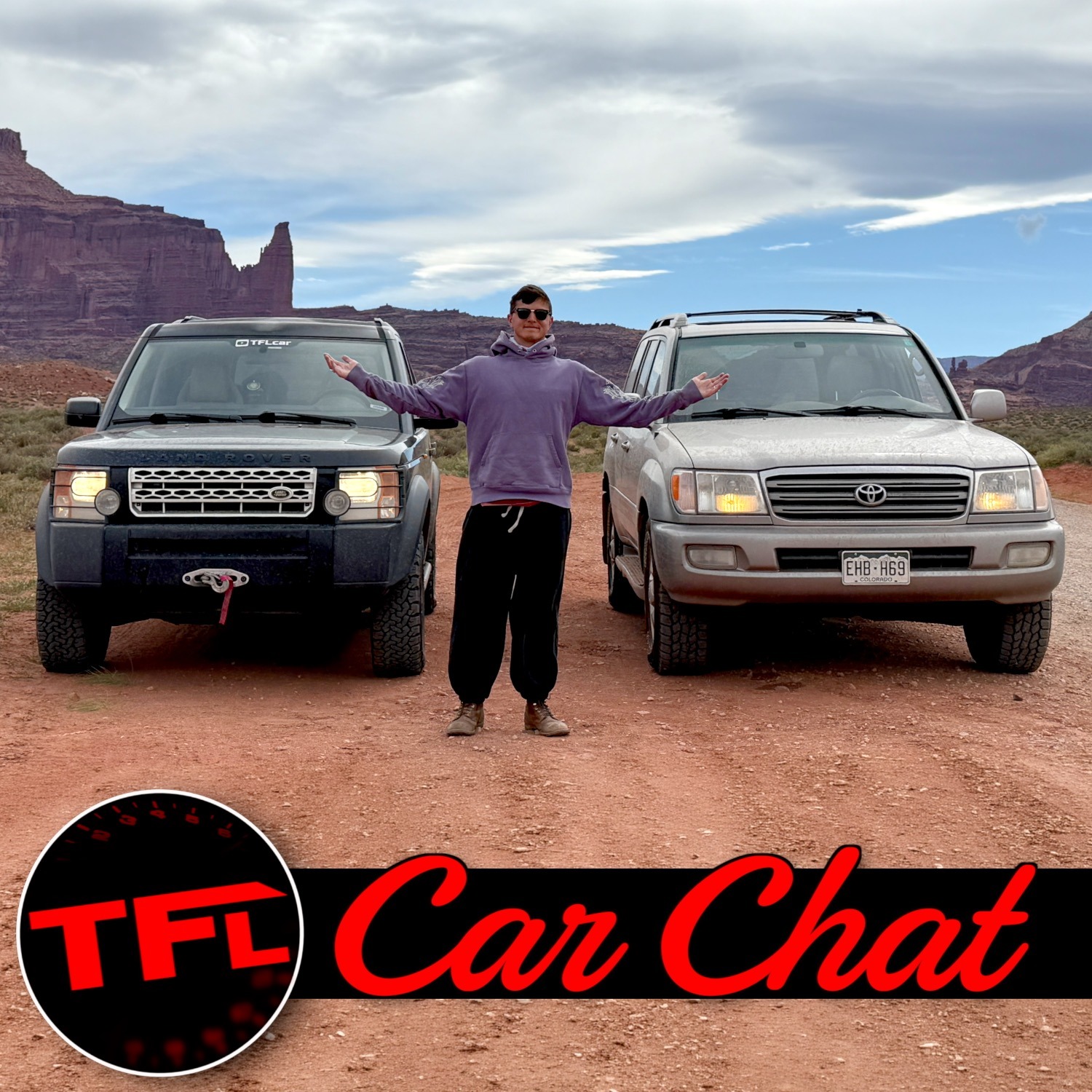
We Need To Talk About Toyota Reliability! | Ep. 334
TFL Car Chat
We Need To Talk About Toyota Reliability! | Ep. 334TFL Car Chat · Apr 20, 2026
Annotations will appear as you listen
0:00
46:33
Topic
Toyota reliability
This episode is about whether Toyota cars stay dependable over the long run. They’re likely using their trip to see how the vehicles handle tough conditions.
Moab is a well-known off-roading area in Utah. People go there because the terrain is challenging and great for testing how a vehicle handles dirt and rocks.
Concept
Grand Junction to Moab bike route
That route is a long trip between two towns, and parts of it can be pretty remote. It’s a good way to see how a vehicle does over time on rougher roads.
Four-wheel drive sends power to all four wheels instead of just two. That helps the car grip better on dirt, rocks, or slippery ground.
Car
Land Rover LR3
The Land Rover LR3 is an SUV built for both daily driving and off-road trips. Here, the host is saying it didn’t have many big problems—mostly normal maintenance and some parts that wear out over time.
A transmission fluid change replaces the old fluid that lubricates and cools internal transmission components. Regular service can prevent overheating and premature wear, which is why it’s often cited as “maintenance” rather than a sign of a failing transmission.
Concept
regular maintenance vs failure
They’re basically asking: is this problem something that’s expected to wear out, or is it a real breakdown? On an older car, many issues are just parts aging, not a sign the whole vehicle is unreliable.
A driveshaft is the part that sends power from the drivetrain to the wheels. If something in that system wears out, you might hear clunks or feel vibration, and the repair is often replacing the worn parts.
Lower control arms are part of the suspension that helps hold the wheels in the right position. If they get worn out, the car can feel noisy or loose, and the fix is usually replacing those worn parts.
The carrier bearing is a support for the driveshaft so it can spin smoothly. When the bearing or its rubber bushing wears out, the car can start making noise or feel rough without the driveshaft needing to be replaced entirely.
A bushing is like a cushion between moving parts. Over time the rubber can get old and stiff, and that’s when you start hearing clunks or feeling vibration.
Poison Spider is a Moab-area trail commonly associated with rugged, rocky obstacles and technical driving. Its inclusion helps listeners understand the off-road “difficulty level” implied by the trip.
Off-road trails are dirt or rugged routes meant for driving where normal roads don’t go. They’re talking about finding quieter, less crowded paths to explore.
I-70 is a major U.S. interstate that runs through Colorado and Utah, making it a common route for road trips to Moab. In this segment, it’s used as the starting point for planning an off-road approach.
Mud makes it harder for tires to grip the ground. It can slow you down and sometimes makes it easier to get stuck, so it’s a good real-world challenge for off-roading.
Some trails are rated for difficulty. If it rains, the ground can get slippery, so a trail that’s usually manageable can become much harder and more demanding.
Arches National Park is in Utah and has lots of rough, rocky driving. It’s a place where you can really see how well a vehicle handles dirt and uneven terrain.
“Fins and Things” is a popular off-road trail in the Moab area. It’s used because it has a mix of obstacles that can show how well a mostly stock vehicle can handle tough driving.
Bigger tires can help the car roll over bumps and rocks more easily and can improve traction. They can also slightly change how the car feels and how accurate the speed reading is.
Rock sliders are protective bars that help keep the sides and underside from getting smashed on rocks. A winch is a tool that can pull the car out if it gets stuck.
A Toyota Land Cruiser is a rugged SUV built for long-term reliability and off-road use. The “100 series” is just the specific generation, and they’re saying theirs is mostly factory—just with a slightly bigger tire.
“Bone stock” means the car is basically the way it came from the factory. They’re emphasizing that you don’t need a heavily modified truck to go explore.
Break-over angle is how well a vehicle can go over a bump without its underside hitting. If you remove things like side steps, you often gain a little extra clearance for rough trails.
Pritchett Canyon is a well-known off-road trail area in Moab, Utah, often associated with rock crawling and technical obstacles. The hosts mention avoiding it because their current vehicles aren’t set up for the most extreme terrain.
“Rock buggies” refers to purpose-built off-road vehicles (often heavily modified) designed for rock crawling. The hosts contrast those extreme builds with their more stock-oriented approach, highlighting that different vehicles are suited to different trail difficulty levels.
The hosts emphasize doing challenging off-road driving in a “stock vehicle,” meaning minimal modifications. This concept matters because it changes the audience’s expectations: the goal is skill-building and adventure rather than showcasing expensive builds.
Concept
50, 60, 70, 80 thousand dollar rig
They’re talking about how many off-road builds cost tens of thousands of dollars. Their point is that you can still go have fun without spending that kind of money.
Concept
full size trucks with campers
They’re describing big pickup trucks that have campers attached for living/travel. That setup can affect how the truck handles and what kinds of trails are comfortable or safe.
Car camping is staying overnight using your vehicle as part of the lodging—often with a mattress, basic storage, and gear. The hosts connect it to affordability: if the vehicle is cheaper, you’re more willing to take it to rougher places.
Overlanding is like extended road-trip camping, but in more remote areas. They’re saying their setup is built so they can sleep in the vehicle while traveling.
Concept
venture travel
They’re using “venture travel” to mean adventurous trips. It’s basically the idea of going places that are more challenging than a normal vacation, often with your vehicle involved.
A “stealthy setup” means you keep the vehicle looking more normal and don’t bolt a lot of stuff on the outside. They’re saying that helps keep the vehicle lighter and easier to drive off-road.
They’re talking about using a memory foam mattress to sleep comfortably in the back of the truck. It’s an example of a simple, comfort-focused setup for camping.
An “eight foot bed” describes a long truck cargo bed length, which can make it easier to sleep or set up gear inside the bed area. The host uses it to live out of the truck for days and to fit a mattress setup.
“Bear country” refers to areas where bears are present, which changes camping safety and gear choices. The host’s point is that a hard-sided enclosure can offer more protection and comfort than sleeping in a tent.
Hard-sided camping means you’re sleeping in a solid, enclosed setup rather than a tent. The benefit is you’re usually more protected from wind and rough weather.
Side steps are the little steps on the side of a vehicle that help you climb in more easily. If they’re covered in mud, it usually means the vehicle saw rough terrain.
Pinstriping is the thin decorative line(s) you might see on a vehicle. The host is mentioning it as part of the story of how the vehicle looks after the trip.
Wheel wobble is when your car’s wheel starts shaking or bouncing while you drive. It can come from tire balance issues, worn suspension parts, or even a bent wheel.
A solid axle swap means changing the suspension so the wheels move together as a single axle. Off-road people do it because it can help the tires keep contact on rocks, but it’s a big, involved modification.
“Forties” is off-road slang for running 40-inch tires, which are much larger than stock and dramatically change clearance and stance. Bigger tires help with obstacle clearance and traction on rocks, but they also increase stress on drivetrain components and require suspension/brake/fitment work.
“Trimming” means removing or cutting some body parts so the bigger tires can move without hitting the truck. It’s often needed after lifting the suspension or installing larger tires.
“Go anywhere SUV” means it can handle rough trails and still get you where you’re going. They’re saying the Land Cruiser can do tough Moab driving even without major upgrades.
Yokohama is a tire brand, and in this context the host is pointing out that the tires are larger than stock. Bigger tires can change the vehicle’s stance, clearance, and how much tire fills the wheel well.
Fenders are the parts of the car body that sit above the wheels. If you put bigger tires on, the tires can look like they fill the fender area and may rub if there isn’t enough clearance.
A rock rail is a reinforced bar under the side of the vehicle meant to protect it when you scrape or hit rocks. It’s there to reduce damage to the important parts underneath.
A line adjustment is just changing where you drive around an obstacle. Even a small change in angle can help the tires grip better and avoid hitting the rock.
Rock crawling is when you drive very slowly over big rocks and uneven terrain. The goal is to keep the tires gripping and to pick a line that lets the vehicle climb without getting stuck.
Low range is an off-road gear setting that makes the vehicle move slower but with more pulling power. It’s used for tricky terrain where you need careful control.
Raising the suspension means lifting the car higher off the ground. That gives you more clearance so you’re less likely to hit the bottom when driving off-road.
The Ford F-150 Raptor is a special, off-road-focused version of the F-150 pickup. They’re using it as a comparison to explain how tall the seating position feels and how much visibility you get.
Term
broken record
“Broken record” just means they keep hearing the same thing over and over. Here, it means people constantly talk about how reliable the Land Cruiser is.
A V8 is a type of engine with eight cylinders. In this discussion, they’re saying the Land Cruiser’s V8 is smooth and built to last a long time if you keep up with maintenance.
A “million mile engine” means an engine that can last an extremely long time—around a million miles. The key point is that it usually only happens if you do regular maintenance and don’t ignore small issues.
Suspension is what helps the car absorb bumps and stay stable. They’re saying Toyota’s suspension tuning makes the Land Cruiser feel smooth and controlled, whether you’re driving normally or going off-road.
A supercharged engine uses a device that pushes extra air into the engine. That usually makes the car feel more powerful, but it can also affect how much fuel it uses.
Term
4.4
“4.4” here refers to a 4.4-liter V8 engine option that the hosts say had more issues than the more solid version they’re praising. They also mention common wear items like timing chains and gaskets.
Timing chains help keep the engine’s moving parts in sync. If they wear out, the engine can run poorly or even be damaged, so it’s something to watch for as mileage climbs.
The Ford Ranger is being used as a comparison. The host is basically saying the LR3 doesn’t feel very strong, like it has less power than you’d expect.
Sport mode is a button or setting that tries to make the car feel more responsive and less “soft.” The host is saying it doesn’t fully fix the handling feel they don’t like.
Air suspension is a suspension system that uses air-filled bags instead of metal springs. It can make the ride feel smoother and can sometimes raise or lower the car, but the bags and related parts can wear out over time.
The Range Rover is a large, luxury SUV made by Land Rover. Some older versions used an air suspension system that can fail, which can make the car expensive to fix. That’s why it’s sometimes mentioned when people warn about suspension reliability.
A 4WD system powers all four wheels for better grip. It helps off-road, but the conversation suggests that using it aggressively (like rock crawling) can be tough on the vehicle.
Rock crawling is off-roading over rocks where you move slowly and need the tires to keep traction. The point here is that not every SUV is naturally suited for that kind of abuse.
A software lift means the car can raise itself using its air suspension settings. It can help a little with clearance, but it’s not the same as a full suspension lift and can run into limits.
Lifting a vehicle changes how the wheels and suspension sit. That can lead to problems like uneven tire wear or handling that feels “off” because the angles aren’t ideal anymore.
The aftermarket community is the group of companies and people that make parts and upgrades for a specific car. If fewer people drive or modify a model, there are often fewer parts available and less support. That can make repairs or upgrades harder or more expensive.
The Land Rover Discovery 2 is an older Land Rover SUV. In this discussion, the hosts say it was especially troublesome to keep running over the long term, with big mechanical problems that could get expensive. They’re using it as a contrast to the LR3.
The head gasket is a seal inside the engine. If it fails, the engine can start mixing fluids or overheating, which usually means a costly repair. The hosts are calling it out as one of the big reasons some older Land Rovers were hard to own.
Term
liner slip
In some engines, there are sleeves (liners) that help form the cylinder walls. “Liner slip” means that sleeve shifts, which can damage the engine and cause leaks or overheating. The hosts are mentioning it as a serious reliability problem.
The cooling system keeps the engine from overheating. If it’s unreliable, the car can run hot and cause damage over time. The hosts are pointing to cooling problems as a major reason some older Land Rovers were hard to own.
The gauge cluster is the dashboard that shows things like speed and warning lights. If the connectors/pins behind it corrode, the car can start acting strangely with random warning lights or errors.
The front diff is a gearbox that helps the front wheels turn at different speeds, especially in corners. If it fails badly, it can cause a big, costly repair because it’s a complex part inside the drivetrain.
“Brakes wear out” is a reminder that even reliable vehicles require routine maintenance. Brake pads/rotors and related hardware degrade with use, and neglecting them can lead to reduced stopping performance and more expensive repairs later.
A “massive repair bill” is what happens when small problems aren’t fixed early. Over time, one failed part can cause other parts to wear out or break too.
The “four grand immediately” point highlights the risk of buying an older used vehicle expecting it to be cheap. Even if the purchase price is low, deferred maintenance can mean you quickly need major repairs to make it reliable.
Some cars keep their resale value better than others. If people really want the vehicle and it lasts a long time, you usually get more money when you sell it later.
Independent front suspension means the left and right front wheels can move separately. That can help the truck ride better and keep traction, and the point here is that it’s not automatically “bad” just because it’s independent.
This is another differential gear layout—this one uses two pinion gears instead of four. The hosts are comparing these designs to explain why some Land Cruisers may be more prone to front differential problems when driven hard.
In a differential, pinion gears help transfer power. The idea here is that a “four pinion” design might handle more stress than a “two pinion” design, but it still may fail if you push the truck hard enough off-road.
“Achilles heel” just means the weak spot. In this case, they’re saying the front differential is the part that can give trouble when you drive the truck harder than it was meant to handle.
“Wheeling it hard” means aggressive off-road driving that subjects the drivetrain to high torque, traction changes, and repeated shocks. The hosts tie this kind of use directly to the risk of breaking the front differential on the Land Cruiser 100-series.
“Articulated” means the suspension is flexing a lot so the wheels can follow the ground. That can put extra stress on the drivetrain when one wheel loses traction and torque has to be managed.
LIVE
Hey everybody, welcome to the middle of nowhere.
We are about as remote as we possibly could be to be recording a podcast.
Yeah.
Is this going to be one of the off-road podcasts?
What's the plan?
I think that's the plan.
Yeah.
I want to talk about our adventure.
I want to talk about some of the stuff we've been chatting about on this three-day adventure.
So, some background, we're like, I don't know, 40 miles outside of Moab, Utah.
Yeah.
We probably spent three hours or so driving, kind of meandering, not necessarily taking
the most direct and fastest path to where we are now.
But it's pretty cool because at the moment, it's very busy in Moab.
It's kind of the beginning of peak season, so it's good weather there.
There's tons of people where we are.
It's dead quiet.
Yeah.
Typically, a bike route that connects Grand Junction to Moab, it's actually pretty long.
I think it's 100, 140 miles.
We're doing a stretch of it in our four-wheel drive, and we thought it'd be cool to bring
out two cars from the same era.
Yeah.
So, yours is a 2006.
I'm driving a 2005.
What you're in is your Land Rover LR3, one that you got for $4,500, did some upgrades
to it, almost no repairs other than regular maintenance, a fluid change on the transmission,
and anything else.
That's it, major?
Yeah.
Yeah, that's it.
Yeah, I mean, I've put a little bit of like, all right, I need your opinion.
Is this considered a fault of the vehicle or regular maintenance?
So I had to do lower control arms and a driveshaft.
But it's also 20 years old, and it wasn't that the driveshaft was flying apart.
There's kind of a carrier bearing of sorts with a bushing in it, and the bushing was
getting old.
So it's really just rubber parts aging out.
I don't really think that that's necessarily a failure.
A failure, yeah.
Not a breakdown.
So I mean, like I could have kept going with my clunky lower front control arms and the
driveshaft.
But basically, we agreed to do this thing with our sponsor On-X, where we'd spend three
days, two nights out on what they call a rugged adventure.
And look, a lot has been done around Moab, Utah.
You've got all the famous trails, Hell's Revenge, Fins and Things, Poison Spider.
I mean, we could have done any number of those.
But what I thought would be cool is the fun way in and out of Moab.
So if you're kind of passing through or you want to like do like a quick greatest hits
of Moab over a really short period, this is a cool way to do it.
Yeah.
So we're a little off the beaten path.
There's plenty of trails that we've filmed several times and trails that a lot of people
have run over and over again.
But I think the cool thing about what we're doing on this is it's a little something different,
probably a stretch of trail systems that most people haven't had a chance to check out.
And I'll include a link in the full video, which is going to go up very shortly.
But I've created this route and I'm actually, I think it's going pretty well.
But basically, if you're going down I-70, either east or west, you go south toward Moab
and you could just take, it's called, I think it's the Highway 191.
You could take that all the way down into Moab, Utah.
But what I thought would be cool is to actually stop and visit arches, but go through the
back way.
So off of the main highway, we turned left just four miles from Interstate 70.
And then we took this beautiful dirt trail into the backside of arches.
You avoid all the traffic, all the madness of trying to get into the national park.
And then we also found some cool little off road trails to explore out there.
Yeah.
Some pretty interesting stuff.
It's surprisingly damp out here right now.
So we've actually come across some mud, which is fun because especially being based in Colorado,
we don't usually get to spend that much time in mud.
Yeah, for sure.
No, it's been awesome.
Yeah.
A little something different from the usual slick rock, silt and dirt that we find ourselves
on all the time.
Like we've hit on this in a very short amount of time.
We've hit slick rock, obviously.
We hit some sand, obviously gravel, a tarmac, of course, and then some genuinely pretty slick
trails.
Yeah.
Because what happened was is April is a little bit unpredictable.
There is some sporadic rain, but it doesn't hit everywhere, it just hits in spots.
And it can turn a level two trail into like a level four, even potentially five in spots.
But anyway, we started in arches national park.
Then we spent the night in Moab, drove through much of the park actually, got to see some
cool sights.
And then this morning we woke up and continuing with the greatest hits thing, we did our most
common trail that we experienced out here in Utah.
Yeah.
So we did fins and things, which is kind of a staple for us.
And I think it's a really good trail to test a lot of vehicles, especially vehicles that
are either stock or nearly stock.
And both of these machines that we're in for this trip are that.
Both of them have slightly bigger tires.
Yours has sliders in a winch, but nothing...
It's going to affect performance.
Yeah, exactly.
Nothing super dramatic.
And then this 100 series Land Cruiser is just on a slightly bigger tire.
It's a Yokohama Geolander.
And other than that, it's bone stock.
We didn't even pull the side steps off of it, which, you know, I mean, I think it would
have been a benefit to have done that because we'd have a little extra break over angle.
I've only touched them down to the ground maybe two times though, so far in all of our
run.
We haven't been doing Pritchett Canyon and the craziest stuff because you have to keep
in mind the kinds of vehicles that we're in.
It's not those were not in rock buggies, but all things considered, even in bone stock
rigs like this, there's a lot of really good trails that you could go hit, fins and things
being one of them.
That's one of the reasons that we've run that trail so often.
Yeah, I mean, and like the goal with this, and I think kind of the goal with the channel
in general is we want to be able to do stuff that is fun, that pushes your skills a little
bit, but doesn't get you in harm's way in essentially a stock vehicle, right?
And there's a lot of channels that do some incredible bills and they do some amazing
stuff with them.
But I think like what really resonates with our audience is like you take a stock vehicle
and you kind of go on an adventure with that, right?
And that's basically what we're doing here.
And the other emphasis I want to do here, right, is like, you know, we don't have a
50, 60, 70, 80 thousand dollar rig.
A lot of the vehicles we've seen out here are these full size trucks with campers, right?
And a lot of times you're going to be looking into six figures on those.
But the advantage of what we've done with car camping and we've got vehicles that are
affordable is like you're willing to take them into places you might not.
So we were at this campsite, we went down this gnarly little trail that was just tree
after tree pinstriping the crud out of them.
But it's not really a huge deal because they're, you know, in this Landover's case, let's
call it seven, eight grand in that hundred series, 15, right?
So like it's not the end of the world.
Whereas if we had our 70 thousand dollar new Land Cruiser, we wouldn't ever have tackled
that, right?
I would have turned around.
For sure.
Yeah.
So there's a lot to be said for a vehicle that's reasonably affordable and that you don't
mind putting a little bit in a harm's way, nothing too dramatic.
The other thing that I like is that you certainly could describe what we're doing with this
trip as overlanding as we are staying in the vehicle.
And venture travel, right?
For sure.
Yeah.
But these are both, as configured, pretty stealthy setups.
So we don't have tons of things bolted to the outside which keeps them relative to the
types of vehicles they are, relatively lightweight.
As far as my camping setup, I have a memory foam mattress that I put in the back of my
truck whenever I'm camping in it.
My truck has an eight foot bed and so I've spent as much as nine days, not an insanely
long time, but a decent little stretch living out of it.
And so I took the memory foam mattress that I usually put in the bed of the truck.
I pulled the seats out of the Land Cruiser so I get to stay in this vehicle.
One thing that I like about this versus having a tent on the ground, especially, but even
arguably compared to a rooftop tent is that we are in bear country out here.
So hard sided camping setups is something that I'm personally fond of just for that
reason.
Plus, if nothing else, we also get some crazy winds, some crazy weather out here.
And if the wind is absolutely whipping across your campsite, this is going to be a little
more insulated and a little more comfortable by my calculation.
If you're wondering what that weird panting is, we got blaze with us.
Blaze is on this adventure with us.
But yeah, I mean, you can see like we got some real mud caked up here on those side steps.
And you know, certainly the paint is a little bit worse for wear now, but I think a lot
of that's going to come out actually.
Yeah, definitely exactly the spot that we're in.
Yeah, there was some pinstriping to get here.
So my camping setup is even more minimalist.
I've just got like a pad and then a sleeping bag.
And then I need a spot for Blaze if he's going to sleep next to me.
But both these vehicles are big enough where you can realistically lay down inside of them.
Yeah, which is another nice thing about them because they are on the larger side, on the
heavier side.
That Land Cruiser especially is closing in on 5,500 pounds.
I figured out my wheel wobble.
Oh, there you go.
Oh, God.
Just like in my cousin Vinny, you got mud in there.
What the heck, dude?
That is properly caked on there.
You've seen my cousin Vinny, right?
I have not seen that.
Oh, that's a problem.
Is that a movie or is it a TV show?
Yeah, it's a movie.
Joe Pesci and Mercer Tomei.
Stop eating poop, please.
Yeah, this is an unusual podcast.
Yeah, this is crazy.
So I'm going to have to figure out how to scrape that mud off before we get back on the road
tomorrow.
But yeah, it's been a pretty cool little adventure.
And we're also out here during maybe not your typical week because this is, I'm trying
to remember what they call it.
The Toyota Summit Land Cruiser.
Cruise?
No.
Oh, Cruise Moab.
Cruise Moab.
Good job, Kase.
I am the one driving the Toyota.
Oh, Blaze is knocking over our camera.
So Cruise Moab is essentially like the Easter Jeep Safari, but for Toyota people.
So people come from all over the country to Moab and they're various Toyotas.
And we've seen some pretty crazy builds.
Yeah, earlier today we saw a hundred series on forties, solid axle swapped, and a lot
of trimming done, which was really cool.
The guy was very kind because we were very obviously staring as he was pulling up.
And he saw us staring and so we acknowledged it by saying, we really like your Land Cruiser.
And he said, oh, I like yours too.
That's generous.
This is basically full grandpa spec, triple gray, nothing much going on.
It's not really on the same level.
No, no, it's not quite a solid axle swapped Land Cruiser on forties.
But I've got to say, as time has gone on, and the more I've driven this, the more I
appreciate just why everybody loves these machines so much.
And it's not because this hundred series Land Cruiser with all its size and weight
and everything, not because this is necessarily the most athletic, most capable rock crawling
rig that you're going to take the hardest possible line on.
But even in a centrally stock form, it is a truly go anywhere SUV because we've gone
to, again, not the craziest trails in Moab, but we've done some intentionally difficult
things in both of these machines.
And this really does a lot without breaking a sweat, even though it's completely unmodified.
So if you want a machine that will just deliver you to any place you want to go, this is that.
Yeah, I've actually been pretty blown away with it.
I mean, it looks visually because the tire is kind of bigger than stock.
These Yokohamas fill out the fenders.
It looks very low.
But there was some stuff like that.
I was surprised it cleared, even though it's a Land Cruiser, there's this one obstacle
today where there was this large boulder that was embedded in the earth.
And there's really no way around it.
And then it was super muddy leading up to it, so there was no grace away of doing it.
So I took in the Rover, what I thought would be the best line, and I ended up slamming my
rock rail into the rock and like skidding my way up to the top.
And I was like, well, this is going to be a problem for the Land Cruiser.
And you just did like a slight line adjustment, kept the speed up, and it just like hopped
over that rock.
Yeah.
And I don't even think it tagged us down.
No, it didn't touch anything.
Again, if you want to go hit a trail in such a way as to pick the hardest possible line
and do the most intense rock crawling you can imagine, then a Land Cruiser like this,
you could build it into that kind of machine.
But in stock form, it's not really what it is.
But this will absolutely go just about anywhere you want to go.
So it's a really impressive piece of equipment.
And it's not hard to see why people like them so much.
It's also so comfy.
It's like it is very couchy.
Yeah.
It is.
It's very couchy.
Now, I'll give you my three pros and cons on my LR3, and then you give me the Rover.
I think the Land Rover is on the head.
Number one pro of the Land Rover, and I keep saying this, but it's like the versatility.
Sure.
This is a vehicle that you can very comfortably carry seven people in.
And then with a couple of twiddling of knobs, you can raise the suspension, put it at low
range, select rock mode, and then happily go do things and things, or even hells of range
I've done in this.
And it's no problem.
Right?
So I think that's very cool.
Number two pro is the space.
It's just like it's unashamedly, unashamedly just a box.
Yeah.
Right?
They just were like, let's just build a square.
And that's what they did.
And then number three, what was the third thing I really liked about it?
Oh, just the level of comfort.
I mean, you've got that command seating position.
You sit higher than any other vehicle on the road.
You know, it's crazy.
Like, it doesn't look that high, but you part next to like a new F-150, even a Raptor, and
you're kind of right at that level.
Yeah.
And you get these huge windows.
So you get a great view of the world.
So those are my three pros.
What about you?
I have to list three on the cruiser.
Yeah.
So three pros after spending more and more time with the 100 Series Land Cruiser.
Number one pro is the obvious one that is the broken record.
Everybody talks about it.
Reliability, obviously, these can do many, many hundreds of thousands of miles to use
that V8 incredibly smooth and incredibly long lived.
That is a million mile engine if you keep up with the couple little bits of maintenance
that you got to keep up with.
So 100% dependability is a huge factor with this machine.
So that's right up there.
Likewise with the LR3, comfort is also a really big deal on this.
Toyota has had decades of experience making suspension systems that are just fantastic.
Ride really smooth, handle really well on-road and off-road.
All things considered, obviously it's not a 911, but the suspension on this is fantastic.
Leather seats, very comfortable, it's very quiet, it's very smooth.
So it's just a great machine to spend a lot of time in.
And then the community and parts availability around these is also pretty great.
So if you want to build this up into something bigger and more grandiose,
and if you have the money to do it, then you absolutely can.
So you can basically turn this 100 Series into just about anything you want.
But even in stock form, like we've been saying, there's a lot you can do with it.
I am as much on board with modifying and personalizing vehicles as anybody out there.
It's something that I do.
But I'm also of the mind that you don't have to with this machine.
You could leave it bone stock and do a lot of things with it,
and you're not going to get left behind.
Okay, let's talk about cons.
So with the LR3, the first thing we need to talk about is the fuel economy is properly bad.
So there were two engine options in the US, and you're up there with a bunch of diesels.
But here in the US, we got the 4.4 V8.
It's called the AJ V8.
I mean, they use it in everything at that time.
So it was like in the Jaguar XK, right?
It made its way in the Aston.
For Thunderbird.
For Thunderbird for some reason.
Lincoln LS used an AJ V8.
And really, they built that engine from like 2000 and I think it's like 02 through like today.
I mean, I think the supercharged V8 in the Defender is still an AJ V8.
The AJ platform obviously has been changed a lot over the years.
So genuinely, no one's going to agree with this, but I've seen and I've talked to people
with 250,000, 300,000 miles on an AJ V8.
Like they are really long-lived engines.
If you get a 4.4, the five liters had some more issues.
They had timing chains.
They had gasket stuff.
But the 4.4 specifically, very solid.
Now my stupid LR3 is a very rare model, the 4.0 liter V6.
From the Ford Ranger, it's the power of a 4-cylinder, the fuel economy of like a V10.
I mean, it's 217 horsepower and I'm averaging like 14.6.
Yeah, to be fair, it's not very efficient, but at least it's slow.
At least it's slow.
That's right.
Yeah.
So I wouldn't get the 4.0 liter if you're going to get the LR3, but even if you get
the V8, especially if you get the V8, like 13, 14 is kind of the standard and it's not
like it's that fast.
So it's just early 2000s fuel economy.
Second thing I don't like about it, I mean, it's not like a thing I hate, but like if
you're on a twisty back road, it handles like a barge, right?
So like modern air suspension, there's almost always a sport mode to really stiffen things
up.
Yeah.
This thing is, regardless of what ride height setting, it's always like Cadillac floaty,
70 floaty.
So huge amounts of body roll.
I love it because that's how I drive every day is just like being floated around.
Yeah, I think it's fine.
By the way, remember when I was saying that air suspension is a little reliable, we're
out here in the middle of Utah.
I just looked and these airbags are date coded 2005.
So they're original.
They're original to the car.
They're original to the vehicle.
It's a fair assumption because there are Land Rover products like a P38 Range Rover that
have terrible air suspension.
Yeah.
But the LR3 and LR4 and the Range Rover Sport, the L320 first generation, Range Rover Sport,
that air suspension system is actually really good.
My final thing I don't like about it, people do, so the 4WD system is incredible and people
do turn them into rock crawlers, but it's very difficult to do so and they're not really
happy doing it, right?
There are things you can do to lift them.
I have a slight, quote, software lift or basically a program the computer to sit like
a centimeter higher and you can get like an inch out of it, maybe an inch and a half,
but then you start running into geometry issues.
And then the aftermarket community is not tiny, but stuff is very expensive, especially
on a car that's not worth much, right?
So at least with a 100 series cruiser, you put money into it and it's still a valuable
vehicle, but the part price is not much cheaper on the LR3.
Like an A or B is going to be $1,800, $2,500.
And just because you spent $30,000 modifying.
It's never going to get, you're never going to get it out of it, right?
So the part and the aftermarket community is much smaller.
Yeah, now people are obviously going to be very surprised that you haven't mentioned
reliability as a con of the Land Rover.
Yeah.
Now we've actually owned three of these LR3s now.
So it's not just that this one in particular is solid and it's kind of an outlier.
We've had a few of these LR3s and all things considered for a 20 year old car and a car
that you can get for this one less than five grand, but consistently six grand, seven grand,
something like that, you're pretty decent.
I was hoping during COVID because like prices started coming back up and then they just fell
through the floor.
So like this is still a 4,000 car.
Yeah.
So but let's talk about what you mean by decent, right?
So like genuinely, specifically 06 through 09, like if you look at the common issues,
so if you look at like the older Land Rovers, like your Discovery 2, right?
There are fundamental design flaws that make them horrible to own long term, unless you're
weird and crazy like we are, right?
But like headgasket's failure, liner slip, driveshafts explode that then takes out the
transmission, the cooling systems were garbage.
I mean there were really big issues with them.
100%.
And obviously there's been many Land Rover models over the years that had issues like
that and they've given them this reputation.
The thing is that I think a lot of people don't care to investigate to a point where
they have kind of a nuanced understanding of it.
Yeah.
Because I agree.
I think it is still absolutely fair to say that the majority of Land Rovers are not the
most reliable vehicles on the road.
Sure.
I think that's a reasonable thing to say.
But the LR3, like you said, 06 to 09, it's a good motor, it's a good air suspension,
the electronics aren't problematic, cooling systems aren't problematic.
Yeah.
I mean there are like known issues, like sometimes the gauge cluster, the pins that
connected to the wiring harness, right, those can corrode and then you get weird faults.
I think they can still have sunroof leaks, right?
Sunroof leaks, yeah for sure.
You know, people do, I'm kind of the outlier with the air suspension.
People do replace air suspension, but it's not actually that expensive.
Yeah.
And you know, like any vehicle, there are some issues with some of them that need to be fixed
here and there.
I mean ultimately, I don't tell anyone I said this, but second gen Tacomas used to split in
half because the frames were rusting so bad.
That's also kind of a problem, right?
But we still like Tacomas.
I mean and then you end up with this discussion about like age in any vehicle, right?
Both of these are 20, 21 years old now.
I mean we had the front diff explode on this, it's got 240,000 miles, it's 20 years old.
I mean things just wear out, right?
Like control arms wear out, bushings wear out, brakes wear out.
Also for the people that aren't watching videos when I say front diff explode,
I'm pointing at the lane freezer, believe it or not.
Yeah, right.
And I think like if you want a vehicle and you never want to do maintenance,
yeah, I think the lags probably take you further.
And then spit out a massive repair bill, right?
And that happens a lot on hundreds of series.
People buy them for what they think is cheap.
And then like we did, you end up spending four grand on it immediately, right?
Landrovers just going to kind of nickel and dime you a little bit more, but ultimately,
like I do genuinely think you could have an experience in a Land Rover that's not as terrible as.
As the internet would have you believe.
Yeah.
Now off of our soapbox, because ultimately there's plenty of people out there that no
matter how many of these things that we buy and take on a trails and own for years and
put real miles on and actually buy with our own money, there's still 99% of the reasonable people
out there in the world that are never going to buy it.
That's fine.
Sure.
It keeps the prices low.
Anyway.
Three cons with the hundred series.
Three cons with the hundred series.
Now, despite what some of the fan girls might say, there are actually some drawbacks
are there to this.
Really?
They're there actually are.
For me, I think the number one thing is the weight of it.
Look, it's a large vehicle.
That doesn't mean you can't go run difficult trails.
It doesn't mean you can't get these things out to be super capable.
It is just a factor.
This one, as it sits right now, is almost 5,500 pounds, not including the gear that's in it.
And you feel that when you're driving it.
So there are four by fours out there that are narrower, lighter, feel a little bit more athletic
on the extreme end of the spectrum.
Yes.
Not a lot of athleticism in the other series.
Yeah, I give you that.
In some ways.
For sure.
Yeah, that I would say another big one being cost because these vehicles are so sought after
and because they are so long lived, they really do hold value really well,
which if you own one already and you're going to sell it, then that's great news.
Yeah, that is good news because you'll get good money for it.
But it's not uncommon to look around online and see a hundred series laying cruiser with
300,000 miles and a wee bit of rust that was said for $12,000, $15,000.
And the seller sees it as, look, I'm doing you a favor here by even letting you buy this car.
Yes.
So trying to find an affordable one can be a pain.
These don't seem to rust LR3s, but hundred series do rust.
Like it's very common to see rusty hundred series.
Yeah.
Just seeing our windshields, like underneath, I've seen some really rusty hundred series.
Yeah, LR3, there's a lot of aluminum.
Yeah, and that helps.
Yeah, it's a little bit more modern.
I mean, this is still fundamentally a 90s design or this is a 2000s design.
Yeah, sure.
Yeah, and then the number three con for me is the front diff on this.
So independent front suspension is not inherently problematic,
even though some people kind of feel like it is.
There's plenty of very durable and very capable independent front suspensions.
Just look at the Bronco, for example.
For sure.
It's a really good setup.
Articulates very well, durable, even comes from the factory on a Raptor.
Raptor with 37s.
Yeah, that's cool.
So that's an impressive system.
This one in particular, it's not a massive front diff and there are two pinion and four pinion
front diffs for these hundred series Land Cruisers.
Some people say that the four pinion is stronger.
It doesn't sound like it's necessarily guaranteed to be significantly stronger,
and it is kind of the Achilles heel on these.
Yeah, that's true.
You can definitely get into a situation where you break that front diff,
especially if you're wheeling it hard and especially if you go to a bigger tire.
Because it's a heavy vehicle, that's just kind of a part of it.
There's still, again, there's so much you can do with this machine
without that front diff being an issue.
But it's still, as I drive it and it gets articulated and starts to struggle a little
bit, it's something that's in the back of my mind.
I think, if I remember right, I think early hundreds were eight inch front pinions,
and I think maybe they went to an eight and a half.
But if I recall, that's essentially the same front diff out of the 80 series.
But that was a fairly anemic in line six, and it was fundamentally a lighter weight vehicle.
Not to start pulling trump cards, but if you compare it to the Land Rover,
it was of the same era.
They were running nine and a half inch diffs, and you never hear about those failing.
So I think that they did undersize them.
Now, granted, when I blew this up, I was doing something pretty stupid,
but it always is at the end of the back of your mind.
And we read those comments too, but people are like, yeah,
100 series are perfect.
I have had to replace four front diffs, but they are perfect.
So that, I mean, I think that is a real problem.
And yeah, I mean, it was kind of an extreme use case when the front diff let go on this one for us,
but you're not the first person to have a front diff let go on 100 series.
Probably not.
It happens.
Yeah, it does.
It's a known thing.
It's not just us.
You can read about it.
On the interwebs.
On the interwebs.
Even the internet admits that they can break.
So yeah, ultimately, this is a really fantastic vehicle.
I don't want anyone to leave this podcast saying that we think the LR3 is
necessarily a better vehicle than 100 series Land Cruiser because somebody will throw a brick
through the window of our office.
That's right.
That's a bad day.
And that costs a lot more money than what YouTube videos make.
So I do want to talk a little bit about some of the interesting trends we've been noticing
out here in Utah.
So obviously, Cruz Moa, what's going on?
My dad went last year and I think I want to go back next year because I think there's
some interesting things happening.
Now we've seen some of the rigs that you'd expect.
So like at the sandflags creation area, we saw like the big, tired, early,
400 stuff, right?
Like 80, 45, the trucks, solid axle with big tires.
You've always seen that.
Seen some pretty crazy 80 series out here and then that really built 100.
But I'm starting to see a lot and I do mean a lot of the new gen stuff, right?
I mean, today on the trail, we saw they were a little bit in front of us, but there was
like a group of new 4th gen Tacomas and the new 250 series Land Cruiser.
We saw that 400.
6th gen, 4th.
Yeah, with the big 35s, that looked really good.
So like I think the community is really starting to embrace the new turbo slash hybrid stuff.
Yeah, there's definitely plenty of people that are uninterested in the complexity of
those powertrains, but the sales numbers say a lot and those vehicles, they're moving units.
Big, big units, yeah.
People are buying them and we're going to upset all of the old school Toyota body on frame people
here.
But the new gen stuff, turbo four cylinders, especially here at high altitudes with steep
grades, they drive much better.
Yes.
The new 4Runner with a four cylinder drives better than the 5th gen.
For sure.
There's no comparison.
Hands down.
Well, you know, like there's been a lot of talk about problems and like one of the most
common issues we're seeing, especially with Tacomas.
And I've talked to some people who are very in the know about this, put it to you that way.
Like failing transmissions slash hybrid components.
So be that like the integrated motor in the transmission, which requires us some $20,000
transmission replacement, right?
Be it other hybrid components.
And there does seem to be one trend.
And I'm not going to say it's user error because Toyota should address it, but like I think what's
happening and if, like I said from talking to people in the know, a lot of these failures
are related to people off-roading quote incorrectly.
And what I mean by that, like is if you look at the horsepower and torque numbers on 4Runner
and Tacoma hybrid, I think that torque number is 465 pound feet, right?
So huge amounts of torque and they're so much faster than the old stuff.
That people are now hitting the trails and not sticking the trucks in 4Lo.
So basically what they're doing is they're using that immense torque to muscle the truck up
obstacles, even somewhat light obstacles, right?
And they're not getting that mechanical advantage of gearing down in 4Lo.
And what that's doing is, yes, the powertrain can do it, but you are ultimately going to build
up a huge amount of heat, right?
And I think that from some folks I've talked to that that heat build up and that strain
you're putting on the transmission and hybrid system is what's causing these failures.
Now it's interesting and I'm surprised that Toyota doesn't do this and I don't,
I'm pretty sure they don't do it.
First things first, if you're on a trail, just go right into 4Lo.
Like even if it's a three out of 10, right?
Just stick it in 4Lo, you get more control and you build up a lot less heat.
We're wearing at your components a lot slower.
But what Land Rover does, oh god, people are going to hate me for this,
but if you're going up a trail in a Land Rover, especially the newer stuff,
and you start getting on a throttle, they're also very powerful, they will muscle through it,
but the computer will throw a ding and it will say 4Lo recommended, right?
Because it can look at how much throttle you're giving it, how much torque is being applied,
and realize this person's probably off road, it needs to be in low range.
So you're suggesting more chimes, Tommy?
Listen, I agree that the Toyota stuff chimes too much,
but I think that there's fundamentally, people are just going to keep doing it.
Do you know what chimes incessantly?
What?
Fords.
They do chime incessantly.
You put it into low range and whatever off road mode you want to be in,
and it's telling you adaptive cruise, unavailable.
Right.
And all these things, it's like, yeah, that's fine.
I know, I know.
Sometimes it will warn you of that every minute, and it doesn't seem to go away.
So getting off my soapbox here, I think that there needs to be a chime,
or at least a message saying 4Lo recommended, and then just more consumer understanding that like,
yes, you can do it in high range, but just don't put the strain on and go to low.
And like we were talking about this earlier, if James, my buddy James, if you're listening to
this, our foreigner buddy, who's in Moab right now at Cruise Moab,
he's got a really nicely built out 5th Gen 4Runner, the reality is you can't run that thing in 4High
because it's too bloody slow, right?
Like you'd be foot to the floor just trying to get up mild obstacles.
You got British for a second there.
I did.
But the new stuff, you can just power up.
So like the old stuff you had to go in low range or practically wouldn't move.
Yeah.
A little bit of exaggeration, but not really.
Like they're slow vehicles.
On a steep enough hill, and a foreigner that's got enough stuff weighing it down.
Yeah.
It will feel like it's working.
It will let you know I'm working really hard, and the new stuff just won't.
But like do you think long term, this is a loaded question,
but do you think the new stuff could be as reliable as the older stuff?
Here we go with the keyboard commandos.
As reliable, probably not in the long run, right?
Maybe not 300,000, 400,000 miles or so with as few issues because it is,
the older stuff is simpler.
But at the same time, I mean if you're buying, for example, a 5th Gen 4Runner
because it can get to 400,000 miles with relatively minor repairs,
and you buy that thing brand new, and you sell it at 70,000 miles,
you're saving the major benefit of it for the next person.
Or maybe the person after them or the person after them.
So if you're buying something brand new, I think most people buying brand new cars
aren't bringing them to two, three, 400,000 miles.
So for the 200, 250,000 miles, I think it's going to be 90, 80, 90, maybe percent as good.
It's hard to put a number on it.
I mean it's tough like reality is.
If you look at the data, and I don't want to misquote it, but a little while back
is something like the average new car is, so the average car on the road is like 12 years old,
and the average person keeps a new car like 9 or 10 years.
So that's roughly 100, 120,000 miles is what the typical new car buyer keeps.
So you're buying reliability for the third owner in some ways.
And ultimately, as warranties continue to get longer, is it really going to be a problem
if you're only going to keep the car 60,000 miles, which isn't unheard of.
Everybody says I'm going to buy this car and keep it forever, but nobody does.
People get bored of cars, that's just the reality of life.
We want to experience different things and experience change and be it new cars or used cars.
People just don't typically, unless you're in the Van Ries family, keep a car for 25 years.
That's my family, by the way.
Yeah, that's Casey's family.
We do hold on to cars for a while.
And I don't say you have to be in the Micah family where you go through cars every 28 minutes,
but there's like the reality is most people are like 3, 4, 5, 6, 7 years is the average.
For sure.
And I think there's plenty of precedent for a hybrid Toyota to go plenty far and not need
major maintenance.
How long have they been making the Prius for?
And how reliable is the Prius?
Not that necessarily forerunner and Land Cruiser people want to be compared to a Prius,
but they are good cars in that sense.
They go a really long distance.
They do go a long distance.
Let me make sure this camera's still rolling.
Oh yeah, that would be bad.
Our toolbox is currently filming us.
Yes, they do go a long distance.
And then what about like, people love to say that turbos are unreliable.
And it's a little bit of apples to oranges, but like, I mean, obviously diesels have been
turbocharged for 50 years now, right?
And in the heavy duty applications, they're looking at million miles.
But even in the light duty stuff, like if you look at your Cummins, like 400,500 miles
is not uncommon.
Now granted, gas engines are different kind of warms, but like turbos have been around
for long enough where I think we know how to do them and make them last, especially a brand
like Toyota.
Yeah.
And Toyota has been doing hybrid systems for a long time.
So do I think it's going to be as reliable as some of their older products after 400 or 500,000
miles? No.
But they also drive a lot better.
Even though in some ways the characters at the engine are worse.
Sure, they don't sound good.
They don't sound good.
And they're a little buzzy.
But they have low end torque.
And for me in a truck or an SUV, low end torque is pretty important.
Like it adds a lot to the drivability of them and the experience of driving them.
So I think it's an overall improved experience to actually drive those vehicles.
You just have to figure out what is the right combination of things for you.
I mean, if all out reliability is literally the only thing that matters to you, full stop,
then maybe not the new product.
But if you care about a combination of...
Oh my God.
Sorry, the dog keeps eating the horse pat, the cow patties on the ground.
No, keep going.
Yeah, you're right.
Yeah, if you care about a combination of drivability and a vehicle that's more modern,
more recently updated, because some of the older Toyota product that was going away,
look at third gen Tacoma, didn't drive that great.
That six speed and V6 combo would hunt for gears all the time.
Well, and the...
Fantastic.
The problem is people are like, I don't like the character of the new turbo form.
Like, well, yeah, but you're comparing it against a 3.5 V6 that was always at 100 million RPM.
Right?
And it was not like a great sound.
I mean, the sound of a naturally aspirated V6 is not...
It's not like the baritone of a V8.
So, like, what you're comparing it against is fundamentally not that characterful of an engine.
Yeah, right.
It's two different brands of vacuum cleaner.
Yeah.
Couple other things I want to talk about before we close up here.
Extera is coming back.
Yeah, which is a big deal.
There's some teaser images out there which don't reveal a ton other than the fact that
it seems like the new Extera is going to look, obviously, very modern.
Not necessarily.
It doesn't seem like it's going to be super retro,
but they were showing off some amber lights and things.
It looks interesting.
So, I can't...
I don't think I can say much about it, but I will say this.
My dad was in Japan with Nissan this past week.
Yeah.
And they actually took them behind the scenes, took their cameras,
and then showed them the new Extera.
And he said it looks pretty legit.
But even for the regular public, there are teaser images where you can start to get a little bit of a feel for what they're...
what they're shooting for.
So, I think it's going to be really interesting.
Obviously, they see the value in that market because it's a huge market.
It really blew up almost immediately after they stopped making the Extera.
Like 2014.
And there are obviously different...
There's many considerations for making a vehicle like that, right?
There's cafe regulations that were a factor in the past.
That are relaxing now that are making it easier according to Nissan for them to actually make a vehicle like that.
So, it's something that we're very much looking forward to.
And I know there's been a lot of talk, a lot of buzz and rumor around 35s.
Yeah.
So, like, what do you think Nissan needs to do for that thing to be a big hit?
It's a good question.
I mean, for sure.
It's got to have a lot of faked-in capability, right?
It can't just look rugged.
And I don't think that that's going to be the way it goes.
They knew what made the Extera work more or less in the past and what makes people love that vehicle even to this day.
So, you got to shoot for a baseline level of some real capability based on the hardware that it's running.
I mean, it can't be a rogue on tires basically.
It can't be a Pathfinder Rock Creek.
Yes, it has to be legit.
Yeah, it's got to be legit.
And I think that they've got some of the hardware to make that happen because they have the frontier.
I think they're going to do more, if I had to guess, than just slap a SUV body on a frontier.
But as far as I see it, I think you could theoretically reuse a lot of that to make
a rugged SUV and make people pretty happy.
I agree.
Yeah.
I mean, I think that...
But we don't know yet actually what they're going to do.
We don't.
But I think they've confirmed its body on frame.
Yeah.
It's already a good start, so it's not going to be a Pathfinder, right?
Because that's Unibody.
Although, apparently, the new Pathfinder might be body on frame two is what I was reading.
Which would be cool.
But I think that they have to prioritize the actual effectiveness of the four-wheel drive
system and make it a legit machine.
Yeah, absolutely.
Yeah, because that's going to be tested.
Pathfinder is funny because I don't think there's another vehicle that's gone back and forth
between body on frame and Unibody construction like the Pathfinder has.
Yeah, because it started in body on frame.
First gen, third gen.
Not fifth, though.
Not fifth.
But first gen and third gen are body on frame, I remember, right?
It was like B-O-F Unibody, B-O-F Unibody, Unibody again in the current one.
And then maybe back to body on frame.
Maybe back to body on frame, yeah.
I mean, there's a lot of...
You lose a lot of potential cargo space with body on frame.
If you look on, it's harder to achieve with body on frame.
But I think what Nissan's doing, I'm sure, is they're looking at 200,000 Wranglers they sell
every year, 150,000 Broncos they sell every year, I don't know what it is, $200,000 foreigners
they sell every year, $200,000 would be an expensive foreigner.
We're getting there, though.
Now all we need is for GM to take notice.
Well, did you see that get involved?
They confirm that they're going to...
I think they confirm a body on frame, Jimmy.
Really?
Yeah.
So I'd seen some rumors about that and people emailing us, but I hadn't seen official
confirmation of it, is it?
I don't.
Maybe it's just rumor mill, but...
Could be rumor mill.
I mean, they kind of...
They kind of need to...
Kind of burn the Blazer name a little bit, because that's being used for something that's not a
Blazer.
Jimmy would be cool, though.
That's a good name.
Yeah, this should bring that back.
It's close to your name, Timmy.
That's right.
You got a case, that's right.
But it's going to be really interesting, I think, next few years.
I'm a little worried that Nissan's a little late to the game, right?
And GM is going to be really late to the game, because the height of what we're doing right
now, in my opinion, was like 2021, 2022.
And you can actually see that by going up someplace like the Overland Expo, right?
When people, when COVID hit, everybody wanted to come out here to the wilderness.
So they all went out and they started buying parts and accessories and lift kits like crazy.
But now a lot of that kind of pipeline has shrunken a lot.
And you go to the Overland Expo now, and they're still fun, and I recommend doing them,
but they're so much smaller than they were a few years ago.
Because people have to go back to work.
I do think people still want...
There's some, basically, that American drive for an adventure vehicle.
So we're always going to have needs for rugged four-wheel drives.
But they're going to be a little bit of an uphill battle.
Yeah, it's still the general trend, even if people aren't necessarily spending as much
money on aftermarket parts and camper trailers and things like that.
The trend is still always towards bigger vehicles, SUVs, and people love rugged SUVs for good reason.
They do.
Because it's confidence inspiring.
They look good.
They maybe ride a little softer.
So I would be perfectly fine with it if the trend of sporty SUVs, where everything's
got to be stiffer and it's got to handle well.
That were to die?
It doesn't have to die.
But it can scoot over a little bit to allow for more rugged SUVs.
I like it.
All right, guys.
Well, there's our impromptu podcast.
I hope that this worked.
And we'll have this full video, our Onyx Offroad Rugged Adventure,
in the next couple of weeks, likely.
And drop us a comment what you guys think.
Absolutely.
See you next time.
We'll see you next time.
About this episode
Moab, Utah becomes the backdrop for a three-day “rugged adventure” comparing a 2005 Land Rover LR3 and a bone-stock 100-series Land Cruiser (plus light mods). The hosts focus on what reliability really means in the real world: the LR3’s known issues are nuanced, while the Land Cruiser’s reputation is earned—but not without drawbacks like weight, rust/cost, and the front diff. They also debate newer Toyota turbo/hybrid reliability, arguing many failures stem from using high range instead of 4Lo. Cruise Moab trends, Extera rumors, and overlanding/camping setups round it out.
( https://www.alltfl.com/ ) Check out our new spot to find ALL our content, from news to videos and our podcasts!
Recording from the middle of nowhere (literally 40 miles outside of Moab, Utah), Roman and Kase dive into a 3-day rugged adventure that pits two off-road legends from the same era against each other. Is the Land Rover LR3 actually as unreliable as the internet says, or is it a $4,500 bargain? And does the legendary 100 Series Land Cruiser still live up to the "million-mile" hype when you're dragging its stock sidesteps over slickrock?
We’re breaking down the pros and cons of these 20-year-old rigs, from the LR3's surprisingly sturdy air suspension to the Land Cruiser's "Achilles heel" front differential. Plus, we address the elephant in the room: Modern Toyota Reliability. Are the new hybrid and turbo powertrains in the Tacoma and Land Cruiser 250 failing because of tech, or because people are "off-roading them wrong"? We discuss why "Low Range Recommended" needs to be more than just a suggestion.