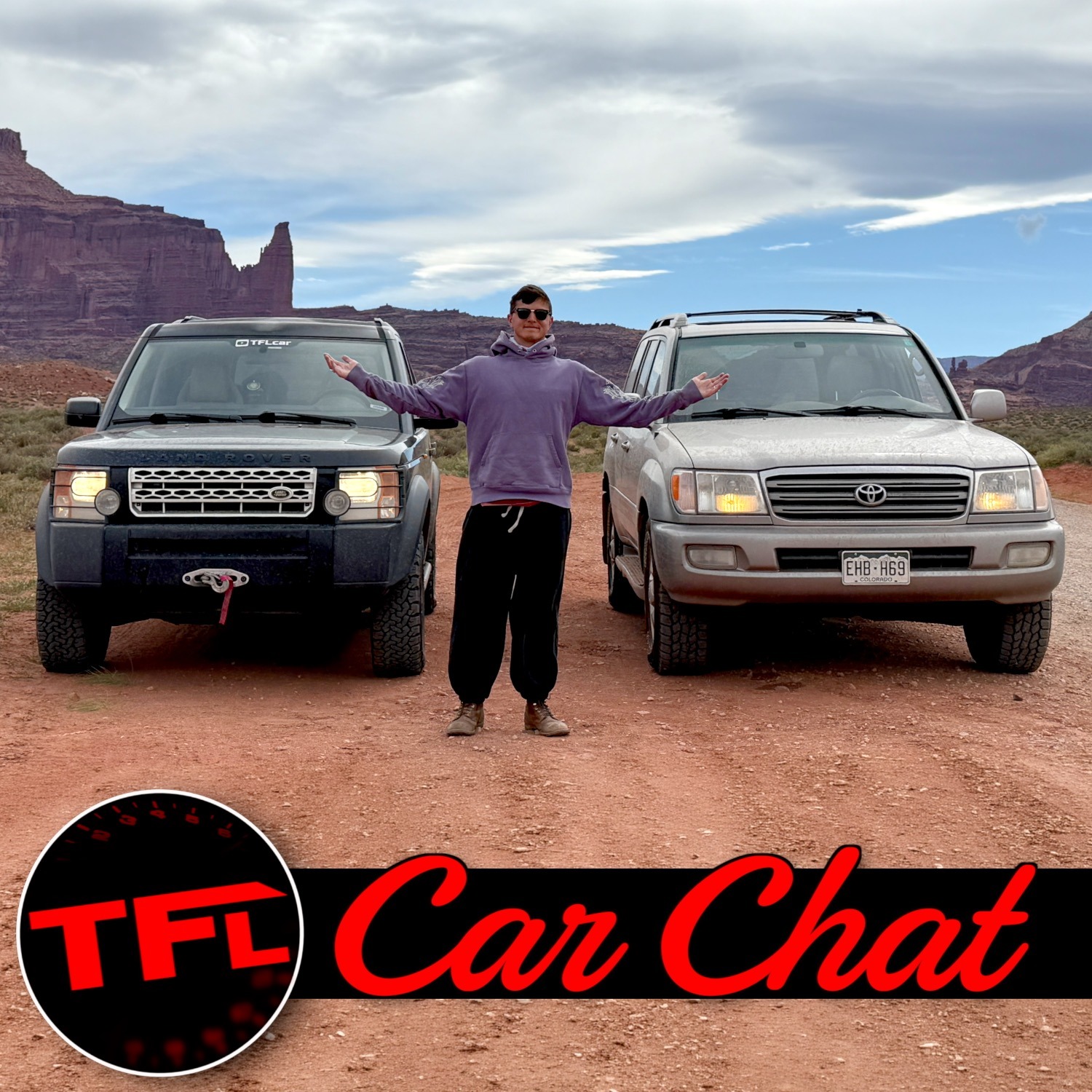
We Need To Talk About Toyota Reliability! | Ep. 334
About this episode
Moab, Utah becomes the backdrop for a three-day “rugged adventure” comparing a 2005 Land Rover LR3 and a bone-stock 100-series Land Cruiser (plus light mods). The hosts focus on what reliability really means in the real world: the LR3’s known issues are nuanced, while the Land Cruiser’s reputation is earned—but not without drawbacks like weight, rust/cost, and the front diff. They also debate newer Toyota turbo/hybrid reliability, arguing many failures stem from using high range instead of 4Lo. Cruise Moab trends, Extera rumors, and overlanding/camping setups round it out.
( https://www.alltfl.com/ ) Check out our new spot to find ALL our content, from news to videos and our podcasts!
Recording from the middle of nowhere (literally 40 miles outside of Moab, Utah), Roman and Kase dive into a 3-day rugged adventure that pits two off-road legends from the same era against each other. Is the Land Rover LR3 actually as unreliable as the internet says, or is it a $4,500 bargain? And does the legendary 100 Series Land Cruiser still live up to the "million-mile" hype when you're dragging its stock sidesteps over slickrock?
We’re breaking down the pros and cons of these 20-year-old rigs, from the LR3's surprisingly sturdy air suspension to the Land Cruiser's "Achilles heel" front differential. Plus, we address the elephant in the room: Modern Toyota Reliability. Are the new hybrid and turbo powertrains in the Tacoma and Land Cruiser 250 failing because of tech, or because people are "off-roading them wrong"? We discuss why "Low Range Recommended" needs to be more than just a suggestion.
( http://www.patreon.com/tflcar ) Visit our Patreon page to support the TFL team!
Advertising Inquiries: https://redcircle.com/brands
Privacy & Opt-Out: https://redcircle.com/privacy
Toyota reliability
"Hey everybody, welcome to the middle of nowhere..."
This episode is about whether Toyota cars stay dependable over the long run. They’re likely using their trip to see how the vehicles handle tough conditions.
The episode title indicates the hosts are focusing on Toyota reliability, likely comparing how different Toyota models hold up over time. In an off-road setting, reliability can include things like cooling, drivetrain durability, and how well systems tolerate heat and dust.
Moab, Utah
"So, some background, we're like, I don't know, 40 miles outside of Moab, Utah."
Moab is a well-known off-roading area in Utah. People go there because the terrain is challenging and great for testing how a vehicle handles dirt and rocks.
Moab, Utah is a famous off-road destination in the American Southwest, known for trails and desert terrain around Arches and Canyonlands. It’s a common proving ground for how vehicles handle heat, dust, and traction changes.
Grand Junction to Moab bike route
"Typically, a bike route that connects Grand Junction to Moab, it's actually pretty long."
That route is a long trip between two towns, and parts of it can be pretty remote. It’s a good way to see how a vehicle does over time on rougher roads.
The Grand Junction to Moab bike route is a long-distance corridor that can include remote stretches where vehicles may face sustained dirt roads and variable traction. Using a route like this highlights real-world durability and drivability rather than short, paved tests.
four-wheel drive
"...we're doing a stretch of it in our four-wheel drive, and we thought it'd be cool to bring out two cars from the same era."
Four-wheel drive sends power to all four wheels instead of just two. That helps the car grip better on dirt, rocks, or slippery ground.
Four-wheel drive (4WD) means power is sent to both the front and rear axles, improving traction on loose or uneven surfaces. It’s especially useful in off-road conditions like sand, rocks, or muddy trails where two-wheel drive can struggle.

Land Rover LR3
"What you're in is your Land Rover LR3, one that you got for $4,500, did some upgrades to it, almost no repairs other than regular maintenance, a fluid change on the transmission, and anything else."
The Land Rover LR3 is an SUV built for both daily driving and off-road trips. Here, the host is saying it didn’t have many big problems—mostly normal maintenance and some parts that wear out over time.
The Land Rover LR3 is a mid-size, body-on-frame SUV known for off-road capability and a complex drivetrain. In this segment, it’s used as an example of a vehicle that mostly needed routine upkeep, with a couple of wear items as it aged.
fluid change on the transmission
"What you're in is your Land Rover LR3, one that you got for $4,500, did some upgrades to it, almost no repairs other than regular maintenance, a fluid change on the transmission, and anything else."
A transmission fluid change replaces the old fluid that lubricates and cools internal transmission components. Regular service can prevent overheating and premature wear, which is why it’s often cited as “maintenance” rather than a sign of a failing transmission.
regular maintenance vs failure
"Is this considered a fault of the vehicle or regular maintenance? So I had to do lower control arms and a driveshaft. But it's also 20 years old... So it's really just rubber parts aging out. I don't really think that that's necessarily a failure."
They’re basically asking: is this problem something that’s expected to wear out, or is it a real breakdown? On an older car, many issues are just parts aging, not a sign the whole vehicle is unreliable.
The segment contrasts wear-and-tear repairs (like aging rubber parts and suspension components) with true failures that cause breakdowns. This distinction matters for reliability discussions because a 20-year-old vehicle will naturally need some component refreshes even if it doesn’t “fail.”
driveshaft
"So I had to do lower control arms and a driveshaft. But it's also 20 years old, and it wasn't that the driveshaft was flying apart. There's kind of a carrier bearing of sorts with a bushing in it, and the bushing was getting old."
A driveshaft is the part that sends power from the drivetrain to the wheels. If something in that system wears out, you might hear clunks or feel vibration, and the repair is often replacing the worn parts.
A driveshaft transfers torque from the transmission/transfer case to the differential(s), typically through the center of the vehicle. On older SUVs, driveshaft-related issues often come from worn rubber components, bearings, or bushings rather than the shaft itself failing catastrophically.
lower control arms
"So I had to do lower control arms and a driveshaft. But it's also 20 years old, and it wasn't that the driveshaft was flying apart."
Lower control arms are part of the suspension that helps hold the wheels in the right position. If they get worn out, the car can feel noisy or loose, and the fix is usually replacing those worn parts.
Lower control arms are suspension components that connect the wheel to the vehicle’s frame/subframe and help control wheel alignment and ride quality. When they wear out, you can get clunking, vibration, or vague steering feel—especially on older vehicles.
carrier bearing
"But it's also 20 years old, and it wasn't that the driveshaft was flying apart. There's kind of a carrier bearing of sorts with a bushing in it, and the bushing was getting old."
The carrier bearing is a support for the driveshaft so it can spin smoothly. When the bearing or its rubber bushing wears out, the car can start making noise or feel rough without the driveshaft needing to be replaced entirely.
A carrier bearing supports the driveshaft and helps keep it properly aligned as it spins. If the bearing or its bushing deteriorates, you can get noise (like clunks) and vibration, even if the driveshaft itself is still structurally fine.
bushing
"There's kind of a carrier bearing of sorts with a bushing in it, and the bushing was getting old. So it's really just rubber parts aging out."
A bushing is like a cushion between moving parts. Over time the rubber can get old and stiff, and that’s when you start hearing clunks or feeling vibration.
Bushings are rubber or elastomer components that isolate vibration and allow controlled movement between parts. As bushings age, they can harden or crack, leading to driveline or suspension noise and a “worn out” feel.
Hell's Revenge
"You've got all the famous trails, Hell's Revenge, Fins and Things, Poison Spider."
Hell’s Revenge is a famous off-road trail in Moab. It’s the kind of route that tests how well a vehicle can handle rough, steep terrain.
Hell’s Revenge is one of Moab’s most well-known off-road trails, often used to showcase a vehicle’s traction, ground clearance, and driver technique. Mentioning it signals the kind of terrain the group is targeting.
Poison Spider
"You've got all the famous trails, Hell's Revenge, Fins and Things, Poison Spider. I mean, we could have done any number of those."
Poison Spider is a Moab-area trail commonly associated with rugged, rocky obstacles and technical driving. Its inclusion helps listeners understand the off-road “difficulty level” implied by the trip.
off-road trails
"There's plenty of trails that we've filmed several times ... But I think the cool thing about what we're doing on this is it's a little something different ... trails that most people haven't had a chance to check out."
Off-road trails are dirt or rugged routes meant for driving where normal roads don’t go. They’re talking about finding quieter, less crowded paths to explore.
Off-road trails are routes designed for vehicles that can handle loose surfaces, obstacles, and varying traction. In this segment, the hosts emphasize exploring lesser-known trail systems to avoid crowds and traffic.
I-70
"But basically, if you're going down I-70, either east or west, you go south toward Moab ... and you could just take ... Highway 191."
I-70 is a major U.S. interstate that runs through Colorado and Utah, making it a common route for road trips to Moab. In this segment, it’s used as the starting point for planning an off-road approach.
Highway 191
"you go south toward Moab and you could just take, it's called, I think it's the Highway 191. You could take that all the way down into Moab, Utah."
Highway 191 is a road that helps you get into the Moab area. They’re describing it as the main drive before they turn off onto dirt trails.
Highway 191 is a state route that connects the Moab area with the surrounding road network. The hosts mention it as the practical way to reach Moab before cutting off toward trails.
mud
"It's surprisingly damp out here right now. ... So we've actually come across some mud, which is fun because especially being based in Colorado, we don't usually get to spend that much time in mud."
Mud makes it harder for tires to grip the ground. It can slow you down and sometimes makes it easier to get stuck, so it’s a good real-world challenge for off-roading.
Mud is a traction-limiting surface that can reduce grip and increase the chance of getting stuck, especially if a vehicle can’t maintain momentum. The hosts note it’s unusually wet for their Colorado base, making it a more challenging test condition.
level two trail into like a level four, even potentially five
"And it can turn a level two trail into like a level four, even potentially five in spots."
Some trails are rated for difficulty. If it rains, the ground can get slippery, so a trail that’s usually manageable can become much harder and more demanding.
Off-road trails are often rated by difficulty (commonly by a numeric scale). When conditions change—like rain turning dry dirt into slick mud—the same route can become significantly harder, requiring more driver skill and traction.
arches national park
"But anyway, we started in arches national park. Then we spent the night in Moab, drove through much of the park actually, got to see some cool sights."
Arches National Park is in Utah and has lots of rough, rocky driving. It’s a place where you can really see how well a vehicle handles dirt and uneven terrain.
Arches National Park is a well-known Utah off-road destination with lots of rugged trails and scenic routes. It’s the kind of environment where vehicle traction, tire choice, and drivetrain durability get tested.
fins and things
"So we did fins and things, which is kind of a staple for us. And I think it's a really good trail to test a lot of vehicles, especially vehicles that are either stock or nearly stock."
“Fins and Things” is a popular off-road trail in the Moab area. It’s used because it has a mix of obstacles that can show how well a mostly stock vehicle can handle tough driving.
“Fins and Things” is a well-known Moab-area trail often used to evaluate vehicles because it includes varied obstacles and traction conditions. The route is frequently chosen for comparing stock or near-stock setups.
slightly bigger tires
"Both of them have slightly bigger tires. Yours has sliders in a winch, but nothing..."
Bigger tires can help the car roll over bumps and rocks more easily and can improve traction. They can also slightly change how the car feels and how accurate the speed reading is.
Bigger tires can change how a vehicle grips and how it clears obstacles by increasing ground contact and improving approach/clearance behavior. They can also affect gearing, ride quality, and speedometer accuracy, even if the vehicle is otherwise stock.
sliders in a winch
"Both of them have slightly bigger tires. Yours has sliders in a winch, but nothing... It's going to affect performance."
Rock sliders are protective bars that help keep the sides and underside from getting smashed on rocks. A winch is a tool that can pull the car out if it gets stuck.
“Sliders” usually refers to rock sliders—reinforced side protection that helps prevent damage when tires or the underbody contact rocks. A winch is a recovery tool used to pull the vehicle out if it gets stuck, and it’s often paired with off-road hardware.

Toyota Land Cruiser
"And then this 100 series Land Cruiser is just on a slightly bigger tire. It's a Yokohama Geolander. And other than that, it's bone stock."
A Toyota Land Cruiser is a rugged SUV built for long-term reliability and off-road use. The “100 series” is just the specific generation, and they’re saying theirs is mostly factory—just with a slightly bigger tire.
The Toyota Land Cruiser 100 series is a late-1990s to early-2000s generation known for durability and off-road capability. In this segment, they’re describing it as essentially stock except for a tire change, which helps show how capable a mostly unmodified Land Cruiser can be.
Yokohama Geolander
"It's a Yokohama Geolander. And other than that, it's bone stock."
Geolander is a type of off-road tire from Yokohama. Tires like this are made to grip better on dirt and trails compared with regular highway tires.
Yokohama Geolander is a line of all-terrain/off-road tires designed to balance road manners with trail traction. Here, the hosts mention it as the main modification on an otherwise stock Land Cruiser, implying improved grip and clearance behavior from the tire choice.
bone stock
"And other than that, it's bone stock. We didn't even pull the side steps off of it..."
“Bone stock” means the car is basically the way it came from the factory. They’re emphasizing that you don’t need a heavily modified truck to go explore.
“Bone stock” means the vehicle is essentially unmodified from the factory. The hosts use it to frame the challenge: they’re trying to prove you can have fun and reach good trails without expensive builds.
break over angle
"I think it would have been a benefit to have done that because we'd have a little extra break over angle. I've only touched them down to the ground maybe two times though, so far in all of our run."
Break-over angle is how well a vehicle can go over a bump without its underside hitting. If you remove things like side steps, you often gain a little extra clearance for rough trails.
Break-over angle is the maximum “hump” the vehicle can crest without the underbody contacting the ground. Removing side steps can improve clearance and reduce the chance of scraping when the suspension articulates over uneven terrain.
Pritchett Canyon
"We haven't been doing Pritchett Canyon and the craziest stuff because you have to keep in mind the kinds of vehicles that we're in."
Pritchett Canyon is a well-known off-road trail area in Moab, Utah, often associated with rock crawling and technical obstacles. The hosts mention avoiding it because their current vehicles aren’t set up for the most extreme terrain.
rock buggies
"It's not those were not in rock buggies, but all things considered, even in bone stock rigs like this, there's a lot of really good trails that you could go hit..."
“Rock buggies” refers to purpose-built off-road vehicles (often heavily modified) designed for rock crawling. The hosts contrast those extreme builds with their more stock-oriented approach, highlighting that different vehicles are suited to different trail difficulty levels.
stock vehicle
"...we want to be able to do stuff that is fun, that pushes your skills a little bit, but doesn't get you in harm's way in essentially a stock vehicle..."
The hosts emphasize doing challenging off-road driving in a “stock vehicle,” meaning minimal modifications. This concept matters because it changes the audience’s expectations: the goal is skill-building and adventure rather than showcasing expensive builds.
50, 60, 70, 80 thousand dollar rig
"...we don't have a 50, 60, 70, 80 thousand dollar rig. A lot of the vehicles we've seen out here are these full size trucks with campers, right?"
They’re talking about how many off-road builds cost tens of thousands of dollars. Their point is that you can still go have fun without spending that kind of money.
This is a cost-based framing of what many off-road builds can cost, contrasting expensive custom rigs with more accessible “stock-ish” setups. It supports their channel philosophy: adventure and capability don’t have to require a huge budget.
full size trucks with campers
"A lot of the vehicles we've seen out here are these full size trucks with campers, right?"
They’re describing big pickup trucks that have campers attached for living/travel. That setup can affect how the truck handles and what kinds of trails are comfortable or safe.
“Full size trucks with campers” describes a common overlanding/off-road travel setup where a pickup is paired with a camper shell or integrated living unit. It’s relevant because it changes vehicle weight, ground clearance, and how trails are selected compared with lighter rigs.
car camping
"But the advantage of what we've done with car camping and we've got vehicles that are affordable is like you're willing to take them into places you might not."
Car camping is staying overnight using your vehicle as part of the lodging—often with a mattress, basic storage, and gear. The hosts connect it to affordability: if the vehicle is cheaper, you’re more willing to take it to rougher places.
overlanding
"The other thing that I like is that you certainly could describe what we're doing with this trip as overlanding as we are staying in the vehicle."
Overlanding is like extended road-trip camping, but in more remote areas. They’re saying their setup is built so they can sleep in the vehicle while traveling.
Overlanding is long-distance, self-sufficient travel using a vehicle equipped for remote areas, typically with sleeping and cooking setups. In the segment, they describe their trips as overlanding because they’re staying in the vehicle and traveling to rough terrain.
venture travel
"And venture travel, right? For sure."
They’re using “venture travel” to mean adventurous trips. It’s basically the idea of going places that are more challenging than a normal vacation, often with your vehicle involved.
“Venture travel” is used here as a broader umbrella for adventurous trips, similar in spirit to overlanding but not necessarily tied to the same vehicle-first, remote-camping definition. The hosts use it to frame their travel style as intentional exploration rather than a typical campground vacation.
stealthy setups
"But these are both, as configured, pretty stealthy setups. So we don't have tons of things bolted to the outside which keeps them relative to the types of vehicles they are, relatively lightweight."
A “stealthy setup” means you keep the vehicle looking more normal and don’t bolt a lot of stuff on the outside. They’re saying that helps keep the vehicle lighter and easier to drive off-road.
A “stealthy setup” in overlanding/camping means keeping the vehicle relatively clean and low-profile—fewer external racks, fewer bulky add-ons, and less gear mounted outside. The hosts link this to keeping the vehicle lighter and more like its original form.
memory foam mattress
"As far as my camping setup, I have a memory foam mattress that I put in the back of my truck whenever I'm camping in it."
They’re talking about using a memory foam mattress to sleep comfortably in the back of the truck. It’s an example of a simple, comfort-focused setup for camping.
A memory foam mattress is a comfort-focused bedding choice for sleeping in the vehicle during camping. The hosts mention it as part of their camping arrangement, emphasizing that the vehicle can function as a sleeping platform without specialized hard-shell gear.
eight foot bed
"My truck has an eight foot bed and so I've spent as much as nine days... living out of it."
An “eight foot bed” describes a long truck cargo bed length, which can make it easier to sleep or set up gear inside the bed area. The host uses it to live out of the truck for days and to fit a mattress setup.
rooftop tent
"One thing that I like about this versus having a tent on the ground, especially, but even arguably compared to a rooftop tent is that we are in bear country out here."
A rooftop tent is a tent that sits on top of your car and pops up when you park. The host is saying a hard-sided setup can be nicer when it’s windy.
A rooftop tent is a tent mounted on the roof of a vehicle, typically deployed when you arrive at camp. The host compares it to a hard-sided setup, arguing that the enclosed option is more comfortable in strong wind.
bear country
"...is that we are in bear country out here. So hard sided camping setups is something that I'm personally fond of just for that reason."
“Bear country” refers to areas where bears are present, which changes camping safety and gear choices. The host’s point is that a hard-sided enclosure can offer more protection and comfort than sleeping in a tent.
hard-sided camping setups
"So hard sided camping setups is something that I'm personally fond of just for that reason... Plus, if nothing else, we also get some crazy winds, some crazy weather out here."
Hard-sided camping means you’re sleeping in a solid, enclosed setup rather than a tent. The benefit is you’re usually more protected from wind and rough weather.
Hard-sided camping setups use solid, enclosed structures (like a truck-bed camper or similar) instead of soft fabric shelters. They tend to handle wind and bad weather better, which is why the host prefers them in “bear country” and during harsh weather.
side steps
"Yeah, I mean, you can see like we got some real mud caked up here on those side steps."
Side steps are the little steps on the side of a vehicle that help you climb in more easily. If they’re covered in mud, it usually means the vehicle saw rough terrain.
Side steps (running boards) are exterior steps that make it easier to get into and out of a vehicle, especially when it’s lifted or tall. The host mentions mud caked on the side steps, implying off-road or rough-road use.
pinstriping
"Yeah, there was some pinstriping to get here. So my camping setup is even more minimalist."
Pinstriping is the thin decorative line(s) you might see on a vehicle. The host is mentioning it as part of the story of how the vehicle looks after the trip.
Pinstriping is thin decorative trim lines, often applied by a previous owner or as a factory/aftermarket accent. The host references pinstriping as part of the vehicle’s appearance and how it relates to getting to the campsite.
wheel wobble
"I figured out my wheel wobble. Oh, there you go."
Wheel wobble is when your car’s wheel starts shaking or bouncing while you drive. It can come from tire balance issues, worn suspension parts, or even a bent wheel.
“Wheel wobble” is a noticeable shaking or oscillation of a wheel while driving. It’s often caused by things like bent wheels, worn suspension components, incorrect tire balance, or damage/contamination that affects how the tire sits and rotates.
Cruise Moab
"So Cruise Moab is essentially like the Easter Jeep Safari, but for Toyota people. So people come from all over the country to Moab and they're various Toyotas."
Cruise Moab is a Toyota-focused off-road meetup in Moab, Utah. People drive in from all over and bring their trucks and SUVs to show what they can do.
Cruise Moab is an event where Toyota owners drive to Moab, Utah, and show up with their builds. It’s similar in spirit to other brand-focused off-road gatherings, but centered on Toyota platforms.
solid axle swapped
"Yeah, earlier today we saw a hundred series on forties, solid axle swapped, and a lot of trimming done... No, no, it's not quite a solid axle swapped Land Cruiser on forties."
A solid axle swap means changing the suspension so the wheels move together as a single axle. Off-road people do it because it can help the tires keep contact on rocks, but it’s a big, involved modification.
A solid axle swap is a modification where the vehicle is converted from an independent suspension setup to a solid front and/or rear axle. Off-road builders do this to improve durability and articulation for rock crawling, but it’s a major change that affects ride quality and steering.
forties
"Yeah, earlier today we saw a hundred series on forties, solid axle swapped, and a lot of trimming done..."
“Forties” is off-road slang for running 40-inch tires, which are much larger than stock and dramatically change clearance and stance. Bigger tires help with obstacle clearance and traction on rocks, but they also increase stress on drivetrain components and require suspension/brake/fitment work.
trimming done
"Yeah, earlier today we saw a hundred series on forties, solid axle swapped, and a lot of trimming done, which was really cool."
“Trimming” means removing or cutting some body parts so the bigger tires can move without hitting the truck. It’s often needed after lifting the suspension or installing larger tires.
“Trimming” in off-road builds typically means cutting or removing bodywork (like fender liners, bumpers, or inner panels) to prevent tire rub when suspension is lifted or tires are enlarged. It’s a common step when fitting larger wheels/tires and improving wheel travel.
go anywhere SUV
"But even in a centrally stock form, it is a truly go anywhere SUV... And this really does a lot without breaking a sweat, even though it's completely unmodified."
“Go anywhere SUV” means it can handle rough trails and still get you where you’re going. They’re saying the Land Cruiser can do tough Moab driving even without major upgrades.
“Go anywhere SUV” is a description of a vehicle’s real-world off-road capability—how well it can handle varied terrain without constant breakdowns or extreme modifications. Here, the hosts argue that the 100-series Land Cruiser can do intentionally difficult Moab obstacles even in a mostly stock configuration.
Yokohamas
"I mean, it looks visually because the tire is kind of bigger than stock. These Yokohamas fill out the fenders."
Yokohama is a tire brand, and in this context the host is pointing out that the tires are larger than stock. Bigger tires can change the vehicle’s stance, clearance, and how much tire fills the wheel well.
fenders
"These Yokohamas fill out the fenders. It looks very low."
Fenders are the parts of the car body that sit above the wheels. If you put bigger tires on, the tires can look like they fill the fender area and may rub if there isn’t enough clearance.
Fenders are the body panels above the wheel openings, and their shape/clearance affects how tires fit visually and physically. When tires are larger, they can “fill out” the fenders and may also require lift, trimming, or careful alignment to avoid rubbing.
rock rail
"...I ended up slamming my rock rail into the rock and like skidding my way up to the top."
A rock rail is a reinforced bar under the side of the vehicle meant to protect it when you scrape or hit rocks. It’s there to reduce damage to the important parts underneath.
A “rock rail” is an off-road protection bar (often along the lower rocker area) designed to take impacts when driving over rocks. It helps protect the body and underbody during trail use, but it can still get damaged if you hit a rock directly.
line adjustment
"And you just did like a slight line adjustment, kept the speed up, and it just like hopped over that rock."
A line adjustment is just changing where you drive around an obstacle. Even a small change in angle can help the tires grip better and avoid hitting the rock.
“Line adjustment” in off-roading means changing your path slightly to improve clearance and traction around an obstacle. Small steering and throttle changes can help the vehicle’s suspension and tires “find” a better angle to climb or hop over rocks.
rock crawling
"Again, if you want to go hit a trail in such a way as to pick the hardest possible line and do the most intense rock crawling you can imagine, then a Land Cruiser like this..."
Rock crawling is when you drive very slowly over big rocks and uneven terrain. The goal is to keep the tires gripping and to pick a line that lets the vehicle climb without getting stuck.
Rock crawling is a slow, technical form of off-roading where drivers carefully manage traction over rocks and obstacles. It often requires choosing the hardest line, maintaining momentum, and using vehicle articulation (suspension movement) to keep tires in contact.
rock mode
"And then with a couple of twiddling of knobs, you can raise the suspension, put it at low range, select rock mode, and then happily go do things and things, or even hells of range"
Rock mode is a special driving setting for rough trails. It helps the SUV move slowly and steadily when the ground is slippery or uneven.
Rock mode is an off-road driving setting that adjusts throttle response, traction control, and sometimes transmission behavior to help the vehicle crawl over obstacles more smoothly. The goal is to reduce wheel spin and keep control when traction is uneven.
low range
"And then with a couple of twiddling of knobs, you can raise the suspension, put it at low range, select rock mode, and then happily go do things and things, or even hells of range"
Low range is an off-road gear setting that makes the vehicle move slower but with more pulling power. It’s used for tricky terrain where you need careful control.
Low range (often via a transfer case) provides a much lower gear ratio for off-roading. It multiplies torque so the vehicle can crawl at very low speeds with better control over rocks, ruts, and steep grades.
raise the suspension
"And then with a couple of twiddling of knobs, you can raise the suspension, put it at low range, select rock mode, and then happily go do things and things, or even hells of range"
Raising the suspension means lifting the car higher off the ground. That gives you more clearance so you’re less likely to hit the bottom when driving off-road.
Raising the suspension increases ground clearance, which helps prevent the underbody from scraping on rocks, ruts, or steep driveways. Many off-road SUVs do this with adjustable air suspension or electronic height control.
command seating position
"Number three, what was the third thing I really liked about it? Oh, just the level of comfort. I mean, you've got that command seating position."
Command seating position means you sit up higher than usual. That usually makes it easier to see what’s going on around you.
A command seating position means the driver sits higher than in most cars, improving visibility and making the vehicle feel more “in control.” It’s a common SUV design choice because it helps drivers see traffic and the road ahead more easily.
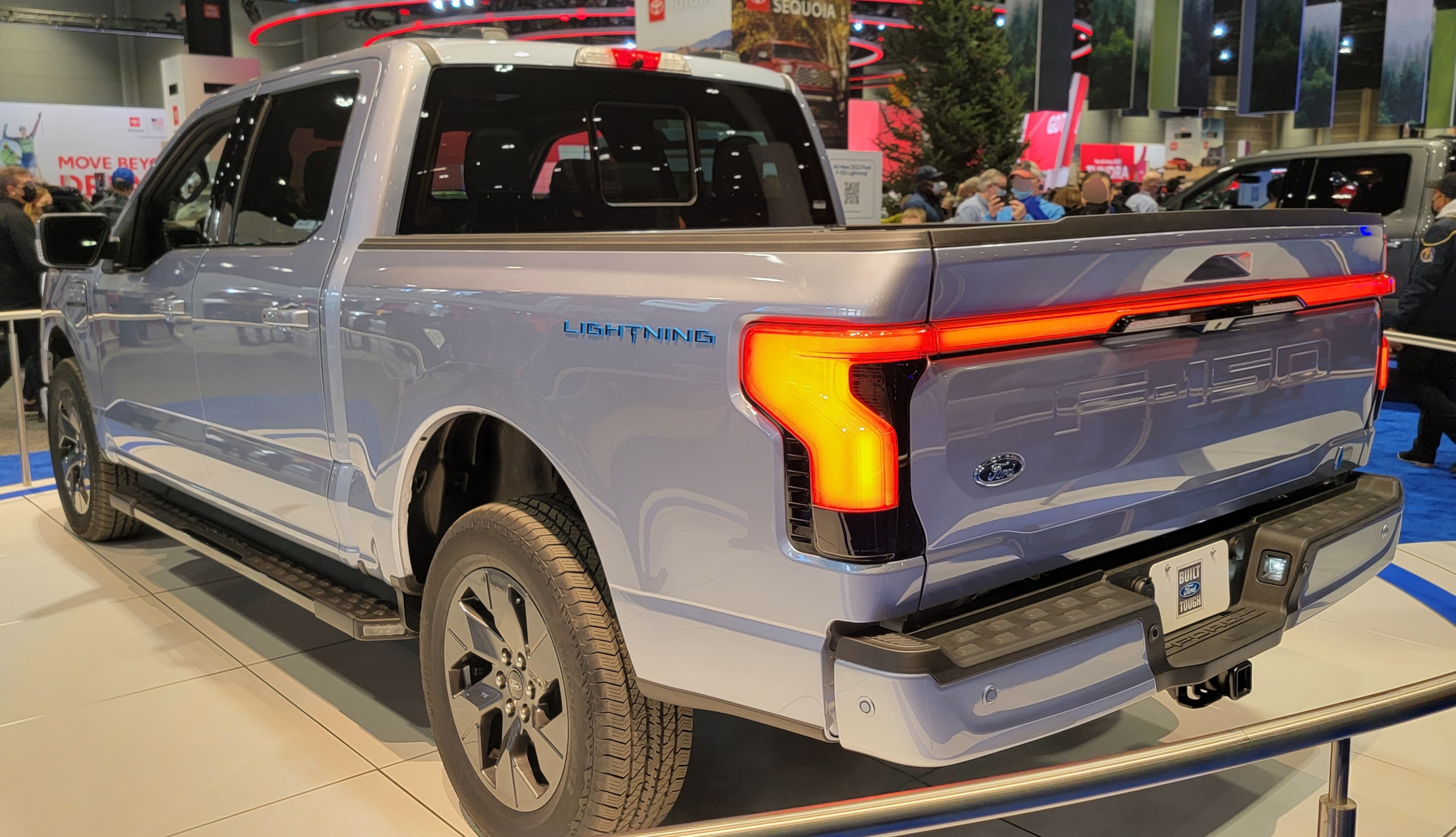
Ford F150
"Like, it doesn't look that high, but you part next to like a new F-150, even a Raptor, and you're kind of right at that level."
The Ford F-150 Raptor is a special, off-road-focused version of the F-150 pickup. They’re using it as a comparison to explain how tall the seating position feels and how much visibility you get.
The Ford F-150 Raptor is a high-performance version of the F-150 pickup, typically associated with off-road capability and a more aggressive stance. Here it’s used as a reference point for how high the seating position feels compared to the other vehicle being discussed.
broken record
"Number one pro is the obvious one that is the broken record. Everybody talks about it."
“Broken record” just means they keep hearing the same thing over and over. Here, it means people constantly talk about how reliable the Land Cruiser is.
“Broken record” is an idiom meaning something is repeated so often it becomes a cliché. In this context, it signals that the Land Cruiser’s reliability is a commonly discussed talking point among enthusiasts and owners.
V8
"Reliability, obviously, these can do many, many hundreds of thousands of miles to use that V8 incredibly smooth and incredibly long lived..."
A V8 is a type of engine with eight cylinders. In this discussion, they’re saying the Land Cruiser’s V8 is smooth and built to last a long time if you keep up with maintenance.
A V8 is an engine configuration with eight cylinders arranged in a “V” shape. The hosts connect the Land Cruiser’s V8 to smoothness and long-term durability, framing it as a key reason the vehicle can rack up very high mileage.
million mile engine
"That is a million mile engine if you keep up with the couple little bits of maintenance that you got to keep up with."
A “million mile engine” means an engine that can last an extremely long time—around a million miles. The key point is that it usually only happens if you do regular maintenance and don’t ignore small issues.
“Million mile engine” is a reputation-based idea meaning an engine can potentially last around one million miles with proper care. The hosts emphasize that this outcome depends on staying current with routine maintenance rather than being automatic.
suspension systems
"Toyota has had decades of experience making suspension systems that are just fantastic. Ride really smooth, handle really well on-road and off-road."
Suspension is what helps the car absorb bumps and stay stable. They’re saying Toyota’s suspension tuning makes the Land Cruiser feel smooth and controlled, whether you’re driving normally or going off-road.
Suspension systems control how a vehicle rides over bumps and how it behaves during cornering and off-road travel. The hosts credit Toyota’s experience with suspension design for the Land Cruiser’s smooth ride and confident handling both on-road and off-road.
fuel economy
"So with the LR3, the first thing we need to talk about is the fuel economy is properly bad. [1026.6s] So there were two engine options in the US, and you're up there with a bunch of diesels."
Fuel economy is how far you can drive on a tank of gas. If it’s “properly bad,” you’ll be stopping for gas more often than you’d like.
Fuel economy describes how efficiently a vehicle uses fuel, usually expressed as miles per gallon (MPG) or liters per 100 km. When hosts say it’s “properly bad,” they’re pointing out that real-world driving likely returns low MPG compared with alternatives.
AJ V8
"But here in the US, we got the 4.4 V8. [1033.3s] It's called the AJ V8. [1034.7s] I mean, they use it in everything at that time."
The “AJ V8” is a V8 engine family used by Jaguar Land Rover. It shows up in different vehicles, and it was updated over the years.
The “AJ V8” is Jaguar Land Rover’s AJ-series V8 engine family. The hosts note it was used across multiple brands/models and that the platform evolved over time, including use in vehicles like the Defender.

Jaguar Xk
"So it was like in the Jaguar XK, right? [1039.6s] It made its way in the Aston."
They mention the Jaguar XK to show where this engine showed up. It helps you understand the AJ V8 was used in more than one type of car.
The Jaguar XK is referenced as an early application of the AJ V8. This is useful context because it shows the engine family wasn’t limited to one brand—it appeared across Jaguar and other manufacturers.

Lincoln LS
"Lincoln LS used an AJ V8. [1045.2s] And really, they built that engine from like 2000 and I think it's like 02 through like today."
They mention the Lincoln LS as another car that used the same V8 family. It’s part of the story of how the engine was used across brands.
Lincoln LS is cited as another model that used the AJ V8. This reinforces the idea that the AJ V8 family was shared across multiple luxury brands in that era.
supercharged V8
"I mean, I think the supercharged V8 in the Defender is still an AJ V8. [1057.0s] The AJ platform obviously has been changed a lot over the years."
A supercharged engine uses a device that pushes extra air into the engine. That usually makes the car feel more powerful, but it can also affect how much fuel it uses.
A “supercharged V8” uses a supercharger to force more air into the engine, which typically increases power output. In this context, it’s mentioned to explain that the AJ V8 family can be configured with forced induction.
4.4
"If you get a 4.4, the five liters had some more issues. They had timing chains. They had gasket stuff."
“4.4” here refers to a 4.4-liter V8 engine option that the hosts say had more issues than the more solid version they’re praising. They also mention common wear items like timing chains and gaskets.
timing chains
"They had timing chains. They had gasket stuff. But the 4.4 specifically, very solid."
Timing chains help keep the engine’s moving parts in sync. If they wear out, the engine can run poorly or even be damaged, so it’s something to watch for as mileage climbs.
Timing chains are used to synchronize the engine’s camshafts and crankshaft. On some engines, they can stretch or wear over time, so they become a reliability topic—especially at higher mileages.
gasket stuff
"They had timing chains. They had gasket stuff. But the 4.4 specifically, very solid."
Gaskets are seals that keep fluids from leaking where engine parts meet. If they fail, you can get leaks that may require repairs.
“Gasket stuff” is shorthand for gasket-related leaks or failures, which can show up as oil or coolant seepage. It’s mentioned alongside timing chains as part of the types of issues that can appear on higher-mileage engines.

Ford Ranger
"From the Ford Ranger, it's the power of a 4-cylinder, the fuel economy of like a V10. I mean, it's 217 horsepower and I'm averaging like 14.6."
The Ford Ranger is being used as a comparison. The host is basically saying the LR3 doesn’t feel very strong, like it has less power than you’d expect.
The Ford Ranger is referenced as a comparison point for engine character—specifically, the host says the LR3’s 4.0-liter V6 feels like it has the “power of a 4-cylinder.” It’s a way to communicate perceived performance rather than a technical spec.
sport mode
"So like modern air suspension, there's almost always a sport mode to really stiffen things up. Yeah. This thing is, regardless of what ride height setting, it's always like Cadillac floaty,"
Sport mode is a button or setting that tries to make the car feel more responsive and less “soft.” The host is saying it doesn’t fully fix the handling feel they don’t like.
Sport mode is a driving setting that typically firms up suspension behavior and/or changes throttle/steering response. Here, the hosts point out that even with sport mode, the LR3 still feels like it has excessive body roll.
body roll
"This thing is, regardless of what ride height setting, it's always like Cadillac floaty, 70 floaty. So huge amounts of body roll."
Body roll is when the car leans over during a turn. More body roll usually means the car feels less planted and more floaty on curvy roads.
Body roll is the tendency of a vehicle’s body to lean to the outside of a turn. The hosts use it to describe why the LR3 feels unstable or “barge-like” on twisty back roads, even with suspension settings.
air suspension
"By the way, remember when I was saying that air suspension is a little reliable, we're out here in the middle of Utah. I just looked and these airbags are date coded 2005."
Air suspension is a suspension system that uses air-filled bags instead of metal springs. It can make the ride feel smoother and can sometimes raise or lower the car, but the bags and related parts can wear out over time.
Air suspension uses air-filled springs (often called airbags) instead of traditional steel coils. It can smooth out the ride and automatically adjust ride height, but it depends heavily on the health of the airbags and compressor/valving system.
airbags
"I just looked and these airbags are date coded 2005. So they're original."
In air suspension, the airbags are the “spring” that supports the car. If they’re old, they may start leaking or not hold the car at the right height.
In an air suspension setup, the airbags are the spring elements that carry the vehicle’s weight. If they’re original and old (like the 2005 date code mentioned), they can be a clue to how long the system has been operating and whether it’s likely to need replacement soon.

Land Rover Range Rover
"... because there are Land Rover products like a P38 Range Rover that have terrible air suspension."
The Range Rover is a large, luxury SUV made by Land Rover. Some older versions used an air suspension system that can fail, which can make the car expensive to fix. That’s why it’s sometimes mentioned when people warn about suspension reliability.
The Land Rover Range Rover is a luxury SUV known for its off-road ability and comfort-focused design. It often comes up in discussions because some older models—like the P38 generation—are associated with problematic air suspension systems. That makes it a common example when people talk about ownership costs and maintenance risk on certain Range Rover years.
4WD system
"My final thing I don't like about it, people do, so the 4WD system is incredible and people do turn them into rock crawlers, but it's very difficult to do so and they're not really happy doing it, right?"
A 4WD system powers all four wheels for better grip. It helps off-road, but the conversation suggests that using it aggressively (like rock crawling) can be tough on the vehicle.
A 4WD system sends power to all four wheels, which helps with traction on loose surfaces and off-road use. The hosts mention it as “incredible,” but also note that pushing it into rock-crawling territory can be hard on the vehicle and not ideal for everyday use.
rock crawlers
"people do turn them into rock crawlers, but it's very difficult to do so and they're not really happy doing it, right?"
Rock crawling is off-roading over rocks where you move slowly and need the tires to keep traction. The point here is that not every SUV is naturally suited for that kind of abuse.
Rock crawling is a slow, technical off-road style that demands lots of articulation and traction while keeping the vehicle stable. The hosts are implying that some vehicles can be adapted for it, but they may not be “happy” doing it due to setup limits and stress on components.
software lift
"I have a slight, quote, software lift or basically a program the computer to sit like a centimeter higher and you can get like an inch out of it, maybe an inch and a half, but then you start running into geometry issues."
A software lift means the car can raise itself using its air suspension settings. It can help a little with clearance, but it’s not the same as a full suspension lift and can run into limits.
A “software lift” refers to using the vehicle’s computer to command a higher ride height without physical suspension changes. It can provide a small amount of extra clearance, but it may be limited by the vehicle’s designed suspension geometry and calibration.
geometry issues
"but then you start running into geometry issues. And then the aftermarket community is not tiny, but stuff is very expensive, especially on a car that's not worth much, right?"
Lifting a vehicle changes how the wheels and suspension sit. That can lead to problems like uneven tire wear or handling that feels “off” because the angles aren’t ideal anymore.
When you lift a vehicle, suspension and drivetrain angles change. That can cause “geometry issues,” like altered alignment of suspension arms and steering components, which can affect ride quality, tire wear, and how the vehicle behaves.
aftermarket community
"So the part and the aftermarket community is much smaller. Yeah, now people are obviously going to be very surprised..."
The aftermarket community is the group of companies and people that make parts and upgrades for a specific car. If fewer people drive or modify a model, there are often fewer parts available and less support. That can make repairs or upgrades harder or more expensive.
The “aftermarket community” refers to the ecosystem of third-party parts, shops, and support for a specific vehicle. The hosts connect it to ownership economics: if a car’s audience is smaller, there may be fewer performance or replacement options and less competition on pricing.

Land Rover Discovery 2
"So like genuinely, specifically 06 through 09... if you look at like the older Land Rovers, like your Discovery 2, right? There are fundamental design flaws that make them horrible to own long term..."
The Land Rover Discovery 2 is an older Land Rover SUV. In this discussion, the hosts say it was especially troublesome to keep running over the long term, with big mechanical problems that could get expensive. They’re using it as a contrast to the LR3.
The Land Rover Discovery 2 (often called “Discovery 2”) is an older generation of Discovery that the hosts describe as having major long-term ownership problems. They cite specific failure modes—like head gasket issues and cooling system problems—that they consider “fundamental design flaws.”
headgasket's failure
"...headgasket's failure, liner slip, driveshafts explode that then takes out the transmission, the cooling systems were garbage."
The head gasket is a seal inside the engine. If it fails, the engine can start mixing fluids or overheating, which usually means a costly repair. The hosts are calling it out as one of the big reasons some older Land Rovers were hard to own.
A head gasket failure happens when the seal between the engine block and cylinder head breaks down, allowing coolant and/or combustion gases to leak. In the transcript, it’s listed as a major problem on older Land Rovers, contributing to expensive repairs and long-term reliability concerns.
liner slip
"...headgasket's failure, liner slip, driveshafts explode that then takes out the transmission..."
In some engines, there are sleeves (liners) that help form the cylinder walls. “Liner slip” means that sleeve shifts, which can damage the engine and cause leaks or overheating. The hosts are mentioning it as a serious reliability problem.
“Liner slip” refers to a failure where the cylinder liner moves out of position inside the engine block. That can lead to loss of compression, coolant/oil leaks, and overheating, and it’s cited here as part of the older Land Rover’s severe common-issue list.
cooling systems were garbage
"...the cooling systems were garbage. I mean there were really big issues with them."
The cooling system keeps the engine from overheating. If it’s unreliable, the car can run hot and cause damage over time. The hosts are pointing to cooling problems as a major reason some older Land Rovers were hard to own.
“Cooling systems were garbage” is a blunt way of saying the cooling system design or execution led to frequent overheating or cooling-related failures. In reliability discussions, cooling issues matter because overheating can warp components and accelerate engine wear.
gauge cluster
"... like sometimes the gauge cluster, the pins that connected to the wiring harness, right, those can corrode and then you get weird faults."
The gauge cluster is the dashboard that shows things like speed and warning lights. If the connectors/pins behind it corrode, the car can start acting strangely with random warning lights or errors.
The gauge cluster is the instrument panel that displays speed, engine info, and warning lights. The hosts mention a specific failure mode: corroded pins where the gauge cluster connects to the wiring harness can cause intermittent or “weird” electrical faults.
sunroof leaks
"I think they can still have sunroof leaks, right? Sunroof leaks, yeah for sure."
Sunroof leaks mean rainwater gets into the cabin. It’s usually caused by worn seals or clogged drains, and it can damage the interior over time.
Sunroof leaks occur when water intrusion gets past seals, drains, or the sunroof’s sealing surfaces. The hosts say the LR3 can have this issue, which typically leads to interior water damage if not addressed.
front diff
"I mean we had the front diff explode on this, it's got 240,000 miles, it's 20 years old. [1397.8s] I mean things just wear out, right?"
The front diff is a gearbox that helps the front wheels turn at different speeds, especially in corners. If it fails badly, it can cause a big, costly repair because it’s a complex part inside the drivetrain.
“Front diff” means the front differential, the gear assembly that lets the left and right front wheels rotate at different speeds when turning. When it “explodes,” it usually indicates severe internal wear or failure, which can turn into an expensive repair because it’s not just a simple wear item.
brakes
"Like control arms wear out, bushings wear out, brakes wear out. [1402.4s] Also for the people that aren't watching videos when I say front diff explode,"
“Brakes wear out” is a reminder that even reliable vehicles require routine maintenance. Brake pads/rotors and related hardware degrade with use, and neglecting them can lead to reduced stopping performance and more expensive repairs later.
massive repair bill
"And then spit out a massive repair bill, right? [1420.3s] And that happens a lot on hundreds of series."
A “massive repair bill” is what happens when small problems aren’t fixed early. Over time, one failed part can cause other parts to wear out or break too.
The hosts describe how deferring maintenance can escalate into a “massive repair bill.” This is a typical pattern with aging vehicles: small wear items (bushings, suspension components, drivetrain parts) can fail and damage adjacent systems, multiplying cost.
spending four grand immediately
"People buy them for what they think is cheap. [1423.8s] And then like we did, you end up spending four grand on it immediately, right?"
The “four grand immediately” point highlights the risk of buying an older used vehicle expecting it to be cheap. Even if the purchase price is low, deferred maintenance can mean you quickly need major repairs to make it reliable.
weight of it
"For me, I think the number one thing is the weight of it. Look, it's a large vehicle... This one, as it sits right now, is almost 5,500 pounds... And you feel that when you're driving it."
Heavier vehicles feel harder to move around. That can make them feel less quick or agile, even though they can still handle tough terrain.
Vehicle weight affects how a 4x4 feels on-road and off-road. A heavier SUV tends to feel less “athletic” because it has more mass to accelerate, brake, and change direction, even if it’s still capable on trails.
four by fours
"It doesn't mean you can't go run difficult trails... This one... is almost 5,500 pounds... So there are four by fours out there that are narrower, lighter, feel a little bit more athletic..."
A 4x4 drives all four wheels, which helps it grip better on dirt, mud, rocks, or uneven ground. Here they’re saying lighter 4x4s can feel more nimble.
“Four by fours” (4x4s) are vehicles designed to send power to all four wheels, typically improving traction on loose, uneven, or off-road surfaces. In this discussion, the hosts contrast heavier, larger 4x4s with narrower, lighter ones that feel more agile.
hold value really well
"Yeah, I would say another big one being cost because these vehicles are so sought after and because they are so long lived, they really do hold value really well, which if you own one already and you're going to sell it, then that's great news."
Some cars keep their resale value better than others. If people really want the vehicle and it lasts a long time, you usually get more money when you sell it later.
“Hold value” refers to how well a vehicle retains its resale price over time. If a model is long-lived and in demand, owners often get stronger trade-in or private-sale prices, which reduces the total cost of ownership.
independent front suspension
"So independent front suspension is not inherently problematic, even though some people kind of feel like it is. There's plenty of very durable and very capable independent front suspensions. Just look at the Bronco, for example."
Independent front suspension means the left and right front wheels can move separately. That can help the truck ride better and keep traction, and the point here is that it’s not automatically “bad” just because it’s independent.
Independent front suspension (IFS) means each front wheel moves somewhat independently, improving ride comfort and allowing better wheel control over uneven terrain. The hosts emphasize that IFS isn’t inherently unreliable—durability depends on the specific design, components, and how it’s used.
two pinion
"This one in particular, it's not a massive front diff and there are two pinion and four pinion front diffs for these hundred series Land Cruisers."
This is another differential gear layout—this one uses two pinion gears instead of four. The hosts are comparing these designs to explain why some Land Cruisers may be more prone to front differential problems when driven hard.
“Two pinion” describes a differential configuration using two pinion gears. In this discussion, the hosts contrast two-pin and four-pin front diffs for Toyota Land Cruiser 100-series trucks and connect the design to real-world durability under off-road abuse.
four pinion
"Some people say that the four pinion is stronger. It doesn't sound like it's necessarily guaranteed to be significantly stronger, and it is kind of the Achilles heel on these."
In a differential, pinion gears help transfer power. The idea here is that a “four pinion” design might handle more stress than a “two pinion” design, but it still may fail if you push the truck hard enough off-road.
“Four pinion” refers to a differential gear setup that uses four pinion gears to drive the ring gear. The hosts discuss whether that design is inherently stronger than a “two pinion” setup, and conclude it’s not a guaranteed fix—stress and loading still matter.
Achilles heel
"It doesn't sound like it's necessarily guaranteed to be significantly stronger, and it is kind of the Achilles heel on these. Yeah, that's true."
“Achilles heel” just means the weak spot. In this case, they’re saying the front differential is the part that can give trouble when you drive the truck harder than it was meant to handle.
“Achilles heel” is a metaphor for a specific weakness that can define a vehicle’s reliability reputation. Here, the hosts use it to describe the Land Cruiser 100-series front differential as the component most likely to fail when conditions exceed its design limits.
wheeling it hard
"You can definitely get into a situation where you break that front diff, especially if you're wheeling it hard and especially if you go to a bigger tire. Because it's a heavy vehicle, that's just kind of a part of it."
“Wheeling it hard” means aggressive off-road driving that subjects the drivetrain to high torque, traction changes, and repeated shocks. The hosts tie this kind of use directly to the risk of breaking the front differential on the Land Cruiser 100-series.
articulated
"But it's still, as I drive it and it gets articulated and starts to struggle a little bit, it's something that's in the back of my mind."
“Articulated” means the suspension is flexing a lot so the wheels can follow the ground. That can put extra stress on the drivetrain when one wheel loses traction and torque has to be managed.
“Articulated” describes how much a vehicle’s suspension can move so wheels maintain contact over uneven terrain. The hosts connect articulation to increased strain on the drivetrain and differential as the truck struggles for traction.
Request an Explanation
Heard something you'd like explained? We'll add it to this episode.
Sign in to request explanations for terms you heard.
Want to learn more?
Browse our glossary for plain-English explanations of automotive terms, jargon, and concepts.
Help improve this episode
See something that's not quite right? Our annotations are AI-generated and can sometimes miss the mark. Click the flag icon on any annotation to suggest a correction.