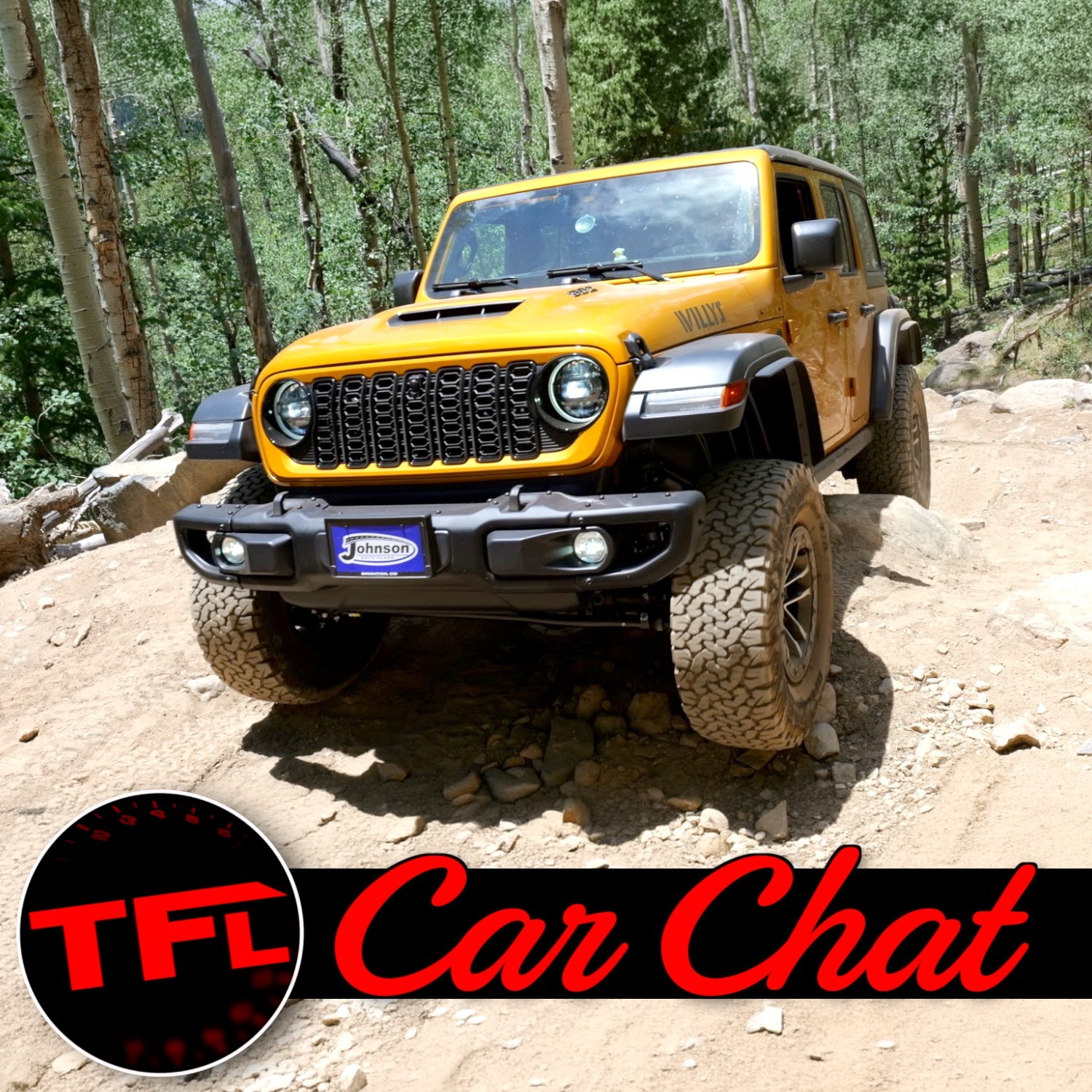
Surprise, There's A New Sales King! Wrangler VS 4Runner VS Bronco! | Ep. 346
About this episode
A new sales “king” emerges as the hosts compare Q2 2026 volume for the Ford Bronco, Jeep Wrangler, and Toyota 4Runner—then dig into why Bronco momentum is finally outpacing Wrangler. The conversation shifts to real-world ownership: a Wrangler 392 Willys V8 build, off-road minivan surprises, and what buyers want from modern interiors and powertrains. Later, they pivot to used-car pricing trends (Corvette/C8, Porsche 911) and debate whether software can truly mimic manual driving feel.
Go to https://www.autotempest.com/TFL for everything you need when searching for a new vehicle!
( https://www.alltfl.com/ ) Check out our new spot to find ALL our content, from news to videos and our podcasts! The team dives straight into the freshly released quarterly sales numbers to crown a surprising new king in the fiercely contested off-road SUV segment. While a major competitor continues to experience a noticeable slide compared to previous years, its archival rival has finally surged ahead to secure the quarterly crown. Meanwhile, Toyota's latest generation of its iconic off-roader is making massive gains as inventory settles into dealerships, signaling a massive market shift that could shake up the podium by this time next year.
Beyond the showroom numbers, Roman launches into his weekly rant with a bold strategy to save the manual transmission, sparked by Ferrari's controversial new electronic gearbox setup. The guys debate whether a computer-controlled, fly-by-wire clutch system keeps the analog spirit alive or simply adds training wheels to the driving experience. Shifting gears to watch culture, they analyze how classic timepiece reissues offer a perfect blueprint for bringing back legendary car nameplates with a modern twist. Finally, the team shares some painful personal news regarding the eye-watering depreciation they just took on a recent truck trade-in!
( http://www.patreon.com/tflcar ) Visit our Patreon page to support the TFL team!
Advertising Inquiries: https://redcircle.com/brands
Privacy & Opt-Out: https://redcircle.com/privacy
Q2 of 2026
"Exploring which one is the new sales [SPEAKER_00]: for Q2 of 2026. [102.9s] [SPEAKER_00]: Yeah, the numbers just came out manufacturers used to do it monthly, but now they do it quarterly, and we've got the numbers asked to who is doing the best, and actually the results are pretty surprising, because this time last year the foreign era was not doing well, and surprisingly, it's doing really well."
“Q2” is just a way of splitting the year into quarters. Q2 of 2026 means the sales from roughly April through June 2026.
“Q2” means the second quarter of the year, covering April through June. Here, the hosts are using Q2 2026 sales results to determine which SUV is leading in sales.

Jeep Wrangler
"And then the Jeep Wrangler splits the difference at 41,793. That's down 12% compared to a year ago. Yeah. So Ford Wrangler, Bronco, our up Wrangler is down..."
The Jeep Wrangler is a rugged off-road SUV that’s famous for being able to remove the roof and doors on many versions. Here, the hosts are talking about how many Wranglers are being sold compared to other popular SUVs.
The Jeep Wrangler is a body-on-frame SUV known for its off-road focus and removable roof/doors on many trims. In this segment, the hosts discuss its sales numbers and how it compares to the Toyota 4Runner and Ford Bronco.

Toyota 4Runner
"I think we're helping personally to up the numbers for everybody because we've owned a Bronco or Wrangler and a foreigner at this point, but here to date sales, the Jeep is actually still in the lead at 86,000 total for 2026, the 4 to that 79,000 in the Toyota at 72, but the Toyota is definitely making the most headway up 81% compared to where it was last year."
The Toyota 4Runner is a rugged SUV known for being tough and good for off-road use. The hosts are comparing its sales growth to the Wrangler and Bronco in this sales race.
The Toyota 4Runner is a body-on-frame SUV that’s built around durability and off-road practicality, with a long-running reputation in the Toyota lineup. Here, the hosts compare its sales trajectory against the Jeep Wrangler and Ford Bronco, including how quickly it’s gaining momentum year over year.
sixth generation
"So clearly, people are warming up. to that new sixth generation for under and I think maybe this time next year it may come ahead from Wrangler and Rockout."
“Sixth generation” means the model has been redesigned for a new era. The hosts are basically saying that the newer generation could be helping sales.
“Sixth generation” refers to the next major redesign cycle of a model line, typically bringing changes to the platform, styling, interior, and powertrain options. In this segment, the hosts connect the Wrangler’s “sixth generation” to shifting sales momentum.
refresh
"I think jeep probably should have had a refresh if not a completely new well they did in twenty four never that was such a fact yeah i was like three things like you know a new grow different screen and a different interior layout"
A “refresh” is when a car gets updated partway through its life, like new styling or a newer screen inside. The speaker is saying Jeep probably should have updated the Wrangler sooner.
A “refresh” is a mid-cycle update to a vehicle—often including styling tweaks, new infotainment, revised interior materials, and sometimes minor mechanical changes—without fully replacing the model. The hosts argue that Jeep may have needed a refresh earlier to better compete with newer rivals.
lease returns
"Manages, lease returns. Okay. And the question was, what car is returned earliest out of his experience and take this with the grain of salt because it is tiktok and I don't know if he is who he says he is, but the question is, what car gets returned the earliest?"
“Lease returns” means when someone brings a leased car back at the end of the lease. The host is using that idea to guess which cars people give back earlier.
“Lease returns” refers to the process of turning in a leased vehicle at the end of the lease term (or sometimes early). The speaker uses a lease-return scenario to compare which vehicles tend to be returned sooner, as a proxy for owner satisfaction or residual value behavior.
splitting the gaps
"It doesn't really good job of splitting the gaps. I'm kind of surprised to hear that news Is that just a dealer saying that?"
“Splitting the gaps” here just means a vehicle trying to do two different jobs at the same time. The host is basically wondering if the Bronco really hits that balance people want.
“Splitting the gaps” is a colloquial way to describe a vehicle trying to cover multiple buyer needs at once—like being both comfortable enough for daily driving and capable enough for off-road use. In this context, it’s used to question whether the Bronco is truly bridging that middle ground.
independent suspension
"..., it's solid axles, it's definitely one trick-pony, it's off-road, or 100% whereas the Bronco is newer technology, independent suspension, obviously."
Independent suspension lets each wheel react to bumps on its own. That usually makes the ride smoother and the car feel more controlled, especially on regular roads.
Independent suspension means each wheel can move up and down somewhat separately, rather than both wheels sharing the same rigid axle movement. This often improves ride comfort and handling on-road because bumps on one side don’t affect the other side as much.
solid axle
"So you're like, I don't want to rangle her because that thing goes back to to the World War II G, because it's solid axles, it's definitely one trick-pony, it's off-road, or 100% whereas the Bronco is newer technology, independent suspension, obviously."
Solid axles connect the left and right wheels with one rigid bar. That can help the tires stay planted on rough ground, but it can also make the ride feel less smooth than newer suspension designs.
Solid axles are a drivetrain setup where the left and right wheels are connected by a single rigid axle. They’re common on traditional off-road vehicles because they can keep more wheel contact over rough terrain, but they can also ride differently than independent suspension.

Ford Ranger
"...o, you go for it. [SPEAKER_00]: Well, we bought a ranger. [SPEAKER_01]: We bought another ranger."
The Ford Ranger is a mid-size pickup truck. It’s meant for hauling and towing, but it can also be used like a normal daily vehicle. The hosts bring it up because they’ve owned one and then bought another.
The Ford Ranger is a mid-size pickup truck that’s commonly chosen for everyday driving plus work or weekend utility. It’s significant because it offers truck practicality without the size of a full-size pickup. The podcast mentions it because the hosts say they bought one—and then bought another—highlighting personal ownership experience.
V8
"affordable way to get a V8 in the Wrangler. [426.3s] [SPEAKER_01]: So up until now, the V8s have been $90,000. [433.0s] [SPEAKER_01]: The Moab came out recently, that brought the price down about 80, and then the wheelies has brought that price down another 10k to 69,95 starting."
A V8 is an engine with eight cylinders. More cylinders generally means more power potential, and here they’re talking about which Jeep models can be had with a V8 and what it costs.
A V8 is an engine with eight cylinders arranged in a “V” shape. In this segment, the hosts use it to compare how different Wrangler trims (and related models) offer a V8 and how that affects pricing and performance expectations.
soft top
"Yeah, so this one was 74,000 basically 5,000 because I think you can't get the soft top, so you got to pay like $2,500 for the hard top. [450.3s] [SPEAKER_01]: It's like 1800 for the hard top and then it's 85 for the paint and like 170 for the floor mats."
A soft top is the fabric roof option on a Jeep Wrangler. They’re saying this particular one didn’t have the soft top available, so they had to choose the hard top instead, which cost more.
A soft top is a Wrangler roof made from fabric rather than hard materials. In this segment, the hosts say they couldn’t get the soft top on this specific build, which affected the price and forced them toward a hard-top configuration.
hardtop
"Yeah, so this one was 74,000 basically 5,000 because I think you can't get the soft top, so you got to pay like $2,500 for the hard top. [450.3s] [SPEAKER_01]: It's like 1800 for the hard top and then it's 85 for the paint and like 170 for the floor mats."
A hard top is the solid, rigid roof option on a Jeep Wrangler. In this story, they had to get the hard top because the soft top wasn’t available yet, and that added to the cost.
A hard top is a rigid roof for the Wrangler, typically made from molded panels rather than fabric. The hosts mention it as a paid option and then specify they were only offered a “three piece” black hard top for this early allocation.
floor mats
"It's like 1800 for the hard top and then it's 85 for the paint and like 170 for the floor mats. [457.7s] [SPEAKER_01]: But basically, this is such a new thing that we wanted to get it first, rather than as cheap as we possibly could."
Floor mats are protective liners placed on the vehicle’s floor to reduce wear and make cleaning easier. Here, they’re mentioned as part of the itemized add-on pricing for the Wrangler build.

Dodge Power Wagon
"...rsepower V8, basically the same one that's in the power wagon. [SPEAKER_00]: In the power wagon it's detuned, I..."
The Dodge Power Wagon is a tough pickup truck made for off-road work. In the podcast, they talk about its V8 engine and how it may be tuned to deliver power in a different way. The point is that the same engine can be set up differently depending on the truck.
The Dodge Power Wagon is a heavy-duty pickup variant known for off-road capability and rugged mechanicals. The podcast specifically references its V8 and notes that the engine is “detuned” compared to another application, which is a common way manufacturers tune power for different uses. It’s mentioned to explain how the same basic engine can be configured differently depending on the vehicle.
detuned
"In the power wagon it's detuned, I think, to 405. [492.9s] [SPEAKER_00]: And this is a lot of power for what is basically a hardcore off-roader and it sounds incredible."
Detuned means the engine is set up to make less power than it could. It’s usually done to make the car or truck easier to drive or to help it last longer.
Detuned means the engine is calibrated to make less power than its maximum potential. Manufacturers often detune an engine for durability, drivability, emissions targets, or to match the vehicle’s intended use.
torque
"four hundred seventy horsepower for seventy pound feet of torque in a little narrow wrangler right so it's it's a lot of engine for that platform the whole thing kind of torques off the line when you give it some gas so it's it's a very interesting experience."
Torque is the engine’s pulling force. More torque usually means the car feels stronger when you start moving, like right off the line.
Torque is the engine’s twisting force, measured in pound-feet (lb-ft). It’s what makes a vehicle feel like it “pulls” strongly from a stop or at low speeds, especially when the host says the Wrangler torques off the line.
front locker
"and the willys does lose the front locker and it does lose the front display bar disconnect but it still has the extreme recon package"
A front locker helps both front wheels work together when traction is poor. It’s useful for off-roading because it can prevent one wheel from spinning uselessly.
A front locker is a differential locking feature for the front axle that forces both front wheels to rotate together. That improves traction on loose surfaces (mud, rocks, snow) by reducing wheelspin when one tire loses grip.
35s
"but it still has the extreme recon package which got the 35s it's got the suspension lift on it"
“35s” means the tires are about 35 inches tall. Bigger tires can help off-road, but they can also make the ride and efficiency a bit worse.
“35s” is shorthand for 35-inch tires, a common off-road tire size. Bigger tires can improve obstacle clearance and traction, but they also affect steering feel, ride quality, and fuel economy.
Suspension lift
"it's got the suspension lift on it it's got all the protection so we're can't wait to take it off road"
A suspension lift raises the truck or SUV higher off the ground. That usually helps it clear obstacles and fit bigger tires for off-roading.
A suspension lift raises the vehicle’s ride height by changing suspension components. On an off-road package, it typically increases ground clearance and allows larger tires to fit without rubbing.

Canyon AT4 X
"we traded our Canyon AT4 X on it And that was desert side which was it's really well You called it desert you called it colon orange traffic cone orange"
The GMC Canyon AT4X is a more off-road-ready version of the Canyon pickup. They’re saying they traded it in and lost a lot of money in a short time.
The GMC Canyon AT4X is an off-road-oriented midsize pickup trim focused on trail capability. The host compares it to the Wrangler and later discusses the money lost when they traded it in after relatively low mileage.

F-150 Raptor
"... a lot less than a can and you look at a range of raptor because I'm not sure if they're still both 57,000..."
The Ford F-150 is a large pickup truck. The podcast mentions it while talking about pricing and how much different versions cost. It’s used to help compare what you get for the money in truck trims.
The Ford F-150 is a full-size pickup truck and one of the most widely known trucks in its class. In the podcast, it’s mentioned in a pricing context—comparing costs to a range-topping variant—showing how buyers weigh mainstream trucks against higher-performance trims. It’s used as a reference point for what people pay for capability and performance.
200 miles an hour
"Let's talk about the other big news, and that is, what's the fastest way to get to 200 miles an hour... It's $73,000 essentially... it will just touch 200 miles an hour."
They’re talking about top speed—whether the car can reach 200 mph. It’s used as a simple benchmark to compare different versions of the same model.
“200 miles an hour” is a shorthand for a car’s top-speed capability, often used as a benchmark for extreme performance. The hosts compare whether different Corvette trims/options can reach that number.

Chevrolet Corvette
"...[SPEAKER_01]: Well, I think it's probably the new Corvette, so Chevrolet just revealed pricing on the new C8..."
The Chevrolet Corvette is a sports car built for fast driving and strong handling. In the podcast, they talk about the newest version’s pricing, which matters if you’re shopping for a performance car. It’s mentioned because it’s a major, widely watched sports car release.
The Chevrolet Corvette is a performance sports car known for delivering high speed and handling at a relatively attainable price for the category. The podcast specifically references the “new C8” and mentions that Chevrolet revealed pricing, which makes it a timely topic for buyers. It’s discussed as part of a comparison of how new sports cars are landing in the market.
6.7 liter small block
"It's $73,000 essentially... That's the new 6.7 liter small block, and it will just touch 200 miles an hour."
“Small block” is Chevrolet’s name for a type of V8 engine. They’re saying the new Corvette uses a 6.7-liter version of that engine, which helps it achieve extreme top speed.
“Small block” refers to Chevrolet’s compact V8 engine family, and “6.7 liter” specifies the displacement of the current Corvette’s V8. The segment uses it to explain why the base C8 can reach very high speeds.
Z51 package
"That's the new 6.7 liter small block, and it will just touch 200 miles an hour... Funny if you get the Z51 package, which is performance package, it won't do 200 because it's got too much arrow..."
The Z51 package is an optional performance upgrade for the Corvette. Here, they’re saying it changes the car’s speed at the very top end because it adds more aero (and that can slow you down).
The Z51 package is Chevrolet’s performance option package for the Corvette, typically adding track-oriented hardware and tuning. In this segment, it’s specifically tied to reduced top speed versus the base car, attributed to increased aerodynamic drag from added aero features.
Arrow
"Funny if you get the Z51 package, which is performance package, it won't do 200 because it's got too much arrow, but if you get the standard car it will..."
They mean the car’s aerodynamics—how the shape and spoilers affect airflow. More aero can improve stability, but it can also create extra drag that reduces top speed.
In this context, “arrow” is almost certainly a mis-transcription of “aero” or “aerodynamics,” meaning the car’s aerodynamic features. The point is that added aero on the Z51 package increases drag, which can limit top speed.
price trends
"Yeah, so this is the price trends. And you can find this at AutoTempis.com slash TFL."
“Price trends” just means watching how prices move over time. Here, they’re using it to see if certain Corvettes are getting more expensive or cheaper in the used/market listings.
“Price trends” means tracking how vehicle prices change over time. In this context, it’s about whether the market price for a specific car (or trim) is rising, falling, or leveling off.
holding strong
"Yeah, so you can see that right around 23, they started to increase in value, and the newer ones are holding strong and actually going up a little bit. [1016.6s] [SPEAKER_01]: So they're looking, they're firing a little bit better than the Porsche's, but you will notice, like there's a big cluster around the three, four, 500,000 dollar range."
“Holding strong” just means the car’s price stays steady and doesn’t fall off quickly. The host is saying newer Corvettes keep their value better.
“Holding strong” is resale-value language meaning the car’s market price doesn’t drop much over time. In this segment, it’s used to describe how newer Corvettes maintain their value better than older ones.

Porsche 911
"So they're looking, they're firing a little bit better than the Porsche's, but you will notice, like there's a big cluster around the three, four, 500,000 dollar range. [1026.1s] [SPEAKER_01]: So there's a lot of really expensive 911 that are dragging the whole market up like the GT3s, and then there's a big cluster that kind of stays steady around the $100,000 mark, which you're gonna be more of the base cars."
The Porsche 911 is Porsche’s famous sports car. It’s often expensive to buy and it tends to keep its value well, which is why the hosts talk about 911 prices affecting the whole market.
The Porsche 911 is Porsche’s iconic rear-engine sports car, and it’s known for holding strong resale values compared with many other performance cars. In this segment, the hosts use 911 pricing clusters to explain how certain 911 variants can pull the overall market upward.
electronically controlled CVT
"but it's a really interesting manual because there's a stick, there's three pedals, but it's fully electronically controlled ... So they're actually using the clutches within the automatic transmission connected to the clutch pedal."
This means the car uses computers to control how the clutch and gears work. Instead of everything being purely mechanical, the computer decides what happens when you press the pedals.
“Electronically controlled” here means the car uses computers and sensors to manage clutch engagement and shifting behavior. The speaker specifically says the system uses the clutches inside an automatic transmission, even though the driver operates a clutch pedal.
manual transmission
"You've added a manual transmission to it After people have been complaining about the lack of manuals at auto everything, but it's a really interesting manual because there's a stick, there's three pedals"
A manual transmission is when you choose gears yourself. You use the clutch pedal to help switch gears, instead of the car doing it automatically.
A manual transmission is a gearbox where the driver selects gears using a clutch pedal and a gear lever. In this case, the speaker emphasizes that the “manual” feel is implemented with electronics, not a fully traditional mechanical linkage.
automatic transmission
"So they're actually using the clutches within the automatic transmission connected to the clutch pedal."
An automatic transmission shifts gears for you. In this case, the car still uses an automatic transmission’s clutch system, even though you can drive it like a manual.
An automatic transmission changes gears without the driver manually selecting each gear. In this Ferrari example, the speaker says the car’s “manual” pedal setup is tied into the clutches inside an automatic transmission.
by wire
"It's a game that's shifter which is classic for Ari which is cool but it's all basically by wire so it's three pedals but you're not actually actuating anything mechanical."
“By wire” means your pedal inputs are sent to a computer as signals. The computer then controls what the car does, instead of using a direct mechanical connection.
“By wire” means the driver’s inputs (like pedal movement) are converted into electronic signals rather than directly moving mechanical linkages. The speaker says it’s “all basically by wire,” so the three pedals don’t actually actuate mechanical parts in the traditional way.
dual clutch
"Same thing with the shift lever you're not actually moving any gears all you're doing is allowing the computer then to shift the dual clutch for you while you feel like you're shifting it with a lever versus a push button or any other way you could do that."
A dual-clutch transmission is a type of automatic that uses two clutches to shift faster. Even if you move a shifter, the car’s computer can still manage the actual gear changes.
A dual-clutch transmission uses two separate clutches—one for odd gears and one for even gears—so it can pre-select the next gear and shift very quickly. In this discussion, the host is contrasting a lever-based interface with a system that can still do the actual shifting for you.
engagement point
"you could have a shift like any old classic Ferrari that you wanted to shift with the engagement point being in a different place with the mechanical feel being reproduced from older cars."
The engagement point is when the drivetrain starts to actually grab and move the car. The hosts are saying the car can be programmed to make that feel like older cars.
The engagement point is the moment in a clutch/shift control where torque transfer ramps up—essentially when the drivetrain “catches” and starts pulling. The hosts are describing how software can mimic the mechanical feel of older cars by changing where that engagement happens.
power band
"Yeah, but you're also not replicating, for example, a power band, because you do have a genuine power band from the engine, right?"
A power band is the part of the engine’s RPM range where it feels strongest and most eager. The hosts are saying EVs don’t have the same kind of “sweet spot” as a gas engine.
A power band is the range of engine speeds where the engine produces strong power and feels responsive. The hosts point out that EVs don’t behave like traditional engines with a narrow power band, so replicating that exact “band” is different from replicating shift timing.
shift points
"But you can certainly replicate the shift points from different cars and you can replicate the gearing from different cars."
Shift points are when the car decides to change gears. They’re based on things like engine speed and how hard you’re accelerating, and they affect how the car feels while driving.
Shift points are the conditions (like RPM and throttle/load) that determine when a transmission upshifts or downshifts. The hosts are debating whether an EV can replicate the “feel” of older cars by matching those programmed shift timing targets.
RPM
"How many RPM? You get to choose because it's a manual."
RPM means how fast the engine is spinning. When you drive an automatic, the car often uses RPM to decide when to shift gears.
RPM (revolutions per minute) is how fast the engine spins. In automatic or dual-clutch systems, RPM is one of the key inputs used to decide when to shift—so the discussion ties RPM to how gear changes happen.
manual mode
"Like, for example, on the ionic five end, the car gets slower when you put it in a manual mode."
Manual mode is a setting that lets you control how the car behaves instead of the computer doing everything. Depending on the car, it may actually change gears or it may just imitate the feel.
“Manual mode” is a driving setting where the car lets you choose gears (or gear-like steps) instead of fully letting the computer decide. On some cars it’s real gear selection, and on others it’s more of a simulated/limited behavior to mimic manual driving.
one-speed
"It's a one-speed, the computer's making it."
A one-speed setup means the car doesn’t shift through multiple gears like a gas car. EVs can still accelerate well because the motor can change torque smoothly without gear changes.
A “one-speed” transmission means the vehicle uses a single fixed gear ratio rather than multiple selectable gears. Many EVs use this approach because electric motors can provide strong torque across a wide range without needing traditional gear steps.
clutch feel
"But with this, you could replicate the clutch feel of different cars."
Clutch feel is how the clutch pedal and engagement feel in your hands and feet. Some cars have a light, smooth clutch, while others feel heavier or bite more suddenly.
“Clutch feel” refers to the physical characteristics of a clutch pedal and engagement—how heavy it is, how quickly it bites, and how smooth or abrupt the take-up feels. Even when two cars use different drivetrains, manufacturers can tune software and hardware to mimic a particular clutch engagement character.
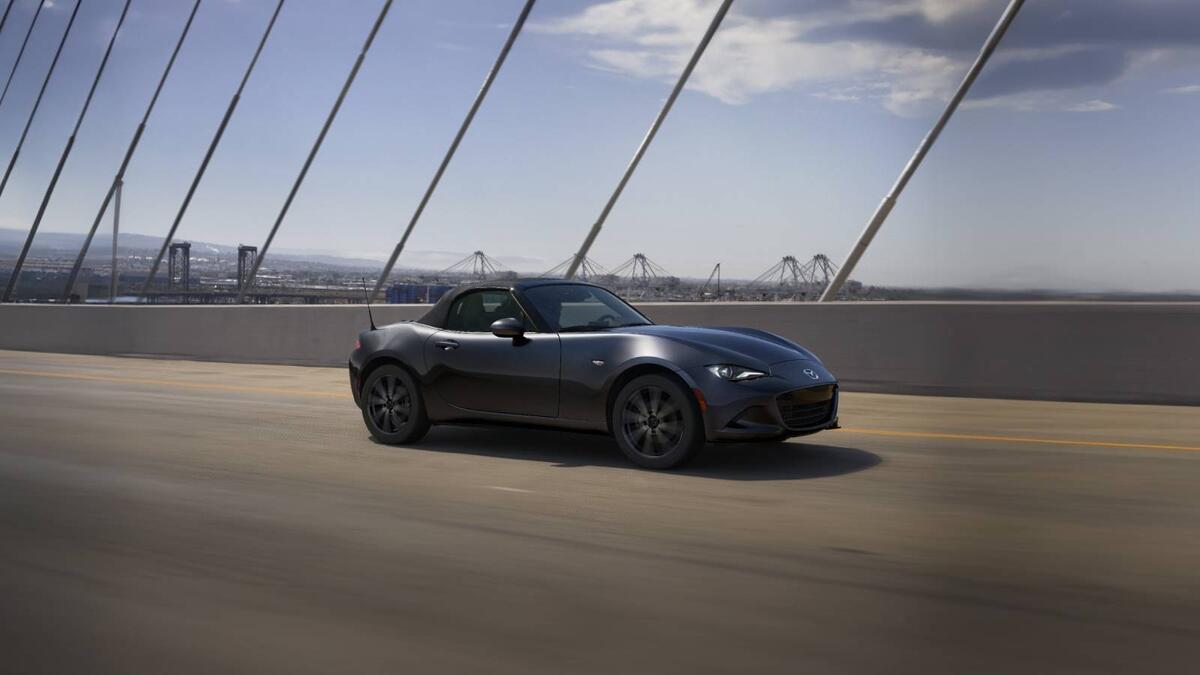
Mazda MX-5 / Miata
"...01]: I don't think people are like, oh, I love my Miata because the clutch feel is different than a Chall..."
The Mazda Miata is a small two-seat sports car designed to be fun to drive. People often talk about how the controls feel, including the clutch. In the podcast, it’s used to explain that different cars can feel different even if they’re all “sports cars.”
The Mazda MX-5, commonly called the Miata, is a lightweight, driver-focused roadster known for its feel and balance. The podcast compares it to other cars by discussing how the clutch feel differs, which highlights why enthusiasts notice small driving characteristics. It’s mentioned as an example of a car people love for the way it drives.

Dodge Challenger
"...Miata because the clutch feel is different than a Challenger, right? [SPEAKER_00]: I think people are like tha..."
The Dodge Challenger is a performance car with a focus on power and acceleration. The podcast mentions it to compare how it feels to drive compared with a Miata. They’re pointing out that even the same basic controls can feel different in different cars.
The Dodge Challenger is a muscle car built around strong power and a classic American performance layout. In the podcast, it’s referenced mainly to contrast driving feel—specifically how the clutch feel differs from a Miata. That kind of comparison helps explain why drivers may prefer one car’s character over another’s.
EV
"On the electric car, you can make it sound like a four-cylinder versus a V8 versus a jet plane."
An electric car runs on electricity from a battery and an electric motor. Here, the speaker is saying EVs can also fake the sound and feel of other engines.
An “electric car” uses an electric motor instead of a traditional internal-combustion engine. In this discussion, the speaker is highlighting that EVs can use sound and behavior simulation to mimic other engine types (like a V8) or even non-car sounds.
PDK
"so I could see Porsche saying well if for I can do it we can do it to our PDK and they could do the exact same thing."
PDK is Porsche’s name for its dual-clutch automatic transmission. In this discussion, the host is comparing how Porsche could use its PDK approach to handle power without needing a separate, fully manual gearbox design.
automated manual
"which makes it much cheaper for the manufacturers to offer a manual because they'd be like, hey, we can give you this automated manual, which is really what it is when you think about it."
An automated manual is basically a manual gearbox, but the car does the clutch and shifting for you. You don’t have to press a clutch pedal yourself.
An automated manual is a gearbox that is fundamentally based on a manual transmission, but the clutch and/or shifting are controlled by actuators instead of a human using a clutch pedal. The point here is cost: it can be cheaper than developing a fully separate automatic transmission.
ZF-A speed
"There's already guys doing this now on the current ZF-A speed, that's not everything."
ZF is a company that makes transmissions for many car brands. The host is referring to a specific ZF transmission setup that can be controlled in a way that feels closer to manual shifting.
ZF is a major transmission supplier, and “ZF-A speed” here refers to a ZF multi-speed automatic transmission family. The host is saying there are already systems like this that can be adapted or controlled in a way that resembles manual operation.
overdrive
"Well, they're like overdrive. Yeah, well, that's what I'm saying."
Overdrive is a gear that usually lets the engine spin slower when you’re driving steadily. It helps the car feel calmer and can improve fuel economy.
Overdrive is a higher gear ratio that typically reduces engine RPM at cruising speeds to improve efficiency and reduce noise. The discussion connects it to how gear selection can be handled similarly whether the driver is using a manual or an automated system.
money shift
"This way, with this, the best you're doing is giving the machine suggestions, but if you can't override it, if you can't money shift it, You don't, and these are not good things, but these are things that make driving a manual challenge."
A money shift is a serious manual-transmission mistake where you end up in the wrong gear. It can send the engine to very high RPM and potentially cause damage.
A money shift is when a driver accidentally upshifts or downshifts into the wrong gear—especially downshifting too far—causing dangerously high engine RPM. It’s called out as a key risk that manual driving can involve, and it’s used here to argue about how much control an automated system should allow.

Chrysler PT Cruiser
"... recreating them like Let's say they did with the PT cruiser where you're trying to come with a new design on ..."
The Chrysler PT Cruiser is a car with a retro, old-school look. The podcast mentions it as an example of a company trying to bring back a certain style. They’re using it to talk about how redesigning a classic idea can be risky.
The Chrysler PT Cruiser is a retro-styled compact car that was designed to look like a throwback while still being practical for daily use. In the podcast, it’s referenced as an example of what happens when companies try to recreate or reimagine older design ideas. The point is about whether that approach can work when launching something new.

Ford Thunderbird
"...ike the like I select the PT cruiser was like the Thunderbird was right all these really cringey old cars where..."
The Ford Thunderbird is an older American car model that was popular in the past. The podcast mentions it as an example of a car some people might not want to bring back. It’s part of a discussion about reviving older designs and how they’re perceived.
The Ford Thunderbird is a classic American personal luxury car known for its styling and place in past decades of car culture. In the podcast, it’s brought up as an example of older models that might be seen as “cringey” or outdated by some people. The mention is used to frame a conversation about which legacy designs are worth reviving or reimagining.

Ford Bronco
"I mean, the Ford Bronco is exactly that. [1704.5s] [SPEAKER_01]: It's a manual transmission. [1706.0s] [SPEAKER_01]: It's touches of the old with modern technology."
The Ford Bronco is a rugged SUV that brings back an older, famous Bronco name. Here they’re saying you can still get it with a manual transmission, which is a throwback to older driving styles.
The Ford Bronco is a modern off-road SUV that revives the original Bronco nameplate. In this segment, the host highlights that it’s offered with a manual transmission, tying the new truck to older driving culture while still using modern tech.

Honda Element
"...ike another good example of that would be the new element. [SPEAKER_00]: Apparently, Honda's bringing back ..."
The Honda Element is a small SUV with a very unusual, boxy shape. The podcast talks about a “new Element,” meaning bringing that concept back in a modern form. It’s mentioned because the original was known for being practical and different.
The Honda Element is a compact SUV/crossover known for its boxy design and practical interior layout. In the podcast, it’s referenced as a “new element” idea, implying a potential revival of the model’s distinctive, utilitarian character. It’s mentioned to illustrate how some older designs could be reintroduced in a modern way.

Toyota Celica
"...otor Show and they're bringing back, I think, the Celica and the MR2. [SPEAKER_01]: Yeah, but I mean, this..."
The Toyota Celica is an older sports car model. The podcast mentions it because people are talking about Toyota bringing it back. It’s part of a discussion about returning well-known sports-car names.
The Toyota Celica is a former compact sports coupe known for its sporty styling and driving character. The podcast mentions it alongside the MR2 in the context of Toyota potentially bringing back classic nameplates. It’s used to support the idea of reviving familiar sports-car brands.

Toyota MR2
"...hey're bringing back, I think, the Celica and the MR2. [SPEAKER_01]: Yeah, but I mean, this is not a ne..."
The Toyota MR2 is a small sports car that was designed to be fun and nimble. The podcast mentions it because people are talking about Toyota bringing it back. It’s used as an example of a classic sports car name that could return.
The Toyota MR2 is a compact sports car known for being lightweight and driver-focused. The podcast mentions it in the context of Toyota bringing it back, alongside the Celica, which makes it relevant to discussions about reviving nameplates. It’s brought up as part of a broader “what should come back” conversation.
limited numbers
"You make these cars manual only and you make them, like they do with the watches and limited numbers. [1740.4s] [SPEAKER_00]: So now you have a car that people actually, and when you say, when I say a limited, I don't mean like Jeep does with their drops..."
“Limited numbers” just means the company makes only a small number of those cars. Fewer cars usually makes them feel more special and can increase what people are willing to pay.
“Limited numbers” refers to a production strategy where a manufacturer builds only a small quantity of a model (or a special variant). The scarcity is used to create demand and justify higher pricing, especially when paired with desirable features like a manual gearbox.

Honda Prelude
"It could be double the price of like, let's say if they did the prelude like that, instead of being, I think they're $45,000, let's call that a $70,000 car. [1783.0s] [SPEAKER_00]: But it's manual, it's got, you know, a nice interior, they're only going to build a thousand of them..."
The Honda Prelude is an older Honda sports coupe that enthusiasts associate with “fun to drive” styling and feel. Here it’s mentioned as an example of a car that could be made into a very expensive limited edition.
The Honda Prelude is a long-running Honda sports coupe known for being a driver-focused, enthusiast-oriented model. In this segment, the host uses it as an example of how a limited, manual, numbered-style “halo” approach could justify a much higher price.
halo car
"And so this could be like a modern twist on what the halo car used to be. So in the past, when you had these halo cars that were extremely expensive and were extremely outside of most people's range, this could be somewhere, you know, halfway to that..."
A “halo car” is a flashy, expensive car a brand makes to get people excited. It’s not usually meant to be the most affordable car—it’s more about showing off the brand’s best tech and style.
A “halo car” is a very high-end, attention-grabbing model a brand uses to build excitement and prestige. It’s usually priced well above what most customers buy, so it’s more about brand image than mass sales.
lost leader
"Well, yeah It's not about making money, so it's a lost leader. It's like when you sell milk at the grocery store You know for cheaper so the people come into the grocery store and then buy all the other stuff..."
A “lost leader” is something a company sells cheaply even if it doesn’t make much money on that item. The idea is that customers come in for the deal and then buy other things that do make profit.
A “lost leader” is a product sold at little or no profit (or even at a loss) to attract customers. The hope is that buyers will then purchase other higher-margin products once they’re in the store or ecosystem.
electrification
"the most classic example is Porsche right now is in deep due to and they don't have a halo card the mission one was going to be their halo card and you know because of electrification they pulled it..."
“Electrification” means moving away from gas engines and toward electric driving. That can include full electric cars or hybrids that use an electric motor.
“Electrification” in automotive usually means shifting from gasoline engines toward electric powertrains (hybrids and full EVs). In this context, it’s being used to explain why a planned halo model was pulled.
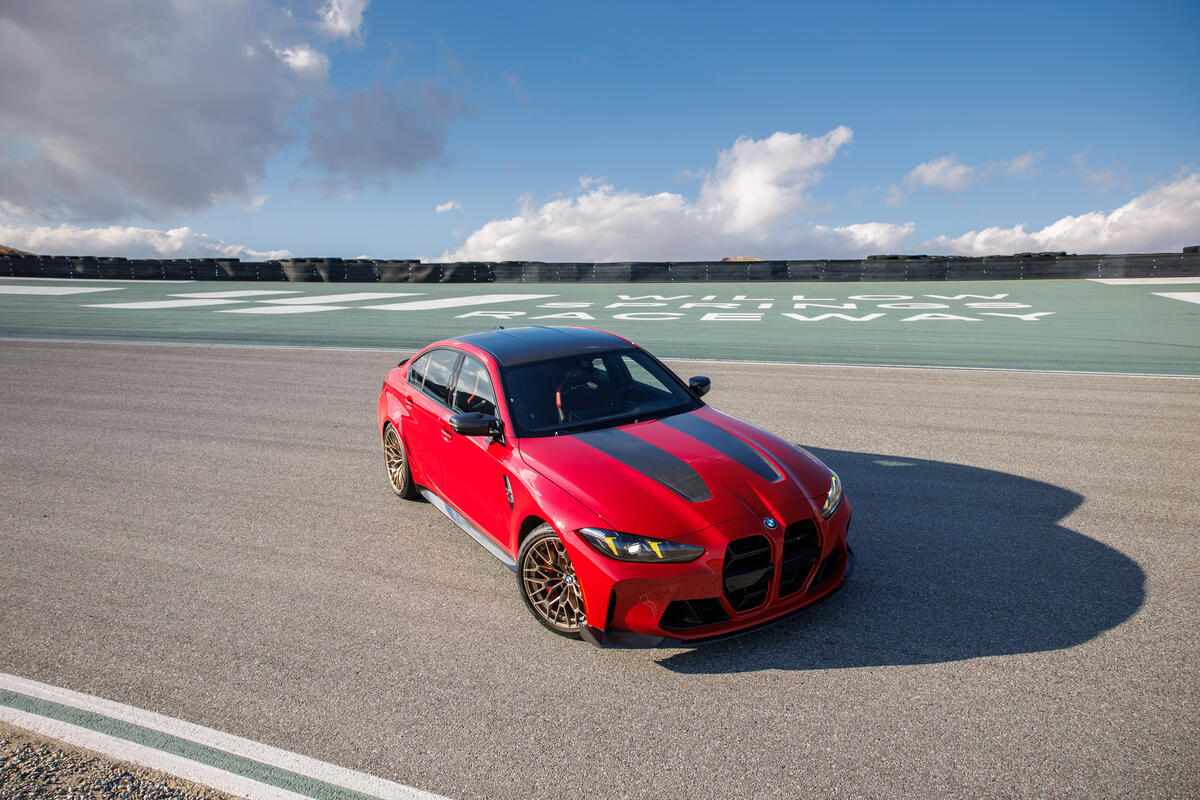
BMW M3
"[SPEAKER_00]: the most classic example is Porsche right now is in deep due to and they don't have a halo card the mission one was going to be their halo card and you know because of electrification they pulled it and right now unlike McLaren unlike you know the old uh one of us at the Holy Trinity uh who's the other one McLaren a missing one. [SPEAKER_00]: Portion Ferrari Ferrari yeah Ferrari has one the F-80 uh McLaren has won [SPEAKER_00]: Porsche, no Halo cars. [SPEAKER_00]: They've got GT3 RS."

Porsche 911 GT3 RS
"Porsche right now is in deep due to and they don't have a halo card the mission one was going to be their halo card... They've got GT3 RS. Those aren't Halo cars."
The Porsche 911 GT3 RS is a very performance-oriented 911 made for drivers who want track-level capability. Here it’s mentioned to say that even though it’s special, it may not serve the same marketing role as a traditional “halo car.”
The Porsche 911 GT3 RS is a track-focused 911 variant known for its high-performance, motorsport-derived setup. In the episode, it’s used to argue that Porsche’s current “GT3 RS” isn’t functioning as a true halo car in the marketing sense.
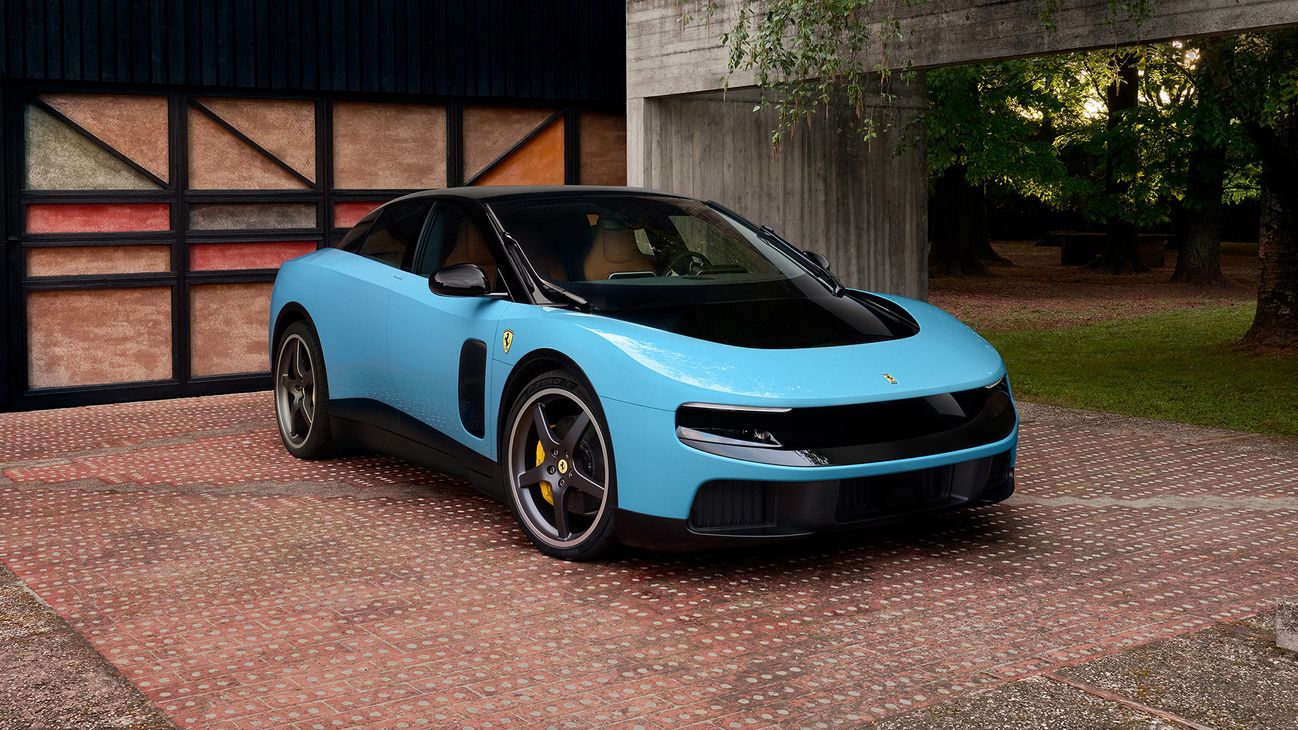
Ferrari Luce
"...he Ferrari is the king of buzz right now with the Luce. [SPEAKER_01]: Well, that's the wrong kind of buz..."
The Ferrari Luce is a car model being talked about in the podcast. The hosts mention it in a way that suggests the attention around it isn’t necessarily the kind they want. It’s brought up as part of a discussion about how car hype works.
The Ferrari Luce is referenced in the podcast as a “buzz” topic, but the conversation frames it as the wrong kind of buzz. That suggests the hosts are discussing how certain high-profile releases can create attention for the wrong reasons or in the wrong way. It’s mentioned as part of a broader debate about what makes a compelling “halo” car.

Gordon T50
"[SPEAKER_00]: But where we are right now is that is that I think taking this back to where I started. [SPEAKER_00]: I think that if manufacturers were to build manual halo cars that are limited production, one of one sort of kind of... Well, let's say the Gordon Murray T-50. [SPEAKER_01]: That's exactly that."
The Gordon Murray Automotive T.50 is a very special, high-performance sports car made in limited numbers. The podcast brings it up while talking about “halo” cars—cars meant to show off a brand’s best engineering. It’s also discussed in the context of keeping the driving experience more engaging, like with a manual setup.
The Gordon Murray Automotive T.50 is a high-performance, limited-production supercar designed to be a driver-focused “halo” vehicle. The podcast discusses the idea of manufacturers building manual halo cars in limited numbers, and the T.50 is used as part of that conversation. It’s mentioned because it represents a special, enthusiast-oriented approach rather than a mass-market product.
allocations
"This watch is like if you can't get a Daytona, which you can, right? Rolex Daytona, because you know, because of the way the allocations work, you can get this and I feel just as good about this."
In luxury markets, “allocations” are limited quantities of a product (like a specific Rolex) that are distributed to customers through a controlled process. The hosts use it to explain why certain desirable cars or watches are hard to get even when demand is high.

Volkswagen Beetle
"...PEAKER_01]: Like, that'd be like doing a $100,000 Volkswagen Beetle, right? [SPEAKER_01]: The whole point of the prel..."
The Volkswagen Beetle is a small car with a very recognizable design. The podcast brings it up as an example of what it would be like to make a super-expensive version of a familiar model. The point is about whether people would buy something like that in large numbers.
The Volkswagen Beetle is a compact, iconic car known for its distinctive shape and long production history. In the podcast, it’s used as a hypothetical example—like making a very expensive “Beetle” to illustrate a point about whether certain brand ideas would sell at scale. It’s mentioned to support the discussion about pricing and limited-production “special” cars.

Honda NSX
"...right? [SPEAKER_01]: So you could do that with an NSX, right? [SPEAKER_01]: I think that that's why the..."
The Honda NSX is a sports car made by Honda. In the podcast, they talk about it as an example of a special, attention-getting car for a brand. The idea is that a car like the NSX can represent the company’s performance image.
The Honda NSX is a sports car known for blending performance with everyday usability, and it’s often treated as a halo-style model for Honda. In the podcast, it’s referenced as an example of a car you could use for a “halo” strategy—something special that draws attention to the brand. The discussion suggests the NSX fits that role because it’s a standout performance product.

Ford Mustang
"...know, but I think like brands like Pralood Beetle Mustang right I'm not sure that they work as 500,000 cars..."
The Ford Mustang is a sports car model that’s been popular for many years. The podcast mentions it while talking about whether it makes sense to price a familiar car model extremely high. It’s part of a discussion about what people will actually buy.
The Ford Mustang is a long-running American sports car that’s known for performance options and a huge enthusiast following. In the podcast, it’s mentioned alongside other “brand strategy” examples, questioning whether certain models could realistically be produced in very large numbers at extremely high prices. The Mustang is used as a reference point for what brands can and can’t charge for.

AMC Javelin
"...cool name played back there. [SPEAKER_00]: That's javelin, right? [SPEAKER_00]: You could bring back someth..."
The AMC Javelin is an older muscle car model. The podcast mentions it as an example of a name you could bring back. It’s used to talk about reviving classic cars and whether people would want that kind of return.
The AMC Javelin is a classic American muscle car name that the podcast mentions as something you could bring back. It’s referenced through the idea of reviving older models with a cool name and a recognizable identity. The mention fits the podcast’s broader theme of whether legacy nameplates can be revived successfully.
hyper screen
"Yeah, it's got the hyperscreen, which is basically a screen that goes across the entire dashboard from driver side to passenger side."
The Hyperscreen is Mercedes’ big digital dashboard screen. It’s designed to look like one continuous display across the whole front of the car, rather than multiple smaller screens.
The Hyperscreen is Mercedes’ wide, fully integrated dashboard display that spans from the driver side to the passenger side. Instead of separate gauges and infotainment screens, it presents a single continuous digital interface.
MVUX
"I mean, MVUX, I think, is a pretty simple, easy-to-use system with that, that actually makes sense in the voice assistant is also very, very useful."
MVUX is Mercedes’ software/UX branding for its in-car user interface. The host is arguing it’s straightforward to use and pairs with the vehicle’s voice assistant for common tasks.
hybrid and internal combustion
"I mean, it is such a great mix of hybrid and internal combustion."
A hybrid uses both electricity and a gas engine. It can drive on electric power sometimes, and then the gas engine helps when you need more power or when the battery runs low.
A hybrid powertrain combines an electric system with an internal-combustion engine. The idea is to use electricity for low-speed/short trips and then rely on the engine when more power or range is needed.
inline six
"That's the only issue with the inline sexist really, but I think that this car would have been right up your alley because it's got [SPEAKER_01]: 40-ish miles of all electric range."
An inline-six is a type of engine with six cylinders lined up in a row. In this car, the host is saying it teams up with the electric system to make the car accelerate strongly.
An inline-six (I6) is an engine layout where six cylinders are arranged in a single straight line. The host is saying this inline-six works alongside the electric system, so the car can feel strong both on battery and when the engine is running.
all-electric range
"I think that this car would have been right up your alley because it's got [SPEAKER_01]: 40-ish miles of all electric range. Maybe 50 if you're nice to it."
All-electric range is how far the car can go using only electricity before it needs the gas engine. The host is saying it can do about 40–50 miles on battery, then the gas engine helps afterward.
All-electric range is the distance a plug-in hybrid can travel using only its electric motor and battery. The host is quoting roughly 40–50 miles, then explaining that the internal-combustion engine takes over when the battery is depleted.

cyber truck
"you know I love new technology but look I mean look look at all those there's like 28 functions on that steering wheel not to mention the little rotary dial which changes you know suspension and the how can you like the cyber truck but not like screens cyber truck doesn't have a single button on the inside but the cyber truck has a very intuitive layout so it's actually very easy to control stuff"
The Tesla Cybertruck is a very futuristic-looking truck with a modern, screen-based dashboard. The point here is that, even though it’s high-tech, the controls are laid out in a way that’s supposed to be easier to use than a complicated button-and-dial setup.
Tesla Cybertruck is known for its angular, stainless-steel body and a very tech-forward interior. In this segment, the host contrasts its screen-based controls with more traditional button-heavy layouts, arguing it feels easier to operate despite the “new technology.”
rotary dial
"you know I love new technology but look I mean look look at all those there's like 28 functions on that steering wheel not to mention the little rotary dial which changes you know suspension and the how can you like the cyber truck"
A rotary dial is a round knob you turn to change settings. In this case, the host says it adjusts the suspension, which affects how stiff or soft the ride feels.
A rotary dial is a circular control knob used to adjust vehicle settings. Here it’s described as changing suspension settings, which typically means altering ride firmness or damping behavior.
station wagons
"I I think that Long roofed cars that are low basically station wagons are always going to be Really good looking and really attractive and I I kind of feel like it's your generations fault That nobody's buying station wagons anymore"
Station wagons are cars with extra space behind the back seats, usually with a longer roof. The host is saying they often look great, but fewer people are choosing them now.
Station wagons are passenger cars with an extended roofline and cargo area behind the rear seats. The host argues long-roof wagons tend to look attractive and suggests changing tastes are part of why fewer people buy them today.
ground clearance
"I mean, I think that objectively for most people, the SUV makes more sense. You get more ground clearance. It's easy to get in and out of."
Ground clearance is how much space there is between the bottom of the vehicle and the ground. More clearance usually helps on bumpy roads and can make it easier to step into and out of the vehicle.
Ground clearance is the distance between the lowest part of the vehicle and the road. Higher ground clearance helps with rough roads, curbs, and off-road obstacles, and it can also make getting in and out easier.
off-road quote looking tires
"It doesn't really have anything else, so it's got some, like. black wheels and some maybe off-road quote looking tires isn't it raised a little bit half an inch okay so it's just a little bit higher but the beach was pretty rough..."
This means the tires look more like they’re meant for dirt or rough ground. The tread pattern helps the car grip better when the surface isn’t smooth, even if it’s still a normal road-focused tire.
“Off-road-looking tires” refers to tread patterns and sidewall styling meant for traction on loose or uneven surfaces. Even if they’re not true rock-crawling tires, the more aggressive tread helps the vehicle grip better when the surface is rough or sandy.
two wheels
"Well, there was this hill climb I had to do where I got it up on the sense of two wheels at the end here, where no other minivan dared to go."
“Two wheels” means the car ends up balancing so only two tires are touching the ground while the other side lifts. It’s a sign the terrain is really uneven and the suspension is flexing to keep the vehicle moving.
“On two wheels” describes a situation where a vehicle’s weight shifts so that only two tires maintain contact with the ground. It’s a common way to test traction and suspension articulation on uneven terrain, because the vehicle can still move even with reduced tire contact.
slip test
"And I did a real life slip test. I got the rear axle engaged, the front axle going, and it just walked right up, and it was very, very impressed with the Sienna Woodland."
A “slip test” is when you intentionally make the tires lose grip a bit to see how the car reacts. It helps show whether the car can regain traction and keep going.
A “slip test” is a traction test where a vehicle is driven in a way that causes wheels to lose grip (“slip”) so you can see how well the drivetrain and traction systems respond. The goal is to evaluate whether the vehicle can regain traction and keep moving.

Sienna Woodland
"I got the rear axle engaged, the front axle going, and it just walked right up, and it was very, very impressed with the Sienna Woodland. But what a machine."
The Toyota Sienna Woodland is a minivan trim that’s meant to handle outdoor-style driving better than a typical minivan. The host is saying it did really well when they tested traction by getting the wheels to grip and climb.
The Toyota Sienna Woodland is a Sienna trim aimed at buyers who want a more rugged, outdoors-friendly minivan. In this segment, the host highlights how it performed in a “real life slip test” by engaging the axles and climbing effectively, suggesting capable traction for a family hauler.
rear axle engaged
"I got the rear axle engaged, the front axle going, and it just walked right up, and it was very, very impressed with the Sienna Woodland. But what a machine."
“Rear axle engaged” means the car is sending power to the back wheels. The host is using it to explain how the vehicle handled traction when the front wheels needed help.
“Rear axle engaged” refers to a drivetrain setup where power is sent to the rear axle, typically as part of an all-wheel-drive system. In this context, it’s part of how the vehicle managed traction during the slip test.
front axle going
"I got the rear axle engaged, the front axle going, and it just walked right up, and it was very, very impressed with the Sienna Woodland. But what a machine."
“Front axle going” means the car is also powering the front wheels. That can help the vehicle stay stable and move forward when traction is poor.
“Front axle going” indicates that power is also being delivered to the front axle, which is typical of an all-wheel-drive (AWD) system. Together with the rear axle, it helps improve grip when road conditions are slippery.
all wheel drive
"I think it's so good. 35 MBG, 245 horsepower, and all wheel drive. So it, I mean, so do you think this is something that like Honda is going to also add to its arsenal of trail sports?"
All-wheel drive means power goes to both the front and back wheels. That usually helps the car grip better on slippery or rough ground.
All-wheel drive (AWD) is a drivetrain that can send power to both the front and rear axles to improve traction. It’s especially helpful on loose, wet, or uneven surfaces where one axle might otherwise spin.
TrailSport
"35 MBG, 245 horsepower, and all wheel drive. So it, I mean, so do you think this is something that like Honda is going to also add to its arsenal of trail sports? Do you think there's going to be a trail sport?"
“Trail sports” here means vehicles that are meant for outdoor driving—like dirt roads or light off-roading—while still being practical for daily life.
“Trail sports” is used here as a category idea for vehicles that blend everyday usability with off-road or outdoor-focused capability. The hosts are debating whether Honda will add a similar offering to its lineup.
underbody protection
"So, the minivan, the Chrysler one had two inches of ground clearance and real tires and underbody protection."
Underbody protection is extra armor or shields on the bottom of the car. It helps protect important parts if you hit something on rough roads.
Underbody protection refers to shields or skid plates that protect vulnerable components like the oil pan, transmission, and fuel lines from impacts. It’s especially relevant on lifted or off-road-oriented builds where the car is more likely to hit rocks or debris.
TRD minivan
"But I think like if they actually genuinely committed to a TRD minivan, it would be really, really cool."
TRD is Toyota’s brand for performance and off-road upgrades. A “TRD minivan” would be a Toyota minivan set up with more rugged, off-road-friendly parts than a regular one.
TRD is Toyota Racing Development, Toyota’s performance and off-road parts brand. When someone says “TRD minivan,” they mean a Toyota minivan configured with TRD-style upgrades (often suspension, tires, and appearance) aimed at making it more capable off-road than a standard minivan.
approach
"Yeah, why not TRD offroats the end? Or if you just go to your approach, that would be even better."
Approach angle is how well a vehicle can drive up toward something steep without scraping the front. Bigger approach angle usually means less front-end damage on rough terrain.
Approach angle is the steepest angle a vehicle can climb toward an obstacle (like a hill or curb) without the front bumper or underbody hitting first. It’s a key off-road geometry metric that improves with lift and suspension tuning.
lifted
"They're going to put a little bit of black trim on it and they're going to lift it half an inch like the like the Toyota... It's a long term for us and that is a new Honda pilot trail sport, which... it is a three-row and it is lifted..."
“Lifted” means the SUV is raised higher off the ground than normal. That can help it handle bumps and rough terrain better, and it also gives it a more off-road look.
In SUV talk, “lifted” means the vehicle sits higher than stock, usually to improve ground clearance and make it easier to handle rough roads or off-road obstacles. The host connects it to a more rugged, trail-ready look and capability.

Honda pilot trail sport
"Well, speaking of that, there's another vehicle that we just got in and we're going to hand us until, uh, well, three months... It's a long term for us and that is a new Honda pilot trail sport, which, you know, kind of can substitute as a mini van because it is a three-row and it is lifted..."
The Honda Pilot TrailSport is a bigger Honda SUV with three rows of seats. It’s meant to look and feel more rugged than a normal family SUV, and the host says it can work like a mini-van because it has room for more people.
The Honda Pilot TrailSport is a three-row SUV with an off-road-oriented look and setup, positioned as a more rugged alternative to a typical family hauler. In this segment, the hosts focus on its “lifted” stance and how it can feel like a mini-van thanks to the extra seating rows.
three-row
"It's a long term for us and that is a new Honda pilot trail sport, which, you know, kind of can substitute as a mini van because it is a three-row and it is lifted..."
“Three-row” means the SUV has seats in three rows. That usually lets it carry more people than a two-row SUV, which is why the host compares it to a mini-van.
A “three-row” SUV has seating in three separate rows, typically for up to seven or eight passengers depending on the configuration. It’s a key packaging feature because it changes how much interior space and flexibility the vehicle offers for families and cargo.
hybrid option
"it does feel a little bit dated and I would love a hybrid option... But the pilot, I could use just a little bit more tech on... to make it feel a little bit more modern in terms of the power train..."
A “hybrid option” means the SUV would use both gas and electricity. The host thinks that would make the Pilot feel more up-to-date and likely save fuel.
A “hybrid option” means the vehicle can combine an internal-combustion engine with an electric motor to improve efficiency and reduce fuel use. In this segment, the host wants the Pilot to offer hybrid power to feel more modern and better match their needs.
3.5 liter Honda V6
"So this is a bunch of stuff... But, uh, it does feel a little bit dated and I would love a hybrid option... It's got the 3.5 liter Honda V6. So it's just a basic simple, easy to drive SUV."
This means the Pilot has a 3.5-liter V6 engine made by Honda. The host is saying it’s a simple, easy engine to live with.
A “3.5 liter Honda V6” refers to an engine displacement of 3.5 liters arranged in a V configuration with six cylinders. The host uses it to describe the Pilot’s powertrain as straightforward and easy to drive.

Honda Passport
"... way over the top. [SPEAKER_01]: I like it in the passport, because I feel like that's supposed to be a simp..."
The Honda Passport is a midsize SUV. It’s designed to be a practical family vehicle with more room and capability than smaller crossovers. The podcast mentions it because it seems to fit a straightforward purpose for the kind of buyer Honda targets.
The Honda Passport is a midsize SUV positioned for buyers who want more space and capability than a smaller crossover. In the podcast, it’s mentioned in a way that suggests the Passport fits a “simple” or straightforward role in the lineup. The discussion uses it to talk about how certain vehicles are meant to appeal to specific buyer needs.
plug-in hybrid
"Like a hybrid pallet, I think, would be the perfect sweet spot or even a plug-in hybrid. But if you do want the easiest car to use on the market, this is definitely that."
A “plug-in hybrid” is a car that uses gas and electricity, and you can charge it by plugging it in. The host thinks that would be the best balance for real-world driving.
A “plug-in hybrid” (PHEV) is a hybrid vehicle with a battery large enough to be charged from an external power source, not just by the engine and regenerative braking. The host suggests it as an even better “sweet spot” than a standard hybrid for everyday use.

Jeep Grand Cherokee
"...e of the most capable in the class other than the Grand Cherokee. [SPEAKER_01]: All right."
The Jeep Grand Cherokee is a larger SUV meant for both daily driving and tougher situations. The podcast says it’s one of the more capable SUVs in its category. That means it can handle things like rough roads better than many typical family SUVs.
The Jeep Grand Cherokee is a midsize SUV known for combining everyday comfort with serious capability. The podcast calls it “one of the most capable in the class,” which highlights its off-road and towing-oriented strengths. It’s mentioned as a key example of a capable SUV rather than a purely lifestyle-focused one.

Fiat 124 Spider
"So I would get this. Otherwise you're buying a Fiat 124 spider. That's the other option."
The Fiat 124 Spider is a small two-seat convertible/roadster. Here, it’s brought up as another option instead of the main car being discussed.
The Fiat 124 Spider is a small, two-seat roadster known for its lightweight, fun-to-drive character. In this segment, it’s mentioned as an alternative if you’re looking for something practical but still want a more engaging, open-top experience.

Fiat 124
"...get this. [SPEAKER_01]: Otherwise you're buying a Fiat 124 spider. [SPEAKER_01]: That's the other option."
The Fiat 124 GT Abarth is a sportier version of the Fiat 124. The podcast mentions it as another option if you’re considering the 124 Spider. It’s brought up because both are meant to be fun to drive, but they’re different trims.
The Fiat 124 GT Abarth is a performance-focused version of the 124, aimed at drivers who want a fun, sporty driving experience. In the podcast, it’s mentioned as an alternative to buying a Fiat 124 Spider, suggesting it’s part of a lineup choice for enthusiasts. The discussion uses it to highlight different ways to get a similar sports-car vibe.

Hyundai Palisade
"I mean, we've got the direct competitor to this is the long term loan, too, which is the Palisade XRT. And I think that the Palisade is a better looking car overall."
The Hyundai Palisade is a big family SUV with three rows. XRT is a particular version/trim, and the hosts are saying it’s a close alternative to what they’re talking about.
The Hyundai Palisade is a three-row family SUV, and the XRT is a specific trim level. In the discussion, the Palisade XRT is positioned as a direct competitor to the vehicle being compared, implying similar “practical family” use cases.

Honda Crv
"You know, Honda's having a moment, I mean, have you seen that? The CRV has now officially become the best selling car in America. Yeah, it's overtaken the event."
The Honda CR-V is a popular compact SUV that many people buy for everyday practicality. In this segment, they say it’s now the best-selling car in America.
The Honda CR-V is a compact crossover SUV that’s known for being practical and easy to live with. Here, the host claims it has become the best-selling car in America, highlighting its mainstream popularity.
best selling car in America
"You know, Honda's having a moment, I mean, have you seen that? The CRV has now officially become the best selling car in America. Yeah, it's overtaken the event."
“Best selling car in America” means the model sold the most cars in the U.S. The host is using it to say the Honda CR-V is doing especially well right now.
“Best selling car in America” is a sales ranking claim based on total units sold. It’s used here to emphasize Honda’s current market momentum and the CR-V’s dominance in the mainstream market.
analog cars
"...I think it's because Honda like you said at the very beginning of your review of the Pilot is still doing very analog cars."
“Analog cars” means cars that feel more traditional inside—more buttons and normal controls, not everything handled through screens and menus.
“Analog cars” here means vehicles that rely more on traditional, physical controls and conventional interfaces rather than heavy touchscreen or software-driven workflows. The hosts connect this to buyer appeal, arguing that some shoppers prefer straightforward, tactile driving and cabin ergonomics.
door handle winglets
"...it's got those little winglets for the doors... basically it's like a little winglet with a button..."
This is a newer door-handle design where the handle looks like a little fin and you press a button to open the door. The hosts think it looks strange and is less satisfying than a normal handle you grab.
“Door handle winglets” refers to a design where the door-handle area is shaped like a small fin/wing and often includes a button-based release rather than a conventional grab handle. The hosts argue this can make the door look taller and cleaner, but they personally find the design awkward and unintuitive.

BMW X5
"...And with the BMW if you get what the upper trim It actually opens the door automatically so you don't even have to like pull on it..."
The BMW X5 is a luxury SUV. Here they’re talking about a door-handle feature on certain trims that can open the door automatically, and they think the design looks awkward.
The BMW X5 is BMW’s midsize luxury SUV, and this segment focuses on its exterior door-handle design. The hosts mention an upper trim that can automatically open the door, which is part of the broader trend toward “hands-free” convenience features that some people find visually or ergonomically annoying.

Volvo EX60
"...and that includes it in the new Volvo EX60 which also has those little winglets for door handles..."
The Volvo EX60 is an upcoming Volvo electric SUV mentioned here. The point is that it’s using the same kind of door-handle design that the hosts think looks and feels worse than traditional handles.
The Volvo EX60 is a Volvo electric SUV concept/line name referenced here as having the same “winglet” door-handle styling. The hosts use it to argue that multiple automakers are adopting similar design language that some customers dislike.
stop-start
"...I have never heard as much vitriol about these things except for maybe stop start and you have to manufacture or seem to be completely deaf..."
Stop-start is an engine management feature that automatically shuts the engine off when the vehicle is stopped (like at a red light) and restarts it when you’re ready to move. The hosts say it’s one of the few tech features that has drawn widespread criticism, implying it can feel intrusive or annoying to some drivers.
Request an Explanation
Heard something you'd like explained? We'll add it to this episode.
Sign in to request explanations for terms you heard.
Want to learn more?
Browse our glossary for plain-English explanations of automotive terms, jargon, and concepts.
Help improve this episode
See something that's not quite right? Our annotations are AI-generated and can sometimes miss the mark. Click the flag icon on any annotation to suggest a correction.