Formula One is the highest level of race car competition. When the rules or technology change, it can upset people because it changes how the cars race.
A “halo product” is a flagship item designed to generate excitement and brand prestige, even if it isn’t the highest-volume seller. The hosts use it to describe the Daytona as the model meant to make people care about the electric lineup.
Electrification means replacing gas engines with electric power. In this conversation, it’s why the car lineup shifted and why some muscle-car fans were unhappy at first.
Smaller displacement means the engine is physically smaller. The idea is to use less fuel and still make power, often with turbocharging or other efficiency tech.
Rear-wheel drive (RWD) is a key part of many classic muscle-car definitions because it emphasizes a traditional driving feel and allows power to be sent to the rear axle for traction and handling characteristics. The segment uses RWD as a benchmark for whether a car still “fits” the muscle-car identity.
“Eco mode” is a driving mode that usually reduces engine output and changes how aggressively the car responds to your pedal. In this discussion, it’s contrasted with “regular mode” to see whether it improves real-world fuel economy.
Fuel prices are how much it costs to buy gas or other driving fuels. When they go up, driving costs more, and people often start looking for cars that use less fuel.
A small percentage move in used-car pricing can signal broader changes in affordability and demand. When prices rise, buyers may delay purchases, switch brands, or look for cheaper alternatives, which can further shift the market.
Tax incentives are government programs that reduce the effective purchase cost of EVs or other clean vehicles. The host notes that these incentives can temporarily make EVs cheaper, but when they expire or change, pricing and demand can shift.
HVAC is the car’s heating and air-conditioning system. They’re saying the Pacifica lets you change temperature using buttons you can reach without staring at the screen.
Jeep’s “seven-slot” grille is a signature design element that’s strongly associated with the brand’s identity. The hosts point out that while the new vehicle has the grille and the Jeep name, they question whether it has the off-road capability to match.
V8 engines are known for their strong low-end torque and distinctive sound, and they’ve historically been popular in the US. The speakers are arguing that US buyers often expect V8 performance/feel as part of certain categories like muscle cars.
Honda is a major automaker, and here they’re talking about Honda taking off-roading more seriously. The point is that some vehicles look rugged, but may not actually be built to go off-road.
Some cars are designed to look like they can go off-road, but they’re really meant for regular driving. The important question is whether it has the real features for dirt trails, or just the rugged look.
“MPG” (miles per gallon) is a measure of how far a vehicle can go on one gallon of fuel. The host is using a ~40 mpg target to frame the vehicle as particularly efficient for its size/class.
“Hold their value” refers to how well a vehicle retains its resale price over time. The speaker claims these SUVs keep resale value strongly, which affects the real cost of ownership.
“Drive to Survive” is a Netflix show about Formula One racing. It makes the sport easier to get into by showing the people and stories behind the races.
Grid position is where a car starts on the starting grid based on qualifying results. The speaker notes that the driver who wins grid position is often the one who eventually wins the race, highlighting how qualifying can heavily influence outcomes.
It’s a feature that makes the car “slice” through the air better by reducing resistance. That helps it go faster, especially when it’s trying to pass someone.
“Carbon neutral” is the idea that a fuel or activity doesn’t add extra climate pollution overall. The goal is to remove as much carbon from the air as you put back when you burn the fuel.
Red Circle is a service that helps podcasts find sponsors. You set what you’re into, and it connects you with advertisers that fit your show, plus it gives you data to see how well things are working.
LIVE
If you're a podcast host, listen up this once for you.
My name is Allie Jackson.
I'm the host of Finding Mr. Height,
a dating and relationship podcast
that I've been doing for four years now,
sharing my positive and practical approach to dating
that's built on my own life experience.
And I wanted to share another experience that I've had,
my secret behind monetizing my show.
It's called Red Circle.
And I was just telling my colleague
about how much I love their platform.
With Red Circle,
not only am I getting a seamless hosting experience,
but I also love the support I receive in AdSales.
It's not just typical AdSales either.
It's targeted opportunities based on my show and my life.
And the platform is super simple.
You just set your preferences
and Red Circle matches you with sponsors
that align with your show.
You can vet every opportunity
and their platform gives you great analytics.
More recently too,
my Red Circle team has brought me opportunities
outside of my podcast on social media.
To really augment the podcast partnerships,
bring them full circle.
I just can't recommend them enough.
If you want to give it a try,
go to redcircle.com to get your free trial.
That's redcircle.com for a free trial.
Go ahead, Tommy. I thought you were starting.
It was unclear what the starting procedure was.
But in today's podcast,
we've got a really fun topic
because we have spent a week
with the most controversial car on the market.
The new, let's say the little electric fiat
that is going to be sold.
The topolino.
The topolino.
Is that what we're going to be discussing?
The topolino, Tommy?
No, we're not talking topolino.
We are talking about a different fiat though
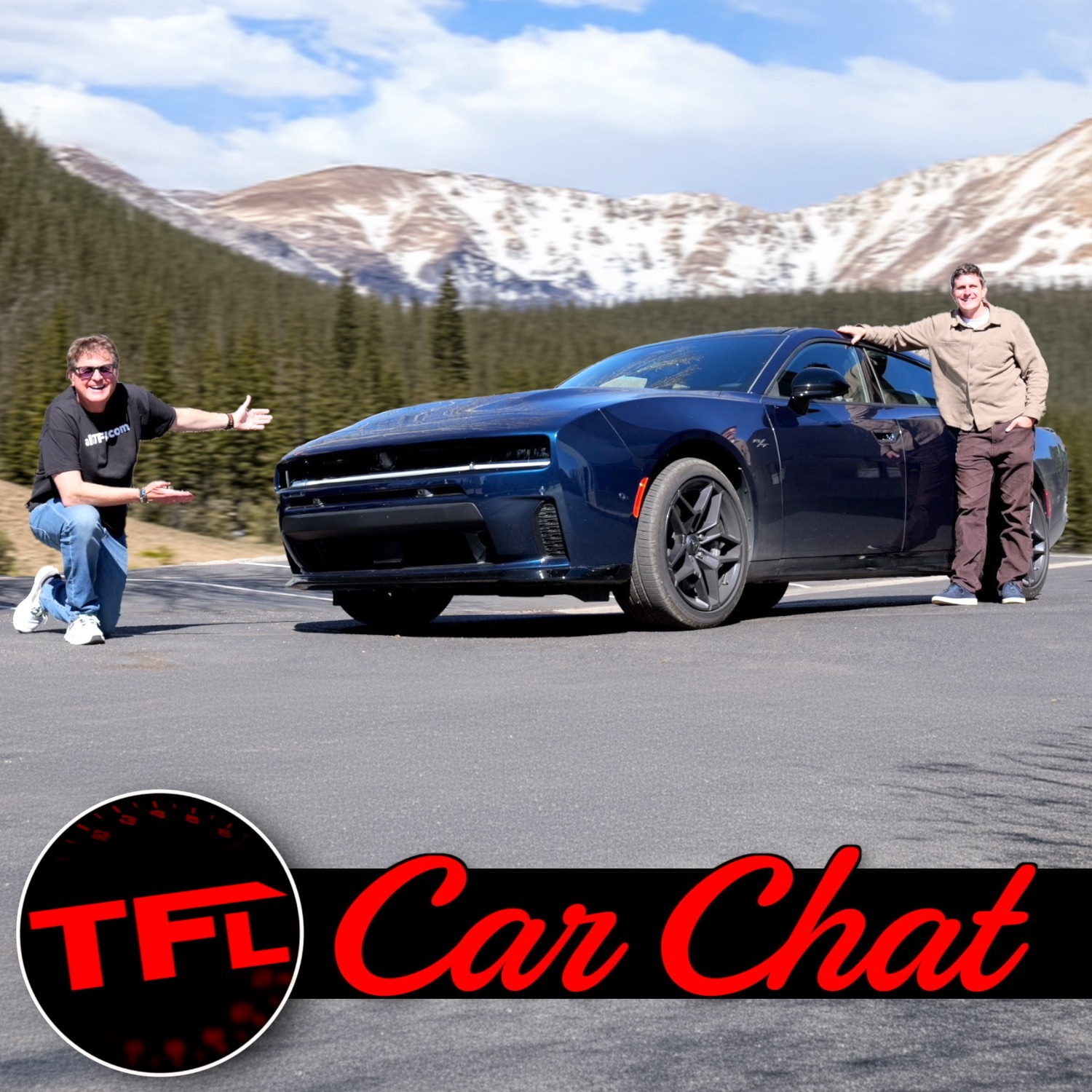
because we spent the week with the Dodge Charger
and specifically the new six-pack Dodge Charger,
the gasoline charger.
But we've also spent a week with the new Jeep Cherokee,
which is another really, really, really popular car.
You drove the Telluride.
Yep. New Telluride is in the house.
I drove the Q3.
Yeah, you drove the Q3.
So we even spend time behind the wheel of the Pacifica,
believe it or not.
Yeah, a lot going on here at the TFL offices.
And then we bought a new car.
What did we buy?
Oh, that's next week's podcast.
Well, we can tease it.
We'll talk about it.
Yeah, so we also bought a Land Cruiser.
But next week we're going to do
a full little off-road podcast on that car.
And, Tommy, we might even get into Formula One
because there's controversy.
Well, there's always controversy at Formula One,
but this year it's very controversial
because they've switched to, oh my god,
environmentally friendly electricity.
And we can't have that, can we, in Formula One?
Because there's overtaking, but there's no more passing.
There's a distinction between overtaking and passing.
I'll tell you about that as well.
So we've got all that coming up.
But let's start with the new charger,
which is very confusing.
Let's start with that.
So once upon a time, at least in the last model year,
you could always tell the difference
between a charger and a Challenger
because a Challenger had two Ls,
which meant that it had two doors.
And then the charger didn't have two Ls in the name.
That was the two door.
No.
That was a four door, sorry.
That's the other way around.
This is what I mean.
It's very confusing.
Don't roll your eyes.
It's very unpolite.
Well, you said it was super easy in the old one.
I said it was very confusing.
I'm not rolling my eyes at you.
It was very confusing.
And then the previous generation was also,
you couldn't tell which one was a two door and this four door.
But the new one, they retired the Challenger,
which was a two door, and they built a four door.
First a two door and then a four door charger now.
So there's a two door and a four door.
So I am completely confused
whether the charger or Challenger is two or four doors.
But right now the charger is either two door
or if you want to spend an additional $2,000, it's four door.
How did you manage to take such a simple thing?
Because it's freaking confusing.
It's always been super simple.
Okay.
It's never been super simple.
It's been the exact opposite.
In the 1960s and 70s.
Yes.
Right.
Go for it.
The charger and the Challenger were both two doors.
They were very in some different bodies, right?
One was an E body.
I think the other one was a B body.
Then when it was resurrected in the early 2000s,
the charger became a four door sedan.
Right.
And then alongside the four door sedan was the two door Challenger.
Okay.
So that's not confusing.
No, it makes perfect sense.
I mean, it was confusing at first,
but I think people have become used to
charger four door, Challenger two door.
And now?
And now the charger has taken place of both of them.
So now you should be happy because it's simplified.
I'm not happy because it's very confusing.
So the charger now is available in both two
and four door configuration,
which means that essentially you can get the same car,
the same look and the same design,
just in different flavors, right?
Do you want the family hauling one?
Or do you want the more single minded oriented two door,
less practical one?
But what's unique about this is in the old charger and Challenger,
they looked very different, right?
And they were also different sizes.
But now the new charger two and four door is the same length.
They're both 206 inches.
It's got the same roof line.
It's got the same interior volume.
So there's three models, basically $5,000 apart.
But that's also confusing because there's like four names
for three models, right?
There's a six pack, which signifies that it's got a straight six,
which is in the RT and in the scat pack.
So you got a six pack RT and you got a six pack scat pack.
And then you got the Daytona, which is the electric one.
And basically starting out, give or take, okay?
Because this changes, but give or take,
the three models are $5,000 apart.
So the RT, let's say starts at about 50,
which you won't find because you're going to have to get
all the accessories and blah, blah, blah.
And then the scat pack goes to 55 and then the Daytona goes to 60,
which is the all EV one.
Starting.
Yeah, starting.
But in real life, that's probably more like five or $10,000 more.
And that's also confusing.
So you've got one model with four names.
Listen, dad, this car has got a lot of problems,
but the naming structure I think is not one of the problems.
One model with four names.
No, it's RT, scat pack, Daytona.
That's all you need to know.
Six pack.
The six pack is just like saying Hemi.
It's the same thing, right?
Instead of saying Hemi, you say six pack.
That's just the engine, right?
It's just the engine name.
It's like saying Coyote.
And in the previous one, they were all Hemi's.
No.
For the most part, except for the.
The penistar, yeah.
Penistar, yeah.
I think that you just got to get your head in the,
you got to get your head in the divorce dad rock face, right?
Oh my God.
That's the problem.
You got to grace creed, nickel back, puddle of mud.
This is the naming structure makes sense to these people.
You got RT, scat pack.
They're both six packs.
The pack is confusing and then the Daytona is the electric one.
But let's talk about why this car is so controversial.
So this car launched as the Daytona came out first as the electric one.
Yeah.
Which was, which was like what Cole, Cole came up with this.
Thank you, Cole.
It was like selling fish hooks to fish.
Yeah.
Yeah.
No, no, no muscle car guy or gal wanted an electric muscle car.
But.
No matter how much horsepower.
What I think happened was is they were like five years too late to the party.
Because if they'd introduced the electric one, let's say in 2017 or 2018.
Stalantis has incredibly bad timing right now.
I do think that potentially there would have been some interest in it because that's when
we saw vehicles like the Tesla Model S Plaid, right?
Got everybody really excited.
The Lucid Air came out and then you had the Sapphire, which got everybody excited.
But by the time Stalantis finally got their butts in gear and came out with the electric charger,
people were over the electric thing and they were back to wanting gas, right?
So they launched the Daytona first, I think to be kind of the halo product.
And actually if you're watching this, you'll see that the Daytona has this really cool wing on the
front, the Delta wing.
Yeah, which is missing from the RT and the scat pack.
Yeah.
So they launched the electric one first and that was supposed to be their halo product.
It was incredibly missed times and also to your and Cole's point, it was also
the wrong product for the wrong audience, right?
When you think about the typical charger buyer, it's someone who values V8 sound
and thinking that traction control is a government conspiracy.
And you're just not going to sell them one of those left-wing electric cars, right?
Like that's fundamentally the problem with it.
So they really rushed hard to get the gasoline versions back into production.
The challenge was when this car was debuted, right?
That was like right after the push to kill the V8s, right?
2023 into 2023, Stalantis came out and said, look, we're done with the V8s.
We're moving to electrification.
We're going to smaller displacement.
Here's what worries me, Tommy.
I've been doing this 17 years and in 17 years, this has always held true.
You only have one chance to make a first impression.
And the first impression they made with the electric Daytona was that it was a electric
and B that it was expensive and see that it was unwanted.
And now that they've come out with the hurricane powered, which is actually a really good car.
I mean, think about this.
If you want a traditional American muscle car, there aren't a lot of choices out there.
There just aren't.
And so now you have this straight six, very powerful.
I want to say in the RT, it's what, 450 horsepower?
420.
420 and how much is the scat pack?
550.
Which is a lot of power.
Yeah.
It's a lot of power.
So you have this curvy, right?
I'm doing the Coke bottle shape with my hands if you're listening to this vehicle that is
styled by one of the most talented stylists out there, Ralph Jeals at his team.
And the car is absolutely gorgeous.
It's classic.
It's big.
It's got a lot of road presence.
It makes a good sound right now.
A straight six, obviously a lot of the muscle car people like the Rover V8, but a straight
six has its own magic to it as well.
But the problem is the people who should typically like this car aren't going to give
it a second chance because it came out as electric.
And I feel and I fear that it spoiled the lineup for the typical Dodge fan.
That's my biggest worry.
And like you started your argument by saying classic American muscle car.
This is not a classic American muscle car.
We've had this discussion.
You think it's more of a German like, because it's got a, it looks like it's got a trunk,
but really the back is a hatchback.
It's a lift back.
So like it's more of like an A7.
So it's a fundamental mindset shift, right, in what a charger is.
So if you want to go, be careful with your bracelet right in front of the mic there.
We don't want to blow up the sound.
If you look at like the typical American muscle car, the V8 is the core of that experience,
right?
That is what a muscle car is, is a big V8 in a small family platform.
That's what the original GTO was.
It was a Le Mans with a V8, right?
That's what all of that huge 1960s era was.
You took essentially a family car and then you put a large displacement eight cylinder engine in it.
This is not that.
You still have the family car shape, but instead of large displacement,
it's a relatively, for American standards, normal displacement engine with a couple of turbos
and all wheel drive and a focus on handling.
So this is a total mindset shift.
And the reality is like, it's, it's a, like you mentioned earlier,
it's actually a really good car to drive and it feels so German to me.
It really does feel like a budget RS7 or maybe a BMW Grand Coupe,
because the dynamics are excellent, right?
Especially you get the RT, the one we have on test right now has a sport package.
So you get the sport suspension, 275 with tires.
You get the high back bucket seats.
This car handles excellent.
It's got happy cases.
He's having a good time.
If there's anybody who loves a classic American muscle, it's case.
Yes, but once again, this is not a classic American muscle experience.
This is a German experience.
I disagree.
I don't, I'm not, I'm not going to go there.
I get what you're saying.
I mean, it's refined.
It sounds like a BMW.
It handles a little bit like a heavy BMW.
Yeah, but this would never fly.
If you took this car to Europe, the Europeans would, would, would look at it as a classic
German muscle car.
No, but I would say this is an American as it gets.
I disagree.
They would say it's American as it gets because it has an eight cylinders.
I get that the ingredients are those of a potentially German car, but I disagree.
It's all wheel drive.
I think this is American as, as it gets.
It's not.
Well, that, that's, that's a difference of opinion, Tommy, but you look at the interior,
you look at the, look, look at that stance.
Look at the way the thing, you know, is going to die.
It's like, it's almost like Clint Eastwood saying, I forgot how many bullets did I shoot,
right?
That is as American as a muscle car gets.
Yes.
It's not a traditional Hemmy and they may put a Hemmian still.
They will put a Hemmian, right?
So when that happens, I will be, I will be 100% with you.
But as the car sits now, as an inline six cylinder twin turbo all wheel drive lift back,
that's not fundamentally what we would consider a muscle car formula.
Yeah, but that also changes over time.
Not really.
A muscle car is a muscle car.
Yes, it does change.
Of course it changes because generations change.
I mean, the, and their definitions of, of muscle car also changes.
But I disagree, dad, because the Mustang has been the same formula.
You always disagree with me.
So I get that you'll never agree with me.
Hear me out.
Has the Mustang formula changed since 1965?
Yes, it has changed.
How?
Well, is it still a rear wheel drive?
Well, first and foremost, the original Mustang was a secretary's car.
And I know that's, that's stereotypical and probably sexist,
but back then that's what they called it.
So I'm going with it.
So it was a, it was a six cylinder and it wasn't, it wasn't an eight cylinder.
And it eventually turned into that, but it's launched with an eight for the record,
though it came out as an eight cylinder, but it started out as an affordable, yes.
But that formula is still the same.
It's still an affordable way to get a V eight, right?
I mean, the Mustang has always been a rear wheel drive.
I don't want to argue it's getting, it's getting, we're starting to bicker on this.
You're right.
But my point that is that this is not a charger experience, right?
I think it is a charger experience.
I think that it's, I completely disagree.
I think it's as American and quintessentially twin turbo inline six.
Yeah.
Yes.
That's fine.
It is.
And, and yes, people are going to have a hard time with the twin turbo straight six.
But I like straight sixes.
I just think it's a different flavor of muscle.
So it's not necessarily the traditional flavor,
but that doesn't mean that muscle can't evolve over time.
I think if they do put a V eight into it, then it'll be more your definition.
But I like practical muscle.
I like the fact that you can do that lift back and throw your bike back.
Sure.
I think that's one of the great things about it.
And I think if you look at traditional American sedans, just look at the shape,
a four door big sedan.
It's not a sedan.
But you see what I'm saying?
It's a four door.
Doesn't matter, right?
It doesn't really matter whether it's a lift back or whether it's a trunk.
Subaru made that mistake.
And they got rid of the lift back and everybody in the WRX and the STI is like,
why'd you get rid of the lift back?
It was so much more practical.
We loved it.
And they got hung up on the definition of a sedan being either, you know, a trunk or
so I don't care about that.
I care about the overall shape.
I think if you look at it to me, it says traditional American sedan,
especially in the four door.
And I think those are few and far between.
And if muscle buyers want that, this is the car form.
Yes, it doesn't have the V eight.
But then again, the Hemi is an old engine.
And let's face it, it's a very great marketing term.
I get the Hemi marketing people love themselves a Hemi,
but the thing isn't nearly as powerful and it's crazy thirsty.
So yeah, you're going to pay a lot for that Hemi sound.
And the one they're bringing back Tommy isn't like a new version of it.
It's the old one that they put on the shelf because it was thirsty.
It wasn't very powerful and reliability was so so.
And that's what you're putting back into it.
And if that's if that's what people, if that's like,
I believe in giving people what they want.
If that's what you guys want, you're going to get it.
But don't expect 550 horsepower out of the old Hemi.
Oh, it'll be 700 because they're going to put the Hellcat engine in it.
Yeah, but I'm saying before that.
I don't think they're going to put the 57 back in it.
I think it's just going to go right to the Hellcat.
Yeah.
So I love the car.
I'm not saying I don't love the car.
I think the car is actually excellent.
I just think that it's not what people expect it to be.
And that's why it's struggling.
Once again, I think it's because they came out with the electric one.
Oh, for sure.
That's definitely going to give it a second chance, unfortunately.
But if you do give it a second chance,
I love it because I find it fundamentally to be a very different experience
than what you'd come to expect out of the old one.
I actually find that even though it's 4,800 pounds
and is longer than an Explorer,
with modern suspension and entire technology,
you're able to really mask a lot of that weight, right?
So the car handles surprisingly well,
which is something that you could never really say about the old one.
I know that the wide bodies were a little bit better,
but I find that this car is really dynamic
and fun to drive on a twisty road.
I like the power delivery.
It feels very much like a BMW N54
and how it delivers powers and the sound it makes.
So I really do think the experience is excellent.
But to your point,
I don't think that people are going to give it a second chance.
So I also think it's a fool's errand to try to out BMW, BMW.
I think you got to stick with your core value,
which is what you do best.
And that is obviously American big-ass sedan muscle car.
But there are some issues that I have with it,
not nothing to do with the ones you have.
My issues are that once again,
there's this trend among designers,
and I don't know if this is you, Ralph,
or if it's on the other team as part of this,
that are just infuriating and stupid.
And it's like guys that are too clever by half,
adding these stupid things that nobody wants,
but yet all designers love.
And I'll give you an example of that,
electronic door handles.
Why?
Why do we have to have electronic door handles on this?
Yeah, the door handles are stupid, for sure.
And there's a little manual one right below it.
And in fact, I find the doors really infuriating
because the placement of those buttons is kind of too far back.
And so I'm always trying to find out
where that little button is.
Also, the start-stop button.
Most start-stop buttons are in front,
so I'm always pushing forward.
And they put it down in the center here.
But that's kind of cool.
Sob had the key.
Yeah, it's kind of funky.
So every time I sit in the car, I'm like, oh, no, it's over here.
But I think that's a little bit like a jet fighter.
I mean, you have that pistol grip shifter, right?
So they kind of move that experience
down to the center console.
And that's my other gripe with the car.
I want that pistol grip shifter not to be plastic,
but to be metal.
For sure.
That does feel cheap.
Yeah, I agree.
It's very cheap, and it feels like.
And then the one that drives me absolutely nutty
is there's a bit of trim that goes along the side of the car
that's French-stitched.
So you've got this French-stitching.
There's this bit of trim.
And it's supposed to line up exactly with the trim
that's on top of the dashboard.
But the two don't line up.
And not just by a little bit.
I mean, they don't line up by, like, half an inch.
That's really bad.
And it just, once you see it, if you have OCD like I do,
then you just can't unsee it.
And every time you get in the car,
you're just focusing on these two little bits of trim
with the French-stitching that doesn't line up.
And you're like, come on, guys.
You're better than this.
Yeah, no, I agree.
So those are my biggest gripes.
But overall, I really love the car.
I enjoy the look of it.
I enjoy the sound of it.
It makes me happy when I drive it.
And I actually like the RT better than the Scat Pack
because I think the 420 horsepower is plenty.
It's also all-wheel drive, so it's good in the snow.
I just went to Vermont and drove it in the snow.
It's amazing.
If you put snow tires on the thing,
it'll be completely unstoppable.
And my only issue with it is I think the ones I've seen
with the options are just a little too expensive.
Oh, for sure.
I think the one that we have right now, the RT 65,000,
and that's $15,000 over the average new car price.
And that just seems very steep for most people.
Yeah, I think that especially because the thing
with the Chargers, it's always been cheap speed
and Challenger especially.
And this is no longer cheap speed.
Like I said, I do really think it's kind of like a budget RS7.
But the reality is it's also gaining up in price.
Craving the coffee flavor you love but without the caffeine?
Kachava's got you covered with their newest coffee flavor.
This all-in-one nutrition shake delivers bold, authentic flavor
crafted from premium decaffeinated Brazilian beans
with 25 grams of protein, 6 grams of fiber, greens, and so much more.
Treat yourself to the flavor and nutrition your body craves.
Go to kachava.com and use code NEWS.
New customers get 15% off their first order.
That's kachava.com code NEWS.
If you're a podcast host, listen up this one's for you.
My name is Ali Jackson.
I'm the host of Finding Mr. Height, a dating and relationship podcast
that I've been doing for four years now, sharing my positive
and practical approach to dating that's built on my own life experience.
And I wanted to share another experience that I've had,
my secret behind monetizing my show.
It's called Red Circle.
And I was just telling my colleague about how much I love their platform.
With Red Circle, not only am I getting a seamless hosting experience,
but I also love the support I receive in ad sales.
It's not just typical ad sales either.
It's targeted opportunities based on my show and my life.
And the platform is super simple.
You just set your preferences and Red Circle matches you with sponsors
that align with your show.
You can vet every opportunity and their platform gives you great analytics.
More recently too, my Red Circle team has brought me opportunities
outside of my podcast on social media.
To really augment the podcast partnerships, bring them full circle.
I just can't recommend them enough.
If you want to give it a try, go to redcircle.com to get your free trial.
That's redcircle.com for a free trial.
So if you guys want to comment live, and we do have some commenters live,
head on over to patreon.com slash TFL carpet.
Thank you to everyone that supports Studio.
And let's go to the chat because we've created some controversy.
So Trace Smith in the live chat says,
I normally always side with Tommy,
but on the muscle car argument, I can see how it may be evolving.
That's your point.
People were up in arms over the Mustang,
removing the solid axle saying it isn't the muscle car,
but it becomes independent, but then everyone accepted it.
And then Trace says,
that said, I don't consider a thousand horsepower Tesla a muscle car.
True that.
So other comments.
Jeremiah wonders, is Dodge sponsoring Roman?
Well, Jeremiah, you probably posted that comment before I went
through my long list of grievances.
So does that, does that answer your question?
And then Chris brings up an interesting point.
He says, my problem with the hurricane versus Hemi
is the perceived fuel savings of the hurricane.
I drove both in the rag and near,
and the MPG was worse with the hurricane engine.
Yeah.
That is a, that is a realistic problem.
That's the eco boost problem, right?
It's the eco and the boost.
Yeah.
You get one or the other.
And by the way, tomorrow or today,
depending on when you're watching this,
we're putting out a video where Andre and I spent the day
driving to the branch and back in regular mode versus eco mode.
And I'm not going to give it away.
Usually I would give it away,
but you really should have watched that video because,
and that's it here, all TFL.com.
It's on my shirt.
Because that, the results of that were really surprising.
And the reason we, of course, did that was because fuel prices
have skyrocketed overnight, it seems like.
And so we wanted to see if you wanted to save some fuel,
if it's worth hitting that eco button,
if you have it in your vehicle.
And like I said, the results were completely unexpected
and blew my mind because I didn't do what I thought it would do,
which is kind of a hint as to what happened.
And this is also something that I think we need to get at,
and that is Stalantis has just incredibly bad timing,
at least in my mind.
So like you said, they missed the train
when it came to electric cars.
It's too late and too expensive.
And now that they're putting Hemmys in everything
and Hellcatting everything,
all of a sudden gas has just gone,
I don't know what it is in most states,
but here if you're putting premium fuel in,
it's five bucks a gallon basically for premium or close to it.
And I think if you're in California,
that number is going to be a lot higher.
And at some point, if prices of fuel don't go down,
this Iran conflict war, whatever you want to call it,
just seems to be getting worse.
It doesn't look like this is going to get sorted anytime soon.
And all the folks who are clamoring for Hemmys and Hellcats,
are they still going to be willing to spend,
let's call it $80,000?
I think the Hellcat people will.
Do you think so?
Even if fuel prices are now?
Have you ever met someone who drives a Hellcat?
So I hear that, Tommy.
I hear that, I hear, I hear that.
And it's one of those things that like you kind of pound your chest
and you're like, Hellcat, everything.
And then when you go to the dealership
and you look at the reality of how much that's going to cost
and how much fuel you're going to put in it,
people's buying habits do shift and they do shift rather quickly.
I don't think that the Hellcat buyer is looking at long-term costs.
I think that they're going in there.
I'm going to say the Hellcat buyer's wife
is certainly looking at long-term costs.
I don't think the typical, listen,
I don't think that's the case either, unfortunately.
The Hellcat dad is notorious for being sold to people
with 400 credit scores for 84 month loans.
This is not someone that really is focused
on the geopolitical situation about gas prices.
So I think that if it was any other product, I would agree.
But these are people that want to go fast at any cost
and they want to sound cool.
So I think that, yeah.
So we haven't, here's what ends up happening.
Right now we're like three weeks into this war
and we really haven't seen a lot of focus on fuel prices.
We've seen, I've seen a ton of focus.
It's kind of in the background.
It's what everyone's talking about.
No, not in the media.
I mean, I can go to my news feed and it's all war-related,
but there's not a lot of stories about the price of fuel.
There are those stories about like other countries
because we were lucky enough that we, at least at this point in history,
we have enough fuel that we don't have to rely on Middle East fuel.
Okay.
But, but the rest of the world does, unfortunately.
Yeah, but is that the-
This is the first story.
Yeah, but look, I'll go to my-
And then they've got a constant ticker about the fuel prices.
So this is Apple news, top stories.
You used to employ thousands of additional troops.
Yeah, but that's based on what you read.
It tailors to what you're reading.
No, I just did the today.
I just did the headlines today.
Every news site I've seen has been really-
Anyway, I don't think there's been this.
Okay.
There has been this because it will all of a sudden explode,
and then you're going to have man on the streets.
Well, what do you think of filling up your car?
And when it becomes that kind of overwhelming news cycle
where the fuel costs become-
Because I think right now people are like,
this is going to be a temporary thing.
It's going to, you know, we're waiting for the price to come down.
But if this turns into a long, and I feel like it's becoming a quagmire
because apparently everything we ever do in the Middle East is always a quagmire.
Then I think people's buying decisions are going to change.
And the other thing I'm going to say about this is
there was a lot of hand-wringing in the media,
not that long about the fact that we have one of these cars,
that all these EVs are coming off leased.
The number is 300,000.
Wow, EVs are coming off leased this year.
And everybody's like, oh my god, what's going to happen?
These things are not going to be able to get sold.
And you're already seeing the effect of this war on prices of Teslas
because right now Teslas, Tesla prices,
used car prices are up between three and five percent.
Sure, makes sense.
And that has not happened with the leaves of the world or the Ioniq Fives,
but that is also going to happen.
And I'm guessing, and this is 17 years of experience doing this,
that at some point if fuel prices stay high,
all those 300,000 EVs are going to get gobbled up.
And all of a sudden, Stalantis is halking everything,
getting rid of all of their four by E's,
and people are going to start looking for more fuel-efficient vehicles,
and they're not going to be able to offer them to them because they killed everything.
And everybody's hunted at the same thing.
They still have the EV charger.
There you go.
$70,000.
Yeah.
Well, that's what a four by E was.
They were like 60.
No, they were giving those away for a while.
You could buy those with a gum wrapper.
Yeah, but that was because of tax incentives.
Yes, I'm saying, but that's gone away too now.
But that also then sets the use price of those.
They're so cheap.
Four by E's are not going up.
And you know why four by E's don't go up?
Because they're a liability nightmare.
Yeah, I know.
I think that I agree with you that it's probably a good time to buy an EV,
but that's not going to suede a Hellcat buyer.
You know, I don't know.
We'll see.
I don't think Hellcat buyers care about gas prices.
Time will tell.
All I'm seeing and going to find my finger up in the air is that
everybody's making fun of the fact that all these stupid companies are now writing off.
It's been like $100 billion and that they invest at EVs at the wrong time and people
don't want them.
But there's two factors that usually fail to mention.
One is oil prices.
Somehow they forget about that.
And two is the fact that the rest of the world is going EVs,
and these companies are global and not local.
So yeah, in America, the EV may have crested and hit the rocks of reality,
but the rest of the world is still gung-ho for EVs.
And I think if what's happening in Canada and what's happening in South and Central America,
and that is that the cheap Chinese EVs are already there or coming,
you're going to see one of the Chinese companies buy,
let's say, one of the Stalances brands because let's face it,
Chrysler sells one car right now and that's the Minivan.
And it's hard to keep a brand alive on one car.
Speaking of that, we did drive the Pacifica.
Yeah, and we also drove the Jeep Cherokee.
Yeah, so let's talk about the Cherokee.
Let's talk about this quickly about the Pacifica.
I actually like it a lot.
I think the Pacifica is such a useful vehicle.
It's the Lanthus Day here, Dad.
Yeah, but no, but because it still has real buttons and all that stuff I talked about
in the Daytona and the Scat Pack and the RT doesn't come into play here.
You've got regular door handles.
You've got real buttons for HVAC, no haptic controls.
It's just refreshing to get in a car and know how to start it
and know how to change the temperature control
without having to take your eyes off the road.
Didn't you like it?
Yeah, it's great.
You don't like the Pacifica.
I mean, mini vans are so useful.
I love vans.
I mean, if you want to watch the video, I go about how much I like mini vans.
And I, yeah, it's great.
I just don't think people listen to podcasts for mini van news.
Okay, you think we're boring.
I'm right.
We'll move on to the Cherokee which we...
I unfortunate reality of the situation.
Which we just took off road and didn't do so well.
I think we can use the word seriously struggled.
Yeah, if you go to TFL off road, Cole, you can see the video we just put up.
So the Cherokee is back.
And this is a vehicle that has a massive fan following, right?
The XJ Cherokee, the one from the late 80s and the 90s for 2001.
That is probably one of the most beloved 4x4s of all time.
So whatever the Cherokee name is put on a new vehicle,
I think there's fundamentally quite a bit of interest.
Now the previous Gen Cherokee was pretty controversial
because it had that wild styling that Mark Allen penned that
looked kind of weird in 2014.
But actually, I think aged pretty well
because everyone went to that stacked headlight design.
Yeah, they put the headlights below the turn signals.
And what the old Cherokee had was in a shocking amount of off road capability
because what I think Jeep realized is if you're going to compete against
RAV4, CRV, Tucson Sport, you have to bring something to the table
that really makes it stand out.
So the Trailhawk really was the most capable crossover maybe to ever exist.
It had an actual rear locker, an actual low range recovery point skid plates.
But the new Cherokee has gone in a different direction.
So instead of kind of making it Jeep-E,
they've made it very fuel efficient.
So this is a standard hybrid now.
Which is good because finally,
Stalantis has something that's fuel efficient.
There you go, fuel efficient.
And if you're watching this video,
you'll see that we couldn't even get it up to the why between truth and dare.
We use a hill, test hill, where we test these,
let's call them mid-sized crossovers, mild off-roaders,
which the Jeep shouldn't be in my mind.
It should be a serious off-roader.
But there's a why where we have truth and dare.
And we couldn't even get to that y-intersection in the new Cherokee
before it started to struggle.
And then it turtled itself, it turtled moded.
So that means...
Which is what, it overheated.
Yeah, this is, well, something got hot, exactly right.
Yeah, this is a big, big problem.
So the Cherokee, the fuel economy is impressive.
I think it's 37 combined, 39 city, 35 highway, something like that.
210 horsepower, 230 pound-feet of torque.
It's only available in a hybrid, and there's no trail-hawk version currently, right?
They're only the standard models.
This one we had was a limited.
But the problem is, if you're going up against Sierra VRF4,
you gotta have something truly outstanding, right?
That was gonna sway a buyer out of those products.
And I'm not sure that Jeep has done that,
because the Jeep is the adventure brand, right?
That's the adventure nameplate.
So if you're gonna build a Jeep, you have to,
you have to bake in a little bit of off-road DNA.
And they haven't really done that in this new one.
Yeah, it's a head scratcher, Tommy.
I don't understand why Jeep wouldn't even lead with a trail-hawk, let's say,
because to me, the Jeep brand's strongest strength,
just like Land Rover slash Range Rover,
is that they have this heritage of off-roadiness.
And yet here we have a vehicle that, if you put it up against a Toyota RAV4 Woodstri,
I know it's called Woodland, or Subaru Forester,
it's gonna struggle.
And they've got the seven-slotted grille,
they've got the Jeep name on it.
Why wouldn't you make it,
why wouldn't you like lean into double down on your DNA,
which is what the Wrangler brings?
And I know that in the past, a lot of the more affordable Jeeps,
I'm talking about the Renegade, the Compass, the Cherokee,
what's the other one, Liberty, right?
They have not been the most off-roading.
Liberty was good.
Yeah, some of them have had off-road cred,
and this one really does not.
And you can take a look at it when you see it,
the tires are wrong, the ground clearance isn't right,
there's only one real off-road setting mode,
which is, I think, mud and sand.
And all that stuff that makes the Jeep so attractive and so adventuring and so,
I think, friendly toward today's lifestyle-oriented buyer is missing from this thing,
and I just don't understand what happened.
The only thing I can think of is that this was when Stalantis was under,
what was that guy's name, the previous CEO?
Uh, Filosa?
Filosa, yeah.
And it was very like European-centered,
and they just misunderstood and completely miscalculated what American buyers want.
Do you want to talk about some of the comments?
Yeah, we want to sec, but that was kind of what happened with the charger.
Right, I feel like under Stalantis,
it's so driven by the execs in Europe that don't, until now,
I think that maybe some of the changes have been a good thing.
But for the most part, in the past,
it's been so European-focused that they don't understand the US market,
they don't understand the US obsession with the V8s,
they don't understand the need to put huge tires on things, right?
But that's fundamental to what makes a muscle car a muscle car and a Jeep a Jeep.
And without those things, you might as well just go buy the CR-V, right?
You might as well just go buy the Mustang in the case of the charger, right?
So it's a really tricky thing for these Europeans to understand,
and I'm hoping, I mean,
Colen case went on the launch of this,
and they didn't confirm that they're coming out with a Trailhawk,
but it was certainly suggested that that will happen.
The issue is, I don't know how you turn that powertrain
into something that's going to be good off-road,
because it's fundamentally a 1.6 turbo and an ECVT, right?
I mean, the issue was, sorry, the big issue we found off-road,
it wasn't even the traction or even the ground clearance,
we didn't really run out of either of those.
It just didn't have the low-end torque delivery.
Like you pointed up a hill full throttle,
and the thing would just kind of sit there and right.
So how do you fix that without a fundamental re-engineer of the car?
Well, it didn't have a lot of things, Tommy.
I mean, it didn't have the right tires,
it didn't have the suspension travel,
it didn't have the recovery hooks,
it didn't have all this stuff,
it didn't have the real things that make it off-road worthy,
or the kind of the fake pseudo things that a lot of automakers,
even like Honda, on their Trail Sport,
and Honda's becoming serious actually about off-roading.
But let's talk about these vehicles that look off-roading,
but necessarily aren't off-roading.
This thing has neither of those.
Why wouldn't you make it look off-road?
Anyway, the thing I do like about it is,
it's got an enormous, enormous backseat and a huge trunk area.
So if you're looking for one that is roomy and is fuel-efficient,
then I think that is certainly some place that you might want to take a look.
I don't want to take a dump on this thing.
No, no, no. There are some good aspects of it.
Because a lot of people live in New York,
and they'll never take the thing off-road on Chicago.
Oh, for sure.
So we're very kind of Colorado mountain centric,
so I don't want to be that.
But if you're looking for something with just a boat on a room
and really good fuel economy,
we're looking at like, you know, you're getting up to close to 40mpg,
then this might be a vehicle that you should take a look at.
Let's talk about the comments.
Cole, can you put the comments back up for a second?
I know you're showing the interior of the vehicle.
Yeah, and you were talking about timing,
but Elliott Tucker-Dixon says,
on the fuel part, my husband is having freak out.
We paid 527 Canadian in one tank.
And the U.S. will be $320 for his tank.
That must be a massive tank. $320.
We'll be driving from here to Nova Scotia to B.C.
We can afford it, yes, but many can't.
Mopar was traditionally for low FICOs.
If you remember 2009, many did change.
Look at the 70s embargo,
which I think fuel will be going towards.
And if you're talking about gas prices,
Stalantis did nail that with this cheap, right?
So we're complaining about its capability.
But the stuff that makes something good off-road,
like solid axles, like a low-range transfer case,
like body-on-frame construction,
these are fundamentally very heavy, inefficient things.
And if people are moving toward fuel economy
or looking for it, maybe the Cherokee's
the right choice at the right time.
Well, that's the one they have.
So go to the dance with the one you have.
I mean, they're stuck with it now.
So I did do a slip test on it, and that video hasn't gone up.
But what I will say happened in our roller test
is in the standard mode, it did something funny.
I've never seen where I would like put push down the pedal
and the engine just like held 5000 RPM.
It was like, but the wheels didn't really turn.
But then I put it in the off-road mode
and it actually did a really good job of distributing torque.
So if you're not crawling,
if you're just looking to get through snow,
I have a good feeling that all-wheel drive system
will probably be pretty decent.
I just wish that they, I mean,
and it is a drive shaft,
it's not an E all-wheel drive like Toyota does.
I just wish that they pushed it a little bit more
toward what that Jeep brand represents.
Because realistically, this could be a Chrysler
and maybe it should have been a Chrysler.
Maybe it should have been a Chrysler, yeah.
And I think people would have loved it more, right?
Because as a Chrysler, there's not that pretense
that it has to be good in the dirt.
It can just be comfortable and feel efficient, and it is.
All right, let's keep going.
You recently went on the launch of the Telluride
and we have the Palisade here at our office.
So those are two of the best-selling KIAs and Hyundai's
right now, and they're very popular vehicles.
So tell me about the new Telluride
and I'll tell you kind of what I feel about the Palisade.
Yeah, so the three-row largest Kia
and then the largest Hyundai, all new for 26 and 2027.
The Kia's gotten like 2.7 inches longer in wheelbase,
2.3 inches longer overall.
It's dumped the V6, it's got a standard turbo four,
or it's got a really good hybrid turbo four.
There's a couple different trims we drove.
Oh, you drove up a river.
Yeah, that was actually pretty cool.
Look at that.
So this is the off-road trim, which is called the X-Pro.
It gives you a little bit more ground clearance,
off-road tires, tow points, recovery points
for in the back, which is very, very cool.
It gives you some off-road modes as well.
So it's such a good vehicle.
I mean, I think for the price point.
For the price point.
Starts in the high 30s for the standard turbo four.
The hybrid starts in the mid 40s.
Realistically, they're transacting like 50s-ish,
and then they top out right around $60,000.
But the luxury you get in massaging seats,
heated seats, ventilated seats, the interior is really cool.
They just did so much right with this vehicle.
I think it's going to be a big seller.
We got to kind of address the elephant in the room.
There's a very unfortunate incident that happened
with the second row power sliding.
Yeah, baby was killed.
Right, that was really, really sad.
So I think there's a stop sale right now,
I was reading, on the electric second row.
Yeah, apparently the cutoff didn't work.
And what you really want is the standard sliding second row,
anyways.
And it's only in the upper trims.
Yeah.
The regular trims don't have the power seats.
The standard second row manual slide
is so much better, anyways, than the power slide ones.
So we've got the Pal Sate here for a long-term review.
Thank you, Keo.
We're going to have it for a year.
And we've been doing a lot with it.
One of the things that we actually did with it,
which is a video that's coming up soon on altff.com,
is Andre and I compared it to the new Land Cruiser
in a towing test.
We call it family towers instead of family haulers.
Okay.
And we wanted to see how well the Pal Sate toes,
because I think we actually hooked up a side-by-side to it.
I think the Pal Sate toes up to 5,000,
and the Land Cruiser toes up to 6,000.
The issue we had with the Pal Sate
is it doesn't have a brake controller,
which is a common issue, and we don't have the hybrid.
So it does struggle a little bit with 4,500 pounds hooked to the back of it.
Well, the difference between the Pal Sate and the Telluride
is the Pal Sate you can still get with the normal V6.
So the standard one that we have is a normal V6.
It's a little slow.
You can't get the XRT in the hybrid.
No, you can't.
So if you want the off-roading one,
you got to go with the standard V6.
Yeah.
It's a little slow if you don't get the hybrid version.
And I will say, after spending some time with both,
these cars are so...
The character is so dependent on the trim specification.
So we had a calligraphy on test, and I think that that...
I hate that term, by the way.
On test.
Why?
Because it sounds like highfalutin,
and it's like, oh, we've got something on test.
First of all, is it on test?
Yeah, we tested it.
No, but is it sitting on a test?
It seems like somebody took a British way.
Okay.
The British say it.
How about we just had it here for a review?
We had it for test.
No, you're missing the thing that goes before the test.
We had it here for a test.
Well, we had it for test.
No.
For testing.
How about that?
We had it here for testing.
It's like when the British say, hey, we say, hey, are you okay?
Oh, I had to spend some time in the hospital.
The British don't say the hospital.
They say hospital.
Sure.
And they say the same thing.
They say on test or test.
So let's not adopt the British way of speaking here.
Let's just be American and say, hey, we had it here.
We have it here for a long-term review.
And then the other one.
Okay, sure.
That's the thing.
This is something that Kyle does.
So Kyle, I blame you for this, my man, from Out of Spec Sports.
He does this thing that the Germans do,
and he always says on our side, right?
Because whenever you go to a German press conference
with the German team, they'll be, and from our side,
somehow you're on two different teams,
and this is the one side that's presenting something,
and you're on the other side.
Just say, hey, at BMW, we believe,
but you don't have to say welcome from our side.
It's just a very German way.
And I grew up partially in Switzerland,
so I understand when I hear that in German,
how it sounds natural in German,
but when you say it in English, it just sounds weird.
All right, that's my Roman rant for this episode.
So no on our side, no on test.
We're just, we have it here for review,
and from our point of view, blah, blah, blah.
How about that?
Vanacular.
Well, I don't even know what I was going to say now, so I...
Well, it's pretty boring.
I hope your point was very important there, Dad.
My point was that you were getting into the weeds
on this thing, and I was getting bored,
so I wanted to...
Oh, yeah.
Oh, yeah.
Colossus calligraphy.
The high-end writing thing is a big way to say
that you've got a luxury car,
like calligraphy, autobiography, right?
All of these writing terms.
I don't know where I was going with that,
but thank you for lecturing me
about the difference between the UK and...
I'm not lecturing you.
I'm just telling you this.
I have my set of beliefs,
and somehow with the new generation,
if you express your belief, then you're lecturing them.
You're no longer allowed with your generation
to actually believe anything,
and then express it in a way
because that could potentially trigger you somehow.
I also heard an interesting comedian that says
if you're using the term your generation,
you're probably not making a good point.
Well, once again, anything that you say
that is controversial, you can't say
because that is impolite,
or it could potentially trigger somebody,
or it could potentially create conflict,
and that is no longer...
Except, of course, when you drop bombs on people,
apparently that's okay.
All right, you want me to get off your lawn too
while we're at it?
Yes, don't take a poop on my lawn.
Okay, so going back to the live chat here,
did Stylites kill the Wagoneer S?
There's no 2026 model.
Interesting, I haven't heard that.
That's interesting, yeah.
I've got to look into that.
They did, for sure, kill the plug-in hybrids,
but they also said they were going to continue the Wagoneer.
That's another Jeep that has no off-road ability.
So Jonathan says...
I was going to say, okay,
vampires are not that smart.
The fact there are no other Chrysler products,
other than the Pacifica is crazy,
the Cherokee could have been a Chrysler.
It isn't worthy of the Jeep brand anyways.
How long before the Dolphin becomes the next Chrysler?
The Dolphin?
What do you mean, Dolphin?
BYD buys Chrysler.
You take a $15 billion right off,
that's going to hit your bottom line,
and then you've got this Chinese company saying,
hey, by the way, you're only selling one vehicle,
why don't you let us, and then all of a sudden,
you rename the Dolphin into the Chrysler 200 or 300,
and all of a sudden, you've got Chinese cars
that are being built, let's call it in Illinois.
EDM says, did you guys have some off-road trouble
with even the Renegade Trailhawk?
Yeah, but that one actually did have skid plates
and recovery points, so even when we did get stuck,
you can still pull it out,
and you're not worried about tearing something off the bottom.
So that one also had a power issue when you're off-road.
It was interesting, because in your video on the Cherokee,
a lot of people were commenting on the fact
that this is an Italian car, obviously,
Stalantis is partially European,
but the Renegade, which was based on the Fiat 500L, right?
X.
Sorry, X was also an Italian car,
and yet it had a lot of off-road cred.
We owned it for a number of months.
Yeah, it was okay.
Yeah, it wasn't great, but it was better than this.
Yes, it was better than this, but that had its whole,
that wasn't kind of another kind of worms, right?
That thing was made out of tinfoil, so.
It had other issues, yeah.
Quality issues.
Transmission, specifically.
Yeah.
All right, you want to talk about your Land Cruiser?
Yeah, so we bought the Land Cruiser out of the press fleet.
So initially, if you recall,
we wanted to buy a Land Cruiser when it first came out,
and then by the time we figured it out,
the new Forerunner came on,
we thought it'd be more interesting to you guys
if we pick up a Forerunner,
and so I think we were one of the first in the country.
Thank you, Toyota, to be able to buy a Forerunner.
We picked it up in California,
and we brought it all the way back to,
and I got to say,
even though they're built on the same chassis,
they have the same powertrain.
I like the Land Cruiser a lot better,
just because I feel like it's much airier,
it's got a lot more glass,
and I think it's actually, for at least,
for where I am in my life, a much more comfortable car.
Yeah, I think you're right.
Yeah, exactly right.
It's a more refined experience,
and it's got much better visibility,
which is what I've always said.
There is a reason I like the Land Cruiser more.
It's just easier to see out of.
They did an excellent job with this new 250 series,
and I know it's a little bit controversial,
because it's the 4-cylinder turbo hybrid and not a V8,
but as a whole, it is a really, really, really good product,
and I'm really excited to have it on test
for the next year or so.
Hey, well, it's on test.
Actually, it isn't on test.
It's on long-term review.
We bought it, so it's ours.
Cole, can you go to the video that we published this week,
because I want to show the biggest change that we did to this,
and that is we put on some KO3s.
It's on off-road, I believe, and we put on some,
yeah, right there, the one with, yeah, that's the one.
We put on some KO3s, and I can't express
how big of a change they did to the character of the vehicle.
And you did a great job picking the sizing.
It's 10 millimeters wider, so it's also got a little taller.
So we used the same wheels.
We got cheap.
Our friends at Michelin gave us a tire,
so thank you for the KO3.
I'm Michelin, sorry.
Same company, you're good.
Yeah, Bridgestone.
Yeah, no, wrong company.
A BFT.
You were on the right track, and then you went the wrong way.
Of course.
Yeah, so you went a little bit wider,
and then therefore got a little bit taller.
And we'll do a full video with this thing
on the next week's podcast case,
and I will take it through the pit
and kind of talk about it more in depth.
But yeah, some of the interesting comments.
So are you worried at all?
This may have been the one
that Throttle Hells launched off this hand dune.
No.
Are you sure?
I'm not worried about that.
Okay.
Okay.
Did they do a heritage blue?
Yeah, this is the exact same color.
Was it a 2025?
I don't know.
I think it maybe was a 24.
Yeah, probably was the first year.
But a lot of comments did say it could be the same car.
I don't think so.
I think it's a different model year.
Yeah.
But there's a lot of risk in buying a used-press car.
Yeah, I wasn't too worried about that.
I mean, I don't think that this thing
was probably broken in properly.
No, the press fleet managers tend to break them in.
They don't let them loose with no miles.
They dry them.
Sometimes it's like 200 miles,
but if this thing came off the press drive or whatever.
So we bought it after we had it on loan, Tommy,
from the press fleet twice.
So I kind of got a chance to experience it for two weeks twice,
for a week twice or two weeks altogether.
And that kind of gave me a sense that this was a relatively good one.
It didn't seem like it was very creaky.
The one that we had before,
which was that weird mustard color gold.
I think that one was the one that Jason Kniezma used in his video.
And that thing was just a pile.
It was really goosey goosey.
The one we took to Moab.
This one seems much more sorted.
It could be because it's another model year.
So maybe Toyota does get better.
And Toyota does these ongoing changes.
So as you get farther into the product year cycle, they do improve.
You're not worried that this thing has been launched from zero to 60 on every stoplight?
No, I'm not.
No, there's other worries I have, but not that.
I just think I really like the new Land Cruiser.
I think it's one of the best cars that we've bought in the last year.
I think Toyota really nailed it.
And the question I keep asking myself is,
how does Toyota have such a deep, not stock, pile bench of off-roaders?
So, and they kind of cannibalize each other to some extent.
So you start with the forerunner.
And then if you go up to the TRD Pro in that new wave breaker color,
you're looking at like a $70,000 vehicle.
Sure, man.
And ours was 57.
And then, of course, you go to the Land Cruiser,
which is now cheaper than the old 200 series.
Then you go up to the GX and then eventually you go up to the LX.
That's four incredibly capable and very well-built off-roaders.
That is a deep lineup that any manufacturer I think would be jealous of.
And yet, Jeep, which should have that, it's kind of struggling with it.
It's a really weird thing what we're going through right now.
Well, I also think that part of the Stellantis issues,
they just have so many brands and only so much budget, right?
So you have to spread the budget across 14 brands,
versus Toyota that's got Toyota and they got Lexus.
I'll give you $80,000.
Do you buy a forerunner for, let's say, 57 and then use the rest to go on vacation?
Do you buy a Land Cruiser for 75 and then put five in the bank?
Or do you spend it all on a GX?
Which of those three options do you choose?
Driving to the INEOS dealer.
Left turn.
Getting myself a granted deer.
You could buy a used one for like $50,000.
Not really.
Yeah, yeah, that's correct.
I look for them like constantly.
I did.
The cheapest one I could find was like $61,000.
They hold their value like crazy.
Trust me, I have like...
My throat is always holding the value,
unless they're Range Rovers or Land Rovers, then they don't.
$67,000, $64,000, $67,000, $68,000, $70,000.
I mean, they really, unfortunately, those are used.
10,000 miles, 18,000 miles.
They're really hard to find affordable.
To INEOS' credit, I think they've got a lot of issues with that car,
but the value holding is not one of them.
I liked our INEOS until I had to run errands in it,
and I could not turn the damn beeping off
every time I exceeded the speed limit by one mile an hour.
They fixed it, though.
But now they have a new problem
where you have to turn off the lane keep every time.
So they fixed the stupid beeping issue,
and now you've got the lane keep issue.
Can I, speaking of that, how have we gotten to this point in time
where we are now in a place where cars are incredibly and unnecessarily annoying?
Yeah, I agree.
I was so happy when we had our Tesla Model Y with full-salt driving,
and I was so impressed by how well it self-drove,
and then the subscription ran out, and all of a sudden,
every time I get in the car, I've got to do three things.
Every time you cycle it, not just in the car,
but every time you turn it on and off,
you've got to turn the lane keep off,
you have to turn the lane keep assist,
and then there's emergency lane avoidance, departure avoidance.
So you've got to turn both of those off,
and then when you turn emergency lane avoidance off,
it asks you, are you sure you want to turn this off?
Correct.
So you've got to hit three yeses, not including getting to that screen,
so it's like four every time,
because it's so intrusive and it's so annoying,
and yet there's no law in America that says you have to have that turned on.
In Europe, you have to do that.
In Europe, there's a law that says…
Yeah, which is why the Ineos has it.
Yeah, which is why the Ineos had that stupid beeping,
and you can't just default to having it off,
but in America, you can.
And one of the things that made Tesla such an attractive vehicle for me
was that the company was not afraid to do things the customers wanted
instead of what the government mandated,
but now they're doing something that the government doesn't mandate.
That's incredibly…
It's like the most annoying thing you can do,
because every time you drive it and you veer just a little bit off of the road,
it grabs your steering wheel and throws you back in the lane.
It's so annoying, and yet there's no reason to keep it on at every cycle.
I don't know why they're doing a Tesla.
Can somebody in the comments or if Tesla, if you're listening,
what the F?
Why are you doing this?
Why?
Why are you making your products
so unnecessarily annoying?
Did you hear that?
I agreed with you.
Yes, finally.
Thank you.
No, I agree.
It's tremendously annoying.
I need to Google it a little bit to see if there's a way to permanently turn it off,
but as far as I can tell, it comes on every time you essentially quote,
key cycle the car.
It makes me…
That's the reason you're driving the car, Tommy.
I don't want to drive it anymore.
And that's the reason…
You really don't like when you have to turn stuff off.
No, and that's the reason…
That's why you sold the Grenadier.
Yeah, yeah, yeah.
But for me, the Grenadier…
Oh, you can't even sell the Tesla though, because it's…
It's the least, yeah.
Oh, no.
I think part of the reason it's doing this is because when you have full self-driving,
it doesn't make you do this.
Well, because it doesn't ever all just drive itself.
So I think that this might be some stupid ass cutting plan by Musk
to force you to spend 99 bucks a month to get FSD
because they make the car otherwise so annoying that it becomes undriveable.
And this is the unspoken downside of over-the-air updates.
It's like, you think over-the-air updates…
It makes the car worse.
Well, for historically in Tesla, it's made it a lot better, right?
You got dog mode.
You got camping mode.
You got all these new features.
The car got better and better.
And you're like, wow, I'm just getting this stuff for free.
But then they can do stuff like this crap where like,
oh, by the way, you can't turn this stuff off
or you have to go through three clicks to turn it off.
And there's nothing you can do.
Dun, dun, dun.
And if somebody from Tesla is listening to this,
we have a reservation for that $60,000 Cybertruck.
You know the one that…
Because I like the Cybertruck a lot.
Yep.
But I'm going to walk away from that reservation if you don't get rid of this.
I will walk away from that reservation.
I don't think Musk is going to mind.
I think he can afford it.
So you're going to lose…
If you care, you're going to lose one sale
and you're going to lose a relatively prominent YouTube outlet
because of this stupid decision to force me to turn off this thing.
Three different clicks to turn this thing off.
So there you go.
Beware.
All right, let's finish with Formula One, Tommy.
Oh, yeah.
So my wife has gotten super, super, super into Formula One.
She started watching Drive to Survive.
And next thing you know, she's become a big F1 fan.
Which is funny because she cares not at all about cars at all.
But then the other day, she was asking me to explain
like how an engine works and what a turbocharger does.
So it's a hilarious situation I found myself in.
She still doesn't care about normal cars,
but she really does like Formula One.
Yeah.
So Drive to Survive has brought a lot of non-traditional fans into the sport.
And I've been a Formula One fan since I was, you know…
You haven't watched Formula One in 25 years.
I have, Tommy.
We watched it as a kid when Schumacher was in it.
I've been a fan since I was a little guy.
And I've come and gone out of the sport, as I think many people do.
OK, fair enough.
You're right.
You're right.
I've come and gone out of it.
Yeah, that's fair.
And the reason I left it last time was because it became a parade.
In other words, under the last set of cars, they became very big.
They became very…
This was like, this was a while ago.
No, this was the last season.
No, DRS.
DRS made passing all the time.
No, no, no.
They weren't passing all the time.
They were.
No, Tommy, last season, if you got pole, you won the race.
It just, it was.
In certain tracks, but for like the…
That DRS was a game changer for passing.
It was really, really interesting.
Anyway, anyway, if you got pole, you would win it.
And it got boring, especially with Verstoppen,
because he won everything right.
And it was just very predictable.
And it became a giant parade instead of a race.
He didn't win the last championship.
And so what they did now was, what they did now was,
of course, they electrified the cars.
Which they were before, for the record.
They were hybrids before, too.
Right, but they got rid of the DRS, and they electrified them,
and they made electricity a bigger part of the game.
And the Brits, and a lot of people hate this,
because it's no longer about the best driver
going as fast as possible.
It's about how you use the technology that's in the car.
And I was listening to a podcast, which is our intercooler.
And what they did was, they defined the difference
between overtaking and passing.
So overtaking is like you're on the highway
and you overtake a truck.
There's no drama, it's just moving slower.
And that's what they define as the kind of racing
that you see now.
A pass is you have to force the competitor
that you're trying to pass to either make a mistake,
or you brake late.
It's heroic, it's hard, and it's meaningful.
And they're saying what makes the current Formula 1 boring
is that people are no longer passing,
but they're overtaking, right?
You just hit a button, and all of a sudden,
you use that extra 100 horsepower that you have,
and you zip by somebody on the straightaway.
And that makes it boring to them,
because it's not heroic, it's not challenging.
And I understand that, I get that.
But dude, there was something like 150 overtakes or passes
in the very first one in Melbourne.
And it was exciting, it was actually fun to see cars
actually vying for position.
And yes, maybe it wasn't passing,
but it was interesting because things were happening.
It wasn't just this giant parade of cars
going way too fast or very fast,
with nobody able to pass anybody else,
and the person who won the grid position
being the one that eventually wins the race.
And so I think it shook it up,
and it made it interesting to me.
And so I'm kind of back into it.
And yes, maybe I'm not a purist,
and maybe I haven't been washed in the wool,
like going back to the bare chested days
when guys would put their lives at risk.
And I understand that, but it's more entertaining than it was.
And I like new technology, and times move on.
And yes, I understand the feeling
that everybody wants V12s back,
and then this new technology is making it slower,
more boring, more, I don't know, overtaking friendly.
But for me, it works.
Jonathan was saying he's been watching
for 12 years in the live chat, and he likes it too.
Yeah, I mean, I still think that the whole discussion
about why are we hybridizing a race car is kind of valid.
I do miss the sound and the kind of the drama
of the V10s and the V8s.
Those were really interesting.
But to your point, before DRS,
I think that it was DRS's drag reduction system.
And basically, as I understand it,
if you're within one second of the person in front of you
on certain sections of the track,
you can engage a mode
where it'll actually change the arrow of the car
to make it faster so you could pass.
Yeah, so you change the spoiler from like this to like that.
And then that was killed for this year.
And now they've gone to a passing button,
which gives you a burst of electricity,
which essentially acts exactly the same as DRS.
It's just instead of adding an arrow advantage,
it gives you a power advantage.
There's a significant power advantage.
So it's a little bit Mario...
It's like 100 horsepower.
Yeah, it's a little bit Mario Karp.
But I also think that it makes for interesting racing.
Yeah, and I watched Australia,
and then we watched China, and we watched the whole race.
And it was very entertaining.
So the big challenge this year,
the reason that people are grumpy is it's 50% engine propulsion
and 50% battery propulsion.
That was the big change for this year over the past years.
It made the electricity a bigger component.
But what that means is that you really have to manage the energy
leaving and entering the battery when you regen and then spend the power.
So you want to...
It adds a new layer of...
The drivers have to make sure that as they're going down the track,
they're saving battery for the straights,
and then they can deploy it on the straight.
So it's a little gimmicky,
but it also adds another layer of complexity,
which I think makes the fundamental racing a little bit more exciting.
And I think that's cool.
Yeah, anyway, so the solution that died in the wool petrolheads,
which is what they're called in Britain,
and let's face it, Britain is the home of Formula One,
all the teams are there.
Yeah, they're all based there.
So I'm not being...
It is, they're all based in one part of Britain.
Their solution is sustainable fuels.
The problem with sustainable fuels is, first of all,
I think I heard that it's $400 a gallon in Formula One
to have a sustainable fuel,
so that's not going to sell at the local gas pump.
But the problem with them is that Porsche tried to pioneer this,
and I give Porsche a lot of credit.
So they opened up a sustainable fuel refinery in Chile of all places.
And the idea is that you take carbon out of the air.
So one of the issues with, of course,
burning fossil fuels is that you create a lot of carbon,
which then adds to global warming.
And I'm going to call it warming.
Let's be real, it's been 95 degrees here in Denver
in the middle of winter, so things are getting hotter.
I get climate change is a nice way to tone that down.
Keep going.
No, it's important, Tommy, because somehow facts
and science has become irrelevant in today's discussion.
So I'm going to bring it back.
Anyway, so they created this refinery in Chile
where you take carbon out of the air
and then you transform that carbon using energy electricity
into a liquid state, which is a fuel,
which then you can use to power a car,
which then turns back into carbon.
So the idea is it's carbon neutral.
So you're taking carbon out of the air
and then you're putting it back when you burn the fuel,
except for when they actually tried it.
They didn't have the carbon scrubbers available yet,
so they actually had to buy carbon,
so they didn't take any carbon out of the air.
They had to buy it.
And then it takes energy to create the fuel.
And then of course, since this is in Chile,
you got to use energy to truck it to the port.
Then you got to use bunker fuel, which is horrible,
to truck it to Europe.
And then you got to use energy and petroleum
to truck it to the gas station.
And at the rate we're going,
this carbon neutral fuel becomes
incredibly non-carbon neutral and incredibly expensive.
So yes, if you can make carbon neutral fuel
actually work in reality, then go for it.
But isn't it just easier to take whatever form of energy
you want, which is could be solar or wind,
or even natural gas or even coal,
and just burn it and create electricity
and then plug it into your car,
which is a much simpler way
than going through this entire process
just so you can maintain the,
let's say, the veneer of carbon neutral.
Well, they have that.
It's called Formula E and it's really boring.
But the bigger, I think you're missing the bigger point.
What's the bigger point?
We're so focused on making these race cars
better for the environment.
And then the second the race is over.
Yeah, they fly everybody on a plane.
The car is loaded into a truck.
And then the truck is shipped on a plane to the next city.
And then the drivers get on a private jet
and fly to the next city.
Well, some will take commercial.
So yeah, but first class commercial.
So here's what you end up with.
You end up with a situation where like,
okay, so maybe that 80 kilograms of fuel
you're burning in the car
is a little bit better for the planet.
But then what about the 3000 kilograms of fuel
it takes to get the team from place to place?
Yeah, I think that petrolheads would make that point.
So why not just burn race fuel?
Well, exactly.
It does this stupid.
The whole thing is kind of silly.
But they're talking about this as a solution,
not electrification.
They're talking about this,
do this instead of electrifying cars.
Just use carbon neutral fuels.
Like in normal cars.
Yeah, yeah, yeah.
That's the point.
But they still haven't figured out all the rest of it.
Well, I think fundamentally that
electric cars are just not as fun as gas.
No, I am, I am there dude.
I think of electric cars.
So like I for the environment for the environment.
Yeah, it's a lot better just to make solar power.
But from an experience,
like car guys are going to be car guys, right?
They want to burn stuff
and they want to make cool noises.
So, right?
That's the reality situation.
Look, I am there Tommy.
I love, I love Hellcats.
We've owned a bunch of them.
I love burning old dinosaurs
and creating smoke
and creating explosions out of it.
But I just don't like it when cars
and this becomes political.
Give people a choice.
And you don't have to subsidize it.
Don't subsidize electric cars
and don't subsidize carbon neutral fuels
and don't subsidize automakers.
Just let people choose
what form of propulsion they want
and let the market decide.
But nobody seems to want to do that anymore.
For sure.
I'm very much free market.
Let the market decide.
Right now we're living.
The previous administration
was very pro renewables
and spent a lot of money and time
trying to get people
and trying to force people to do it.
And the exact opposite happened, right?
There was this huge pendulum swing
that went the other way.
And now this administration
is doing the exact same thing.
But in the other way,
they're killing renewable projects.
You know, they're making it hard to buy electric cars.
They're not allowing importation of electric cars.
Yada, yada, yada.
Just let the free market decide.
Let people buy what they want to buy.
All right, guys.
Well, let's know what you think
in the comment section below.
We're going to end it here.
Yeah.
And we'll see you in the next podcast.
Not too much big ring.
There's a lot of big ring.
Yeah, sorry.
Ciao.
Reggie, I just sold my car online.
Let's go, Grandpa.
Wait, you did?
Yep, on Carvana.
Just put in the license plate,
answered a few questions,
got an offer in minutes.
Easier than setting up
that new digital picture frame.
You don't say.
Yeah, they're even picking it up tomorrow.
Talk about fast.
Wow.
Way to go.
So about that picture frame.
Ah, forget about it.
Until Carvana makes one,
I'm not interested.
Car selling made easy.
On Carvana.
Pick up these may apply.
If you're a podcast host,
listen up this once for you.
My name is Ali Jackson.
I'm the host of Finding Mr. Height,
a dating and relationship podcast
that I've been doing for four years now,
sharing my positive
and practical approach to dating
that's built on my own life experience.
And I wanted to share
another experience that I've had,
my secret behind monetizing my show.
It's called Red Circle.
And I was just telling my colleague
about how much I love their platform.
With Red Circle,
not only am I getting
a seamless hosting experience,
but I also love the support
I receive in ad sales.
It's not just typical ad sales either.
It's targeted opportunities
based on my show and my life.
And the platform is super simple.
You just set your preferences
and Red Circle matches you
with sponsors that align with your show.
You can vet every opportunity
and their platform gives you great analytics.
More recently too,
my Red Circle team has brought me opportunities
outside of my podcast on social media.
To really augment the podcast partnerships,
bring them full circle.
I just can't recommend them enough.
If you want to give it a try,
go to RedCircle.com to get your free trial.
That's RedCircle.com for a free trial.
About this episode
A week behind the wheel of the “controversial” new Dodge Charger Six-Pack (gas) sparks a debate over what a muscle car should be: inline-six twin-turbo AWD with a liftback vs the expected V8/Hemi identity. The hosts argue the lineup got spoiled by launching the electric Daytona first, plus they nitpick modern design choices (electronic handles, cheap-feeling shifter, misaligned trim). They also sample the hybrid Jeep Cherokee (struggles off-road despite good MPG), the Kia Telluride/Palisade family of crossovers, and wrap with Tesla annoyance-by-design and a lively Formula One discussion about “overtaking vs passing” under electrified rules.
( https://www.alltfl.com/ ) Check out our new spot to find ALL our content, from news to videos and our podcasts! In this episode, Roman and Tommy dive into the chaos currently surrounding Stellantis. We’ve spent a week with the most controversial car on the market: the new Dodge Charger. Is it a muscle car, or has it basically become a German sports sedan? We break down the confusing new naming structure—from the "Six-Pack" gas versions to the electric "Daytona"—and debate whether Dodge missed the mark by launching the EV first.
Plus, we take the new Jeep Cherokee off-road, and... it didn't go well. Between "turtle mode" overheating and a lack of low-end torque, we question if Jeep has lost its DNA in the pursuit of fuel efficiency.
( http://www.patreon.com/tflcar ) Visit our Patreon page to support the TFL team!