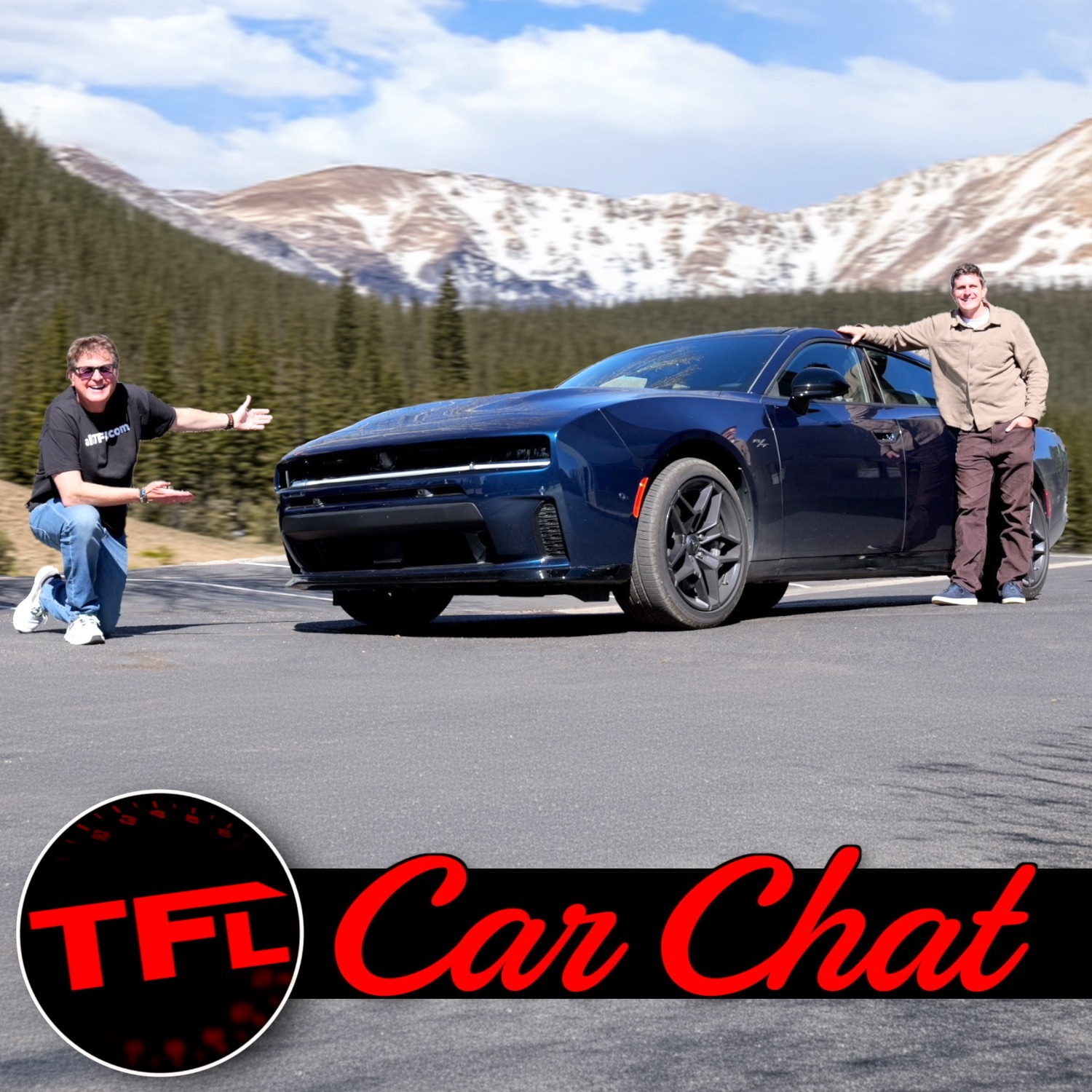
We Spend A Week In The Most Controversial Car Of The Year! | Ep. 330
About this episode
A week behind the wheel of the “controversial” new Dodge Charger Six-Pack (gas) sparks a debate over what a muscle car should be: inline-six twin-turbo AWD with a liftback vs the expected V8/Hemi identity. The hosts argue the lineup got spoiled by launching the electric Daytona first, plus they nitpick modern design choices (electronic handles, cheap-feeling shifter, misaligned trim). They also sample the hybrid Jeep Cherokee (struggles off-road despite good MPG), the Kia Telluride/Palisade family of crossovers, and wrap with Tesla annoyance-by-design and a lively Formula One discussion about “overtaking vs passing” under electrified rules.
( https://www.alltfl.com/ ) Check out our new spot to find ALL our content, from news to videos and our podcasts! In this episode, Roman and Tommy dive into the chaos currently surrounding Stellantis. We’ve spent a week with the most controversial car on the market: the new Dodge Charger. Is it a muscle car, or has it basically become a German sports sedan? We break down the confusing new naming structure—from the "Six-Pack" gas versions to the electric "Daytona"—and debate whether Dodge missed the mark by launching the EV first.
Plus, we take the new Jeep Cherokee off-road, and... it didn't go well. Between "turtle mode" overheating and a lack of low-end torque, we question if Jeep has lost its DNA in the pursuit of fuel efficiency.
( http://www.patreon.com/tflcar ) Visit our Patreon page to support the TFL team!
Advertising Inquiries: https://redcircle.com/brands
Privacy & Opt-Out: https://redcircle.com/privacy
Formula One
"And, Tommy, we might even get into Formula One because there's controversy. Well, there's always controversy at Formula One, but this year it's very controversial..."
Formula One is the highest level of race car competition. When the rules or technology change, it can upset people because it changes how the cars race.
Formula One (F1) is the top tier of open-wheel racing, where teams compete using highly regulated technical rules. Because the sport is rule-driven, changes to technology and race procedures can create major controversy among fans and teams.
halo product
"So they launched the Daytona first, I think to be kind of the halo product."
A “halo product” is a flagship item designed to generate excitement and brand prestige, even if it isn’t the highest-volume seller. The hosts use it to describe the Daytona as the model meant to make people care about the electric lineup.
electrification
"We're moving to electrification. We're going to smaller displacement."
Electrification means replacing gas engines with electric power. In this conversation, it’s why the car lineup shifted and why some muscle-car fans were unhappy at first.
Electrification is the broader strategy of moving powertrains from gasoline engines to electric motors, including hybrids and fully electric vehicles. Here it’s used to explain why the lineup changed and why the electric Daytona made a controversial first impression.
smaller displacement
"We're moving to electrification. We're going to smaller displacement."
Smaller displacement means the engine is physically smaller. The idea is to use less fuel and still make power, often with turbocharging or other efficiency tech.
Smaller displacement means using a lower engine cubic-inch (or liter) size to reduce fuel consumption and emissions. The segment connects it to Stellantis’ plan to keep performance while moving away from large V8s.
horsepower
"I want to say in the RT, it's what, 450 horsepower? 420. and how much is the scat pack? 550."
Horsepower is a way of describing how much power the engine can make. Higher horsepower usually means stronger acceleration potential.
Horsepower is a measure of engine power output, often used to compare performance between vehicles. The hosts mention horsepower to argue that the gasoline return still delivers big numbers for muscle-car buyers.
eight cylinders
"[720.3s] I disagree. [721.0s] They would say it's American as it gets because it has an eight cylinders. [723.3s] I get that the ingredients are those of a potentially German car, but I disagree."
They’re talking about a V8 (or similar) engine—an engine with eight cylinders. People associate that with classic American muscle-car power.
“Eight cylinders” refers to an inline or V8 engine configuration. In car talk, it’s often used as a quick signal for a big, American-style powerplant—especially in the context of muscle cars.
rear wheel drive
"Has the Mustang formula changed since 1965? Yes, it has changed. How? Well, is it still a rear wheel drive?"
Rear-wheel drive (RWD) is a key part of many classic muscle-car definitions because it emphasizes a traditional driving feel and allows power to be sent to the rear axle for traction and handling characteristics. The segment uses RWD as a benchmark for whether a car still “fits” the muscle-car identity.
4,800 pounds
"I actually find that even though it's 4,800 pounds and is longer than an Explorer, with modern suspension and entire technology,"
That’s the car’s weight. Heavier cars can feel slower and take more effort to stop, even if the engine is strong.
4,800 pounds is a reference to vehicle curb weight, which strongly affects acceleration, braking, tire wear, and overall feel. In performance-car discussions, weight is often blamed for “struggling” even when the engine is capable.
trim
"is there's a bit of trim that goes along the side of the car ... And it's supposed to line up exactly with the trim that's on top of the dashboard."
“Trim” is the decorative stuff you see inside the car. If it doesn’t line up cleanly, it can make the whole interior feel lower quality.
In car interiors, “trim” refers to the visible finishing pieces—like panels, moldings, and decorative surfaces—that frame areas such as the dashboard and door/side sections. Fit and alignment matter because mismatched trim gaps or misaligned pieces can make a car feel poorly assembled.
all-wheel drive
"It's also all-wheel drive, so it's good in the snow. I just went to Vermont and drove it in the snow."
All-wheel drive means the car can send power to multiple wheels. That helps it grip better on slippery roads like snow or ice.
All-wheel drive (AWD) sends power to more than just the rear wheels, improving traction when roads are slippery. In this segment, the host credits AWD for confidence in snow and winter conditions.
snow tires
"If you put snow tires on the thing, it'll be completely unstoppable."
Snow tires are tires made to work better in cold weather and snow. They usually grip the road much better than regular tires when it’s wintery.
Snow tires are specialized tires with softer rubber compounds and tread patterns designed to grip in cold, snowy, and icy conditions. The host claims that pairing the AWD car with snow tires makes it dramatically more capable in winter.
eco mode
"we're putting out a video where Andre and I spent the day [1346.7s] driving to the branch and back in regular mode versus eco mode."
“Eco mode” is a driving mode that usually reduces engine output and changes how aggressively the car responds to your pedal. In this discussion, it’s contrasted with “regular mode” to see whether it improves real-world fuel economy.
fuel prices
"Right now we're like three weeks into this war and we really haven't seen a lot of focus on fuel prices. We've seen, I've seen a ton of focus. It's kind of in the background."
Fuel prices are how much it costs to buy gas or other driving fuels. When they go up, driving costs more, and people often start looking for cars that use less fuel.
Fuel prices are a major driver of how expensive it is to drive and how quickly consumers change buying habits. When fuel gets more expensive, people often shift toward more fuel-efficient vehicles and may delay discretionary trips.
used car prices are up between three and five percent
"because right now Teslas, Tesla prices, used car prices are up between three and five percent. Sure, makes sense."
A small percentage move in used-car pricing can signal broader changes in affordability and demand. When prices rise, buyers may delay purchases, switch brands, or look for cheaper alternatives, which can further shift the market.
tax incentives
"Yeah, but that was because of tax incentives. Yes, I'm saying, but that's gone away too now."
Tax incentives are government programs that reduce the effective purchase cost of EVs or other clean vehicles. The host notes that these incentives can temporarily make EVs cheaper, but when they expire or change, pricing and demand can shift.
oil prices
"But there's two factors that usually fail to mention. One is oil prices. Somehow they forget about that."
Gas prices depend a lot on oil prices. If oil is cheap, gas cars cost less to run, and that can make EVs feel less urgent.
Oil prices strongly influence the cost of gasoline, which affects consumer demand for EVs versus internal-combustion vehicles. When oil is cheap, driving a gas car is less expensive, which can slow EV adoption in some markets.

Jeep Cherokee
"Yeah, and we also drove the Jeep Cherokee. Yeah, so let's talk about the Cherokee."
The Jeep Cherokee is a Jeep SUV. They’re saying they drove one and want to talk about it next.
The Jeep Cherokee is a compact-to-mid-size SUV from Jeep. In this segment, the hosts mention they drove it, setting up a comparison to the other vehicles discussed.
HVAC
"You've got regular door handles. You've got real buttons for HVAC, no haptic controls. It's just refreshing to get in a car and know how to start it"
HVAC is the car’s heating and air-conditioning system. They’re saying the Pacifica lets you change temperature using buttons you can reach without staring at the screen.
HVAC stands for Heating, Ventilation, and Air Conditioning. In cars, it’s the system that controls cabin temperature and airflow, and the hosts specifically praise having dedicated physical HVAC controls.
seven-slotted grille
"And they've got the seven-slotted grille, they've got the Jeep name on it. Why wouldn't you make it,"
Jeep’s “seven-slot” grille is a signature design element that’s strongly associated with the brand’s identity. The hosts point out that while the new vehicle has the grille and the Jeep name, they question whether it has the off-road capability to match.
V8s
"they don't understand the US market, [2069.5s] they don't understand the US obsession with the V8s, [2071.8s] they don't understand the need to put huge tires on things, right?"
V8 engines are known for their strong low-end torque and distinctive sound, and they’ve historically been popular in the US. The speakers are arguing that US buyers often expect V8 performance/feel as part of certain categories like muscle cars.
Honda
"[2151.5s] and Honda's becoming serious actually about off-roading. [2153.7s] But let's talk about these vehicles that look off-roading,"
Honda is a major automaker, and here they’re talking about Honda taking off-roading more seriously. The point is that some vehicles look rugged, but may not actually be built to go off-road.
Honda is signaling a bigger push into off-road-oriented vehicles. In the context of the episode, the host is contrasting “looks off-roading” styling with actual off-road capability.
vehicles that look off-roading, but necessarily aren't off-roading
"[2153.7s] But let's talk about these vehicles that look off-roading, [2157.0s] but necessarily aren't off-roading."
Some cars are designed to look like they can go off-road, but they’re really meant for regular driving. The important question is whether it has the real features for dirt trails, or just the rugged look.
This is the idea of “off-road styling” without true off-road hardware or capability. Listeners should think about whether the vehicle has real traction systems, ground clearance, and underbody protection—or if it’s mostly cosmetic.
40mpg
"[2188.8s] But if you're looking for something with just a boat on a room [2191.9s] and really good fuel economy, [2193.0s] we're looking at like, you know, you're getting up to close to 40mpg,"
“MPG” (miles per gallon) is a measure of how far a vehicle can go on one gallon of fuel. The host is using a ~40 mpg target to frame the vehicle as particularly efficient for its size/class.
fuel economy
"these are fundamentally very heavy, inefficient things. And if people are moving toward fuel economy or looking for it, maybe the Cherokee's the right choice at the right time."
Fuel economy is how far a car can go on a tank of gas. If a vehicle is built for off-roading, it can be heavier and use more fuel.
Fuel economy is how efficiently a vehicle uses fuel, typically measured in miles per gallon (or liters per 100 km). It becomes a central trade-off when discussing off-road hardware, which often adds weight and reduces efficiency.
Bridgestone
"[2932.0s] Same company, you're good. [2933.3s] Yeah, Bridgestone. [2933.9s] Yeah, no, wrong company."
Bridgestone is a tire brand. The tires a car uses can change how it grips the road and how comfortable it feels.
Bridgestone is a major Japanese tire manufacturer. In car reviews, mentioning Bridgestone usually means the vehicle is running specific tire models that can strongly affect grip, ride comfort, and wet/dry performance.
hold their value
"The cheapest one I could find was like $61,000. They hold their value like crazy."
“Hold their value” refers to how well a vehicle retains its resale price over time. The speaker claims these SUVs keep resale value strongly, which affects the real cost of ownership.
Drive to Survive
"So my wife has gotten super, super, super into Formula One. She started watching Drive to Survive. And next thing you know, she's become a big F1 fan."
“Drive to Survive” is a Netflix show about Formula One racing. It makes the sport easier to get into by showing the people and stories behind the races.
“Drive to Survive” is a Netflix documentary series that follows the personalities and behind-the-scenes drama of Formula One. The hosts mention it as the entry point that turned someone who “doesn’t care about cars” into a dedicated F1 fan.
grid position
"...and the person who won the grid position being the one that eventually wins the race."
Grid position is where a car starts on the starting grid based on qualifying results. The speaker notes that the driver who wins grid position is often the one who eventually wins the race, highlighting how qualifying can heavily influence outcomes.
drag reduction system
"But for me, it works. Jonathan was saying he's been watching for 12 years in the live chat, and he likes it too. Yeah, I mean, I still think that the whole discussion about why are we hybridizing a race car is kind of valid. ... before DRS, I think that it was DRS's drag reduction system. And basically, as I understand it, if you're within one second..."
It’s a feature that makes the car “slice” through the air better by reducing resistance. That helps it go faster, especially when it’s trying to pass someone.
A drag reduction system reduces aerodynamic drag, which allows a car to achieve higher top speed or faster acceleration down straights. In racing, it’s usually regulated so it only activates when cars are close enough, aiming to make overtakes more likely without turning every lap into a free-for-all.
carbon neutral
"[3817.5s] which then you can use to power a car, [3819.7s] which then turns back into carbon. [3821.9s] So the idea is it's carbon neutral."
“Carbon neutral” is the idea that a fuel or activity doesn’t add extra climate pollution overall. The goal is to remove as much carbon from the air as you put back when you burn the fuel.
“Carbon neutral” means the process is designed so the amount of carbon dioxide added to the atmosphere is balanced by removing an equivalent amount elsewhere. In this segment, the claim is that carbon is captured from the air, turned into a fuel, and then returned when burned—ideally netting to zero.
Red Circle
"It's called Red Circle. And I was just telling my colleague about how much I love their platform. With Red Circle, not only am I getting a seamless hosting experience, but I also love the support I receive in ad sales."
Red Circle is a service that helps podcasts find sponsors. You set what you’re into, and it connects you with advertisers that fit your show, plus it gives you data to see how well things are working.
Red Circle is an advertising and sponsorship platform for podcasts and creators. It helps match shows with sponsors based on the creator’s preferences and provides analytics so you can evaluate opportunities.
Request an Explanation
Heard something you'd like explained? We'll add it to this episode.
Sign in to request explanations for terms you heard.
Want to learn more?
Browse our glossary for plain-English explanations of automotive terms, jargon, and concepts.
Help improve this episode
See something that's not quite right? Our annotations are AI-generated and can sometimes miss the mark. Click the flag icon on any annotation to suggest a correction.