It means the car’s behavior and features are controlled mostly by software. So instead of everything being “hardwired,” the car can feel like it’s running apps and can change over time.
An infotainment system is the car’s main screen and controls for music, maps, and phone features. It’s what makes the dashboard feel like a phone interface.
Brand
GM 2028
GM is the automaker General Motors. The “2028” reference is about what GM plans to do with car software/connectivity in the future.
Apple CarPlay lets your iPhone show certain apps on the car’s screen. It’s meant to keep things familiar—like using your phone, but through the dashboard.
Tesla is an EV brand known for building its own in-car software experience rather than relying on phone-mirroring platforms. The host’s point is that Tesla “never had” CarPlay/Android Auto, which is part of why some cars feel more like a self-contained computer.
Rivian is an electric-vehicle brand. The host is using it as an example of an EV company that chose its own software approach instead of using the standard phone integration.
Term
native system
The “native system” is the car’s built-in screen and software. It can use its own internet connection to show navigation and other features.
Wi‑Fi connectivity means the car can use the internet through a Wi‑Fi network. If you’re using your phone as a hotspot, the car’s navigation depends on that connection working reliably.
Cellular connectivity means the car uses the mobile phone network to get internet access. If you’re in an area with weak signal, the car’s online features can drop out.
A hotspot is when your phone turns its internet connection into Wi‑Fi for the car. It helps the car stay online, but it can be affected by phone signal and battery life.
A built-in connection means the car has its own way to get online. That can reduce dependence on your phone, but it can still fail if the signal is bad.
A recall is when the car maker says, “There’s a problem—let’s fix it.” Sometimes the fix can be done remotely with software, instead of going to a shop.
Dead zones are areas where a wireless network signal is weak or unavailable. At a racetrack, dead zones can prevent cars from reliably receiving over-the-air updates or communicating with the network.
A key fob is the remote you use to lock and unlock the car. They’re saying the fob itself can get software updates, which can fix problems like it not working reliably.
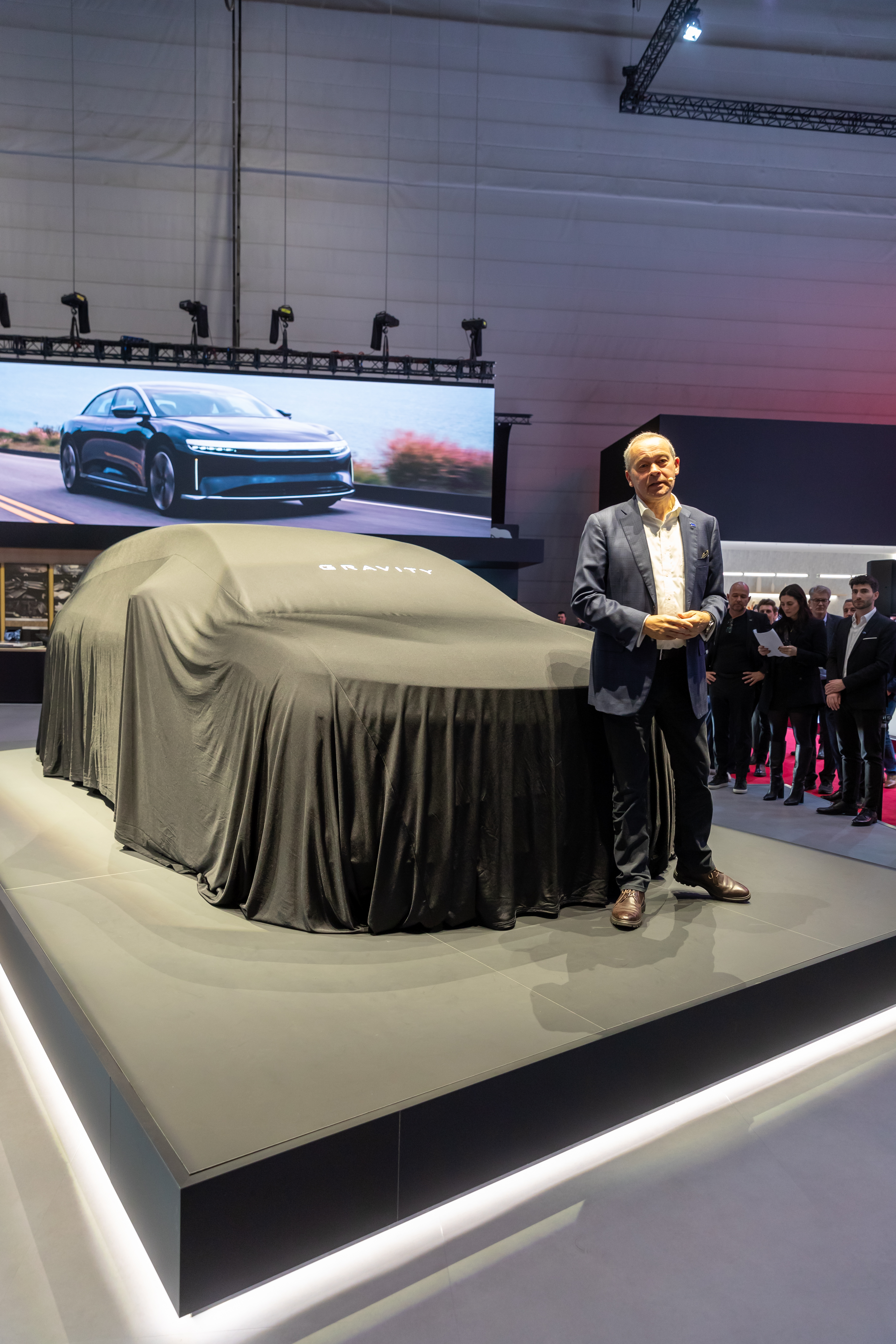
Lucid Gravity is Lucid’s SUV. Here, they’re using it to show that newer cars get software updates, and even the key fob can be updated using a phone connection.
Term
lock and unlock button
Those are the buttons on the key fob that tell the car to lock or unlock. They’re saying the update improved how well those buttons work from farther away.
Cars today can get new software after you buy them, like a phone update. That software can add features or fix problems without needing a full repair visit.
EV charging is plugging your electric car into a charger to refill its battery. How fast it charges and where chargers are matters a lot for road trips.
EV data is the car’s battery and energy information. The navigation uses it to figure out if you can make it to the next charger and how long you’ll need.
Charging scheduling means you tell the car when to start charging. If electricity is cheaper at certain times, you can set it to charge during those windows.
A voice assistant is the feature that lets you talk to your car and ask it to do things. The host is saying it’s not always reliable yet, even for simple requests.
AI means artificial intelligence—computer “smarts” that can understand and respond to things like speech. Here, it’s about whether the car’s assistant can reliably help you find charging.
Large language models are AI tools that can understand and respond to human language. The host’s point is that they’re improving how the car talks with you, but they’re not perfect yet.
Voice control lets you talk to the car to do things like find directions or charging stations. The host says the system didn’t work well enough to get the right charging option.
A fast charger is a charger that recharges an EV quicker than a regular one. In this segment, the problem is that the car couldn’t find the fast charging spot when asked.
Bluetooth is a wireless link between your phone and the car. It lets the car and phone “talk” so you can use things like music and calls without plugging in a cable.
A wired connection means plugging your phone into the car with a cable. It usually works more reliably than wireless, but you have to deal with cables and the right connector.
USB-C is a common charging/plug type that works both ways (you can plug it in either orientation). Some cars use USB-C, so you may need the right cable to charge and connect your phone.
Charging to 100% means topping the phone battery all the way up. Some people avoid doing that often because it can make the battery age faster, especially if it also gets hot.
Wireless charging charges your phone without plugging in a cable. You set the phone on a pad, but it can get hot and sometimes won’t charge well if the phone isn’t positioned correctly or if you have a thick case.
Google Meet is a video-calling app. The point here is that some cars can connect to apps like this, which makes the in-car system feel more like a smartphone than a dashboard.
Navigation apps are map programs on your phone that guide you with directions. Newer cars can show and control them through the car screen, which makes the whole driving experience feel more like using a phone.
Spotify is a music streaming app. When it works through your car’s screen, it’s one more example of how your car is starting to behave like a phone hub.
Waze is a navigation app that uses other drivers’ reports to warn you about things like accidents or debris. Some people use it mainly for alerts rather than for the exact route it suggests.
Google Maps is a phone navigation app that tells you where to go and how to get there. Here, the host uses it for directions even while another app is shown on the main screen.
Android Auto is a way to connect your Android phone to your car. It shows certain phone features on the car screen so you can use navigation and music more easily while driving.
A “walled garden” means a system where one company controls the experience. In cars, it can mean your phone features work in a limited, controlled way instead of completely freely.
Term
privacy wise
They’re talking about privacy in the sense of what the car collects and shares. Even if it sounds minor, it can still be used to make decisions about you later.
Adaptive cruise control is cruise control that can react to traffic. If a car in front slows down, your car slows too, and then resumes speed when the road clears.
Lane centering is a system that helps keep your car in the middle of the lane. It uses sensors to detect lane lines and makes small steering corrections so you don’t drift.
HD mapping data is a very detailed digital map that helps the car understand the road better. Instead of guessing, the car can use this information to assist features like navigation and driver-assist systems.
OEM means the carmaker itself—the company that built your vehicle. Here, it’s being used to talk about what the automaker can learn or analyze from the car’s systems.
This means the car has built-in Google features, not just a phone app. You can sign in with a Google account and the car can use that info to show things like reminders or route-related timing.
When you sell a connected car, you have to remove it from your phone/app account. If you don’t, your phone can still reconnect and you may still see alerts or control features.
“Total vehicle” usually means the car was damaged so badly that it’s not worth fixing. Insurance treats it as a write-off, and it may be sold for parts or salvage.
A factory reset is like rebooting the car’s computer back to its original settings. Here, it’s used to make sure the car is no longer tied to the previous owner’s account.
Toyota is a major automaker whose connected-car workflow is described as being quick to remove from an app account. The host says it can be done in “two clicks,” highlighting how different brands handle telematics/account management.
Sirius XM is a company known for satellite radio. In this case, they’re also involved in the connected-car system that handles account and vehicle access.
Stellantis is a big car company group that makes many different brands. Here, they’re mentioned because their cars use a connected system that Sirius XM helps manage.
Here, “fuel” means the app can show you the car’s fuel level remotely. That’s part of the connected-car system, not just something you check in the dashboard.
Lock/unlock means you can lock or unlock the car using your phone. The concern is that if the account isn’t removed properly, someone could potentially control the car remotely.
LIVE
Hey. Welcome back I'm Keith berry.
I'm Maddie mccarty. I'm Michael Crossan.
And we've got a very special episode of Talking Cars.
Today we are going to talk about why the heck so many cars feel like a phone, and why so many cars need a phone.
So this is this is sort of the role that software plays.
Your car is a smartphone on wheels, right?
One way to look, that's one way to look at it.
Or your car is a screen that you bring your smartphone to, depending on which car you buy.
Yes. So there's like two camps here.
So there's like there's kind of like the that some automakers that are like we're just going to have a screen, bring your own device, plug it in.
And then they're the other ones who are like, leave your device in your pocket.
Your this car is software defined, right?
Yeah.
And it's typically a lot of the EVs, our scene where they want you to put your phone down and use their system as an experience, especially since it can be tied to a lot of EV features.
Yeah.
But yeah, then you definitely have others that it doesn't seem like they invest maybe so much into their infotainment system.
So then you can just plug it in and use your own Honda. And.
Exactly.
And we're also starting to see GM 2028 right.
They're going to drop this.
So I think anyone who's watching this is probably familiar with Apple CarPlay Android Auto.
You plug in or connect your phone, and all of a sudden those familiar apps and icons appear on your screen.
That's Tesla never had it.
Rivian A few of the other EV manufacturers like you said, kind of went their own direction.
But now a major, major automaker GM is talking about getting rid of that too, right?
Yeah.
And they've they've sort of made some moves to that as well.
They have just have a lot of native things.
You can download apps like if you like, ways you can download ways to the vehicle, you know, if that's your preferred navigation, app of choice.
So I think it just comes down to, I mean, I know be curious of what everyone here thinks, about what?
Which one in particular?
Like, do you. Yeah.
Do you just want do you want to live with native?
Oh screen native function and features, or do you want it all based on your phone because you're sort of an expert in this and I know what I think, but I feel like I'm wrong and I know what I think, but I feel like I need to know more from you.
Oh, okay, I use both.
You use both because I don't trust either completely.
Because the native system is going to rely on a, an internal, like Wi-Fi connectivity or cellular connectivity, and then your own phone is going to be either on Wi-Fi connected to the vehicle or a hotspot or a cell phone.
But that just means that there's so many opportunities for the system to go wrong, or to fail to load or to disconnect and so for me, having both my phone plugged in and the native system map like pre mapped, then if one fails I can just switch to the other.
Okay. That's that's called being prepared.
That is being prepared, being terrified of getting lost in the middle of nowhere with no service.
That is true. And we have a lot of that around here.
We have a lot of that. It might not be something.
It matters as much if your commute is on kind of main roads, but if you're in a dirt road in sort of the middle of nowhere, you with no cell service, you really want to know where you are?
There's like a patch that's like a mile down the road where every single time I come into work, if I'm, like, listening to something that just drops out for just, like a quarter of a mile, and that's one of the issues.
So I know that cars nowadays almost every car has, not every but almost every car has a built in connection.
So this used to be for things like they'd call it telematics.
That would be like, you could look at your phone and unlock your car.
You could see if the alarm went off.
This is, you know, OnStar.
This is going back to the 90s that these connections would happen, you know, so these built in connections are now being used to do all kinds of things.
You can fix a recall, it can get beamed down from the sky and fix the car.
But we have trouble with that at the track. Right.
Because yeah, some, some of the cars, whatever carrier they use.
Right. So there's certain carriers, have dead zones here.
And one of them, I actually was my own personal cell phone carrier when I started.
I actually switched carriers, the one that has the best cover.
And your productivity went, no, I'm kidding.
I shot one up because we use our phones for so much.
Yeah, I have my phone. I have a phone here.
That's one of our car phones because it is so important and we're talking about like recalls and updates and we talk about updates all the time.
These cars just feed updates and we're in the middle of testing them.
So we need to check with everybody.
So I'm always sending that an email like, hey can I update this car or do you still need it, you know, and how it is.
But I just updated the keyfob for the lucid gravity off of this phone.
You connect them with Bluetooth phone, download software, puts it in the keyfob, and the Keyfob actually works better. After the update.
It got rid of some of the quirks of it.
Oh, does it no longer go dead all the time?
I can't say 100%. Yeah.
It's better.
Okay.
It recognizes as you get a little or from a little more distance, the actual lock and unlock button seem to work okay.
Oh, I haven't had to shut the door.
I think it's a week.
And there's still a bunch of updates to do on that car, which is why I'm just sort of living in it.
But it's the first time I've.
We've done software updates off of phones.
BMW and mini had a system where you download it, and then you have to pair the phone and drive around the matter.
Once you put you in a car for like four days with this red phone.
So a car would do the update.
I don't even remember because it probably happened a few times.
It was just like, here, drive it and hold this phone.
Yeah, make sure the phone is connected to the car.
No. Download the GM cars update at my house.
They don't update like anywhere else in my house. They work.
So yeah.
So we've kind of come to the fact of like, can you take this one home?
So the update will actually happen. Yeah.
So it is a new world, with these phones and everything like that.
Now, you don't think about key fobs needing to have a software, right?
Download an update.
And it was very easy.
It took three minutes, like all in.
And I'm sort of adverse to some technologies and that would be one of them but was very easy.
Yeah.
So yeah it's and that's a good thing I think for, for owners because otherwise especially a car like this, gravity is not the easiest in the service.
For us to really going down to New York or up to Boston, it's a process to do.
But literally just at my desk, I didn't have to be with a car.
Just put the two of next to each other and in three minutes it was done.
That's nice.
But then you also have to take a step back and think, why do I have to update my car so much?
Well there's that. Yeah.
And that's totally valid.
Yeah.
I mean I think that that's something that we even kind of are starting to talk about in our reviews that if there is kind of these two directions you can go when you're buying a car, you can be the sort of there's, you know, the car is cell phone person, or you can be the person who chooses the car that so that maybe has connectivity for things like recalls.
Like, I would love that.
If something can give me a software update, that means I don't have to go to the dealership just for someone to plug a USB drive into the car, and I have to sit there drinking crappy K-Cup coffee, you know, from a machine that hasn't been clean in ten years.
And there's, you know, The Price Is Right is on TV and someone's trying to sell me something.
No, I'd rather just have that happen in my driveway.
But this is where these things are sort of, sort of diverging.
I want to hear a little more about what EVs because people I see, at least on social media, in talking with people, people seem to conflate electric vehicle with too much technology.
That has nothing to do with electrification.
And I think part of that is Tesla's fault or not fault.
But part of that is the association with, you know, part of that is what EVs can do because they have so much power on board.
But why? What are these?
Why are we starting to see these systems more in EV, in EVs than than in a more basic vehicle?
A lot of it has to do with EV charging and how you plan as you are driving or, planning a trip somewhere.
How do you make sure that you have enough range to get to the next station?
How long is it going to take for you to charge there with these?
The integration of the map system, within the EV.
Now you have the the maps has access to all of the EV data in your vehicle.
So it's going to be the range and it's going to be able to use that to calculate a whole like trip from the East coast to the West Coast.
And it'll put you at stops along the way and tell you how long you have.
Well, you can also in some vehicles you can decide how much range you want to have by the time you get to the next charging station.
So if you're like me and a little bit more conservative, afraid of running out of battery, yeah, you can't say, right, okay.
And then you're like, oh no, there's nothing around. Yeah.
So you can set it to be I want to be at this charging station with at least 50 miles of range left.
And that's not something that you see in every vehicle, but it is something that I like to see, and I like to choose if I'm going to take a road trip in an EV, because that's just my sense of peace of mind.
You can also you know, do you charge scheduling?
So if you live in a state where charging or electricity costs increase during the daytime, you can have your vehicle charge between like 2 a.m.
and 7 a.m..
You can have it heat up in the morning, so it's nice and warm, things like that.
Yeah, yeah, yeah. So there's a lot that you can do.
Where if you have a vehicle that's not quite integrated as well, like I believe, was this whole Terra wasn't integrated very well.
And so you would just, you would have a drive to someplace that's 500 miles away, but the range is going to run out of, like, less than 300.
So that's literally impossible to do.
But the maps are telling you to just go for it.
Yeah. And I think this is this is interesting.
I mean, I think this this is actually and I'm a bit of a skeptic around certain things that are related to like AI, but I think there's there's this world that I would love to be able to have a voice assistant that's built into the car where I can say, hey, find me a charging station with a with a decent coffee shop within walking distance that has an open, place for me to charge in.
It could take that real time data, synthesize that, say, all right, here's a cool coffee shop.
The kind of place that totally over there would go to.
And I can charge the car now, I posted that on on blue Sky the other day, and someone responded, I can't even get it to open Spotify.
So I think some of these promises aren't quite quite there yet.
I think they're really dry, and there's a lot of like systems that are using, looms, large language models and they're getting there to be a lot more conversational.
I think it's going to take a while before it gets to the point where it's like, I want this view and I want it to be right here and blah, blah, blah.
It is going to take a while.
But yeah, if you can't even log into your Spotify, how are you going to trust it to take you to the right EV station?
I was just in the Lexus ES, EV and was trying to find a place, to charge for the fast charger, and it would not show me.
It would not narrow it down over voice control.
I had to go in there and and but I mean, the system, if I had set it up, it would have figured it out for me.
But on the fly, it couldn't figure it out.
Something I want because you're the one who everyone comes to when we have problems with our system, we bring you all our problems.
Yes, which is why you have such a, a look on your face of you doing all of the things that we don't necessarily want to exaggerate hard.
By the way, I need to talk to you afterwards, but, anyhow, no.
So you hear all the things that go wrong, whether it's plugging in a phone or whether it's a system.
A native system, whether it's a bring your own device or this sort of walled garden, what are the things we're starting to see?
Because I feel like things are getting worse.
Am I dreaming? I don't think they're better.
Okay. I don't know if they're actually worse.
They're different. I think first we should talk about.
I mean, there's basically two phones.
You have an Apple product or a non-Apple product, some type of an Android phone.
And I happen to currently have an iPhone.
This company phone is also an iPhone.
So I'm living with two iPhones.
So iPhone, Android, Android.
So we got the whole everything represented here.
And I always also I always think it's me that I'm the problem.
So you get in the car and my phone all connects.
We're always the priority.
Now I just assume it's me. Yeah.
So I take my phone out of the car.
I take the car out of my phone, I drive on, I go through this whole process outside the gate.
I just assume I don't know how to do something.
It's funny when you see people pulling out of here outside the gate there that they do this like dance.
Like the car stops, the door opens, they get out, the door goes on and off.
They get on the car there.
Yeah.
Now, I will concede that we have an unusual circumstance because we're in so many cars, and I know people here have different modes in which they operate.
The only cars that are on my own personal phones Bluetooth list are the cars that are actively in test, because those are the cars I spend most of my time in.
Once a car goes out in the fleet, I delete those.
So I only have six to maybe nine cars sort of set up for Bluetooth at any given time.
But I know there's people that have like 50 car cars that are you can just scroll on.
I still got a Fisker Ocean on mine.
So yeah, that's not me.
That maybe all the time, but maybe that's wrong.
Because I do have connectivity trouble in certain cars, particularly Toyota.
But if you have trouble and I have trouble and I have trouble, trouble and everyone who writes about it in our law books have trouble, I don't think we are the problem. No. Correct.
But in the moment, I always think it's me.
And I also feel like if it was my own personal vehicle, I would use a wired connection.
Yeah, I would have the cable.
It's the right cable, but some cars have usb-C, some have a I just never have the right cable, or I leave it in the car.
Or you have to think about the fact that if you plug in your phone now, it's going to be charging.
And if you're like me and you don't want your phone to charge you 100% because it's bad for the battery or it's just going to get it hot, yeah, then I don't want to actually plug it in, but I want the stable connection for that cord.
You're pulling it in and out of the thing.
You're twisting it.
It's sitting in the hot car, it's sitting in the cold car, and all of a sudden one day it just stops working because modern phones have so much more data that they they you I mean, I'm on the always be charging camp the same here, but but that's just sort of how that goes, I guess, at least for me.
But yeah, you know, we have wireless charging that gets the phone hot in a lot of cars as well.
Never any cars have a good wireless charger. Yeah.
So it slides off.
And again it depends on the case and things like that.
So it's I don't think things are necessarily worse.
I just think we're relying on it more.
Used to be more frequently like connecting your phone was almost a chore and like, well, I'm just taking this car home and back.
Like I'm not going to connect my phone. I'll listen to the radio.
But now it's because we use it for so many things.
And, you know, I get a lot of calls.
Someone's like, hey, I have a problem with my car, that kind of thing.
So on my commute, like I want to be, will answer the phone and not have to actually pick up my phone and do things like that.
So I think we all rely on it more.
So it seems like we're having more problems because we're really utilizing that, you know, like taking a Google Meet from the car, that kind of a thing.
Just it just comes up to the system and you can mute and unmute.
And it's the same as talking on the phone, which on one hand is really great.
It is neat that we can do that, but it does complicate things.
They're also putting so much into the systems now.
It's not just phone media and navigation.
Now you can have games which typically you you can't do while you're driving.
Yes, but there's that capability and there's a bunch of different navigation apps, kind of thing.
There's just so, so much going on, you know, Spotify.
Yeah. Any music streaming thing.
And so one of the things I really like about CarPlay or Android Auto, it didn't get it depends on whatever phone I have is that it's very simple.
I can't have the three tiles or four tiles on the side of just the stuff I want, which is I want to be able to have the car read me a text or speak a text back, want some sort of music streaming and I want some sort of navigation.
Yeah.
Even if I'm not following the directions, I'm a Waze person, so I run Waze just for the alerts, right?
If I don't put a destination, says there's debris on the road, I kind of want to know that.
Yeah, I don't love Waze directions, though.
I actually prefer Google Maps, and I know Google now owns Waze, but I run them side by side and I still prefer Google, but you can run that in the background.
You put your destination on Google, but you have Waze up on the screen.
I do the opposite anyways on the screen.
And then I have, so yeah, and then I have Google Maps in the background.
That's right. That's how I run. Yeah.
So I run my, my directions on Google, but I have Waze on the screen.
My oh wait, my stop.
Okay. So but either way. But it's clear.
Yeah.
So running two different navigations I mean I can see what that's overwhelming.
And you could get confused and all that kind of stuff.
I just happen to like it because a lot of times I've searched my destination on Google ahead of time, like, this is where I'm going. Yeah.
And it's there.
It's in the history, but I still prefer Waze on the screen.
So I realize, maybe a little different, but clearly not because you're also running to it sounds like, you know, there's just not one thing that works for everyone.
Correct? Right.
But I think these the native systems, they're busy.
You have all the other settings and stuff that are in there.
You're looking for things where an Android Auto or CarPlay, you just have like the 3 or 4 tiles on the side. Yeah.
And you can just bounce back and forth very easily to the things you use the most. Yeah, that's what I like about it.
I think that maybe the designers of these systems aren't so I don't know, they're there's not given the same resources perhaps as other areas of the vehicle.
Certainly. Yeah.
Maybe they're I don't know because they are they can be like so confusing.
And they very different settings.
Like if you just want to mute sometimes you have to go into like a completely different settings menu or if you just want if you accidentally like cancel your out and you want to restart it, you have to search for the whole thing over again.
North up is the one that always gets me when somehow it gets it.
Somehow someone's put the car.
There's some psychopath in this building who sets the maps to North up, and I'm going to find that you. They're an engineer.
Oh. It's nuts.
I don't even know how your brain could even work that way.
You should be studied if you use north up.
Anyhow, I get in the car and it's north up, and and I don't know where I'm going.
It's showing me driving this way, but I'm driving this way and I'm not.
I'm not smart enough to be able to comprehend that.
And I tried to do an IQ test for that.
But really, no, I know, I mean, I could be I can live with it.
It doesn't bother me as much, but I get what you're saying. Yeah.
So trying to figure out things like that and you're already on the road.
You're already on route to, what are you going to do?
Get off the highway and sit and rest.
You know, it's these sort of.
Yeah, yeah.
And like, theoretically you would know how to use this, but bad design doesn't eventually become good design.
Yeah. It's always going to
take a few steps to do that when it should just be one step.
And this is your world. This is what you study.
This is what you evaluate.
What what makes a what what are some of the things if someone's like buying a car, what are the things that they should look for in that system, whether it's native, whether it's bring your own, what should they be looking for?
Well, I would think about what's important to you.
So it's going to be I mean, aside from all the safety features and, driving related features like turn signals and headlights, if you are someone who has, you always use, the native system, then you're going to want to make sure that it's easily accessible, that it has large buttons, that the process of searching for something is simple for you.
And if that involves being able to create a lot of favorites, that's great.
If you like to use voice, maybe you get a system that has more natural language processing.
But at the end of the day, you want to be able to be able to, tap on large buttons with large icons with, text or labels.
That makes sense.
And that'll make it way easier.
And anything that you do all the time should be on like the surface level.
So even being able to customize what features are there or maybe pull out like drive home as a favorites onto your main page.
That could be really helpful too.
So it's just what's important to you.
And then big buttons, large text, large icons, and easy to understand.
One thing I noticed that I really like that I've seen in more modern cars.
It used to be really hard to switch between the radio and CarPlay, Android Auto and now they're starting.
Or even, you know, you'd have to go to like, an icon that had the name of the automaker, and then it would pull up this totally different screen, and now they're starting to integrate those.
Porsche was kind of the first to do it now.
So I saw it in the Lexus.
Car manufacturers are starting to do this little better.
And that's something that's gotten better over the years.
Yeah.
It's interesting with some vehicles you can choose Android Auto as a media source so it doesn't switch you to Android Auto, but it plays that music through it.
So you're still in your home, your native system, home screen, but you have easy access to Android Auto so that if you want to have Waze going on in the background, you still can't do that.
Your phone is still connected to the vehicle.
It's a lot of players who have to play nice with each other.
Yeah, which is why I think there is that.
I think, you know, I see why GM would want you in their walled garden.
It also means that there's more information they can take from you and we know we've seen there's been some investigations about, you know, settings that might look innocuous privacy wise, that if you leave it on, suddenly your insurance rates go up suddenly, someone knows, you know, the automakers might say, hey, I had a transmission from the car.
We don't sell your data, but some of our partners may have access to it.
And if you turn some of those features off, you, if you turn some of the sharing off, you'll lose access to features.
Yeah, you can lose access to your level, too.
Like lane centering and adaptive cruise control.
If you turn off some privacy settings in a certain vehicle.
And that's just like sensors.
Yeah, there's nothing there that needs to have some connection and shared information.
I mean, you're supposed to have be using like HD mapping data, but that's something that is like downloaded into the vehicle.
And so there's no reason apart from I think just being able to, analyze when people are using what at the OEM, level.
Yeah, yeah.
You shouldn't have to transmit your data out of the vehicle in order to use those systems.
I get a little.
So a lot of cars now have a native Google based system, and they can connect to if you're in the Google versus if you have a Gmail account, it can you can log in with your Gmail account in the car.
Will will when you get into it, it'll prime you and say, oh, there's a doctor's appointment at 430, and here's how long it'll take.
And when I first look at that, I think, oh, that's cool.
And then then I think about it for about 10s and I say, I don't want like Volvo or GM or, you know, or like knowing I don't know why, but I don't want that.
Yeah. I mean, I totally get it.
It's for private information that you're already giving to Google or whatever.
Yeah, you're giving it to Google.
And now it's like, well, am I forced to give Volvo this information about my medical health in order to just drive my car?
You haven't had your teeth cleaned in a while. Teeth.
I see it's time for, Yeah.
So, I mean, I know again, you lose some features, but I know something we've done here.
We make separate accounts.
Yeah, your car gets its own email.
Yeah, we have, a couple of different accounts that we manage, and it's purely just so from a functionality standpoint, if I need to log in and and Keith, you need to log in to the mountains logging, we want to know that we're using the same account, the same password.
If someone does have to update a password, we have a place that we update that.
So everyone still has access.
And you know, so when we get in the car, most of them say like a cr welcome.
CR some of them, you know, you can't do like the company name.
So actually my boss John, his name is on a lot of the cars.
Yeah. So we get in the car that says, you know, welcome, John.
That kind of a thing.
And, my parents recently got a Kia, and, I did most the deal, but then I finally sent them to go do the paperwork, and I said to them, and I wasn't totally clear, I'm like, don't set up the app because in my mind, don't set up.
I'll set it up when you bring the car home, which is what we do always when we buy a car.
I want to be in control of setting this up because I'm going to make a specific email address.
This can be like Mike's parents Kia ads.
You know the. Com I this not it to use their own name.
So w you know someone may have that but I wanted to set up just an email that was dedicated for the car.
That way my email is not getting spammed.
Their email doesn't get spammed and we are in control of it.
And they took it as we're not going to set it up.
And salespeople want you to set this up because they get this gets counted at the dealer level.
They need their ten do this. Yeah.
So the salesperson was like, well, that's okay, I'll set it up for you.
I have an email address.
So now there's some random email address associated with my parents. Kia.
But because I don't have actually access to the email address, it's difficult to make that change.
There's a way to do it. It just takes time.
So, you know, we set these cars up. It takes time.
And then when you sell the car, you need to get the car out of the account and there's all this kind of stuff to do.
You don't want to sell a car then.
Now Keith is driving and all of his places are now like associated with this kind of a thing. Yeah.
So there's a lot of layers and steps this and a lot of doing to make this happen.
Never mind that we're doing it with like 75 cars at any given point, but just on an individual basis.
I mean, I'm an expert in this stuff, and I just didn't communicate it well enough to my parents.
Now there's some random sales guys email in there. Kia.
We we've had some interesting stuff happen here.
You know, occasionally bad things happen to cars in our fleet.
And there was one a few years ago that that, through no fault of ours was damaged enough that it went away.
And that car, the parts went away to a different country.
This happened several times.
And cargos. Yeah.
The whole car went and it was a total vehicle.
And all of a sudden one day on that car phone, a ping came up that said, you know, I think I think one of them was it was, you know, registered it was getting an oil change in Bratislava.
And, and the car was I for whatever reason, it was able to it was able to it's still in the app.
You sell. Whoever has,
you know, that has connectivity to what you can lock and unlock. Yeah.
I have a story.
So I mean I've seen this and it's it's a scary thing.
Yeah.
So we sold a vehicle probably at least over a year ago.
And I didn't realize it, but I still had it connected.
I still had it on my Bluetooth list, and I went to, like, the store the other day, and I look at my phone because my music stopped playing, and it had connected to the car that we had sold.
So really? Yes. Yeah.
So it got sold locally? Yep.
And someone is hearing your.
Wow. Yeah.
So I immediately deleted it.
But I was also very curious.
I'm like who bought the car.
You could you could call them you.
You can just if you can hear this you're driving my old.
Yeah. My old whatever. Yeah.
And that goes with when you do sell a car.
There's certain precautions to take. Yeah.
And oh same with if you're renting a car too.
If you're using a rental car and you plug in and like, I mean I found I use native everything in the rental car.
Yeah. I try not to plug my phone in.
Oh, I was going to say I would immediately plug my phone in like wired connectivity.
Yeah. Yeah, that that would just be my preference.
I just try to use everything in the car.
Don't even connect my phone at all.
Just live with FM for the week. It's really annoying.
Like with vehicles that do have Google and if you don't log in then you can't save your work, your home, any sort of favorites, but you're used to be able to do at least.
Like if you go to like Google Maps, but in your car it's not going to let you.
So every single time you have to go to your recent destinations or just type it in again.
Yeah.
And I think that's so important when you do sell the car because you have these favorites saved. Yeah.
You don't want this person who now bought the car knows where you live, where you work. All those kind of things.
I always I never even put in my home address.
There's a restaurant, like, a mile from my house that I literally just put the restaurant in.
And because when I'm that close, I can get home.
I can make it a mile without now.
But, you know, so we actually have a process now of how we deal with all these accounts in the cars.
We do a factory reset on the cars before they go, the way we get them out of the account, sometimes it's very easy.
Toyota is like two clicks in the app and the car is gone.
Reset the car. It's done some. You have to call?
Yeah, some.
When you call, you actually end up talking to Sirius XM is the company that's administering this for the for its Stellantis products? Yep.
I'll just say it.
Speaking of talking to Sirius XM to just tell them that you've sold your Jeep or whatever it is.
We just did it with the Jeep, actually. Wow.
I had to call them. So you.
That car must have sort of been before.
You know, we sort of put some of these processes in place because we started to realize that, yes, you know, we need to do these things.
This can happen. Yeah.
I opened an app once and I was able to see a car.
One was up in Boston and there was another one in another country, and so I could see how much fuel was in it.
You know, all these things I could lock unlock it, and it's kind of scary.
So, yeah, delete those cars out.
You know, and, and so it when people sell cars, you know, delete them, we don't have to sell out the, the ways that could be a problem.
Yeah. Yeah.
So it's an interesting world that we are in.
If you have any questions about this, because this is something that we, you know, we live with and we experience this on different cars all the time.
Send it to talking cars at Icloud.com.
If you have a question about your car, about setting something up, about why dealers do that the way they do about about any of any stuff like that, and we've got some real user interface telematics, you know, the Adas experts here that, that, that can answer those questions for you.
So although although I will say there is one thing you can multitask and that is if you're watching us on YouTube, there is a way that you can donate to us.
So you'll notice that we haven't talked about like mattresses or like different like, supplements or anything like that.
Exactly.
We I don't have like a can here of, of something that I'm trying to tell you that you should buy and we buy it to you.
In fact, if you pick up the print magazine, you won't see any ads for cars or anything.
If you go to Coorg, you also won't see ads.
You'll see ads for us because we like us and we like talking about us.
But, that's because we're a nonprofit.
And, you know, we don't have that influence from advertisers.
We take donations and you can help keep, you know, us talking cars with, you know, just, just a couple of dollars a day.
Can keep, can keep make out under the under the hoods of the cars in our garage and feeding them with, the oil and electricity and gas that they need.
So, we thank you to everyone who's already donated and just, you know, that's who we are. It's a special place.
Thanks for talking cars with us. We'll talk again soon.
About this episode
Modern cars increasingly feel like smartphones because they rely on software, connected services, and phone-style ecosystems. The hosts compare “bring your own device” setups like Apple CarPlay/Android Auto with more closed “walled garden” approaches, then dig into the tradeoffs: native connectivity can drop, voice assistants can struggle, and even updates can depend on cellular coverage. They also cover how over-the-air fixes and key fob updates work, plus the privacy and account-reset steps needed when you sell a connected car.
In this episode of Talking Cars, we discuss why modern vehicles rely so heavily on software, apps, over-the-air updates, and smartphone integration. We compare the pros and cons of Apple CarPlay and Android Auto, discuss the learning curve of built-in infotainment systems, and explore personal data privacy and how you can best protect your information while using a vehicle.
Join CR at https://CR.org/joinviaYT to access our comprehensive ratings for items you use every day. CR is a mission-driven, independent, nonprofit organization.