The Chevrolet Trax is a small SUV made by Chevrolet that is easy to drive in cities and has enough space for passengers and cargo. It's like a bigger car but still small enough to park easily. People talk about it because it's a good choice if you want a simple and affordable SUV.
An apprenticeship program is like a learning job where someone new works with an expert to learn how to do a specific kind of work, like fixing cars, by doing it together and sometimes going to classes.
A mentor-mentee relationship is when a more experienced person helps someone newer to learn and get better at their job by giving advice and teaching them.
LIVE
This is the Automotive Repair Podcast Network.
Hey everybody, Karm Capriotto here and yes.
We're gonna have coffee with Karm and a coach.
And oh, by the way, I just want you to let you see
that this is fresh.
You know I'm a coffee drinker.
You see me drink coffee for the last 10 years.
And I thought, I interview so many coaches in the industry.
Why don't we just segment this out every month,
every time I talk to a coach,
we'll just call it coffee with Karm and a coach.
Anyway, my guest who will be coming up here in a minute
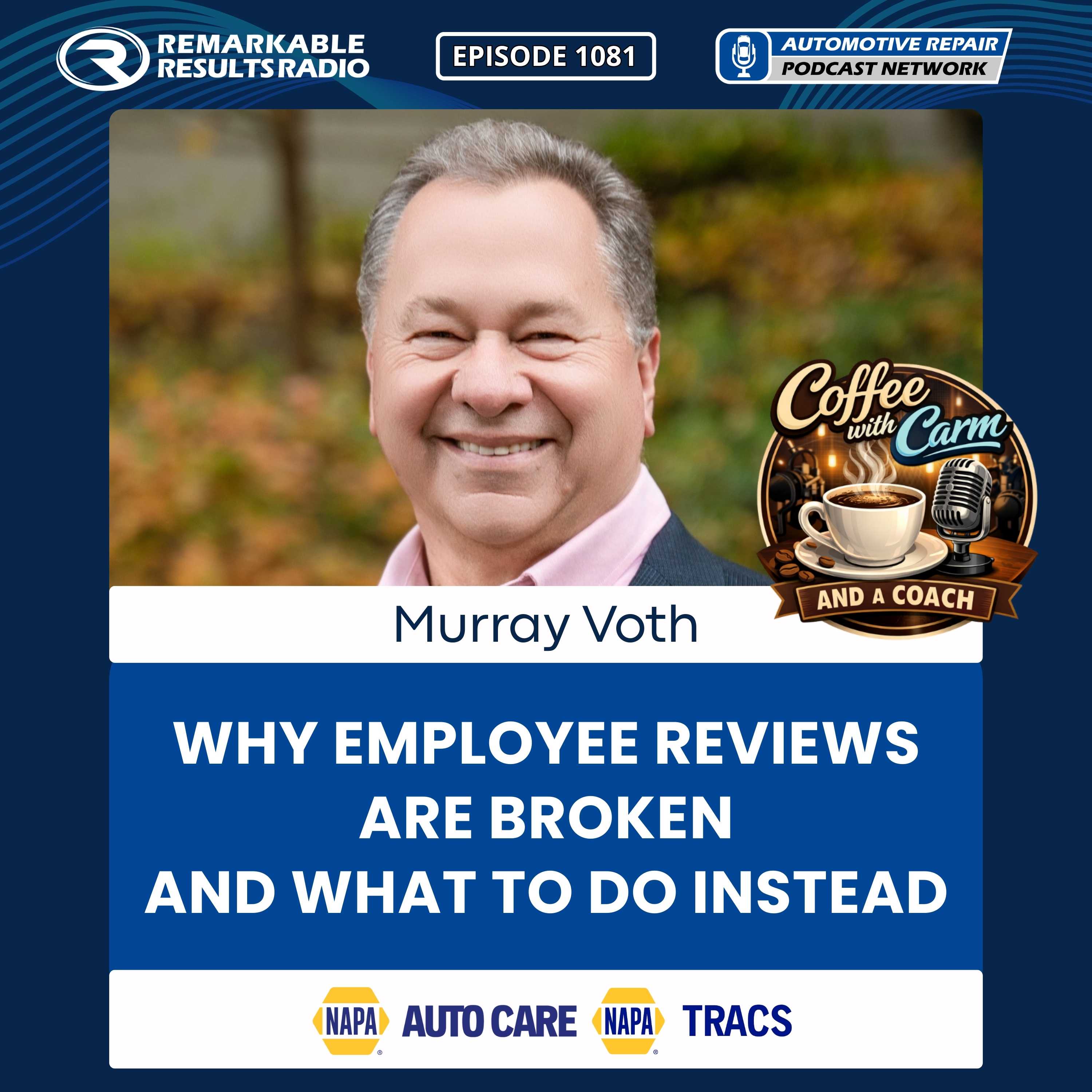
is Murray Voth from RPM Training.
I'm so excited to have Murray here
as my first coffee with Karm.
Not that Murray's been on 20, 30 times in the past.
Don't forget we're gonna be out of the TST big event
Saturday, March 28th, Tracy and I in Tarleton, New York.
Here from educators Andrew Fisher,
Ken Zanders, Adam Roberts,
go to tstseminars.org and sign up
for this one day technician training.
And here from the keynoter, Tracy Capriato.
She's gonna do that there.
I'm so excited for her.
And don't forget for your smartphone,
the Automotive Repair Podcast app,
the ultimate professional automotive repair playlist.
And thank you so much to all of our great partners
for over the years that make this show
available to you for free.
Hey, take your Napa Auto Care Center to the next level
with the Napa Auto Care Gold Certified Program,
increase car count, build trust with customers
and stand out as one of the best.
Talk to your local Napa representative today.
Hey, for over 30 years,
Napa Trax has made selecting the right shop
management system easy by offering
the best most comprehensive SMS in the industry.
We'll prove to you that Trax is the single best shop
management system in the business.
Find Napa Trax on the web at NAPATRACS.com.
Hey, welcome back everyone.
Murray, so glad to have you here.
So what if employee reviews
are actually hurting engagement instead of helping it?
Today, we're talking about why reviews need a rebrand
and what replaces them.
And keep this in mind, everyone.
Most employee reviews were designed for a different era,
long time ago in a galaxy far, far away.
Now today, they often feel more like a formality
than a strategy or force for growth, Murray.
And so what if the problem isn't the people
but the process and or even what we call it?
Yes, yeah.
We're gonna change some language again,
Kerm, which you love.
Yes, we are, Murray.
Thank you for grabbing on to that.
And I know that you are big on this.
In fact, just before we got on here,
Murray is on with one of his clients
talking this whole thing.
So it's fresher in your mind.
Where do we go from here?
What do we start doing?
Well, let's always ask the question why.
I think we should be better at that.
Why should we do reviews?
What is the purpose of a review?
What are we trying to achieve?
These are kind of all kind of why,
questions that I guess in a way.
And at the end of the day,
I'm gonna suggest that what we're trying to do,
accomplish is having an engaged group of people
working together that want to be there.
They want to grow together.
They want to learn.
They want to achieve the vision
that the organization, the company has set out to do.
And reviews are just a part of creating
that employee engagement along with culture,
which is a real hot topic these days
in business as well, right?
So on the outset, two negative things
that we wanna put away in the past.
One is in our industry, shop owners
don't come from HR backgrounds.
They don't come from business backgrounds.
So they get asked to do reviews
or by their coach or by somebody.
They don't know how to do it.
So they're nervous, so they put it off.
They are afraid that it's gonna be negative in confrontation.
It's possible that if they work for a larger company
as a technician, cause most of them probably were or are,
that they had a really bad experience
with an employee review, working at a dealership
or a large brand chain store or something like that.
And so we have this whole negative piece about,
this is a formal way to beat up my employees.
Let's just be blunt.
That's what the perception is.
Yeah, you sit and listen, let me tell you what's on my mind.
And I was upset four weeks ago
that you did something strange
and I really never covered it.
And you sit there and you listen and I know,
what if we called it a career alignment meeting?
Well, that's a good one.
The people that I've been following in another world of HR,
she actually, I have her on retainer,
a lot of her, she does all the HR work for my clients.
She just calls them one-on-ones.
Ah, I love that.
So let's just have a one-on-one.
But before we get there,
Carter, there's one other negative thing
that I wanna set aside.
I still saw somewhere on LinkedIn
a company that was doing 360 employee reviews,
which means that everybody that you work with,
report to, work with, reviews you without the room,
submits it all to somebody who then meets with you
and tells you how you're seen by everybody that you work with.
She has been around for over 10 years
that 360 reviews are a great opportunity to backstab,
set people aside and climb over the corporate ladder.
They don't work.
They're ugly.
So we need to get away from having employees review employees.
There's a place for conversations between people.
And if our time allows it, we might,
we might get to that, all right?
Karm, do you have any other questions
before I launch into a three-part sermon?
Listen, Father Murray,
you do this coffee with Karm and a coach Murray,
just drop it, let's go.
So I wanna add one more thing to your beautiful logo.
Coffee with Karm and a coach and a cookie.
Ha, ha, ha, ha, ha.
We should have a picture of a chocolate chip cookie there.
Wait a minute, were you following me around today?
Because Tracy walked in to the office today
with a bag of oatmeal raisin cookies, my favorite.
And I was gonna bring one down, so you just nailed it.
Oh my God, that is too funny.
All right, Murray, go ahead.
Let's take a look and step back a little bit
in terms of what a lot of employees are looking for.
Now, we talk about the generations and stuff like that.
And yes, there are key differences.
Sarah Fraser, great shout out to her,
does a lot of great work with generational conversations, right?
But we have to remember that we're human beings
and a lot of us actually want the same thing.
We just verbalize it differently.
So if we talk about an employee,
we'll talk about the employers in a second.
I believe from reading research experience
that they want a safe place to work.
They want a place to develop and grow.
They wanna get better at what they do.
They wanna be able to improve their role.
So again, some small companies, it's a bit harder,
but they wanna grow in their opportunity for roles,
careers, you know, back to your career term, right?
Career development or career improvement conversation.
And of course, they want to make more money,
but they also wanna understand how do I make more money here?
Now, that's assuming that these employees
are having the vocabulary or the life experience
to phrase it the way I'm phrasing it.
A lot of them, especially the younger ones,
won't phrase it exactly that way, right?
They'll say things like, I've been bullied
or I've been triggered.
Or they'll say things like, you know,
they'll get the nerve up to ask for a raise or whatever.
The wording might not come out as, you know,
we're public speakers, you and I,
we can do this easily, right?
We've been doing this for a while,
so they might phrase things differently.
So here's what the conversation
that I wanna have with everybody is,
we've been using the employer review in the past
to patch all of our past HR mistakes
to fix what we haven't done well up until that point.
And we also have to separate what the conversations
are about.
So let me walk through a great whole process, all right?
You have an opening for a position in your company.
Number one, does that position,
I call them positional agreements,
has it been documented?
This is what the position does.
This is the outcomes, the results it creates.
These are the specific certifications
and training that is required.
There is no name attached to this position.
It is just a position.
And so what we do is we hire to the position.
Is this person a fit to what we're looking for
as opposed to Carmen and I start talking about oatmeal cookies
or about fishing or about Labat's beer.
Next thing you know, we're best friends and I hire them.
And six months later, I can't stay on the guy
because he's just like me, right?
He's got the same weaknesses as I do, right?
We've all done that where we've hired somebody like us,
we hate them six months later.
And so what we're trying to do is have a position created.
So that'll right away clarify, now that can change,
that can be adjusted and adapted over time.
Have that created.
Then you advertise to that position.
All the advertising marketing for that position
is worded to attract the person that fits that.
Then the interviewing, which is a whole nother episode,
the interviewing technique is on how to elicit
the right human being you're trying to get
to work at your company.
Not so much the 20 years experience on the front counter
and 20 or five years at GM, all of that.
But things like a question that we have an interview
that an academic friend of mine has helped me create,
have you ever been late for work?
And you ask and you listen for the response
and how it's responded to.
There's another question in there.
Well, like I say, for example,
it's a technician you're looking for,
describe a tough diagnostic or a testing procedure
or a testing issue that you had on a vehicle.
How did you approach it?
How did you handle it?
They have to think a little bit and talk about
the 2019 Chevy pickup, the water and the tail light.
They have to sort of walk through.
You listen to how they respond.
You're listening for victim mentality or, you know,
what is it?
I can't think of the opposite of victim mentality,
but right now at the top of my head.
But you don't want to say you're listening for somebody
who takes charge of their own problem
or somebody who blames other people.
So then you interview the person
to see if they're a good fit for the position.
Now it gets fun.
Onboarding, right?
1980 style of onboarding.
Karm, that's where your toolbox goes.
Here's your first oil change.
Yeah, good luck.
I hired somebody.
What's that guy's name?
Four weeks later.
What's that guy's name I hired?
Right?
So there's great resources available online.
You know, AI, all of us are using it a bit more.
Onboarding, right?
Even things like all the legal HR stuff,
contractual employee handbook,
but where the washrooms are, where the change rooms are,
how do the uniforms work?
Meeting your coworkers, right?
Having introductions around the place with everybody.
And then, you know, onboarding on how we use the hoist.
And even if somebody's got 20 years experience,
we onboard them on how we do things here.
In their first two weeks of working,
we've walked through how we use the equipment
and all that kind of stuff.
Because one of the things we joked about
in one of my groups this morning was
the phrase that an employee says,
well, that's not how we did it at my last job.
Oh my God, I'm sorry.
I keep thinking of the word process or protocols
that we have in our business that this individual,
and yeah, if the business crashes,
that's because the individual
hasn't conformed to your culture, right?
So we need to onboard to the culture.
The other stuff is details, like, right?
In terms of approach to cars and stuff like that, right?
So there's that culture beat.
I'm getting to the reviews here in a moment.
So then you've onboarded them,
and then there's a training plan, right?
So everybody is signed up for training.
We assess their needs,
whatever role they have in the company.
So we have a training plan,
and you and I have done,
I think we've done an episode on meetings, right?
We have a daily toolbox meeting.
We have a weekly meeting over basic KPIs,
then we have a monthly meeting
that's a bit broader discussion.
Regular meetings happen all the time
regardless of who shows up,
a culture of positivity in these meetings.
Now, think of everything that we have removed now.
The person knows what the position is.
They've been onboarded to the position.
They've been working there.
We now, 90 days in,
after the probationary period is about to enter,
89 days in in Canada,
it's 90 days, but I always recommend 89
so that if you can't make it to work one day
because you're sick, you don't own that employee,
you can already start the review process.
You can call it a development check-in.
Yeah, right?
Now, we have to also think about
the two sides of this conversation.
There's the business needs,
and then there's the employee needs.
So a lot of my impression that shop owners think of
as training is training from outside people.
So bringing on some of the great technical trainers
that you have in your network
or bringing on one of us coaches for training.
But what about the owner doing training?
The owner themselves training the team
in this process or processor.
I always get mixed up with my Canadian English.
The idea here is we don't need to review
as much of the employee's performance
because that's already being checked in
with all the daily and weekly meetings.
Those conversations are already being head,
like a group setting or one-on-one if need be.
I got to stop you for a moment.
I think it's a brilliant idea to say
that the owner's got some responsibility
to size of the shop, general managers, you know, scaling,
but that the owner can't let...
Listen, we'll find out from Charlie how we do this
or learn from the guys and the girls at the counter
how we do workflow and assignments.
And no, it's like, I guess you're 100% right.
Owner owns it.
There's all this talk of SOPs.
Like the conversations about SOPs and process
and protocols and all that kind of stuff.
Well, who teaches it?
I have yet to hear anybody in a conversation.
Well, some of my clients are doing this
is they work together with the team to develop the SOPs
and then the owner trains them.
This is how we do things.
Here's the why of why we're doing it, right?
Here's the intention of this SOP.
And here's the thing, right?
A lot of owners are uncomfortable with public speaking,
even though it might only be a team of five
they're speaking to, that is the biggest area
of growth for owners in terms of the ability
to speak and train their team, all right?
So now you've eliminated the need
for this 20-page employee review
about how they're performing on this and that
and that and that and that and that and that and that
because that's what even overall should have been dealt with.
So I'm gonna jump ahead
and then we're gonna go backwards a little bit
so that our audience gets a sense
of where I'm going with this.
Talked about this wonderful woman named Sophia.
She's got this company called Upskill Consulting.
She's been a guest with us and our groups.
And then she does for a fee.
She does their employee handbooks and the rest of it.
And she's just brilliant with this topic.
And she calls them one-on-ones.
And she has a little bit more of an elegant way
of saying things, but I'm gonna say the way
I've sort of interpreted it.
So let's say, Karm, we create a culture
where you and I meet once a year or we meet twice a year.
We're finding some group members are doing it quarterly now
where we have a one-on-one and three questions
are on the agenda, only three.
Question number one, Karm, is there anything
that we are doing as a company
that you would like us to stop?
And then you and I dialogue about that.
Question number two, is there anything
that we are doing as a company
that you would like us to do more of?
And question number three, Karm, is there anything
that we're not doing as a company
that you would like us to do?
And you have a dialogue.
Are you an APA Auto Care Center ready to elevate your shop?
Then it's time to step into the premier tier
APA Auto Care Gold Certified Program.
Gold Certified Centers are recognized
as the best of the best,
delivering a consistent trusted customer experience
nationwide.
Now that consistency means more repeat business,
more referrals and more opportunities
to grow your car count.
Now when you're Gold Certified,
you unlock advanced resources, maximizing technology,
boosting your local marketing presence
and keeping your team fully trained
on the latest trends and tools.
In short, Gold Certified Status separates you
from the rest.
So what does it take to be Gold?
To qualify, your shop must be an APA Auto Care Center
for at least one year,
have been open for two years or more,
employ an ASE Master Technician
or hold ASE Blue Seal Status,
co-brand with the Pro Image Program,
maintain a four star rating or hire on Google,
Yelp or Napa CSI,
use digital vehicle inspections,
offer Napa Consumer Financing,
purchase $7,500 or more in Napa Parts Monthly
and participate in a Napa Business Development Group.
It's a true partnership and in return,
Napa rewards Gold Certified Shops
with premium benefits like free priority placement
on the Napa online.com locator,
annual marketing funds, enhanced warranties,
rebates, training opportunities and a whole lot more.
Are you ready to take your shop to the Gold level?
Well, contact your local Napa Sales Representative today
to see if you qualify and start your journey
to Gold Certified.
Increase car count, build trust with customers
and stand out as one of the best.
Talk to your local Napa Representative today.
Let's face it, your shop management system
is the single most important tool in your shop, period.
Napa Tracks was built from the ground up
to make your business more profitable and efficient.
We provide an extensive set of tools
to increase and track profitability in real time.
Napa Tracks offers the industry's best post sale support
hands down and we train your people on site.
Yep, on site and we offer remote refresher training
10 times a week and customer support is open
six days a week.
Give us a call, visit the website
or join our Facebook community today to learn more.
We'll prove to you that Tracks
is the single best shop management system in the business.
Napa Tracks is always customized and tailored for you
whether you're a one man shop
or a large multi-bay or multi-location company.
After all, it's your shop, so it's your choice.
Visit us on the web at Napa Tracks, that's N-A-P-A-T-R-A-C-S.com.
It's the employee's meeting basically.
Is the owner gonna just sit there and listen
or have a dialogue?
I think it's gonna take practice.
I think we're gonna have to learn to listen.
I believe we're gonna have to learn to have a dialogue
and then this is where this skill comes in
that's gonna take some practice
and we'll get to some more detail here in a minute
for the owner side of things
is I think that's gonna open up conversations
about the employee's needs
but also about maybe some of the things
that they're not bringing to the table.
So they might ask for something
and then you might be able to have an opportunity
and say, hey, that's interesting that you bring that up
because two other people have brought up something similar
from a different point of view
but it's very similar that they need
from the company as well.
And I realize that maybe I need to help each
you guys talk to each other about this, right?
So something that that employee needs to change
to improve with their interaction
with these other two people, right?
I guess we have prepared a couple more examples of that
but we're talking about and maybe where we rephrase
that a little bit is, are there any obstacles
to getting your job done or accomplished?
Murray, I gotta stop you from one
because I think my big takeaway
in this thought pattern of yours
is if you can learn to sit on your hands
and just continue to ask why, why?
So if anything to stop and that person
that you're doing this interview with,
you're one on one, well, why?
You have a level of curiosity.
You gotta be taking some notes
but the individual can dive deep into things
and maybe let you realize that where they came from,
they were doing a few things weird
but they're comfortable with it
and they would rather like the short version
than the long version that we're doing.
I don't think, is it a time to explain why we do what we do
or do you just wanna sit and listen?
Well, I would say we listen first document
and then I would say, this is a natural,
well, I don't know, I've practiced this
for a lot of years as a coach
but this is where you learn to ask more,
like you said, the questions.
So let's just use an example.
Karma say, for example, you have brought up to me
that you don't like the way the parts distribution's working.
We have a bin system,
we have a purchase order number on the work order
and my bin is bin number three
and you say to me, Maria, I don't like walking,
I'm in the farthest bay across the way
and I don't like walking all the way to get my parts.
Is it possible that we could have a bin system
across on the other side of the shop?
And then you say, well, you know,
that's actually a good idea,
let's make the service advisors walk
and that way the parts are right by you, right?
So then that one's evolved right there.
Well, let's say, for example,
you don't have the space for the bin system
to be on the side, maybe you've only got four bays
and there's no space to put another set of shelves up
for the parts to be brought over to you.
You can say, so is there a reason why
that bugs you that you have to walk across there?
Well, you keep telling me that, you know,
I'm supposed to be more efficient
and I'm supposed to get my job done faster yet.
You know, I feel like I have to walk all the way
across the shop to get my parts,
whereas the guy closes to the parts,
you know, he can naturally be faster.
Then you can say, well, I appreciate the fact
that you're worried about your efficiency
and your productivity, Karm.
At the end of the day, you know that that,
your numbers are actually pretty good.
I wasn't actually worried about it that much.
I understand that you have to walk further for the parts,
but here's some other areas that you're actually stronger at.
Or we have a discussion about the hoist layout.
Maybe we need to reassign the one person
that does a lot of the heavier work,
like a different bay, and we discuss, you know,
why don't we move that toolbox there, your toolbox here,
but let's have a dialogue with that other technician, right?
We're kind of spitballing at this point,
but the idea is, is the conversation comes up,
they can bring objections and we can say,
well, here's how we see it, and then the dialogue begins.
And I'll bet you if you decide to carve out 15 minutes
for a three question ask or a four question ask,
it's gonna go on for an hour.
If your employee, and it doesn't matter
if this is a new employee after, you know, 35, 40, or 60 days,
or it's a legacy lifetime,
because you changed the format of this,
and now you're really, you're deep into the pool.
Why, what's going on?
What do we need to know of obstacles and all that stuff?
I gotta stop for one minute and say this.
Great idea when the purchase order is sent up
to the parts store with obviously the RO number on it.
There's another number at the back side of that,
and that's the number of the bay.
When the delivery person comes in
and they know your bay layout,
they're gonna bring the parts directly to that bay
or that specialist,
and the signature is gonna come from inside.
But hey, I dropped them off at Johnny's place
because drivers get to know your people.
Drivers get to know your layout.
It's a quick way to shortcut that.
I get why it all needs to be in a central place.
I really get that because somebody wants to observe
that all the parts are here,
but I love drivers dropping them off in the bays.
I think that's a cool idea.
Yeah, and there's multiple systems
that people are using for that.
Some people have a central bin system.
Some people have a shelving spread out throughout the shop.
I know two shops that have shelving
right beside each technician's workbench,
and it's brought right to them.
And again, they have the space for that,
that ability to do that.
So I get it.
These are great ideas.
The other question that came up today,
and comes up very often in this conversation,
is the wage review.
There's this assumption on the part
of a lot of business owners that the employee review
is also at the time of the wage review.
So, Karm, here's a list of five things
that you need to improve on,
and if you improve on these, I'll give you a raise,
or what do you think you need to improve on, Karm,
and da-da-da-da-da-da, right?
Employees will generally grade themselves
higher than they actually are.
We tend to grade themselves lower than we actually think.
So that whole grading piece,
I don't think works really, really well.
Now, I have a couple of clients
that have proved me wrong with what I'm gonna say next,
but they have a culture in which they can,
a context in which they can prove me wrong.
I feel that the wage review is a separate conversation
from the check-ins that we just talked about, right?
The one-on-ones that we talked about.
Specifically an only wage review.
Correct, right?
Now, the reason for that is,
is I wanna be able to have a conversation
about your concerns,
and even about your performance
without money hanging over our conversation.
I get it.
There's a piece of, their brain is going,
oh no, oh no, am I gonna get a raise?
Am I gonna get a raise?
They're not even thinking about the conversation.
They're just thinking about,
is the word raise gonna be in this conversation?
As opposed to, and again,
people do this differently once a year, twice a year.
I like twice a year, it spreads it out a little bit,
where you sit the person down
with a set of KPIs that they have control over,
they've been trained on, they've been engaged with,
they can teach you back
how they have control over these KPIs,
and then you can talk about
how they're going to get a raise,
or how they could earn a raise, right?
It could be productivity efficiency,
build hours per technician per day.
We don't have to get too carried away on KPIs.
There's lots of other episodes
with numbers that your guests have done, right?
We could call that a metrics review.
Yeah.
And metrics have everything to do also with wages,
it's numbers.
So we have a development review,
career development review, and we have a metrics review.
Now, one client this morning does them at the same time,
but the employees, he's got them where they're engaged.
Like his culture, he's worked very hard
over the last few years at it, where it works, right?
They have the dialogue about how all that all works
in that place, but generally I find initially,
it's important to separate them.
Now this leads to, and I don't want to go off in the weeds
with incentives and bonuses and stuff like that,
because that's a slippery slope,
but what I do want to say is, is we need to have a plan
so that our employees understand how raises work,
when and how they work,
so that they're not just left hanging,
thinking about when can I bring up a raise,
or when does it come up?
They will know that every January the 15th
and July the 15th, they're going to have that meeting.
They know that, they've been told that
on the onboarding process, this is how it works, all right?
So at Christmas time, or the holidays,
is fraught for a lot of people.
It's a really happy time for a segment of people,
and it's a very sad time for a segment of people.
I remember back when I was an employee at a company,
one year I received a $200 bonus,
which was a lot of money back in the late 80s, really 90s,
and the next year I got a Starbucks coffee mug,
and I was confused.
I understand, what did I do wrong?
What did I do wrong?
And so we need to separate the end of the year
holiday celebration piece from the business piece.
So if you, and by the way, everybody listening,
you're going to do this your way.
This is not, I'm not going to judge you.
I'm just laying out some of the pitfalls that happen
if you are not careful, right?
If you want to give your employees a Christmas bonus,
right, that's unrelated to their performance,
that's fine, that's a gift.
Some shops have moved away from a Christmas bonus dollar wise,
and they've put on a nice celebration with a food basket
or some kind of a gift shopping cart or whatever
to a grocery store.
And then in January, they review the year,
or wherever the fiscal year is, and they review that,
and then they do bonus saying,
and they do stretches around that whole piece, right?
So the idea being is,
is I think we need to separate the rewarding process.
There's the gift as in we're celebrating the holidays.
Here's a gift from us to you.
And then we separate that from incentives, bonuses,
and other payouts and raises
are part of a business conversation.
I think that really helps clarify things for owners
and for employees about the emotional side
of that whole piece.
Just because we finished, you know,
we're just on the other side of that hill of the holidays,
right, is a thought that wants to be.
I love it.
What I'm hearing from you, Murray,
is thematic every sit down
and say it is quarterly, has a different theme to it.
And you know exactly when you're gonna talk money,
and maybe that's not a great idea, but maybe it is.
And I love the concept of the metrics review,
even if it's more than twice a year,
because even though they may be public,
or everybody can see and share,
depending on how transparent an owner is, Murray,
I imagine that the more an individual knows
what raise time or wage increase time is,
they shouldn't have a problem
knowing what's gonna happen.
Obviously business dictates how much of a raise,
like, you know, because sometimes it's
not the employee's performance,
it's overall business atmosphere,
other challenges that the business might have,
you know, the business might have an unexpected expense,
you know, a new law has changed,
now they have to pay more for some other fee,
or whatever, right?
There's things, business decisions that have to happen.
But the clarity, now I have people
that I've worked with over the years,
you know, in different contexts.
I have to be careful what I say,
because there's people that know people
who I know, et cetera, et cetera, right?
So I'm gonna be a little diplomatic here.
Yes, sir, I understand.
You know, working with some younger employees of companies,
the owners are walking around,
talking about, oh, things are tough this month.
Or, you know, if we don't reach this,
we won't reach our profit goals.
And the employee being a caring, engaged person
begins to take on the stress of that owner.
And I think that is really inappropriate
for owners to be walking around,
talking about how bad it is.
I mean, let's talk about how good it is,
but then there should be a direct connection
to the employee's remuneration at that point too.
But this idea of being so transparent
about how the business is in front of your people,
I don't think is fair to them,
because they're not always as financially sophisticated
or business sophisticated,
where they understand that this is a temporary downturn
or a temporary challenge that the business is facing.
That's so interesting.
I think it's heavy on both sides.
Some like to be transparent,
they wanna teach, you know, where the money goes.
But how are you doing that, all right?
So if you have a culture where you are very transparent
and there's a set of numbers that everybody sees,
and I know people that show everything, right?
I have clients that show everything right to the net.
And they have those conversations.
They're a mature, guided conversations
about the reality of where they're at.
I got no issue with that.
Where I have an issue is a shop owner
who barely understands their own numbers,
is not doing regular reporting,
is behind on their books with their account,
and is walking around because they're checking accounts
low, walking around going,
oh my goodness, business is really slow this month.
Or man, I'm stressing out.
They're dumping their own BS on their people.
That's what I meant.
There's just no way that should happen.
I mean, I would wanna sit down with an individual
and ask him the why question.
Why are you doing this?
What empathy are you looking,
or sympathy are you looking for?
These are squarely your problems.
I don't think your people, wow, wow, okay.
Well, I gotta leave.
This place is going nowhere.
I gotta go find another job.
I mean, the connotation of something like that
is just terrible.
Now, I'm not saying that the business being transparent
could be something gonna happen.
Road closure, damn hurricane, whatever.
Those are the things that challenge a business.
But you don't seep in the negative
because say we're gonna pull out of this thing, everyone.
We're gonna pull together.
You know where we're going and how we're gonna get there.
Oh yeah, like we're not gonna be high to be polyannish,
but what I'm saying is we're gonna do it appropriately,
structured.
I love that word.
With a plan, moving forward on how,
and ask them for solutions too.
Like once they understand the problem,
ask them for solutions,
because there is knowledge and wisdom in your team as well.
Hey, look, before you keep going,
we're with Murray Voth, RPM training.
We're talking our employees' reviews broken,
and I hope you're enjoying this as much as I am.
Listen, I always have coaches on,
but I've decided to call this thing,
coffee with Karm and a coach,
and we're gonna start doing these monthly specifically
with coaches, even though I just do this all the time.
I just wanna kinda narrow cast this down
and have people tune in to hear the wisdom
from all the coaches that I know in the industry.
Okay, I had to do a little mini commercial for you there.
All right, fantastic.
Well, a mini commercial, this is amazing.
So the nagging question, that might still remain.
We've done developmental conversation, career development.
We've done the metric conversation.
Where do we have that conversation
about improving their performance
or improving what they're doing?
There's no reason why we can't do those ad hoc.
Like, in other words, we see an issue.
It's not a review, it's a training opportunity.
We have to separate, and maybe it's just semantics,
but for me, it's like, hey, Karm,
I'd love to talk to you about something here.
Between your next two cars,
we'll have a little chat about it,
and then you just go through the thing
that you wanted to talk about, right?
This is an area that I had a lot of growth
when I was young in business.
I didn't like it, still don't, I can deal with it now.
I've got the maturity, but I didn't like confrontation.
I wanted to be a nice guy.
I wanted it to be light.
I didn't want to be negative to my employees.
And so then I would delay dealing with stuff, right?
I'd be walking through the shop from parking in the back
and going to my office, and I'd see something going,
and I'd be like, I got to get to my desk and finish this,
so I would avoid that.
I would say, I'll deal with it later.
Of course, I wouldn't deal with it.
And then something else would happen four days later,
and all of a sudden, three weeks in,
I yell at somebody, right?
I lose my temper, very explodes, and it wasn't good.
So I did get some help with that and learn to step in again.
But let's circle back to,
let's say a person is doing a process incorrectly.
Now, I'm gonna use an example
that I may have used somewhere in our episodes, Karin,
but I think it's worth repeating
because it's so real and so much fun for me.
So a client in conversation in his group
talked about this young junior employee
who was doing the wheel balancing,
like for a winter tire changeover, right?
So this is in the fall doing that.
He had delegated to his technicians
to train this new young apprentice
on how to do wheel balancing, all that kind of stuff.
Now, part of the process of preparing a wheel
to balance it is to clean it, right?
If you have mud or accumulation of stuff inside that rim
and you put it on a balancer, you might balance it now,
but if some of that mud breaks off later,
it'll be out of balance.
And so you're supposed to wash the rims, right?
Before you balance them.
So my good friend walks by this young fella,
the wheels are not wet, they're dry,
they're on the balancer,
and he snaps at him and says,
how come you didn't wash them?
And the young fella said, well, they look good to me.
Now, that's the story I heard, right?
The complaining about these young people today,
da, da, da, da, da, da.
So I asked the owner, I said,
go back and ask the kid why he has to wash the rims.
What do you mean?
He got trained.
I said, no, go back and ask him,
why does he have to wash the rims?
And he had never been taught
why he was washing the rims.
He thought it was cosmetic, right?
So here's a young person who got yelled at,
they said it was fixed,
but who got yelled at because the training gap
in terms of why they were actually doing something
was missing.
I'm learning lessons as a coach
after doing this for so many years,
and I have now added some more layers
to some tools that we use in RPF.
And this is the, you've probably heard,
have you ever heard of Blooms taxonomy?
The whole learning process,
teaching process and stuff like that.
So I've taken Blooms and a couple of other
or things that I don't remember the names of,
and I now have a list of about 80 things
that my clients need to self-assess them.
Okay, so question one is,
I have taken training on this topic, okay?
Green, yellow, red,
they have a toggle in the sheet to tell, okay?
Number two, I understand this concept
and can explain it to my coach in my own words.
So in other words, as an employee, as an apprentice,
I can explain in my own words
to the head technician, to my boss,
why I have to wash the rims, okay?
So we asking them, teach us back to us, teach me back, right?
Number three, I know how to implement
or apply this knowledge, right?
Because there's one thing to know the theory,
it's another thing to physically or mentally do it.
Number four, this concept is implemented
or this process is implemented
or whatever, my employee's now doing it successfully.
And number five, we have evaluated
this concept when appropriate.
So if you think about the five points,
when somebody's not doing something right,
question number one is, have they had the training?
Question number two is,
can they teach you back in their own words?
What it is that you're asking them to do?
Number three, can they demonstrate
that they understand the implementing it,
taking the theory and actually doing it in real life?
And then a little check, yes or no, is it done?
And then number five is as it's evaluated.
So many times when people aren't performing or doing
or do something different or whatever
is because they haven't had the training
or they may have had the training but don't wanna comply,
which is we have to be ready for those conversations
back to the why.
So is there a reason why you feel
you need to continue to do it this way?
You know, Murray, should business be this sophisticated?
I'm being a little sarcastic
because you and I and everyone in the top tier
of our industry knows this is how business
needs to be done today.
Let's address that from the standpoint
of the blue collar tradespeople
that are generally listening to us, all right?
I'm hoping that in our audience,
there are people that had a great experience
as an apprentice slash junior technician
with a mentor or a journey person, all right?
Like we have the formal apprenticeship program in Canada,
you know, there's ASC in the States, there's other things.
So if you think about that mentor-mentee relationship
or that shop foreman or that journey person
and apprenticeship relationship,
there's a formal relationship there
and that journey person is walking you
through the tasks and the skills
and repeating and repeating and showing you the best way
and showing you the tips and the tricks and the hacks.
It's already happening, Karm.
The good tradespeople are passing on their knowledge
to the new tradespeople.
They're not using the same formal language that we're using.
There might be quite a bit of salty language
mixed in there, right?
But it's already been around for centuries
where there's been good mentors
and people learning from those mentors.
What's happened is in our industry specifically,
because that's the one I know,
is a lot of these people then went on to be owners
and began to feel the financial stress
of business ownership.
And then without the lack of,
without the formal training about psychology
and how people work,
they begin to push and shove and bully people
because that's just how they think they have to do
to get the business to be profitable.
Or if they had a negative,
so here's the other thing, Karm,
is for all the ones that had a negative experience,
they're gonna do karma is whatever
and they're gonna teach their apprentice,
they're gonna beat up on their apprentice
as the way they got beat up on.
The number of times I have heard a journey technician say,
these young people got a tough enough
because you should have seen what I went through,
has to stop.
We have to stop the hazing,
we have to stop the bullying.
At the end of the day, it's really,
yes, there are some psychology pieces
that you need to understand,
but at the end of the day,
it doesn't have to be that complicated, right?
Like, is there anything that we need to improve on?
Is there anything that we're doing you'd like us to stop?
Is there anything that you'd like us to continue to do?
It's pretty simple, three questions, right?
And then the other five that I just listed,
has the person been trained?
Can they explain it in their own words?
Can they demonstrate that they can implement it?
Has it been implemented, right?
And have we evaluated it?
That's eight things.
Wow, very, very heavy.
I mean, you've got this thing, really.
You've done so much research on this,
not only on the review thing,
but getting in deeper as to how people are going to respond
to your leadership.
I mean, that great story.
What about washing the wheel?
I can only think that if I was an owner,
what could I take back with this?
It was a now moment.
Think about that.
It was a now moment that you cannot let faster go away.
That individual didn't do the job that they were asked to do,
never were taught to do,
then that person will continue to do nothing
because you didn't create this now moment.
Hey, now let's talk about this.
What I'm saying is a leader,
maybe if you think about as you do management
by walking around and you hang with your people
and you're observing and you're doing all these things,
in the back of your mind is there a now moment
that we can have to teach, to share, to understand.
You know, again, hey, Bob, come over here
and explain to Charlie why we wash.
And maybe when you teach, you learn,
and now somebody becomes a part.
Hey, thank you so much for telling me about this.
So this now moment opportunity, I love it.
Well, you just said a key phrase that hasn't come up yet.
When you teach, you learn.
That owner has to teach all this stuff.
And as they're teaching, they're gonna go,
oh, oh, that sounds like crap.
Or, oh, I just heard myself say that.
And that is, there's so much power in it.
And Karm, I have been teaching and training for 30 years.
And I still have a how moments, you know, weekly
of concepts and stuff that I've been working with.
And when you teach, you learn because, you know,
and something else that you said is that feeling
that a person gets when they learn something
and it's not that, you know, here's a better way.
I'm gonna use one from outside our industry,
a personal experience, one of the happiest,
funnest days of my life.
I did my commercial pilot's license many, many, many,
many years ago.
In my early flying private pilot's license,
there's a thing that you do in airplanes
called a steep turn.
As you go into a steep turn, the nose wants to go down,
you have to pull back on the yoke, you know what I mean?
And add power to stay steady.
Well, I could not keep an airplane
in level flight in a steep turn.
I was chow, right?
My regular instructor had a bad cold.
I had a substitute named Rick.
We'd take off, we'd go to the practice area,
and Rick says to me, Murray,
anything you're having trouble with.
And I'm like, yes, steep turns.
He said, show me how you're doing them.
So I showed him.
And he said, what is the tool that you use
to relieve the pressure off the control services?
Oh, the trim wheel.
There's a little wheel that you turn.
He's like, okay, try again, trim it.
And literally we took our hands off the controls.
It was stable air and we were going in steep turn circles
when the airplane was level.
And somebody asked me what I was having trouble with,
got me to show them how I was doing it incorrectly.
And then just by giving me the hint of the tool,
the part of the airplane I should be using,
because I hadn't thought all the steps through.
I was pretty early in this career.
Carm, the feeling of joy and satisfaction
of 45 years ago still comes to me
when I think of Rick and that day.
I use that example all the time.
Thank you for that inspiring story.
And I'm gonna make a change to what I said
just a few minutes ago.
Remember I said a now moment?
Now I wanna change it to a discovery now moment.
Because that's what happened to you.
You discovered by someone giving you the,
listen, I wanna help Muriel
and I'm gonna give him a discovery
and he now has a now moment.
It may sound like three words that don't work together,
but in the story of cleaning and washing the wheels,
this is a discovery moment.
It may not be a now, a discovery moment now.
Maybe that's what we need to say.
I'm sorry I'm kind of clouding this thing up with words,
but I think people, if they can,
oh my God, that makes sense.
And then they own it, buy it and do it.
Own it, buy it, do it.
Yeah, and for technician,
I mean, this works for advisors, managers,
it works for any role possible,
but even in my circle, Carm,
where we have people on different brands
of shop management software.
One person will talk about a challenge you're having with
and the other person will be,
well, let me show you on the share screens,
let me show you.
We use Slack, thank you for the information
a few years ago.
We have Slack chat with all of our clients.
We have channels.
And without using the names of the,
because I'm agnostic to the brands
until I'm cornered in a corner, right?
Not publicly, of the different brands of SMS,
but we have the five main brands used by my clients
and they can chat with each other
about challenges with the software.
And many times he's like, oh jeepers,
I had no idea that was there.
The rep never taught me that, right?
And so I'm already watching this
with my clients doing that with each other.
I can just imagine a second year apprentice
who is struggling to release a really tight,
fast or whatever.
And the technician walks over and says,
hey, let me show you how to use an impact
or how to use this or how to use that.
Here's some things that I've learned
that are really helping with that.
And that discovery moment,
how good that person's gonna feel.
And the next time they can do that job by themselves
without that help,
I think is gonna really engage people.
Wow, I mean, where do we go?
I mean, we're already 49 minutes in
to this employee reviews are broken
and we went to a million different little side hustles
and I love them.
But I think we've got the message out there.
This isn't you sit down once a year and talk wages.
This is an employee reviews can almost be ongoing.
I mean, I'd love to be scheduled, I get that.
I love the idea.
We can have them, they could be growth conversations,
performance partnerships, career alignment meetings.
You can call them whatever you want
or you can have separate ones no matter where they go
and let that employee, that team member,
realize that four times a year you're getting together
with the manager and or the CEO of the business
to talk stuff.
Now, the leader to your point earlier
has got to know how to dive into those three questions
and dig them deeper with the why question.
And I'm telling you, you walk away with a great feeling
that I'm in a, I'm working for a great spot
or I've got the wrong person.
There are two ways that you can come out of it.
Exactly, like the person just is in this,
these are two more points I wanted to make that
finally came back to me.
If the person's uncoachable, we might have to part ways.
And that's what I was gonna say is the language
that a lot of modern employees without generation,
modern employees looking for is coaching.
They want to be coached.
So how do I get better at running the 100 meter, right?
How do I get better at football?
How do I get better at baseball?
We have coaches for so many things.
Why can't we see ourselves as a coach to our employees?
Marie, are you teaching your owners
how to coach their people?
Yes, remote modeling it with the way I coach them.
We have monthly meetings.
We have individual sessions together.
We are using the same principles across the board.
I'm in love with this concept.
Teach him how to be a coach.
Go ahead.
The last one.
The other one is, you know, the one-on-one,
you know, yes, it's scheduled.
It doesn't have to be that formal.
A lot of owners that are doing that are finding it off site
in a restaurant doing lunch or doing dinner.
It's calms it down.
It's a social, we're breaking bread together, right?
So that's a piece that I have found
that has worked well for a lot of people.
So there's the coaching piece.
There's the breaking bread together piece.
So one of my clients this morning,
who was just turning 40, got frustrated
with an employee, a young employee,
and said, I've been working at a shop
longer than before you were born.
He went, holy mackerel, I'm old, he's 40.
And I looked at him and I said,
when were you born?
And I said, I started my career the year you were born.
So it gets worse.
Anyways, yes, it does happen.
Now we need to train our team
that we're going to be doing this
and the why we're doing it.
You don't just wake up one morning
and call an employee into the office and do one of these.
Because what happened with me was I got inspired to do these.
I called my first employee into the office
and everybody else was running around going,
why did Earl get called into the office?
Did he do something wrong?
And I'm like, oh, I guess I should have told everybody
that I was going to do this.
Really important to lay the groundwork,
train them on, right?
And one of my clients years ago,
one of my early coaching clients
when he talked about doing staff meetings,
his hands were shaking.
He was that nervous about it.
And he said, what would my first agenda item be?
I said, your first agenda is why we're doing staff meetings.
I love what we talked about today.
I think it's an inspiration for owners out there
to rethink, of course, the whole review process.
And I love your final point was so, so strong.
Here's my takeaway.
Our review policy and protocol, okay?
I love the word protocol today.
Actually, it's protocols above the process.
And so here's our protocol for reviews.
I want everyone to know it.
I'm going to sit with you quarterly.
We're going to call it this.
We're going to talk about all these things, be prepared.
Everybody's going to go through it.
We're going to have a blast.
You're going to teach me, I'm going to teach you.
I want to know what's going on in your world,
how we can make the business better.
I mean, what a great introduction in a meeting
for everyone to start realizing
that these yearly reviews aren't going to be pain.
You know, I have a pain streak.
I got to take IBU profan before I go meet with Murray.
Yeah, it's an IBU profan day.
It can be, yeah.
rpmtraining.net, Murray Voth has been a great friend,
a great coach in the industry.
From Canada, I think you probably heard him say process a lot.
Thank you so much for being here.
We're going to do coffee with Karm and a coach often
because I think our coaches have so much great wisdom to share.
And you can sit back, listen on our app and share it with a friend
and have a blast.
Murray Voth, thank you so much for this.
Oh, my pleasure, Karm.
Absolute pleasure.
Thanks for being on board to listen and learn
from the Premier Automotive Repair Business Podcast,
Remarkable Results Radio.
Get your episodic education on the ARPN listening app
at automotiverepairpodcastnetwork.com.
Also enjoy the podcast on our Karm Capriato YouTube channel.
Karm is all for advancing the professional automotive service industry.
Until next time.
About this episode
Murray Voth and Karm Capriotto dive into why traditional employee reviews often fail to engage automotive repair staff and propose a fresh approach. They discuss the negative perceptions around reviews, the importance of clear job roles, effective hiring, thorough onboarding, and ongoing training. The conversation emphasizes shifting from formal reviews to more meaningful, regular one-on-one career alignment meetings that foster growth, trust, and culture. They also critique 360 reviews and highlight the need for better communication tailored to individual employees’ needs and generational differences.
In this episode of Coffee with Carm and a Coach, Carm Capriotto and leadership coach Murray Voth explain why traditional employee reviews often fail to build trust, engagement, or real growth. Instead, they advocate replacing formal evaluations with ongoing “Career Alignment Meetings,” and one-on-one conversations focused on coaching, open dialogue, and removing obstacles.
They discuss the shop owner’s role as a coach, the importance of onboarding and positional clarity, and why wage discussions should be separated from development conversations. Murray also shares practical tools, including the three key questions that drive meaningful feedback and real-time coaching moments.
This episode offers a modern, human-centered approach to leadership that strengthens culture, improves communication, and helps employees and shops grow together.
Timestamps
(00:00:00) Introduction: Coffee with Carm and a Coach
(00:03:00) Rebranding the Review
(00:05:30) The Problem with 360 Reviews
(00:08:00) What Employees Actually Want
(00:12:00) Hiring for the Position, Not the Personality
(00:16:00) Modern Onboarding & The 89-Day Check-In
(00:26:00) The Three Magic Questions
(00:32:00) How to Handle Employee Objections
(00:36:00) Separating Wages from Development
(00:41:00) Holiday Bonuses vs. Business Incentives
(00:45:00) The "Rim Wash" Lesson & Bloom’s Taxonomy
(00:49:00) The "Discovery Now" Moment
(00:52:00) Breaking Bread & Setting Protocol