LIVE
ACAS powers the world's best podcast.
Here's a show that we recommend.
Do you like being educated on things to entertain but don't matter?
Well then, you need to be listening to the podcast with Nox and Jamie.
Every Wednesday, we put together an episode dedicated to delightful idiocy
to give your brain a break from all the serious and important stuff.
Whether we're deep-diving a classic movie,
dissecting the true meanings behind the newest slang,
or dunking on our own listeners for their bad takes or cringey stories,
we always approach our topics with humor and just a little bit of side-eye.
And we end every episode with recommendations on all the best new movies,
books, TV shows, or music.
To find out more, just search up the podcast with Nox and Jamie
wherever you listen to podcasts and prepare to make Wednesday
your new favorite day of the week.
ACAST helps creators launch, grow, and monetize their podcasts everywhere.
acast.com.
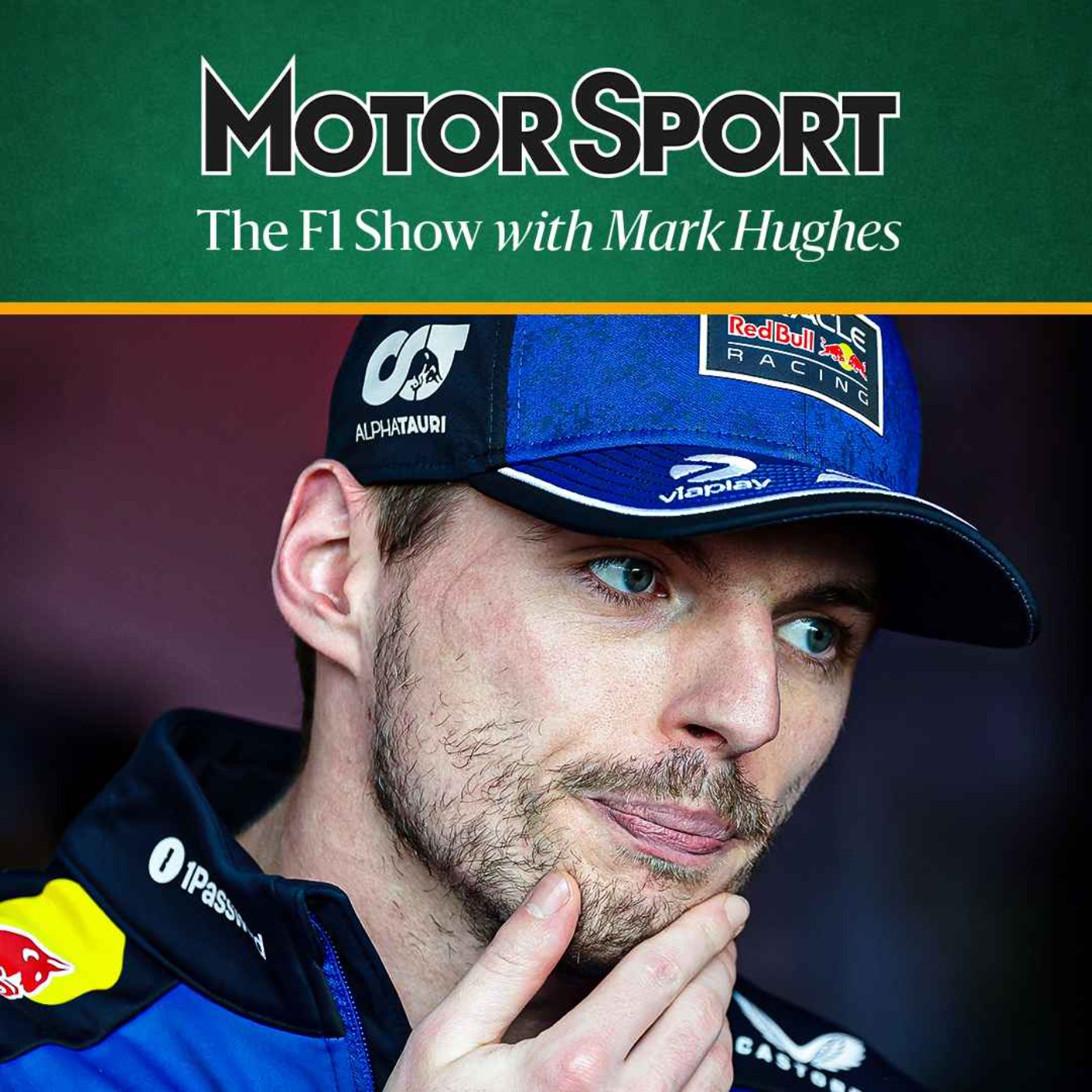
Two top F1 drivers punished by the new regulations,
with two very different reactions.
Max Verstappen and Charles Leclerc can't race the way they want to
and Verstappen is threatening to quit.
But Leclerc has built a team to help him master the new rules.
We look at what's going on.
Plus, F1 faces a crunch meeting,
and who is Formula One's greatest ever team boss?
So, a fair bit to get through on this episode of the Motorsport F1 show
with Mark Hughes.
Well, Mark, as this episode is launched and goes live,
there's a very big meeting going ahead,
which is going to change the regulations, perhaps for the rest of the season.
Rather than speculate on what may or may not happen from this meeting,
there are implications through the grid aren't there.
And I guess each team is going to be looking at it from a slightly different angle,
but they all want the same outcome, I suppose.
I think this is such an important issue of Formula One,
getting this ride, getting the energy split right
and trying to address the criticisms that Formula One has brought on itself
in these first three races, that there's an overall broad consensus
among all the teams between Formula One management and the FIA.
So, I don't think anybody's sort of offside.
There may be, you know, people hoping that it goes more
in favour of whatever their strengths are,
and, you know, there's maybe others that hope that some of their weaknesses
can be disguised a little bit more with whatever's decided.
But I don't think anybody's fundamentally opposed to the idea
of making substantial changes to try and address the issues
of the type of racing we've seen in, but in particular, there's two issues.
There's the closing speed differentials between a car on charge and one that's not.
And the very obvious way
that drivers are having to not attack corners in qualifying.
And so these are the two things that have to be,
that are the main things in the sights of those looking to truth the rules.
Yeah, as I said, the speed differential was highlighted really by Ben
and wasn't it last time out at Suzuka.
We're not going to dwell really on the ifs, the what's the maybes and things like that.
We'll come to that next time when we have some concrete answers, hopefully.
But Formula One has possibly had a break when it needed to.
Obviously, the reason for the break is not at all good news for the globe.
And hopefully, you know, it gets resolved as quickly as possible
for the benefit of everybody.
But to Grand Prix's missing means that the FIA Formula One management
that teams have a bit of time to to iron this one out
and then work on whatever the outcome of this meeting happens to be.
Yes, exactly.
We, you know, there's there's bigger, more important things happening
in the outside world than in Formula One.
But there's a lot happening in Formula One as well.
So, yeah, let's let's hope it all gets resolved in a in a way that keeps
the maximum number of people happy.
Yeah, absolutely right.
Now, your latest column, the MPH column talks about two drivers
relating to this issue and how they both approached the the troubles
that they're facing with their respective cars, talking Max Verstappen
and Charles Leclerc.
Why did you choose these two drivers specifically to focus on?
I think it's quite interesting where they're both out in their careers,
two drivers of immensibility and both being compromised
in how they can express their talent at the moment,
partly by just the traits of their individual cars, in the case of Max Verstappen,
but also by the the traits of the regulations
that the regulations have imposed upon driving styles.
So they're being affected in different ways.
But it's quite interesting because people when people are trying to rate drivers
and who's who's best, who's better than somebody else, where everybody stacks up.
It's it's quite a misleading thing because it's not it's not some constant.
And it depends upon the circumstances
and it depends upon whether their car allows them to exploit
their talent and sometimes you'll get a false ceiling put upon it.
And this is what Max is going through at the moment with a car
that has quite a lot of slow speed understeer.
And this is where he was in early twenty two and twenty three
when if you remember Sergio Perez was very competitive with him.
It wasn't that suddenly Perez had become as good as Verstappen.
It was just that Verstappen had a sort of false ceiling put upon his special stuff.
He couldn't access it because the car just didn't allow him to do that.
And in his case, what he's wonderfully good at
is getting the initial very quick rotation of the car into a slow medium speed corner
by how he's trading off the braking in the steering.
And but then not suffering a time loss
through getting the rear tyre scrubbing in the the rest of the corner.
So most drivers when they try to do that, well,
yes, you can get the quick rotation by doing that,
but you'll tend to not gain as much lap time doing that
as you then lose from the excess scrubbing of the rear
because you haven't been able to feel as delicately as he can.
So he can pivot on a credibly narrow point.
And that's where when you make the car really pointy,
that's where the gap between him and a say a good but not a great driver
really increases.
So that that's where he is at the moment.
But even even though that's a trait of the car rather than the regulations,
he's further frustrated by the regulations
because when he can get the car to do that, all it means is that he's using up energy
that then he doesn't have down the straights and he gets punished for doing that.
So the other thing with the Clare,
the Clare's got this amazing ability to just hold the car right on the edge
of the rear grip and hold it there just throughout through a corner.
So he's sort of quite acrobatic in that.
But he then he's punished for this new regulation set
because when he he goes to do something really spectacular,
something that he's saved up for the final run in Q3.
The algorithm doesn't recognize what he's done
because the algorithms is based itself on what he's done.
So far, so there isn't that room for that great improvisation
as he feels the track changing.
He feels the outer limits of the car more finely.
So yeah, he's being punished a different way.
So they're both very frustrated by these regulations,
but they're in totally different positions,
even though the drivers of quite similar ability.
Max has achieved everything.
Max has done everything.
Max has won four world championships and broken all sorts of records.
And he's now very, very disillusioned
and he's finding it very hard to stay positive.
And he's talking about retiring at the end of the season.
If things don't change with Leclerc is reacted in a very different way.
But Leclerc is not achieved his potential.
He's he's never been given a championship caliber car.
He's been a top driver for at least eight seasons now.
And so there'll be an underlying frustration there.
But there'll also be a determination that he needs to get in that car.
He hasn't proved what he thinks he can prove yet.
So he's reacted in a very positive way.
In fact, he's got his own people,
his own software people that come in and work through all the different
permutations that you might encounter on a race track
with the energy management.
And so he's going in pre-prepared.
So I just find it very interesting that these two amazing drivers,
both being compromised by the the regulations
in expressing their amazing ability,
but have reacted in totally different ways
because of the different circumstances and different histories.
So yeah, that's that's where I've gone this week.
So to wind it back a bit, Max's issue,
apart from problems with the car,
I mean, it's not as point as he'd like at the moment,
as you say, is that because he's able to get that rotation done
early in a car that he likes is working for him is pointy.
He can get you can get on the power more quickly.
But because of this energy staff situation,
he runs out of power earlier,
which means he can't drive the way he'd like to arrive
because if he drives the way he'd like to drive,
he'll be compromised further down the line.
That's the essence of his frustration.
With it when it comes to Red Bull,
obviously they've been looking to try to satisfy
not just Max for Max's reasons,
but their own their own reasons they've got to satisfy it.
What can they do as it currently stands
without any regulation changes
to suddenly make that car more to Max's liking?
Or is there zero they can do
because they're clipped so much by these energy regulation?
Well, without trying to second guess
what were they going to come up with at this meeting?
What they've got in terms of how the the energy deployment
has been working in these first three races?
No, everybody stuck with that
and everybody has been stuck with that,
but let's hope that that gets alleviated subsequently.
But in terms of the chassis balance that they've got,
no, that's just standard development work.
That's understanding where those traits are coming from,
listening to the driver, working out what they can do
in simulation to try and eradicate that trait
and move the balance around to somewhere else
and take weight out of the car and move it around
and all just all the normal development things.
And Red Bull have traditionally been very, very good
in development terms,
but they are in a first time situation this year
in that they're trying to develop their own engine as well.
So that that's in a very early stage of development.
Looks quite good actually in terms of its harvesting
efficiency, but it also looks a bit clunky.
It's not always working cleanly,
but when it's working properly, it looks pretty good.
But again, that's something that's just standard development
and I think that's gonna be a big part
of the improving that car.
And as you improve the power unit,
it also makes it easier to improve the chassis
because the more power you have,
the more you're able to use wing levels
and more downforce levels to give you the balance
that the driver wants.
So yeah, it all goes on and on.
That's just gonna be standard development,
but in terms of the frustrations arising
from the energy split,
it's all hugging in the air at the moment.
Yes, as I say, this is the topic of your MPH column,
which anybody can go and check out.
I've got emotesportmagazine.com.
You can have a read for yourself.
It goes into quite a lot of detail.
Let's just flip to Charlotte Kledder.
No, with Max very quickly, Max's personality,
and you say that the stages they're at with their careers,
Max has always said that he won't be in Formula One forever.
He's always got his eye on something else.
We know that he has his GT3 team
in GT World Challenge Europe and beyond.
We know that he's gonna be racing at the Nürburgring,
for example, the 24 hour race.
So he's already looking at those other areas,
maybe not necessary for a future,
but certainly look at those areas
because the opportunity is there for him.
But with Max and his mentality,
the way he's facing this, is it really,
and we talked about this before,
but is it really a case of if he's not satisfied
with what comes out of this meeting,
Max could very well leave at the end of the season.
Is it that cut and dried?
Oh, I think it's something that we have to take seriously.
I think it's perfectly feasible
that that's the route that he chooses.
I think with Max,
he's always said that that first title
was mission accomplished really,
and everything after that was just nice,
but the first title was all he dreamt about
and didn't ever think he would get that far,
but he did, and so after that,
you said you're just repeating yourself
just because it's an indulgence.
You can, all the opportunity is there and you can do it.
So if that's how you feel about it all,
then when it becomes much more difficult
and the rewards aren't there
and you kind of exploit your own ability,
then yeah, I think it's perfectly feasible.
It's not as if he's addicted to Formula One.
Some people are, but I don't think he,
he's never given the impression that he is.
So I think, yeah, I think it's something that he may well,
and also you've got to think of his age.
He's still young.
So there's nothing to stop him thinking,
yeah, I might do two or three years out and then come back.
You know, if the cars are looking good in,
you know, 2030 or 2031, I might try one
and see if it lights my fire and I might come back.
That might be interesting.
He's got the world at his feet really.
He doesn't need to worry too much about his career.
He's achieved all he wants to achieve.
Imagine if he did, if he did that, that option,
he had disappeared off for a couple of years
and then decided to come back.
Pretty much all teams would be falling over
to get him to sign on the dotted line.
There's one, there's one avenue
or one angle of looking at Max Verstappen
that this is toys out the pram, this is petulance.
That he just doesn't, he can't win
so he's not interested.
But it doesn't, if you dig in a bit deeper than that,
it doesn't seem to be the case.
He's not saying, I'm not not liking this
because I'm not winning.
I don't like this because it's not racing.
That seems to be the angle he's coming from.
He's saying, even if we improve the car to the extent
that I can start winning races again,
I don't think I'll be enjoying winning races
having to drive like this.
So that still wouldn't be enough.
That alone wouldn't do it.
So no, I don't think it's petulance.
I think that's like an outsider looking in
and coming to that logical conclusion,
interpreting his comments that way.
I don't sense that that's where it's coming from.
It's just, he's not thinking about what it looks like
or how it's perceived.
It's just, he's just being himself
and that's how he feels about it.
Then he doesn't owe anybody anything.
He's done what he wants to do and it's all there for him.
So yeah.
I think it depends on what side
of the Max Verstappen fan club you're on,
doesn't it really?
Because if you don't like Max Verstappen,
it falls into a lovely narrative
that the internet has created.
If you do like Max Verstappen,
as most F1 fans should like Max Verstappen
for good to say, then it's nice to know
that he's being taken seriously,
but it's not for any other reason
than he just wants to enjoy his racing again.
Charlotte Clair, you mentioned a few moments ago
that Charlotte Clair has employed
this team of software engineers, I guess,
to help him understand how best to deploy
the power that he has at his disposal
to get the best from the race.
That, to me, is a really, really interesting story
because it shows somebody who's willing to keep adapting
and to keep gaining the 1%,
but not just content with letting the team
deal with it themselves.
Yeah, and I think it really shows the intensity
of his desire and I think he's quite a special driver
and I think even already in those three races
that we've had, he's shown that he is absolutely masterful
in how he uses the battery and the deployment.
He might not enjoy the style of racing,
but he's extremely good at it
and you see him holding off faster cars
and then he compasses them and he repasses them
and he forces them to use their batteries
in the wrong place for them
and able to pounce back and front.
He is absolutely masterful under these regulations.
He's helped a little bit by the Ferrari's traits,
the Ferrari's, the way it's geared
and the way it's turbo sizing and things like that.
Makes it a nicely raceable car,
but the way he's exploiting that is it's a joy to behold
and yeah, every demand that's sort of,
that the formula places upon drivers,
he just shows himself to be exceptional
and this latest demand, although he's not enjoying it,
he's again exceptional.
I think he's a wonderful driver.
ACAS powers the world's best podcast.
Here's a show that we recommend.
Do you like being educated on things to entertain
but don't matter?
Well, then you need to be listening
to the podcast with Nox and Jamie.
Every Wednesday, we put together an episode
dedicated to delightful idiocy
to give your brain a break
from all the serious and important stuff.
Whether we're deep diving a classic movie,
dissecting the true meanings behind the newest slang
or dunking on our own listeners
for their bad takes or cringy stories,
we always approach our topics with humor
and just a little bit of side-eye
and we end every episode with recommendations
on all the best new movies, books, TV shows, or music.
To find out more, just search up the podcast
with Nox and Jamie wherever you listen to podcasts
and prepare to make Wednesday
your new favorite day of the week.
ACAST helps creators launch, grow
and monetize their podcast everywhere, acast.com.
If your eyes are the windows to your soul
and your glasses are the windows to your eyes,
then it's pretty important to find your perfect frames.
That's why at Warby Parker,
we've made shopping for eyewear
as easy and fun as can be.
Peruse endless styles in our stores
or use our app to virtually try on frames
and get personalized recommendations.
To find your next favorite pair of glasses,
sunglasses or contact lenses
or to locate your nearest Warby Parker store,
head over to warbyparker.com.
That's warbyparker.com.
Much like football teams over the years
have changed the way they train,
the way they analyze their players' likelihood
to get injured and things like that,
is that not the norm then
for every single one of the now 22 drivers,
current drivers in a Formula One grid,
to be having a team of people
to be looking at this sort of detail
or is it above and beyond the norm?
This is beyond the norm
because everybody has the simulation
and whole banks of engineers and test drivers
trying out different things,
but a driver doing that
and doing his own stuff with his own people
because the demand is so new
and there's so many different aspects to it
that no one's fully mastered yet.
Now that's gone beyond.
I think it's just where he's at.
That's just where he wants so much to achieve his potential.
It is worth checking out Mark's column.
Like I mentioned, the MPH column,
it goes into really good detail.
It gives you an idea really of how both Max
and Charlotte Clair have been focusing on this season.
Maybe it gives you an idea of their mentality as well.
And if you want to stay across all the things
that are going on in Formula One
and there's a lot going on in Formula One as we speak,
go to mostportmagazine.com
and there you can subscribe to the F1 newsletter.
It's free and you'll get the newsletter into your inbox,
your email inbox for you to read
so you'll be across all of the updates as they come on in.
Now Mark, because of this being a slightly different episode,
we are in a bit of a downtime as we know between the races.
What I've done is I've grabbed up four questions
from the audience, from our lovely listeners and readers
and viewers as well.
And at the end of this episode,
I'll give you the ways to get your questions to Mark
for next time, but four questions for you, Mark.
I'm going to grill you here.
First one is from Gavin C and he says,
Hi Mark, after listening to your Adrian Newey podcast,
the episode a couple of weeks ago, last week,
maybe last week, two weeks ago, whenever it was,
I was curious to find out who you rate
as the best team principal we have seen in Formula One.
Is that across, is that of all time?
Over to you, you can interpret that as you like.
Yeah, I mean, so many contenders
and there's so many different eras
that they've shone in.
So obviously the names that come to the fore
are Enzo Ferrari, Colin Chapman, Ron Dennis, Frank Williams,
and then latter times, Total Wolf, Christian Horner.
You know, so there are others still making their,
their reputations very early in their careers,
which we'll probably have to consider
in some time in the future, but yeah,
I think Enzo Ferrari is the most storied
and inspirational of them all, isn't he?
But he's from an era where it was,
which legends were made, you know,
it's from the black and white days sort of thing.
And pre-war even, and he was already making his name,
running the Works Alpha team
and doing extraordinary things behind the scenes.
And then he has this incredibly charismatic brand
of his own after the war.
But yeah, the cars have occasionally been dominant
and Ferrari have been,
because of the charisma of the brand,
they're allowed sort of longer gaps
between being contenders
than probably other teams would be.
But yeah, he sees one of them.
Colin Chapman not only, you know, led this team Lotus
to amazing technical innovations and dominance
and radical new ideas that revolutionized the sport
several times, but he was also running the team
and running the car company
that the team was an offshoot of.
So yeah, he's the inspirational engineer
for people like Adrian Newey
and Gordon Murray and things like that.
So he's another contender.
Ron Dennis, he absolutely changed the scale
of what a Formula One team could be.
And he took this team that was heading for oblivion
and absolutely made it a super team,
better than any anybody.
Everybody else had to completely change the scale
to keep up.
And he enjoyed three decades, three decades at the top.
Fran Williams, very inspirational character,
very unusual man that full of charisma himself.
Yeah, and then the other,
if you look at the record of achievements,
just in the numbers of the dominant eras of Red Bull
and then the dominant eras of Mercedes,
you can make a case for both Christian Honor
and Total Wolf as well.
There isn't a best as it's just who most resonates
with the things that you admire.
But for me, I guess if there has to be one,
it would be Enzo Ferraro.
So I think you could tell that I was just about
to launch into, I'll have to press you for one there.
There you go.
Enzo Ferraro is the one that gets your vote,
but it's still a kind of, it was an open answer, I think.
Enzo Ferraro, because you had to give an answer,
but there are a few names in the hat.
Enjoy more ways to save at Fred Meyer
like low prices in every aisle.
And when you download the Fred Meyer app,
you can clip and save more with digital coupons every week.
Plus, you can earn fuel points
to save up to $1 per gallon at the pump.
At Fred Meyer, you can enjoy more ways to save
and more rewards every time you shop.
So it's always easy to save big every day
with savings and rewards.
Fred Meyer, fresh for everyone.
Savings may vary by state.
Fuel restrictions apply.
See site for details.
Every idea starts with a problem.
Morby Parker's was simple.
Glasses are too expensive.
So they set out to change that.
By designing glasses in-house
and selling directly to customers,
they're able to offer prescription eyewear
that's expertly crafted and unexpectedly affordable.
Morby Parker glasses are made from premium materials
like impact-resistant polycarbonate and custom acetate.
And they start at just $95, including prescription lenses.
Get glasses made from the good stuff.
Stop by a Morby Parker store near you.
Our next question then is from M12 by 12.
Says, there's talk of increasing fuel flow,
which for race distance would require larger fuel tanks,
more robust cooling and potential reliability challenges.
Why not instead increase battery capacity
from four to five or six megajoules
while raising limits on energy harvesting during a lap?
Why not consider for 2028 a homologated energy recovery
unit on the front axle developed by engine manufacturers
working together like IndyCar did
with its hybrid supercapacitor collaboration
between Chevy and Honda?
Yeah, so two parts to that question.
So in terms of the energy storage,
you really want to be reducing the available store
because the bigger you make it,
the more reward there is for backing off in the corners
and deploying and getting more lap time.
So in terms of the split between internal combustion engine
and battery, you really need to get rid
of this problem that we have in qualifying.
You really need to alter the split more
in favor of the internal combustion engine
and less in favor of the battery.
But yes, in terms of harvesting, absolutely, yeah,
increasing the harvest rate, absolutely,
decreasing the deployment rate as well.
So it lasts longer.
So you harvest it more quickly,
but what you've got, you are forced to use more sparingly.
But in terms of what's available,
no, you don't need to increase battery.
You need to reduce the proportion of power
that the battery is providing.
In terms of taking energy from the front axle,
yes, it would be way more efficient
than just taking it from the rear.
And yes, that there has been a way
of doing it in other categories and a standardized way.
The concern in Formula One is that there would be
an extreme motivation to find a way of offsetting,
not just across the axle, but between the axles,
a way of introducing stability control.
And if you introduce stability control,
you're taking a huge skill set away from the driver,
probably the most important.
The thing that more than anything else differentiates
the really great driver from the good driver
is just that ability and turning to absolutely nil
how you rotate the car with the minimum of first light
that we were talking about before would first happen
without the time loss through scrubbing.
Stability control would optimize that
and make everybody do that almost perfectly.
And there would be an extreme motivation to do it
because it would be such a competitive advantage.
So really Formula One desperately
doesn't want to introduce that.
It's trying as hard as it can to not introduce that.
But yes, it would be much more efficient.
Lovely. James M has asked a question about the cost cap.
Actually, he says, will teams be able to use
the month long gap until Miami
to increase development of their cars?
Or will the budget cap mean that they can't afford
to do more than they planned?
I think it just gives you more time
without the distraction of the race team
disappearing for weeks on end and then coming back.
I think in terms of spend and nothing will change,
it's, in fact, it probably, you know,
that you're reducing the spend in terms of your travel,
that you might even be able to,
you might end up having a little bit more
development budget than you would have done.
Now, the development will still be ongoing.
You won't notice any difference there.
Yeah, I guess the development wise,
they're always months ahead anyway.
They're always thinking of upgrade packages
down the line, aren't they?
So they think a couple of races
probably won't make huge difference, as you say.
Final question from either AI14 or Al14 says,
I think it's a cheeky question, this one.
With Kimi Antonelli leading the championship,
will Toto Wolf try and recruit an unhappy Max Verstappen,
again, to replace George Russell?
I picked it because it's a challenging question
or it's a cheeky question.
It is a challenging question.
Why would you want to be rid of George Russell?
He's doing a fantastic job and could well be this year's
world champion, you know, he's probably still odds on
favorite to win this championship.
So you'd be ditching your world champion to take on
somebody that said they don't particularly like
this style of racing and then want to retire.
So I don't think that would be, it's not of the moment.
You know, it's just, if you freeze-frame it
right at this moment in time, it's not a very,
it wouldn't seem a very attractive thing to do
from Toto's point of view, I don't think.
But the picture might change by the end of the year,
who knows?
What's that saying, better the devil you know, right?
And as you said earlier, if Max decides to disappear off
and then come back in a few years,
you can bet your house on the fact
that Toto Wolf would be there in the conversation
if he's still informing one of that point,
having a conversation with Max Verstappen.
Mark, thank you very much indeed.
We'll pick up next time on the outcome of this big meeting.
But it's an interesting time,
we've formally won as always.
Thanks so much for your time.
Yeah, thank you.
Thank you for the great questions.
Well, there you have it.
Once again, thanks very much to Mark.
Don't forget to give this a like and subscribe,
tell your friends as well all about this new show
and get your questions for Mark next time.
You can do so by going to motorsportmagazine.com
or by leaving your questions in the comments
at the bottom of this YouTube video.
Now there is the latest issue of the magazine
in the shops right now.
The issue winds the clock back 59 years
to the sizzling summer of 1976
when there were high jinx controversies
and blistering racing.
When James Hunt and Barry Sheen took the Formula One
and World Motorcycle Championships,
respectively both big characters.
You can pick up the April edition
in the shops online or via the app.
As always, thanks so much for your company.
We'll see you next time.
More rewards every time you shop.
So it's always easy to save big every day
with savings and rewards.
Fred Meyer, fresh for everyone.
Savings may vary by state.
Fuel restrictions apply.
See site for details.
0:00
29:54