Hey everybody, welcome back to another episode of The Daily Dealer Live.
I'm your host Sam Darker. Thanks for choosing to be here on this Monday, April 6th.
Coming up today, we've got an action pack show. We've got a disruptor. We've got a dealer and
a debate that every store in America needs to hear. One guest, well, he's negotiating deals
against your desk every single day. He's exposing pricing, processes, profit. Another is proving you
can still win in both volume and gross in today's market. And the third is going all in on video
and rewriting how internet deals get done. Plus, he's calling your store to see whether you're
actually sending the video or not as well. Margins are tightening, leads are getting tougher,
and customers, well, they're getting smarter. So the question is, are dealers adapting fast enough?
Drop your responses in the comments. As a reminder, we're streaming across all CDG
social media platforms. Post your comments and we'll bring them into today's show. Hector Mataso,
4684 says, listening in from Team Tomy at Delivered, Patrick Block, Moda Ventures,
Happy National Pajama Day from Nashville. Listen, I didn't know about Pajama Day. Otherwise,
maybe I'd be here different. Not, but this will be a fun show today nonetheless. And now let's
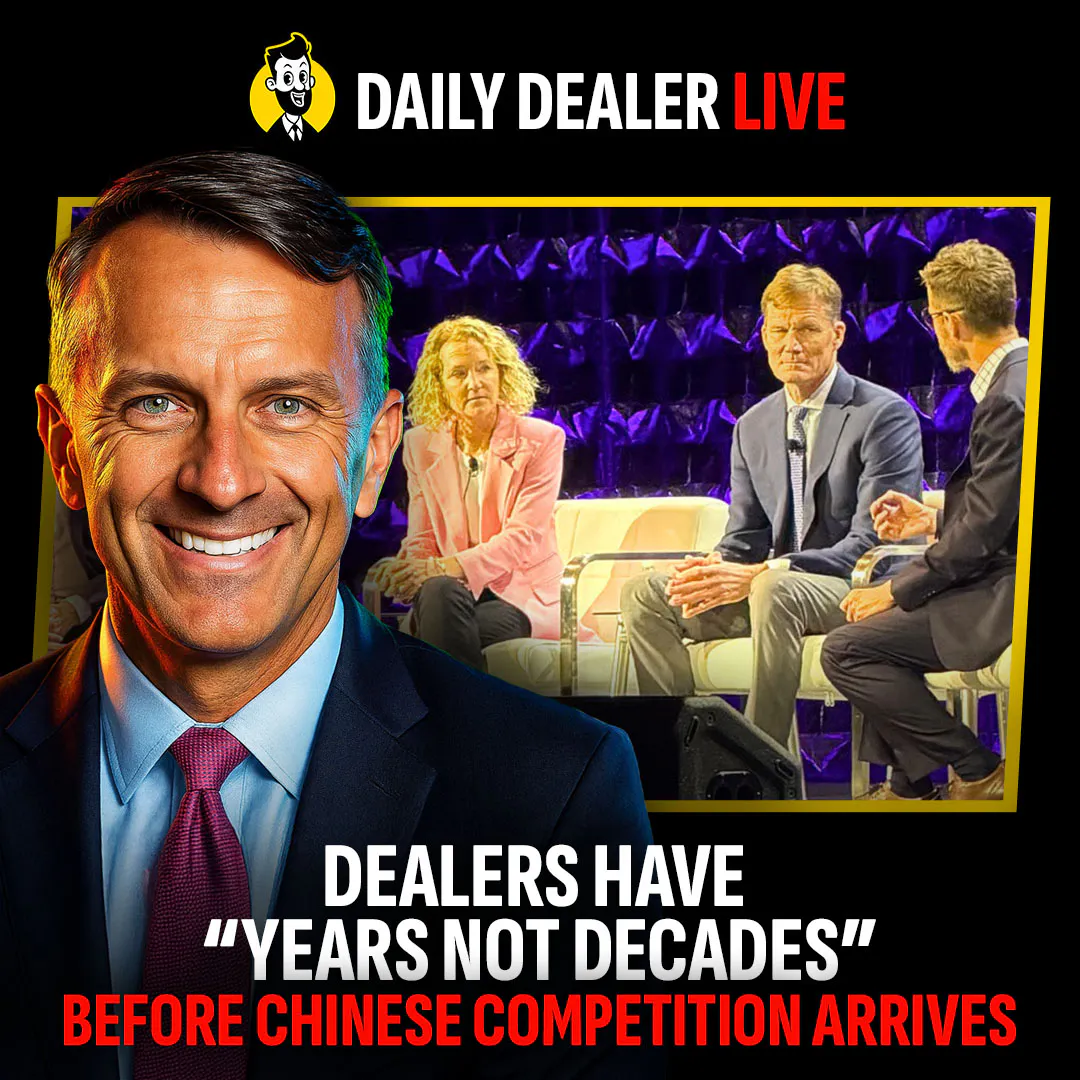
drop into today's auto industry headlines. The New York Auto Forum wrapped last week and during one
of the panels, speakers stressed that dealers have a defined window, they say most likely 2030,
to get their house in order before competition from Chinese automakers and other disruptors
gets real. Apart from the China concern, they highlighted that transparency in the trade-in
process remains a massive opportunity with JD Power data showing that satisfaction scores are higher
even when trade offers are lower as long as the dealer explains the reasoning.
Video MPI was another area of opportunity with panelists explaining that fewer than half of
premium customers, and this is shocking to me, and only one in four mass market customers are
actually getting a video MPI despite it being a known best practice for years. And lastly on AI,
the consensus was to use it to take administrative work off your people so they can focus on what
actually builds loyalty, which is the relationship. Up next, CDK's March Ease of Purchase score jumped
to 88%. That's up from 81% in February, with the biggest gains coming in the stages that typically
stress buyers the most, aka financing, add-ons, and paperwork. Price agreement improved sharply
with 69% of buyers saying negotiations were easier versus 58% the prior month. Both are an
astonishing increase, it seems to me. Meanwhile, documentation and protection product selection
both posted double-digit monthly gains. The areas still needing work are speed and inventory.
28% of buyers said the process took longer than expected, and 57% said their desired vehicle
it wasn't in stock. Point being, these improvements are real, but consistency across the full purchase
experience, that's where the work is. All right, next up today, shifting to a headline
out of Stellantis, we are out of the OEM world. Stellantis is kicking off a nationwide dealer
training tour this week. It's the first of its kind in about a decade, starting in Miami on April
8th and hitting 20 markets through Chicago in late June. Sessions are said to be built around
hands-on product experience, competitive comparisons, and powertrain education across
the full Stellantis lineup. The tour also includes a technician pipeline component,
which invites local, vocational, and community college students in select markets
to participate. For Stellantis dealers who've been navigating a challenging stretch,
we'd love to hear whether you plan to participate, and what's your take on this investment by the
brand. And last up today, we turn to the CDG Bicell Tracker, one Bicell deal to close on today.
There we go. Luther Auto Motive Group just purchased Ike Mazda and Ike Volkswagen in St. Cloud,
Minnesota from Linda Ike in a deal that closed February 23rd, including real estate, a storage
facility, and a detail shop. Get this, Ike Motor Company, it was founded in 1898. It sold its
first Studebaker in 1910, and it's been a fixture in St. Cloud for over a century under
four generations of family ownership. The seller's priority was that her employees were taken care of,
and all staff were expected to stay on. Multiple offers ultimately came in, which brokers attributed
to St. Cloud's growth trajectory in the store's image-compliant facilities. And you want to learn
more about M&A activity currently ongoing? Visit the full tracker at cdgbicell.com.
And that's a wrap on today's auto industry headlines. And, you know, I think the New
York Auto Forum, I'd love to go next year. I know Bernie Moreno was there. He was talking about his
take on Chinese vehicles. He has said he's introducing legislation, as I understand it,
that would permanently keep Chinese vehicles out of the US. I think that's a cool aspiration aside,
my own opinion. I love the day when we compete fully. It's got to be on some sort of an even playing
field or even platform. But given how well Chinese vehicles are penetrating across the globe,
the US market has got to figure out a way to get aggressive, get competitive, become innovative,
and somehow find a way. And I don't know what the vision is behind it to equalize some of the state
sponsored components and some of the technology taking and the intelligence taking that potentially
could happen there. We've got to find a way in automotive to neutralize that. So anyway,
that's my little rant. Again, Patrick Block ventures came into the chat today. Happy National
Pyjama Day. We'll make sure we catch on to that next year. So for this year, let's go headlong
straight into our first guest today, a return guest, Brad Wise, executive manager at Furman
Chevrolet Mazda. Brad, welcome to the show. Welcome back rather. Hi, Sam. I'm an avid listener of
your podcast. I think it's fantastic. Oh, thank you. I'm humbled to be here. Hey, you know what?
It's fun to have you back again. You were on the pod with Yoshi. I think a while back and
you've been on DDL on one of our earlier shows. For our audience that doesn't know about you,
just tell a little bit about who you are, what you do, and then how is biz this April 6th, 2026?
Sure thing. Like you mentioned, I'm Brad Wise, approaching 40 years in the business. I've been
here at Furman Chevrolet Mazda here in Tampa, Florida for almost eight years, spent 25 years in
the Chicago market. And I just thank God, every day that I stumbled into the car business, just
like a lot of us did. And it's been a fantastic journey and met so many great people and been
able to lead some great organizations and just full of grateful, very grateful to have that
opportunity. You've been a pretty good weather move there, going from Chicago to Tampa, I have
to say, depending on the time of year. Chicago wins in the summer because nothing's more beautiful
than the lakefront there in the summer months. It sucks here, Sam. So, all right. How's business
April 2026 before we go into your story? Well, that's a long, kind of a long-winded answer,
but I'll make it short. I mean, for what's out there, we're getting, I'm very proud of the
footprint that we're putting on in the first quarter. I mean, it's no secret it's tougher
out there. Other franchises, it depends. It's franchise specific, inventory related,
but there's no doubt that it's tougher than it was last year. You look at the SAR and the forecast
for the year, there's just a lot of uncertainty in the market with tariffs and high gas prices.
I mean, there's a whole long six, seven things that a consumer's dealing with at the time.
So, this is the time when really good cultures rise and take more market share as opposed to
market-driven type stores that, it's not that hard to be great when everything is great,
but it's harder to be great when things aren't so great. And we actually kind of enjoy the grind
a little bit better. I mean, we like our paychecks in COVID. Don't get me wrong, but we kind of enjoy
the grind. But it kind of made you nervous wondering. It was a different environment
altogether and execution wasn't the call of the day during COVID. It was just being there for
what was there. So, let's turn. You've made some big changes since we last talked. Alex Flores,
you brought him on. Would love to talk a little bit about what he's accomplished,
how far down the road. But you've also said that historically, you've been a volume
solves everything store, but that belief changed. What broke that belief that volume
solves everything in April, 2026, Brad? Well, if you look at our financial statement,
it's so dependent on stair step money and dealer fee and all those under the line money,
but above the line, it's a disaster. The margins on front end grosses, but once you bring in
that money at the bottom, it's fantastic. But that's a little scary. And even though I've been
doing this a long time and had a lot of success, I need to challenge my own thinking. And Alex came
here right away and he was throwing up at our margins. It wasn't what he was used to, what he
used to do. He used his Florida and F and I's regulated and I didn't want to, I just, you know,
just let him do his thing because he has a, just an incredible history of growing stores
dramatically in a very short period of time. So I just wanted to get out of his way and
let, you know, a few things, our numbers are terrible and he can do better. Well, okay,
let's do it. And that's exactly what has happened because you know what, what you focus on happens.
We were focused on gross. We were selling 700, 750 cars a month and making a great net profit and
everything was great. But imagine if you could get volume and gross. And then the first, where we
are doing that in a market that is, that is compressing in market. So it's even, even better.
So tell us what are three things that you've done as you've sought to kind of make this
change over in your store that others might learn from?
Well, number one, I guess it would be a measurement. You know, every manager is now measured on their
own profit. And if there's any deal that's going to, you know, be under whatever is acceptable,
they have to talk to Alex first. And Alex goes in there and talks to the guests before we, you
know, give away that we talk about it constantly in the meetings, we're measuring it. Like I said,
we're holding people accountable on it. The first pencil, you know, the matrix. But you know,
the gross profit comes from rapport and building value. You know, too many stores
are focused on budgets, prices, trading values and interest rates and website pricing. And that's
the last thing we want to talk about even before Alex got here. But Alex and I are completely aligned
in that thinking where he's just thrown rocket fuel on that concept that salespeople are in the
presenting business, they're in the building value business, and they're building obligation
business, then the numbers take care of themselves. And the rat poison that exists in the car business
is that people think the payments matter, that the price matters at the trade ends, man, that
means nothing. You know, if you get someone emotionally involved and find out the emotional
need on why they want the car, you know, they're much more reasonable on what their expectations
are on those budgets. So it's getting off budgets and getting on building value in that bond
with a guest. You know, I know you've got Tommy coming on later, you know, talking about some
things and that kind of goes right into our thing. We don't have addendums where they only,
as far as I know, the only major operator in the area that doesn't have forced addendums where
they're bringing people in under low prices and then hitting them with this big surprise. We've
never done that. We never will do that. So, you know, you have to earn the gross, not, you know,
play hide the weenie and when they come in, plus I wouldn't want to go to work in a place like
that anyway. That's been our thing even before the FTC sent this letter out to all these dealers
about it. Will anything change? Probably not. But what I was talking about with the building value,
that's what we focus on, not trying to raise people on a price that they got under, you know,
misleading circumstances. Now you bring up an interesting point. So you're referring to the
FTC letter that went out last month that sent echoes through the automotive industries. Everybody
scrambled to kind of figure out, hey, what are they looking for here? And how do dealers make
sure they're 100% compliant? Dock fee disclosure on websites, a big one, right? There have been
variations across the United States. Is it on? Is it not? How's it disclosed? State laws vary
across the country. And it does seem the FTC saying, hey, that and other fees need to be clearly
labeled right across the board. When you heard about this letter, did it change anything operationally
in the way you do business? And if so, what's your thinking on that as far as a go to market strategy?
No, the only thing it changed is that we should, well, I mean, if it levels the playing field,
I mean, we don't do business that way. So there's no way we're getting out of here.
But now our competitors are kind of like their whole business model is centered around
that addendum and that price. I'm not throwing shade at them. That's the way they do business.
Great. Furman, we've been in business 135 years and you don't last that long by getting sued left
and right and having reputation of a predatory type of environment. Do you think digital lead
providers contribute to the problem a little bit, that race to the bottom, by if you have the lowest
price, you show up highest on the list. And if you're not doing that, you say, hey, we don't have
the addendums. We're not advertising a low price. How are you competing in the marketplace? How are
you getting the word out about the experience over price and still ranking high? We are at a
disadvantage. We probably lost a lot of revenue over the years by not showing up at the top,
because some of our competitors have their prices lower at the top, though, for instance,
on used cars. If you're not including recon, which is ridiculous, you're going to show up first,
and then they show up, and then they're skilled at raising the people. See, we'll never do that.
So we probably have lost a lot of revenue by doing it the way we do it. But again, you're not in
business. We're playing the long game. We're not playing the short game. And it's not fun to come
to work to have to raise people when it should be a happy event for a guest to buy a car. You got
a lead generation in this month, April of 2026. Where are the best deals actually coming from
right now? Is it internet? Is it showroom? Is it service drive? Where are your best clients coming
from? Are you talking about from a ROI or lead standpoint? Yeah. Well, I mean, Alex obviously
is Latin, and we've been doing a ton of Latin advertising. We even did that before he got here,
but now we've really thrown gasoline on that. We have a great population of great folks from
all kinds of different Latin backgrounds that fall into that category. So that's one military.
We're big into honoring our military people in the showroom. We have a wall of honor where every
military person signs that. And the advertising that Alex has brought in on both of those things
just hit. So we haven't even seen the effects of that yet, but really just kind of standing up
for something and being something and really not underappreciated people, just really putting more
spotlight on those kind of groups. Yeah. So you are going to hear Tommy in just a moment. We've
had a big debate on this show over brokers. Tommy's essentially a broker. We'll let him
describe his own process. What do you think is broken and automotive today in April of 2026
that creates an environment where Tommy and other brokers are successful? And do you say, hey,
it's good to have in the market or do you think it's something that should be restricted legally
in the marketplace? I don't know. I mean, I don't think the car business has gotten any better when
it comes to this kind of stuff. At least I'm down here in Florida where it's a wild, wild west. So
maybe in other areas, that's not the case. But you are kind of a product of the sales managers
that you work for when you were growing up in the business. That is true. You learn a strategy,
you learn a process, you learn a way of doing business. But you also have to do your own
self-education. Like watching this podcast, for example, you're going to listen to the top 5, 10
percent of operators out there and listen to what they say and not maybe what a sales manager that's
leading through deception would say. So if you're new to the business and you're not exposing yourself
to a whole other library of information and education, you just think that's just the car
business. That's what you have to do. You have to mislead people to get them in to sell them a car.
Well, that's not true at all. You get people to come in through creative videos, through meaningful
communications, through how can I stand out in this moment more than any other salesperson in the
world in a creative way instead of just trying to hide things? I hear it. It's a negotiating type
of transaction. So there is some of that, but there's a line to that. And sometimes guests
appreciate the back and forth. That's why you have to have that instinct to understand who you're
dealing with. So you're doing a tough job right now. You've said, hey, Alex is kind of working on
your day-to-day sales process, training, and you've focused on hiring and recruiting, which
today, where are you finding your best hiring and recruiting candidates in auto sales?
And what are you doing to bring them into the fold, so to speak, so that they're successful and
they're set up best for their career? You say, you learn how to desk the way that you're initially
taught. It stays with you. What are you doing in that realm? I'll tell you exactly what I'm doing
is going on this podcast today. I go on podcasts and do interviews for 10% in-go and 90% recruiting.
I mean, my direct message is blow up after I do these things because people want to work for a
store that doesn't have addendums. I have a salesperson that left us and went somewhere
and they had them there and they wouldn't even sell his family a car without the addendum.
You know, they didn't want it. I mean, I just couldn't do it and we fortunately let him come
back to the organization. So I think that certainly is a message that people want to work every day,
five, eight to ten hours a day in an environment where hustle always wins, not how cute we can be
and play games with people. That's not what we're all about. I mean, hey, we're about gross,
but we're about earned gross. The people that pay the most money are usually the happiest.
Isn't that usually the case? That still stands to the test of time. But we're also in Tampa,
Florida where we have sunshine for 55 days a year. It's a beautiful part of the country.
Yeah, it's not hard to sell and we're on the busiest street in America for the highest volume
dealers. So in 135 years in business and a family owned and operated, I mean, who wouldn't want to
work for a family owned business in Tampa, you know, selling the products that we do in my mind
anyway. And that's the kind of message I'm trying to sell on these types of things. I was going to
say just after this show, I think today your DMs will again fill up and we do want to have you
back as part of our roundtable. We're going to bring in with Brian Gelfand who's the GSM at
Community Car. So I want to save some of the questions for the very end, but I know we talked
a little bit about it last time. We don't hear a lot about Mazda in the marketplace. It seems like
it's a sleeper OEM. What is Mazda doing really well April of 2026 to help you as a Mazda dealer
win through the rest of this year? You know, Mazda still is that best kept secret. If you are in
tune with the Blue Sky multiples and reading the head, you'll see Mazda is well loved by them.
And during COVID, they really gained the most market share of any company when they directed
all the inventory in North America knowing that's where all the demand is. But they're very dealer
focused much like Toyota here and they're worked for Toyota. But I respect how Toyota and the
manufacturer are sort of aligned and have the same goals. Mazda the same way. They have great
stair step programs. They have great co-op programs and they have the best cars. If you do your due
diligence on investigating cars, you'll find Mazdas at the very top of the list. We get these Honda
Toyota people that creep over through the lot and look at these Mazdas. But again, they're not as big
as Honda and Toyota, but they're certainly growing. But the tariffs have definitely thrown them off
balance being a smaller company. But for us, unfortunately, we had our one of our best Mazda
months ever last month. And stair step plus minus last question. Do you like it? Do you hate it?
Well, as a large dealer, I love it. If I was a small dealer, I'd hate it. It's totally price fixing.
I mean, it is. It's so unfair. But because I'm on the benefit of that, I love it.
Yeah. Brad Wise, executive manager, Furman Chevrolet Mazda. Thank you so much for being on the show.
We're going to bring you back at the very end as part of the round table with Brian. Thanks for
being here. Good segment. Let's talk CDG circles. Today's episode is brought to you by CDG circles,
the digital peer group for top auto dealers, private dealer chats, vendor reviews, real insights,
confidential, compliant, no travel required. Join dealers representing 3000 plus rooftops
at CDG circles.com. So props to CDG circles for supporting today's content, including that great
conversation with Brad Wise on hiring and recruiting in 2026 and things that they're doing to really
stand out in the marketplace in a increasingly competitive market. CDG circles, if you're not
in it, check it out. It's fun. I'm able to watch conversations in these groups of multiple dealers
and the things that you learn and take away. One of the biggest challenges, honestly,
is just speed to execution is you can get a great idea. Everybody can have it,
but how do you implement it quickly? And these circles do a nice job of giving the idea,
and then it's up to you to go execute. So props to CDG circles. All right, let's now turn to Tomy
Tommy, Makula, founder, delivered LLC. Tommy, welcome to the show. Thanks for having me.
Thanks for being on. So listen, long before you and I talked in the green room before the show,
I've seen you on TikTok. I'll be on TikTok. I'll be kind of scrolling around and you pop up.
For our auto dealer audience that doesn't know who you are or what you do,
how did you start this? Where did you come from on TikTok and elsewhere?
Yeah, I was in the auto industry for about six years, sales and finance. Love what I did,
but felt like there was a better way. So I started delivered about three years ago,
did this free out of my bedroom for about 10 months, tried to figure out what consumers wanted,
what made them happy, and it ended up coming with a business model that I did for that $1,000
fee. We handled that entire dealership process for the people who don't want to deal with the
dealership side, but still want to have a great deal and a great experience. So we started advertising
on social media. I've paid about $200 in advertising since the day I started the company,
and my business model from day one is all transparency. So I decided for that $1,000
fee, you should see what you get, right? There's so many hidden fees in the dealership world.
So I'm just going to live stream everything I do my entire day. And I used to do that for
12 hours a day, just live streaming, showed my profits, showed my income, showed everything,
and it took off. Wow. So it's interesting to me as you live stream this, as you show everything,
you're literally calling card dealerships and negotiating against them. Customers are paying
you $1,000 on their behalf to negotiate against the customers. Why do dealers still take your
calls? Why are there dealers that pick up and work with you, Tommy? Why don't they say no?
I mean, there's plenty of reasons. First off, there are some dealers that say no. If they do,
it's their loss. A car deal is a car deal. And here's my general philosophy. We've all been in
the industry where you've taken a skinny deal. It took eight hours. They went through 10 pencils
back and forth. And it's just a grind. I am that grind, but you don't have to wait to waste 10 hours.
I tell you the exact number you need. We're getting to that endpoint, but my deals take
a dealership on average about 30 minutes of their time. So for us, they're not big deals,
but there's volume and it comes down to speed more than anything else.
So how did you arrive at the $1,000 price? How did you decide that's what the market would bear?
So one of the things that I think we did differently is at the very beginning,
I did this for 10 months for free. When I did it for free, I offered $100 Amazon gift card for
anybody that would do a third party survey answering their experience. So I had a third
party come in and they asked every bit of question, what they didn't like about the dealership,
what they did, what they liked about Tommy, what they didn't. And I compiled all this data and I
realized that most consumers actually, the biggest shocker to me is that consumers didn't care about
savings at all. It was like out of the top four or five things, it was number five.
People cared more about the time, the energy, the anxiety than anything else.
And most people said based on the service that if I saved them five grand, I could take half of it.
I didn't feel that was a fair model. I didn't feel like that was a good model. And I felt like
that kind of went against the entire idea of the dealership model, which they wanted transparency.
So $1,000 was, there was very few people that said below $1,000. And for those,
they warned our clientele. So that $1,000 just stuck. Interesting. So you have proved that it's
not all about price. Why do dealers get that so wrong? Why do they get it so wrong? Why do we
get it wrong? I think in the world, because obviously I was in the dealership and I think
that's how you're trained. You have salespeople that are trained on pencil. We talk about it all
the time. Consumers are trained because they understand that they shouldn't accept first
pencil because if they do, they got a bad deal. So consumers are trained to understand that even
if it's a great deal on first pencil, I have to negotiate because if I'm not, I'm getting screwed.
Like that's just the mentality. So everybody's been talking about price as if that is the really
concern. That's really just the byproduct of it all. It's all of the negative things that have
happened. It's the addendums that Brad was bringing up earlier. It is the back and forth
dealerships that say your presence is power and won't give deals over the phone. All of this
has added up to just showing that price is the talking point, but we have to fix the underlying
issues. So then price is solved. So this show is watched by thousands of dealers, both live right
now as we stream across all the social media platforms, but then also through the podcast
later. Give us some tips. There are many dealers in this debate over brokers and the franchise
model that say, look, make brokers illegal. Like they're not at the end of the day,
they don't represent the OEM. They don't have the expense of the massive facilities, the advertising,
all the covenants that they have with the OEM. And my own personal opinion is, is there's obviously
a market need for what you're doing. Otherwise, people wouldn't be paying you a thousand bucks to
do it, right? What could dealers fix in their own process, Tommy, today that would eliminate the
need for your job and what you do? Yeah. And, you know, I know there's a big debate in the dealership
world. We don't consider ourselves brokers. I think there is, by the way, social media right now,
Yoda of Toyota. He's not a broker. Hector Meato. So he's not a broker. Like we've got 15 comments,
not a broker. Yeah. Yeah. Yeah. And that's, and that's the thing. There's the debate. We believe
we've created this new niche, right? Where, you know, brokers and one of the videos I saw you
guys recently post was talking about, you guys don't like brokers because they advertise inventory
that isn't theirs. They control the client from A to B or from A to Z. They go through and really
just skip the entire dealership process. For us, we consider ourselves as a third base coach more
than anything else. You still have full interaction with your client. We are just getting the pricing
all figured out. You're still in paperwork. You're still doing backend pitch. All of that stuff
still happens for that client. Now we advise them on, are they getting a good rate or getting a
good deal in the warranty? That's on the broker side versus delivered side. But what I'd say
what dealerships are doing wrong is I think one of the fundamental questions that we're not asking
as a dealership world in car salesmen is how do we make consumers' lives easier? I know I've
watched this podcast and I've watched a lot of people talk about the dealership world and we
talk about how do we be more profitable? How do we be more efficient? And I believe that's just
not a good way to run business. I think the way you run business is answering the question
of what problems do my consumers have and how do I solve them? And if we do that, profit becomes
easy. Profit becomes simple because people will pay you hand over fist to solve their problems.
And that's why Deliver does so well. Consumers do not want to have to spend hours talking to a
dealership. They want things to be simple. They want the Tesla model. And what blows my mind is
that a dealership has not got smart enough to build a dealership model or the Tesla model out of
their own app. I should have an auto nation app that in 10 clicks, I can buy a car. You can pay me
10% of the profit for that idea. I'm just kidding. A big dealership should have that I should buy
my car on 10 clicks just like I would Tesla. Just have an experience. If I want my products,
I want my products. I'm telling you, people would go hand over fist just to skip the dealership.
But why hasn't that happened? I kind of agree with you on that, by the way. One of the biggest
challenges in automotive today, I think most customers feel is the time it takes to execute on
the transaction. So you're handling the negotiating part. The customer still has to go into the
dealership and navigate through that process. How do you shorten that process from your service
standpoint? Do you coach the dealer before the customer comes in? Do you set expectations? Like,
how do you do that? So we try to coach everything beforehand. So one thing we do is we get warranty
quotes before the deal even starts. So we have an idea of the client went to warranty. We go
through with the dealership and say, Hey, these are the quotes that we found rate. We go in and
just with the expectation. If it's a manufacturer rate, this is the rate we're hoping to qualify for.
If it's going to be an outside finance, then we go through with outside financing. If you can
beat that rate, then we're all good to go. So we're coaching that. We're trying to get everything
done. We try to work with dealerships that are willing to do remote signing. So it's quicker
and more efficient. That's the general rule of thumb. And then we're coaching our client to
let them know as well. So it's a lot of coaching on everybody's side, letting the dealership know
what to expect, what the client know what to expect. But that definitely helps with the speed
side of things when it comes down to paperwork. And then those clients have reached out to you
first. Do you retain the right to market to those customers? Like, do you have a database, a CRM of
everyone you and the company have sold to? And do you connect and stay connected to that clientele?
Yeah, I mean, absolutely. But you also do as well as a dealership. And I will tell you,
I think of a four dealership in North Carolina. I love them to death. But we did one business
deal with this client. I ended up getting him 10% off of F-150. He loved it to death. But he loved
that dealership so much that he has now done 15 deals with that dealership has skipped us as a
whole. I've lost out of 15 deals. But that's part of our business model. If we connect them,
that makes sense. And they can continue that business model. That's great. We're not mining.
We still have that database. But I'll tell you, as of right now, Delivered has more business than
we can handle. It's one of those things that I have. If I could respond to every single lead,
we'd probably triple in business tomorrow. We just can't handle it all right now. So it's a great
problem to have. So you did say we. Tell us the size of the business today. You started with just
you live streaming. You were not charging anybody anything. It was free. Now what is it?
We now have 15 people on board. So it is a full operation. Last month, we did 300 deals.
So with us, our main goal is to give that premium experience, right? So we have multiple people
in different phases that go through from negotiating to consults to fulfillment,
making sure that client feels heard and appreciated every step of the way.
What's the biggest mistake a dealer makes when you call up and begin to have a conversation with them
about a deal that's not brokered but a customer you're bringing to them?
Yeah, I'll tell you on live stream, at least my general advice to dealers, if you don't want to
do business with me, you don't like me. You're allowed to be civil, but some people like to take
it too far and like make a prank and a joke out of it, which is great for me, right? The content
is beautiful. You look, you yell at me, you curse me out. But you look terrible and it just
advertises well for my business. So if I was a dealer, at the very least, just be respectful.
I'll tell you the deals that somebody says, Hey, you know what, I just can't do 10% off.
I appreciate it. I like what you do. But maybe next time, like those go two minutes, nobody cares
about them, but it's the ones that make that just try to make themselves because they want to go
viral, which I'm all for because it makes my business like even better and more people hire me.
But that would be my advice to dealers is just make it easy. Tell me what you can do.
Don't tell me what you can't do and we'll do a lot of car deals together.
Do you have any data? Like, are you able to quantify how often what percentage of the time
you're able to quote unquote beat a customer deal? So you call up, you go through negotiating based
on your knowledge of the industry and the business, and then a customer calls up and does the same.
What percentage of the time are you able to beat what the customer would have had without you there?
So first off, I want to make sure we're always clear. I don't have a magic wand or a secret
sauce to save you thousands of dollars more than you can on your own. I teach everything I do for
free. So I truly believe if you follow all the tips that I do, put in all the same work I do,
compared to somebody else, you can get a similar deal, right? I don't want to claim that. And I
think that's one of the biggest issues that I have with the broker model right now is brokers
like to advertise that they have a super great relationship with dealers that I get secret
pricing that nobody else does. But in reality, when a broker has to get paid by the dealership,
they have to connect and that dealership knows they're never going to have a relationship.
Like the pricing you're getting isn't as crazy as what you think it is, and the market can beat that.
So I believe anybody can get a great deal on a car. That being said, compared to first pencil,
our average savings is right around six grand all in set price of the car, trade in add-ons,
finance, everything on the back end is about a six grand savings.
And is it possible to quantify it down at final pencil the customer would have put together? I
mean, that's tougher, right? I guess. Yeah, that's tougher, right? I wouldn't have that readily
available. All right, a few comments coming online. Let's bring these in. Paul Salisman says,
if dealers replicated the need he solves, then consumers wouldn't pay him to do it for him.
It's a friction problem. It is a friction problem, Tommy. Yes.
Yeah, absolutely. And that's where I think people make the mistake. Like I said, what I'm not doing,
what I'm doing is in rocket science, right? Listen to customers' needs, solve their needs,
call it a day. Consumers will pay a premium for that experience. And I think you asked this question
earlier and I wanted to answer it. I think one of the biggest problems the dealership model has,
and I know we talk about competition, is the dealership model is a monopoly on itself. They're
the only way to buy a new car. But what they're trying to do is solve the needs of every new car
buyer possible. And one of the things you learn when you start a business is if your clientele
pool is too wide, you can't serve anybody in an excellent way. So like right now, dealerships want
to serve the person that wants a very quick and efficient process. They don't want to play games.
They don't want to play back and forth. But there's also a client over here where I think the
dealership model excels, which is somebody that does want their handheld, that is willing to pay
for a premium experience, that is willing to pay to have an expert go in and go through that
experience. But because they're too wide of a net, they end up making just everybody mad.
So that's why I think like a direct-to-consumer model actually solves this, not replacing dealers,
but is adding one where I can buy a Chevy or Mazda right from my phone or I can go to the
dealership model. I think that strengthens the dealers because now they have a purpose.
They have to be really good at serving people. And then the manufacturer is able to take on
those people that just don't want to deal with it. And to be fair, they're probably the worst
clients for dealerships, right? The people that don't want to deal with anything,
they don't want to buy anything. They just want to go in and out as quickly as possible.
But in direct-to-consumer, that's been a tough model for Tesla, right? Because the only lever
they have on price to pull is monthly changes in pricing, right? Which if you buy it direct from
the manufacturer and they change the price 14 days later, that's not right either, is it, Tommy?
Yeah. I mean, obviously, they're pros and cons to both, right? And this is why I say it's not
all about price, right? When you're talking about people that go to Tesla, genuinely, people aren't
talking about, I don't feel like I got a good deal or not got a good deal. It was the easiest
car buying process of my life. And that's where this dealership model, again, we go back to price.
The people that would use the Tesla model to buy their Chevy do not care about price. They care
about a quick, efficient process that they do not have to talk to anybody 10 clicks on my phone,
call it a day. It's not the same as sticker is quicker because I still have to go through all
your pitches. I still have to go through all of your clicks. I still have to talk to finance for
45 minutes as they pitch me a warranty that I don't want. I want 10 clicks call it a day.
And that's what that needs to be served. Now, Tommy, part of your success is social media.
That's what gave you the stage. If social media didn't exist, would you be where you are today?
Or what is another route that you could have taken that would have got your message out as
successfully and inexpensively as it has? Because you've used this platform and this notoriety
going from a TikTok live stream where people catch you to the Wall Street Journal article
to here and other places. You've got a large platform because of social media.
Yeah, so I don't think there'd be any way not not to this level. I guess that I've paid $200
to advertises companies since day one, which I still think is bonkers to go through it. And
maybe I caught lightning in a bottle when it came through at all. But no, I mean, I just don't
think there's any. I mean, you could try to do word of mouth, but you wouldn't be here. You
wouldn't be at this level. When we first started, we were doing it for free on Reddit and any forum
that would just allow me to do a deal. But it was creepy. Some random guy in your DM saying,
can I negotiate a car deal for you? Because I saw you were commenting saying you're buying a car.
It doesn't go too far. Yeah. What's your vision long term as we wrap up today for your company
delivered in this process, this strategy of negotiating a deal for $1,000?
Yeah. Yeah. My goal is really simple. My vision is really simple. We talk about it in my team all
the time. We talk about it on lives all the time. I want to reinvent the way we buy cars. I want to
be the Wikipedia page that says Tommy McCool had delivered reinvented away an entire country,
purchases vehicles. And I understand there's two different routes that happen,
either dealerships, which is one of the reasons why I'm on this podcast right now.
They understand and start to learn that what consumers actually need, they solve their problems,
and because of that, car buying becomes so easy that it would be silly to hire delivered. All the
problems are solved. Or option two, people don't even think about dealerships. They think about
delivered when buying a car, and that becomes the main business model. And I'm okay with either
or. My goal is to fix this industry. It's the second biggest purchase of your life. It shouldn't
be a dread. And right now in consumers' eyes, right wrong or indifferent, it is a dread.
So I want to change that process. I want to have that Wikipedia page, so to speak,
and then I'll fix another problem. However, if your vision of delivered becoming the place where
customers come by a vehicle, if that is realized, it's realized at the expense of the franchise
model being broken. It is wholly broken if that ends up being the midpoint. And it sounds like
a lofty goal when I say it out loud, and people laugh at me, which they do. People laugh at me
at the very beginning. My goal is to make it so another competitive model can go out there,
because I think the franchise model is broken. I think the idea of franchise laws need to be
torn down so dealerships can improve. I don't think it eliminates dealerships. I really think
that dealerships can succeed. But when they don't have competition, it just eliminates the need for
anybody to try to improve their process. We talked about all of these things that they do. We talked
about adding value. We talked about the last guest about adding value. But what consumers want is
why isn't a dealership owner investing in technology to make it faster to buy a car,
more efficient to buy a car? Why aren't they doing these things instead? They're just making it so
a lot of dealerships are adding tint and saying we added value to your car because you don't have
to do the tints now. But in reality, just pocket profit in their pocket. All right, we'd love to
have you back actually too as part of the round table. Can you hang out just till the very end of
the show? Because I would like to ask what's one negotiating tactic that you've used that has
really been successful. So hang out. We're going to bring you back. We'll actually have all four of
us if we can. I'm saying this to our production crew, David, JJ. Give me a thumbs up if that's
possible. Tommy McCool, a founder delivered LLC. Thanks for being on the Daily Deal Live Show today
and we'll have you back as part of our round table. And we are running right towards Brian
Gelfand, General Sales Manager, Community Cars. Brian, welcome to the show.
You know what? I asked for him way too fast because now we're running and gunning. Brian,
welcome to the show. Thanks for being here. Thank you for having me. How are you doing today?
Doing well. So all right, for our Daily Dealer audience, it doesn't know who you are. Tell us
who you are, what you do. Oh yeah, my name is Brian Gelfand. I'm a General Sales Manager at
Community Kia, which is one of the stores that owned by Community Cars in Bloomington, Indiana.
Very good. Now, it's interesting. We talked about things. In the very beginning of the show,
I talked about video MPI. Not every dealer is doing it. It's a best practice. It's proved.
It kills me that a basic process that delivers so much value to a consumer isn't done 100%.
You're doing video on 100% of internet leads. What made you go all into that process, Brian?
Well, it was a company decision that started about a year or two ago. We've got seven stores.
I know at least four of the stores are 100% on videos. And it's just a process that we
demanded from ourselves, people when they bought in, and it just took off from there.
And it's definitely contributed to our internet sales success that we've had.
How would you quantify the impact of it at 100%? I believe it probably, at a minimum,
has doubled the success we've had on internet leads. We have stores, and I've seen stores that
aren't doing videos or are 100% and they're closing half the internet leads we are.
So it's interesting. You said you actually went out and tested it. You wanted to see
how many dealers truly deliver on it. Most dealers do say they use video. What are most
dealers doing wrong? And how did you uncover that they're actually not doing what they say
they're doing on video? I mean, I've mystery shop or sent test leads to dealers here in Indiana,
Ohio, Florida, North Carolina, just places that I have a little bit of familiarity with.
And I didn't get one video in the 7, 8, 9, 10 leads I sent out, not one video. So I did that,
obviously, not really necessarily to initiate to see what's doing videos or not, just to see
what the process was, the quality was, so I can compare to what we're doing and what we,
what maybe we're missing out or what we're doing that others aren't doing.
So as to the dealer audience that's listening, what are tips or strategies when you're creating
these response videos that you hold your team accountable to that are working on getting those
leads to convert? Obviously, we personalized the video. We say the customer's name in the video.
Thank you for the inquiry. Let them know that we've got their inquiry. We're going to answer
all the questions they had. We've got the vehicle here on the lot. We do a walk around
of the vehicle on the outside and in the inside, anywhere from 60 seconds to two minutes,
just highlighting a couple of points on the interior and the exterior,
and then introducing ourselves as well so we can put a face to the name.
That's great. Coming into the chat, our CDG's own Colin Kubic says,
what was the most difficult part of getting 100% buy-in on MPIs, or not MPIs, but in the service
lead response time? We opened the store about 15 months ago, a new building and a new location.
We already had the franchise, but it was a new building, a new location, and I had a young staff
that was eager and hungry to succeed. So I was kind of blessed that I didn't have to
wrestle with anybody that had had the bad habits for 20 years or hadn't done a video in their life.
So it wasn't hard at all. You set the standard, set the process, you let them see the benefits of
what you think it's going to accumulate to, and they want to start seeing some benefits,
start seeing the communication go up. We have a goal of 75% contact rate, and we range anywhere
from 65% to 75% of the contact, depending on which store it is. So they started to see impact
pretty quick, and others started buying in right away, and you get the salesman that's closing
30% internet leads. They either start buying in pretty quick.
They're learning best practices real time, and they don't have the bad behavior to encounter that.
All right, let's turn from the video, and I want to come back to it at the very end and
around table with Tommy, because you've done business with Tommy. So I'm going to tease this
a little bit. I'm going to actually, with him on in the roundtable, just ask what your experience
has been like, and what your take is on what he's doing in the market, whether there's value there,
or whether it should be banned. So, but let's first talk used vehicle acquisition. It's brutal
right now on the intake form you listed as a key strategy you have in 2026. What are you doing in
used car acquisition today in April 2026? Obviously, big concentrating,
concentration on grabbing those trades. Right now, we're trading in a new car,
60% of our new car purchases have a trade, about 45% of our used cars have a trade. So
we're keeping on that. We're starting to make an effort towards when they don't have a trade,
find out what they're doing with their current vehicle that they do have and why they're not
trading it in. So we can try and figure out a way to get that trade as well. We also do have
Auto Hub that we've been using for about six to nine months that is helping in the acquisition of
all our stores and the service drive. What do you do with Auto Hub? Tell us what that is. What
does that do? Auto Hub is an automated text message that goes out to anybody in our service drive
once the RO is opened, once they step foot in the store and the service advisor opens that RO,
begins that RO, they get an automatic text asking if they'd like an appraisal on their vehicle while
they wait. Yeah. So I'm going to bring this into the next show, but Yossi, the car dealership guy,
sent me a text over the weekend. And it was a Twitter post that someone had made online.
And this customer is frustrated with one thing. Tell me what you think about this. The customer
said, look, I had a great experience with this dealership. They changed my oil, they serviced
me, they did a great job. He's like, I got no less than I think four texts after he left the
service department asking how the experience was, asking if I wanted to trade his vehicle. And he's
like, enough already. I had a great experience. All I wanted was a flip and oil change. And now
you guys are assaulting me left and right with all these messages. What's wrong in automotive today
with so many duplicative messages? And how do we solve that? And part of that arises out of
what you guys have discussed multiple times is just the seven, eight, nine, 10, 12 different
programs a dealer is using, whether it's their CRM, their DMS, their X-Car, their Auto Hub.
So you've got to make sure you don't have three or four programs sending out the exact same messages
to the exact same customer. Yeah. Yeah. Yeah. All right. You know what? Let's dive into this
lightning round with all three of our guests today. So we're going to bring back into the show
Brad Wise, Tommy McCulla, and Brian, you join us. Brian, thanks for your perspectives today.
So this is a CDG first, by the way. And Tommy, I promise we're not here to all gang up on you,
but I am curious. I am curious about some things, right? So Brian said in the intake and in our
intro in the green room, he's like, I've taken a call from Tommy before, and he's bought cars from me.
So, Brian, when you first got that call from Tommy, what was your reaction? And why did you
decide to continue with the conversation? Well, I haven't actually taken a call for
safe from Tommy. He's never been able to, I don't think, blow me up on the spot on TikTok or anything.
I actually reached out to him shortly after we opened this new store. I'm in a town of 80,000
people with 40,000 to 80,000 of those being IU students. So I don't have a, I'm an hour away
from a metro market where there's four other Kia stores in that metro market. So I was just trying
to find a way to find some business, grow that new car business that we didn't have before. So I
reached out to him. And we've done probably, I'm estimating eight to 12 deals and 25 with him.
So you reached out to him because of his social media.
I mean, he's basically an advertising source for you, not a negotiating tactic. What do you
think about him charging your customers $1,000 in order to put the deal together before you get
the TO? Does that work? I mean, that's what the customer's project is. They're paying $1,000,
like he said, is for timing. We talked about a lot of time here with our company,
and whether it's a service department or a sales department, time is the normal commodity
or customers. And what do we can do to make it more efficient and save them time? That's what
the customer's looking for. Tommy, why don't you go to dealers and say, look, your cost per lead,
your cost actually sell a vehicle in 2026 is so high. Rather than a thousand bucks from the consumer,
I'll take 500 from the dealer, I'll take 500 from the, from, from the customer. Why, why the
thousand bucks from the customer only? Because the second you start taking money from the dealership,
the, the question to a client that we've learned really quick is who are they working for? If you,
if I'm doing that's the broker, right? Yeah, yeah. I mean, that's, and this is a conversation with
Brian. I'm going to say, Hey, after this call, let's jump on a phone call because I have 15
KIAs. I got to work today. So we can put some deals together. But like, when it comes down to this
model, by the way, I love it. When clients don't know who they're working or when you're working
for it becomes this conflict of interest. It's the same thing as a car salesman, right? A car
salesman wants to sell you a car to make a commission, but they also want to profit the
most amount of money to make the most amount of commission. You don't really know who they're
working for. And the answer is somewhere in between. For us, we don't want that at all. I'd
rather have all that savings. We get offered bird dogs all the time. I just like add it to the
savings call it a day. And, you know, for Brian, you know, it's one of those deals where he says,
you know, $1,000 we're taking from his clients, he just admitted it. His audiences or his clientele
is 80,000 college students. He probably never would have met my client ever. It is a lead gen
source that he pays $0 for. Yeah. Yeah. Interesting. Brad, what would you do when Tommy called you up?
Well, I mean, we're the perfect dealer that he's trying to do business with somebody who doesn't.
I mean, we fail on a lot of things just like we're human beings and nothing's perfect. But
our intentions of being transparent and building value and spending time with our guests and
reporters, what our business is centered around instead of deception, for lack of a better word.
So the reason he's successful is because there's far too many dealers that are like that.
I mean, that's all. I mean, one question I would have is, you know, 10 clicks and buy a car. I
think the only thing that really we have trouble with that is negative equity and bad credit. So
how do you deal with that, Tommy? Yeah. I mean, the simple answer is they'd have to go through
the dealership model. Tesla doesn't deal with negative equity. They don't deal with bad credit.
I'm sorry? Majority of guests, negative equity. I mean, it depends. But the majority of the guests
that would want this type of service wouldn't have negative equity. Otherwise, Tesla would not
be succeeding. And again, every market is different. But I mean, the majority of clients don't have
negative. I mean, I wouldn't say the majority. There's a large portion of our clientele base
in America that doesn't have negative equity and has good credit.
Yeah, I don't know if I've had any of Tommy's customers be under a 700 credit score. And
I can't think of one that had negative equity, to be honest.
So you do target a very specific cross-section of America. So the goal of having a model like yours
be the model for most consumers by a car probably isn't realistic unless it could
deal with some of the tougher cases, which actually begs the... And I guess I'm going more
towards brokers where brokers take money from dealers. It does beg the question. Dealers are
asked to invest money. They're asked to get bonded. There's recourse that the consumer has against a
dealer. There's a relationship dealer has with an OEM. They've got to build these facilities.
You're kind of using the social media influence and exposure that you have, Tommy,
as a platform to kind of take the cream of the crop, the gravy off the very top.
How do you respond to that? Hey, if it weren't for the investment dealers made,
your model couldn't be successful, Tommy. Yeah. And I would argue if it wasn't for franchise
laws, my model wouldn't exist anyway, because there would be a new solution that would make the
most sense. So I think I will say, I think it's absurd that it takes a middleman to fix a middle
man in order for a client to have a good experience. But if dealers are asking that question, the real
question shouldn't be, how do we ban this person? But then how do we fix this problem so consumers
would feel like an idiot to hire him? I think that's the question they need to answer. And then I
go away, right? That's as simple as that. I go away the second you make it so easy to buy a car
that we're like, why would you pay a... It's like the similar to like, would you pay a thousand bucks
for somebody to grow a tree shop for you? No, of course, I guess not that hard. And if there's
other services out there, that's what we need to have in the dealership talk and the conversation.
Yeah. Yeah. That's interesting. Do you see that your... I mean, your model obviously is growing.
So you feel like it's going to become bigger. Are there laws and you say, hey, I'm not a broker.
So that kind of takes you out of that space. Many states are trying to outlaw the broker model
or this model at a state or a federal level saying, hey, the franchise investment means
franchise dealers should be the exclusive seller. But you're different because you're just connecting
the consumer back. Do you ever see a day where your model could be outlawed either by state or
federal law? I think there's going to be a day where we've become big enough for and now we're
doing 300 deals a month. We expect by the end of the year we're doing a thousand a month. I think
some dealerships that don't like us are probably going to try to attack us and go that route.
I mean, you're going to have to make an argument. We're connecting two people together.
You can make an argument. We're closer to cars.com. That's connecting a lead to a buyer than if we are
a broker where we're actually being that true middleman. So it's a very interesting discussion
and we're all ready for it and excited for it. Like I said, but for us, we believe we're a great
lead gen source for dealers, but we're also a way for a client to just have a third base coach and
have a consultant. Yeah, you know, it's interesting as we talk, I almost think you going down the
lead gen route is more true to your model than is broker. I think it's, you know, how are you,
why could it not be the model of the future that instead of a cars.com or a car gurus or even a
true car, you've got someone like you, an organization with a platform, you've got a following online
or connecting customers up to dealers. That's an interesting thought, especially when you think
about the average cost per lead most dealers get, I think then you open yourself up to,
I mean, that's an interesting, I think that's an interesting, interesting model to the round table.
Any thoughts, Brad, Brian? Yeah, go ahead, Brian. No, go ahead. Go ahead, Brad. I recently was trying
to book a hotel room. And then after, you know, a half hour of going back and forth, I wasn't
dealing with the hotel at all. I was dealing with some third party that was representing themselves
as the hotel. But really, they were a booking agent. So maybe that's kind of what
Tom thing is that he's kind of a dealer for, for, for a, he's kind of his own dealer,
but he kind of needs the dealer that has the inventory and all the other things. I mean,
yeah, but what makes Tommy work, Brad, is the fact that car buying has been such an
opaque process. He opens up all, all the things and allows everybody to see it. And that's
confidence, right? So that's an ultimate lead gen source for a narrow segment of
Society Yoda of Toyota dealerships need to earn delivered business, not pay for it.
Emil says a better model is just teaching dealerships how to lower their cost per lead
and capitalize on the ones they do get. Patrick Blockventure says Tommy's the only one that got,
that dressed up for pajama day today. Tommy, that's a knock. Take that back.
Hey, when you get to work from home, you get to wherever, whatever you want. That's a beautiful
thing. Yeah, but yeah, go ahead. What I, what I will say when it comes down to the lead gen
sources, this is, we're seeing another company, I don't want to use their name, but they're going
down that route, right? Which is they built this entire huge consumer advocacy program.
And now all of a sudden they're going to dealers and say, Hey, give me money so I can give you
leads. Again, who do you work for? Right? That is the, that is the true source. We believe
we're a great lead gen source for people like Brian, because again, our deals are always going
to be some of the best deals out there because we're taking no money from you. It's a free lead.
You can do it or you don't. But the second you start taking money from somebody else,
the question consumers will always ask is who you're working for. I never want that question
here delivered to ever be anybody other than the client. And on that you've got the high ground.
So thank you, Brad Wise, executive manager at Furman Chevrolet Mazda, Tommy McCullough,
founder and delivered Brian Gelfand, general sales manager at community cars. Thank all three of you
for being here for this interesting conversation on our model franchise and how we kill it in
April of 2026. Thank you all for being part of this roundtable today. Thank you. And to you,
our daily dealer live audience, fun show today. Hope you enjoyed the conversation as much as I
did. Thanks for watching daily dealer live. We break down the biggest moves in the car business
as they happen. Don't forget, we're here live every Monday, every Friday, every Wednesday. I
said that completely out of order 1pm Eastern. So if this is your world, hit like, hit subscribe,
turn on those notifications so you never, ever miss a beat. We'll see you next episode. Thanks,
About this episode
Dealers face tighter margins, tougher leads, and smarter customers, so the show focuses on what’s changing operationally and commercially. Headlines cover New York Auto Forum takeaways (trade-in transparency, video MPI gaps, and using AI for admin), CDK’s improved ease-of-purchase scores, and Stellantis’ nationwide training tour. Brad Wise explains how Furman Chevrolet Mazda shifted from “volume solves everything” to earned gross via accountability, value-building, and no forced addendums. Tommy McCool of Delivered argues consumers pay for speed and transparency while he negotiates deals for a $1,000 fee. Brian Gelfand pushes 100% video MPI on internet leads, claiming it at least doubles conversions.
Today's show features:
- Bradley Wise, Executive Manager at Ferman Chevrolet Mazda
- Tomislav Mikula, Founder of Delivrd
- Bryan Gelfand, General Sales Manager at Community Cars
This episode is brought to you by:
CDG Circles – A digital peer group for top auto dealers. Private dealer chats. Vendor reviews. Real insights — confidential, compliant, no travel required. Join dealers representing 3,000+ rooftops at https://cdgcircles.com
My Socials:
X ➤ https://www.twitter.com/GuyDealership
Instagram ➤ https://www.instagram.com/cardealershipguy/
TikTok ➤ https://www.tiktok.com/@guydealership
LinkedIn ➤ https://www.linkedin.com/company/cardealershipguy/
Threads ➤ https://www.threads.net/@cardealershipguy
Facebook ➤ https://www.facebook.com/profile.php?id=100077402857683