Rivian is a company that makes electric vehicles, like trucks and SUVs, designed for outdoor adventures. They are known for their unique features and modern technology.
Direct-to-consumer means that companies sell their products directly to buyers instead of going through stores or dealerships. This can help customers get better prices and services.
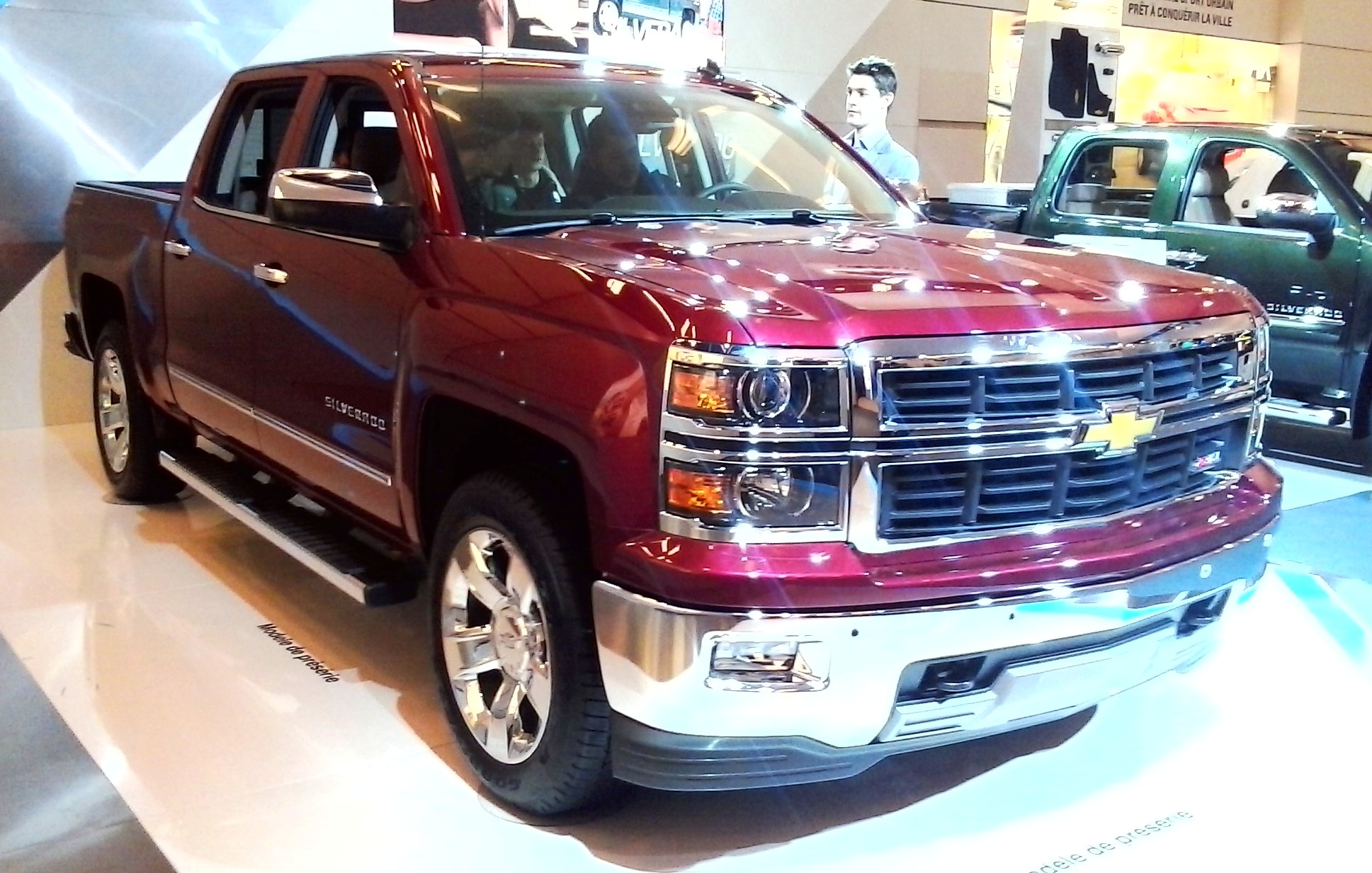
The Chevrolet Silverado is a big truck that people use for work or to carry things. It's known for being tough and reliable, making it a favorite for those who need a vehicle that can handle heavy loads.
OEM means Original Equipment Manufacturer. It's a term used for companies that make parts for cars, which are then sold by other companies. For example, a car maker that builds engines for their cars is an OEM.
Hummer is a brand that makes big, tough SUVs. They are now making electric versions of these vehicles, which means they will be more environmentally friendly.
KPI means Key Performance Indicator. It's a way to measure how well a business is doing in reaching its goals. For a car dealership, this could mean looking at how many cars they sell or how happy their customers are.
Supply chain shortages mean there aren't enough cars available because of problems in making and delivering them. This can make buying a car harder and more expensive.
TrueCar is a website that helps people find out how much cars should cost. It shows you what other buyers paid, so you can get a better deal when buying a car.
Franchise dealers are car dealerships that sell cars from certain brands, like Ford or Toyota. They have permission from the car makers to sell their cars and usually offer services like repairs and maintenance.
The Nissan Pulsar is a small car that's easy to drive and good on gas. It's designed to be comfortable and has enough space for passengers and luggage, making it a great option for city driving.
LIVE
Hey
Hey, everybody! Welcome back to another episode of The Daily Dealer Live!
I'm your host, Sam Dark, and welcome to this space where automotive comes together to learn,
to share, and most importantly, to execute. Thanks for choosing to be here on this Monday,
January 28th, coming up with an episode we've got. We're cutting through the noise today.
David Wyler's here, fresh off a once-in-a-generation luxury acquisition, Ferrari, Lamborghini,
scale, and the hard leadership calls that made it possible. Plus, Ryan Warman joins us with a
no-spin 2026 forecast, plus his plans at NADA, talk a little tariffs, margins, data ownership,
and where dealers are leaking leverage. And then Scott Painter is back in the CEO seat
as CEO of Trucar after a $227 million take, private. What changed now for your store as a
result of this acquisition? It's not just theory today. It's strategy. It's pressure tested.
But first, let's hit today's auto industry headlines. First up today, U.S.
First up today, U.S. franchise dealerships generated a record 5.5 million Google reviews
in 2025. That's up 25% year over year, according to Widewell, who we'll have on the show today.
And for the first time, communication issues are hitting sales just as hard as service.
In late 25, nearly half of all reviews mentioned communication platforms
in both departments. What's the problem? Well, too many sales staff positions are cycling every
six to nine months. That is a big problem in automotive, leaving customers dealing with
under-trained teams. Inconsistent answers feel like deception to shoppers, even when the real
issue is a lack of experience and process discipline. What's not changing much is price
complaints. Well, even as price vehicle prices climbed, negative reviews mentioning price
stayed flat. Looking ahead, as sales turnover accelerates, inconsistent experiences are eroding
trust. Not to mention, these reviews are now feeding AI systems that increasingly influence
where customers shop. Next up today, Rivian is taking a very public swing at Washington
State's franchise laws. We've talked a lot about direct-to-consumer EV vis-a-vis scout motors
by Volkswagen. Rivian's pledging nearly $5 million to push a ballot measure that would
let more EV makers sell direct to consumers. Right now, Tesla's the only automaker allowed
to sell direct in Washington. Rivian has tried for years to change that through the legislature
and failed. So this time, it's going straight to voters. The company's backing a coalition that
says consumers should be able to test drive and buy EVs direct from manufacturers. To get on the
ballot, the group needs just over 300,000 signatures by early July with the vote targeted for November
2026. However, lawmakers repeatedly blocked similar efforts, including a bill last year
that would have opened the door for Rivian and lucid. That bill died quietly in committee
despite support from environmental and business groups. What's the bottom line here? Well,
Rivian scout motors, Afila and a slew of others are testing how strong franchise protections
really are in a changing market. And as a little editorial aside, I think there's a big difference
between Rivian and Tesla that don't have a dealer network and an entity like Volkswagen
trying to go direct through scout. Two separate issues, but fascinating to see Rivian will stay
and keep you updated on those news items as part of the CDG news and future episodes.
Next up, we've got another busy stretch on the dealership M&A Front. Super busy with three deals
spanning Chicago, the Southwest and Central Florida involving both private and public buyers.
First, Auto Canada has sold Toyota of Lincoln Park in Chicago to Margato Automotive Group
as part of Auto Canada's broader exit from the US market. After struggling to make its American
stores profitable, Margato has renamed the store Toyota of downtown Chicago. Next up in New Mexico,
Giles Automotive has purchased a Kia dealership in Las Cruces from the Petri Automotive Group.
That acquisition gives Giles its first Kia store and expands the Louisiana based group into
New Mexico. That's a big geography change, bringing its footprint to nine dealerships
across four states. And in Florida, Pinsky Automotive Group announced it will acquire
Lexus of Winter Park and Lexus of Orlando. Two stores about 16 miles apart. The deal
is expected to close in the first quarter and add roughly 450 million in annual revenue,
strengthening Pinsky's presence in one of the fastest growing regions in the country.
What's the big picture here? Well, whether it's portfolio exits, regional expansion,
or public groups scaling up, buyers' interest remains strong, especially for Toyota,
Kia, and Lexus stores. And don't forget, you can see this deal announcement many more
throughout the entire year by visiting the CDG Buysale Tracker, powered by
the Presidio Group at cdgbuysale.com. And of course, that jingle makes us all happy,
so thanks for getting that out. I love it. And last up today, President Trump is back
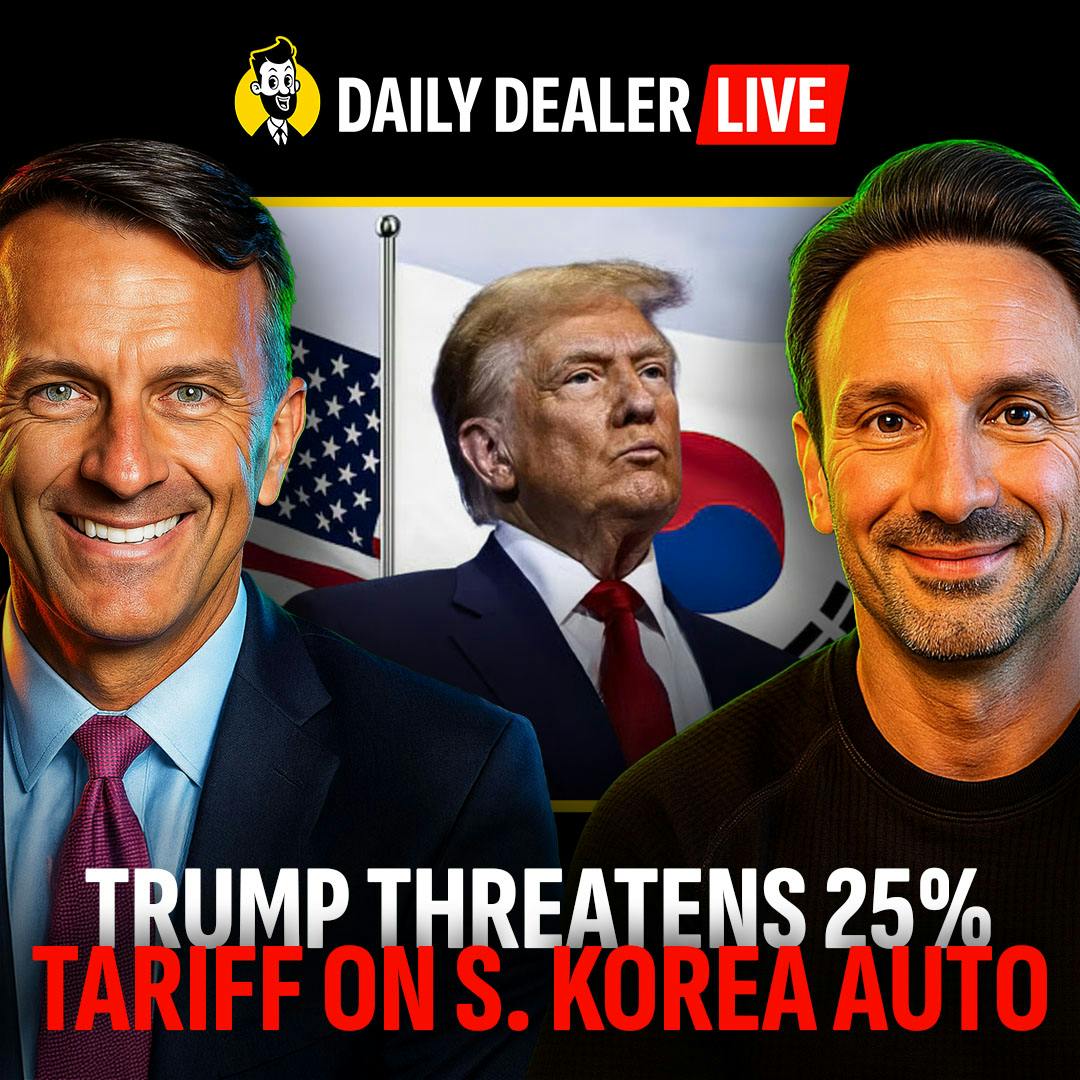
threatening to raise tariffs on South Korean auto imports to 25% up from 15, accusing Seoul of
dragging its feet on a trade deal the two countries struck last year. In a post to
truth social, Trump said South Korea's parliament is quote, not living up to its deal while the U.S.
has already reduced tariffs on its side. But some analysts are skeptical the tariff hike
actually goes into effect. A South Korean delegation is heading to Washington this week,
and Trump has a history of using tariff threats as leverage before backing off once talks restart.
But at the end of the day, if the new tariffs do stick, Hyundai and Kia would likely eat part
of the costs to stay competitive. But not all of it. Dealers could see short-term buying shifts
as customers try to get ahead of potential price increases. And that is a wrap on today's industry
headlines. Yuli, welcome back. We're in the week before NADA, pumped for what's coming up next
week. You and I'll both be there. We talked a little bit about it on the last show. I'll be at
the American Financial Services Association, so AFSA, Vehicle Finance Conference and Expo,
be there Tuesday to moderate and do a keynote on a session. It's going to be super interesting.
We're tackling the role dealers and lenders play in creating an elite customer experience. So how
do we get rid of friction points as we go into finance and throughout that process to help get
the customer financed on the road? Worry and happy free. Then on Tuesday, Yuli, I get to take the
stage at the JD Power's annual event with my friend Jeff Stafford. And Dennis Gingrich of the
Neal Auto Group will talk about multiple hot topics and automotive, including his switch
from one CRM rather to another and just what success he's seen there. And then later on Tuesday,
I get a swing over to the Alan Haig M&A event. Alan's always an interesting event as you think
about buy-sell activity, multipliers and what's going on in that world. Cardiola Ship Guy himself,
Yossi will be there. Yossi will be on stage. I will not at the Alan Haig deal, but I'm going to
be a benefactor of all the data and information that ends up getting shared there. So it's going
to be fun. And then you and I, of course, Wednesday and Friday, we are doing two live shows at the
lot links booth. So you can come by and see that. We've got a great lineup of dealer guests.
And in fact, we've got a couple of surprise guests that we'll have there as well. We're
locking down a couple of those. And a shout out, I just want to throw it out there. I think
President Trump should come on and talk a little tariffs on the show. So the invite has been extended
to the Trump administration. And I'd love to hear Elon Musk's take two on all things EV. So I've
thrown out that invite as well. Probably won't happen. But you know what? If we can get them
on remotely Wednesday or Friday, if you don't ask, you will never, ever get a shot at it. So
all right, we've got an action packed show today. Buckle up. Let's head straight into our first
guest, David Weiler, president and CEO of the Jeff Weiler Automotive family. David, welcome to the
show. Gentlemen, thanks for having me. Yeah, thanks for being here. We thanks for working
on it through your IT issues from last episode. So we're thrilled that we were able to make that
put that together. So to our guests that heard you teased on Monday, we're here thrilled to have
you on Wednesday. So look, you've got big news. You guys made a huge acquisition in the Ohio
Marketplace. Tell us a little bit about that acquisition and what prompted it. Yeah, Sam. Well,
we purchased the Midwest Auto Group. Some folks may recognize it as MAG in Dublin, Ohio,
and it's 14 brands, none of which we actually had as of two weeks ago. So that'd be Ferrari, Porsche,
Land Rover. So it's a big step for us. It was a strategic move just in the sense that
it's in our geographical circle where we want to do business, right? So we're located in
headquarters in Cincinnati, Ohio. Really anything that's within 100 to 150 miles of Cincinnati
is something that we kind of really want to look at. And you've got those 14 brands and
it'd be hard not to take a look at it. Yeah, you know, I've walked across that campus in the past
and it is a beautiful property. All of what some people may not realize is all those brands that
you listed are on the same location, right? It's an enormous campus in really a very upscale area
of that community. That's a big get when you think about you're not currently a Ferrari dealer,
you're not currently a Rolls-Royce. Each one of those high-end or exotics have their own nuances
that you have to learn as a dealer group. What have been some of the biggest challenges as you've
worked through this transition that you've learned that others may learn from as well
by your experience? Yeah. Well, Sam, I'd say the biggest thing would be our support staff.
Can you imagine doing 14 dealer applications? Yeah. No, I can't. No, right? And me having you
kind of up your rear end every day, making sure we're getting approval process and closing,
at the deadline that we agreed to. And oh, by the way, I don't know if you know these. Some of
these OEMs take holidays off, not only in North America, but the Italians. Yes. Yeah, in Europe.
So that has been a, that was the biggest thing so far. But today marks our 14-day anniversary
of the all-new TWC, the Weiler Collection. So other than a foot of snow, a water main
break last night, by the way, that was exciting. And I forgot to mention that the day we closed,
we transitioned from CDK to Tekyon at that location. So as you can imagine, everything
is just gone smooth, swimmingly. It's been great. So it's interesting. When we made the
acquisition of Ferrari and Lake Forest, one of the things we learned, that acquisition happened
about the time the Pope died. And so to your point about international holidays,
like there was the Pope passing, there were a couple of other holidays that just impacted
the whole approval process, which caused it to take a hot second, extra David.
Yeah. No, it certainly was unique in the sense that they take a long time to get back from holiday.
But they were super hopeful and all 14 OEMs actually were actually great to work with. It was
overwhelming initially, as you can imagine, just touching base with everybody, trying to get to
everybody on each of the teams of the OEMs. But our team, they're a lot better than I am.
There's no way in hell I could have ever accomplished what they did.
Well, so let's talk about that. First, I'd love to ask, this is an enormous lift to your point.
A lot of OEMs, big geography, higher dollar vehicles and new OEMs to you. What inspired you
to say, hey, this is a step we want to take. This is an acquisition we believe in and we
want to make. And then we'll shift and talk a little bit about your team and what made you
feel prepared that way. But why this acquisition now today? Well, as I told you earlier, it's in
where we want to be. We're already in the Columbus, Ohio market. We've got a Chevrolet store.
We've got a Stellana store in that market. We've been looking to grow into it and expand
in the Columbus market. And you get an opportunity like this, whether or not we could have pulled
it off when we looked at it initially this past summer. That was one thing. But we were definitely
always very interested in adding these types of brands to our portfolio. So these 14 brands,
they'll join the 19 existing brands that we have. So the only brands we don't really represent right
now, we don't have a Ford franchise, don't have Lexus or Subaru. So for our existing customer base,
we went around for 52 years, there's really everything for our existing customer base,
whether it's sales or service, newer used. We've pretty much got you covered.
And then the other thing, this was like a generational acquisition. I've got three boys
that want to get into the business and some already are. My nephew is in our business.
And so it was looking at those four young men and saying, Hey, is this something that you want to do?
I'm 53. And these guys are going to be around a hell of a lot longer than I am. So it was something
that like, Yeah, this, this would be fun. This would be great that they do as a family. But
so those are the three aspects that really piqued our interest. So David, when you rock, paper,
scissor, who got the Ferrari demo and who got the Rolls Royce demo between your kids, who won that
argument? Well, you want to know what pressure is Sam is like, and you got your three boys calling
you every single day. Hey, did you do the deal? Did you do the deal? I'm like, easy, easy. But
yeah, no, I think they're, I think they're good in their Silverado demos that they have. Yeah,
yeah, good for them. Good for you, by the way. So so it's a big lift. And to your point, having
a leadership team that can do that transition. Talk to us a little bit about your development
strategy that helped you prepare as an auto group to make this acquisition. Because to your point,
such a large growth sales volume value, adding that all at once to the group is big, you've got
to be able to establish your own culture within this acquisition. Talk to us a little bit about
your leadership strategy leading into it. Yeah, the leadership and culture for us is huge, Sam.
You know, we've made prior acquisitions, let's say we've made about 10 transactions over the
last four years. And we've been fortunate enough out of those 10 transactions, we've actually retained
most of the people that are working at those locations. And in fact, every single general
manager we've retained, we've only lost one during those recent transactions. And so that's
something that we're proud of is that we think that we have a culture that people embrace,
and they want to be part of our team. We have our corporate headquarters in Cincinnati, Ohio,
we've got about 130 people that are just solely dedicated to the operations of every single location
that we have. And so as you can imagine, we've had countless people up at Dublin at TWC the last
two weeks. And quite frankly, they've been up there 45 days before we closed. So it's not going to be
easy when you take on 250 new employees, 14 different brands. And you've had a culture that
they've had for over 30 years in our culture of 52. But you know, it's not like we go in and have a
sledgehammer. And this is how we do things and want to do things. We give them a clear vision
of where we are and where we want to get to. And so far in the last 10 transactions,
it's gone well. And knock on wood, this one stays the course.
So David, a lot of acquisitions fail more in integration than in negotiation, right? So you
talk about that, bringing them into your culture and making them part of the auto group team.
You mentioned one big adjustment. So going from CDK to Tekyon, that's the DMS, I assume that's
probably a change in the CRM. What drove that change from CDK to Tekyon? And how do you feel
like that gives you an advantage in the months and years coming forward with this auto group,
Tekyon versus CDK? Yeah. So this actually started a little over a year ago. And when we looked at
transitioning our DMS, it's not like I made the decision. That's not the way our culture is. So
over probably a 12 month period, we got together folks at different locations from parts, from
service, from collision centers, from sales, from accounting, and listened to different
presentations from different providers. And they made a recommendation. And their recommendation
was Tekyon. And so we made that decision that we are going to move forward with that transition
of switching DMSs. And actually, we're going to do this company-wide late spring. And then this
transaction actually happened. And so we were at a crossroads, kind of do we just
stick with CDK during this transition on this buy-sell? Or do we just go ahead and rip the
band-aid off? And we got feedback from everybody that the all new TWC, the Weiler collection,
and our teams, and they said, let's just go. Let's get it over with. And it's never an easy
change. So we listened to them. And that's how we got to where we were today. And is that DMS,
CRM, all the different tools that are associated with that in the world? Because Tekyon is more
of kind of an all-in-one solution, right? Exactly. So it'll be all encompassing from CRM,
from sales, service, and parts, along with accounting. So all encompassing.
So as you talk about this transition and to the dealers that don't have those premium high-end
or those ultra luxury exotic brands, what operationally, David, are you seeing as the biggest
difference between those ultra exotic luxury high-ends and the brands that you've been selling
all these years, 51? Yeah. You know, we've experienced over the last 10 years of being a
Mercedes-Benz dealer. And that first transition, when you go from your regular OEM to a luxury and
then an exotic, it is a big step. But really, when you think about it, it shouldn't be as a
big step as you think it might be, because you want to treat all your customers the same way,
right? Just because you're buying a Ferrari, you're buying a Maserati. If we want to treat
our Stellantis customers the same way, we want to treat our General Motors and our Toyota and
Honda and all the way down the line. We want to treat them the same. But we also are cognizant
of the fact that somebody is going to buy an $800,000 Lamborghini and it's not a $10,000 used car.
And so having concierge services and knowing your clientele and what they want and let them dictate
on how they want the transaction to happen, whether it be sales or service, is probably
something that you need to listen to a little bit more when it comes to the mainstream OEMs.
So I would love to sit down with you six months, 12 months down the road. One of the comments,
because, and I'll share this with you, one of the comments are our General Manager over the
Mercedes-Benz store, which by the way, love Benz. Best or nothing, they are all in, they're very
committed to the consumer, they're committed to the brand, their retailers. He said on the Ferrari
acquisition, because he works with both the Benz store and the Ferrari, he said, look, Benz,
incredible, amazing, highest level of service we provided any of our customers. And then over to
Ferrari, a totally different world, right? In terms of like earning vehicles and like, you know,
customers saying, hey, I want this and you can't quite have it yet. And in fact, we're going to
have Jay Leno on the show here in the next couple of months, a little spoiler alert. He agreed to
be on thanks to Chase. And he's infamous for not being a huge Ferrari fan because he doesn't want
to have to earn these different vehicles. And I think it's a little bit of FOMO by him, right?
He's like, hey, I don't want something I can't have because people that have money
want to be able to buy it. But it is a little different, right? The approach is David.
Yeah, it really is. In fact, about 30 days before we closed on this transaction,
what do you think happened? My new Ferrari shows up. The one that I had ordered. And it's, you know,
it's my third Ferrari, right? Yeah. And so I'm certainly very well aware of wanting to kind of
make your way up the Ferrari food chain. And in fact, I got another one coming too. So hopefully,
when you get it transferred over. Yeah, what do you have on order? Are you buying from our store?
Yeah, I don't know. But Aaron said he would give me probably a half a dozen to a dozen
for ours just to kind of get my feet wet to start with a future clientele.
No way. No way. No, the Persong ways come in here in the spring and my 296 showed up literally 30
days ago. Nice. Very good. Very good. Well, hey, so who you represent a lot of brands current,
existing and new, just quick perspective as we wrap up. Who is winning right now in your
portfolio of OEMs and why and then who's struggling starting off with the winners? Who would you
say is the top one or two best performing OEMs in your collection? I mean, you know, I think you
you've got to start with the, you know, the who's who the usual suspects, right? The Hondas, the
over the years. You know, we've got 35 different brands and I think there's 67 now that we have
that we have multiples of. And so you're going to have the ebbs and flows. You know, some of these
OEMs are cyclical. Those those brands have over the test of time seemed to have weathered whether
the storm, whether it would have been 08, whether it had been 2000 and then before that.
But I'm optimistic. Even some of the brands that have struggled in the past, like, you know,
Solanis and Nissan, I think those brands have have righted their ways. I think 26 is going to be
much better for those brands. And as an industry, you know, everybody is building
fantastic cars, right? So the reliability across the board is great design across in the technology
across all these OEMs is great. So that's my take on on these OEMs. Let me let me wait and see what
these 14 new brands look like. But so excited to have these and offer them to our our existing
customer base. What should take David on the Volkswagen issue that's going on right now?
State of Colorado and other states are approving direct to consumer with their new scout brand.
You know, a lot of state associations, including Virginia, who we had on earlier this week,
Don Hall, also big, you know, fighting to make that not happen. Should should Volkswagen be
able to go direct to consumer through scout through a new brand?
Well, yeah, I'm excited to go to Las Vegas, because I can't wait to go to the the VW meeting.
You know, I've been a Volkswagen dealer for 14 days. And I had probably haven't had the experience
that long time Volkswagen dealers have had in the ebbs and flows and then the direct to consumer
with with Scout. So I'm going to just sit back and see and it should be an exciting meeting. But
you know, they're they're telling me that, you know, Scout is 18 to 24 months away.
What does electrification electrification look like? As we know, it's it's it's a soft market
now with electrification. You put a nice engine in that thing. I think it's a different story. But
it's I think it's a wait and see. But I don't know that I would be
too discouraged right now with the Scout brand, just because of electrification. You know, we've
seen, you know, some of the brands, you know, haven't taken off quite like they could have,
like with Hummer and Rivian and I know Tesla soft now, but in some of the other
electrics that that we have that in our OEM portfolio. So I think it's a wait and see.
Well, David Weiler, President and CEO of Jeff Weiler Automotive Family, thanks for sharing
with us your new acquisition. Truly a legacy play. It's exciting to hear as your next generation
comes in how that goes. And we'd love to check back with you six months to 12 months and just
learn more about how this big addition to the Weiler group takes hold. Thank you so much,
David Weiler. Absolutely. Thanks guys. I hope you all see you in Vegas. We'll see you there.
Absolutely. That's David. Good. That's a fun conversation. I do wonder, you know,
everybody's always like to me, they're like, Hey, you know, what's it like driving the fries? I'm
like, I don't I'm not driving. Yeah, I'm not driving one. Like they stay on the showroom.
They do very nicely there. And but what a great get by that group. And for sure. And what a what
a heck of a great group. I guess I should have offered my Italian translating services. There
you go. You should have. You should have. Yes, you did. All right. Let's talk stream companies
quickly before we go to Ryan Rohrman. So today's episode is brought to you by stream companies.
Dealers stop chasing incentives, retail ready from stream companies, updates your offers in as
fast as four hours and keeps them compliant, stay current, beat out competitors and drive more leads.
If you're headed to NADA, visit stream companies at booth 3113W. Write that down
or learn more at streamcompanies.com slash retail ready. You can also scan the QR code
on the corner there if you're watching the live show or you can go into the show notes
for more information there. Stream companies, we appreciate you supporting today's content,
including that great conversation with the Weiler group, David Weiler on this big addition to their
auto group. Excited to see how that works out. Next up, let's transition quickly to our next
guest and he's been on twice, I think before done. It's always fun to have on this show.
It's his third appearance, Ryan Rohrman, chief executive officer, Rohrman Auto Group. Ryan,
welcome to the show. Hey, thanks for having me again. Good seeing you guys. Isn't that fun hearing
David? I mean, he's not too far from you and I. We share the Chicago land. He's over there in
Ohio. It's fun to see dealers growing and winning in the space. So in the green room,
you guys obviously know each other, have crossed paths professionally. Any thoughts about that big
acquisition by them other than what he said? It's a big get. It's a big get. I love it. I'm all about
legacy impact of family run organizations like his. I don't know. Your guys, I love it. I think
David said 58 years. That's a long time and bringing that third gen in. I'm third gen. Love
that. We're about ready to celebrate 65 years here soon. So it's a legacy piece. It means something to
me. I think it's huge. I love it. As the third gen, so Aaron Ziegler, he's second gen in the
Ziegler Auto Group. We just celebrated 50. It was a big event and he had some words to say about
being second. You're third. Presumably, you've got kids who will be fourth. What does it mean to you
to be third and to continue the legacy? And by the way, your leadership style is very different
than your grandfather's. Give us a perspective as the third generation. I'm going to talk a lot
about that, but that is a deep question. I would say this. I truly believe that the car business
as a whole inside the United States, it's very young. My grandfather, with the stores that he
had, he really, I think he only purchased two or three of them. He was the originating dealer
on every single one that he had. At the peak of his career, he had just over 40 stores.
So I think about that and how many franchises are passing out open points today. It just
doesn't happen often. But that was only 60-some odd years ago where that's how you grew.
Now fast forward to today and all we talk about is acquisitions. Sure, there's acquisitions of one
and two, but it's acquisitions of these. Some first gen still, but many second gen and some third
gen legacy businesses. And so that has been a huge shift. And even the way you run them,
like my grandfather, he was very much like a wheel and hub guy. So everything circled around him.
He was the point of contact for it all. But that's how he grew. And he wanted it that way.
He felt more in control of the organization that way. And even though it grew and it was large,
that's the structure he appreciated. How are you different, Ryan? What's your approach?
I had the opportunity to work really close with him for the first 15 years of my career.
And I tried it his way for a little bit and it was tough. I realized right away,
I think we would be more efficient and we would grow if we actually had this executive team.
And like even what David said, I don't want to mess his words up, but he had over 100 support
people in a corporate center. I mean, bigger than the women group. But that is the power,
I think, of multigenerational growth. Because, and I'll just speak for myself, my grandfather,
great businessman, extremely smart, did not feel comfortable with the layers
between himself and the store. It's hard to say. Whether that was a trust issue,
whether it was a control issue, whether it was a perspective issue, did he see other dealers
his age rubbing his shoulders with those guys? Were they doing that? Because I sat in a lot of
meetings when I was younger, you know, with the original dealers in these rooms and they all
looked at it the same way. Every now and then one of them would have the vision to be like,
hey, if I had a team of five people that was between me and my stores, I think I could sell
more cars and service more cars and retain my people better. But it was few and far between.
I think that was a second gen and a third gen and so forth vision. I mean, the scale is huge.
We've scaled internally the amount of cars we're selling and servicing. We can't even compare
ourselves to what we were before. And yes, our teams are stronger, but in my opinion,
it's that middle section. It's that executive team that is their boots on the ground. They're there
every day. They care. They're in the stores. I can't physically be in every store every day.
My executive team can't and they can provide that support, that training. And that's how you
scale. So to your point, I think your grandfather's approach was maybe a generational difference,
right? To your point. It wasn't just exclusively him. Now, obviously, there are all the great
stories about your grandfather in the Chicagoland. We've heard him, right? And he was a larger than
life personality. But I think that's the way many dealers back then operated. What was the moment,
Ryan, where you said it's not going to work for us that way in 25, 26? We want to continue to grow.
We've got to scale in a different way. And what were a few of the first steps you took
towards assembling that team that you had confidence in that caused you to take a different
direction because it's a risk, right? You departed from what he knew and was comfortable with. And
that's a risk to his legacy, right, Ryan? Well, it is and it's not, right? Because I think part
of his legacy is he's the foundational piece. He built that foundation. It was up to us to like,
what are we going to build on top of it? I mean, the foundation is secure. It's ready for more.
But if we kept doing it the same way, we'd still have a great foundation. But we'd be missing out
on all this opportunity for growth. And so like, I don't think it takes away, I think,
if anything it adds, because he did, in theory, he did the hardest part. I mean, he was a hand
razor. I still remember his stories. Like, even with Kia, when he got Kia, it wasn't,
Kia was brand new. It just had come over the United States. And they were looking for Kia
dealers and he didn't want one. He goes, I'll take four. And they're like, well, Bob, you know,
how about three? He goes, all right, I'll take three. And, you know, like, so our dealer numbers,
I got one, six, nine, you know, in these different states. And I can sell, I can tell that same
story with, with Hyundai, I can tell it with Lexus, I can tell it with Acura, and some other ones.
And, but that was his mindset. And there's also failures like Daewoo came over, he goes, I want
three of those. We don't have any anymore. Suzuki Azuzu, we had those and we had like
ones and twos and they're gone too. So, you know, it was that, that he had an appetite
for risk. And, you know, he said, I don't want just one. I want multiples and it worked, you know,
but that was his mentality. He's like, I'll figure out how we're going to support it,
just give me the franchise, I'll build the store and we'll go from there.
Pivoting to your moment in time, Ryan, what was there a moment? Was there an event? Was
there something that happened where you said, hey, we need to shift and we need to grow this
executive team and, and, and look at this business a little different, differently, Ryan.
So I got my opportunity to take over the auto group, April 1st of 2018. And when I got that
opportunity, I knew like I had a go. So one of my, I just really believe is that the team
mentality. So we really ran in silos prior to 2018. Like, you know, even if we were on the same road,
you're, that was your competitor. Like that was even if it was owned by Roman, you're competing
against it. And like, I don't love that mindset. Like we are competing against each other,
but we're on the same team. Like we're, we're here to help each other do more, you know,
whether that's selling more cars or service, but really impact the communities that we're in,
because that's, we're talking about market share. It's not one and done. It is continuing to be
an impact player in that market for the legacy of the Roman automotive group. And so
right away, I was in every store every month. And that time we had 26 stores across three states.
I was in every store every month. And I just had the same, I love the, the, the, the, the Sony,
I like ideology of clarity. So I was driving clarity. This is what we do. This is who we are.
And so I ran and that turned into what I call the infinite pursuit today. So it's a KPI program
that unifies, we have just shy of 1,400 employees. So it unifies 1,400 employees under one battle
cry. And I started that. What's it called again, Ryan? Ryan, what's it called? The infinite pursuit.
Where could people find out more about that? I use some stuff. It's not, it's, we have a website,
but it's, it's hidden, but I have no problem sharing it. But yeah, it's a KPI program for every,
all the way up to director levels. We have KPIs for them. And then we just had our big banquet.
It's my favorite event of the year. We have it in January and it's, it's just awards. We just pass
out all the wins. And so that was super fun. But that started in 2018. And I was in every store
every month. And I did that for two years, almost two years, like 18 months. And I realized
we are missing out on growth because I can't be everything for everyone.
You're the limiting factor, right? Because your presence, if it's required, you can't be everywhere.
No. And if everything, if everything gets stuck with me with that many people, that's a major
flaw in my leadership style. And so then I started saying, okay,
you're great at fixed ops. So I'm going to platform you here. And so like over probably another 18
months span, you know, I went from zero directors besides my CFO to 12. And so I still have those
same 12 directors today, you know, and they are their catalyst for growth. So catalyst is their
infinite pursuit program. I called it the catalyst. So catalyst is a spark. It's a, it's an ignition.
Something that starts something bigger than itself. And so that's what they do. Like that is,
that is the whole point. That's their role inside these stores is to support them
and start that spark, you know, whatever it is inside of that KPI for them, you know, if it's
in sales, we have that if it's in finance, we have that GM's have their program service managers,
parts managers, office staff, they have their programs and the directors are there to support it
way more than I can be there, you know, and I'm still in source, but I can't do it at the level
of consistency that they can do that. And so that allows you to scale infinitely. You can you
can add as long as you've got platform and the right team supporting you very quickly because
I want to I want to just touch on NADA before we let you go and we're getting close on time.
Is there a key KPI that you look at Ryan every day or two key KPI's that kind of come up from
your executive team? And if so, what are they? So the stuff that I track all the time, I'm a huge
net sale believer in expense control. So I'm big believer in the NADA composite. So I run internal
20 group with my stores. So there's no other outside stores. And so we have that compiled into
a 20 group. And we run pretty heavy on, you know, you guys are familiar with that. So, you know,
those ABC and D pages, we run heavy on that year over year, you know, expense control, profitability,
we, you know, I love breaking down a dealership into five profit silos, you know, your parts,
your service, your new and used car sales and finance and, you know, we drive year over year
growth in each one of those. And one's not, we attack it, you know, or two, you know, two is
not like in 25, I only had one silo that that performed worse than 24. And so, you know, that's
what was that silo use cars, use cars, yeah, yeah, profit use car profitability. And we're
attacking that this year, we change some we change some KPIs, we change some of our methodologies
and what we will and will do. And it's we we we soft launched it in December, we had a 25% growth
in use car sales in December. So I'm bullish that it's going to work out well first this year,
but we'll see, but that's we got to be adaptable to so we can't just like slot, you know.
So, so this conversation is killing because I want to pull every little thread. I want to
know exactly what it is that you're adjusting in use cars because I think everybody could learn
from but we can't do that because we've got two more guests we got to go. I just one thing I
want to go down the kind of the tunnel of you're going to NADA next week NADA, it's the annual
convention for auto dealers, dealers, vendors, everybody's going to be there. I am in your
orbit. So I talked to your GMs on occasion, you've got a great team. And one of the differences
that they acknowledge generally, that generally, generationally between your grandfather and you
is your approach to NADA it for getting best practices your grandfather said absolutely
not nobody's going, you know, maybe you went maybe he went there was very key core people.
You have a very different approach. You actually or at least I'm told I could be wrong.
You require your GMs to go. You say, hey, don't go out to the parties, but you want them to have
specific tasks that they come back for. Give us like a best practice advice from your vantage point
couple minutes for your GMs as they go to NADA. What do you ask from them and how do you bring
back best practices and make them part of your culture Ryan? So loaded question. So yes, I do
not require them to go. Oh, you don't? Okay. No, no, no, it's an optional thing. But they know
what my expectations are. And so some of them I invite I normally invite up to 12 to 15 of them
to go with me. Yeah. And I literally tell them, if you don't want to go, it's okay. Here are my
expectations. And so I bet 80 to 90% of them take me up on it. So here's what we do. So well,
my grandfather, his big thing was NAD as a party. Yeah, nothing comes out of it.
Yeah, yeah, generational thing. Yeah, right. Yeah, because it was, but it's not so much. I don't
think yeah, it's shifted. It could be. Yeah, I think perspective and what what you do prior to
going is really big. Like right now, my calendar is booked. Like I know, same here, if if I know
where I'm going to be every day, almost at 10 p.m. at night, it's exhausting. But it's it's done.
You know, I'm still getting people asking me to do something. It's like, I'm sorry. I can't. I mean,
it's like, you try if I if I have 15 minutes, I'll try to scoot over, you know, but yeah,
I reached out, you're like, Nope, scheduled. I'm done. Yep. You're right. And I wanted to.
That one to be clear is I'm coming in on Wednesday because of yeah, I know I know I'm teasing.
Anyways, you know, so my big thing is this, I rent a closed space on the very last day. So this
year, it's Friday. And I feed them, I have TV, I have TV in there. And they have to do a presentation
for the group on their takeaways. Oh, I like that. And we've done that every so the first year that I
went in the role that I currently have, I feel like I had a posse everywhere. And I don't like
that. Like, that's not my like, I had like 12 guys on my heels. And I was like, we come in, you
can't even fit 12 people in these boots. That's like four. And so I was like, it's ineffective,
like, different things, right? We want to see what you're looking at. I'm just like,
why don't you guys go figure it out yourself? And then you can talk about it. And so then I
looked from that, I was like, All right, next year, I have one or two guys with me. Everyone else,
go do your thing. Like, like, inside of your role, whether you're a service guy, whether you're a
general manager, whatever, whatever it is, go find new stuff. Like one of our core values is
innovation. We love the innovative, innovative. Like we, I love a change culture. Like,
I am all about adapting, adopting change and attacking it. And so, and that took a little
while to get used to, you know, like changing CRM is changing DMS is five, eight years ago,
I'd get, Oh man, really? And today it's like, I just threw it out that, you know, my CRM company
is going to freak out on this, but I've threw it out. So my director team was like, Hey, what's
your appetite for a CRM change? And they're like, Oh, look at it if you want. I'm just like, Okay,
you know, if I would ask that question, they'd be like, please, who are you, who are you on now?
Worth men. Yeah. Yeah. So, all right. Well, you'll get a lot of attention from that when you go by
the booth. Yeah. So I would love, I'm a competitor. So I can't be in the room when you guys do your
last deal. But what a cool commitment as an auto group to bring everybody together and share
that's great. Because really, everybody should go out and learn different things, get a different
perspective and then allow it to be a battle of perspectives at the end, which props to you for
creating that culture of innovation that ties into that evolution, you know, when you're talking
about generationally, because it's what worked great 10 years ago, maybe doesn't work today,
you have to be willing to evolve that process continually. Absolutely. Yeah.
30 seconds. So one of my favorite things to do after that pitch tank that we do,
yeah, some of them would be like, right, I got a deal, but we got to sign it here. I'm just like,
let's go. So we'll walk over as a group of you. Yeah, I love it. That's good. All right. And I'm
just like, all right, do the intros. And so I was, and then, you know, there's 15 eyeballs or 30
eyeballs looking at this one dude. I'm just like, what? So they told me this is your best. Is that
really the best? Because I can sign it if it gets better. And you're like, uh, I love it.
All right. When you do the, when you do the march over to the booth this time, call me. I don't
need to be there for that. I'd love to see the march. We'll, we'll live stream that out to our
team. Absolutely. I'll let you know. If we do it this year, I'll text you. I'll let you know.
Let's do it. All right. Well, Ryan Rormann, Chief Executive Officer, Rormann Auto Group.
Thanks for being on the show today, sharing your perspectives. Look forward to seeing you
next week at NADA. Thanks, Ryan. That's good. Good seeing you guys. Thanks.
That's fun. He's going to get a lot of attention this week at NADA, but I love that approach. What
a great idea to bring people out. You know, he made such a good point about it doesn't make
sense to all go around together. Let's go out and conquer. Yeah. Well, and it's not even divide,
conquer. I think Ryan is showing some trust in his team that some people don't necessarily show of,
Hey, I trust you to learn something, understand it and bring that perspective back and then advocate
for it. And then in the circle of great ideas, let's pick some of the best
ideas that come out of that. And then let's be open to change. And his point about DMSCRM
change. Oh my gosh. You know, I don't know many dealers anywhere in the country that would embrace
or get excited about that type of a change because it's such a big, big swap. But I think that says
a lot props to him in the culture he creates that they're open to change and that they're always
running towards the best, the best option. Obviously, operationally, you got to balance
the impact of change. Although, you know, as soon as I say that, we get better every time we change
anything, right? So like in change, your execution sharpens. It just takes work and, you know,
everybody's got to be okay working. So but very cool talking to Ryan Rorman. Now we're behind.
All right, let's go. Next up, let's go to Kyler Owen, CEO of Widewell. Kyler, welcome to the show.
How are you doing guys? Welcome, Kyler. Good to see you. Our signature question. We know you're
with Widewell, but for those of us that, you know, don't know who you are or what you're doing,
why don't you tell us how busy is and in your neck of the woods? Yeah, business is great. So we,
I joined as CEO right around six months ago, and company's been in existence for about eight years
and really focused on reputation management. And we're really shifting into customer intelligence
and understanding a lot more about customers and grabbing that feedback and the details and the
nuances and pushing that back into how dealers are operating more effectively to match the expectation
of customers. I expand on that customer intelligence because I have personal experience with Widewell
previously in my groups, you know, for reputation management and things like that. But pull back
the curtain on the customer intelligence. Yeah, it's super interesting. And this was a big part
of the decision to join the team and take it to the next level. Reputation management largely has
been how do we get as many reviews as possible? How do we drive our store up? How do we make sure
that when customers are searching for us that, you know, Google results or any of the other
review platforms are showing up positively. And what's interesting about that is we've been
capturing over the last three years, every single review from every franchise automotive dealer in
the United States. So that's, you know, 90 roughly 90,000 dealers. And we're closing in close to
20 million reviews that we have in our repository, where we're able to look at
really good overtime metrics. We then tie those with some of the DMS data that we have. And we've
done a good job of our team. And this is proprietary technology where we are tagging the 25 most
common sentiment topics that are coming up in these reviews, either negative or positive.
And so we've been putting out these reports and it's been largely marketing activity.
What we're starting to see is once you get into the data and we just put out a report and that'll
be available, I think came out yesterday, where you can look at some of the general trends.
What's interesting about customer intelligence, if you dial that down into a dealership, you dial
that down into regional or by OEM, or by vendor that you're evaluating, there's so much information
that you can glean out of your customers. And there's so much information that you can capture
from competitors. Maybe they're doing a great job of winning across multiple different topics.
What are they doing that's different and customers are really explicit about what's happening,
what they like, what they don't like. And it's a good way to really gauge on a trending level,
rather than that one customer that blows up and ends up in the GM's office or ends up at the
principal and the Prismals email talking about how this is horrible and the worst experience ever,
or somebody that has glowing reviews. There's so much insight in between those two extremes
and capturing that much data, analyzing that and helping dealers understand what these operational
opportunities are, is a really important step that candidly hasn't existed in the marketplace at all.
So we led today's show with a news item by Widewell. It said that you guys generated,
Google reported 5.5 million reviews in 2025. That's up 25% from prior year.
And you indicated in your research, the report you're talking about here, that communication was
an issue in over half of all those reports. Two questions, does that, is automotive different
from other industries? Do you have a sense of that? And if we are different,
why is communication such a challenge for us in automotive? And what do we need to do to
fix it? Do you have what to do about it once you collect the data?
For sure. A couple things there. One is, and there's more data around this, around the turnover
in the industry, right? So there's a lot of new people showing up in your dealership and training
is a constant issue, right? That turnover is massive. The second is from a communications
perspective, you're in a franchise model with an OEM that's pushing messages out and a dealership
that's pushing messages out. There's inconsistencies that show up. And the way I talk about it with
my team and have talked about this even before joining Widewell is this concept of no surprises,
right? So the more consistent you can be across that communication. I was talking to a dealer
just yesterday talking about the need to check and figure out if you're getting this same story
for multiple different points on the same team, right? So if your service advisors aren't saying
the same thing the same way every time, if your sales team is talking about things differently,
there's inconsistency that shows up there and then surprises pop up. And so that is definitely a big
piece of this. Communication is and probably always will be the biggest challenge for dealers to set
expectations then deliver on those expectations. Certainly there are other things that pop up,
but communication is always going to be top of the heap. So Kyler, as you provide these reports
to individual dealerships, you've done this for the industry, you've identified the challenge
of communication. You've also pointed out pricing is still a challenge for auto dealerships that
those pricing complaints are pretty flat, even though price prices have increased. But do you
have tips to ensure consistent communication between sales service, OEM, all the different
entities that are trying to message with a consumer so that we can increase those scores?
Yeah. So as we go in with the dealership and we look at those things and we identify where
those gaps are turnover is one of those things. We have a way to identify specific staff members
that are referenced in reviews and call out trends that may be emerging there. So if you have some
folks that need additional training or are not delivering the right thing, we can we can capture
those and the consistency across and there are some things that, you know, where there are
national promotions that come out and those may not match with the regional stuff that is showing
up when somebody walks into a dealership. Some of those things are captured and there's communications
and opportunities to communicate with the OEM as a dealer to show up and say, hey,
we've gotten some feedback from our reviews that identify these things. A lot of it comes to training
and as you dig into the nuances of the scores below that communication catches a lot of a lot
of sins in the world. And so the so what below that the details of was it about pricing? Was it
about professionalism? Was it somebody that didn't understand the vehicle or the capabilities of the
vehicle and that created a bad experience? Those are the nuances that we pick out. And so what we're
doing right now is we're leveraging AI and we're leveraging this massive database of information
that we have to identify those that are doing a great job. And we have a recommendations engine
that is now pushing out, you know, full page documentation of these are the KPIs you should
be tracking. It was interesting just just listening to your last participant talking about KPIs and
how important they are those drive activity. And if you track those and manage those and so we
actually have recommendations of KPIs that will help to correct some of the pieces that are showing
up. And the customer intelligence engine, which would be launching here in the first half of the
year later in the first half, will actually have all of that embedded. And we'll have full recommendations
based on the best of the best who we see that's doing a great job and whose customers are raving
about them, we can try to replicate that. So do you see what's the financial impact when
dealers are watching this? They're utilizing this AI, is it CSIs and that profit? Is it unit sales?
What changes to the dealer that's focused on figuring out? Like, I don't know, I think about it,
if I'm a service advisor and I'm not messaging clearly and I'm outed in this, like I'm going to
feel a little defensive about it until I realize, hey, you know what, if this helps me learn a better
way, I'm going to become better as a result. It's an opportunity to become better and deliver
better. Yeah, are those the key elements that improve over time utilizing? Yeah, so there's a
downstream effect of more effective communication, which is trust, lifetime value of the customer.
What do you have customers that feel heard and feel like they've been treated appropriately
and are willing to rave about what you're doing and sort of fit into that? Those customers almost
certainly will be back. A lot of our dealers talk about service retention and particularly with the
price of vehicles going up and the need for those service customers to continue to come back even
after they get out of that warranty stripe of fourth year, fifth year, and a lot of people
are holding their vehicles longer, that service revenue becomes really important. So that experience
drives to lifetime value. You can then extrapolate into service repairs, multiple inspections and
whether or not they're taking the optional pieces or not. A lot of that has to do with trust.
A lot of that has to do with pricing and the way things are described, consistency of the way
that those are delivered. So it has a downstream effect to the entire dealership. There are a lot
of profitability levers. As we start to pull in some of the DMS data, we can really start to
quantify. That's our task for this year is to quantify the impact of these reviews and sentiment
and topic tag performance on the actual profitability of the dealership. And what's
important to highlight about our philosophy and the way that we tackle this is really easy to be in
the reputation game and just say, hey, customers are mad, go fix it. We really put ourselves in the
seat of operators. And so our goal is to help customers, our customers, the dealerships that
we work with, find the line. And that line really is what are the operational changes that you can
make to drive profitability? And how does that align with the lifetime value of that customer
and retention and loyalty? And there is a line. There are things that people will pay for if the
service level is up there. They will continue to come back for a great service level, a great
relationship with the dealership. They will not if they've gone over that line. And so our goal
really is to help dealerships find that line and identify what operational changes they can make,
maybe what pricing changes they can make. And when that starts to hit a nerve with their
customers or loyalties at risk, we can say, hey, we've identified there are some things going on.
And what's great about what we're doing is it's real time. It's every single day,
we're going to lose information. It's not a year in a rears. It's not, you know, and I can't wait
to go to the JD Power event in Vegas next week and see the data that comes out. But think of that
more as like the annual doctor visit and we're kind of like the Apple Watch is telling, hey,
your heart rates up, you need to fix these things. Yeah, yeah. So hey, in 60 seconds,
if you can tell us this, I think one thing that from from data standpoint that you've collected
is super interesting, but we've just got 15 seconds really worth. You did a you did a survey on on
surcharges for credit card fees. Yes. Just very briefly, what's a takeaway for dealers as it comes
to surcharging? Yeah, so this is a perfect example. We did this with a large group that came to us
and said, hey, we've got some concerns about customer loyalty based on us charging for credit
card fees. And so when we did that analysis, we did a crossover visit 86 stores, where they
rolled it out, and we got the specific date when that was rolled out, and we started tracking the
before and after activity. And what was interesting about that is, yes, 0.2% of the reviews that came
in were scathing. They were negative. And they did, to my example, before they actually showed
up on the president's desk. And it was a big concern. And I think escalated the need to do this
research project. What we found overall, though, is the rigor that was put in
for training for communications for explaining it for mapping out the line items actually
elevated their communication scores. And they had very limited impact on their pricing scores. So
customers were happy about visibility and the understanding of the full communication because
they were so focused on it. And actually, the negative sentiment around the pricing was
extremely limited and didn't really impact their performance of reputation.
Awesome. Very good. Kyler Owens, CEO, widewell. Thanks for being on the show. We'll catch you
NADA next week. See you in Vegas. Thanks so much for having me, guys. We'll see you there.
Hey, and by the way, apologies to our audience. I usually have a screen up that shows all the
comments. We bring those comments into the show. Paul Salzman, but I didn't get, I didn't have that
in front of me until a little bit ago. So Paul Salzman says it's wild with all the tech and
systems we have in place surrounding automotive communication is the highest failure point.
Agree 100% we've got to do better at communication. So we appreciate widewell for bringing in
their research, which helps gives us a glimpse and a look behind what's really going on and
what the consumer sentiment is finally up today. Scott Painter, founder and CEO of Truecar.
Scott Painter, welcome to the show. Hey, Scott. Thanks for having me back. Good to see you guys.
Scott, good to see you. Thanks for being back. It's been a little bit since you were last on and
your acquisition wasn't final. So you executed this $227 million acquisition of Truecar leading
a group of strategic investors. How's the acquisition going? How's the transition going, Scott?
Well, so we closed the acquisition on Wednesday of last week. So that brings sort of a two-year
chapter to a close. The last week has been a lot of meetings. One of the things that I really want
to do is get to meet my team. I have been slowing down to actually meet with every single employee.
We've got almost 400 humans that I've got to meet. So I've got quite a bit of backlog in
terms of getting to meet the team. But it's been encouraging. First of all, it's been nice to come
back and sort of get... I've got some employees that have been there since I was there in Truecar 1.0.
And to see those sort of OG long haulers that are really big believers in helping
dealers to find customers into cell cars digitally. I've also just been overwhelmed by
how much has changed in auto retail and the digital auto retail front. I've got a ton of media
questions about new entrants like Carvana and how we're going to position against them. So I am
still in sort of listen mode. And my real goal over the first quarter here is to make sure that
I don't do something that resets the company and sets us back at all. I am not only taking the
time to listen to our employees, but I'm also talking to all of our key accounts. I'm talking
to all the dealers that are on the program and getting a lot of really positive feedback.
I think what I'm hearing very clearly is even though consumers have more access to information
and better digital tools than they've ever had before, it's harder to make money and acquire
customers digitally than it's ever been. Yeah, the higher cost. Much higher cost.
I think it's a two-sided sort of conversation because I think buying a car in 2026 for a consumer
is just as challenging as it always was. I think that while the game is different and certainly
consumers and dealers go to market differently than they ever have, when I was building Truecar
1.0, I had to spend a lot of time convincing dealers and partners that the internet was a big
deal. Obviously, every dealer that goes to market today goes to market digitally and
advertises their cars for sale online. 100% of consumers are now using digital technology to
go to market. One thing that is totally unique and new is that we're completely on the other side
of smartphone adoption. All consumers have smartphones and not all dealers are yet communicating
with those consumers on the smartphone. The mobile web and sort of the syndication of content
and projecting things out to a.com is one layer of sort of engagement. But when a customer is
in an app, for example, it's a frequency, it's a two-way conversation, much more high fidelity,
and that's, I think, on its way. So Scott, last time you were on the show, you couldn't talk too
much about this because you were still bound by a bunch of confidentiality. But in this Truecar
2.0, you're seeking to bring the company into some new realms. In 1.0, there are some dealers
that might have said, hey, Truecar had a little bit of trust issues with dealers. You fought with
dealers in some cases. What do you say to the dealer now that says Scott's back? There were
trust issues in the past. What are you doing differently this time to make sure that there's
trust transparency and a connection with the dealers you serve? I think trust in Truecar 1.0
is about the fear of the unknown. Today, I think dealers are much more comfortable with the idea
that auto pricing is transparent and upfront and consumers have much more access to information.
So a lot of the unknowns and the unanswered questions have already happened. And so I'm
not coming back to reset or come in and be provocative just to be provocative or disruptive.
I think we want to understand why Truecar works and how it can best serve its dealers as partners.
There's absolutely a flywheel here between helping consumers to save time and money when
buying a car and selling more cars for dealers at less money. At the end of the day, if we don't make
the Truecar value proposition true for a consumer, we fail. If we don't make it work for the dealer,
that they can truly sell more cars for less money, we fail. And I was just asked about,
are you going to bring back paper sale billing? And Truecar lives in a very highly regulated,
compliance-driven environment where we have billing models in all different states that are
based on lots of track record and lots of history. But at the end of the day, it doesn't matter what
your billing model is. If you're a dealer on the program, the bottom line is, what does it cost
you to sell a car using this technology, using this program? And I think that Truecar has to be
accountable to its dealers for that result. And what we want to see is another real sort of
refocusing on accountability. Truecar is not just a lead generation or classified marketplaces.
The goal is not to get dealers just more leads. It's to get them really high quality introductions
to customers that are in market and ready to buy a car and help to give those dealers the toolkit
that they need to sell that car a high percentage of the time. But at the end of the day, the real
measurement of Truecar success is how many people buy a car. I believe that where Truecar
was in 2016, we were seeing over a million consumers a year buying a car using the platform.
I know there was a lot of friction and a lot of concerns about that fear of the unknown. Whereas
today, Truecar is about a third that size in terms of actual results. Yet, Truecar has 11,500
dealers. When I was running the company, we had closer to 3,000 dealers. So it's a much larger
company today. You've got more dealers on the program. You've got a million and a half pieces
of inventory. I was asked over the weekend, how are we preparing to position ourselves against
Carvana? And I think Carvana is brilliant. I got a lot of respect for what those guys have
accomplished. But we're not a car dealer. We don't sell cars. We are a platform, a technology platform,
very much like Uber, helping an Uber driver and an Uber consumer to find one another.
Uber is just that platform helping those two to communicate. That's our role here. Carvana is
a used car dealer and they've captured the zeitgeist of doing a lot of this online. But at the end of
the day, we're a digital auto retail marketplace. We've got a much broader network. We've got lots
of brands, lots of cars, lots of dealers that we serve. The value proposition is just fundamentally
different. So I let our CDG circles know. It's a collection of dealers that you were coming on the
show today just asked for questions. There were a couple, two, three themes just as we get towards
the end of our time together. I wanted to make sure I got out. One was some digital lead generating
tools end up being kind of a race to the bottom in terms of pricing. How are you thinking about
that? Is it a race to the bottom? How would you respond to a dealer that says that's what
true car and some of the other digital providers are doing?
First of all, I do think the price matters. If you're shopping for a car and you really want
to understand the value proposition that comes off of transparency, it's about first understanding
and being able to recognize a fair price and then being given a clear upfront transaction based price
that represents savings. So while certainly customers who are affinity members and who are
part of these groups are expecting to save money, there's a very, very real difference
between list pricing or advertised price and what dealers actually sell cars for. We happen to be
in one of the largest discounting cycles in the automotive century. And the reason for that has
everything to do with interest rates, sort of the pandemic effects, supply chain shortages,
tariffs, all the concerns about the economy. But the conventional wisdom that you go into the
car dealership at the end of the month, you get a better deal is a real thing because most consumers
don't really understand that when you drive by a car dealership, you see hundreds of cars on the lot,
the car dealer's paying to floor that car every month and they pay interest and curtailment.
And so they are motivated to move metal. And when for other reasons that are external to the
dealership, metal is moving more slowly, certainly there's motivation to move that car at a discounted
price. We would never want to come back and say that dealers have to be at the bottom. And this
notion of a race to the bottom, I think is based on the theory that if all dealers compete for all
consumers on price alone, that ultimately because new car dealers in particular are selling an
appliance, a commodity that comes off of an assembly line, that there will be this race
to beat the other dealer based on price only. TrueCar was always built on this affinity network.
So while you've got eight and a half million in-market shoppers going to TrueCar,
only about 20% of those shoppers are really coming through the affinity channel and not
everybody's entitled to the same level of discount or savings. And so I think it does
start with recognizing that while TrueCar does need price clarity, there's a ton of room here
to make the dealer a lot of money. And I do think that we have to live in that balanced
equation where we're helping the dealer to retain gross. Scott, if you don't highlight and ask dealers
to compete on price on a digital platform like TrueCar, how do you accentuate the value of other
components of the car buying cycle? Like if it's not price at TrueCar, what is it? How do you
highlight some of the other value props? Yeah, so clearly it's a better process. It's a digital
process where you're discovering what's available in the marketplace. But you're also looking for a
network of dealers that are leaning into affinity groups and to specialty organizations. The 11,500
dealers on the TrueCar network are not all dealers, right? You've got about two-thirds of the
dealers, a little over 8,000 dealers are franchise dealers. TrueCar represents nearly half of all
franchise dealers and the rest are independent dealers. I think that you need to recognize
that those are the dealers that have said, we're going to lean in, we're going to understand that
a digital customer wants a different kind of conversation. They want to have upfront information,
they want transparency, they want to have better clarity about what their out-the-door costs are
going to be. I do think that there are four transactions when you're buying a car that we
need to acknowledge. One is negotiating for the price on the car clearly and you want to feel
like you're getting a good deal. The second is that 94% of people do not pay cash for their car.
75% of people who buy a car have a trade-in. They can't have two cars in the driveway at the
same time. They can't finance two vehicles. If you're not solving all these different dimensions
of the problem, 100% of consumers need to ensure the car they're driving to drive it on public roads.
If you're not addressing all the dimensions of the transaction, you're just not going to sell a car.
This is interesting, Scott. When you look behind the curtain of this private acquisition,
to your point about the different components, insurance and financing, your strategic investor
partners are interesting. PenFed Credit Union, Zurich, North America, who I worked for, almost
a two-decade-cur, incredible company, elite, props to everybody at Zurich, AutoNation,
what is your investors in this quarter-billion-dollar acquisition say about your future? Why Zurich is
an example? Sure. Let me start with PenFed. You brought them up first. Sure. PenFed is one of
4,600 credit unions. PenFed, while focused on military and federal workers like USAA,
has a national charter. They're one of six credit unions that actually can lend money in any U.S.
state or territory. Because they're a nonprofit, they have a 200 to 400 basis point advantage over
a retail bank. At the end of the day, a lower interest rate ladders up to a lower monthly
payment, greater affordability, and being able to get more customers behind the wheel of the car.
I think we do like the fact that we've got lenders, partners, insurance partners that are
really focused on the balanced equation of helping consumers in their journey and also helping
dealers to make more money. To the extent that we're working with any of these partners, it's
because they recognize the fundamental truth that TrueCar is talking to an in-market car
shopper who's about to buy a car. The thing you do before you buy a car is you check price,
and that's always been the value at TrueCar. What about Zurich? Zurich is very focused on
helping dealers to make profitability. Not all dealers use Zurich products. Dealers are going
to have the choice to be able to use whatever products work for them. What we do want to do is
bring those aftermarket products, whether it's a vehicle service contract or gap protection,
into the conversation with the consumer. We don't want there to be any mystery when the consumer
sees the price of the car, showing them the total cost of ownership, what the cost is going to be
out the door, means creating greater visibility for that consumer during the shopping journey.
Zurich is going to be giving dealers in the TrueCar network more optionality, more products,
more services, more opportunities to make money. I think we're also looking to help them reach
out to customers who might really be thinking about their car shopping process on the side of
where can I get peace of mind? There's certainly a great opportunity to appeal to customers
with a vehicle service contract who maybe haven't chosen that for their existing vehicle.
Do you first see a day, as you head down the road with TrueCar, where you offer the financing and
the FNI and some of these other options outside the dealer network, outside the dealer site?
Maybe similar to what Amazon's doing, right? Amazon has their FNI partner. They've got their
lender partner. I'll tell you what we're not going to do. We're not a dealer. We don't compete with
dealers and we're focused on being a technology platform that helps the dealer and the consumer
have a really good conversation. I do think we need to step up the fidelity of that conversation
by moving from the mobile web into more of an app-based conversation whenever possible.
We're sitting at a point right now in the technology arc where smartphone adoption is
nearly complete. Everybody uses a smartphone today. The ability to increase the level of
engagement that a dealer can have with a consumer, you wouldn't use Uber if you had to use email as
a way of communicating with the platform. The smartphone really unlocks a level of fidelity
and capability that has never really been seen before. TrueCar 1.0 didn't have that capability
when I was actually out raising money from investors. I had to tell everybody that the
internet is going to be a big deal. Obviously, we're on the other side of internet adoption.
We're on the other side of smartphone adoption. I think artificial intelligence
raises a lot of really interesting questions about how much more we can do to help the dealer
sell a car. TrueCar is not looking to get into that transaction and be the counterparty to the
customer or be an auto retailer. We're really about helping the dealer and the customer and
bridging that communication divide. AutoNation is an investor. Just last one. I got to ask.
The collection of investors is fascinating. You've brought together a group of unlikely
cohorts. I don't see it that way. First of all, AutoNation is part of a broader network.
AutoNation has 340 rooftops. TrueCar has 11,500. The overall TrueCar network
and AutoNation have to work really seamlessly. AutoNation is one of our bigger customers,
no doubt. They certainly, like PAG, Solonic, Lithia, Hendrix, Asbury, all these large
consolidators all think about how can they be more digital? Some have their own initiatives
like Driveway with Lithia. I think that in the case of AutoNation, it's also worth noting
they were already in a shareholder at TrueCar. They're leaning in and trying.
It's a continued relationship. I think the thing that TrueCar can deliver,
not just to AutoNation, but to all dealers, is insight into where is the inflection point
where you can increase velocity and retain gross? There's a massive get. Right now,
most people don't know, but we've seen it so clearly in the data, that the average advertised
price for a new car is about 6% to 7% below MSRP. On a $58,000, $59,000 car, that's a $55,000
advertised price. In terms of where those cars actually get sold at, it's closer to $50,000.
I mean, there's an additional 5%, 6%, 7% that all dealers are giving away when the customer says,
I'm interested in shopping for that car. Of course, as soon as the dealership starts talking
to that customer, they start negotiating and that price tends to come back down to reality.
I think that what we're really excited about is developing data-driven tools, AI-enhanced insights,
predictive analytics that can help dealers to price the car at market and sell the car a
high percentage of the time. I think this is really important, delivering the highest gross
retention at the price the customer is at, not having to force so much sales tactics as a way
of getting the customer into the car. A fascinating goal, a fascinating mission because
truly it is an interesting... One side is great relationship with dealers help them preserve
gross. The other side to the consumer is most competitive price, best selection. You're trying
to do something that a lot of digital lead providers are doing and nobody's really completely
solved for Scott Fair. One beginning thing here is, I think there's a radical difference between
a new car shopping experience and a used car shopping experience. I think true cars real
moat has always been that 75 to 80% of consumers who go to true car search for a new car.
That also reflects the fact that the true car customer cohort is a little more educated,
makes a little bit more money. They're not a used car shopper per se. It doesn't mean that they don't
have a willingness to look at a used car, but I think the name of the game in used car,
VIN based, classified marketplace, lead gen businesses is variety. True car does not have
all the dealers and have all the cars and so it's not going to win on that. I think that
our real motive is to focus on new car pricing transparency, help franchise dealers predominantly
sell new cars, help them get the trade on that trade in when it's possible, and help them get the
auto finance business depending on whether that's a captive finance company or a subprime
auto finance opportunity. So many of these large dealer groups today have their own auto finance
capability internally. We want to solve as much of the customer's problem as a platform,
but we want to help the dealer to do that. I think that there's just a tremendous amount of
opportunity. Certainly AutoNation being a part of this effort reflects the fact that we started
with how do we create a balanced ecosystem that's going to really help the dealer and help the
customer because if a customer feels good about their price, if they feel good about their process,
then they're going to buy the car a higher percentage of the time and one doesn't happen
without the other. It's not as though this thing is going to be all consumer good and it's bad for
the dealer. You cannot drive grosses down and force the dealer to lose money. You got to balance.
Okay, will you be at NADA next week? Will you be in Vegas?
Turns out I'll be there all week. I've got so many meetings set up and it's really been
sort of like old homework. I've had Groundhog Day every day since we closed this thing.
I'm going to be meeting with the ATAEs and Don Hall and Brian Moss and all these guys,
and I'm also meeting with all our big dealer customers and OEMs. It's been a pretty big
whirlwind. So a CEO of Truecar, just curious, Don Hall asked you about it. He says, hey,
the Scout deal, being able to sell direct in states like Colorado, Utah, and others is a problem
for the franchised auto industry. What's your take on it? Is it much to do about nothing and just a
natural next step in the evolution of automotive or is it something a franchise dealer should
continue to push against, Scott? I think there's a lot of concerns that we got to be thinking about
in the modern auto retail context, whether it's Amazon, whether it's Carvana buying,
new car franchises, whether it's Scout going direct. I think Tesla, Lucid, Pulsar, all these
companies have really opened up a conversation about what the future looks like. I really do
believe that more of the process is going to be digital, and I think where we're positioned is to
really help dealers navigate that digital conversation as we move to better technology,
like an app-based conversation, integrate AI. We're going to be doing it in partnership and
in service of our dealers. The Scout thing is not really an issue for us. We're not going to be
directly selling cars. We are a business that works with and through dealers, and we're really
about enhancing the conversation and the link between the consumer and their dealer. Scott
Painter, founder and CEO of Truecar. Thank you so much for being on the show today. See you next
week in Vegas, Scott. Thanks for being on. Always good to be with you guys. Thank you.
It's a fun conversation. It's interesting to see as their vision starts to unfold. You can see the
different pieces coming together and kind of that direction you're headed in. As I mentioned, the
shock to me, my former 20-year career at Zurich, to see them get into a partnership with a company
like Truecar, I think that's a big play for them. It'll be interesting to see that unfold
as it does. I saw some shades of things, and I tried to connect the dots, but he didn't totally
go there. So it'll be interesting to see what comes of that. But usually Friday, we're doing our
video competition unveil. We'll have four guests, four videos. We're going to do the whole thing.
We ran long today. Thanks for patience, everybody. Thanks for watching Dealer Live. We break down the
biggest moves in the car business as they happen. Don't forget, we're here live every Monday, Wednesday.
We'll be back Friday, 1 p.m. Eastern. So if this is your world, hit like, hit subscribe,
turn on those notifications so you never ever miss a beat. We'll see you next episode. Thanks,
everybody. Thanks, guys.
About this episode
David Wyler discusses his recent acquisition of a luxury dealership group, expanding his portfolio with brands like Ferrari and Lamborghini. Ryan Rohrman shares insights on dealership operations and the importance of communication amidst high turnover rates. Kyler Owens from Widewell highlights the significance of customer intelligence in improving dealership performance, while Scott Painter outlines TrueCar's new direction post-acquisition, focusing on enhancing dealer relationships and digital retailing. The episode dives into industry challenges, strategies for success, and the evolving landscape of automotive retail.
Today's show features:
- David Wyler, President and CEO of Jeff Wyler Automotive Family
- Ryan Rohrman, Chief Executive Officer of Rohrman Auto Group
- Cuyler Owens, CEO of Widewail
- Scott Painter, Founder & CEO of TrueCar
This episode is brought to you by:
Stream Companies – Stream Companies is a full-service, fully integrated, tech-enabled advertising agency that drives measurable results through performance marketing, creative and content development, and proprietary AdTech solutions. Our innovative platforms, including the Retail Ready platform and Integrated Marketing Cloud, empower brands to optimize performance and accelerate growth. To learn more, visit StreamCompanies.com.
Widewail – Leading dealerships aren’t choosing between profit and customer experience. They’re learning to balance both. Widewail CEO Cuyler Owens unveils how Customer Intelligence provides the real-time insights needed to stay aligned with customer expectations as the digital-native market grows. The discussion, backed by Widewail's 15M-review dataset, will also highlight key findings from the 2026 Voice of the Customer Report. Read the full report here: https://carguymedia.com/3Zxbkrt
Check out Car Dealership Guy’s stuff:
CDG Circles ➤ https://cdgcircles.com/
CDG News ➤ https://news.dealershipguy.com/
CDG Jobs ➤ https://jobs.dealershipguy.com/
CDG Recruiting ➤ https://www.cdgrecruiting.com/
My Socials:
X ➤ https://www.twitter.com/GuyDealership
Instagram ➤ https://www.instagram.com/cardealershipguy/
TikTok ➤ https://www.tiktok.com/@guydealership
LinkedIn ➤ https://www.linkedin.com/company/cardealershipguy/
Threads ➤ https://www.threads.net/@cardealershipguy
Facebook ➤ https://www.facebook.com/profile.php?id=100077402857683