Dealer profits are the money that car dealerships make when they sell cars. If they sell more cars or more expensive ones, they usually make more money.
Affordability means how easy it is for people to buy cars based on their income and the prices of the cars. If cars are too expensive, fewer people can buy them.
Profit margin is how much money a dealership makes after paying for the cars they sell. If they sell a car for more than it costs them, they make a profit.
Affordable cars are vehicles that cost less money, usually under $40,000. They are important because they help more people buy cars, especially those who may not have a lot of money to spend.
Used vehicle prices are how much you would pay for a car that someone else owned before. These prices can go up or down depending on how many cars are available and how many people want to buy them.
The pandemic was a worldwide health crisis caused by COVID-19 that started in late 2019. It affected many businesses, including car sales, making prices go up a lot for a while.
Electric vehicles are cars that run on electricity instead of gasoline. They are becoming more popular because they are better for the environment and can save money on fuel.
Stellantis is a big car company that makes many different brands of vehicles. It was created when two companies, Fiat Chrysler and PSA Group, combined.
General Motors, or GM, is a big car company in the U.S. that makes many different types of vehicles, including popular brands like Chevrolet and Cadillac.
The Chrysler Daytona is a new electric car that looks to bring back the excitement of classic muscle cars. It's designed to be fast and fun to drive, but it's also eco-friendly since it runs on electricity instead of gas.
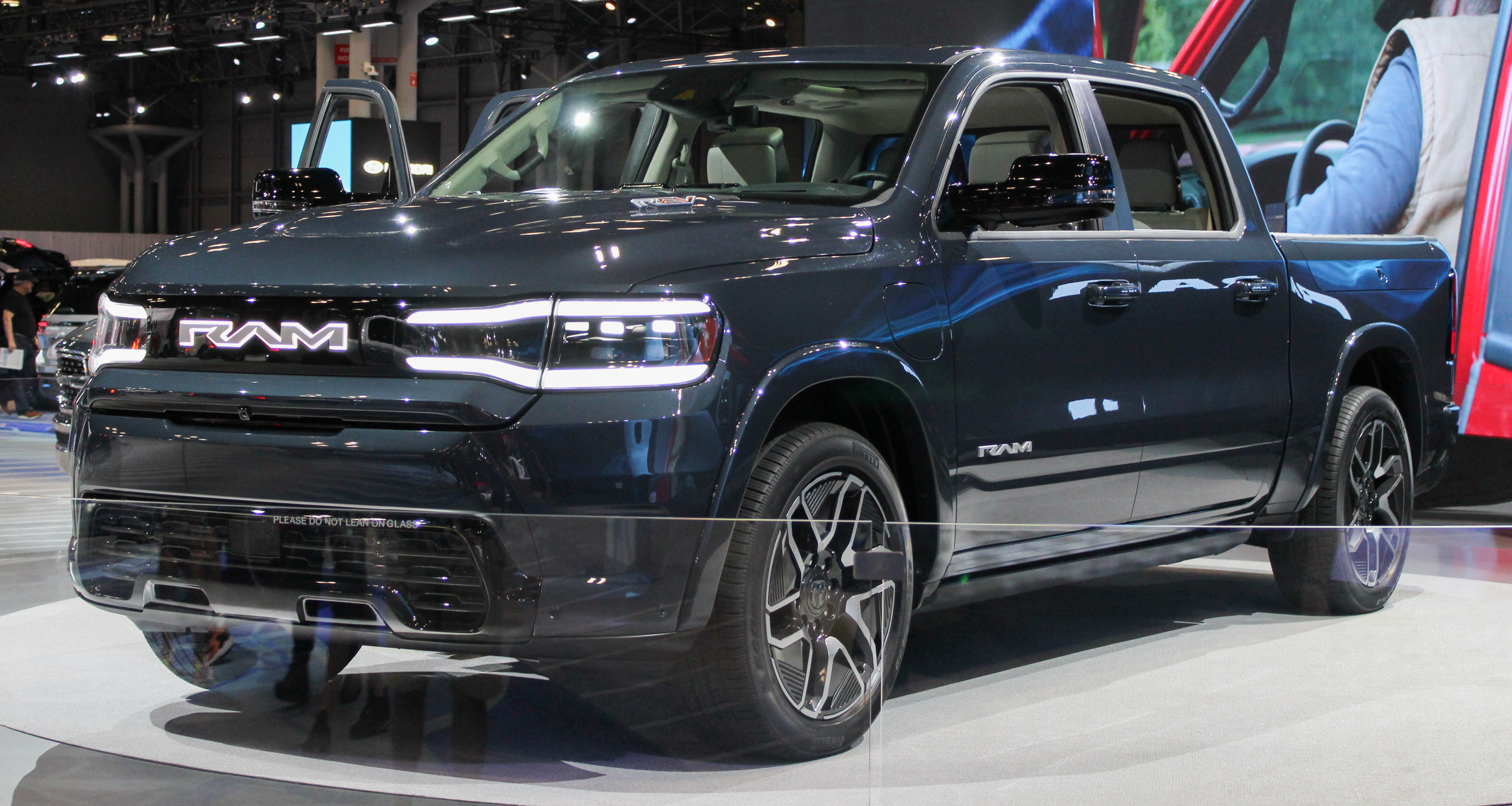
The Ram 1500 is a big truck that people use for work and recreation. It can carry heavy loads and has a comfortable inside, which makes it a favorite for those who need a reliable vehicle for tough jobs or family trips.
CAFE standards are rules that help make cars use less fuel. They set goals for how many miles per gallon cars should get, which helps save energy and reduce pollution.
Model years are the years when a specific version of a car is made. For example, a 2023 model year car was made in 2023 and has features that are available for that year.
The Jeep Grand Wagoneer is a fancy SUV that can go off-road and is really comfortable inside. It's designed for people who want a stylish vehicle that can handle tough terrains while still having all the nice features you’d find in a luxury car.
Mass market adoption means that a lot of people start buying and using a product, making it popular and common.
LIVE
Oh my goodness, it's noon here in Venture City, New Jersey and our nation's capital, Washington, D.C.
And this is Car Edge Live.
Yes, Car Edge Live back on schedule for Monday, February 9th with your host, me, right here in Venture City,
and Zach hanging out in Washington, D.C.
How have you been, handsome? We haven't seen you in so long.
Guys, I thought I was going to be available last week when I was at the National Automobile Dealers Association Conference
in Las Vegas, Nevada, and boy was I wrong.
What a crazy experience that was. Happy to talk about it today on the show a little bit,
but grateful to be back here for another episode of Car Edge Live.
We should, I say should have a normal week as I head to New York later this afternoon,
but we should have a normal week of the show.
So thank you everyone for tuning in and joining us now.
Today's show is brought to you by CarEdge.com.
My dad and I started this company six years ago.
We can help you buy or sell or protect a vehicle.
Check it out, CarEdge.com.
Now, Dad, the story I wanted to talk about this morning is a continuation of a story we've been talking about
for a long time yet with some new headlines.
You can't afford a car and the auto industry is in trouble.
The latest headlines over in automotive news are pretty damning.
Dealer profits expected to fall 12% this year.
That's what JD Power is saying.
And at the same time we have out of NADA, them saying dealers won't see 17 million auto sales again
for years as affordability shrinks the buyer pool.
I wonder if there's a correlation here, Dad, between making money and selling cars.
Shocker.
Well, there's usually a correlation.
And I guess the reason dealers would expect profits to go down 12%
is the expensive cars that they have to sell that normally have a bigger profit margin.
Well, they're going to have to dip into that profit margin to get people to be able to buy them.
So they're going to have to end up making less per vehicle sold,
which will ultimately cut down on profits.
Now, I have read somewhere and it might have happened at the NADA conference last week in Las Vegas
where Ford has said, you know, we are going to bring back more affordable cars,
more affordable nameplates under $40,000.
And of course we hope to have those in the next five years.
So, you know, let me just help everybody with this.
There has never been a five-year period of time where there hasn't been some form of inflation,
unless of course we go into a great depression.
So let's assume we don't go into a great depression.
So over the next five years, we will see some form of inflation.
And so those $40,000 nameplates that could be $40,000 a day if they could build them,
won't be $40,000 when they eventually do build them.
So once again, in my world, it is words not matching actions,
but it sounds good.
It gets your dealers pumped up.
Oh yeah, we're going to have some $40,000 vehicles again, not in their lifetime.
Yeah, it seems like it's maybe within the next five years to your point over those five years prices go up.
Dad, let me show you a few more details from this JD Power projection.
So we've got here at the Auto Summit.
So this was last week, this was a part of NADA.
Retailer profits are expected to drop to $25.4 billion, still a lot of money in 2026,
but that's 12% lower than they have been.
We will see some contraction.
The bad news is it's declining, but in context, it's still very robust.
The expectation is that automakers will have to increase the amount of money
they're spending on incentives to sell vehicles to $3,500 per vehicle up from $3,100.
And then one of the interesting things I saw here, Dad, this subheading,
prices rising, but consumers getting used to it.
This is what you've said all along, which is it's all just talk, no action.
And the subheading like this concerns me a little bit because the auto industry is in trouble
if we see years upon years of stagnant sales, but maybe they're not if we just get used to it
and they figure out how to make as much money as they've made off of fewer customers.
I believe I've said it before that they have figured out, most of the manufacturers have figured out
how to still make a tiny income off of, say, 15.8 million new car sales in a year of North America.
And if that's the case, then there's no need to get back to 17 million or 18 million
or really see that number grow.
So it's not that consumers are getting used to it.
It's the consumers that can afford to get used to it have gotten used to it.
The vast majority of people who in the past would have been new car buyers
are now finding themselves as used car buyers looking for two, three and four year old cars
that can fit into their budget since they're no longer our new cars that will fit into that budget.
So I don't think the consumers have gotten used to it per se.
It's just there's a large enough percentage and that percentage is probably somewhere
between 12 and 15 percent of the buyers out there.
They have accepted it.
They can afford it.
And so it's not a question for them of getting used to it.
It's how do you get the rest of America to come along and get used to it and accept it?
And I don't think they can and I don't think they will,
which is why they're projecting sales stagnation for the next several years.
Now, you did mention used cars, Dad.
JD Power has some data on that as well.
Used vehicle prices are expected to fall about 4 percent in 2026,
but affordability issues continue to impact potential buyers.
A 4 percent drop though.
I mean, you've got to go back in time a little bit here.
4 percent drop is like really good relative to what we had been saying.
What was it?
Used car prices went up 30, 40 percent in a year during the pandemic.
And so we are starting to see used car prices to at least normalize a little bit.
Well, having said that, you have to look at what we've seen so far through the first six weeks of the year.
And so far through the first six weeks of the year,
we have seen used car values actually depreciate slower and in some cases actually start to go back up again
earlier than they normally do for spring and tax selling season.
So unless there's a huge fall off after the spring selling season,
I'm not 100 percent sure that we'll see a 4 percent decline in used car values and used car prices
if we saw them start to appreciate in the latter part of the January and the first week of February.
So I think some of it is more hope than reality.
The reality has been that even though we have seen some used car pricing corrections,
they are still significantly higher than where they had been prior to the pandemic
and where historically they had been in the past.
So along with new car pricing, used car pricing is still well elevated
and in many cases even still more difficult for many, many customers out there.
Well, especially when you factor in the interest rate component,
which is the average APR for a used car loan is significantly higher than the average interest rate.
For a new car loan, we have back on the CarEdge.com website the best deals in February
and many of them are 0 percent financing options.
You don't get 0 percent on a used car.
No one is underwriting that.
At least last time I checked that's not the case.
I haven't seen it in a while.
Let's go to that other article here, Dad,
which was dealers won't see 17 million auto sales again for years as affordability shrinks by your pool.
This comes from the chief economist of the NADA, the National Automobile Dealers Association.
And I want to just read through this.
It's a very short article.
Let's read through it together.
U.S. new vehicle sales won't return to 17 million mark for years amid affordability challenges for buyers,
said Patrick Manzi, the NADA's chief economist.
Quote, we're looking at low 16 million unit range for the next few years for sales.
This was set at NADA.
I think it's still a pretty good year.
Back in the pre-pandemic 2019,
customers bought 17.1 million new vehicles according to automotive news.
They had expected 17 million that year.
Obviously, we're seeing that go down.
I do not see us getting back to 17 million in the next five years,
the chief economist said.
There aren't enough consumers who can afford new vehicles available today with the market losing lower priced models.
He said, quote, we're chasing a smaller pool of buyers.
Someone who might have been an entry-level new buyer a few years ago is now a three-year-old used buyer.
He said, Dad, and I'll go on here.
He says, I think this is a quote.
I think they can go up to 10% and probably still turn a profit
when speaking on the amount of incentives manufacturers have to place on new cars.
There's so many interesting one-liners there from the chief economist of the NADA
at pretty much waving the flag and saying, yeah, our industry is contracted
and I guess it's what it's going to be for the next five years.
It's almost as if he's watched some of our shows and some of our videos over the last few years
because everything he spoke about there are the things that we've spoken about,
that the pool is smaller than it's been,
that the number of people who can participate is smaller than it's been.
And so this is nothing new.
We have been talking, speaking about this for four or five years now.
And so what have we seen the manufacturers do during that four or five-year period of time?
We have seen the percentage of vehicles below $30,000,
the percentage of new vehicles that are being offered for sale in this country
below $30,000, dipped to the lowest levels they've ever been at.
So if the manufacturers know, and they do, that there's an affordability crisis,
they're not doing anything about it other than cutting out those vehicles that would have been
and might still be affordable.
So you look at it, and for instance, you look at what Jim Farley said at Ford.
We're going to have more nameplates under $40,000.
Yeah, if you build them today, not if you build them in 2028 or 2029.
So it is, to me, what we hear from manufacturers.
And if you really look at what the industry is saying,
it is, we get it, we don't care, and we're not really going to do anything to address it.
And if you don't like it, then you're going to just have to buy yourself a used car,
unless and until Chinese automobile manufacturers come into the country.
And I believe one of the outcomes of NADA was the National Automobile Dealers Association
is against allowing Chinese automobiles in the country.
Now, they're not suggesting to the dealers themselves
that if you want to actually participate in that, that you shouldn't.
If you see profit in that, you should go after it.
But until the Chinese automobiles are offered here, I don't see anybody really stepping up to do anything about it.
Yeah, I hear you, Dad.
Well, one of the reasons why these automakers are trying to defend their profitability
is because they lost so much money pivoting towards electric vehicles.
Beginning of this decade was all about how many EVs can we produce,
how can we get away from internal combustion engine vehicles.
And that leads to now, in February of 2026, this headline,
major automakers have written off 55 billion after overestimating electric vehicle demand.
Stalantis, you can see there, has the lion's share with write downs of over 26 billion dollars.
So this happened last week.
Now, let's talk a little bit about what happened over at Stalantis.
And while you are providing that overview, just give me a second here.
Let's take a quick peek.
The company's only worth 17, only, it's still huge number, 17.81 billion euros.
Okay, that's what Stalantis is worth.
And they are writing down 26 billion dollars.
So again, exchange rate and everything like that.
They're writing down a 26 billion dollar loss on a strategy
that they thought was going to be the future of their profitability.
And now is no longer going to take up much of any space within the automaker.
This is craziness.
And Ford rode off almost 20 billion and GM rode off 7 billion.
And God knows how much Volkswagen's riding off.
It is, if you just read that headline, major automakers have written off 55 billion dollars
after overstating EV demand.
Why would that give you any confidence that they're any good at predicting the future?
Because they're not, okay?
You know, I represented Acura for a long time.
I think about 14 years.
And, you know, I saw them come out with vehicles
and they would spend billions in research and development.
And they would, when they would introduce the new vehicles to us,
they would tell us who the customers we should expect to buy those cars.
Okay?
They're designed for people 30 to 45 with an income level of set, whatever it was.
And they were never the people who were buying the cars.
The projections and the predictions were so far off of reality.
So it comes as no surprise to someone who spent 43 years in retail automotive
that they would have guessed wrong when it came to EVs.
And it comes as no surprise that if they say,
well, you know, we need to address affordability,
that they really, they don't know how.
They're not good at reading between the tea leaves, as you like to say.
They're just not good at it.
They don't really listen to their customers.
They pretend to listen to their customers.
They would like to believe they have their fingers on the pulse of the American buyer.
But if they're content with selling 16 million new vehicles every year
in a country that has a population approaching 340 million,
well, that would indicate to me they don't really care what the pulse of the American buyer is.
They're very content making the money they can make just selling 16 million.
They don't need to sell 17 million cars.
They don't need to sell 18 million cars.
They don't need to.
They don't care to.
And they won't.
So what do you make of this decision then, Dad?
Because obviously your Monday morning quarterbacking, which is fine,
because in your career you had all the automakers come to you and say,
hey, again, this car is going to be for this demographic.
It's going to sell off the shelves.
I mean, you can begin to imagine the Volkswagen factory reps talking to their area,
to the folks in their area, hey, we're going to run this Volkswagen Super Bowl commercial.
You guys are going to be busier than all, you know, can be on February 9th.
And obviously, you know, what is the ramification that you've heard all of it in your career.
So I don't want to take any of that away.
What do you make of this most recent decision?
And again, the decision now is we are going to walk back pretty much everything we said
we were going to do with electric vehicles over at Solantis.
That means they're not coming out with, where was it here?
The Ram 1500 Rev, the Charger Daytona EV, the Charger Daytona SRT Benchy electric muscle car.
They're dropping the all plug-in hybrid Jeep and Chrysler models for Dad doing the same thing,
costing them almost 20 billion to your point.
So what do you make of this decision, Dad?
You know, instead of Monday morning quarterbacking it,
what do you think is going to happen on the other side of this?
Do you think it's going to actually provide value to these companies and to these dealers
and to ultimately the consumer?
Or do you think it's just going to be another mistake we look at five years down the line?
Well, I think if the major manufacturers are writing off 55 billion dollars
because they bet wrong on EVs, then I think that says to me,
we are going as manufacturers to continue to build the high profit margin,
high priced vehicles that we can sell to 12 to 15 percent of the population.
Because we need to recoup some of that 55 billion that we bet on EVs.
Would I sit here and think to myself that this new bet is going to work out 100 percent
the way they would like it to?
History would suggest it will not.
You know, too many of these manufacturers, much like many of the car dealers out there,
are reactive instead of proactive.
Okay, they make a decision.
The decision in 2019, 2020, 2021 was to invest billions upon billions in the ever-growing EV side of things.
It wasn't a good bet.
Okay, they were wrong.
But they were being reactive to what they were seeing European governments
and the US government moving towards.
And so now, with a different administration, they're being reactive again instead of proactive.
And the reaction is, okay, well, we're going to go back to more gasoline-powered cars.
We're going to dig into hybrids and things of that nature.
And my guess is that somewhere slightly beyond that is what reality will be.
And then two years from now or three years from now, we will see headlines where Ford will be investing
$10 billion in whatever fuel source will be popular at that moment.
And Stalantis will be doing some similar things.
And once again, it'll be reactive, not proactive.
And so I think they have a hard time trying to really determine and mold the future
the way they think they can or the way they think it will be.
I do hope, however, that this does provide some bit of a pathway towards more affordable vehicles
because if you're making vehicles with a power train you know and love, with components that you know and love,
this also ties back to the CAFE standards rules being pulled back a little bit.
Ideally, there's a path here now to have cheaper vehicles on the other side of it.
To your point, how quickly can these manufacturers produce those vehicles is really a question that only they can answer.
And we see it, they produce vehicles in model years.
It's not like they do a quarterly vehicle release schedule or a monthly vehicle.
It's model years.
It's the whole year.
And so I do think there is hopefully a path now, but the runway of that path I feel like is more multi-year
or even decade to be able to influence change at the ultimately like the bottom line,
which is the consumer's pocketbook and their willingness to spend money on a vehicle.
It just seems to me that if you have to overcome those write downs,
that the way to do it is not by producing more lower profit margin, lower price point cars,
but by producing higher profit margin, higher priced vehicles.
And so even though they will speak to affordability, because they have to overcome those write downs,
their actions will be directly opposite of their words about affordability.
I don't think for a second we're going to see a decline in production of their most expensive highest profit margin vehicles.
I think if you took a photograph of what's available in the expensive side of things today
and compare it to what's available on the expensive side of things say in November,
that the number of expensive vehicles will not have gone down.
Okay, and we will not have seen a significant increase in the lower priced, more affordable offerings.
It's just, there's too much money involved that they have to overcome.
And let's not forget, you showed the stock chart for Stellantis, they have to placate their investors.
Okay, so what's the best way to increase the profitability of the company?
It's not by producing less expensive lower profit margin vehicles,
it's by producing more expensive higher profit margin vehicles.
And so that's what I think they're going to do.
I will say, however, Dad, over at Stellantis over the past five years, their market value, their stock price is down over 50%.
And so at a minimum, they have to just do something different.
Okay, so that has to happen.
New CEO, new leadership, they have to do something different.
And to put into perspective here, just in the past month, they're down to 32%.
So they had that big precipitous drop on the heels of this right-off, this $26 billion right-off, which again is doing something different.
There's a different world where they said, you know what, we're going to be really, really steadfast and hard-nosed
and we're going to bring the Ram Rev out.
You know what would have happened if they'd done that?
Dealers, lots would be full of Ram Revs that aren't selling right now because $100,000 EV pickup trucks we've learned.
The Cybertruck demonstrated this, the F-150 Lightning, which Ford also has stopped doing production of and will no longer...
So they had to do something different, they are doing something different.
It'll be interesting to see downstream what type of ramification this has on prices.
We do know at Stellantis, to some degree, they are addressing pricing.
And we know that they're reducing the prices of some of their offerings.
But even with the reduced prices, they are still significantly higher than what their customer base can afford,
which is why their customer base abandoned them for the last five years.
It's why their sales went down.
They can't lower their prices enough and remain profitable to ever get those customers back in large enough numbers.
So yeah, we see them admitting the error of their ways.
Oh, we priced our stuff too high.
We moved too quickly upmarket.
But they're not going to get...
If you reduce the price of the Grand Wagoneer from $110,000 to $90,000, it's still not affordable.
You haven't addressed the affordability issue.
You haven't opened up your space to your customers again.
So they went so high-end so quickly that they can't lower their prices enough to ever get their customers back.
It's just kind of crazy.
We shall see.
Hopefully, we're still doing Carriage Live a decade from now.
We'll be talking about the automakers that were in the grave.
And hopefully, we're not in the grave with them.
We've got from Rich here.
I think I'll be alive.
Hopefully, Dad's still alive.
All right, we've got from Rich here.
You'll be 84.
Come on, that's pretty old.
I'm not disagreeing.
All right.
Well, your brother, who I saw this weekend, he's 83, and he looks great.
So hopefully, you're living...
Yeah, but he's an anomaly.
There are not many 83-year-olds like my brother.
That shovels snow for five hours?
Yeah, no, he's crazy.
Okay, from Rich.
Although, if he was stronger and younger, he probably would have done it faster.
From Rich.
Thank you, Rich.
Really kind contribution.
Pops needs a Helikron Auto.
All right.
You give him a sense of flying down there.
Let me Google it.
Helikron...
Well, I'm guessing that's one of them flying automobiles?
Yeah.
Well, I'm just guessing.
I mean, you know, like...
Rich always has the most...
Oh, yeah.
From 1932, Dad.
Yeah, I'm pretty sure that doesn't affect your vision at all.
Because, you know, it's moving so fast that propeller is moving so fast that, you know,
your eye doesn't catch it.
So you can actually see through that.
Rich always put in a smile on our face.
Thanks, Rich.
From ARC Photography, thanks for the kind contribution.
You mentioned big names investing...
Investigating.
No, I think investing in EV caused a downfall.
How would you say EV companies like Tesla and Rivian will do?
Yeah, I think that's a great question, Dad.
I actually am not too opinionated on this yet.
Although, I'm a little bit more opinionated on the Rivians of the world,
the ones that have had less mass market adoption.
Like, they still lose a lot of money.
So it's kind of clear to me that they got to figure out how to make money eventually.
Yeah, I mean, they're still losing billions.
And Tesla has dropped a couple of its models.
That's a big deal.
We didn't cover that here on this channel.
We were, obviously.
But like, the fact that they're no longer producing what is it, the X and the S?
Yes.
That's a big deal.
It is a big deal.
And, you know, it indicates to me that, yeah, automobiles were something at one point in
time, and that they're pivoting perhaps from consumers purchasing their automobiles to
trying to corner the robo-taxi market and all that type of stuff.
Yeah.
You know, I think like Uber and Lyft and, you know, that's part of the gig economy.
And perhaps, you know, that's, I don't even know that in the future, Tesla's are going,
there's going to be very few people that actually own cars.
I was, like, what's crazy to me is Tesla is a $1.32 trillion company.
Yeah.
And I actually think it's kind of speculative to even like try and, I guess, and identify
what they're going to be doing in the future.
Rivian looks like, I think, feels like more of an automaker, and they are just like many
other automakers right now, not profitable and struggling to become profitable.
Look at Nissan as an example.
They're not profitable right now.
Volkswagen and other examples.
So it kind of looks like an automaker, smells like an automaker, is an automaker.
Tesla, I think, is an enigma.
They might be, you know, in the next couple of years here, a totally different company.
From the outside looking in, I'm sure people there know exactly what their strategy is.
Yeah.
Like I said, I checked.
We're not in Tesla's doors.
We're not Tesla insiders.
Who knows what happens there.
But I think the general consensus that I have is that being a purely electric vehicle automaker
is tough sledding.
We've seen a lot of purely EV automakers go out of business.
We see a lot of purely EV automakers struggle to make money.
And we see now legacy automakers no longer competing in that realm.
I think the writing's on the wall a little bit for electric vehicles in the sense of
how mass market they can and will become.
And I truly believe it's, if there is going to be an electric vehicle evolution and revolution
in this country, it will be because the inexpensive Chinese brands have been brought into this
marketplace.
And it won't, that evolution and revolution won't happen until that time.
If people can suddenly buy an electric vehicle for $12,000 or $15,000 or $20,000.
Now it looks different.
Now the world changes.
The world is completely different than if the electric vehicle $60,000, $70,000, $80,000.
So there's, I think everything hinges on Chinese automobile being available in this country
if and when that happens.
It also hinges on going to caredge.com.
If you haven't been, check it out.
It's a fun place to spend some time.
Carside show you fake prices.
We'll get you the real one.
As a friendly reminder, folks, we're here to learn what you're interested in.
Contact dealers and help you get real offers to compare.
Please check it out back at caredge.com.
Learn how we work for you and how we can support you, me and my dad and our incredible team
as you navigate the car buying journey.
We're back tomorrow with more car edge live.
My pops will be in Ventner City, New Jersey.
I'll be in New York, New York, a city so nice they named it twice until then.
I hope everyone enjoys the afternoon.
Dad, I hope my train leaves on time and I look forward to talking to you more tomorrow.
I love you, honey.
I love you too.
Catch you guys then.
Bye, Dad.
You want to hear something amazing.
The train that I took to Philadelphia yesterday originated in Washington, DC.
Left eight minutes late.
I have no idea why.
Okay.
And arrived in Philadelphia 17 minutes late.
I don't get it.
I don't get how that happened.
I don't get how it happens either, but fingers crossed I get up to New York in one piece.
We'll see you guys back here tomorrow.
Love you, Dad.
Love you too.
About this episode
The episode dives into the current state of the auto industry, highlighting the challenges of affordability and declining dealer profits. With JD Power projecting a 12% drop in dealer profits and a stagnation in new vehicle sales, the hosts discuss how many potential new car buyers are now turning to the used market. They also touch on the industry's shift towards more affordable vehicles, the impact of rising prices, and the significant losses automakers face due to overestimating electric vehicle demand. Insights from the NADA conference provide a sobering outlook for the future of car sales.
Today on CarEdge Live, Ray and Zach discuss the latest trends in the car market. Tune in to learn more! Hosted by Simplecast, an AdsWizz company. See https://pcm.adswizz.com
for information about our collection and use of personal data for
advertising.