This holiday, Verizon is giving you incredible gifts and savings you'll enjoy all year.
When you switch, you'll get four new iPhone 17 Pros, no trade-in needed.
That's right, get four lines for just $25 a line and the amazing iPhone 17 Pro for everyone.
Save big this holiday. Visit Verizon today.
$20 monthly promo credits applied to account over 35 months with a new line on Unlimited Welcome.
In times of congestion, unlimited 5G and 4G LTE may be temporarily slower than other traffic.
Domestic data roaming at 2G speeds, additional terms apply for phone offer.
See Verizon.com for details.
Hey, Stacey David here with the Tales of the Gearhead podcast.
Now, what is this? Well, it's a podcast that covers everything automotive, everything mechanical,
everything that's just cool about the automotive lifestyle.
And since that's just about everything, you're going to love it.
Today's podcast is brought to you by Cornwell Tools.
Let's get rolling.
Well, I've got a big surprise coming up for you guys on the show.
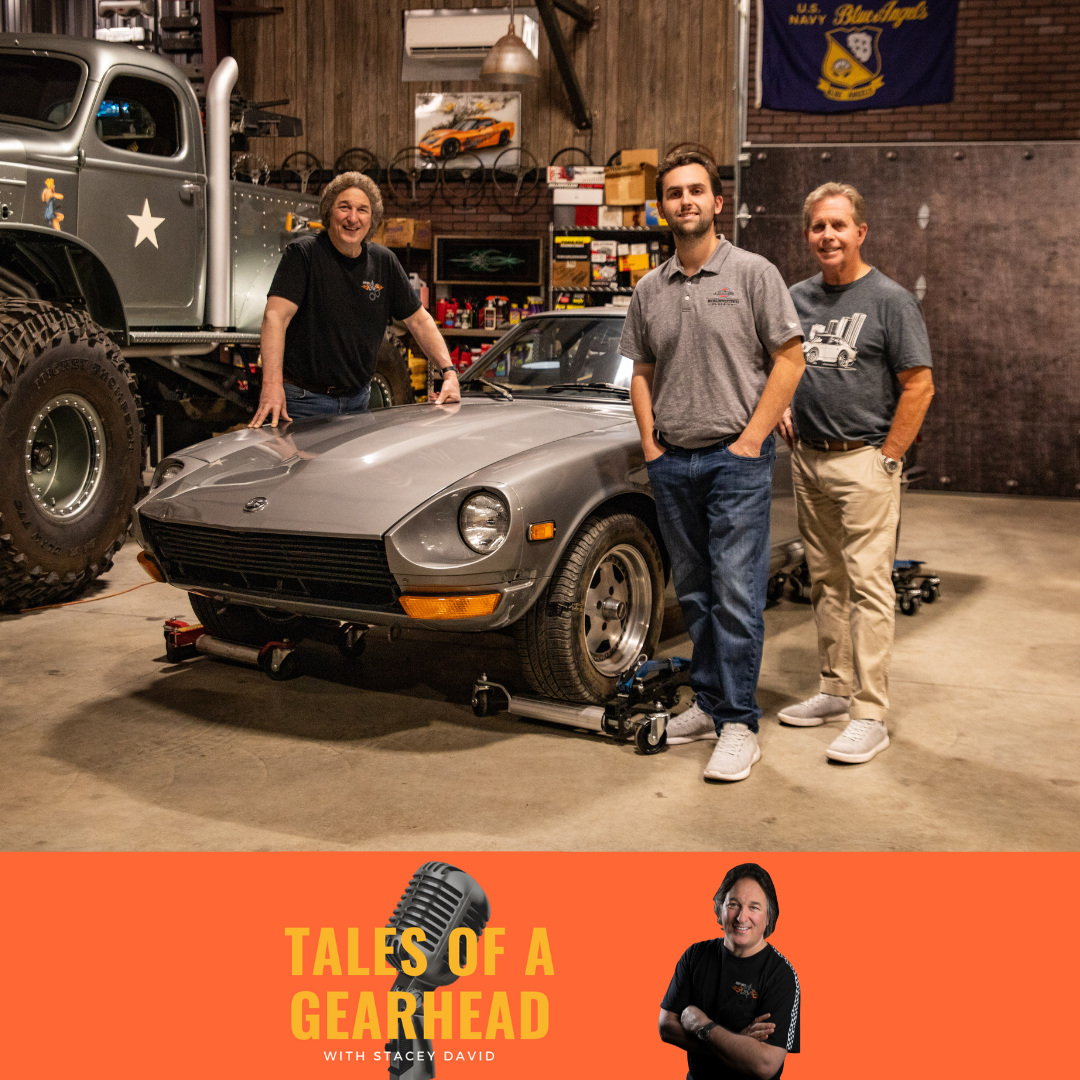
I am going to be rolling in an early, early Datsun 240Z.
And those of you that experienced a Z is pretty much everybody.
And we're going to have a lot of stories and a lot of history to share about those cars.
And I've got a really cool one to roll in and do some restoration work.
So to go with that, I have a special guest here today.
It's Max McCroskey from Resurrected Classics.
Now, one of the things that makes them really unique is that they specialize in early Z-car parts.
And their parts are really nice.
And so we're going to talk about Z-cars.
We're going to talk about parts.
So, Max, welcome to the podcast, man.
Thanks. Got to be here.
All right. Tell me, because you're a young guy, how did you get into Z-cars?
Yeah.
And especially early Z-cars.
What was it about them?
So really, you know, it kind of started in high squad, a buddy of mine that he had a 83-ZX.
So, you know, that's the next generation after that.
But then, you know, I started learning more about it.
And, you know, I already kind of liked, you know, classic cars kind of growing up and I was interested.
And then I looked at those and I learned about the early generation.
I mean, I really liked the lines of that car.
And, you know, it's really nice.
At the time, you know, it was a really affordable classic car.
Yeah. And you like the earlier body style, correct?
Yeah. Yeah. It's a very nice, fastback shape, very slim.
Yeah.
And, you know, pretty obtainable, you know, at my age.
So, tell me about the first time you rode in one.
Was it amazing or was it kind of like, this is fast.
This is cool.
Or did it make a first impression on you?
Well, I remember thinking just, you know, oh, I was really excited to even get one running.
You know, that took a long time anyways.
But then just to, you know, how peppy it was.
Yeah.
You know, how I respond, you know, for so small and, you know, only 150 horsepower.
I mean, it felt really fast.
Yeah. I mean, to you, it felt fast.
You know, it's like when you're in the car, it feels really nice and very responsive.
Now, were you automatic or stick?
Stick, you know, four speed.
I'm glad that you can drive a stick.
You know, not a lot of people can drive stick nowadays.
Yeah, that's true. It's kind of going away a little bit.
Okay. So how did you get into the early first gen Z-cars?
The 240s, 260s and 280s?
Yeah. So really, just, you know, I bought one, I think is something like 400 bucks.
Yeah.
It was really cheap.
Oh, I used to buy those things so cheap.
Yeah. Oh, yeah. I mean, it's a bad shape.
I mean, it was, you know, really, really bad.
And then, you know, I kind of worked on a little bit and then I got out of it
and I got back into it and I found one, you know, that was a pretty nice body from California.
Yeah.
Somebody had swapped it with the V8, you know, kind of cobbled it together.
Yeah, like a lot of them were.
Yeah. And it was really fun, really fun experience.
I mean, that's really good cars and very, you know, reliable.
Yeah. So tell me about resurrected classics.
You guys actually offer sheet metal.
You have bumpers.
You have mostly restoration parts, correct?
Yeah. So pretty much, you know, we're trying to be like a like a one stop shop
for original type restorations, you know.
So a lot of like, you know, rust stuff, like, you know, like panels.
Yeah.
You know, trim stuff and even we're starting to like to engine maintenance stuff,
you know, like maybe gaskets.
Yeah.
You know, weather stripping for the car.
So pretty much just a one stop shop for original stuff.
Now, how do you develop your new products?
I mean, do you go in?
Do you start with like an original panel and then work off of that?
Or do you go in and refine things?
You know, if we can, you know, I spent a lot of time finding new old stock pieces,
you know, Nissan pieces that are original and, you know, bringing the packaging
and, you know, really good shape and, you know, scanning those and, you know,
getting like a model made from that starting there and then pretty much
just, you know, a really long time of going through samples and iterations
and testing and then, you know, real world installs on our, you know,
shop cars to make sure that what we're making is in line with what somebody
can reason install, you know, with maybe limited tools or limited experience,
you know, because we've we've all been there.
Oh, yeah.
No, that's awesome, man.
That's a great approach that now.
Okay.
Now, how many Z cars do you have really?
Yeah.
Used to have, you know, 10 to 15.
Now I'm down to like four.
So now I'm reasonable.
Yeah.
That's nice.
Of course, your dad has five or six.
Yeah.
Yeah.
So that's a little different, you know, different counting system.
Yeah.
Now you've got one with an LS engine in it, right?
Yeah.
And so, you know, I like original, but also, you know, I think they're
fun to swap and do things with just, you know, because it got a little
boring to the same thing a couple of times.
So I did, you know, LS six with the TPT6, you know, transmission.
Yeah.
And that was the magic of the Z car.
They were great original, but they were great to modify.
I mean, they were a modifier's car.
Yeah.
I mean, yeah, they're really open to a lot of different things.
I mean, the engine bay is super wide for a car that I really, you know,
can have a lot smaller engine bay.
So, I mean, it's, I mean, really easy for a lot of different swaps.
And I've, you know, it seems very open to that.
And a lot of people will do, I mean, really crazy things.
Yeah.
How do you like the body kits and stuff that are out there?
Yeah.
I mean, there's a lot of good option there.
People do a lot of like old school and Nissan competition style things.
Yeah.
They're no longer made that kind of style.
You know, ductile spoilers, you know, there's flares.
I've even seen full on like GTO conversion kits and make like a Ferrari.
Oh, those were great when they first came out.
Yeah.
When you could buy Z cars for 500 bucks that didn't rust on them.
Yeah.
Yeah.
I always wanted to build one of those.
Yeah.
And then the kits now you can't even get them.
I think Z-tricks still carries them.
They do.
Yeah.
But it's, you know, the values of these cars have gone up so much.
You don't really want to cut up a Z car.
No.
Yeah.
You really don't.
And what I'm seeing now is people almost, you know, re-restoring cars.
So yeah, I mean cars are from like the 80s and 90s that have been
heavily modified or getting re-restored back to original.
So it's not, you know, interesting.
You're seeing things restored twice.
Yeah.
How the market kind of changes how it changes.
Yeah.
Restorations.
Where do you see the market going on these Z cars?
You see it still going up because Nissan just released their new Z.
And I mean, they're still pushing hard.
So what do you think?
Yeah.
You know, I think it's really come up a lot in the last, you know, five years.
I think it's come down a little bit.
Yeah.
But I think it's a really kind of healthy value right now.
That thing will attract a lot of, you know, enthusiasts kind of to the market.
And I think too, it's not too high where people are priced out of it.
I think it's a really good spot.
Yeah.
And that, you know, people can enjoy.
Especially if you can pick up like 260 or 280.
The 240s, they're pretty collectible.
Yeah.
You know.
But so if a guy picks up like a 260 or a 280 up to 78, their first gen cars.
Yeah.
What would you suggest that they do?
What would your suggestion be to the approach this should take?
Yeah.
Do it original.
Make it a hot rod.
You know, what do you think?
Yeah.
So, you know, it's my relics of the look of a 240Z.
Something like a 260 or 280Z is also a good idea, you know, a good idea because the
body is pretty much exactly the same.
Yeah.
And especially they're a lot easier to pick up and they were made better.
The metal is thicker.
Yeah.
And they're pretty much the pinnacle of that early design.
Yes.
And so if, you know, things are honey back, like, you know, like how big
the bumpers are, that can all be changed.
So don't let that, you know, deter you because they're still really good,
you know, picks and you can really pretty easily modify them where somebody can tell
the difference between 240 and 280 from a distance.
Matter of fact, don't you have a bumper conversion kit that's the front and rear bumpers
and to convert like a 280 to 240 bumpers?
Yeah.
Yeah.
So that's awesome.
Yeah.
Yeah.
The brackets, it's super simple.
It's really not that bad.
The front is really easy to back.
It's a little bit harder.
Let's take gas shocks out.
You get the gas shocks out.
It's not bad.
Don't cut the gas shocks.
I know that for a fact.
Yeah.
Yeah, don't do that.
That's a whole other story.
Forget the warning on them.
Just cut them.
Oh man.
So what it knew do you have coming out?
What new Zcar products do you have coming out?
Yeah.
So some of them we're kind of working with now.
Bert, you know, kind of like the testing phase.
Yeah.
Once I put a sample is exhaust kits.
Nice.
So work on exhaust and gasket.
So, you know, we think with all the new kind of resurgence
and the value of 240 and people won't go back to original.
There really is no way of making a 240Z original exhaust.
Yeah.
Which really is important because I mean by this age,
you know, they're either really rust or they're changed out.
Yeah.
Who want original and it's hard to make something like that
probably from scratch.
Yeah.
And so we have something like that we're going to be
releasing pretty soon.
It's nice.
With all also to the original brackets and hangers.
So it's not going to be after all the drilling.
It's original style.
So look the exact same sound the same everything.
Okay.
That's going to be cool.
Now you're going to be a Zcon, right?
Yeah.
Yeah.
Nashville.
Yeah.
Tell everybody about Zcon.
If you're into Zcars, you need to hear about this.
Yeah.
Zcon is really a great place.
I mean, it's a very targeted show.
I mean, it's like six days, isn't it?
Yeah.
Just driving Zcars around.
And I mean, all generations.
So you've got, you know, the oldest ones all the way up to,
you know, 80s, 90s, modern day.
I mean, every Z person would really enjoy it.
And they've got events, you know, track stuff.
It's a big world.
A lot of people don't realize how big that world is.
Yeah.
No, it really is.
Yeah.
And also too, you know, if you're thinking about getting
it, you know, getting into Zs, that'd be a great thing
to go and visit.
You can talk to enthusiasts, get their experience.
Yeah.
Learn the market.
Get advice.
See what kind of parts are available.
I think that's important before we dive into a car, you know,
to restore.
Yeah.
Awesome.
Well, Max, that's been great.
And great to have you on here.
We look forward to having you back on.
Thanks.
Sounds good, man.
Thank you very much.
I appreciate it.
You know, I got a question for you out there.
If you're working in your shop, what kind of tools
are you using?
Now, you're probably going to go, you know, whatever I got.
Gee, man.
Are you kidding?
Well, and that's the problem because, listen, we all grew
up working with cheap tools.
And my first set of tools, my dad got them at Kmart,
got them for Christmas.
And I use those things until they just, there was nothing
left.
But that's all we had at the time.
But as soon as I could, I started investing in good
tools.
And the reason it's not because you want to show them
off to people, even though that's okay, it's because
they allow you to do quality work.
And there is nothing more frustrating.
I have talked to gearheads all across the nation around
the world, actually.
And one of the biggest frustrations they have is
either not having the right tool or breaking the tool
they were using or having something strip or break
or something.
And almost every time it's because they don't have
the right tool or they're not using a quality tool.
So if you are into this like I hope you are,
you need to get some good tools.
And that's where Cornwell Tools comes in.
They're America's oldest tool manufacturer.
They're still American made.
I think that if you are going to build some stuff,
if you invest in a good set of tools right off the top,
you don't have to get everything.
But just get yourself a nice set of hand tools
and work from there.
You will never regret it.
And you can pass them down to your grandkids
or whatever if you want to.
But most car guys want to hold onto their tools
as long as they can.
Anyway, if you get a chance, check out Cornwell Tools.
You will not be disappointed.
All right, we've got some questions here.
This one comes from Bill.
And Bill says, hey Stacey, gear talk with my buddies
often leads to transmissions.
Yeah, sticker automatic is the first thing.
He says we're doing automatics.
And he said it is clear that the concept
of torque converter stall is misunderstood.
Yeah, it is.
He said a simple, accurate explanation
would be so helpful for us.
He said for the average street build,
say an 80s Mustang with around 400 horse in a small block,
what stall would work the best for street grudge matches
but also decent for city street driving?
So basically you want me to help you set up
your street race car, I love it.
I'll be glad to do that for you.
Okay, fantastic question.
A lot of people don't really understand torque converter
stall speed and a lot of them think higher is better,
bigger is better, kind of like they do with cams.
Here's the basic thing.
When you're running up an engine,
say your engine is an idle
and at idle you're not in your power band yet.
Most engines start to build torque
and start to build horsepower around 3,000 RPM,
something like that.
So basically when you get ready to launch a car with a stick,
you run your RPMs up around 3,500 and dump the clutch.
Now the reason you do that
is because your motor's right in the power band
and when you floor that thing and dump the clutch,
you're right there where all your horsepower and torque is.
Well, an automatics the same way
except you don't have the clutch pedal,
that's where your stall speed comes in.
Now your stall speed is what allows the engine to rotate
up into that power band while the vehicle's still sitting there.
So the torque converter is still slipping
until it hits the stall speed then it locks in.
So if you're running an engine and your power band,
you really want to launch that thing at 3,000 RPM.
Well, you'd want a 3,000 RPM stall speed
because that allows you to load that torque converter
sitting there and then launch that thing
and the car really won't start moving
until it hits 3,000 RPM.
Now setting the stall speed is a lot of things affect this.
I mean the vehicle weight, the engine horsepower,
the torque curve, you know,
the specific design of the torque converter.
So you have to be careful what you pick
because you don't want to pick the wrong stall
for your engine and the way you're driving it.
Generally your high stall converters are 3,500 RPMs and up.
This is usually racing applications only.
They maximize acceleration because you're leaving right,
you know, in your power band.
Most of your lower stall speeds, 2,000, 3,000,
those are suitable for daily driving, towing,
street machines, that kind of things.
So to answer your question,
I would recommend probably around a 2,000 to 2,500,
probably a 2,500 stall
because you're probably starting to build some power there.
Keep in mind if you load that torque converter
just like a clutch and you get up right into that stall's RPM
and then you floor it,
well, all that power is going to hit
just as that torque converter releases.
You're going to get a great launch.
So that's what I would recommend.
Generally when I'm building a street vehicle
that's going to be driven on the street
and also make some passes down the strip,
about a 2,500 stall.
I never go higher than three,
never on a primarily street driven vehicle.
Now, if you're going to be doing more serious racing
and you really want to get that launch
and say your engine really hits,
you're hitting top torque at 3,500
and your horsepower is really coming in there
and you've looked at your dyno graphs
and you're right there where your horsepower
and your torque are crossing.
Well, yeah, you want to put your stall right there
but that's a drag race thing.
Now, one other aspect of this,
if you're going with a supercharger,
keep in mind your big block engines
that build all this torque right off idle
and superchargers,
anything that's adding low end torque,
you're getting power right off the idle
so you really don't want the highest stall.
You want that thing to launch right as you're in that torque.
So anyway, hopefully that explains to you how this works.
Like I said, I would recommend about 2,500 stall
for your car
and hopefully you'll win some races out there, man.
Good luck to you.
Okay, this question comes from Robert
and this is a question that we have dealt with several times
and it just keeps coming up.
So this is a really popular issue that's out there.
He goes, hey, Stacey, the question I have
is that I've been restoring my grandfather's 79 Chevy C20.
Awesome truck, man.
He said I've been working on it for the past four years
and one thing that I want to do is convert it to a 4x4.
I was wondering what I have to do to convert a 2-wheel drive
to a 4-wheel drive.
Wondering if I could do it without doing a complete frame swap.
Yes, once again, great question.
You don't have to do a complete frame swap.
Sometimes that's easier depending on your skill
and your ability.
But let me just kind of walk you through this.
Obviously, if you can find a square body Chevy truck,
a C20 that's a 4-wheel drive truck,
well, just putting your body down on that frame
would be absolutely the simplest thing to do.
It's a bolt-on deal.
That's provided you can find that frame.
If you can't, then you got to do it yourself.
Now, the good part is all of the parts
to put 4-wheel drive under a 79 Chevy are available
from anybody that sells, you know, square body Chevy truck parts,
LMC or, you know, any of these places,
brothers, any of these guys that carry these parts.
Also off-road and limited is somebody we use to actually
make a conversion kit to put a front axle
under one of these things.
But it's a little more difficult than that
because here's what you're looking at.
You not only have to get a matching front axle.
Now, I assume you're talking about putting a solid axle
in the front, not an independent suspension.
That's all another ballgame
if you're going 4-wheel drive with that.
And I don't recommend you do that as a first-time thing.
But let's say you want to put a solid axle in the front
okay, you're going to need the suspension
which will probably be leaf spring.
If you're going to do some sort of 4-link and stuff
that's a whole another engineering thing
that you need to understand.
And there's kits out there to do that
but the simplest would be a leaf spring deal.
So you have to get the hangers for that.
So you have to get the front axle
with the matching gear ratio to what's in the rear
and all the suspension to hang it.
Then you're going to have to get the steering
that will work with that solid axle
because it's going to be different
than what was on the original independent front suspension
on your 2-wheel drive.
So now you have front axle, you have steering upgrades.
Now you have drivetrain upgrades
because you need to add a transfer case
which means you also need to add the transmission
that works with the transfer case.
Those trucks had what we call a married transfer case.
In other words, a transfer case bolts
to the back of the transmission.
Some of your other vehicles had what we call
a divorced transfer case
because the transfer case is separated
from the transmission by a little tiny drive shaft.
And a lot of military vehicles did that
and obviously you see why they're called divorced
and married because they're together or they're apart.
But anyway, so all that has to be taken into consideration.
So you need to be on the hunt
for the proper drivetrain parts.
And this goes all the way up
of what engineer you're going to use.
So ideally you would want to find a drivetrain
that is out of a 4-wheel drive square body Chevy truck.
And those are still pretty easy to find.
So you're looking at, you know, the transfer case
which is usually a 208 that came with those
behind a Turbo 400 that's set up for that
that you bolted behind your small block.
Then your drive shafts.
You're going to need the drive shafts.
This gets you in the ballpark.
Obviously your cross members where you mount the transmission
all that will have to be built fabricated by you
or borrowed from a donor vehicle.
So even if you're not doing a full frame swap
it behooves you to have a donor vehicle
where you can just transfer these parts off of.
If you're going to junk yards or swap mates
trying to find these parts
man that can turn into a crazy deal.
That's what I suggest with any of these
is that you get some sort of a donor vehicle
whether you're doing a frame swap
or just putting a suspension in.
Okay, once you have all the hard parts in
now it's all hookups.
You know, you got to have the gear shifts
for shifting the transfer case.
You have to have all of the little bits.
You know, your exhaust system will need to be different.
Your cooling system will probably need to be changed.
You know, you're going to need different wheels and tires.
I mean, all of these things that can add up.
And this is a simple version.
Like I said, this is basically taking something
off of a donor vehicle
and bolting it onto what you have now.
Let's say you can't find a donor vehicle.
Let's say you want to put the suspension
under a modern Silverado
like a, you know, 2014 Silverado.
And that would definitely be easier to do a full frame swap
but there's still going to be some engineering
and some fabrication required
to get all the mounts right
for the body and the cab and that kind of thing.
Or you have to pull all that suspension out
and re-engineer it onto your stock frame
and make it work.
Either one is doable
but then the big question is,
is what is your skill level?
Because these are what I call level four projects.
And like I said, there's only a level five beyond that.
So this is a pretty advanced thing.
So you need at least three bays of space in your shop.
One bay to work, one bay to have the truck
and the other bay to have the other frame chassis
suspension stuff.
Anytime you're pulling a body off,
you know, you need that other bay at least
and you need the proper tools to do it.
So if you are not set up to do this kind of project,
you would be looking at maybe taking it somewhere
and that starts to add cost very quickly
if you have to go to a shop and have them do this.
So it's definitely doable.
If you find a donor vehicle or find the donor parts,
it is almost a bolt-on deal.
You have a 79, but any square body truck,
long bed, you have a C20,
find an old one that's all rusted out and grab that frame
and you can pretty much transfer most of that stuff
right to your frame or bolt your body down on it.
Anything more than that starts to get more difficult.
So Robert, the choice is yours, man.
Which way you want to do it.
It's a great project.
I would recommend it.
I've got a 85 K20 4x4 sitting right here.
I'm looking at and they're awesome.
Okay, the next question, this comes from Leland
and it's about towing and hauling a vehicle.
Very good question.
He goes, hi, Stace.
I'd like to know the best ways to tow a vehicle safely,
whether it's across town or across country.
And he said, I just want to make sure
I'm getting my vehicle home safely.
All right, Leland, you don't realize it,
that you have jumped onto a huge issue for most people
because you would be surprised how many people do not know
how to strap a vehicle down properly.
I'm talking people that should know better.
Excellent question.
And we've done a couple of shows
on actually towing and hauling.
I have a new one coming up that we're doing right now
on how to choose a trailer
and what kind of trailers do what and all of that.
Obviously I can't go into all of that right now.
But let's go into the basics of towing and hauling.
Okay, we're going to deal with first towing something
on a trailer.
Okay, there's two schools of thought here.
Basically, you get the vehicle on the trailer
and you have to center the weight of the vehicle
over the axles.
That's a given.
If you get the weight too far back,
it picks up the back of your bumper
and puts you light in the rear
and you will lose control of the vehicle.
If you get the weight too far forward,
it's not as good, obviously.
It's not as unstable of having the weight too far back,
but it also causes problems.
So you really want the weight of the vehicle
right over the axles.
So placement on the trailer is important.
Now, when you go to strap it down,
there's some people that like to strap from like the bumpers
and the frame
and then pull the vehicle down and compress the suspension.
I don't like to do it that way.
And the reason being is every time you hit a bump,
that vehicle is going to bounce on its suspension.
And you can't have that suspension compressed enough
to alleviate that,
which means every time you hit a bump,
it's going to bounce against those straps.
It's going to compress and pull up hard against those straps,
potentially breaking a strap
or potentially just stretching one.
Or letting the thing, you hit a big enough bump,
it can compress enough to let the strap,
if it's got a hook on it,
let the hook come loose.
And that's no good.
So I always strap a vehicle down from a fixed point,
like the control arms,
something where you can pull the vehicle down
and get it tight
and where the vehicle still rides on its suspension.
Yeah, so if you can get something,
you know, in the back,
I usually strap to the rear axle in the front.
I'll strap to the front axle or a lower control arm.
Sometimes you have to go through the wheels,
depending on how low the car is.
Then you can strap it down and you're good.
A lot of people have said you need to cross the straps.
That's good.
If you can do that, you can't always do that.
It's also not imperative.
I have strapped vehicles down with two straps,
one strap in front, one strap in back.
That's okay.
I prefer to do it with four straps,
two in front, two in back.
Whichever way you go,
once you get it strapped down,
get it nice and tight
and then drive it a few miles,
pull over and check all the straps again.
And all through your trip home,
every once in a while stop and check those straps
because they can work loose for whatever reason.
And if you do it this way,
you'll safely be able to tow something
as far as you need to.
Another thing, make sure you get really good straps.
There's a lot of places that sell them.
We use them from Max Tie Downs.
They're built specifically for towing
and strapping down vehicles.
And it's really important to get the right straps.
Also, depending on the vehicle,
I had said before that sometimes
I only use one strap in the front and one strap in the back.
That's only on really light vehicles.
Little sports cars, little things.
The heavier the vehicle, the more straps I use.
And obviously if you're strapping a tractor down,
sometimes it's six straps forward and back
and you can't overstrap something,
but you can understrap them.
Anyway, good luck to you on that.
Make sure you get the proper equipment,
proper straps, and you won't have any trouble.
All right, that's our show for today,
which means you need to get out there
and start working on something.
Spend some time turning wrenches.
You might be surprised how much you like it.
Make sure you check out our website, StaceyDavid.com,
because we've got all kinds of new products
and some other great stuff that you're just going to love.
Also, make sure to check out our social media.
That's Instagram, TikTok, Facebook, YouTube,
all at official StaceyDavid.
Our social media is where you're going to find
all of the bonus content, the giveaways,
the contests, the trivia.
We even have extra viewer projects
that focus on what you are working on.
Also, the new season of Gears will be on MavTV
and YouTube will be the place that you can view
all of your favorite Gears episodes,
as well as the full project builds
that follow the project from beginning to end.
Make sure to check out our new Gears coffee cars.
This is a unique blend of coffee and cool stickers to collect
that will appeal to anyone.
But, the most important thing is get out there
and turn some wrenches yourself.
Get a project, start working on it,
and if you don't have tools, check out Cornwell.
They can help you out there.
All right, that's all the announcements.
We're all up to date.
We'll see you next time.
Falls a time to plan ahead
and ensure your brand shows up in ways that matter.
4imprint's promotional products work as hard as you do
and make a lasting impression.
From quality apparel, including exclusive brands
to drinkware, tech, and totes,
they've got thousands of options
to fit your brand and budget.
Plus, you get free samples, expert help,
and their 360-degree guarantee.
So, you'll be 4imprint-certain.
Everything shows up just right, right on time.
Explore more at 4imprint.com.
4imprint, 4certain.
Ring Central knows that businesses run on communication
and juggling separate systems
for team collaboration and customer service
creates confusion, missed opportunities,
and frustrated customers.
Ring Central changes everything with Ring EX and Ring CX,
one powerful platform that connects your entire organization.
Ring EX keeps your team connected
with seamless calling, messaging, and video meetings,
whether they're in the office or working remotely.
Meanwhile, Ring CX transforms your customer experience
with AI-powered contact center capabilities
that root calls intelligently and provide real-time insights.
The magic happens when they work together.
Your customer service agents can instantly collaborate
with experts across your company
to solve problems faster.
No more transferring customers between systems
or losing context
with over 500,000 businesses trusting Ring Central
and 99.999% uptime reliability
you're in good company.
Visit ringcentral.com.
That's ringcentral.com.
Ring Central, voice of your business.
About this episode
Max McCroskey from Resurrected Classics joins the podcast to dive deep into the world of Z-cars, particularly the early Datsun models. He shares his personal journey into the Z-car community, discussing restoration projects and the unique parts offered by his company. The conversation touches on the evolution of Z-cars, the appeal of modifications, and the current market trends. Max also highlights the upcoming Zcon event, emphasizing its significance for enthusiasts looking to connect and learn more about these iconic vehicles.
On this episode, Max McCroskey from RESURRECTED CLASSICS is in the shop to discuss his love of the Z-Car. After that, Stacey shakes open the mailbag to offer some advice on torque converter stall, converting a '79 C-20 to a 4x4, and tow-strap safety.