01:44
This holiday, Verizon is giving you incredible gifts and savings you'll enjoy all year.
01:49
When you switch, you'll get four new iPhone 17 Pros, no trade-in needed.
01:53
That's right, get four lines for just $25 a line and the amazing iPhone 17 Pro for everyone.
02:00
Save big this holiday. Visit Verizon today.
02:03
$20 monthly promo credits applied to account over 35 months with a new line on Unlimited Welcome.
02:06
In times of congestion, unlimited 5G and 4G LTE may be temporarily slower than other traffic.
02:10
Domestic data roaming at 2G speeds, additional terms apply for phone offer.
02:13
See Verizon.com for details.
02:18
Hey, Stacey David here with the Tales of the Gearhead podcast.
02:21
Now, what is this? Well, it's a podcast that covers everything automotive, everything mechanical,
02:26
everything that's just cool about the automotive lifestyle.
02:30
And since that's just about everything, you're going to love it.
02:33
Today's podcast is brought to you by Cornwell Tools.
02:43
Well, I've got a big surprise coming up for you guys on the show.
02:50
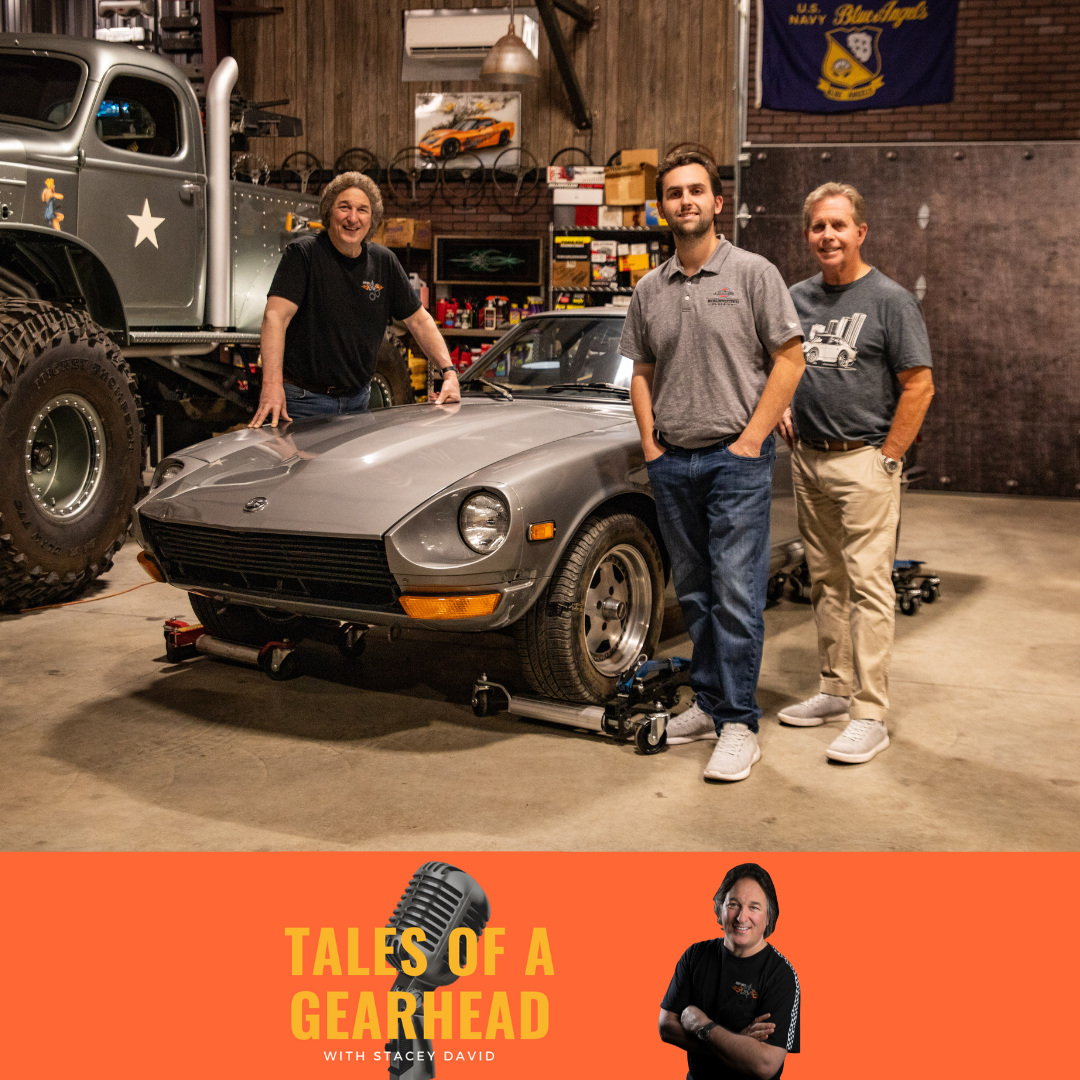
I am going to be rolling in an early, early Datsun 240Z.
02:55
And those of you that experienced a Z is pretty much everybody.
03:00
And we're going to have a lot of stories and a lot of history to share about those cars.
03:05
And I've got a really cool one to roll in and do some restoration work.
03:09
So to go with that, I have a special guest here today.
03:13
It's Max McCroskey from Resurrected Classics.
03:17
Now, one of the things that makes them really unique is that they specialize in early Z-car parts.
03:23
And their parts are really nice.
03:26
And so we're going to talk about Z-cars.
03:27
We're going to talk about parts.
03:29
So, Max, welcome to the podcast, man.
03:31
Thanks. Got to be here.
03:33
All right. Tell me, because you're a young guy, how did you get into Z-cars?
03:38
And especially early Z-cars.
03:40
What was it about them?
03:41
So really, you know, it kind of started in high squad, a buddy of mine that he had a 83-ZX.
03:49
So, you know, that's the next generation after that.
03:53
But then, you know, I started learning more about it.
03:55
And, you know, I already kind of liked, you know, classic cars kind of growing up and I was interested.
04:00
And then I looked at those and I learned about the early generation.
04:04
I mean, I really liked the lines of that car.
04:06
And, you know, it's really nice.
04:07
At the time, you know, it was a really affordable classic car.
04:11
Yeah. And you like the earlier body style, correct?
04:14
Yeah. Yeah. It's a very nice, fastback shape, very slim.
04:18
And, you know, pretty obtainable, you know, at my age.
04:21
So, tell me about the first time you rode in one.
04:24
Was it amazing or was it kind of like, this is fast.
04:28
Or did it make a first impression on you?
04:30
Well, I remember thinking just, you know, oh, I was really excited to even get one running.
04:34
You know, that took a long time anyways.
04:35
But then just to, you know, how peppy it was.
04:40
You know, how I respond, you know, for so small and, you know, only 150 horsepower.
04:44
I mean, it felt really fast.
04:45
Yeah. I mean, to you, it felt fast.
04:47
You know, it's like when you're in the car, it feels really nice and very responsive.
04:51
Now, were you automatic or stick?
04:53
Stick, you know, four speed.
04:55
I'm glad that you can drive a stick.
04:56
You know, not a lot of people can drive stick nowadays.
04:58
Yeah, that's true. It's kind of going away a little bit.
05:00
Okay. So how did you get into the early first gen Z-cars?
05:05
The 240s, 260s and 280s?
05:07
Yeah. So really, just, you know, I bought one, I think is something like 400 bucks.
05:13
It was really cheap.
05:14
Oh, I used to buy those things so cheap.
05:15
Yeah. Oh, yeah. I mean, it's a bad shape.
05:17
I mean, it was, you know, really, really bad.
05:20
And then, you know, I kind of worked on a little bit and then I got out of it
05:24
and I got back into it and I found one, you know, that was a pretty nice body from California.
05:31
Somebody had swapped it with the V8, you know, kind of cobbled it together.
05:35
Yeah, like a lot of them were.
05:37
Yeah. And it was really fun, really fun experience.
05:40
I mean, that's really good cars and very, you know, reliable.
05:43
Yeah. So tell me about resurrected classics.
05:47
You guys actually offer sheet metal.
05:51
You have mostly restoration parts, correct?
05:53
Yeah. So pretty much, you know, we're trying to be like a like a one stop shop
05:58
for original type restorations, you know.
06:03
So a lot of like, you know, rust stuff, like, you know, like panels.
06:08
You know, trim stuff and even we're starting to like to engine maintenance stuff,
06:12
you know, like maybe gaskets.
06:15
You know, weather stripping for the car.
06:17
So pretty much just a one stop shop for original stuff.
06:20
Now, how do you develop your new products?
06:22
I mean, do you go in?
06:23
Do you start with like an original panel and then work off of that?
06:27
Or do you go in and refine things?
06:29
You know, if we can, you know, I spent a lot of time finding new old stock pieces,
06:36
you know, Nissan pieces that are original and, you know, bringing the packaging
06:40
and, you know, really good shape and, you know, scanning those and, you know,
06:44
getting like a model made from that starting there and then pretty much
06:49
just, you know, a really long time of going through samples and iterations
06:53
and testing and then, you know, real world installs on our, you know,
06:58
shop cars to make sure that what we're making is in line with what somebody
07:03
can reason install, you know, with maybe limited tools or limited experience,
07:07
you know, because we've we've all been there.
07:09
No, that's awesome, man.
07:10
That's a great approach that now.
07:13
Now, how many Z cars do you have really?
07:17
Used to have, you know, 10 to 15.
07:19
Now I'm down to like four.
07:21
So now I'm reasonable.
07:23
Of course, your dad has five or six.
07:25
So that's a little different, you know, different counting system.
07:29
Now you've got one with an LS engine in it, right?
07:32
And so, you know, I like original, but also, you know, I think they're
07:37
fun to swap and do things with just, you know, because it got a little
07:41
boring to the same thing a couple of times.
07:42
So I did, you know, LS six with the TPT6, you know, transmission.
07:47
And that was the magic of the Z car.
07:49
They were great original, but they were great to modify.
07:52
I mean, they were a modifier's car.
07:54
I mean, yeah, they're really open to a lot of different things.
07:56
I mean, the engine bay is super wide for a car that I really, you know,
08:01
can have a lot smaller engine bay.
08:02
So, I mean, it's, I mean, really easy for a lot of different swaps.
08:07
And I've, you know, it seems very open to that.
08:10
And a lot of people will do, I mean, really crazy things.
08:13
How do you like the body kits and stuff that are out there?
08:16
I mean, there's a lot of good option there.
08:18
People do a lot of like old school and Nissan competition style things.
08:24
They're no longer made that kind of style.
08:26
You know, ductile spoilers, you know, there's flares.
08:30
I've even seen full on like GTO conversion kits and make like a Ferrari.
08:34
Oh, those were great when they first came out.
08:36
When you could buy Z cars for 500 bucks that didn't rust on them.
08:41
I always wanted to build one of those.
08:43
And then the kits now you can't even get them.
08:44
I think Z-tricks still carries them.
08:47
But it's, you know, the values of these cars have gone up so much.
08:51
You don't really want to cut up a Z car.
08:54
And what I'm seeing now is people almost, you know, re-restoring cars.
08:59
So yeah, I mean cars are from like the 80s and 90s that have been
09:02
heavily modified or getting re-restored back to original.
09:05
So it's not, you know, interesting.
09:06
You're seeing things restored twice.
09:09
How the market kind of changes how it changes.
09:13
Where do you see the market going on these Z cars?
09:15
You see it still going up because Nissan just released their new Z.
09:18
And I mean, they're still pushing hard.
09:20
So what do you think?
09:23
You know, I think it's really come up a lot in the last, you know, five years.
09:28
I think it's come down a little bit.
09:30
But I think it's a really kind of healthy value right now.
09:34
That thing will attract a lot of, you know, enthusiasts kind of to the market.
09:38
And I think too, it's not too high where people are priced out of it.
09:42
I think it's a really good spot.
09:44
And that, you know, people can enjoy.
09:46
Especially if you can pick up like 260 or 280.
09:49
The 240s, they're pretty collectible.
09:53
But so if a guy picks up like a 260 or a 280 up to 78, their first gen cars.
09:59
What would you suggest that they do?
10:01
What would your suggestion be to the approach this should take?
10:06
You know, what do you think?
10:07
So, you know, it's my relics of the look of a 240Z.
10:12
Something like a 260 or 280Z is also a good idea, you know, a good idea because the
10:17
body is pretty much exactly the same.
10:19
And especially they're a lot easier to pick up and they were made better.
10:25
The metal is thicker.
10:27
And they're pretty much the pinnacle of that early design.
10:31
And so if, you know, things are honey back, like, you know, like how big
10:35
the bumpers are, that can all be changed.
10:36
So don't let that, you know, deter you because they're still really good,
10:40
you know, picks and you can really pretty easily modify them where somebody can tell
10:46
the difference between 240 and 280 from a distance.
10:48
Matter of fact, don't you have a bumper conversion kit that's the front and rear bumpers
10:53
and to convert like a 280 to 240 bumpers?
11:00
The brackets, it's super simple.
11:02
It's really not that bad.
11:03
The front is really easy to back.
11:06
It's a little bit harder.
11:07
Let's take gas shocks out.
11:08
You get the gas shocks out.
11:10
Don't cut the gas shocks.
11:12
I know that for a fact.
11:14
Yeah, don't do that.
11:15
That's a whole other story.
11:16
Forget the warning on them.
11:21
So what it knew do you have coming out?
11:23
What new Zcar products do you have coming out?
11:25
So some of them we're kind of working with now.
11:29
Bert, you know, kind of like the testing phase.
11:32
Once I put a sample is exhaust kits.
11:35
So work on exhaust and gasket.
11:37
So, you know, we think with all the new kind of resurgence
11:41
and the value of 240 and people won't go back to original.
11:44
There really is no way of making a 240Z original exhaust.
11:50
Which really is important because I mean by this age,
11:53
you know, they're either really rust or they're changed out.
11:55
Who want original and it's hard to make something like that
11:59
probably from scratch.
12:00
And so we have something like that we're going to be
12:03
releasing pretty soon.
12:05
With all also to the original brackets and hangers.
12:09
So it's not going to be after all the drilling.
12:11
It's original style.
12:12
So look the exact same sound the same everything.
12:16
That's going to be cool.
12:17
Now you're going to be a Zcon, right?
12:20
Tell everybody about Zcon.
12:22
If you're into Zcars, you need to hear about this.
12:24
Zcon is really a great place.
12:26
I mean, it's a very targeted show.
12:30
I mean, it's like six days, isn't it?
12:32
Just driving Zcars around.
12:34
And I mean, all generations.
12:35
So you've got, you know, the oldest ones all the way up to,
12:38
you know, 80s, 90s, modern day.
12:42
I mean, every Z person would really enjoy it.
12:46
And they've got events, you know, track stuff.
12:49
A lot of people don't realize how big that world is.
12:54
And also too, you know, if you're thinking about getting
12:57
it, you know, getting into Zs, that'd be a great thing
13:00
You can talk to enthusiasts, get their experience.
13:05
See what kind of parts are available.
13:06
I think that's important before we dive into a car, you know,
13:12
Well, Max, that's been great.
13:13
And great to have you on here.
13:15
We look forward to having you back on.
13:17
Thank you very much.
13:21
You know, I got a question for you out there.
13:23
If you're working in your shop, what kind of tools
13:27
Now, you're probably going to go, you know, whatever I got.
13:32
Well, and that's the problem because, listen, we all grew
13:35
up working with cheap tools.
13:37
And my first set of tools, my dad got them at Kmart,
13:40
got them for Christmas.
13:41
And I use those things until they just, there was nothing
13:45
But that's all we had at the time.
13:47
But as soon as I could, I started investing in good
13:51
And the reason it's not because you want to show them
13:54
off to people, even though that's okay, it's because
13:57
they allow you to do quality work.
14:00
And there is nothing more frustrating.
14:02
I have talked to gearheads all across the nation around
14:05
the world, actually.
14:07
And one of the biggest frustrations they have is
14:10
either not having the right tool or breaking the tool
14:13
they were using or having something strip or break
14:17
And almost every time it's because they don't have
14:20
the right tool or they're not using a quality tool.
14:23
So if you are into this like I hope you are,
14:27
you need to get some good tools.
14:28
And that's where Cornwell Tools comes in.
14:31
They're America's oldest tool manufacturer.
14:33
They're still American made.
14:35
I think that if you are going to build some stuff,
14:39
if you invest in a good set of tools right off the top,
14:42
you don't have to get everything.
14:44
But just get yourself a nice set of hand tools
14:47
and work from there.
14:48
You will never regret it.
14:50
And you can pass them down to your grandkids
14:53
or whatever if you want to.
14:56
But most car guys want to hold onto their tools
14:58
as long as they can.
15:00
Anyway, if you get a chance, check out Cornwell Tools.
15:02
You will not be disappointed.
15:12
All right, we've got some questions here.
15:13
This one comes from Bill.
15:15
And Bill says, hey Stacey, gear talk with my buddies
15:19
often leads to transmissions.
15:21
Yeah, sticker automatic is the first thing.
15:25
He says we're doing automatics.
15:27
And he said it is clear that the concept
15:29
of torque converter stall is misunderstood.
15:34
He said a simple, accurate explanation
15:37
would be so helpful for us.
15:39
He said for the average street build,
15:42
say an 80s Mustang with around 400 horse in a small block,
15:46
what stall would work the best for street grudge matches
15:51
but also decent for city street driving?
15:54
So basically you want me to help you set up
15:55
your street race car, I love it.
15:59
I'll be glad to do that for you.
16:01
Okay, fantastic question.
16:04
A lot of people don't really understand torque converter
16:07
stall speed and a lot of them think higher is better,
16:11
bigger is better, kind of like they do with cams.
16:14
Here's the basic thing.
16:16
When you're running up an engine,
16:18
say your engine is an idle
16:21
and at idle you're not in your power band yet.
16:24
Most engines start to build torque
16:27
and start to build horsepower around 3,000 RPM,
16:30
something like that.
16:32
So basically when you get ready to launch a car with a stick,
16:37
you run your RPMs up around 3,500 and dump the clutch.
16:41
Now the reason you do that
16:43
is because your motor's right in the power band
16:45
and when you floor that thing and dump the clutch,
16:47
you're right there where all your horsepower and torque is.
16:51
Well, an automatics the same way
16:53
except you don't have the clutch pedal,
16:55
that's where your stall speed comes in.
16:57
Now your stall speed is what allows the engine to rotate
17:01
up into that power band while the vehicle's still sitting there.
17:05
So the torque converter is still slipping
17:09
until it hits the stall speed then it locks in.
17:11
So if you're running an engine and your power band,
17:16
you really want to launch that thing at 3,000 RPM.
17:21
Well, you'd want a 3,000 RPM stall speed
17:24
because that allows you to load that torque converter
17:26
sitting there and then launch that thing
17:29
and the car really won't start moving
17:30
until it hits 3,000 RPM.
17:33
Now setting the stall speed is a lot of things affect this.
17:38
I mean the vehicle weight, the engine horsepower,
17:41
the torque curve, you know,
17:43
the specific design of the torque converter.
17:45
So you have to be careful what you pick
17:49
because you don't want to pick the wrong stall
17:51
for your engine and the way you're driving it.
17:54
Generally your high stall converters are 3,500 RPMs and up.
17:58
This is usually racing applications only.
18:02
They maximize acceleration because you're leaving right,
18:04
you know, in your power band.
18:06
Most of your lower stall speeds, 2,000, 3,000,
18:10
those are suitable for daily driving, towing,
18:14
street machines, that kind of things.
18:16
So to answer your question,
18:19
I would recommend probably around a 2,000 to 2,500,
18:24
probably a 2,500 stall
18:27
because you're probably starting to build some power there.
18:30
Keep in mind if you load that torque converter
18:33
just like a clutch and you get up right into that stall's RPM
18:38
and then you floor it,
18:39
well, all that power is going to hit
18:41
just as that torque converter releases.
18:43
You're going to get a great launch.
18:46
So that's what I would recommend.
18:47
Generally when I'm building a street vehicle
18:50
that's going to be driven on the street
18:52
and also make some passes down the strip,
18:54
about a 2,500 stall.
18:56
I never go higher than three,
18:58
never on a primarily street driven vehicle.
19:02
Now, if you're going to be doing more serious racing
19:05
and you really want to get that launch
19:07
and say your engine really hits,
19:09
you're hitting top torque at 3,500
19:12
and your horsepower is really coming in there
19:14
and you've looked at your dyno graphs
19:16
and you're right there where your horsepower
19:19
and your torque are crossing.
19:21
Well, yeah, you want to put your stall right there
19:23
but that's a drag race thing.
19:25
Now, one other aspect of this,
19:27
if you're going with a supercharger,
19:30
keep in mind your big block engines
19:32
that build all this torque right off idle
19:37
anything that's adding low end torque,
19:40
you're getting power right off the idle
19:42
so you really don't want the highest stall.
19:45
You want that thing to launch right as you're in that torque.
19:48
So anyway, hopefully that explains to you how this works.
19:52
Like I said, I would recommend about 2,500 stall
19:56
and hopefully you'll win some races out there, man.
20:01
Okay, this question comes from Robert
20:04
and this is a question that we have dealt with several times
20:07
and it just keeps coming up.
20:09
So this is a really popular issue that's out there.
20:12
He goes, hey, Stacey, the question I have
20:15
is that I've been restoring my grandfather's 79 Chevy C20.
20:20
Awesome truck, man.
20:22
He said I've been working on it for the past four years
20:24
and one thing that I want to do is convert it to a 4x4.
20:28
I was wondering what I have to do to convert a 2-wheel drive
20:32
to a 4-wheel drive.
20:33
Wondering if I could do it without doing a complete frame swap.
20:37
Yes, once again, great question.
20:40
You don't have to do a complete frame swap.
20:42
Sometimes that's easier depending on your skill
20:48
But let me just kind of walk you through this.
20:51
Obviously, if you can find a square body Chevy truck,
20:55
a C20 that's a 4-wheel drive truck,
20:58
well, just putting your body down on that frame
21:01
would be absolutely the simplest thing to do.
21:03
It's a bolt-on deal.
21:05
That's provided you can find that frame.
21:08
If you can't, then you got to do it yourself.
21:11
Now, the good part is all of the parts
21:16
to put 4-wheel drive under a 79 Chevy are available
21:19
from anybody that sells, you know, square body Chevy truck parts,
21:24
LMC or, you know, any of these places,
21:27
brothers, any of these guys that carry these parts.
21:31
Also off-road and limited is somebody we use to actually
21:34
make a conversion kit to put a front axle
21:38
under one of these things.
21:39
But it's a little more difficult than that
21:42
because here's what you're looking at.
21:45
You not only have to get a matching front axle.
21:48
Now, I assume you're talking about putting a solid axle
21:51
in the front, not an independent suspension.
21:54
That's all another ballgame
21:56
if you're going 4-wheel drive with that.
21:58
And I don't recommend you do that as a first-time thing.
22:02
But let's say you want to put a solid axle in the front
22:04
okay, you're going to need the suspension
22:06
which will probably be leaf spring.
22:08
If you're going to do some sort of 4-link and stuff
22:10
that's a whole another engineering thing
22:12
that you need to understand.
22:13
And there's kits out there to do that
22:15
but the simplest would be a leaf spring deal.
22:18
So you have to get the hangers for that.
22:20
So you have to get the front axle
22:22
with the matching gear ratio to what's in the rear
22:25
and all the suspension to hang it.
22:29
Then you're going to have to get the steering
22:31
that will work with that solid axle
22:33
because it's going to be different
22:34
than what was on the original independent front suspension
22:38
on your 2-wheel drive.
22:40
So now you have front axle, you have steering upgrades.
22:43
Now you have drivetrain upgrades
22:46
because you need to add a transfer case
22:48
which means you also need to add the transmission
22:51
that works with the transfer case.
22:54
Those trucks had what we call a married transfer case.
22:57
In other words, a transfer case bolts
22:59
to the back of the transmission.
23:01
Some of your other vehicles had what we call
23:03
a divorced transfer case
23:06
because the transfer case is separated
23:08
from the transmission by a little tiny drive shaft.
23:11
And a lot of military vehicles did that
23:14
and obviously you see why they're called divorced
23:17
and married because they're together or they're apart.
23:20
But anyway, so all that has to be taken into consideration.
23:23
So you need to be on the hunt
23:25
for the proper drivetrain parts.
23:26
And this goes all the way up
23:27
of what engineer you're going to use.
23:29
So ideally you would want to find a drivetrain
23:33
that is out of a 4-wheel drive square body Chevy truck.
23:37
And those are still pretty easy to find.
23:40
So you're looking at, you know, the transfer case
23:42
which is usually a 208 that came with those
23:46
behind a Turbo 400 that's set up for that
23:50
that you bolted behind your small block.
23:52
Then your drive shafts.
23:53
You're going to need the drive shafts.
23:55
This gets you in the ballpark.
23:58
Obviously your cross members where you mount the transmission
24:02
all that will have to be built fabricated by you
24:06
or borrowed from a donor vehicle.
24:09
So even if you're not doing a full frame swap
24:13
it behooves you to have a donor vehicle
24:15
where you can just transfer these parts off of.
24:18
If you're going to junk yards or swap mates
24:20
trying to find these parts
24:22
man that can turn into a crazy deal.
24:25
That's what I suggest with any of these
24:27
is that you get some sort of a donor vehicle
24:29
whether you're doing a frame swap
24:30
or just putting a suspension in.
24:32
Okay, once you have all the hard parts in
24:36
now it's all hookups.
24:38
You know, you got to have the gear shifts
24:40
for shifting the transfer case.
24:42
You have to have all of the little bits.
24:46
You know, your exhaust system will need to be different.
24:48
Your cooling system will probably need to be changed.
24:52
You know, you're going to need different wheels and tires.
24:55
I mean, all of these things that can add up.
24:58
And this is a simple version.
24:59
Like I said, this is basically taking something
25:02
off of a donor vehicle
25:04
and bolting it onto what you have now.
25:08
Let's say you can't find a donor vehicle.
25:10
Let's say you want to put the suspension
25:12
under a modern Silverado
25:15
like a, you know, 2014 Silverado.
25:22
And that would definitely be easier to do a full frame swap
25:27
but there's still going to be some engineering
25:30
and some fabrication required
25:33
to get all the mounts right
25:35
for the body and the cab and that kind of thing.
25:38
Or you have to pull all that suspension out
25:40
and re-engineer it onto your stock frame
25:46
Either one is doable
25:48
but then the big question is,
25:50
is what is your skill level?
25:52
Because these are what I call level four projects.
25:57
And like I said, there's only a level five beyond that.
26:01
So this is a pretty advanced thing.
26:04
So you need at least three bays of space in your shop.
26:08
One bay to work, one bay to have the truck
26:11
and the other bay to have the other frame chassis
26:15
Anytime you're pulling a body off,
26:17
you know, you need that other bay at least
26:20
and you need the proper tools to do it.
26:22
So if you are not set up to do this kind of project,
26:27
you would be looking at maybe taking it somewhere
26:29
and that starts to add cost very quickly
26:33
if you have to go to a shop and have them do this.
26:35
So it's definitely doable.
26:38
If you find a donor vehicle or find the donor parts,
26:42
it is almost a bolt-on deal.
26:45
You have a 79, but any square body truck,
26:48
long bed, you have a C20,
26:52
find an old one that's all rusted out and grab that frame
26:55
and you can pretty much transfer most of that stuff
26:58
right to your frame or bolt your body down on it.
27:03
Anything more than that starts to get more difficult.
27:05
So Robert, the choice is yours, man.
27:10
Which way you want to do it.
27:11
It's a great project.
27:12
I would recommend it.
27:13
I've got a 85 K20 4x4 sitting right here.
27:19
I'm looking at and they're awesome.
27:21
Okay, the next question, this comes from Leland
27:25
and it's about towing and hauling a vehicle.
27:28
Very good question.
27:29
He goes, hi, Stace.
27:31
I'd like to know the best ways to tow a vehicle safely,
27:34
whether it's across town or across country.
27:37
And he said, I just want to make sure
27:38
I'm getting my vehicle home safely.
27:41
All right, Leland, you don't realize it,
27:43
that you have jumped onto a huge issue for most people
27:46
because you would be surprised how many people do not know
27:50
how to strap a vehicle down properly.
27:52
I'm talking people that should know better.
27:54
Excellent question.
27:55
And we've done a couple of shows
27:57
on actually towing and hauling.
27:59
I have a new one coming up that we're doing right now
28:02
on how to choose a trailer
28:04
and what kind of trailers do what and all of that.
28:08
Obviously I can't go into all of that right now.
28:11
But let's go into the basics of towing and hauling.
28:15
Okay, we're going to deal with first towing something
28:20
Okay, there's two schools of thought here.
28:23
Basically, you get the vehicle on the trailer
28:26
and you have to center the weight of the vehicle
28:31
If you get the weight too far back,
28:33
it picks up the back of your bumper
28:35
and puts you light in the rear
28:37
and you will lose control of the vehicle.
28:40
If you get the weight too far forward,
28:42
it's not as good, obviously.
28:45
It's not as unstable of having the weight too far back,
28:48
but it also causes problems.
28:50
So you really want the weight of the vehicle
28:53
right over the axles.
28:55
So placement on the trailer is important.
28:58
Now, when you go to strap it down,
29:01
there's some people that like to strap from like the bumpers
29:08
and then pull the vehicle down and compress the suspension.
29:13
I don't like to do it that way.
29:14
And the reason being is every time you hit a bump,
29:17
that vehicle is going to bounce on its suspension.
29:21
And you can't have that suspension compressed enough
29:26
which means every time you hit a bump,
29:28
it's going to bounce against those straps.
29:30
It's going to compress and pull up hard against those straps,
29:33
potentially breaking a strap
29:35
or potentially just stretching one.
29:38
Or letting the thing, you hit a big enough bump,
29:40
it can compress enough to let the strap,
29:43
if it's got a hook on it,
29:44
let the hook come loose.
29:45
And that's no good.
29:47
So I always strap a vehicle down from a fixed point,
29:54
like the control arms,
29:56
something where you can pull the vehicle down
30:02
and where the vehicle still rides on its suspension.
30:05
Yeah, so if you can get something,
30:07
you know, in the back,
30:09
I usually strap to the rear axle in the front.
30:12
I'll strap to the front axle or a lower control arm.
30:16
Sometimes you have to go through the wheels,
30:17
depending on how low the car is.
30:19
Then you can strap it down and you're good.
30:23
A lot of people have said you need to cross the straps.
30:28
If you can do that, you can't always do that.
30:30
It's also not imperative.
30:32
I have strapped vehicles down with two straps,
30:35
one strap in front, one strap in back.
30:39
I prefer to do it with four straps,
30:41
two in front, two in back.
30:42
Whichever way you go,
30:43
once you get it strapped down,
30:45
get it nice and tight
30:47
and then drive it a few miles,
30:51
pull over and check all the straps again.
30:53
And all through your trip home,
30:56
every once in a while stop and check those straps
30:59
because they can work loose for whatever reason.
31:01
And if you do it this way,
31:03
you'll safely be able to tow something
31:08
as far as you need to.
31:09
Another thing, make sure you get really good straps.
31:14
There's a lot of places that sell them.
31:15
We use them from Max Tie Downs.
31:18
They're built specifically for towing
31:20
and strapping down vehicles.
31:23
And it's really important to get the right straps.
31:27
Also, depending on the vehicle,
31:30
I had said before that sometimes
31:32
I only use one strap in the front and one strap in the back.
31:35
That's only on really light vehicles.
31:37
Little sports cars, little things.
31:40
The heavier the vehicle, the more straps I use.
31:43
And obviously if you're strapping a tractor down,
31:45
sometimes it's six straps forward and back
31:48
and you can't overstrap something,
31:51
but you can understrap them.
31:54
Anyway, good luck to you on that.
31:56
Make sure you get the proper equipment,
31:59
proper straps, and you won't have any trouble.
32:01
All right, that's our show for today,
32:06
which means you need to get out there
32:08
and start working on something.
32:10
Spend some time turning wrenches.
32:12
You might be surprised how much you like it.
32:14
Make sure you check out our website, StaceyDavid.com,
32:18
because we've got all kinds of new products
32:20
and some other great stuff that you're just going to love.
32:23
Also, make sure to check out our social media.
32:25
That's Instagram, TikTok, Facebook, YouTube,
32:28
all at official StaceyDavid.
32:30
Our social media is where you're going to find
32:32
all of the bonus content, the giveaways,
32:34
the contests, the trivia.
32:36
We even have extra viewer projects
32:39
that focus on what you are working on.
32:41
Also, the new season of Gears will be on MavTV
32:44
and YouTube will be the place that you can view
32:46
all of your favorite Gears episodes,
32:49
as well as the full project builds
32:51
that follow the project from beginning to end.
32:53
Make sure to check out our new Gears coffee cars.
32:56
This is a unique blend of coffee and cool stickers to collect
33:00
that will appeal to anyone.
33:01
But, the most important thing is get out there
33:04
and turn some wrenches yourself.
33:06
Get a project, start working on it,
33:08
and if you don't have tools, check out Cornwell.
33:10
They can help you out there.
33:12
All right, that's all the announcements.
33:13
We're all up to date.
33:15
We'll see you next time.
33:21
Falls a time to plan ahead
33:22
and ensure your brand shows up in ways that matter.
33:25
4imprint's promotional products work as hard as you do
33:28
and make a lasting impression.
33:30
From quality apparel, including exclusive brands
33:33
to drinkware, tech, and totes,
33:35
they've got thousands of options
33:36
to fit your brand and budget.
33:38
Plus, you get free samples, expert help,
33:40
and their 360-degree guarantee.
33:42
So, you'll be 4imprint-certain.
33:44
Everything shows up just right, right on time.
33:46
Explore more at 4imprint.com.
33:49
4imprint, 4certain.
33:51
Ring Central knows that businesses run on communication
33:54
and juggling separate systems
33:56
for team collaboration and customer service
33:58
creates confusion, missed opportunities,
34:00
and frustrated customers.
34:02
Ring Central changes everything with Ring EX and Ring CX,
34:06
one powerful platform that connects your entire organization.
34:09
Ring EX keeps your team connected
34:11
with seamless calling, messaging, and video meetings,
34:14
whether they're in the office or working remotely.
34:16
Meanwhile, Ring CX transforms your customer experience
34:19
with AI-powered contact center capabilities
34:22
that root calls intelligently and provide real-time insights.
34:25
The magic happens when they work together.
34:27
Your customer service agents can instantly collaborate
34:30
with experts across your company
34:32
to solve problems faster.
34:33
No more transferring customers between systems
34:37
with over 500,000 businesses trusting Ring Central
34:40
and 99.999% uptime reliability
34:44
you're in good company.
34:45
Visit ringcentral.com.
34:46
That's ringcentral.com.
34:48
Ring Central, voice of your business.