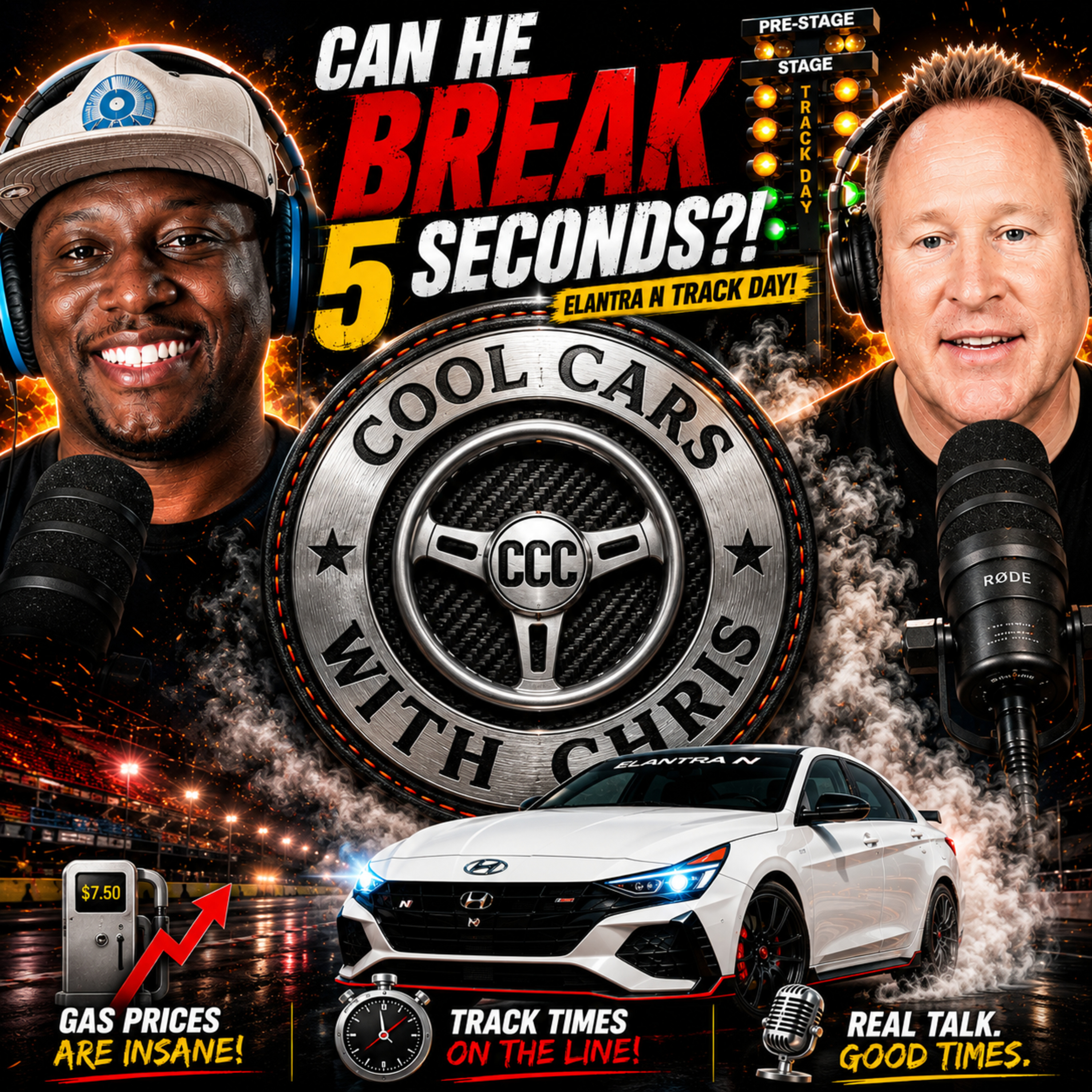
039 | Can a Hyundai Elantra N Break 5 Seconds? Track Day Results, Bugatti Costs & Creator Life
About this episode
Chasing a track-time milestone, the hosts and guest dig into whether fuel strategy and octane learning can help a Hyundai Elantra N crack the “fives,” debating full vs half tanks and discussing 95-octane runs, boost behavior, and tire choices. The conversation then widens to creator life: filming gear, drone rules, and how algorithms shape what audiences see. Along the way, they compare hypercar maintenance costs and even explain why red-dyed diesel gets checked and fined.
What's happening everybody!
On this episode of Cool Cars With Chris, Courage is back from another track day with his Hyundai Elantra N, and he's getting closer than ever to reaching his goal of breaking into the 5-second club. We talk about his latest runs, the difference 95-octane fuel makes, Hyundai's unique octane learning system, and whether his new drag tires are helping him get the results he's after.
We also get into rising gas prices, diesel fuel costs, and even the world of red-dye diesel. If you've ever wondered why some diesel fuel is dyed red or why using it on the street can get you in trouble, we've got you covered.
Later in the episode, we dive into the crazy world of Bugatti ownership. Imagine spending $20,000 to $30,000 on a simple oil change. We talk about the Bugatti Veyron, the realities of hypercar ownership, maintenance costs, and how modern manufacturers are making some vehicles harder than ever to work on yourself.
We also spend some time talking about content creation, YouTube, podcasting, social media algorithms, drones, cameras, and what it's really like trying to grow an audience online in today's world. Whether you're making videos, running a podcast, or posting car content online, you'll probably relate to this conversation.
Thanks for hanging out with us and being part of the Cool Cars With Chris community. If you're enjoying the show, be sure to follow, subscribe, and share the podcast with a fellow car enthusiast.
In this episode:
• Hyundai Elantra N track day results
• Chasing a 5-second pass
• 95-octane fuel and octane learning
• New drag tires and performance upgrades
• Gas prices and diesel fuel costs
• Red-dye diesel explained
• Bugatti Veyron maintenance costs
• $20,000-$30,000 oil changes
• Modern cars and repair challenges
• YouTube growth and content creation
• Drones, cameras, and social media
• Automotive passion and car culture
Thanks for listening to Cool Cars With Chris!
🔗 Connect With Us
🌐 Website: https://coolcarswithchris.com/
📸 Follow Chris on Instagram: https://www.instagram.com/cool_cars_with_chris619/
🎥 Subscribe on YouTube: https://www.youtube.com/@CoolCarswithChris619
🔥 Follow Courage on Instagram: https://www.instagram.com/thedrivendad22/
🏁 Subscribe to Courage's YouTube Channel: https://www.youtube.com/@TheDriveNDad22
⏱️ Chapters
00:00 🚗 Can the Elantra N Break 5 Seconds?
01:13 🐴 Life Without Cars & Amish Hot Rods
03:14 ⛽ Gas Prices Are Out of Control
05:06 🔴 Red Dye Diesel Explained
09:47 🏁 Hyundai Elantra N Track Day Recap
12:05 ⛽ Full Tank vs Half Tank at the Track
12:55 🔥 95-Octane Fuel & Performance Gains
14:21 📈 Hyundai's Octane Learning Mystery
16:16 🛞 New Drag Tires & Best Time Yet
18:07 🏎️ Bracket Racing & Track Day Delays
21:08 🔥 Wildfires Near the Raceway
22:55 🎯 The Goal: Joining the 5-Second Club
24:05 🎥 Filming Every Run With 3 Cameras
25:15 🚁 Drones, FAA Rules & Car Content
29:07 📸 GoPro vs iPhone vs Cinema Cameras
30:58 🎬 Building a Car YouTube Channel
38:45 📊 Are Social Media Algorithms Broken?
40:28 🎙️ Video Podcasts vs YouTube
45:52 💰 The Truth About Bugatti Ownership
47:20 😳 $30,000 Bugatti Oil Changes
49:15 🔧 Why Modern Cars Are Harder to Fix
51:52 🏆 Bugatti's Rise Under Volkswagen
57:08 📉 The Future of Bugatti & Rimac
01:02:00 🚗 Dream Cars, Specs & Ownership
01:08:45 🎤 Final Car Talk & Wrap Up
01:12:27 👋 Thanks for Listening
If you enjoyed this episode, be sure to follow, rate, and review the podcast. Share it with a fellow car enthusiast and help us grow the Cool Cars With Chris community.
New episodes every week featuring car culture, performance vehicles, industry news, automotive technology, track days, project cars, and conversations with enthusiasts from all walks of life.
#HyundaiElantraN #Bugatti #CarPodcast #AutomotivePodcast #CarCulture #PerformanceCars #Motorsports #YouTubeCreator #ContentCreation #RaceFuel #DragRacing #CarEnthusiast #HyundaiN #BugattiVeyron #CarTalk #TrackLife #CarCommunity

Hyundai Elantra
"...de, your courage has got that really cool Hyundai Elantra in car. You know, the end is more performance and..."
The Hyundai Elantra is a compact car that’s meant for everyday driving. Some versions are tuned to feel more sporty and performance-focused. The podcast is mentioning it as a car that brings more performance.
The Hyundai Elantra is a compact sedan that’s widely known for offering practical daily driving with available performance-oriented trims. In the podcast, it’s referenced in a way that connects it to “more performance,” suggesting the speaker is talking about a sportier Elantra variant or a performance feel compared to earlier cars they owned. That’s why it fits into a driving/ownership conversation.

Ford F350
"I knew a guy years and years ago, I spoke with this guy, he had a big giant F 350 bought used. It was like lifted B 33350 big V eight,"
The Ford F-350 is a large pickup truck designed to pull trailers and carry heavy loads. It’s built for tougher jobs than a regular passenger car. The podcast is describing one that was lifted and had a V8 engine.
The Ford F-350 is a heavy-duty pickup truck built for towing and hauling, often used for work or serious utility. In the podcast, it’s mentioned as a big lifted truck with a V8, emphasizing the kind of capability and presence the F-350 is known for. That’s why it comes up in a story about owning or encountering a used heavy-duty model.
diesel
"Do you see the price of diesel lately? ... They basically had like a diesel section where they had diesel fuel..."
Diesel is a type of fuel used in some cars and trucks. It’s different from regular gas, and the price can change depending on where you are.
Diesel is a fuel used in diesel engines, which compress air to ignite the fuel rather than using spark plugs like most gasoline engines. Diesel is commonly priced differently from gasoline and can vary a lot by region and station type.
San Diego County
"Is that, is that statewide or nationwide? San Diego County, San Diego County itself. Yeah, that's what I've seen."
San Diego County is a specific area in California. The hosts are saying the diesel price they’re talking about is for that local area.
San Diego County is the region in California where the hosts say the diesel price they’re seeing is based. Fuel prices can differ by county due to local supply, demand, and taxes.

Tesla Semi
"...o fill those things up and fill up even a regular semi truck, you know, it's, it costs a lot of money, y..."
The Tesla Semi is an electric truck used to move goods. Because it’s electric, it needs charging, and charging can be expensive depending on how and where you run it. The podcast is talking about the cost of filling it up.
The Tesla Semi is an electric heavy-duty truck intended for long-haul freight. It’s discussed in the context of operating costs—specifically the expense of charging and running large vehicles compared with traditional trucking. That makes it relevant to conversations about real-world use, not just performance.
Hyundai Elantra N-Series car
"So today you took your car, which is the Hyundai Elantra N-Series car. What year was your car, by the way?"
The Hyundai Elantra N is the sporty, track-focused version of the Elantra. Here, they’re talking about a 2022 car and when the Elantra N first came out.
The Hyundai Elantra N is Hyundai’s performance version of the Elantra, built to feel like a track-capable “N” model rather than a normal commuter. In this segment, the host is discussing a 2022 Elantra N-Series car and its early production timing.

Hyundai Veloster
"...as a 20, it was 22 model. Before that, was it the Veloster N they had before that? And then they had the, wa..."
The Hyundai Veloster is a small hatchback car. Some versions are built to be more performance-focused, like the Veloster N. The podcast is talking about whether that was the model the speaker had before another one.
The Hyundai Veloster is a compact hatchback that’s known for its distinctive styling and practical layout. The podcast references the Veloster N, which is the performance version, indicating the speaker is comparing what they had before and after. That makes it relevant when discussing how Hyundai’s sport models evolved over time.

Hyundai Kona
"...y had before that? And then they had the, was the Kona N maybe? I'm thinking of, was that before or afte..."
The Hyundai Kona is a small SUV-style car meant for daily driving. Some versions are made to be faster and more exciting to drive, like the Kona N. The podcast is referencing which Kona model came first in the speaker’s timeline.
The Hyundai Kona is a compact crossover designed for everyday use with available powertrains, including performance-oriented variants. In the podcast, it’s mentioned alongside the Kona N, which is the sportier version people look for when they want more performance from the same general model. That’s why it comes up in a discussion about what came before or after other Hyundai hot hatches/crossovers.

Hyundai i30
"So we, everybody's always said they wanted them to bring the actual I 30 in, I 30 in hatchback to the, to the U S"
The Hyundai i30 is a small hatchback car. People have asked for it to be sold in the U.S. because they want that specific type of car here.
The Hyundai i30 is a compact hatchback that’s popular in markets outside the U.S., where it’s offered in multiple trims. The podcast specifically mentions people wanting Hyundai to bring the i30 hatchback to the U.S., highlighting how demand for that body style can shape what models get offered. It’s discussed as a “what if” model choice for American buyers.
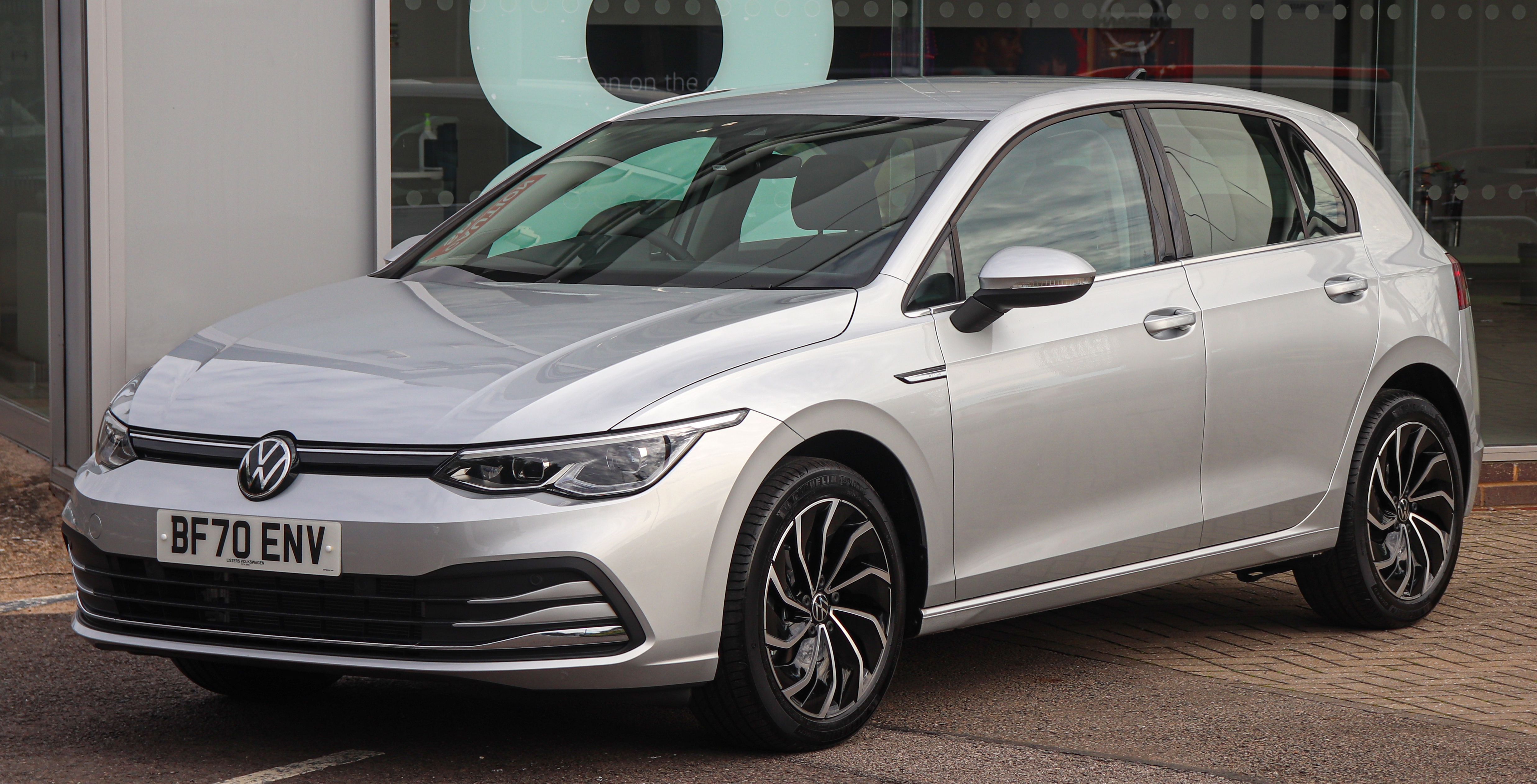
Volkswagen Golf
"... because that's literally just like a, like a GTI golf R, you know, kind of the same shape or whatever."
The Volkswagen Golf is a small car, usually a hatchback, made for everyday driving. Some versions are tuned to be faster and more fun, but they still look and feel like the same basic Golf. That’s why people mention it when talking about the sportier Golf models.
The Volkswagen Golf is a compact hatchback that’s known for being practical, easy to live with, and widely available in many trims. In the podcast context, it’s being compared to higher-performance Golf variants like the GTI and Golf R because they share the same basic shape and platform. That makes it a common reference point when people talk about performance upgrades versus everyday driving.
full tank of gas
"do you go through the full tank of gas for quicker times or half a tank for quicker times? That's actually a good question."
A full tank makes the car heavier. Some people think that running less fuel might help you go faster, but on short tracks the difference can be minimal.
A full tank increases vehicle weight, which can affect acceleration and lap times. Drivers sometimes experiment with fuel level because less fuel can reduce weight, but the benefit may be small depending on track length and how the car is driven.
reaction time
"And it's just still fun because it's like all about the reaction time and how you launch and how much grip you get."
Reaction time is how quickly a driver responds at the start (or launch) after the signal. On short track formats, small differences in reaction time can strongly affect elapsed time because there’s less distance for the car to “make up” mistakes.
grip
"all about the reaction time and how you launch and how much grip you get."
Grip is how well the tires can “hold on” to the surface. If you have more grip, you can accelerate harder without spinning the tires.
Grip is the tire’s ability to generate traction against the road surface. More grip typically means better acceleration and less wheelspin, which is especially important during launch on a track day or drag-style run.
octane
"but that was for different factors, I think, but I did run by 95 octane fuel from my little secret location in Rancho Santa Fe."
Octane is basically how resistant the fuel is to premature “pinging” or knocking in the engine. Racing or performance setups sometimes use higher-octane gas to keep things stable when you’re driving hard.
Octane is a measure of a fuel’s resistance to knocking (uncontrolled combustion) inside an engine. Higher-octane fuel is often used in performance cars or track setups because it can allow more aggressive ignition timing without knock.
Rancho Santa Fe
"but I did run by 95 octane fuel from my little secret location in Rancho Santa Fe. Oh, is that the place that sells racing fuel?"
Rancho Santa Fe is a place in California (near San Diego). Here it’s just where the speaker gets their higher-octane racing gas.
Rancho Santa Fe is a community in San Diego County, California. In this context, it’s mentioned as the speaker’s source for higher-octane racing fuel.
PSI boost
"[825.0s] the higher like 20 PSI boost. [827.7s] So I say, no, is it the boost goes up?"
Boost is extra air pressure made by a turbo or supercharger. It’s measured in PSI, and more boost can mean more power, but the car may limit it to protect the engine.
“Boost” in PSI refers to how much extra air pressure a turbocharger or supercharger is forcing into the engine. Higher boost usually means the engine can make more power, but it also increases stress and heat, so the car may limit boost under certain conditions.
six gear
"[838.1s] kind of, kind of archaic thing where like, [835.9s] kind of, kind of archaic thing where like, [838.1s] if I go to pass somebody, like, you know, [839.9s] go around somebody in six gear and, [841.5s] and I noticed that like, you know,"
“Six gear” means the car is in 6th gear. Different gears change engine speed (RPM), which can affect turbo boost and how responsive the car feels.
“Six gear” refers to using the sixth gear in a manual or sequential transmission. Gear choice affects engine RPM and how quickly the turbo can build boost, which can change how much boost the ECU allows during passing.
full throttle
"[839.9s] go around somebody in six gear and, [841.5s] and I noticed that like, you know, [843.1s] full throttle, it only goes to like 15 PSI. [845.9s] I'm like, oh, well it's not octane learn."
Full throttle means you’re pushing the gas pedal all the way down. It tells the car to request maximum power, so you’ll see the biggest changes in boost and engine behavior.
“Full throttle” means the accelerator pedal is fully depressed, commanding the engine to request maximum air and fuel. On turbo cars, full-throttle events are when boost targets and ECU protections (like fuel-octane learning) become most noticeable.
emissions
"they said that basically like the car could switch [905.7s] like its emissions and things like that to pass better. [909.3s] But then like it would get better fuel economy."
Emissions are the exhaust pollutants a car puts into the air. Governments set rules for how much of these pollutants cars are allowed to produce, and the host is talking about how emissions behavior can be changed to meet those rules.
In automotive terms, emissions are the pollutants a vehicle releases into the air, which are regulated by government standards. This segment discusses how emissions-related software behavior can affect both compliance and real-world outcomes like fuel economy.
fuel economy
"But then like it would get better fuel economy. [911.5s] That was a big sell on it though. [913.2s] It was like better fuel economy"
Fuel economy means how far the car can go on a given amount of fuel. Higher fuel economy usually means you spend less on gas, and the host is saying that the Volkswagen scandal involved claims of better efficiency too.
Fuel economy is how efficiently a car uses fuel, typically measured as miles per gallon (MPG) or liters per 100 km. The host notes that the “dieselgate” story involved claims of improved fuel economy alongside emissions-related behavior.
Golf Volkswagen Gate
"...ke I said, that was a big issue for that with the Volkswagen gate deal. And I think it's just for them,"
In this podcast, “Golf” is mentioned because of an emissions problem that affected some Volkswagen Golf cars. Since the Golf is a common model, the issue got a lot of attention. The speaker is connecting the Golf to that controversy.
In the podcast, “Golf” is used in reference to the Volkswagen “gate” issue, meaning the emissions-related controversy that affected certain Golf models. The Golf is being discussed because it’s a widely recognized model, so the issue had broad visibility. That’s why the conversation ties the Golf name to the controversy rather than just the car’s design.
ECU tuned
"So at the end of the day, a lot of people just end up getting the car like fully ECU tuned or get a spare ECU that's tuned with a different tune on it."
Your car has a computer called the ECU. “ECU tuned” means someone reprograms that computer so the engine runs differently than it did from the factory.
ECU tuning means changing the car’s engine control unit settings so the engine and related systems run differently than stock. It’s often done to improve power, throttle response, or drivability, but it can also affect how the car behaves under load and at the track.
spare ECU
"So at the end of the day, a lot of people just end up getting the car like fully ECU tuned or get a spare ECU that's tuned with a different tune on it."
An ECU is the car’s engine computer. A “spare ECU” is an extra one you can swap in so you can change how the car is programmed without doing it from scratch each time.
A spare ECU is an extra engine control unit that can be swapped in to change calibration quickly. Enthusiasts use this to test different tunes or to revert to a safer/stock setup without waiting for re-flashing.
drag tires
"I took the drag tires out there, air quotes. Yeah, they just the front to get all four."
Drag tires are made for quick acceleration in a straight line. They usually grip really well for launches, but they may not work as well for road-course driving all day.
Drag tires are specialized tires designed for straight-line acceleration, typically with a softer compound and a tread pattern optimized for grip during launches. They can be very fast for short bursts, but they’re often not ideal for sustained cornering or long track sessions.
stock wheel size
"if I were to actually take it to like a circuit track to potentially get a set, you know, that will fit my stock tires or my stock wheel size"
Your wheels have a specific size, and tires have to match that size to fit correctly. Using the same “stock wheel size” helps keep the tire setup similar to what the car was designed for.
Wheel size affects what tire sizes you can fit, which in turn changes grip, steering feel, and rolling resistance. When someone says they want tires that match their stock wheel size, they’re aiming for the same fitment and often similar overall tire diameter.
Michelin Pilot Sports
"They, you know, the Michelin Pilot Sports that come on stock [1005.3s] are pretty great tires just all around."
Michelin “Pilot Sports” are a type of performance tire. They’re meant to grip well when you drive hard, but they can still work for normal day-to-day driving.
“Pilot Sports” is Michelin’s performance tire line. In this context, Chris is saying the stock Michelin Pilot Sports balance grip for spirited driving with enough comfort for everyday use.
tread wear rating
"and driving around and they have a really low, [1038.7s] what does it call it, tread wear rating? [1041.6s] Oh, so they kind of wear out faster?"
A tread wear rating is a number that estimates how long the tire tread will last. A lower number usually means the tire won’t last as many miles.
A tread wear rating (often expressed as a number like 300 or 200) is a standardized way to estimate how long a tire’s tread should last under test conditions. Lower ratings generally mean the tire wears out faster, which is why Chris connects it to track-focused tires.
track tires
"they're about 20, I think that's what a lot of people [1052.4s] on like the ratings when I was looking at them, [1054.5s] they're like, yeah, 15 to 20,000 miles or so. [1056.8s] So you really would want these to be like your track tires."
Track tires are made for faster, harder driving on a race track. They usually grip more, but they wear out sooner and can be louder on the street.
“Track tires” are tires designed primarily for high-grip driving on a circuit rather than long everyday commuting. They typically prioritize traction and heat tolerance, often at the cost of faster tread wear and more road noise.
bracket racing
"there was a, so they tried to do, they've done this before, but they tried to do bracket racing this time around, which basically all it means is that, you know, if you have two or three runs to dial in a specific time"
Bracket racing is a way to race where the goal is to hit a specific time, not just be the fastest. You do a couple runs to figure out your pace, then you try to repeat that time as closely as you can.
Bracket racing is a track format where you try to hit a target elapsed time rather than just going as fast as possible. Drivers make a few runs to “dial in” their pace, then subsequent runs aim to stay as close as possible to that locked-in time.
dial in a specific time
"if you have two or three runs to dial in a specific time, like whatever your, you know, consistent time is, you have the, you test and tune until you kind of lock in a time."
“Dialing in” means getting your car and driving consistent so you can repeat the same kind of results. Instead of guessing, you make a few runs to learn what works, then you try to repeat it.
In track-day or timed racing contexts, “dialing in” means adjusting your setup and driving to achieve a repeatable elapsed time. The idea is to reduce variability so later runs can be matched closely.
five second range
"Really, I just want to get into the fives. [1395.3s] Like, you know, that five second range. [1397.1s] When I, it literally was like 606, 605, you know,"
They mean they want their timed run to be in the 5-second zone. It’s a big goal because it usually takes a lot of grip and power to get that fast consistently.
The “five second range” is shorthand for achieving very fast elapsed times, typically in a drag-style or timed track run. It’s a milestone target because dropping into the 5-second bracket usually requires major traction, power, and consistency improvements.
crack into that
"Like there's a couple of guys that are in that realm, [1421.0s] but yeah, it's definitely, you know, in my head, [1424.5s] I'll have like, I'm in the five club [1426.1s] if I'm able to crack into that."
It’s just a way of saying “finally reach that goal.” Here, the goal is getting into the 5-second times.
“Crack into that” is racing slang meaning to finally achieve a target performance threshold. In this context, it means breaking into the 5-second elapsed-time bracket.

Rolls-Royce Phantom
"...t it down for a while. I actually still have that Phantom 3, you know, in my, like in my garage,"
The Rolls-Royce Phantom is a very luxurious large sedan. It’s designed to be extremely comfortable and quiet when you drive. The podcast mentions it because the speaker still owns one.
The Rolls-Royce Phantom is a flagship luxury sedan known for its high-end comfort, quiet ride, and long-distance refinement. The podcast mentions the speaker still having a Phantom 3 in a garage, which points to the car’s collector/ownership appeal. It’s brought up because it represents a classic, top-tier luxury experience.
depreciation floor
"[2810.7s] get it for the price he got it for, which was still like insane. [2814.6s] So unfortunately, no, we're not, we, we haven't hit the depreciation floor [2818.6s] for those to the point where we might have one."
Depreciation floor means the lowest price a car tends to settle at over time. The host is saying the car hasn’t gotten cheap enough yet to reach that “bottom” price.
A depreciation floor is the point where a car’s value stops dropping much further because the market has found a “bottom” price. The host is saying the Veyron hasn’t reached that bottom yet, so it’s still not something they could realistically pick up.
oil change
"What's the oil change cost of thing? ... [2889.1s] and I looked that up actually, a typical oil change could cost"
An oil change is when you replace the engine’s old oil with new oil. The host is saying that on extremely expensive cars, even this basic service can cost a lot more than you’d expect.
An oil change is the scheduled service where old engine oil is drained and replaced with fresh oil. On very high-end cars like the Bugatti Veyron/Chiron, the host is emphasizing that the labor, access, and required procedures can make the oil change cost shockingly high.
ownership cost
"Literally the price of a car. [2898.3s] It's like you were thinking about a car. [2900.3s] No, you just, you have to maintain this, this price possession of yours."
“Ownership cost” means what it takes to keep the car going after you buy it. The host is saying that for very expensive cars, the ongoing maintenance can be almost as big a cost as the car itself.
“Ownership cost” here means the ongoing expenses required to keep a car running and maintained, not just the purchase price. The host’s point is that for hypercars, maintenance and service requirements can become a major part of what you pay over time.
lock box on the oil filter
"There's like a lock box on the oil filter, as I'm saying. The winner's a wheel, there's a way."
Some cars put the oil filter behind a locked cover. That makes it harder to do an oil change yourself and can push you toward a shop or dealer.
A “lock box” on the oil filter refers to a security cover or housing that restricts access to the filter. It’s meant to prevent tampering or unauthorized maintenance, which can force owners to use authorized service channels.

Bugatti Veyron
"the EB110 and those cars, that car in the 90s, but the Veyron was really kind of this big, ...funding helped them really create the Veyron and from there create the Chiron..."
The Bugatti Veyron is a famous ultra-expensive, ultra-fast hypercar. The host is saying Bugatti came back strongly and the Veyron was part of that comeback—helped by Volkswagen Group money and support.
The Bugatti Veyron is a landmark hypercar from Bugatti, known for being one of the first modern “supercar” benchmarks that proved extreme performance was possible for a road car. In this segment, it’s tied to Bugatti’s resurgence under Volkswagen Group, which helped fund the Veyron program.

Bugatti EB110
"the EB110 and those cars, that car in the 90s, but the Veyron was really kind of this big,"
The Bugatti EB110 is an older Bugatti supercar from the brand’s past. The host is using it to compare Bugatti’s earlier “big moments” to the later Veyron comeback.
The Bugatti EB110 is a notable late-20th-century Bugatti supercar that the host brings up as part of the brand’s history before the modern Veyron era. Mentioning it frames Bugatti’s earlier attempts at building a world-class performance car lineup.
Volkswagen and Audi group
"And the reason why they kind of had that resurgence was because of Volkswagen and Audi group. They purchased Bugatti, they owned a stake in Bugatti and that, you know, funding helped them"
The host is talking about Volkswagen Group (which also includes Audi) taking control of Bugatti. The idea is that this ownership helped Bugatti afford and build the Veyron and later cars like the Chiron.
The host is referring to Volkswagen Group’s ownership involvement with Bugatti and how that corporate backing helped fund the development of the Veyron. In other words, Bugatti’s modern hypercar era is presented as being enabled by Volkswagen Group resources and strategy.
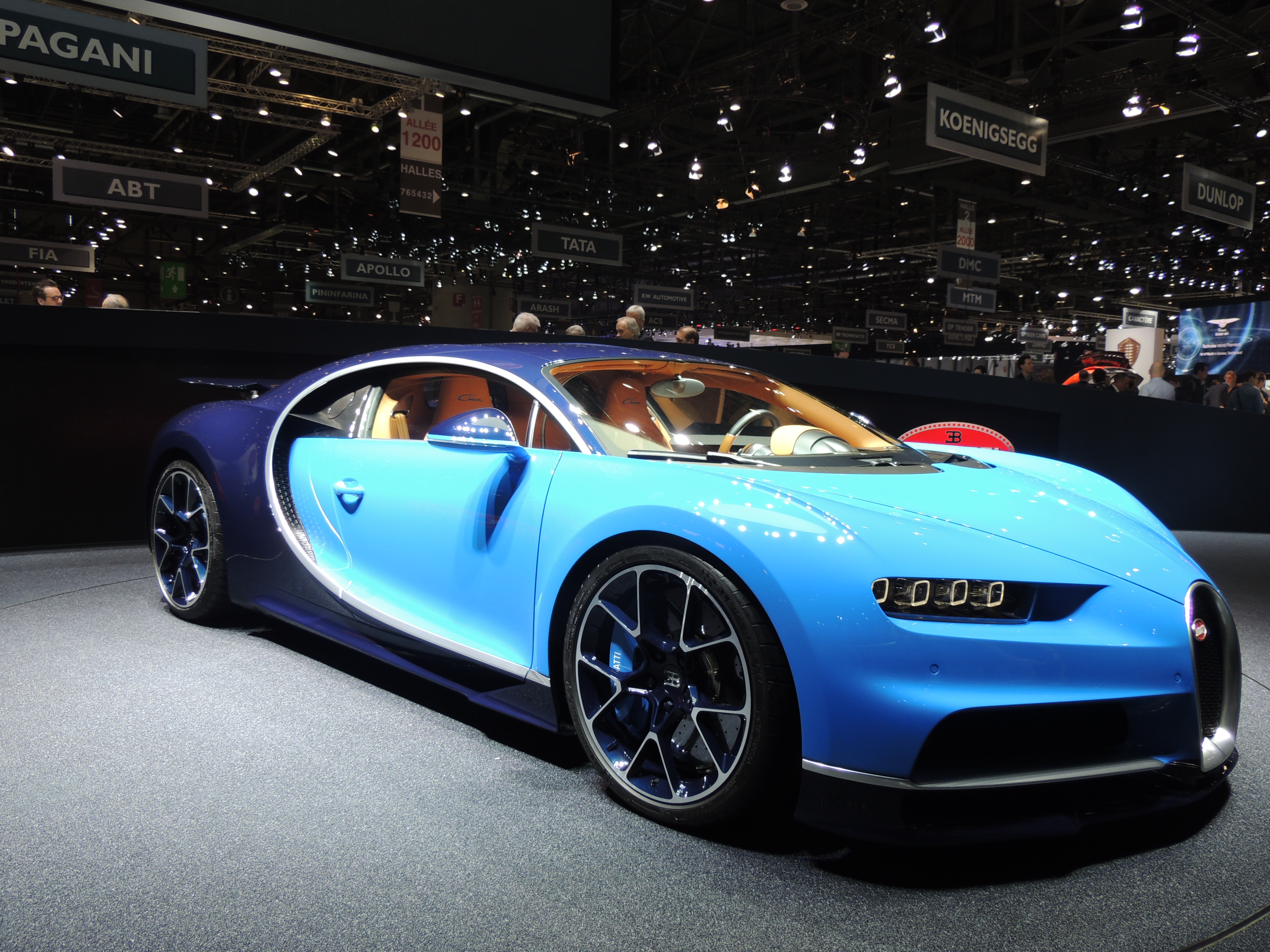
Bugatti Chiron
"funding helped them really create the Veyron and from there create the Chiron and turn into, again, this global company now that you're producing these multi-million dollar cars."
The Bugatti Chiron is another top-tier Bugatti hypercar that came after the Veyron. The point here is that Volkswagen’s involvement helped Bugatti build cars like the Chiron too.
The Bugatti Chiron is the successor hypercar to the Veyron era, continuing Bugatti’s push into multi-million-dollar, high-performance road cars. The host links the Chiron’s creation to the same Volkswagen Group-backed resurgence that enabled the Veyron.
super car
"But what's the first person to buy the first like super car from Bugatti, you think, after Volkswagen took them over..."
A “supercar” is a very expensive, very fast sports car. The host is basically wondering who would be the first person to buy Bugatti’s top-level car after the brand got revived.
“Supercar” is an enthusiast term for a very high-performance, high-cost sports car—typically built in small numbers and aimed at top-tier speed and technology. Here, the host uses it to describe the first Bugatti “super car” buyers after Volkswagen’s takeover.
manual
"Honestly, it was just like, it was, it was trying to find a manual. [3334.2s] That's what I mean. Same with the Z. I was the same with the Z. It was like trying to find a manual"
“Manual” means the car has a stick shift. You use a clutch pedal and move the gear lever yourself to change gears.
A “manual” refers to a manual transmission, where the driver shifts gears using a clutch pedal and gear lever. Enthusiasts often seek manuals because they can feel more engaging and provide more direct control over engine speed.
splitter
"I think they got white and red, white with some red accents around the splitter and the backs in the diffuser and things like that."
A splitter is a front lip that extends downward under the front bumper. It helps the car’s airflow stay more controlled, which can make the car feel more planted at speed.
A splitter is an aerodynamic extension at the front of a car that sticks out below the bumper. Its job is to help manage airflow under the car to improve stability and reduce lift at speed.
diffuser
"I think they got white and red, white with some red accents around the splitter and the backs in the diffuser and things like that."
A diffuser is a part under the back of the car that helps air flow out smoothly. Better airflow can help the car stick to the road more when you’re going fast.
A diffuser is an underbody aerodynamic panel—usually toward the rear—that helps guide airflow as it exits under the car. By shaping that airflow, it can improve downforce and stability, especially at higher speeds.
Remac
"there was the whole combination of Bugatti and Remac, you know, where they were basically, they're one company steel at this point."
Rimac is a company that makes very advanced electric performance tech. Here, the host is talking about how Bugatti and Rimac were combined into a more unified setup.
Rimac (often misspoken as “Remac”) is a Croatian EV and high-performance technology company known for electric drivetrains and power electronics. The host is referencing a corporate combination involving Bugatti and Rimac, describing it as effectively one integrated company.
Volkswagen Audi group Bugatti
"the Volkswagen Audi group Bugatti was a totally different Bugatti than even what they had going on in the nineties."
Bugatti has been connected to the Volkswagen Group, meaning it’s influenced by how that big company runs its brands. The host is saying Bugatti used to feel different under that umbrella than it does now.
Bugatti has been tied to the Volkswagen Group in different eras, which affects strategy, funding, and how the brand is positioned. The host is contrasting Bugatti’s past Volkswagen-era identity with the brand’s newer ownership and corporate structure.
private equity firm
"And now you're getting into this era where, you know, they're, they were bought by a private equity firm, which, you know, we've seen with other companies how things get a little wonky..."
A private equity firm is a company that invests by buying other companies. When they own a car company, the focus can shift toward financial goals, which can make things feel “wonky” compared to how car enthusiasts expect brands to be run.
A private equity firm is an investment company that buys businesses (often taking a controlling stake) with the goal of improving profitability and eventually exiting. The host is using it as a cautionary example of how non-automotive owners can change priorities and decision-making in car brands.
change your oil
"You got one offs and situations. Yeah, you got to change your oil kids, please. Like this basic maintenance."
Oil has to be replaced regularly so it can keep the engine lubricated and clean. The host is saying this kind of basic maintenance matters for long-term reliability.
“Change your oil” is routine engine maintenance that keeps lubricants fresh so they can reduce friction and carry away heat and contaminants. While it’s basic, it’s explicitly called out as part of what helps cars last longer.
making these things last longer
"Yeah, you got to change your oil kids, please. Like this basic maintenance. Yeah, you got to still participate in making these things last longer."
The host is talking about doing routine upkeep so the car doesn’t wear out early. In the next line they mention basic maintenance like oil changes.
This refers to keeping a car reliable over time by staying on top of scheduled upkeep. The transcript immediately ties it to basic maintenance like oil changes, which helps prevent premature wear.
EV game
"But to that point, and kind of like you said, even though a lot of people are pulling out of the EV game, it's when cars really become to that point of like EVs..."
“EV game” just means the whole push to make and buy electric cars. The host is saying some people think that push is slowing down or changing.
“EV game” is shorthand for the market push toward electric vehicles. In this context, it means whether people and automakers are still investing in EVs versus moving back toward traditional cars.
EVs
"it's when cars really become to that point of like EVs and really they're supposed to outside of the battery technology, they're supposed to really be quote unquote, somewhat bulletproof."
EVs are cars that use electricity from a battery to move the car, instead of burning gas. The idea here is that they may be simpler mechanically, so they can be less prone to certain failures.
EVs (electric vehicles) run on an electric motor powered by a battery pack instead of a gasoline engine. The host is arguing that EVs tend to have fewer moving mechanical components than many internal-combustion cars, which can help reliability.
bulletproof
"they're supposed to outside of the battery technology, they're supposed to really be quote unquote, somewhat bulletproof."
“Bulletproof” here just means “very hard to break.” The host is saying EVs are expected to be reliable, except maybe for the battery part.
“Bulletproof” is a common enthusiast way to say a vehicle is extremely dependable with few failures. Here it’s used specifically about EVs being reliable aside from battery-related concerns.
battery technology
"they're supposed to outside of the battery technology, they're supposed to really be quote unquote, somewhat bulletproof."
Battery technology means how the EV’s battery is built and managed. The host is implying the battery is the main area where reliability might still be a question.
Battery technology refers to the design and chemistry of the EV battery pack and how it’s managed. In reliability discussions, it usually points to concerns like degradation over time and how the battery is protected by the car’s thermal management.
full on living room
"And then, you know, you're not really going to get that much more tech advancement unless like you're getting, you know, unless you're getting a car that has like a full on living room in the backseat or something."
The host is using “living room” as a metaphor for very comfortable rear seats. They’re saying some people upgrade mainly for comfort and tech, not because the old car is unreliable.
“Full on living room” is a metaphor for ultra-comfortable rear-seat experiences in luxury cars, often enabled by advanced seating, sound insulation, and climate/entertainment tech. The host is saying that beyond reliability, big feature upgrades like this can be a reason to buy a newer car.
Mercedes
"I've seen some cars, man. Let me tell you some cars look amazing and they look great. And I get like, I mean, once you get into the ladies Mercedes like fully specced out..."
Mercedes is a luxury car brand. The host is using it as an example of a car that can be loaded with lots of features and comfort upgrades.
Mercedes (Mercedes-Benz) is referenced as an example of a luxury brand that offers highly optioned vehicles. The host specifically mentions a “fully specced out” Mercedes as a reason some people are drawn to newer cars for comfort and features.
fully specced out
"once you get into the ladies Mercedes like fully specced out, I mean, I get it. Like I seen some of these, they, they look amazing."
“Fully specced out” means the car is configured with lots of add-ons and upgrades. The host is saying those feature-rich versions can look and feel amazing.
“Fully specced out” means a car is ordered with a lot of options and packages, often including premium interior features. In luxury-car discussions, it usually implies more comfort tech and higher-end materials.
cockpit
"the whole thing that's just very tight, feel like a cockpit and, and I'm sure they're all, all the cars are like all, all of them really..."
“Cockpit” here means the cabin feels built around the driver, like a focused driving space. The host is saying some cars feel more immersive and sporty because of that layout.
In car talk, “cockpit” describes the driver-focused cabin layout—controls and seating feel like you’re inside a performance-oriented space. The host uses it to describe how some luxury cars feel tight and driver-centered.

BMW E63
"...f those old, like the early 2000s or early to mid E63 wagon. It's back in the day and it was like proba..."
The BMW 6 Series is a luxury car line meant for comfortable, long-distance driving. The podcast mentions an older wagon-style version from the early 2000s to mid-2000s. It’s brought up as a car from the speaker’s past.
The BMW 6 Series is a luxury grand touring car line known for comfort and a more upscale driving feel. In the podcast, it’s specifically tied to an early-2000s to mid-2000s E63 wagon, suggesting the speaker is referencing a particular body style and era. That’s why it’s mentioned as a “back in the day” car memory.
rear facing back seats
"it even had like the rear facing back seats all the way in the back. So it was a three row, essentially it had, you know, your middle row, but then it had a rear facing back seat in the, in, the back as well."
Rear-facing seats are seats that look backward instead of forward. They’re commonly used for kids because they can be safer in certain crash situations, but it can feel unusual for adults.
Rear-facing seats are passenger seats that face backward relative to the car’s direction of travel. The host is describing a niche wagon feature where the back row includes rear-facing seating, which is often associated with child-safety use cases (though they note it can feel a little uneasy).
three row
"it was a three row, essentially it had, you know, your middle row, but then it had a rear facing back seat in the, in, the back as well."
A three-row car has seats in three different rows, so more people can ride together. It’s especially useful for families or road trips.
A three-row layout means the vehicle has seating for three rows of passengers, typically used for families or larger groups. In this case, the host emphasizes that the wagon could carry kids in the back area in addition to the front and middle rows.
500 horsepower
"besides the fact that it also had like 500 horsepower even back then in the early 2000s, the thing was super quick and sounded insane."
Horsepower is a way to describe how much power the engine makes. More horsepower usually means the car can accelerate more strongly.
Horsepower is a measure of engine power output. The host uses the figure to emphasize that this early-2000s Mercedes wagon was surprisingly quick for something described as practical and family-oriented.
active side bolsters
"they had these like active side bolsters in the seats where when you corner, the bolsters actually [4004.0s] come up on whatever side that you're leaning to, to like hold you into place."
Some car seats have side pads that can move. When you turn, the pads push in to hold you more firmly so you don’t slide around.
Active side bolsters are seat side supports that can move to better grip your body during cornering. Instead of being fixed and always “hugging” you, they extend more when you lean to help keep you positioned.
best of both worlds
"So it was like the [4009.7s] best of both worlds where you, you didn't want to necessarily have like a, you know, fully bolstered [4014.4s] seat. It's like that all the time, but when you start getting in the curvy rows, the seat adjusts, [4019.4s] you know, for you to be more situated in it."
The host is describing a design tradeoff: fully bolstered seats can feel too restrictive all the time, while non-bolstered seats don’t hold you well in corners. Active bolsters aim to give comfort during normal driving and extra support when cornering.

Chevrolet Corvette
"...last house I came out of, I think I owned about a Corvette though. I think in there, I see, I think more tha..."
The Chevrolet Corvette is a sports car made for speed and fun driving. People often talk about it because it’s a well-known performance car. In the podcast, it’s mentioned as something the speaker owned.
The Chevrolet Corvette is a performance sports car built by Chevrolet, known for its strong acceleration and driver-focused design. It often comes up in conversations about car ownership because it’s a recognizable “enthusiast” car with a long history. In the podcast, it’s mentioned as a car the speaker owned, which is why it’s relevant to driving and ownership talk.
keep up with the Joneses
"[4226.8s] but other than that, like, like I own all the cool cars there too, for the most part. And, [4230.8s] and people used to say like, Oh, you're trying to keep up with the Joneses. Dude, I am the Joneses. [4234.9s] I am the Jones. Yeah."
It means trying to match what other people are doing or owning. Here, it’s about not buying a car just to impress neighbors—buy it because you actually like it.
“Keep up with the Joneses” is a phrase for buying or doing things mainly to match what other people have. In car terms, it’s the idea of chasing other owners’ choices instead of enjoying the car for yourself.
Request an Explanation
Heard something you'd like explained? We'll add it to this episode.
Sign in to request explanations for terms you heard.
Want to learn more?
Browse our glossary for plain-English explanations of automotive terms, jargon, and concepts.
Help improve this episode
See something that's not quite right? Our annotations are AI-generated and can sometimes miss the mark. Click the flag icon on any annotation to suggest a correction.