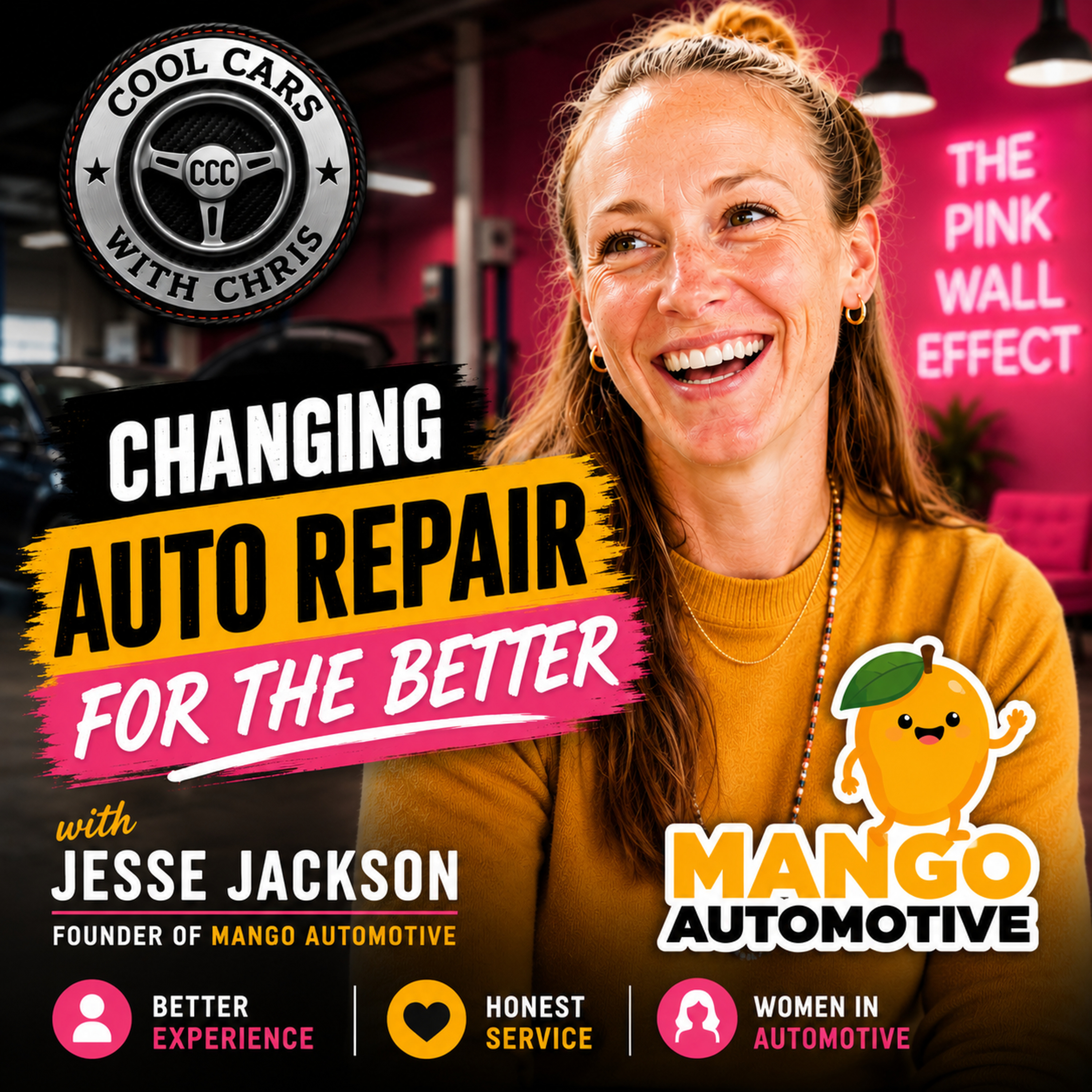
041 | How Jesse Jackson Is Redefining Auto Repair with Mango Automotive
About this episode
Jesse Jackson, founder of Mango Automotive in San Diego, explains how he’s modernizing aftermarket repair through a memorable brand and a friendlier customer experience. The shop’s “pink wall effect” replaces grim waiting rooms with comfort, clean vibes, and even essential-oil scenting. He also tackles gender and pricing bias, arguing women make most decisions and that shops need more women (and broader representation) on both sides of the counter. Mango works on most vehicles, including EVs and diesels, with ASE-certified techs and a team culture that includes being able to drive manual transmissions.
In this episode of Cool Cars with Chris, Chris sits down with Jesse Jackson, co-founder of Mango Automotive, to discuss how she's redefining auto repair through customer experience, innovative business practices, and a fresh approach to an industry that has remained largely unchanged for decades.
Jesse shares her journey from the software industry into automotive repair, the story behind the Mango Automotive brand, and how the company grew from a single repair shop in 2021 to eight locations across New Mexico, Arizona, and Texas.
The conversation explores the unique "Pink Wall Effect," why customer trust matters in auto repair, the importance of creating a welcoming environment for all drivers, and how women are helping shape the future of the automotive industry.
Chris and Jesse also discuss technician training, ASE certifications, shop acquisitions, employee development, vehicle maintenance, extended warranties, customer service, and the realities of operating a growing multi-location automotive business.
Whether you're a car enthusiast, automotive professional, entrepreneur, repair shop owner, or simply someone looking to better understand vehicle maintenance and the auto repair industry, this episode offers valuable insights into one of the most important businesses keeping drivers on the road.
Topics Covered:
• How Jesse Jackson founded Mango Automotive
• Growing from one repair shop to eight locations
• The story behind the Mango Automotive name
• The Pink Wall Effect and customer experience
• Women in automotive repair
• Hiring and training automotive technicians
• ASE certifications and technician development
• Auto repair shop acquisitions and business growth
• Building company culture and employee retention
• The economics of running an automotive repair business
• Vehicle maintenance and preventative service
• Extended warranties and common misconceptions
• The most expensive automotive repairs
• Customer trust and transparency in auto repair
• Managing multiple locations and scaling operations
• The future of the automotive repair industry
Guest:
Jesse Jackson
Co-Founder, Mango Automotive
Connect with Mango Automotive:
https://www.mangoautomotive.com/
#AutoRepair #AutomotiveRepair #CarMaintenance #VehicleMaintenance #AutomotiveIndustry #MangoAutomotive #JesseJackson #Entrepreneurship #SmallBusiness #WomenInAutomotive
00:00 Introduction
00:26 What Is Mango Automotive?
00:55 Starting Mango Automotive in 2021
01:09 Why the Name "Mango Automotive"?
02:09 Redefining the Auto Repair Experience
03:04 The Pink Wall Effect
04:14 Women in the Auto Repair Industry
05:59 What Vehicles Does Mango Automotive Service?
07:10 From Software Executive to Auto Repair Entrepreneur
08:41 Hiring and Training Automotive Technicians
10:17 Learning to Drive a Manual Transmission
12:25 What Happens to Abandoned Vehicles?
14:24 Growing Mango Automotive to Eight Locations
15:16 How Auto Repair Shop Acquisitions Work
16:42 Same-Day Service and Shop Capacity
17:42 Customer Transportation and Lyft Services
18:46 The Most Expensive Automotive Repairs
19:48 Extended Warranties and Repair Challenges
23:25 Rising Vehicle Ownership and Repair Costs
25:02 The Economics of Running an Auto Repair Business
27:01 Mango Automotive's Most Successful Shop
28:59 Growing a Newly Acquired Repair Shop
31:09 Keeping Employees During Ownership Changes
33:03 Helping Auto Shop Owners Retire
35:35 Alternatives to Selling a Repair Shop
37:51 Competition in the Auto Repair Industry
39:09 Friendly Sign Wars Between Repair Shops
43:12 Managing Eight Shops and Seven Kids
45:47 Leadership, Hiring, and Company Culture
47:46 Mango University and Employee Development
48:42 Expansion Plans and California Growth
50:42 Vehicle Safety Inspections and Customer Trust
54:20 Car Maintenance Advice for Every Driver
55:22 Where to Find Mango Automotive
56:29 Episode Wrap-Up
liability insurance
"Is there any kind of liability insurance for something like that? What happened on a regular car?"
Liability insurance is the kind of insurance that helps cover costs if someone is responsible for damage. For a repair shop, it can apply if the shop accidentally damages your car while working on it.
Liability insurance is coverage that helps pay for damages or injuries you’re legally responsible for. In an auto-repair context, it’s commonly discussed for situations where a shop’s work (or an accident during service) causes damage to a customer’s vehicle.

Honda Civic
"What happened on a regular car? Like a Honda Civic or something like that? Like, how does that work?"
A Honda Civic is a very common everyday car. That’s why people use it as an example of what a repair shop might work on most often.
The Honda Civic is a mainstream compact car that’s common enough to be used as a “regular car” example in repair-shop discussions. Because it’s so widely owned, shops often see Civics frequently for everything from routine repairs to collision-related work.

Master Techs
"...ue. I mean, I couldn't work on a vehicle, but our master techs and our shop are geniuses by their own right."
“Master” usually means a top-level mechanic at a repair shop, not a type of car. These technicians are the most experienced and are often the ones who handle difficult problems. The podcast is likely emphasizing that the shop has highly skilled people working there.
“Master” here refers to a master technician role in a repair shop, not a specific vehicle model. It’s significant because master techs are typically the most experienced people in the shop, handling the hardest diagnostics and repairs. This kind of detail often comes up in podcasts when discussing who does the work and how complex issues get solved.
manual transmission
"Now it's one of the requirements to work in your shop or any shop for that matter is [620.3s] to be able to drive a manual transmission."
A manual transmission means you shift gears yourself using a clutch pedal. You have to learn how to match the engine speed to the gear so the car doesn’t jerk or stall.
A manual transmission is a gearbox that requires the driver to use a clutch pedal and shift gears manually. It’s often considered a core driving skill because the driver controls gear selection and engine speed directly.

Ford Ranger
"I don't think my first car was like this little Ford Ranger. [632.2s] My grandfather had got it with no extras."
The Ford Ranger is a pickup truck. Here it’s mentioned because it was a manual, so the speaker had to learn how to drive it without stalling.
The Ford Ranger is a compact pickup truck known for being simple, durable, and widely available in manual-transmission form. In this story, it’s used as an example of an early-2000s truck that required learning to drive a stick.
stick shift
"I remember taking my sports car to a shop a couple of times. And every time I take it in because of the stick shift, they're like, we've got to find someone that can drive it like around the back to the shop..."
A “stick shift” is a car with a manual gearbox. You use the clutch and the gear lever to change gears yourself, instead of the car shifting automatically.
“Stick shift” is a common way to refer to a manual transmission car, where the driver uses a clutch pedal and gear lever to change gears. In a shop context, it also means the technician/driver must be able to operate the car correctly to move it safely in and out of the bay.
turnaround
"We call that shop a turnaround. That shop's doing, I think right around 3000000 right now. So we've grown it over the last three years."
A "turnaround" is just how fast the repair shop can get your car back to you. It includes time for diagnosing the problem and then doing the work.
In an auto-repair context, a "turnaround" is how long it takes a shop to receive a vehicle, diagnose it, perform the repairs, and return it to the customer. Shops track turnaround time because it affects customer satisfaction and shop throughput.
radiator
"Say I came in with something, not something serious, but something kind of like, say, I don't need a radiator or something. What would be the turnaround time on a shop that had 12 bays or 10 bays?"
The radiator is part of the car’s cooling system. It helps keep the engine from overheating by cooling the fluid that circulates through the engine.
A radiator is the engine’s cooling-system heat exchanger that helps prevent overheating by transferring heat from coolant to airflow. If a radiator is failing, the car may still drive briefly, but it can overheat quickly—so diagnosis and repair timing matter.
same day
"It's really important to us to get our customers in same day because we know vehicles are critical. So we work our butts off to get customers in same day and to get them out the same day. If you have a radiator problem, you don't know you have a radiator problem and it needs to be"
“Same day” means you bring the car in and the shop tries to get it fixed and ready for you before the day ends. It’s a scheduling and speed target for the repair shop.
“Same day” service is a shop operating goal where customers drop off a vehicle and expect it to be diagnosed and repaired so it can be picked up the same day. It’s especially relevant for time-sensitive repairs and for shops optimizing scheduling and staffing.
diagnosed
"If you have a radiator problem, you don't know you have a radiator problem and it needs to be diagnosed. That's where a lot of the time can go into the diagnosing to try to figure out what's wrong with that car before we fix it."
“Diagnosed” means the mechanic figures out what’s actually causing the problem, not just what it seems like. That step can take time because there are often multiple possible causes.
In auto repair, “diagnosed” refers to the process of identifying the root cause of a problem using tests, inspection, and sometimes scan-tool data. Diagnosis can take significant time because the symptom (like overheating) may have multiple possible causes.
loaner vehicles
"Okay. Okay. Do you guys have any kind of loaner program for like loaner vehicles or like that or no? We do not do loaner vehicles, but we will Uber or Lyft you to wherever you need to go."
A loaner vehicle is a spare car the shop gives you to use while your car is in the shop. It helps you get around so you’re not stuck waiting.
A “loaner vehicle” is a temporary replacement car a repair shop provides to a customer while their own car is being serviced. It’s meant to keep you mobile during the repair process.
Uber or Lyft
"no? We do not do loaner vehicles, but we will Uber or Lyft you to wherever you need to go. Oh, you guys have your own personal shuttle, like your little van, like the dealerships have"
Uber and Lyft are apps you use to request a ride. Here, the shop uses them instead of giving you a spare car.
Uber and Lyft are ride-hailing services used as an alternative to a repair-shop shuttle or loaner car. In this context, the shop covers rides so customers can still get to work or home while their vehicle is being repaired.
whole new engine
"The question I guess when it comes to shop repair and things, what is the craziest repair you've heard of, like most expensive repair, they're like, Oh my gosh, they need like a whole new engine. Cause it is always the whole new engine that is the most expensive repair"
A whole new engine means the shop replaces the entire engine, not just one broken part. It’s usually very expensive because the engine costs a lot and the work to swap it is labor-intensive.
A “whole new engine” means replacing the entire powerplant rather than repairing a single component. It’s often the most expensive repair because the engine itself can cost thousands, and labor to remove and install it is substantial.
core charges
"So those are always heavy. And the core charge too. So the core charges on those two, I believe. Yep. Yep."
A core charge is a deposit-like fee you pay when you buy a rebuilt part. You get the money back after you return the old worn-out part.
A “core charge” is an extra fee you pay when buying a rebuilt or remanufactured part, like an engine. It’s refunded when you return the old “core” part to be rebuilt again.
throwing rods
"Yeah. I've heard stories people throwing rods because we're trying to push the engine beyond its limits. Like, um, I don't, most modern"
Throwing rods is a serious engine failure where the connecting rod breaks and can damage the engine block. It usually happens when the engine isn’t properly lubricated or is pushed too hard.
“Throwing rods” refers to catastrophic engine failure where a connecting rod breaks or comes apart, often punching through the engine block. It’s commonly associated with oil starvation or severe mechanical stress.
oil pressure drops
"I've heard stories people throwing rods because we're trying to push the engine beyond its limits. Like, um, I don't, most modern vehicles have like a shut off too. If like oil pressure drops or if something like that happens"
Oil pressure drops means the engine isn’t getting enough oil flow/pressure to lubricate itself. That can cause major damage fast, so the car may limit power or go into a protective mode.
“Oil pressure drops” means the engine’s lubrication system isn’t maintaining enough pressure to circulate oil. Low oil pressure can quickly lead to severe engine damage, so many modern cars trigger warnings, protective strategies, or reduced power.
limp mode
"usually it goes in like a limp mode or whatever, but sometimes maybe some sensors out or whatever, or something like that. And, um, they don't know when they're climbing a hill, tone a boat or"
Limp mode is when the car intentionally reduces power because it thinks something is wrong. It helps prevent further damage so you can get the vehicle to a mechanic.
“Limp mode” is a protective driving state where the car limits power and/or certain functions after detecting a fault. The goal is to reduce stress on the engine or drivetrain so you can safely drive to a shop.
mango automotive
"[1185.2s] Well, I mean, it never happened to me cause I changed my oil, [1189.2s] you know, speaking of, speaking of oil changes, one thing I love about mango automotive, [1192.1s] your website is that you offer something I haven't seen before, maybe because I haven't,"
Mango Automotive is the auto repair shop they’re talking about. They’re explaining how Mango handles repairs and warranties in a way that’s meant to be easier for customers.
Mango Automotive is the repair shop being discussed in this segment. The hosts focus on how its service model and warranty approach differ from typical independent-shop experiences.
monthly subscription
"[1196.8s] I guess I haven't seen this is the monthly subscription. Can you tell me how that works [1200.8s] and what do you get with that?"
A monthly subscription is like paying a set amount every month for auto-repair help. Rather than paying for everything each time, you’re buying coverage through a plan.
A monthly subscription in auto repair is a recurring payment plan that’s intended to cover certain service needs over time. Instead of paying per visit, customers pay regularly and get defined repair coverage or benefits.
60 month, 60,000 mile warranty
"[1212.1s] I just thought on your website yesterday, [1216.9s] I was like, that's kind of interesting program. You have a 60 month, 60,000 mile warranty, [1223.5s] which is in the locations that we operate almost unheard of."
This is a warranty that lasts five years or 60,000 miles—whichever comes first. The idea is that if something related to the repair goes wrong during that window, the warranty should help cover it.
A 60 month, 60,000 mile warranty is a long coverage period measured both by time and by vehicle mileage. In this context, the shop is emphasizing that the warranty is meant to keep the customer covered for the repairs the shop performed.
warranty work
"[1235.8s] repair. So it only warranties of the work that you guys touched. I'm assuming nothing outside of [1241.6s] that. Yeah, yeah. It's not a, you know, I think you're touching on what's like [1247.5s] aftermarket warranties."
Warranty work is when a repair is done under a warranty, so the warranty plan is supposed to cover the cost. The shop may still have to follow rules and get approval before the warranty pays.
Warranty work refers to repairs that are performed under a warranty agreement, where the warranty company is expected to pay for the covered portion. This segment highlights how warranty work can require paperwork, approvals, and specific parts sourcing.
aftermarket warranties
"[1241.6s] that. Yeah, yeah. It's not a, you know, I think you're touching on what's like [1247.5s] aftermarket warranties. Um, we actually explored that place, space, that space and like played in it."
Aftermarket warranties are warranty plans from companies other than the car maker. They can help pay for repairs, but they may limit what they cover and require specific parts or approval steps.
Aftermarket warranties are coverage plans sold by third parties (not the vehicle manufacturer) to protect repairs after purchase. The speaker notes that these warranties often come with strict rules about what parts and repairs they will pay for.
warranty company
"[1254.5s] it. And it's a challenging space right now for owners and just vehicle owners and I think automotive [1263.1s] repair shop businesses, because those warranty companies, they like to pretend like they're [1269.9s] offering the world. And then when it comes down to it, they don't want to cover crap."
A warranty company is the organization that pays for warranty-covered repairs. They can approve or deny claims, and they may require certain parts or processes before they’ll pay.
A warranty company is the third-party insurer/administrator that decides whether a repair qualifies for coverage and under what conditions. In this segment, the speaker criticizes how these companies may deny coverage or impose strict part requirements.
used eBay part
"[1288.7s] get someone over there to pick up. And then they'll say, you know, we're only going to cover it if [1292.8s] we ship you this used eBay part. What happens when that breaks? Because [1300.3s] we can't warranty the used part off of eBay, right?"
A used eBay part is a secondhand replacement part bought online. The concern here is that a warranty might only pay if the shop uses that used part, which could be risky if it fails later.
A used eBay part is a pre-owned component sourced from an online marketplace. The speaker is describing a common warranty-company tactic: approving coverage only if the shop uses the cheapest qualifying part, even if it’s used.
powertrain warranty
"[1371.6s] I had, what was it? 60,000, 60,000 mile, five year powertrain, I think. I think Hyundai does [1377.7s] the 100000 still, I think on new vehicles."
A powertrain warranty covers the big moving parts of the car, like the engine and transmission. It usually doesn’t cover everything the way a “bumper-to-bumper” warranty does.
A powertrain warranty covers the major components that make the car move—typically the engine, transmission, and drivetrain-related parts. It’s narrower than a bumper-to-bumper warranty, which covers more systems across the vehicle.
bumper-to-bumper
"[1383.7s] Maybe they [1383.7s] gave you bumper to bumper. Most of them give you that."
“Bumper-to-bumper” usually means the warranty covers a lot of different parts of the car, not just the engine and transmission. There are still some things it may not cover, but it’s broader overall.
A bumper-to-bumper warranty is a broad factory warranty that covers many vehicle systems and components, not just the engine and transmission. In practice, it still has exclusions, but it’s generally wider coverage than a powertrain warranty.
parts have gone up
"So we've seen, you know, since COVID parts have gone up in some cases up to 50%, the previous [1470.6s] prices."
They mean the cost of replacement car parts went up. If parts cost more, repairs usually cost more too.
The speaker is talking about how the prices of replacement components used in automotive repair have increased. When parts cost more, repair bills usually rise because shops must buy those components at higher prices.
profit margins
"in automotive repair, you see profit margins for smaller shops that are [1513.6s] around a million dollars. Oftentimes those profit margins are depressed in the 10% range."
Profit margin is how much money a business keeps after paying all its bills. The point here is that many small repair shops don’t keep much profit per job.
Profit margin is the percentage of revenue a business keeps as profit after paying its costs. In automotive repair, the speaker says smaller shops often have relatively low margins, meaning they can struggle even when they’re busy.
P&L profit
"I looked at one [1559.2s] yesterday with four locations where they're making their P&L profit was $13,000 across all four [1567.7s] locations, which means for the year or last year, which means that they're losing money in a lot of [1573.8s] cases."
P&L is a simple way to track whether a business made money or lost money over a year. Here, the numbers suggest the shop wasn’t doing well financially.
P&L (profit and loss) is a financial statement that summarizes income and expenses over a period. The speaker uses it to show that a multi-location shop’s overall profit was very low, implying they may be barely breaking even or losing money.
automotive shop
"I was kind of wondering if like, when you look at an automotive shop and say that there are a bunch of other competitor automotive shops in the same area, does it become kind of saturated?"
An automotive shop is a place that fixes cars and does maintenance. The episode is talking about how having many shops nearby doesn’t necessarily mean one shop can’t succeed.
An automotive shop is a business that performs vehicle maintenance and repairs. In the context of the episode, the hosts are discussing how local competition among these shops affects buying decisions and capacity planning.
maximum capacity
"I think it's a great shop. We loved how the owner was doing business. It was our first shop to hit maximum capacity. So for us, that's about 400 K per year per bay that we have."
Maximum capacity means the most work the shop can handle at once. In this story, they reached their peak level of business for each service bay.
Maximum capacity is the highest workload a shop can handle efficiently with its current setup. Here, it’s used to describe when the shop reached its peak throughput—about 400K per year per bay—before needing more space or resources.
service bay
"It was our first shop to hit maximum capacity. So for us, that's about 400 K per year per bay that we have."
A service bay is like a garage stall for working on a car. If a shop has more bays, it can usually fix more cars at the same time.
A service bay is a dedicated garage stall where a vehicle is brought in for work. Shops often measure productivity and revenue per bay, because each bay limits how many cars can be serviced at the same time.
diesel customer list
"we saw one of the street corners actually sold his diesel customer list to us because he was retiring and closing."
A diesel customer list is basically the shop’s contact list of people who bring in diesel trucks or cars. If a shop closes, selling that list can move those customers to another shop.
A diesel customer list refers to a shop’s customer records specifically tied to diesel vehicles. Selling it transfers leads and established relationships, which can quickly bring in work when a shop is closing or retiring.
sign wars
"And we have a little friendly, like we will do sign wars. And like, Oh, no way. Give me an example of that."
Sign wars are when two nearby businesses keep putting up messages on their signs to one-up each other. Here, they’re doing it in a playful, friendly way.
Sign wars are a local marketing rivalry where neighboring businesses use roadside signs to respond to each other. In this episode, it’s described as friendly banter rather than hostile advertising.
Tesla
"the manufacturers themselves think for Tesla can only account for, this is a wide range, but 25 to 40% of the repair work that needs to be done."
Tesla is a company that makes electric cars. The hosts are using Tesla as an example of how not all repair work can be handled by the manufacturer alone.
Tesla is an electric-vehicle manufacturer whose vehicles require service and repairs like any car, but with different systems than many gas cars. In this segment, Tesla is used as an example of how manufacturers may only handle a portion of total repair demand.
aftermarket repair shops
"So many vehicles that the manufacturers themselves think for Tesla can only account for, this is a wide range, but 25 to 40% of the repair work that needs to be done. So we have to have aftermarket repair shops."
Aftermarket repair shops are regular independent garages that fix cars, not the brand’s own dealership. The point here is that there are more cars needing repairs than the manufacturers can handle directly.
Aftermarket repair shops are independent businesses that service vehicles outside the automaker’s own dealer network. The episode argues that because manufacturers (and Tesla specifically, in their example) can’t handle all repair demand, independent shops fill the gap.
private equity
"certain places where you've already seen private equity gobble up a bunch of shops. So there's not as much available."
Private equity is an investment company that buys businesses. When they buy lots of auto shops, it can reduce how many truly independent repair places are available.
Private equity is a type of investment firm that buys companies, often with the goal of improving profitability and then selling later. In auto repair, it can lead to consolidation where many independent shops end up owned by larger groups.
oil changes
"And you probably should go in there for, you know, maintenance oil changes and, you know, things that sort fairly rarely, but I think it's cars get older..."
An oil change is when you replace the engine’s old oil with new oil. It helps protect the engine and keeps it running smoothly.
An oil change is scheduled maintenance where the engine oil is drained and replaced with fresh oil. It helps keep the engine lubricated and removes contaminants that build up over time.
tuneups
"standard maintenance programs, I'm sure you guys do all the standard stuff, you know, the regular oil changes and the tuneups and spark plugs and all that..."
A tuneup is a service that helps get the engine back to how it’s supposed to run. It usually involves checking and replacing common wear parts.
A tuneup is a maintenance service aimed at restoring an engine’s correct operating condition. Depending on the vehicle, it may include checking ignition components and replacing wear items to keep the engine running efficiently.
spark plugs
"the regular oil changes and the tuneups and spark plugs and all that, all the normal kind of stuff."
Spark plugs make the spark that starts the engine’s combustion. If they wear out, the engine can run poorly or misfire.
Spark plugs are the ignition components that create the spark needed to ignite the air-fuel mixture in gasoline engines. Worn spark plugs can cause misfires, rough running, and reduced fuel efficiency.
full inspection
"I think the thing that's really important to me is like, we do a full inspection on every vehicle. So when the vehicle comes in, if you come in to get your brakes done..."
A full inspection means the shop checks the whole car, not just the one thing you came in for. It helps catch problems early so they don’t turn into bigger repairs.
A full inspection is a comprehensive check of a vehicle’s condition beyond the specific service requested. It typically involves looking for wear items, safety issues, and other problems that may not be obvious until later.
brakes done
"So when the vehicle comes in, if you come in to get your brakes done, like we're going to replace your brakes, but I always, you know, tell our employees,"
“Brakes done” means the shop is working on your braking system. Usually that involves replacing worn brake parts so the car can stop safely.
“Brakes done” refers to servicing the braking system, commonly including replacing brake pads and/or brake rotors depending on wear. Brake service is safety-critical, so shops often pair it with a broader inspection.
struts
"like, if we replace their brakes and we didn't notice like their struts are cracking, like, [3075.5s] and they drive down the road and have an issue, like that's our responsibility."
Struts are suspension parts that help keep the car stable over bumps and help the wheels stay properly controlled. If they’re cracking, it can become unsafe and should be checked or replaced.
Struts are part of a car’s suspension system and help control ride quality and steering response. When struts are “cracking,” it can indicate structural failure risk that affects handling and safety.
factory maintenance
"we're not only going to look up what your regular factory maintenance should be, but we're also [3088.8s] going to examine the vehicle."
Factory maintenance refers to the scheduled service intervals and checks recommended by the vehicle manufacturer. It’s typically based on mileage/time and includes items like inspections, fluid services, and wear-part replacement criteria.
safety item
"if there's a safety item, you know, if this was my daughter, [3097.5s] I would tell her to fix this. Like, you really need to get new brakes and, you know, your tires"
A safety item is a car problem that could make the vehicle dangerous to drive. If it’s something like bad brakes, cracked suspension parts, or worn tires, it’s usually urgent.
A safety item is a repair or inspection item that can directly affect crash risk if ignored—such as worn brakes, failing suspension components, or tires with insufficient tread. Shops often prioritize these because they can create immediate or near-term hazards.
tires
"Like you really need to get new brakes and, you know, your tires [3102.8s] are bald. Like you really need to fix these safety items."
Tires are what actually grip the road. If the tires are “bald,” they have worn down too much and can lose traction, especially in rain or emergency braking.
Tires are the only contact patch between the car and the road, so their condition directly affects braking, traction, and handling. “Bald” tires indicate excessive tread wear and reduced grip, which is a major safety concern.
waiver
"Do you have to have them sign a waiver [3142.7s] or anything like that? I mean it's not that we have to, but we do because we just feel so serious"
A waiver is a paper you sign that says you understand the shop’s warning and you’re choosing not to do the recommended fix. It helps document that the shop told you about the risk.
A waiver is a signed legal document where the customer acknowledges certain risks or declines recommended repairs. In auto repair, it’s often used when a shop believes a safety-critical issue should be fixed but the customer refuses.
major safety problem
"like, you know, your vehicle, you, you're risking your life if you get in a vehicle that [3153.1s] has a major safety problem."
A major safety problem is a serious issue that makes the car unsafe to drive. It could affect how well the car stops, steers, or stays stable.
A major safety problem is a serious condition that could significantly increase the chance of an accident if the vehicle is driven. Examples in this segment include cracked suspension struts, worn brakes, or bald tires—issues that can reduce control and stopping power.
Mannheim index
"One is the Mannheim index is sort of like the price of vehicles. And as the price of vehicles goes up, especially used vehicles, people tend to hang onto their vehicles for longer..."
The Mannheim index is a number that helps predict how much cars are worth in the market. If cars are worth more, owners are more likely to keep fixing them instead of buying something new.
The Mannheim index is a pricing indicator used in the automotive industry to track vehicle values—often tied to wholesale/used-car pricing trends. In this segment, it’s used to explain how higher vehicle prices can make owners more willing to keep and repair their cars instead of replacing them.
economic climate
"but I think it's tricky right in the current economic climate. Oh, it is. It is."
Here, “economic climate” just means the overall money situation people are dealing with. If gas and other costs are high, people may delay repairs that aren’t safety-related.
In this context, “economic climate” refers to broader affordability conditions—like higher gasoline prices and tighter budgets—that affect how willing customers are to pay for repairs. The speaker connects it to repair decisions, especially for non-urgent items.
Request an Explanation
Heard something you'd like explained? We'll add it to this episode.
Sign in to request explanations for terms you heard.
Want to learn more?
Browse our glossary for plain-English explanations of automotive terms, jargon, and concepts.
Help improve this episode
See something that's not quite right? Our annotations are AI-generated and can sometimes miss the mark. Click the flag icon on any annotation to suggest a correction.