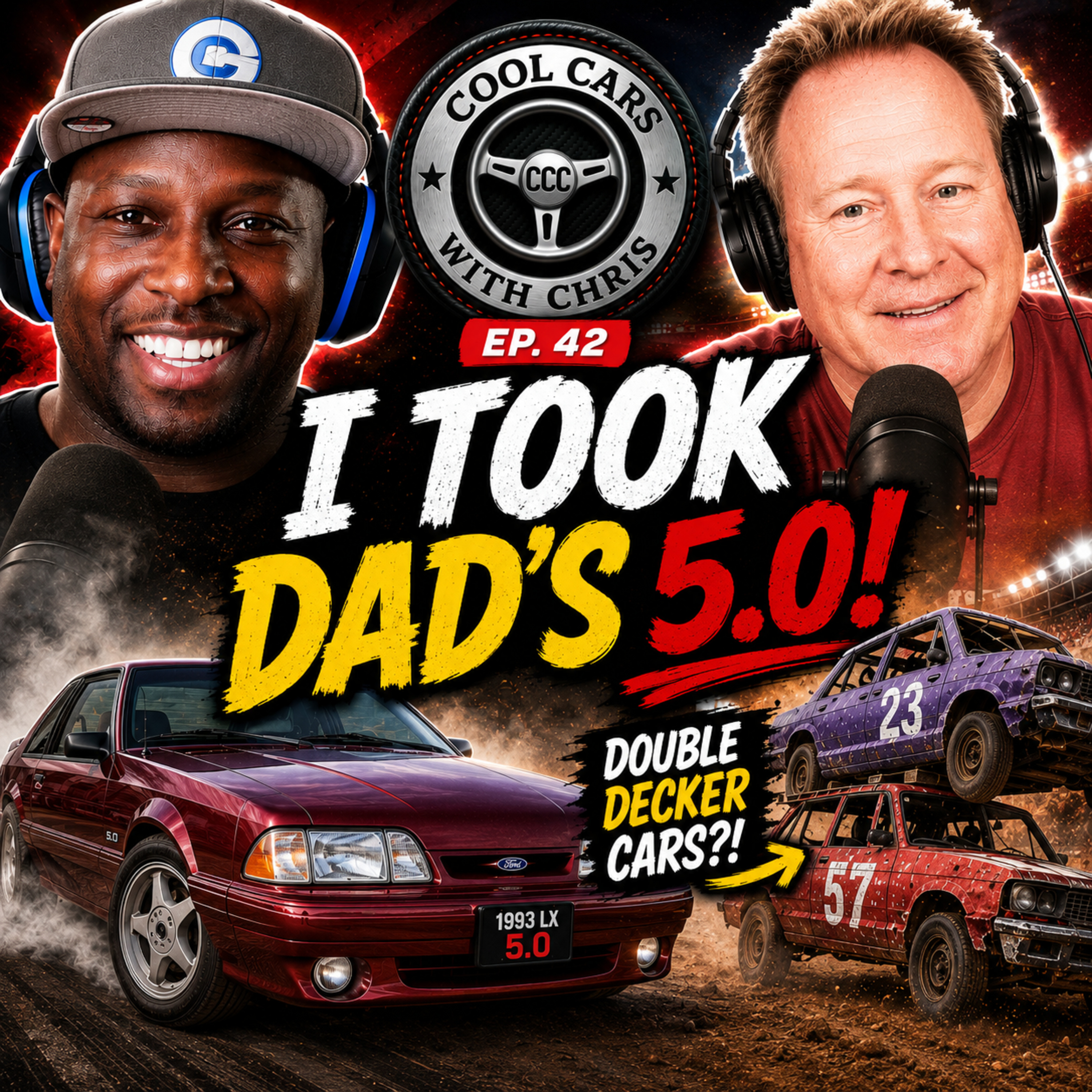
042 | I Took Dad’s Fox Body 5.0! Double-Decker Cars & Mexican GTRs
About this episode
Borrowing a Fox body 5.0 kicks off the episode, then the talk jumps to street-racing matchups and the slang “Mexican GTR.” The hosts explain what “double decker cars” are—stacked cars with split steering and throttle—then zoom out to demolition derby culture: campus car shows, dirt-track chaos, and older “beater” builds. Later, the conversation turns practical with fuel and engine myths, E85 tradeoffs, and oil-consumption realities, plus Ford Coyote and swap-fitment ideas.
This week on Cool Cars with Chris, Chris and Courage are talking Fox Body Mustangs, demolition derby madness, double-decker cars, E85 fuel, oil-burning engines, Datsun finds, and the legendary “Mexican GTR.”
Chris kicks things off with a story from back in the day: the time he secretly took his dad’s Fox Body 5.0 Mustang for a weekend joyride. Beach runs, friends in the car, racing a Z31 Nissan 300ZX, and trying to cover his tracks before dad checked the mileage — what could possibly go wrong?
Then Courage recaps a packed car weekend, including a big Temecula car show with everything from classics and rat rods to JDM cars, supercars, and an Arizona iced tea-themed Subaru STI. After that, things get wild with a trip to a Perris demolition derby, featuring dirt track racing, trailer races, and the unforgettable double-decker derby cars — one driver on the gas, another on the steering wheel, and a whole lot of trust involved.
The conversation also dives into classic car myths and garage talk, including whether sugar in the gas tank really kills an engine, old-school YouTube car torture experiments, running E85 fuel, Ford 5.0 Coyote oil consumption, VQ engines that burn oil, cylinder deactivation, and what happens when cars are pushed way past their limits.
To wrap it up, Chris and Courage talk about hidden Datsun 240Z finds, engine swap ideas for old Datsun pickups, EcoBoost swaps, Coyote swaps, and the ultimate sleeper truck: the Coyote-powered F-150, also known as the Mexican GTR.
If you love car stories, Mustang talk, sleeper builds, JDM cars, demolition derby chaos, and real car-guy conversations, this episode is for you.
Website: https://coolcarswithchris.com/
YouTube: https://www.youtube.com/@CoolCarswithChris619
Instagram: https://www.instagram.com/cool_cars_with_chris619/
Courage’s YouTube: https://www.youtube.com/@TheDriveNDad22
Courage’s Instagram: https://www.instagram.com/thedrivendad22/
00:00 🏁 Intro: Fox Body 5.0, double-decker cars & Mexican GTRs
01:10 🎙️ Welcome to Cool Cars with Chris
01:49 🔑 Chris takes dad’s Fox Body 5.0 Mustang
04:41 🚗 Temecula car fest and the Arizona STI
07:34 💥 Perris demolition derby night
09:32 🤯 Double-decker derby cars explained
13:27 🛻 Trailer races and dirt track chaos
20:55 ⛽ Sugar in the gas tank and car myths
22:32 🔥 Car torture experiments and engine abuse
25:19 🌽 E85 fuel, flex fuel trucks and gas prices
29:03 🛢️ Ford 5.0 Coyote and VQ oil-burning problems
32:24 ⚙️ Cylinder deactivation and V6 Camaro stories
38:12 👀 Datsun pickups, a hidden 240Z and swap ideas
43:11 🇲🇽 What is a Mexican GTR?
49:16 🙌 Wrap-up with Courage from Driven Dad 22
Chris and Courage talk Fox Body 5.0 Mustang memories, Ford Mustang joyrides, a Z31 Nissan 300ZX street-race story, Temecula car show highlights, a wild Perris demolition derby with double-decker derby cars, trailer racing, E85 fuel, Ford 5.0 Coyote oil consumption, VQ engine problems, Datsun 240Z spotting, engine swap ideas, Coyote F-150 sleeper trucks, and the legendary Mexican GTR in this fun car podcast episode of Cool Cars with Chris.
#CoolCarsWithChris #FoxBodyMustang #FoxBody #FivePointOh #FordMustang #MustangGT #CoyoteF150 #MexicanGTR #SleeperTruck #FordF150 #CoyoteEngine #DemolitionDerby #DoubleDeckerCars #PerrisDemolitionDerby #TrailerRacing #TemeculaCarShow #Datsun240Z #Nissan300ZX #E85Fuel #CarPodcast

Ford Mustang
"Well, years and years ago, we had a Fox body 5.0 Mustang in the family. Well, and I actually borrowed it for a weekend."
This is a Ford Mustang from the “Fox body” generation (late 70s to early 90s). The “5.0” usually means it has a 5.0-liter V8 engine, which is a big reason people love these cars and modify them.
The “Fox body” refers to the 1979–1993 Ford Mustang platform, known for its simple, modular layout and huge aftermarket support. The “5.0” typically means the 5.0-liter V8 (often associated with the later 302-cubic-inch small-block era) that made these Mustangs a classic for drag and street builds.
Paris, California
"and up in the Paris area, not Paris, France, but Paris, California. I know you get those mixed up all the time, right?"
Paris, California is a small place in the U.S. The host is clarifying it’s not Paris, France—just where the story is taking place.
Paris, California is a small community in Southern California (not the country of France). The host clarifies the location to avoid confusion, and it functions as a story setting for where the guest saw the “double decker cars.”
Temecula area
"And also courage himself is up there in the Temecula area and up in the Paris area, not Paris, France, but Paris, California."
Temecula is a place in Southern California. Here it’s just being used to say where the story happened.
Temecula is a city in Southern California, often referenced as part of the Inland Empire / Inland Southern California region. In the episode, it’s used as a geographic anchor for where the guest encountered the cars.
Mexican GTR
"Have you ever heard the term Mexican GTR? What is a Mexican GTR? Well, I kind of have one myself. Well, sort of."
“Mexican GTR” is a nickname people use for a Nissan GT-R that’s been modified or built in Mexico. It’s not an official model name, so what it means can depend on the person using it.
“Mexican GTR” is a slang nickname for a Nissan GT-R that’s been modified or built in Mexico—often referring to cars that show up with unusual swaps, styling, or performance parts compared to typical GT-R builds. Because it’s informal, the exact meaning can vary by who’s using the term.

Nissan Gtr
"...ping it off. Have you ever heard the term Mexican GTR? What is a Mexican GTR? Well, I kind of have one ..."
The Nissan GT-R is a fast sports car from Nissan. It’s designed to accelerate hard and handle well. People talk about it a lot because it’s known for serious performance.
The Nissan GT-R is a high-performance sports car built for very fast acceleration and strong track-capable performance. It’s become famous enough that even casual references—like “Mexican GTR”—show how widely the name is recognized. In the podcast, it’s brought up through a playful question and anecdote about having one.
mileage
"stuff. And the only reason why I guess he found out because he checks his mileage. Yeah. And he saw the mileage on the car."
Here, “mileage” just means how many miles are on the car’s odometer—basically how much it’s been driven.
In this context, “mileage” means the odometer reading (how many miles the car has been driven). The speaker is describing how the owner tracked miles to notice when the car was used and how often it was driven.
traction control
"He like was racing somebody with a car and like spun around the corner and the thing has like no, I think it had traction control. Maybe he didn't, I don't know, but he like he fishtailed around the corner"
Traction control helps prevent the tires from spinning when you accelerate or turn. If the car starts to lose grip, it can reduce power and help the car stay under control.
Traction control is a stability system that reduces wheel spin by cutting engine power and/or applying brake force to the slipping wheel. It’s relevant here because the car fishtailed on a corner, and the host suspects traction control was present.
fishtailed
"but he like he fishtailed around the corner and I'm like, holy crap. You know, and he was like, yeah, things got some power."
“Fishtailing” describes a loss of traction where the rear of the car swings side-to-side, often from oversteer during hard cornering or acceleration. It’s a driver-sensation term that indicates the tires briefly lost grip.

Z 31 300 ZX
"and he had a 300 CX with Z 31 and we were racing that, you know, and my buddy was filming with a video camera. ... Yeah. Everybody will want to see a Z 31 300 ZX versus a Fox body."
The “Z 31 300 ZX” is a Nissan sports car from the 1980s. It’s the kind of car people used to race on the street, and it’s known for being a fun, capable platform.
The “Z 31 300 ZX” is the Nissan 300ZX from the Z31 generation, a 1980s sports coupe known for its aerodynamic styling and, in some trims, turbocharged performance. Here it’s being used as a drag/racing comparison against the Fox body, which highlights how popular these 80s coupes were for street racing.
torque
"And I gunned it. You know, the torque torque, I throw you back, but his wasn't turbo, but it was, it was nice car still"
Torque is the engine’s twisting force. More torque usually means the car feels stronger when you accelerate, especially at lower speeds.
Torque is the twisting force an engine produces, and it strongly affects how quickly a car accelerates—especially from low speeds or when you “gun it.” The host contrasts the cars’ power delivery by mentioning torque while describing a hard acceleration moment.
car show
"…one time a year they do an actual car show. So the whole campus, there's a [298.2s] school here, MSJC, they take over the whole campus, whole bunch of vendors."
A “car show” is an event where people bring their cars to display them. Sometimes there are awards or categories, and in this case the event charges a fee that helps support the school.
A “car show” is an organized event where car owners bring vehicles to display them, often with categories, judging, and vendor booths. In this segment, it’s described as a campus takeover with hundreds of cars and a paid entry fee that supports the college.
rat rod builds
"…anything that you could think of was there from like, [309.8s] you know, older classics, crazy rat rod builds, a whole bunch of 90s, you know, Japanese sports"
A “rat rod” is a custom car that looks intentionally rough and rusty, like it came from a junkyard. When someone says “rat rod builds,” they mean custom projects that aim for that rugged, worn-out style.
A “rat rod” is a deliberately rough, worn-looking hot rod—often with a mix of older parts and a shabby aesthetic. “Rat rod builds” means custom projects where the builder intentionally keeps (or creates) that beat-up, scrapyard vibe.
junkyard
"They were like, dude, we, we know a guy who owns a junkyard with a bunch of cars. Like, let's do this next time."
A junkyard is where old cars are kept after they’re no longer useful. People go there to take parts off cars or find cheap cars to use for repairs.
A junkyard is a facility where old, wrecked, or unwanted cars are stored and dismantled for usable parts. Enthusiasts often use them to source inexpensive components or whole “parts cars” for projects.
AIS
"Yeah. You know, I bet there's going to be some kind of AI version of that where the AI like, you know, drives the car and you have to like steer it."
AI (artificial intelligence) refers to computer systems that can perceive the environment and make driving decisions. In the context of self-driving talk, it means the car would handle steering and speed control without a human actively driving.
Waymo
"I still want to check out one of those Waymo's. I was in San Francisco, I saw them and I was like, oh, it's so cool."
Waymo is a self-driving car company. They test and operate cars that can drive without a human driver behind the wheel.
Waymo is a company known for developing self-driving technology, operating driverless vehicles in cities like San Francisco and Los Angeles. The discussion highlights how the vehicles can run without a human driver in the car.
Demolition Derby
"But that's super cool though, like at the actual like campus and going to the demolition derby. Now, when you go in the demolition derby, these cars were not like new pristine off the dealership lot."
A demolition derby is a race where cars crash into each other on purpose. The winner is typically the car that can keep going the longest after a lot of damage.
A demolition derby is a motorsport event where cars are driven into each other and the goal is usually to keep running the longest while others get disabled. It’s less about lap times and more about durability and surviving impacts.

Chevy Cavalier
"Like you were seeing stuff like, like the early 2000s, like Chevy Cavalier or even 2000 stuff. Yeah. Yeah."
The Chevrolet Cavalier is a common older compact car. Because so many were made, it’s often the kind of car people can find cheaply and use for rough events.
The Chevrolet Cavalier is a compact car that was especially common in the late 1990s and early 2000s, which is why you’ll often see them in “beater” situations like demolition derbies. Its popularity and mass production made it easy to find cheap replacements and parts.
front wheel drive
"Okay. They did it in sort of classes. So they had like early, yeah, like a lot of front wheel drive, like Cavaliers, focuses, Civics, but then they had like the tear up, which were like, you know,"
Front-wheel drive means the front wheels do the work of moving the car. The host is saying that a lot of the early compact cars used in the beginner classes were front-wheel drive.
Front-wheel drive (FWD) means the engine’s power is sent to the front wheels for traction and propulsion. In this segment, the host points out that many early-2000s compact cars were FWD, and those were used in the lower racing classes.

Honda Civic
"They did it in sort of classes. So they had like early, yeah, like a lot of front wheel drive, like Cavaliers, focuses, Civics, but then they had like the tear up, which were like, you know,"
A Honda Civic is a popular small car. Here it’s being used as an example of the kind of front-wheel-drive compact cars people started with in the racing classes.
Honda Civic is a compact car line known for front-wheel-drive packaging and high-volume availability. In this segment, it’s mentioned as an example of the early-2000s compact front-wheel-drive cars used in entry-level classes.

Focuses
"They did it in sort of classes. So they had like early, yeah, like a lot of front wheel drive, like Cavaliers, focuses, Civics, but then they had like the tear up, which were like, you know,"
A Ford Focus is a common small car model. In this story, it’s being used as an example of the front-wheel-drive compact cars people start with.
Ford Focus is a compact car line that was widely available with front-wheel drive. Here it’s mentioned alongside other compact FWD cars as typical starter-class machinery.
V8
"you see like V8, like, you know, V8 purpose built like dirt cars were like one of the classes. And then they had others where it was like, you know, char old beat up chargers and,"
A V8 is an engine with eight cylinders. The host is using it as a shorthand for the more powerful cars in the event—especially compared to smaller four-cylinder compacts.
A V8 is an engine with eight cylinders arranged in a V shape. In this segment, V8-powered cars are treated as the step up from compact four-cylinder cars, and they’re also tied to the “purpose built” dirt-track class.

chargers
"like Cavaliers, focuses, Civics, but then they had like the tear up, which were like, you know, you see like V8, like, you know, V8 purpose built like dirt cars were like one of the classes. And then they had others where it was like, you know, char old beat up chargers and,"
A Dodge Charger is a well-known American car, often with a V8 engine. The host is mentioning Chargers as examples of the kind of V8 cars that show up in the higher classes.
Dodge Charger is a muscle-car nameplate that’s strongly associated with V8 power. In this segment, “beat up chargers” are grouped into classes where the goal shifts toward V8-powered vehicles.

Ford expeditions
"you know, char old beat up chargers and, you know, Ford expeditions, like basically anything that with a V8 that you could get running,"
A Ford Expedition is a big SUV. The host is basically saying that if it had a V8 and could be made to run, it could qualify for the V8-focused classes.
Ford Expedition is a full-size SUV that can be had with V8 engines depending on year and trim. Here it’s used as an example of “anything with a V8” that could be made to run for these trailer-racing classes.
trailer-racing rules and event culture
"this was the words of the announcer at the event. So this was not my words at all. Okay. But his announcement of, because they basically did these trailer races where like a trailer was attached to, to like the cards that were racing and they were basically,"
The host describes the rules of the event and what the crowd is like. The main idea is that cars tow trailers, and knocking other trailers loose is what matters.
This segment explains how the event works: cars tow trailers, and the objective is to knock other trailers out of the race. It also includes the announcer’s tone and the local “redneck entertainment” vibe, which frames how the crowd experiences the competition.
trailer races
"Okay. But his announcement of, because they basically did these trailer races where like a trailer was attached to, to like the cards that were racing and they were basically, the goal is like to get everybody, knock off everybody else's trailer."
In this kind of race, cars tow trailers and the goal is to knock other cars’ trailers loose. It’s more about causing the other team to lose their trailer than about a clean lap.
Trailer races here refers to a demolition-style format where cars tow trailers and try to knock other trailers off the competitors. The host explains that once a trailer is knocked out of the race, the event’s announcer calls it “redneck entertainment,” emphasizing the contact-and-disruption goal.
area code 909
"with the, [882.2s] with the 909 area code and everything you said kind of give me flashbacks of what they were talking about back in the day..."
Area code 909 is a phone-number region in Southern California. Here it’s being used like a label for a local “vibe” and the jokes people made about it.
Area code 909 refers to a specific telephone region in Southern California. In the episode, it’s used as a cultural shorthand for the kind of local radio identity and stereotypes the hosts are reminiscing about.
drag racing
"like, you know, racing your trailer on a drag racing trailers or whatever you guys are doing [895.0s] out there, jumping cars through the, through the fields..."
Drag racing is when cars race in a straight line over a short distance. The goal is to get off the line fast and accelerate as quickly as possible.
Drag racing is a motorsport where two cars accelerate from a standing start over a short, measured distance. It’s distinct from road racing because the focus is on launch, traction, and straight-line acceleration.
fire extinguisher
"they had a kind of hole in the hood that gets us required to have like a hole in the hood, maybe for like the [956.9s] fire extinguisher to blow the flames out..."
A fire extinguisher is a safety tool that helps put out fires fast. In car events, it’s especially important because crashes can start fires.
A fire extinguisher is a safety device used to quickly suppress flames, especially important in motorsport where fuel or electrical fires can occur after impacts. The speaker mentions a required hood opening that could provide access to the extinguisher.
motor oil
"there was some YouTubers that were doing experiments with like other forms of motor oil. Do you see these ones where they did, they replaced oil with like WD 40 to see how long it would go."
Motor oil is the fluid that keeps an engine’s moving parts from grinding against each other. It also helps cool the engine and protects it from damage.
Motor oil is the lubricant inside an engine that reduces friction between moving parts and helps carry heat away. It also helps keep internal surfaces from wearing out quickly.
WD-40
"Do you see these ones where they did, they replaced oil with like WD 40 to see how long it would go. And it kind of fire eventually, but it ran for a while."
WD-40 is a spray meant for things like loosening rust and displacing water, not for running an engine. If you put it in an engine instead of real oil, it can overheat and cause serious damage.
WD-40 is a water-displacing spray and light lubricant, not an engine lubricant. Using it in place of motor oil is an experiment that can lead to overheating and engine damage because it doesn’t provide the same film strength or heat-handling as proper oil.
caught fire
"And then it eventually like, like caught a fire or whatever, or removing the oil from the car completely and just seeing how far you can, you can run because you'd be surprised the car can run because the oil just kind of bond"
Here, “caught a fire” means the engine area ignited. Running an engine with the wrong fluids or without proper oil can get hot enough to start a fire.
In this context, “caught a fire” refers to an engine or engine bay ignition caused by the experiment (e.g., overheating and flammable residues). It’s a risk when running an engine without proper lubrication.
seizes up
"It'll seize up eventually, but I think you can run. It won't like immediately stop. It'll run for a while. Not like, not like for a trip to here to Vegas, but it'll run for like maybe a few miles."
“Seizes up” means the engine parts get stuck and can’t move freely anymore. Usually that’s because there isn’t enough lubrication, so the metal parts overheat and jam.
“Seizes up” means the engine’s internal moving parts stop moving because of extreme friction or lack of lubrication. In engines, that typically happens when metal-to-metal contact occurs and components overheat and bind.
cylinder walls
"The cylinder walls are moving around and then eventually it seizes up and then you throw, throw a rod, whatever you end up doing."
Cylinder walls are the inside surfaces of the engine cylinders. Pistons slide against them, so they need proper lubrication to avoid overheating and damage.
Cylinder walls are the inner surfaces of the engine’s cylinders where the pistons move. Their condition and lubrication are critical because they experience high heat and friction during operation.
throw a rod
"The cylinder walls are moving around and then eventually it seizes up and then you throw, throw a rod, whatever you end up doing."
“Throw a rod” is when an engine’s internal rod fails badly and can damage the engine block. It’s usually the result of the engine being badly overheated or not lubricated properly.
“Throw a rod” means an engine’s connecting rod breaks or comes loose and punches through the engine block. It’s a catastrophic failure often caused by severe lubrication loss, overheating, or mechanical damage.
engine oil
"of like engine oil and transmission oil, like what happens like when you just got no oil and all of these moving parts, but I mean, like no coolant would be, that to me is like really cruel"
Engine oil is the fluid that keeps the engine’s parts from grinding against each other. If there’s no oil, the engine can overheat and get damaged fast.
Engine oil lubricates the engine’s moving parts and helps carry heat away from internal components. If you run low or out of engine oil, metal-to-metal contact can quickly cause severe damage.
transmission oil
"of like engine oil and transmission oil, like what happens like when you just got no oil and all of these moving parts, but I mean, like no coolant would be, that to me is like really cruel"
Transmission oil is the fluid that helps the gearbox work smoothly and stay cool. If it’s missing, the transmission can overheat and get damaged.
Transmission oil (or transmission fluid) lubricates and cools the transmission’s gears and clutches. Without it, shifting can fail and internal components can overheat and wear rapidly.
coolant
"all of these moving parts, but I mean, like no coolant would be, that to me is like really cruel because it's like, it really is like, it's like, you know, at a certain point, like you're just"
Coolant is the fluid that keeps the engine from overheating. If the coolant is gone, the engine can’t cool itself and can die quickly.
Coolant is the liquid that absorbs heat from the engine and carries it to the radiator to be cooled. Without coolant, the engine can’t regulate temperature and can overheat, leading to major failure.
E-10
"it's funny is that there's ethanol all over our gas, you know, 10%, you know, and now they're talking about raising it even higher because the field. Yeah. There was a suggestion that they wanted to raise it right now. It's E10 is everything's E10 right now."
E10 is regular gas that has about 10% ethanol mixed in. Most cars can run it because it’s a standard blend in many places.
E10 is a common fuel blend that contains about 10% ethanol and 90% gasoline. It’s widely used, and many vehicles are designed to tolerate it without special modifications.
E20
"It's E10 is everything's E10 right now. And they want to raise it to like, I think E20 or 30, they want to raise it too."
E20 is a gas blend with more ethanol than E10. Some cars can handle it, but others may need tuning or compatible fuel-system parts.
E20 refers to a fuel blend with about 20% ethanol. Increasing ethanol content can change fuel-system wear characteristics and engine tuning requirements, so compatibility depends on the vehicle’s design.

BMW E30
"...as kind of messing around with those blends, like E30 is the max that it was saying that you, you would..."
The BMW 3 Series is a luxury car that’s meant to drive nicely, not just look good. Some older versions are especially popular with car enthusiasts. That’s why it shows up in discussions about different generations and performance setups.
The BMW 3 Series is a long-running compact luxury sedan (and wagon) known for its balanced driving feel and broad range of engines. In car-talk contexts, older generations like the E30 are often discussed because they’re popular for enthusiast builds and “what it can do” comparisons. It comes up frequently because it’s both a mainstream model and a platform people modify.
E 85
"That's just because they wanted to try to get the prices down, you know, because E85 is, you [1617.7s] know, I drove by a station yesterday. I've got, I haven't bought the E85 in a while, but my truck [1622.3s] can't run on E85..."
E85 is a fuel blend that’s mostly alcohol (ethanol) mixed with regular gas. Since it has less energy than regular gas, you usually get fewer miles per gallon and have to buy it more often. Some trucks can run it, but you may need extra care to keep things working right.
E85 is a gasoline blend made mostly of ethanol (about 85% ethanol and 15% gasoline). Because ethanol has less energy per gallon than regular gasoline, using E85 typically reduces fuel economy and increases how often you’ll refuel. It can also be harder on some engines and fuel-system components unless the vehicle is specifically designed for it.

Ford Edge
"... to like already, it's already pushed it over the edge, you know? And plus you get less, you get a lot l..."
The Ford Edge is a family-sized SUV that’s meant for normal daily driving. It has room for passengers and cargo, and it’s usually chosen for practicality. People mention it when they’re talking about how an SUV can fit into everyday life.
The Ford Edge is a midsize crossover SUV designed for everyday driving with comfortable seating and practical cargo space. It often comes up in conversations about “pushing it over the edge” because it’s a common choice for people who want SUV capability without going to a full-size vehicle. In the podcast context, it’s referenced as part of a discussion about how far something has been taken.
flush it out with regular
"Even though it says I can, they even say don't run it. Even though it says it right on [1691.0s] there, you can run both. But they say, you know what, you can run it, but you have to flush it [1694.2s] out with regular before you get service."
They’re saying to use regular gas after E85 so the fuel system doesn’t stay full of the ethanol blend when you go in for service. That can help avoid problems during maintenance. It’s basically a “clean out the system first” instruction.
“Flush it out with regular” means running regular gasoline after using E85 so the ethanol blend is cleared from the fuel system before maintenance. The idea is to reduce the chance of ethanol-related residue or compatibility issues affecting service work. It’s a manufacturer-specific guidance point, so it’s best followed exactly as stated in the owner’s manual.
oil gauge
"And so like a knucklehead I've been, like I would go when it's at like 20% [1776.9s] take it in there. And then the guys checked the oil, I said, there's no oil in this."
Your oil gauge is the dashboard light/indicator that tells you about your engine oil. Some cars show a simple “low oil” warning, but this one sounds like it shows a percentage estimate of how much oil life is left.
An oil gauge is the dashboard indicator that tells you how much engine oil is available. In this case, the host says Ford uses a percentage-style gauge that estimates “oil life left” rather than directly showing “low oil” like a traditional dipstick-style level indicator.
VQ engine
"you know, with the Ford and the, and the Z like Nissan infinity, like they, the VQ is known for [1813.2s] that too with burning oil."
The VQ engine is Nissan’s V6 engine design. Some VQ engines have a reputation for using extra oil as they get older, so owners may need to check and top up more often.
The VQ engine refers to Nissan’s V6 engine family (the “VQ” name is Nissan’s internal designation). The host is pointing out that certain VQ variants are known for oil consumption issues, which can be related to ring wear and blow-by over time.
blow by
"But for some reason, like, you know, I guess just age of the engine or something like [1854.4s] that just had like more spacing and was getting more, they call it blow by. It was, you know,"
Blow-by means some hot engine gases are getting past the piston rings where they’re supposed to stay in the cylinders. That can lead to the engine using more oil over time.
“Blow-by” is combustion gases leaking past the piston rings into the crankcase. When blow-by increases, it can raise oil consumption because more oil gets pushed out or burned, even if the engine otherwise runs smoothly.
third generation coyote
"But this other truck, it's the third generation coyote. So it's still a 5.0 like the other one, but that my mind's got the, like the main differences other than more power"
“Coyote” is Ford’s V8 engine. Here, they’re talking about the third version of that engine and how it changes how fuel and oil are handled compared to earlier ones.
“Coyote” is Ford’s modular V8 engine family used in many Mustang and truck applications. In this segment, the host is talking about the third-generation Coyote (still a 5.0L) and how its fueling and lubrication strategy differs from earlier versions.
direct injection
"the new oiling mind has the direct injection plus it has fuel injection. It's got both."
Direct injection means the engine sprays fuel straight into the cylinders. It helps the engine burn fuel more precisely, which can improve efficiency and reduce emissions.
Direct injection is a fuel system where gasoline is sprayed directly into the combustion chamber instead of into the intake. That can improve efficiency and emissions control, and it’s part of why newer engines can run cleaner under many conditions.
fuel injection
"It's got both. So direct injection and it's got the fuel injection coming over the top to kind of clean things out or whatever."
Fuel injection is how the engine delivers fuel. Here, they’re saying the engine uses direct injection plus another injection strategy to help the engine run cleaner.
Fuel injection is the general system that meters and delivers fuel to the engine. In this context, the host is contrasting it with direct injection and describing a setup that uses both approaches to manage combustion and cleanliness.
cylinder shut off
"And then the fourth gen coyote, I believe, is got the cylinder shut off. So that's kind of the thing that that one has on top of what I have or whatever."
Cylinder shutoff is when the engine turns off some cylinders to save gas when you’re cruising. It can make the car quieter, and some drivers feel a difference while others barely notice it.
Cylinder shutoff (often called active fuel management) temporarily disables some cylinders during light-load driving to save fuel. The tradeoff is that it can change engine sound and feel—some people notice it, others don’t.

Chevrolet Corvette
"I've always been curious to like, it like ask somebody who's own like, say like the Corvettes because they've had that for a while."
Corvette is a Chevrolet sports car. The host is using it as an example to ask whether cylinder shutoff makes the car feel different—like quieter cruising or different acceleration.
The Corvette is Chevrolet’s performance sports car line, and it’s used here as an example of a car that may use cylinder shutoff technology. The host is asking whether drivers notice changes in sound or acceleration when cylinders deactivate.
sport mode
"she kind of babied the car, like never put it in sport mode. Like I said, put these paddle shifters to use."
Sport mode is a button/setting that makes the car feel more “responsive.” When it’s on, the car usually reacts faster when you press the gas and may shift differently.
Sport mode is a driving setting that changes how the car responds to your inputs. It typically sharpens throttle response, steering feel, and transmission behavior so the car feels more eager.
paddle shifters
"Like I said, put these paddle shifters to use. Let's use these things."
Paddle shifters are little levers behind the steering wheel. They let you tell the car when to shift up or down instead of letting it decide on its own.
Paddle shifters are steering-wheel-mounted controls that let you manually command upshifts and downshifts. On many automatic cars, they override the default automatic shifting to give a more driver-controlled feel.
3000 RPM
"when I drove the car, I would, I would take it to like, I swear, I took it like 3000 RPM and slow down, slow down."
RPM is a measure of how fast the engine is spinning. Saying “3000 RPM” means the engine was running at a fairly moderate rev level.
RPM (revolutions per minute) is how fast the engine spins. Mentioning 3000 RPM suggests the speaker was keeping the engine at a moderate speed rather than revving hard.
learners permit
"at a certain point, because I, you know, I got my learner's permit. And so, you know, I had that and they were in the car with me."
A learner’s permit is the first step for new drivers. It usually means you can drive, but only with a licensed adult in the car.
A learner's permit is an authorization that allows a new driver to drive while supervised by a licensed adult. It’s part of the graduated licensing process used in many places.
convertible
"it was, it was the convertible. So with the convertible is interesting because it's like even more claustrophobic in the back seat than it is like in the coupe"
A convertible is a car with a roof that can open up. With the roof down, the cabin feels different, and the back seat can feel more cramped or exposed than in a coupe.
A convertible is a body style with a roof that can be lowered, typically removing the fixed roof structure. That can affect cabin sound, airflow, and how enclosed the rear seating area feels compared with a coupe.
coupe
"than it is like in the coupe because they have like that little window in the coupe, but the convertible doesn't really have any of that."
A coupe is a two-door car with a solid roof. Because the roof stays up, the cabin usually feels more enclosed than in a convertible.
A coupe is a two-door car body style with a fixed roof. Compared with a convertible, it usually provides more structural rigidity and a more enclosed cabin, which can make the rear seat feel less cramped.
downshifting paddle
"every single tunnel we went through, I was like downshifting paddle shifting through the like here, here, the V six..."
Downshifting paddles are buttons or levers behind the steering wheel that let you choose a lower gear yourself. That can make the car feel quicker and can also help slow down using the engine.
Downshifting paddles are the steering-wheel-mounted controls that let you manually command lower gears. They’re commonly used with automatic transmissions so the driver can hold revs for stronger acceleration or better engine braking.
paddle shifting
"every single tunnel we went through, I was like downshifting paddle shifting through the like here, here, the V six..."
Paddle shifting means using little levers on the steering wheel to change gears yourself. It’s a way to feel more in control than a normal automatic.
Paddle shifting is a manual gear-selection method where you use paddles on the steering wheel to command upshifts and downshifts. It’s typically used on cars with an automatic transmission to give the driver more control.
V six
"downshifting paddle shifting through the like here, here, the V six, cause even the V six sounded good back then."
A V6 is an engine with six cylinders. Here, the point is that the V6 still sounded good and made the car fun to drive.
A V6 is an engine with six cylinders arranged in a “V” shape. In this segment, the host emphasizes that even the V6 Camaro sounded good, which points to how the engine note and character can matter even without a V8.
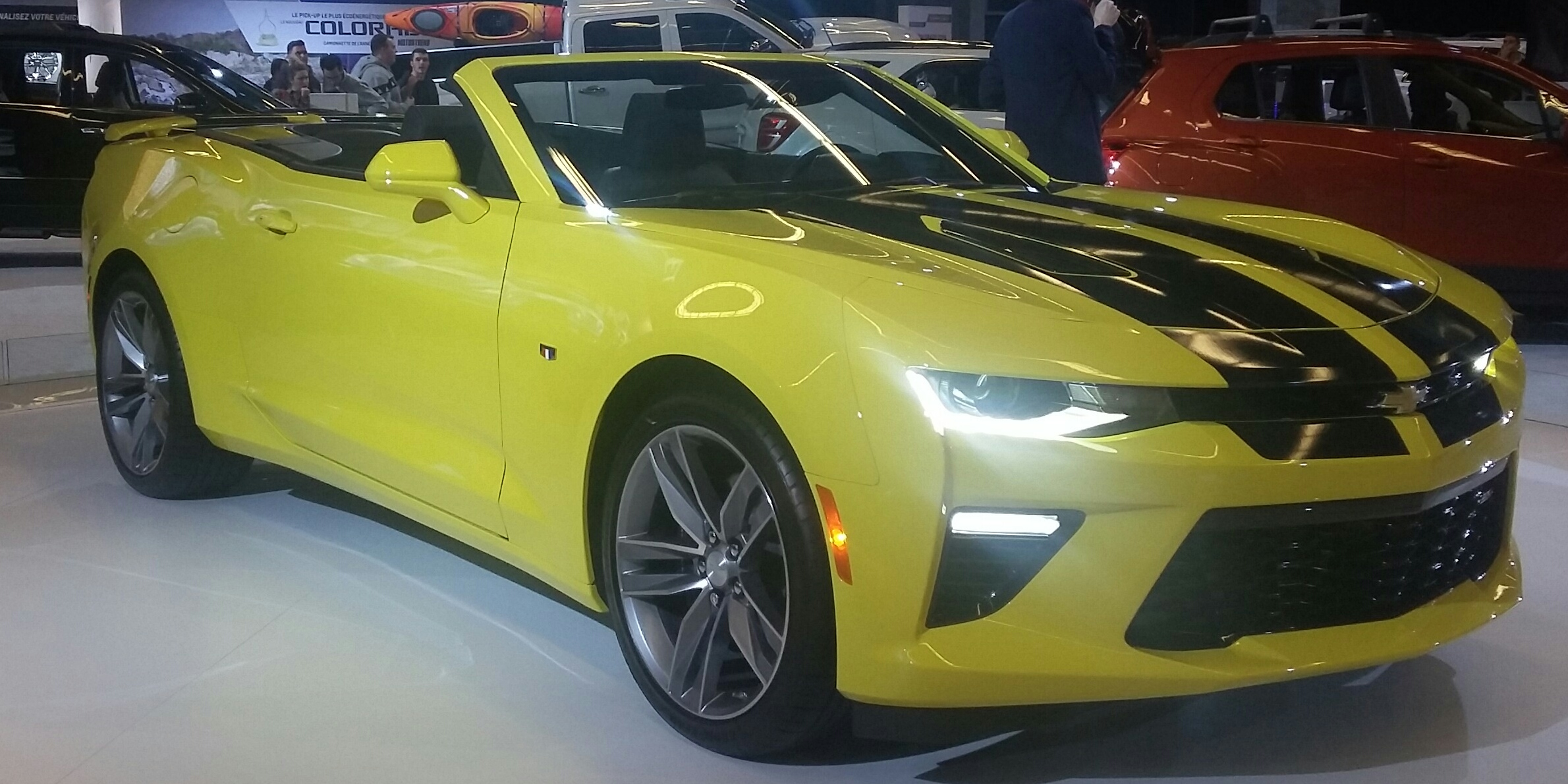
Camaro
"They were like, oh, sure. Like they gave me the keys. So we take the Camaro around the block. And, you know, I know for sure that like they hurt us when we left..."
A Camaro is a sporty American car (often a V6 or V8) that’s meant to feel quick and exciting. Here, the story is about driving it hard and enjoying how it pulls on the road.
The Chevrolet Camaro is a classic American muscle/pony car known for its V6 or V8 power and rear-wheel-drive feel. In this segment, the host talks about taking a Camaro around the block and then flooring it on a straightaway, which highlights the car’s acceleration and “fun” factor.
horsepower
"I think the one that, that she had had about 350 ish horsepower. I think it was somewhere in the low threes..."
Horsepower is a number that tells you how strong the engine is. Higher horsepower usually means the car can accelerate more easily.
Horsepower is a measure of engine power—how much work the engine can do over time. The host uses it to describe the Camaro’s output (around 350-ish horsepower), which helps listeners gauge how strong the car felt.
reverse
"I'm like, man, this car does feel like it has this kind of creak it makes when you like back it up and put reverse, put it in drives, kind of creak. You know, if you don't say older cars kind of do that, when you put them in, you know,"
Reverse is the gear you use to back the car up. The host is saying the car makes a creaky sound when he puts it into reverse and then drives again.
Reverse is the gear used to move a vehicle backward. The host mentions a “creak” when shifting into reverse and then back into drive, which can be a sign of worn linkage, mounts, or other older-car mechanical looseness.

Dotson 240Z
"kind of hidden on the right side of the front of the driveway, kind of the right side of the house, kind of behind the trash cans with a half ass tarp kind of sitting over it is a red, not in the greatest shape, but a red Dotson 240Z. And I'm thinking, I told my son,"
The Nissan 240Z is an old-school Nissan sports car from the early Z-car era. The host is pointing out a red one that looks rough, but it’s still a recognizable classic.
The Nissan 240Z is a classic 1970s-era Z-car that helped popularize Japanese sports cars in the U.S. The host describes a red 240Z that’s not in the greatest shape but is still parked as a classic project/collector car.

Datsun 240Z
"... red, not in the greatest shape, but a red Dotson 240Z. And I'm thinking, I told my son, I got to ask th..."
The Datsun 240Z is an older sports car that people collect and restore. It’s known for its classic look and for being fun to drive. The podcast mentions one that’s not in the greatest condition, which is common for older project cars.
The Datsun 240Z is a classic early Z-car sports coupe known for its timeless styling and driver-focused design. It’s a popular target for enthusiasts because it’s relatively straightforward to work on and has a strong parts and community ecosystem. In the podcast, it’s mentioned as a red example that’s not in perfect shape, which fits the “project car” kind of discussion.
Shell
"it doesn't look like, like it's just a shell, you know, looks like it has glass windows and stuff."
A “shell” is basically the car’s body without the working parts. It usually means it’s not running and needs a lot of work to become a real car again.
In car talk, a “shell” means the body of the vehicle remains, but major components like the drivetrain and wheels may be missing. It’s often used to describe a project car or non-running car that needs restoration.

620 Dotsons
"... maybe they're like a Dotson, you know, they like Dotsons or whatever. These old Dotson trucks, the little ..."
The 620 is an older pickup truck made by Datsun/Nissan. It’s smaller than many modern trucks and is often kept or restored by enthusiasts. The podcast brings it up as part of a group of classic Datsun vehicles people like to see.
“620” most likely refers to the Datsun/Nissan 620 pickup, a compact truck from the 1970s and early 1980s. It’s often discussed by classic-truck fans because it’s a smaller, simpler platform that’s easy to spot and can be used for projects. In the podcast context, it’s mentioned alongside other older Datsun vehicles and the idea of people wanting to see them.
engine bay
"You can remodify those. I mean, they're not really like the engine bay isn't very big, [2437.9s] not very long, but you might put an LS in there."
The “engine bay” is the space under the hood where the engine lives. If it’s too small, it can be hard to fit a different engine in.
The “engine bay” is the compartment in the front of the car where the engine and related components sit. Its size and shape matter a lot for swaps because the engine, accessories, and cooling system all need physical clearance.
coyote swap
"Maybe not a coyote swap, because the thing about my engine and my truck, the coyote, [2457.6s] is you don't even realize this because it's double word cam."
A “Coyote swap” means putting Ford’s Coyote V8 engine into a different car. People want it for power, but it can be tough to fit depending on the engine compartment.
A “Coyote swap” refers to swapping in Ford’s Coyote V8 engine into another vehicle. It’s a common swap idea because the Coyote makes strong power, but it can be harder to fit due to packaging and width/length constraints.
double word cam
"Maybe not a coyote swap, because the thing about my engine and my truck, the coyote, [2457.6s] is you don't even realize this because it's double word cam. It's got this really wide."
They’re talking about the engine’s camshaft design—how the valves are controlled. The key point is that this engine layout affects how wide the engine is, which matters for fitting it into a small engine bay.
“Double word cam” appears to be a mis-transcription of a camshaft layout description, likely referring to a dual overhead cam (DOHC) setup. DOHC engines use camshafts located in the cylinder head to control valve timing more precisely than simpler layouts.
straight sixes
"maybe, but straight sixes are long. So that probably wouldn't work."
A straight-six is an engine with six cylinders in a single row. It’s physically long, so it can be hard to fit into some cars when you’re doing an engine swap.
A straight-six is an engine layout where six cylinders are arranged in a single line (inline). Because it’s long front-to-back, it can be difficult to fit into tight engine bays or older swaps without major packaging work.
turbo
"like an SR motor, like out of like the two forties, like with a turbo or"
A turbocharger is a device that helps an engine make more power. It uses exhaust gases to spin a fan that pushes extra air into the engine.
A turbo (turbocharger) forces more air into the engine by using exhaust gas to spin a turbine. That extra airflow lets the engine burn more fuel and make more power than a non-turbo version of the same displacement.
boxer engine
"even like an STI, like a, or like a, you know, Subaru, a boxer engine. Those are wide though. Don't forget those are, those are like pancake engines."
A boxer engine is a type of engine where the cylinders lay sideways. The pistons move opposite each other, and the engine is usually flatter, which can help fit it in certain engine bays.
A boxer engine is a horizontally opposed engine where pistons move in opposite directions, like a boxer’s fists. In practice, it’s often described as a “pancake” layout because the engine sits flatter than many inline or V engines.
EcoBoost 2.3
"I wonder if you can get like a modern EcoBoost 2.3 and put that in there. Cause well, that would be a lot of power."
EcoBoost 2.3 is a Ford engine that’s 2.3 liters and uses a turbo to make more power. The idea is to get good performance without wasting fuel.
EcoBoost 2.3 refers to Ford’s 2.3-liter turbocharged engine family. The “EcoBoost” name is used for engines that use turbocharging (and typically direct injection) to make strong power while staying efficient.
crate engines
"Yeah. But are those, are those crate engines? Oh, can you buy them like that?"
A crate engine is basically an engine you can buy ready to install. Instead of hunting down parts one by one, you get a packaged engine for an engine swap.
Crate engines are engines sold as complete units (often with accessories and sometimes wiring/ECU support) that you can install without sourcing every component separately. Enthusiasts use them for swaps because they’re easier to buy and plan around than piecing together an engine build from scratch.

Ford F150
"About the, about the Ford F 150 with the, um, it's just a regular like work truck, you know, [2614.4s] you know, day cab recall with the four wheel drive and the coyote and then the turbo charge that"
The Ford F-150 is a popular full-size pickup. Here, they’re talking about how it can be set up with four-wheel drive and a V8, and how people add turbo or supercharger power to make it much faster.
The Ford F-150 is a full-size pickup truck, and in this segment it’s discussed as a “work truck” that can be configured with four-wheel drive and the Coyote V8. The hosts are focusing on how the engine responds to boost (turbocharging/supercharging) and how people modify these trucks for big power.
Coyote engine
"day cab recall with the four wheel drive and the coyote and then the turbo charge that [2619.5s] thing or super, super charge. Yeah. Either way, you know, that coyote engine does take boost"
The “Coyote” is Ford’s V8 engine family. In this discussion, they’re saying it’s known for being able to handle added forced-induction power like a turbo or supercharger.
“Coyote engine” refers to Ford’s modular V8 family used in many Mustangs and also offered in some F-150 configurations. In this segment, the hosts emphasize that it “takes boost” easily, meaning it can handle turbocharging or supercharging with common supporting modifications.
four wheel drive
"day cab recall with the four wheel drive and the coyote and then the turbo charge that [2619.5s] thing or super, super charge."
Four-wheel drive sends power to all four wheels, which helps the car grip better. In this conversation, it’s brought up because it affects how the truck accelerates and handles power.
“Four wheel drive” (4WD) means power is sent to both the front and rear axles, improving traction on slippery surfaces. Here, the hosts argue that a 4WD setup changes how the truck can put power down compared with a rear-wheel-drive sports car.
supercharge
"the turbo charge that [2619.5s] thing or super, super charge. Yeah."
Supercharging uses a mechanical compressor (usually driven by a belt) to push more air into the engine. More air can mean more power.
A “super charge” (supercharging) is forced induction where a belt-driven compressor increases intake air pressure. The segment pairs it with turbocharging as another way to add boost to the Coyote engine for higher output.
all wheel drive
"Now you're, now you're an all wheel drive car and you're, I mean, you're probably the same weight as a, as a GTR."
All-wheel drive means power can go to all four wheels. The idea is that it helps the vehicle hook up better when you accelerate.
“All wheel drive” (AWD) is a traction system that can send power to all wheels, often with a computer-controlled split between front and rear. The hosts use it to describe what happens when you combine four-wheel-drive hardware with the boosted setup, comparing it to the traction feel of a sports car.
drivetrain
"But you can, you can get it going. But you notice the drive chain in my truck, the new truck, when I first bought the thing, I was peeking underneath it, you know, I was looking around and that thing's really beefy."
The drivetrain is everything that sends power from the engine to the wheels. They’re saying the truck’s drivetrain looks strong and built for handling power.
“Drive train” (drivetrain) is the collection of components that transfer engine power to the wheels, including the transmission and the driveshaft/axle system. The hosts describe it as “beefy” and thick, implying the truck’s hardware is designed to handle torque and durability under load.
ultimate sleeper
"I mean, it's all fun and games. They call it the ultimate sleeper, you know, the Mexican GTR,"
A "sleeper" is a car that looks normal, almost boring, but is actually fast. The "ultimate" part means it’s the most extreme example—people don’t realize how quick it is until it moves.
An "ultimate sleeper" is a vehicle that looks slow or ordinary on the outside, but has serious performance hidden underneath. The idea is to surprise people who underestimate it based on appearance.
wheel wells
"but it was kind of hidden tucked down where, like, the wheel, the wheel well was. And yeah,"
The wheel well is the space in the car body where the tire sits. It’s the area around the wheel that can hide parts underneath the truck.
The wheel well is the inner cavity/structure above and around the tire where suspension components and parts of the bodywork sit. It’s a common place for hidden routing of components like piping or, in this case, a tucked-away forced-induction setup.
race in that
"here's the thing. If, if somebody wants to race in that, then you automatically know he's got something because no, no regular person drive, drive in a work truck is going to want to race"
for pinks
"they want to race you for pinks or something like that or for money."
"For pinks" is slang for racing where the stakes are huge—often the winner gets the other car (or a prize like that), not just a small bet.
"For pinks" refers to street-racing bets where the winner takes the other person’s car (or the prize equivalent) rather than just money. It’s a common racing slang term.
single exhaust
"they're like, if you ever see a three 35 I with like a single exhaust and like missing a headlight because they like"
Single exhaust means the car has one exhaust tip/outlet instead of two. People may do this for styling or because they changed the exhaust system.
A single exhaust setup means the car routes exhaust through one outlet rather than dual outlets. Enthusiasts sometimes change exhaust configurations for sound, weight, packaging, or to match a specific performance setup.
headlights
"they're like, if you ever see a three 35 I with like a single exhaust and like missing a headlight because they like took the headlight out. So yeah, for the turbo, like, you know, air air filter, don't mess with that."
air filter
"So yeah, for the turbo, like, you know, air air filter, don't mess with that."
The air filter keeps dirt out of the air going into the engine. On turbo cars, it’s especially important because the engine relies on a steady, clean airflow to run correctly.
The air filter is the component that cleans incoming air before it reaches the engine’s intake system. On turbocharged cars, the air filter and intake path can affect airflow and filtration quality, which can matter for performance and engine protection.
sleeper build
"On that note, I, I bet you those who are working with the sleeper builds are probably onto something because the name of the cop doesn't know what it, what it really is by looking at it."
A sleeper build is a car that looks boring on the outside but is really quick on the inside. People might not realize how fast it is until it starts moving.
A sleeper build is a car modified to be fast while looking relatively plain or stock. The idea is to avoid attention and “out-perform” what people expect based on appearance.
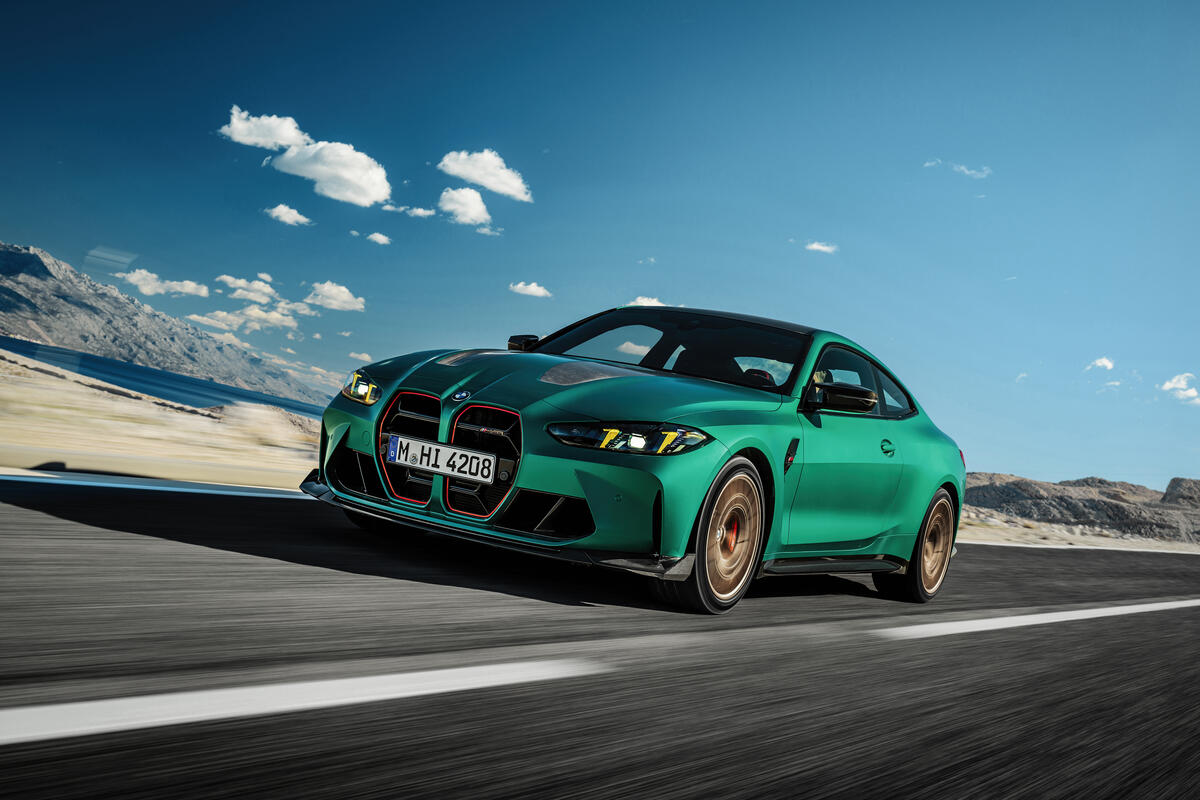
BMW M4
"...ween like, you know, a base, you know, BMW versus M4, you know. They don't know the difference, you kn..."
The BMW M4 is a performance version of a BMW 4 Series. It’s built to be faster and handle more aggressively than the standard model. People compare it to non-M BMWs because the M4 is meant to feel like a step up.
The BMW M4 is the high-performance version of the 4 Series, tuned by BMW’s M division for stronger acceleration and sharper handling. It’s commonly brought up when people compare “regular BMW” models versus the M-badged cars, because the differences are more than just styling. The podcast mentions it in that kind of base-versus-M comparison context.

Benz
"You can have like a 15 year old BMW paid too grand for and might impress some shit. He'd drive a Benz and then some other guy rolls in with like a $100,000 car and she's like, whatever, you know, it's like my boyfriend's, you know, whatever."
“Benz” is a common nickname for Mercedes-Benz, another German luxury/performance brand. In this context, it’s used as a generic comparison point for how people may not care about exact model details.
Request an Explanation
Heard something you'd like explained? We'll add it to this episode.
Sign in to request explanations for terms you heard.
Want to learn more?
Browse our glossary for plain-English explanations of automotive terms, jargon, and concepts.
Help improve this episode
See something that's not quite right? Our annotations are AI-generated and can sometimes miss the mark. Click the flag icon on any annotation to suggest a correction.