Liability insurance is the kind of insurance that helps cover costs if someone is responsible for damage. For a repair shop, it can apply if the shop accidentally damages your car while working on it.
“Master” usually means a top-level mechanic at a repair shop, not a type of car. These technicians are the most experienced and are often the ones who handle difficult problems. The podcast is likely emphasizing that the shop has highly skilled people working there.
A manual transmission means you shift gears yourself using a clutch pedal. You have to learn how to match the engine speed to the gear so the car doesn’t jerk or stall.
A “stick shift” is a car with a manual gearbox. You use the clutch and the gear lever to change gears yourself, instead of the car shifting automatically.
“Same day” means you bring the car in and the shop tries to get it fixed and ready for you before the day ends. It’s a scheduling and speed target for the repair shop.
“Diagnosed” means the mechanic figures out what’s actually causing the problem, not just what it seems like. That step can take time because there are often multiple possible causes.
A whole new engine means the shop replaces the entire engine, not just one broken part. It’s usually very expensive because the engine costs a lot and the work to swap it is labor-intensive.
Throwing rods is a serious engine failure where the connecting rod breaks and can damage the engine block. It usually happens when the engine isn’t properly lubricated or is pushed too hard.
Oil pressure drops means the engine isn’t getting enough oil flow/pressure to lubricate itself. That can cause major damage fast, so the car may limit power or go into a protective mode.
Limp mode is when the car intentionally reduces power because it thinks something is wrong. It helps prevent further damage so you can get the vehicle to a mechanic.
Mango Automotive is the auto repair shop they’re talking about. They’re explaining how Mango handles repairs and warranties in a way that’s meant to be easier for customers.
A monthly subscription is like paying a set amount every month for auto-repair help. Rather than paying for everything each time, you’re buying coverage through a plan.
This is a warranty that lasts five years or 60,000 miles—whichever comes first. The idea is that if something related to the repair goes wrong during that window, the warranty should help cover it.
Warranty work is when a repair is done under a warranty, so the warranty plan is supposed to cover the cost. The shop may still have to follow rules and get approval before the warranty pays.
Aftermarket warranties are warranty plans from companies other than the car maker. They can help pay for repairs, but they may limit what they cover and require specific parts or approval steps.
A warranty company is the organization that pays for warranty-covered repairs. They can approve or deny claims, and they may require certain parts or processes before they’ll pay.
A used eBay part is a secondhand replacement part bought online. The concern here is that a warranty might only pay if the shop uses that used part, which could be risky if it fails later.
A powertrain warranty covers the big moving parts of the car, like the engine and transmission. It usually doesn’t cover everything the way a “bumper-to-bumper” warranty does.
“Bumper-to-bumper” usually means the warranty covers a lot of different parts of the car, not just the engine and transmission. There are still some things it may not cover, but it’s broader overall.
Term
parts have gone up
They mean the cost of replacement car parts went up. If parts cost more, repairs usually cost more too.
Profit margin is how much money a business keeps after paying all its bills. The point here is that many small repair shops don’t keep much profit per job.
Concept
P&L profit
P&L is a simple way to track whether a business made money or lost money over a year. Here, the numbers suggest the shop wasn’t doing well financially.
Term
automotive shop
An automotive shop is a place that fixes cars and does maintenance. The episode is talking about how having many shops nearby doesn’t necessarily mean one shop can’t succeed.
Term
maximum capacity
Maximum capacity means the most work the shop can handle at once. In this story, they reached their peak level of business for each service bay.
A diesel customer list is basically the shop’s contact list of people who bring in diesel trucks or cars. If a shop closes, selling that list can move those customers to another shop.
Sign wars are when two nearby businesses keep putting up messages on their signs to one-up each other. Here, they’re doing it in a playful, friendly way.
Tesla is a company that makes electric cars. The hosts are using Tesla as an example of how not all repair work can be handled by the manufacturer alone.
Aftermarket repair shops are regular independent garages that fix cars, not the brand’s own dealership. The point here is that there are more cars needing repairs than the manufacturers can handle directly.
Private equity is an investment company that buys businesses. When they buy lots of auto shops, it can reduce how many truly independent repair places are available.
A full inspection means the shop checks the whole car, not just the one thing you came in for. It helps catch problems early so they don’t turn into bigger repairs.
Struts are suspension parts that help keep the car stable over bumps and help the wheels stay properly controlled. If they’re cracking, it can become unsafe and should be checked or replaced.
Factory maintenance refers to the scheduled service intervals and checks recommended by the vehicle manufacturer. It’s typically based on mileage/time and includes items like inspections, fluid services, and wear-part replacement criteria.
A safety item is a car problem that could make the vehicle dangerous to drive. If it’s something like bad brakes, cracked suspension parts, or worn tires, it’s usually urgent.
Tires are what actually grip the road. If the tires are “bald,” they have worn down too much and can lose traction, especially in rain or emergency braking.
A waiver is a paper you sign that says you understand the shop’s warning and you’re choosing not to do the recommended fix. It helps document that the shop told you about the risk.
The Mannheim index is a number that helps predict how much cars are worth in the market. If cars are worth more, owners are more likely to keep fixing them instead of buying something new.
Here, “economic climate” just means the overall money situation people are dealing with. If gas and other costs are high, people may delay repairs that aren’t safety-related.
LIVE
Hey, Jesse, how are you doing today? What's up? I'm doing great. How are you?
Do fantastic. Love the day here in San Diego. I think it was raining
yesterday as you record this. We're drizzling anyways. So now we have some nice
weather. It's great. All right. Back to sunny San Diego. That's right. That's right.
So, um, you actually run the, is it, is it a business, a company,
mango automotive? Sure. Yeah. All those things. All the above. Um,
if you could describe in a nutshell what mango automotive is for those who don't
know. Sure. We do aftermarket automotive repair. So mechanical repair,
not body work. Um, you know, we do quick lube also, like oil changes,
brakes, engines, everything in between. Really? So when did you first start the
mango automotive? Okay. I started mango automotive in, well, we opened the first
shop December 27th, 2021. So that's pretty recent though. I was looking around
for like four years, five years. Yeah. It's new-ish. Yeah. Wow. Now, now, the
biggest question I have, I guess, with mango automotive is like, why mango
automotive? Okay. When I got started in the brick and mortar automotive world,
I looked around and there were all of these shops that I couldn't remember
their names. It's like J and J Automotive, Wrench Works Automotive,
Joe's Automotive, Joe's Garage. They all sounded the same. So I wanted a name
that was memorable. Um, my sister actually suggested mango automotive and I
socialized it with my business partner and my mother-in-law. Everyone hated
it. So I thought that's perfect because he vokes a strong feeling and you'll
never forget it. So when we opened our first shop, all of the, you know, a lot
of other shops talk smack about us and our name, but they didn't forget us.
Wow. So what sets the mango automotive apart from like Joe blows gas and fix
something, you know? Well, I think that Joe blow, my dad used to say Joe blow.
When you go to Joe blows, you walk in and there's oil stains on the carpet and
a pot of burnt coffee and probably a 10 year old sports illustrated sitting on
the table that's offending you.
And don't forget like the seats you wait in the waiting room or just like
out rips and tears. Oh yeah. You're like, should I sit on that?
Right. They got tires like in the waiting room, just like sitting there.
They just took off a car.
Yes. Exactly. You're like, I hope I'm not wearing shorts because I don't want
my legs to touch those chairs. Yeah. Yeah. Yeah.
So I wanted to do things differently in that, right?
I mean, I think automotive repair has been around for 150 years is a bit
of an aging industry and the customer service bar needs to be elevated.
So we implemented what we call the pink wall effect, which is what tell me more.
What's that about? Well, we do actually have a pink wall, but it's seats
that you actually don't mind sitting on. We diffuse essential oils.
We don't have any nasty tires in the lobby.
Do you actually oil, oil, send oils in the, in the lobby?
Essential oils, you know, yeah, really making it smell good.
I think like this is what often happens with a new customer.
They'll call and make their appointment or online
and they'll show up the day of their, their appointment, park their car,
walk into the lobby, look around, look very confused, slowly back out of the
front door, look up at the sign.
OK, this is an automotive just walk back in because they feel like
they've walked into like a spa or a co-working space.
Right. A Starbucks or something.
They're like, where am I?
Do you guys sell lattes at the, at the, I think about automotive?
We don't, although if there's anyone listening who owns a coffee shop
in New Mexico, West Texas or Arizona, I'd love to partner with you
because I think that we should have a proper coffee, coffee shop.
We do have, you know, a little machine, but something's better, nothing.
I think along with elevating the customer experience right now
in aftermarket automotive repair, women make 65% of the decisions.
But we're still not doing a great job speaking to them.
I think as recently as last year, there was a study that came out
that women are charged more for the same services, which is no way as a woman.
Crazy to hear, right?
Well, you know, it kind of makes sense.
There's always these running jokes, like skits and sketches
about how a woman goes into a repair shop and then the salesman's telling her
that, like, you know, her unicorn tire needs to be replaced, you know,
and whatever nonsense, just like, oh, yeah, OK, makes sense.
Yeah, sure. How much is that 8000? That's all right.
Yeah, no problem.
So you're trying to bring in women to the repair shop
and feel like a very comfortable space, I'm assuming.
Yeah, and I think to do that, like, we really believe you have to have women
on both sides of the table.
So we outpace the average women in automotive by seven times the industry
average, it's still not enough.
We still need more women in automotive, but to bring equality to the space,
you just have to have all kinds of people on both sides of the table.
Like, your employees have to look like your customers.
What do you mean by that?
Well, you have this space that's traditionally
owned and run by men and there are men at the counter and there's men
in the back shop and you have customers that are majority women.
So you have women coming into a shop that's owned by men.
But not only in terms of gender, I think race, everything like you need
to have, you know, different kinds of people.
The same kind of people working at your shop is the customers you're serving,
right? That helps us feel comfortable as humans.
Right, right.
So you guys work on almost every type of vehicle at your shop.
So is there anything excluded like you?
I won't touch those kind of vehicles.
We don't work on a lot of vintage cars.
We do work on electric vehicles.
We do work on diesels.
We work on most everything.
I mean, a super high end car we might not work on because, unfortunately,
if someone scratches like.
Okay, okay.
So like a certain dollar value.
So it's like someone brings in like, say a 3000000 dollar vintage car.
You're like, we're not touching that.
Yeah, yeah.
Otherwise, it's just our liability reasons, I guess, and things like that.
Right, right.
It's just not our specialty.
Is there any kind of liability insurance for something like that?
What happened on a regular car?
Like a Honda Civic or something like that?
Like, how does that work?
Like, if someone brings in my Honda Civic, you guys, you know,
I don't know, run a something into it.
Like, how does that work?
Oh, we, if we ran, we did something.
I mean, we're responsible, of course, like, of course, we have insurance
and we'll cover that.
And we just believe in, you know, you want to do the right thing.
I mean, I think everyone in automotive talks about this.
So yeah, of course, if we screw something else, like, we're going to fix it,
whether that's through our insurance or not.
Okay, okay.
Okay.
So when you got started with your first shop, what made you decide to even go
into automotive in the first place versus say something else?
I mean, there's plenty of other entrepreneurial shops you could have done.
I know, what am I even doing here?
I had been in software for many years and I stumbled into an automotive software.
So I was chief product officer in that role.
I learned a ton about the automotive repair industry.
It's a 150 year old industry.
And at the time you had six out of 10 owners looking to retire within the next six years.
So you had an aging industry where there was going to be huge transfer of wealth.
And I think I kind of feel comfortable in the shop.
Like my grandfather owned an aviation repair shop.
My other grandfather had like a hitch repair shop.
So sort of grew up in that dirty environment.
Well, also 150 years ago, even, gosh, I mean, 30 years ago, everyone says cars are so much
easier to work on back than they are today.
Everything's computers and software.
You worked in the software.
So I just kind of wondering how those skills kind of transferred to today's cars,
you know, versus like, you know, cars, which is carburetors like back in the day, you know?
Yeah, it is.
There's like the computer transformation.
There was a carbureted indigent transformation and there's a transformation
we're undergoing now, however, so we're fastest going like toward electric vehicles.
And it's true.
I mean, I couldn't work on a vehicle, but our master techs and our shop are geniuses
by their own right.
How do they get certified through you guys?
You guys have a program?
Do you have to go hiring process?
How does that work?
Yeah.
So ASE is the sort of like the name of the game and certification.
So that's how you become a master tech.
You pass all your ASE certs.
So that's an outside organization that certifies technicians.
And then you hire them through that program.
It's like they push and you do like, I'm not sure how it works for an automotive mechanic.
It's not really that way.
It's just like, if you have a job and you have a degree and you apply for the job,
then you're like, I got a degree from Harvard.
So when they apply for a job for us, they'll be like, I have all of my ASE
certs in their current, or if they're not, we're like, you got to get those things current.
And there's now, when you check to see if they are current, is there like a website
or certification wall you can go to to verify that stuff?
Yeah, for sure.
Okay.
Cause I have no idea how this stuff works or whatever.
Now I was kind of wondering if you guys have like a skills test, like a five,
before you work for here, you have to like rebuild that engine in 10 minutes.
Go do it right now.
Go.
That would be fun.
I think that our applicants would not enjoy having to work for us before they got the job.
But there is some sorting out like our foreman and the shop is going to understand,
you know, what skills they have in our manager as well and like what jobs are the best jobs
for them to work on.
And we have a foreman that they can always run to.
If they get, you know, stuck, that foreman is overseeing all of the work.
We're cute seeing all of the work.
So no matter what they're, you know, what they like to work on, we back them up in terms
of making sure that that repair was quality.
Now it's one of the requirements to work in your shop or any shop for that matter is
to be able to drive a manual transmission.
Good question.
That's one thing I can do to have a manual transmission.
I don't think my first car was like this little Ford Ranger.
My grandfather had got it with no extras.
I mean, we had to roll down the windows and this was in the early 2000s too.
So I'm not that old, but it was a manual transmission and he gave it to me.
And it just was like, I was going to school in San Diego and living in L.A.
And it was like, okay, here you go.
You better learn to drive it to San Diego right now.
Wow. You made it work though.
So you made it happen?
I did. I did.
I just stalled it quite a few times on the way down there.
You're good once you're on the freeway.
It's mostly freeway driving.
I remember taking my sports car to a shop a couple of times.
And every time I take it in because of the stick shift, they're like,
we've got to find someone that can drive it like around the back to the shop
or pull it out of the shop or bring it.
Your car is done.
We're going to find someone who can drive a stick to bring it around the front.
I was kind of thrown back by that thing and like, oh my gosh, it makes sense.
A lot of people don't know how to drive stick shifts.
I was kind of wondering if you work at a shop, you would think to be required
is definitely not a requirement.
But yeah, we got to have most of our team can drive stick shift.
Even my daughter, who's 19 now, she started working in a mango shop
when she was 16 and the car that we got for her is manual transmission.
Because I was like, you have to learn to drive a stick.
Yeah, I was kind of wondering about that.
I was thinking about teaching my son how to drive a stick shift.
He doesn't have his license yet, but we bought him an automatic car.
But I was kind of wondering like, where can you find like a really cheap
inexpensive manual transmission car just to teach him on not like to own
just like, you know, run through the process of driving.
That sounds like you need a friend with a manual.
Well, I don't have mine, but I'm ruining it.
I want one that's kind of already like beat up, like on its last legs
just to kind of like just to use, just to get the idea of like using a stick shift.
You know what?
The truth is automotive repair shops have clunkers around sometimes.
Oh, really?
Ask your local automotive repair shop.
It's like someone brings their vehicle in to get fixed.
Turns out it costs more money to fix it than the doggone car is worth.
And they just like sort of leave it there, but it might still run and like be on its last legs.
So wait, wait, wait, now you got me curious.
Now you got me curious. How does that even work?
So it's like someone comes in with like, say a car that's worth $2,000
and needs $3,000 worth of work or whatever, and they're just like screw it.
They just leave it there.
And now legally, how does that even work?
Yeah, there's like a different process state by state where you will we communicate
with the customer mostly where like, do you want it back?
Are you coming to get it?
And sometimes they just don't even it's not like not worth that worth it for them to tow it, right?
So we can acquire the pink slip like through a mechanics lean.
If we need mechanics lean, how's that?
How does that?
How does mechanically mechanics lean even work?
Like what's the steps?
I don't know. My team knows, though.
Okay. Okay. No worries.
I just got this a little something with the DMV.
You wait for some time to pass, but like it depends on state to state.
So like California can have different rules and things like that.
Exactly. It's different in every state.
Yeah. You wait for some time to pass.
Eventually you can potentially get the pink slip.
And then, you know, either either fix it up and sell it or sell it for scrap metal
or do whatever you got to do with it.
Wow. Well, that's crazy.
We sometimes have like internal giveaways in our company
where we'll give away a vehicle to one of our employees.
Really? Check that little bonus.
A bonus check and give you a brand new car.
You get a car. That's great.
It will just be like, we like to have our employees share stories and like nominate people.
Some cars, you know, we'd love to do it with customers,
but some cars are just, you got to keep them internal
because you really need, should be a mechanic to own that.
Oh, of course. I would think.
I would always be fixing something on the thing.
Yeah, for sure.
Wow. Well, that's fantastic.
So how many shops do you guys have running right now operational?
We have eight shops.
Eight shops across three states?
Yeah.
Now, are they all fairly close?
I mean, what states were they in?
So New Mexico, Arizona and Texas.
So they're all fairly close.
Seven of eight are drivable within a half day.
Okay.
And we have one that's kind of out there that we got to fly to.
Now, why do you choose those states?
Like, why, why there?
Oh, just because that's, I mean, I was in Albuquerque when I started Mango.
So we just started there.
And kind of branched out from that spot.
Kind of, yeah, exactly.
So they're easier to manage when they're nearby and you can actually go to them.
Now, what is the requirement for a shop to convert from Joe Blow's house of cars
to Mango Automotive?
What's the requirement?
Well, it depends on what the owner is looking for.
I mean, typically we're working with owners who want to retire and sell.
We're looking for shops that have a minimum of seven bays and are doing at least a million
dollars in revenue for it to be, you know, a potential acquisition for us.
Now, they have to be doing those before you guys come on board with Mango Automotive.
You know, we can float those numbers potentially, right?
Like, we tend to look at the whole picture.
So the first shop we acquired had 12 bays, but they were only doing like a hundred K in revenue.
And we knew it was in a good location and we could turn it around.
We call that shop a turnaround.
That shop's doing, I think right around 3000000 right now.
So we've grown it over the last three years.
So we take different things into account.
But that is sort of like our starting acquisition criteria.
I just personally don't know how to make money from like a two or three bay shop.
Because like you got one manager out there, it's fine if the owner can be back up, right?
Your manager, you know, gets sick and someone's got to be there.
But our, how we run a shop really, we've got three people up front, you know,
in a crew of 78 or nine techs in the back.
So can run that out of a tiny two or three bay shop.
And there's always two is like, if I take a vehicle to a two bay shop, it's like,
you know, you're going to be on a waiting list to get in there because if they've got
five cars ahead of you or whatever it is, you know, so what is the average turnaround time?
Say I came in with something, not something serious, but something kind of like, say,
I don't need a radiator or something.
What would be the turnaround time on a shop that had 12 bays or 10 bays?
Yeah, for sure.
It's really important to us to get our customers in same day because we know vehicles are critical.
So we work our butts off to get customers in same day and to get them out the same day.
If you have a radiator problem, you don't know you have a radiator problem and it needs to be
diagnosed. That's where a lot of the time can go into the diagnosing to try to figure out what's
wrong with that car before we fix it. But I would hope if you brought it in, you know,
in the morning that we could have it out the same day at the end of the day.
Okay. Okay. Do you guys have any kind of loaner program for like loaner vehicles or like that or
no? We do not do loaner vehicles, but we will Uber or Lyft you to wherever you need to go.
Oh, you guys have your own personal shuttle, like your little van, like the dealerships have
this van. They take you to like your house with an range. Yeah. So we did have shuttles and we
just found that Lyft's shuttles were like, if you're shuttling someone, your customer has to wait.
Lyfts, if we have five customers that need to be picked up right now, we can call five Lyfts.
So we found that to be much easier. And while we have a customer's car, like we can, you know,
if we lift them to their office and then they need to be lifted to their house, like we'll
lift them around while we're working on their vehicle. Okay. Okay. That makes sense. Pretty
easy to do. I guess it's, it's a, and you don't have to use your vehicle for it to pay for your,
pay for another employee, pay for, you know, that kind of stuff too. Although
are you paying for the Lyfts or you have them pay for the Lyfts? We pay for them. Okay. So
there's some costs involved with that. So it's not all free and funsies and that sort of thing.
The question I guess when it comes to shop repair and things, what is the craziest repair you've
heard of, like most expensive repair, they're like, Oh my gosh, they need like a whole new engine.
Cause it is always the whole new engine that is the most expensive repair because that engine
itself can run, you know, eight, $10,000 is for the engine. And then we got to have our master
tech spend three days dropping the new engine in. So those are always heavy. And the core
charge too. So the core charges on those two, I believe. Yep. Yep. Um, is it usually because
they didn't change the oil? Is that what it is? I mean, I think a lot of times it's like older
vehicles. Um, I don't know, to be honest, I don't know. Yeah. I've heard stories people throwing
rods because we're trying to push the engine beyond its limits. Like, um, I don't, most modern
vehicles have like a shut off too. If like oil pressure drops or if something like that happens
usually it goes in like a limp mode or whatever, but sometimes maybe some sensors out or whatever,
or something like that. And, um, they don't know when they're climbing a hill, tone a boat or
something. And boom, there goes the engine. I've seen it happen a couple of times. Um,
do you know more than me? Well, I mean, it never happened to me cause I changed my oil,
you know, speaking of, speaking of oil changes, one thing I love about mango automotive,
your website is that you offer something I haven't seen before, maybe because I haven't,
I guess I haven't seen this is the monthly subscription. Can you tell me how that works
and what do you get with that? Sure, but I don't really want to talk. Oh, what? No, no, I think
we do definitely still have some customers. We're getting ready to, to deprecate the monthly
subscription program, the description idea. I just thought on your website yesterday,
I was like, that's kind of interesting program. You have a 60 month, 60,000 mile warranty,
which is in the locations that we operate almost unheard of. You typically see two,
three year warranties. Um, but we really want to make sure our customer is, is covered for that
repair. So it only warranties of the work that you guys touched. I'm assuming nothing outside of
that. Yeah, yeah. It's not a, you know, I think you're touching on what's like
aftermarket warranties. Um, we actually explored that place, space, that space and like played in
it. And it's a challenging space right now for owners and just vehicle owners and I think automotive
repair shop businesses, because those warranty companies, they like to pretend like they're
offering the world. And then when it comes down to it, they don't want to cover crap.
Yeah. So you guys have to deal with, if there's warranty work that you're covering through your
shop, you got to go through the warranty company and gives you guys to run
around. Yeah. I mean, our advisors will spend, you know, an hour on the phone just trying to
get someone over there to pick up. And then they'll say, you know, we're only going to cover it if
we ship you this used eBay part. What happens when that breaks? Because
we can't warranty the used part off of eBay, right? But they're like, this is the cheapest price on
the internet. So that's what we're warrantying it for. So there is, I mean, usually we'll just
talk to our customer, like what do you want to do? You know, they'll cover, it's great news,
like they'll cover 40% of your repair or 60% of your repair. But I think it's kind of disappointing
because the warranty company sells them this product that doesn't show up for them.
Yeah. That makes sense. You know, I have my struggles with warranty companies when I bought
my last two vehicles, I said, screw it, not doing any extra, more extra warranties.
I'll just pay out of pocket. We need something fixed or whatever, knock on wood, but
you might be better served, like putting the money you're paying for the warranty
into a savings account. Yeah. And they're so expensive too. I think they're trying to quote me
a couple of like three, $5,000 for a warranty. I'm like, gosh, like have to price for an engine.
Yeah. I could cover a lot of repairs for that $5,000.
They try to sell it to me too. I remember about my truck or trying to upscale me.
I bought my truck brand new from Ford and Ford like most, almost every manufacturer gives you
their own Ford, you know, the warranty from the company. And so, you know, the, the, you know,
I had, what was it? 60,000, 60,000 mile, five year powertrain, I think. I think Hyundai does
the 100000 still, I think on new vehicles. Was it three year, 36,000? Maybe they
gave you bumper to bumper. Most of them give you that. And so if they all give you that, then,
you know, and they're trying to extend it, oh, you'll go a 100000 miles or whatever,
kind of deal. But, but then it's an additional like five grand or whatever on top of the,
what we paid for and stuff and vehicles are so, so expensive. So,
Oh, expensive right now. It's insane.
Well, I mean, it depends on kind of vehicle you get. So, I mean, if you were to say these
bends, they're expensive and things of that sort. So what is the most expensive vehicle that you've
seen come roll through your shop that you guys had to work on? Oh, no. You don't know. Maybe like
a hundred grand. When you get up to those really like luxury vehicles, a hundred grand is nothing
these days. Like you can buy a Chevy truck. I have a Honda pilot because I have a bajillion kids.
That thing cost me like 60 something and I have a Sprinter van and that thing we bought
during COVID and it was still, you know, it was 90 K. Wow. That's crazy. And now,
yeah, it's in the cost of vehicles is crazy. So, because the cost of vehicles are crazy,
is it cost repairs crazy too? I mean, everything's inflated. I would say the cost of repairs is higher
than we would like it to be. And I think the pressures on us are the rising cost of parts.
So we've seen, you know, since COVID parts have gone up in some cases up to 50%, the previous
prices. And then our doggone employees want to be paid a living wage. What is that?
Well, I mean, you gotta pay people. You So, as a cost to run the shop,
is the majority of the costs in the parts of the labor, probably labor I would think,
probably the biggest expense, right? Oh, sort of like the biggest line item. Yeah.
I mean, yes, labor. Yeah. What's with any industry really think about, you know?
Because it's labor to work on the cars in the front of the house, the advisors who are educating
the customer. I mean, in automotive repair, you see profit margins for smaller shops that are
around a million dollars. Oftentimes those profit margins are depressed in the 10% range.
So that's kind of crazy, right? If a shop is making a million dollars, you would probably
be hard pressed to get 100K out of that shop in profit. And that's if the owner is working
inside the business. That's crazy. And those numbers can sort of, you know,
they scale up because you're still paying your rent, you're still paying for your software.
So if that shop, then if you can scale it to like, there's a big gap between one and 2000000
and you'll probably scale your profit from 10% to 20% as you're scaling that shop.
But yeah, we see a lot of automotive repair shops that are really not making it. I looked at one
yesterday with four locations where they're making their P&L profit was $13,000 across all four
locations, which means for the year or last year, which means that they're losing money in a lot of
cases. So people think like, oh, these services business make so much money and profits can be
had and you have to be careful with your expenses at the end of the day. I mean, we do expense
reduction January and we just went through it and we're like, you know, we're calling our cable
company saving $30 a month because every dollar you save goes straight to the bottom line, right?
And yeah, right now we have a sort of massive empire. I mean, our payroll is a quarter of a
million dollars and we have 91 families that, you know, depend on Mango to keep going to feed
their families. So it's a, it's a heavy feeling. I'm so thankful to those employees and we got
to make sure that we take care of them. Definitely. So of your shops, which one is the most profitable
and why? Oh yeah, our oldest one, probably the original, the original one. It's just they take,
okay. So for us, when we acquire a shop and most of the shops we acquire our turnarounds and that
we want to grow the revenue in those shops. So the growth takes money. So when we're growing the shop,
it's either it's breaking even at best, but it's usually losing money because we we're growing
rapidly, right? When we're in growth mode, we're growing 50 to 100% year over year. So any funds
that the shop is generating are just being reinvested into marketing to grow that shop.
And then once you get to sort of this maintenance level or you're at capacity and you can dip down
your marketing and you have those returning customers, that's when you really start to
see those profit numbers. So time there is the key, our ownership time of the shop.
Okay, okay. So when you do take it over as a mango automotive shop versus the Joe's automotive shop,
like how long does it take to see numbers kind of like increase from what they were,
say they were doing, like you said, the 13,000 a year, whatever it was,
how quickly could you turn something that around? Oh, the that profit number. Yeah. Yeah. Being that
it is now a mango shop versus the Joe's whatever shop. I mean, we're going to probably lose more
money. When we take it over, we'll lose more money than they lost because we want to grow the
revenue. So we have to grow the revenue before we can realize any profits. So first shop that we
talked about December 2021, they were doing like 800K, they're doing 3 million now. They're seeing
some profits, which is great for them. So that's how much time it's taken us to grow. Sometimes we
can double the revenue in the first 12 months, but then you see growth. It's like that initial
year after we own it, revenue sometimes explodes. And then we see sort of like smaller, like 50 or
30% growth in the following years. Interesting. Now, when you first take over a new, a new shop,
what kind of like marketing strategies do you get to like get people interested in that shop?
Because, because, because to the general public, when they see a mango automotive they've never
seen before, like, ooh, what's this place? You know, kind of a thing. Yeah, we're sort of lucky
that we do, we have developed a name in New Mexico and El Paso. So people do know about us.
And I mean, employees want to work for us. And we have sort of like a waitlist for employees who
want to move to us. And we have sort of a reputation in those areas, but we do. And when we take over
a business, we, you know, we, one thing we're acquiring is their customers. So it's always a
conversation with the customer. Like, I know you love Chuck. He's retired now. We're so happy
for him, but I'm still here. I worked with Chuck. The crew in the back is still the same.
You know, we, we love to continue working with you. And then we grow primarily through digital ads
and we do some postcard marketing, if you can believe that.
Yeah. Mail, mail flyers, things like that. I get a lot of those two in the mail and stuff
like that. It's kind of, so I would assume that every current customer that Joe had probably
has their email on file or their information on file, you probably send them information saying,
yo, this, this shop is going to be turned into a mango automotive. You know,
here's what we offer things like that.
This is about six months to do that transition and customers and after market automotive repair
come two to three times a year. So we're typically waiting for them to, to give us a call or come
visit us. And, you know, we'll just say something like we used to be Joe blows automotive Joe blow
retired. Now we're transferring to, to mango automotive. You still got the same crew here.
Okay. Awesome. You guys, you guys, I'm assuming you guys keep the same employees when they take
over a shop. I mean, cause that's, that's, that's a big fear. Like if, if you're working for a place
and a new company comes in, they're like, first thing you think about, they're, they're cleaning
house. They're like getting rid of whatever the manager, they're getting rid of their whatever.
I mean, it's a big fear. I'm sure you have to really cut the way those options out,
especially with like the bottom line and like looking at your, you know,
employees are really one of the most valuable part of an acquisition. So you have employees,
customers and location. And I would say in that order. So we, we definitely want to keep the
employees in this was sort of like private equity 1.0, which we're not private equity. We're not
backed by private equity. It's just my business partner, Brian. It's just Brian and Jesse doing
our thing. Brian and Jesse changed the world. But private equity gave everyone who was buying
businesses a bad name because they did this, right? They bought all these services, businesses,
and then they ran them on the PNL. They fired a bunch of people. This happened to a business that
I owned actually that got purchased. They fire a bunch of people. They, you see the profit profit
pop up for a while. And then they wonder why the business fell apart. And a lot of cases
when that happened, the old owners got to buy those businesses back for the pennies on the
dollar and sort of remake them. I would say even in private equity, even in the private equity
that we're seeing now, they've had a shift or realization like this business has been running
for X amount of years, Joe blows been running it and doing a great job. There must be something
there. So even when I see my competitor selling to private equity, they're typically holding
on to the owner or the things the owner is doing. So yeah, we, when we acquire a business,
there is, you know, we meet the employees before the transaction is closed, we let them ask us
questions, we talk about their pay plan. We like to be right there when the owner announces it,
we'll be in the parking lot, we'll come in, we just want a chance to talk to them before they
go home and talk to their spouses and have a chance to panic, right? Like you see us, let's talk,
we're not a holes. Like we'd love to get to know you and, you know, you're here already. So let's
try it. Let's see if it works. Yeah, definitely. I mean, that makes sense. You want to make it
as smooth transition as possible. You know, I mean, yeah, I mean, especially somebody's,
these shops probably been run by their fathers and their fathers before them and fathers before
them kind of thing. Like how, how do you break the news? Like how do they break the news? How
does it all go down when you get to like, when you come in and up and put an offer in front of them,
when they've owned this in-house, you know, business for multiple generations.
Yeah. I'll tell you one story about an owner. Well, something that you see a lot is some
owners do have secession plans, but a lot of owners don't have secession plans. And by that,
I just mean, they don't know what's going to happen to the business after them because a lot of
They figure that little joey is going to take it over. Yeah. But these days, because there might
be third generation owners, but then, you know, little joey says, I don't want your business,
dad. Like I'm a YouTuber, dad. So you see these owners, they don't know how to retire. They've
owned a business their whole life. They, you know, want to find a way to spend more time with their
family. So oftentimes when I talk to those owners, they're excited. And I'll tell you one story about
an owner and Tom, he called me up one day about six months after we bought his shop. He said,
Jesse, Jesse, I want to go to dinner. I said, okay, Tom, he said, invite your, your husband.
I'm going to invite my wife, invite Brian and his wife. We all go to dinner. I said, Tom,
what's this dinner about? Tom says, Jesse, this is the one year anniversary of the day that you
called me. I had been praying for someone to call me so that I could spend more time with my wife
and kids and grandkids. And I'd been praying for years and you answered my prayer. And I think
that was such a powerful moment for me. I said, Tom, don't you miss the shop? Your dad worked here.
Your grandfather worked here. He said, I thought I was going to miss it, but I haven't had time.
And I think that's what it's like for a lot of owners, you know, they, they feel that they're
ready to move on and they're not quite sure how to do it. So not everyone wants to sell their
business. And if you don't want to sell your business to mango, great, I don't want to buy it.
But for those owners that want to move on to the next phase of their life or, you know,
they want to move to Florida, whatever they want to do, like, I think those are the owners that
we're really there for. Like I love helping people. And so I love that we've had the opportunity
to help eight owners retire and spend more time with their families. Like that is really gratifying.
It is. I mean, I can imagine what that'd be like, you know, like
you're older, you got a shop, you don't have to deal with it. You want to retire, you know, like,
okay, what is the other option for them other than having you guys buy? What could potentially
happen if, you know? Yeah, so they could find a broker and put the business on the market.
66% of broker represented businesses never end up selling. They can reach out to competitors
in their area. Competitors are, you know, one of the big buying pools. You used to have the, and
depending on their size, you might have a strategic player be interested in purchasing the business.
So that's probably, you know, a brand that's backed by private equity, those brands,
they used to only look at stuff that had $2 million in profit and up, which is, you know,
a multi-location pretty sizable business. They've eaten up a lot of those shops. And I know they're
sort of coming down on their minimum requirements. A lot of owners, if they purchase the property,
will sell the property. I've seen a lot of businesses going to Dutch bros,
like a lot of automotive. Oh, it comes to a completely different, like they changed entire
building. Because the property has appreciated so much, right? Like maybe they are only doing
a hundred K, like we talked about out of that business. So the business might be valued at
$300,000, but the property that they purchased, you know, 40 years ago is now a $2 million asset.
And so it can't support an automotive repair shop. And the fastest way for them to get their funds out
is to sort of sell it to a big name. Or if they own it, they might lease out the building and
that's the, you know, recurring income that they want to see. So I think there's a lot of options
and all owners are in a different position, right? Do you own the business only? Do you also own the
property? How much is the business valued at? What's the property valued at? You know,
what's the right move for you? I think, you know, unfortunately in our space, there's a lot of
brokers who are not action oriented. And so that's why you see a lot of businesses sit on the market,
which is, is sad. I think, you know, we have purchased businesses that have been on the
market with a broker for two years or something like that. Wow. Now I guess if a automotive shop
is in a certain area, there's this, I was kind of wondering if like, when you look at an automotive
shop and say that there are a bunch of other competitor automotive shops in the same area,
does it become kind of saturated? You're like, well, I don't know if I want to buy this one
because there's like seven other ones within a two mile radius. And you know,
there were four shops on that corner. Really? And that really didn't dissuade us. I mean,
I think it's a great shop. We loved how the owner was doing business. It was our first shop to hit
maximum capacity. So for us, that's about 400 K per year per bay that we have. And we saw one of
the street corners actually sold his diesel customer list to us because he was retiring and
closing. And the one across the street, they're not running service out of anymore. So now it's
just the two of us. And we have a little friendly, like we will do sign wars. And like,
Oh, no way. Give me an example of that. Oh my gosh, I don't have one. If you can find the recording,
I can look it up. I can't think of what we said. Okay. What would be a sign? For those that don't
know, what is an example of a sign war? Okay. A sign war is when you put things, you know,
those signs where you, we saw the ones where you manually put up the letters.
And so you put things on those signs. So like, you have a sign, is it like talking trash,
but the other store kind of thing? Or is it just like a friendly banter?
It's really friendly. So the one across the street said, will you be our Valentine? They put on
theirs. And then we put, Oh gosh, what does this one say?
Um, we are flattered, but we're already in our committed relationship with our five year warranty.
Oh, nice. Nice. They put like well played mango, like just a little friendly banter. But I don't
know. I think there are so many vehicles that need to be repaired. In fact, so many vehicles that
the manufacturers themselves think for Tesla can only account for, this is a wide range, but
25 to 40% of the repair work that needs to be done. So we have to have aftermarket repair shops.
And in most places where we are, the average household has two and a half vehicles. So there's
so many vehicles to be worked on. I really try like to be friendly with other shop owners,
like support them in any way. I always tell them when I talk to them, even if I can't buy them,
you have a great shop. We're friends. We're across the street from each other. If you
ever need anything, let us know. Sometimes they have a piece of equipment we don't have. I mean,
I don't have a scarcity mindset. They're going to take away our business or that's too scary.
We all do business in our own way. So I don't think that every customer is the right customer
for mango. Some might be happier to go to the shop across the street. That might feel more
comfortable for them or they might have a relationship with that advisor that's over there.
So it's not competition. I do, certainly, I'm going to look at who the customers are of the
shop we're acquiring and how I think we can grow the business, all of these numbers. But I'm very
rarely dissuaded just because there's friendly competition. I mean, Albuquerque is a city of
only 600,000 people. There's 150 automotive repair shops. So of course, they're all over the city.
Right? And the bigger the city, the more shops you have.
Yeah, I was kind of wondering, three of the shops you said that I mentioned with Albuquerque,
you know, like those classic, I remember the movie Vacation where he got the tires blew out
and he was like, out of nowhere, that shop's like charging some outrageous price. I always
kind of wonder if a shop is out of nowhere and they've got no competition anywhere,
out in a little desert road somewhere, what if they could just charge whatever they want?
I don't know.
Any kind of repairs? I've heard things like that when people have shops in small resort towns.
Oh, really? That you can be highly profitable in those towns because yeah, there's no competition.
You can charge a lot. You have out of towners that need to, if they have, if you have something
happen and you're in some little mountain resort town, you got to get it fixed, not much choices.
So you can leave for your, you know, go home after your vacation.
Right, right. It's not how we run our businesses.
The same with gas stations. Do some gas stations because of location. They charge more or less
and depends. We have a shop in Yuma and if you get out in the middle of either between Yuma and
Albuquerque or Yuma and San Diego, there's a couple of spots where there's like one gas station.
You pay so much. You have to remember that I'm always like, I've got to get down a gas while
I'm in Yuma, like at that shop because there's nothing for a few hours in either direction.
But here, but the gas station, there's on the news. I saw there's a gas station on the
border of, I think it's Nevada or Arizona that's empty in California side because people are
jumping over the border just to get gas on the other state side because it's like three dollars
cheaper. And so the gas stations on the California side are just like ghost towns.
I don't think that's California, Arizona border because that's like very mountainous there on
the California side. There's not much right over the border, but maybe California, Nevada.
Yeah. Yeah. Definitely. Definitely. So
you're, you got seven kids as in who? Yeah.
Wow. How do you manage that with like all the shops? Are you trying to get one kid per shop?
Is that what you're doing? We did that already because until January I had seven kids and
seven shops, but I'm not having any more kids. So we're never going back to the matchy-matchy.
It was cute. Well, it lasted for 11 months and it was adorable to have seven kids and seven shops,
but it name each shop, each kid's name, free shop. It is no more.
Well, but how do you manage it all though? Like how do you manage it as a mom and like,
you know, business owner and running all the stuff? How do you do it all?
I mean, I don't do it all. And I, what did I read recently? Like every business is owned,
but we can't cuss on this podcast by an ADHD M effort. Is that you? I'm the same way too.
Like, I don't know. I don't like to be bored. So I've designed a life where I'm never bored.
And sometimes I just collapse because I have, you know, I have been called one speed, one speed,
but actually it's two because there's the one speed and then sometimes there's collapsing. But
in my team, I'm, in my company, I'm really lucky now that I don't do everything. Like that's why
sometimes you ask me a question. Like, I don't know the answer because my team does that, right?
My business partner is he's COO, everything that happens inside of the shops he's sort of responsible
for. I mean, we have HR, we have finance. So we have a lot of backups on that front. I consistently
hire people to do jobs that I used to do that are better at it than I was.
That's great. You're at that level now because I think starting out when you're brand new,
like you have to handle a handle at all. I'm just giving birth to my sixth child when I started.
So I don't know. You just keep going. Anyway, you just do it anyway.
And it's a way you have no choice. Like if you have another kid, you're not going to not take care
of that next kid. Like it's the same with the work. I'm not just going to like not take care of the
eighth business. Yeah. I mean, there, there are some people like put things on autopilot though a
lot. I mean, they kind of rely on other people to kind of do things for them. And then sometimes
those things don't work out because the other person didn't realize they're supposed to be
taking care of that thing you put in front of them, that kind of stuff. So we're all just
doing our best at life, right? Now, I guess when it comes to the downside of all this running a
business is had you had to do any firing of employees for like crazy things that, that you're
like, I, you know, I gave you like 18th tries and, and now you just like blew this customer's
engine up. You got to go. Has there been something like that have happened with you guys?
Yeah. I think we have never fired an employee for making a mistake. So let me clarify that.
Like if you did your best and something got messed up, like as a company, we're going to cover that.
Like we think that you didn't intend to do that. And we've never had someone who just sort of like
repetitively made these major mistakes because we have, you know, we have the foreman checking
their work. We have the QC process. So I feel like we're designed to have that not happen.
But of course we've had to fire people last year. We had a manager steal $30,000 from us.
Oh my gosh. Yeah. We've had some rough situations. And I think that at the end of the day,
our policy at Mango is to have fun because life's too short and you spend so much time at work.
And I don't think every employee has fun every day, which is sort of unrealistic,
but I think a lot of our employees like do enjoy coming to work and we try to support them. I mean,
we've paid for employees to go to rehab. We try to be there for them. I say to work at
Mango Automotive, you only need one quality and that quality is a growth mindset because I can
train any employee how to sell or how to fix, you know, do some kind of fix on a vehicle.
But if you already think you know it all, I can't help you.
Yeah. I'm sure you get some of those coming in. Like I've worked at like 20 shops for 20 years
and I know everything, every car inside out, you can't tell me anything, what to do.
Yeah. And we have three different training programs because we really believe in it. My
favorite one is Mango University and it's not focused on automotive repair. It's just like if
you want to take a course or read a book, we'll send it to you, we'll pay for it, go to this website,
like choose it and then it shows up in your mailbox because we believe like continuous learning
is so important whether you're just, whether you're learning how to be a leader or, you know,
how to put spark plugs in. We want to support our employees. And if they do have a growth mindset,
they're hungry to learn too. So we got to provide those opportunities.
Yeah. Never stop learning. You know, you should always be learning and learning new things and
don't think you know everything. I mean, I don't think I know everything, you know. So I'm always
trying to learn things with all kinds of stuff I do. Great. You can work for Mango.
Oh, really? You have that one quality, the only thing you need.
Well, there you go. Hey, speaking of that, he opened a shop out here in California. When are
you going to move into California? Well, we've been looking. So when we find the right shop,
I'm sure there's plenty of them. I mean, just, just mere massive vehicles on the road
in California, you would think there'd be, there's like a shop at every corner. I mean,
depends where you live, there's shops everywhere. There's a lot of shops. Yeah. I think there are
certain places where you've already seen private equity gobble up a bunch of shops.
So there's not as much available. And so you might see a shop that feels like your little,
you know, it's like San Diego family auto repair. Like when you look into it, they're owned by,
you know, a big conglomerate. So a lot of that has happened in sort of Southern California and
some of the more major cities as well, like Phoenix. So it just, yeah, if you know of,
if your shop wants to sell, send the owner my name, I'd love to talk to him.
There you go. You know, if you're listening out there in the podcast land, yeah. Well,
you know, automotive repair is something that we kind of like don't want to have to like think about,
but we kind of have to when things do go wrong, things do happen. And I kind of wonder how,
like a lot of people don't ever step foot in an automotive shop until something breaks.
And you probably should go in there for, you know, maintenance oil changes and, you know,
things that sort fairly rarely, but I think it's cars get older, probably more frequent than cars
that are newer. I think if you have a new car, you probably think, Oh, it's good. It's new. It's a
new car. It's, it's, it's reliable. It's good, whatever. But things do happen. Things go wrong.
And you probably should stay up with your maintenance program. So when it comes to
standard maintenance programs, I'm sure you guys do all the standard stuff, you know,
the regular oil changes and the tuneups and spark plugs and all that, all the normal kind of stuff.
And you don't do the monthly thing anymore. You said you're doing, doing that, the monthly
subscription. We're doing it for customers who already have it, but not new customers. Yeah.
You got it. So a new customer can't get in like that. So is there any special programs or any
any special deals or anything like that you guys have for, for maintenance, why stuff, not
repair stuff, but maintenance, why stuff? Yeah. I mean, we're always running different coupons.
So you guys can ask about that. I think the thing that's really important to me is like,
we do a full inspection on every vehicle. So when the vehicle comes in, if you come in to get
your brakes done, like we're going to replace your brakes, but I always, you know, tell our employees,
like, if we replace their brakes and we didn't notice like their struts are cracking, like,
and they drive down the road and have an issue, like that's our responsibility. Like we messed up.
So, you know, when you come to us for just your oil change, like we're going to look,
we're not only going to look up what your regular factory maintenance should be, but we're also
going to examine the vehicle. And we're not just going to throw it all at you either. We're going
to say like, these are, you know, if there's a safety item, you know, if this was my daughter,
I would tell her to fix this. Like, you really need to get new brakes and, you know, your tires
are bald. Like you really need to fix these safety items. You know, sometime in the next six months,
like you, you probably want to look at these items. And then, you know, these other items aren't as
important, but have them on your radar, like they might come up and be issues you need to fix. So
anyone who comes into a mango shop is going to have a really good sense for where their vehicle
is at and what needs to be repaired when, because we do that full inspection on every vehicle.
And as a customer ever, like it's been so bad where you said, you really need to fix this,
like don't leave the shop until you fix this. And the customer says,
customer says like, no, it's fine. I'll deal with it later. Do you have to have them sign a waiver
or anything like that? I mean, it's not that we have to, but we do because we just feel so serious
about it. Like, you know, your vehicle, you, you're risking your life if you get in a vehicle that
has a major safety problem. So we've definitely had customers refuse to make fixes and we've
asked them, like, can you sign this? I just, you know, it's, I really want you to be safe.
I get that you don't want to fix it now. I highly encourage you to fix it here or anywhere,
take it somewhere else. We can tow it to another shop for you. You know, and if you insist on
getting your vehicle back and not fixing that safety item, we'll just ask you to sign, you know,
here because we do think it's our, our responsibility.
That's good. It's good because I wonder if like, I haven't forbid like they refuse to repair
it damage or kill somebody and they go after you guys. So when you guys worked on the last,
why don't you guys, you know, or whatever it's kind of like, you know, cover your butt.
I think that's hard because sometimes you'll work on, you might fix something and it can happen that
they'll drive down the road and, you know, something else will break that wasn't even near
what we touched, but it, it feels like to the customer, you touched my car and then 10 miles
later, this thing broke. That's why we try to catch it like and give them a warning if we
think it's going to break, but some things just break with no warning, right? So I think as a
shop, we just always try to do right by the customer and, and serve them how they see fit,
but it has happened in a couple of circumstances that there's a disconnect there.
Yeah, it sucks, but it's, it's kind of the joys of owning a car. You know, it's, it's one of
those things I think when you own a car that you have to kind of realize that repairs are needed,
you know, things do break and maintenance is, is, um, it's not a recommendation that somebody
should be doing on your vehicle regularly oil changes, change oil kids. Come on. You know,
I think it's really hard for people like right now. So there's a couple of things that affect
people's willingness to bring their cars. One is the Mannheim index is sort of like the price
of vehicles. And as the price of vehicles goes up, especially used vehicles, people
and new vehicles, people tend to hang onto their vehicles for longer and be more willing to fix
them. But the one thing that makes it hard for people to fix their vehicles is when you see the
price of gasoline skyrocket for obvious reasons, right? Like we're driving around more cash is
coming out of our pocket. We have less cash for repairs. So that can be a really hard time for
our customers. And we're sort of in that time right now. So I would just encourage you if you
need maintenance on your vehicle, go to a shop you trust and, you know, really understand the
situation that your car is in, fix any safety items. And if there are some other things that you
can wait on, you know, you can wait on those things, but I think it's tricky right in the
current economic climate. Oh, it is. It is. It's much easier to spend money. We have money.
You know, it is. Well, Jesse, this has been so fantastic having you on the show today and I
appreciate you and your shop. And if anyone's looking to get a repair shop, get some stuff done,
go to mango automotive work. You find your shops is it mango automotive.com?
Yeah, we're mango automotive.com. And if you happen to have any shop owners listening,
can I give them my cell phone number? Do you want to put your cell phone number on the podcast?
Yeah. Are you sure about that? I'm crazy like that. Are you absolutely sure about that?
I'm totally sure. Okay. I see you trying to talk me out of it. Well, I mean,
normally I would say no, but I can't tell me no. Don't put this. Okay. Okay. If you want to,
go right ahead. Okay. Look, you can text 505-441-4779. Just mentioned cool cars with Chris. And if
you want to talk anything shop or you're thinking about retiring, feel free to shoot a text.
Okay. Got it. Sounds fantastic. Well, Jesse, you have a fantastic rest of your day and rest
of your week and we will talk later. Okay. Awesome. Thanks, Chris.
About this episode
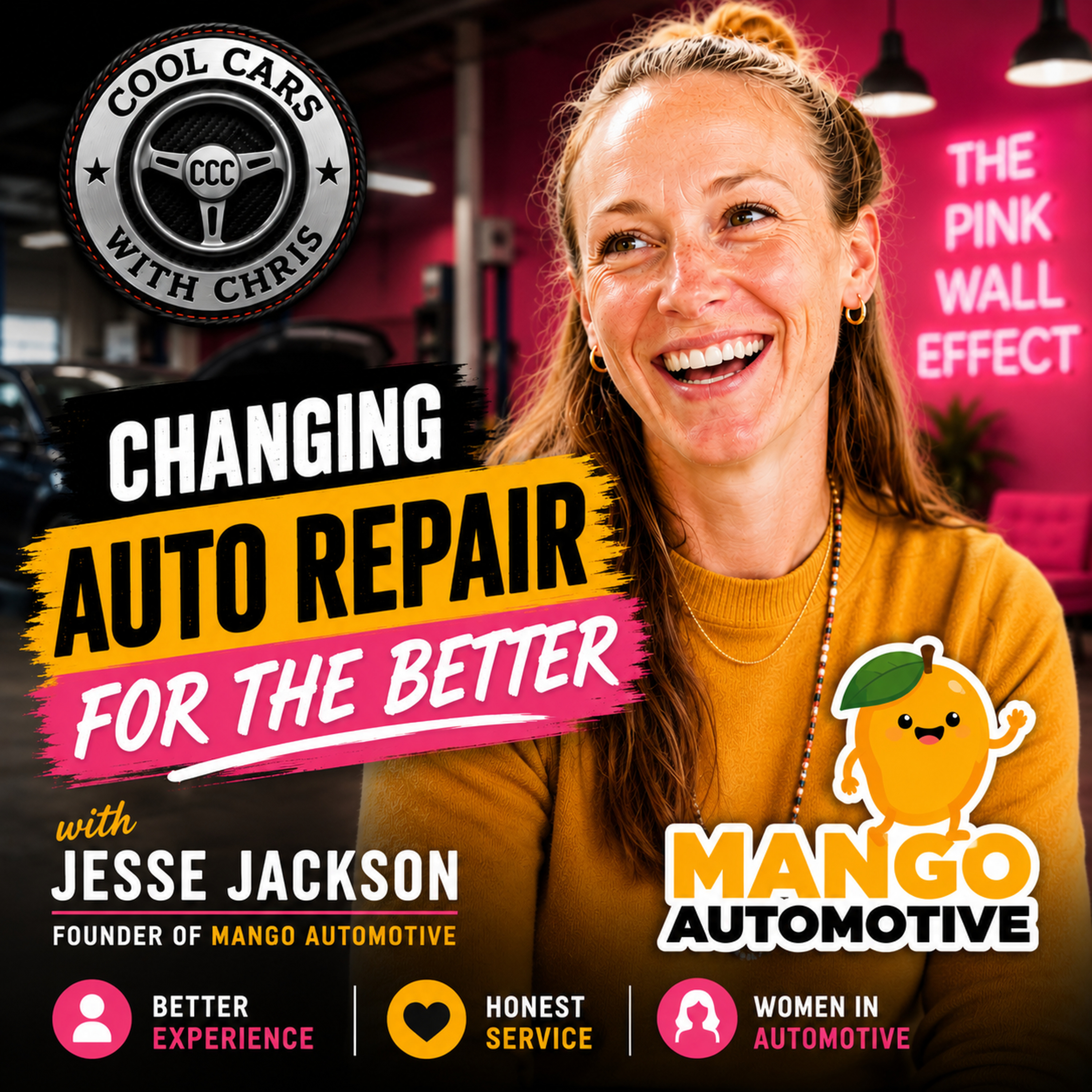
Jesse Jackson, founder of Mango Automotive in San Diego, explains how he’s modernizing aftermarket repair through a memorable brand and a friendlier customer experience. The shop’s “pink wall effect” replaces grim waiting rooms with comfort, clean vibes, and even essential-oil scenting. He also tackles gender and pricing bias, arguing women make most decisions and that shops need more women (and broader representation) on both sides of the counter. Mango works on most vehicles, including EVs and diesels, with ASE-certified techs and a team culture that includes being able to drive manual transmissions.
In this episode of Cool Cars with Chris, Chris sits down with Jesse Jackson, co-founder of Mango Automotive, to discuss how she's redefining auto repair through customer experience, innovative business practices, and a fresh approach to an industry that has remained largely unchanged for decades.
Jesse shares her journey from the software industry into automotive repair, the story behind the Mango Automotive brand, and how the company grew from a single repair shop in 2021 to eight locations across New Mexico, Arizona, and Texas.
The conversation explores the unique "Pink Wall Effect," why customer trust matters in auto repair, the importance of creating a welcoming environment for all drivers, and how women are helping shape the future of the automotive industry.
Chris and Jesse also discuss technician training, ASE certifications, shop acquisitions, employee development, vehicle maintenance, extended warranties, customer service, and the realities of operating a growing multi-location automotive business.
Whether you're a car enthusiast, automotive professional, entrepreneur, repair shop owner, or simply someone looking to better understand vehicle maintenance and the auto repair industry, this episode offers valuable insights into one of the most important businesses keeping drivers on the road.
Topics Covered:
• How Jesse Jackson founded Mango Automotive • Growing from one repair shop to eight locations • The story behind the Mango Automotive name • The Pink Wall Effect and customer experience • Women in automotive repair • Hiring and training automotive technicians • ASE certifications and technician development • Auto repair shop acquisitions and business growth • Building company culture and employee retention • The economics of running an automotive repair business • Vehicle maintenance and preventative service • Extended warranties and common misconceptions • The most expensive automotive repairs • Customer trust and transparency in auto repair • Managing multiple locations and scaling operations • The future of the automotive repair industry