Used car prices can go up when there aren’t many cars available and more people want to buy. If people get extra money around certain times of year, they may be more likely to purchase, which pushes prices higher.
“Full self-driving” is Tesla’s name for a system that can help with driving tasks. Even when it’s enabled, it doesn’t mean the car is fully autonomous in every situation, and the driver still has responsibilities.
Remotely disabling means the company can turn off certain features using the car’s internet connection. It’s a reminder that what you can use in a car can change based on software rules.
Unauthorized hacks are changes someone makes to the car’s software without permission. Because the car is software-controlled, those changes can lead to the manufacturer limiting features or taking action.
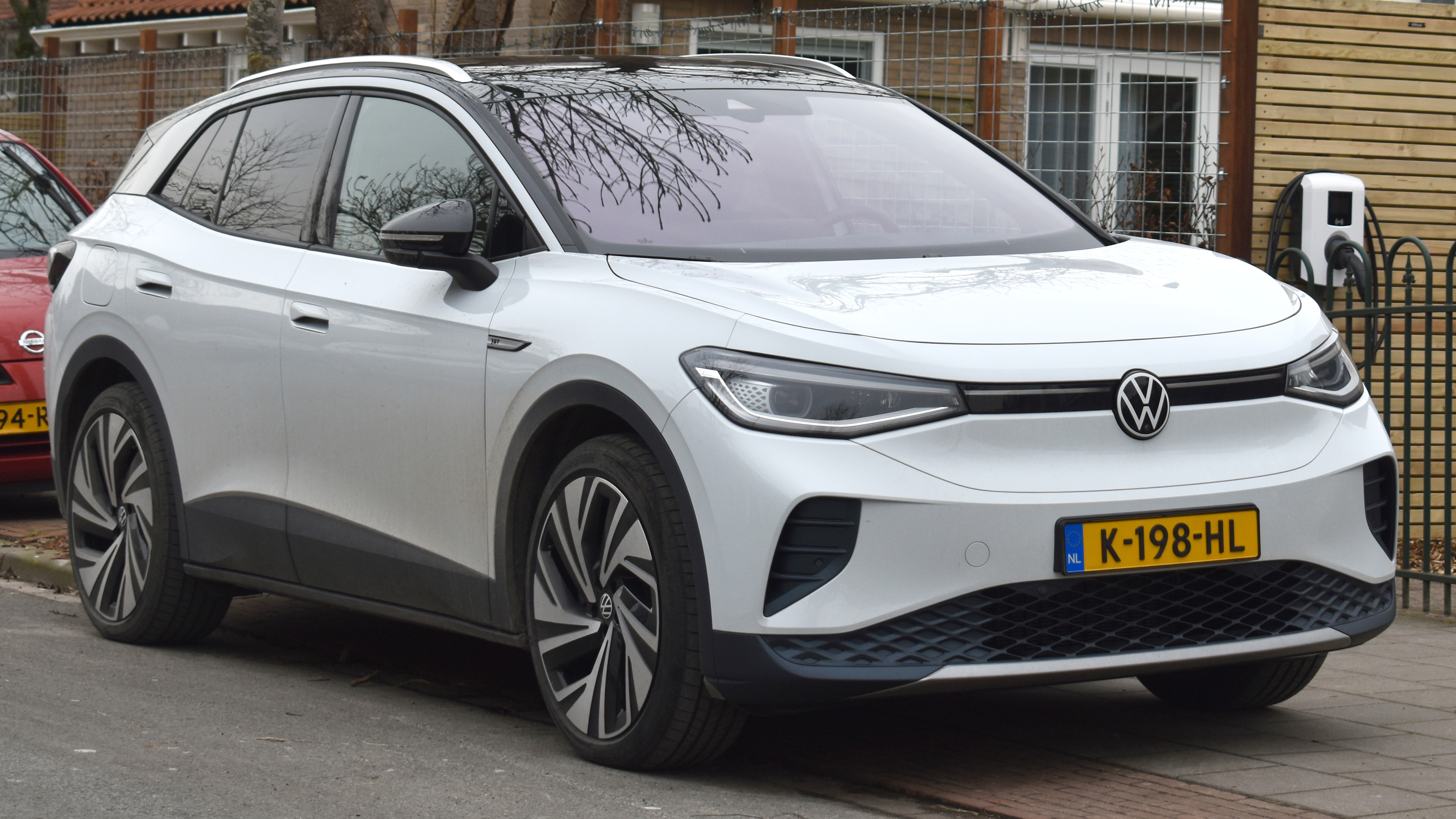
The ID.4 is an electric SUV, meaning it runs on a battery instead of a gas engine. The podcast notes that production is ending in the U.S., which can affect how easy it is to find new ones. It’s discussed because it’s a well-known electric model and changes in production can matter to shoppers.
The Toyota Land Cruiser is a long-running, rugged SUV known for off-road capability and durability. The hosts mention Toyota updating it for 2027, suggesting changes to keep it current while maintaining its core identity.
Cox Automotive is a company that studies and reports on car market trends. When they share numbers, it helps explain whether prices are rising or falling.
The Mannheim Used Vehicle Index is a pricing indicator used to track changes in wholesale used-vehicle values over time. A rise (like the 6.2% mentioned) suggests used cars are getting more expensive at the wholesale level, which often filters through to retail prices.
Wholesale price is the price cars trade for between businesses, like dealers. If wholesale prices go up, it often means the used cars you see for sale may cost more too.
A tax refund is money you get back from the government. If people have extra cash, they may be more likely to buy a car—especially when there aren’t many cars available.
“Days of supply” is a market metric estimating how long current inventory would last at the current sales pace. A record-low number like 37 days implies very limited used inventory, which usually pressures prices upward.
The “COVID effect” means the pandemic changed how cars were made and how people bought them. Those changes can still affect today’s car prices and availability.
Leases are like rentals you return at the end. If fewer people are returning cars, there are fewer used cars for sale. If more used cars start showing up, it can make it easier to find a deal.
J.D. Power is a well-known automotive research and consulting company that tracks industry trends like vehicle quality, sales, and customer behavior. In this context, the hosts are citing J.D. Power’s outlook on how many used vehicles will enter the market.
This refers to unofficial gadgets people buy to unlock features that the company didn’t intend to be enabled that way. It can cause trouble with safety rules and with the car’s warranty.
Cars can receive software updates over the internet. The story says Tesla can also turn off a feature remotely if it thinks the feature was enabled improperly.
They’re talking about an unofficial gadget that people use to unlock features the car wasn’t supposed to have in that area. That kind of workaround can cause problems and may affect warranty coverage.
A warranty is the promise to fix problems for free (within limits). If you change the car in an unauthorized way, the company might say the warranty doesn’t apply.
They’re saying the workaround changes what the car thinks you’re doing. The car may be trying to confirm you’re paying attention, and the hack could trick it.
The car may watch your eyes or face to make sure you’re paying attention. If someone tries to defeat that monitoring, the car can’t reliably tell whether it’s safe to keep assisting.
These are the systems that watch you to make sure you’re paying attention. If you look away or stop paying attention, the car can warn you or limit the feature.
Concept
regulatory people have been slow
Sometimes the car’s software can’t be fully turned on right away because government rules have to approve it first. That can delay when drivers get access to certain capabilities.
Concept
crack the code
“Crack the code” here means trying to pay extra to unlock something that’s not currently available. It’s basically about getting access to a feature through software permissions.
Tesla is a car brand that relies heavily on software features. The hosts are questioning whether it’s fair to sell features in some places if they can’t actually be used there.
Distracted driving means you’re not fully focused on driving—like looking at your phone or fiddling with controls. The idea behind safety tech is to help keep your attention on the road.
General Motors, or GM, is one of the big car companies. Here they’re being mentioned because they’re working on safety tech aimed at reducing distracted driving.
Some cars use small cameras inside the cabin to watch the driver’s attention. If you look away too long or seem distracted, the car can warn you. The idea is to reduce crashes caused by not paying attention.
The Insurance Institute of Highway Safety, or IIHS, is an organization that tests cars for safety. They help set expectations for what safety features should do to prevent crashes and injuries.
It’s a label that means a car scored really well in safety tests. To earn the highest level, manufacturers usually have to include advanced safety features, not just passive crash protection.
Hands-free technology generally means you can control certain vehicle functions without physically touching controls—often via voice commands. It’s commonly paired with infotainment and connectivity features to reduce distraction while driving.
Super Cruise is GM’s hands-free driver-assistance system for certain roads, using a combination of sensors and mapping to help the car steer and manage driving tasks. It’s designed for highway use where the system can monitor lane position and driver attention.
A three-row SUV is a bigger family vehicle with extra seating in the back. It’s built so more people can ride together, usually for road trips and kids.
“Pivoting back” means the company is changing direction again—making more gas-powered cars after planning to go mostly electric. It’s usually driven by what buyers want and how the market is developing.
“Off-road focus” means the SUV is built to handle dirt, rocks, and uneven ground. Even if it’s hybrid, the goal is to keep it capable off the pavement.
A high-mounted air intake moves the engine’s air opening higher on the vehicle. That helps the engine keep running when you’re going through deeper water or messy terrain.
Concept
creek passing
“Creek passing” means driving through a shallow stream. It’s tricky because water can get into places it shouldn’t, so off-road features help keep the vehicle running and stable.
Heating and ventilation are seat comfort features—warm air for cold weather and airflow for hot weather. They help passengers stay comfortable on longer drives.
The Toyota 4Runner is a rugged SUV that’s popular for off-road trips and everyday driving. In this discussion, the hosts think it makes more sense for most people than the Land Cruiser.
Concept
limited-run Redline edition
A limited-run edition is a special version of a car made in smaller numbers. It usually has unique styling or extra features to make it stand out from the regular models.
“Type S” is Acura’s way of saying “this version is meant to be sportier.” It usually means you get more than just different looks. Here, they’re saying the powertrain is improved too, so it should drive better.
An “appearance package” is mostly about styling—things you can see. The host is saying the Type S isn’t just a look-only upgrade. It’s supposed to include real performance-related changes.
“As tested price” means what that exact car costs with all the options it was equipped with for the review. It’s not the cheapest version you can buy. So the test car can end up costing a lot more than the starting price.
This is the size of the engine in the Acura MDX—specifically a V6 with 3.5 liters of displacement. Bigger displacement often means more power potential and smoother operation.
This engine uses two turbochargers to help it make more power. Turbos basically cram more air into the engine so it can burn more fuel and feel stronger.
This is an all-wheel-drive system that can “aim” power to the wheels that need it most. The goal is better grip and more controlled handling, especially when turning or on slippery roads.
This is an automatic gearbox with 10 different gear ratios. It helps the engine stay in the right “power or efficiency” zone so the car shifts smoothly and can feel quicker.
This suspension uses air bags to change how the car rides. “Auto leveling” means it can adjust the height to keep the car sitting level, which can make the front end move slightly even when you’re stopped.
Sport Plus is a button or mode that makes the car feel more “aggressive.” It usually firms things up so the ride and steering respond faster when you drive harder.
The Acura Integra is a smaller, sportier car. The point here is that a big three-row SUV won’t feel as sharp as a compact performance car like the Integra.
The Alfa Romeo Milano is a car model from Alfa Romeo, and the podcast is talking about what the inside looks and feels like. It mentions special seat materials and finishes, like leather and suede-style accents. That’s usually what people mean when they discuss a car’s “trim” or interior package.
A “premium interior” means the car’s inside feels nicer—better materials and more comfort features. The hosts are saying Acura is charging more, so it has to deliver a nicer cabin.
Platform sharing is when different cars are built on the same basic “skeleton.” They can still feel different because the company changes the look, comfort features, and how it’s tuned.
The Honda Odyssey is a family minivan. The hosts mention it to show that some Honda vehicles share the same underlying design, even if the final product feels different.
The Honda Pilot is a family SUV with three rows. The hosts are saying it’s related to the Acura MDX underneath, so some parts of the driving feel can be similar.
A digital gauge cluster replaces traditional analog dials with a screen that can display speed, navigation, and vehicle status. The size (12.3 inches here) often correlates with how much information can be shown at once and how customizable the display can be.
A touchscreen is the main screen you tap to control things like music and navigation. If it’s responsive and well laid out, it’s easier to use while driving.
Some cars use a trackpad-like controller instead of tapping the screen directly. If you don’t like it, it can feel awkward because you have to learn a different way to control the infotainment.
Wireless Apple CarPlay lets you use your iPhone features through the car’s screen without a cable. If it doesn’t connect right away, you may need to try again or use a wired connection temporarily.
Bang & Olufsen makes premium audio equipment. If a car has their sound system, it’s usually meant to sound noticeably better than the standard speakers.
Forward collision alerts are warnings that help you avoid hitting the car in front. The car watches traffic and tells you when a crash might be coming.
Blind spot monitoring helps you know when another car is in your blind spot. Rear cross-traffic alerts warn you about cars coming from the sides when you’re reversing.
Sport mode is a button that makes the car feel more eager to accelerate and respond. It’s meant to make driving feel more exciting, but it can also make the ride less relaxed.
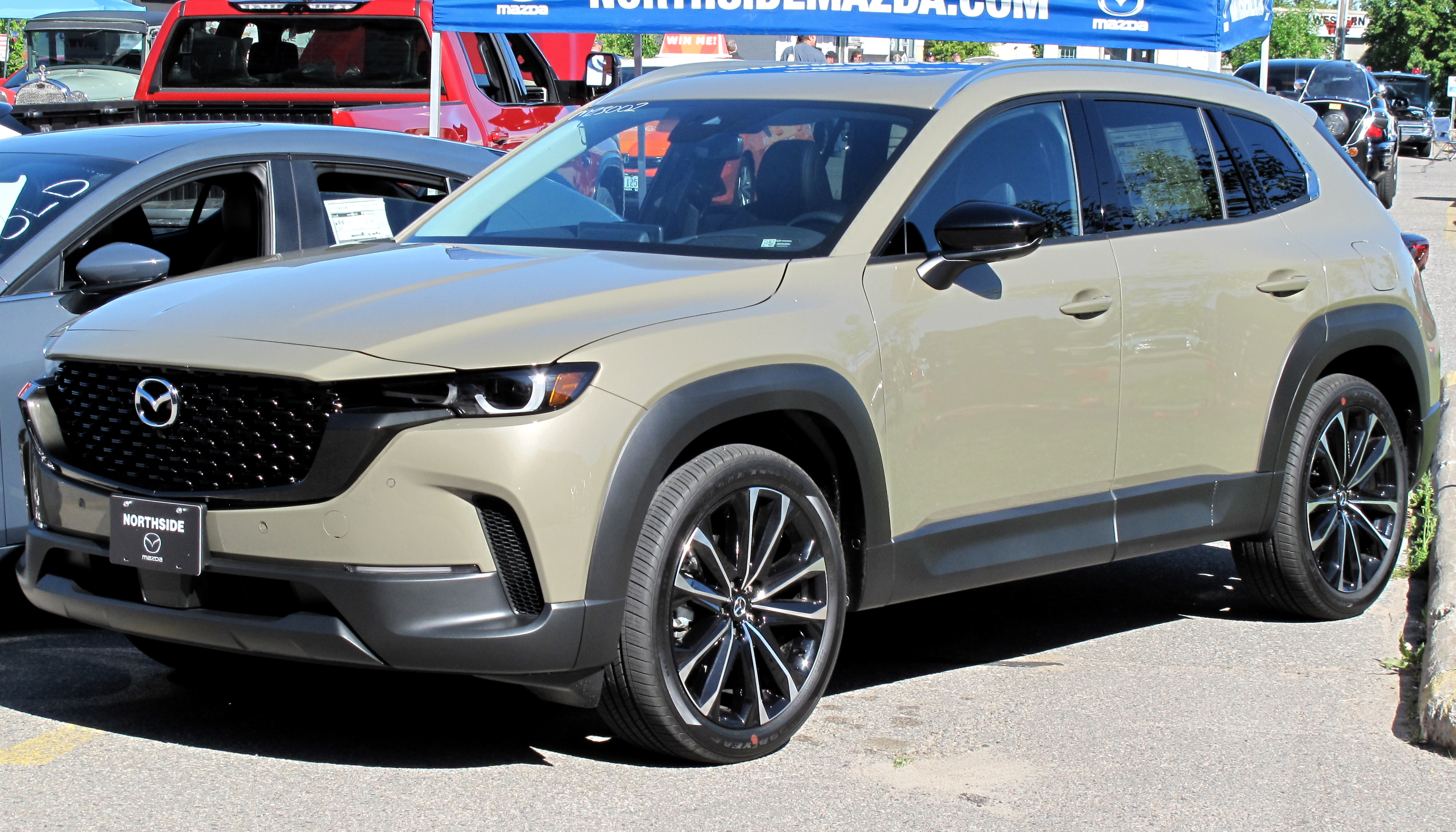
This is Mazda’s CX-50 SUV, but with a hybrid powertrain. The point they’re making is that it’s meant to drive more like a normal car on the road, while still being useful for everyday errands and road trips.
The CX-5 is another Mazda SUV in the smaller/compact category. They’re using it as a comparison point to explain how the CX-50 fits into Mazda’s SUV lineup.
A trim is basically the version of the car you buy—like how much equipment it includes. Different trims can change the price and what features you get.
A hybrid system uses both a gas engine and an electric motor. The car can switch between them (or use both) to save fuel and feel quicker when you need it.
A CVT is a transmission that can smoothly change the gear ratio without shifting like a traditional automatic. The computer controls it so the car stays efficient and drives more naturally.
All-wheel drive means power goes to more than one set of wheels. When it’s “electric,” the car can manage how much power each axle gets, which can help grip and stability.
Low-end torque is the power you feel when you’re just starting to move or accelerating from slow speeds. More of it usually means the car feels easier to drive and doesn’t need as much revving.
EPA estimates are the official fuel economy ratings you see on the window sticker. Your real mileage may be a bit different depending on how you drive and conditions.
LIVE
This is America On The Road, the best radio show by the International Automotive Media
Conference, and now in its 34th year on the air.
Thanks for being with us.
This is, we bring you the latest automotive information from around the world.
I'm Jack Neerad.
With me is co-host Chris Teigen.
Chris, you're a little bit sick and traveling today, not a good combination.
Where are you headed off to?
I'm headed to Vermont, and at least it's a very nice day outside.
I did 70 here, so spring is here all at once, I guess.
Ah, awesome, awesome.
Vermont, terrific.
I know where you're going.
It's going to be very pretty there, so enjoy that.
Hopefully you'll get a little bit of time to see what it looks like.
Plenty of automotive news to talk about this week.
Used vehicle prices are climbing again.
Tight inventory, strong seasonal demand as tax refunds hit consumers' wallets.
Those are nice things.
We'll break down all that.
Tesla is remotely disabling full self-driving for owners using unauthorized hacks.
I want to talk to Chris about this story.
This has been making the rounds here, pretty interesting stuff.
Makes you wonder what you own and don't own, I guess.
General Motors is ramping up its fight against distracted driving.
New in-vehicle technology, safety awareness push, all that kind of stuff.
It's pushing its full self-driving itself.
Boy, a lot of selfs in that sense.
Volkswagen is shifting gears in the U.S.,
ending production of the ID4 electric vehicle in Chattanooga,
doubling down on the Atlas SUV, how times change, right?
And Mini is adding a special edition.
We'll talk about that.
Toyota is updating the Land Cruiser for 2027, at least a little bit,
so we'll talk about that.
Chris, do you think a Land Cruiser would fit in your lifestyle?
I do, but I'm also a big Toyota nerd,
so maybe not as fitting as I would like it to be.
Ah, there you go.
America on the Road is brought to you by drivingtoday.com.
I am Lancy.com, the publisher of my latest book.
Only one thing stays the same.
And Mercury Insurance, if you're looking to save some money,
you should switch to Mercury for your auto and home insurance.
California has saved an average of $670 with Mercury,
so imagine how much you could save.
Get a quote today at drivingtoday.com slash auto insurance.
That's drivingtoday.com slash auto hyphen insurance.
Chris, what is your test vehicle for this week?
I spent the week driving the 2026 Acura MDX Type-S.
It's the sporty version of that SUV.
I can't wait to tell you all about it.
Sporty SUV, love to talk about that.
I had one too, actually.
My test vehicle is the 2026 Mazda CX-50 Hybrid.
Tell you all about that in our road test segment.
I especially guess this week is a great guy.
Ray Shefska is with CarEdge,
and he's an expert on extended warranties, among other things.
So stay with us, and we'll have a lot of show for you.
We're glad you're with us, and stay with us.
We'll be right back.
Welcome back to America on the Road with Chris Teeter.
We're here to do it in our news segment,
and there's a lot of interesting news going on
in the automotive world right now.
Used vehicle prices are climbing again.
Tight inventory, of course,
and that's been a long time thing in the used vehicle market.
Seasonal demand goes up in the spring.
Cox Automotive, some place that you know pretty well, Chris,
has said that the Mannheim Used Vehicle Index
rose 6.2% in March compared to a year ago,
so that's acceleration there.
Wholesale price is typically,
the average wholesale prices right under $20,000.
I mean, it's pretty tight out there
in terms of the used car market, isn't it?
Yeah, we talked about this last week,
the new car average transaction price is around $50,000,
I think, as of this month,
and people can't afford those new cars,
they're gonna look to the used market,
and unfortunately for used buyers,
that pushes the demand up there,
lowers the supply, and raises prices.
One thing pushing up demand is the fact
that a lot of people are expecting tax refunds
or getting tax refunds, so that's kind of a nice thing.
It's nice that they're getting tax refunds,
it's not necessarily nice that the prices are going up.
New car prices, of course,
are pushing more shoppers into the used car market.
Inventory is constrained on the used side.
A vehicle supply of just 37 days,
that's a record low, that means that there are
relatively few used cars on the market,
which translates into higher prices, doesn't it?
It does, and I can't help but wonder
if some of this is the tail end of the COVID effect
when we had those vehicles shortages,
that there weren't as many leases,
there weren't as many people buying cars,
so now we're seeing the other side of that,
where there are fewer leases being turned in
and fewer used cars being returned to dealers.
Yeah, I think we're at the absolute tail end of that.
I'm fairly close to the JD Power folks,
and they indicate that we're gonna see more used vehicles
coming into the market this year than last,
but as you say, that was an issue for a long time.
I'm really curious about your reaction
to this Tesla story, the fact that Tesla is cracking down
on this underground market of devices
that unlock full self-driving software.
This is in regions and countries, basically,
where this has not yet been approved.
There are reports from Europe, Asia, and the Middle East
that Tesla has just started to remotely disable the feature
in vehicles where it senses they're being used.
What's your take on all this?
I'm kind of of two minds here, right?
I can see Tesla's side.
They're looking at some liability
and maybe some regulatory issues
from having people using these features in places
where they're not approved to be used,
but at the same time,
if I bought the car in another country,
I already bought the feature,
the full self-driving feature, I own it,
you shouldn't be able to take it away from me.
I don't know.
I mean, I can see where a third-party underground device
could cause some issues with the car
and maybe have some reason to void the warranty
and take the features away,
but it's hard for me to make a solid decision on this.
Yeah, I'm right with you.
I'm of multiple minds on this.
I guess for about 500 euros, which isn't a ton of money,
you can get this thing that unlocks full self-driving
in these regions.
And then there are plenty of regions
where safety officials have said,
we're not going with this yet.
And one of the things the hack allows the system to do
and allows the driver to do is basically avoid the fact
that they're being monitored to determine
whether they're actually looking down the road
as they should be,
even when they're using this quote unquote,
full self-driving.
And we've had issues with the naming of that too,
but you're supposed to be paying attention, really,
is what should be happening.
And this allows you to not do that.
And I think that could be a major safety problem, right?
I mean, you're gonna be taking a nap in theory,
which you don't want.
Yeah, I do take issue with that.
We've talked about some fatal crashes involving people
who were really inattentive behind the wheel
while using some of these features.
And I think those driver monitoring features
are there for a reason.
And even though they're kind of a pain to some people,
they do serve a purpose.
I think that part of it does bother me.
It's interesting to me too
that a lot of these people have apparently
bought full self-driving,
but they haven't been able to open it up yet,
or they haven't been able to use it,
because the regulatory people have been slow
to approve it in their country.
And they paid good money.
I think in this market,
it was like $8,000 or something like that as an option.
So they paid money to have this and they don't have it.
You can see why they go,
okay, well, I'll throw some more money at this
and crack the code.
But it also makes you wonder, like, who owns the car?
It's not Tesla's car, it's your car, right?
Yeah, I mean, look, Tesla shouldn't have sold
those features in countries unless they were able
to back it up with actual functionality.
You know, I mean, that's just kind of the thing
that bothers me the most about that.
But once you buy a car, once you pay for the feature,
you should have that feature.
Right, right.
Well, one company that is pushing that kind of feature,
like self-driving, to target distracted driving,
actually, is General Motors.
I mean, they have made a new push
to avoid distracted driving.
Of course, this is Distracted Driving Awareness Month.
I don't know whether you celebrated with a cake
or anything, but that's what it is, Chris.
Now there are a lot of deaths, 3,200,
according to federal figures, and 300,000 injuries
in 2024 linked to distracted driving.
I mean, that's a big problem.
A lot of people dying on the road
because people aren't paying attention.
And it's easy to be distracted, right?
Not only by things in the car, but by other passengers,
by passengers in the car, by other stuff going on,
by your phone dropping at your feet,
while you're trying to look at a text, that kind of stuff.
I mean, there's a whole bunch of ways
to kind of screw up behind the wheel, aren't there?
Yeah, you know, the United States
has a ridiculous number of traffic fatalities
given how developed of a country we are on the world stage.
These things, as much as they do feel
like a little bit of a privacy invasion in some cases,
you know, especially having cameras inside the cabin
looking at you and all that,
it's gonna be more widespread as we go forward.
The Insurance Institute of Highway Safety
is gonna start including some of these things
to prevent, you know, reckless and distracted driving
as part of their safety rating system.
So I think in order to achieve a top safety pick plus,
more and more cars are gonna have to start
having these technologies.
General Motors is pushing hands free technology.
Of course, voice controls, that can help a lot.
You can talk to your car as opposed to looking at the dash
or looking at a touchscreen, Bluetooth connectivity.
I mean, that seems like so old school now,
but I guess a lot of people are still not using that.
And, you know, this kind of stuff.
And of course, then General Motors also has its own
kind of automated driving capability too
that I think it wants to get more people
interested in as well.
Yeah, I'm getting ready to take a 300 mile road trip
and most of that's gonna be done with supercruise
in a cattle like Escalade, so I'll report back.
I can't wait to hear how that goes for you.
Well, Volkswagen is changing its production strategy,
kind of driven, market driven change here.
I mean, it was going to make its Chattanooga Tennessee plant
essentially kind of all electric all the time.
Now it is changing that radically.
The all electric ID4 is going away
in terms of production there.
It's not going away totally, but they're gonna build them,
I think in Europe and other places probably also in China,
although we're not gonna see those.
And that plant is going to build the Atlas SUV,
a three row SUV with a conventional powertrain.
Big shift, isn't it?
Yeah, it's a shame for Volkswagen
after having invested so much money into the ID4
and converting the facility to make that vehicle.
But the Atlas is basically it's breadwinner, I guess, right?
Like that's the one that sells three row SUVs sell
in America, so I'm glad that they're able to keep
the Chattanooga facility going.
It's in my home state, so I'm happy to see it.
Yeah, I mean, it's interesting that Volkswagen
had pivoted from diesels and that kind of thing,
internal combustion engine vehicles to electrics
and now is pivoting back
to internal combustion engine vehicles.
So it's nice that the company has the ability to do that.
Toyota has unveiled updates to the Land Cruiser for 2027.
Of course, this is now hybrid powered.
And well, it goes without saying that has an off-road focus.
What's your take on the Land Cruiser?
It's got a couple of new things.
The new features are a high-mounted air intake,
so I guess you could do more waiting,
more creek passing.
And upgrade in second row seating
with heating and ventilation,
which might be great for the T-girls.
What do you think about that?
Yeah, I've tested one of the new Land Cruisers.
It was the lower trim that had cloth upholstery
and things like that.
It's an okay vehicle.
I'm not a huge fan of it as much as I am of the new
4Runner, I think that's a better all-around vehicle
for most people.
People who are buying these are looking
for a capable platform and these updates,
I think will help them do that.
Yeah, when you look at the Land Cruiser
and the 4Runner side-by-side,
you kind of scratch your head over
why you would pay a lot more for the Land Cruiser,
but that's my take.
Many has just introduced a limited-run Redline edition.
How do you feel about these limited editions?
Well, it looks to be just an appearance package,
so I'm not really sure how I feel about that,
but I mean, people love their appearance packages.
Yeah, yeah.
Remind us of the vehicle you're gonna road test this week,
Chris.
I drove the 2026 Acura MDX Type S.
I'm excited to hear about that.
I was driving the 2026 Mazda CX-50 in hybrid trim,
so stay with us for that, and we'll be right back.
I received a letter from a reader this week,
and I thought I'd share it with you.
Here's what he wrote.
I just got around to reading Dance in the Dark
and wanted to say how much I enjoyed it.
I'm a compulsive reader and this one was right up my alley.
An unlikely hero.
A lot of twists and turns, some adult content,
and humor that rose naturally from the action.
Keep on writing, and I'll keep on reading.
Of course, that's just the kind of letter
any author would love to get.
I hope that others get the same enjoyment
from reading Dance in the Dark
and my newest crime novel, Only One Thing Stays the Same.
Both are available exclusively at Amazon.com.
That's Dance in the Dark,
and Only One Thing Stays the Same,
both written by me, Jack Arneerat.
Thanks for looking for them today.
Welcome back, everybody, to America on the Road
with Chris T. Jackney Redback.
Well, he was so glad you're with us,
and if you like America on the Road,
please let others know about our show.
We would appreciate that.
It is road test time.
Chris, you're road testing a vehicle,
a sporty SUV in Type S trim, oh my goodness.
Tell us all about it.
Yes, it's the 2026 Acura MDX Type S.
I appreciate this Type S,
because it has an actually upgraded powertrain.
This is not an appearance package.
You can get into this vehicle,
the base models for around $52,000,
so this is not a cheap vehicle by any means.
My as tested price was almost $78,000.
That's for the top line MDX, the Type S,
with some options and a couple of accessories.
Jack, have you driven the MDX recently,
and if so, what did you think about it?
I think I was on a launch of MDX fairly recently,
so I have driven it.
I always have liked the MDX.
I think it's kind of the go-to
among that quite a value compared to some others
in that segment.
I agree, and some of the touches
I'll get into a little bit later on.
I really liked, and they were surprising for an Acura.
You don't expect some of these things,
but the base powertrain in this vehicle
is a 3.5 liter V6.
It makes 290 horsepower.
My MDX Type S tester had a twin turbocharged 3.0 liter V6.
It makes 355 horsepower with 354 pound-feet of torque.
You get torque vectoring all-wheel drive
as standard with the Type S,
as well as a 10-speed automatic transmission,
and it also has adaptive air suspension with auto leveling,
which if you're not expecting it,
you're sitting in a traffic light at times.
You can see the nose raised and lower at times,
but the effect there is that you get a smooth ride
most of the time, but when you put it into Sport
or Sport Plus mode, the suspension really tightens up,
and you get pretty decent handling for a three-row SUV.
I wouldn't put this on Acura Integra
or Honda Civic Si Type handling levels,
but very capable for a large vehicle here.
I think that also the engine makes a good noise.
Acura puts a good exhaust system on this vehicle,
but when you're just cruising around,
there's not a lot of engine noise getting in the way.
There's not a lot of exhaust noise,
so it does feel luxurious when you want it to,
and I will say this vehicle has larger wheels
than the base model.
I think they're either 21 or 22-inch wheels,
or maybe even 20s on this, but you get less rubber,
so the ride quality here is a little bit harsher
than the base MDX.
I think some people probably expect that.
The trade-off there is better handling.
Inside, you get sports seats with quilted
and perforated Milano leather upholstery
with ultra suede accents.
My test vehicle had, I think it's called Ivory Leather,
is the color they call it,
but you have like three or four leather choices
in this vehicle, which I appreciate.
A lot of times with Honda and Acura cars,
you might get tan and black or tan and charcoal,
so it's nice to see.
You have a few options, even in the sporty model
with the sports seats up front.
You get heated and ventilated front seats,
heated rear seats, massaging front seats,
and a heated steering wheel.
I will tell you that it took me until the third or fourth day
having this vehicle to realize that it had massaging seats.
I could obviously have read the spec sheet there,
but it's not immediately clear
some of the buttons on the dash, what they do and all that.
Jack, what do you think about the MDX interior?
I think they've come a long way.
I mean, in years past, this was kind of a,
just a somewhat gussied up Honda interior
in a lot of Acura vehicles,
and I think they've realized they got a,
they're charging a premium price,
they better give a premium interior,
and so I think they've really upped their game there,
and I think they're doing a nice job now.
I think they have good looking interiors these days.
I agree, you know, the MDX shares,
I think a platform with the Honda Pilot
and the Honda Odyssey and a few other Honda vehicles,
but inside this car, it doesn't feel like a Honda,
it doesn't look like a Honda, it doesn't sound like one,
so you definitely get the differentiation level there,
and again, it's nice to have the choice of seats,
and the materials are really nice here,
so you're not really missing anything.
This vehicle comes with a 12.3-inch digital gauge cluster,
a 12.3-inch touchscreen.
The touchpad controller system from several years ago is gone.
I think most people really despise that,
Acura hung onto it for longer than I thought they would,
but the Type-S also comes with a 10.5-inch
full-color head-up display system
that has navigation and safety alerts and things like that.
You also get wireless Apple CarPlay and Android Auto.
I had a lot of trouble getting wireless
to connect in this vehicle.
I often had to plug my phone in
to get it to realize that Apple CarPlay was a thing,
so I think, you know, just something to keep in mind,
test it out, I think wireless works flawlessly,
or wired connectivity works flawlessly,
so no issues there.
You also get a Bang & Olufsen sound system
with the Type-S, which sounds fantastic.
It's more than loud enough.
No issues with the sound system,
and then you get a full suite of safety equipment,
so you get forward collision alerts,
blind spot monitoring with rear cross-traffic alerts,
adaptive cruise control, and so on,
with automatic lane keeping and things like that.
So I think if I were buying an NVX jack,
I'd probably opt for a lower trim
and maybe get one with some options,
like a panoramic moonroof and maybe a nicer stereo.
The Type-S is a lot of fun for what it is,
but if you're buying a three-row luxury SUV,
you probably don't need the extra power
and the extra sport mode
and air suspension characteristics here.
Yeah, I've always wondered about these sporty three-rows.
I mean, who's doing that?
I mean, who cares about that?
I think if you're buying a three-row,
probably you want comfort and room
and those kind of things,
much more so than you want sporty handling,
but certainly we look-
Well, if you wanna say I have the best Type-S there is,
or the best MDX there is, then the Type-S is it,
but otherwise you could save a lot of money.
Yeah, agreed, agreed.
I was driving the 2026 Mazda CX-50 Hybrid.
This is somewhat of an expansion of the model lineup.
CX-50 is one of the smaller of the Mazda SUVs.
There's also the CX-5,
which is kind of largely competitive
with this vehicle in some ways and in some ways not.
In an era when many manufacturers are trying to establish
rugged outdoor-oriented identities for their SUVs,
not so much in the CX-50, and I think that's just fine.
I mean, this is much more of a road-oriented vehicle
with a lot of utility for a smaller vehicle.
We just transported a bunch of stuff,
our luggage and stuff up north and back in it, for example.
It comes in a baffling number of iterations here.
Mazda does this and I don't know how they do it,
but the Hybrid alone is available
in preferred premium and premium plus trims,
and we had the premium plus trim,
which is easy to say, as our tester.
MSRP of $43,265, goodness.
We'll talk about value though a little bit later.
This is a very likable vehicle,
powered by a two and a half liter four-cylinder engine
with a hybrid system, combined 219 horsepower,
which is plenty.
It's not gonna blow anybody's doors off, but plenty of power.
And then the fact that it has this electric torque
from the electric motors and it has four and a half
electric motors with an electronically controlled CVT,
electric all-wheel drive, of course.
That's pleasant.
I mean, the driving dynamics are pretty good
because you've got that low end torque.
And good EPA estimates, a fuel economy estimates,
39 miles per gallon in the city,
37 on the highway, and 38 combined.
Mazda doesn't have a long history of building hybrids,
but this is a pretty good one.
So it works pretty well.
Towing capacity is 1,500 pounds,
so you're not gonna do tons of towing.
But this has Mazda's driving dynamics.
It's a vehicle that is fun to drive.
You've spent some time in CX-50, I imagine, Chris.
Tell us about your impressions.
Like you, I remain impressed that Mazda's able
to offer so many configurations
and then two head-to-head competing vehicles with the CX-5,
which was recently updated as well.
I do agree the hybrid is fun to drive.
Mazda's driving dynamics are better
than the competition.
I do think Mazda benefits from its partnership
with Toyota.
Toyota owns a stake in Mazda.
I think that helped their hybrid system.
So I'm a fan.
Yeah, and it certainly helped them with this, too.
I think maybe there's some shared production capacity
for CX-50 as well.
There are drive modes in this vehicle tailored
for the hybrid.
You can get power and trail.
I'm not sure many people are gonna be using this
on the trail.
It wouldn't be my choice on the trail.
Like I say, this is a great on-the-street vehicle.
And then the interior accommodations.
We're praising Mazda for that.
And I think rightly so.
They do a great job.
I think this is, if it's not a premium vehicle,
it is premium adjacent anyway.
It is very luxurious, good looking.
The materials are, you can go from half leatherette.
Do you know any half leatherettes out there, Chris?
But yeah.
I do not.
Me either.
To full leather, heated and ventilated front seats,
heated rear seats, a bunch of stuff like that.
Power adjustable driver's seat, dual zone climate control,
the panoramic moon roof.
So that's a nice cabin experience.
It's just good inside.
Your thoughts on Mazda interiors
and the CX-50 in particular?
Yeah, as you say, they're premium adjacent.
They definitely feel nicer than the price tag suggests.
And they're, again, nicer than the competition.
So yeah.
Right.
Well, let me talk about a gripe.
And it's a gripe we've had for a long time
with Mazda vehicles.
And it just hasn't been fixed yet.
And that is the infotainment system.
And it's kind of nice enough display.
It's in a quarter inch display.
It has Apple CarPlay and Android Auto.
It just seems kind of recalcitrant,
which you won't hear that word on a lot of other car shows.
But I'm using it.
And that means it's kind of hard to use sometimes.
You should have some voice control functionality,
but that didn't seem to work all that wonderfully well.
And just getting Apple CarPlay to connect,
we tried it several times, and then suddenly it worked.
And I don't know whether it's just slow to hook up
or what the deal was, as my wife would say, the dealio.
But otherwise, this is such a likable car
that I feel bad that I've got to kind of slap it around
for that.
I mean, it has tons of safety equipment.
I mean, Mazda really piles on the safety equipment.
Cross-traffic alert, smart brake support,
traffic sign recognition,
some stuff that you wouldn't necessarily see
in a lower-priced car.
Of course, then you can say,
well, it's not all that lower-priced.
This is $43,000 for a vehicle this size.
Your parting thoughts on this, Chris.
Yeah, I know Mazda's put some work into updating
their infotainment system,
but it has been a low point for years.
But again, you do get a lot for the money,
even though it doesn't feel like that big of a bargain.
Yeah.
The good news is you can save money on gas with this thing,
and I think there are real savings here,
so that's a good thing.
And again, a very likable vehicle,
fun-to-drive vehicle.
I wouldn't go heavily off-road with it,
but then I don't think many people are doing that anyway.
Our special guest is coming up.
His name is Ray Schefska.
He works for a company called,
he's actually a co-founder of a company called Car Edge.
He's also a veteran of 40 years in auto retail
and an expert on extended warranties,
and we're gonna talk about that.
So stay with us for all that,
and we'll have some more with Ray Schefska
when we come back.
Stay with us.
["The Star-Spangled Banner"]
I'd like to tell you about the most exciting
and authentic racing novel I've ever read.
It's called Closing Speed,
written by award-winning author Ted West.
In 1970, the Indy 500 pole speed was 170 miles an hour,
but at Le Mans, Vic Alfred's Porsche 917
raged down the Mulson Strait at 248 miles per hour.
The racing pit of the Porsche 917 versus the Ferrari 512,
the fastest road racing ever,
and Road and Track sent a promising new rider,
27-year-old Ted West, to cover it.
He traveled from Brands Hatch to Monza,
the Targa Florio, Spa, the Nürburgring, and Le Mans.
You got to know the races personally
and the women who loved them.
The racing was blindingly fast.
Driving horrifically fragile cars at those speeds
took unheard of courage.
That was around every corner
and the drama tensely real every moment.
Closing Speed is the most realistic,
intimate racing novel ever written.
It's a look into the very heart of the sport,
an incomparable racing read.
It's available now at Amazon.
That's Closing Speed by Ted West.
Look for it.
Welcome back everybody to America on the Road Track
and your ride back with you.
And we have a true big guest for you
from an organization called CarEdge.
His name is Ray Shefska.
And Ray, thanks so much for being with us.
We appreciate it.
Jack, thanks so much for having me.
It's a pleasure to join you today.
Tell us a little bit about CarEdge.
We want to talk about auto warranties
and extended warranties, that kind of thing.
That is a real reason for being on this segment.
But first I want to learn a little bit more about CarEdge.
CarEdge is an organization
that my son and I co-founded six years ago.
And the basis for the business
is to help educate and form and entertain people
so that they have a better understanding
as to the sales process
when they are about to head into a dealership.
I used to manage automobile dealerships for 43 years.
Well, my son thought that my insights
might be able to help people.
You know, I really think that's true.
And a car purchase is one of the most complicated purchases
anybody's ever going to make.
It may be rivaled only by buying your own home
or something like that.
And you don't do that nearly as often
as most people buy cars.
So having your expertise seems like a terrific idea.
Well, yeah, Zach thought, he said to me,
he said, well, you know, I have you
when I go to buy my car.
Why shouldn't the rest of America?
So here we are.
Yeah, well, terrific, terrific.
What do you think is the biggest mistake
people make when they go to buy a car?
They concentrate on the wrong thing.
And what I mean by that is most people,
85% of all car buyers out there
are what's referred to in the industry as payment buyers.
And all they're interested in
is what their monthly payment's going to be.
When in reality, what they need to be interested is,
well, how much am I paying for the damn car?
And they put that aside just to concentrate
on a monthly payment.
And when they do that, typically they pay way too much
and they're making payments for way too long.
Yeah, I mean, we're looking at loans that are going 84 months
now is not uncommon at all.
And you and I both know what that implies, right?
Well, I might not live 84 more months,
but that's besides the point.
Yeah, what we're seeing is 84 months.
We even know of credit unions out there
and some banks out there that are offering 120 month loans.
And if you have to find something that long,
I'm pretty sure you really can't afford it.
Yeah, absolutely true.
And when you're getting a home loan
that's 30 years or something like that,
you have the sense that at least that asset
will appreciate or not depreciate in such a rapid fashion.
But cars aren't like that, are they?
Not really.
Cars are probably the,
well, I hate when people say it's an investment.
It is not an investment.
When a customer would ever say that to me,
I would look at them and say,
let's pretend I'm your investment counselor for a minute.
How about you give me $50,000
and I'll show you how to turn that into $25,000 in three years.
Are you going to fire me or are you going to keep me?
And that's what a car is.
A car is, it's an expense.
It's not an investment and people have to treat it
as an expense and they have to figure out ways
to minimize that expense, not maximize that expense.
Yeah, well give us a tip or two on that
before we dive into warranty.
Well, when you go into,
before you go into shop for a car,
what you need to do is you really need to assess
what your needs are versus what your wants are.
And I can assure you that your needs
are going to cost you a lot less than your wants.
So practice a little self-control
and only look at things that,
well, satisfy your needs, not your wants.
And then actually understand your budget.
If you are a payment buyer,
well understand that you want the payment to last
for as short a period of time as possible,
not as long a period of time as possible.
And then once you understand what that payment buys,
total dollars and cents wise,
don't look at any cars that are more expensive than that.
Makes a lot of sense, absolutely makes a lot of sense.
Before I get to warranties,
one more question I want to ask you
and it's about cash buyers.
I typically buy a car with cash.
How do typical dealers feel about a cash buyer like me?
They're not particularly fond of you.
And the reason they're not is most dealerships
arrange for automobile loans for their customers.
That's what's known as indirect lending.
And so you're not the one actually applying
to the bank for the loan.
The dealership is applying to the bank
for the loan on your behalf.
And so the bank can approve the loan
and they will tell the dealership
how much the rate will be for that loan.
And since it's indirect lending,
the dealership is allowed to mark that rate up.
And most dealerships mark interest rates up
anywhere from one to 2%.
And then they participate in the extra profit that is made
because there's extra interest to be paid.
And typically the dealership gets 70% of that.
And the bank gets 30% of it,
which is why the bank's okay with it.
Yeah, and which is why I typically don't tell people
I'm a cash buyer until I'm pretty close
to the end of the transaction.
That's exactly when you should let them know.
Yes, not before.
All right, let's talk about extended warranties.
Car repairs are getting more and more expensive.
Of course, everything's getting more expensive.
Cars are more expensive and the repairs are more expensive.
What's your overall take on those
before we dive into more specific?
Well, let me preface this by saying
I spent 43 years in a retail automotive,
so my take might be a little bit prejudiced.
But this is what I used to tell people.
Extended warranties, vehicle service contracts
for your car are simply similar
to health insurance for you as a human being.
You pay your premiums every month
and you pray to God you never have to use it.
Well, the same holds true for your car.
It's health insurance for your car.
And if you are like most people in America
where you are a payment buyer,
and as we know, most Americans don't have $500
for an emergency, well, then I'm pretty sure
most people can't afford that expense
if something goes wrong with their car.
So if you think of an extended warranty
as health insurance for your car,
you make your monthly payment on it.
You pray you never have to use it.
But if you do, you're not coming out of pocket
for anything other than the deductible
if it is a covered repair.
And that's the key.
What's covered and what's not.
Yeah, well, a couple of things I would point out there.
I mean, if you don't have the $500 for an emergency,
I would say you probably shouldn't be buying a new car.
Number one.
Yeah, but that would collapse the economy.
Exactly, wouldn't it, you know?
And we want people to continue to buy cars,
I certainly do, as a car reviewer for 40 years,
absolutely, but I would think about that too.
And at the same time, I think with health insurance,
a lot of people run into catastrophic problems, right?
Problems that would bankrupt you.
Hopefully you're not going to see that
out of a car problem you have.
So I would say the analysis is a little bit different there.
What do you think about that?
I think you're spot on,
but if you're selling cars for a living,
the health insurance analogy works pretty well.
And in today's world, you know,
a major repair could become catastrophic
on some of these cars with all the electronics built into them
because realistically,
they're nothing but computers on wheels today.
Absolutely true.
Let's say somebody decides that they want
an extended warranty and for a lot of people,
it's a good idea.
I mean, it just gives them peace of mind.
You know, you know, in theory,
you know, the maximum you're going to pay for a repair.
What are some tips you would give to them?
Well, make sure it's an exclusionary policy
and not an inclusionary policy.
Exclusionary policies are more comprehensive
and cover more items on a vehicle
than an inclusionary policy.
And then cross shop them with other sources.
Explain that, would you Ray?
Because I think what you're saying is
some policies say what they do cover,
others say that what they don't cover
and really you kind of want the latter, right?
Yes, because what they don't cover is typically greater.
They cover more things than the one
that tells you what they do cover.
And so the better policies out there
are the exclusionary policies.
They're much, much more comprehensive than inclusionary.
And you know, dealerships sell extended warranties
and then there's any number of companies out there
that sell extended warranties as well.
And if you're interested in one, especially,
let's say you're looking at a particular brand,
maybe you're getting a Ford.
Well, you don't have to buy the warranty at your Ford dealer.
If you're interested in the warranty,
call other Ford dealers and get them to give you quotes
and then you can reward whoever gives you the lowest quote
for the same coverage.
It's not unlike shopping for anything else.
And it is negotiable.
Yeah, let people know that you're shopping.
Probably helps with that negotiation too.
Yes.
You also probably don't have to buy it
right when you buy the car, right?
I mean, walk us through that.
I mean, that kind of long warranties to begin with.
Well, yes, most cars have a three year,
50,000 mile, or three year, 36,000 mile warranty.
Some are for 50, some are for 550.
They like to sell you the warranty.
They like to bundle it into your financing.
It's just more profit for the dealership at that time,
especially when they've marked up the interest rate on you.
And realistically, that coverage doesn't go into effect
until your factory warranty runs out.
If you're interested in an extended warranty,
buy it right before your factory warranty expires
or you can even buy it after the warranty expires.
The difference is it'll be slightly more expensive
at three years and 36,000 miles
than it would be at zero miles.
But you haven't been paying for it for three years
and gotten nothing out of it.
What is your take on a manufacturer backed warranty
versus a third party warranty that is not manufactured?
Well, a lot of the manufacturer's warranties
are actually third party backed warranties.
But let's face it, if there's really an issue,
the manufacturer's going to step in
and do their best to make good
because they don't need the bad publicity,
they can create all their own, they don't need extra.
But there are a lot of third party warranty companies
out there that are good and they do offer a good value.
It's like anything else, you have to check,
you have to make sure and with all the information
that's available on the internet today,
it's easy enough to check on a company's reputation
and background and see who it is you're trying to deal with.
Because really an extended warranty company
is essentially an insurance company, right?
I mean, we see pet insurance now,
we see insurance on kind of all kinds of things.
You know, consumer electronics that we never saw
insurance on before, part of it I guess is based
on the fact that stuff is more expensive
than ever before, right?
But also there's profit to be made
from all of these insurance companies.
Oh, absolutely and obviously some cars
are a lot less expensive to cover through
an extended warranty than others.
For instance, we use a company called Fair
when it comes to extended warranties on our website
and we had a customer who said,
my God, the price quote for my BMW was astronomical.
So we contacted the CEO of Fair
and his response was, well, the repair rate for that BMW
is outrageous and because of that
and because they're a relatively new company,
they don't have a lot of ways to hide repairs like that
so that they can keep the cost down.
They have to charge accordingly for it
and then there's some brands,
it's virtually impossible to get an extended warranty on it.
A lot of Land Rovers and Range Rovers
are difficult to find extended warranties for
because they know they break
and they're not cheap when they do.
Tell our listeners how they can reach you at CarEdge.
Just CarEdge.com, C-A-R-E-D-G.com.
We've got a full service website, tools, tips,
videos, blogs, anything and all that can help
make that car purchase a little bit easier.
Yeah, we'd all love to see that.
Well, Ray, I knew we were gonna be friends.
Practically the second we decided to talk to one another
and I'm so glad you were with us today.
Thanks so much for being with us.
Thanks for having me and I look forward to speaking
to you again.
I hope so.
We were gonna do that soon.
So stay with us, everybody.
We'll be right back right here on America on the Road.
Welcome back to America on the Road with Coach.
This is Jack Meerat with you
and it is listener question time,
our final segment of this week.
I always am sad when this happens
because I love to talk with Chris about cars
and we love to answer your questions too
based on our lengthy experience.
Send your questions to editoratdrivingtoday.com.
That's editoratdrivingtoday.com.
Here is a great question I think from Theotis in Chicago,
my hometown, he asks.
I need to buy a used car and it seems like
everyone I look at has a whole lot of miles on it.
What used car brands are most reliable over 100,000 miles?
Well, I have a little bit of experience
buying used cars with over 100,000 miles
and I will tell you, I think that you're probably
still looking at the usual suspects here.
You're looking at Toyota, you're looking at Honda,
you're looking at Mazda and those are probably the three
that I would go with.
If you're looking at hybrids, it's probably not gonna be,
you're gonna need to do a little bit more homework there.
I think hybrids are a little bit touchier
when you get past 100,000 mile mark
and the warranties usually start wearing out at that point too.
But I think those would be my three favorites, Jack.
And the problem there is that everybody else
thinks the same way, right?
So the Toyotas, the Hondas and the Mazdas
are usually a little bit more expensive on the used market.
Yeah, I mean a lot of people used to steer away
from high mileage used cars and certainly 100,000 miles
is way high mileage.
It used to be over 50,000 miles was considered
to be very, very high mileage for a used vehicle.
A lot of these vehicles and I would say Toyota in particular
has a lot of useful life after 100,000 miles.
So I would say that and also I would say big Chevy trucks.
We've got a Chevy Tahoe with 130,000 miles on it
and still ticking away, so good stuff there.
That wraps up our show for this week.
I'd like to mention that my crime novel,
only one thing stays the same is available
as an e-book and paperback, that's at Amazon.
If you like our show, pass it on,
listen on this radio station each week,
let your friends know where you hear America on the Road
and we'd love to double our listenership this year.
We need your help, don't we Chris?
That's right, you can help us by looking up
the America on the Road podcast with a quick Google search.
We'll come to you on all the major platforms,
Apple, Spotify, several others.
Like the show, subscribe to the show,
download us so you can take us with you wherever you go
and that helps us out.
We would appreciate that very much.
Check out our YouTube channel.
We do our many road tests on there,
a lot of video content now.
Our thanks to Mercury Insurance for sponsoring the show
and to our sports byline network stations
for carrying it on a terrestrial radio, most of all.
Thanks to you for listening, we do appreciate it
and we hope you'll join us again next time
for another edition of America on the Road.
["America on the Road"]
I received a letter from a reader this week
and I thought I'd share it with you.
Here's what he wrote.
I just got around to reading Dance in the Dark
and wanted to say how much I enjoyed it.
I'm a compulsive reader and this one was right up my alley.
An unlikely hero, a lot of twists and turns,
some adult content and humor that rose naturally
from the action.
Keep on writing and I'll keep on reading.
Of course, that's just the kind of letter
any author would love to get.
I hope that others get the same enjoyment
from reading Dance in the Dark
and my newest crime novel, Only One Thing Stays the Same.
Both are available exclusively at Amazon.com.
That's Dance in the Dark and Only One Thing Stays the Same,
both written by me, Jack Arnie Ratt.
Thanks for looking for them today.
About this episode
The America on the Road crew tackles a busy mix of auto news and real-world ownership talk, from rising used-car prices and tight inventory to Tesla remotely disabling full self-driving in regions where it isn’t approved. General Motors’ push against distracted driving and Volkswagen’s shift away from Chattanooga ID4 production toward the Atlas are also covered, along with Toyota’s 2027 Land Cruiser updates and a Mini limited edition. Road tests compare the 2026 Acura MDX Type S and the 2026 Mazda CX-50 Hybrid, then Ray Schefska of CarEdge shares practical guidance on extended warranties and buying smarter.
This week on America on the Road, Jack Nerad and Chris Teague review two impressive SUVs — the high-performance 2026 Acura MDX Type S and the fun and fuel-efficient 2026 Mazda CX-50 Hybrid. They also dive into rising used car prices, Tesla’s crackdown on Full Self-Driving hacks, GM’s new distracted driving tech, Volkswagen’s U.S. production shift, the new MINI Red Line Edition, and Toyota’s updated 2027 Land Cruiser.
🚙Jack Nerad’s Road Test: 2026 Mazda CX-50 Hybrid
Jack reviews the 2026 Mazda CX-50 Hybrid Premium Plus, which combines 219 total horsepower, standard AWD, excellent 38 mpg combined efficiency, and rugged outdoors styling. He covers its smooth hybrid powertrain, composed ride, upscale interior, 10.25-inch display with wireless CarPlay/Android Auto, strong safety suite, and assesses its value at $43,265 as tested.
🚗Chris Teague’s Road Test: 2026 Acura MDX Type S
Chris tests the 2026 Acura MDX Type S, the most powerful and luxurious three-row SUV in Acura’s lineup. It features a 355-hp turbocharged 3.0-liter V6, 10-speed automatic, Super Handling All-Wheel Drive with torque vectoring, adaptive dampers, Brembo brakes, massaging seats, and an available 25-speaker ELS Studio 3D audio system. Is it still the go-to in the luxury three-row segment?
🎙️Special Guest Interview
Ray Shefska from CarEdge joins the show. With over 40 years in auto retail, he shares expert insights on extended warranties and smart car-buying strategies.
📰This Week’s Headlines
Used Vehicle Prices Surge
Tight inventory and strong tax-refund demand push the Manheim Used Vehicle Value Index up 6.2% year-over-year, with wholesale prices nearing $20,000 and supply at record lows.
Tesla Cracks Down on FSD Hacks
Tesla is remotely disabling Full Self-Driving on vehicles using unauthorized unlock devices, voiding warranties and raising ownership and safety questions.
GM Fights Distracted Driving
General Motors’ new Driver Attention Assist technology and a major awareness campaign aim to reduce the 3,200+ annual deaths caused by distracted driving.
Volkswagen Shifts U.S. Production
VW ends ID.4 production in Chattanooga to focus on the gasoline-powered next-gen Atlas SUV.
MINI Launches Red Line Edition
The spunky brand introduces a bold new special edition of the Cooper S with sporty styling, red accents, and performance upgrades starting around $34,000.
2027 Toyota Land Cruiser Updated
Some new equipment accompanies the hybrid powertrain with 326 hp and 465 lb-ft, enhanced off-road tech, and modern amenities.
❓Listener Question
Theotis from Chicago asks: “What used car brands are most reliable over 100,000 miles?” Jack and Chris share their recommendations.
📚 Jack Nerad’s New Book
Jack’s crime novel, Only One Thing Stays the Same, is available now in paperback and eBook on Amazon — currently at a sale price.
🎧 Where to Listen
Catch America on the Road on your local Sports Byline Radio Network station each week and subscribe to the podcast on Apple Podcasts, Spotify, YouTube, and more. Follow for new car reviews, guest interviews, auto news, and road tests.
Sponsored by Mercury Insurance and DrivingToday.com
📺 Watch & Subscribe
Find America on the Road on YouTube and Rumble. Subscribe for road test videos, shorts, and extended reviews.