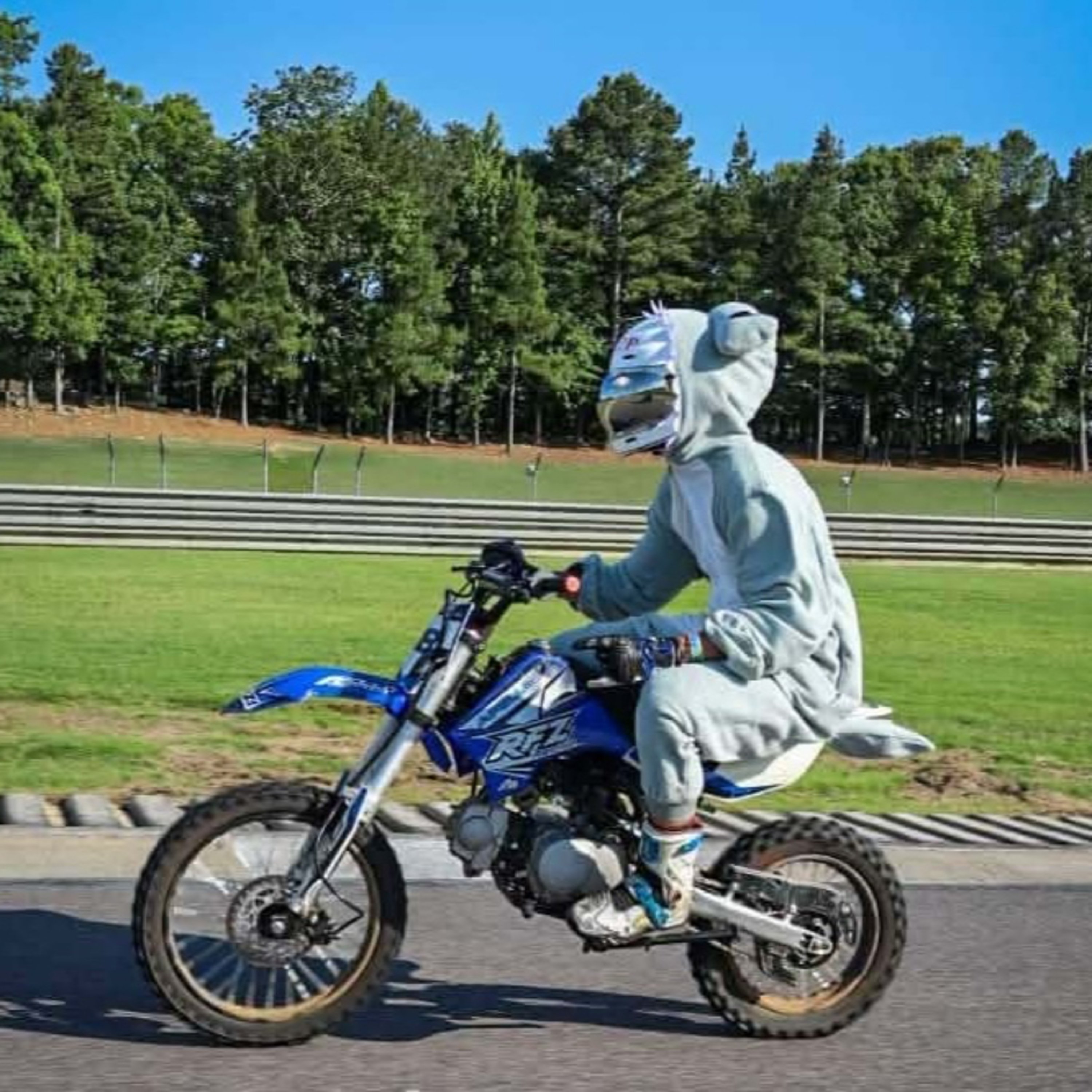
A “crash count” just means how many times someone has crashed. On a track, it can be a way to measure how much you’re learning and how often mistakes happen.
Topic
TMGP
TMGP is the name of the motorcycle racing group/series they’re talking about. It sounds like there are rules for what bikes and setups are allowed.
Cruiser tires are tires made for a more relaxed, street-style bike. Using them on a small race bike means they weren’t starting with track tires, but they were trying to get it working for racing.
Topic
Denton round
A “Denton round” sounds like a race event held in Denton as part of a bigger series. It’s probably one stop in a season with multiple races.
Dirt suspension is made for rough ground—more bump absorption and better grip on uneven surfaces. That changes how the bike feels when you hit corners or land after bumps.
Company
Motor Liberty
Motor Liberty sounds like a local shop or community where they got the riding gear they needed. It highlights that being prepared with the right suit matters when you’re learning on track.
Topic
Ryder School
“Ryder School” appears to be a structured riding/track training session where riders learn technique and lines. The speaker mentions doing it and then practicing afterward, suggesting it’s part of a progression from instruction to real track riding.
If you crash early, it means you’re testing what the bike can do before you go faster. The goal is to learn where you’re losing control so you can ride smarter next time.
Car
TTR 125
The TTR 125 is a beginner-friendly dirt bike. It’s small and common for learning how to ride on dirt tracks, which is why it shows up when someone is practicing and making mistakes.
Term
cruised the tires
“Cruised the tires” is a rider’s way of describing tire spin or sliding—using the tires’ grip (and loss of grip) to move the bike around. It usually indicates the rider found traction limits and was having fun with controlled loss of grip.
Topic
three hours of sterling
This sounds like they rode for about three hours at a track/event called Sterling. More time on track usually means more practice and faster learning.
Concept
cheap vs go kart racing
The speaker compares the cost of track riding to go-kart racing, emphasizing that entry-level motorsports can be much cheaper depending on equipment and venue. This is a practical concept for listeners: budget and barrier-to-entry often determine what kind of racing/training people pursue.
Concept
building formula cars
“Building formula cars” refers to constructing and maintaining open-wheel-style race cars, which can be expensive and time-consuming. The speaker uses it to explain why dirt-bike track riding felt like a more affordable hobby at the time.
They’re basically saying dirt biking feels safer because you’re not dealing with cars and traffic. On a farm you can go slower and the main challenge is controlling your speed and balance on the ground.
Those are different ways to weld metal together. TIG, MIG, and arc welding are common shop processes, and gas welding uses a flame—each one is useful for different kinds of metal work.
They’re describing how building a race car in college is like a real engineering project. Students learn by doing the work—designing and building—while still taking classes.
Formula SAE is a college competition where students build their own race car from scratch. Teams learn how to design the car, assemble it, and then test it for performance.
Chassis design is about building the car’s main structure. In a race car, it needs to be strong and rigid so the wheels and suspension can work predictably.
The Ford Bronco is a type of SUV built for off-road driving. People often restore older Broncos and work on them themselves, so it can come up in conversations about repairs and projects. It’s known for having lots of parts and support for DIY work.
The Chevrolet Chevelle is an older muscle car, and the ’65 is a well-known version. The podcast mentions rebuilding one, which means taking it apart and fixing or replacing worn parts. People talk about it a lot because it’s a popular classic to restore and work on.
Formula SE is a program that mixes engineering learning with racing. The guest says it helped steer them toward motor sports and eventually motorcycles.
A “lemon’s car” is a joke term for a race car that’s not supposed to be perfect—often cheap and a little unreliable. The fun is building something that can still race.
Moto Liberty is a motorcycle gear shop mentioned as the guest’s workplace. The conversation frames it as a high-quality environment for riders—especially because they stock lots of leathers and gear and employ passionate staff.
Circle track racing is racing on an oval track where the cars mostly go around in circles. Because the turns are consistent, teams set up the car to handle that kind of driving and tire wear.
A road course is a track designed with a mix of left and right turns, braking zones, and elevation changes—more like real-world driving. Cars and suspension setups are usually tuned for repeated cornering and braking rather than mostly steady oval-speed running.
A “one stop shop” is a place where you can get everything you need in one place. For racing gear, the hard part is making sure it fits, and returns can take time.
OBD2 is a built-in diagnostics system in most cars that can report what the car is doing and what faults it detects. An OBD2 sensor/device reads that information so you can track vehicle health or performance.
Complex system integration is making sure all the different parts of a vehicle’s electronics work together. It’s less about one single component and more about getting the whole system to behave correctly.
An ECU is the car’s main computer. It controls things like engine behavior, and it also has to “talk” to other computers in the car so everything works together.
ABS modules are the car’s computers that help prevent wheel lockup during hard braking. They need to work with other car computers so the braking behavior matches what the sensors are saying.
ABS testing is making sure the anti-lock brakes work properly. It’s not just about testing one part alone—it's also about making sure it works correctly with the rest of the car.
This is about making sure all the car computers work together once they’re connected. Even if each part works alone, integration testing checks that they share the right information at the right time.
Here, “interfaces” means how different car computers connect and share information. If they aren’t compatible, they might not understand each other even if both are working.
In racing, rule changes can force teams to redesign parts or strategies on short notice to stay compliant. That’s why teams often build with flexibility and maintain processes to quickly re-engineer solutions when regulations shift.
Systems engineering is basically “making sure everything works together.” Instead of focusing on just one part of the car, you coordinate multiple teams so the whole race car meets the same rules and goals.
The powertrain team is responsible for the components that generate and deliver drive—typically the engine, transmission, and related driveline systems. In a race program, their work must align with chassis and electronics requirements so the car behaves consistently under race conditions.
Concept
electronics and safety team
The electronics and safety team covers systems like data acquisition, control electronics, and safety-critical components that must function reliably under racing loads. Their work must match the car’s mechanical requirements and rulebook constraints to avoid conflicts between teams.
Concept
mathematically and financially impossible cost benefit analysis
They’re basically saying that for the money, riding/racing motorcycles gives you more enjoyment than you’d expect. It’s their way of judging whether spending on bikes is “worth it.”
In racing, you need parts for repairs and upgrades. The hosts are saying the Benelli may be harder to support because it’s not as easy to find replacement or upgrade parts.
Car
Honda Grom
The Honda Grom is one of the most common mini bikes for racing. In this segment, it’s the comparison point for speed and—especially—how easy it is to find parts.
“Hotter motors” means the engine is set up to make more power. That can help lap times, but it may also run hotter and stress the bike more.
Car
Benelli TNT135
The Benelli TNT135 is a small motorcycle the host is racing. They’re talking about whether it’s a good choice for the rules and how it stacks up against other popular mini bikes.
The hosts describe a common pattern in some budget motorcycles: a frame design that looks similar to other models, but with different (often heavier) mass. Weight affects acceleration, braking, and handling, so being ~20% heavier can change lap times and tire wear.
Clubman bars are handlebars used on café-racer-style motorcycles. They change your riding position and how you can brace during braking, and in this story that setup didn’t work out safely.
Clip-ons are a type of handlebar setup that puts the bars closer to the bike and usually lower. That can make the bike feel more “sporty,” but it can also make it harder to hold on or brace if something goes wrong.
Bracing during hard braking is about where the rider can safely grab and support their body when decelerating aggressively. This segment explains that removing the tank and using low bars removed the rider’s ability to brace effectively, increasing the chance of being thrown forward.
Car
Benelli
Benelli makes motorcycles. Here, the speaker is saying that on their Benelli, the way the handlebars were set up made braking feel unstable and unsafe.
The run-off area is the space next to the road that’s supposed to help if you go off the lane. Here, it wasn’t fully safe because there was a drainage ditch in it.
“Self-ejecting” is a dramatic way of saying the bike can throw you off by itself when you brake hard or crash. In this case, the handlebar setup made it easier for the rider to get pitched forward.
That phrase means the bike wasn’t street-legal and didn’t have insurance. If there’s an accident, it can make everything harder for the rider and the other party.
A side stand is the little leg that you flip down so the bike can stand on its own. In this story, removing it meant the rider couldn’t park safely and ended up tripping right after the crash.
If something is bolted together and it gets lots of shaking, the bolts can gradually loosen. Once they loosen, the body may not heal properly and problems can happen.
Loctite is a sticky chemical that’s put on screw threads so they don’t loosen over time. It’s meant to resist vibration, which is exactly what can make screws slowly back out.
Safety wire is a thin wire that’s twisted through holes in bolts so the bolt can’t loosen. It’s popular in racing because it helps keep important parts tight even when the car or bike vibrates a lot.
Concept
external fixation
External fixation is when doctors put pins into the bone and connect them to a frame outside the body to keep the bone in the right position. It’s used when there isn’t an easy way to hold the break internally with screws.
Term
external pins
External pins are small metal pins put into the bone, then held by supports outside the body. They help keep a broken piece lined up while it heals.
Motorcycle racing is tough on parts because everything shakes and loads up hard. That’s why racers use extra ways to make sure bolts and fasteners don’t loosen.
Car
F4i
They’re talking about a Honda sport motorcycle called the CBR600F4i. It’s a 600cc bike from the early 2000s that the host says is reliable and easy to live with.
Car
CBR 600
The host compares the Honda CBR600F4i to the broader CBR 600 family, specifically noting the era and that it’s “widely considered” among the best 600cc sportbikes. This is part of why they chose it as a dependable track/dyno platform.
Fuel injection is how the bike delivers fuel to the engine using sensors and electronics. Compared to older carburetors, it usually makes the bike start easier and run more consistently.
Car
CBR F4
The speaker says the CBR600F4i is essentially the CBR F4 “just with fuel injection,” explaining the key difference between carbureted and fuel-injected versions. Fuel injection generally improves cold starts and throttle response consistency, which matters for track use.
The Fiat 600 is a small older car. In the podcast, they’re saying it’s known for being very tough and reliable compared to many other vintage cars. That reputation is part of why people still talk about and restore them.
The host claims the Honda CBR600F4i engine is “indestructible,” emphasizing durability under extreme conditions. They support it with examples like long operation without oil and continued running afterward, framing it as a track/dyno-friendly powerplant.
The oiling system is how the engine gets oil to all the moving parts. On a track, the bike can experience oil starvation if the system isn’t good, so a strong oiling setup helps prevent engine damage.
The host mentions their record of running “13 minutes without oil,” which is essentially oil starvation. Oil starvation can quickly damage engines, so the claim underscores why they consider this motor unusually tolerant of abuse.
Rod knock is a scary-sounding engine noise that usually means internal wear. If there’s no rod knock, it suggests the engine isn’t suffering from major internal damage.
The speaker discusses the motorcycle’s mileage (“3,500 miles on the original odometer”) and questions whether it was truly original. Mileage matters for buying and assessing wear, especially for track bikes where components can be stressed even at low indicated miles.
Oil pickups are the parts inside the engine that help pull oil from the bottom up to where it needs to go. If they don’t work right, the engine may not get enough oil and can get damaged.
A manual adjuster is a way to tighten or set the timing chain correctly. It can help fix timing-chain slack without replacing everything.
Term
first street bike
Choosing a first street bike is about matching power delivery, weight, and ergonomics to your experience. Dirt-bike riders often expect different throttle response and traction behavior, so the “right” first bike depends on how you’ll actually ride.
Temporary plates are a short-term way to make a vehicle legal while you finish paperwork. In the story, they couldn’t get them, so the bike couldn’t be driven legally.
Insurance fraud is when someone lies or manipulates an insurance claim. It can cause a vehicle to get labeled as wrecked, which then makes it hard or impossible to get a clean title.
Untitled means the bike doesn’t have the legal paperwork that proves ownership. Without that, you can’t easily register or insure it, and selling it later can be a headache.
A “title issue” is a paperwork problem with who legally owns the bike. The bike can be fun to ride, but you might not be able to register it normally or sell it easily.
A track bike is built to be ridden hard on a race track. It usually has setup changes that make it handle better and stop better than a normal street bike.
A “street fighter” is a motorcycle that’s been modified to look tough and minimal, often by removing the bulky fairings. It’s usually done for style and a more direct riding feel.
Part
track bearings
Bearings are the parts that let wheels and steering move smoothly. “Track bearings” usually means bearings chosen for better performance and feel when riding hard.
Car
Suzuki Katana 750
The Suzuki Katana 750 is a well-known motorcycle model from Suzuki. Here it’s being used as an example of a bike that got crashed repeatedly, showing how rough real riding can be.
Car
BMW R 1200 GS
The BMW R 1200 GS is a long-distance adventure motorcycle. It’s known for being comfortable and capable, and the speaker is basically saying it’s a great “do-everything” bike even with lots of miles.
A “beater” bike is one you use without worrying too much about keeping it perfect. It’s meant to be ridden and enjoyed, not protected like a collectible.
They talk about why someone would keep buying more bikes instead of just sticking with one. The idea is that there are always new rides to find and try.
Premix means you mix oil into the gas before you pour it into the tank. Two-strokes need that oil for lubrication, so getting it wrong can destroy the engine.
A two-stroke engine needs oil mixed in with the fuel (or added separately) to lubricate it. If you forget the oil, the engine can overheat and get damaged quickly.
The top end is the upper part of the engine that includes the cylinder and piston. Replacing it can get a damaged two-stroke back running, especially after something like piston failure.
A race kit is a performance upgrade for a small engine. It usually changes parts like the cylinder/piston to make more power, but it can also require careful setup to run right.
Car
1982 CR80 piston
They’re using a piston from a Honda CR80 (from 1982) as part of the scooter’s engine build. That piston choice helps the engine make more power when combined with other cylinder changes.
LIVE
Hi, I'm Scott.
And I'm Seth.
And I'm Cole.
And we are Track Locking. Tonight we have Cole Carson who has a unholy affinity for Italian
design combined with Chinese manufacturing. He is responsible for the largest number of
motorcycle injuries that I'm aware of while racing.
To himself or others.
Others, well, and to himself.
Probably mostly others.
And builds missiles for a living, which we probably can't talk about.
So, Cole, welcome to the show.
Hello, thank you all for having me.
I will say, though, I've only had three motorcycle injuries or three and a half on a motorcycle.
Well, yeah, but falling off a motorcycle counts, too.
Yeah, yeah, that's still including the three and a half.
The one I broke my hand last year was actually the third one.
Okay.
The rest are everything else I've ever done in my life.
Because I've worked so many bones doing everything else.
Seth has messed himself up way more than that.
This whole show is going to be Cole telling me it's not that bad,
which is what he does when we are at the racetrack.
He's just got to bounce really well. It's fine.
I met Cole racing tiny motorcycles with Texas Mini Grand Prix.
And probably half of what I know about Cole
is from sitting in the stands with his mom
and talking to her about Cole while Cole crashed his Benelli.
What's the actual model name of the Benelli, Cole?
It's the TNT135.
And I think I've done the crash count on it recently.
And it's somewhere like over 100 in between 100 and 120 since we got it in 2020.
So yeah, we need to interview Cole
primarily because I asked all my TMGP friends who do you most want to hear interviewed.
And Cole was absolutely at the top of the list.
And because I am curious about how you got the way you are.
Oh, I've got a good TMGP story for you.
If you haven't heard my first TMGP story.
Yes, I want to know about your...
How did you start racing motorcycles and why?
So I kind of always been into motorcycles and got back into it is what I'm going to call it in college.
I was working at Motor Liberty at the time and living with one of the guys there who's Sterling.
I don't know if y'all know who Sterling is.
I've met Sterling before.
Kind of worked at Motor Liberty forever.
So he was my roommate back in college, got me the job at Motor Liberty.
And then him and his dad were trying to field a TMGP team on a $600 TTR 125 that had cruiser
tires mounted to both ends and enough safety wire to be rules legal.
And that was about it.
So we showed up to a Denton round.
This is probably like 2017 or something like that.
Okay.
On said TTR on dirt suspension.
I had no idea what I was doing first time out on the track.
Actually borrowed a suit from Audrey at Motor Liberty.
One of her crash ones that she had up on the wall.
Proceeded to go out and kind of figure out what I was doing.
Did Ryder School.
High-sighted a borrowed Grom in Ryder School.
In corner three it didn't.
You know.
As long as I'm crashing early.
Yeah.
Did that.
Let's see.
Other than that was a very undramatic Ryder School.
Went out there and then proceeded to crash the living shit out of the TTR 125.
I mean it cruised the tires on both ends.
Thought it was super fun.
Sat there and did it for three hours of sterling and his dad until we got sick of it.
And probably made two other races the rest of that year.
I don't really know what got me into it.
Besides it just seemed like it would be a fun thing to do and it was cheap.
Oh my gosh it was so much cheaper than a go kart racing.
And I was building formula cars at the time and anything is cheaper than formula cars.
Yeah let's let's go let's go back.
We're going to get into motorcycle racing.
So you said you got back into motorcycle back into motorcycle.
So were you as a kid.
Into motorcycles.
So as a kid I was super into motorcycles but really only had dirt bikes.
Grew up on a farm out in Alvarado.
My parents have 37 acres out there and enough construction equipment to build
whatever form of horrible motocross track that we wanted.
So my brother had a friend growing up that was sponsored by one of the Yamaha shops.
So he'd come out and we'd build tracks and stuff, ride trails.
But mostly smaller bikes like but I actually my first dirt bike was a XR50 and the second one
was a KLX 125 big wheel that I've still got somewhere around here.
And just did a ton of trail riding mostly on the 125 from I don't know 12 to like 17.
And then got out of motorcycles from 17 to probably about 23 or so.
Okay in in I'm just shocked that you're getting to drive bulldozers and stuff around.
That's that's probably yeah I could probably drive a bulldozer before I could drive a car.
Amazing. So you rode dirt bikes and drove bulldozers and then presumably you went off to college?
Yeah so I after kind of after dirt bikes and stuff like that the rule was no street bikes.
You can only get dirt bikes because street bikes are dangerous and dirt bikes are controlled at
least on the farm where you only have to deal with gravity.
So went off to college or to UTA to do aerospace engineering, picked up a major in aerospace
engineering, a minor in mechanical engineering and then kind of a minor or a certificate not a
motive engineering, a minor in metallurgy and then some TIG, MIG, ARC and gas welding certificates
while I was there took me way too long to get out of college because I kept getting distracted
with different things to pick up and then got back in the motorcycle. Yeah it was a very I'm
going to call it audible degree program where I went from aerospace to mechanical back to aerospace,
back to mechanical and then realized I was closer to finishing aerospace than I was mechanical.
Yep. Yeah so college sounds fun. I'm sure it was an experience.
I would say building race cars during college was the funnest thing in college.
Just the the formula SAE stuff? Yeah so I did the UTA formula SAE. I probably did just about
every position they had on the FSAE team. I did let's see chassis design, suspension, engine,
aero, composites. One point I was our shop foreman for a while. Did kind of just a little bit of
everything while I was there. And that's a pretty good team isn't it? It is. We used to do a lot
better when we were the competitions didn't have so many of the like the German teams in
because over in Germany like at Stuttgart that's what you get your degree in is formula SAE essentially.
It's a four-year program where it's two-year cycles of you building the car and at UTA it's
whatever we're doing at our free time. So all the sponsors, the students kind of
wrangled up the sponsorships. We did 100% of the car development while we were taking classes
instead of that being the class to take like at a lot of other universities.
Did you have any other motor sports before this or did you just show up to UTA and you're like
this is awesome I should do this? I mean I'd always kind of been interested in motor sports
and cars. I mean I'd been building cars since I was like 14 or 15. I mean my first car was a
96 Civic with the if you can fix it you can have it. So kind of just always been repairing things,
restored a 85 Bronco while I was in high school and then one thing to another I mean I've got to
see a project cars at this point in time. And then showed up and that seemed something fun to do
was FC and I was like I have a lot of car experience so I can kind of figure it out and
one thing led to another. So was that part of the farm like environment family that you know you
just pick something up to fix it or was it automotive stuff specifically like something
that your parents or siblings did? I mean it's a little bit of everything. My dad was into cars
when he was in high school so he rebuilt a 65 Chevelle but I mean I can do just about anything.
I did a lot of plumbing work, electrical work and it's at the farm. My parents didn't really
want to pay anybody to go out and do stuff that we could do so if you didn't know how to do it you
figured it out. You were meant to be an engineer weren't you? Yes. Oh my gosh everybody when I was
a kid described me as the person who would take everything apart to figure out how it works and
probably get it back together by the end of it before I moved on to the next thing.
So you're doing Formula SE, how did you have any interest in doing like
track car stuff outside Formula SE? Yeah, I actually was trying to build a lemon's car
for a long time with a bunch of the guys that I went to college with and was trying to get into
more automotive racing when I was doing FSE. Just kind of when I was I'm going to call it
falling out of motorcycles because I wasn't really into them at the time and as much as I am now
and then FSE is actually part of what got me into motorcycles actually where I bought my first
street bike was through the FSE program and the idea was probably get into motor sports. I've got
several friends that IndyCar just came to Arlington and I've got several friends on IndyCar race
teams as either race engineers or various other positions so that was kind of the path that I
intended to do was just get more into motor sports and then figure it out after there.
How did that go Aray? Because when I met you you were still working at Moto Liberty and your mom
was terrified that you'd never get a real job. Oh, I think everybody at Moto Liberty was terrified
I'd never get a real job because honestly that was the single best job I have ever had in my life.
It is I would go back at a heartbeat if I could make a pay half of what my current job does.
Just you know Scott, Moto Liberty is probably the best motorcycle gear shop in the country. They
have more leathers than anywhere else in the country, right? Just about. I think STG's got to
speed now. Okay, but just a beautiful motorcycle shop friendly staff. You can go try in a million
sets of leathers. It is a wonderful environment if you are at all into motorcycles.
Nice. Yeah, it is by far the single best play, best company, best environment,
best place I've ever worked. Everybody there is crazy passionate about motorcycles. I always
make the joke that we're all Audre's adopted children because she's kind of found people that
she really likes to work with and found people who are different flavors of motorcyclists to bring
into the store. It kind of sucks that race carring doesn't have more of that because there are so
many different types of automotive racing and every shop like there's a bunch of circle track shops,
then there's you know a few road course shops, but like even within those like nobody has like
the selection to go try on. You just have to like hop back and forth depending on the brand,
depending on the discipline. It would be nice if we had like literally one stop shop.
That was the worst part about finding fire seats for the formula cars was you didn't really know
what was going to fit until you ordered something in and then it was two weeks to send it back and
get another one. Yes. Although it does really help that summits right down the road for me too,
so it's a lot easier to do returns with them. This is true. So when, how did you decide to get a
real job? What was that decision? Technically Audre fired me so I would get a real job. I'm
going to put fired in air quotes. It was the you need to leave so you don't just stay here forever
with a whole bunch of degrees. And one of the guys that I was on the FSA team with, he's now a
test driver for Tesla. I was working at a data analytics company literally right across the
street from Moto Liberty and showed up there. He was like, Hey, I know how you work. You'll do
fine here. It'll be a entry level job right out of college. You'll kind of get a bunch of experience.
And it was to do data analytics and be a Python developer. I had written zero lines of Python
before I had interviewed with this job and had loosely seen it before I had done a little bit
of C programming. Went through the interview, made a joke about how I know Python's not just a
snake in the interview. Maybe the guy laughed, got the job and then worked there for about a year
and a half or maybe it was about two years and went from entry level developer to program lead.
Or I was running what two or three of the programs that we were working on at the time.
Some of it was private sector stuff. Some of it was defense stuff. The private sector stuff was
mostly a really fancy wireless OBD2 sensor that could report back vehicle diagnostic data
through cellular connections to a centralized hub so that people or companies could monitor their
fleets. Are you idling too long? What are your carbon emissions so they could use them really
to get insurance discounts and like tax discounts from the state and stuff like that for reducing
their emissions and stuff? That only sounds like vaguely related to what you went to school for.
I can make the joke that it was two weeks ago. It was the first time I'd actually used my degree
and it was to argue with Michael about whose break rotor was better.
So you've just been forced gumping it through your work career then?
Yeah, whatever sounds interesting. I mean, really my resume I've done almost everything.
I do something for a few years, kind of figure it out, move on to something else I don't know
and then do that for a few years, move on to something else I don't know.
So like right now I do complex system integration. The easiest way I can describe it is imagine all
the electronics in your car. They're all different electronics that have to talk to each other. So
you've got your ECU, you've got your ABS modules and stuff like that. When everything's tested,
they test it individually. They're always going to do all their ABS testing but as soon as you
hook that up into the real system, does it work? Is everything communicating on the right clocks?
Are you getting the right data transmitted between everything? What are all your interfaces
compatible with everything? So I do a lot of that testing for flight systems right now
and I'll do some development for stuff like that. Flight systems. Yes.
Things that fly. That's about what we can say about them? Yes, right now, yes. All right.
There's a reason audience lie and look at the news and put things together.
Yeah, there's some inferring that can be done. Right. But I mean, it's an interesting job.
It's a lot less engineering than it sounds like. Although there is some very interesting
engineering problems to be solved every now and then. Most of them are... Is it like all hair
on fire type engineering problems? Always hair on fire engineering problems. The funniest thing
is I always make the joke. The most applicable skills I learned from when I was building race
cars because everything on a race car is, oh, we thought we had this done, rule books changed.
What is your new hair on fire problem for today that you now have to re-engineer and solve in
negative three days because it needed to be on the car two days before the rule books was published.
So how do you figure that out? What do you do and how do you get past your requirements?
So we could argue that getting an engineering degree is really by getting a degree in problem
solving. Yes, yes it is. And being very adaptive at your problem solving. Mostly seeing unrelated
solutions that are definitely the solution you need. Say that last part again.
Uh, using unrelated solutions to find the solution that you need.
Sounds multidisciplinary. Like it sounds like frost.
Realistically, I'm a systems engineer is how I would describe it. So like I make sure every
system works together. I would say I'm a systems engineer in the true mechanical side of systems
engineering versus the software side of systems engineering that's pretty popular nowadays. I
know, like in a car, you'd have your suspension, your chassis team, your suspension team, your
powertrain team, your electronics and your safety team to make sure that everybody is
fulfilling the same requirements and you're not getting a out of shape pyramid where one team's
getting a listen to more than the others and everybody's still marching towards mission success.
You talk to the customer so the engineer doesn't have to. I get it. You're putting that in between
guy. It's an office space reference. I'm sorry. Yeah. That's a great movie. If you haven't seen
the Pentagon Wars, it's a very similar movie that's equally as good. Really? Like comedy?
Pentagon Wars? Yeah, HBO original. It is essentially office space for the defense industry.
God, that sounds kind of amazing. All right. That sounds fun.
Loosely inspired by true events. Okay. Speaking of true events, you rode one
TMGP race with a buddy at work and his dad. Yeah. Oh, as soon as I did that one TMGP race,
I immediately knew that was the thing for me. It was immediately hooked on it. I had already
figured out that when I graduate, this is what I am doing. Whenever I have more disposable
income than $10. I have told everybody that you either look at tiny motorcycle racing
and you either say, that's what I'm going to do for the rest of my life. It's the best thing I've
ever seen or you just shake your head and walk away. Those are the only two reactions to it.
I don't think I've ever described it as anything besides the you cannot have more fun on two wheels.
Like it's just mathematically and financially impossible cost benefit analysis. You cannot
have more fun on two wheels. I could spend $200,000 and probably have more fun, but there is no way
I can have more fun for the amount of money I'm spending. I think I've hit TMGP with an
unlimited budget for five years and I'll be lucky and I've bought a bike every year and a motor home
and I don't think I've spent 25 grand in five years. That makes me feel bad about myself,
really. Also, if you see anything I race, it looks like it came out of a wrecking yard.
Yeah, we're going to talk about that right now because with the rule set of Texas Mini Grand Prix,
you chose a bike that doesn't really work with the rules.
But it does and it's the best package out there and I challenge you to tell me that it's not
better than a Grom except for there's no parts available for it.
Well, except that it's worse than a Grom. That's the problem.
I mean, if you look at our lap times in the last race, there's only two Groms faster than us and
they have hotter motors than we do. That's true. That's true. So you ride the Benelli TNT135.
Benelli is an Italian company that is responsible for the design of the bike. Is that right?
Sure. I would say it was probably designed in an airport terminal in Italy or something on it
was to get it to qualify as made in Italy. Really, what it was is, what is it? It's either
Zong Shen or one of the other Chinese manufacturing conglomerates bought Benelli when they were on
severely hard times a few years ago and then took the Italian inspiration to a Chinese manufactured
bike. So it's got a lot of the, what can I call it, Ducati and Aprilia if you squint aesthetics,
but kind of the same Chinese designs that everything else has where they'll do a frame
that's very similar to something else, but it'll be about 20% heavier than anything on the market
because that's how they save on engineering is they just make the frames a little bit heavier
so they don't have to do a lot of FBA on them and their factor of safety is a little bit higher.
So generally, most of the Chinese bikes are about, I'd say, 20 to 30 pounds heavier than
any of their competitors. But it works. Oh, it works well. Our frame is the most rigid thing on
the planet. Whenever you ride a Grom, it's like riding a wet pasta noodle and the Benelli just
locks in. I mean, it's got the trellis frame all the way around and then the fully triangulated
motor inside of it. That frame is so overbuilt. I was looking at tubes. I could cut out of it
last year so I could take some weight out of it and it's not worth it. So if that's true,
how come the bike falls over so often and hurts people? Because I am generally poor at choosing
my lines and have had some, I'm going to call it interesting disagreements with what the correct
line into corner one is that Katie, whether that is square it off and then magically I'm where you
decided to square it off and I end up on the losing end of that or, oh, I'm going to take a big
swooping line and somebody's going to under-shoot me on the inside and I'm somehow going to lose
that one too. I will say the first year of the Benelli, the biggest issue we had was the kick
stand not dragging the ground on the stock suspension and then forming a new point of
contact in the center of the bike and it just rotating the back end out. Once we saw all that
off, that fixed a lot of those problems and most of the problems we're running into now are just
overcooking it going into stuff. But you've hurt yourself. Your dad who rode with you for a while
broke his collarbone on it, right? Oh my gosh, that's a story. That's a story. Yeah, tell me the
story of you feeling your dad on your race bike. I will say the thing that everybody should learn
from the story is don't practice track stuff on public roads because that is why the story was bad.
So my parents live out in the middle of the country. There's generally nobody out on those roads.
They're gravel-trapped nightmares but generally traffic-free. So my dad decides that he wants
to go out and just get comfortable with the bike and we had put the single worst handlebars I've
ever seen in my life on it. We switched from, I think we're running just some rent-all fat bars
from like an 85 or something like that on it right now to a set of clubman bars from a cafe
eraser and try and emulate clip-ons because lower is better, right? It was not. Sure. The problem
with those clip-on or those that style of bars, whenever you hit the brakes on the Benelli,
you have to use the bars to brace because I took the tank off and there's nothing for you to grab
onto on the frame and you just got to use upper body to brace yourself. Well, they're so low you
can't use upper body anymore and it wants to throw you over the front of the bike. Well,
nobody had ridden on those bars yet. My dad decided he wanted to take it out on the county road
and a car comes around the corner on the inside of the line that he's trying to go on and he just
grabs a fist full of brake, goes right over the bars, goes into a drainage ditch and then
essentially broke his fall with his collarbone meeting the driveway and drainage ditch that
was in the run-off area of the road. So he hits the ground. You built a self-ejecting bike that
you're dead on on road. Which is why every time anybody asks me how I felt about those bars,
I will say I will give them to them and they can make up their own mind, but it's the worst
set of bars I've ever put on a bike. I think somebody in Team GP actually has them right now.
That's horrifying. Your parents are so nice too. I know. So my dad hits the ground, car stops,
of course, track bike, no plates, no insurance, no anything. And the lady also apparently didn't
have the best insurance in the world. My dad's collarbone is wildly broken. He tells her,
don't worry about it. He is maybe, I don't know, a mile away from the house, picks the bike up,
it's his right collarbone, kind of gets it where it's sorted out, and then rides it
about the mile back to the house, gets through their electric gate down their Clichi driveway,
and it's on raceliks this whole time, gets all the way up to their shop, and then goes to turn
it off and get off the bike, but it doesn't have a side stand on it because we cut that off about
a year before this, and then immediately trips and then pins himself up underneath the bike with
a broken collarbone, and he's on his right side. So he ends up trying to shimmy out of the bike,
takes about like 15 minutes to get it off of them, and then proceeds to call everyone,
like my brother, my mom, and myself, who all go through this, oh, I'm at work, I'm also at work,
or I don't know what I was doing, I was doing something else, see if, hey, I need somebody
to come take me to the emergency room, finally gets ahold of, I think it was me, I was two hours
away at the time, so I was on my way back to go get him to the emergency room, and my mom ended
up taking me to the emergency room to get his collarbone reset, which ended up getting rebroken
about three times because he refused to listen to the doctor. Yeah, because he was hurt for a long
time, right? Yeah, so they told him he didn't need plates the first time, definitely needed plates
the first time because it was very displaced, it was like 120% displaced, so didn't really start
or heal correct, he ended up getting it plated, then they told him he could do whatever he wanted
because it had plates on it, and my dad's version of do whatever you want is go operate a bunch of
heavy machinery that has a bunch of vibrations, so it backed out a few of the screws and the plates,
which then got infected, had to remove two or one of the two plates in there, and then a bunch of
the screws to then let it re-heal, so I think that was the third re-break. Wait, wait, pause, pause,
real quick, I'm sorry. From vibrations, the screws that got put through the plate into his bone
backed out? Yeah, that's what everybody's theory was on it. Fuck that noise, do they not use
Loctite or something? What are these people doing? You know, I would say they should, but the screw
that's been in my knee for about 10 years has started to back out over the last two years,
so I'm not quite as permanent as I thought. This is terrible.
Oh my god, I'm sorry, this is like horrifying to me. Oh yeah, that's one that I'm going to have
to get dealt with in a few years is one of the screws in my knee is probably going to have to
come out because it keeps slowly backing out over the, right, I got that done in 20, oh, it's been
way more than 10 years, probably been almost 15 years now since I had my knee down. Like,
see, you'd figure the calcium that heal over and it wouldn't want to back out and be like the most
rusted in bolt you could imagine. Yeah. Apparently not, or maybe not with my family.
Can they safety wire it? Like, I'm just, I'm trying to like throw as many options as I can
here. You motorcycle guys love safety wiring everything. Oh my gosh, I have so much safety
wire on everything. That's what I'm saying, like just, I don't know, attach a ligament to it. So
whenever it tries to back out, just pulls on the ligament a little bit. Yeah, give me that surgically
rated safety wire. That's a, that's a million dollar move right there. I guarantee you that
somebody with their fancy 3d printer that's printing organs could absolutely print something like that.
God, actually, they almost had to safety wire my hand back together last year. Now that I'm
thinking about it because that was one of the options if I needed surgery was they were
going to wire my thumb back together. Right. They can put, they can wire it back together and then
they can pull. Don't you usually get external fixation of the wire so then they can
Yeah, because it was where I broke my hand was in a really awkward spot because I split the joint
in half and there wasn't really a lot of area to get a screw in if I needed a screw in. So they
were either going to have to put two screws in on other sides of my thumb and then a net that pulled
that piece back or external pins to pull the like the tension to get that corner of the joint that I
broke off back into place. However, I did a really good job realigning my hand when I reset it and
did not need any of that. You're an engineer. Why can't you figure out a solution to these problems?
Ah, because every time I say that the medical industry goes, where did you get your doctorate degree?
I mean, that's, I guess that's fair. Maybe.
Yeah, that's true. They're just, they're just breakable, squishy semi squishy struts. You're not
wrong. So you're an adult now and have an adult job and you're getting back in a motorcycle racing.
Well, yeah, but we're in the past. We're not going to talk about right now.
Yeah, let's get some context to that statement. Cole, how many drinks do you have nearby and
what are they? Oh, I have a coffee that I just killed, coconut water that is mostly sugar,
and then a Miller light that is now empty and a second Miller light that is on the way.
Thank you. You're witness.
You're not counting the empty cans from yesterday.
That's so you've reached the point where you have an adult, an adult grown up job.
You're racing a terrible Italian Chinese motorcycle and how do you, is this you like really getting
back into motorcycles and like doing too much craigslist stuff? What's what?
Oh, I mean, so the real story of me and getting back into motorcycles, I think starts with
the D&D track bike that I bought in 2016. Oh, that was a motorcycle. If any bike had more
title problems than that, I would be impressed. It's like getting back into racing and getting
back into motorcycles, I would say are two kind of different things. When I was a kid, I always
wanted street bikes. I thought that would be those were the coolest things. Didn't really get into
motor GP because it just didn't really have anything to watch it on. But anything I could get
that was motorcycles. I always wanted to kind of gravitate towards that. So I got a F4i as a
parking solution while I was in college because it was about two miles to walk from the parking
lot that I had to walk to or park in to go to my classes and motorcycle parking.
First car people, an F4i is a CBR 600 of what vintage?
It's 2001 to 2004, I believe, because it's the same thing as the CBR F4 just with fuel injection.
Okay, widely considered to be one of the best 600s made.
They are the most indestructible motorcycle on the planet. You could not kill one of those if
you tried. The oiling system that bike is awesome. It's actually one of the most common motors we
used in the formula cars was the F4i motor just because you could not kill them. I think our
record is 13 minutes without oil and it was fine. Motor still runs, has never been a part.
And no rod knock, no crazy clearances. When we put oil in it and then changed the oil,
it didn't come out with a ton of glitter in it either. They are just tanks.
The bike I bought was D&D's dyno and track bike that had, I'm going to put in air quotes,
3,500 miles on the original odometer, which may or may not have been the original odometer.
And I ended up selling it to a stunner for about three times what I paid for it because
it's the stunner bike of choice. You can leave them at a 12 o'clock wheelie almost all day where
the oil pickups at and not blow the motor. They absolutely love them. They take a beating like
nobody's business. Can't be the only thing wrong with them is they have a bad timing chain every
now and then and you just put the manual adjuster in and that's it. So how did you go from what is
like a reasonable sport bike to the mess that is your garage right now? Oh, the 13 motorcycle 14?
I don't know. I'm picking up two more this week. However many motorcycles I have at my house.
Let's see. So I got the F4i, rode it exactly four times, realized that was probably the stupidest
motorcycle I could have bought as my first street bike because I went like everybody
else who rode dirt bikes. Oh my gosh, I rode dirt bikes. It's a 600. It will be fine. It does 90
miles an hour in first gear. That was absolutely an experience. And then went to get it titled,
got it inspected, insured and everything, showed up to the DMV with all my paperwork and they went
off. There's no way you can title this bike. It's got registered is destroyed. There's no way
you'll get a safety inspection that will pass. And I went, well, cool. Here's my passing safety
inspection. And they went, well, there's no way you'll get insurance on it. I went, cool. Here's
my insurance. And I went, well, we're not doing this. And I was like, well, it runs, it's in the
parking lot, figured out and they were like, no, no temporary plates, no anything. Turns out that
had been an insurance fraud and was registered as a crushed and repairable cube of metal due to
them paying somebody out. It was a whole ordeal. I would actually end up having to contact some
dude that was currently in prison when I was trying to get the bike registered and get him to
admit that they specifically caused insurance fraud on that motorcycle to get the title fixed,
which is never going to happen. So I ended up just listening on Facebook for,
and I think it was 3,500 bucks. I paid $600 for the bike. It was a dollar, a CC deal.
It was 3,500 bucks and I got three grand out of it.
Still untitled at this point?
Oh, yes. Stolded to some stunner in Houston, actually. Drove all the way up because it was
apparently the best deal on an FRI with the lowest mileage. And I went, hey man, there's no way you're
going to get this registered. It's got every title issue in the book. It's a great track bike. I've
got all the track bearings on and it's kind of been converted into a street fighter, but you're
kind of SOL on the title. And his response was, that's okay. I'm not going to stop when I see
flashing lights. And I looked at all the money he handed to me and it was real. And then I went,
cool, here's your bill of sale, not my problem. Oh, motorcycles. Oh, I know. So I went from that
to I got a Katana 750 that I totaled, what, three times, maybe four times? Then a Buol Blast that
I still have actually just sold the Katana this year with a hole in the motor for exactly what I
paid for it. And then let's see, I had the Buol Blast for, I don't know, what 15,000 miles or
something like that. Went from that to a handful of just random runs for a little bit street bikes.
Then got a R 1200 GS for I traded a Ram X for it and a like when I was working at Moto Liberty.
And one of those, hey, we need your help on a weekend. Can you come cover a shift?
Customer came in with a bike or wanted to sell a bike and was looking at a helmet that was about
the same price as the bike. So I offered him a trade and he said, sure, his wife is not super
happy with that trade, but he was. And then our 1200 GS is the big BMW touring bike, right? Oh,
yeah, it's got. Oh, got it. Had 100,000 miles on it when I got it. And it's got several thousand more
now. If you think of an adventure bike, that's what it looks like. Yep, 100%. It is honestly one
of the best beater bikes I've ever gotten. So why do you, this is a dumb question me asking you this.
If you have a really good bike, why do you need to buy every other bike that you can buy on Craigslist?
Because there's always more bikes to ride and there's always cool stuff.
Yeah. Why are you asking this, Seth? I literally had Facebook marketplace open
during this meet or like before this, this chat. Mostly I'm trying to validate myself, Scott.
Okay. I was about to say again, I really think there's something to like the size of these bikes
and like they don't take up that much room. They're not that expensive and y'all are used to working
with way bigger budgets. And so it's just like little pieces of candy. It's like,
maybe I'll ride the dark sea salt caramel today and tomorrow I'll ride the strawberry milkshake.
Oh, exactly. It's, I mean, it's why I have that arrow 80 sitting in my garage right now.
What are you going to do with it? I love it though. Oh my gosh. You won't. Oh,
you've heard half of my arrow 80 story because I got told you this the last round,
the Worcester story from last year. No, you didn't tell me that. Oh, okay. I'm going to.
Okay. Scott, arrow 80, which is a very angular Honda scooter from what year would it be, Cole?
Oh, mine's an 84, I think. It's like 83 to 85. It's the only time they sold them in the U.S.
It's the Dio in every other market. Yeah. So like really angular early 80s Honda scooter. Go, Cole.
Tell us the story. All right. So this scooter is another one of my mode of Liberty purchases.
I bought it from David at the shop with the, it ran great last time I ran it and then I just
don't know how to tune a carburetor. So like just 600 bucks, runs fine. Cool. Put gas in it,
mix up the premix, started it up. Man, this thing just doesn't want to start. What's going on with
it? Well, turns out he melted the piston because he didn't put any oil in the pre or in the two
stroke when he ran it last. So $43 later off Amazon, turns out you can get an entire top in
for one of these. Although at the time, I didn't realize that had a race kit in it.
And I put a factory top end in a super built motor. So if you stick the 1982 CR80 piston specifically
into one of these and then overbore it a little bit, you get a screaming race motor because it's
got a super nice cut out on the two stroke piston to get a little bit of extra charge into the chamber,
a little bit higher compression, plus you get, I don't know, almost 10 cc's of bore. So it ends
up being a 90 cc big bore kit. Ripped all that stuff out with its super fancy custom race pipe
and then put the factory exhaust on it and took it up to the Moto Liberty once every two-year
motorcycle rally up in Oklahoma. I think I got it running, I don't know, five hours before I left
or something like that and when I'll figure out my jetting on the way, got up there and left all
my carburetor jets at home like I usually do. So I spent the first day and a half of the,
I'm going to call it Audrey's motorcycle rally, but it's really just a hangout,
but of the rally playing around with the or the motor trying to get it jetted correctly with
whatever I had on me and whatever jokes I could scrounge from everybody else. I think I softlocked
the motor four or five times before I kind of got it running rich enough to not softlock after
10 minutes or not 10 minutes, probably about four minutes of sustained wide open throttle.
We were trying to do one of the mountain roads and hardlocked the motor on the mountain road.
However, you can kind of hear it coming on a two-stroke and right on a scooter,
you have to not do what your first reaction on a regular motorcycle is, which is, oh my god,
my motor's about to explode. Let me go grab the clutch because if you grab the clutch, it's your
rear brake. And I proceeded to pull the rear brake all the way to the lever going. I'm about to blow
this motor and then fishtailed it at about 45 miles an hour. It stepped out at a pretty good amount
on both directions. Pulled over to the side of the road went, all right, I'm probably done for the
day. I'm going to head back over or head back to the campsite. So heading back down the freeway
and get off the freeway onto the county roads. I'm probably, I don't know,
I'm going to say it was two miles, but it was really probably closer to five miles away from our
campsite and the exhaust pipe snaps in half. So I mean, I am at this point, I don't have a welder.
I can't fix it. Leave it on the side of the road and because this had been acting up the whole
day, I had my emergency beer in the glove box for when I'm inevitably going to have to walk back
to wherever I'm walking. Pop the glove box and go, all right, I'm just going to walk back to
camp. So walking down this county road, except for my beer going, all right, this is going to be a
long walk, get some time to myself. And I'm going, you know, it's going to be really funny when the
sheriff crests the hill walking towards me. So I probably should finish this beer real quick.
So drink a little bit more of the beer sticking to my helmet just so I'm not walking with an
open container because I have no idea what the laws are in Oklahoma. And as soon as I do that,
the sheriff crests the hill pulls right up on me and goes, hey, what you doing? And I was like,
ah, bike broke down about that way, heading back to camp about that way. And he looks at me for
about 30 seconds going, all right, okay. There you go. Anything you need? And he goes, no,
then those 30 seconds go by, you need a ride. And he's got what I think is his wife in the front
seat of the sheriff's car, because they were going somewhere up the road. And I was like, yeah, man,
you know, I'd love a ride. I'll just jump in the back. He goes, no, no, no, we got to let you
into the special side of the back. I have never seen a cop car that is a single cell occupant
in the back. However, I got put into a single cell occupant squad car with about four go pros
facing me and an open beer in my helmet. Going I really should have thought of this slightly
more before I got in this car. So get there and making the most awkward small talk I have ever
made with this cop is every single object in my hip bag falls out and hits the floorboard like pocket
knife, lighters, whatever else was in my hip bag at the time, just all over the floorboard. I'm
trying to like just put it in my feet. So it's not sliding all around the cab. And they're like,
oh, we're we're all and I'm like, oh, we're at the group campsite. Oh, we take all the church kids
up there and everything else. And I'm like, they're about to drop me off at a motorcycle rally that
I hope nobody is just doing burnouts for fun in the parking lot of the group campsite.
And so what I thought was my two mile way back ends up crossing the two mile point. I'm like,
we're nowhere near where I thought my campsite was. So about 10 minutes later, we finally get
to the campsite because I was about five miles away from the campsite. And there's a T intersection
right before you get there. And I was like, you can drop me off the T intersection. No big deal.
Don't sweat it will save you some turnaround time. And he goes, is there anything you don't want me
to see? And I was like, Oh, absolutely not. We're the most behaved group of motorcyclists. And of
course, I get there and everybody else is on their group ride, which was super lucky, except for
the NT and OA guys, which is the North Texas Norton Owners Association. And they're trying to
fix some super old super broken triumph. That's having one of the several issues that every
triumph that comes has probably carbs, probably just decided it doesn't want to run on a Saturday.
And so they've got to let me out of the back of the squad car. And I am holding my helmet to my
chest where you can't see anything inside of it. Guy goes, All right, we're here. And I was like,
Thanks, man, I'm going to go run over here, walked all the way over to the Norton guys. And I was
like, I'm sorry, I'm stealing this in your box. And then just set my helmet down on top of their
parts box and then jump whatever beer was in it into their parts box. Oh, man. Although they did
make the joke that I am the only person who's been dropped off by the sheriff. And usually he's
showing to pick one of them up. Yeah, I mean, you brought the cops to a motorcycle rally.
I know, it's generally how it works with me, though. It's always the opposite of what you think
it might be. Oh, my goodness. Okay, so that brings us about to the present. Yeah. Yeah.
Well, I still want to hear about the formula car
String of
Oh, if you want the craziest motor that we built in the formula cars,
my absolute favorite motor that we ever built was the Honda 250 R ours, which is the Japanese
only 250cc four cylinder that came out within the 80s that read to about 19,000 RPM. The thing is
insane. It sounds like a formula one car. So we shoved them in and they only make about 45 horsepower.
Your pistons are the size of shot glasses. Absolutely wild. It's got geared cams, right?
Oh, yeah. It is a wild motor and I've definitely windowed a few of them. So what we used to do
is we have to run a 20 millimeter restrictor for FC and we did a whole bunch of restrictor math
and found out that at 19,000 RPM, you can hit that restrictor flow perfectly with one of these
motors just with how they suck the air in. So of course, like any good engineering team, we decided
that the answer for more air is a turbo. So we shoved the turbo on it, switch from regular pump
gas to methanol and then put a fuel injector in the restrictor so you could pre cool the restrictor
and kind of ice it up and get denser air through it and run a pre cooler and then get them from
about 45 horsepower. I think you were dinoing of it somewhere around 80 to 100 depending on tune.
Yeah, that's why the rods like to go through the block to
and then throw those into the lightest possible chassis we could. I think the one of the heavier
cars would have been riding about like 415 pounds or something like that. And most of them were
like 375 ish. Some we had air on some we didn't have air on and they would honestly just scream.
You just got to hold them in the power band. So the only way you're making power is between
15 and 19,000 just trying to keep it down in an autocross course.
The launches and those. Did you get to drive these cars?
Oh yeah. Let's see. Which ones did I drive? I drove some of our super single cars. I did drive
that car because that was the 98 Legacy car that I actually did the whole restoration on
before they took it up to Silverstone to do because in 1998 the UTA went to the UK FCE
competition which was hosted at Silverstone and they did a oh it was the 20th anniversary.
This has had to been 2018 20th anniversary of it at Silverstone again and they asked a lot of the
cars that either placed or won to come back. So I think ours was either third or second place
in that competition. So we did a rebuild on the legacy car and then field of our newest car which
I think was a R3 powered car running ethanol and turbo at the time.
So I got to drive the 254 car. I've gotten to drive a few of the 80s turbo 600 methanol cars.
Some of the super singles which were like 315 to 350 pound total weight.
Like 450 dirt bike motor cars which are wild. We put wings on them that are snow plows. Most of
the newer cars have either unsprung aero or active aero too. So you can open and close the wings
while you're going around corners or going through the straightaways just to kind of
balance your aerodynamic load. A few of them had a quadrant controlled active aero as well too
which would take steering input to open and close specific quadrants of the wings so you
most we got on one was 3.3 g's or something like that. Oh yeah it's insane. It's 60 miles an hour
they'll hold themselves on the roof. Yeah no. Aren't Formula SE cars the fastest autocross cars
now? Aren't they faster than AMOD cars sometimes? We actually built an AMOD. Was it two or in 2021
or 2019 since oh it's got to be 20 the COVID transition. When COVID happened they stopped
doing competitions and of course they didn't want to stop doing the internal program at UTA so
they just went all right if they're not going to do competitions SCCA hasn't shut down so we'll just
build an AMOD and they built an AMOD with a booster motor because I think the AMODs have a
thousand pound minimum weight so they built a 500 pound car and then shoved about or 500 pounds of
lead in the under tray to get it to hit the minimum weight and nothing is insane. Oh my gosh that
car is just a monster to drive. Immediate power all the time weighs nothing sucks itself right
down to the road. I think it took first or top three in SCCA Nationals when they fielded it.
That's wild. Yeah and like the FSE cars when you run them in SCCA you have to run them as
equipped to the rulebook that year so like if you've got a 2016 car it's got to meet the FSE
2016 rulebook so you can't mix and match rules. It's kind of how they keep it competitive at
SCCA to keep you from building something that's just an AMOD annihilator that doesn't run in
an AMOD class because I mean if you take the or the restrictor off one of these you can tune a CBR
600 to 130 horsepower with the right amount of tuning high compression and cams and stuff like that
and the idea that 20 millimeter restrictor is to keep the power low so you're not just
send in 400 pound cars through fences and autocrosses which I have definitely seen happen.
My understanding of AMOD cars I talked to somebody about them and like outside of
you crazy students building cars they always say the the trick is because it's obviously a
builder's class the trick is finding somebody who can simultaneously build the car and is
capable of driving it. That was our biggest problem. Was finding somebody who's capable of driving it?
Yeah because I mean if you think about it most of the people doing FSE your college gets so
if you can get a carter who's car did most of his life that's going to be your star driver
right there but most of the time you get somebody who's done a few autocrosses or dirt bikes growing
up. Most of our better drivers did dirt bikes growing up because they kind of get how the power
delivery of the motors are and when you're doing the cars that are that lightweight it's just a
little bit different how you can take a lot of the corners like you can point and shoot a whole
lot more in a car that weighs 375 pounds and you can in a car that weighs 2,800 pounds it's making
the same horsepower. Yeah that's a different game isn't it? Yeah I mean even the small cars
though the super singles when you do three G's in a corner you get bruises on the inside of your
leg from the steering column just pressing up against your leg in a skid pad drill or something
like that. I believe it I mean that's that's why carters wear the the rib protectors and everything
it's gravity hurts when it's sideways. I would have loved some of those rib protectors because
our headers are running so close to that seat back any rivet or bolt in the seat back you would just
feel after about 10 minutes. So you you mentioned at some point where you did you try to actually
get into kart racing after this? It's one of those things that I have talked about with my friends
like oh we'll find a cheap car do a car endurance series it's just never materialized it's uh I
have too many hobbies already. I can see that. I'm not going to talk about the sea of electronics
to my right right now. Yeah we were just talking about that because I mentioned that my son was
into nerdy things and you were talking about uh modding gaming consoles? Oh yeah like I've
everything from the ps1 to I think I'm at the 360 generation right now I've got just about every
console that's been made in between those times hacked where I can do either play games off an sd
card or off an internal hard drive or some other variation of I don't need a disk drive anymore.
And that's just because you like all the things and so I like games like all the things and that
is something I don't really do a lot of electronics tinkering outside of building arduinos for extra
data for stuff or I don't know whatever home project I need a custom electronic piece for
and I just thought it'd be an interesting thing to learn more about hardware design and hardware
interfacing. You're not really afraid of anything are you? I mean it costs you nothing to make mistakes
usually it costs you a lot to fix the mistake it doesn't cost you much to make the mistake first
time. That and I will say a $12 dreamcast really hard to uh go oh man I can't just buy another
$12 dreamcast. You really like Craigslist and Facebook Marketplace don't you? I really do it is
the biggest addiction. The only reason I still have Facebook. So we just did the first race of the
year for Texas Mini Grand Prix. Oh yeah and you were horrifyingly quick and you beat us. That was our
single best finish we have ever had in TMGP. Brandon I'm pretty sure it's because our two best
competitors had massive mechanical failures but hey we're getting there. Yeah I mean whatever you
showed up and you did well so. It's a finish first you must first finish. This is true so what do you
have in either in your racing life or your personal life of insanity what what do you have coming up
that you know about? Uh let's see I think I'm going to try and do the Quincy TT this year I talked
about doing it last year and then just had a sea of scheduling conflicts that I couldn't make it out
so I think it's Indiana or Idaho to do it it's uh I don't know if y'all know about the Quincy TT
it is on my list of mini bike stuff to do. No idea tell us oh my gosh okay so this is the single
coolest mini bike race I have found so far outside of the one the 24-hour endurance race in California
that I am also trying to do at some point in the next two years. So the Quincy TT is the only TT style
road race that I know of for mini bikes in the U.S. they shut down a public park in Quincy I'm
going to go with Indiana it might be Idaho but I think it's Indiana they shut down a public park
and they do a hybrid go-kart and then mini motorcycle race in the public park kind of
mini isle of man style you got curbs trees park benches and everything else to compete with
but they do a kind of one and done course throughout the entire park and they've been doing it for
I think 25 years almost consecutively they took a few years off but they hosted every year right
in the middle of the summer that's amazing how do how do I not know about that right somebody
posted about it actually in the team GP but it's now mini bikes on tiny tracks the unofficial
Facebook page several years ago that they did it once on a go-kart and that it would be fun and
then I looked it up and I was like oh my gosh there's all these bike classes and that looks even
better so trying to go up and do that let's see they don't do small war anymore because I was
doing small war for a while every year that's it that's it barber that's it barber Scott because
they did uh did a bike small bike weekend and what did they say to you guys though or to the
motorcyclist the last time they did it cool so the last time I'm honestly surprised they
let us back after the first time but I think because about $30,000 in property damage due
to the fact that it rained the day before they let us do the Barbie Jeep races down the most
manicured hillside I have ever seen in my life and they had I think it was a Porsche cup race the
next weekend so you have to have your facility grounds looking perfect for all of your very
fancy races and we destroyed their photo op hillside with Barbie Jeeps so they asked us to politely
not come back but thank you for having us and small war was the big I'm going to call it mini
bike stunt aficionado thing at the barber motorsports museum I usually went for the the track stuff
they did so they turned the proving grounds course into a mini endurance it's a two hour endurance
race I think on the Saturdays and they do a whole bunch of off-road events for groms and
grom style bikes they do a hill climb a rhythm challenge kind of a motocross style course
bike shows drag races and everything else you can imagine just kind of every aspect of big
motorcycling and one tiny mini motorcycle event and I think what was it 2024 was the last year
they were going to do that at barber and now it's in the back hills of Tennessee somewhere
so this is the Quincy yeah yeah that right there yeah it's like people have like fold out chairs
right next to the track and there's like little there's trees everywhere
hay bales on the trees oh my god I mean if you've never hit a hay bill before are you really living
and there's like fencing directly on the inside to some of these corners like it's
oh yeah I meant mini I love yeah there's a you know a stone wall that's three feet high that
you can deal with yeah you should go do this yeah it's been on my list to make it out I think
last year I had a wedding and then something else happened that same weekend so it was one of those
I'll make it whatever I have a slightly more free time that's I mean last time I did a small
war I did it by myself I went up there took me and one of my friends who I think it was a second
time on a motorcycle just because he thought it sounded cool he wanted to go watch the events and
I would be real I drafted him to be my pick roof and then did the it was a two hour endurance
just single-handedly just Iron Man did I mean Seth usually do the four hours I've I've done
too many of the four hours yeah that's yeah he complained about the rain was way easier
he complained about how sore he was I was still mad I qualified fourth fastest I think and I was the
only one to qualify in the rain at that race oh wow that was the only one on anything smaller than
a 190 as well and I was like come on guys you'll have the dry session yeah it always the races at
Barber Smallbore always seemed odd it's an odd track if you've never raced the proving grounds
because southeast mini moto does it a few times a year but the track's different every time they
come back because it's a reconfigurable racetrack okay they'll switch directions and they'll switch
how the course kind of weaves through it it's essentially I think it's what two or three
figure eights and then a big bank corner section that you can just cone off the different like
connection pieces and build a just really wild weaving track it's almost all turns though there's
no straightaways when you're right out there okay so it actually doesn't favor horsepower at all
no which is great for my 135 yeah so that's god I don't even know where to end this interview Cole
I do have a question for you from one of one of the TMGP people because I told them we're gonna do
this and the question that more than one person asked me was do you always sleep like a vampire
oh probably what do they mean by sleep like a vampire is it the fact that I can fall asleep
at the racetrack in between stents or the absolute cocoon that my van is it was it was you uh you
were camping with some some other racers and they woke up and you were sleeping on your back
with your arms crossed over your chest like you were sleeping in a coffin and just oh that 100%
is probably me just passing out in between stents that's so funny
did I just say that like that is the most comfortable sleeping position okay I'm gonna
be honest I get the single best sleep in my life at the racetrack Audrey has made this joke for years
that I will always be asleep at every MotoGP um because when I was working at Moto Liberty we
worked MotoGP almost every year and I'd always be behind the booth just passed out in the middle
of a qualifying session because it just puts me to sleep I love the sound of a racetrack it is the
perfect white noise I've got a I've got a big kind of high high level question for you here
all right let's go like I've been I've been listening to like your story and your interests
and you you have this like kind of rebellious let's go try stuff streaking you where you know
you like to do things but then you're obviously like a problem solver like let's make all this
stuff work you know more intellectual so what does racing mini bikes do for you oh it hits all
sides of that um like I've picked the most undeveloped chassis I possibly could that has
almost no bolt-on parts for it and just engineered my way through it this year I'm trying to make
my own high compression piston and a new cam profile because nobody else makes it so I bought
a cnc here but earlier in the year and you'd cnc pistons and you can cnc camp to write each
reading it's a good little way for me to tinker and do stuff I haven't done before one of the other
side projects I'm working on right now is I've got the racebox imu and if you email them they'll give
you their api and then I've got one of the eraser ecu's it's all bluetooth so I can build an app that
links the data from the two together and so I can start not having to splice my data together
afterwards and I can just track live ecu data with my live imu data all in the same software
package um it you do anything with racing like anything you want to learn you can apply to
racing I mean uh every bit of metallurgy I've done along the way is cam profiles and pistons or the
rings or cylinder geometry all the engineering for struts and beams and just regular force
application that I learned in college that's frame design um talked about talked for several
years about just building up a motorcycle from scratch picking an engine that I like doing
enough engine modification to call it my own engine or my own flavor of that engine and then
picking some points on a jig table and building a frame around it it's you do whatever you want
with track baits I have only so much free time outside of work um that is really my big limiting
factor right now is I always have a personal life that's about 900 more than it should be
like I've got a motorhome I'm restoring right now got the TMGP season I'm doing and then
everything else kind of in between that that I'm doing as well too so if I can find the time I'll
weld it together but find the time is the problem succinct answers to a high level question I've
ever heard on this show the world's your oyster with anything you want to do I can make motorcycle
racing as complicated as I want to and as much of an engineering challenge as I want to and
if I develop something that's never been developed for I think that's cool so might as well do it
another time or figure out how I can make my own thing better with your with your aerospace
background I'm surprised you haven't figured out how to put some wing profiles on a bike
our speed regime is actually too low for aero like that to matter I mean tucking makes more
of a difference than wings or anything I think it's under 60 miles an hour any wing effects are
kind of negligible all right then make you know make a suit that's like a long tail like cut that
cut that oh yeah get a comment back on it or something like that like the um Shelby Daytona
poops yeah oh my gosh if you all want a fun TMGP fact do y'all know the self-fulfilling
prophecy with my team name all right so I raised talk to us about that all right our race is
mocked 0.05 which was originally a speed racer joke because mocked 5 speed racers car it's the
fast car mocked 0.05 because it's mini bikes and we're tiny and we're slow mocked 0.05 at
sea level is about 38 miles an hour which on average for our first two years was our average
track speed okay I got that's perfect yeah that's an amazing gotten slightly faster since then
but it's about our average track speed still yeah raising that raising that average is awfully hard
isn't it it really is you end up at like 0.051 and it's like oh man I'm going 40 now
yeah I think we've tracked it in the straight we're getting to either 59 to 63 in the braking
zone that's I mean I don't think we're gonna get any faster than that no that's horrifying because
we're going about the same speed as you on the 70 right now our terminal speed at the end of the
straight is pretty close to yours well y'all are also about 130 pounds lighter than we are too
right right I mean yeah you know how that works so we we also engine we also engineered our way
into our particular box so I mean I think I've picked the three wildest race chassis you can
race I've got two team chinesians and then team American questionable manufacturing with the Cobra
the bike that's been lit on fire by more people than me yeah that's Scott that's his 65 cc two stroke
um child's motocross bike that is I definitely really does want someone to die like everybody
who rides it is like oh my gosh this bike was great today and I was like no no this is an off
power day you should go ride it when it's an on power today and everybody who rides it when
it's an on power day goes no thank you yeah I took a one of my friends out to cart moto
here not too long ago and he's got a 600 a 400 and getting into mini bike racing and rode the Cobra
I don't know last year when it was having one of those slow days I was like man it's running great
today you just got to go out there and thrash it it'll be fine and he came back in did the out lap
and then pulled into the pits before he'd even completed one lap he was like no not today it's
going to throw me immediately and I was like see you know that's how you know it's a good day
getting in a knife fight with a motorcycle and calling it a draw that's that's why I stopped
riding 65 I I did that one time too many and uh had to be carried off the track so yeah I'm hoping
for not more than four motorcycle injuries we'll stick with three I thought you said three and a
half yeah okay I'll count the broken ribs with the broken hand as the half what I still can't
believe I broke okay so last year was my that's not a half you know half and the total helmet
and everything else yeah last year I broke my right hand pulling into pit lane in about 10 miles
an hour when I clipped the curb while hitting the brakes threw it to the ground broke two ribs on my
left side and then put the handlebar right into the base my thumb and split the base of my thumb
and half on the right side isn't race we're like literally everyone on your team was injured at the
end of the race everybody crashed and everybody was injured yeah because Michael high-sided I
swear we all crashed in almost the same corner too because Michael just high-sided it into the
left hander right in front of the pits at Katie I crashed in pit lane Joseph went off somewhere on
track um it was that was a dramatic weekend actually it was a weekend we broke our first
brake lever too I which is crazy yeah we crashed the bike a hundred times and broke one brake lever
for the first four years actually we broke one brake lever I love having you guys in
paddock like just you and whoever you bring along on your crazy adventure it's always a good random
collection too I think this is the last two years they're the most consistent team I've had for what
it's worth I asked Michael if you wanted to come ride our bike with us and he said no I like riding
with Cole that is amazing thank you Michael somebody has finally committed to the death machine
with me I don't know if you saw the memes Derek made with the the Benelli sacrificing people to
the Aztec gods but it's still true that that is true I know the webs all right Cole anything
do we usually do do the end of this is there is there anybody you want to thank and mention
for along with your crazy journey that got you where you are today god Audrey everybody else who's
I don't been along the journey with me this whole time um honestly probably Audrey though for
starting TMGP and just kind of getting me back into motorcycles um because I think I had the
f4i for four weeks before I got the job at Moto Liberty um maybe I had the Katana at that point
in time um but honestly anybody who's helped me along the way there's lots of cool people you
meet lots of people help me out on the side of the road or in random situations everybody at TMGP
has probably given me parts or advice at some point in time um to everybody man it's isn't it
wonderful like you you actually can't have the entire world take care of you sometimes yes yes
as long as you've asked them the right questions and have a good vibe what's the what's the one
thing coming up for you that you're really excited about uh this season a TMGP vintage
fest honestly just doing cool motorcycle stuff I started a I'm going to call it a yearly tradition
last year as a motorcycle ride with some friends and I that we dubbed the coldest balls 2000
so the second iteration of that this year I'm really looking forward to and it's we took a week
off to do a moto camping trip from Christmas to New Year's and just kind of went all around and
decided I mean we changed our plan 15 times after we had set the original plan and just stayed
flexible and went and camped some cool places ended up in Carlsbad went all across New Mexico
so second iteration of that this year is going to be awesome that sounds cold always an open
invitation if anybody wants to join um it is definitely cold though I think we were camping
in like the high of 22 at one point good lord maybe I'll be able to ride out from Colorado
and meet you guys this year I mean we could just join you in Colorado different locations
you know Shannon you know she would definitely let you park all the bikes in the garage and
sleep on the floor so you know I got to figure out a another bike I can start building less than
a month before the trip though that's the way to do it oh yeah that was the Ulysses this time
well where can where can people go to uh take a look at stuff your non classified stuff that
you're doing right now um honestly the best way is to probably physically find me doing something
because I am going to call it social media averse I do have an Instagram that is updated probably
once every two years um also kind of the same with my Facebook um working on getting better at it um
so I would say probably Cole Carson on Instagram and I am oh god this is a photo from at least six
years ago in a ponytail working on a katana in a horrible garage so just message you and ask you
questions that we yeah I generally will respond to that yeah amazing smoke signals you know bat
signal any other form of signal I'm sure I'll figure out how to get it well we are at track
walking podcast Facebook and Instagram kind of like Cole we don't update it the most because
we're mainly on discord discord link is in the show notes uh best thing you can do for us is
like share write review subscribe all that stuff always helps well Cole thank you for uh for coming
on and sharing some of your uh nonsense that you've uh you get into mostly nonsense and mostly
maybe in a motor mouth no I think the cop story is really kind of what stands out in my mind
there's probably several other similar ones for that one as well too
but thank you for coming on and uh hanging out with us for a little bit yeah thank you all for
having me well that's going to do it for us this week uh for the three of us I'm Scott
and I'm Seth and I'm Cole this is Track Walking we'll talk to you next week
About this episode
Cole Carson drops a wild mix of engineering brain and chaos gremlin energy, from Texas Mini Grand Prix crashes to a Benelli TNT135 that’s “Italian-inspired” but Chinese-built. He explains how he got hooked on tiny motorcycle racing after college Formula SAE, and how his aerospace/systems background helps him build custom solutions—pistons, cams, and even live data logging. The episode’s standout story is his dad’s public-road handlebar disaster that turned into multiple collarbone setbacks. Cole also shares Craigslist/Marketplace addiction, scooter rally mishaps, and upcoming TMGP plans like Quincy TT.
Cole smuggled a been in a cop car... Seth thinks 4 crashes is a lot... and Scott just learned that surgical screws can back out, and now he has to live with that knowledge...
Cole Carson joins us to talk about formula SAE, dirt bikes on a farm, old free Civics, "flight systems," the engineers problem, and mini bike events to put on your list.