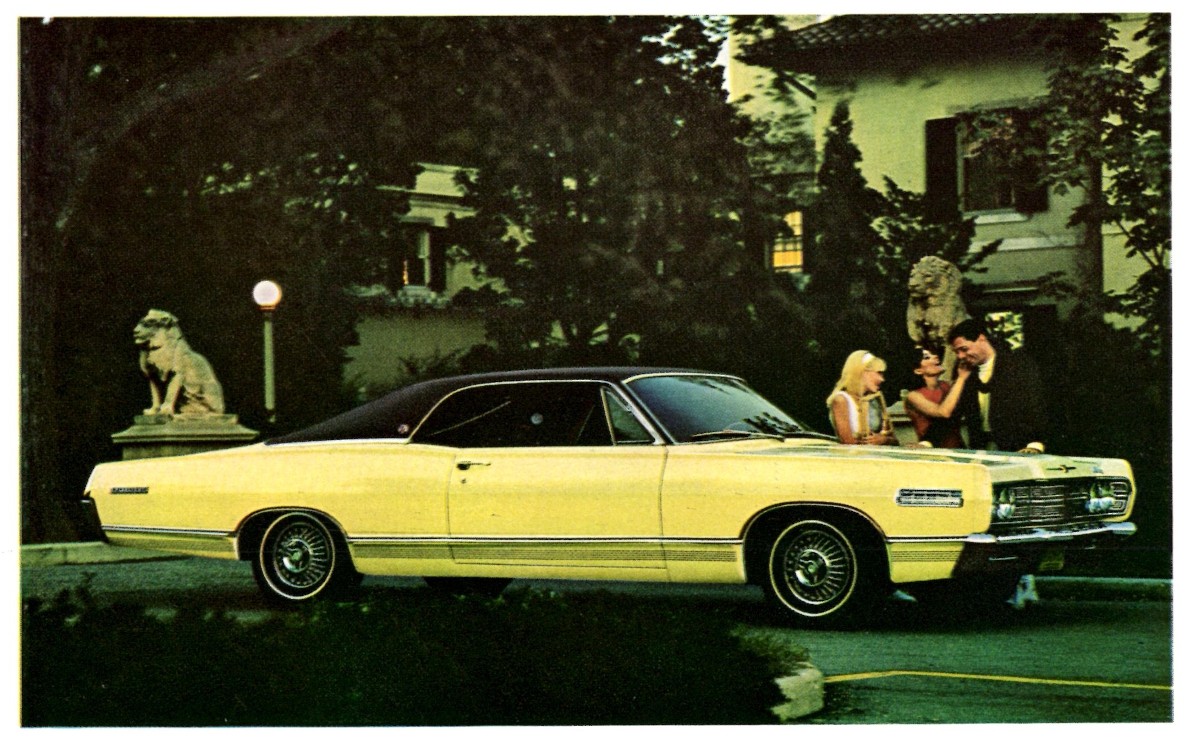
Air suspension is a system that uses air pressure to raise or lower the car. It can automatically keep the car level when you have extra weight in the back.
Ride height is how high the car sits from the ground. When it changes, the car can look/handle different—especially when you load up the trunk or back seat.
The air compressor is the pump that makes the air pressure for the suspension system. When the car needs to sit higher, it runs and fills the air parts.
Here, “sensors” are the car’s measuring devices. They tell the suspension system things like how heavy the car thinks it is, and if they’re wrong, the car can adjust itself at the wrong time.
Brand
Lincoln Mercury dealer
A Lincoln Mercury dealer is an official car service shop for those brands. If a problem is confusing, the dealer may have the right computer diagnostics and repair instructions.
Car
fully restored classic Volkswagen 1965 21-window deluxe micro bus
They’re talking about a classic 1965 Volkswagen van with lots of windows—specifically the 21-window “deluxe” version. It’s been restored so it looks and feels like a well-kept vintage vehicle, not a worn-out one.
Shocks are parts that help your vehicle settle after hitting bumps. Heavy-duty shocks are stronger versions meant for heavier use, like carrying lots of passengers.
An axle is the shaft and assembly that transmits power and/or supports the wheels, depending on the vehicle layout. In this context, the host is talking about diagnosing a noise by checking along the axle and then identifying it as coming from the front axle.
The lower control arm is another metal link that supports the wheel from below. Together with the upper arm, it helps the wheel move without losing alignment.
A ball joint is a joint that lets the suspension move while still holding the wheel in place. Some ball joints have a grease fitting so they stay lubricated.
Control arms are parts in the suspension that help hold the wheel in the right position. If the joints get dry, they can make annoying noises. Greasing them can quiet the sound if that’s where the noise is coming from.
Horsepower is how much power the engine makes. “36 horsepower” is pretty low, so the vehicle won’t feel strong on hills or at higher speeds. That’s why they say it only works well on flat ground and slow driving.
Coronado is a place they’re talking about, and they’re pointing out that it has hills. Since this bus has low power, hills would make it struggle. So it only makes sense if you’re driving on flatter routes.
This is a 1997 Honda Civic in the EX trim. It’s a common, everyday compact car from the late 1990s, and people often pick it because it’s generally simple to maintain and parts are easy to find.
Reverse gear is the part of the car’s gearbox that lets you drive backward. When you shift into reverse, the transmission has to line up the right gears so the car can move back.
A gear crunch is the harsh grinding/cracking sound (and feel) that happens when gears try to engage without proper speed matching. It often points to worn synchronizer parts or incorrect shift timing/speed when selecting a gear.
A synchronizer is like a timing helper inside the gearbox. It makes sure the gears spin at the right speed before they click together—so you don’t get grinding or a harsh crunch when shifting.
A transmission rebuild is when a shop takes the gearbox apart and fixes or replaces the worn parts inside. It’s a bigger job than just adjusting something.
When you press the clutch pedal, it should fully separate the engine from the gearbox. If it doesn’t, shifting can feel rough or grind because the gears aren’t fully released.
The friction point is the spot on the clutch pedal where the car starts to “grab” and move power to the transmission. If that spot is wrong, the clutch may be worn or misadjusted.
Clutch free play is the little “slack” you feel at the top of the pedal before it starts doing anything. If there’s essentially none, it can mean the clutch isn’t set up correctly.
The clutch master cylinder is a hydraulic part that helps move the clutch mechanism. If it’s not working right, the clutch won’t release or engage correctly.
The slave cylinder is the part that actually pushes the clutch to release it. It can sometimes be fixed by replacing just that part instead of the whole system.
If the clutch parts themselves are worn out or damaged, you may need to replace the clutch. The host is saying this is usually the next step if the hydraulic parts don’t solve it.
Rebuilding the transmission is a big repair where they take the gearbox apart and fix internal parts. The host is saying you only get to this step if the simpler clutch-hydraulics and clutch replacement don’t work.
They’re saying their 1989 Subaru wagon did the same turn-signal blinking behavior. That helps show it’s likely a common electrical problem that can show up on different cars.
LIVE
Hello and welcome to Choir Talk from National Public Radio with us Click and Clack the Tappet Brothers and we're broadcasting this week from the center for continuing education here at Choir Talk Plaza.
And everyone knows how interested in education we are.
We certainly are. This came from cyberspace from Samantha Morris, wherever she may be.
And it says something fun for Tom.
Evidently there was some contest of the worst analogies in high school essays.
And these are some of the ones that won the prize for the interesting ones.
From the attic came an unearthly howl.
The whole scene had an eerie, surreal quality.
Like when you're on vacation in another city and Jeopardy comes on at 7 o'clock instead of 7.30.
That is eerie and surreal for sure.
Here's another one.
He was as tall as a six foot three inch tree.
John and Mary had never met.
They were like two hummingbirds who had also never met.
I like this one.
The little boat gently drifted across the pond exactly the way a bowling ball wouldn't.
He spoke with the wisdom that can only come from experience.
Like a guy who went blind because he looked at a solar eclipse without one of those boxes with a pinhole in it.
And now goes around the country speaking at high schools about the dangers of looking at a solar eclipse without one of those boxes with a pinhole.
Well, if you'd like to complain about the lack of clear thinking in our schools, you're going to give them an A for effort though.
The box with the pinhole in it.
Not everyone knows that evidently.
He was as tall as a six foot three inch tree.
If you'd like to complain about the lack of clear thinking on our show, you can call us with your car question at 888-CAR-TALK.
That's 888-227-8255.
Hello, you're on Car Talk.
Hello, Virginia Ellington from Tallahoma, Tennessee.
Hi, Virginia, from Tallahoma?
Yes.
Tallahoma, Tennessee.
Right, near between Chattanooga and Nashville.
Okay, so how are you today, Virginia?
I'm fine, and you guys?
We're not bad.
You sound wonderful.
Yeah, well, I look pretty good.
My brother looks like hell, but I guess he feels good.
I don't know.
Is that New Year's Eve celebration I haven't recovered from yet?
So what's going on?
I've got a 1991 Lincoln Connellino and I took it and set it in the sun in the summertime, of course, on asphalt.
I came back to get in and I looked at it and I thought, I don't know that car.
It was up.
The back end was bucking up at least 8 to 10 inches off the case.
I think it doesn't like the hot sun.
Well, wow.
So, guys, help, help.
The part of your car that is not working is something that we have avoided fixing, like the plague.
Yeah.
And what's wrong with it is the level ride system.
Your car has the ability to change the ride height in the back by means of inflating bladders
that are, I believe, inside the springs on this car.
There's a little compressor and it pumps air into it and raises up the back of the car.
Why anybody?
Oh, we know why.
Never mind.
For me.
Yes, for me.
So, for example, let's say you were taking a ride to, I don't know, some place that was
going to be fun, like Gatlinburg.
Oh, yeah.
All right.
And you had three or four of your girlfriends in there and some of them were a little on
the heavy side and you piled them all in the back.
Then it's possible that the back end would sink down with your suitcases and all that
in the trunk and this system would compensate and a little pump would come on and it would
raise the back end up so that the car was level.
You don't even know that you have this?
Well, I knew it had some kind of thing.
Yeah.
One of my mechanics said, get rid of it.
It'll go up and never come down.
If it does, it'll come down and eat your tires.
I had new tires.
I didn't like that idea.
Yeah, well.
Well, you can probably get rid of it.
Oh, sell the car?
No, no, get rid of the level ride system.
Oh.
Yeah.
Yeah.
I mean, who usually rides in the car with you?
Me.
Just you.
I must be way too heavy.
I only weigh a little over 100, barely five pounds.
No, no, and it's not you that's doing this.
Oh, thank you.
By all means, there's something wrong with the sensors that making the car think that
there's a lot of weight in it and it turns this thing on and it keeps raising it up and
up and up because it thinks that there's a lot of weight in the back.
Oh.
Okay, and it's possible that whoever worked in the car, I believe when you lift these
cars up on the lift, you have to turn this thing off.
Yeah, otherwise it gets all confused.
Oh.
So I think if your local guy can't figure this out, I would take this thing to your Lincoln
Mercury dealer and tell them what it's doing and they're going to be able to fix this.
And nobody else is going to be able to fix it because no one else has this.
I mean, this is a wacko thing.
Too bad.
And eat a little more, you're too skinny.
Right.
There you go.
105 pounds.
I'll be riding in the back.
See you later.
Bye-bye.
Thanks for calling, Virginia.
1-888-CAR-TALK, that's 888-227-8255, a lawyer on CAR-TALK.
Hi, this is Garner Mabry from Coronado, California.
Hi, Garner.
Garner Mabry.
Can I use that name?
I've been thinking of changing my name.
Well, it's actually Garner Alan Mabry, the third, so there's three others.
Oh, man.
Actually, there's four others and he's...
See, I was going to change my name to Ship and Bradshaw Throckmorton IV.
Garner Mabry.
Yeah.
Okay.
So what's up, Garner?
Where are you from again?
Coronado, California.
Coronado.
It's a little island five minutes away from San Diego.
Oh, yeah.
It sounds romantic.
Yeah.
It's old.
And they've got a hotel here called the Hotel Del Coronado, which is kind of responsible
for the entire island.
And what do you do there?
That's part of my call.
Ah.
I'm a partner in a one-bus historical tour company.
Oh, the bus breaks down and you're out of business.
It's got a full three-foot by five-foot sunroof on it that retracts.
Oh, beautiful.
But I took my wife and my son for a ride and I hit a bump.
And after I hit that bump, a squeak came out.
And I'll make the noise for you if you'd like.
Oh, by all means.
Okay.
As good as I can.
It goes...
Depending on...
Now, you hit a bump and a squeak came out of...
It's coming from underneath the driver's side.
Yeah.
And when I stop the car and it's not moving and I rock it back and forth, it will squeak.
Good, good, good, good.
But then sometimes the squeak goes away.
Bad, bad, bad, bad.
Bad, bad.
Yeah, I know.
For us.
When I turn left, the squeak goes away.
So I'm considering designing a tour of just left turn.
You could do it.
And I could on this island because it's pretty small.
But so that the squeak is there, it goes away.
I took it to a mechanic.
We put it on the rack.
I needed to put heavy-duty shocks on it anyway because I carry a lot of passengers.
Hoping that would get rid of it.
Well, as soon as he took the shock off that particular wheel, I rocked the thing back
and forth and it still squeaked even without a car.
So you know.
I knew then at that point.
We brought it down.
Before bringing it down, he put on a stethoscope and he went all along the axle.
Great.
And he isolated the noise inside this, you know, simple little micro bus axle.
Looks like it's a pretty simple.
And he isolated.
This is the front axle.
Correct.
Right.
He put it up underneath the driver's side.
And he said, that's where your noise is coming from.
I don't know what it is.
Well, there's a bearing in there.
Oh, God.
Yeah.
But the bearing wouldn't make that kind of noise.
Oh, yeah.
There's a bearing there because this thing doesn't have springs.
This thing has torsion bars.
Exactly.
And the torsion bar is attached to the upper control arm.
Okay.
And I believe the lower control arm too.
Right.
I thought it was the control arm.
And well, it could be the ball joint.
But if he hears it coming from inside there, there's a grease fitting on that thing.
Well, we've lubed it until I've got grease oozing out everywhere.
But is it making it all the way to the bearing?
I think you need to take the Hoosie Watzis off.
Do undo the ball joints and pull the control arms out.
Okay.
Ball joints, control arms.
Right.
And then you're going to be laid up.
You try to run these tors every day?
When's the slow season?
I do have another job.
This is not my day job.
But I think that you're going to need, I think if you spread enough grease, I don't
think the grease is getting all the way out to the bearings because the bearings are
at the outer end.
Okay.
And I don't think the grease is making it out there.
But if you pull those control arms out, you can grease them manually.
Put them back in and the noise will be gone.
Awesome.
By the way, my brother wants to buy this thing from you.
Okay.
Yeah.
No matter what it costs.
Well, he wants it because he needs a micro bus.
I certainly do.
Now, how many people does this seat again?
Nine.
It'll hold nine, including the driver.
Nine people.
And does it have an engine in the front, the in the back?
No.
No, it's got the 36 horsepower, 16.
Yeah.
Good thing there are no hills on Coronado.
It's got to be only on flat land and only if you don't have to go over five miles an
hour.
You have the perfect application for this vehicle.
That's my passion.
The tour is an excuse to have the bus.
Yeah.
Yes, I can understand that.
I went on the internet and there's all sorts of people that work on Volkswagen's theoretically.
One of them referred to a Bazalone flange.
You ever heard of that?
No.
No.
I think the heat plate with the guy Lombardo.
Okay.
Yeah.
There could be.
I mean, there's a lot of nomenclature about these that I've forgotten, but that isn't one
of the pieces.
And I do remember guy Lombardo on the Bazalone flange.
Oh, they were great.
Castanetists, I believe.
See you later, man.
Great.
Thanks for your help.
Bye-bye.
Hey, don't go anywhere because we've got a lot more calls.
Well, a few anyway.
And the puzzler answer coming up right after this.
Hi, we're back.
You're listening to Car Talk with us.
Click and Clack the Tapper Brothers, and we're here to talk about cars, car repair, and the
answer to our most recent puzzler.
Yeah, which was old.
It's old.
Well, this was an automotive puzzler, kind of.
You remember our pal Vinny Gumbatz?
Yes.
Well, he had, had two cousins, Rocco and Throckmorton.
From different genealogical pieces.
Oh, yeah.
And they found themselves in the middle of a little mob fracas once.
And next thing you know, they're both locked in the airtight trunk of a late model Lincoln
town car.
Yeah.
So after the gunplay subsides, Rocco and Throckmorton realize that if they don't get out, they're
going to die.
So Rocco begins beating on the trunk and screaming, let us out.
Let us out.
Of course, nothing happens because there's nobody around, but he expends considerable
energy and most of the air supply.
Finally, after several hours.
This is an airtight trunk, which is not usual in many cars, but the Lincoln town car was
particularly purposely made.
Well, I mean, for that purpose, as most of us know.
It turns out it's an option.
You want the airtight trunk?
We shouldn't.
We shouldn't.
No, no.
It's not just the Lincoln town car.
We're in enough trouble now.
You can also get the same models of Cadillac.
Don't go any further.
You're in enough trouble now.
Anyway.
Which Cadillac has the option?
After several hours, Rocco ceases his begging and screaming, and in fact, he expires.
Oh, man.
During this time, Throckmorton has done nothing.
Hasn't made a sound.
He's been like in a trance.
He's just been lying there, saving his breath, breathing very slowly, while Rocco sucked up
all the air.
Hours later, Throckmorton is still alive.
He has a car approach and he figures this is his chance for good or bad.
He's going to bang on the trunk.
Sure enough, it's the police.
They opened the trunk and let him out.
The question is, how could Throckmorton have possibly survived for hours after Rocco had
sucked up all the air and expired?
Pretty good nifty little story, huh?
Pretty crummy little answer coming up.
Really?
I don't know what the answer is.
You don't?
And I know that I'm not going to like it.
I knew three weeks ago when you brought up this puzzler that I wasn't going to like
the answer.
Can I expect a...
I would.
Go ahead.
You might as well just do it now.
No, no, go ahead.
I want to hear.
What would you do, Throckmorton, if you were in there?
How would you have survived?
How would I have survived?
I would have stuck a plastic bag over my head, so at least I would have a little air after
Rocco sucks up all the rest of the air.
No, you should have put the plastic bag over his head.
Yeah, the plastic bag would have been a good idea.
That would have been good.
No, but if you're going to hold your breath, you want to at least save some of the air
that Rocco is going to be sucking up.
Yeah, yeah, but you didn't have a plastic.
Did I say you had a plastic bag?
No, you didn't.
So why would you deduce that you had a plastic bag?
I don't know.
What else is in the trunk besides Rocco?
Oh, the spare tire.
Exactly.
Throckmorton, being the low life that he is, that we knew he was, had to wait till Rocco
expired to maximize the time he would have on the spare tire air.
So he waited and did nothing while Rocco beat his brains in the poor thing.
I can just see him now eating a meatball grinder, the sauce dripping on his tie.
Actually, that's not bad.
So who's our winner, man?
The winner is Sean Devaney.
That's a nice name, isn't it?
Yeah.
Sean Devaney from St. Louis, Missouri.
And for having his answer selected at random, from among all the correct answers to that
we got, Sean will get a $25 gift certificate to the Shameless Commerce Division at the
Cartalk section of cars.com.
And with that $25 gift certificate, he can get five nights of an official Cartalk all-season
shell, which is what?
What is a shell?
It's a blue and a red nylon jacket with a hood and the Cartalk logo on it, which you
can rip off if you don't want it.
And it's according to those who know, one of the least fashion-challenged pieces of
clothing we have ever offered.
In other words, people actually like this one.
No, they didn't dislike it as much.
Ah, there you go.
I'm sorry, I was going a little bit too far.
By the way, if you got stiffed over the holidays and you want to visit the Shameless Commerce
Division, you know, pick up something for yourself, it's at the Cartalk section of cars.com.
Anyway, we'll have a new puzzler coming up in the third half of today's show, so stay
tuned for that.
In the meantime, if you'd like to call us, or if you wouldn't like to call us, the number
remains 1-888-CARTALK, that's 888-227-8255, hello, you're on Cartalk.
Hey, my name is Jason.
I'm calling from Needham, Mass.
Hi, Jason from Needham, right in our own backyard.
We hardly ever get calls from Massachusetts, you know?
We used to get all our calls from Massachusetts.
That's because we were only on in Massachusetts.
Yeah, we were in the truck.
We used to broadcast from the truck.
So, what's new, Jason?
All right, well, here's the deal.
Yeah.
I have a 1997 Honda Civic EX, and I bought it new, and as I was thinking about the car,
I was remembering an issue which I've had since I bought it, and that is whenever I'm driving,
and it's just me in the car, and I go over a rough road surface while driving at a decent
clip, the car rattles.
There's like this intense rattle which feels like it's coming from the center bottom of
the car.
Was it tinny, and is it metallic sounding?
No, it's not metallic sounding.
It's more like a vibration type thing.
And when I first got the car, I guess, you know, maybe the first time I brought it into
the dealer, I asked them that, and they said, oh, that's because one of your wheels is airborne.
Oh, I like that.
What did they say again?
One of your wheels?
Wait a minute.
I need to know these.
One wheel?
I've never used that.
And most people wouldn't have fallen for it.
Jason, you're very, very susceptible to these.
Well, they put you off for four years.
Yeah.
Well, I figured whatever I'll just let it pass, it seems fine.
So this has been gnawing away at you for four years.
Exactly, exactly.
Does it make a difference if you hit the bump with one wheel as opposed to another?
I don't think so.
For example, if you singled out a bump and decided to try to hit it with your left front
wheel first, would that elicit the same response?
You're asking an awful lot.
Hey, this is very important.
Of course it's important, but Jason is not obliged to have it.
He's been listening to it for four years.
He ought to have a complete dossier on the round by now.
You are right.
I mean, as long as you got a noise that you're going to put up with for four years, you ought
to at least have been gathering data.
Well, it only happens when I'm alone, which is difficult.
Well, isn't that interesting?
And do the voices only come when you're alone?
That's what I was thinking.
It's just something with me.
I love it.
But no, no, no.
It only happens when you're alone.
See, that's important.
I wrote down alone on my little scrap of paper here.
You would because I knew that was going to be important.
Really?
Yeah, alone.
Because you thought I was making it up?
Well, it was one way or the other.
It was going to be important.
No, but there is a certain dynamic that gets changed when there's a passenger in the car.
Absolutely.
Yeah, yeah.
So definitely, you hit rear-wheel tracks.
Yeah, but it tends to be kind of, I don't think it's really related to one particular
wheel.
It seems like when the whole car is going over a rough road surface.
Right.
And it's been the same for four years.
It hasn't gotten worse.
Yeah.
I mean, I don't know.
I mean, rest assured that things are tight in this car.
I mean, what I mean by that is the exhaust system is pretty close to the undercarriage.
Yeah.
And it could easily be that with just you in the car, and under the right circumstance
of the exhaust system is hitting the heat shield or the floor of the car, and that would
make a little...
No, it would.
But here's what I don't like about that answer.
Yes.
He was going for it.
You know, but I feel as though I must be an advocate for Jason because Jason is extraordinarily
gullible.
No.
And I'm going to try to protect you from my brother, because I mean, if my brother is
correct, it would be worse with two people in the car, not one.
So, dear brother, explain me that.
Talking to me?
Well, you know, when...
No, when someone else is in the car, you're engaged in conversation, you're not paying
attention.
It's actually worse, but you just don't notice it.
He's going for the psychological.
Yeah.
And what you don't realize is when there are two people in the car and you go over the
railroad tracks, two wheels are airbound.
Airborne.
Airborne.
Two wheels are airborne.
That's right.
One in the front and one in the back.
Like the left front.
Diagonally opposite.
Exactly.
Yeah.
And they cancel each other out.
Oh, is that what it is?
Yeah, I think so.
Okay.
I don't know what this is.
I don't think I'd be too worried about it, but it would be nice to drive another Honda.
Uh-huh.
Now's the time.
You could go to a dealership and ask if they have any 97 EXs for sale.
Okay.
And you'd like to test drive a couple.
So I can make them gullible and think that I'm trying to...
Well, so you can at least make the comparison.
See if they all do that.
Yeah.
And if the noise is there in those cars, then just turn your radio up.
Oh, yeah?
Okay.
Say it, Jason.
Hey, you know, I've been working on a theory here.
You have?
Maybe you can help me with this.
Noises are the bane of the existence of a mechanic.
Oh.
Without a doubt.
I cannot get this.
I have a theory that it's very...
First of all, it's very difficult to know where the noise is coming from, but what's
making the noise is a function of where it is and how big it is.
Right?
Yeah.
And there are noises.
Boom, boom, boom.
He said boom, boom, boom.
First of all, the boom, boom, boom has a pitch.
So it could be a low boom, boom, boom.
Oh, so you're going to...
Or it could be a...
You're going to devise a matrix.
And the frequency of the noise, not the pitch frequency, but if it's boom, boom, boom, boom.
Right.
Right, right.
Oh, you're going to need a multi-dimension matrix here.
I think it's at least three.
Oh, yeah.
And it might be four or five.
Right.
We might have to go into the fifth dimension.
You want to work on this?
You'd like to fly my beautiful balloon.
So would you like to join me in this, writing a little monograph on this?
Yes, I would.
We'll be right back with more calls and the new puzzler after these messages.
We're back.
You're listening to Car Talk with us, Click and Clack, the Tapper Brothers.
And we here to discuss Cars, Car Repair, and the new puzzler from the Insect Kingdom.
We haven't delved into the wonderful world of...
No, I mean, we've had the string series of puzzlers.
Oh, yes.
We've had the Krusty series.
Oh, yes.
And this is from the Bug Collection.
In honor of Bugsy, who happens to be here today.
Yeah.
Yeah.
I mean, here there was a free lunch.
Actually, he got the aroma wafting out of the cafeteria.
Okay, you're ready now.
Pay attention.
Okay, go ahead.
Two grasshoppers are hanging around one day.
And each of them is boasting that he can jump faster than the other one.
Jump faster?
Yes.
In other words, cover a greater distance in the same amount of time.
You mean farther?
No, faster.
I mean, if two guys are running, if you and I are racing, and I get to the finish line
for us immediately at that very instant, I will have run farther.
But the objective is to see if we can go faster.
Yeah, yeah.
Okay.
So that's how they do it.
They jump and then they jump again and they jump again.
Each jump being like a step that we would take.
Or something.
I don't know what grasshoppers do.
Whatever they call them.
Anyway, to settle the argument, they decide to have what?
A race.
There you go.
I'm quick, huh?
Yeah, okay.
The larger of the two grasshoppers who can jump 10 inches at a bound.
Yeah.
His name is Throckmorton.
Throcky.
Throcky.
Okay.
And the other one who's named Rocky can jump six inches at a shot.
Yeah.
Okay.
Oh, I get it now.
So the larger guy says, okay, here's what we're going to do.
He says we're going to set up a race that consists of 24 feet, 12 feet out, and 12 feet
back.
Yeah.
So we're just going to start off with the starting point.
Okay.
I got you.
Vinny's going to shoot the gun.
Yeah.
And we're going to take off.
Okay.
Now, even though the bigger guy can jump 10 inches at a shot, the other guy jumps more
often.
So when they get to the five foot mark, which is 60 inches, the little guy will have jumped
10 times.
Right.
Right.
The big guy will have jumped six times, but they're dead even.
Exactly.
Neck and neck.
Do they have necks?
Grasshopper.
Antenna.
They're antenna to antenna.
Got you.
You got it?
Okay.
All right.
So the bigger grasshopper who takes the bigger leaps has designed the course and it's 12
feet out and it's 12 feet back.
Got you.
Can either one of them win the race?
And what is there a part B?
How?
And now it's part three?
What's part?
Who?
Who?
Good question.
Right?
So you do want to know who?
If you want.
Okay.
Got you.
If you choose.
All right.
If you're thinking of the answer.
Write it on a postcard.
This is very good.
Or freeze it inside a 10 foot high ice sculpture of Britney Spears.
And send it to my son Andrew, care of puzzler tower, car talk plaza, box 3500, Harvard Square,
Cambridge, Matt 02238.
Or of course you can email your answer from the car talk section of cars.com.
If you'd like to call us the number is 1-888-CARTALK.
That's 888-227-8255.
Hello, you're on car talk.
Hey guys, this is John from San Francisco.
John?
Hello, John.
How are you?
We're doing well.
How are you?
Good.
I am doing terrific.
Great.
What can we do for you today?
Okay.
I have a 1989 Ferrari 328 GTS.
And I bought this car because the guy that sold it to me told me that it was cheap and reliable transportation.
Did he have any bridges that he was selling?
Most of the time I'm a happy and well adjusted owner.
However, I've had this problem now for about two years that just does not go away.
The issue is this.
The car works fine when it's going forward.
It works fine when it's stopping.
The problem comes when I try and put it into reverse.
About 25% of the time, if you try and engage reverse with the car at a complete stop, the gear goes in with this horrible crunch.
It's as if you were trying to engage reverse with the car moving.
Yeah, yeah, yeah.
You look like a real plonker.
Yeah.
And it's difficult to look suave.
Well, look at the bright side.
In the two years, it hasn't gotten worse.
No, no, that's true.
Yep.
That's good.
That is good, yeah.
What it means is that you have no more teeth on that synchronizer to grind off.
You've ground every one of them off.
And I just want you to know this is about the only Ferrari question that we would have had a snowball's chance of answering.
Yeah, so lucky you.
Lucky you.
Lucky me.
If you had said anything else, like if you asked us like is the engine in the back or in the front, we wouldn't have known.
Okay.
If you know this one.
All right.
So.
So what's wrong is that you no longer have a synchronizer left for reverse.
Thankfully, the other gears still have their synchronizers.
Right.
And that's why you can shift into those gears without the grinding.
I would recommend you could have the transmission rebuilt, which would cost you about 400 million lira.
Or is that 400 billion lira?
I don't remember.
I think it's billion, but you have to bring the car to Rome.
Now, the other possibility is that the clutch is not sufficiently disengaging.
When you drive the car, does the clutch engage very close to the floor?
I guess the friction point is maybe two thirds of the way down, roundabout where it should be.
I mean, the Ferrari mechanic guys, I mean, if you own one of these cars, you enter into a deep and meaningful relationship with a whole bunch of different mechanics.
Yes.
Does it involve holding hands and candlelight dinners?
Yeah.
Yeah.
That happens before and after.
Yeah.
Yeah.
And they claim that pretty much all of the time when they look at the clutch, the friction point is okay.
Do you have any idea how much free play there is in the clutch when you push it down with your fingers?
How far down does it go before?
Before you get hot.
Yeah.
Essentially none.
No free play.
Well, very, very little.
I've never pushed it down with my fingers, but you can't feel any with your feet.
Is that an insufficiently...
Yeah, the feet are not sensitive.
Well, you might know.
I think John has sufficient sensitive...
He sounds like a sensitive guy to me.
He does.
He's very sensitive.
We are a legendarily sensitive people.
You are.
I mean, it's known throughout the world.
You want to find sensitivity.
Right.
Drink warm beer.
Well, anyway, I would have to say that it could easily be that the clutch...
The clutch is not disengaging, and reverse would be the most difficult gear to get into
if the clutch weren't disengaging fully.
But I'm still going to stick with my original theory that you've ground up the synchronizers.
Okay.
But I would ask them to bleed the clutch first.
Okay.
I think you're in for some huge bucks here.
But I mean, why else would you own a Ferrari if you weren't prepared for that?
Right.
And on some level, you must enjoy it.
Yeah.
I mean, you could have bought a Holden, and you wouldn't have any trouble like this.
Well, here's the order in which I'd recommend you do things.
Okay.
You ready?
Yep.
If bleeding doesn't help, I would then go ahead and replace the clutch master cylinder.
Right.
And maybe even the slave cylinder, but you can do them separately.
Okay.
If neither one of those helps, and you're still embarrassed by this condition, and or you
have any money left.
Right.
You can go ahead and replace the clutch itself.
Oh.
If that went, not if, but when that doesn't solve the problem, then you'd have to go
ahead and rebuild the transmission, but that's last on the list.
But I think before you get to that point, you will, one of several things will have happened.
Either you will have solved the problem or run out of money or an earthquake would have
struck and your part of the city would have fallen to the ocean.
Oh, you would have sold the car.
One of the, or you'd build a circular driveway.
See you later, John.
It would be cheaper, by the way.
Thanks, guys.
Very much.
Good luck.
Bye.
That really was the only question he could have asked us, maybe about the cooling system
we might have had a shot at something about a Ferrari.
Have you ever seen a Ferrari?
Oh, yeah.
I go to the auto show real, I see them.
Yeah.
Yeah.
I'm kind of disappointed in all these years they've never offered to let us test drive
one.
You're not surprised though.
None at all.
No.
Of course.
1888
Car talk.
That's 888
2278255
A lawyer on car talk.
Hey.
Hey.
My name is Katie.
I live in Durham, California.
Durham, California.
Where the heck is it?
Yeah.
Durham, California.
The land of the nuts and fruits.
Oh, you're in the San Joaquin Valley.
North.
North.
North in the Sacramento Valley.
Sacramento Valley.
Yeah.
About 90 miles north of Sacramento.
Well, you know, I was amazed at how much stuff is grown in California.
You probably don't have an appreciation for it because you've been there your whole
life.
Not exactly.
We moved from Syracuse, New York.
You have to have a great appreciation.
I mean, have you driven the area obviously in scene and stuff?
It's amazing.
It is amazing.
California feeds the whole country.
Thank you.
I hope it doesn't slide into the ocean in the near future.
So anyway, Katie, what's shaking?
Well, an 88 Mercury marquee and the shake is only in the front.
Oh, there is a shake.
Get out.
I was using a figure of speech.
I know.
Yeah.
Here's my question.
Yeah.
The Mercury, when I turn on the left hand signal, the blinker goes blink, blink, blink,
blink, blink.
Yeah.
When I turn on the right hand signal.
Just the opposite.
Right.
Yeah.
It means there's a light out on the left side.
The right one's working correctly.
But here's the puzzler.
Yeah.
I had an 89 Subaru wagon that did the exact same thing.
And?
My girlfriend has a 70-something Volvo and her car does the exact same thing.
They all have the same problem.
You know why?
No.
Because you're living on the left coast.
That's it.
Yeah.
And if you take a left turn there, you'll be right in the ocean.
And so it's warning you when you say left turn, it's saying, no, don't do it.
What are you crazy?
So all the cars in California plotting against us, they want us all to go to the right.
Exactly.
You guys are focusing too much time on the election.
Yes, we are, aren't we?
Yes, you are.
But all of those cars really do have the same problem.
There's a bulb probably not working, and the front or the back on the left side.
Or a bed, ground, or some such thing.
Many cars will have more than one directional bulb in the front or back.
And if one of them, for example, is out in the left rear, when you turn the thing on,
one of them will blink in the left rear, the one in the front, the left front will blink,
but it'll cause, because there's not enough resistance in the circuit,
it causes the flash to actuate faster.
And it's a message to you to check the bulbs because something is wrong.
So here's what you do.
Turn on the key, turn on the right blinker and notice how many lights light up,
because that side's working correctly.
Yeah, and then get out of the car and you can just walk back and forth and look.
And then you can do the same thing with the left and you'll say,
aha, I've got a dead bulb.
You're so clever.
Thank you.
Isn't it easy?
We are clever if you ask a simple question.
So what are you doing in Durham?
Picking nuts.
Are you really?
No.
You lied to us?
No, I figured.
But the blinker problem really exists.
But you obviously recently relocated from Syracuse to Durham.
My husband teaches at the state college here just 10 miles north of us.
Oh yeah, what does he teach?
Exercise physiology.
Is that a good living?
You know, it's better than being free for public radio.
All right, rub it in.
You have your MIT degree.
We could have been contenders.
We could have been somebodies.
Instead we were a couple of losers.
By the way, are there any jobs out there picking nuts?
Because we have the summer off.
Yes.
Really?
Absolutely.
I can see it now.
Two nuts picking nuts.
There you go.
See ya, Katie.
Thanks for calling.
Thank you.
Bye-bye.
Bye-bye.
Well, it's happened again.
You've misappropriated it.
Another perfectly good hour listening to car talk.
Or misjudged, maybe.
Our esteemed producer has dug the subway fugitive Bungo Boy, Berman.
There's a ring to it, doesn't it?
Bungo Boy, Berman.
Bungo Boy.
And the fact that his name is Berman.
Yeah.
I mean, it's great.
It's so illiterative.
Bungo Boy, Berman.
If his first name were Bob, Bob Bungo Boy, Berman.
Or Bill.
Bill.
Bill.
You left the work on that.
Our associate producers are Louis the...
Well, it could be Bob, the bungling Bungo Boy, Berman.
Our associate producers are Louis, Cronin, the Barbarian, and David.
Things are suspiciously good.
What are you guys planning to do?
Our engineer is Tad Massamon Curry.
Our senior web black, he has dug the old gray mare, aka Zoo Boy, who's...
We don't know where he is.
We don't know.
God only knows.
God only knows.
And our technical spiritual...
God knows where he is.
Or Pakistanier.
And men you advise are just in from the Banff Ice Chai World Finals, is John Bugsy.
Our public opinion pollster is Paul Murky of Murky Research, assisted by statistician
Margin Overa, our customer care representative is Heywood Jabuzoff.
Our new truck reviewer is Zubignu Rick.
Our staff bodyguard is Liam Malone.
The force attorney is Carmine Naut, yours.
Our director of genealogical research is Manny Cousins.
Our sexual harassment investigator is Hank Panky.
The car talk used car salesperson is Sasha Deal.
Our Russian chauffeur is Peacoff and drop off the banker at Car Talk Plaza poker games.
Is Nikolai Putin.
And our seat cushion tester is Mike Easter.
Our chief counsel from the law firm of Dewey treatment.
How is you, Louis Dewey, known to the unemployed constitutional scholars in Harvard Square?
Is you, Louis Dewey?
Thanks so much for listening.
We're clicking clack the Tappet Brothers.
Don't drive like my brother.
Don't drive like my brother.
We'll be back next week.
Bye-bye.
Car Talk is a production of Dewey Treatment How and WBUR in Boston.
And even though Manny Ramirez thinks if I'd known they were from Boston, I'd have held
up for more money whenever we say it, this is NPR, National Public Radio.
About this episode
Click and Clack tackle two very different, very specific repair mysteries. First, a 1991 Lincoln Continental’s rear end rises dramatically after sitting in hot sun, traced to a malfunctioning air-suspension/level-ride system with sensors that think the car is heavily loaded—likely confused during lift service. Next, a restored 1965 VW microbus squeaks after bumps; the sound changes with steering and is isolated to the torsion-bar front axle area, suggesting a lubrication/grease path issue at the bearing/control-arm setup. The show also teases an automotive puzzler involving an airtight trunk scenario.
John is in the early stages of Ferrari ownership. Along with the exorbitant bills he’s noticing a certain ‘extra special attention’ from the dealership mechanics. Click and Clack help John decide if his mechanic’s intentions are pure on this episode of the Best of Car Talk.
See pcm.adswizz.com for information about our collection and use of personal data for sponsorship and to manage your podcast sponsorship preferences.