Tesla makes electric cars. Here they’re saying the outside might look older, but the important stuff underneath can still be updated so it’s not really “old” in how it drives.
An exterior redesign is when a car’s looks change—like the front and rear styling. They’re saying Tesla can keep the same general look while still improving the car in other ways.
“More than skin deep” means the important improvements aren’t just about looks. They’re implying the car can look older outside, but be updated in the important parts underneath.
A major vehicle redesign is when a car gets a big update—more than just cosmetic changes. They’re using it to argue about how many parts typically stay the same versus being replaced.
Toyota is mentioned as one of the big traditional car companies. They’re using it as an example in a debate about how often automakers redesign cars and reuse parts.
The 1964 Mustang is the early version of Ford’s Mustang. They bring it up to argue that today’s Mustang doesn’t reuse the same parts from the original car the way the other person’s calculation implies.
“Legacy OEMs” means the traditional big car makers that have been around for a long time. The host is saying these companies usually update cars more often with small changes.
LED accent lighting is decorative lighting—small lights meant to make the car look different or more modern. They’re saying some automakers add these kinds of changes on a regular schedule.
“Electronics” here means the car’s digital control systems and sensors. They can be updated over time, which can change how the car behaves even if it looks unchanged.
Suspension is the system that helps the car ride smoothly and handle bumps. It affects how the car feels on the road, and it can be changed between versions.
“Hardware three” means a newer version of the car’s internal computer. The host is saying the car can look the same, but the brains inside can be upgraded.
The Tesla Model 3 is the car being used as an example here. The point is that two Model 3s can look identical but have different internal computer/parts versions depending on when they were built.
Term
hardware 2.5
“Hardware 2.5” is the version of the car’s built-in computer/processing unit. Different versions can change what features work and how well they work.
FSD stands for Full Self-Driving, Tesla’s driver-assistance software package. The host mentions doing a trial of it, which implies they were testing the software’s capabilities and limitations.
Term
visual society
They mean people today often judge things by how they look. For cars, that can matter because a noticeable redesign can make a model feel newer.
They bring up Apple as an example of a company that updates its products often. Even if the changes aren’t easy to spot, people still buy because it feels like an update.
They’re talking about a car having three cameras grouped in one spot. Those cameras help the car “see” the road for features like driver-assist and safety systems.
An HVAC system is the car’s heating and cooling. In an EV, a heat pump can warm the cabin more efficiently—especially when it’s cold—by moving heat instead of just making it from scratch.
Term
LLP battery
This is a shorthand for a particular type of EV battery design. Different battery types can store and deliver energy differently, which can affect things like range and how well the car performs in different temperatures.
Concept
visual changes every few years
Car companies often update the look of their vehicles every few years. Even if the driving feel is similar, the outside and inside styling changes can make people think the newer car is a big upgrade.
A license plate frame is the border around your license plate. People can buy frames that show a brand name or logo, like “Tesla,” to make the car’s identity more obvious.
Topic
EV branding vs generic EV usage
They’re saying that people used to say “Tesla” to mean “electric car” in general. But once lots of other EVs showed up, Tesla needed to make sure people knew which brand they were looking at.
They’re comparing “Tesla” to words like “Kleenex” or “Xerox,” where a brand name gets used like a common word. That can make it harder for people to tell the difference between one brand and the whole product category.
“EV market share” means what percentage of electric-vehicle sales (or registrations) a brand gets. If it goes down, the brand is selling a smaller slice of the EV market than before.
BYD is a big Chinese company that makes electric cars. The speaker says it uses different brand names to sell cars at different “levels,” from more mainstream to more premium.
BMW is mentioned because the speaker is comparing lineups—whether BMW has a car that’s similar to the Denza roadster. It’s a quick “who has an equivalent?” comment.
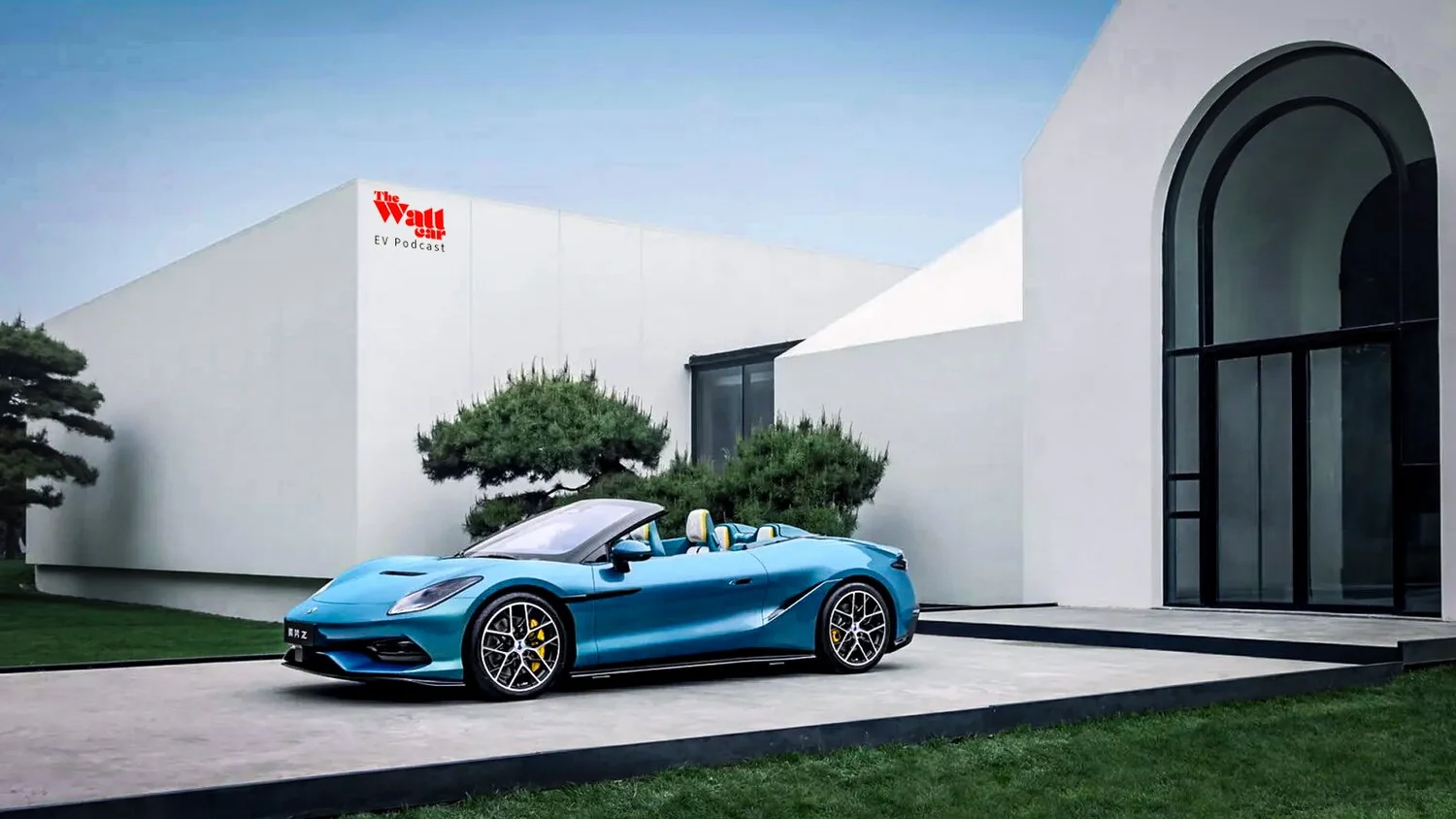
Denza is a Chinese electric-vehicle brand. The Denza Z Roadster is their new electric roadster, and the hosts are talking about how fast it is and what it costs in China.
The Tesla Roadster is an electric sports car. The podcast is describing it as looking like the earlier Roadster, but bigger. It’s meant to be a more performance-focused EV than a typical family car.
Charging speed refers to how quickly an EV can add energy while plugged in, usually tied to the car’s maximum charging power (often measured in kW). Higher charging speed can reduce time spent at fast-chargers, though real-world results also depend on the charger and battery temperature.
The battery pack is the EV’s main battery system. For fast charging, the battery pack has to be designed to safely take in a lot of electricity quickly.
“Flash chargers” are chargers built to add a lot of energy to an EV in a very short time. They use very high power so the battery can charge faster than with normal chargers.
1500 kilowatts is how much electrical power the charger can deliver. More power usually means faster charging, but the car’s battery and conditions still affect the final speed.
“Autopilot” is a name for car features that help with driving, like staying in lane or maintaining speed. It usually still requires the driver to stay alert and take over when needed.
“Full self driving” is a phrase used to suggest the car can drive itself. Even when cars use names like this, they usually still require supervision and may not work reliably everywhere.
“Dragon Drive” sounds like a company’s name for its EV driving technology. The hosts mention it as part of how the system is marketed, similar to how some cars talk about autopilot or full self-driving.
Concept
God's eye
“God’s eye” is a name for a driver-assistance feature that’s supposed to “see” what’s around the car. The hosts are mainly reacting to the name and how it compares to other self-driving-style branding.
Real-world range is how far an EV actually goes in normal driving, not just in lab tests. Weather, driving speed, and road conditions can make it better or worse.
Yang Wang is a Chinese EV brand. The hosts are using it to show that Chinese EV makers offer everything from fancy luxury models to smaller everyday cars.
Wuling is a Chinese brand that makes small, affordable cars. The hosts are pointing out that Chinese EV makers aren’t only building big, flashy tech—they also make simple city-friendly cars.
The Xiaomi SU7 is an electric car made by Xiaomi, a company best known for phones and other electronics. The hosts bring it up as an example of a new kind of EV maker that’s getting attention.
Reverse engineering means studying something by taking it apart (or analyzing it closely) to figure out how it was made. The hosts are saying some people have used that approach to learn from Chinese EVs.
VinFast is a company that makes electric cars. The hosts are saying that even if the car’s advertised specs looked okay, the real-world experience wasn’t great—like it didn’t drive smoothly and the software could be buggy.
“Fit and finish” is a way of talking about how carefully the car is put together. It covers details like how smooth the surfaces are and how well parts line up.
Government subsidies are money the government gives to help a company sell or build something for less. The hosts are saying that EV companies may benefit from these supports, which can change how their cars compete.
“Take losses” means the company might lose money on each car for a while. They do it to grow sales and build a bigger customer base.
Concept
reporting out of Asia is very kind of triumphalist
“Triumphalist” reporting means the news is overly upbeat and may not mention the downsides. The hosts are implying some coverage can be biased toward praising the cars.
Concept
negative social points
“Negative social points” means there could be social consequences for saying something negative. The hosts are suggesting reviewers might hold back criticism to avoid trouble.
A battery-electric vehicle is an EV that uses a battery for power instead of a gas engine. “Battery electric vehicle sales” just means how many of those EVs were sold.
Hybrids are cars that use two power sources—usually a gas engine plus an electric motor. The hosts are saying Japan was more focused on hybrids before switching attention to EVs.
They’re mentioning hydrogen as another way to power cars. The idea is that a car can use hydrogen to make electricity while driving, instead of using a battery-only setup.
Concept
percentages are easy
They’re saying that when the starting number is tiny, percentage growth can look huge even if only a small number of cars actually sold. It’s a reminder to look at both percentages and real quantities.
Incentivizing EVs means governments use incentives—like money back or tax breaks—to make electric cars easier to buy. The host is saying EV sales depend a lot on whether those incentives exist.
The Rivian R1S is an electric SUV. It’s designed to carry people and gear like a family vehicle. The podcast is saying it’s a common choice for everyday family use in their area.
They’re using the Honda Civic as an example of a car that many people can rely on for years. The idea is: it’s practical transportation, not a hobby car.
“Brick” here means the car can’t really be used—like it gets stuck or fails so completely that it’s basically dead. It’s usually caused by serious electronic or software problems.
They’re referencing Fisker as an example of an EV brand that had serious problems. The worry they’re pointing to is software or system failures that can effectively “kill” the car.
They’re talking about how fast the EV can charge. The “X rate” is basically a charging speed number, and the hosts say most people don’t obsess over it.
They’re talking about how people often switch to an EV when they’re ready to replace their current car. In their view, trust in a brand and past reliability matters more than flashy performance specs.
The Honda Prologue is an electric SUV. The podcast is saying it looks good and that they’re starting to see them around. It’s meant to be a practical EV option for regular driving and families.
The Chevrolet Silverado EV is an electric pickup truck. The podcast is talking about how many of them are being sold, which shows interest in electric trucks. It’s being mentioned because its sales are relatively strong compared to other EV trucks.
GM is short for General Motors, a big car company. They’re talking about whether GM will keep selling certain EV models and just update them instead of doing a full redesign.
A “refresh” means updating a car partway through its life. Instead of building a brand-new model, the company makes changes like styling and features to keep it current.
“Long ranges” refers to how far the EV can drive on a full battery charge, usually expressed as an estimated miles-per-charge figure. Longer range reduces the need for frequent charging and can improve real-world trip flexibility.
“Compliance cars” are EVs that a company makes mainly to meet government rules. The point here is that these weren’t just made to satisfy regulations—they were meant to be proper cars people actually want.
An internal combustion vehicle is a car that runs on a fuel-burning engine, like gasoline or diesel. They’re saying their example isn’t an EV, so the comparison to EVs isn’t perfectly fair.
A four-cylinder engine has four “power chambers” inside the engine. Many newer cars use them because they can be more efficient, especially when boosted with a turbo.
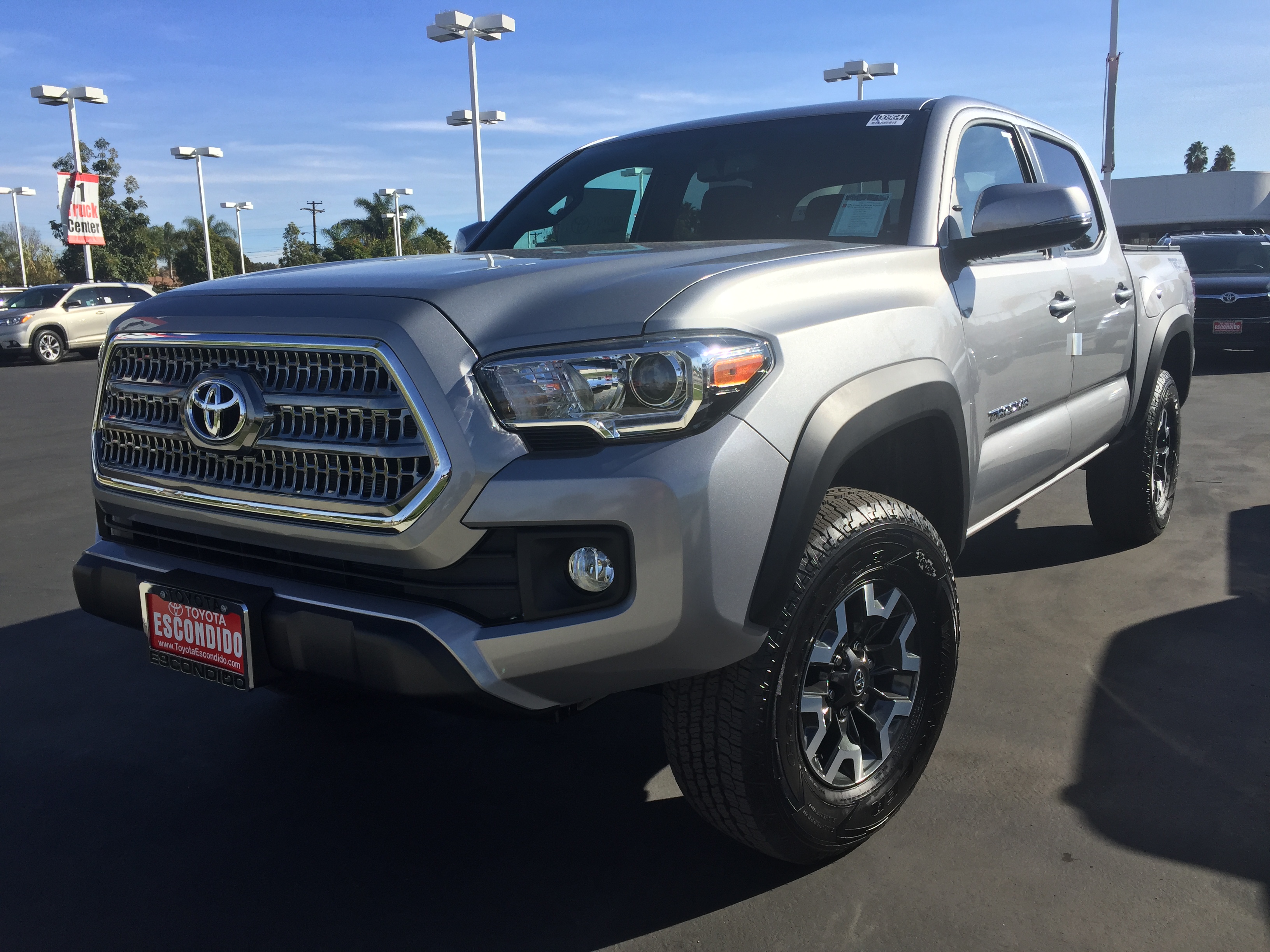
The Toyota Tacoma is a midsize pickup truck known for long-running design choices and a reputation for being straightforward and durable. Here, it’s used as an analogy for how some older-feeling vehicles can develop a “cult following” because they don’t chase every new trend.
A “cult following” means a loyal group of fans really loves something, even if it’s not the newest thing. With cars, it can happen when people like how it feels or how it’s been built for a long time.
Concept
old Google G1 phone
The host uses the “old Google G1 phone” as a metaphor for early-generation technology that may feel dated but still has a recognizable identity. The comparison is meant to question whether EVs will develop similar nostalgia or loyalty as they age.
Refurbishing is basically repairing and restoring something so it works well again. Here, it’s about keeping older electric cars running by fixing key parts.
They’re talking about the Tesla Model Y, a very common electric SUV. Since there are so many of them, there should be more businesses and parts available to repair or refurbish them.
Term
swappable brain
They’re using “swappable brain” to mean the car’s main computer could be replaced or upgraded like a module. The idea is to keep the car current without replacing the whole vehicle.
Infotainment is the car’s screen and software for things like music, maps, and phone features. They’re saying newer cars might get better versions of that over time.
Over-the-air updates are changes to the car’s software that you can download wirelessly. Instead of swapping hardware parts, you often just update the software.
The Tesla Model S is an electric car. People like it as a donor because its electric parts—like the motor and battery—can be reused in updated projects.
LIVE
This is WhatCoreYB Podcast for Thursday, April 30th, 2026, episode 268, God's Eye.
I hate it.
I hate it when something pops up and confirms that you were right, or at least confirms your
opinion.
And I am going to somewhat disagree with what is said confirming your opinion.
Alright.
And who is you?
Who is me?
I'm Phil Royle.
I'm the person that says go to the whatcar.com slash store and buy an EVA F-shirt as soon
as you can before they're out of stock.
Just kidding.
It's print on demand.
They're never going to run out of stock.
The world has to like implode for that to happen.
Anyway, you want to go there.
That helps support the podcast and the blog that doesn't really exist anymore.
But the podcast is here weekly for your enjoyment, for free, for download, and for free for watching
on youtube.com slash at the whatcar, where you can see my eyes roll around my head every
time I've got to try and remember a URL.
Why does that happen?
Because I'm old and I've been doing this for forever.
So long that I no longer give my professional credentials, I'm just here and happy to be
alive.
Maybe I'm not that old.
Fellow old guy at Sanchez.
People must think we're like 90.
Close enough.
Anyway, let's see.
I think we're past the five year mark on the podcast.
So there's that.
Yeah.
At Sanchez, Day Job, Automotive Electronics Industry Analyst, Side Hustle, The What Car
Podcast, and here we go, off to the races.
I was flipping through the old Facebook that shows you how old I am and a real popped up
that was part of a bigger video that it was Haggerty, right?
Haggerty did this video and it was.
Yeah, he does these videos that are great, you know, Haggerty.com slash media, you find
all their stuff there and they've got a YouTube channel.
I mean, like that's where all their whatever, search for it.
And so this was a real based on a longer video that you've done.
I didn't watch the entire video you did.
I only watch bits that like feed me the information quickly like our shorts do to everybody else
share our shorts, by the way, on social media.
You'll find those on YouTube.
Anyway, I've been saying and unused, by the way, you've been saying for years that
Tesla does not need to do redesigns of its vehicles, exterior redesigns, because the
redesign is more than skin deep for Tesla, that the car can look old and raggedy like
a 2012 model all day long.
But underneath, it's shiny and new, like Tamatoa.
Yeah, so and this agrees with you, this video agrees with you.
OK, so well, OK, so we can unpack this a little bit.
You want my commentary or you have more?
Well, I disagree with some of what he says.
Jason Kamasa and it says that for every redesign, there's like 50 percent for every
major vehicle redesign like Toyota for GM, whoever does like 50 percent of the components
of a vehicle of all new quote unquote, all new vehicle, 50 percent of them are all 50 percent
of the parts are old.
So you actually have about so over the course of since 2012 to today, the model S shares
3 percent of its parts with the original car.
And he said, do the math.
That means that you would need 50 years of redesign of vehicles, the traditional redesigns
to hit that same point to which I say.
So he said he gives the example of 1964 Mustang to today's Mustang, to which I say there is
not 3 percent of the same parts in today's Mustang as there was for 1964.
I would say there's probably zero.
There is zero.
I've done a little bit of research.
And unless you can find something that I could not find, there is zero percent.
So his math doesn't math, but the point is still solid.
Now with your turn.
No, I mean, yeah, I mean, I agree, like Tesla's approach has been very
contrary to the rest of the industry and that, you know, typical legacy OEMs, like every
say two to three at the most five years, every two to three years, they'll change the
wheel design, they'll change the grille, maybe they'll add a little LED accent lighting
or different stuff.
But fundamentally, it's the same car.
Whereas Tesla, from year to year, it like barely changes if at all, but
visually skin, yeah, visually, but under the skin, you know, components like motors,
heat pumps, you know, suspension, electronics, architecture, you know,
computer brains, whatever, they'll be changing that stuff constantly.
So from the outside, they may look identical, but, you know, three years apart, they're
like completely different cars.
As you discovered with your Model 3, where if you would have bought it like six months
later or whatever it was, you would have had hardware three.
Yeah, instead of having to pay out a pocket for it, which is now obsolete regardless.
And the car looked identical, as far as I'm aware.
They just changed the from hardware 2.5 to 3.
To 3, yeah, and he ultimately got you nothing.
Well, we'll see.
I mean, they say they're going to offer a retrofit, but I'm done paying.
I mean, unless they give it to me for free.
They're saying they'll do a hardware four retrofit for your car?
They're talking about that now.
Or even five now.
They may skip four entirely, I'm not sure.
But anything to get out of a lawsuit, huh?
I'm not going to pay anymore.
I mean, to me, I don't care if I'm part of the RoboTaxi fleet.
Yeah, you know, I I did the like a 30 day trial of FSD.
It's kind of cool, but it's kind of a party trick.
I just, I mean, it's not for you.
I'll defend him a little bit.
It's just not for you because I know people that swear by it.
You don't drive anywhere.
You're a hermit.
Well, I mean, I just took a road trip, but, you know.
Yeah, your day to day is like your commutes a little bit less than my commute.
And I work from home.
Yeah, point taken.
And so, I mean, it's kind of a non-issue for me about it for other reasons.
And I like it for other reasons.
Anyway, do you think that this is a this isn't what the episode is about, you guys.
But do you think that this is a problem with Tesla that they are not keeping up visually?
We're a very visual society.
Everything's about the latest and greatest.
Apple doesn't need to update its iPhone every year, but they do.
And it helps sell more.
And here, they're saying this one looks the same.
Buy it and we won't even tell you what the changes are.
Just trust us.
But funny thing you mentioned, Apple, sometimes the updates are hard to tell apart visually.
It still has a little three-camera cluster.
It's roughly the same size, you know, maybe, you know, where they put the apps
and the little trays and, you know, whatnot has changed a little bit.
But it's not a drastically different form factor year to year.
Now, if you look at it over the years, you know, one from 10 years ago to today,
I mean, it's clearly a different a different phone.
But, you know, even then, I'd say that it's more evolutionary than, you know, like revolutionary.
Well, they still spend a lot of time and money advertising what the differences are between them.
Of course. No, I mean,
I think it's going to sound funny.
I think Tesla is sometimes kind of annoyed with consumers because they're kind of like,
why don't they understand all these changes and improvements we've made?
It's because from the outside, it looks the same.
And you could say, oh, we just did the heat pump HVAC system.
We did a new LLP battery.
We did this, we did that, we did that.
People are like, it looks exactly the same as last year's model.
So which is why I think in some ways with the Highland initially for the Model 3,
they were forced to kind of redesign it.
So it looks tangibly new, like visually new.
So when people look at it, they're like, oh, that's a new car,
as opposed to basically 2018 till.
Well, when I'm trying to remember when the Highland came out, 23, I think.
I can't remember. Could be, could be or 24.
So basically four years of a car that looked exactly the same,
even though under the skin, it was this constant improvement.
Now, what's interesting, I watched the full length version of this video you're citing.
They had a 2012, and I'm assuming like a 2026 or 27 Model S side by side.
And actually side by side, you could you could see the differences.
They weren't dramatic, but they were noticeable.
The newer model is noticeably wider.
I mean, obviously the interior is completely different.
And so I think year to year, it's hard to see, but, you know,
oldest to newest, it's like, oh, you know, but one of my one of my neighbors has an old and a new.
And so I see it nearly every day when I go for a run.
I see these two cars.
He's got a black, old one and a red new one.
And they are they are very distinctly different.
But man, I think to the majority of people, you didn't see him side by side.
You'd be like, they look the same.
Yeah, you need it side by side.
And even then, I think the majority of vehicle purchasers.
We're nerds.
I think majority of people aren't.
They're going to look at them and say it looks like the same car to me.
Yeah.
So I mean, I mean, I think for better or for worse, Tesla is going to have to keep up
with kind of the consumer expectations of visual changes every few years.
I think they're struggling with kind of a lot of problems
with their brand beyond Elon, beyond the obvious.
Yeah, because the new models, I only just notice it.
I don't know why.
Maybe this was a big story and I just missed it.
But with the Highland and then with the revamp model, why whatever codename
redwood or whatever it was, they dropped the T from the car.
The logo is gone and now it says Tesla before it was very distinct.
If you wanted Tesla written on your car, you had to buy a license plate frame
that said Tesla or put a buy aftermarket things.
It was you just got the little T and that was it.
People just had to know that that was Tesla.
And I think back to my statement of most people,
I think most people would see a T and be like, I don't know what that is.
It's a T.
Maybe it's even a T.
Maybe outside of California.
I think most people in California would know what a Tesla is.
Yeah, but it wasn't advertising what the name was.
Now they all say Tesla.
I think that they've hit a point where Tesla was, quote unquote, Kleenex.
It was a Xerox.
It was the generic EV.
It was the term you used.
Oh, you drive a Tesla.
What you actually meant was you drove an EV.
And then now that everybody else has EVs out,
if you drive a Tesla and you're using it generically, it's just an EV.
I think now they're having to actually brand their stuff to identify their vehicles.
I think they're kind of a victim of their own success a little bit.
Somewhat, yeah.
I mean, their market share, I mean, I think.
I think even in California for EV market share,
I mean, at one point, I think Tesla was like 70 or 80 percent of EV market share.
Now, I think I read they're like 45 or 46 percent.
So they've dropped below the 50 percent threshold.
Now, in absolute terms, 40,
you know, 45 percent is still a huge market share.
Probably more than what it was numerically than when it was 70 something.
Yeah, but relative to all the other models out there, it's smaller.
So yeah, I think they're having to stand out a little more and be a little more
distinctive. So but anyway.
So going to the other side of the world from here.
So I guess there was just a big auto show in Beijing.
I think it was Beijing, yeah.
So obviously that's China flexing their muscle and showing off the latest and greatest.
So so as we discussed, BYD has a bunch of different brands.
Yang Wang is like they're they're Bentley or Bugatti or whatever it is.
So Denza is kind of they're like.
Kind of more premium ish, like kind of like Audi, I guess.
Maybe. OK.
So they just came out with the Denza Z sports car.
Funny that you used Audi and not BMW.
Oh, as they released their Z Roadster.
Well, well, no, I mean, well, BMW doesn't really have an equivalent.
I mean, BMW is BMW.
But I guess I used Audi because there's Volkswagen Audi.
No, I'm saying that this is this this Denza Z that they've unveiled is a.
Roadster Z Roadster.
Yes.
You went in our notes like a different direction for what brand they're kind of mimicking.
But go on, tell me more about the car.
Z. So 1000 horse claims zero to 60 in less than two seconds.
So, you know, fast plaid territory on sale for the equivalent of about 65 grand in China.
Kind of cool looking.
I don't know exactly what I'd say it looks like.
Maybe kind of like the old Tesla Roadster.
Kind of bigger, it looks like.
But yeah, yeah.
Anyway.
I mean, 65,000 is not a bad price.
Mark it up 100 percent for tariffs and why not 30 grand 130 grand for a two second sports car.
Maybe. Yeah, still not bad.
We maybe we should revisit that episode we did when we did the Chinese forbidden fruit models.
But yeah, kind of cool.
Yeah, 65.
Yeah, I'd say bang for the buck would be awesome.
130.
I mean, you put charging speed, I think.
Oh, no, that was later.
I did I know charging speed on something else.
I was just flipping through.
Well, I mean, so to your point, though, BYD.
Another thing they they I want to say we covered this last week.
It's like a super fast like charging like what they say, like 10 to 80 percent in five minutes or so.
Mm hmm.
Did we talk about that?
Yeah, I think that was BYD.
Yeah.
So the battery pack cornered this article and inside EVs link in the show notes.
Battery pack that's compatible with BYD's flash chargers, which is what I imagined that it that was what we were talking about,
delivers 1500 kilowatts of power for sub 10 minute top ups.
Yeah.
So fast.
Now, I really like favorite part of this car is that they have come up with a better name than autopilot and full self driving.
Dragon drive.
God's eye.
Oh, yeah.
Yeah.
Fantastic.
Beat that, Elon.
Beat that.
Yeah.
I don't know.
It's pretty cool sounding.
I don't know.
You know, to paraphrase Trump, you know, are you tired of winning?
I wonder if the Chinese are tired of winning with EVs.
I mean, they're they're pace of like innovation, new models, new stuff.
Now, you know, I think maybe some of this is it's a little hard to judge from a distance, like,
you know, not having firsthand, you know, access to these living with them, experiencing them, you know, getting a sense of real world range.
I think maybe some of these maybe aren't quite as spectacular as they seem from a distance.
In fact, I just I can't remember where I saw this.
But someone did a review of the BID.
I can't even remember because there's a couple of different names for it.
It's kind of their base kind of urban compact car.
And it was like the base base model, but it's on sale in Europe and it only has 85 horsepower, which is this particular model, which,
you know, was pretty common in like the 80s and early 90s.
But I think I read somewhere there's not a single car on sale in the US today with less than 100 horsepower.
So they do have a model that has like 150 horse.
But anyway, but the guy that drove it said it's pretty basic.
It's pretty stripped down.
It's not very fast, you know, but he was like, it's cheap, you know, I guess it's on sale in Europe for the equivalent of like 20 grand,
which is not like the 12 grand it is in China.
But yeah, it seems you're just looking for basic wheels.
That's good.
But I can't imagine 20,000 on something that's that basic.
Yeah. So but I guess I mean, I guess it's kind of equivalent to,
you know, like Dacia is the kind of the entry level brand in Europe.
That's I think that's like a Renault group brand now.
You know, it's kind of equivalent to that, like, you know, basic wheels.
So but I mean, I'm not saying the Chinese just do that.
They have the full, you know, the Yang Wang, New Nine Xtreme all the way down to this little basic BYD and they even have the little.
I think it's Wuling is the brand, the little city car.
You know, so they've really got the whole gamut there.
But I don't know.
I mean, I think until we get some over here and I know some have come in.
You know, I know Ford, you know, Farley had the Xiaomi Su7.
A lot of people call it Su7.
I'm calling it Su.
So he liked that.
I know some like reverse engineering, Kersoft in Michigan.
They've done a lot of reverse engineering on Chinese models.
But, you know, I'm not saying they're not competitive, but I'm saying till they're here,
which I still feel is a matter of when not if.
But I'm wondering if in person that the kind of the new shiny might fade a little bit.
They'll be like, oh, they're good, but they're not like this amazing life changing.
Yeah. No, I think that's definitely true.
And until they come here, we don't know.
And as soon as they come here, we'll be disappointed.
That's the nature of the beast.
Well, I mean, I mean, maybe disappointed relative to what some of his expectations are.
I mean, they think these are going to be like flying saucer like
level technology and then they actually get them.
And they're like, you know, the range isn't quite as good as I thought.
Is it just a fit and finish the polish that like the problem with Vinfast was not
its specs, its specs were fine.
It was getting in the vehicle and it just didn't drive well.
Or the software was really glitchy or.
Yeah, it just had basic problems that they had to work through.
And maybe they have by now, I don't know.
You know, there's been no reports that Vinfast is while they're still here
and I still see him on the road, they've kind of gone MIA a little bit.
They're not pushing as hard as they used to.
But we don't know, like with China, you don't know the story behind it
because there's a lot of like government subsidies.
There's a lot of they'll take losses.
Amboyism, too.
I think a lot of the reporting out of Asia is very kind of triumphalist and like.
I think they have to be best ever and amazing.
Yeah, there's certain requirements when reporting on Chinese things
of when you go into China to drive them that there are certain
you want to get like negative social points or yeah.
I so yeah.
And I don't know.
I don't know.
We'll see when they arrive.
We'll see this thing seems great.
And if they could bring it to America for six, five thousand dollars,
that would be that would well, it might come to Canada first.
But we'll see.
I'll tell you what is here.
And it seems like consumers are resonating with.
And this kind of gets back to something you've said.
More than once over the years.
Like once Toyota gets into EVs are going to go big.
And it looks like that's starting to happen.
So sales are up.
Quite a bit.
Now, this is global.
This is in the U.S.
So this global Toyota's global battery electric vehicle sales
reached thirty five thousand five twenty five in March.
An increase of one hundred thirty nine percent from the same period last year.
And that's real percentage.
Yes.
So the big the big eye opener here was actually in Japan.
In Japan's ironically, despite importing like 90 plus percent of their oil has been
up till now kind of ambivalent about EVs.
They were like like hybrids are the answer, blah, blah, blah.
They were a big push on hydrogen and hydrogen.
So thirty five hundred EVs, which I mean is like.
I think they probably sell more than that in L.A. County.
But that was an increase of over four thousand percent from last year.
Well, yeah, when you're dealing with low numbers, percentages are easy.
Yeah.
So that's shocking that that number was so low.
But yeah, the government there was not incentivizing EVs.
As far as what I'm aware from news reports, I'll tell you what I think is
incentivizing EVs is the current situation in the Middle East.
So but also Europe up eighty five percent for in the first quarter.
That's pretty substantial.
And then now the BZ is now the third best selling EV in Q one twenty twenty six
behind only the Model Y and Model three.
So I am seeing them pop up more and more in my neighborhood.
We've got tons of I mean, I mean, Southern California.
Yeah, see tons of EVs like the the Rivian R1S is like the de facto family
hauler in my neighborhood.
It's so I'm beginning to see more BZs.
Long story short, there's one Salterra, somebody screwed up
and walked into the wrong dealership and bought a Salterra.
But the rest are BZs and BZ forex is I'm seeing more BZs show up now
as those hit dealerships and they look great.
Yeah, I mean, what's funny is objectively they're not like superstars.
I mean, even with the refresh, they're more competitive, but they're not.
I wouldn't call them class leading in terms of like charging speed,
range, you know, whatever else, but Toyota is a trusted name.
You know, consumers trust Toyota.
They've got a solid reputation.
So they're like, well, I know if I buy one, I can count on it.
It'll be solid may not be the, you know, the most spectacular thing in the world.
But I know it will last me.
So I know so many people who are diehard Toyota and diehard diehard Honda fans.
And they're not there for the enthusiast portion.
They're there because they drove a Civic for 15 years and put 350,000 miles on it.
And it never gave them a lick of problem.
So they're going back to the Honda place and getting themselves a Honda.
Toyota and Honda seem to have the non-enthusiast brand loyalty.
Yeah, just because you know, it's money well spent.
And whether or not the BZ is the best car in the world, it's building on that success.
And so as long as these keep going and they don't brick themselves like fiskers, then.
They're not a very high bar.
No, it's not.
But they're going to keep that loyalty because the loyalty that comes with it
is not, well, my model Y does zero to 60 and whatever, or charges at X rate,
or, you know, whatever, charging greater.
Nobody cares.
Yeah, no, these people don't care.
They care about the fact that their Civic took them through high school without any problems.
And so they got another one and then they got another one.
And here they are.
And it's time to graduate to an EV.
And so they go and they get that because that's the brand they know and trust.
Yeah.
Too bad it doesn't look like Honda doesn't have anything in the pipeline for the US for a while.
But the prologue looks great.
I'm seeing those all around my neighborhood, too.
Re-batch GM, so.
But they look better.
I buy the prologue first.
And they have car play.
Many reasons why I would buy the prologue.
But they look and they sound great, too.
They're a little space warble.
Is is fun.
No, I like the prologue.
It's one of my best, one of my favorite of the like that size SUV, midsize for how they look.
So speaking of GM, the maker of the prologue.
So they came out with their full size EV trucks and SUVs.
So that would be Silverado, Sierra, Hummer and Cadillac Escalade IQ.
So the original plan was to give them a full redesign in 2028.
But I guess automotive news is reporting that ain't happening.
So, and really, if you unpack the numbers a little, it's not hard to see why.
They're not exactly setting the sales charts on fire.
Chevy sold just under 1400 Silverado EVs and Q1.
GMC sold about 1300 Sierra EVs, 1600 Hummer EVs and Cadillac sold 2000 Escalade IQs.
So I guess relatively speaking, that's not bad.
But even if you do the math, you know, times three or four, that's still less than 10,000
each for the year.
And these are big, heavy expensive cars.
10,000 for Q1.
We're talking Q1.
No, the numbers I have there are quarterly.
So Q1.
But if you were to extrapolate that out over a year, that's still less than 10,000 units.
Yeah.
Assuming that same sales rate.
Yeah.
So GM is looking relatively low volume, high price cars that aren't selling great.
But I mean, maybe they still see value in having them in the lineup.
So they're like, well, we'll just kind of do a refresh and, you know, new colors.
So they're just going to let it ride.
It kind of sounds like it.
It doesn't sound like they're going to discontinue them necessarily.
But I don't think they're going to spend billions on a redesigned refresh.
I think they can get away with it.
I think right now you can get away with it.
The vehicles that they've come out with are all modern.
They all charge fast.
They've got long ranges.
They weren't compliance cars.
They all look good if you like that particular car.
I saw the Hummer just yesterday.
I saw a Hummer truck.
I don't know how to distinguish it from the SUV.
Like what's its name?
The SUV.
Okay.
So I saw one of those.
It's got a lot of presence.
That thing is, every time I see one, they're like massive, massive.
You round the corner and you see one parked to the side of the street,
and you're like, whoa, that thing's a behemoth.
So the Silverado, I don't know, looks like an outfit.
Yeah, I think your point, I think it's a matter of,
even if they did redesign it, or I don't know if it would make
that big of a difference in sales.
I mean, I think if you want to get one, you want one regardless.
And the specs are a little bit older design, yeah.
And they're good enough.
They're not lagging in any way right now.
So I think they can push it off, maybe do some body cladding,
and call it in for a while.
I mean, I know this is kind of apples and oranges,
because the example I'm about to cite is an internal combustion vehicle,
but it makes me think of the Dodge Durango.
And the current model has basically been on sale for the past 16 years, effectively.
In fact, even since the last major redesign was like 10 years ago,
and they're still selling great.
They're still popular.
I think what's kind of ironic is, even though the rest of the Durango's competitors have since gone,
I shouldn't say Unibody, because the Durango's Unibody too,
but they've gone to four-cylinder and turbo six powertrains.
You can still get the Durango with the V8.
And even though objectively, it may be inferior to like a turbocharged six,
it's got that V8 sound, that rumble, that hemi kind of aura to it,
and some people still want that.
So I think-
No, I wonder with EVs if that still stays true,
because Toyota's got that with the Tacoma.
The Tacoma's never been cutting edge,
but as they've just let it drag out, and it's such old technology there,
that now it's got a cult following, because it's old school.
It's the awesome way of doing things.
It's the way they used to do it when I was younger,
because it's been around for so long and they've never changed it.
I don't know if EVs are going to have that same thing of like,
well, it's really old, and so it's tried and true,
and this is the way it should be done.
I think they're more like if you had an old Google G1 phone now,
the first generation Google phone.
I don't know how-
I like the flip out keyboard, but it doesn't work.
It's kind of hard to say how EVs are going to age.
I mean, I think there's going to be,
some of them will be collector's items, some will not.
I think the Tesla Model Ss that survive,
I think at some point will be valuable ones that are in good shape.
And I think you'll see, you're already starting to see this cottage industry of
kind of keeping them refurbished and refresh battery packs, this and that.
I mean, I think you'll see kind of like a secondary market for refurbished battery packs
for some models.
I think the Model Y, just because it's so ubiquitous and they're like everywhere,
you're probably going to see a market for refurbishing those a little bit.
I think a lot of other EVs will just kind of-
there'll be a chapter in the history book,
but I don't think they're going to stick around for the long haul.
Yeah, it's hard to know because technology is progressing so quickly,
how, if they're going to build them where they basically have like a swappable brain,
I mean, kind of in some ways what I did going from hardware 2.5 to 3,
if 10 or 15 years from now, they'll be like a retrofitable computer
to give them 5G capability, 5 or 6G capability at that point,
modern infotainment, maybe a little more range, who knows, I don't know.
If they just let these things age and not have any, like with laptops, with phones,
it used to be, and with laptops, it used to be you could change battery,
used to be you could change RAM, it used to be you could change the hard drive,
and that all went away. Now you pick it up, throw it away,
go to the store and buy a new one, that's your upgrade range.
I say this recording this on a 2012 MacBook Pro, you don't really stick around with the
old technologies for that long. You kind of hit this spot where it's good enough,
and that's where I am with my MacBook, like it is good enough to do what we're doing
with some upgrades. I upgraded this thing, it's got an SSD and not a spinning drive anymore.
So I think cars like yours, you've upgraded it, you could upgrade it as far as you can go,
eventually it's just going to stop. I think eventually the newer models just won't be
upgradable, everything will be too, it'll just be the same way they went with phones,
same way they went with computers. I don't think it's going to be the same as it is with
gas-powered vehicles, but I could see a market on gutting these old EVs,
and then it turns into a hot rod situation, or a rest-o-mod, whatever.
You're already seeing that with the Model S, the Model S motors and batteries are
in actually pretty high demand for EV rest-o-mods, which is kind of a nascent kind of cottage
industry right now, but the Tesla motors are really sought after because they're relatively
compact, they got a lot of power. But I think owning an OG Model S in 50 years,
I don't see that being a thing, but I can see owning an original Model S in 50 years,
but it's got all the guts from a 2030 in it, or a 2040 model, and that's what you keep doing.
The originals go away, all the original internals keep getting swapped out, so maybe in 10 years
you're taking original Model 3s and you're putting Model S drivetrains in them with an
aftermarket battery pack from something else, and that keeps it going, but externally it looks
the same. I don't see how you keep these things going indefinitely
with things that change, and you get to the point where the charging infrastructure will
change in the next 50 years, I'm sure, and there's only going to be so much backward
compatibility, you will hit the point where certain EVs just won't charge, where an old 1772
whatever CCS plug just isn't compatible with the level 345 chargers, whatever we're calling them,
in the future, it just won't work. I don't think we're going to hit the point where you've got
the Durango and the Tacoma that are celebrated for being old school when you fast forward out
50 years. I don't see how these cars keep running without major modifications, so I think it's going
to be a different type of vehicle that you keep. To your point, I think a lot of the components
will change just based on availability and the aftermarket. Outwardly, first glance,
they may look different, but you go inside, it's like, oh, it's got a new display, and it's
got a Type 4 AC induction motor versus Type 1, and now it's got lithium,
sodium, thorium batteries and stuff in MC or whatever. I don't think this is the
worst call from GM, because- Oh, you're going back to what we were talking about.
No, I'm just saying, I think they're probably, what they may do is they did want to implement
kind of this higher-level electronics architecture that would support eyes-off
self-driving. They probably will proceed with that, or whatever, super-duper cruise or whatever
GM's calling it. They probably will implement that, but minus a full-fledged redesign.
If I had to appear into my crystal ball, that's what I think is probably going to happen.
You're saying they're going to go Tesla's route. Basically, they're going to do like Tesla,
they're going to upgrade the bits that you can't see and let it ride for as long as they possibly
can. Yeah, and I think the other thing, too, is they're waiting to see what happens in 2028.
If we go- Aren't we all? Yes. Even right now, with the market shift,
because of fuel prices and the global energy. What's happened with fuel?
I don't know. I drove a Tesla. I think maybe after that, once they get a little more clarity
for the next four years, they'll be like, okay, now we can do whatever. The market has decisively
shifted this way. You never forecast anything 100%, but we can forecast pretty sure there's going to
be more demand for EVs, whereas right now, it's kind of- Who knows, I guess.
So who knew that Porsche was going to sell at stake in the Bugatti rematch?
Yeah, this was a little bit of a surprise. Didn't see this coming.
Did not see this coming. So I guess Porsche is going to sell their stake to a New York-based
venture capital form, HOF capital. I don't know if Hasselhoff is on their board or not, but
HOF capital, anyway. So Porsche first got involved, I guess, in 2021.
And I guess Bugatti was under Porsche somehow in the Volkswagen corporate hierarchy.
Yeah, it's really weird. The Volkswagen group is very weird.
Yeah. So rematch held a 55% majority stake in Bugatti. So I'm not exactly sure what this means.
This may mean Bugatti's out of the VW group entirely.
The articles I read didn't really make that exactly clear.
But yeah, I mean, Bugatti may be its own thing again. So I don't know.
That was kind of going to be my question, is Porsche acquired a 10% stake in rematch in 2018,
according to this article that we will link to. The later increased to 21%.
And the connection between Bugatti rematch and Volkswagen was always through Porsche.
So I don't know what this means when Porsche gets out. Does that get rid of the Volkswagen
connection or is Bugatti, which is part of the Volkswagen group,
via Porsche? Who knows? Somebody does. Mate does.
Mate does. Yeah. So speaking of the Volkswagen group, the next generation Golf,
so this would be the Mark 9. Supposedly that's going full EV, but what's kind of interesting is
I guess they're going to keep around the current ICE version. I think it's considering the current
model Mark 8.5. It's not quite a full generation. But anyway, I mean, keep that around. But I think
the Mark 9 is going to be predominantly EV. So I found some of the references to this article
interesting. It said, Kai Grunitz, head of technical development, said the new generation
will draw inspiration from the Mark 4, which I owned. Yeah, they're obviously trying not to get
you as a repeat customer, I guess, by drawing in the Mark 4. I mean, it's not drawing inspiration
in terms of reliability, because that was left a little bit to be desired. So I guess the reason
they're saying that is from the Mark 3 to the Mark 4 in terms of sophistication, technical
sophistication, trim, fin finish, the luxuriousness of the trim. For the big jumps in the Golf slash
GTI, the big jumps that they had was definitely the second generation got the sportiness right.
That got the design right. The Mark 2 got kind of everything right. And the Mark 4
elevated that to add luxury and refinement to it. The Mark 1 was kind of an introductory,
lost some of the, it was trying to be modern, but it wasn't really a big enough leap. And they
introduced some of the things like the VR6 and they started adding things, but it wasn't a
fully finished product. The Mark 4 was the first time they had the Mark 2 that got the
enthusiasts. And the Mark 4 put the enthusiasts in together with the people who wanted a little bit
more class and refinement, but still the sportiness. So I could definitely see that the Mark 4,
I don't know if it's got a cult following, but I can definitely see where the Mark 4
would have that because that was the first time that it really all came together in one cohesive
unit of sportiness and style and refinement minus the one you had.
Well, I don't know. Mine was kind of, maybe it was uniquely cursed. However,
I do know the Mark 4 in general had a lot of issues. I think I experienced most of those.
Yeah. No, they had window regulators where a regular fail on them. I think the Sonarovs
regularly failed on them. There was things like that. This was actually during my hay day at
EuroTuner magazine was basically Mark 4, the transition from Mark 3 to Mark 4. And so was
all, everything that we did was basically Mark 2 and Mark 4. And after that, they got very,
they had a lot of good things. There's a lot of more recent ones are styled really well,
but they're all kind of derivative. They all built off of the Mark 4.
Yeah, I think to your point, the Mark 4 is the big leap from its predecessors in terms of style,
refinement, kind of premium appeal. That's when PIK was still in charge. I think the Mark 4 was
the beginning of the fate and Turek era. I think the Mark 4 was the beginnings of that where
PIK had really like premium aspirations for the Volkswagen brand. Never mind the fact,
Volkswagen also own Audi and Porsche. A lot of people were kind of like, why
you already have premium brands? Why are you doing this? But anyway, so yeah.
So I don't see that as a bad thing if they're using the Mark 4 for its EV takeoff.
And so the VWCO, Thomas Schaefer, this report says he said, wow, when he looked at the
Mark 9. So he was impressed, I guess. Wait, he didn't say, whoa, what a piece of crap.
I'm shocked, shocked. So yeah, good for them. I'm still kind of on the fence if I'd ever
consider another Volkswagen product, although I still like the idea of the Rivian R3, which
it'll be interesting to see how similar the Mark 9 and the R3 are. I'm wondering if it's just going
to be like software and electronics, or if they're going to share more than that.
No, I feel like somebody at Rivian, perhaps the CEO, was of the similar generation to us,
that the Mark 2, Mark 3, Mark 4 was very influential in your automotive
likes. I can't think of the word. I ran out of words.
Words are gone. Culture, history?
Yeah, you kind of what built your, what definitely made a mark on you
were with those cars. So they've got the R3 that is certainly influenced by that.
Interesting to watch. Now, this was something that I sent you, another thing that I sent you
as a real because I was like, whoa, well, I made a comment about it.
Well, no, you made a disparaging comment. I did make a disparaging comment.
So this was the Ford Cobra Jet 2,200, sets EV quarter mile record, 6.87 seconds,
quarter mile runs 221 miles an hour, pulls really hard to the left.
Did you notice that? So I get that, like both at the first quarter of the quarter mile,
and then at the shutdown area, that car was over the line or close to it.
Oh, maybe you should go into NASCAR. Isn't that what they do? They pull the left?
Yeah. So this definitely didn't go in a straight line, but this thing goes fast.
It accelerates like a little bullet. What I found kind of interesting,
so this is not the first Ford EV dragster. I guess they made a Cobra Jet 1800,
and that thing was quad motor, and this is only a dual motor. So they've kind of simplified,
but it's also faster and more powerful. So good for them.
Technology tends to do that. Yeah. Kind of somewhat interesting to me is it said the
battery system takes about 20 minutes to charge, which falls within the NHRA's 45-minute turnaround
window. So cool. I mean, I don't know if they plan to make a series out of this or...
The 20 minutes, I can see people saying, oh, that's a long time. Once you get to top fuel,
now this is slower than top fuel. Yeah.
Than the big, big. Top fuel is like three and a half or something.
Yeah. I don't even know if they don't run quarter miles anymore. They run like
eight miles, but they're still doing it. I'm talking beyond my knowledge here.
But those guys rebuild the engine between each run.
So here, if you've just got to plug it in and check some bearings or whatever,
I don't know what the crew does. Maybe they pull all the drivetrain apart. Maybe that's
what they're doing. They pull the gear reduction unit out and they check all the gears. Maybe,
I'm sure there's still a lot of maintenance that goes on between.
My guess between runs, they charge the battery and probably stick a plug in the diagnostic
port we're going to scan. All systems check out. Cool.
Yeah. Well, in this case now, once it gets competitive, this is the class and there's
money to be had, I'm sure that they will be pulling the motors out and checking the windings.
I'm sure that they will find something to do between runs because they freaking rebuild
engines right now between runs. Yeah, but that begs the question of will that be necessary?
I mean, I know 2,200 horsepower, but fundamentally, it's just...
I could see you having to change axles every time because you're twisting them.
I could see... Possibly.
Instead of it being on the engine slash now motor, I could see it being on all of the drivetrain
that you are now hitting. I mean, what's interesting is a little more detail says
features a multi-speed transmission centrifugal clutch. The system allows Ford to improve
traction stability by controlling torque at launch and managing motor inertia,
the car switches to direct drive after launch. I could see them maybe pulling out the transmission
and maybe changing out the clutch packs, but I would think the motor itself is probably good for
a while. You'd think that of an engine in these dragsters, but they're not. They're good for
about a minute. Yeah, but I mean, how much... Anyway, we could go on for...
I forget what horsepower those things are turning down. I don't know with this.
But it's like at 14,000 horsepower or something. It's absolutely...
I think it's at least like six to eight.
It's... Okay, let's look this up. How far? Because I'm pretty far off.
How much horsepower for a top fuel dragster? And the internet says
11,000 to 12,000 plus. Oh, wow. Okay. Yeah, they're sick. And as far as I back when I
looked into this before was that they don't really know how much horsepower.
Yeah, there's no dyno strong enough to measure one of these.
Yeah, you certainly can't do it on a wheel dyno because it just spins the tires.
And yeah, and you can't do like hubs because you'll break it. There's so many things that it's
like... I think it's an mathematical calculation. So...
10,000. Current estimates right now are 6,000 horsepower under blah, blah, blah, blah, blah,
one and a half gallons of nitromethane per second.
Talk about a gas hog. So it's literally gallons per mile because it's a quarter mile.
Yeah, top fuel dragster. Four or five gallons just for the run.
Yeah, Wikipedia is saying about 8,000 horsepower. Hot Rod's saying 11,000. I mean,
it's all over the place. It's all over the place. I imagine this is the problem with when you ask
somebody and they'll just be like, I'm making 12,000 horsepower and the other person's like
more conservative and they're like, I'm making 8,000. They're just giving you any number
that either makes the other people feel like losers because you're beating them with less
horsepower or losers because you've got double their claimed horsepower number.
Here, I don't think they gave the horsepower number on this. 2,200.
2,200? Hence the name. Oh, well, there you go. But then again, the Yang Wang has like 3,000.
Yeah, I don't know. I don't know what's special anymore.
We'll end this with my disparaging comment because we got to wrap this up. Our episode's
getting longer. What's up with that? I don't know. I sent it to you and this is not a conversation
for this episode, but I sent the clip to you and I said something along the lines of,
it just doesn't sound right. Watching. Yeah, there's a wine and it takes off and it just,
I just expect it to be loud. You expect more Sturman drink.
Yeah, this just doesn't, it did its thing. I can't remember what.
You were like, whew. Well, I mean, I can't remember what episode it was when we were talking
about EVs and motorsports where you're like, the sound and the noise and even the smell is
kind of part of the spectacle. It's the experience. It'll always kind of be that.
Yeah, the spectacle, the circus. They took the animals out of the circus, but they kept the
spectacle. Here, if you take the animals out of the circus, take the horsepower out of the
circus of drag racing or other motorsports, like professional motorsports, top fuel level,
NASCAR level. If you take the animals out, you take the horses out, what are you left with?
If you've just got a car that goes fast in a straight line, but you missed it because you were
off getting a hot dog and you didn't even know that the cars were running. I mean, I have not
been to many baseball games and I'll make a ton of enemies here, but you don't know what's going
on. All of a sudden, something happened and you blinked and you missed it because the action
just took place. That's the thing with baseball is it's a lot of waiting around until someone
makes a base hit or a home run and everyone's like, yay. You're like, nothing's going on. I'm
going to go to the bathroom and get a hot dog and then you hear the crowd roar and you're like,
what did I miss? What did I miss? Yeah, that's this. That's exactly this. We'll do an episode,
a filler episode at some point, so look forward to that. Getting back to motorsports and everything,
but I'm still on that boat of, I think, amateur level EV. Sure, no problem. All day long. Autocross,
road racing, amateur stuff. You could do EVs. We're all happy with that. I don't see any problem.
Once you get to the pro pro stuff, the crazy quarter mile. The big sponsors. Yeah. I really,
I'm not seeing it with Formula E as super exciting. I'm sure they're thrilling to drive,
but you're trying to draw a crowd. You need the spectacle. There you go.
Leave a comment below if you're listening and watching on YouTube as to how wrong I am,
because this is not the right, they say read the room and I did not read the room on this one.
I just came by. Yeah, let's see. We're doing an EV podcast and
I'm just like down with EVs. I think there's a place for everything.
Yes. And the place for everything is youtube.com slash at the walk car.
Re-watch this episode if you want to listen to us. Also, the walker.com slash store.
Buy the merch. There's more than a walk car paraphernalia there, like the hat that Ed's wearing.
There's also the EVAF shirt. There's a charge shirt. There's hydrogen into the future and always
will be and a variety of things. We may still have a water bottle or maybe I took that off.
We've got a hoodie that I love, my hoodie. That thing is so soft and warm and fuzzy.
It is great when it's slightly chilly. I put that thing on. It's like a nice electric hug.
Isn't that electrocution? Yikes. I don't know. Anyway, back next week with more stuff.
Time to go before this hits one hour long and we get kicked out of whatever it is we're doing.
About this episode
Tesla’s habit of changing the hardware under the skin while keeping the exterior familiar sparks a bigger discussion about branding, consumer expectations, and how EVs age. The hosts compare Tesla’s approach with Toyota’s growing EV momentum, GM’s decision to delay a full redesign of its big electric trucks and SUVs, and Volkswagen’s next Golf going EV. They also dig into Chinese EV advances, including BYD’s God’s Eye driver-assist system and a 1,000-horsepower Denza Z roadster, plus Ford’s 2,200-horsepower EV dragster record run.
BYD reveals a wild one with its Denza Z. Is this 1,000hp roadster everything that the new Tesla Roadster isn’t…because it’s real? Also on this week’s podcast, Toyota EV sales surge, GM delays EV redesigns, Porsche steps back from Bugatti Rimac Group, VW teases the Mk9 GTI (with EV variant), and more!