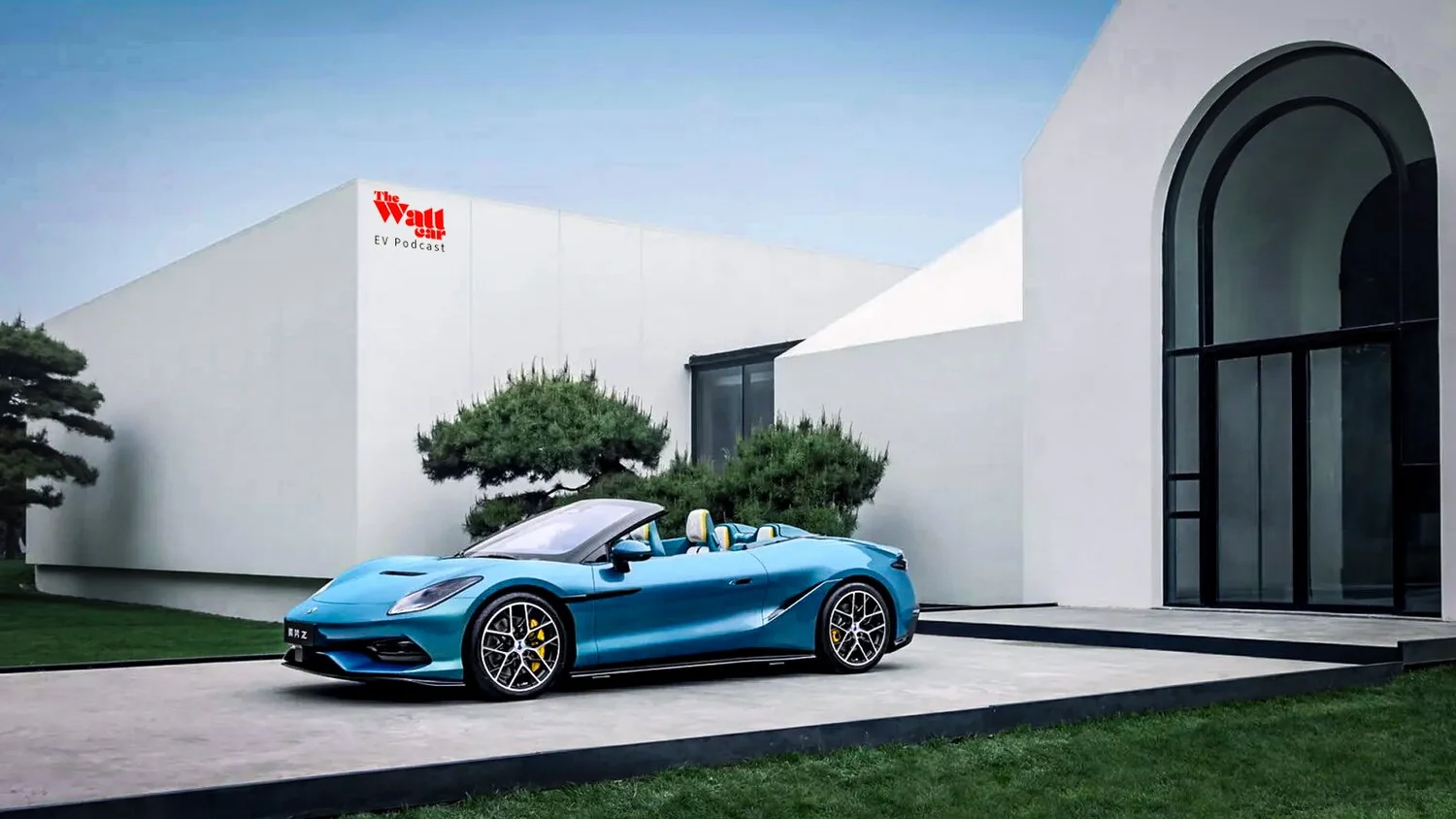
About this episode
Tesla’s habit of changing the hardware under the skin while keeping the exterior familiar sparks a bigger discussion about branding, consumer expectations, and how EVs age. The hosts compare Tesla’s approach with Toyota’s growing EV momentum, GM’s decision to delay a full redesign of its big electric trucks and SUVs, and Volkswagen’s next Golf going EV. They also dig into Chinese EV advances, including BYD’s God’s Eye driver-assist system and a 1,000-horsepower Denza Z roadster, plus Ford’s 2,200-horsepower EV dragster record run.
BYD reveals a wild one with its Denza Z. Is this 1,000hp roadster everything that the new Tesla Roadster isn’t…because it’s real? Also on this week’s podcast, Toyota EV sales surge, GM delays EV redesigns, Porsche steps back from Bugatti Rimac Group, VW teases the Mk9 GTI (with EV variant), and more!
Subscribe to the podcast on Apple Podcasts, Amazon Music, Audible, Spotify, PocketCasts, iHeartRadio, Podbean, and more! Or heck, use your favorite podcast application.
Perhaps you prefer to watch as well as listen. If so, we’ve got you covered.
SHOW NOTES
Tesla redesigns on the fly: https://www.facebook.com/reel/950802907550703/?mibextid=9drbnH&s=yWDuG2&fs=e
BYD shows off 1,000-hp Denza Z sports car: https://insideevs.com/news/794147/denza-z-ev-roadster-1000-hp-charging-reveal/
Toyota EV sales more than double from last year: https://electrek.co/2026/04/27/toyotas-ev-sales-surge-139-drivers-seek-gas-alternatives/
GM delaying redesign of full-size EV trucks, SUVs: https://www.thedrive.com/news/gm-delays-full-size-electric-truck-and-suv-redesigns-indefinitely-report
Porsche sells stake in Bugatti Rimac Group: https://www.electrive.com/2026/04/25/porsche-exits-bugatti-rimac-and-rimac-group/
VW CEO Thomas Schäfer reportedly said “Wow” at Mk9 Golf styling: https://www.caranddriver.com/news/a71138991/volkswagen-mk-9-golf-new-details/
Ford Cobra Jet 2200 sets EV quarter-mile record: https://www.hagerty.com/media/news/ford-racing-mustang-cobra-jet-2200-quarter-mile-time/
This week’s hosts: Phil Royle and Edward A. Sanchez
Episode art courtesy BYD
Music courtesy Twisterium at Pixabay
Website: https://www.thewattcar.com
Buy merch: https://www.thewattcar.com/store
YouTube: https://www.youtube.com/@thewattcar
Tesla
"Anyway, I've been saying and unused, by the way, you've been saying for years that Tesla does not need to do redesigns of its vehicles, exterior redesigns, because the redesign is more than skin deep for Tesla, that the car can look old and raggedy like a 2012 model all day long. But underneath, it's shiny and new, like Tamatoa."
Tesla makes electric cars. Here they’re saying the outside might look older, but the important stuff underneath can still be updated so it’s not really “old” in how it drives.
Tesla is an electric-vehicle brand known for updating cars over time. In this discussion, the point is that even if the outside looks dated, the underlying hardware and software can be updated so the car still feels current.
exterior redesigns
"Anyway, I've been saying and unused, by the way, you've been saying for years that Tesla does not need to do redesigns of its vehicles, exterior redesigns, because the redesign is more than skin deep for Tesla, that the car can look old and raggedy like a 2012 model all day long."
An exterior redesign is when a car’s looks change—like the front and rear styling. They’re saying Tesla can keep the same general look while still improving the car in other ways.
An exterior redesign is a change to the visible body styling—things like headlights, bumpers, and sheet metal. The hosts argue that for Tesla, the important updates may happen “underneath,” so the outside doesn’t have to change as often.
more than skin deep
"...exterior redesigns, because the redesign is more than skin deep for Tesla, that the car can look old and raggedy like a 2012 model all day long. But underneath, it's shiny and new, like Tamatoa."
“More than skin deep” means the important improvements aren’t just about looks. They’re implying the car can look older outside, but be updated in the important parts underneath.
“More than skin deep” is a phrase meaning the real changes are not just cosmetic. In automotive terms, it’s used here to contrast exterior styling with deeper updates to the car’s systems and overall design.
major vehicle redesign
"OK, so well, OK, so we can unpack this a little bit... major vehicle redesign like Toyota for GM, whoever does like 50 percent of the components of a vehicle of all new quote unquote, all new vehicle, 50 percent of them are all 50 percent of the parts are old."
A major vehicle redesign is when a car gets a big update—more than just cosmetic changes. They’re using it to argue about how many parts typically stay the same versus being replaced.
A major vehicle redesign is a large-scale refresh where the car’s architecture and many components are updated rather than only minor styling changes. In the segment, it’s used to frame a claim about how many components remain unchanged during redesign cycles.
Toyota
"...major vehicle redesign like Toyota for GM, whoever does like 50 percent of the components of a vehicle..."
Toyota is mentioned as one of the big traditional car companies. They’re using it as an example in a debate about how often automakers redesign cars and reuse parts.
Toyota is referenced as an example of a traditional automaker (“legacy OEM”) in the discussion about redesign practices and component carryover. The point is comparative—how different companies approach updates to their vehicles.

Ford Mustang
"So he said he gives the example of 1964 Mustang to today's Mustang, to which I say there is not 3 percent of the same parts in today's Mustang as there was for 1964."
The 1964 Mustang is the early version of Ford’s Mustang. They bring it up to argue that today’s Mustang doesn’t reuse the same parts from the original car the way the other person’s calculation implies.
The 1964 Ford Mustang is a classic first-year Mustang model that represents the early design of the car line. The speaker uses it as a comparison point to argue that modern Mustangs don’t share the same tiny percentage of parts as the math claim suggests.
legacy OEMs
"No, I mean, yeah, I mean, I agree, like Tesla's approach has been very contrary to the rest of the industry and that, you know, typical legacy OEMs, like every say two to three at the most five years..."
“Legacy OEMs” means the traditional big car makers that have been around for a long time. The host is saying these companies usually update cars more often with small changes.
“Legacy OEMs” means established original equipment manufacturers—traditional automakers with long histories of building cars. The speaker contrasts their frequent, incremental refresh approach (styling and minor updates) with Tesla’s more disruptive strategy.
wheel design
"Now with your turn... typical legacy OEMs, like every say two to three at the most five years, they'll change the wheel design, they'll change the grille, maybe they'll add a little LED accent lighting"
Wheel design is how the wheels look and what size/shape they are. The host is saying some traditional automakers change wheel styling every few years.
Wheel design refers to the shape, size, and styling of the wheels, which can also affect aerodynamics and fitment. The speaker mentions legacy OEMs changing wheel design on short cycles as part of frequent updates.
LED accent lighting
"...they'll change the wheel design, they'll change the grille, maybe they'll add a little LED accent lighting"
LED accent lighting is decorative lighting—small lights meant to make the car look different or more modern. They’re saying some automakers add these kinds of changes on a regular schedule.
LED accent lighting refers to small, decorative light elements (often in grilles, trim, or fascia) using light-emitting diodes. The speaker lists it as an example of the kinds of relatively minor visual updates legacy automakers add every few years.
heat pumps
"...components like motors, heat pumps, you know, suspension, electronics, architecture, you know, computer brains, whatever, they'll be changing that stuff constantly."
A heat pump is how the car warms the cabin. Instead of using lots of battery energy to make heat, it helps move heat more efficiently.
A heat pump is an HVAC system that moves heat rather than generating it directly, improving efficiency—especially in cold weather. EVs often use heat pumps to reduce energy draw from the battery for cabin heating.
electronics
"...heat pumps, you know, suspension, electronics, architecture, you know, computer brains, whatever, they'll be changing that stuff constantly."
“Electronics” here means the car’s digital control systems and sensors. They can be updated over time, which can change how the car behaves even if it looks unchanged.
In this context, “electronics” means the car’s electronic control systems—wiring, sensors, and modules that manage functions like power delivery, thermal management, and driver-assistance. The host is saying these systems can be updated frequently even when the car looks the same.
suspension
"...heat pumps, you know, suspension, electronics, architecture, you know, computer brains, whatever, they'll be changing that stuff constantly."
Suspension is the system that helps the car ride smoothly and handle bumps. It affects how the car feels on the road, and it can be changed between versions.
Suspension refers to the system that connects the wheels to the car and controls ride comfort and handling. The hosts mention it as one of the areas Tesla may revise between model years while the car’s exterior stays similar.
hardware three
"As you discovered with your Model 3, where if you would have bought it like six months later or whatever it was, you would have had hardware three."
“Hardware three” means a newer version of the car’s internal computer. The host is saying the car can look the same, but the brains inside can be upgraded.
“Hardware three” is the next generation of the car’s onboard compute hardware compared to earlier versions. The discussion implies that Tesla changed the internal electronics/compute platform while keeping the exterior largely unchanged.

Tesla Model 3
"As you discovered with your Model 3, where if you would have bought it like six months later or whatever it was, you would have had hardware three."
The Tesla Model 3 is the car being used as an example here. The point is that two Model 3s can look identical but have different internal computer/parts versions depending on when they were built.
The Tesla Model 3 is the specific car the host references as an example of hardware revisions. They’re describing how buying the same model at different times can mean different internal “hardware” versions even if the car looks the same.
hardware 2.5
"They just changed the from hardware 2.5 to 3."
“Hardware 2.5” is the version of the car’s built-in computer/processing unit. Different versions can change what features work and how well they work.
“Hardware 2.5” refers to a specific generation of the car’s onboard compute hardware used for driver-assistance and related functions. In this segment, the host says their car’s hardware was updated to a newer version.
FSD
"Yeah, you know, I I did the like a 30 day trial of FSD."
FSD stands for Full Self-Driving, Tesla’s driver-assistance software package. The host mentions doing a trial of it, which implies they were testing the software’s capabilities and limitations.
visual society
"We're a very visual society. Everything's about the latest and greatest."
They mean people today often judge things by how they look. For cars, that can matter because a noticeable redesign can make a model feel newer.
“Visual society” is a commentary on how much modern consumers rely on appearance and design cues when evaluating products. In automotive terms, it points to how styling refreshes and visible changes can influence buyer perception.
Apple
"Apple doesn't need to update its iPhone every year, but they do. And it helps sell more."
They bring up Apple as an example of a company that updates its products often. Even if the changes aren’t easy to spot, people still buy because it feels like an update.
Apple is used as an analogy for how product updates can be frequent even when changes aren’t obvious at a glance. The point is that subtle or incremental updates can still drive sales because customers expect regular refreshes.
three-camera cluster
"It still has a little three-camera cluster. It's roughly the same size, you know, maybe, you know, where they put the apps"
They’re talking about a car having three cameras grouped in one spot. Those cameras help the car “see” the road for features like driver-assist and safety systems.
A “three-camera cluster” refers to a group of three cameras mounted together on the vehicle, typically used for driver-assistance systems and perception (like lane detection, object recognition, or mapping the surroundings). The hosts are saying the car’s camera layout is still visually similar.
heat pump HVAC system
"People are like, it looks exactly the same as last year's model. So which is why I think in some ways with the Highland initially for the Model 3, they were forced to kind of redesign it. So it looks tangibly new, like visually new. And you could say, oh, we just did the heat pump HVAC system."
An HVAC system is the car’s heating and cooling. In an EV, a heat pump can warm the cabin more efficiently—especially when it’s cold—by moving heat instead of just making it from scratch.
A heat pump HVAC system uses a refrigeration-style cycle to move heat rather than just generating it. In EVs, it can improve efficiency in cold weather by using less energy than traditional electric resistance heating.
LLP battery
"And you could say, oh, we just did the heat pump HVAC system. We did a new LLP battery. We did this, we did that, we did that."
This is a shorthand for a particular type of EV battery design. Different battery types can store and deliver energy differently, which can affect things like range and how well the car performs in different temperatures.
“LLP” here refers to a specific battery chemistry/pack type used by Tesla (commonly discussed as a lithium-based variant). The key idea is that changing the battery chemistry or cell design can improve efficiency, power delivery, and thermal behavior.
visual changes every few years
"So I mean, I mean, I think for better or for worse, Tesla is going to have to keep up with kind of the consumer expectations of visual changes every few years. I think they're struggling with kind of a lot of problems with their brand beyond Elon, beyond the obvious."
Car companies often update the look of their vehicles every few years. Even if the driving feel is similar, the outside and inside styling changes can make people think the newer car is a big upgrade.
This refers to periodic styling refreshes—small exterior and interior updates that make a newer model look different from an older one. In car marketing, these changes can strongly influence how buyers perceive whether a vehicle is “new” or “updated.”
license plate frame
"If you wanted Tesla written on your car, you had to buy a license plate frame that said Tesla or put a buy aftermarket things."
A license plate frame is the border around your license plate. People can buy frames that show a brand name or logo, like “Tesla,” to make the car’s identity more obvious.
A license plate frame is an accessory that surrounds a vehicle’s license plate and can display branding or logos. The speaker mentions it as a way owners could add “Tesla” identification when the car itself didn’t prominently show the name.
EV branding vs generic EV usage
"Now they all say Tesla. I think that they've hit a point where Tesla was, quote unquote, Kleenex. It was a Xerox. It was the generic EV."
They’re saying that people used to say “Tesla” to mean “electric car” in general. But once lots of other EVs showed up, Tesla needed to make sure people knew which brand they were looking at.
This segment is about how the word “Tesla” shifted from being a specific brand name to being used like a generic label for electric vehicles. As more EV brands became common, Tesla had to lean harder into branding to clearly identify its own vehicles.
genericized trademark
"I think that they've hit a point where Tesla was, quote unquote, Kleenex. It was a Xerox. It was the generic EV."
They’re comparing “Tesla” to words like “Kleenex” or “Xerox,” where a brand name gets used like a common word. That can make it harder for people to tell the difference between one brand and the whole product category.
The speaker uses “Kleenex” and “Xerox” as examples of a genericized trademark—when a brand name becomes commonly used to mean a whole category of products. In this case, “Tesla” is described as being used generically for EVs, which can dilute brand distinctiveness.
EV market share
"I think even in California for EV market share, I mean, at one point, I think Tesla was like 70 or 80 percent of EV market share. Now, I think I read they're like 45 or 46 percent."
“EV market share” means what percentage of electric-vehicle sales (or registrations) a brand gets. If it goes down, the brand is selling a smaller slice of the EV market than before.
“EV market share” refers to the percentage of the electric-vehicle market attributed to a specific brand or company. It’s commonly tracked using sales, registrations, or deliveries, and it helps show whether a company is gaining or losing ground versus competitors.
BYD
"So so as we discussed, BYD has a bunch of different brands. Yang Wang is like they're they're Bentley or Bugatti or whatever it is."
BYD is a big Chinese company that makes electric cars. The speaker says it uses different brand names to sell cars at different “levels,” from more mainstream to more premium.
BYD is a major Chinese EV and battery company that the speaker says has multiple brands under its umbrella. The discussion frames BYD as using different brand tiers to compete across price and prestige levels.
Denza
"So as we discussed, BYD has a bunch of different brands. Yang Wang is like they're they're Bentley or Bugatti or whatever it is. So Denza is kind of they're like."
Denza is a brand that comes from BYD. The speaker is saying it’s aimed at a more premium audience—like a step up from the basic models.
Denza is one of BYD’s brand names, positioned by the speaker as more premium than the mainstream offerings. The comparison to Audi is meant to convey “upmarket” positioning rather than a direct technical equivalence.
Audi
"So Denza is kind of they're like. Kind of more premium ish, like kind of like Audi, I guess."
Audi is mentioned as a comparison for how “premium” Denza is. It’s basically “this brand feels like that level of car,” not a technical comparison.
Audi is used as a reference point for Denza’s positioning, with the speaker saying Denza is “like kind of like Audi.” This is about brand tiering—how premium the cars are perceived to be—rather than a specific platform or technology.
BMW
"Funny that you used Audi and not BMW. Oh, as they released their Z Roadster. Well, well, no, I mean, well, BMW doesn't really have an equivalent."
BMW is mentioned because the speaker is comparing lineups—whether BMW has a car that’s similar to the Denza roadster. It’s a quick “who has an equivalent?” comment.
BMW is brought up in a quick comparison about whether BMW has an equivalent to the Denza Z Roadster. The speaker’s point is that BMW’s lineup may not have a direct match in that specific sporty roadster category.

Denza Z Roadster
"No, I'm saying that this is this this Denza Z that they've unveiled is a. [852.6s] Roadster Z Roadster. [855.5s] Yes."
Denza is a Chinese electric-vehicle brand. The Denza Z Roadster is their new electric roadster, and the hosts are talking about how fast it is and what it costs in China.
Denza is a Chinese EV brand, and the Denza Z Roadster is a newly unveiled electric roadster. The hosts discuss it as a very high-performance, low-price-in-China sports EV, including claims about acceleration.
zero to 60 in less than two seconds
"Z. So 1000 horse claims zero to 60 in less than two seconds. [873.0s] So, you know, fast plaid territory on sale for the equivalent of about 65 grand in China."
“Zero to 60” is how fast a car can go from standing still to 60 mph. Saying it’s under two seconds means it launches extremely quickly.
“Zero to 60” is a common performance metric that measures how quickly a car accelerates from a complete stop to 60 mph (or 100 km/h, depending on the market). When it’s described as “less than two seconds,” it’s emphasizing extremely rapid acceleration typical of top-tier electric performance cars.

Tesla Roadster
"... it looks like. Maybe kind of like the old Tesla Roadster. Kind of bigger, it looks like."
The Tesla Roadster is an electric sports car. The podcast is describing it as looking like the earlier Roadster, but bigger. It’s meant to be a more performance-focused EV than a typical family car.
The Tesla Roadster is an electric sports car concept that’s designed to be a bigger, more modern take on the original Roadster idea. In the podcast context, it’s being compared visually and positioned as a larger, more substantial version. That makes it a frequent topic when discussing Tesla’s EV lineup and how it targets different segments.
charging speed
"[926.1s] 130. [928.8s] I mean, you put charging speed, I think. [932.0s] Oh, no, that was later."
Charging speed refers to how quickly an EV can add energy while plugged in, usually tied to the car’s maximum charging power (often measured in kW). Higher charging speed can reduce time spent at fast-chargers, though real-world results also depend on the charger and battery temperature.
battery pack
"So the battery pack cornered this article and inside EVs link in the show notes. Battery pack that's compatible with BYD's flash chargers..."
The battery pack is the EV’s main battery system. For fast charging, the battery pack has to be designed to safely take in a lot of electricity quickly.
A battery pack is the full set of cells, modules, and electronics that store energy in an EV. In fast-charging discussions, the battery pack’s design and thermal management determine how much power it can safely accept.
flash chargers
"Battery pack that's compatible with BYD's flash chargers, which is what I imagined that it that was what we were talking about, delivers 1500 kilowatts of power for sub 10 minute top ups."
“Flash chargers” are chargers built to add a lot of energy to an EV in a very short time. They use very high power so the battery can charge faster than with normal chargers.
“Flash chargers” refers to very high-power EV charging systems designed to add a large amount of energy quickly. The idea is to enable short “top ups” by delivering extremely high power to the battery during the charging session.
1500 kilowatts
"Battery pack that's compatible with BYD's flash chargers... delivers 1500 kilowatts of power for sub 10 minute top ups."
1500 kilowatts is how much electrical power the charger can deliver. More power usually means faster charging, but the car’s battery and conditions still affect the final speed.
1500 kilowatts (kW) is an extremely high charging power level, far beyond typical public fast chargers. Higher kW generally means faster charging—though real-world speed also depends on the car, battery temperature, and charging curve.
autopilot
"Now, I really like favorite part of this car is that they have come up with a better name than autopilot and full self driving. Dragon drive."
“Autopilot” is a name for car features that help with driving, like staying in lane or maintaining speed. It usually still requires the driver to stay alert and take over when needed.
“Autopilot” is a branded term used by some automakers to describe driver-assistance features that can handle certain driving tasks. It typically does not mean the car is fully autonomous in all situations, but rather assists the driver under specific conditions.
full self driving
"Now, I really like favorite part of this car is that they have come up with a better name than autopilot and full self driving. Dragon drive."
“Full self driving” is a phrase used to suggest the car can drive itself. Even when cars use names like this, they usually still require supervision and may not work reliably everywhere.
“Full self driving” is marketing language that implies a higher level of automation than basic driver-assistance. In practice, these systems are often limited by regulations, sensor performance, and operating conditions, so the name can be more aspirational than literal.
Dragon drive
"Now, I really like favorite part of this car is that they have come up with a better name than autopilot and full self driving. Dragon drive. God's eye."
“Dragon Drive” sounds like a company’s name for its EV driving technology. The hosts mention it as part of how the system is marketed, similar to how some cars talk about autopilot or full self-driving.
“Dragon Drive” is a branded name for a vehicle’s driving/EV control technology (often used to describe powertrain and software integration). In this segment, it’s presented as an alternative to common driver-assistance marketing names.
God's eye
"Dragon drive. God's eye. Oh, yeah. Yeah. Fantastic. Beat that, Elon."
“God’s eye” is a name for a driver-assistance feature that’s supposed to “see” what’s around the car. The hosts are mainly reacting to the name and how it compares to other self-driving-style branding.
“God’s eye” appears to be a branded name for an advanced driver-assistance or perception system. The hosts are highlighting the marketing/branding choice, implying it’s meant to sound more impressive than “autopilot” or “full self driving.”
real world range
"...not having firsthand, you know, access to these living with them, experiencing them, you know, getting a sense of real world range."
Real-world range is how far an EV actually goes in normal driving, not just in lab tests. Weather, driving speed, and road conditions can make it better or worse.
“Real world range” is the distance an EV can travel in everyday conditions, which often differs from official test-cycle estimates. Factors like speed, temperature, terrain, and driving style can significantly change how far the battery goes.
Dacia
"Yeah. So but I guess I mean, I guess it's kind of equivalent to, you know, like Dacia is the kind of the entry level brand in Europe."
Dacia is a European brand that makes inexpensive cars. The host is comparing the Chinese EV to Dacia’s “get you into a car for less” approach.
Dacia is a budget-focused car brand best known in Europe for offering low-cost vehicles. The speaker uses it as a comparison point for how BYD’s entry-level EVs are positioned—cheap and basic rather than premium.
Renault group
"That's I think that's like a Renault group brand now."
They’re saying Dacia is part of the Renault corporate family. That can affect how the cars are built and how the brand is run.
The speaker says Dacia is “like a Renault group brand now,” meaning Dacia is owned/controlled within the Renault corporate group. This matters because ownership can influence shared platforms, manufacturing, and how the brand is marketed.
Yang Wang
"They have the full, you know, the Yang Wang, New Nine Xtreme all the way down to this little basic BYD and they even have the little."
Yang Wang is a Chinese EV brand. The hosts are using it to show that Chinese EV makers offer everything from fancy luxury models to smaller everyday cars.
Yang Wang is a Chinese luxury electric-vehicle brand within the broader BYD ecosystem. In the context of the episode, it’s mentioned as part of a lineup that spans from high-end EVs down to smaller, more basic city cars.
Wuling
"I think it's Wuling is the brand, the little city car. You know, so they've really got the whole gamut there."
Wuling is a Chinese brand that makes small, affordable cars. The hosts are pointing out that Chinese EV makers aren’t only building big, flashy tech—they also make simple city-friendly cars.
Wuling is a Chinese automaker best known for small, affordable vehicles—often city cars and microcars. The episode uses it to emphasize that Chinese EV offerings include very small, practical options, not just high-tech luxury models.

Xiaomi SU7
"I know Ford, you know, Farley had the Xiaomi Su7. A lot of people call it Su7. I'm calling it Su."
The Xiaomi SU7 is an electric car made by Xiaomi, a company best known for phones and other electronics. The hosts bring it up as an example of a new kind of EV maker that’s getting attention.
The Xiaomi SU7 is an electric sedan from Xiaomi, the consumer-electronics company that entered the EV market. The hosts mention it as an example of a non-traditional automaker (or tech brand) making a serious EV push, and they discuss how people shorten the name to “Su.”
reverse engineering
"I know some like reverse engineering, Kersoft in Michigan. They've done a lot of reverse engineering on Chinese models."
Reverse engineering means studying something by taking it apart (or analyzing it closely) to figure out how it was made. The hosts are saying some people have used that approach to learn from Chinese EVs.
Reverse engineering is the process of taking an existing product apart to understand how it works, then using that knowledge to improve or develop similar technology. In this episode, it’s brought up in the context of how some companies have studied Chinese EV designs to learn what makes them competitive.
Vinfast
"Is it just a fit and finish the polish that like the problem with Vinfast was not its specs, its specs were fine. It was getting in the vehicle and it just didn't drive well."
VinFast is a company that makes electric cars. The hosts are saying that even if the car’s advertised specs looked okay, the real-world experience wasn’t great—like it didn’t drive smoothly and the software could be buggy.
VinFast is an EV brand from Vietnam that has tried to enter the global market. In this segment, the hosts discuss how its vehicles were said to have fine specs but still didn’t drive well, with possible software glitches and other basic issues.
fit and finish
"Is it just a fit and finish the polish that like the problem with Vinfast was not its specs, its specs were fine."
“Fit and finish” is a way of talking about how carefully the car is put together. It covers details like how smooth the surfaces are and how well parts line up.
“Fit and finish” describes how well a vehicle’s parts are assembled and how refined it feels—things like panel gaps, surface quality, and how solidly components feel. It’s often used to judge perceived quality even when the underlying performance specs are similar.
software was really glitchy
"It was getting in the vehicle and it just didn't drive well. Or the software was really glitchy or."
“Glitchy” software means the car’s computer systems don’t work smoothly. You might see delays, bugs, or features that act weird.
“Glitchy” software means the car’s digital systems (infotainment, controls, driver-assist features, or other electronics) behave inconsistently—freezing, lagging, or acting unpredictably. For EVs, software quality can strongly affect day-to-day usability.
government subsidies
"But we don't know, like with China, you don't know the story behind it because there's a lot of like government subsidies."
Government subsidies are money the government gives to help a company sell or build something for less. The hosts are saying that EV companies may benefit from these supports, which can change how their cars compete.
Government subsidies are financial support from a government to help companies lower costs or sell products at lower prices. In EV markets, subsidies can affect pricing, production decisions, and how competitive a brand appears versus rivals.
they'll take losses
"because there's a lot of like government subsidies. There's a lot of they'll take losses."
“Take losses” means the company might lose money on each car for a while. They do it to grow sales and build a bigger customer base.
“Taking losses” means a company sells products for less than it costs to make them (at least temporarily) to gain market share or build scale. This can happen in fast-moving EV markets where brands are trying to grow quickly.
reporting out of Asia is very kind of triumphalist
"I think a lot of the reporting out of Asia is very kind of triumphalist and like. I think they have to be best ever and amazing."
“Triumphalist” reporting means the news is overly upbeat and may not mention the downsides. The hosts are implying some coverage can be biased toward praising the cars.
“Triumphalist” reporting refers to coverage that’s overly positive or celebratory, potentially downplaying problems. The hosts suggest some EV coverage may be biased toward good news, especially when evaluating Chinese brands.
negative social points
"Yeah, it’s certain requirements when reporting on Chinese things of when you go into China to drive them that there are certain you want to get like negative social points or yeah."
“Negative social points” means there could be social consequences for saying something negative. The hosts are suggesting reviewers might hold back criticism to avoid trouble.
“Negative social points” here is a metaphor for social or reputational consequences for giving negative feedback. The hosts are implying that reviewers may feel pressure to avoid criticism when evaluating cars in certain contexts.
battery electric vehicle sales
"This is in the U.S. So this global Toyota's global battery electric vehicle sales reached thirty five thousand five twenty five in March."
A battery-electric vehicle is an EV that uses a battery for power instead of a gas engine. “Battery electric vehicle sales” just means how many of those EVs were sold.
“Battery electric vehicle” (BEV) refers to cars that run only on electricity stored in onboard batteries, with no gasoline engine. “Battery electric vehicle sales” is a market metric tracking how many BEVs are sold over a period.
hybrids
"They were like like hybrids are the answer, blah, blah, blah. They were a big push on hydrogen and hydrogen."
Hybrids are cars that use two power sources—usually a gas engine plus an electric motor. The hosts are saying Japan was more focused on hybrids before switching attention to EVs.
“Hybrids” here refers to hybrid electric vehicles that use both an internal-combustion engine and an electric motor/battery. They’re contrasted with battery-electric vehicles as the “answer” Japan leaned toward before fully embracing EVs.
hydrogen
"They were like like hybrids are the answer, blah, blah, blah. They were a big push on hydrogen and hydrogen."
They’re mentioning hydrogen as another way to power cars. The idea is that a car can use hydrogen to make electricity while driving, instead of using a battery-only setup.
Hydrogen is being referenced as an alternative power approach that Japan previously emphasized. In automotive discussions, hydrogen usually means hydrogen fuel-cell vehicles that generate electricity onboard from hydrogen.
percentages are easy
"Well, yeah, when you're dealing with low numbers, percentages are easy."
They’re saying that when the starting number is tiny, percentage growth can look huge even if only a small number of cars actually sold. It’s a reminder to look at both percentages and real quantities.
The hosts are making a statistical point: when absolute sales numbers are small, even modest changes can produce very large percentage growth. That can make early EV adoption look more dramatic than the raw volume suggests.
incentivizing EVs
"But yeah, the government there was not incentivizing EVs. As far as what I'm aware from news reports, I'll tell you what I think is incentivizing EVs is the current situation in the Middle East."
Incentivizing EVs means governments use incentives—like money back or tax breaks—to make electric cars easier to buy. The host is saying EV sales depend a lot on whether those incentives exist.
Incentivizing EVs refers to government policies that encourage EV adoption, such as tax credits, rebates, or other financial support. The host contrasts regions where EVs are (or aren’t) being incentivized to explain differences in EV uptake.

Rivian R1S
"...ornia. Yeah, see tons of EVs like the the Rivian R1S is like the de facto family hauler in my neighbo..."
The Rivian R1S is an electric SUV. It’s designed to carry people and gear like a family vehicle. The podcast is saying it’s a common choice for everyday family use in their area.
The Rivian R1S is an all-electric SUV built for families that want more space and capability than a typical EV. The podcast context calls it a “de facto family hauler,” which reflects how it’s commonly used as a practical, multi-passenger EV. It’s often discussed because it combines SUV practicality with electric drivetrain performance.
Honda
"So many people who are diehard Toyota and diehard diehard Honda fans. And they're not there for the enthusiast portion."
They’re talking about Honda as a brand people trust because it’s been reliable for them. So they keep buying Hondas instead of switching brands.
Honda is mentioned as a brand with strong “buy what you know” loyalty among everyday drivers. The hosts connect that loyalty to long, trouble-free ownership experiences.

Honda Civic
"They're there because they drove a Civic for 15 years and put 350,000 miles on it. And it never gave them a lick of problem."
They’re using the Honda Civic as an example of a car that many people can rely on for years. The idea is: it’s practical transportation, not a hobby car.
The Honda Civic is being used as an example of a long-lasting, low-problem commuter car. The hosts cite a typical non-enthusiast ownership story: driving it for many years and racking up very high mileage without major issues.
brick themselves
"And so as long as these keep going and they don't brick themselves like fiskers, then."
“Brick” here means the car can’t really be used—like it gets stuck or fails so completely that it’s basically dead. It’s usually caused by serious electronic or software problems.
“Brick” (in EV/software contexts) means the car’s systems fail so badly that it becomes inoperable or stuck in a non-recoverable state. It’s often associated with software updates, control-module failures, or electronic faults that prevent normal driving.
fiskers
"And so as long as these keep going and they don't brick themselves like fiskers, then."
They’re referencing Fisker as an example of an EV brand that had serious problems. The worry they’re pointing to is software or system failures that can effectively “kill” the car.
“Fiskers” is a reference to Fisker, the EV brand that has had high-profile reliability and business issues. In this context, the hosts use it as a cautionary example of EVs “bricking themselves,” meaning failing in a way that makes the vehicle unusable.
charges at X rate
"is not, well, my model Y does zero to 60 and whatever, or charges at X rate,"
They’re talking about how fast the EV can charge. The “X rate” is basically a charging speed number, and the hosts say most people don’t obsess over it.
“Charges at X rate” refers to how quickly an EV can add energy during charging, typically expressed as power (kW) and/or time to reach a certain battery percentage. The hosts contrast charging-speed bragging with the more practical concerns of reliability and brand trust.
graduate to an EV
"And so they got another one and then they got another one. And here they are. And it's time to graduate to an EV."
They’re talking about how people often switch to an EV when they’re ready to replace their current car. In their view, trust in a brand and past reliability matters more than flashy performance specs.
This is the segment’s discussion topic: moving from a familiar, trusted gas-car brand to an EV when it’s time to replace the old car. The hosts frame EV adoption as a “next step” driven by brand loyalty and proven reliability.

Honda Prologue
"... in the pipeline for the US for a while. But the prologue looks great. I'm seeing those all around my neig..."
The Honda Prologue is an electric SUV. The podcast is saying it looks good and that they’re starting to see them around. It’s meant to be a practical EV option for regular driving and families.
The Honda Prologue is an electric SUV that’s been in the US pipeline for a while, and the podcast highlights it as looking strong and appealing. It’s discussed because it represents Honda’s entry into the EV SUV market with a mainstream, family-oriented shape. That makes it relevant when talking about how EV options are expanding beyond the earliest adopters.

Honda Prologue
"I buy the prologue first. And they have car play. Many reasons why I would buy the prologue... So speaking of GM, the maker of the prologue."
car play
"I buy the prologue first. And they have car play. Many reasons why I would buy the prologue."
CarPlay lets you use an iPhone in the car through the screen. You can get things like maps, music, and calls without picking up your phone.
CarPlay is Apple’s system for mirroring and controlling supported iPhone apps through the car’s infotainment screen. It typically provides navigation, music, calls, and messaging in a driver-friendly interface.

Cadillac Escalade IQ
"So that would be Silverado, Sierra, Hummer and Cadillac Escalade IQ. So the original plan was to give them a full redesign in 2028."
The Escalade IQ is Cadillac’s electric Escalade SUV. They use its sales numbers as an example of how GM’s large EVs are doing in the market.
The Cadillac Escalade IQ is Cadillac’s electric version of the Escalade luxury SUV. The hosts cite its sales figures to argue that GM’s big, expensive EV vehicles aren’t selling in huge numbers yet.
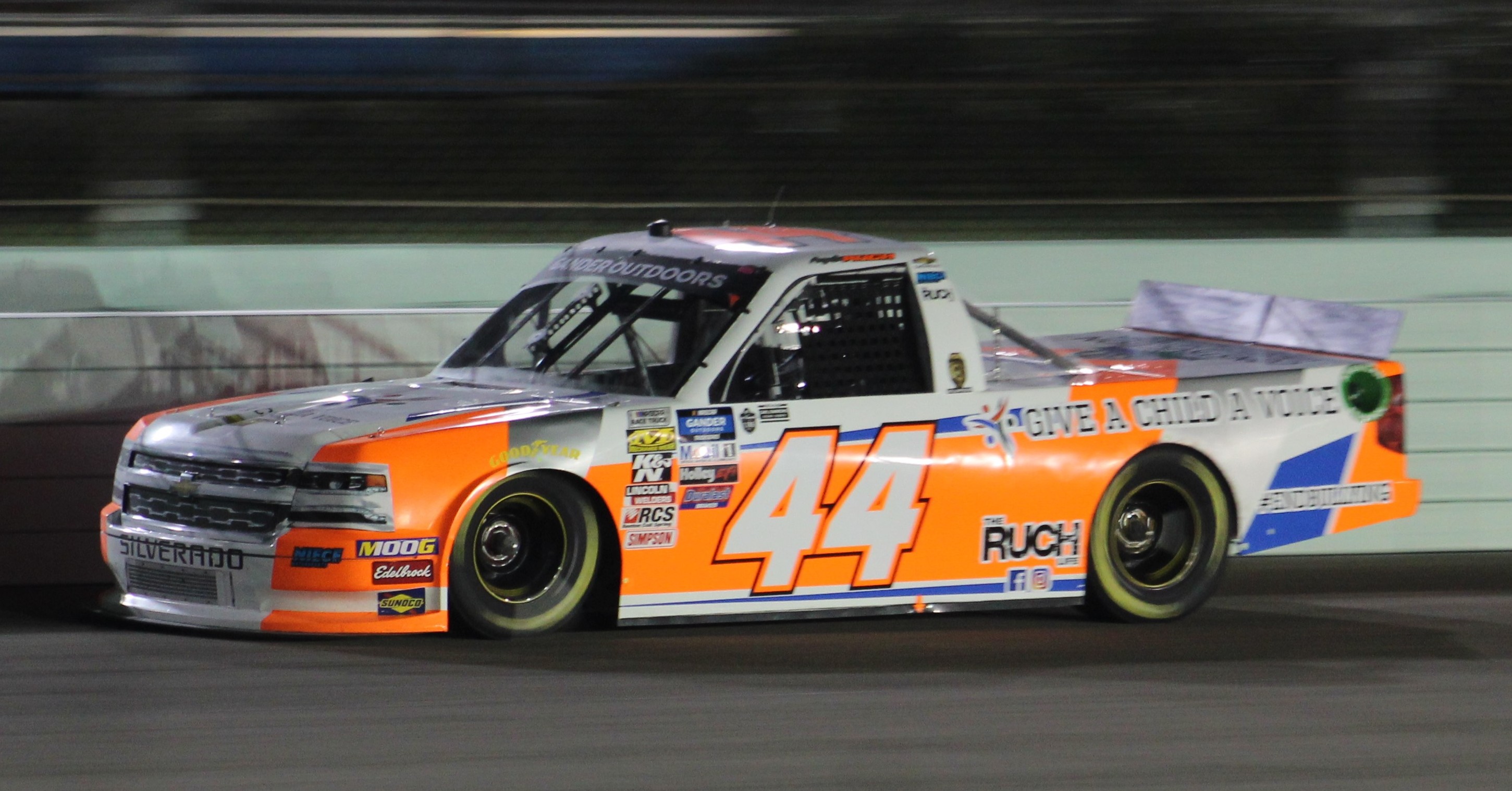
Silverado EV
"So that would be Silverado, Sierra, Hummer and Cadillac Escalade IQ. So the original plan was to give them a full redesign in 2028."
The Silverado EV is the electric take on the Silverado pickup. They mention it to show which EV trucks GM is selling and how those sales are tracking.
The Chevrolet Silverado EV is GM’s electric version of its full-size pickup. In this segment, it’s listed as part of GM’s broader strategy to expand EV trucks and SUVs.

Sierra EV
"So that would be Silverado, Sierra, Hummer and Cadillac Escalade IQ. So the original plan was to give them a full redesign in 2028."
The Sierra EV is GMC’s electric version of its full-size truck. They bring it up as part of the EV lineup they’re comparing by sales numbers.
The GMC Sierra EV is GM’s electric full-size pickup offering under the GMC brand. The hosts include it in a sales comparison to illustrate how GM’s EV truck lineup is performing.

Hummer EV
"So that would be Silverado, Sierra, Hummer and Cadillac Escalade IQ. So the original plan was to give them a full redesign in 2028."
The Hummer EV is GMC’s electric Hummer. They mention it alongside other EVs to talk about how many units are being sold.
The Hummer EV is the electric Hummer pickup/SUV line associated with GMC. In this segment it’s grouped with other GM EVs to discuss sales volume and whether the lineup is meeting expectations.
full redesign in 2028
"So the original plan was to give them a full redesign in 2028. But I guess automotive news is reporting that ain't happening."
A “full redesign” is a big overhaul of a car—more than just small updates. They’re saying the original plan for a 2028 overhaul may not be happening.
A “full redesign” means a major refresh of the vehicle’s engineering and styling—often including new platforms, powertrain changes, and updated interior/exterior design. The hosts suggest GM’s EV plans may have been delayed or scaled back.
sales charts
"So, and really, if you unpack the numbers a little, it's not hard to see why. They're not exactly setting the sales charts on fire."
“Sales charts” are just graphs or rankings showing how many cars a model sells. They’re using it to say these EVs aren’t selling as fast as hoped.
“Sales charts” refers to how vehicle sales rank and trend over time, usually by model and by market. The hosts use it to frame whether GM’s EV trucks and SUVs are gaining traction.

Chevrolet Silverado EV
"...sales charts on fire. Chevy sold just under 1400 Silverado EVs and Q1. GMC sold about 1300 Sierra EVs, 1600 Hum..."
The Chevrolet Silverado EV is an electric pickup truck. The podcast is talking about how many of them are being sold, which shows interest in electric trucks. It’s being mentioned because its sales are relatively strong compared to other EV trucks.
The Chevrolet Silverado EV is an electric version of the full-size Silverado pickup. The podcast context focuses on sales numbers, noting that it’s showing up strongly in early EV truck demand. That’s why it’s discussed—because it’s part of the push for electric trucks to gain real market traction.
GM
"So GM is looking relatively low volume, high price cars that aren't selling great. But I mean, maybe they still see value in having them in the lineup."
GM is short for General Motors, a big car company. They’re talking about whether GM will keep selling certain EV models and just update them instead of doing a full redesign.
GM refers to General Motors, the automaker making decisions about which electric vehicles to keep, refresh, or potentially redesign. In this segment, they’re described as focusing on low-volume, higher-priced EVs.
refresh
"So they're like, well, we'll just kind of do a refresh and, you know, new colors. So they're just going to let it ride."
A “refresh” means updating a car partway through its life. Instead of building a brand-new model, the company makes changes like styling and features to keep it current.
A “refresh” is a mid-cycle update to an existing vehicle platform—often involving styling changes (like new colors), updated software, and minor hardware tweaks—without fully redesigning the car from scratch. The hosts suggest GM may use a refresh strategy to keep these EVs competitive.
charge fast
"The vehicles that they've come out with are all modern. They all charge fast. They've got long ranges."
“Charge fast” means the EV can refill its battery quickly at fast chargers. That matters because it reduces how long you have to stop to charge.
“Charge fast” refers to the vehicle’s ability to add significant battery energy in a short time, typically using DC fast charging. It’s a key EV metric because it affects road-trip usability and charging convenience.
long ranges
"They all charge fast. They've got long ranges. They weren't compliance cars."
“Long ranges” refers to how far the EV can drive on a full battery charge, usually expressed as an estimated miles-per-charge figure. Longer range reduces the need for frequent charging and can improve real-world trip flexibility.
compliance cars
"They've got long ranges. They weren't compliance cars. They all look good if you like that particular car."
“Compliance cars” are EVs that a company makes mainly to meet government rules. The point here is that these weren’t just made to satisfy regulations—they were meant to be proper cars people actually want.
“Compliance cars” are EVs produced mainly to meet regulatory requirements rather than to be true mainstream products. The hosts imply these vehicles were designed as real consumer EVs, not just token offerings to satisfy rules.

Dodge Durango
"I mean, I know this is kind of apples and oranges, because the example I'm about to cite is an internal combustion vehicle, but it makes me think of the Dodge Durango. And the current model has basically been on sale for the past 16 years, effectively."
The Dodge Durango is an SUV. The point they’re making is that even after long periods between big changes, it can still be popular and sell well.
The Dodge Durango is a midsize SUV from Dodge. Here, the hosts use it as an example of a model that’s stayed on sale for a long time (through major redesigns) while still selling well, implying that an older design can remain competitive.
internal combustion vehicle
"I mean, I know this is kind of apples and oranges, because the example I'm about to cite is an internal combustion vehicle, but it makes me think of the Dodge Durango."
An internal combustion vehicle is a car that runs on a fuel-burning engine, like gasoline or diesel. They’re saying their example isn’t an EV, so the comparison to EVs isn’t perfectly fair.
An internal combustion vehicle (ICE) uses an engine that burns fuel (like gasoline or diesel) inside the engine to create power. The hosts contrast this with EVs to explain why the sales/refresh-cycle comparison might not be perfectly apples-to-apples.
Unibody
"I shouldn't say Unibody, because the Durango's Unibody too, but they've gone to four-cylinder and turbo six powertrains."
Unibody is how a car’s body is built as one connected structure instead of a separate frame underneath. It usually helps with weight and efficiency.
Unibody construction means the vehicle’s body and frame are integrated into one structure, which is typically lighter and more efficient than a separate body-on-frame design. The host is noting that the Durango’s platform is unibody even though some competitors have changed their powertrains.
turbo six
"... they've gone to four-cylinder and turbo six powertrains. You can still get the Durango with the V8."
A turbo six is a six-cylinder engine that uses a turbocharger to make more power. The turbo helps it feel stronger without needing a bigger engine.
“Turbo six” refers to a turbocharged inline-six engine (six cylinders with a turbocharger). Turbocharging forces more air into the engine, allowing smaller engines to produce strong power and torque.
four-cylinder
"... they've gone to four-cylinder and turbo six powertrains. You can still get the Durango with the V8."
A four-cylinder engine has four “power chambers” inside the engine. Many newer cars use them because they can be more efficient, especially when boosted with a turbo.
A four-cylinder engine uses four combustion cylinders to produce power. In modern vehicles, four-cylinder setups are often paired with turbocharging to maintain performance while improving fuel economy.
V8
"You can still get the Durango with the V8. And even though objectively, it may be inferior to like a turbocharged six, it's got that V8 sound, that rumble..."
A V8 engine has eight cylinders, shaped like a V. People often like V8s because they sound great and feel powerful.
A V8 is an engine with eight cylinders arranged in a “V” shape. It’s often associated with a distinctive sound and smooth power delivery, which is why the host says some people still want that V8 character even if newer turbo engines are objectively better on paper.
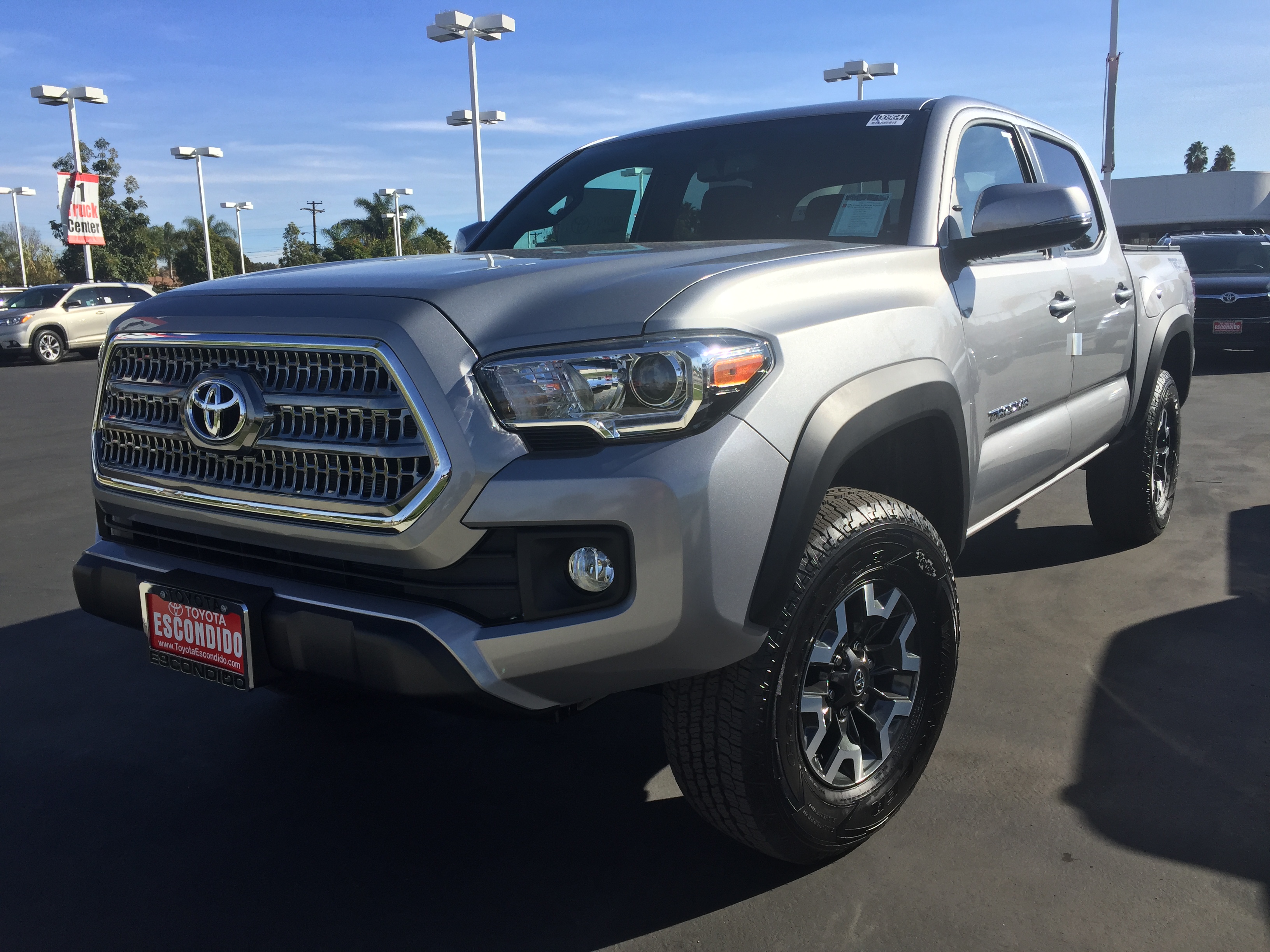
Toyota Tacoma
"... because Toyota's got that with the Tacoma. The Tacoma's never been cutting edge, but as they've just let it drag out..."
The Toyota Tacoma is a midsize pickup truck known for long-running design choices and a reputation for being straightforward and durable. Here, it’s used as an analogy for how some older-feeling vehicles can develop a “cult following” because they don’t chase every new trend.
cult following
"... it's such old technology there, that now it's got a cult following, because it's old school. It's the awesome way of doing things."
A “cult following” means a loyal group of fans really loves something, even if it’s not the newest thing. With cars, it can happen when people like how it feels or how it’s been built for a long time.
A “cult following” is when a group of fans strongly prefers a product (or vehicle) and keeps supporting it even if it isn’t the newest or most advanced option. In automotive terms, it often happens when a model’s design, simplicity, or character stays consistent for years.
old Google G1 phone
"I think they're more like if you had an old Google G1 phone now, the first generation Google phone."
The host uses the “old Google G1 phone” as a metaphor for early-generation technology that may feel dated but still has a recognizable identity. The comparison is meant to question whether EVs will develop similar nostalgia or loyalty as they age.
refurbishing
"...you'll see this cottage industry of kind of keeping them refurbished and refresh battery packs, this and that."
Refurbishing is basically repairing and restoring something so it works well again. Here, it’s about keeping older electric cars running by fixing key parts.
Refurbishing means taking an older or worn component and restoring it to a usable, often improved condition. In this context, it’s about maintaining older EVs by rebuilding parts like battery packs rather than scrapping the vehicle.

Model Y
"I think the Model Y, just because it's so ubiquitous and they're like everywhere, you're probably going to see a market for refurbishing those a little bit."
They’re talking about the Tesla Model Y, a very common electric SUV. Since there are so many of them, there should be more businesses and parts available to repair or refurbish them.
The Tesla Model Y is Tesla’s high-volume compact electric SUV. Because it’s so common, the speaker expects a larger secondary market for refurbishing components—especially battery packs.
swappable brain
"...how, if they're going to build them where they basically have like a swappable brain, I mean, kind of in some ways what I did going from hardware 2.5 to 3..."
They’re using “swappable brain” to mean the car’s main computer could be replaced or upgraded like a module. The idea is to keep the car current without replacing the whole vehicle.
“Swappable brain” is a metaphor for making an EV’s control electronics (the car’s computing/management hardware) modular so it can be replaced or upgraded without replacing the whole vehicle. The speaker is imagining future EVs that could be updated with newer connectivity and features.
5G capability
"...they'll be like a retrofitable computer to give them 5G capability, 5 or 6G capability at that point..."
5G capability means the car can connect to the internet using the newer cellular network. That can power features like live maps and software updates.
5G capability refers to cellular connectivity using the 5G wireless standard. In EVs, it enables features like real-time navigation, over-the-air updates, streaming, and connected services that depend on network access.
infotainment
"...they'll be like a retrofitable computer to give them 5G capability... modern infotainment, maybe a little more range, who knows..."
Infotainment is the car’s screen and software for things like music, maps, and phone features. They’re saying newer cars might get better versions of that over time.
Infotainment is the EV’s in-car entertainment and information system—typically the touchscreen, navigation, media, and connectivity features. The speaker suggests future upgrades could include more modern infotainment and potentially improved range.
over-the-air updates
"If they just let these things age and not have any, like with laptops, with phones, it used to be you could change battery, ... you could change RAM..."
Over-the-air updates are changes to the car’s software that you can download wirelessly. Instead of swapping hardware parts, you often just update the software.
Over-the-air (OTA) updates are software updates delivered wirelessly to a vehicle. The speaker contrasts EVs with older electronics where you could replace parts, implying that modern cars may rely more on software/tech replacement cycles than hardware swaps.
SSD
"[2074.3s] with some upgrades. I upgraded this thing, it's got an SSD and not a spinning drive anymore."
An SSD is a type of storage for a computer. It’s faster than a spinning hard drive and usually works better over time.
SSD stands for solid-state drive. Unlike a spinning hard drive, an SSD stores data using flash memory, which is typically faster and more resistant to bumps.
rest-o-mod
"[2096.0s] but I could see a market on gutting these old EVs, [2102.6s] and then it turns into a hot rod situation, or a rest-o-mod, whatever."
A rest-o-mod is an older car that’s been updated with modern parts. The goal is to keep the classic look but make it drive and work like a newer car.
A rest-o-mod is a restyled and modernized vehicle—often an older car that keeps the original look but swaps in newer technology. In EV circles, it usually means replacing old EV components with newer motors, batteries, and electronics to extend the car’s life.

Model S
"[2108.7s] You're already seeing that with the Model S, the Model S motors and batteries are [2113.0s] in actually pretty high demand for EV rest-o-mods, which is kind of a nascent kind of cottage [2119.7s] industry right now, but the Tesla motors are really sought after because they're relatively [2125.0s] compact, they got a lot of power."
The Tesla Model S is an electric car. People like it as a donor because its electric parts—like the motor and battery—can be reused in updated projects.
The Tesla Model S is an all-electric luxury sedan that has become a common candidate for EV restomods. The speaker specifically discusses demand for its motors and batteries as replacement parts for modernized builds.
Request an Explanation
Heard something you'd like explained? We'll add it to this episode.
Sign in to request explanations for terms you heard.
Want to learn more?
Browse our glossary for plain-English explanations of automotive terms, jargon, and concepts.
Help improve this episode
See something that's not quite right? Our annotations are AI-generated and can sometimes miss the mark. Click the flag icon on any annotation to suggest a correction.
2 community members have helped improve this episode.