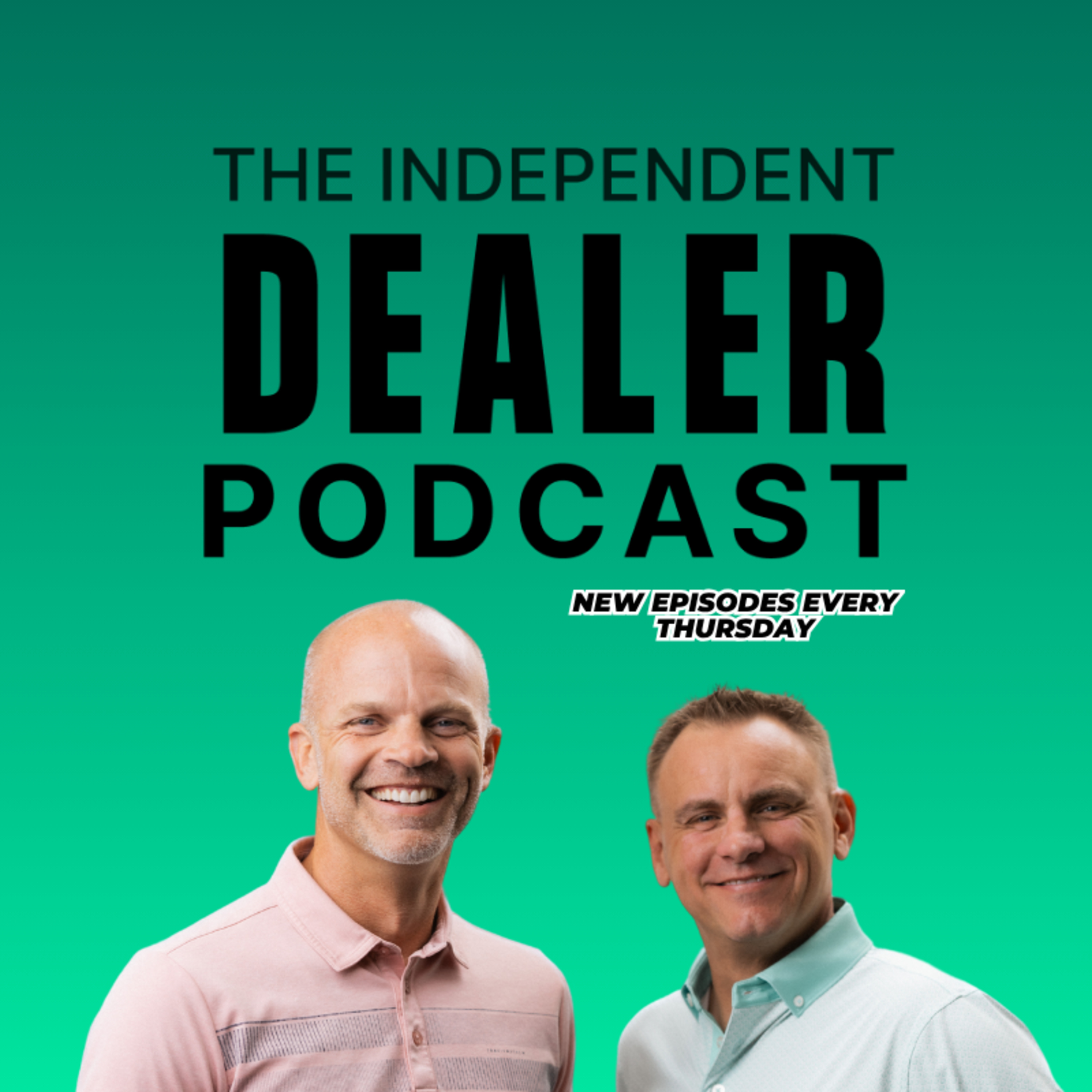
#433 - What If You Don't Train Them, And They Stay?
About this episode
Worrying about turnover turns into a bigger staffing conversation: train and engage people, then build workflows that scale. The hosts debate whether BDC agents are still needed, arguing that human-led lead handling matters more than office presence, with AI helping route and follow up. They also cover hiring sales and technicians with better screening (working interviews, technical questions) and using automation to prevent repossessions. The episode ties it all back to interpreting metrics and adjusting processes, not just collecting numbers.
In this episode of the Independent Dealer Podcast, Jeff Watson and Luke Godwin get real about one of the most pressing challenges facing independent dealers in 2026 — building and keeping the right team. From sales to collections to the shop, they break down how AI is reshaping every position on your lot, which roles are disappearing, which ones matter more than ever, and what it actually takes to hire and retain people worth keeping.
What You'll Learn:
Why the BDC agent as you know it is going away — and what kind of salesperson you actually need to replace them in an AI-driven dealership
The debate: human-led lead management vs. full AI automation, and where the real closing magic still has to happen in person
How the collector-to-account ratio has nearly doubled and what that means for who you hire, how you train them, and what you pay them
Why hiring mechanics without experience and training them up beats poaching experienced techs — and how to run a working interview that cuts through the noise fast
How the Blytz and Ituran integration is eliminating after-hours headaches and cutting down the busywork your collectors shouldn't be doing anymore
Why every dealer needs a numbers person — and what happens to your business when the person running gut instinct finally meets a spreadsheet
If you're a buy here pay here or independent dealer trying to figure out how to staff smarter, hold people accountable, and stop letting good be the enemy of great, this episode is for you.
Support the businesses that support the podcast:
Buckeye Risk Services - Reinsurance and wealth strategies for independent dealers. https://theindependentdealer.com/buckeye
Blytz - BHPH payment processing with fast funding and text-to-pay.
https://theindependentdealer.com/blytzpay/
Ituran GPS - Asset protection and customer management for BHPH and retail dealers. https://theindependentdealer.com/ituran
Follow & Connect:
Website: www.theindependentdealer.com
Facebook Group: @independentautogroup
Luke Godwin: @lukegodwin
Jeff Watson: /sendtojeffw
Like, subscribe, and share this with a dealer who needs to hear it.
leads
"“...for the amount of leads they have because if you if you really look at the people that are selling...”"
Leads are people who might buy a car and have shown interest. Dealerships track them and contact them to turn that interest into an appointment.
In dealership sales operations, “leads” are potential customers who show interest (often via online forms, calls, or ads) and need follow-up. The speaker uses lead volume to argue how many staff are required to contact and schedule those prospects.
overstaffed
"“...handling 200 leads a month should probably be handled by two or three people or less and so you can get overstaffed trying to build different departments that you don't need...”"
Overstaffed means you have more employees than you really need for the amount of work. The point is that if you don’t have enough leads, adding more staff just costs money without improving results.
“Overstaffed” here means hiring more people than the lead volume actually requires, which can waste payroll and create inefficiency. The speaker argues that lead handling should scale with lead count, so too many departments can be unnecessary.
BDC
"“...if you were a 30 car a month lot if you had two stellar bdc people with the help of AI lead managers...”"
BDC is a dealership department that works leads for you. They call people who might buy, answer questions, and set up appointments so salespeople can spend time with shoppers who are ready to talk.
BDC stands for “Business Development Center,” a dealership team that handles lead intake and appointment setting instead of having salespeople do everything. In many stores, BDC reps call, qualify, and schedule prospects so the sales floor can focus on closing.
lead managers
"“...two stellar bdc people with the help of AI lead managers and one I'm not even gonna call it salesperson...”"
Lead managers are the people (or systems) that keep track of potential customers. They make sure leads don’t get lost and that someone reaches out and sets up the next step.
In dealership operations, “lead managers” are responsible for managing incoming leads—tracking them, routing them to the right process, and ensuring they get contacted and scheduled. The term is often used alongside BDC to describe the workflow that turns raw leads into appointments.
appointments
"“...his job or her job is to set appointments underwrite mine my database...”"
Appointments are times booked for a customer to come in or talk with the dealership. The idea is to have someone schedule these so salespeople aren’t constantly chasing new leads.
“Appointments” are scheduled meetings between a prospect and the dealership, typically for test drives, product discussions, or negotiations. In the speaker’s model, BDC/lead management focuses on setting appointments so salespeople can close.
underwrite
"“...his job or her job is to set appointments underwrite mine my database um...”"
Underwriting here means checking whether the customer qualifies for financing and what terms they can get. It’s part of the approval process before the deal is finalized.
“Underwrite” in this context refers to evaluating a customer’s credit and financing eligibility for an auto deal. Dealership underwriting is typically tied to finance approval and structuring terms before finalizing paperwork.
referral program
"“...I won't I want somebody that's really trained to to call my old leads work referral program uh take the incoming leads...”"
A referral program is how a dealership gets new potential customers from people who already bought or know someone who might buy. It’s a way to create leads without relying only on ads.
A “referral program” is a structured process for generating new leads from existing customers, partners, or past buyers. The speaker contrasts referral-driven lead flow with older leads that need professional follow-up.
repo
"so now every single touch that that employee is making is saving you 5000 dollars because [1330.3s] they prevented a repo that day or that week so yeah that employee that collector now needs to"
A “repo” means the car gets taken back because the payment wasn’t made. It usually happens through the lender or a company hired to handle the process.
In dealer/finance context, a “repo” is short for repossession: the lender or its agent takes back a vehicle when the borrower misses payments. It’s a major operational risk because repossession can be costly and time-consuming, and it often triggers additional compliance steps.
collection boot camps
"the quality the quality touches of those really good collectors who come [1363.5s] to gowan consulting groups uh collection boot camps um they get better and"
A “collection boot camp” is training for the people who work on getting missed car payments handled. The goal is to resolve issues before the car has to be taken back.
“Collection boot camps” are training programs for people who handle vehicle loan collections and repossession-related work. The idea is to improve how collectors contact customers, manage payment resolution, and reduce the chance of a repossession happening.
automations
"it iran will know if they try to crank it send them a text through blitz they can pay it and turn [1392.5s] it back on how i mean those type of automations and that and that it's not that automated intelligence"
In this context, “automations” means the system does certain steps automatically. For example, it can message someone to pay and then update the vehicle status without a person having to do it at night.
Here, “automations” refers to software workflows that trigger actions automatically—like sending a payment prompt and then changing vehicle status—based on events such as whether a payment was made. In repossession-prevention workflows, automation reduces after-hours manual work and helps keep the process consistent.
starter interrupts
"it's huge when i used to [1411.6s] starter interrupts it was the scariest thing because i was like okay if i shut them off [1415.7s] i gotta be available in case they pay and so i can turn it back on"
A “starter interrupt” is a system that stops the car from starting. In payment-related setups, it can be turned off once the bill is paid—so the dealer/collector has to be ready to re-enable it quickly.
“Starter interrupts” are anti-theft/vehicle-disable systems that prevent a vehicle from starting under certain conditions (commonly tied to missed payments). The speaker describes it as “scary” because if the system is shut off, someone must be ready to re-enable it when payment is made to avoid leaving the driver stranded.
turn it back on
"because i was like okay if i shut them off [1415.7s] i gotta be available in case they pay and so i can turn it back on and i don't want them to be [1421.4s] stranded all weekend and so you would like shut it off and then you'd just like sit there by the"
“Turn it back on” means restoring the car so it can start again. If it’s not turned back on after payment, the driver may be stuck until it is.
“Turn it back on” refers to re-enabling the vehicle after a disablement event—typically after the customer makes the payment that triggered the restriction. In these systems, timing matters because the driver can otherwise be unable to start the car until the system is restored.
skip trace
"“...they give me updates daily the car is repossessed... they're covered properly they give me updates... they skip trace...”"
“Skip tracing” is the process of locating someone who has “skipped” payments—often by using databases and investigative methods to find the vehicle owner’s current whereabouts. In repossession workflows, it helps agents find the car when the borrower is hard to reach.
parts reconciliation
"“...my shop manager and my parts reconciliation and i'm currently in the process of building out some automations...”"
Parts reconciliation means double-checking that the parts you bought or used match the paperwork and records. It’s like making sure the receipts and the actual parts line up.
“Parts reconciliation” is the accounting/operations step of matching what parts were expected (from invoices, purchase orders, or job records) to what was actually received or used. The host connects it to automation that compares shop invoices and credit card statements to find mismatches.
clod
"“...building out some automations through clod where i can just upload all my credit card statements upload all my shop invoices...”"
“clod” sounds like a software tool the shop uses to automate paperwork. The host says it can read statements and invoices and help match everything up.
“clod” appears to be the name of a software tool the host is using to automate back-office workflows. In this segment, it’s used to process uploaded documents (credit card statements and shop invoices) and match records.
timer belt
"finally he said hey you want to do a uh timer belt on a on a uh toyota highlander right or raf or somebody that bro it [1957.6s] took him two weeks since this time"
A timing belt is a belt inside the engine that keeps the crankshaft and camshaft working in sync. If it’s wrong or fails, the engine can get out of time and can be badly damaged.
A “timer belt” is almost certainly a timing belt, a rubber belt that synchronizes the engine’s crankshaft and camshaft timing. If the timing belt is installed incorrectly or fails, the engine timing can go out of sync, which can cause severe damage.

Toyota Highlander
"...ou want to do a uh timer belt on a on a uh toyota highlander right or raf or somebody that bro it took him two..."
The Toyota Highlander is a family-sized SUV made for everyday driving and carrying people and cargo. A timing belt is an engine part that helps the engine’s moving parts work in sync, and it usually needs to be replaced at certain mileage intervals. The podcast mentioned it because replacing that belt is a common service that owners should plan for.
The Toyota Highlander is a midsize SUV built for family use, balancing comfort, practicality, and everyday drivability. It came up in the podcast in the context of a timing belt job, which is a scheduled maintenance item that can be important for engine longevity and planning repair costs. That’s why it’s often discussed by dealers and service providers—timing-belt intervals affect both labor and budgeting.
timing job
"most cynical owners will say well what do you mean that means they're gonna learn on my dime that means i'm gonna pay them three times to do a timing job and i'm gonna pay for the parts and when it blows up"
A “timing job” means work that makes sure the engine’s timing is correct. In this context, it’s about doing the timing-belt job properly so the engine runs correctly and doesn’t need to be redone.
A “timing job” refers to work that sets or services the engine’s timing components—here, specifically timing-belt replacement. Because it involves precise alignment and reassembly, it’s easy to get wrong without proper training and supervision.
Request an Explanation
Heard something you'd like explained? We'll add it to this episode.
Sign in to request explanations for terms you heard.
Want to learn more?
Browse our glossary for plain-English explanations of automotive terms, jargon, and concepts.
Help improve this episode
See something that's not quite right? Our annotations are AI-generated and can sometimes miss the mark. Click the flag icon on any annotation to suggest a correction.