“Customer pay service” means the customer pays out of pocket for repairs or maintenance. The dealer benefits because it builds trust over time. In this segment, they’re saying that trust can make it easier to sell a car later without customers comparing prices as aggressively.
Term
FTC rules
“FTC rules” are consumer-protection rules from the U.S. government that affect how businesses advertise and disclose pricing. In car sales, they can change how dealers present deals and what customers can compare. The speaker is saying these rules are part of why the market is changing.
Dock fees are extra charges that come from shipping and handling cars when they arrive at a port or dock. They can change how much a dealer can charge and still make money.
Dealers make money in two main ways: from the car’s sale price (front-end) and from extra products or financing (back-end). They track them separately because it changes how much profit they can realistically earn.
A window sticker is the official label that shows what a car was built with. It includes the original price and the options, which helps compare cars fairly.
iPacket is a dealer tool that helps show vehicle details online. It can compare one specific car (using its VIN) to other cars so customers can see how the options and prices really differ.
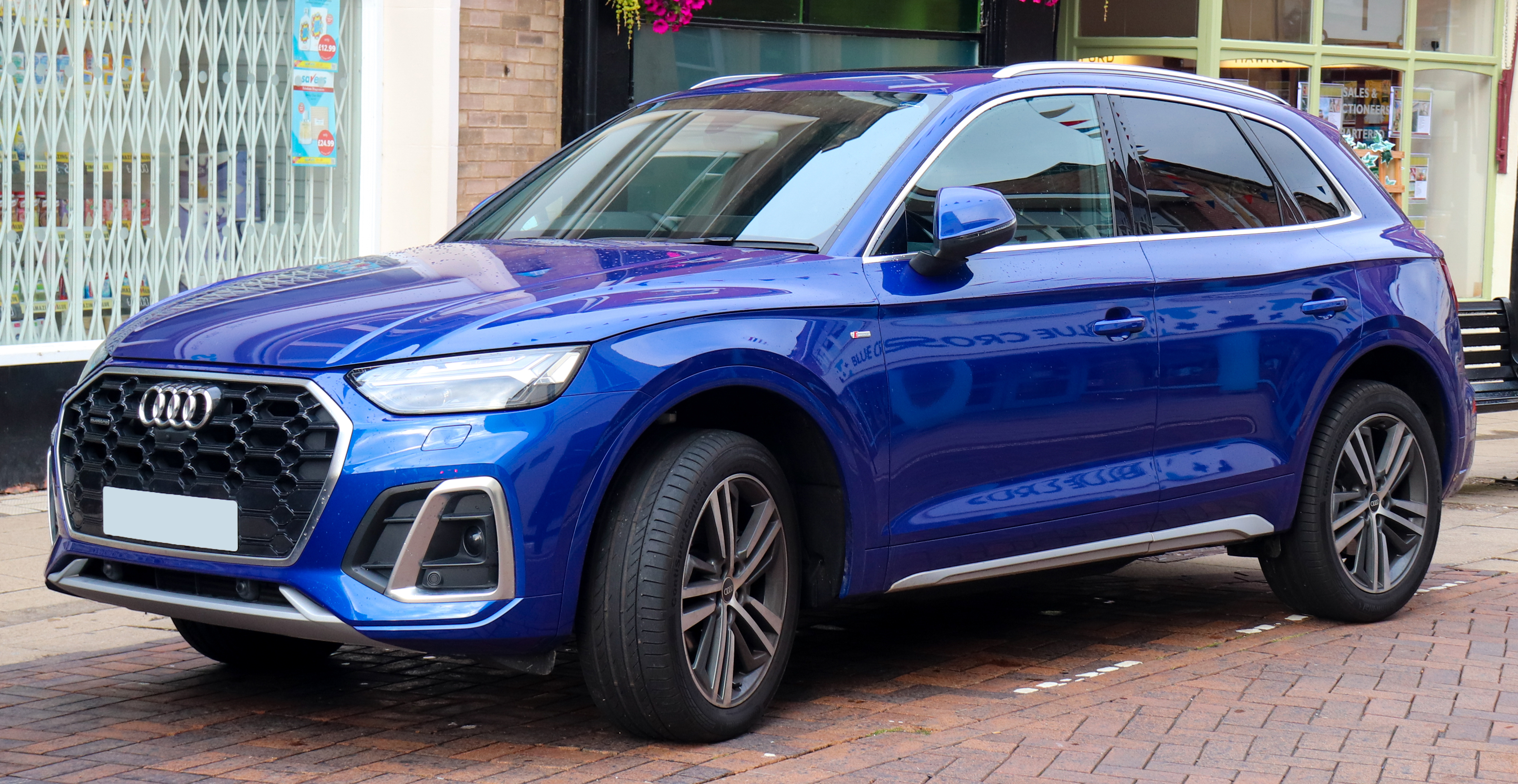
The Audi Q5 is a luxury SUV. The key idea is that two Q5s that look the same on the outside can have very different option packages, which changes the price.
J.D. Power is a company that does automotive research and publishes ratings. In this conversation, it’s mentioned as a different way dealers might estimate value compared with option-by-option comparisons.
“Back end” is the money the dealer makes after the car is sold, usually from financing deals and optional add-ons. It can be a big part of a dealership’s profit.
“Cookie cutter” means the cars are pretty standard and similar to each other. The speaker is saying that makes their numbers and risk easier to manage.
Buckeye is a company the dealer works with to help cover risk on warranty-like plans. If the car needs covered repairs, Buckeye helps share the financial burden.
A “walk away” warranty is basically a plan that helps cover repairs so the buyer isn’t stuck paying for them. The warranty company (and the dealer’s partners) handle the repair/claim process.
Vero is a warranty company the dealer uses for certain cars. When a car is outside the dealer’s normal coverage rules—or is higher risk—the dealer routes the warranty/service plan through Vero.
They’re using location as a way to manage warranty risk. If the customer is far away, repairs may happen at another shop/dealer, and that can cost the dealer more.
“75 miles” is a cutoff distance they use for warranty coverage decisions. Beyond that distance, they’re more likely to route coverage through a different product/provider.
A “high-risk vehicle” is a car they expect to be more likely to need covered repairs. Those cars get a different warranty setup (in this case, routed to Vero).
Term
24 24 36 36's
This looks like shorthand for specific coverage options (like different term lengths). The dealer uses these brackets to price and compare reinsurance-related products.
A “walk away” product is designed so the dealer isn’t stuck holding the bag if a claim goes badly. It’s a way to limit risk compared with staying fully exposed.
A “pass through” arrangement means some parts of the claim process or responsibility flow through the reinsurance program instead of staying entirely with the dealer.
Warranties and service contracts are vehicle coverage products sold to customers to pay for repairs under defined terms. In dealer finance and reinsurance programs, these are the underlying products whose claim risk the dealer may want to secure.
The alternator is what keeps your car’s battery charged while you drive. If it fails, the car can start acting up because the battery isn’t being recharged.
The Ford Explorer is a popular SUV. They’re using it as an example of a repair that should be straightforward, but the warranty/service-contract process became annoying and paperwork-heavy.
A control arm is part of the suspension that helps hold the wheel in the right position. If it’s wearing out, the car can handle worse and the alignment can get off.
Part
bottom one
They’re talking about the lower suspension arm that works with the upper one. The idea is: if one is worn, it’s often smart to replace both so you don’t have to come back for the other soon.
VSCs are basically extended repair coverage plans for a car. If something breaks, the contract determines what repairs are paid for. The host is saying some plans feel more helpful than others depending on how claims get handled.
Powertrain is the car’s main moving parts—things like the engine and the transmission that send power to the wheels. The host is asking whether customers buy the simpler “powertrain-only” coverage or the bigger, more expensive coverage. It’s basically about what parts the warranty covers.
GAP coverage helps if your car is totaled and the insurance payout doesn’t cover what you still owe on the loan or lease. It pays the “difference” so you’re not stuck with the remaining balance. The host is saying New York makes it hard to sell this add-on.
An exclusionary warranty covers some things, but it leaves out other parts or problems. The exclusions matter because they decide what the warranty will and won’t pay for if something breaks.
Here, “rolling the dice” means taking a chance that the warranty will end up costing more than expected. It’s about whether the coverage is risky for the company selling it.
“Euro cars” just means cars from European brands. Dealers sometimes assume they can be more expensive to repair, so warranties may be priced or approved differently.
Term
$3,900
They’re giving a specific dollar amount for the protection plan they sell. It’s an example of the kind of pricing dealers discuss when setting up warranty coverage.
A 90 day warranty is a short promise that if something covered breaks soon after you buy the car, the seller will pay for repairs for about three months.
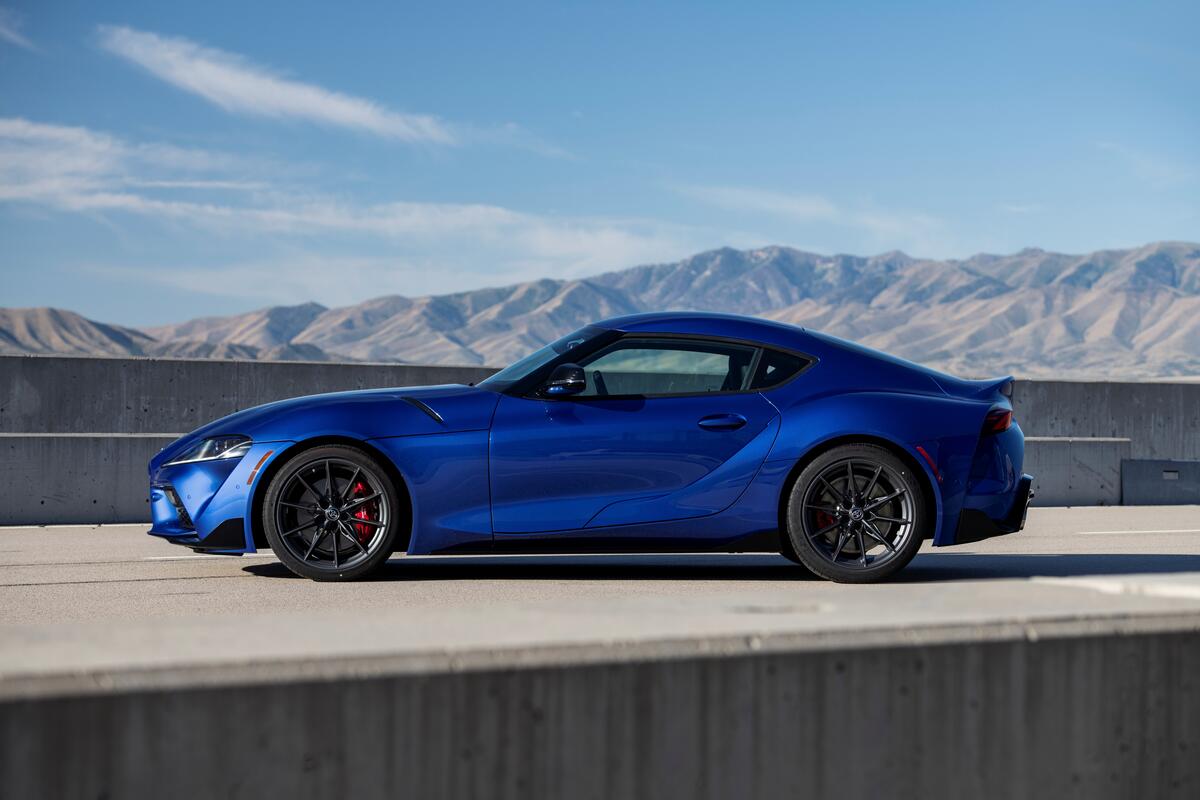
The Toyota Supra is a sports car made for faster, more exciting driving. In the podcast, it’s brought up because the dealer is talking about how their warranty and claims have been going. The point is that, so far, the cars they sell seem to have a good claims record.
Term
pay repair order
A repair order is the paperwork for a car repair—what’s being fixed and what it costs. The speaker is describing a small extra charge tied to those customer-paid repairs.
Term
wheel and like road hazard
This is coverage for common damage from the road—like wheel or tire problems—so you’re not paying the full cost if you hit something or damage a tire.
Aftermarket warranties are extended repair promises sold by companies other than the car brand. The speaker is saying they used to be skeptical of those plans.
“Wheel and tire” coverage is an add-on that helps pay if your wheels or tires get damaged or need replacement. It’s like extra protection beyond the main plan.
Key replacement coverage helps if you lose a key or key fob. Because modern keys have electronics inside, they often need to be cut and programmed to work with the car.
The speaker is saying some European cars have key systems that are trickier to duplicate or program. That can make key replacement harder than on many other makes.
CPI is an acronym the speaker uses to refer to a current economic condition. In car-dealer conversations it often relates to inflation, but the exact meaning here isn’t fully clear from the excerpt.
Here, “penetration” means how many customers actually choose the extra coverage being offered. If more people buy it, the dealer sells more of the product, but claims can also rise.
A “20 group” is a small group of car dealers who meet to compare notes and trade ideas. The idea is you learn faster because you’re not doing everything alone.
Term
VSE
VSE is another kind of protection plan sold with financing—similar in spirit to extended coverage. It’s meant to help pay for certain repairs or costs after the basic coverage ends.
Concept
public pay
“Public pay” here refers to dealership service work performed for customers who did not buy their vehicle from that dealer (i.e., not part of the dealer’s own customer base or contract club). The host frames it as a policy change: they focus service on their own buyers and reduce servicing of walk-in/outsider customers. That can be a competitive positioning move to build loyalty and manage workload.
Term
soak service
“Soak service” sounds like a specific shop step they do to certain cars. The key point here is that it’s not something they do for everyone—there are rules about who qualifies based on prior buying and contact info.
“Time to line” is basically how quickly a car gets from being worked on to being ready for the next step. They’re saying they reduced that time a lot, which helps the dealership sell more cars.
“Retail work” here means service work tied to selling/servicing customers directly (as opposed to internal reconditioning flow). The host contrasts retail work with keeping the shop focused on recon throughput and quick-turn availability.
Term
repair side
“Repair side” refers to the service/maintenance operation of a dealership or shop, distinct from the sales-side reconditioning (“recon”) workflow. The host implies that if retail repair work is cut off, technicians might have idle time unless the shop’s recon flow absorbs it.
LIVE
I went to the NI80 convention in Vegas and I was actually kind of bummed because we had a
reinsurance company look at our business and basically say to me I don't think that you're
reinsurance material. They said I don't think that you're big enough to do it and make money at it.
When I went to that convention though a friend of mine introduced me to Brett at Buckeye,
talked to him about what we had going on and like it was he didn't skip a beat he's like
you're totally reinsurable you're like I don't even know what that person was talking about. I was so excited.
Hello and welcome to the independent dealer podcast. Luke we got a couple of good looking
guys on the episode today. If you guys are on YouTubes I hope you're tuned in here.
I'll tell you Mark's probably one of the the better looking fellows you've ever had on here.
I kind of feel I feel really left out with the glasses thing. Everyone looks so much smarter than
me. Let me grab some spectacles so we can all look such how do I get the hair?
You know mine's going away really fast so I can't help you there.
Well Jeff what's great today is that we actually we were going to talk some retail deals Jeff
and you know there's a lot of buy here pay here that goes on here but when we get to talk retail
it probably gets me excited man. Yeah good it should it should so gentlemen introduce yourself
to the podcast community. Mark go first tell us where you're at your basic business model
and kind of a little metrics on maybe sales or employees or things like that.
Sure so my name is Mark Feerbacher I'm the president of Universal Imports of Rochester
we're in Rochester New York which is sort of up between Buffalo and Syracuse.
We were just talking before the show started about our bad times of the year or the first
quarter when the snow is flying that's the that's the toughest time for us. We've been in business
41 years we are a euro store and shop. One of the things that makes us unique we have
we have 30 employees but a heavy emphasis on customer pay service at our place.
We do sell between 30 and 40 cars a month but we do about 400,000 in customer service a month.
We also have a big gap yeah we also have a body shop and we do we're not a direct repair shop
for insurance but we do insurance work there as well. We are looking to be about a 12 million
dollar operation this year so we've been scaling up over the last five years or so.
It's fairness when you say 400,000 in euro tickets each month that's only like four
that's only like 4000000000 Yeah I mean the average RO is a little bit higher than what some
are used to so. What is your average RO Mark because that is that is Jeff made a really
funny and important point what is the average? It's about a $1,200 average RO which I'm so
mighty that is awesome. I've been told that that's low surprisingly so.
And before Dan introduces himself you guys know who Dan is if you've listened to the
episodes for a while a funny story that I love telling like one we're at convention last week
and people say Jeff how did you get started in the podcast thing with Luke and I say funny story
let me tell you actually I got shot down by the first person I asked and Luke was my fall back
so that's how Luke and I got hooked up which was Mr. Dan Reel. And Dan Reel was the first one
and you know Dan Dan has always been one step ahead of me. Dan reintroduce yourself to the
podcast community. Okay hello everybody my name is Dan Reel I own Reels Auto Sales we have two
retail locations in Ohio and Orwell and Chardonnayou both very rural locations we have about I think
currently full-time employees about 25 between the two stores we have I believe seven or eight
of those are techs so we have two service two service centers with about four guys in each
then we have some detailers and then obviously sales and finance so make up the rest with admin.
We retail on average probably in the mid 60s right now maybe up to you know 75 per month
and then we wholesale probably another 20 on top of that and what else been in business
for 28 years this year we our second location is now six years old we opened that one at the
once COVID started and it was like literally right the first as soon as COVID opened we were
announcing our grand opening so that was a very scary time because it was a
massive investment and it's really turned out to be amazing and I couldn't be happier I mean it's
a lot more work but I feel more content as a business person that I have more work to do like
I have to be busy that's my mentality and it's really it's it's made me a better business person
and just I love it you know it's in it's a good family environment too my kids are growing up
so they're starting to come into the fold a little bit so it's nice awesome yeah I don't
dad you said 28 years wait a minute yeah a math doesn't math for me you look like you're 38 so
I'm 47 I'm 47 I have not been here the whole time my dad and my brother started the business
in 1998 I graduated high school and then I went to the army so I joined the company
when it was a few years old already you know they're still involved and my father passed away
in 2008 my I bought my brother out of the business in 2017 I knew that he lives in Las Vegas now
and he's he's having a good time out there so not in the car business anymore thanks it is
Dana is one month older than me so I'm gonna you know so gentlemen what we want to focus on today
is obviously retail but more importantly reinsurance right and and how we're making more money on the
back end because we know that it is harder and harder margins have been compressed for years
decades up front um and mark I want to ask you that specifically when we think about Euro brands
we think about you know kind of the premium do you are those still hard to make money on the front
end because it seems like well the price is the price you're buying a Mercedes or a BMW or an Audi
you're paying the money or is it still super competitive I think that's a great question and
I think it depends on who you ask so if you if you would ask me I would tell you that it's
still fairly easy for us to make front end gross on cars but the reason that is and I'm like a
huge advocate for this in fact I I sort of want to talk to NIDA about like letting me push customer
pay service in the industry a little bit more because a lot of dealers are afraid of it or they
just can't see their way past recon because if you have customer pay service and you build that
rapport with customers then when it's time for them to buy a car and they now know you because
they've worked with you in service they're less likely to like say well I found this car over
here for this much and so why you know why aren't you lower so we're we're really not competing a
lot with other cars prices out there and now with the FTC rules and people having to be a
little bit more of an even playing field that helps us because in New York we couldn't charge any
dock fees and everywhere else in the country or a lot of other places they were so with our customers
it's like hey we're just going to really find a great car we're going to go through it we're
going to recondition it really well and we're going to try to stick to our guns on the price and
we're you know we're going to shoot for a $5,000 front and back profit and in a lot of cases most
of that is in the front. That's so great a statement because I've always thought that
if you're had a neuro model that you're actually going to to have better money better grace margins
on the on the front because they're very specific to the packages that tumble those cars and and
the people buying those cars truly understand what they're buying and they're not buying that
commodity is that how you're able to do that Mark? Yeah it's actually are we allowed to like
name drop different products and stuff on here? Yes okay so one of the things that we started
using I think it's super helpful is iPacket um so iPacket is a window sticker company
as well as like some widgets that they put on your website which is cool but
why we have them is we get the uh the Monroni sticker and then they'll take that your VIN number
and they'll pit it up against every other every other vehicle in your market that someone else
might be looking at and compare the actual MSRP's because if someone's just looking at a 2022
Audi Q5 let's say well the different even in a premium plus package there could be a three or
4000 dollar difference on single item add-ons and so if you go off a percentage of MSRP
as opposed to just what JD power is or something like that you can show a customer going yeah okay
I know these cars quickly look the same but ours has 4000 more options and so therefore
it's 4000 more dollars um yeah what's what's what's super interesting about that is
that's what a really good sales person used to do right right and now and now it's up to your
website to to build that value but that's uh Marksman used to tell me about that the reason
that that the euros cars would sell and make good money is because the way they're actually
you know assembled at the factory and the way people add options that you just wouldn't
typically figure yep yeah so being able to do the MSRP's really does uh does help build some value
in in a vehicle as well yep yeah and you've got to be an expert at buying I imagine and that's a
whole other topic but you're that's what's so funny when I look at those those cars makes models
that I'm not familiar with and I think to myself wow why is there such a drastic swing in this
exact same make model trim level it's because you've got the euro a la carte menu where it's like
it's got some crazy 5000 dollar ad that maybe even the seller doesn't know is in demand
or the auction house the wholesaler whoever it is the bank that's selling it didn't know this one
has this weird option um well and you guys know this is probably maybe more so true on higher end
cars but like color is a is a factor I mean certain colors are going to get more money
all day long I mean they always used to say black and white got the most money and I think
it probably still does in a general sense but uh you might get some special carbon blue or
something on a BMW and that's a hard hard color to find that's my color yeah or carbon black is
what they call it yeah there's carbon black yeah I will and that's and that's very interesting on
these ian sports cars you could have 10 or 15 thousand dollar in one option yep and so it really
does make a difference let me ask you Dan the same question Dan yeah with your I don't know what
what typical makes the models you stick to but are you finding the front end gross is
still harder there and then talk to us about what you typically try to shoot for front and
back end because I know you're heavy in the reinsurance and you've got a million different
products that you're pushing into your reinsurance and I want to get into those because you mentioned
a couple that were a little interesting to me I don't dabble in yet for so uh front end is that
obviously compressed right now for us because we're not specialty vehicles we are cookie cutter so
I mean our front end is compressed but it's still good I mean so our numbers are similar to Mark's
numbers in total but the front end is going to be lighter than the back we make a lot more on the
back end at our dealership I mean 95 of the people that buy from our dealership are financing we have
banks that are paying reserves we have our own products so it it's a very very nice back end
that makes everything worthwhile and I'll pay a little more at the auction because I'm sure my
competitors will hear this podcast and you know they're like yeah dude pays way too much and I do
but I can't but I sell I sell a lot of cars and I can't sell parking spots you know so like yeah
I'll pay up because of the retail side of things because I got the great banks with the reserves
and I got the back end products that I own and control and for the ones that we don't
um re-insure we um we re-insure through Buckeye but we uh Buckeye also partnered with another
company recently to do uh the walk away uh warranties or service contracts for people
outside of our market so we started doing business with that it's called Vero so um yeah it's
really I mean we have a good hold on everything it's really really nice wait let me ask you
to dig that in because that's actually news to me you're saying you through your Buckeye re-insurance
you've got a third-party warranty company and say if this person's in Florida or California
you control there's a but you can do that with your normal service contract through Buckeye
but Dan explain the Vero because I think the Vero concept is something that maybe you wouldn't
want to put in your re-insurance portfolio uh yes so there's 22 things there so we were
pretty strict about uh what we put in our re-insurance and I'm not talking about just the
quality I'm talking about the geographic area so if they're if that customer's driving 75 plus miles
away I don't necessarily want them to be re-insured because they're going to take it to uh Volvo of
Columbus and then I'm going to get hammered right so we if it's within 75 miles it's getting our
product if it's outside of that 75 miles or it's a high-risk vehicle to me high-risk vehicle is
going to be you know the your own sales the miles on it you know or the the key or the
Hyundai that's got too many miles it's like I'm going to put a Vero on it you know if it's a diesel
truck that's too many miles I'm going to put it on Vero so Vero is just a a company that they've
they've partnered with to allow us to have another product and it's really nice because it's it's all
on the same umbrella basically so we could kind of have a good communication between our our reps
and the people there are you still making oh sorry go ahead look I just wanted to ask Dan
in the follow-up to that are you still making the same percentage on back then on those products
as you would with your normal products 100% yeah sometimes more sometimes more uh I I have a pricing
chart for my what I charge myself for 24 24 36 36's and etc sometimes when I punch that number
into say Vero or somebody else I'm like damn why are they so cheap I don't get it but I I stick to
my numbers I don't ever deviate from them I probably should and we just we just raised recently
raised them a little bit too so cost of labor is up cost of parts are up as everybody knows so we
we adjust our pricing accordingly mark where we can say like almost in the spitting image of what
Dan's doing so we're also with Buckeye we like the walk away products because there's just certain
cars or certain situations where you don't want the risk in your reinsurance and talking to Buckeye
what I liked is because you're already selling like for us with Buckeye we're selling assurance
as our as our reinsurance we do the same thing but when you when you have the I call it a pass
through or the walk away you still have some of the same clout because you're a customer under
that umbrella so if you need a push on a claim or something you you may have a better chance of
getting it that way I don't know if that's a guaranteed thing but at least there's a chance of
it and to Dan's point I I do think sometimes there's the ability to make more money for the deal
with the walk away product you're not putting money in your reinsurance which kind of suck so it's
there's always this like angel and devil on my shoulder about which one to do because I want
to keep putting money in my reinsurance but I also like not having the risk on those cars and
you can still make some good profit hey sorry to break into real quick but make sure you guys know
about Buckeye long time awesome sponsor the podcast and who I use for all my reinsurance
products I can't thank them enough for teaching me so much about reinsurance over the years and
coming up with new products and new ways to get my portfolio secured my customers have options of
warranties and service contracts gap I guess it's just been great Jeff it's absolutely been a great
way for me to build wealth put away some money so if you are a buyer pay here lease your pay here
or a retail dealer it works for all dealers you can set up a reinsurance company you can ensure
your own stop giving money to those third-party providers that aren't going to cover your stuff
anyways keep it in-house call the guys and girls over at Buckeye risk services and get set up ASAP
March something super important there that that I think needs to be brought out some more is that
what has been great over the years when you have your reinsurance through Buckeye is that
you could kind of make your own decisions when maybe other more to your reinsurer
service contract companies would deny a claim and you know having that leeway with
with customers in certain situations is a big deal and I know that that Dan you've experienced
the same thing when you can cover it when what other service contract companies wouldn't cover it
you see that with Barrow too is that that's something you can push back on sometimes
yeah I mean we we've had pretty good luck with Barrow so far I mean it is kind of in the beginning
stages for us so I haven't had many claims we reconditioned this not out of these cars so I
mean our claims are normally really low anyway but we haven't had any kickback whatsoever and
the times that we have had claims they haven't been tacky tacky about them where another company we
had a recently through through another lender they use their their service contract yeah guys had
the car for six month the alternator goes out they're like we're gonna need pictures of the
alternator I'm like what I go it's a six it's a it's a 600 dollar claim it's a freaking
Ford Explorer it's a 600 dollar claim like I'm not even beating up the
warranty company I'm just trying to get this done and uh and Mark's like 600 bucks let's
anyway it's an old change man yeah so that that's that that's what we don't deal with with
reinsurance though with with reinsurance we have the control that we need to run a successful
business with a good reputation that we don't have to you know whether the customer's out of
town on vacation and they gotta you know the dodge dealer calls you because they need a
upper control arm and the bottom one starting to go out fix them both man who cares the guys bought
four cars fix them both I don't need pictures nothing to fix them you know that's
the beauty of this whole thing that I I absolutely love I mean obviously the business side and the
money thing is fantastic but heavy control to help people man it's crazy you know I love it
we were gonna fix three before but actually a big sales pitch that I give to customers it's it's
the thing when I'm trying to sell them on warranties I don't go into the bones of reinsurance
that's too much for a consumer to like digest understand they don't really need to know but
I I kind of position it like this is a warranty where I have some actual like skin in the game
and I can if we have and you always have to be careful who you're talking to if it's a customer
you know really well you can go listen I've known you really well and if there's a claim that's kind
of borderline it could go either way with this product I can tip the scale if I want and that
is usually what sells it because they go well I've been doing business with you for X amount of
years so if I know that you can go to bat for me and it may actually mean something versus
all those other VSCs that we used to sell it you could kick and scream it didn't matter the policy
was policy and that was that and then you could put the repair to policy if you wanted to but
you know so that that seems to help us sell sell these mark mark let me I want to ask mark what
products and I want to ask you Dan this as well what what specific products are you getting the
best penetration on when you look at back end products if I'm a dealer saying hey I I need
to get into this more I'm gonna push these more what are the best low hanging fruit I know with
you know euros everything breaks and it's very expensive so you could throw everything at it
probably uh the full the full thing I can't I knew anyone would buy one of those cars without an
extended warranty but what do you find in the most success with is it just like a 1212 basic
powertrain or is it kind of like the top are you selling gap vignette key
wheel and tire in New York state we can barely open our doors legally I mean it's like New York
state is very very strict so we can't sell gap in New York and that's a big you know that's the
stupidest a big revenue generator that that I wish we had but we can't so it's such a it's a
protector for for customers too and that uh a customer-centric state as they would call those
sales won't allow that is I won't even dare down the play crazy crazy because you know
they somebody comes in with uh you know if you credit and it's 18 interest on a $20,000 car and
they wreck it and they owe $25,000 it's like they're screwed yeah I will tell you it's really
difficult when you sit in like I sit in my 20 group meeting and I listen to everybody talk about
reinsuring gap and I just have to like go go use the bathroom during that part of the conversation
because it doesn't matter what I think I can't do anything with it but uh Jeff thanks for teeing
that question up because I you know this is something I feel real passionate about um three
years ago I went to the niad a convention in Vegas and uh I was actually kind of bummed because
we had a reinsurance company look at our business and basically say to me I don't think that you're
reinsurance material they said I don't think that you're big enough to do it and make money at it
um I don't think they saw the value in what we had with our service customers um and it was uh you
know it was humbling and it was uh kind of bummy all of it when I went to that convention though um
a friend of mine introduced me to bread at buck I talked to him about what we had going on and
like it was he didn't skip a beat he's like you're totally reinsurable you're like I don't even know
what that person was talking about so I was very excited I was so excited I'll never forget that
morning I talked to him I went into like I don't know the the Caesar's uh forum we're walking through
the the mall area there and I called my CPA and I'm like is this is this too good to be true is
this real like should we be doing this and he's like mark you'd be crazy if you're not doing it
and uh within a month we signed up and so what we are doing in reinsurance and why I just tell
you that story is that there's so many opportunities for reinsurance it's not just vse so for us it's
vse's and like like Dan said we do um we are pretty much selling exclusionary warranties the powertrain
stuff uh I don't really see the value it's hard for me to sell that value to the customer um but
an exclusionary and I know you guys are thinking that might be rolling the dice a little bit with
euro cars but we do a three a 36 36 that's kind of what we sell um I can share with you what we
sell for we sell it on a car that qualifies so it has to be a car within a certain amount of years
certain amount of miles so we're not going to go too risky on it but we'll do uh $3,900
for a 36 36 our claims ratio has been really good so that it seems to work I mean granted we're only
a few years in so that might change um but we also um reinsure a 90 day warranty on every car we
sell so we put 200 bucks on every car for a 90 day and what's great about that is it it earns out quick
and then we put um $50 on every customer pay repair order um and now I'm and that's what we do right
now I'm looking at doing deal shield reinsurance and there's a couple other products I'm working
with folks on believe it or not I think there was quite some time in New York you couldn't
even do wheel and like road hazard uh legally so um at least that was my understanding I could
have been wrong this whole time and I could have been making money on it but I'm but I'm looking
into doing that now so and and uh Mark what do you read how much do you hold back
and reassure us on that $3900 36 36 2000 okay and that's uh that makes sense on what you're selling
so that's uh yes I think it's too cheap I think you're selling it too I think I think you're
selling it too cheap especially in New York where you're not allowed to sell gap because you have
more more back end opportunity there but that's my personal opinion I mean we sell I think you're
right Dan I think we are selling it too cheap but the my my sort of psychology is that my so like
your business our businesses are very similar in the sense that my my parents started the company
my father passed away eight and a half years ago um we were really like anti aftermarket warranties
we just were not back end we just weren't a back end dealership I think my dad had been burned years
ago with a company and he was like I'm not doing that again um and so for years we were conditioned
really to kind of poo poo that stuff and so when I went into it I figured like maybe I gotta I start
here and I can if I can get comfortable at selling it 39 then there'll be a point where then I can
get comfortable at selling it at 49 yeah yeah you will and that's that's that's I love it we we
actually sell the 36 36 for 37 81 and that's on a standard American car so good and we're we're
holding back um less than you are by a few hundred bucks um so anyways what we sell you want me to go
over that we're really quick and what we what we reinsure okay so we we reinsure every car that
we buy we do the psi the post sale we're reinsuring that so every car we buy off the street which we
buy a lot off the street everything at the auction even when I post sale it I'm still gonna put my own
psi on that car and it builds up a a fun that I could fix those cars when the auction misses it
because you know they miss everything we do a 3-3 on everything just like Mark does there that 90
day 3 month 3,000 mile warranty um we reinsure that and then our bread and butter on the VSC
side is 24 20 24 24's we sell a lot of 24 24's and and we're we're doing a sum 36 36 is in 48 48's
now in the retail world uh you have to typically most the lenders want you to have a service
contract to be half the length of the loan that's kind of a thing right so you sell
you're selling a 60 month loan they want you to have half of it covered for them to finance it
yeah you gotta check your dealer agreements on those uh because every bank's a little different
you know uh things that we're currently looking at doing in in this this year uh to reinsure
would be wheel and tire as a separate one it's a key replacement because we have a key machine we
cut and program key fobs for all makes and models except for some of those pesky european cars
and Nissan Altamas and Nissan's newer Nissan's they got a weird system and we want to do gap we
want to do our own gap we're doing enough gap where our gap penetration is is in the in the
high 70s 70 percentile yes we we we have a really strong sales team that that emphasize the importance
of it um and i think that we're we're measuring how many claims we're getting right now to see how
how it's going to work out for us you know i think we could do it i really do and we sell
a ton of gap at you know 899 and 999 selling price and we have the volume to justify it so
i i think it's something we're likely to start doing soon you know and the buy here pay here
world just to to wake and buy here pay here up right this point cpi but we've always we have
screwed our own gap but luckily it was with cars we had sold right so it's not like we were gonna
lose we weren't gonna lose but we our penetration when we're doing buy here pay here was kind of
70s percent and what's what's interesting you may get slaughtered for a minute but at some point
it catches up especially when you have that kind of penetration i've never heard a retail dealer
doing it damn but if you pull it off if anybody can pull it off if you pull it off yeah i i um
we we uh we obviously will have to measure that measure though keep looking at these numbers the
ones that scare me is like when somebody buys a uh you know i just sold a super duty uh for
$59,000 last week you know they that one would hurt you know like some of these
higher-end vehicles would hurt but i mean in the end i think it'd be fun well that's that's kind
of what i i mean not that it matters for me because i can't do it but with gap i try to understand like
what's an average claim on it on on a gap product it's got it could be 10 000 or in my case it could
be 15 or 20 thousand dollars there could be that has to get paid out so that we'll appreciate it
what's that is that it's gonna be it's gonna obviously be the depreciated amount between
the uh the insurance coverage and what you pay so right yeah you gotta make sure enough goes into
each gap product that you sell so that so that uh it makes sense to do it yeah gas um i think that
that one thing that really helps you all with your service contract your penetration as well
as your claims is having your own service for Dan i think you do a lot of uh customer
pay work as well watch i'll talk about the ability to handle that in-house and how how big a difference
absolutely so funny story we actually uh we actually quit doing customer pay work uh at the
beginning of 2026 we have enough internal work of reconditioning and of the cars we've sold we have
hundreds if not close to a thousand service uh reinsurance contracts out there we we have enough
oh we have enough work you know like so we have a few people we allow into the folds but uh that's
probably one of the best moves we ever made i'm like i it was a tough decision but we've quit
doing it i want to really quickly say something because of all the products and and mark saying
this statement about being too small for reinsurance the one thing that you know i had spoke to uh
rob fox and buckeye and uh when i was first starting it and he gave me the idea of the
reinsurance all the different things when you reinsure all those different things it adds up
your account quick enough that even it with a small size anybody can get into it i think if
you're selling 15 20 cars a month you can do it if you're selling a good car so don't if you're a
listener or watching it don't don't let don't let your volume of under you know close to 30
slow you down right that you need to get in and be in both feet wet so
it's about to have the uh and you talked about how good your staff was at at presenting the
products it no matter how many cars you're selling you still need a staff that is trained
in presenting and selling service contracts and and all the other products and and building
value for customer absolutely yep and i have a few things for most most dealers today if they're
not doing these things i don't know how they'll survive uh one is reinsurance uh and then the
other if you really want to grow your dealership uh is is getting into the 20 group thing because
that that has been that's been a huge one for for me i mean it's where i learned all this stuff
yeah i had been a car dealer for 35 years and it wasn't until 2021 when i went to
my first 20 group meeting i was like wait what's this reinsurance thing now because
because in rochester it's a it's a little bit of a i mean there are other markets like this but
at least back in the day uh the the competition here in town did not talk to each other we all
lived on our own little island um so we didn't really have other people to to understand what
they're doing and what's working and and we couldn't share it with others we kept it was like you know
keeping the pizza sauce our secret so no one knew what we were doing and then when you when you get
into a 20 group and here you got all these guys that they're just playing it all out there and
you just you come back with so many great ideas and if you just implement one of those each time
you come back it's a game changer yeah i wanted to ask what to get that kind of penetration i assume
you have salesmen or fni guys that are comped on those right i mean is that pretty much like
it's a guaranteed formula if you want to get that kind of success you got to have people that are
getting some bonuses based on that absolutely our our commissions uh if you just sell the car it's
a week i mean you're just it's it's sad uh but once you once you get gap and once you get a vse in
there i mean it now you're talking you know it it goes from a couple hundred to you know way way
higher you know so we're the same i am so they uh they're good at it i mean they're just that's
their focus and just selling that service service contracts as much as they are the car you know in
a professional way so and then honestly service contracts make good customers they really do
we all go that like fences make good neighbors and service contracts that's how you keep friends
that's how you keep customers and the one that don't get the service contract that breaks down
in a year and you're like hey i offered it to you and then they're you know you're the bad guy
i'm telling you we we make it emphasis to sell these things hey guys real quick to interrupt the
episode and make sure you know about a great sponsor and support of the podcast blitz blitz i love it
yeah that is kind of like goes from the facebook to just facebook you're gonna reuse that joke aren't
you it was fun isn't it y'all will get that reference in a future episode but uh blitz has
changed their name a little bit because they're launching more products you know they're not
just a payment platform not just a processor but they're also collections platform and analytics
platform and who knows what else robin and the team are going to get into but they've got the
technology they've got to know how to help dealers in a lot of aspects of their business
yeah data is hard to process from just everyday dealers but blitz is gonna harness that they're
gonna harness ai and they're gonna combine that with payment platforms and payment process
which is amazing so if you need a payment processor you need a a friend in the industry
our partner blitz is the only company i would recommend so dan how does it work so not having
customer pay service now and not having uh i'm assuming you had some control over your vsc's
because they'd come back to you for service work but now if they're not doing that are you more
external no no no they're they're they're part they're part of the club if they bought their car
from us we're gonna service oh then you're gonna service them okay we're just not
doing public public pay you know i like that idea yeah as we're doing that's interesting i never
even thought about that and we don't we're out and my sales guys say hey well once you once you buy
your car here you're part of it's not sam's club it's dan's club you're you're you get in the
you get in for service you get a priority now because we don't service the public
that's a true selling point people love that you know we changed that about three months ago where
we have what we call the soak service and if you do not have my full number and you don't have
Isaac's phone number and you haven't bought a car from us we don't touch it because we were so packed
and people people just are ridiculous if they hadn't bought a car from us they won't all these
little things they never anyway i said uh we're done it's the soak service and that's it you know
that's a that's like you you guys give me a lot to think about because that's scaling up in a
different way than i'm like i'm scaling up by going we have more customer pay people coming in
let's hire more bigger built like we're scaling up in in in the literal sense where it's like
doing what you're doing is like confining what you want and getting rid of what you don't and
yeah that's uh that's actually really interesting our time to line this year has been
cut in half you know we got this week alone i bought 27 cars and those cars are in recon and
they're coming out at an expeditious rate and i'm so happy like there's i don't i don't have to
worry about the log jams of somebody you know off the street wanting a break job i don't need to
worry about it you know so it's it's really really amazing um it and it didn't it didn't change our
dollar amount it didn't change the bank account in a negative way it's actually been positive
because those cars are faster to the line there's more sales happening now because of it you know
what's something to think about also i would ask both of you is that strictly a capacity
standpoint and say you had extra room extra bays extra technicians would you utilize them with
customer pay you know retail work or would you still keep that philosophy of like i just want
to have an open bay and a mechanic standing ready in case one of my customer comes in on a friday
afternoon i can get them in and out within a couple hours or would you start taking on more
outside works i'm guessing mark coming as a retail coming from the repair side of it you probably have
a good capacity of bays if you suddenly cut off your retail work you'd have a lot of guys
stand around staring at each other i imagine well no because we so we have again we're we're sort of
backwards we're like and i was you know dyslexic as a kid so it makes sense that that's what's going
on here now it is um a lot of shops are really focused on their recon time to line and then
customer pay secondary we're customer pay first and my sales department and i are fighting
my service department to get my cars in to recon so that is that that's tough though the one thing
i'd say i'm trying to think of the like the so the pros and cons of both of these models and
you know one of the cons would be that you how do you from from a public standing point uh
your google business profile your website how do you say it without being offensive that's going
like listen we only work on your car if we mod it here mark you know what we did we turned off all
the advertising and we we just said you know what the people that are here are going to stay here
and the people we sell cars to we're going to let them know but no more service advertising
because we just can't handle we just don't have the capacity to handle it we gave everybody a
three-month notice basically all of our service counters had had the information the flyers we
did social media posts i did a video on social media and honestly people have been really fine
with it there's been a couple people disappointed like oh i've been bringing my cars there for years
i apologize about that i had a lady at my news store she came in for service and i'm like i'm
sorry man we're no longer servicing outside cars you know she says she goes well let's go look at
cars then and she bought a car yeah i can see that happening yep so people people if they like you
and they're gonna they're gonna want to you know be part of part of it so
although if you were in a uh season of needing new customers a service department
could help you get new cars sold too so but that comes at a cost of hiring more tax and you know
the cost of doing business man is never and probably that's always the saying it's never
been higher right it just it gets crazy what these technicians are getting paid right now
it's hard to fill a shop full of tax if you can find them yeah uh and then pay them to
where you keep them and they're happy um that is no easy feat going back to just question
i was really quick jeff i was gonna say you said would you rather have them standing around on
friday or whatever my answer to that a hundred percent of the time is yes so what we do which
is very rarely if we're like completely caught up is our tax will actually go on five mile drives
you know so you get you get uh four i got six or 77 full-time tax like actual tax
they're they'll they'll get start cars and start driving on and then guess what you don't have
tire pressure lights technician lights no issues you know they're coming back in for service so
a hundred percent i'd rather not have and i pay my guys hourly and hourly salary so
we don't do flat rate and everybody's happy damn you don't do flat rate either yeah i remember
back in covid times there was about a 30 minute window where i was caught up on uh on make ready
i remember that very specifically where we kind of looked at each other it was like a
thursday afternoon and we're like whoa we're gonna work on tomorrow and that lasted about 30 minutes
and it's literally not been that way in 20 years so i hope you put that in your diary so you can
reflect back on that 30 minute it was like a little little scary for all of us but let's wrap
this up with the final question why are you reinsuring to what purpose and i know dan's been
doing it a bit longer so maybe dan you've used some of those reinsurance funds for something
useful interesting mark maybe you've got something planned for yours as you earn it out
but that's the issue i always have is like why what am i gonna do with this money i'm gonna
borrow it back am i gonna lend to myself i'm gonna buy a property am i gonna what are we why
will we do this other than the obvious benefit of being able to control the repairs and the tax
savings the the deferred tax savings that we get right now dan what have you done with it so we are
i think we're on year three or four of reinsuring in the retail uh world and um it was the honestly
the best thing and i've ever done in my business career uh we don't owe any money to a fc we don't
owe any money to next gear great companies we'll use them if you need them absolutely we are for
a planned company that's first and foremost so i have a couple million dollars of cars and guess
what i own them next next thing i don't owe a bunch of debt to anybody real estate you know what you
want to you could use your reinsurance money to pay off your loan and be your own loan you know
you you use the use buckeye and their people to make make the right documentation up for whatever
you need to do but i mean honestly in 2017 when i bought my brother out of the business i i i didn't
know how this is going to work out the second location scared me we put a million dollars on
that one corner just in the real estate before cars and fast forward um thanks to reinsurance
everything's surviving we have to actually think about capital improvements to do to you know
because you're gonna do that you're gonna save your save some tax money now but guess what you're
still gonna have all this extra income because you're not paying paying curtailment you're not
paying for this you're not paying for that so guess what now we have additional cash flow we
never really had before so now you have new problems but those are good problems so and
then obviously the most important thing is is family you know you want to make sure you
take care of your family in the end when you're not here we're all we're all independent dealers
we you know we we're not part of a massive corporation we got to make sure our kids are
taking care of our wives our spouses you know our you know everybody around us our employees
everybody needs something and that that reinsurance is what's gonna you know provide for them for
years to come so that's my answer i'd say mine's not much different um we even in just the two
years or a little over two years that we've been doing it i was able to uh so all of our buildings
are paid for we're a very healthy company in that regard we've just bought this 8 000 square foot
body shop again about a million dollars uh and was able to pay a nice chunk of it from reinsurance
and uh and i probably wouldn't have even gone into the deal if i couldn't do that um i could have
found the money other places but i also didn't want to take money out of what i need for cash
flow just for a rainy day in the shop right because i still have a 40 000 payroll every week that i
got to make sure happens whether cars sell or don't um and so i probably wouldn't have been able to
do that without it and to dan's point also for just our families our team um having that money
there when you know maybe there will be a time where we can do a company retreat and you need
you want to pull 20 or 30 000 out to treat everybody to something or you want to you want it for
retirement yeah i love it yeah i was recently talking with um with brett from from uh buckeye
and uh through rob fox and um we're trying to put together a round table a reinsurance round table
where we get people like mark and i and other dealers who are reinsuring and saying hey are we
utilizing this we have it what do we do you know you got it the thing is you don't want to play in
the gray area so you got to have a company like buckeye or some somebody that's going to help you
manage all of it and do it the right way i remember i was in a 20 group years ago and i'm not saying
this dude's name because people know him but we were in a 20 group meeting long before i had
reinsurance i'm like what are you doing with your reinsurance he goes oh i bought a bulldozer and
about 20 had a cattle and i got a ranch and i'm like dude are you are you for real yep i'm like
anyways there's there's there's everybody to eat stuff who that is you can do the right way
to each their own you can do that you can buy the cattle just write your loan the appropriate way
you know like do it the right way yeah well i know this guy that's actually gonna have a
reinsurance boot camp in dallas on september 16th and we're going to discuss all this type of
things buckeye is going to be the sponsor i'm breaking it out we're we're talking about it now
jeff rock is saying up buddy we take it up way too much time but these guys yeah it's such a great
topic guys gentlemen i appreciate you being here thank you so much it definitely gives me stuff to
think about i'm going to look at my penetration and what products i can add um and and those types
of things so hopefully everyone learned a lot from it and of course if you have questions
reach out to these guys on facebook reach out to bill and brad and buck and jason and all the
buck i team out there and i guess apparently this episode was set up as a big advertisement for
luke's boot camp that's coming up i had no idea let's go i want a seat on that i
i want to just like to use you got one all right gentlemen thanks so much talk to you guys take
care
About this episode
A dealer-focused discussion centers on how independent stores are defending profits through reinsurance and service-driven customer relationships. Mark Feerbacher (Universal Imports, Rochester) shares how euro brands can still produce solid front-end gross when dealers build value with tools like iPacket to explain option/MSRP differences, and by leaning into customer-pay service. Dan Reel (Reels Auto Sales, Ohio) explains his rural retail model where front-end is tighter but financing reserves and reinsurance products create most of the profit. The episode also opens with a story about being “too small” for reinsurance—until Buckeye disagreed.
This episode of the Independent Dealer Podcast is brought to you by Buckeye Risk Services — the reinsurance and wealth strategy partner for independent dealers.
In this episode, Jeff Watson and Luke Godwin sit down with Mark Fuerbacher, President of Universal Imports of Rochester — a 41-year euro specialty dealership doing $400,000 a month in customer pay service — and Dan Reel of Reel's Auto Sales, a two-location retail operation in rural Ohio retailing 65 to 75 cars a month. The topic is back-end profit: reinsurance, service contract penetration, GAP strategy, and why both of these dealers have quietly built some of the most resilient operations in the independent retail space.
What You'll Learn:
-How Mark built a customer pay service department that generates $400,000 a month — and why that single decision made front-end gross almost irrelevant
-Why Dan stopped taking public service work entirely in 2026 — and how cutting off outside customers actually increased his cash flow and cut his recon time to line in half
-The geographic 75-mile rule Dan uses to decide whether a service contract goes into his reinsurance or gets passed to a third-party provider — and why that distinction protects his claims ratio
-How Mark was told by one reinsurance company he was too small to qualify — and why a conversation at NIADA with Buckeye changed everything within a month
-Why Dan is seriously considering reinsuring his own GAP product at 70-plus percent penetration — and what that math looks like when you're selling a $59,000 Super Duty
-The commission structure that turns salespeople into back-end hunters — and why a deal without GAP and a VSC is barely worth writing up
-Why both dealers say reinsurance and 20 groups are the two things most independent retailers can't afford to keep ignoring
If you're a retail or independent dealer who feels like you're leaving money on the table every time you hand a deal to a third-party warranty company — this conversation will change the way you think about the back end of your business.