An investor day is when a company explains its plans to investors and business analysts. It’s basically a big strategy presentation, not a consumer event.
They’re trying to use just a few shared car “platforms” for lots of different models. That can make it cheaper and faster to build new cars because many parts and designs are reused.
“Stella one” is the name of a shared car “foundation” Stellantis wants to use across many models. The idea is that one design can be adapted for different drive wheels and different types of engines.
E REV refers to an electric car setup that can use electricity to drive, but also has a backup system to help extend the driving range. It’s meant to reduce range anxiety compared with a pure battery-only car.
ICE stands for internal combustion engine. It refers to vehicles powered primarily by an engine that burns fuel (like gasoline or diesel) to produce mechanical power.
A platform environment means multiple car brands share the same basic engineering and production foundation. That can save money, but it can also make it harder for famous brands to feel truly unique.
Maserati is a luxury/performance car brand. The question here is whether it can keep its identity if the cars are built using shared “platform” parts and manufacturing across the group.
A five-year plan is a company’s roadmap for what it wants to build and invest in over the next several years. For car makers, it often includes new models and electrification timing.
The Grand Cherokee is a Jeep SUV that’s bigger than the smaller Jeep models. It’s built to be more capable and often comes in higher trim levels. The podcast brings it up while talking about where a company is putting its efforts.
Chinese automakers are other big car companies, and they sometimes team up with brands in Europe. The hosts are saying Stellantis brands are making deals with them to speed up new cars.
Mega castings are big metal parts made as one large piece instead of many smaller ones. They can make manufacturing simpler, but if something goes wrong, repairs can be more complicated.
Chrysler is a well-known car brand. The hosts are saying it will get several new models, and some will be versions of cars that are already being developed—just with Chrysler branding.
A fastback is a car shape where the roof smoothly slopes toward the back. It usually looks more sporty, and it can also change how the car is packaged and how it moves through the air.
Rebadging means selling basically the same car under a different brand name. The company changes the badges and branding, but the car underneath may be very similar.
A crossover is like a mix between an SUV and a regular car. It’s usually built to feel easier to drive than a full SUV, but with a taller, more rugged look.
Here, “electric” means the car runs on electricity (an electric motor), not gasoline. The hosts think it’ll be sold in smaller numbers and in limited regions.
Term
molded blocks
They’re describing a car body made from big, simple molded pieces instead of lots of complicated parts. That can reduce cost and make assembly easier.
Giga casting is when a factory makes big metal parts in one piece instead of assembling lots of smaller pieces. That can make the car cheaper and easier to build.
Stilantis is the company behind a lot of car brands. Here, they’re talking about the company bringing back an idea for a very low-cost car.
Brand
Pougeot brand
“Pougeot” here is referring to Peugeot, a car brand within Stellantis. They’re saying Peugeot will be tied to a new low-cost concept.
Topic
Parasa Auto show
They mention an auto show where the new car will be revealed. It’s basically about when and where the announcement happens.
Car
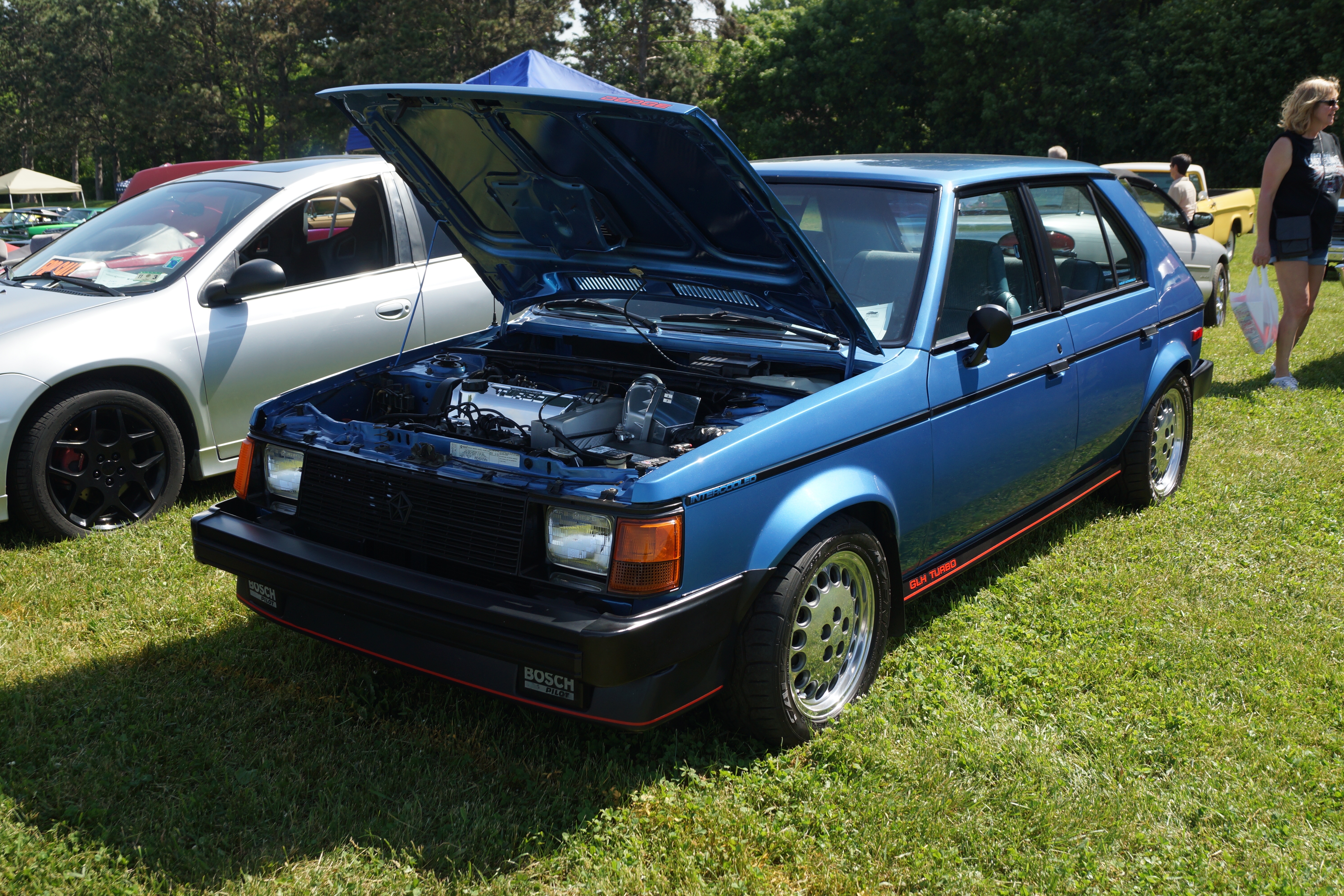
Dodge GLH
Dodge GLH is a name Dodge used for a more performance-focused version of a hatchback. Here, they’re saying Dodge plans to reuse that name for a new hot hatch.
A hot hatch is a small hatchback that’s been tuned to drive faster and feel more sporty than a regular one. It’s the “fun” version of a regular compact hatch.
Term
Rose like Hell
They’re explaining what the GLH name is supposed to mean—basically “go like hell,” meaning it’s meant to sound fast and aggressive.
The Dodge Omni is an older compact Dodge model they’re talking about as the car that the GLH idea/name was tied to in the past. It’s part of the history behind the GLH name.
The Dodge Super B is an older Dodge car model name. In the podcast, it’s brought up because it’s related to another car mentioned, the Hornet. The discussion sounds like it’s about how the same ideas or parts were used across different models.
They bring up the Dodge Hornet as another older Dodge model that they think might have had a performance GLH-style variant. It’s mostly about the name’s history.
The Dodge Viper is a legendary, hardcore Dodge sports car. They expected something Viper-like, but the rumor they’re discussing sounds more like a sedan.
The Dodge Challenger is a famous American muscle car. In this discussion, they’re using it as a style comparison for a new high-performance Dodge concept.
The Dodge Charger is a well-known muscle car. They’re saying the upcoming Dodge concept would look like a super-stretched, slammed version of that style.
EV market share is how big the electric-car slice is of total car sales. They’re talking about forecasts for how much of the market EVs will take in Europe.
A mild hybrid adds a small electric assist to the gas engine. It helps save fuel, but it usually isn’t meant to run the car on electricity alone for long.
“800-volt” is the voltage level of the car’s high-voltage battery system. Higher voltage can help the car charge faster and move power more efficiently.
Bidirectional charging means the car can not only charge its battery—it can also send electricity back out. That can power your home or even help the electric grid.
A virtual power plant is a way to combine lots of small energy sources together. EVs and home batteries can be coordinated so utilities can use them like one big power system.
This means a factory that used to build whole cars would switch to making car parts instead. The idea is to keep the facility working even if the company changes what it wants to produce. It’s like changing from “making the whole product” to “making components.”
Leap Motor is a car brand from China. The segment suggests Stellantis would use factories to build cars associated with Leap Motor. It’s basically a partnership where one company helps produce another brand’s cars.
Brand
dong Fong
“dong Fong” sounds like a Chinese car company name. The hosts are saying Stellantis would use factory capacity to build cars for that partner instead of only Stellantis models. It’s about changing who the factories produce for.
Capacity utilization means how busy a factory is—how many cars it’s making compared to what it could make. The hosts say the plan aims for around 80% so the factory can cover its costs and start making money. It’s basically “running the plant enough to be profitable.”
The Jeep Compass is a smaller SUV made by Jeep. It’s meant for regular daily driving, with some capability features depending on the version. The podcast mentions it as an example of the smaller Jeep models.
Concept
stretched platform
A “stretched platform” means using the same basic car design, but making it longer to fit different-sized models. Companies do this to save money on engineering while still selling different vehicles. It’s like extending the same “car blueprint” for multiple products.
It means the car was built with one main purpose in mind, then changed for another use. Because it wasn’t designed from the start for the second job, it has trade-offs—some things work, but other things are less ideal.
“Platform plans” refers to an automaker’s strategy for using shared vehicle architectures across multiple models. When those plans slip or don’t deliver enough compatible vehicles, the company may delay features, rework timelines, or consolidate onto fewer platforms.
A “smart cockpit” is the car’s digital cabin—screens, software, and connectivity that make the dashboard and controls feel more high-tech. It’s usually tied to features like navigation, apps, and updates.
This is a way to organize the car’s computers. The car is split into zones, and those zones are managed by a more centralized computer system, which can make the car easier to update and potentially reduce complexity.
A software defined vehicle is a car where a lot of what it does is controlled by software. Instead of being “locked in” at the factory, some features can be improved or added later with updates.
Jaguar Land Rover is the company behind Jaguar and Land Rover cars. The hosts are saying Stellantis wants to partner with them to develop new tech and vehicles, and do the engineering work in Auburn Hills.
Range Rover is a Land Rover brand line known for luxury and refinement, especially compared with more utilitarian off-road vehicles. The hosts suggest Jeep could borrow some of that refinement while still keeping Jeep’s simpler, more utility-focused identity.
The Range Rover is a large SUV made for comfort and a smooth ride, while still being able to handle rough roads. People talk about it because it feels more “polished” than some other SUVs. In the podcast, it’s used as an example of that blend of comfort and usefulness.
The Wrangler is a Jeep SUV designed for off-road driving. It’s known for being simple and capable on rough terrain. The podcast compares it to a more luxury-focused SUV to show how their priorities differ.
A government subsidy is help from the government that can reduce a company’s costs. In this segment, it’s described as things like land and help building factories.
Concept
tier ones
Tier ones are big companies that supply major parts to car makers. They’re not the final car brand, but they make important components that go into the car.
OEM means the company that supplies parts used to build a car. It’s different from aftermarket parts, which are made to replace or upgrade parts later.
Brake systems are the parts that make the car slow down and stop. This segment is comparing how different companies design brakes—either tailored for each model or standardized to save money.
Stopping distance is how far the car goes before it fully stops once you start braking. Better brakes and better tires usually mean a shorter stopping distance.
These are basic, widely available car parts that many companies can make. If most of the car is made from these common parts, it’s faster and cheaper to build new models.
This is a Chinese auto organization that helps set rules and check that car parts and suppliers meet requirements. The hosts are saying it plays a big role in making certain parts common across the industry.
This is the part of the car you interact with—like the touchscreen menus and controls. The hosts are saying some companies focus on improving this instead of reinventing every hardware component.
A joint venture is when two companies team up to work together. Here, the idea is that China partnered with foreign automakers to learn how to build cars and factories.
A tariff is a tax the government charges on imported products. The point being made is that it encouraged companies to build cars inside China instead of importing them.
They’re talking about using computer intelligence to help analyze car designs faster. The goal is to estimate what changes could save money without compromising safety.
In a crash, the car has to send impact forces through strong parts. A “load path” is basically the route those forces take, and it needs to be designed so the safety structure holds up.
A crash test is when a car or part is intentionally crashed in a controlled way to see how safe it is. The results help determine how well it protects people.
Mass reduction means making the car lighter. A lighter car can use less energy and often feels more responsive, but it can cost more to build depending on the materials used.
“Sub four meter” means cars under 4 meters long. Some governments use that length to set lower taxes or incentives, which can make smaller cars cheaper and often lighter.
They’re talking about ways to make the car cheaper to build. That can mean changing parts or designs, or changing how the company buys components and offers options.
This means trying to redesign the car so it costs less to build. The point here is that it’s only one part of the cost problem—other departments can affect cost too.
A “spec book” is like the car company’s rulebook for what the vehicle is required to be. If a proposed change doesn’t match those rules, engineers reject it.
It’s like a holding area for ideas that need more checking. Instead of killing them right away, the team puts them into a group to see if they really work.
Parallel means different people work on different tasks at the same time. That can make the whole project finish faster because you’re not waiting on one step to end first.
In sequence means one task has to be finished before the next one starts. That often takes longer because you can’t move ahead until the earlier step is done.
Concept
disposition the idea
To “dispose of” an idea means to decide what happens to it. Either it moves forward, gets changed, or gets turned down.
LIVE
Speaker 1: Out Online after Hours is brought to you by Bridge Don't Tires Solutions for your journey.
Speaker 2: He everybody, thanks for joining us on Online after Hours.
Gary Vaslash is not here today.
Speaker 3: He's on vacation.
Speaker 2: I believe he's in jolly old England, in London in particular.
But we've got Sean McElroy here and our great colleague, good friend Lindsay Brook has joined us as well.
Speaker 4: Good to see, and boy, we got a lot of good stuff to talk about.
Speaker 5: Yeah, I mean, obviously I think we should address first.
Speaker 6: We were supposed to have a couple of.
Speaker 5: Guests that haven't showed up yet, so we're just kind of waiting on that.
Speaker 3: Rolling with the punches, rolling with the punches, so to speak.
Speaker 5: So I'm kind of here filling in at the moment, hopefully, you know, we have a guest or to show up.
Speaker 3: At some point the guest shows up, I'm kicking you out of the chair.
Speaker 6: Yeah, I'll be gone, that's for sure.
Speaker 5: But so yeah, I mean figure, there's plenty of news going on in this industry for the three of us here to talk about, so I think it'll be just fine.
Speaker 2: Well let's get into I mean, I literally just got back from the Stilantis investor Day, and you know, they brought in media from all over the world. Actually I
shouldn't say all over the world, mostly Europe and Latin America.
Brought in analysts from Europe and Latin America, and of course there was a US and Canadian media and Mexican and analysts and all that. But here's the basics that,
you know, the highlights of what I see. They're going
to try to put just about everything on only three platforms.
They have a new platform called coming called Stella one that is going to be able to front drive, rear drive, all wheel drive, ICE, hybrid, BEV, E REV.
Speaker 6: Yeah.
Speaker 4: I think it was bc D.
Speaker 5: Yeah, that that one platform could cover and up to thirty plus models.
Speaker 6: Yeah.
Speaker 2: Then they have Stella Frame, which they've had for a couple of years, and now they've got another commercial van platform coming to that will do ICE and BEV. But
I think that's a smart plan to have three platforms.
I mean, you're gonna get massive scale. But Lindsey, we
were talking before the show and you were pointing out, man, do they have a lot of brands to feed?
Speaker 4: They got a lot of brands to feed. Main plates
within the brands. And I think for automotive enthusiasts, you know,
you wonder about some of the storied brands that they have, Maserati, et cetera. But what happens to them in a global
platform environment and can you sustain them? And even Fiat
in this market, we saw what happened to that with the Fiat five hundred and the little kind of van version of it, and then the Fiat one twenty four which was really a Mazdamiata, and the dealers just they were achingly disappointed at the product cadence that happened there.
So I'm wondering what they're going to do with Is the Fiat brand still alive in the US?
Speaker 3: I don't think so.
Speaker 2: I mean, they talked a lot about Fiat, but globally, Yeah, and I didn't realize this before.
Speaker 3: Fiat is actually the.
Speaker 2: Highest volume brand in the Stilantis group. They were more
car sold with the Fiat badge on them than any other badge in the in the Stilantis group. But yeah,
they didn't say anything about Fiat in the US or Alfa Romeo in the US, and they said, uh, Maserati, We'll talk about Maserati another time. So they've got plans
for Maserati, but they weren't ready to talk about it yet.
Speaker 5: Yeah, I mean, I think the thing I found pretty interesting is that, you know, over the next five years, the committing something close to seventy billion dollars to this this whole plan that they have rolled out, and seventy percent of that investment is going towards the commercial brand jeep Ram.
Speaker 4: Was it at Pougo in Fiat?
Speaker 5: Yeah, yeah, so those five will get the seventy percent of that. Then it's Chrysler, Opal, Alpha and Satroan are
kind of like the next tier down. They'll get all
the same stuff that those ones get, but those ones get the new stuff first. And then DS Lancia are
going to be controlled by Satroan and Fiat and will kind of be like more of a niche brand within those groups. And then they said two new emobility vehicles
for Maserati, whatever that may mean.
Speaker 4: And they're doing deals. Puho's doing deals with Chinese automakers
as well. Yes, I read recently.
Speaker 5: Yeah, they're gonna be announced that a couple of models that they showed off at the Beijing Auto Show are going to be developed in China, and then there's going to be a jeep model off of that same platform.
Speaker 6: It sounds like as well, yeah.
Speaker 2: So, and that's all going to be I think the Stella one platform.
Speaker 6: Yeah, I don't.
Speaker 2: And then that's they didn't say it, but I'm confident to say that it's all the motor this is all being done in China. And so because they're bragging, hey,
we're going to get this out in two years time and blah blah, blah blah, and it's like, yeah, it sounds to me like the Chinese are doing this for you.
Speaker 4: It sounds like a lot of band within this one on this one platform. I mean a ton of band.
Speaker 3: Yeah right, you know.
Speaker 4: And and do you do you make like the ones in the middle are they really good? And the ones
on the fringes of it, the you know, smaller ones and larger ones are they going to be kind of compromised?
Because good question.
Speaker 5: Well, hopefully one of our guests later will be the perfect person to ask that question.
Speaker 2: Yes, yeah, because we'll have Matthew toront Paro from carasof coming on.
Speaker 3: Hopefully your figures crossed.
Speaker 5: And I'm just he's talked in the past about that exact very thing Lindsey is you know, uh, we've all heard of flying cars before, but we know that they're not good cars and they're not good planes either, right, that's right. So it's kind of that same effect on
a platform where you're trying to stretch it across so many things, there is going to be inefficiencies somewhere in there.
Speaker 4: Yeah, and hopefully Matthew does show up because that's a good it's a good point to make about uh Mega castings or Gaga castings or whatever you want to call them, and consolidating some of this down to just three or four kind of main underpinnings of the platform and how you do that with that, with that breadth of product that you're going to be putting on that platform.
Speaker 3: Yeah.
Speaker 6: Yeah, so big news.
Speaker 2: I think that our audience is going to be especially interested in. The Chrysler brand is going to get three
new models sort of a I would say, a four to s escape sized match version and slightly more fastback version.
Speaker 3: And they're going to be rebadged versions.
Speaker 5: No, they're not going to be doing like the Mercedes BMW thing where they have you know, the fastback SUVs.
Is that what it sounded like, yeah, yeah, I really disliked that strategy because I think you just.
Speaker 4: Tour was in that realm exactly right.
Speaker 2: It's I mean most people would go for the more squared off back to it because it's you know, more luggage capable and all that cargo capable. People are going
to want a slightly sportier version. I mean, all the
sheet metal is identical except for the rear three quarter panels and the hatchets.
Speaker 3: Other than that, so for very minor tooling change you can address. I don't know what is it going to
be that of those sales will be the sportier version.
Speaker 4: So is Deilantis recommitting to passenger cars with this, I wouldn't call them.
Speaker 3: I call them crossovers.
Speaker 5: Ok.
Speaker 3: They don't look like passenger cars at all.
Speaker 4: No three box sedans, no, not.
Speaker 3: Not for the US market certainly.
Speaker 2: And then they've got what they're going to call the Chrysler airflow that is not like at all the airflow that they showed it. What was it Cees four years
ago or something like that. Yeah, there's ever uh it's
much boxier version. Again, it's uh, you know, another rebadged,
refaced version of something that Fiat's getting.
Speaker 4: A boxy airflow. Now, viewers out there google Chrysler airflow. Okay,
the whole point was aerodynamics before aerodyamics was even a topic.
Autive but right, so exactly right.
Speaker 3: Let's see the other thing.
Speaker 2: Citron is going to bring back the douchevo and it's.
Speaker 3: A retcho modern version.
Speaker 2: I thought it was pretty cool, but it's clearly going to be a really niche product. It's going to be electric,
and I'm sure they're not going to sell it in the USA. It'll probably be a phenomena largely in brance Italy,
Spain and Portugal.
Speaker 3: That kind of market is what I see it.
Speaker 5: Do either of you guys see something like that working for a car as iconic as the Douchevo Me, no, Like, I don't think you can capture that essence anymore that a vehicle like that had.
Speaker 4: Well, it's a question, Sean, about just basic vehicles and how basic you can go in today's particularly in this market where you're used to electric windows and automatic transmissions and conditioning and all that kind of we'll see it with the slate truck. Certainly, that's probably the you know,
as far down as we'll see it. But when I
was at Chrysler, we did the CCV program, which was a douchevea modern douchevo with just a few plastic panels, big panels for developing markets and so but as it turned out, the developing markets did want something that cheap, you know, they didn't want something that basic.
Speaker 3: But you know, that car was brilliant.
Speaker 2: It was really brilliant because you know, you say four panels, it was really the car was made up.
Speaker 4: It was a floor that was the anchor of it.
Speaker 2: Right, but then the rest of the car was just four big molded blocks.
Speaker 4: You know.
Speaker 2: People are talking about giga casting, yeah, the ccving, but I mean.
Speaker 3: You know, talk about cutting complexity.
Speaker 2: I still think the idea should be brought back because to me, it blows giga castings away right right.
Speaker 4: So it's interesting that Stilantis is returning to that with from from the Pougeot brand and Chrysler had tried it because the head of engineering was French and he used that as a model for a global cheap car. So
that's really interesting to see that. I can't wait to
see that car. Yeah, it looks cool.
Speaker 2: It will be revealed at the Parasa Auto show appropriately.
So yeah, they're not going to release any pictures, and of course they didn't let us take any pictures. The
other thing that might be interesting too to everybody watching Dodge is going to bring the GLH back released. They're
going to have a hot hatch that they're going to call the GLH.
Speaker 4: Rose like Hell.
Speaker 2: It was like hell that remember that was Carol Shelby came up with it back in the day for the Omni.
Speaker 4: Yeah.
Speaker 5: I thought they had a GLH version of the Hornet as well, but I don't but I know they they what was the other name that they used for the Hornet that was an old super B. Yeah, I think
they had that as well, but I thought they were supposed to have a GLH version. I don't know if
they ever did come out with that, but they they had that name back for at least a moment with that one.
Speaker 4: You know, you got to hand it to Chrysler and then Diamer, Chrysler and al Stilantis that they have curated these great name plates and kept them in their intellectual property as well as anybody in the industry has, and they constantly Pulllice'll be behind the vehicle on traffic. It's
like they pulled that out of nineteen sixty eight and they pulled that out in nineteen seventy four. I think
they have an appreciation for their history. That's pretty good.
Speaker 3: Yeah, yeah, it's worked.
Speaker 2: Another thing, Dodge is going to come out with a hyper performance car. I thought it was going to be
like a Viper, but it's a hyper performance sedan and it looks like a super slammed version of the Dodge Challenger or Dodge Charger. And they wouldn't say anything about
They're calling it the copper Head.
Speaker 3: You know, so Viper is a snake. Copperhead is a snake.
Speaker 4: And that was a concept car. If you're remember during
the time Jail it was forgot about is it a roadster?
But it was a comprehend. It might have had a
Viper engine in it at the time.
Speaker 2: So yeah, they you know, their whole goal is refresh everything, put everything on three platforms, get megascale, take costs out, get into new segments you know where they're not right now, and grow the company that way. And I think the
plan is solid. But you know, every car company we
go to says, oh, we're going into new parts of the market.
Speaker 3: We've never been we're going to grow all.
Speaker 2: You know, everybody thinks they're going to grow their sales and it never works out that way. I'm not saying
it's not going to work out for them. I'm just
saying that everybody says they're going to grow their sales.
Speaker 4: Did they mentioned their continuing commitment or not to electrification.
Speaker 2: Yeah, absolutely, not so much for the US because it's not happening here, but they believe that in a decade ev market share in Europe. I'm trying to remember now,
they say it's either going to double or triple. So
every one of these brands that I've been talking about, plus commercial is going to have pure BEVs.
Speaker 5: See if I can remember the numbers enough. Sixty new
models was part of it. Twenty nine BEV, fourteen ish
P have e REV. There was a bunch of full
hybrids in there, and then there was ice ice and mild hybrid as well. So yeah, and the Stella one
platform is multipower train and it can go up to eight hundred volt with BEV and it'll have like LFP packs and Stell the pack design.
Speaker 2: Well, yeah, they said it would be eight hundred volt ready, so it looks to be. It's a stage thing to
get And they also said it would be bi directional ready by bi directional charge.
Speaker 5: Feed it back into the grid, right yeah, or you can feed it back into your home or other devices.
Speaker 4: Right.
Speaker 2: What I like about bidirectional and I think this will be the game changer where a lot of people say, man, I got to get me abev.
Speaker 6: Where you can.
Speaker 2: Fill up your battery when electric rates are low at night and sell it back to the utility during the day if you're not using your vehicle and actually make money.
So I mean, you know, theoretically it may even be possible your electric bill is zero because you're buying and selling electricity, buying low and selling high.
Speaker 3: So yeah, I love the idea bi directional.
Speaker 4: Well, you think of like a space view of any quadrant in a suburb at night with X number of electric cars and all sitting there with potentially full batteries, full charge, And what the potential that could be to mitigate you know, storms, or feed it back into the grid or what you want to do. I mean, potentially
it's a lot of energy sitting in one place, that's right, and multiplied it over the world. Wow, it's a good idea.
Speaker 5: I don't know if you've heard about these virtual power plants at all, Lindsay, and it's that idea. Just people
are aggregating all that together into one source, and then these virtual power plants are selling off that electricity to the utilities. And you know, it's not just vehicles.
Speaker 3: A lot of people.
Speaker 5: Have solar and they have home energy storage as well, and they're using all of that.
Speaker 4: They're sitting on a lot of power.
Speaker 5: Potentially there's gigawatt hours in some of these virtual power plants that are all together.
Speaker 4: But thanks the question. With this breadth of all sorts
of new vehicles, all sorts of new technology GEZ down to three platforms, did they mentioned it all about their manufacturing plant for this and like supplier involvement, because christ was always weak on kind of advanced technology, but they were always clever, They had great ideas, but it was like pulling it off in scale was always a struggle.
Speaker 2: Yeah, So the only thing they talked about manufacturing wise really is they're going to reduce Stilantis capacity.
Speaker 3: In Europe by eight.
Speaker 2: Hundred thousand vehicles without without closing any plants, And how do you take out that much capacity and not close the plant.
Speaker 3: So one of them is an assembly plant.
Speaker 2: In France pois C. They're going to convert it from
assembly to parts manufacturing. And then there's three other plants
and I don't know if I can remember them off the top of my head.
Speaker 5: Madrid one was Madrid, and then there was another one in France as well.
Speaker 2: Yeah, and then I But anyway, what they're going to do is what dong Fong from China build car. They
will build cars for dong Fong and UH and Motors Leap Motors is uh oh, no, I got that right.
They're going to build cars for Leap Motor and dong Fong is going to manufacture cars in their those plants.
So they're taking Stella capacity out and filling it with dong Fong and Leap Motor capacity.
Speaker 4: Uh.
Speaker 2: We'll see how that works. But what it does is
it'll get those plants. So the plan says to eighty
percent capacity utilization, that's when you can start making money at those plants.
Speaker 4: Any reciprocity for Leap Motor and Dong Fong plants in China to make plant his brands vehicle.
Speaker 3: No, they're gonna make jeeps.
Speaker 2: That makes sense they're gonna put and they didn't say exactly which models, but it's probably like Compass and uh, you know the smaller it.
Speaker 5: Was like if I remember correctly, I think they were like mids considered mid size vehicles.
Speaker 3: Okay, but they didn't stay with yet.
Speaker 2: Wow, the elite motor platforms built in China or export to markets around the world.
Speaker 4: But the badge as jeeps, but bad.
Speaker 5: This is the Pugo vehicles that we were talking about earlier too, right, right, that's what the jeep vehicles going to be on as well.
Speaker 4: Sounds like an ambitious plan, of course. I remember when
Sergio came in and the first big plan when Yah took over, it was just the grand plan and some of it turned out, but they ended up just standing on the shoulders of muscle cars, which was very profitable for them and ramps, right, you know, so can they pull this off with you know, the stretched platform is really interesting, that's a great story.
Speaker 3: Yeah, it really is.
Speaker 2: And that it is so multi power train, right, you know, it can accommodate anything. Now, you know, there are people
that Kresoff will tell you, well, there's a what do they call it?
Speaker 3: Scar mass?
Speaker 2: Yeah, you know, where you know, if you design a vehicle to accommodate a gas tank, a gas tank and stuff, and you want to make a bed version, and the bed version hauling around a lot of weights compromised.
Speaker 3: It's a compromise design.
Speaker 2: But we're in an industry right now that has just wiped out tens of billions of dollars in capital on evy bets that went wrong.
Speaker 3: Here in the US, the automakers are spending.
Speaker 2: Multiple billions on terraffs and it's like they got to have one platform that can do at all.
Speaker 4: Right, right, Yeah.
Speaker 5: I will say though that you know, what Stilantis is doing is very ambitious, and you know, it sounds really nice, but I kind of think at the same token they're previous platform plans sounds somewhat ish similar to this, where they had Stella Small, Stellar Medium, Stella Large, and stell a frame now that was supposed to be more BEV focused, but they weren't able to pull those off. Really, they're
not too many vehicles that fit on those platforms right now.
And on top of that, the Stella platforms were supposed to get there what they call Stella Brain Stell a smart cockpit and all this technology and now this what we think is elite motor platform, the Stella one that's going to have all of it. It's getting that stuff first,
not the original Stella platforms that were supposed to get it.
Speaker 3: So and they pull it off.
Speaker 6: I guess it's the deal.
Speaker 5: You know, they weren't able to do it before with the stuff that they had previously announced, and now it's just kind of looks it's getting kicked down to this.
Speaker 2: Now here's how I read it. So they had, you know,
all the different Stellas that you know that you just mentioned, they were probably high cost, certainly compared to you know, they probably looked at Leap Motors platform and went, oh.
Speaker 3: My, yeah, this is so much cheaper. And also Leap
motors can move far faster than them.
Speaker 2: You know, it's doing the programs in twenty two twenty four months, and so when you're you got a program that's moving far faster, you can put new technology into it.
Speaker 3: Quicker than into the other stuff.
Speaker 2: So I think that's what's happened is they just said, okay, we did all these Stellar frames or Stella platforms, but let's just put it all on this Leap Motor one and call it a day.
Speaker 5: I get it, but I still you know, we criticized Volkswagen for how bad Cariads screwed up, and they're kind of doing the same thing with that Stella's doing. They've
jumped to Rivian and sank nearly six billion bucks in the Ribbean to get their time right.
Speaker 2: Right right, But you know, but that was all about getting a software defined vehicle, you know, zonal centralized compute architecture.
They couldn't Volkswagen Carrie and couldn't make it work. Rivian said, well,
we'll sell it to you. It's only five billion dollars.
Speaker 6: But how is but how is.
Speaker 5: That different from what Fella's doing with Leap Motor then, because you.
Speaker 2: Know, so they're getting the platform, but they're keeping Stellar Brain, which is essentially a zonal not essentially it is.
Speaker 3: It's a it's a zonal centralized.
Speaker 4: Central computing in the vehicle.
Speaker 5: But that comes from qual Common and video right right now, that's exactly right.
Speaker 4: I'm just I'm just saying, like I.
Speaker 5: Wonder about their ability to integrate all this stuff in they really.
Speaker 2: Want to great question and and then we have to see, you know, to your point, lindsay, how how good are these vehicles going to be? You know that go B,
C and D segment? You know, is it going to
be a great C segment and a mediocre B and a mediocre D or the fair question?
Speaker 3: Why?
Speaker 6: Yeah?
Speaker 4: And what is did they mentioned the future of the old Chrysler Technology Center? What is going to be generated
from the engineers and designers in this market versus globally because Fiat has played a big role in these kind of global global platform.
Speaker 3: The only reason Stalantis is holding this meeting in Auburn.
Speaker 4: Hills where they're making the money.
Speaker 3: Where they make all their profits.
Speaker 2: I mean, they can talk all this great stuff going on in Europe, in Latin America and Asia and all they make all their I shouldn't say all them. They
make sixty or they did make sixty percent of their profits until everything came apart and they recognize Jeep and Ram are going to be the saviors of the company.
Speaker 6: Yeah, so.
Speaker 2: Look, why don't we I think one of our guests has arrived. This is probably Matthew, and we'll keep talking, folks,
because this is what you do when it's live, Just roll with whatever is happening.
Speaker 5: Yeah. I was going to add one quick more thing
that Lindsay was talking about production earlier. They did say
in North America they want to boost volume by thirty five percent here and boost capacity utilization in North America to eighty percent as well. Yeah, so, I mean obviously
they're they're thinking about some increased production somewhere somehow, you know.
Speaker 4: But well, I was learning about like designed engineering capacity utilization, you know.
Speaker 2: Oh yeah, they're hiring like crazy in Auburn Hills right now.
Speaker 4: Oh that's good.
Speaker 2: They gutted the operation under Tavares. They realized, now that
was a mistake. They're trying to rebuild it, but.
Speaker 3: It didn't easy.
Speaker 2: So yeah, no, they'll they'll rebuild the capacity in Auburn Hills.
Speaker 3: I don't know as it'll go back to what it was before.
Speaker 2: But remember what was the other big news that broke this week or yesterday. They're going to work with JLR
Jaguar Land Rover to do new technology and new vehicles, and all of that engineering will be done.
Speaker 3: In Auburn Hills.
Speaker 4: That's interesting. Yeah, yeah, who would have thought that. But
these last concepts I saw of the future Jaguar, these kind of long almost shooting brake kind of you know, huge cars. Yeah, what they call the Typo one. They
finally put a name on it.
Speaker 2: Yeah, I don't see Stillanta is doing much with Jaguar, But I think there's a natural to have Jeep of Jeep land Rover develop platform or technology or whatever together.
Speaker 4: Yeah, yeah, hopefully. Well, I don't know. I think they
could both lend something to each other without muddying the water between them or muddying each other. You know, there's
a refinement with with range Rover that maybe Jeep could use.
But there's a utility and a kind of simplicity of Jeep.
Just thinking a Wrangler versus land Rover that that I think Jeep has an advantage on.
Speaker 5: I did be a headline that kind of made me chuckle just talking about Wow, two brands that are really known for their reliability.
Speaker 4: Yeah.
Speaker 2: Hey, hey, let's take a quick commercial break right now.
We'll be back in just a minute. We've got a
lot more to talk about.
Speaker 7: Knowing that a little rain won't slow down your day, that's what really matters. Bridge done Toronto Qui attract tires,
confident control in wet conditions.
Speaker 3: What are you doing, Yeah, I'm doing well. Great to
have you here.
Speaker 4: Matt Brook. Nice to see.
Speaker 3: All right, we're back.
Speaker 2: We have Matthew va param Pill, the CEO of Caros off with us and Matthew, I know one of the things we've been trying to get you on the show for weeks now, but you were at the Beijing Auto Show and you learned a lot of things. So just
top of mind, what were like two or three of the top things that you learned.
Speaker 3: While you were there.
Speaker 6: I think the thing that impressed me the most was one is, of course in time, it's always a speed of change. More importantly, how they're implementing AI, the product
or their employment AI and their companies and processes. So
that was one big piece you could see that innate as systems so on and so forth. The other thing
that really struck me was the evolution in terms of chips and are they One of the most expensive components in AI is chips in front of it, and so you saw various companies developing their own associate systems on chips and so on and so forth because they want to keep control of their costs and get control of their technology.
Speaker 4: And then.
Speaker 6: The other one was the fast charging from PYD was huge because it goes from zero to get around nine minutes around of the charge, So it reduces difference between an ice vehicle and a battery vehicle. CTL showed their
batteries which they planned to go into production in twenty twenty seven. They didn't say it's solid state, but they
said it's a battery with no liquid. It's semi solid
solid state and so on. So and then the important
thing was this for the same killer, what hours the battery is that are forty percent lesson volume and later so which affects your body, job and body in terms of crash performance. Thert will run away all those things
and so on.
Speaker 3: Yeah, that's amazing.
Speaker 4: You know. One Matthew, one uh descriptor that's used to
describe the the Chinese OEM success is government support. Uh.
You know, it's one one advantage they have over the rest of the of the industry. If if you were
advising the US government on how to you know, how to change that scenario. So there's so the US industry
is more of a competitive footing in terms of government support.
What what would you advise the government?
Speaker 6: So I think it's quite important to understand. I think
there's a lot of things being thrown thrown out in terms a lot of things being thrown out in terms of garment subsidy. But it's important to understand what the
government subsidy is. So typically it has to do with
they give you land that can be leased, they will help you with the construction of a building, and those are the sort of subsidies and so on. But I
think so that's one piece. So I think what's important
to understand is where the Chinese work very very efficiently.
So let's take a company like Sai C for example, they work with they work with Volkswagen, they work with GM, and they work with say some other ow EEM And typically if you go to GM Ford instilland this year, if you take a vehicle with the two thousand kilos, they all develop their own brake systems pretty much. What
defines the performance characteristic break is the way to the car, the stopping distance, how many seconds you want to stop it in the speed and so on. And the Chinese
OEM looks at Ookswagen, GM and somebody else says all three.
If you make same cars in the CSUV segment, you make different breaks, and it makes no sense because it's the same thing. Does the customer care about so long
as the car stops do you really go in and look at whether the break has this particular aspect. So
one of the car stops, it's the performance, you're happy with it. Chinese look at it and says, you make
on a hundred thousand, John makes a hundred thousand, Lindsey makes a hundred thousand. Just make one break at three
hundred thousand and get it off the shelf. So when
we see these cost advantages, I think when you to see these customer tranners, the Chinese work very smartly. They
ask fundamental questions, and that's the advantage when you don't have one hundred years of legacy.
Speaker 4: Sure.
Speaker 6: Okay, So coming back to what the garment gives, and I've worked with a lot of tier ones and I've heard from OEMs what they give is land which is free, which is kind of free. They give you a building,
they build it up. It is usually the state government,
the provincial government. So it's just like Michigan saying the
governor is saying, hey, I want the automotive industry. Here's
some plant, here's a building, come set up, and you want some loan and give you some industry loans and you take a risk. What happens is the barrier to
entry is less and it allows foster's innovation. You're not
going around asking spending half your time fundraising and so on.
And that's what I've never heard of in the very rare cases. Do they They are an ultimate objective in
the provincial government to raise employment. So by providing this,
they hope that entrepreneurs will come in or they invest in companies like in Hafei Province Neo they invested in Neo.
Neo came out there, created those jobs. Chile came out
to Ningbo and Sean created those jobs. This is the
garment support that I know. How Okay, Okay, Now what
it does is it reduces the risk level of entrepreneurs, which allows them to set up more industry. So this
is coming out playing out very well right now in the humanoid robot industry.
Speaker 4: So they handle initial big capital expenses that otherwise the startup company would have to be very difficult.
Speaker 6: Okay, So you're de lookate from the garments perspective. I
have land. Yeah, if you fail, lindsay you fail, I
lose it for something else. It is somebody else. So
you see it is not like you're handing artists just reducing the barrier to entry.
Speaker 4: So you're not seeing any major R and D input from government to these.
Speaker 6: So they okay, they help you with land building, if you have capital equipment, they help you with financing and so on and so forth. So it's not like the
government hands out those and then you see in certain cases.
You you have seen that many Chinese ev companies when bankrupt. Sure,
so when they go bankrupt, of course they walk out.
They you know, that's even in the United States, ninety percent of startups go bankrupt. Okay, so that's just the
nature of the game.
Speaker 4: Okay, great, great, thank you for that.
Speaker 2: So, Matthew, you really hit on something that I think is key to China speed, and that's this common commodity components across the industry and it's CATARK. The government organization
that that sets that up is my unders standing, the China Automotive Technology and Research Center, and it designs all these component parts and it validates the designs, it validates suppliers.
Speaker 3: So all in OEM has.
Speaker 2: To do is maybe a top hat, maybe an interior, maybe some of their own proprietary technology and the user interface everything else is commoditized.
Speaker 6: So I haven't been to chian Jinktark in four years.
So I used to go there a lot the initial stages of a company between twenty sixteen and twenty twenty two, and COVID I didn't go to China, So I have not been to Katark in three or four years. Katark
is kind of your nitze. Okay, you're there or they have.
It's an organization where they test the vehicles and so on.
It is not I don't think they designed the components and all that. That's not what they do. They say, hey,
they look at this, they set specifications and so on and so forth, and they are able to see all these vehicles. And the industry is very much about looking
at things. So let's go back in history to the eighties.
China had a very there's a video, famous video in faw first start of works from the nineteen sixty five, sixty as sixties or so on. The famous video where
you see them assembling a truck with hammers and while Henry Ford was doing the assembly line with hammers and everything, and China was very smart saying, hey, we don't know much about building cash. They're very humble people Chinese. They said, okay,
let's learn from the best. They went, how what's the
best way. Let's set up we have this huge market
of a billion one point five billion people. Let's allow
them in. Let's set up joint to interures with all
these companies. Fifty to fifty joint interures. You come and
set up. We learn manufacturing, we learn engineering, we learn
how you decize. We build a flyer base. If you
don't build in the country, you don't there's a tariff.
So what happened It spawned an industry. So they learned
from the early nineties to for twenty years, they learned from Toyota. So if you go today to Chinese or ems,
a lot of the people in manufacturing are ex Toyota, Gak, Toyota, Gak, Honda, the Gunjora motive as a cooperation. Hunter Gon Automotive has
a cooperation with Toyota. Dong Phone had a cooperation with Nissan.
So those folks in manufacturing are now at very a lot of the Chinese companies because they came from the lean tourte manufacturing system. Same way they would take a
lot of Germans who came. They would go for styling,
so BYD's design I think is a German gentleman. So
they use the twenty to twenty five years from the late eighties to the mid twenty fifteen to rarely learn and they said, hey, you're a number of the days where everybody said we could make money from China hand over fist with the royalties and IP fees and all these things. The Chinese knew that Western and the other
countries are making money at their expense. We are going
to have our time. That time is now. The time
has come. It's no different to what the Japanese did,
no different to what the Koreans did. So so it's
just history repeating itself.
Speaker 5: Interesting, do you see the same thing kind of happening now just kind of on the reverse with like US auto makers or legacy automakers, with the Chinese having to now kind of take and absorb some of their technology.
You talked about everything that you saw at the Beijing Show, that these automakers are bringing in a house chips and beyond.
You feel like the legacies will kind of have to do the same thing that they did that the Chinese did with the legacies, the kind to kick off I think.
Speaker 6: It's more and more. The question is, okay, so look
at it simplistic. Somebody's if you're better than me, it's
very important that I first accept that you're better than me.
Only if I accept that you're better than me, will I come to you and say can I learn from you?
That's the fundamental So the quest first, I think we've all realized it better than us. The question is now
do we with all the tariffs and all the geopolitical issues, will will environment allow us to go learn from the Chinese. So,
for example, it's the famous news that Jim Farley said in the Wall Street Journal and drove to show me to seven for six months and I didn't want to give it up. I think something of that nature, right,
So I think it's great of Jim to say, hey, that he respects a competitor. It is huge and so on.
So it all depends and whether the environment a government will allow you to to apply those technologies here.
Speaker 4: Don't you think Barley's comment too was kind of a motivator motivator intended motivator for Ford engineers and designers and manufacturing people that if the top guy is saying we got to get serious this is really a good competitor here, whereas they might have thought, oh, it's a Chinese car.
Speaker 6: Well, I don't know the intentions, but I think it's great.
Speaker 4: Of uh, I mean, does that make sense?
Speaker 6: Yeah, I think it's Yeah, it's we have to accept.
So we have a John Wee y U seven here in Southfield in our office. And yesterday, yesterday the chief
manufacturing officer of one of the Detroit three or drive he came through and he said, it's an amazing car.
He looked at the fitted finish. He said, this is
better than this is better than our cars, and so on.
I think the realization is coming that the Chinese Ese learn from us. So if you go to a lot
of the companies. So I'm going to China tomorrow night Friday.
Tomorrow's Friday Friday night. I'm leaving with China next week.
I'm with three days in China. We're working with three
Chinese customers. And when I go there, they have come
from all these joint ventures. So I have Chinese who
speak German. I have Chinese customers only speak German because
they worked in Wolfsburg, or they worked in street cards or whatever. I have Chinese customers who only speak Japanese
in Chinese because they worked in Nagoya. Or you have
Chinese customers who speak go to Wuhan, they speak only French.
So they've been trained and they've learned. So that's how
knowledge spreads.
Speaker 4: Now, are those companies the Chinese OEMs asking caresoft to do teardowns and analyzes of American, German Japanese vehicles? Is well,
I mean, are they staying up on the competitive set like the Americans are with the Chinese?
Speaker 6: So when we so I'll talk over the three customers who we are doing cost relection project benchmarking and cost of election projects. They are asking us. We analyze it
on thirty five to forty vehicles a year, and we have a lot of data. But we also have the
advantage that we have done around sixty cost reduction projects for twenty two aems. So we are kind of just
imagine it's like there's some just imagine that we are a blood test lab and you have one hundred people there.
We have collected the blood from everybody, We look at all their markers and we know who is healthiest of the lot. Everybody has their issues, but who's kind of
the healthiest. So what we do is say who's the best,
who's worst, and how can we And it's all measured in terms of cost. Technology and cost are two sides
of the same coin. So for example, I have this
iPhone here. If this iPhone has doubled the technology in
two years, do you think I'll pay double the price? No, way,
expectation is the same price. It's the same expectation with cars.
You look at cars. So I remember when I first
came to the US. My car it was a second
end car. I bought it for four hundred dollars. Then
I bought a new car it was around fifteen sixteen thousand dollars. Today I can get a new car, say
in the lowest end of Sedan would be say twenty twenty five thousand dollars or so. So the car is
in terms of technology. Since I've been near like thirty
five thirty two years, the car technology has improved drastically, But for the processing power, it has not increased in prices.
It's like the Intel More's law. Okay, so the chip
doubles in speed and so on. So the so coming
back to the thought process says the the technology is just going so fast expectation is to still have the same race.
Speaker 2: Matthew, you mentioned that you've got all this data on cars.
Is this part of this Eureka program that Caresoft has developed.
Speaker 6: Yes, So coming back to your question on the China Chinese oms and cost. So having done these sixty construction
programs for various OEMs, we are now we have a platform called Eureka where we have for various entire vehicles, we have it's known as best of benchmark system designs.
So when we tear down an analyzing a vehicle, we can now say, hey, which is the best design. So
when we work with Chinese oams also, they are very eager.
You know, it could be from a German company, it could be from an American OEM, it could be from a Chinese OEM. But what is the best design that's
out there which helps me reduce the cost. You don't
want to take away from the customer. Go to market strategy,
go to market, perform attribute whatever you measure in terms, but you want to have the best technology, the lowest cost, the lowest weight, and the lowest manufacturing time in terms of putting it together. My time to put it together
in terms of weight in terms of cost. Our weight
has become extremely important in China, especially in the last six to nine months. We are doing construction projects in
China China. But now suddenly and as in Beijing, we
got we work. Two of our customers said, more important
than cost is tax because over a particular weight class, the tax increase is double. Okay, So that has become
a big focus. And coming back to Uika, and now
we've developed this platform where we have eight hundred two thousand best of benchmarkets. So when we tear down a
vehicle and analyze all the designs, we look at our the platform and we put the data in. We now
have an AI solution as a proof of concept. But
what we do is we see whether the idea applies with our experts. We are an engineering company and we
really apply these ideas. Then if so, we are able
to say, hey, you can save a three hundred or five hundred or even one thousand dollars in a vehicle.
So what used to take us six months, we're now able to do much faster in a couple of months or so.
Speaker 5: Are you even able to like compare parts like say one might be lighter than another, like you mentioned, but another has more power. Let's say, would someone able to
be able to quickly kind of review that sort of stuff on there as well?
Speaker 6: Okay, so a lot of times we just don't look at whats You have to look at the system. Yeah, okay.
So a classic example is you could compare a classic examples, you could look at a seat, compare the seat frames and you could say, hey, that's a lighter seat, so let's lighter frame a thinner seat frame. It's cheaper, it's
lighter less. Do it. But then you have to see
whether when you mounted in the body with the seat is the one that takes the maximum impact from a safety perspective and a crash, so will the crash load path be able to pass through that frame or are you going to kill someone the worst worst thing you want, which happened to one of the Japanese OEMs recently. For
the long time since it's happened that their seat bucket during a crash test and they got a zero star rating or a big Japanese OEM. It happened a year ago.
So you don't want a disaster to like that to happen because uh and and so on. So you just
can't look at a part and say, hey, this is lighter.
If that's the case, everybody would be driving the cheapest car in the world. So you have to look at customers.
You have to look at the system. You're going to
degrade the system, because the whole vehicle is part of a system. You know, to look at the architecture and
so on. So that's where as we're an engineering company,
but we also have a lot of experts, technical experts who review the ideas and see whether we can apply them and so on.
Speaker 4: Do you see mass reduction returning as an engineering priority in the US and North America? It had been before
EVS and then EV's it seemed like just giant batteries, very heavy batteries kind of negated the gains that were made in the last generation of combustion engine vehicles. Now
we're swinging back to hybrids and combustion engine vehicles. Is
that a returning priority for the engineers in this market?
You mentioned China with the weight classes, which isn't as important in this market, but nonetheless, weight reduction is still important.
Speaker 6: Weight translates to cost, right, It translates to cost because you have an extra kill or steel. It could be
a buck, a buck and a half aluminum, more copper, or so on. So weight translates to cost. So if
we work everything in the fundamental of cost, the weight translates to cost, and fashion time can translates to cost, and so on and so forth. So customers specifically in
North America have not said they want to take out weight, unless in certain cases. But in China this has become
very pronounced because China government recently i think introduced I'm not very sure of all the details and the weight classes and so on, but the tax increased tremendously, and so they are trying to reduce the weight.
Speaker 4: That's a real driver is the taxing.
Speaker 6: Yeah, the tax So for example, in the country India, you see any vehicle less than sub four meter as a lower tax rate than one over four meters because they want to have cars that are smaller because smaller role easier, easier to park. Plus it's more affordable. So
the affordability you can keep. I'll just to you an
example if you said I just I'm just going to perfectly say this, but if the US had a rule it said sub more, all sub four meter cars in the United States had no sales tax, okay. Or it
said if you had the sub four meter car and if it costs you twenty thousand dollars, you get a twenty thousand dollars reweight of your income tax. What happened,
Suddenly the average price point of the car goes down booming market. Yes, okay. So it just depends on the
garment incentive. So you had the seven five hundred eve incentive.
So if you flip this around, suddenly the affordability problem goes away. You know, your fuel efficiency goes up because
you're if you have a sub four meter car is going to be lighter, okay, and so on and so forth.
So tell me how you measure me, tell me the incentives I behave.
Speaker 3: A car, Matthew.
Speaker 2: China speed is something that everybody in the industry talks about.
What advice are you giving to legacy auto makers are what do you think are the key steps they need to take to catch up to China speed or can they.
Speaker 6: Well, so it's a very very difficult question. So it's
one thing, you can feel the speed when you go to China, so a lot of times, so for example, just give I'm going to China on Monday and next tomorrow night and so on. So I'm meeting the CTOs
of two companies. I set up the meeting earlier this week. Okay,
And yesterday we had the CTO of one of the big Chinese OEMs visit us here to see our process what we do CFO. He was here for Wall Street.
I invited him over. He came over yesterday evening, went
out for dinner with us. He's meeting with Wall Street
investors and so on. So he's here in the US.
He immediately saw what we do, all the things and cost and so on. He immediately set up a meeting
on Monday morning, next Monday morning. That would never happen
in a European, American or Japanese OEM. So they are Chinese.
When I see them, they understand it's importance and urgency.
Importance dictates urgency, and for them, cost is a very very important element coming to speed. So that's a good.
The country itself is very flexible, The culture is very flexible.
It sounds chaotic and so on, but it's very flexible to move with speed. So a lot of times when
we so I'll just give you a concrete example of what I see, which I tell my customers. Last week
I was in Germany. I spent a lot of time
with one of the German OEM CEOs expactly on this point, and he asked me the exact same question. So, when
we come up with technology and cost reduction ideas, usually because we focus only on engineering cost reduction, not sourcing, not options configurations with the consulting companies do because a engineering cost reduction. Because we're an engineering company and we
give these ideas, we give it to the engineering organization, so they look at it. They have their rules which
is called the spec book, and they will say, hey, this will not work, and so on, and before they reject a lot of ideas. Then you go to say
manufacturing people, they will say this will not we don't have the capital, the tooling. They will reject ideas. And
then you go to purchasing they say, okay, we have this contract with this supplier for three years. We cannot
change it. The cancelation costs are high. We need to
spend half a million for tooling. So if you're going
to say one dollar and my life cycle is only uh say for three years, it is only six hundred thousand units, it makes no sense to spend half a million to make a buck and so on, and then if go list goes on, then you'll go to finance.
And it doesn't mean why are in sequence? Everybody has
the option to say no. And these OEMs are so
structured with their process inspects that the ability to change quick is very very difficult. Now contrast that to Chinese OEMs,
and it's a it's very much a pleasure to work with one. The pressure from leadership is very very high
on cost. Then often when you implement an idea, yes,
the idea involves change. So there's there are there's there
will be issues in engineering, there'll be issues in manufacturing, there will be issues in purchasing and so on. But
the Chinese will like when we present the ideas of Chinese OEM and them they have all their stakeholders. So
I'll give you an example of one meetings which we had last year and one of our customers and every review went this way. So we went into the ideas.
First of all, they told us here, so we don't need to see your ideas because we know your ideas are good. It worked with us before, so give us
your ideas. They analyzed it in four days, fifty two
ideas five days, and they said our of the fifty two ideas, two ideas are good. We're going to do it.
Twenty four ideas have to go for checking. We know
they're good. The remaining twenty six they said, we don't think.
We don't. We have rejected them. They came back to
us and said, we have rejected them, but you have told us that BMW is doing it, we have seen Tesla's doing it, b ID is doing it, and so on.
So they came back and Emily said, those guys are not stupid. We really don't understand the reason why we
should do it. Can you tell us? They gave us
also the rejection reasons, tell us where we are wrong.
The approach is not your others are bad's the others are different. I need to understand why I am wrong.
So we went back looked to this is whatever the twenty six ideas and in that meeting, kid, you not, I've never had meetings like this with any OEM outside China.
Three OEMs. You go to China. We had the head
of deputy CTO there, the head of program plant manager, the head of deputy head of poetas saying, and all their teams behind out on forty people in the room.
There's a four hour meeting. So we'll present an idea
or experts in the US would be in teams. We
had two of the seven of us on our side.
We present the ideas. They will give their counter We
give their founder speak for English, in five to ten minutes on each idea. Then suddenly there's a big argument
in Chinese. They're all, it's little chaotic. You think you're
fighting with each other, but actually they're having a conversation saying, if this is the obstacle is or I sue, somebody will save, somebody will answer, solve, and so on. End
of the end of the four hours of twenty six ideas, twenty four went back into a validation bucket and two were rejected and when the deputy seat you walked out of the room. This was the most important event moment
before he took me out for lunches. He told his team,
if anybody of you want to reject an idea which is more than five R and B, which is like seventy cents eighty cents, you have to come to my office explain to me why you cannot do it before you reject the idea, because they all said agreed and said we will send it. We think it's possible, and
if Beamer is doing it, or Chesler's doing it, or byd is doing it, it's a very good reason that we are actually the ones who are not fast enough.
And you walked out. Now, just imagine if John, you're
an engineer in that company, do you want to go to the deputy CTO and say I can't do something?
No way, Yeah, okay, your pressure is so high and because it's parallel, not many people can veto. So in
a Western OEM and we get ten fifteen percent or in the best case you've had around twenty five percent.
The Chinese OEMs is around forty to fifty percent in our best case with one Chinese OEM with sixty five percent on a future program because toooling was not involved and so on. So the pressure is high. You work
in parallel when you do in sequence, and if somebody checks fifty percent, then you come here another percent to checks twenty percent. So now you're working out of one
hundred yeas to fifty twenty percent of that you go to forty and so on. The fall office much lower
at the end of the process. Yeah, if you get
together and if you can get fifteen the first shot to get at least fifty ideas through, So that is how they are faster. So typically with the Western OEM
it will take you six months to dispose of an idea.
Here they are able to disposition the idea and say, say eight weeks, so very fast.
Speaker 2: Matthew, I could listen to you all day long, but unfortunately we're going to have to wrasp up this segment.
Oh question, I know, but Matthew, thanks so much for coming on. Lindy Brook, great to have you on the show. Hey,
Shana was good to have you on here too.
Speaker 6: Yeah, it's nice to hop on.
Speaker 3: I want to thank all of you for having tuned in.
Speaker 1: Out online after hours. It's brought to you by bridge
Stone Tires Solutions for your Journey
About this episode
Stellantis’ new five-year plan gets dissected from the investor day: consolidation onto “only three platforms,” including the multipowertrain “Stella one,” plus big spending—“seventy percent of that investment is going towards the commercial brand jeep Ram.” Hosts weigh tradeoffs of stretching platforms and using mega castings, then connect the strategy to crossovers, aerodynamics, and bidirectional 800-volt BEVs with LFP packs. They also discuss manufacturing shifts, capacity targets, and how software-defined, zonal computing ties everything together.