
AAH #792 - Breaking Down Stellantis' New 5-Year Plan
About this episode
Stellantis’ new five-year plan gets dissected from the investor day: consolidation onto “only three platforms,” including the multipowertrain “Stella one,” plus big spending—“seventy percent of that investment is going towards the commercial brand jeep Ram.” Hosts weigh tradeoffs of stretching platforms and using mega castings, then connect the strategy to crossovers, aerodynamics, and bidirectional 800-volt BEVs with LFP packs. They also discuss manufacturing shifts, capacity targets, and how software-defined, zonal computing ties everything together.
Stellantis investor Day
"Well let's get into I mean, I literally just got back from the Stilantis investor Day, and you know, they brought in media from all over the world."
An investor day is when a company explains its plans to investors and business analysts. It’s basically a big strategy presentation, not a consumer event.
An investor day is an event where a company lays out its strategy to investors and analysts. In this case, the host says Stellantis used it to communicate its product and platform plans for the coming years.
only three platforms
"They're going to try to put just about everything on only three platforms. They have a new platform called coming called Stella one..."
They’re trying to use just a few shared car “platforms” for lots of different models. That can make it cheaper and faster to build new cars because many parts and designs are reused.
The host says Stellantis wants to consolidate its vehicle lineup onto only three platforms. Platform consolidation is a cost-and-speed strategy: fewer unique architectures means more shared engineering, parts, and manufacturing tooling across many models.
Stella one
"They're going to try to put just about everything on only three platforms. They have a new platform called coming called Stella one that is going to be able to front drive, rear drive, all wheel drive, ICE, hybrid, BEV, E REV."
“Stella one” is the name of a shared car “foundation” Stellantis wants to use across many models. The idea is that one design can be adapted for different drive wheels and different types of engines.
“Stella one” is the name of Stellantis’ new vehicle platform strategy. A platform is the shared underlying architecture that can be adapted for different drivetrains (front-, rear-, and all-wheel drive) and different powertrains (ICE, hybrid, and battery-electric).
E REV
"They have a new platform called coming called Stella one that is going to be able to front drive, rear drive, all wheel drive, ICE, hybrid, BEV, E REV."
E REV refers to an electric car setup that can use electricity to drive, but also has a backup system to help extend the driving range. It’s meant to reduce range anxiety compared with a pure battery-only car.
E REV is used here as a powertrain shorthand for an electrified “range-extender” style setup. The key idea is that the vehicle can drive electrically, while a secondary system (often an engine) helps generate electricity to extend range.
ICE
"They have a new platform called coming called Stella one that is going to be able to front drive, rear drive, all wheel drive, ICE, hybrid, BEV, E REV."
ICE stands for internal combustion engine. It refers to vehicles powered primarily by an engine that burns fuel (like gasoline or diesel) to produce mechanical power.
platform environment
"But what happens to them in a global platform environment and can you sustain them?"
A platform environment means multiple car brands share the same basic engineering and production foundation. That can save money, but it can also make it harder for famous brands to feel truly unique.
A platform environment means using shared vehicle “platforms” (common architectures, engineering, and production tooling) across multiple brands and models. The tradeoff is scale and lower cost versus the risk that “storied” brands may lose distinctiveness or struggle to justify their identity on shared underpinnings.
Maserati
"you know, you wonder about some of the storied brands that they have, Maserati, et cetera... And then... they've got plans for Maserati, but they weren't ready to talk about it yet."
Maserati is a luxury/performance car brand. The question here is whether it can keep its identity if the cars are built using shared “platform” parts and manufacturing across the group.
Maserati (Maserati) is one of Stellantis’ storied luxury performance brands. The hosts discuss whether Maserati can remain distinctive when the company moves toward shared global platforms and scale-focused investment.
Alfa Romeo
"they didn't say anything about Fiat in the US or Alfa Romeo in the US..."
Alfa Romeo is a sporty car brand owned by Stellantis. They bring it up when talking about which brands Stellantis is focusing on in the US.
Alfa Romeo is a Stellantis brand with a reputation for sporty driving dynamics and distinctive styling. The hosts mention it in the context of which brands are (or aren’t) being actively discussed for the US market.
Fiat
"And even Fiat in this market, we saw what happened to that with the Fiat five hundred... So I'm wondering what they're going to do with Is the Fiat brand still alive in the US?"
Fiat is a car brand owned by Stellantis. They’re saying Fiat sells a lot globally, but it’s unclear whether it can succeed in the US.
Fiat is a mass-market brand within the Stellantis group, known for smaller cars and broad global reach. The hosts note that Fiat is a high-volume brand in Stellantis overall, but they question whether it can sustain a presence in the US market.

Fiat 500
"And even Fiat in this market, we saw what happened to that with the Fiat five hundred and the little kind of van version of it..."
The Fiat 500 is a small, city-focused car. The hosts mention it to illustrate that Fiat’s US rollout didn’t go as smoothly as dealers hoped.
The Fiat 500 is a compact city car that became a recognizable “small car” icon. In this segment, it’s referenced as an example of how Fiat’s US product lineup and timing didn’t meet dealer expectations.
five-year plan
"Yeah, I mean, I think the thing I found pretty interesting is that, you know, over the next five years, the committing something close to seventy billion dollars to this this whole plan that they have rolled out..."
A five-year plan is a company’s roadmap for what it wants to build and invest in over the next several years. For car makers, it often includes new models and electrification timing.
A five-year plan is a long-range corporate roadmap that sets priorities for product development, manufacturing capacity, and investment timing. In automaking, these plans usually tie directly to platform strategy and electrification schedules.
Ram
"seventy percent of that investment is going towards the commercial brand jeep Ram."
Ram is the truck brand within Stellantis, especially known for pickups. The hosts say most of the new investment is aimed at Jeep and Ram together.
Ram is Stellantis’ truck-focused brand, best known for pickup trucks. In this segment, Ram is grouped with Jeep as the primary recipient of Stellantis’ investment, reflecting where the company expects the biggest near-term growth.
Jeep
"over the next five years... seventy percent of that investment is going towards the commercial brand jeep Ram."
Jeep is a well-known SUV brand. They’re saying Stellantis plans to spend the majority of its new money on the Jeep/Ram side of the business.
Jeep is a major Stellantis brand focused on SUVs and off-road-oriented vehicles. The segment highlights that most of Stellantis’ planned investment is going toward the commercial brand Jeep Ram, indicating Jeep’s central role in the group’s next phase.

Jeep Brand Jeep
"...f that investment is going towards the commercial brand jeep Ram. Speaker 4: Was it at Pougo in Fiat?"
The Grand Cherokee is a Jeep SUV that’s bigger than the smaller Jeep models. It’s built to be more capable and often comes in higher trim levels. The podcast brings it up while talking about where a company is putting its efforts.
The Jeep Grand Cherokee is a midsize SUV that’s typically positioned as a more capable, higher-trim alternative within Jeep’s lineup. In the podcast, it’s mentioned in a broader conversation about where investment and focus are going across brands and model lines. That makes it relevant to discussions about product planning and which vehicles get attention.
Lancia
"And then DS Lancia are going to be controlled by Satroan and Fiat and will kind of be like more of a niche brand within those groups."
Lancia is an Italian car brand with a long history. Here they’re saying it’ll be handled as a niche brand rather than a big-volume one.
Lancia is a heritage Italian brand under Stellantis. The hosts describe it as being controlled within a grouping that treats it as a niche brand, implying fewer mainstream-volume expectations.
DS
"And then DS Lancia are going to be controlled by Satroan and Fiat and will kind of be like more of a niche brand within those groups."
DS is a more premium, niche luxury brand within Stellantis. They’re saying it may be handled as a smaller specialty brand rather than the main focus.
DS is a Stellantis luxury brand positioned more as a niche premium offering than a mass-market volume player. The segment suggests DS will be managed within a broader brand grouping and treated as a smaller, more specialized lineup.
Chinese automakers
"And they're doing deals. Puho's doing deals with Chinese automakers"
Chinese automakers are other big car companies, and they sometimes team up with brands in Europe. The hosts are saying Stellantis brands are making deals with them to speed up new cars.
Chinese automakers are increasingly partnering with global groups through joint ventures, platform sharing, and supply deals. The segment notes Stellantis brands are “doing deals” with Chinese automakers, which can accelerate new product development and electrification.
mega castings
"[386.7s] Speaker 4: ...hopefully Matthew does show up because that's a good it's a good point to make about uh Mega castings or Gaga castings or whatever you want to call them, and consolidating some of this down to just three or four kind of main underpinnings of the platform..."
Mega castings are big metal parts made as one large piece instead of many smaller ones. They can make manufacturing simpler, but if something goes wrong, repairs can be more complicated.
Mega castings are very large castings—often for structural body parts—made in fewer pieces than traditional stamping and welding. The goal is to cut weight and manufacturing complexity, but they can introduce new engineering and repair considerations because the part is harder to replace if damaged.
Chrysler brand
"[412.2s] Speaker 2: ...The Chrysler brand is going to get three [417.4s] new models... and slightly more fastback version. [435.1s] Speaker 3: And they're going to be rebadged versions."
Chrysler is a well-known car brand. The hosts are saying it will get several new models, and some will be versions of cars that are already being developed—just with Chrysler branding.
The Chrysler brand is a legacy American automaker brand within Stellantis. The hosts say it’s set to receive multiple new models, including fastback-style variants, and that some will be rebadged versions of other vehicles.
fastback
"[417.4s] Speaker 2: ...a four to s escape sized match version and slightly more fastback version. ... [448.0s] Is that what it sounded like, yeah, yeah, I really disliked that strategy because I think you just."
A fastback is a car shape where the roof smoothly slopes toward the back. It usually looks more sporty, and it can also change how the car is packaged and how it moves through the air.
A fastback is a body shape where the roofline slopes smoothly down toward the rear, usually with one continuous contour rather than a distinct trunk lid. It’s often used to create a sportier silhouette and can affect packaging, aerodynamics, and rear visibility.
rebadged versions
"[435.1s] Speaker 3: And they're going to be rebadged versions. [439.2s] Speaker 5: No, they're not going to be doing like the Mercedes BMW thing where they have you know, the fastback SUVs."
Rebadging means selling basically the same car under a different brand name. The company changes the badges and branding, but the car underneath may be very similar.
Rebadging is when a vehicle is sold under a different brand name with different exterior badges and branding, while the underlying vehicle may be largely the same. Automakers use it to stretch platform investments across multiple brands, but it can lead to criticism if the differences feel too superficial.
crossovers
"I call them crossovers. They don't look like passenger cars at all. Not for the US market certainly."
A crossover is like a mix between an SUV and a regular car. It’s usually built to feel easier to drive than a full SUV, but with a taller, more rugged look.
A crossover is a vehicle type that blends traits of SUVs and passenger cars, usually with a unibody structure and a more car-like ride. The hosts emphasize that these new Stellantis products don’t look like traditional passenger cars, especially for the US market.
aerodynamics
"Ok, the whole point was aerodynamics before aerodyamics was even a topic."
Aerodynamics is about how smoothly air moves around the car. Better aerodynamics can help the car use less energy and feel more stable at speed.
Aerodynamics is how air flows around a vehicle, affecting drag, stability, and efficiency. The hosts note that the “whole point” of the earlier Airflow idea was aerodynamic efficiency—something they frame as being important even before it became a mainstream talking point.
electric
"I thought it was pretty cool, but it's clearly going to be a really niche product. It's going to be electric, and I'm sure they're not going to sell it in the USA."
Here, “electric” means the car runs on electricity (an electric motor), not gasoline. The hosts think it’ll be sold in smaller numbers and in limited regions.
In this context, “electric” means the vehicle is powered by an electric motor rather than a gasoline engine. The hosts connect it to why the revived model would be niche and likely limited to certain markets.
molded blocks
"[629.4s] Speaker 2: Right, but then the rest of the car was just four big molded blocks."
They’re describing a car body made from big, simple molded pieces instead of lots of complicated parts. That can reduce cost and make assembly easier.
“Molded blocks” here describes a cost-focused body approach where large, simple molded sections form most of the exterior/structure rather than using many individually shaped panels. It’s part of the broader theme of reducing complexity and manufacturing steps.
giga casting
"People are talking about giga casting, yeah, the ccving, but I mean. [641.7s] Speaker 3: You know, talk about cutting complexity."
Giga casting is when a factory makes big metal parts in one piece instead of assembling lots of smaller pieces. That can make the car cheaper and easier to build.
Giga casting is a manufacturing approach where very large sections of a car body (often structural parts) are cast as single, huge pieces instead of being made from many smaller parts. The goal is to cut part count, reduce assembly complexity, and lower cost—especially for high-volume electric platforms.
Stilantis
"So it's interesting that Stilantis is returning to that with from from the Pougeot brand and Chrysler had tried it..."
Stilantis is the company behind a lot of car brands. Here, they’re talking about the company bringing back an idea for a very low-cost car.
Stilantis appears to refer to Stellantis, the major automaker formed from the merger of Fiat Chrysler Automobiles and PSA Group. In this segment, they’re discussed as returning to a “cheap car” concept using a Peugeot brand connection.
Pougeot brand
"So it's interesting that Stilantis is returning to that with from from the Pougeot brand and Chrysler had tried it..."
“Pougeot” here is referring to Peugeot, a car brand within Stellantis. They’re saying Peugeot will be tied to a new low-cost concept.
“Pougeot brand” is almost certainly referring to Peugeot, a Stellantis brand. The hosts are saying Stellantis is using Peugeot as the platform/brand context for bringing back a low-complexity, low-cost vehicle idea.
Parasa Auto show
"It will be revealed at the Parasa Auto show appropriately. [673.7s] So yeah, they're not going to release any pictures..."
They mention an auto show where the new car will be revealed. It’s basically about when and where the announcement happens.
The Parasa Auto show is referenced as the venue where a new car will be revealed. This is a discussion anchor for timing/announcement context rather than a technical automotive concept.
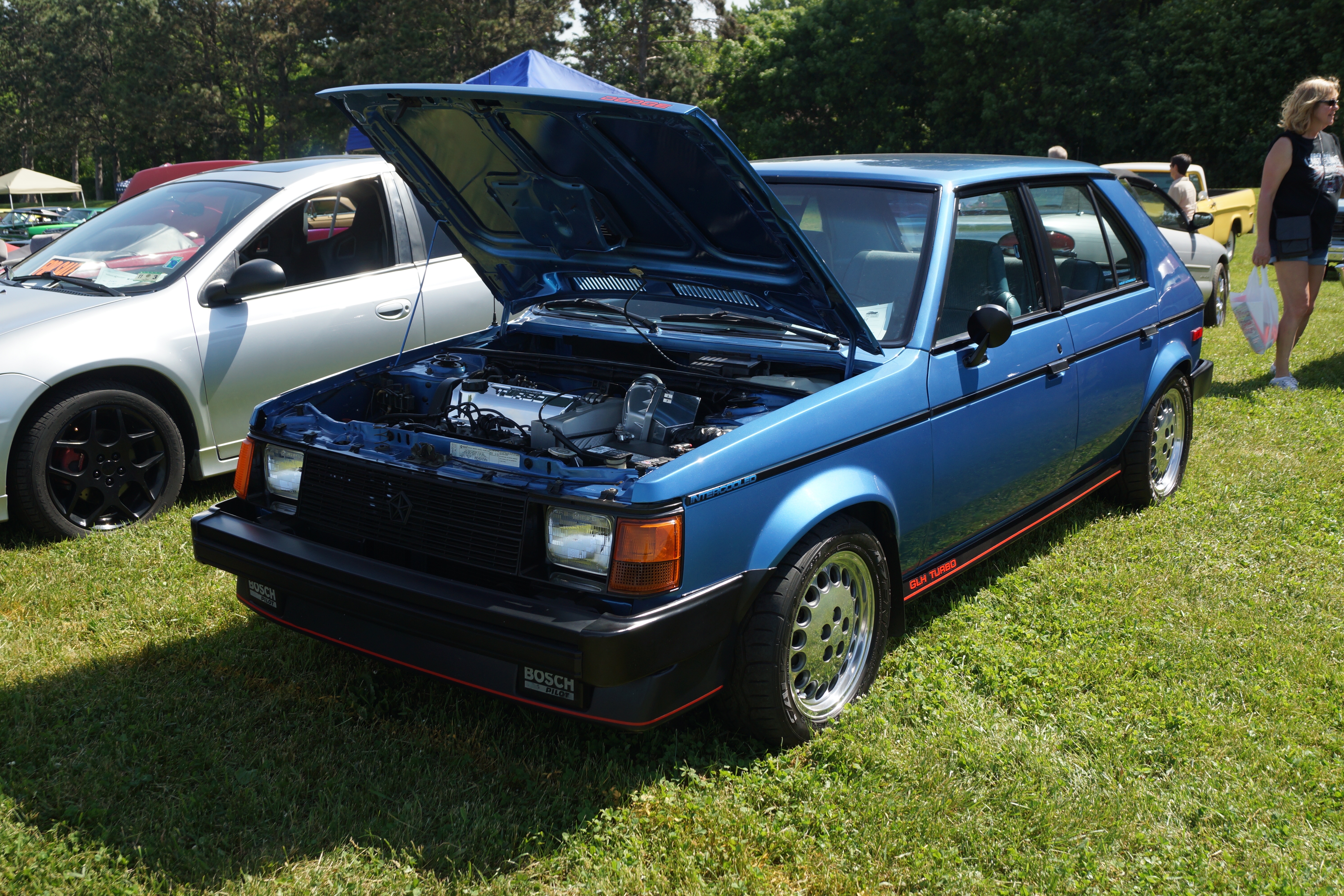
Dodge GLH
"Dodge is going to bring the GLH back released. They're [687.1s] going to have a hot hatch that they're going to call the GLH."
Dodge GLH is a name Dodge used for a more performance-focused version of a hatchback. Here, they’re saying Dodge plans to reuse that name for a new hot hatch.
The Dodge GLH is a performance-oriented trim name that historically stood for a “hot hatch” concept within Dodge’s lineup. In this segment, the hosts say Dodge is bringing the GLH back as a new hot hatch, tying it to the brand’s muscle-era performance naming.
hot hatch
"They're [687.1s] going to have a hot hatch that they're going to call the GLH."
A hot hatch is a small hatchback that’s been tuned to drive faster and feel more sporty than a regular one. It’s the “fun” version of a regular compact hatch.
A hot hatch is a hatchback tuned for stronger performance than a typical compact car, usually with a more powerful engine and sport-oriented suspension/brakes. It’s a specific enthusiast category: practical body style with driving-focused upgrades.
Rose like Hell
"[692.1s] Speaker 4: Rose like Hell. [693.0s] Speaker 2: It was like hell that remember that was Carol Shelby came up with it back in the day..."
They’re explaining what the GLH name is supposed to mean—basically “go like hell,” meaning it’s meant to sound fast and aggressive.
“Rose like Hell” is the spoken phrase used to explain the GLH acronym’s meaning—commonly associated with “Go Like Hell.” It’s a branding-style backronym that signals aggressive performance rather than a technical specification.

Dodge Omni
"It was like hell that remember that was Carol Shelby came up with it back in the day for the Omni."
The Dodge Omni is an older compact Dodge model they’re talking about as the car that the GLH idea/name was tied to in the past. It’s part of the history behind the GLH name.
The Dodge Omni is a compact car that’s referenced here as the earlier platform where the GLH-style performance naming was created. The hosts connect the GLH concept to the Omni era and to Carol Shelby’s involvement in the naming/performance story.

Dodge Super B
"...ame that they used for the Hornet that was an old super B. Yeah, I think they had that as well, but I thoug..."
The Dodge Super B is an older Dodge car model name. In the podcast, it’s brought up because it’s related to another car mentioned, the Hornet. The discussion sounds like it’s about how the same ideas or parts were used across different models.
The Dodge Super B is a classic model name that the podcast connects to the “Hornet” and an older Super B used as a reference point. It’s mentioned in a historical or model-line context, likely discussing how certain platforms or engines were reused across different cars. That kind of conversation is common when talking about how automakers evolve or repurpose designs over time.

Dodge Hornet
"I thought they had a GLH version of the Hornet as well, but I don't but I know they they what was the other name that they used for the Hornet..."
They bring up the Dodge Hornet as another older Dodge model that they think might have had a performance GLH-style variant. It’s mostly about the name’s history.
The Dodge Hornet is mentioned as another older platform the hosts think may have had a GLH version. This is a historical/rumor-style reference rather than a detailed technical discussion.

Dodge Viper
"Speaker 2: Another thing, Dodge is going to come out with a hyper performance car. I thought it was going to be like a Viper, but it's a hyper performance sedan..."
The Dodge Viper is a legendary, hardcore Dodge sports car. They expected something Viper-like, but the rumor they’re discussing sounds more like a sedan.
The Dodge Viper is a performance sports car famous for its raw, high-output V10-era character and extreme driving feel. The hosts say they expected a Viper-like direction, but the new idea is described as a hyper-performance sedan instead.

Dodge Challenger
"Speaker 2: Another thing, Dodge is going to come out with a hyper performance car... it's a hyper performance sedan and it looks like a super slammed version of the Dodge Challenger or Dodge Charger."
The Dodge Challenger is a famous American muscle car. In this discussion, they’re using it as a style comparison for a new high-performance Dodge concept.
The Dodge Challenger is a long-running American muscle car known for its retro styling and wide range of performance trims. Here, it’s used as a visual reference for a new Dodge “hyper performance” concept that’s described as a slammed, super-aggressive take on the Challenger/Charger look.

Dodge Charger
"Speaker 2: ...it looks like a super slammed version of the Dodge Challenger or Dodge Charger."
The Dodge Charger is a well-known muscle car. They’re saying the upcoming Dodge concept would look like a super-stretched, slammed version of that style.
The Dodge Charger is another iconic American muscle car, traditionally offered with powerful V8 options and a distinctive long-hood profile. In this segment, the Charger is mentioned alongside the Challenger as the design inspiration for a rumored Dodge hyper-performance model.
electrification
"Speaker 4: Did they mentioned their continuing commitment or not to electrification. Speaker 2: Yeah, absolutely..."
Electrification means moving from gas engines toward electric driving. Here, they’re talking about how strongly the company plans to do that.
Electrification in automotive usually refers to shifting powertrains away from gasoline engines toward electric propulsion. In this segment, the hosts discuss the company’s stated commitment to electrification and how that varies by region.
EV market share
"Speaker 2: ...but they believe that in a decade ev market share in Europe... So yeah, they say it's either going to double or triple."
EV market share is how big the electric-car slice is of total car sales. They’re talking about forecasts for how much of the market EVs will take in Europe.
EV market share is the percentage of total vehicle sales in a region that are electric vehicles. The hosts reference projections for Europe, suggesting the company expects EVs to grow significantly over the next decade.
pure BEVs
"Speaker 3: ...every one of these brands that I've been talking about, plus commercial is going to have pure BEVs."
BEV means the car runs only on electricity from a battery. “Pure BEVs” means they’re talking about fully electric cars, not hybrids.
BEV stands for battery-electric vehicle, meaning the car is powered only by an electric motor and a large battery. “Pure BEVs” emphasizes that these models are fully electric rather than hybrids or plug-in hybrids.
full hybrids
"There was a bunch of full hybrids in there, and then there was ice ice and mild hybrid as well. So yeah, and the Stella one platform is multipower train..."
A full hybrid can use electricity, gas, or both. A mild hybrid usually can’t drive on electricity alone for long.
A full hybrid can run using the electric motor, the gasoline engine, or both, depending on conditions. That flexibility typically allows better efficiency than a mild hybrid, which usually can’t propel the car electrically by itself for long.
mild hybrid
"There was a bunch of full hybrids in there, and then there was ice ice and mild hybrid as well. So yeah, and the Stella one platform is multipower train..."
A mild hybrid adds a small electric assist to the gas engine. It helps save fuel, but it usually isn’t meant to run the car on electricity alone for long.
A mild hybrid uses an electric motor mainly to assist the gasoline engine, rather than replacing it. It can improve efficiency (especially during stop-and-go and acceleration), but it typically can’t drive the car for extended periods purely on electric power.
eight hundred volt
"So yeah, and the Stella one platform is multipower train and it can go up to eight hundred volt with BEV and it'll have like LFP packs and Stell the pack design."
“800-volt” is the voltage level of the car’s high-voltage battery system. Higher voltage can help the car charge faster and move power more efficiently.
“800-volt” refers to the electrical system voltage used in the vehicle’s high-voltage battery and power electronics. Higher voltage can enable faster charging and reduce current for the same power, which can help with efficiency and component sizing.
LFP packs
"So yeah, and the Stella one platform is multipower train and it can go up to eight hundred volt with BEV and it'll have like LFP packs and Stell the pack design."
LFP packs are EV batteries made with lithium iron phosphate. They’re popular because they tend to last a long time and handle heat well.
LFP packs are battery packs using LFP, or lithium iron phosphate, chemistry. LFP batteries are known for long cycle life and good thermal stability, and they’re often chosen for cost and durability reasons in EVs.
bi directional charge
"And they also said it would be bi directional ready by bi directional charge. Feed it back into the grid, right yeah, or you can feed it back into your home or other devices."
Bidirectional charging means the car can not only charge its battery—it can also send electricity back out. That can power your home or even help the electric grid.
Bidirectional charging lets an EV send electricity back out through the vehicle’s charging system. That enables “vehicle-to-grid” (V2G) and “vehicle-to-home” (V2H) use cases, where the battery can support the grid or household loads.
vehicle-to-grid
"Feed it back into the grid, right yeah, or you can feed it back into your home or other devices. Right. What I like about bidirectional and I think this will be the game changer..."
Vehicle-to-grid means your EV can send power back to the electric grid. It can help when the grid needs extra electricity.
Vehicle-to-grid (V2G) is the idea that an EV can export electricity to the electrical grid when it’s needed. With bidirectional charging, the car’s battery can help balance demand, potentially reducing strain during peak periods or emergencies.
virtual power plants
"I don't know if you've heard about these virtual power plants at all, Lindsay, and it's that idea. Just people aggregating all that together into one source, and then these virtual power plants are selling off that electricity to the utilities."
A virtual power plant is a way to combine lots of small energy sources together. EVs and home batteries can be coordinated so utilities can use them like one big power system.
A virtual power plant (VPP) aggregates many distributed energy resources—like EVs, home batteries, and solar systems—into one coordinated “power source.” Instead of treating each home separately, utilities can dispatch the combined capacity as if it were a single plant.
gigawatt hours
"Potentially there's gigawatt hours in some of these virtual power plants that are all together. And you know, it's not just vehicles."
Gigawatt-hours measure how much energy there is in total. It’s a way to describe the big-picture amount of electricity stored across lots of systems.
Gigawatt-hours (GWh) measure energy, not power. When the hosts say a VPP could represent “gigawatt hours,” they’re emphasizing the total amount of stored energy available across many homes and vehicles.
assembly to parts manufacturing
"In France pois C. They're going to convert it from assembly to parts manufacturing."
This means a factory that used to build whole cars would switch to making car parts instead. The idea is to keep the facility working even if the company changes what it wants to produce. It’s like changing from “making the whole product” to “making components.”
“Assembly to parts manufacturing” describes shifting a facility’s role from building complete vehicles to producing components (parts) instead. This can help companies keep plants productive while changing product strategy or partner production. It’s a common industrial tactic when automakers need flexibility without closing sites.
Leap Motor
"They will build cars for Leap Motor and dong Fong is going to manufacture cars in their those plants."
Leap Motor is a car brand from China. The segment suggests Stellantis would use factories to build cars associated with Leap Motor. It’s basically a partnership where one company helps produce another brand’s cars.
Leapmotor (Leap Motor) is a Chinese automaker. Here, the hosts discuss Stellantis using Leap Motor capacity—meaning these plants would produce vehicles for the Leap Motor brand (or in partnership with it). That’s a notable supply-chain/production strategy rather than a typical single-brand factory plan.
dong Fong
"They will build cars for dong Fong and UH and Motors Leap Motors is uh oh, no, I got that right."
“dong Fong” sounds like a Chinese car company name. The hosts are saying Stellantis would use factory capacity to build cars for that partner instead of only Stellantis models. It’s about changing who the factories produce for.
“dong Fong” appears to be a mis-transcription of a Chinese automaker name (likely Dongfeng). In this segment, it’s described as manufacturing cars in those plants and supplying capacity that Stellantis would otherwise use. The key point is the production swap: Stellantis capacity is being repurposed to build vehicles tied to that partner.
capacity utilization
"But what it does is it'll get those plants. So the plan says to eighty percent capacity utilization, that's when you can start making money at those plants."
Capacity utilization means how busy a factory is—how many cars it’s making compared to what it could make. The hosts say the plan aims for around 80% so the factory can cover its costs and start making money. It’s basically “running the plant enough to be profitable.”
Capacity utilization is how much of a factory’s potential production is actually being used. The segment says the plan targets 80% capacity utilization, which is often where plants start to become profitable because fixed costs are spread over more vehicles. It’s a manufacturing economics concept, not a vehicle performance metric.

Jeep Compass
"... say exactly which models, but it's probably like Compass and uh, you know the smaller it. Speaker 5: Was l..."
The Jeep Compass is a smaller SUV made by Jeep. It’s meant for regular daily driving, with some capability features depending on the version. The podcast mentions it as an example of the smaller Jeep models.
The Jeep Compass is a smaller Jeep SUV positioned for everyday driving with available off-road capability features. It’s often discussed in the context of model lineup size—how Jeep offers different vehicles from smaller to larger. In the podcast, it’s referenced as an example of a “smaller” model within the Jeep range.
stretched platform
"can they pull this off with you know, the stretched platform is really interesting, that's a great story."
A “stretched platform” means using the same basic car design, but making it longer to fit different-sized models. Companies do this to save money on engineering while still selling different vehicles. It’s like extending the same “car blueprint” for multiple products.
A “stretched platform” refers to using a vehicle architecture (platform) with a longer wheelbase or body length to create multiple vehicle sizes from shared engineering. Automakers do this to reduce development costs while offering different models. In the segment, it’s called out as an interesting part of the story behind the plan.
compromise design
"Speaker 2: ...and you want to make a bed version, and the bed version hauling around a lot of weights compromised. [1226.0s] Speaker 3: It's a compromise design."
It means the car was built with one main purpose in mind, then changed for another use. Because it wasn’t designed from the start for the second job, it has trade-offs—some things work, but other things are less ideal.
A “compromise design” is when a vehicle platform is engineered for one primary use, but then adapted for another role. The adaptation forces trade-offs, so the second version (like a “bed version” that hauls heavier loads) may not perform as well as a design built from the start for that job.
platform plans
"Speaker 5: ...they had Stella Small, Stellar Medium, Stella Large, and stell a frame now that was supposed to be more BEV focused... [1278.2s] ...the Stella platforms were supposed to get there what they call Stella Brain... and now this... Stella one... [1310.0s] ...they weren't able to do it before..."
“Platform plans” refers to an automaker’s strategy for using shared vehicle architectures across multiple models. When those plans slip or don’t deliver enough compatible vehicles, the company may delay features, rework timelines, or consolidate onto fewer platforms.
smart cockpit
"Speaker 3: ...the Stella platforms were supposed to get there what they call Stella Brain Stell a smart cockpit and all this technology... [1302.0s] ...it's getting that stuff first..."
A “smart cockpit” is the car’s digital cabin—screens, software, and connectivity that make the dashboard and controls feel more high-tech. It’s usually tied to features like navigation, apps, and updates.
A “smart cockpit” is an in-car digital experience—typically a coordinated set of displays, software, and connectivity—that aims to make the cabin feel more like a connected device than traditional controls. It often includes advanced infotainment, driver-assistance integration, and over-the-air software updates.
Rivian
"Speaker 5: ...they've jumped to Rivian and sank nearly six billion bucks in the Ribbean to get their time right. [1378.72s]"
Rivian is an electric-vehicle company. The hosts mention Stellantis investing in Rivian to speed up EV progress and get technology sooner.
Rivian is an EV-focused brand known for building electric vehicles and related software/technology. The segment references Stellantis “jumping to Rivian” and investing billions, framing it as a way to accelerate timing and access EV know-how.
zonal centralized compute architecture
"Right right, But you know, but that was all about getting a software defined vehicle, you know, zonal centralized compute architecture... They couldn't Volkswagen Carrie and couldn't make it work... so they're getting the platform, but they're keeping Stellar Brain, which is essentially a zonal not essentially it is."
This is a way to organize the car’s computers. The car is split into zones, and those zones are managed by a more centralized computer system, which can make the car easier to update and potentially reduce complexity.
A zonal centralized compute architecture is an electronic vehicle design where the car is divided into zones (areas like front cabin, rear, doors, etc.), and each zone is managed by centralized computing. Instead of many separate controllers scattered everywhere, data and control are coordinated through a more centralized compute setup, which can simplify wiring and enable more software-driven features.
software defined vehicle
"Right right, But you know, but that was all about getting a software defined vehicle, you know, zonal centralized compute architecture."
A software defined vehicle is a car where a lot of what it does is controlled by software. Instead of being “locked in” at the factory, some features can be improved or added later with updates.
A software defined vehicle (SDV) is a car where many functions—like infotainment, driver assistance, and even some powertrain behaviors—are controlled primarily by software. That means features can often be updated or expanded over time, rather than being fixed at production.
Jaguar Land Rover
"[1557.2s] Speaker 2: But remember what was the other big news that broke this week or yesterday. They're going to work with JLR [1563.6s] Jaguar Land Rover to do new technology and new vehicles, and all of that engineering will be done. [1571.2s] Speaker 3: In Auburn Hills."
Jaguar Land Rover is the company behind Jaguar and Land Rover cars. The hosts are saying Stellantis wants to partner with them to develop new tech and vehicles, and do the engineering work in Auburn Hills.
Jaguar Land Rover (JLR) is the UK-based automaker that builds Jaguar and Land Rover vehicles. The hosts say Stellantis plans to work with JLR on new technology and new vehicles, with engineering work done in Auburn Hills.
Range Rover
"[1603.5s] ... You know, there's [1612.6s] a refinement with with range Rover that maybe Jeep could use. [1616.5s] But there's a utility and a kind of simplicity of Jeep."
Range Rover is a Land Rover brand line known for luxury and refinement, especially compared with more utilitarian off-road vehicles. The hosts suggest Jeep could borrow some of that refinement while still keeping Jeep’s simpler, more utility-focused identity.

Land Rover Range Rover
"...h other. You know, there's a refinement with with range Rover that maybe Jeep could use. But there's a utility ..."
The Range Rover is a large SUV made for comfort and a smooth ride, while still being able to handle rough roads. People talk about it because it feels more “polished” than some other SUVs. In the podcast, it’s used as an example of that blend of comfort and usefulness.
The Land Rover Range Rover is a luxury SUV known for a refined ride and a more upscale, comfort-focused approach than many off-road-oriented vehicles. It often comes up in discussions about how well a brand balances everyday comfort with real-world capability. In the podcast context, it’s referenced as an example of “refinement” and “utility” that others might try to match.

Jeep Wrangler
"...and a kind of simplicity of Jeep. Just thinking a Wrangler versus land Rover that that I think Jeep has an a..."
The Wrangler is a Jeep SUV designed for off-road driving. It’s known for being simple and capable on rough terrain. The podcast compares it to a more luxury-focused SUV to show how their priorities differ.
The Jeep Wrangler is a rugged, off-road-focused SUV built around a simple, straightforward design and strong trail capability. It’s frequently discussed because it’s one of the most recognizable vehicles in its class and has a loyal following. In the podcast, it’s contrasted with the Range Rover to highlight differences in simplicity versus refinement.
government subsidy
"So I think it's quite important to understand. I think there's a lot of things being thrown thrown out in terms a lot of things being thrown out in terms of garment subsidy. But it's important to understand what the government subsidy is."
A government subsidy is help from the government that can reduce a company’s costs. In this segment, it’s described as things like land and help building factories.
A government subsidy is financial or in-kind support provided by a government to reduce a company’s costs or help it invest. Here, the speaker describes subsidies as things like land provided for lease and assistance with building construction, which can lower the cost of establishing production.
tier ones
"But I think so that's one piece. So I think what's important to understand is where the Chinese work very very efficiently. So let's take a company like Sai C for example, they work with they work with Volkswagen"
Tier ones are big companies that supply major parts to car makers. They’re not the final car brand, but they make important components that go into the car.
Tier ones are major automotive suppliers that deliver large, integrated components directly to automakers (OEMs). The speaker says they’ve worked with many tier ones, implying they understand how supplier capabilities and cost structures affect vehicle component development.
OEM
"they work with Volkswagen, they work with GM, and they work with say some other ow EEM And typically if you go to GM Ford instilland this year"
OEM means the company that supplies parts used to build a car. It’s different from aftermarket parts, which are made to replace or upgrade parts later.
OEM stands for original equipment manufacturer, meaning the company that makes the parts that go into a vehicle as it’s built. In the transcript, “OEM” is used to describe the broader automotive ecosystem that Chinese firms work with and supply.
brake systems
"if you take a vehicle with the two thousand kilos, they all develop their own brake systems pretty much."
Brake systems are the parts that make the car slow down and stop. This segment is comparing how different companies design brakes—either tailored for each model or standardized to save money.
Brake systems are the coordinated components that slow and stop a vehicle—typically including the hydraulic/pneumatic hardware, calipers, rotors, pads, and related control hardware. The speaker argues that different automakers may develop different brake systems for similar vehicles, while Chinese OEMs may standardize to reduce cost.
stopping distance
"What what defines the performance characteristic break is the way to the car, the stopping distance, how many seconds you want to stop it in the speed and so on."
Stopping distance is how far the car goes before it fully stops once you start braking. Better brakes and better tires usually mean a shorter stopping distance.
Stopping distance is the total distance a car travels from the moment braking begins until the vehicle comes to a complete stop. It depends on speed, brake performance, tire grip, and vehicle weight, and it’s used here as the key metric for brake system “performance.”
commodity components
"Speaker 2: ...and that's this common commodity components across the industry and it's CATARK... Speaker 2: To do is maybe a top hat, maybe an interior, maybe some of their own proprietary technology and the user interface everything else is commoditized."
These are basic, widely available car parts that many companies can make. If most of the car is made from these common parts, it’s faster and cheaper to build new models.
“Commodity components” are standardized parts that multiple companies can buy from many suppliers, rather than unique, proprietary hardware. The segment frames this as a reason China can move quickly: OEMs focus their differentiation on a few areas (like software/UI or certain proprietary tech) while the rest is sourced as common parts.
China Automotive Technology and Research Center
"Speaker 2: So, Matthew, you really hit on something that I think is key to China speed, and that's this common commodity components across the industry and it's CATARK. The government organization ... Speaker 2: that sets that up is my unders standing, the China Automotive Technology and Research Center, and it designs all these component parts and it validates the designs, it validates suppliers."
This is a Chinese auto organization that helps set rules and check that car parts and suppliers meet requirements. The hosts are saying it plays a big role in making certain parts common across the industry.
The China Automotive Technology and Research Center (often shortened to C-A-T-R-C) is a government-linked organization in China that helps standardize and validate automotive parts and suppliers. In the segment, it’s described as designing component specifications, validating designs, and testing/approving suppliers so OEMs can source compliant parts.
user interface
"Speaker 2: ...maybe some of their own proprietary technology and the user interface everything else is commoditized."
This is the part of the car you interact with—like the touchscreen menus and controls. The hosts are saying some companies focus on improving this instead of reinventing every hardware component.
In modern vehicles, the user interface refers to the screens, controls, and software interactions the driver and passengers use (infotainment, menus, touch controls, etc.). The segment treats it as a key differentiator while other hardware is described as commoditized.
joint ventures
"Speaker 2: ...Let's set up joint to interures with all these companies. Fifty to fifty joint interures. You come and set up. We learn manufacturing, we learn engineering, we learn how you decize."
A joint venture is when two companies team up to work together. Here, the idea is that China partnered with foreign automakers to learn how to build cars and factories.
A joint venture is a partnership where two companies (often a local firm and a foreign automaker) share ownership and collaborate on building cars, manufacturing, and engineering. The segment says China used “fifty to fifty joint ventures” to learn manufacturing and engineering know-how from established automakers.
tariff
"Speaker 2: We build a flyer base. If you don't build in the country, you don't there's a tariff."
A tariff is a tax the government charges on imported products. The point being made is that it encouraged companies to build cars inside China instead of importing them.
A tariff is a tax on imported goods. The segment connects tariffs to the strategy of building production inside the country: if you don’t manufacture locally, the import tax makes it harder or more expensive to sell.
Toyota
"Speaker 2: So what happened It spawned an industry. So they learned from the early nineties to for twenty years, they learned from Toyota. So if you go today to Chinese or ems,"
Toyota is being used as an example of a company China studied and learned from while building its own auto industry.
Toyota is referenced as a benchmark source of manufacturing and engineering learning for Chinese automakers over the period described. The segment claims that from the early 1990s for about twenty years, China learned from Toyota as it built up its industry.
weight class
"Two of our customers said, more important than cost is tax because over a particular weight class, the tax increase is double. Okay, So that has become a big focus."
Some countries tax cars based on how heavy they are. If a car is over a certain weight limit, the tax can jump a lot.
A “weight class” is a regulatory or tax threshold based on the vehicle’s mass. When a vehicle crosses into a higher class, the tax rate can jump significantly, which makes weight reduction financially important.
AI solution
"We now have an AI solution as a proof of concept. But what we do is we see whether the idea applies with our experts."
They’re talking about using computer intelligence to help analyze car designs faster. The goal is to estimate what changes could save money without compromising safety.
An “AI solution” here refers to using machine-learning or data-driven methods to analyze vehicle designs and predict outcomes. In the context of engineering, it’s used as a proof of concept to estimate cost savings and speed up evaluation.
proof of concept
"We now have an AI solution as a proof of concept. But what we do is we see whether the idea applies with our experts."
A proof of concept is a small test to prove an idea can work. It’s like a prototype step before fully rolling it out.
A “proof of concept” is an early demonstration that an idea or technology can work in practice. It’s not the final product yet, but it shows the approach is feasible before scaling it into real engineering workflows.
crash load path
"But then you have to see whether when you mounted in the body with the seat is the one that takes the maximum impact from a safety perspective and a crash, so will the crash load path be able to pass through that frame..."
In a crash, the car has to send impact forces through strong parts. A “load path” is basically the route those forces take, and it needs to be designed so the safety structure holds up.
A “crash load path” is the route forces travel through a vehicle during a collision. Engineers must ensure those forces pass through the right structural members so the occupant compartment and safety-critical parts don’t fail.
crash test
"...and a crash, so will the crash load path be able to pass through that frame or are you going to kill someone the worst worst thing you want, which happened to one of the Japanese OEMs recently. For the long time since it's happened that their seat bucket during a crash test and they got a zero star rating..."
A crash test is when a car or part is intentionally crashed in a controlled way to see how safe it is. The results help determine how well it protects people.
A “crash test” is a controlled evaluation where vehicles or components are subjected to impact conditions to measure how well they protect occupants. Results can include ratings that reflect injury risk and structural performance.
seat bucket
"...their seat bucket during a crash test and they got a zero star rating or a big Japanese OEM. It happened a year ago."
The seat bucket is the main structural part of the seat that the person sits in. If it fails in a crash test, it can seriously affect safety results.
A “seat bucket” is the seat’s structural shell that shapes the seating area and supports the occupant. In crash testing, the seat bucket’s strength and how it transfers loads can strongly affect occupant protection and test ratings.
mass reduction
"Do you see mass reduction returning as an engineering priority in the US and North America? It had been before EVS and then EV's it seemed like just giant batteries, very heavy batteries kind of negated the gains..."
Mass reduction means making the car lighter. A lighter car can use less energy and often feels more responsive, but it can cost more to build depending on the materials used.
Mass reduction is the effort to make a vehicle lighter through materials and design changes. In practice, it can improve efficiency and handling, but it also has to be balanced against cost and safety requirements.
sub four meter cars
"in the country India, you see any vehicle less than sub four meter as a lower tax rate... So if you flip this around... your fuel efficiency goes up because you're if you have a sub four meter car is going to be lighter..."
“Sub four meter” means cars under 4 meters long. Some governments use that length to set lower taxes or incentives, which can make smaller cars cheaper and often lighter.
“Sub four meter” refers to vehicles shorter than 4 meters, which some countries use as a threshold for tax or incentive programs. The segment argues these policies can make smaller cars more affordable and can indirectly improve fuel efficiency because smaller cars are typically lighter.
sales tax
"if the US had a rule it said sub more, all sub four meter cars in the United States had no sales tax..."
Sales tax is the extra tax you pay when buying something. Here it’s used to show that if taxes favor smaller cars, more people will buy smaller cars.
Sales tax is a consumption tax added at the point of purchase. The discussion uses it as an example of how tax policy can change what kinds of cars people buy, which then affects automaker strategy.
fuel efficiency
"suddenly the affordability problem goes away. You know, your fuel efficiency goes up because you're if you have a sub four meter car is going to be lighter..."
Fuel efficiency is how far a car can go on a given amount of fuel. The hosts are saying smaller and lighter cars often get better fuel economy.
Fuel efficiency is how effectively a vehicle turns fuel energy into motion, commonly expressed as miles per gallon (MPG) or liters per 100 km. In this segment, it’s linked to vehicle weight and size: lighter cars can require less energy to move.
cost reduction ideas
"when we come up with technology and cost reduction ideas, usually because we focus only on engineering cost reduction, not sourcing, not options configurations with the consulting companies do because a engineering cost reduction."
They’re talking about ways to make the car cheaper to build. That can mean changing parts or designs, or changing how the company buys components and offers options.
The phrase refers to structured efforts to lower the total cost of building a vehicle. In practice, it can include engineering changes, supplier/sourcing changes, and how options are configured—each affects cost differently.
engineering cost reduction
"when we come up with technology and cost reduction ideas, usually because we focus only on engineering cost reduction, not sourcing, not options configurations"
This means trying to redesign the car so it costs less to build. The point here is that it’s only one part of the cost problem—other departments can affect cost too.
“Engineering cost reduction” focuses on redesigning components or systems to reduce cost while meeting requirements. The speaker contrasts this with other cost levers like sourcing strategy and how vehicle options are configured.
spec book
"They have their rules which is called the spec book, and they will say, hey, this will not work, and so on, and before they reject a lot of ideas."
A “spec book” is like the car company’s rulebook for what the vehicle is required to be. If a proposed change doesn’t match those rules, engineers reject it.
A “spec book” is an internal document that defines approved vehicle requirements—what parts, materials, dimensions, and performance targets are allowed. When engineers say an idea “will not work,” they’re usually checking it against these locked-in specifications.
tooling
"Then you go to say manufacturing people, they will say this will not we don't have the capital, the tooling. They will reject ideas."
“Tooling” is the special equipment a factory needs to make parts. If a change would require new equipment, it can be too costly to do quickly.
In manufacturing, “tooling” means the specialized equipment and molds/fixtures used to produce parts at scale. New tooling is expensive, so even if an engineering idea is good, manufacturing may reject it if the factory can’t afford the capital investment.
cancellation costs
"purchasing they say, okay, we have this contract with this supplier for three years. We cannot change it. The cancelation costs are high."
If a company has a contract with a supplier, ending it early can trigger big fees. Those fees can block quick changes to who they buy parts from.
“Cancellation costs” are the financial penalties and fees incurred when a purchasing contract with a supplier is ended early. These costs can make it hard to switch suppliers quickly, even when a new sourcing approach would reduce vehicle cost.
validation bucket
"End of the end of the four hours of twenty six ideas, twenty four went back into a validation bucket and two were rejected and when the deputy seat you walked out of the room."
It’s like a holding area for ideas that need more checking. Instead of killing them right away, the team puts them into a group to see if they really work.
A “validation bucket” is an internal stage in a product-development process where ideas are grouped for review/testing before they’re either approved or rejected. In this context, most of the proposed ideas get routed there after the initial debate.
parallel
"No way, Yeah, okay, your pressure is so high and because it's parallel, not many people can veto. So in a Western OEM and we get ten fifteen percent or in the best case you've had around twenty five percent."
Parallel means different people work on different tasks at the same time. That can make the whole project finish faster because you’re not waiting on one step to end first.
“Parallel” development means multiple teams work on different parts of the same program at the same time, rather than waiting for one step to finish before starting the next. The hosts argue this reduces cycle time because fewer people/steps become bottlenecks.
in sequence
"You work in parallel when you do in sequence, and if somebody checks fifty percent, then you come here another percent to checks twenty percent."
In sequence means one task has to be finished before the next one starts. That often takes longer because you can’t move ahead until the earlier step is done.
“In sequence” development is the opposite of parallel: tasks are completed one after another, so each step depends on the previous one. The transcript suggests this increases total time because each stage can introduce delays and additional review points.
disposition the idea
"So that is how they are faster. So typically with the Western OEM it will take you six months to dispose of an idea. Here they are able to disposition the idea and say, say eight weeks, so very fast."
To “dispose of” an idea means to decide what happens to it. Either it moves forward, gets changed, or gets turned down.
“Disposition” here means the internal decision outcome for an idea—whether it gets approved, rejected, or moved to the next stage. The speaker contrasts Western OEM timelines (months) with faster decision cycles (weeks) in the discussed process.
Request an Explanation
Heard something you'd like explained? We'll add it to this episode.
Sign in to request explanations for terms you heard.
Want to learn more?
Browse our glossary for plain-English explanations of automotive terms, jargon, and concepts.
Help improve this episode
See something that's not quite right? Our annotations are AI-generated and can sometimes miss the mark. Click the flag icon on any annotation to suggest a correction.