AD #4304 - 1st Peek at Chrysler's New Models; Ford Escape Going on UEV Platform; Xiaomi Loses $5,600 Per Car
About this episode
Stellantis is planning to expand Chrysler with new crossovers, while Ferrari revealed its first EV, the Luce, built on a bespoke eight hundred volt platform with four in-house motors and even fake engine noises. Ford’s Escape is reportedly headed back to production in 2029 as a fully electric model on the company’s new UEV platform. The hosts also cover Xiaomi’s auto losses—about $5,600 per car—and how autonomy branding is shifting, including Tesla renaming FSD in China and Waimo pausing robotaxi service.
Chrysler
"But on today's show, let's look at what's happening with the Chrysler brand. Of course, it's keeping the Pacific a minivan, but it's adding three crossovers..."
Chrysler is a car brand. Here they’re talking about Chrysler adding new crossover SUVs to go along with its minivan, the Pacific.
Chrysler is a major American automaker brand known for vehicles like minivans. In this segment, the hosts discuss Chrysler keeping the Pacific minivan while adding new crossover models to expand its lineup.
Stella small platform
"They'll be based on an optimized version of the Stella small platform, and we believe the Aero Cross will be priced under thirty thousand dollars."
A platform is the shared foundation underneath a car. Using the “Stella small” platform means different models can be built on the same basic structure, which can help reduce cost and speed up development.
A platform is the shared engineering “base” a car is built on, including major structural components. Here, the hosts say Chrysler’s compact crossovers will use an optimized version of the “Stella small” platform, meaning multiple models can be built with similar architecture.
rebadged versions
"The lesser brands will just get rebadged versions of the products from its key retail brands, which are Jeep, Ram, Fiat and Pougeot."
“Rebadged” means the same car is sold under a different brand. The hosts say Stellantis may use the same vehicles across several brands, changing badges and some styling instead of designing everything from scratch.
“Rebadged” means taking a vehicle that already exists and selling it under a different brand name, usually with minor cosmetic changes. The hosts say Stellantis plans to feed multiple brands by using rebadged versions from key retail brands like Jeep, Ram, Fiat, and Peugeot.
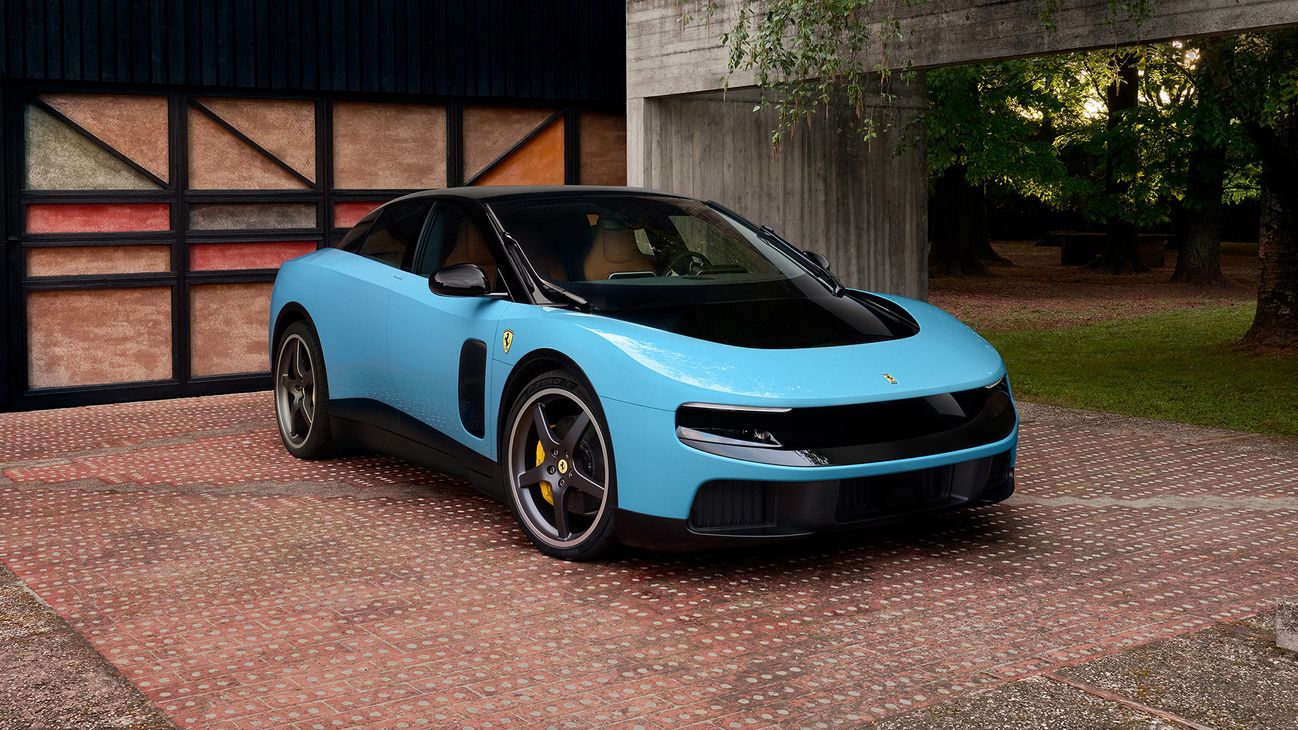
Ferrari Luce
"Ferrari revealed its first electric vehicle, the Luce, which is also the company's first four door five seater. It's built on a bespoke eight hundred volt platform..."
The Ferrari Luce is Ferrari’s first electric car, and it’s also their first practical four-door, five-seat model. The hosts say it uses a high-voltage electrical system and has motors at each wheel.
The Ferrari Luce is notable because it’s Ferrari’s first electric vehicle and its first four-door, five-seater. The segment also highlights its engineering approach: a bespoke 800-volt platform and four in-house electric motors, one at each wheel.
bespoke eight hundred volt platform
"It's built on a bespoke eight hundred volt platform and weighs two two hundred and sixty kilograms..."
“800 volt” is the electrical system voltage in the car. Higher voltage can help the car charge faster and move more power around efficiently.
An 800-volt platform refers to the vehicle’s electrical system voltage level, which affects how efficiently the car can charge and deliver power. A “bespoke” platform means Ferrari designed this architecture specifically for the Luce rather than adapting an existing EV setup.
four in house developed electric motors, one at each wheel
"but the Lucha features four in house developed electric motors, one at each wheel, which combine for up to seven hundred and twenty five kilowatts..."
This means the car has a motor for each wheel, instead of one motor driving everything. That can help the car control grip better and feel more responsive.
Having one electric motor at each wheel is an “independent wheel” setup that can improve traction and control. The segment says Ferrari developed these motors in-house for the Luce, enabling torque distribution to each wheel for sharper handling.
fake engine noises
"Like some other performance evs, it will pump out fake engine noises as well, which get more or less than ten depending on the driving mode."
Because EVs are so quiet, some cars add artificial sound. Ferrari is saying the Luce will play different “engine-like” noises depending on how you’re driving.
Fake engine noises are artificial sound systems used in EVs to mimic engine sounds. They can be adjusted by driving mode to give the driver and pedestrians more audible feedback at low speeds.
active suspension system
"Other highlights include an active suspension system, rear wheel steering, and displays that were co developed with Samsung."
Active suspension is a system that actively adjusts how the car’s shocks behave. It helps the car stay controlled over bumps and during cornering.
An active suspension system uses sensors and actuators to adjust damping and/or ride height in real time. The goal is to keep the car stable and comfortable while also improving handling response.
rear wheel steering
"Other highlights include an active suspension system, rear wheel steering, and displays that were co developed with Samsung."
Rear wheel steering means the back wheels can also turn. That can make the car easier to maneuver at low speeds and more stable when driving fast.
Rear wheel steering turns the back wheels in addition to the front wheels. At low speeds it can improve maneuverability, and at higher speeds it can help stability and reduce turning effort.
Samsung
"Other highlights include an active suspension system, rear wheel steering, and displays that were co developed with Samsung."
Samsung is a big electronics company. Here it’s mentioned because it helped develop the screens used in the Ferrari Luce.
Samsung is a major electronics company. In this segment, it’s mentioned as a co-developer of display technology for the Ferrari Luce.

Ford Escape
"Looks like Ford is not getting rid of the Escape crossover altogether. Auto four Cast Solutions reports the Escape will go back into production in twenty twenty nine, but this time it will be fully electric..."
The Ford Escape is a popular crossover SUV. The hosts say it’s coming back as an all-electric vehicle built on a new electric-focused platform.
The Ford Escape is a compact crossover that the hosts say will return to production as a fully electric model. They specifically connect it to Ford’s new UEV platform and provide production timing and plant details.
UEV play
"Auto four Cast Solutions reports the Escape will go back into production in twenty twenty nine, but this time it will be fully electric, made off the company's new UEV play..."
A UEV platform is Ford’s plan for building electric cars. The hosts say the Escape will be built on that new electric platform, not just converted from a gas-car design.
UEV (as used here) refers to Ford’s electric-vehicle platform strategy—an “EV play” for building future electric models. The segment says the Escape will be made on Ford’s new UEV platform, implying a dedicated electric architecture rather than a conversion.
Louisville assembly plant
"Auto four Cast Solutions reports the Escape will go back into production in twenty twenty nine, but this time it will be fully electric, made off the company's new UEV play and built at the Louisville assembly plant."
The Louisville assembly plant is where the car would be built. Where a car is manufactured can affect availability and production planning.
The Louisville assembly plant is a specific manufacturing location where the electric Escape is said to be built. Plant-specific production matters because it affects labor, tooling, and which models a region can supply.
CE one
"The program's code name is CE one. The model is referred to as the U eight three three..."
“CE one” is a code name for the project behind the electric Escape. It’s basically an internal label used during development.
“CE one” is a program code name for the Escape’s electric production platform or project. Code names like this are commonly used internally to track development and manufacturing plans before official model branding is finalized.
body on frame
"Auto Forecast also reports that Hondai and Kia will build their mid sized pickups for the US market at Honda's assembly plant outside of Savannah, Georgia. They'll be body on frame trucks that will offer hybrid and EREV powertrains."
Body-on-frame means the car has a separate “truck-like” frame underneath, and the body mounts on top. It’s often used for trucks because it’s strong for hauling and towing.
Body-on-frame is a construction method where the vehicle’s body sits on a separate ladder-like frame. It’s common in trucks because it can handle heavy loads and towing, and it can make it easier to build variants like pickups.
hybrid and EREV powertrains
"They'll be body on frame trucks that will offer hybrid and EREV powertrains. The platform is code named IMA."
Hybrid means the truck can use both a gas engine and an electric motor. EREV means it mainly drives like an electric vehicle, and a small engine helps generate electricity to extend how far it can go.
A hybrid powertrain combines an internal-combustion engine with an electric motor. An EREV (extended-range electric vehicle) is a type of electrified vehicle that primarily runs on electricity, using a generator (often from a small engine) to extend range when the battery is low.
IMA
"The platform is code named IMA. Hondai will keep the Santa Cruz name, but internally it's called the TE..."
“IMA” is an internal name for the platform the pickups will use. It’s basically the development label for the shared truck foundation.
“IMA” is the code name for the platform that will underpin the mid-size pickups for the US market. Code-named platforms are used during development to refer to the shared architecture before official product branding.

Hyundai Santa Cruz
"... platform is code named IMA. Hondai will keep the Santa Cruz name, but internally it's called the TE, while Ki..."
The Hyundai Santa Cruz is a small crossover that also has a pickup-style bed in the back. It’s meant for everyday driving but can carry items like tools, groceries, or gear. Automakers sometimes use internal code names during development, which is why you may hear different names for the same underlying platform.
The Hyundai Santa Cruz is a compact crossover pickup—built on a car-style platform but with a truck bed for hauling light cargo. It’s often discussed because it represents Hyundai’s push into the “small truck” segment using mainstream crossover packaging and technology. The podcast mention of internal code names highlights how automakers develop and organize platforms behind the scenes.
FSD
"Tesla changed the name of its FSD or full self driving system in China. Now it's called Tesla Assisted Driving, but this isn't the first time it changed the name."
FSD is Tesla’s software that tries to handle more of the driving for you. Even though the name sounds like it drives by itself, it still needs supervision and isn’t truly fully autonomous everywhere.
FSD stands for “Full Self-Driving,” a Tesla software package aimed at automating parts of driving. In practice, it’s not fully autonomous in all conditions, which is why regulators pushed Tesla to rename it in China to avoid implying it’s a complete self-driving system.
Tesla
"Tesla changed the name of its FSD or full self driving system in China. Now it's called Tesla Assisted Driving... Tesla is obviously changing the name to satisfy regulators."
Tesla is the car company behind the software that helps with driving. They changed the name of their self-driving feature because regulators didn’t like the implication that it’s fully autonomous.
Tesla is the automaker using driver-assistance software branding like FSD and “Assisted Driving.” The segment ties Tesla’s naming changes to regulatory concerns in China and mentions that it received approval to sell the system in parts of Europe.
Mercedes
"Mercedes announced it will launch its MB drive assist pro system in Germany by the end of the year. It's a level two plus plus system that features point to point driving."
Mercedes is the car company rolling out a new driver-assist feature. It can help with steering and route guidance, but it’s still not the same as fully autonomous driving.
Mercedes is the automaker announcing an advanced driver-assistance system called “MB drive assist pro.” The segment says it will be a Level 2+ system with point-to-point driving, and it’s planned to roll out across Germany, the US, and previously in China.
level two plus plus
"Mercedes announced it will launch its MB drive assist pro system in Germany by the end of the year. It's a level two plus plus system that features point to point driving."
“Level 2+” is a way to describe advanced driver-assist features that can steer and control speed, but you still have to watch and be ready to take over. It’s not the same as the car fully handling driving on its own.
“Level 2+” and “Level 2++” are marketing-style labels for driver-assistance systems that go beyond basic lane-keeping and adaptive cruise, but still require the driver to supervise. The key point is that these systems are not “Level 3,” where the car can take over more of the driving under certain conditions.
point to point driving
"It's a level two plus plus system that features point to point driving. The technology has been available in China since the end of last year, and it will roll out in the US sometime this year."
Point-to-point driving refers to an assisted-driving mode where the system can guide the vehicle along a route from one location to another, rather than only handling short segments like lane centering. It typically relies on navigation, mapping, and sensor inputs to manage the route while the driver remains responsible.
BMW
"Meanwhile, the technology has been available in China since the end of last year... BMW is also planning to roll out a similar system by the end of the year in Germany as well."
BMW is also planning to bring out a similar driving-assist system. The episode is basically saying many brands are competing to offer advanced help while staying within regulatory limits.
BMW is mentioned as planning to roll out a similar advanced driver-assistance system in Germany by the end of the year. The point is that multiple automakers are racing to offer comparable route-based assistance without crossing into Level 3 claims.
level three
"And by the way, do you know why these automakers keep adding plus signs to their eight ass levels? Because once you go to level three you face a lot more regulatory and legal scrutiny."
Level 3 is closer to “the car can drive” for certain situations, and you don’t have to watch every second. But it’s harder to approve legally, which is why companies are cautious about claiming Level 3.
“Level 3” is a higher automation tier where the car can handle most driving tasks under specific conditions, and the driver may not need to continuously monitor. The transcript notes that moving to Level 3 triggers more regulatory and legal scrutiny, because responsibility shifts more toward the vehicle/system.
level four
"In one last bit of autonomous news, this time at level four, Waimo has suspended its robotaxi service on highways, and it also halted its operations in Atlanta."
Level 4 is when the car is designed to drive itself without you taking over, but only in certain areas or conditions. Even then, companies may pause service to update software and improve safety around tricky roads.
“Level 4” refers to highly automated driving where the system can perform the driving task without expecting human intervention within a defined operating area. The segment describes Waimo suspending robotaxi highway service and updating software, which highlights how Level 4 deployments still require careful operational validation.
Waimo
"In one last bit of autonomous news, this time at level four, Waimo has suspended its robotaxi service on highways, and it also halted its operations in Atlanta."
Waimo is a company that operates self-driving taxi services. They paused service and updated their software to handle construction areas and flooded roads more safely.
Waimo is an autonomous-vehicle company running robotaxi services. In this segment, it suspends highway robotaxi operations and halts service in Atlanta to update software for better behavior around construction zones and flooded roads.
Shaomi
"Earlier this month, the company recalled around thirty eight hundred vehicles... Chinese evemaker Shaomi has become one of the"
Shaomi is mentioned as a company making electric cars. The host is about to talk about how much money they lose for each car they sell.
Shaomi (likely referring to Xiaomi) is mentioned as an “evemaker” that has become a notable player in electric vehicles. The segment is setting up a financial impact point—losses per car—before the excerpt ends.
Request an Explanation
Heard something you'd like explained? We'll add it to this episode.
Sign in to request explanations for terms you heard.
Want to learn more?
Browse our glossary for plain-English explanations of automotive terms, jargon, and concepts.
Help improve this episode
See something that's not quite right? Our annotations are AI-generated and can sometimes miss the mark. Click the flag icon on any annotation to suggest a correction.