AD #4314 - Donut Battery Labeled a Fraud; Honda CEO Asked to Resign; BYD Expects to Double Scale in 5 Years
About this episode
Donut Labs’ “solid state sodium” battery claims unravel under expert scrutiny, with measured performance landing at 298 Wh/kg instead of 400. The episode then pivots to geopolitics and procurement, noting the Pentagon added BYD and NEO to a list of companies aiding the Chinese military. Honda’s leadership troubles surface as former executives push CEO Toshihiro Mibe to step down. BYD’s chairman lays out aggressive growth math, predicting it will become the world’s largest automaker by scale.
solid state sodium cell
"Uh oh, turns out that miracle battery from Donut Labs is actually a fraud electric reports than an investigation from over twenty battery experts found that the so called solid state sodium cell from Donut is actually a lithium ion cell."
They’re talking about a battery design that’s supposed to use a solid material inside (instead of a liquid) and use sodium chemistry. The big point is that the podcast says the battery wasn’t actually what it was advertised to be.
A “solid state” battery uses a solid electrolyte instead of the liquid electrolyte found in conventional lithium-ion packs. The claim here is that the cell was “sodium” based, which would be a different chemistry than lithium-ion and could change cost and performance expectations.
lithium ion cell
"…found that the so called solid state sodium cell from Donut is actually a lithium ion cell. The investigation uncovered a number of companies behind the fraud…"
Most EV batteries today use lithium-ion chemistry. The episode says the battery being marketed as something new was actually using the same general type of chemistry as today’s lithium-ion batteries.
A lithium-ion cell is the basic electrochemical unit used in most modern EV battery packs. The episode’s key claim is that the “solid state sodium” battery was actually just lithium-ion, meaning it likely won’t deliver the dramatic performance gains Donut promised.
Donut Labs
"Uh oh, turns out that miracle battery from Donut Labs is actually a fraud electric reports than an investigation from over twenty battery experts found that the so called solid state sodium cell from Donut is actually a lithium ion cell."
Donut Labs is the company that marketed a new battery. The episode says experts found it wasn’t actually the advanced battery it claimed to be.
Donut Labs is the company behind the battery product being investigated in this segment. The episode claims their “miracle” battery marketing was contradicted by expert findings that it was actually lithium-ion rather than the advertised solid-state sodium design.
four hundred watt hours per kilogram
"Instead of the claim four hundred watt hours per kilogram, it turns out that it only develops two hundred and ninety eight, no better than today's lithium ion batteries."
This is a way to describe how much energy a battery can store compared to how heavy it is. Higher numbers generally mean more range for the same battery weight, and the episode says the real number was much lower than advertised.
“Watt-hours per kilogram” is a gravimetric energy density measure—how much electrical energy a battery can store for its weight. The host contrasts Donut’s claimed 400 Wh/kg with an investigation finding about 298 Wh/kg, which is far closer to typical lithium-ion performance.
Verge
"And remember that electric motorcycle from Verge that was supposedly going to use the Donut battery. Yeah, well that never happened either."
Verge is mentioned as the maker of an electric motorcycle that was rumored to use the battery. The host says that plan never materialized.
Verge is referenced as the company behind an electric motorcycle that was supposedly going to use the Donut battery. The episode says that integration never happened, reinforcing the broader credibility issues around the battery claims.
BYD
"…including BYD and NEO. BYD immediately denied that it's a military company, while NEO said this would. … BYD has struggled this year to keep up with the success it had been seeing…"
BYD is a big Chinese car company. The episode says the U.S. added BYD to a list of companies it believes support China’s military, and it also talks about BYD’s plans to grow very fast.
BYD is a major Chinese automaker discussed here in the context of U.S. concerns about military-linked supply chains and also in terms of its growth ambitions. The segment says BYD denied being a military company, but was added to a Pentagon list of firms that aid the Chinese military.
NEO
"…including BYD and NEO. BYD immediately denied that it's a military company, while NEO said this would. Not affect it."
NEO is another company named in the episode’s discussion of U.S. accusations related to China’s military. The host says NEO responded that it wouldn’t change anything for them.
NEO is mentioned alongside BYD as a Chinese company accused by the U.S. of working with the Chinese military. The segment notes NEO’s response that the situation “would not affect it,” in the context of a Pentagon-published list.
Pentagon regularly publishes a list of companies that aid the Chinese military
"The Pentagon regularly publishes a list of companies that aid the Chinese military, and the two automakers were added when the updated list was published yesterday. That aid includes a wide ecosystem of technologies…"
This refers to a U.S. government compliance-style list used to identify companies considered to support China’s military. The practical effect described is that it doesn’t automatically impose sanctions, but it blocks the U.S. Defense Department from doing business with those companies.
scale
"…still expects huge growth within the next five years. He predicts BYD will be the largest automaker in the world by scale. Right now, Toyota holds that."
Here “scale” means making a lot more cars and becoming a much bigger company. The episode also says the hard part is doing it without letting costs rise too much.
In this context, “scale” means growing production volume and market presence to become the biggest automaker by sheer output. The host ties it to the challenge of keeping costs down so profits don’t get squeezed while ramping up.
capacity to make over eleven million vehicles a year
"Right now, Toyota holds that. Top spot with the capacity to make over eleven million vehicles a year including its commercial divisions. Last year, BYD made about four and a half million vehicles…"
Capacity is how many cars a company can build in a year. The host compares Toyota’s yearly production ability to BYD’s current output to show how big BYD’s growth target is.
“Capacity” here means annual production capability—how many vehicles a manufacturer can produce in a year. The episode uses Toyota’s capacity as a benchmark to argue BYD would need to more than double its production to surpass it by scale.
Insurance Institute for Highway Safety or IIHS
"Speaker 1: The Insurance Institute for Highway Safety or IIHS, released the results of its first evaluations of commercial vehicles. It tested nine cargo vans and Class three trucks for things that it considers essential for driver protection..."
IIHS is an organization that tests cars and trucks to see how safe they are in crashes. If a vehicle earns good IIHS ratings, it usually means it performed well in their standardized safety tests.
The Insurance Institute for Highway Safety (IIHS) is a U.S. nonprofit that tests vehicles for crashworthiness and other safety features. Its ratings are widely used by shoppers and automakers because they focus on real-world-relevant performance, not just what’s printed in marketing materials.
seat belt force limiters
"It tested nine cargo vans and Class three trucks for things that it considers essential for driver protection, like standard front and side airbags, seat belt force limiters and pretentioners, and effective seat belt reminders."
In a crash, a seat belt can pull very hard. A seat belt force limiter helps make that pull less extreme so the body isn’t shocked as much.
Seat belt force limiters are mechanisms that reduce the peak force applied to a person during a crash. They let the belt spool slightly so the occupant experiences a more controlled deceleration, which can lower injury risk.
pretentioners
"It tested nine cargo vans and Class three trucks for things that it considers essential for driver protection, like standard front and side airbags, seat belt force limiters and pretentioners, and effective seat belt reminders."
Pretentioners are part of the seat belt system that instantly tightens the belt during a crash. That helps keep you held in place sooner and more effectively.
Pretentioners are seat belt components that tighten the belt immediately when a crash is detected. The goal is to remove slack before the occupant moves forward, improving how effectively the belt restrains them.
seat belt reminders
"It tested nine cargo vans and Class three trucks for things that it considers essential for driver protection, like standard front and side airbags, seat belt force limiters and pretentioners, and effective seat belt reminders."
Seat belt reminders are the beeps or lights that tell you to buckle up. They’re meant to increase the chance that people actually wear their seat belts.
Seat belt reminders are alerts (typically visual and/or audible) that prompt drivers and passengers to buckle up. IIHS treats them as an important driver-protection feature because unbelted occupants are a major contributor to serious injuries.
Class three trucks
"It tested nine cargo vans and Class three trucks for things that it considers essential for driver protection..."
“Class” is a way of grouping trucks and vans by size/weight. IIHS uses these groups so it can test comparable commercial vehicles.
“Class” refers to U.S. vehicle weight classes used for commercial trucks and vans (based largely on gross vehicle weight rating). IIHS uses these classes to decide which vehicles to test and to compare safety features across similar categories.
automatic emergency braking
"The IIHS will also evaluate headlights in automatic emergency braking in commercial vehicles, and it will test Class four to six trucks as well."
Automatic emergency braking is a safety feature that can brake for you if it thinks a crash is about to happen. It’s designed to help reduce how hard the collision is.
Automatic emergency braking (AEB) is a driver-assistance system that detects a potential collision and applies the brakes automatically to reduce impact speed or avoid the crash. IIHS is planning to evaluate AEB performance on commercial vehicles as part of its safety testing.
Stillantis
"Building on a previous partnership with autonomous company pony Ai and European mobility provider Bolt that was announced last year, Stillantis is launching a robotaxi test program in Luxembourg."
Stellantis is a major car company. They’re running a robotaxi testing program to see how ready their self-driving plans are.
Stellantis (transcribed here as “Stillantis”) is the automaker formed from the merger of Fiat Chrysler Automobiles and PSA. In this segment, Stellantis is launching a robotaxi test program in Luxembourg as part of validating safety readiness for autonomous services.
Level four tech
"They'll use Pougo Expert mid sized vans to help validate the safety performance and readiness of pony AI's Level four tech for traffic environments in Europe."
Level four is a scale for how automated a car can be. At level four, the car can handle driving in certain situations without you constantly taking over, but it still may not work everywhere.
“Level four” refers to SAE driving automation levels, where the vehicle can perform the driving task in defined conditions without expecting continuous human intervention. It’s not the same as full autonomy everywhere, because the system’s capabilities are limited to specific environments and scenarios.
Luxembourg
"Stillantis is launching a robotaxi test program in Luxembourg. They'll use Pougo Expert mid sized vans to help validate the safety performance..."
Luxembourg is where the robotaxi tests are happening. The idea is to test self-driving tech in real European traffic conditions.
Luxembourg is the country where Stellantis is running its robotaxi test program. It’s being used as a real-world environment to validate autonomous driving readiness for traffic conditions in Europe.
hands free driving
"After a six month delay, Lucid Motors is finally adding hands free driving. To its Gravity Suv. The feature is part of an over the air update..."
Hands-free driving means the car can steer for you without your hands in certain situations. It usually still expects you to pay attention and be ready to take control.
“Hands-free driving” is a marketing term for driver-assistance systems that can control steering (and sometimes other functions) without the driver holding the wheel, but only within specific road and speed conditions. It’s typically still not full autonomy, so the driver may need to monitor and be ready to take over.
Lucid Motors
"After a six month delay, Lucid Motors is finally adding hands free driving. To its Gravity Suv."
Lucid Motors is the EV maker behind the car being discussed. They’re adding a hands-free driving feature, but the release was delayed due to software and quality issues.
Lucid Motors is the EV company behind the Lucid Gravity mentioned in this segment. The host ties Lucid’s software rollout to a delayed OTA release, emphasizing how software quality gates can affect when advanced driving features arrive.
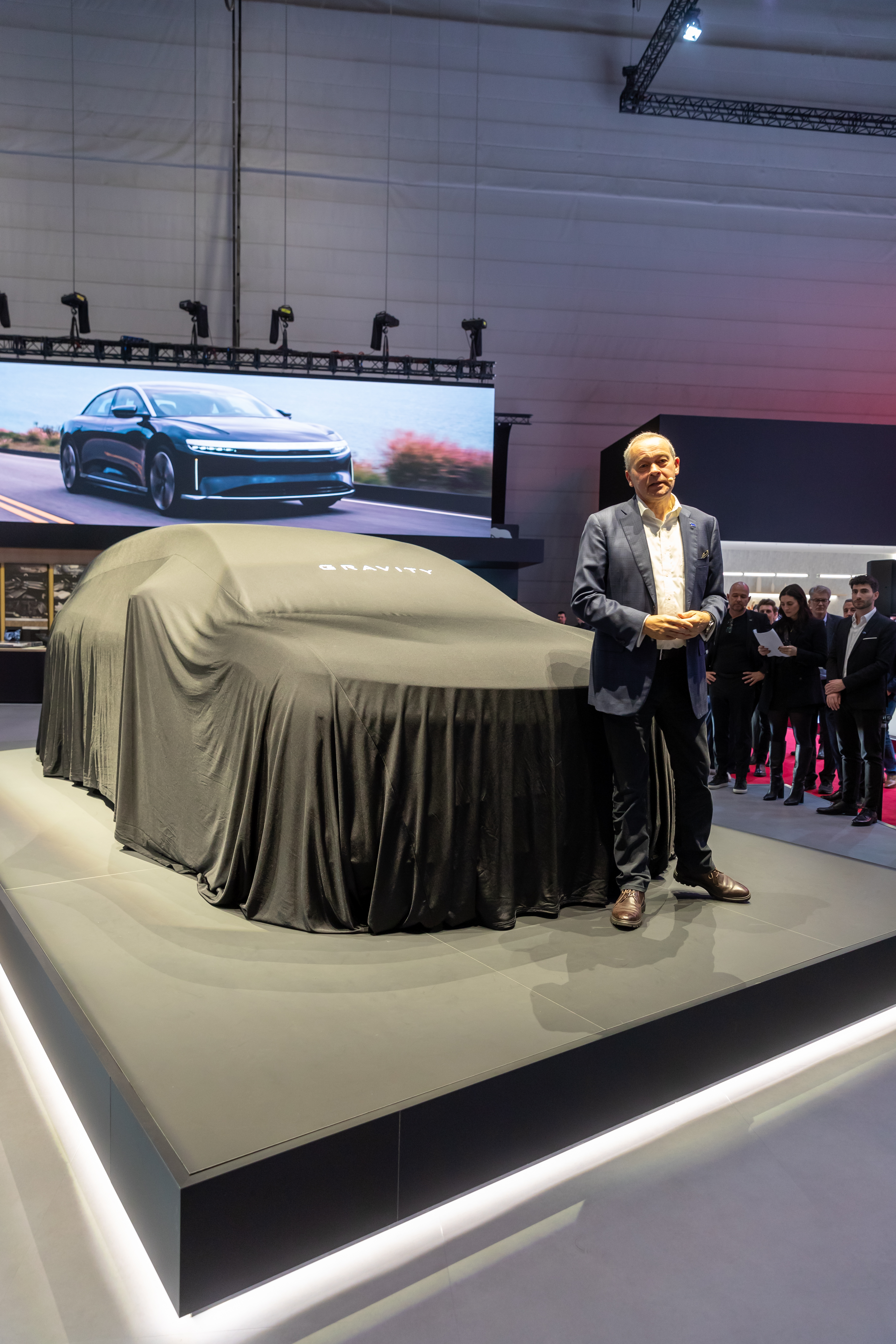
Lucid Gravity
"...ally adding hands free driving. Speaker 2: To its Gravity Suv. Speaker 1: The feature is part of an over th..."
The Lucid Gravity is an electric SUV made by Lucid. It’s designed to carry people and cargo while using electricity instead of gasoline. The podcast mentions it because it’s getting a hands-free driving feature, which helps the car steer and manage parts of driving with less driver input.
The Lucid Gravity is an all-electric SUV from Lucid Motors, built to bring long-range EV capability into a larger, family-oriented body style. It’s the kind of vehicle that gets discussed when new driver-assistance or hands-free driving features are announced, because those systems are often highlighted in the context of higher-end trims and tech packages. In this podcast segment, the focus is on hands-free driving technology being added to the Gravity.
over the air update
"The feature is part of an over the air update that also includes navigation and headlight improvements. Lucid plan to roll out the updates at the end of last year, but it ran into software and other quality issues..."
An over-the-air update is a software update sent to the car wirelessly. It lets the manufacturer add or improve features without taking the car to a shop.
An over-the-air (OTA) update is software delivered to a vehicle wirelessly, similar to how phones update apps. Automakers use OTA updates to add features, improve performance, and fix software issues after the car is already on the road.
automated lane changes
"The feature enables hands free driving on the highway at speeds up to one hundred and thirty kilometers an hour or eighty miles an hour, along with automated lane changes."
Automated lane changes let the car switch lanes for you. The car uses sensors to do it, but it usually only works under certain conditions and still expects you to watch.
Automated lane changes are driver-assistance functions that can move the vehicle into an adjacent lane using sensors and vehicle control systems. They’re typically constrained by speed, road type, and driver supervision requirements.
assembly plant
"Hundai has an assembly plant in Georgia that can make three hundred thousand cars a year. They're going to boost that to five hundred thousand..."
An assembly plant is where cars are built. The episode is using factory output capacity to talk about how many vehicles these companies can produce.
An assembly plant is a factory where vehicles are built by assembling major components into a complete car. The segment uses plant capacity numbers to argue about how quickly Hyundai/Kia can scale production in the U.S.
Request an Explanation
Heard something you'd like explained? We'll add it to this episode.
Sign in to request explanations for terms you heard.
Want to learn more?
Browse our glossary for plain-English explanations of automotive terms, jargon, and concepts.
Help improve this episode
See something that's not quite right? Our annotations are AI-generated and can sometimes miss the mark. Click the flag icon on any annotation to suggest a correction.