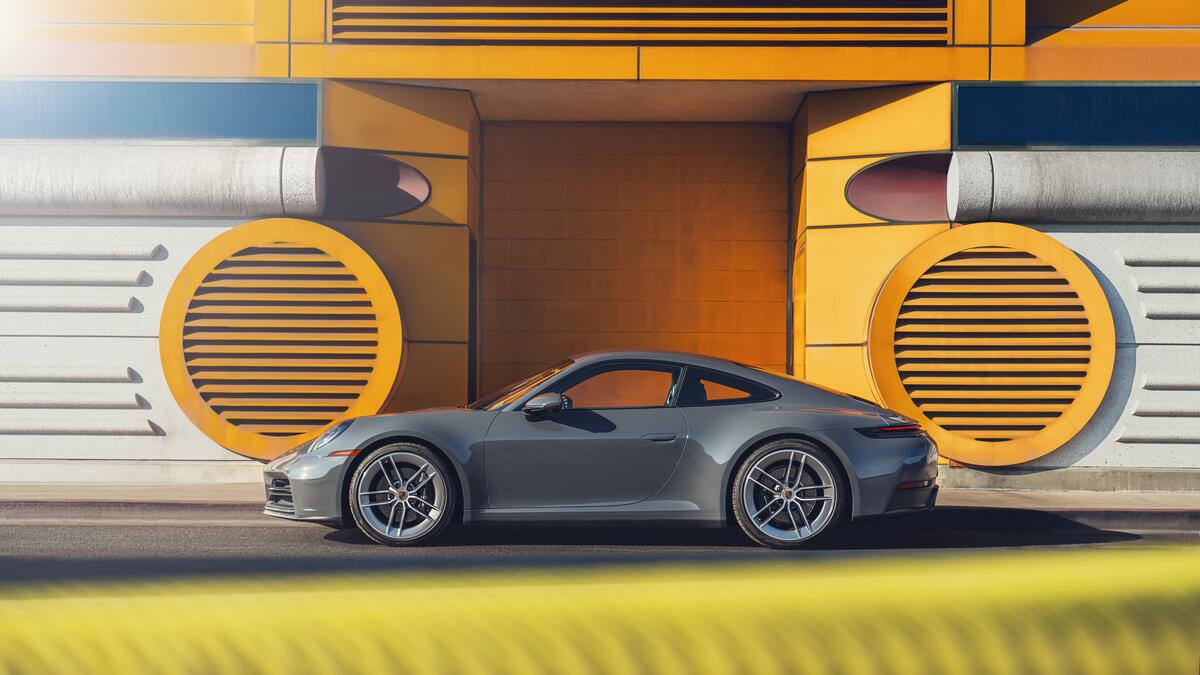
This is a Porsche GT4 model (a Cayman) that’s built to feel sharp and fun in corners. The host says it’s especially enjoyable because it’s balanced in the middle and the shifting feels great.
A gearbox is the part of the car that changes gears so the engine can make the right amount of power. The host is saying this one feels really satisfying to shift.
“Mid-engine” means the engine sits closer to the middle of the car. The host is saying that this helps the car feel more balanced and easier to steer into turns.
“Steering feel” is how the steering wheel talks to you—how heavy or light it feels and how clearly it shows what the tires are doing. They’re saying the Porsche made that feedback enjoyable.
The Porsche 924 is an older Porsche model that’s often considered a gateway into the classic air-cooled era. Here, it’s mentioned as the first Porsche Adrian owned back in 1978.
“Air-cooled” means the engine is cooled mainly by air flowing over it, not by circulating liquid coolant. With classic Porsches, that can change how the car feels and responds compared with newer cars.
A rev counter is the gauge that tells you how fast the engine is spinning (RPM). It helps you drive by listening and watching the engine speed.
Place
Molsan Strait
This sounds like a specific straight on the Le Mans track. The point is that it’s a long, fast section where you really notice the engine speed and the classic driver view.
Le Mans is a legendary race in France known for endurance racing—cars run for hours and hours. Bringing it up is a nod to racing history and the kind of driving people associate with these cars.
Concept
open B road
An “open B road” is a quieter, smaller road with curves. It’s the kind of road where you can enjoy driving without needing high speeds.
Term
kerf spot together
This sounds like a misheard phrase about setting up and connecting corners smoothly. The point is enjoying a good sequence of turns.
Ferrari Dino refers to a Ferrari model line from the early 1970s. The speaker brings it up to compare how both Ferrari and Porsche have recognizable “family” traits that show up across different generations.
The “A-pillar” is the metal support at the front of the car, next to the windshield. If it’s rusted through at the bottom, it can be a big structural problem—not just cosmetic.
Here, “salt” means winter road salt. It gets on the car and can cause rust faster, so a car that lived in salty conditions often needs more corrosion work.
Term
left hand drives
“Left-hand drive” just means the steering wheel is on the left side. The hosts are using it as a clue about where the car lived, since some regions are harsher and can lead to more rust.
“Panels” are the car’s body pieces you replace after damage or rust. On a very old car, getting new panels to line up perfectly with the original frame can be hard because the car may have shifted or been repaired before.
“Frame” is the main structure the body parts bolt and weld to. If it’s old and has rust or prior repairs, new body panels may not fit correctly, making repairs more expensive.
They’re describing how worn a part is—like it has only about a quarter of its useful life remaining. The tricky part is that the cost to fix things later can swing a lot depending on the car’s actual condition.
Concept
regular servicing
Regular servicing means following the maintenance schedule—oil changes, inspections, and replacing worn parts before they fail. It helps older cars stay reliable and can prevent costly problems later.
Porsche 986 is the Boxster model from the late 1990s/early 2000s. The speaker is basically saying that different Porsche models can be priced differently depending on where you’re shopping.
An import duty is a tax a country charges when you bring a car in from another country. The host is saying older cars can sometimes get a smaller tax rate, which can make them cheaper to buy after shipping. That changes the total cost of importing a Porsche.
“3.2 Carrera” is a Porsche 911 from the 1980s with a 3.2-liter engine. It’s a common target for air-cooled Porsche fans, and the host says there seem to be more of them available for sale. That makes them easier to shop for than some other years.
A service book is the paperwork that shows when the car was serviced. It helps prove the car was maintained instead of neglected. The host is saying he looked for Porsches with good maintenance records.
“Unfallfrei” is German for “accident-free.” It means the car is claimed to have never had a crash (at least according to the paperwork). The host is saying he looked for cars with that kind of clean history.
“First original paint” means the car still has its factory paint, not a repaint. Many classic-car buyers prefer original paint because it can suggest the car hasn’t been heavily repaired. The host is saying he often looked for that when buying Porsches.
“Lacquer” is the protective paint/clearcoat layer on older cars. “First original lacquer” means it’s the original factory finish, not something that was redone later. Collectors often prefer that because it can mean the car hasn’t been repainted.
This is a 1980 Porsche 911 SC in a coupe body style. Since it’s air-cooled, the owner is asking about the best way to warm it up and whether to let it idle before driving.
A water-cooled engine uses coolant (liquid) to carry heat away from the engine. The host is comparing how that changes the warm-up process versus an air-cooled engine.
Idle means the engine is running while you’re stopped. The listener is asking whether letting it idle helps the engine warm up properly before driving.
Oil temperature is how warm the engine oil is when the car is running. Warm oil lubricates the engine better than cold oil. That’s why you should drive gently until it’s warmed up.
“Too rich” means the engine is getting too much fuel compared to air. That can make combustion less clean, especially when the car is idling. Driving helps the engine use a more appropriate fuel mixture.
Heater channels are the ducts that move warm air from the engine area into the cabin. Opening them helps the car warm up and brings heat to the occupants. It’s a practical tip for air-cooled cars.
“On-off boost” is how turbo power can feel when you quickly go from no throttle to more throttle. Instead of building smoothly, boost can come in more suddenly. That can make the car feel punchy or a bit abrupt.
“Martini” is a racing-style paint scheme associated with Porsche motorsport. In this context, it’s about the car’s look and vibe, not a performance part.
They’re talking about the car’s stopping system. The point is that they didn’t drive it aggressively enough to really test how strong the brakes were.
Term
polybursts
It sounds like he means polyurethane bushings. They replace the rubber parts in the suspension to make the car feel tighter, but they can also make the ride a bit harsher.
“Original spec” means the car is basically as it left the factory. He’s saying that if the original parts are in good condition, it can be more enjoyable and predictable than heavily modifying it.
Dampers are the shock absorbers that control how quickly a suspension compresses and rebounds. Upgrading dampers can reduce body motion and improve ride/handling balance, especially when paired with fresh bushes and correct alignment.
Bushes are the flexible parts in the suspension that help the wheels move smoothly. When they wear out, the car can feel loose or vague, especially when turning.
Tyres are the tire contact patches that ultimately determine grip. He’s pointing out that modern tire compounds and tread designs provide much better traction than older tires, which can noticeably improve everyday drivability.
“Bigger wheels” usually means using larger wheel sizes and matching tires. That can change grip and handling, but if you don’t choose the right tire and fitment, the car can feel less balanced.
“Offset” is how the wheel sits relative to the car—toward the inside or outside. Changing offset can help fit a wider tire under the fenders without it hitting anything.
Brand
Pirelli piece sevens
Pirelli is a tire brand. The speaker is saying their car originally came with a particular Pirelli tire model, and that it didn’t last or grip as well as they wanted.
“Compliance” here means how much the tire gives and flexes over bumps and during cornering. That affects whether the steering feels sharp and confident or soft and less precise.
A “stiff sidewall” tire doesn’t bend as much when you turn or load it. That usually makes the car feel more responsive and predictable, instead of vague or wobbly.
“Tire specification” means the exact tire details the car expects, like the tire size and ratings. Using the right ones helps the car handle the way it was designed to, especially on an older air-cooled Porsche.
Tires get hot when you drive and then cool down again. The number of times that happens—heat cycles—matters because it ages the rubber and can make the tire less grippy even if it hasn’t been driven much.
Term
UV
Sunlight can slowly break down the rubber in tires. Even if the car doesn’t get driven often, UV exposure can make the tire hard and less safe.
“911” means the Porsche model line that includes different versions of the same basic sports car. Some versions are more performance-focused than others, and people often talk about those differences. The podcast is likely clarifying which 911 variant someone is asking about.
Concept
barn of about 339 turbos
They’re not talking about an actual barn; they mean a big private stash/collection. The point is that there aren’t many of these cars around, so they’re hard to find.
Concept
cars that have had an awful lot of money chucked at them
They mean a car that’s been heavily worked on—repairs, upgrades, or restoration. The idea is that if a previous owner spent a lot to make it right, it can still end up feeling like a good deal.
In Porsche restoration and modification projects, a donor is the car used as the parts source. The donor’s condition and cost directly affect the total project budget because parts availability and labor both depend on what the donor provides.
A restomod is an older car that gets fixed up and then improved with newer parts or tech. It’s usually meant to make the car easier to drive and more dependable, not just return it to stock.
A compromised car is a car that isn’t perfect—maybe it has damage, rough cosmetics, or past repairs. But it can still be safe to drive and worth improving gradually.
In this context, marketplace just means there are buyers and sellers trading these cars. Even if a car isn’t perfect, people still want them and will fix them up.
Tuthill is a company known for building and tuning Porsche cars, especially air-cooled projects. The host is using the Tuthill name to show how a branded build can be extremely desirable—and expensive—because people want that specific work.
An “air-cooled” engine runs cooler using airflow over the engine parts, not coolant in a radiator. The host is talking about air-cooled Porsche projects where the engine work is a big part of why these cars cost so much.
“Residual” is about what a car is still worth later, after you buy it. The host is saying that when someone prices a Porsche build at a high number, a lot of that price is really paying for expensive parts (like the engine and bodywork), so you don’t get as much value from buying a cheaper base car.
WRC means the World Rally Championship, a major international rally racing series. It’s the kind of event where cars race on twisty roads over different surfaces.
The Porsche 993 is a specific generation of the 911 that’s famous because it’s the last air-cooled 911. People really care about it, and the discussion here is about how more buyers are starting to want them.
“G series” is a way enthusiasts refer to an older generation of the Porsche 911. The point here is that people have been focusing more on those earlier cars, but interest in the 993 is growing.
“Dross” just means the worse, lower-quality cars. The host is saying that if the market stops overpricing the bad ones, more people will want the better ones again.
Here, “hot rods” means cars that have been modified instead of kept stock. The host is basically comparing customized cars versus original, unmodified ones.
“Longbonnet” is a nickname for older Porsche 911s with a longer-looking hood. The idea is that it changes how the car feels and how you experience the driving—more “in the moment” and connected.
“Supply and demand” just means prices move based on how many cars are available versus how many people want them. If lots of people want a certain kind of car (or color), it tends to cost more.
“Rust” means corrosion—metal getting eaten away over time. On older cars, rust can be a big deal because it can lead to costly repairs, not just a bad look.
Term
thin rim
A “thin rim” is a steering wheel that’s slimmer than usual. A slimmer wheel can make the steering feel more direct, and the host says it adds to the overall driving “event.”
“G-model” is a nickname for an older Porsche 911 generation. The host is comparing that older 911 feel and look to the longbonnet cars they’re talking about.
An “impact bumper” is a bumper design meant to meet crash-safety rules. It can change how the car looks, and that’s why enthusiasts sometimes debate whether it makes the car less or more desirable.
“C2” is Porsche shorthand for the rear-wheel-drive 911. Adrian is talking about the coupe version of that rear-wheel-drive setup, and how those cars are getting more expensive.
“2.2 T” is a Porsche 911 with a 2.2-liter engine, and “T” is a trim name Porsche used on some classic 911s. Adrian is saying even a smaller/less powerful version can still be great if it’s in good shape.
“Hype and pump” means people build excitement to push prices higher. The host is basically saying don’t assume a high price means the car is actually great.
Concept
generations coming through
“Generations coming through” refers to how buyer demographics and tastes shift over time, affecting which Porsche 911 eras become most desirable. The host ties this to long-bonnet cars struggling with newer buyers and suggests later generations are more likely to attract them.
They’re talking about how excitement and hype can push interest (and maybe prices) too far. Then, as people’s tastes change, the market can cool off and “correct.”
The Porsche 356 is one of Porsche’s earliest classic sports cars. It’s a big deal historically because it predates the 911 and helped define the brand. In this segment, someone is asking about a special 356 build that sounds impressive.
“Restored properly” is about returning a classic car to correct, high-quality specifications rather than doing a cosmetic or shortcut rebuild. For collectible air-cooled Porsches, proper restoration details (including engine and valvetrain correctness) strongly affect both drivability and long-term value.
“Four cams” means the engine uses multiple camshafts to control the valves. More camshafts usually means a more complex, more specialized engine setup—so it can be harder and costlier to restore correctly.
“Hold a good value” means the car tends to keep its price instead of getting cheaper quickly. The host suggests that rarity and the difficulty of restoring these cars correctly help support that.
“Depreciation” means the car’s value going down over time. The host is saying that with a classic Porsche, you shouldn’t let value changes distract you from buying the right car.
Here, “transparency” means the seller should be honest and clear about the car’s condition and history. That helps you avoid buying something that has problems you didn’t know about.
“Cosmetics” means how the car looks—paint, interior, and other visible stuff. The advice here is: make sure it runs and works properly before spending time or money on appearance.
Williams Corford is a car showroom the host mentions visiting. It’s included here because it’s where they looked at a Porsche in person and discussed what to learn when shopping.
Porsche’s “930 Turbo” is the classic 911 Turbo from the 930 generation. People care about it because it’s a famous air-cooled turbo 911, and how many were built affects how rare and collectible it feels.
LIVE
This is NineWorks Radio, brought to you by the NineWorks Marketplace and powered by the
Driven Not Hidden Collective. Sign up now at NineWorks.co.uk
NineWorks Radio is brought to you in association with Heritage Parts Centre. Get up to 10%
off your basket for all manner of Porsches from 356 to 997 inclusive, plus the mid-engine
and transaxle Porsches by using the code NineWorks10 at heritagepartcenter.com. That's the code
NineWorks10 at heritagepartcenter.com.
We are live, as old Giza would say, on a boat, on the way from Dublin back home to Holyhead.
I've been on an amazing trip this weekend. I've got a couple of special guests with me here.
Say hello.
Hello.
Leslie James.
Hello James.
Hello.
Good to be here.
How was your weekend?
Pretty epic in many different ways.
It was great fun.
Excellent.
Daniel.
Andy B.
How are you?
I'm doing very well. Thank you.
Excellent. Good weekend.
Very good weekend. Thank you for making me feel so welcome as a sort of a new DNHCR.
I jumped on this trip as soon as I saw it and yeah, it's really exceeded my expectations.
Although this ferry probably hasn't exceeded my expectations, but everything else was great.
I think it's better than the one we had on the way over. It's a little bit more modern.
What did you guys drive this weekend?
So yeah, I was in my relatively new to me 981 GT4. So I've had it a couple of months now.
And yes, it was probably a little bit firm for this trip, but no, it was great fun.
It's just getting seat time at the moment.
So I've done one road trip with a couple of friends to Wales.
But I think from start to finish, this will probably be another 1250 miles by the time I get home tomorrow evening.
But yeah, hell of a car. Good fun just learning how to how to enjoy it and use it on some pretty epic roads.
So it's been good.
Excellent. What have you learned about the car?
I think it's how much more capable it is than probably my driving skillset is at the moment.
But for me, it's a gearbox. It's just lovely rowing up and down the gears.
It's zipped around. It makes a fantastic noise.
A little bit antisocial sometimes, but that's all part of the fun, isn't it?
But yeah, it's been great keeping up with the other cars on the trip.
And yeah, just getting getting underneath it a little bit.
It's mid-engine. So I've had a 911 before a 996 four years ago and that drove quite differently.
So the kind of front end turning bite on the GT4 is something else really good fun.
Good. Good. And how did you enjoy the roads this weekend?
What did you think to Wales?
We weren't in Wales.
We weren't in Wales.
We're in Ireland.
What did you think to Ireland?
Actually, a mixed variety of roads. Definitely.
We had some fairly inclement weather at times, didn't we?
Up in the clouds, which was a bit of a shame because it spoiled some of the view.
But yeah, no great roads. I love the southern area, actually.
I was quite surprised by that.
Yeah.
It was first time to Ireland for me at all.
So yeah, didn't know really what to expect, but some of the scenery is stunning.
And then you come around a corner and there's a castle or a ruins of something, which is great.
So yeah, really good routes. Got a round fair bit up and down.
So yeah, it's great.
What was a surprise to me was how foreign it felt.
Yeah.
So it didn't feel anything like anything else in the UK.
The road signs were very different.
The road layouts were very different.
Architecture was very different.
It just felt more like you were in France or I don't know, just somewhere very different to the rest of the UK.
Daniel, what were you driving?
I was driving my 906.1 C2.
Yeah.
I've had it for about four years.
It's my only car and a family car as well for my two year old toddler.
So yeah, I came on the trip complete with baby on board sign and car seats in the back.
Were there car seats in the back?
Yeah, car seats in the back.
I didn't see that.
So yeah, so dad was unleashed for the weekends.
That was fantastic.
Now that sounds quite fruity, that car.
Have you got some mods on it?
I have a car graphic valve set up on it so it can keep it quiet when you need it to be and open it up when you want as well.
It sounded very nice.
Thank you.
I think Lee might be interested in hearing that because he was considering car graphics system.
So yeah, get him to give you a shout.
I recommend it.
Yeah, it's not too droney at all.
And honestly, I think even the unvalved one would be fine, but happy to ever chat to him about that.
Yeah, no, good.
Excellent.
Good.
How did you find Ireland?
Was that your first trip over there?
It was my first time on the Emerald Isle and I really enjoyed it.
As you say, the ferry journey and arriving really feel like you're somewhere else, particularly Ireland.
It felt quite affluent from the get-go.
There was none of the kind of occasional British seaside air of despair that you get in some areas of the port.
It was really nice.
Love the coastal routes in particular.
Great scenery.
We had a bit of sun coming through, but I mean, for me, I live in central London, so weeks can pass without driving.
And yeah, I'm used to sort of an urban environment.
So for me, it was about getting my confidence up and just getting to enjoy the steering feel of that 996.
It was great for me.
And there was really a kind of a variety of bases of people.
So there was always someone to stick with, which was great.
Excellent.
What did you learn about the car?
That it's quite planted.
Yeah.
It's quite planted.
I thought people with more modern machinery might be sort of miles ahead and they were.
But I think the car was very capable.
Steering feels great as well.
So just enjoying all the undulations of Ireland and Northern Ireland and feeling that through the wheel.
I felt like it really is a car that can do everything for everyone and just strikes a nice balance of modern and old, in my view.
That said, I did get my first passenger ride in an air-cooled car.
Oh, did you?
Yes, I did.
A 993 this morning and yeah.
Sold?
Well, it's a bit of a problem.
I found myself in the middle of the night, waking up, googling 993s.
So that's problematic for me.
And yeah, probably the rest of the family, but yeah.
Brilliant.
Brilliant.
Love it.
Well, on that note, we will switch over, come to the main feature of today's episode, which is a winter seminar that we did with Adrian Crawford from Williams Crawford earlier in the year.
He brings up some great information on what to look for for air-cooled cars for your future purchase, Daniel.
So we are delighted that you're joining us for this online seminar on behalf of Williams Crawford.
Thank you so much for your time today.
Well, you'll soon find out whether it's been worthwhile inviting me.
It's a mainstream scene, but I'm going to enjoy it, aren't you?
Excellent.
Now, with no doubt of that, so obviously as listeners to the seminar indeed of the podcast will know, you guys have been going strong for over 30 years now, but your passion for Porsche runs a bit beyond that, I would say.
Could you hazard a guess as to how many air-cooled Porsches you've owned in your time?
Well, my very first Porsche would have been in 1978, 924, but before that, my dad crashed a few, 911, so sort of like, you know, lived through those cars.
I reckon I've probably had two or 3000
Really? Wow. Okay. That's incredible and unfathomable at the same time.
So you're ideally placed for this.
So if people haven't done this before, it's an open Q&A.
So Adrian has very kindly volunteered his time and his expertise to answer any questions people have off the bat, which can be a daunting proposition.
So again, Adrian, very, very grateful for that.
And yeah, we can share some stories like Richard, I'm particularly keen to hear a little bit more on your 964 into 997 story as well.
But I guess, Adrian, for people like myself that are perhaps curious about Luft Porsches, what is like the greatest thing about air-cooled ownership in your experience?
I think they connect with you really beautifully.
The reason why I got into them was that they worked, you know, that you couldn't kill one and I used to kill lots of cars.
So, you know, they were hard, they were fast, they responded, they were a bit of a challenge and they were strong as a strong thing.
And for me, all the, and this goes through all the air-cooled cars.
I remember seeing an advert on 993s when they came out as an American sort of TV advert.
And it's like a side shot looking through that beautiful quarter window at the driver with a big rev counter.
And that to me is always the image that I've got, whether it's like at Le Mans going down the Molsan Strait, it's that quarter window with the big rev counter.
And whenever I get in one, I think, oh yeah, this is proper gear.
You know, I like the motorsport connection.
So for me, it's, and everyone's different.
Some people like smoothing them with wax, some people like driving them, some people like showing them to people.
For me, it's that motorsport connection.
And well, I think, no, this is properly designed.
It was built to work.
Game on.
Excellent, excellent.
Okay, so I mean, I will say fantastic etiquette by everybody and going on mute, by the way.
That is superb.
Hi to Ian and Darren as well, by the way. Thanks for joining.
I wonder if anybody has any sentiments they'd like to add to what Adrian said as an air-cooled owner?
I think from my perspective, an air-cooled is like the antithesis of the modern car in that it's not very fast, but it feels fast when you drive it.
You get a lot of feedback from, you know, the steering wheel and, well, everything because, you know, there's no softening to it in the same way.
But you get that kind of exhilaration at low speeds that you just can't get from modern cars.
So it just, it's just really fun to drive.
You just get a nice open B road, get some kerf spot together.
And I don't think there's a better feeling within road legal limits anyway.
Certainly, it certainly seems that way from the experiences that I've had behind the wheels.
But again, you guys have more place to know, right?
So that's fantastic, John.
Is it any other comments from anybody else?
Well, I would say you've obviously never followed Ben Bailey then.
We don't talk about Ben. That's just, you know, he's different gravy.
I think for me, it's just the way the car, the whole essence of it.
The fact is it started in 63, which was happening when the year was born.
So there's quite a lot of affinity there.
And it's the way that it transcended through the, what were a lot of other sports cars that were around and it maintained it effectively.
You can see the lineage right from 63, 64, all the way through to the 89,
which was sort of the end of the G series in particular, and then carrying on through the 64.
And it sort of went like a lot of things.
It sort of went through a dip where people are like, oh my God, you know, what is that thing?
And then it sort of came back up again, particularly perhaps with the 993.
And then obviously now people go and choose the era they wish.
So I think it's that longevity and development through that longevity in spite of the engine hanging out the back,
in spite of being air-cooled, in spite of this, that,
that it managed to transcend through from long bonnet to G to 64 to 993.
And if I miss something out, I'm not sure.
But also with the kids.
And it's quite important this with the new generations coming through.
And I do believe this to be the case in particular.
If you look at Ferrari's going back to Dino's in the early 70s and through the sort of pretty awful cars they produced in the 80s
when Porsches were still amazing cars, they can see the lineage from a 992 all the way back to 64.
You know, that classic shape.
Yeah, it might have like a lot of things as one matures put on weight, but it's still there.
That essence in the shape of the car, the true spirit of the air-cooled may not be there.
And they try and revive it in things like the Carrera T, the Clubs Bors and various models.
But that essence is still there will be my take on it.
And there is something special.
Everybody smiles at you in an air-cooled Porsche, even the policeman when he books you.
Adrian, in regards to PP's sentiments on longevity there and chasing that line right the way back to the earliest cars.
You were nodding there.
Do you feel in your experience that the air-cooled cars are more special in a modern day context than they were when you?
Yeah, definitely.
And of course, we're using them differently because when they were new, we would all be chasing around to say a farce ago and you drive them to the edge of oblivion or to the edge of your license.
Whereas now, all the modern cars have gone faster and I sort of almost feel like they're going up a dead end because the roads are going slower and slower.
There's width restrictions, bumps in the roads, all sorts of stuff going on.
And I think the air-cooled cars have got a really, really good place because they're actually enjoyable to drive at any pace.
If you want to go to the south of France with one, it'll sit at any speed you want to dial in with ease and get you there.
So I think that they're even more appropriate today than they might have been back in the day and I think that's part of the appeal with them.
It certainly seems like there may be a build quality with the classic stuff, as we can call now, that perhaps isn't quite matched today.
And again, just through my job and what I do, very lucky to have tried many different cars and the thing that really strikes me about the air-cooled stuff is they're all just so well built.
It's as if they're like hewn from granite and they all still work wonderfully and like what you're saying, driving down to the south of France, even if a car is 50 years old, it will do it.
And like, you know, PP with your 930 driving to basically the Arctic Circle a couple of years ago in a half a century old car.
There are a few cars outside of the Porsche Brammer, I think that would be possible to do on a car of such vintage.
Yeah, that's very true, actually.
I think the other thing is, Adrian, it's probably the most fearful thing about owning one is not the mechanical side of it.
It's the body. That's where your big, big, big money is going to end up going.
I may be wrong. You may tell me different, but mechanically wise, they're pretty simple and a quick check over.
I mean, I literally just took it to Scotty at Barnsport, gave it once over, mopped the Arctic Circle, actually picked him's jaw up off the floor.
He sort of, he said, yeah, I've checked it over half a day later.
Yeah, Vine put some new Michelin zone and off for Wem.
Yeah.
And, and I had every confidence in that car that would get me that I was not worried mechanically at all.
And so.
Okay, okay.
I'll go on Adrian.
It's the bodies that can absorb the money and it's the course of bodies that are very difficult for people to judge.
Yes.
And, you know, we've seen, I keep probably 10 years ago, I saw my first 993 that I could put my hand through the bottom of the A post.
Wow.
That was 10 years ago.
You know, and so the, but I've seen it.
You also sit with 996 997.
And how they've been used, treated the running it in salt and one thing another is is a big deal.
And it's part of the joy of some of us here will have had left hand drives from nicer climates.
And then you've got an original body and you can look after it and, you know, treat it with care.
So, but they are super durable.
Like you say, Lee, I just love the way thing, the mechanical action of things and, you know, the difficulty is some of the parts and not the quality they once were when they were fitted to the cars.
Yeah.
Yeah.
And also, I guess we can come on to that in greater detail.
But like, even like bodywork, for example, if you're if you're buying panels for cars that need it, getting that panel to fit onto an existing frame, right?
That's 50 years old.
I mean, that is a very difficult thing to do.
Nothing straightforward there.
Nothing straightforward.
And that's not my responsibility.
Otherwise, all the cars would look higgledy-piggledy, but there are people that can do it.
Yeah.
So it can be a challenge, but prices are not really going down too badly.
And I think you always balance in modern car depreciation against old car maintenance costs.
Yeah.
Yeah.
I mean, that that leads on quite nicely to the second of two questions that I had planned today to ask you, Adrian.
I'm glad that we prepared for this.
Yeah.
Yeah.
As much as we can.
But it's the big thing for me, and I know there'll be many people listening to this that are not air-cooled owners, but are really interested in it.
And, you know, like Mark, in this conversation, I know for a fact you're in the same boat as me there.
So, you know, prepare to fail and all that.
Fail to prepare.
How much should we be budgeting realistically to run an air-cooled Porsche per year?
Oh, my God, Lee, that is such a big question, isn't it?
So how well are you running it?
How far are you running it?
And what the hell's the state of the darn thing when you bought it?
Because most of us will be, we won't be trying to keep them in the same condition.
Most of us have bought things that, you know, are okay and we're trying to improve them along the way.
So you're taking things that are maybe 25% of their life left in them and you're trying to replace it with 100% life on that component.
It's a really, really hard one to answer.
Regular servicing, no problem at all.
We all know that here.
That's simple.
If your cheapest Porsche is going to be something that's in great shape when you buy it.
You know, I just don't want to, unless you were specific, I couldn't put a number on it because it varies like hell.
I think if you wanted to just try and safeguard yourself, put away four grand a year and one year it'll cost you 600 quid and the next year it might cost you eight grand.
Yeah, yeah.
But to be honest, Adrian, that is no different, which is encouraging.
That's no different to water called Porsche ownership, so far as I can tell.
It's not inflated in any way.
It's pretty much what we would say for water pumpers, you know?
Yeah, exactly.
Yeah, it's just that your starting point is much more varied with condition and that's the harder thing to gauge.
Yeah, yeah.
How does that work for you guys in terms of selling them?
Because we're very lucky and privileged to have your cars on the Narmarkt's marketplace.
And I really enjoy your stock because it's so varied in terms of how old some of the cars are.
And, you know, key case in point was November in the video I was lucky enough to do on that 911e.
Fantastic car and the 2.7 911S last year.
So, you know, you're not afraid to stock these classic historic Porsche vehicles as they are now.
How do you go about sourcing them and finding them to be able to put your name to them?
We will take all conditions, assuming that we can sell them legitimately and with a high degree of transparency.
So internally, we've got five different levels.
We've got black, which means that, you know, it comes in a box probably.
It's got an idea with it.
And, you know, that's just like that is it's a project and that's the end of it.
We got the level two, which in our heads is orange, which means that we'll make it good to go.
You can use it, but, you know, it's going to have flaws and bumps and all sorts of stuff, but it'll work and it won't kill you.
A green would be a good usable daily classic.
A blue would be a really nice classic and a white might be something someone's kept in their sock drawer.
So, you know, our warranties will reflect that our level of preparation will reflect that.
And, of course, then you're trying to match your use against the right car because for most of us here that enjoy driving them.
Maybe a white that's been kept in a sock drawer is not appropriate.
You spend more for it and you probably ruin it.
For me, I take a daily driver and because I'm going to scuff it and put the dog in it and, you know, probably be, you know,
be running out of road in it or whatever, you know.
So, yeah, that's how we do it.
Excellent.
And how regular would you expect to find a car for the sock drawer from the sock drawer?
It's really, really rare.
I mean, that just comes in every now and again.
And they're a delight to have because they should represent the way that those Porsche were presented when they were nearly new.
And those are the ones I remember because I sort of handled them when they weren't very old.
So, you know, I know how these cars should work and should feel and should go together.
But it's really, really rare.
And I think we had a little yellow 1969 or 70 with like 20,000 miles on it in first paint.
I mean, it smelled like new, you know, and from, from what's that 50 something years ago, but I'd be afraid to use it.
You know, I'd ruin that.
I'd use it in the winter and it would be, it'd be too restrictive for me personally.
So, yeah, I mean, obviously, as they get newer, you find it more often.
Yeah.
Yeah.
You're very clearly empathetic of the fact that there's a car out there for everybody.
So that that car might be great for part of a collection or portfolio.
And equally, there are cars out there for drivers as well.
Right.
Yeah.
Okay.
Grand, let's throw things out to the to the floor because I'm keen for this to be a group conversation.
Perhaps if you've got a question to ask, yeah, just raise your hand either physically or popper.
I think you can stick a thumb on zoom somehow, but I'll keep abreast of that.
If you do own an air cooled Porsche, please make us all jealous by telling us what it is to start with as well, please.
And but yeah, Mark, it's come to you first.
Yeah.
So even Adrian and he's great to hear from you.
And so, yeah, I think my question really is obviously not an air cooled owner as yet.
And obviously, I've heard your stories in the past going back to your start time when you put sourcing cars from abroad and Germany in particular.
And that's still an avenue for you to source cars for your clients or is Brexit made that almost impossible?
It's so we know how to do it.
And we are happy to sell cars into Europe and and to buy them from Europe.
That's okay.
But the numbers don't really match up.
So, you know, there's very, very little point doing it unless it's something really specialized or I'll see any point to do it.
Really, really specialized or you must have left hand for some particular reason.
Sure.
I guess the reason for asking the question was it seems to be far more availability on the continent than perhaps is in the UK.
So it's probably quite difficult to come by.
If you look at the price of say a 997 in I know we're talking about air cooled here's here but it's worthy of mention 997 986 is 987 things like that.
They are significantly dearer.
There are more left there are more classics there.
But generally, they will be more expensive.
That might be beginning to change just because of the volume on them.
I came across a 71 2.2 s the other day and that was surprisingly sensible.
But again, I'm looking over the Internet and I can't really see what it is.
It might have been surprisingly horrid as well.
So, you know, it's I'd say it's not we don't do it anymore.
We were bringing cars from Japan and we did that in the heyday of bringing cars from Japan.
Now, I think the difference between the UK and the rest of the world is narrowed considerably.
Interesting.
Great question.
Great question.
Anybody else have some questions?
Comment on the quality my answer.
I think it's a tinkering that I left.
I don't have a problem with left hand drive and they're called car because of the size of the car.
It's less of an impact than it is on a more a wider bigger car, even a 992 or something like that.
And I would agree.
I think that the prices in Europe, they used to tend to go up and down a bit, but I was looking at a 993 2 s.
And in Europe, I mean, over here, there are a few people banning them around at crazy, crazy money.
But in Europe, there's there's more selection and they are ranging from about 120,000 euros up to 180,000 euros,
which if you knock 15% off, but then add back 5% because if a car is over 30 years old, it's only a 5% import duty.
Obviously, the further south in Europe it's been, then potentially the better it's going to be body wise,
which I think would probably be the most worrying thing about one of those.
Not 100% sure.
So I have been looking and there's definitely more supply there.
And if you're not bothered about left hand drive, I would also say long term, I think that left hand drive is more likely to appreciate,
particularly if you can open that car up to the American market because that market is just going gangbusters at the moment.
And I think particularly with Brexit, I think the UK potentially is going to become the right hand drive cars will appreciate within the UK.
But they will have less and appeal around the world because the import duties into Australia and New Zealand are horrendous.
Taiwan is Taiwan is like a yo-yo, sometimes it has big duties, sometimes low. Japan's got enough stock, probably.
And where's your other markets?
That's it.
Unless I'm wrong.
Yeah, I guess look on our sport as people do, I guess.
And if you're looking at the sort of 3.2 Carrera, that kind of era, like 80s, there seems to be a far more plentiful supply kicking around.
Oh boy, obviously you can't see them other than a picture.
Yeah, it was just interesting there in my Adrian's previous past, where he came from and importing cars in, whether that was still an avenue.
But when I was doing it, remember that these cars, I started doing that in probably about 1995.
So a 3.2 Carrera would have been 10 years old at the very outside.
And I was buying low kilometer, Shekheft service book, unfall free, accident free, and often first original paint.
What's that in German?
I don't know.
First original, I think it was a first original lacquer.
It's lacquer, isn't it? That's the German for paint.
None of us is going to be able to disagree.
No, I had good auto. Good Daz German, because there's a big magazine called Daz.
And I'd be buying summer use cars.
So to counter Paul's thing about the south, you'd also find summer use cars.
So they'd be registered eightfold through to October.
And that's what I was buying.
So back in the day, I was bringing beautiful cars in.
And now, you know, certain countries in Europe where where the dross goes and always always house done,
and certain countries where it's much harder.
My favorite country in Europe would always be the Germans because they'd be straightforward.
And, you know, you'd have a chance.
I liked pasta, but I didn't like dealing with the Italians.
Love it. Love it. Okay.
Gary, I've seen your hand up by Barry.
I think you were you were in there just just before if you're okay to jump on.
Yeah, it's fine.
So you asked us to say what we've got.
I'm lucky enough to have a 69 T coupe and also an 81 SC target.
A bit of a range.
I was actually asked maybe it's for everyone, but we'll start with Adrian,
which is the classic if you could have one air called 9 11, which one would it be?
But what purpose and Gary?
Whatever you do every day, I think not not to stick in a museum.
Okay, I probably have the car that I sold back along and I had a beautiful left hand drive 2.7 narrow body cargo.
So that was the car that no one wanted, which of course I love things that no one else wants because, you know,
and I really enjoyed that car.
I like the sound of the motor being a magnesium motor.
I like the delicacy of it.
And I drove that all over Europe winter, summer, took a dog to the beach, did all sorts of stuff with it.
Yeah, it was a target.
I didn't want to buy a target, mind you, but when I saw it, I thought I got to have that.
So yeah, that was the car that I really liked for most people.
There may be a few compromises with that car.
And so a coupé might be a better, better choice or even a cabrio might be better choice.
And probably the most durable and easy going of all of those cars is a 3.2 Carrera.
You know, they were they were the rock solid ones.
And so they were they would be the lowest risk for a buyer.
Great.
Excellent. Excellent insight on that. Excellent.
Yeah, I'd like to talk a little bit more about the 3.2 Carrera in due course.
But yeah, Gary, if you've got a question you'd like to ask?
Yeah, thanks, Lee. Hi, Adrian.
I've got a 1980 SC Coupe, which is my first Porsche.
So I feel like I'm a bit of a newbie still.
And silly things kind of bother me like the correct way of warming up an air cooled car versus a water cooled car,
which you've got a nice temperature gauge totally exactly where you are.
And things like do you run it straight away or do you let it sit an idle?
What would be your advice for a man of 2000 in the background?
I would just get in and drive it.
And I wouldn't drive it hard until I got oil temperature on it.
But I would just drive it because they're designed to work best whilst they're moving along the road.
So move the thing along the road. Just sat there idle, especially old stuff.
That we're talking about now.
It's probably at idle where the things are not running at their cleanest.
You know, so it might be, you might be running it way too rich.
And of course, using it, you're immediately off that idle circuit and you can get the car operating in a good band really.
So don't be afraid of it, drive it, use it, get a bit of oil temperature on it, start enjoying it.
Michael, thank you very much.
I heard a good tip on that actually, Gary, which was drive it.
Don't drive it too much above 3000 revs and have the heater channels open.
And once you feel the hot air coming through, it's ready to go.
I'll remember that for the summer months in particular.
One of my channels is still wide open, so the passenger gets absolutely roasted.
I think there's a caveat with that and that is the heaters working properly.
They usually pump out hot air in the summer and cold air in the winter.
That's where our friends at Classic Retrofit come into play, I think.
Great question, Gary.
Yeah, anybody else with any questions?
Just talking about kind of the question, the sort of air cooled car that you'd like.
I have to say that probably my favorite car, which I'm currently having a little bit of fettling with the engine,
mainly due to following Ben Bailey, but is the original 3-liter turbo just the fact that that car represented,
what it represented at the time when it came out, the performance of it, the lightness, the absolutely dreadful brakes.
And yeah, it represents not only is it great to drive, lovely seats, your on-off boost,
but that would probably be my choice over and above 3-liter, 74 RS, probably above a 73 RE.
And I've had a couple of sport CSs, a couple of those, which I think they're a bit overrated for the money,
but I get them.
But what are they now, 150 now?
Loads of money, yeah.
I appreciate that the 3-2s are moving up, but it wouldn't take much to make a 3-2
into that chuck of sun visor out the window and your bits and pieces.
Well, the thing with all that, if I can cut in, is that in my experience,
if you lined up 20 3.2s, that all looked shiny and it all was supposed to be nice and drove them,
there'd be a massive difference between the quality of the drive of those cars now.
Back when they were newer, of course, they'd all be closer and closer together.
So, you know, there'll be another man out there that says,
what's Adrian talking about enjoying a 2.7 target because the one that he drove was shit
and mine was by optimum and they'd be at different ends of the scale.
And so you've got to bear that in mind that a lot of these cars have had such a wide variety of views
and a wide variety of skill applied to the repairs and we see that all the time.
So like 3-litre turbo like Paul had, you know, we've had really, really rubbish ones come through
for maintenance that, you know, just beg a belief and then they're just terrifying cars
and we built a world-class martini that was just a delight.
It was just so nice, you know, it was a real occasion driving it.
What's it, 260 horses, I think it is, that's all it is, you know, and leg like this, you know,
that you've got to predict two, you know, several corners further on,
but it was an absolutely gorgeous thing to drive.
We didn't drive it fast enough to worry about the brakes.
Well, that was the one Ian Harris found in the garden.
Yes, exactly.
The only 3-litre.
Yes.
Yeah, yeah.
Actually, I saw it on the show and yeah, yeah, one of the three.
One of the three.
I think that might have been four and I think one got destroyed and we found the second one
and then we, I think ours might have been the third one and that there was,
I've got a picture of two of them together, always and the second one.
The second one was my father's.
Right, okay.
He used it as a daily in London.
Right.
And that's the one that sold at Bottoms a few last year, a year before,
took him down to age 84, took him back to see his original martini.
Right.
He was the second owner.
So it was originally the Motor Show car.
Yeah.
Then somebody owed it and then my father bought it.
Right.
He did 100,000 miles in it.
Yeah, well, I've had two of them together.
I felt quite privileged to have the two side by side.
Yeah.
And yeah, us had a dick to throw in in it.
That's probably got answers on a postcard, isn't it?
Well, actually, I use my fingers, but anyway.
I think it's a good point.
Having driven a fair number of vehicle cars over the years, it's absolutely bang on,
Adrian, something I concur with.
There is no such thing as two cars driving the same of that age.
There are so many variables in the story of each individual car.
And from a buying point of view, it's a really pertinent point to make that it's such a good idea
to drive as many examples as you can because diving into one, unless it is a car for,
as you said, that's wrapped in socks, Adrian, earlier on.
It's difficult to take that one experience as the reference for that model.
Johnny, I've seen you've raised a hand.
Yeah, go for it.
I'll jump back in afterwards.
Yeah.
Sorry, I might be slightly changing the subject here, but I think a question I had for Adrian
from his experiences.
What would he look for as the biggest thing to do to make it an air-cooled car as usable
as possible, given the experience, whether that's suspension, original, modified, steering,
wheels, tires, you know, mechanicals aside, because that just makes it go quicker, but
more about the usability to be able to go and drive it every day.
What would he advise somebody buying an air-cooled car to do to their cars the first thing?
Okay, so your mechanicals, your engine transmission, you'll be part way through the life of something
like that.
And you can probably, even if it's got poor synchro mesh or whatever, you'll overcome
it.
You can enjoy it.
You can carry on using it.
But for me, as a daily, as a day-to-day car, Porsche spent, I don't know how many
Deutschmarks develop in them, but they did a bloody good job.
So, before people rush off and put modified suspension on and polybursts and things like
that, when you get an original car or one that's in original spec with a rear-wheel drive,
original components on the suspension and it's all in good condition, it's a joy.
You know, they're so bloody good.
But most people are modifying them and saying, well, you know, I've modified them and I've
got them way better because they started out at such a low point.
So, you know, dampers, bushes, alignment.
I'd be after that because I could enjoy that every day.
I'd feel it in my hands.
I'd know where I was.
And then it would be tires.
And then it's all the other stuff that you might want to do.
But I'd say if you're going to do it day-to-day, apart from the pleasure of modifying it, I
would be keeping it really close to the original spec.
It's an interesting answer.
Thanks, O'Lean.
Yeah.
Adrian, can I just jump in there?
You mentioned tyres very briefly.
With some modern grip on tyres, being so much better than it was back in the 80s,
might benefit anyway.
Is there any value in putting bigger wheels on the back of a car to actually make it too
grippy, almost, and you lose some of the balance of how it drives?
Well, I think it depends on how fast you're going down the road.
Yeah.
You know, so you might like the effect.
Yeah.
Yeah.
You might like the aesthetic or you might.
So I compete with one in Europe on tarmac rallies.
And I think I can just about grish a 275 slick under the rear arches with a special offset
on the tyre.
Yeah.
And I sort of the harder I go, it still has a lovely balance with that big tyre out the
back, because that's their weak point.
But I'm driving it in a way that you should never do that.
So I don't really think that going to a bigger tyre is necessary.
I think it's more to do with choosing the right tyre for what you're doing.
And that's where quality comes in, isn't it?
You know, getting a really nice quality tyre and something like that.
I'm just down on the tyres.
Scotty at basketball tonight went round about the houses because the original, this was
for the nine, a 3.3, they came with the Pirelli piece sevens and they'd be done by the advertising
authority now because there are anything but gripping stuff.
And we put Michelin's on and I forget off the top of my head exactly why that.
Oh my goodness me completely transformed the car.
I mean, it gave me so much confidence into the corners and particularly in the wet as
well, lag accepted.
So I would tires are really it's very nice to see the original type tyres on them, but
the technology has moved on.
Definitely technology has moved on.
And I think you want to think about the compliance to the tyre as well, because that's going
to affect the way that the car feels and drives and how it communicates with you.
And if you stuck with the big brands and you've got a fair chance, I don't know what
a remade CN 36 feels like.
I just I just don't really know.
So most people if they're not, you know, an option is a slightly more competition
orientated tie in like an advent or something like that, because they got a really stiff
sidewall.
That's going to be one of the keys on any of the air cooled cars is how stiff the car
is.
And that's part of this end rated tire specification.
It's it's how stiff the car is on the rear, because the air cools really push that.
So, yeah, put the wrong tire on and they feel like they're going to kill you with the right
tire on.
And you should be good to go 150.
Yeah.
Yeah.
And it will do it as well.
And something to add into that as well is particularly again from like a buying point
of view, if there's a car that's, you know, it's sat around for years and it, you know,
might only do a thousand miles a year or something.
But when you come to buy it and the tires are still 15 years old, you know, push a new
rubber on there.
It doesn't matter if they've only covered 5000 miles in in 10 years, you know, that tire
will spend all that time degrading.
If you and yourself are only going to be doing the 1000 miles a year, they may as well be
the most pleasurable miles rather than tiptoeing around corners because the tires have got
no life left in them.
That's I seem to spot really old knack of tires on classics quite a lot.
And I think again, I don't know from your experience from from from what you've seen
it like the many events you've been to and whatnot.
That's the same sort of thing.
It's a bit of a headscratcher for me.
You can feel you can feel the rubber and and how hard it is or how soft it is with your
fingernail often.
I've got a I don't know what the right word is.
I've got a squishometer that checks the the shore of the stickiness of rubber.
So as I can check on the competition tires and see which ones have died and which ones
are still alive.
But how much trads on them is irrelevant is really how how many heat cycles they've been
through and how how much UV they've suffered.
So, yeah, we have a 930 in and we said, look, you've got 18 year old tires and they were
like concrete and 930 and he said, yeah, could you fit that?
Could you fit a new head unit?
No, come on, please.
Can you just do I nearly bought them for him, you know, he wouldn't have known himself.
At least if you fit new tires, you've saved a man's life.
They're happy to be honest.
So on the subject to 930s, just for anyone else who has got a question to ask, where
have all the 930s gone because like relative to the numbers produced, you know, they're
rare, but they're not so rare and they've never been cheap cars to buy ever.
But there's only ever a smattering of cars for sale often that are kind of quite poor,
not on the most marketplace, obviously, but you know, elsewhere and on other bits and pieces.
So what's what's the reason?
Where are all these 930s, Adrian, in your experience?
I don't know.
I think 930s maybe have been perhaps they've been bought more by amateur or professional
collectors.
And so they're holding them.
I don't know.
But, you know, back in the day when I was bringing them back from Germany, you know, it'd be
one 930 to every 10, three liter or 3.2s.
So, you know, I don't I can't remember how many produced, but like you say, produced over
a long period, weren't they?
You know, so, so 3.3s were what 77 or 78 all the way through to 89.
And so, you know, there should be plenty out there, but no, you don't see them.
Even for maintenance, we've got one in there, a nice white left hand drive.
It's nice to see it there, but you just don't see them too often.
Right.
So it's the greatest shame, even when I think of like 964 turbos, the 3.6 that is that is
that is a rare beast.
But the 3.3 is I look at it as a 930 in a 964 body, you know, fantastic car, but you just
you rarely see them.
And they've got to be out there somewhere.
And I just like to know who's got a barn of about 339 turbos, you know.
I think I think a lot of them were bought by sort of quite serious collectors and you
do hear of them.
I come across them tucked away.
You'll meet somebody with in the Ferrari world or the Mercedes world or something like that
and they'll say, oh, yeah, I've got 930.
Yeah.
Because they were the iconic car of that era.
And so they they sort of moved into that collector type or must have market, but you're
right.
There are there are very, very few around.
And I was going to ask it for the vehicle car.
So it was a three to anyone.
I slightly get the impression that obviously every car you buy should have inspected.
But it seems that the maths is actually by a car that somebody's done all the work to
appreciate the journey that you might want to go down yourself.
But it does seem to me that cars that have had an awful lot of money chucked at them
and bearing in mind the cost of labor, parts and the VAT and everything,
they they look quite good value.
You quite often see them and you think you've got that red one.
You've got Adrian.
You guys did the work on it.
I don't know what as the price of the base car or the donor and I'm not talking about
a resto mod.
The donor goes up and the price of the works is going up.
Are they is that a fair assumption or am I wrong?
I think it depends on the on the customer because if budget isn't the issue, assuming
that, you know, you're paying an appropriate price for the an appropriate car budget isn't
the issue.
The cheapest Porsche will be a really good one.
You know, let someone else do the work and whatever.
But one of the challenges with the sales guys there is that they had to learn that there's
a marketplace for what Paul and I would know as a compromised car, a car that we both
criticize really easily.
But it works.
It exists.
It operates.
It's going to be safe.
It's going to be reasonably reliable.
And that allows a completely different buyer into the market that will get his mate to
paint the bumpers and he might go and fix a roof one day himself with a kit and he might,
you know, and and that allows a whole different person in and they often get to drive great
pleasure from improving it as they go along.
By the time it comes back to us, it will still only be part way through the journey between
horrible and lovely.
You know, we've sold it OK and safe and they'll have taken it on a little bit further.
And those cars also allow the freedom of you to use it and do what you like to it.
If you take one from a sock drawer, you know, you can't even change wiper blades because
they're not original anymore.
So, you know, they perform different purposes for different owners on the pure economics
of it.
No, it's absolutely right.
You know, the cheap ones can never be cheap enough and the dear ones can never be dear enough.
You know, a dear one isn't three times the cost of a cheap one and they really should
be.
They represent value.
If you find something that somebody's put a lot of money into it, I mean, I was at Merlin
at Duke of London had a Tuthill build, which would now be 300 or 1000.
And it was very early.
It was a Francis Tuthill build, not a Richard and it was 99 grand and people were crawling
on it.
It was gone.
I mean, it was literally gone within a matter of hours.
And it's partly the Tuthill name now is synonymous with various things that sort of ended the
market.
But the donor car alone, just rebuilding the engine, it all adds up.
Well, Lee, I mean, just look at where, you know, little Irish is figure is and an air
cool car will be the same.
Yeah, if somebody's asking 100 grand, there's set 25 grand to the engine where there's probably
35 grand with the bodywork, where you ain't been getting a donor car for that residual.
The it's makes a restoration a thing of love now.
Absolutely.
Rather than a commercial reality.
So it's a shame because I think that we'll see it's lovely to have people invest 100 grand
in restoring them and bringing them back beautifully that the cars have not reached that value yet.
Well, and the base car, as you rightly say, is still valuable enough that you know, you
need to buy them for nothing unless sometimes.
Yeah.
And but we wasn't that long ago.
Three twos were 10 grand.
And and and talking to Paul at Rensport, you know, what they were buying three twos for
to do their work and six fours and now but just just doesn't stack up.
No, we've had two donor cars turn up recently, which just, you know, astonishing really one
I refused to buy about 15 years ago and the same owner came back and he said, you know,
what do you think of Christ?
No wonder I refused to buy it back then.
I could see what's going to happen to it.
And but I bought it often and that's gone to a enthusiast who will gradually work his
way through it himself.
I hope and hopefully keep it on the road.
But that's a very different thing.
That will turn into a very different thing than a restored car.
And the other one is a 993 that I supplied 26 years ago.
And I think the last time it's been washed was 26 years ago.
And it's just like one of my cars.
But mechanically, it was good, you know, he'd serviced it himself.
He kept it together, but there's a hole in the seat and the sunroof didn't work and the door
handle didn't open and the body looked terrible, but he hadn't hit anything.
It wasn't corroded.
But, you know, cosmetically, very unusual owner, you know, but so we just had that turn off.
Richard actually took it to we put some winter tyres on it, checked it over, stopped Richard
getting gas in it.
And he drove it down to see the WRC in Monte Carlo.
Wow.
So he took it through the Alps and, you know, 100,000 mile 993.
That doesn't look like it being looked after.
And he said it was absolutely fantastic, you know.
Adrian, what do you think of the future of Longbonnet Porsches?
Well, I was thinking about this before this podcast happened, because at the moment, I
think that the spotlight's definitely gone on to the G series cars, and it's also beginning
to illuminate 993s better.
So I think that they've become really popular.
And we've sold a few 3.2s at a price that just makes my eyes water, but they've sold
at that and they've been really good cars.
So, you know, 70, 80, 90 for 3.2s.
I find astonishing because, you know, paid 10 grand for them before, you know.
Longbonnets, I think there's a lot of them on the market.
I think that they need a big price adjustment, many of them.
And I think once that price adjusts and the dross becomes correctly priced, we might all
become more attracted to them once more.
But I think when people want 75 grand for a 2.2t, or you could buy a 75 grand and hop
in the world's best 3.2s or a lovely 3.2 or anything else, I think that they're struggling
at the moment in my view.
We've got a couple of hot rods coming.
They're longbonnet cars and these hot rods, fantastic, you know.
They got the lurk and, you know, they'll have some benefits to them.
But original cars, I think there's, or, you know, standard cars, I think there's quite
a lot on the market there.
You know, 2.2s, you know, if they expected a 2.2s to be like 150 to 200, that's changed
a lot.
It's always supply and demand, isn't it, Lee?
It's, you know, who wants a green 996?
Yeah, yeah.
Not me.
Not me at the moment, believe me.
I love green.
Yeah, it's more rust at the moment, but that's fine.
Yeah, I mean, they are fantastic cars and my big takeaway of a longbonnet is they're
just gorgeous to look at for me.
It really is art on wheels and there's a real, yes, the same thing can be said of a G-model,
but, you know, you're driving a longbonnet car with a thin rim.
You can feel everything that's going along at 35 miles an hour.
It's an event.
And, you know, I have the sensation of driving it and thinking, well, you know, the original
owner of this car may not even be here anymore, unfortunately, and yet this car is still going.
And I mean, that lovely 911E, Adrian, of yours that I got to drive in November, it was fabulous
and you just jump in it and it works.
And to go back to the top of the conversation, I could have driven that car all the way to
the south of France.
It would have done it.
So it's a wonderful, wonderful thing.
But the impact bumper cars have taken a lot of that limelight at the moment.
And, yeah, even, you know, on non-much radio, we're perhaps guilty of it.
We don't talk about the longbonnet cars a lot or maybe as much as we should.
So, yeah, I think that the longbonnets might start looking good value again.
I think, you know, some people will have taken a bit of a hit on them.
I think they might start looking good value because, you know, the impacts will go up
and up.
964s have risen considerably, especially coupes, C2 coupes.
It's the beauty of having a Porsche is that if you've got a good car that, for me, a good
car will usually have a story with it, you know, like I like the story behind it.
It may, you know, just like it was owned by a guy in, I don't know, Berlin and he'd had
it, you know, and he bought it on his birthday and all that shit.
You know, his story is a value list, but they're good for me.
So if it's got a nice story behind it and a nice aesthetic, you know, I've sold cars
personally for myself.
That were great cars, but they didn't make me turn around and look back.
And if they do that to me and then they work nicely, I don't mind if it's a 130 horse
2.2 T or 400 horse modified 930 or something.
It still makes me feel great, you know.
So, you know, we're buying these things for the passion of it, for the experience of it,
for how it makes us feel.
And, you know, however, people say, oh, you must have a coupé, you must have a red one,
you must have a whatever.
No, just have what the bloody hell you like.
You know, that's what we're on the planet for.
And if you like it, someone else will like it after you.
I think that's the that's always been the message.
And that's I've bought stuff, Lee, that I've for myself that I think I bought a gold target.
What the hell was I doing a gold target?
You know, but when I saw it, I thought I'd love in that.
You know.
So, yeah.
Let's have like a London car to me a gold target.
Someone's got a really good bonus and he said I want everybody to know about a good year.
It came out of California.
Just on your long bonnets, I think one of the issue I agree with you, I think that there's been a lot of hype
and pump on the long bonnets and people selling mediocre cars at inflated prices.
And you've got to be extra careful going into that era of car because the costs are the same, if not more.
And as you've pointed out earlier, the parts can be more difficult to find and particularly the quality that existed at the time.
But you've always got in markets to look at the generations coming through.
And I touched on the fact is that the shape of the 911 allows it to go back and people see the shape of it and identify with a modern 911 then see the older ones.
I think that the long bonnets are really struggling with the potential new buyers, the next generation of buyers.
And I think the G series is sort of as far back as they're going and they're probably more likely to be going 996.
And I mean the 993 seems to have a bit of a halo image.
I've got four children in all in their 20s.
And the 993 is pretty up there for them.
And they'll look at a 930 I've got or a long bonnet.
It's like, well, it's just an old car dead.
And the G series seems to just straddle that a bit.
And so I do think there's a bit of an issue there.
And of course, the buyers of those cars because it is a certain time in life where you've got spare cash.
They're moving on in terms of age and getting to the point where they want something a bit more complex.
They don't want that brawness and the ability to drive it.
So I think that there is definitely a bit of a correction coming on those because the hype is too much.
I don't disagree. The thing that we like is the hot rod long bonnets.
Then, you know, all of us like them, you know, they might have got wide wheels and arches and beautiful colors and they look more aggressive and they've got a bigger engine in them and things like that.
I like a hot rod long bonnet.
It's no longer does it feel vintage.
It just feels cool.
So yeah, we do really well with them.
Yeah.
Now I owned a hot rod long bonnet and did really well out of it.
But yeah, it was great fun.
But I wouldn't have wanted to go on more than 100 miles in it.
Have we just kept an eye on the time guys?
Have we got one or maybe two more questions just before we finish?
Can we ask you about that amazing 356 whatever build is Ruta build or that you've got?
I don't know much about them.
But my goodness me, does that look a car and a half?
Which color is it?
Oh, I'll just go into your website.
Which color is the one that the one that's the price of a house?
Oh, OK, that one.
Yeah.
Yeah.
The four car.
Yeah.
So yeah, that's a really nice car.
That is a really, really good car.
Of course, it's got enough value in it to have been restored properly, but it took four or five years for restoration.
And it's so difficult to get those right, especially the four cams.
You know, the motor alone is probably a quarter of a million quid's worth.
And it's a really, really good car.
I mean, I don't want to use it because it's so precious.
But yeah, that I think that something like that is always going to have hold a good value.
It's so rare.
Yeah, really, really appreciated kind of only in latter times, you know, last few months really just how much like love there is out there still for the 356
My negligence are kind of dismissed the car, but the more I look around and have discussions with certainly people in the driven or hidden collective.
There's still a hell of a lot of love and affection for the 356
And also it's history of the model is amazing in terms of like longevity, variance of models as well.
It's quite an interesting chapter of Porsche history really.
And it still seems like they're quite relevant as well.
Yeah, I think so.
And I think that they're old enough that people accept them as a vintage car.
So whether it's a young buyer or an older buyer, it's a vintage car.
I mean, values we, you know, we won't necessarily get into values of them because it's quite complicated.
But someone with 60 or 70 grand can buy, you know, something that looks really vintage and actually enjoy using it and roll along with modern traffic and expect to come back home as well with it.
You know, so I think that they've got a place and they're rare enough that, you know, that's not, they're not flooding the market.
Yeah, yeah, definitely.
Definitely something to be explored further with the 356 is and just understand them a bit more be fascinating.
So then what would be your three top tips for somebody looking for an air-cooled car?
Okay, number one, I suppose ought to be buy something that really lights up your heart.
Because, you know, if you can afford to buy a Porsche or waste money on some dodgy old secondhand 40, 50, 60 year old car, then it means that you're doing something good in your day job.
So concentrate on that and don't go worrying about your depreciation so much.
So buy something that lights up your heart and buy it with as much transparency as you can shine on it.
So, you know, it's the disappointment isn't necessarily that the cars poor or the cars average got a problem.
The disappointment is in not knowing when you put your money on the table.
So, you know, get some expertise on it, understand what you're buying and then we're all grown up and we can all make a good decision on it.
So I think those two and then I suppose the third thing, just make sure it works properly because without that, you're missing.
You're missing out the real core of any Porsche which is there for the pleasure of the driver.
So make sure the thing works properly and to do that, go to someone that has really good relevant experience of that era of Porsche.
So my expertise, I don't work on the cars as you must have worked out, but my sweet spot with the impact bumper, 3L, 3.2s, 2.7s and 9.6s 4.
Although a lot about 993, I don't even know how to start a 992 and I'm not an expert on 356.
So, you know, find someone that's got relevant experience and ask them to make it work properly.
Then you can worry about cosmetics later.
Sound advice, Adrian. Sound advice.
I remember you said to me a similar thing. I'm not an expert on 356s.
Then we did that walk around the showroom at Williams Corford for a toy shop tour and the knowledge that was being summoned from you left me in awe.
So I think you're doing yourself a disservice there personally. You definitely know your stuff.
Definitely.
It's just worth touching on just a quick topic that we mentioned earlier on on the regularity of which we see 930 turbos.
Our resident research King Johnny, it would seem, has found that it's approximately 21 to 23,930s were produced between 75 and 89.
That's obviously globally.
And to add some more detail on that, that's pretty much 996 turbo numbers, which obviously, you know, the marketplace is a wash away from the numbers marketplace is a wash with low quality 996 turbos.
They're everywhere, but you just don't see 930s to the same degree that are for sale.
So, Johnny, thank you for that. And yeah, 8 pound 13 a mile in your spend, wasn't it last year?
So I don't really know how you're still smiling, mate, to be honest with you.
Mile or cry?
You're in this position now that you must know there's only two ways.
Absolutely. Absolutely.
I hope, Johnny, that your collection goes OK and the bill is satisfactory in the coming weeks.
Don't mention that.
Might get back to the wife.
Let's not talk.
OK, OK.
Adrian, as the resident specialist on this call, thank you so much for taking time out of the working week to have a chat with us here this evening on this Monday night.
And also to everybody on catch up, no doubt, looking into this conversation thereafter.
We really appreciate that.
So thank you.
Great. Thank you very much for having me on.
It's been great fun.
This episode is brought to you by the Driven Not Hidden Collective.
If you'd like to join the DNHC and unlock unique new experiences with your Porsche, visit nineworks.co.uk forward slash join.
You can also support us by leaving a five star review on your favorite podcast app and Google reviews.
.
About this episode
Adrian Crawford joins 9WERKS Radio for an air-cooled Porsche masterclass focused on buying and living with classic 911s. The discussion moves from what makes Luft cars feel special—direct feedback, “quarter window” drama, and enjoying them “at any pace”—to the real ownership risks: the body, corrosion, and unpredictable costs. Practical guidance covers warm-up habits, tire choice and aging, and how to grade cars for daily use vs preservation. Market talk includes Brexit sourcing, 930 scarcity, and long-bonnet hype.
Thinking about taking the plunge into air-cooled Porsche ownership, or looking to keep your classic flat-six in pristine health?
In this special seminar edition of 9WERKS Radio, Lee Sibley and Andy Brookes host an absolute masterclass dedicated entirely to the legendary air-cooled era. To guide us through the minefield of buying, inspecting, and maintaining these icons, we are joined by a true industry titan: Adrian Crawford, founder of independent Porsche specialists Williams Crawford.
With over 35 years of hands-on experience dealing with everything from early 356s to the final air-cooled 993s, Adrian pulls back the curtain on what it really takes to own a classic Porsche. This isn't just a discussion about appreciation curves; it's a deep-dive technical seminar designed to arm you with expert knowledge and save you thousands in the workshop.
In this seminar, we break down:
The Inspection Checklist:
The critical, hidden trouble-spots people miss when viewing a classic 911 (and what to never ignore).
Restoration Realities:
When does a "minor project" cross the line into a full-scale financial nightmare?
The Market Alignment:
Where is the smart money moving? Adrian shares his thoughts on current value sweet-spots.
Bespoke vs. Pure: The shifting trends between factory-original preservation and custom, backdated modifications.
Whether you're a seasoned air-cooled purist or a modern water-cooled driver dreaming of that analog ignition, this episode is your definitive playbook.
9WERKS RADIO PARTNERS:
Heritage Parts Centre: Proud sponsors of 9WERKS Radio. Sourcing components for an air-cooled classic shouldn't be a headache. From engine gasket kits to hard-to-find trim pieces, Heritage Parts Centre has the stock and expertise to keep your icon on the road. Get 10% off your next order with code '9WERKS10' at the checkout!Shop now:https://www.heritagepartscentre.com9WERKS Marketplace: Looking for an air-cooled classic or ready to trade up? Find verified community and specialist listings here: https://9werks.co.uk/porschemarketplace/
JOIN THE 9WERKS COLLECTIVE:
Access our dedicated discussion forum, member events, and get exclusive benefits here: https://9werks.co.uk/join