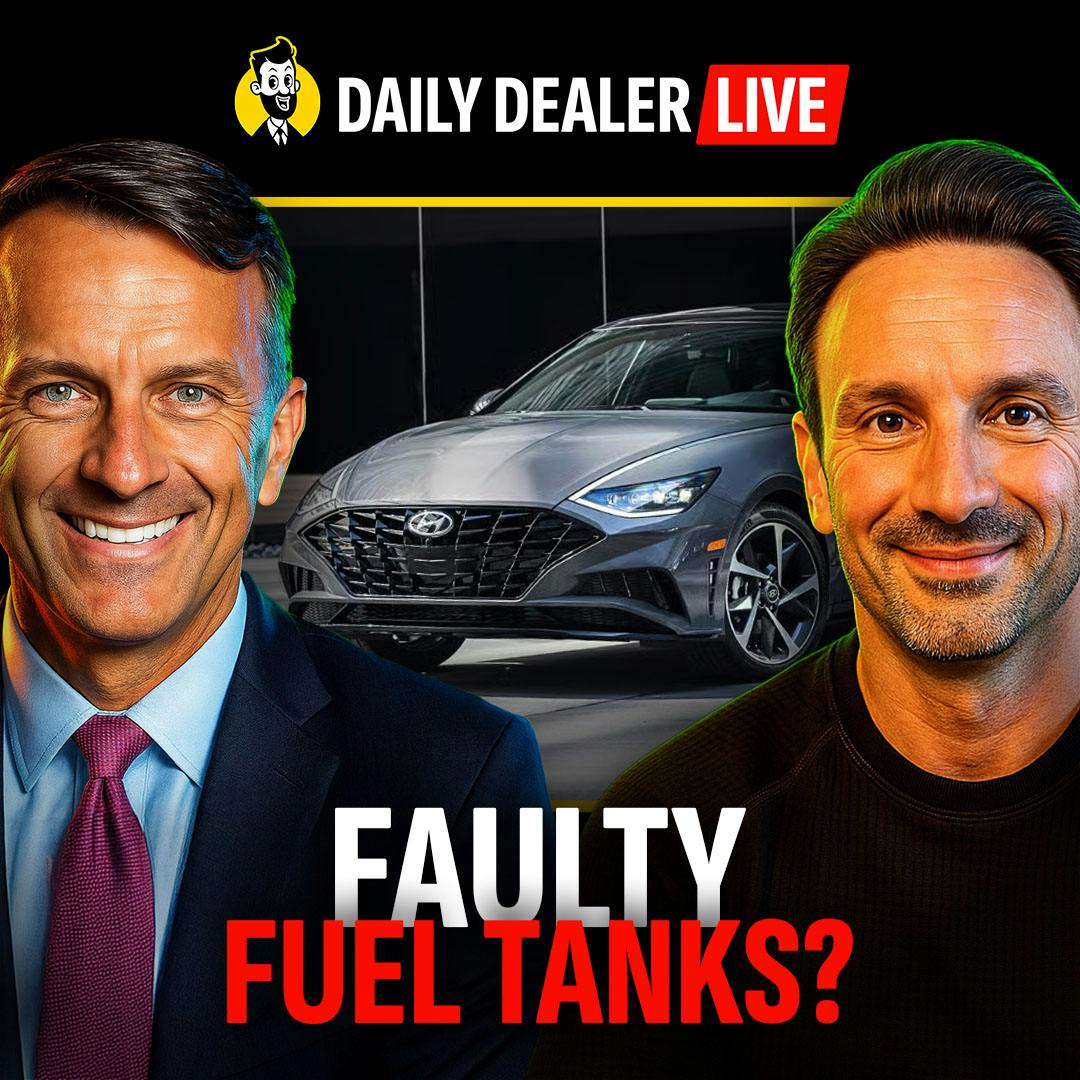
The episode covers significant automotive industry updates, including recalls from Ford and Hyundai/Kia, and insights into dealership operations. Eric Barbosa from Cavender Auto Group discusses the impact of the EV tax credit expiration on sales and shares strategies for improving customer experience and inventory management. David Steinberg from Four Eyes emphasizes the need for better data integration among dealership tech platforms. Lastly, Robert Woolsey from Swickard Auto Group highlights the growing importance of cybersecurity in dealerships, addressing fraud prevention and the need for a proactive security culture.
Today's show features:
Eric Barbosa, VP of Variable Operations at Cavender Auto Group
David Steinberg, CEO/Founder of Foureyes
Robert Woolsey, Director of Corporate Security at Swickard Group
This episode is brought to you by:
Matador AI – Discover why the biggest dealership groups in America are using Matador AI to enhance their Sales and BDC teams to sell and service more cars than ever before. Right now, podcast listeners get the first 30 days risk-free with an included white-glove onboarding, so you can experience the difference in your store. This offer is only available until the end of the month, so don’t wait! Head to https://matador.ai/ and book your demo today.
Foureyes – Foureyes fixes what’s underneath by connecting CRM, inventory, website, and DMS data so it’s clean, connected, and flowing. Then all the stuff you've been stacking on top? It finally works. Collect, connect, and put your data to work – visit https://foureyes.io/ to learn more
CDG Circles – A modern peer group for auto dealers. Private dealer chats. Real insights — confidential, compliant, no travel required. Visit https://cdgcircles.com/ to learn more.
Car Dealership Guy is back with our second annual NADA Party—happening in Las Vegas on Thursday, February 5th. It’s the hottest ticket at NADA 2026. Spots are limited and unfortunately we can't invite everyone —so RSVP today at https://carguymedia.com/cdglive and we hope to see you in Vegas!
—
Check out Car Dealership Guy’s stuff:
CDG News ➤ https://news.dealershipguy.com/
CDG Jobs ➤ https://jobs.dealershipguy.com/
CDG Recruiting ➤ https://www.cdgrecruiting.com/
My Socials:
X ➤ https://www.twitter.com/GuyDealership
Instagram ➤ https://www.instagram.com/cardealershipguy/
TikTok ➤ https://www.tiktok.com/@guydealership
LinkedIn ➤ https://www.linkedin.com/company/cardealershipguy/
Threads ➤ https://www.threads.net/@cardealershipguy
Facebook ➤ https://www.facebook.com/profile.php?id=100077402857683
Everything else ➤ dealershipguy.com
"First up today, Ford is recalling about 230,000 Broncos in Broncos sports because the digital cluster can boot up completely blank."
The Ford Bronco is a type of SUV that is designed for off-road driving. It's popular for its tough look and ability to handle rough terrains.
The Ford Bronco is a rugged SUV known for its off-road capabilities and retro styling. It has a strong following among enthusiasts and has been recently reintroduced with modern features.
"Meanwhile, Hyundai and Kia are recalling roughly 335,000 Sonatas and K5s with a shared 1.6-liter turbo engine."
The Hyundai Sonata is a car that is designed for everyday use, offering comfort and safety for drivers and passengers. It's a good choice for families or anyone who needs a reliable vehicle.
The Hyundai Sonata is a mid-size sedan known for its reliability and value. It's popular among families and commuters for its spacious interior and advanced safety features.
"Meanwhile, Hyundai and Kia are recalling roughly 335,000 Sonatas and K5s with a shared 1.6-liter turbo engine."
The Kia K5 is a newer model sedan that is stylish and packed with technology. It's a good option for those looking for a comfortable and safe car.
The Kia K5 is a mid-size sedan that replaced the Kia Optima. It features a modern design and offers a variety of tech and safety features, appealing to a wide range of drivers.
"Meanwhile, Hyundai and Kia are recalling roughly 335,000 Sonatas and K5s with a shared 1.6-liter turbo engine."
A 1.6-liter turbo engine is a type of car engine that is small but powerful, using a turbocharger to help it run efficiently while providing good speed.
The 1.6-liter turbo engine is a compact engine that uses forced induction to increase power output while maintaining fuel efficiency. It's commonly used in smaller cars for a balance of performance and economy.
"It's a bad check valve can let pressure build in the fuel tank and cause it to deform or leak."
A check valve is a part that helps keep fuel flowing in the right direction in a car, preventing any backflow that could cause problems.
A check valve is a mechanical device that allows fluid to flow in one direction while preventing backflow. In automotive applications, it is crucial for maintaining proper fuel system pressure.
"...the market is settling back into a slower, more normal rhythm where ICE trucks, SUVs and hybrids carry the load..."
ICE means Internal Combustion Engine. It's a type of engine that runs on gasoline or diesel fuel, as opposed to electric engines that power electric cars.
ICE stands for Internal Combustion Engine, which refers to vehicles powered by gasoline or diesel engines as opposed to electric vehicles. This term is often used in discussions about the automotive market's shift towards electrification.
"...where ICE trucks, SUVs and hybrids carry the load and dealers have to work harder on that mix..."
A hybrid car uses both a regular engine and an electric motor. This helps it save fuel and produce less pollution than cars that only use gasoline or diesel.
A hybrid vehicle combines a traditional internal combustion engine with an electric propulsion system. This setup allows for improved fuel efficiency and reduced emissions compared to conventional vehicles.
"...Next up today, First Brands Group, the major U.S. auto parts supplier already in bankruptcy..."
First Brands Group is a big company that makes parts for cars. They are having financial problems and are in bankruptcy, which can affect car repairs and parts availability.
First Brands Group is a major U.S. auto parts supplier that specializes in providing various automotive components and is currently facing bankruptcy. Their situation reflects broader challenges in the automotive supply chain.
"... org structure and all things that you would call EOS, right? So how the organization looks, how it ope..."
The Volkswagen Eos is a small car that can turn into a convertible, meaning you can take the roof off and enjoy the sunshine. It’s a fun car that’s good for both everyday use and leisurely drives. People mention it because it’s a cool mix of a regular car and a convertible.
The Volkswagen Eos is a compact convertible that combines the practicality of a coupe with the enjoyment of open-air driving. Introduced in the mid-2000s, it features a retractable hardtop, making it unique in its class. The Eos is often discussed for its design and versatility as a daily driver and weekend cruiser.
"...and also gives them an anticipated future value to entice that conversation in the drive."
Anticipated future value is an estimate of how much a car will be worth in the future. It helps people decide if they should trade in their car now or wait until later.
Anticipated future value refers to the projected worth of a vehicle at a future date, often used in trade-in evaluations and leasing agreements. This estimate helps customers understand how much their car might be worth later, influencing their decision to trade or sell.
"...Let's say it's a Sierra and a comparison offer to trade out of it or purchase offer..."
The GMC Sierra is a big truck that can carry heavy loads and is often used for work or family trips. It has a nice interior and is known for being strong and reliable.
The GMC Sierra is a full-size pickup truck known for its strong performance, towing capabilities, and upscale interior. It's popular among those who need a reliable work vehicle or a family truck with added comfort features.
"...g values on vehicles in the service drive. You've got Ford. Ford's the the number one most recalled OEM this..."
The Ford GT is a really fast and stylish sports car made by Ford. It’s famous for its racing history and is designed to be super powerful and fun to drive. People talk about it because it represents the best of what Ford can do in terms of performance cars.
The Ford GT is a high-performance sports car that pays homage to the legendary Ford GT40, which dominated endurance racing in the 1960s. Known for its striking design and advanced engineering, the GT features a powerful twin-turbo V6 engine and is celebrated for its speed and handling. It often comes up in discussions about automotive innovation and performance benchmarks.
"before it was a heavy fleet. So we're a year of growing that other business in the retail side of it."
Fleet sales are when companies buy a lot of cars at once, usually for businesses like rental services or delivery companies. They often get a better price for buying in bulk.
Fleet sales refer to the sale of multiple vehicles to businesses or organizations, often at a discounted rate. This can include cars for rental companies, government agencies, or corporate fleets.
"Yeah. Well, let's talk Matador AI. Today's episode is brought to you by matador...."
The AMC Matador is a car that was made in America during the 1970s. It came in different styles, like a two-door and a four-door, and had a distinctive look. People talk about it because it represents a part of American car history and the company that made it.
The AMC Matador was a mid-size car produced by the American Motors Corporation during the 1970s. It is notable for its unique styling and was available in both coupe and sedan versions, appealing to a wide range of consumers. The Matador is often discussed in the context of American automotive history and the rise and fall of AMC.
"...Do you, is there a tool that you use for tracking? At our group, we use LoJack, it's a GPS device."
LoJack is a device that helps find stolen cars using GPS. If your car is stolen, it can help the police track it down and get it back to you.
LoJack is a vehicle tracking system that uses GPS technology to help locate stolen vehicles. It is widely used by law enforcement to recover stolen cars quickly and efficiently.
"Oh, wow. We got hit with hellcats almost. I think the last one we had was out of Oakland. We had a hellcat that they brought in."
The Dodge Challenger Hellcat is a fast car that has a really strong engine, making it one of the most powerful muscle cars. It's known for its cool look and speed, which many car fans love.
The Dodge Challenger Hellcat is a high-performance variant of the Challenger muscle car, known for its powerful supercharged V8 engine and aggressive styling. It's popular among enthusiasts for its performance capabilities and distinctive design.
Select text to request an explanation
Hey, everybody, welcome back to another episode of the Daily Dealer Live.
I'm your host, Sam Dark, and welcome to this space where automotive comes together to learn,
to share, to grow, to execute.
Thanks for choosing to be here this Monday, November 24th.
And happy Thanksgiving week, everyone.
And happy Thanksgiving week also brings us into happy Black Friday week.
It's going to be a big weekend automotive.
But first, before we go into that, let's dive into today's industry headlines.
First up today, Ford is recalling about 230,000 Broncos in Broncos sports because the
digital cluster can boot up completely blank.
The problem?
Well, it's software.
But so far, no injuries reported.
The fix is an over-the-air update or a quick dealer visit.
Meanwhile, Hyundai and Kia are recalling roughly 335,000 Sonatas and K5s with a shared 1.6-liter
turbo engine.
It's a bad check valve can let pressure build in the fuel tank and cause it to deform
or leak.
The issue traces back to the same supplier.
And while both brands say only about 1% of vehicles are affected, fuel leaks are a fire
risk, so this one's getting handled fast.
Uh-oh.
As always, dealers will inspect and fix or replace the faulty parts for free to see
more recalls head over to the CDG Recall Tracker, powered by Busy Car at cdgrecalls.com.
Next up today, new vehicle sales are set to fall in November, not because demand
is collapsing, but because thousands of buyers pulled ahead their purchases before
EV tax credits expired at the end of September.
JD Power expects total sales to land around 1.26 million units, that's down about 5% from
last year, with the SAR drifting to 15.4 million, that's a full million units below
last November's pace, and EV sales saw the biggest whiplash, the pre-expiration
rush inflated Q3 and early Q4 numbers, leaving November looking softer than it really
is.
Dealers are creeping up but not wildly, averaging just over $3200, while affordability
remains the real drag, the average monthly payment is now $760, that's a record for
November.
Big picture here with the tax credit boost gone, the market is settling back into
a slower, more normal rhythm where ICE trucks, SUVs and hybrids carry the load
and dealers have to work harder on that mix, on that pricing, and on that deal
structure to keep volume steady.
Next up today, First Brands Group, the major U.S. auto parts supplier already in bankruptcy
is now suing its founder and former CEO, alleging he, quote, fraudulently secured billions
in financing and siphoned company money for personal use.
The lawsuit claims Patrick James misrepresented First Brands financial health to
raise huge sums, then diverted hundreds of millions potentially more to himself,
whose trust and related entities while the company collapsed under the 11 plus
billion in liabilities.
By the time First Brands filed for bankruptcy in September, the suit says the
company only had about $12 million in cash left in the bank, despite once
generating roughly $5 billion in annual sales.
The legal action comes as the restructuring team tries to stabilize
operations with more than $1.1 billion in court-approved financing and as a federal
judge launches an independent $7 million investigation into the alleged
fraud.
Well, these moves will determine how much money creditors can recover, who's held
responsible, and whether First Brands can realistically reorganize or if it
becomes just another case study in corporate oversight, gone wrong.
And finally, up to today, Sewell Automotive Companies is expanding again
and an update from cdjbicell.com makes us happy, acquiring Land Rover Burn from
Shot and Kirk Automotive Group in a deal that closed November 17th and
included the store's real estate.
This gives Sewell its third dealership in the San Antonio market and
Second Land Rover Point strengthening the family-owned group's footprint in
Texas, in Texas's growing luxury segment.
Shot and Kirk, which operates 30 stores across seven states, says the sale
is part of a broader strategic shift as it reallocates focus elsewhere
in its portfolio.
In a statement, President Greg Shot and Kirk said the group is
confident the store and its employees have a great future under Sewell,
which now represents 12 brands across 12 dealerships statewide.
Big picture here, well, Texas remains one of the hottest buy-sell markets
in the country and deals like this show that top groups are still eager to
plant deeper roots where population income growth and luxury demand
remain strong.
And as always, don't forget, you can see this deal announcement many
more throughout the entire year live by visiting the cdjbicell tracker at
you got that right cdjbicell.com.
And that is a wrap on today's industry news.
Julie, welcome back.
Happy to be here.
Would you believe it's me saying that in the background?
Yes, I could believe that.
Yes, absolutely.
And a big huge hello to all of our listening audience.
We've got a ton of activity on social already, Julie.
Good morning from Tracy Honden, California.
And a happy Monday to everyone says deals with DOM.
We've also got Jonathan Gamble watching on YouTube.
Let's go Hannah from Nashville, Tennessee, coming in at it.
And so much happening in marketing, especially in subprime lending.
We'll have a lot of conversations on that and more.
We want to know where you're coming to us from.
We may have over the next couple of shows, particularly during the holiday
week, some exciting and different destinations where people are coming
from and or they're doubling down efforts inside the retail stores to gear up
for a massive Black Friday, because this Black Friday is going to be awesome.
Yes, Julie?
So we've got that to look forward to.
So post into the comments.
We'll get you into today's show.
It'll change the trajectory of today's show.
And first up, let's go.
By the way, we still have your mustache, Julie.
But first up, we go to another mustache, Eric Barbosa, VP variable
ops at Cavender Auto Group.
Greetings, Eric.
Yeah, still December 1st.
December 1st, we keep it.
Mine will be permanent for a while.
OK, all right.
You're going the duration of the winter.
Good. Welcome back.
You've been on the show before, so we're pumped to have you back.
We're going to ask you the question we ask everybody to start out.
How's biz, Eric?
And tell tell our audience a little bit about you as part of that.
Hey, well, let's start VP of variable operations for Cavender Auto Group.
We're based out of San Antonio.
Yep. Family owned 87 years plus,
fourth generation, and we have domestics, imports and luxury brands.
Business right now is to me, it's steady.
It's not declining.
You know, I just saw some metrics you just said there that new car sales
is down for us. It's probably flat.
We're hoping that we catch up this this final week
as we usually do in our history and use cars is again, steady as well for us.
Yeah, yeah, that's.
So it's interesting.
November sometimes feels a little slower in the beginning.
And then to your point, you go through the holidays and it just speeds up.
Some thought is, will EV pull back a little bit because it pulled so far ahead.
But I think that's usually a fear that's not realized.
Any thoughts on that, Eric, as we approach the big holiday weekend?
Yeah. And I also I think it's preparation and strategy.
You know, if you have them, you have to figure out how to sell them.
And if you don't, then and you have a demand, you got to get them.
So it's all planning.
And yeah, we felt a little bit of it last month after it ended.
But again, another flat item for us that we're just steady on.
Yeah. So, hey, last time you were on the show,
we had a lengthy conversation on org structure and all things that you would
call EOS, right? So how the organization looks, how it operates,
what are your systems and processes?
And you in the green room told us you've had some internal
conversations and discussions about that.
And you've actually done quite a bit of work on EOS
as we approach the end of the year.
Tell us a little bit about that and what prompted it.
Maybe the context is when you guys ask me, I think Yossi may have asked me
and I had no idea what it meant.
I kind of pitched it back to Rob Cavender, because I know it's something
that he was learning as part of the Vistage Group that we belong to.
Well, now starting to know everything about EOS,
we're implementing in our stores, executive management, structure, leadership.
It's having a big benefit to us as a management staff, to be honest with you.
What's one component of that EOS structure you put in place
and how has it benefited you short term?
I think the accountability chart, not organizational chart, two differences.
And then the simplification.
You know, at our level, we look at a lot of reports, a lot of KPIs,
which I like, but when it makes it down to the bottom, they don't need that.
They need simplicity, things that they can work in
and it's not difficult to find or do.
So that's right now the biggest thing for us.
So what's one or two of the most simple KPIs that you want to make sure
reaches the end user in the sales floor and the BDC and service
that really adds jet fuel to what you're doing at Cavender?
I think customer experience and how we communicate.
And like we're learning a lot about communications.
I think you guys did something recently on phone calls
and the drops of phone calls were digging into that.
Yeah, it's huge, huge.
And we need to fix that.
One thing, we had these 50, 20, 10s,
two and ones, which was a little bit controversial on LinkedIn
of the activities of sales people do.
We set that back.
We sent surveys out to our people of what was impactful and then we adjusted.
And now we're literally doesn't change our whole structure,
but impacting connected calls, appointments, sold videos
at a better scale than just saying, hey, go do a bunch of phone calls.
So it's stuff like that that's impactful.
Yeah, we always love the video piece.
So everybody's using it.
Everybody's got a different one.
Who are you using to put videos out into the world, both for sales and service?
For for for sales, I mean, it's to drive centric.
We do videos, vehicle of interest.
And that's that's simple.
And then right now it's I want to say they just switch to.
I forget it starts with an N and I forget the product that they're using.
So we just we just know.
Numa, yeah, voice AI, voice AI.
Yeah, that's right.
So so what prompted the switch to Numa with the voice AI?
Was it was at the stat that CDK just came out with talking about average
whole time for services that I mean, it's not 10 minutes, but it's approaching that, right?
Yes, and it's our new fixed ops platform VP, Todd Flowers, who did a good job.
He just trying to be more efficient, communicate with the customers,
follow up with the customers because I drive this, get busy
and and just to reiterate, X time for the videos, Numa for the communication.
And that's helped out a lot.
So and we went through a couple of demos and it took us probably a year.
And then Todd really pushed the initiative and and we're having really good results from it.
Yeah, any pushback on the voice component where people are like, hey, I'm talking to AI.
I don't want to talk to AI or have has it been embraced in a way that's interesting to you?
I think the staff is embracing it, but we're still having some issues
with maybe the customers embracing it.
And we're going through that now.
And I think we've kind of figured it out.
So cool. OK.
So, hey, it's interesting.
Used car prices are kind of stabilizing right now.
But days supply is creeping up nationwide.
How are you coaching your teams to win
in this affordability strained marketplace in used cars?
What are you doing on supply?
I mean, it's we're trying to shift.
That's a big deal for our next quarter.
Is our buy center service acquisitions, which we do a OK job.
But we're I think the teams underperforming.
We just implemented a new tool.
We're trying to avoid auctions and just really do a better appraisal process
with the customer so we can keep more of the cars that are coming in.
That's really the strategy and keep them focused on.
You're going to pay more for that car.
If you go to auction, why wouldn't we give it to the customer
while they're here or in the service track? Yeah, you said you implemented
a new tool. We always love that.
What would you implement? And is it working?
It is. And it's a brainchild of our CEO, Rob Cavender, OK,
called Cavender comparison.
And we use an axles, the tool that we use to run through it.
Basically, when the customer goes to the drive, they get a text that text
will give them a comparison offer of a current vehicle,
whatever they're driving. Let's say it's a Sierra and a comparison
offer to trade out of it or purchase offer and also gives them
an anticipated future value to entice that conversation in the drive.
OK. Yeah. Yeah.
Love to show it to you at some point.
Did you see our episode with Ben Stock a couple of weeks ago
where he announced kind of that collaboration between three companies
and how they're working together to do that?
Yeah, VinQ and it was Impel, VinQ and Spine, I think,
were the three companies and they're all working together
to deliver a more seamless trade appraisal process in service.
Yeah. Yeah.
Actually, Ben Stock was the reason we fought to New York
probably for almost three years ago to see what they were doing
that service drive and it was phenomenal what they were doing three years ago.
So I can't imagine what he's trying to do now. Yeah.
But yeah, he kind of set that path for us.
Yeah, it sounds very similar to what you're what you're doing there.
So you've talked openly about being super aggressive on inventory turn.
What specific processes or metrics does your team use today
that more dealers should be paying attention to as it relates
to used car inventory turn or new or used, right?
We have so many different KPIs.
We look at it all the time.
We use every tool the auto has to offer and we're not perfect at it.
But the thing we do is communicate, make sure the GMs, the GSMs
and the used car directors or managers that you have all are aware
are SOPs and forcing them extremely important.
Make sure they were pricing right from the get go that that helps.
But nothing, nothing that we don't already know that's common sense.
You know, just you have to pay attention and focus on it.
You're getting a ton of comments online.
So Jay Schindler, Decker says F.E.
Eric is the best been a long time.
Dave, T. Roger says, tell Todd flowers.
I said, hello, yoga cars.
Great question, by the way, yoga cars.
What's the number you're putting on service drive cars?
Low ball, start at the right number where I would add.
Are you OK overpaying for some of those used cars in the service drive?
I would overpay if I could on every one of them and get them in.
You're going to overpay at the auction.
Might as well give it to your customer.
And we try to get as close to 100 percent on some.
And it's from 95 to 100 percent.
So those customers, you got to remember, you're bringing them into market.
They're not in market.
And we got to give them a reason to get in market.
Yeah. And then Gammel says the goatee is good looking.
You got props on your goatee.
You need to switch to the goatee next.
And Gammel also says Tempe, Arizona is where he's coming from.
So lead to appointment.
Lead to appointment to show rates are dropping industry wide.
That's a stat.
What's working today in sales people to development
that isn't the same as a couple of years ago to increase that show rate
that that that I'm going to make an appointment.
I'll walk through that door so you get the opportunity
to make a customer out of me.
I think the most important is getting good leads, quality leads,
making sure the message is right and that you're funneling
the customer through the experience they want to.
That'll shoot up.
If not, you're going to have all that stuff go the wrong way.
So I think that's important.
So who are your best?
We ask this question a lot, make some people nervous,
but we're curious about it anyway.
Who are your best lead providers right now in your marketplace?
And I know you've got a pretty diverse market.
I mean, some of the third party and that's a bad word.
But for some, I think they're still very beneficial.
We want to drive our own traffic to the website
and it's got to be the website.
And then we're building, hopefully here in the next quarter,
a simpler process for them to convert because that's the biggest deal.
But the website right now is our best lead provider.
Yeah, very good.
So you're a you're a JLR dealer
flipping a little bit to inventory and challenges.
They've had some struggles over the past few months
with the outages and whatnot.
How are you adjusting and pivoting in that environment to win at JLR?
That's a tough one.
Our the GM that we have and the team that's there is doing a good job.
We're going aggressively over the use car market for that store
until we figure out the new car.
And then you just talked about a big competitor.
They're right down maybe 10 miles from us.
So we'll just bought that Bernie store.
So that's something that we're going to have to pay attention
because they're going to level the they're going to level the standard
or they're going to raise the standard that is in that market for JLR.
They're a very great company.
You know, how Sewell does it.
So we got a lot of things right now, JLR wise that we're we're working on.
But the operator that we have has a good strategy of planning.
I mean, we can't control the the inventory part.
And they were shut down for, I think, two and a half months.
Yeah. Yeah. Yeah.
What do you make of the Sewell acquisition?
Is this one of the first of many near you?
Or I mean, they continue to grow.
They're an enormous, well respected auto group.
They are a good thing, a bad thing.
It's to us, probably a great thing.
It's just going to raise a level awareness, which should have been there
already, but they're a great competitor, great organization.
And, you know, anything that can raise the bar for us as, you know,
outside or internal is a good thing.
Yeah. So you mentioned service drive acquisition,
providing values on vehicles in the service drive.
You've got Ford.
Ford's the the number one most recalled OEM this year.
That changes and ebbs and flows hasn't always been.
It won't always continue to be.
How are you winning in that recall environment in Ford
in how you either engage with customers or with the OEM?
What's your take on the Ford deal?
Again, that team also is doing well with that.
The thing with our Ford store, it's one of the biggest by the location,
the facility in the state of Texas, but before it was a heavy fleet.
So we're a year of growing that other business in the retail side of it.
And they do a good job.
It's just communicating ahead of time, getting them in right now.
We don't have a wait time because we're a new facility with 65 bays, I believe.
And yeah, they're taking a proactive approach to bring the business in.
Awesome. That's massive.
That's massive. Yeah.
All right. So last couple of questions here, thinking about your tech stack
because you've been so proactive at building technology and tools
to help deliver your best to your customers in your tech stack.
What tools do you think are really core to sales
and delivering your best to the customer?
And is there one or two you'd rip out today
is just not being as efficient or effective?
I wish I could show you this, but I just went over that tech stack.
I love that. I love that.
We got to get more efficient.
There's just too many, you know, just we broke down
per role. This is part of that L10 or the EOS system of how many systems
we have in place for systems for systems.
So we're trying to get more efficient.
But right now, one that I personally like,
I think our team likes for customer experience is the zip deal.
And probably some of our reporting drive centric to CRM tool.
I think it's the best out there.
But we do have a lot of plugins
and we need to get a little bit more efficient of all this tech stack.
Make sure it's streamlined for the customer
because even for the employee, it's confusing.
They have 10 different logins.
So something we're dealing with right now.
What's your process to analyze, kind of get a sense of what works,
what doesn't, and then figure out what to kick to the curb quickly?
Because to your point, Eric, there's so many tools out there.
It's mind numbing, right?
If you could get it could be a full time job.
Eric Barbosa could do nothing else,
but look at tech stack and make decisions on that.
And it would be a full time job times two.
And I don't want to.
So and what I mean by that, it's in store.
We go in store and we ask the end users that are actually using it.
If it's beneficial and then we kind of go through that process,
get feedback from the associate, from the sales manager
or use car manager service manager and then the GMs at the store
and then try to build from there.
And we're currently doing that because I mean, I think, you know,
we all have been in NADA and all these other conferences.
We come back with a bunch of stuff we want to plug in
because it's great and then we're not prepared for it
at the store and I think you need to get the feedback
and buy in from the people that are actually using the product.
That's number one.
Yeah, I love it.
Jay Schindle Decker says, love the good old fashioned white board.
And by the way, I think most dealerships as tech driven
as we become still have that old fashioned white board.
There's something about focusing your attention down to that one thing.
So last, last question, if if a dealer
were considering making one change in variable ops
as we get towards the end of 2025, that would help propel them
to an awesome 2026.
What would that one thing be from your perspective
that most are missing, Eric?
Simplify the processes.
Yeah, yeah.
All of them simplify it, make it easy
and customer centric from the beginning.
Yeah, love it real quick.
Because that's that's prompting what you had said earlier.
You said you simplified even we called them quarter times.
So what do you call them internally?
And then what did you bring them to?
Like what's your current quarter times?
They were 12, two, four and six and every store stops.
They bring the sales staff in and then they would go through
50 calls, 20 emails or texts, 10 social media posts,
two appointments and sell a car.
We sent a survey out of what the team wanted to see
from those quarter times.
And you know, just I'm very, very transparent.
It wasn't a they weren't loving it as much.
I thought they were loving it.
So yeah, we broke it down to the activities that have results,
which is connected calls, the videos sent to do task or
overdue, you know, whatever the CRM may call it, work plan,
set in appointments, their proposals and sell a car.
And then these are coaching items that now the team leads
do and not the salespeople do.
But I think it's important to have the sales associate
connect with their sales managers at least three times
on those those specific items and then simplify it.
You know, and when you're saying connected calls,
we're obviously talking about connecting to a customer and
having meaningful conversation.
Are you talking about connected calls in the CRM as in
like a recorded call so you can verify a recorded call that's
happened because we were pitching do 50 calls.
Well, that's great.
They can do 50 calls and only connect with one person.
Right.
So we want to know what they're connecting with.
And then we'll go from there.
And if somebody's got really low connections is a coaching
opportunity for sure, you yoga cars, pipes and dealer group
should have their own platform and have APIs into other tech.
If there's proprietary product that they can leverage.
That's a cool vision of the future, right?
Eric and Gamal comes in and says yoga cars.
I agree.
So Eric Barbosa VP variable ops,
Cavendra Auto Group.
We appreciate you being on the show today and being back.
This is your repeat appearance here on Daily Dealer Live.
Thanks for sharing your perspectives.
Appreciate it.
You guys have a happy Thanksgiving.
Hey, same to you.
Thank you.
That's pretty cool.
So he came on to had kind of this thought process
on leadership, reorg, accountability, reorg went back
and executed very quickly on it.
They're starting to reap the rewards of some of that.
That's kind of cool.
Yeah.
Yeah.
Well, let's talk Matador AI.
Today's episode is brought to you by matador.ai.
Matador handles calls, texts, and fall-ups.
So your team never falls behind.
More appointments, less chaos.
See the difference for yourself with a free demo at matador.ai.
You can also scan the QR code to our side there.
Go into the show notes for your listening to the podcast
version of today's show.
However you learn more about Matador,
we appreciate matador.ai for supporting great content
on today's show.
Like the one we just had with Eric Barbosa,
huge props to him for coming on the show
and Matador for supporting it.
Thank you.
And, you know, Yuli, we keep talking about this,
but there are limited invites.
We want to make sure everybody who wants to get in
gets a chance to get in.
It's the annual NADA party in Vegas Thursday, February 5.
It's a big ticket.
It's going to be a heck of a lot of fun.
We'll all be there.
So if you want to be considered for a formal invite,
just hit the link in the show notes, request to join,
and fill out a questionnaire.
Of course, spots are limited.
Can't have everyone there, but RSVP today.
And we hope to see you in Vegas.
And I'll sing just like the jingle.
Oh, that's fun.
You should.
That'd be cool.
All right, let's dive into next.
What would you sing?
There you go.
Nice. There you go.
That's what you'd sing?
All right, all right.
Of course.
You know what we need to do is the next M&A activity.
We need to have you sing the M&A song.
We got to have that for Bicell activity.
So we'll do that.
All right, next up, let's turn to David Steinberg,
CEO and founder of Four Eyes.
David, welcome to the show.
Thanks for having me.
Julie, I'm looking forward to hearing your singing voice more.
You'll regret that, but I will indulge you.
It's a plan.
It's a plan.
Well, David, tell us how's Biz and tell our audience
a little bit about who you are and what you do in the world.
Business is great.
It's a really exciting time.
I'm CEO, founder of Four Eyes.
We are unveiling our new platform at NADA,
which is really, really exciting.
I think there's a lot to pick up on on the conversation
you just had with Eric, with Eric Barbosa from Cavender,
but that so much of what he was talking about,
he mentioned four different platforms
that they're using to communicate with their customers.
It's frustrating.
He mentioned that his job is to bring all that in
and work on the client experience on the CX.
And you go, wow, there is a missing piece of architecture
here because none of these platforms
are working with each other.
That when they've got their special platform
that they build in the service lane, they have NUMA,
they have DriveCentric, they mentioned ZipDeals.
The average dealer has nine different platforms
talking to consumers.
And by the way, conversational AI is blowing up,
so go out to NADA and that number is going to be 11
in 2026.
And none of these platforms communicate with each other.
And so the CX is going all over the place.
So what's the solution?
How do you get them to connect and communicate with each other?
You know, Ben Stock brought us an example
where he brought three CEOs together and said,
look, I want you to innovate together.
I want you to drop your defenses and work well together.
That was one path, his path, what would you say?
I think the challenge with that path is that
involves one, a lot of bringing people together,
a lot of management, and you have to have a lot
of pull as a dealer group.
And then those pipes between those vendors
tend to break down over time
because that is really enterprise software
that needs to be built.
You know, what we're excited about bringing into automotive
is a platform that is a well-defined platform
outside of automotive, which is basically,
you know, people will call it a CDP
and I think CDP is so overused
and so dangerous to label.
But what we've done is we've created an organized platform
that allows us to collect and connect
all the information from every different vendor.
If you think about it right now with conversational AI,
you have nine different vendors talking to your consumers.
If you just go, hey, write everything to the CRM.
One, the CRM's not equipped to accept
all that communication.
CRM can't store an email, CRM can't store records
really well, it's not processing stuff.
So the job, and if you send it all to the CRM,
you overload it with notes
that the salesperson can't use it anymore.
Right.
And so the job is there is a book on every customer
and as conversational AI is going out
and collecting information,
maybe from new mom, maybe from another tool.
The job is to update the book
and then the book writes the cliff notes to the CRM
so that anybody who's picking up that deal
can understand that.
So like one of the problems we've just been pulled into,
we built months ago, we built this Consent Manager
where we could see because we're watching
everything that's going on,
we could see how many times people are having
to opt out of communication from a dealer,
you know, like nine different times
and say, stop, stop, stop, stop, stop.
And dealers are getting sued everywhere right now
because of this.
So we built the Consent Manager
that takes in Consent Signals and publishes updates
to every vendor so that vendors can follow
the Consent Signals that are coming from other vendors
that a dealer's using.
So they're not having to unsubscribe nine times.
It's the same with communication.
With communication, if you have a tool
that goes out and gets great information
from the consumer,
that is your dealership's communication to build on top of.
The bad institutional memory
where it's a bad experience is when a salesperson
then calls up and has no idea what was said
or what was shared and the customer
has to repeat themselves.
So what we're doing is a modern architecture
that allows you to solve that problem,
but then also allows you to easily connect new platforms.
So Brian Benstock doesn't have to bring three CEOs
of companies in and organize
three different dev resource teams
to in order to accomplish anything.
How do you make that really easy and integratable?
So you're developing this tool.
It's not completely innovative in automotive.
There are similar tools or is this innovative?
What makes your version of this aggregator
of this customer book or customer story?
What makes it unique to the industry today?
And who will ultimately win
in a highly competitive marketplace
with different companies trying to do a similar thing?
I think one thing that's unique about what we're doing
is that the industry,
what happens when you have bad data plumbing,
which automotive has had,
where systems can't talk to each other,
they're all over the place,
is every vendor becomes a contractor.
And so every vendor says,
hey, just you bringing me everything you do
and I'll take care of everything.
Right.
And that's a problem.
That's a problem.
The industry doesn't need more contractors.
The industry needs more plumbers.
And so our job is to enable connectivity.
Our job is not to be the vendor that does everything for you,
but to be the piping that enables you
to use the vendors you wanna use.
And I think that is a unique perspective in automotive
that we're not trying to go,
oh, we're gonna do this and we're gonna do this
and oh, that's not a roadmap.
We're gonna take this away from you.
It's how do we enable you to connect your data
into places and that when a vendor collects information,
when a vendor collects consent
to allow everybody to work from the same playbook.
But it's more plumbing and less contracting.
So this plumbing, so to speak,
you've been testing or piloting this
in advance of your NADA launch.
How's it going in the test markets?
I mean, it's incredible
because dealers now are seeing it more and more.
And so like a lot of times,
it can be an easy sell when dealers see the access
to the data and the hygiene
and the level of sophistication we're bringing
to piping data out of the DMS, the CRM,
their inventory, their website
and making sense of it quickly.
I mean, Eric made a joke on a call
where on your last segment where he just said,
oh, I can't do that.
It's 10 different systems.
I can't look at all of that data.
That right there is a problem, right?
So.
Well, and that a human has to aggregate it all
and make sense of it, right?
When we have technology that could do that
if it all plumb together to your point.
Yeah.
I mean, we call it like collecting connectile
that so many dealer groups
are in what you call collecting connectile
where your data is only interesting sometimes.
So when you say, oh, well,
to do this report takes me six hours of time.
And by the way, by the time it's done,
I've got a ton of asterisks next to it
because I can't remember how I pulled
this information exactly.
And so now I'm stuck in collecting connectile.
You gotta get out of that.
And I think that oftentimes when we show dealers
the underlying data and the cleanliness
and the bringing it all together,
that right there is an aha moment for them.
But now the next step is giving them a new connectivity
that allows them to solve these consent,
these over communication problems,
really configure how vendors can work together
to allow them to use the tech stack they want.
And by the way, we're not even talking about
the other fact that they're locked into automotive
only tech stack.
Why is everything in automotive $2,500 a month?
Right, right?
Like when there's software outside of automotive sometimes
that does the same thing for 30 bucks a month
at the group level,
at the group level, not at the location level.
So if this is coming out NADA,
people can learn more about it.
It's probably the first clients will get on it at NADA.
So in advance that, can we ask you some questions
that we get a lot from our audience
that I think people are, and I myself,
we're trying to solve for this right now
in this month in November.
So we can have a great month.
A lot of dealers complain they don't need more leads,
they need better ones.
And as an aggregator and one that engages with these leads,
what is your data show regarding real shop
or intent versus noise?
What, how do I win the rest of November
as it relates to the leads?
Yeah, so typically selling a car is three things.
It's sales, process, marketing, inventory.
There's no such thing as a great dealer
with bad sales process.
So sales process is the bottom of the funnel.
It's where you start when you look at stuff.
I think that generally speaking,
when we look at a dealer's performance,
you can usually see sales process problems
that are pretty easily addressable.
It's just they've been sort of hiding in plain sight.
I would say-
Such as one of the one or two biggest problems
you see process.
Yes, the two biggest problems, one batting order,
like you have a lot of times
some of your lower performers getting the most at bats.
And you go, oh, wait a second.
They've been deemed a high performer
because they sell a lot of cars
but it's because they get the volume of leads.
And so one of the things we give them is we say,
based on their exact lead mix,
this is what the average sales person in the industry
would do.
This is what the 65th percentile in the industry
would do.
This is what the 75th.
And so you start to see, wait a second,
this guy that I thought was performing really well
is actually just a middling performer.
But I've got someone fourth in my bat
who's getting the fourth most leads who crushes it.
I just didn't realize they were crushing it
because I was judging them based on their total cars sold
not on their performance.
So batting order matters.
The other piece we see that trips up a lot of dealers
is their BDC will basically be bottling up
too much leads in the BDC.
Not enough is going through the filter.
And so when that happens, dealers often times
they don't realize it and I can go into the technical reasons
they don't realize it, but they don't realize it.
And so when that happens, more marketing
isn't going to get them out of it
because 80% of their leads that they generate
just get stuck in the BDC.
How do they get stuck in the BDC, David?
And as a dealer operator,
how can I find whether or not they're getting stuck?
What does that mean?
Yeah, so like when we look at it and you'll see,
if I'm showing you examples,
you'll see where like the no salesperson assigns
or all the process of when they assign the salesperson.
There's just a huge bottleneck of leads, not all dealers,
but a lot of dealers will have like,
they'll have like 600 leads right there
where no salesperson's assigned there in the BDC.
Meanwhile, there's those people
who have like 40 or 50 leads each.
There's those people crush it
because they have such low volume
they can handle more volume.
We've got 600 sitting right here.
And when that happens,
what happened, your process starts breaking out.
The BDC is not really getting a hold of people.
They're not calling people when the right time is happening.
They're not, you start to see lower performance.
You start to see where, hey,
we'd expect you to close these auto trader leads
at 8.5%, you're closing them at 4% what's going on.
You start to see all of those sort of repercussions happen.
David, when you talk about that stop in BDC,
there are some groups that say,
hey, the notion of a BDC is kind of an old one.
We're going to go straight to the salespeople,
make them accountable to it.
Do you agree with that?
Would you defend the existence of a BDC
or do you think a more direct line approach
is warranted today?
I think again, like this is where there's a key piece
of information that dealers have been missing
because dealers aren't,
they're not currently connected to collecting
all of the different communication points
they have with their consumer
from the BDC, from the tools they're using
and bringing that in.
They don't actually know what's working or what's not.
They're still operating on their gut.
And until we do that, we're operating on our gut.
We're all operating on our gut.
So I think you have to bring it all in
and then you have to then look at it
and go now that we have the data,
like first step of like making a decision
is am I collecting the right data?
The answer on that question is no,
they're not collecting the right data.
So you can't pass go until you collect the right data.
And so that brings us back to the plumbing, right?
And if we get the plumbing right,
vis-a-vis this tool, we're gonna be in a better place.
So is there, you analyze through your company
a ton of data, customer data,
shopping behavior, shopping trends.
Is there one thinking about now to the end of the year,
is there one really surprising shopper behavior trend
that you've seen in the last six to 12 months
that might be evolving or changing
that dealer should be thinking about
when they're engaging with that data
and reaching out to customers.
I would answer, so I'm gonna turn that question,
I'm gonna turn that question,
do the inverse of that question.
Because I think that what we see so much
is that one of the things we measure
is what every salesperson and every dealership's
close rate is by cohort of time.
What's zero to three days?
What are they closing?
What percentage of their leads?
Zero to three, four to seven, eight to 14, 15 to 30.
One of the really interesting things
is if I go down,
we're measuring over 45,000 salespeople.
If I look at a salesperson who has,
what I would consider really good long-term close rate,
days four to 30,
they're closing significantly more
than their industry average.
And then we pick up the phone and call that salesperson.
What you generally see is a slightly different process
where they sell the need, not the lead.
And what I mean by that
is they're collecting information on the consumer.
Oh, why is it that you want a car with?
What are you, this car's third row seats,
what is it about third row seats?
Do you need third row seats?
They're collecting that secondary information
on the consumer,
and that's what they're using to sell them day four to 30,
not coming for a point to come in for an appointment.
So when I look at that,
that's again, like a technological opportunity
for dealers to say,
are we collecting the right information
to sell the need, not the lead?
And that's where I think you start to unlock
real close rate improvements.
Right now, some people, you're relying on their memory,
they're not transcribing information correctly.
They're, you know, this person has 200 leads,
can't track that well.
We see that in the data.
I could go in and tell you a salesperson
who's got really good memory,
and they tend,
we pick up a phone call them,
they tend to have a secondary system.
They're writing notes down next to them.
They're doing something, yeah.
Close the need, not the lead.
And they're taking insights,
insights to play with your plumbing
that you're offering to bring to dealers
through different sources,
but just aggregate them into one place.
So all right, final question for you today,
and then we gotta jump.
What's the easiest, quickest wins dealers
could execute on today
to improve their digital lead performance,
their digital presence between now and the end of the year?
So we close 20, 25 strong.
Oh man.
One thing.
Yeah.
Like, look at your batting.
If you had to close your month,
batting order is usually the number one thing.
If you're off on batting order,
you have a really easy fix
that's hiding in plain sight.
So not all dealers are off on that,
but if you are off,
that's like easy win, easy fix.
You just need to see it.
Batting order, study it, understand it,
and be open to it not being
number one guy that gets twice the leads
of everyone else, right?
So David Steinberg, CEO and founder for Eyes.
Thanks for being on the show.
We look forward to seeing you at NADA
to see your product unveil, so.
Yeah, I'm looking forward to Yuli here in the scene.
We're coming up real soon.
That's right.
I'm looking forward to seeing you.
Looking forward to seeing you.
Thank you.
We'll see you.
That's fun.
A lot of good comments too online.
Steve Schmidt says there needs to be a central data lake
where a unified customer data lives
and data flows inoperably between the lake
owned by the dealer and the vendors the dealer chooses.
And I think that's, I see that.
And I think it's a challenge.
Oh, and the vendors dealer she's worked with,
CDP is not the right answer agreed.
I believe it starts with a,
and then we lost the last part of that,
but there was better parts to that.
But it's interesting this next era in automotive
is going to be about data and customer information
unlike it's ever been before.
And who can get to it first
and who can utilize it and capitalize on it the best
to deliver the best customer experience,
which is pretty cool.
So.
Yeah.
All right.
Hey, by the way, how many more episodes
do we have with your mustache, Yuli?
That would be two, I think.
All right, all right.
You're almost there to the end.
And so, all right, let's transition over
to director of corporate security
at the Swickert Auto Group.
Robert Woolsey, welcome to the show, Robert.
Thanks for having me.
Robert, welcome.
You also have a very strong mustache
as well as everything else.
I've been working on this.
This was a no shave thing last year.
And it just has not got away.
Just like, that's a good look.
Well, Robert, thanks for joining the show.
We got to ask you our signature question.
How's biz and as you do,
tell us a little bit about yourself
and what you do for the org.
Sure.
Business is really good for Swickert.
We've had a really good year.
It's a great team.
We've done a lot of rebuilding
and brought in some really strong GMs
and platform directors across
that have really helped to kind of build that OEM
and just kind of first focus that we've got.
I work on the corporate security team.
Part of my job is to oversee
both our physical or information security
and all of our technology.
And so coming into the group,
one of the things we really wanted to look at
was some of the things that plague
all of the other groups, right?
Fraud, risk, those sort of issues
that kind of impact the overall profitability.
And in many cases,
we've even seen when we're talking about technology
during this issue of the daily dealer, right?
How does that impact even our customer data, right?
And looking at things like PII and red flag stuff.
And so we really focused on developing
an entirely fleshed out program within the auto group here
to kind of focus on some of those really heavy risk things
and kind of limit our exposure
and how we're doing criminal loss
and impacting our customers.
What's the number one area
where people are trying to steal your stuff?
And I want to ask that
because I want to compare your answer
with our answer, the Ziggler Auto Group,
who by the way, we have a head of security,
not a lot of groups do,
former police chief and she is awesome.
You and she would have a great conversation together.
What's the biggest area today in November
where people are trying to take your stuff?
It used to be physical, right?
They used to try and steal cars
and used to try and steal tires
and those sort of things.
Now it's turned into information.
One of the biggest hits we're seeing
and biggest issue we're dealing with
is information, right?
Fishing, smishing, a lot of impersonation attempts
and really on the risk side,
looking at are we getting hit with fraud
when it comes to information, right?
Is this really the person that's supposed to
be sitting in front of us
or making sure that we're doing our red flags checks
and making sure that all of the documents
that they're providing us
are accurate and true to the person?
That's really where we're seeing a lot of difficulty
within kind of the groove in general here
but we're seeing it across, right?
CDK just came out recently with,
hey, fraud and risk are up really high now
and dealers have to pay attention to,
you know, are you checking those licenses
to make sure that's the right person?
Are you checking the bank information is correct?
So that's really where we're seeing a lot of the risk
and a lot of our kind of asset management focus.
Is there a tool or two that is helping you in store
between your retail stores, your employees,
your finance manager, sales manager, sales people
and that end consumer to identify fraud and theft?
We are, I mean, we're working on a lot
of like PCI compliance things.
We work with places like World Pay
to make sure that all of the banking information
is being transferred appropriately.
We're doing a better job at encrypting a lot
of our stuff from end to end to make sure
that, you know, we're not sending it through.
There was a time, thankfully years ago
where people would send, you know,
banking information through email, right?
Completely, you know, risky for, you know, companies.
And so we've done over the last three years
a really good job working with even our partners
at Reynolds to make sure that we're verifying
at the dealer desk, right?
FNI is monitoring and making sure
that they're using things like DocuPad to verify,
hey, is all the information correct?
When the customer comes in, is this really
the right person?
And as we've noticed with everything, right?
You guys even know this kind of the weakest link
is the end user.
So we make sure that our salespeople, our finance people,
our FNI folks understand what are the red flags look like,
right?
What are you supposed to be looking for
when documents come across your desk?
And really, they've been very helpful.
Raising the red flag, hey, we have an issue.
We're not going to sell to this person or to this group.
And part of that has helped us really kind of tighten up
some of that fraud that we're seeing within a group.
So did you have to change culturally automotive
a little bit to get that, to get people along?
Because what I think about, you have a history.
You were with a Las Vegas sports team in corporate security.
You were with a casino in corporate security.
There are movies made about people
that have done what you've done.
In automotive, the movie that is made
is we want to hope and believe that that customer not only
can buy one car, two cars, and three cars.
And sometimes in automotive, we make bad decisions on hope,
rather than reality.
And it is a little bit of a shift
getting everyone on board to say, I'm looking for a flag.
And even though I don't know this for sure,
I'm going to investigate more than less.
What does that cultural shift look like for you?
And how have you done that to get people
to be more aware of red flags?
So one of the things that really was interesting to me
was getting ownership and having people really kind of buy
into, even though it's a larger group,
each one of those locations is their zone.
And really working with them to understand how the process works
and really be better about how to manage that.
I mean, we want to make sure that we're
presenting the least amount of risk to the source as possible.
And coming in here, we, like many other auto groups,
focus very heavily on external assistance
and external vendors when it came to security
and dealing with our risk.
And it didn't really make it so there
was a lot of ownership.
We decided, and you understand this,
the only people that really care about your business
and care about your customers are you, right?
And so while, yes, we're paying lots of money
to hopefully have other groups and other businesses come in
and say, hey, we're going to help protect you
and your business and your assets,
it's really incumbent upon you.
And we've really gone out and sought out general managers
and service professionals and sales professionals who
really understand that this is their responsibility.
And building that culture of safety and security
has been a really big thing for us.
I mean, we support them at the corporate level
every single day.
But it's been amazing over the last three years
to see the transition of, well, this isn't mine.
I don't know what to do with it.
I'm not going to do anything with it.
Or, hey, it's not my asset, it's not my responsibility
to, this is theirs and they own it.
And they will contact us immediately.
We'll have, if an eye manager is
that'll review a document and go,
this just does not look right.
Doesn't smell right, doesn't look right.
And we'll escalate it immediately.
And we've seen a just complete culture shift here
where every deal, every person, every single interaction
at the store level, they are the front lines.
And they're doing everything they can
to make sure that we as a company are more secure.
So as the GMs own it, they own their world.
I love that, by the way.
We believe in that fully, wholeheartedly.
You mentioned people identifying a red flag,
notifying you.
What does that lifestyle, life cycle look like?
How do you go from that first red flag to notification,
to an investigation, and then how do you become involved?
And as a takeaway for dealer groups
that maybe don't have a head of corporate security,
things that they could implement,
how does it work in your world?
So we've created kind of a high level playbook
for fraudulent requests.
And if an issue comes up at a store level,
we typically understand that we want to buy back
a car from a bank.
We want to repossess a vehicle.
We don't want to, I think you had said earlier,
like repossess a dream, right, or a thought.
We go about there.
We really want to make sure that,
hey, is the documents that we presented,
were they fraudulent?
Was the deal good or bad?
We look at the deal jacket.
And at the store level,
they kind of make a very quick judgment call
if this just doesn't look or smell right.
They immediately let us know.
They file a report system that we have internally.
We built it through actual automotive,
where they can go in and put all the information in there.
And it automatically starts to alert all the people
that need to be involved.
And when I say that,
it's the general sales manager, it's our CFO.
It is on the corporate security team.
We have an internal investigator
that her entire job is to look at fraud deals.
And she starts to review and see, okay,
where does this fall within the hierarchy
of what we need to do?
Do we need to involve additional risk management folks?
Is this going to become a insurance related matter?
Do we need to contact law enforcement?
And so that clock starts immediately
at the store level.
They're very, very good.
And like I said, I mean,
we have a whole fleshed out kind of plan,
but it talks about the automatic routing,
who it needs to go to,
who on the risk management team
or who on the security team
and then who starts to make those notifications
whether it be to law enforcement,
hey, we have a stolen vehicle,
whether it be to the bank,
hey, we just want to let you know the OEMs,
potentially if it's through their internal financing.
And so we figure out who the points of decision are
and who those authority members are.
And then we start the process
to guide it all the way through.
Now what that's been good for us is,
it's allowed us to really kind of partner better
with our OEM partners and with our banking partners
to make sure that we're staying responsive to them.
But also it's allowed them to have a recourse
to come back to us and go, okay,
hey, here's all the documentation,
here's all the things that you need,
or if you guys to be successful
to repossess that vehicle and get it back onto your lot.
I think one of the reasons
that I was contacted even come on here
was how quickly we were able to kind of track down
and get our resources and our assets back.
That has really made the difference for us
to be able to have an actual playbook
for us to follow and say within 24, 48 hours,
we've now found our vehicle.
We've now identified what the issues are.
We've now contacted the bank
and we worked as a partner to make sure
that the bank is made whole, we're made whole,
and we're able to bring the whole thing
to a really kind of helpful resolution for us.
So it's really about kind of the pre-planning
and making sure that every member of our team
from the salesperson at the store
all the way through the corporate investigator understands,
hey, here's what's happening in real time.
Here's how quickly we've been able to get the information out
and be able to kind of get our stuff back.
So you've got a thorough plan for Red Flag,
for notification, for investigation
and be able to bring people in
to get these assets back.
Do you, is there a tool that you use for tracking?
At our group, we use Lowjack, it's a GPS device.
There's a bunch of different products out there.
Is there one that you found works better
to keep track of your assets?
So it all depends.
We leveraged a couple of different things
that we started off with our loaner cars, obviously.
Companies like Dealerware and Lodge of Track
have been very helpful, but we also utilize the OEM
and we partner with the OEMs to utilize
their internal GPS systems to be able to track
our vehicles in real time.
Obviously, once we know a fraud deal is hit,
that vehicle's still technically ours.
And because we own that asset,
we were able to track that asset in real time.
And it's been interesting because we have been able
to track that asset.
I mean, all the way to ports of entry,
we've been able to track that asset to other states.
We had one in Seattle that it took two weeks
for us to realize and we found it in New Jersey.
I mean, so to go from Washington, New Jersey,
be able to track that.
We work very closely with Homeland Security.
We work closely with our law enforcement partners.
It's been a really,
we've really kind of fleshed out a plan
on how to make this work and really kind of dial into
what resources are out there
that maybe we haven't been utilizing.
So what would you say to a dealer that says,
hey, I've tried tracking through the OEM,
but it's so hard to get a hold of someone
to be able to initiate that track.
Customers, one thing, that gets tough
because then there's privacy,
but even for your own inventory,
some OEMs make it tough.
What would you say to that?
How have you gotten around that?
We partner with, as I said,
companies like Dealerware and LaunchTrack,
who really do have some of those
internal conversations with the OEMs.
We do have a very strong relationship
with our OEM partners.
And the reason we've done that is
we've really taken some of their initiatives seriously.
And I can tell you when CDK ran into their issues
and some of our partners here locally,
because we're a corporate office in Las Vegas,
have run into some of their issues
when it comes to cybersecurity initiatives,
we've worked very closely with the OEMs
to be ahead of the curve on that.
And thankfully it's been part of my purview as well
to really build that up.
But that's helped to knock down some of the walls
with those OEM partners to be able to say,
hey, we're willing to be early adopters on things.
We need your help.
We need you really to kind of work with us
in our business on some of the other initiatives
that we're looking at.
And that's been really helpful.
Partners like Toyota, Mercedes-Benz, BMW
have been really at the forefront of what we really
want to be helpful.
We work with OnStar, with the GM products
to make sure that those are real time tracking.
They've been very quick to verify
and they cut down some of the red tape.
I mean, I came from a law enforcement background
where it was not so easy even.
Once we knew a vehicle was stolen
to be able to work with those partners.
That's right. That's what I'm talking about.
It's tough to get information from sites.
Yeah, I mean, even from a law enforcement side,
it's been difficult.
We've been able to really kind of show
how we're good partners to the OEMs and to some of the banks.
And the banks have even been good about saying,
look, even though we know we're the owners of that vehicle,
right, we've taken ownership by financing that vehicle,
they work with us as well to be able to release some
of that information to make it a little bit easier for us
to get that data in real time.
All right, last two questions.
One serious one's telling in cheek.
YogaCar says, what kind of cars
do you see most typically stolen high end or what?
What do you see the biggest instances
of physical theft?
Sports cars, you know, hellcats have been
a tradition pain. Hellcats are crazy.
For us, it is insane.
We can't keep a hellcat on the lot more than 24 hours.
So we've had to be really good about that.
You know, I don't really see,
and I'm gonna jinx us.
We have not had a stolen vehicle
for a while. Probably a year and a half to two years.
Oh, wow. We got hit with hellcats almost.
I think the last one we had was out of Oakland.
We had a hellcat that they brought in.
They were still getting it reconditioned.
The person cut through the fence,
took the vehicle, stole the vehicle.
It was insanity.
But we're seeing, if it's a hot sports vehicle,
those are the ones that we're seeing a lot of eyes on.
And like I said, the hellcat is a traditional vehicle
that we will always see being taken off our lot
in real time. It is insanity to us.
But yeah, I mean, those are the ones we typically see go.
All right, well, that's a good answer.
And then now for the tongue in cheek one,
you worked for a Vegas casino at one point.
I think if I did my background research, right,
if you're gonna try to count cards,
what's the best game and what's the penalty
if you get away with it?
You know, I'd love to be able to tell you that.
That is a closely monitored secret.
Trade secret?
Oh, come on.
I don't know, my NDA with them is up yet,
so I can't talk about that, but...
When we go to NADA,
I'm gonna sit at the table with you.
That's what, that's the deal there.
Sounds fantastic.
Let's go, let's do it.
Let's do it.
Oh, my goodness, that was a tongue twister.
Director of Corporate Security at Swickard Auto Group.
Thanks for joining the show,
sharing your perspectives on all things security.
Thanks for being here.
Thanks so much.
I appreciate you having me.
See you guys soon.
I mean, you see those movies and you're like,
which one would I try it on?
Is it Blackjack?
Is it, actually, I think,
do you know you can actually play War
on the casino floor in Vegas?
War?
Do you remember the game War?
I do remember War, yeah.
You just put two cards down
and whoever has the highest card wins.
Like, that's crazy.
But his world,
does he not sound like a pilot or a cop?
So he heads their flight ops
and he also heads their security
and he sounds a lot like our head of corporate security.
They're all the same and we love them
because they help us keep our stuff from getting stolen.
So, all right, Yuli,
will we get to see your mustache next time on Wednesday?
So to everybody watching Daily Dealer Live,
thank you for watching Daily Dealer Live
where you break down the biggest moves
in the car business as they happen.
Don't forget, we're here live every Monday.
We'll be back Wednesday at 1 p.m. Eastern and Friday.
So if this is your world, hit like,
hit subscribe, turn on those notifications
you never ever miss a beat.
And we'll see you next episode.
Thanks, everybody.
Thanks, guys.
Request an explanation for:
8 cars
Scroll for more
8 cars featured
Request an Explanation
Heard something you'd like explained? We'll add it to this episode.
Sign in to request explanations for terms you heard.
Want to learn more?
Browse our glossary for plain-English explanations of automotive terms, jargon, and concepts.
See something that's not quite right? Our annotations are AI-generated and can sometimes miss the mark.
Click the flag icon on any annotation to suggest a correction.