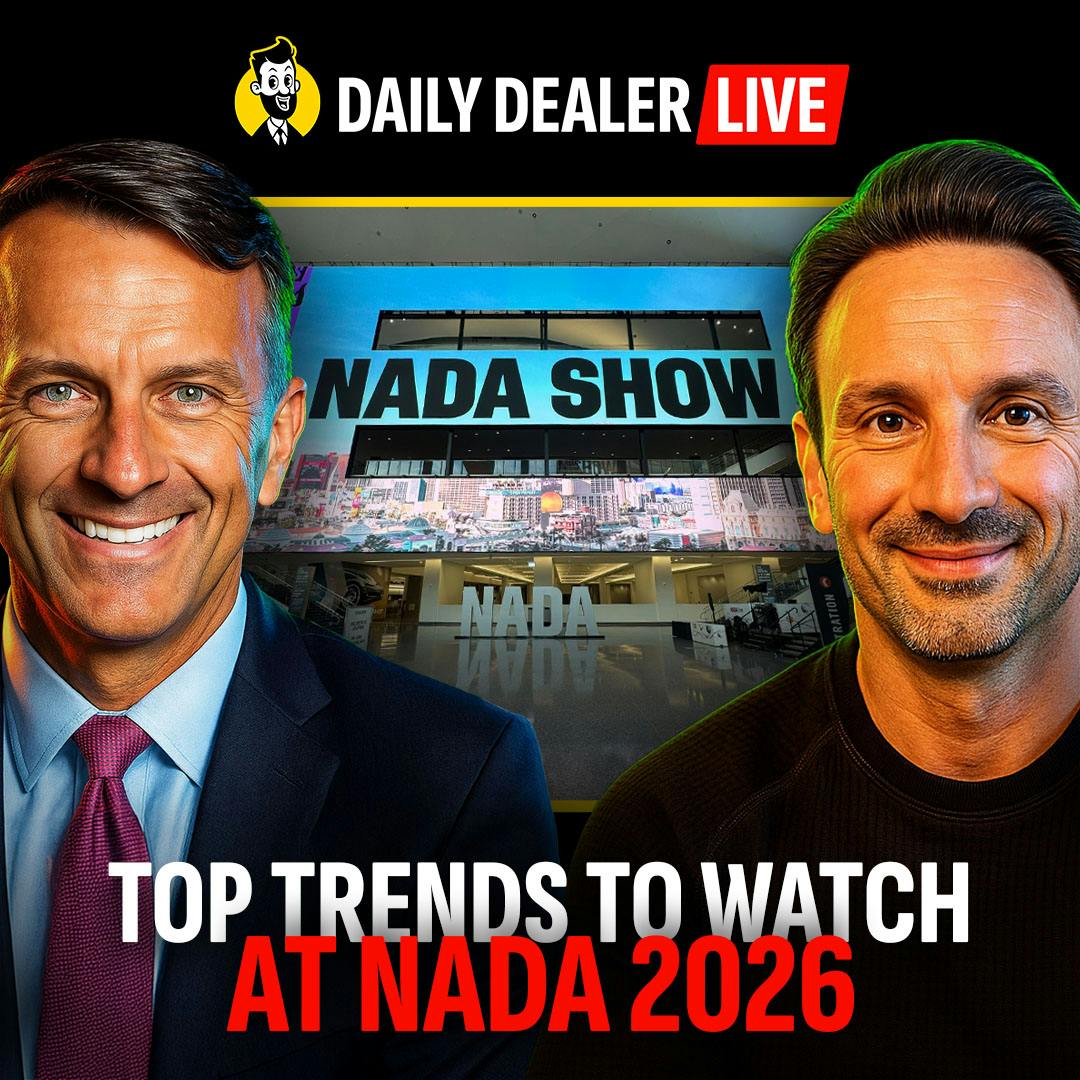
The episode features a lively discussion from the pre-NADA conference, highlighting key industry trends such as AI adoption in dealerships and the shifting dynamics in the new car market, where higher-income buyers dominate. Guests include Brian Benstock, who shares insights on the 'Year of the Horse' as a time for growth and strategic alignment in the automotive sector. The episode also touches on dealership profitability, the impact of tariffs, and the challenges of affordability for middle-income buyers. Excitement builds for the upcoming NADA show with various events and discussions planned.
Today's show features:
- David Steinberg, CEO of Foureyes
- Brian Benstock, Vice President & General Manager Paragon Honda and Paragon Acura
- Robert Steenbergh, CEO of AutoPayPlus
This episode is brought to you by:
Siro – Your customer conversations are gold—but most dealerships never extract the insights trapped inside them. Siro helps your team tap that data for smarter coaching, consistent process adherence, and measurable PVR growth. Come visit us at NADA Show - Booth #6368 (North Hall), or book a 10-minute meeting for a chance to win some exciting prizes: https://www.siro.ai/event/nada2026
AutoPayPlus – AutoPayPlus is the premium biweekly payments provider in the country. By accelerating the equity in the vehicle on the consumer's behalf, AutoPayPlus shortens the loan term and reduces negative equity - all while increasing PVR and making consumer payments more affordable. E-mail [email protected] for more information.
Foureyes – Foureyes helps dealers turn data into action. Starting with a clean, connected data foundation across dealership systems, Foureyes empowers dealerships to use that data to drive consistent execution throughout their business. The data stays dealer-owned, vendor-neutral, and works with any tools or partners. More than a CDP, Foureyes is a reset for how dealer data gets put to work. Headquartered in Oregon, Foureyes employees live in 20+ states to be closer to the communities where dealers are. Visit https://www.foureyes.io/ to learn more
Check out Car Dealership Guy’s stuff:
CDG Circles ➤ https://cdgcircles.com/
CDG News ➤ https://news.dealershipguy.com/
CDG Jobs ➤ https://jobs.dealershipguy.com/
CDG Recruiting ➤ https://www.cdgrecruiting.com/
My Socials:
X ➤ https://www.twitter.com/GuyDealership
Instagram ➤ https://www.instagram.com/cardealershipguy/
TikTok ➤ https://www.tiktok.com/@guydealership
LinkedIn ➤ https://www.linkedin.com/company/cardealershipguy/
Threads ➤ https://www.threads.net/@cardealershipguy
Facebook ➤ https://www.facebook.com/profile.php?id=100077402857683
"...those like Honda that have invested in the United States..."
Honda is a car company that makes many different types of vehicles. They are popular in the U.S. because their cars are known to be dependable and save on gas.
Honda is a well-known automotive manufacturer that produces a variety of vehicles, including cars, motorcycles, and power equipment. The company has a significant presence in the United States and is known for its reliable and fuel-efficient vehicles.
"...the Japanese automakers had a pretty good monopoly there. And then the Koreans came in and took a piece of that."
Japanese automakers are car companies from Japan, like Toyota and Honda. They are famous for making reliable and well-built cars.
Japanese automakers refer to car manufacturers based in Japan, known for their reliability, innovation, and quality. Brands like Toyota, Honda, and Nissan have dominated global markets for decades.
"...And then the Koreans came in and took a piece of that. Now, a very short period of time..."
Korean automakers are car companies from South Korea, like Hyundai and Kia. They are known for making affordable cars with good features.
Korean automakers refer to car manufacturers based in South Korea, such as Hyundai and Kia. They have gained popularity for offering affordable vehicles with good features and warranties.
"...the Chinese have come in and taken a significant portion of that market by driving low-priced, excellent vehicles."
Chinese automakers are car companies from China. They are becoming popular for making low-priced cars that are often good quality.
Chinese automakers are car manufacturers based in China, which have rapidly expanded their presence in global markets by producing low-cost vehicles with competitive features. Brands like Geely and BYD are examples.
"And so if the inevitable happens and companies like BYD come into the United States, I'm wildly impressed with the quality of those vehicles."
BYD is a car company from China that makes electric cars. They are known for their advanced technology and eco-friendly approach.
BYD is a Chinese automotive manufacturer known for producing electric vehicles and batteries. The company has gained recognition for its innovative technology and commitment to sustainability.
"And genuine competitors, I saw the BMW equivalents that I thought were nicer than the BMW."
BMW is a well-known car brand from Germany that makes luxury vehicles. They are famous for their high-quality and performance cars.
BMW is a German luxury vehicle manufacturer known for its performance-oriented cars and motorcycles. The brand is recognized for its engineering excellence and sporty driving dynamics.
"Mr. Farley over at Ford talked about some of the Asian vehicles that he purchased, the Chinese vehicles specifically, and that he thought those were some of the best cars he's ever driven."
Ford is a well-known car company from the United States that makes different types of vehicles, including trucks and cars.
Ford is an American automotive manufacturer known for producing a wide range of vehicles, including trucks, SUVs, and cars. It has a long history in the automotive industry and is recognized for models like the Ford F-150 and Ford Mustang.
"...and that Ford's residuals just couldn't justify that trade cycle management."
Residuals are the expected value of a car after a few years. It's how much the car is thought to be worth when you want to sell or trade it in later.
Residuals refer to the estimated value of a vehicle at the end of a lease or after a certain period of ownership. This value is important for determining lease payments and resale value.
OEMs are the original companies that make cars. They create the vehicles and the parts that go into them.
OEM stands for Original Equipment Manufacturer, which refers to companies that produce parts and equipment that may be marketed by another manufacturer. In the automotive context, OEMs are the car manufacturers themselves.
"...to take a serious look at trade cycle management. I think it's been an NDAB recommendation every year."
Trade cycle management is about how car companies manage the buying and selling of cars over time. It helps keep customers coming back to buy new cars from the same brand.
Trade cycle management refers to the strategies manufacturers use to manage the lifecycle of their vehicles, including how they handle trade-ins and the resale of used cars. This helps maintain customer loyalty and keeps them within the brand.
NADA is a group that represents car dealers in the U.S. and holds a big meeting every year for people in the car business.
NADA stands for the National Automobile Dealers Association, which represents the interests of automobile dealers in the United States and hosts an annual convention for industry professionals.
"...you'd better have an extended service contract. I think an interesting conversation we have this week at NADA as we all get together is,..."
An extended service contract is like an extra warranty for your car that helps pay for repairs after the original warranty runs out. It's useful if you plan to keep your car for a long time.
An extended service contract is a type of warranty that covers certain repairs and services for a vehicle beyond the manufacturer's warranty period. It can provide peace of mind for car owners, especially for long-term loans.
"...when Brian was talking about the affordability of leases,..."
Leasing a car means you pay to use it for a few years instead of buying it. At the end, you can either buy the car or give it back.
A lease is a financing option that allows individuals to use a vehicle for a specified period while making monthly payments. At the end of the lease term, the individual usually has the option to purchase the vehicle or return it.
"...when your standard Accord lease across the country, you were that, what, $175 a month?"
The Honda Accord is a well-known car that many people like because it's reliable and comfortable. It's a good choice for families and commuters.
The Honda Accord is a popular midsize sedan known for its reliability, spacious interior, and good fuel efficiency. It has been a best-seller in the United States for many years, often praised for its value and comfort.
Select text to request an explanation
We're doing better as a result of social media presence.
It doesn't do those three things, then it's on the chopping block.
It's in return on investment discussion.
Hey everybody, welcome back to another episode of The Daily Dealer Live.
I'm your host, Sam Darkin.
Welcome to the space where automotive comes together to learn, to share, and most importantly,
to execute.
Folks are executing behind me in a big way.
Thanks for choosing to be here this Monday, February 2nd.
We are pre-NADA streaming live from AFSA in the Balagio Hotel.
By the way, you ask, what am I doing on the conference floor?
It's not particularly quiet.
I didn't have internet in my room.
Balagio in-room internet is not elite, but the internet here is much better as is the
activity and the excitement in this place as all of automotive gets together.
There's a few conferences happening pre-NADA, including AFSA.
Tomorrow, we'll have the Hague event.
Presidio, I think, is doing an event as well.
Team America, as is JD Powers.
We're excited to be part of all of that tomorrow.
But today, delivering a keynote here at AFSA, welcome everybody.
Coming up today is part of the show.
We've got Brian Benstock joining, plus a preview of this week's events at NADA here in Las Vegas.
And the industry perspectives on all things tech in automotive.
We've got three great guests coming up on today's show, but first, today's automotive industry headlines.
First up, kicking off tomorrow is the NADA show.
It's one of the biggest gathering points of the year for dealers, automakers, and vendors
to network, to share insights, and to gear up for the year ahead.
And this year, there's one topic that is rising to the forefront.
It's AI adoption inside dealerships.
There are more than 20 sessions directly focused on AI automation and analytics across sales,
service marketing and operations, plus a headline super session centered entirely on whether AI is
becoming, is it a disruption, or is it a competitive advantage?
Another major focus is fixed ops and recon efficiency, as front end margins tightening heading into 2026.
NADA's agenda is packed with sessions on service retention, technician productivity,
mobile service, and speeding vehicles from acquisition to frontline ready.
And staffing remains front and center.
Dealer turnover is still elevated, especially in sales and service, with a growing technician
shortage that NADA estimates at roughly 37,000 texts per year.
37,000, not surprisingly, multiple sessions are aimed at recruiting smarter, improving retention,
and addressing burnout for those texts.
Per usual, NADA has its finger on the pulse when it comes to the latest happenings
in the auto industry, and this year is shaping up to be no different.
We hope to see you here.
And if you happen to be in this room, or if you're a part of the session later on today,
come on up and say hi.
I'd love to have a chat with you no matter who you are, where you are, and what you're doing,
and learn a little bit about what it is you're accomplishing here this year at NADA.
Next up today, we're looking at how the new car market is drifting further apart with higher
income borrowers carrying more of the load than they used to.
Five years ago, buyers making under 100,000 were about half of the new car market.
Today, those buyers are about a third.
Meanwhile, buyers earning 200,000 or more now make up nearly 30% of new vehicle sales.
And as prices and payments have climbed, a lot of middle income buyers have been pushed into
used cars, or they've been pushed completely out of the new car market entirely.
What's the bottom line here?
Well, dealers in certain regions are serving a smaller, wealthier slice of customers,
while everyone else is getting routed into strong used CPO or lease programs.
And that is brought to you by affordability and the challenges that face us with that.
In other news today, dealership profitability improved in 2025,
marking the first annual increase since 2021.
And profits are still nearly double pre-pandemic levels.
However, Q4 looked rough on the surface.
Tariff fears and expiring EV credits pulled demand forward earlier in the year,
which made the fourth quarter feel weaker than it really was.
And front-end gross isn't bringing in the lion's share anymore.
Fixed ops, FNI, and used cars, well, they're doing the heavy lifting in automotive today,
profitability speaking, with service in parts now generating more than half of total gross profit.
And with the auto care market already north of $400 billion and still growing,
dealers could have a longer runway, even as vehicle margins normalize.
What's the big picture here?
Well, the pandemic profit spike may be over, but dealers are still running at historically high
levels as we settle into 2026.
And last up today, Victory Automotive Group was purchased by Bob Lindsay Honda
in Peoria, Illinois, from the Lindsay family in a deal that closed December 2nd.
And this is an M&A update for you.
For context, Canton, Michigan-based Victory Automotive, one of the largest private groups
in the country, renamed the dealership Victory Honda Peoria.
The reason?
Roger Olson, Victory's COO, told us, quote,
were leveraging past deals for referrals on future deals.
And Peoria, Milford, and Gertin were all developed organically through our growing network of sellers.
Victory Automotive now owns 61 stores on both coasts and nearly everywhere in between.
Folks, you can see this deal announcement and many more throughout the entire year by visiting
the CDG Bicell Tracker at cdgbicell.com, powered by the Presidio Group.
And by the way, our jingle makes me happy.
Even with all the chaos and the excitement, everything going on behind me,
you can hear the announcement being made in the hall as participants go from the hall back
into the next session.
You can see this announcement and many more throughout the entire year by visiting the
CDG Bicell Tracker at cdgbicell.com, powered by the Presidio Group.
Well, that's a wrap on today's industry headlines.
Julie, what's up?
Man, I got to say, I'm feeling the energy come through the screen already.
I'm like chomping at the bit to be there next to you.
It's kind of fun.
You can see everybody running.
There's people running around taking pictures and all sorts of amusement at what the heck
we're doing here.
But it is excitement.
And it's fun.
Every year at NADA, there's excitement around this industry, what's going on.
People are excited about the future of it.
And it's not a faux excitement.
It is energy created by people coming together to try to find solutions to solve problems.
So today, as I mentioned, U.A., I take the stage in a roundtable discussion,
discussing the role dealers and lenders play in creating an elite customer experience.
So what are those friction points experience?
I'll talk about it on stage.
So how does the lender come together with the dealer?
And how do we provide a more manageable payment to the customer?
So anybody that has perspectives on that will ask Brian Bensock, his today is part of the show.
And then Tuesday, I get to be on stage with my friend Dennis Gingrich,
Jeff Stafford at JD Power's annual event.
You'll see Yossi.
He's with Alan Haig tomorrow at their event doing a keynote.
And Yossi, by the way, the Cardiola ship guy himself is on the NADA main stage coming up this week.
And then, of course, you and I, Yuli, we're going to broadcast live.
Like I'm doing here, we'll have a little bit different setup, professional cameras.
We'll have all the lighting.
And we're going to do the show live from the lot links booth on Wednesday and Friday.
And joining us for the Wednesday show, Andy Elliott,
which we may get a chance to talk a little bit about him with Brian Bensock.
Also Tiago with Nissan and Infinity to talk about plans Nissan Infinity has.
And I think we've got some big names from the General Motors world,
plus a couple of other surprises coming up Wednesday's show as well.
So just an exciting week coming up, Yuli.
Are you ready for this?
I'm always ready for this.
I'm very excited.
Yeah.
Have you eaten your Wheaties and are you energized and ready for the week that is ahead?
So and as a reminder to everybody, we're watching our comments all across social media.
Kathy Pet 4738 said, I'm looking forward to this year's NADA.
Dan C says, looking forward to hearing a recap from you on the AFSA conference.
And Paul Salisman comes in says, happy pre NADA show Monday.
And then I've got people walking around me.
My cord was almost dragged out.
So if the camera goes one way, that was a photographer trying to get a different angle.
It's fascinating.
Just all the stuff.
All right.
Let's dive into today's show.
First up today, Brian Bensock, Vice President, General Manager, Paragon Honda and Paragon Acura.
Brian, welcome to the show.
Hey, Brian.
Hey, gentlemen.
Thank you for that update.
Appreciate it.
You know what?
We're excited.
You're coming to NADA.
When do you get into town, Brian?
I'm getting in tomorrow night, Tuesday evening at seven o'clock.
All right.
We're excited to be with you.
Excited to see you learn from you and have conversations that help make us all better.
Let's start out, Brian Bensock, with the Year of the Horse.
You've talked a lot about it.
What does that mean?
When you say Year of the Horse, what do dealers need to do faster in 26?
And what should they stop doing, Brian?
Well, I think it's interesting.
Last year, the Chinese year, and I don't usually go by that.
I only go by that when it's in my intelligence self-interest, right?
Last year was the Year of the Snake.
It was a shedding of the skin, a transition.
And I think that's an ally to the change in administrations.
And again, whether you're for the prior administration or current administration,
no one can doubt that there's been a change, a transformative change,
a shedding of the skin to something new.
And we had Senator Marino in New York a year ago, and he said that last year was going to be a year of
transition and that 2026 was going to be an outrageous year.
And I agree with that.
This year of the horse is the year to run, the year to get your ducks in a line.
This is the year to have stamina in the industry.
It's a year of growth.
So I'm really excited about all that that brings for us.
We're seeing affordability return.
We're seeing interest rates dropping.
We're seeing some of the top end structural investments that are being made in the United States.
That takes a little while to strip the down to the economy,
but we're starting to feel that.
So I'm really encouraged by what 2026 has been bringing for all of us.
So Brian, you mentioned the transition and administrations from one to the next.
Some, even in automotive, as I walk around this floor here,
express some concern about the ongoing tariffs and the administration's overall tariff strategy.
You held firm earlier this year on that strategy as we talked to you.
What say you now January 2026 as it relates to tariffs
and its impact on automotive here in the U.S.?
We were right.
We were right.
We were right.
We believe in free and fair trade.
We've not been getting free and fair trade.
The U.S. taxpayers have been getting raked over the coals.
It's nice to have somebody in the White House
not making side deals to line his own pockets,
but to make deals that are good for America.
And we've seen country after country acquiesce because they know we're right.
You go to England.
How many escalates do you see in England?
Zero.
How many?
Yeah.
Yeah.
So why?
Is the escalate less of a vehicle there?
Is it less desirable?
Hell no.
It's a fantastic vehicle.
We don't sell escalates.
But there's no, you know, these vehicles are taxed 30 and 40%.
Some of the Latin American countries, our vehicles are taxed 20, 30, 40%.
Yet we only charge them a minimal tax.
So I think as we level out their playing field,
we're going to see some of the import dealers having an advantage.
Those like Honda that have invested in the United States
are going to have an advantage over those manufacturers
that have not invested in the United States of America.
And that's as it should be.
That's good for the American workers.
It's good for the American economy.
It's just going to take some time, you say, to have that work out
and reach some sort of balance.
The other thing that's on many auto dealers' minds right now, Brian,
is the threat of Chinese EVs subsidized by the state of China
coming in across our borders, either from Canada or Mexico initially,
and then maybe even being offered here in the US.
What say you about that concern?
Is it a much ado about nothing or is it something we need to watch?
It's a genuine concern.
If you take a look around the world,
the Chinese automakers have taken over significant pieces
of other industries' market share.
You look at countries like Norway,
that's nearly 90% battery electric vehicles,
and many of those or the majority of those are Chinese.
And this is being repeated around the globe.
I was in Kazakhstan.
And Kazakhstan was initially in 92, the Soviet Union fell.
And the Japanese automakers had a pretty good monopoly there.
And then the Koreans came in and took a piece of that.
Now, a very short period of time,
the Chinese have come in and taken a significant portion of that market
by driving low-priced, excellent vehicles.
And keep in mind, again, free and fair trade,
they don't pay their workers anything.
The workers don't have the benefits that our US workers
have worked hard to get and deserve.
So you can't have fair trade when you've got practically
slave labor going on over there.
So I think the tariffs have been a very good pumping of the brakes
to give the US auto manufacturers a chance to catch up
and to cause China to have to take a good look.
If you want to be in this market,
you're going to have to play by the same rules
that the UAW and the other automakers have to play by here.
If not, keep your cars elsewhere.
That being said, I think it's inevitable
that we're going to see continuation of the expansion
of auto manufacturing by the Chinese in the United States of America.
So as an aside, I don't want to go too far down this,
but it's fun watching you on social media, Brian.
You've been in Kazakhstan.
I saw you, I think in the UAE, you're pro-tariff,
but you're out traveling the world talking automotive.
What are you doing in these international locations
in your role?
What are you doing and what's your approach?
What's your strategy?
What's your goal?
One word, learning.
I think, you know, success leaves clues.
And I think some of these things, you know,
we always think that the United States is the leader in everything.
And that's not necessarily true.
There are many other markets that are more progressive
than our market, our industry here.
And so I'm trying to learn to see what may very well be coming here.
And we think, some of us think,
that the battery electric concerns are over,
you know, with the Trump administration, they're over.
And I don't think that's the case.
In fact, the high watermark for ice vehicles was 2017.
That's a long time ago.
And many European countries have had massive adaptation
to battery electric vehicles.
So I think that's something we have to deal with here.
I think on the technology front,
some of these other places that I visited
are doing an incredible job.
I've met a couple of dealers whose groups are selling
over 100,000 cars a year.
And those are very impressive numbers there.
So in addition to sharing some of my thoughts
and maybe experience in the United States with people overseas,
I'm learning and taking back things
that we can put in place here in our dealerships in the United States.
So I was going to ask you for one key takeaway
as we head into this NADA,
that you learned from your international exposure.
Was it EV related or is there a strategy
that you learned from your international exposure
you're bringing back into Paragon Honda
and to the US auto industry brand?
Well, there are a number of things.
I think there are opportunities over in other countries
for people such as myself, Steve Greenfield, Chip Perry.
We're taking a look at the gaps there and say,
hey, perhaps we can help out.
But there's also some consolidation that they've got there.
And I think that they are taking a very good look
at the Chinese manufacturers instead of fighting it
seeing how they can integrate that into what they're doing.
So certainly a part of my strategy
will be to make sure I insulate the Paragon stores
against the Chinese quite possibly by raising my hand
when they come here and take them in.
That was going to be my next question, Brian.
Would you be a hand raiser for one of the first points
when they came in?
And if so, does that not conflict
with your overall strategy of protect the US economy
from that product?
You know, I'm micro.
I'm not macro.
I don't set US policy.
And so if the inevitable happens and companies like BYD
come into the United States,
I'm wildly impressed with the quality of those vehicles.
I met with Stella Lee, I believe it was about three years ago
in Manhattan, and I drove the BYD vehicles.
And I thought, wow, the ergonomics
are not quite as great as Honda.
The touch on the screen is not the same.
The cars were fast and the cars were beautiful.
But I said, we're good.
I drove the BYD vehicle a year ago in Kazakhstan.
Those cars have come a long way.
And genuine competitors, I saw the BMW equivalents
that I thought were nicer than the BMW.
I thought they were much more affordability.
They had materials that I've never seen before.
The cars were beautiful.
Do they have the longevity?
Well, we can't say.
They've not been around long enough.
Do they have the service?
We can't say.
But the vehicles are at such a discount,
I think many Americans consider giving the opportunity
to buy those cars.
So Brian, I love your strategy of visiting there
and understanding and learning it more.
Do you think OEMs here in the US are missing the mark?
If they are not.
And we had Senator Morano on.
We talked to him, hey, do you see a future of Chinese products
coming in the US?
He said, absolutely not.
I think us isolating ourselves as an economy from BYD overall
is the wrong play.
Do you think US OEMs should be out visiting Chinese plants,
understanding and trying to reverse engineer
to understand how they're doing it from not only a cost standpoint,
but some of the technology benefits they have?
Well, I think a manufacturer not doing that would be remiss.
And I'm sure that they all are.
Mr. Farley over at Ford talked about some of the Asian vehicles
that he purchased, the Chinese vehicles specifically,
and that he thought those were some of the best cars
he's ever driven.
So I think that's got to give a chairman like that
a good wake-up call as to what's necessary.
I think Honda had a little bit of a drop of their market share
in China.
I think that's got to give them a good wake-up call.
And what's happening now?
The US market's becoming increasingly important
for all global manufacturers.
And so we've got this blood-fest here,
and hopefully we see some of the manufacturers stepping up.
A lot of these guys cut back on advertising,
got away from the DAAs, got away from incentives.
Hey, guys, it's time to wake up.
Okay, guys, for the horse, it's time to run.
Time for manufacturers to do what they do best,
and manufacture and allow us, dealers, to sell cars.
Stop with this Beb nonsense.
Mandates forcing us to sell crap.
People don't want to buy.
Let the market dictate.
Imagine that.
Building what you want to buy.
What an old-fashioned, old-fashioned.
Yeah.
So, Brian, before we go into payment affordability,
which I want a cheat sheet for my keynote here at AFSA,
I want your perspective on payment affordability,
which is a problem, right?
But before we go into that, you said you want to focus this year.
It's the year of the horse.
What are two or three areas where US auto dealers
should focus on execute to speed to win in 2026
in this year of the horse, Brian?
You know, I'll go back to Jackie Cooper, WAD.
Write a deal.
Write old deals.
Write another deal.
You've got, we've got to get back in.
Oh, I like that.
Yeah, I mean, we've got to go back to creating customers
and stop with this nonsense of, you know,
are we going to sell less cars and make more money?
That's a failed strategy.
That's a strategy to give up.
We are merchandisers and marketers.
We sell fantastic automobiles.
And so, you know, write a deal.
Write old deals.
Write another deal.
It's a strategy for success.
Keep it simple.
And if we do that and we can focus on that,
manufacturers can get their ducks in a row.
I think we'll be in great shape.
Excellent.
All right.
So I'm here at this conference.
It's lenders, dealers, and industry.
So, you know, captive financers and then other entities
focused on fraud and lending and all that.
So one of the big topics in automotive today is
the average price of a vehicle and the high cost of payments
to the consumer.
How do dealers and lenders, Brian Benstock,
in January 2026, come together to help provide
a more affordable payment to the consumer,
yet preserve profit to the dealer,
yet also preserve a lender's interest,
which is a return on their portfolio
and preventing fraud and other things.
Brian Benstock.
You left somebody out of that.
You left the manufacturers out of that.
All right.
Bring it in.
Let's go.
They have nothing to do with this.
As you may recall, during COVID,
when we were producing less cars,
they produced the most expensive cars.
And that's what they could help their profitability.
Hey, guys, it's time to build what customers want, right?
Well, let's not wait for the Chinese to come in
with these cars.
Let's build what customers want.
Give them some affordability.
Now, the part that the lenders play,
we're going to see a reduction in interest rates.
I think the new Fed share that's been sort of announced
by the Trump administration is somebody
that's going to drive the rates down.
And I'm sorry that a noise.
The markets didn't like him, though, Brian.
The markets didn't like him.
Well, yeah, of course, because they capitalized
by us paying higher interest rates.
I want those lower interest rates.
What's wrong with our flow plan rates going down?
What's wrong with consumers having affordability?
What's wrong with having lower interest rates on credit cards?
Who are these people that benefit from that?
It's not us, right?
And so I think the interest rates are going to come down.
I think the strategy for the lenders
would be go back to trade cycle management, right?
Trade cycle management is short-term leasing.
The nonsense that they're trying to sell dealers on
and dealers are willing to accept
is 84-month financing, 96-month financing.
That's so harmful to the consumer.
No, it's harmful to the industry.
Everybody, yes.
It's a suicide bill.
You never see them again.
And it's also, you know, Tony Robbins,
I went to a seminar many years ago.
He's got a guy on stage.
He says, picture everybody you know that's 300 pounds.
And we can all picture somebody that's 300 pounds.
Just picture everybody you know that's 90 years old.
We can picture people that are 90.
He said, picture everybody you know that's 90 years old
that's 300 pounds.
You can't picture anybody.
And his statement at that time was,
if you want to eat a lot, eat a little.
And you'll be around to eat a lot.
And I think that's analogous to,
if you want to earn a lot, earn a little,
but have the frequency, like at least short-term lease.
And if you look at, many of these dealerships today
are being run by the F&I departments.
And the F&I departments have an easy way
of making higher profit, presumably,
on a long-term finance contract
where the customer's obligated to pay thousands
and thousands of dollars in interest.
I'd rather have multiple transactions
in the same period of time.
Let's say it's a seven or an eight-year period of time.
We could potentially sell that customer three new cars
and take in trades.
And that's five transactions.
You know, our motto at Paragon is find, serve, keep.
And we want to find more customers.
We want to create more customers.
We want to serve more customers.
We want to keep more customers.
And I think the strategy of trade cycle management
every 30 months, new to you every 30, is a great way to go.
Keep in mind, Eustace Wolfington created half a car in the 90s.
Sold it to Ford Motor Company.
For nearly a half a billion dollars.
That was real way back then.
The program was massively successful.
The challenge was that the Ford product
couldn't keep that residual where it needed to be
to make it profitable for Ford.
But the notion of trade cycle management,
the notion of selling somebody a car today,
planting the seed for the future sale
in a relatively short period of time,
opens the opportunity for the most valuable thing
we can do as a business.
And that's frequency.
Take a look at the iPhone.
iPhone, they've got every year,
they've got a new one of these coming out.
Every year, they do everything they can
to make you want that new phone.
It's the frequency.
I've never replaced an iPhone that wasn't adequate.
You know, I've dropped them and broken them.
They're not adequate, but they come out with something new.
And the features.
Well, they've mastered the retention aspect of that.
Trade cycle management, right?
So, Brian, you mentioned the Ford experiment
and that Ford's residuals just couldn't justify
that trade cycle management.
That's right.
That's on Ford, though.
That's too much product back then.
So, here's my question for you in January of 2026.
What's your call for OEMs?
February.
Discipline.
February.
Thank you.
Happy February, everybody.
What's your call to OEMs in February of 2026
as it relates to inventory, discipline,
and entry price point to both problems
we're faced with today, Brian.
Well, you know, retention is a shared opportunity
for the OEMs and the dealers.
We have a role to play, and certainly they do.
But, you know, I would encourage manufacturers
with great residuals, like the Honda Motor Corporation,
to take a serious look at trade cycle management.
I think it's been an NDAB recommendation every year.
You know, it's really a fine sort of keep customers,
keep them recycling through the system,
manufacture used cars, keep them within the Honda world,
and sell more cars.
It's the only way I know of geometrically increasing
your customer base.
And so I would like to see manufacturers,
and more specifically, Honda and Acura,
take a good look at a comprehensive trade cycle
management program.
It feeds all five of the profit centers in the OEM cars,
used cars, finance, parts, and service.
Brian, I object.
You're saying Honda and Acura,
because that's your franchise.
We will have more franchises there first.
Ford to Ferrari, everybody.
Let's go.
All right.
Brian, let's talk.
Oh, go ahead.
It'd be nice.
But let's start with Honda and let them lead the way.
Yeah, yeah, yeah.
Are we going to see you at NADA at some point?
I know there was some banter about,
we need to go do a workout,
pull Andy Elliott for Wednesday show
and sometime do a morning workout.
Well, no banter about it.
Elliott and his Elliott army and I,
and a couple of like-minded individuals
will be in the gym, kicking the stuffing out of one another.
And then I'll get back to the day.
I mean, I see that happening Tuesday and Thursday.
So yeah, you can find this.
The gym is to be announced.
He's going to find some big place where we can all fit
and go in there and then kick it around.
Let me know, man.
All right, great.
As am I, Brian Benstock, Vice President,
General Manager, Paragon Honda Paragon,
Acura looking forward to seeing you in Vegas.
Thanks for being on the show today.
Thanks, guys.
Appreciate it.
Thanks, Brian.
And by the way, he gave me a great cheat sheet for my keynote here.
So I love it.
That's fantastic.
All right.
Let's keep it going because we've got a lot of content
remaining.
Next up, one who's been on the show before.
I think it's a second appearance, David Steinberg,
CEO of Four Eyes.
Welcome to the show, David Steinberg.
Coming to you, coming to you live in my leisure wear.
I'll check this out.
All right.
From my leisure wear in the cell phone parking lot
of Whitefish, Montana, Glacier Airport,
headed to Vegas.
Wow.
So I'm committed.
2026, I only travel in leisure wear.
There's no travel day.
So David, did you come to NADA last year in New Orleans?
Of course.
Of course.
OK.
Did you make it?
There was the tale of two stories.
Some didn't.
Some did.
You were among those who made it.
And I was fortunate.
I was able to hitch a ride with a dealer friend.
And so we made it without problems.
All right.
Well, this year, I can assure you at 70 something,
it's beautiful in Vegas, sunny, dry.
So there will be no weather challenges this year.
So tell us, David, the question we ask everybody
coming on the show, how's Biz?
And tell us a little bit about yourself
and what you do out there.
Business is exciting for us right now.
I think that we just finished the biggest rebuild
we've ever done in 4Eyes, which is our 4Eyes launch we've had,
which is our 4Eyes Connect platform.
We're launching at NADA.
I think it solves a lot of core problems.
We have a lot of dealers who are early adopters.
And we've onboarded over 100 vendors
into our Consent platform.
So we can help dealers finally manage the Consent issues
that happen everywhere.
If you want to use multiple vendors,
they're all talking to your consumers
and no one's talking to each other.
And dealers are getting sued left and right.
So, but the Connect platform does a lot more than that.
It really enables dealers to build their own workflows,
to control their data, to push data where they want,
to connect to platforms outside of automotive.
It's for years.
And we've had this sort of,
the outline of this going for years.
And we finally sort of rebuilt the architecture
to be able to do that.
Awesome.
Hey, what do you see,
what are the most common data disconnects
you see in February, 2026 in dealerships today?
When you think about all the different entities
that connect with each other, CRM and all the other things.
Well, the number one thing is,
I think that there's been this original sin in automotive,
which is that we have an industry
that is an ecosystem of unconnected data.
Everyone talks about siloed data.
You've got my CRM, my DMS, all of that.
But that, the rest of the world evolved in 2016, 2017,
when big data became a thing,
everybody started pulling data out of their legacy systems.
Every industry has legacy software.
We have legacy software, you have legacy CRMs,
you have legacy DMS, you have legacy software everywhere.
But automotive did something unusual in 2017,
which is some big providers shut down data plumbers.
That was the authentic common lawsuit.
Same thing happened in healthcare,
which has the same problems of automotive.
And so what happened is basic data plumbing wasn't a thing.
The modern dealership doesn't have good data plumbing,
does not have the ability to access their data very well,
doesn't have the ability to connect
to systems outside of automotive.
They're stuck with any vendor they use
is controlling their connectivity.
And so as a result, now you're seeing
as people try to adopt AI,
they're having all these problems
where it just feels like the pipes are bursting.
They're really unable to get the juice from the squeeze
in setting up systems
that can actually improve the customer experience.
And part of improving the customer experience
is a massive amount of connectivity.
Is having those AI platforms talk to each other,
talk to the BDC rep, talk to the salesperson,
keep everybody in the loop?
Dealers infrastructure just isn't set up right.
So our goal with Connect is give them that modern infrastructure
that allows them to lay it on top of their legacy systems
and really catch them up to 2026.
So if a dealer suspects that that data foundation
as you talk about is broken and you indicate so many are,
what are a few tests a dealer could run to kind of figure out?
Is it broken? Is it working? Do I need to work on it?
Well, I think some of the symptoms of it being broken
are one, you know, consent issues.
If you can't even reply to a customer saying stop
and you can't honor that
because you have seven different vendors talking to the consumer,
then your system's broken.
I think two, the amount of times you can't get there from here.
So like the amount of times dealers spend
in what we call collect and connect tell
where they're just trying to build a report,
just trying to chase down data
and they end up with a report
and it's got a bunch of asterisks in it
because it took them eight hours to do
and it can't answer the next question.
And so you end up in these stuck wheels.
You know, we look at dealers, for instance,
so much of the AI adoption right now
is about improving long-term close rate,
improving your ability to sell a customer day four to day 30.
But so many dealers can't even measure that.
They can't, they don't even have the measurement
to say whether or not their AI strategies are working.
So what are the steps to fixing that?
And I know it's probably part of what you're talking about
at your booth at NADA,
but if you had to outline a few steps
dealers should undertake to fix it,
what would those steps be?
Yeah, so modern data plumbing
would take everything out of your CRM,
everything out of your DMS, your inventory system.
It would bring it all together into a modern data warehouse
that is set up so everything is transparent.
You can see all the business rules
that have happened to merge duplicate leads,
to bring stuff together, to clean up your data.
And on top of that, you have reporting
and you have connectivity.
And I think that we've been doing this
with some of the biggest dealer groups in the country
and it is opening their eyes to a new world
where one, you know, dealers right now,
a lot of us vendors benefit from this ecosystem
because we get to charge dealers $2,500 a month
to do pretty basic stuff per location.
And so I think when you start to look at a lot of the ways
that dealers can build and if they have the right connectivity,
is they're able to do things at the group level
that are significantly cheaper than what they were doing before
and the cost center for dealerships
is just going up and up and up and up without better results.
Yeah.
David, when you talk about the technology sitting on top,
can you walk us through what that new piece looks like?
Because I mean, that seems like the ideal scenario
for solving that friction point that we all have.
Yes, so if you think right now you have your CRM, your DMS,
you have other vendors as well.
So every vendor is generating data,
but that data doesn't even have piping to land someplace.
So let me give, I'll give you an example for myself.
Sam, I think some of your stores use our like prospect engagement tool.
They do.
We send out an email.
We send an email, we suggest vehicles, we send it.
But guess what?
Your CRM cannot even accept the contents of that email.
So there's no record of that email really going out
to the consumer in the overall record keeping.
So one of the things we put in place in our system
is a communication log.
And we get all the vendors who are talking to your consumer
to log all their communication in the communication log,
as well as every phone call, form, chat,
every communication with the customer
in a clean organized place.
When you have that, you can instantly see over communication.
You can instantly find the opt-outs where the customer's saying stop
and they're continuing to get hammered.
You can instantly see something that is hiding in plain sight,
but the dealers just didn't have connectivity.
They didn't have the piping set up
to be able to even collect that information.
So the average dealer has over eight vendors talking to their consumers.
And the average dealer only has one or two of those,
even writing any of that communication back to the CRM.
Yeah.
So where will you be at NADA?
How can dealers find you to learn more about this challenge
of data integrating and making it all make sense, David?
Yeah, find us at our booth.
We're at the West Hall.
We're next to this horrible location this year.
I'm a little bit worried about our NADA location.
Next to the Stellantis booth,
I should know the number off the top of my head.
I'm also speaking 12.30 Wednesday.
Oh, nice.
Where?
I'll be in W.
And what's your topic, David?
It's reclaiming your data in a vendor-driven world.
So a lot of the stuff about getting the true access and ownership over your data.
I mean, there's a lot there, too.
And there's more states now passing state laws about dealer ownership,
the fact that they've had to even pass these laws,
the fact that dealers are having to go advocate to own their own data.
A lot of these state laws aren't being challenged yet.
I think that we're probably pretty close to some of these being challenged.
Do you think there's going to be one big industry event
that causes the regulation or some greater oversight as AI comes into data,
not only from who owns the data perspective,
but also just from who's liable if there's a breach in some of these AI world scenarios?
Well, I think there's going to be a series of small to medium-sized events.
I mean, even if you look at the CDK hack.
So with the CDK hack, before the CDK hack,
CDK, Reynolds and Reynolds had successfully convinced dealers
that you just need to have your data in their system.
That's the only place your data should be.
They'd convinced a lot of dealers of that framework.
And then when the CDK hack happened,
everyone goes, oh, shit, this framework, it's a problem.
This is a problem.
So I think that was a crack.
I think that there's these legal trolls,
a lot of them coming out of Florida right now
that are suing dealers left and right and part budding up
with the attorney generals and going after dealers for consent issues.
That's a crack.
There's a series of small events.
All right, David.
One thing that NADA participants or attendees may not know about you,
but might be interested to know about you
is they come up and say hi to you on the floor
and they engage with you at your booth.
What's something that would surprise most people?
That's your last question.
My marketing team might have set you up for this one.
I got a few things.
I got a few things.
I was a child actor.
I was in some stuff as a kid.
No way. What were you in?
What were you in?
Well, you probably know this.
I was on the show, Life Goes On.
I don't know.
No, no, no.
Oh, yeah.
Remember Life Goes On?
Yeah, yeah.
I guess starred in an episode of Life Goes On.
That was probably the one,
the thing I did that you would know the most.
But this was back in the day.
I was in the same little group with Alicia Silverstone
and a bunch of...
She was the one of my group who became famous.
There were some other people, but yeah.
So that might be the thing.
I feel like my marketing team set you up.
Well, I don't know.
I mean, you said she was the one that came famous,
but you're the one on Daily Dealer Live, so I just...
Yeah, exactly.
Well, you're buying drinks in Vegas.
We're hearing all about this play.
I only heard about Alicia Silverstone and all the days.
And how you made the transition from child actor
over to CEO.
So David Steinberg, CO4 Eyes from Montana.
Best of luck in your travels into Vegas.
Safe travels, yeah.
I look forward to seeing you here.
Thanks, guys.
See you soon.
Thanks, David.
That was fun.
I didn't know that.
And by the way, his crew truly did not set me up.
I just thought, you know,
it'd be fun to learn something about everybody.
Paul Salisman chimed in.
He says 2471W, according to AI Search,
is the booth for four eyes.
They've got some really neat things going on.
We use them in several of our stores in the Ziggler Auto Group,
and they've helped us in the outreach piece.
Let's talk Ciro briefly before we go on to our last guest.
So today's episode is brought to you by Ciro.
Your customer conversations hold valuable insights,
but most dealerships never tap.
See how dealerships across the US use Ciro to extract that data
for smarter coaching and increase PVR by nearly 20% at Ciro.ai.
That's S-I-R-O, S-I-R-O.ai.
You can click the QR code.
Actually, it's this way, I guess now.
You can click the QR code on the screen here
if you're watching post-live.
You can also go to the show notes in the podcast library.
And I'm sure, I don't know where the booth is,
but everybody's here.
So they've got to be here as well.
So you can probably visit Ciro direct here on the NADA floor
if you'd like.
But we appreciate Ciro for supporting today's content,
including that cool insight by Brian Benstock.
Thank you, Ciro.
All right.
This is pure coincidence, Julie.
Both of our guests today, one with four eyes.
One is CEO of AutoPay Plus.
Very similar last name, spelled gently differently.
Pronounced the same.
But we welcome to the show next, Robert Steenberg,
CEO of AutoPay Plus.
Welcome to the show.
Robert.
Thank you very much.
It's good to be here.
Welcome.
Are you related to David at all?
Not at all.
Okay.
We're going to ask you this.
Were you ever a Kyle D'Actor?
No, I used to play a heavy metal band, though,
so I could get that right out of the way.
All right.
Wait, which band?
Well, none of you ever heard of, believe me.
Okay.
All right.
Well, we may have to see those skills at NADA.
Go ahead, you.
I was going to say, we got to ask you our signature question.
And I think there's another similarity here,
because our first guest was talking about
shortening the cycle, which I think Robert here
is going to pull back the veil on.
But how's biz in your neck of the woods?
Tell us a little bit about who you are and what you do.
Business is very good.
Even going into NADA, we're about to roll out a new product.
We had another all-time record year last year,
so we continue to grow.
We have about 125 employees now.
Keep spreading through more and more dealerships
throughout the country.
And basically what we do is, if you're familiar with
bi-weekly payments, we're the largest company
that does that for dealerships.
So effectively, you make 13 monthly payments a year
by making bi-weekly debits every 14 days,
and you shorten the term of the loan
and reduce the interest the customer pays,
and you reduce that trade cycle to get them back
to the dealer in a better equity position.
Now, I'm very familiar with your product.
We've used it in my stores and back many, many moons ago
when I was in finance, I was probably our number one guy
of pushing that because I wanted to see my customers
come back to me sooner if we couldn't get them into a lease.
But unfortunately, not everyone qualifies for a lease,
but your auto pay is pretty straightforward.
When you say you have a new product,
what's that look like for your company?
Well, we had the AutoPay Plus core product
for 20 plus years now.
So thinking about one more couple of the issues
we could solve for a dealer, one's retention.
Another one is they're facing, although I just saw your article
this morning that the dealer profits were actually up,
they're selling fewer vehicles and fewer FNI products.
So their re-insurance reserves are not
going to grow at the levels they have been.
So by coupling the AutoPay Plus core product
with a retention piece of the $499 credit
and making it thereby reinsurable,
it will turn into more of a core FNI product.
That way you've got something that's essentially free
to the customer because if they stay in the program
for two thirds of the term and don't miss any payments
or debits, when they go back to the dealer,
the dealer will credit them $499 for the next car.
So it's a service now that's essentially free to the consumer.
They get all the benefits of the reduced interest
and the short trade and the better equity position
and the dealer is getting his customer back faster
with the retention credit.
That's awesome. So that's a great reason to come back.
What does that look like for the consumer credit?
So the consumer pays $499 out of the stream of payments
over the term of the loan that's usually in the first year.
So it's not finance, it doesn't cannibalize any other FNI profit.
He comes back after the end of the two thirds,
complied with all terms, he gets the $499 towards the next car.
Gotcha. Now, in today's market, what do you think the two to three
biggest affordability signals that you're seeing
and how should dealers react?
The 84 and the 96 month terms are a real problem.
Even if interest rates come down a little bit,
the 84 month and the 96 terms are still a real problem.
And I do think they will come down somewhat this year with the new Fed share.
But the problem there is you have 20% of the payments now that are over $1,000.
Yeah. That's a big deal.
I mean, that's a lot for people. I mean, half of the loan is 72 months.
So I think you're going to see more and more people who want to use cars.
And even then, they're going to be fairly high payments
and they're going to need to find a way to pay them off faster.
I think you're probably going to see a surge in used car leasing
that we haven't seen in a long time.
And I think, like I said, for the people who will qualify,
there's going to be, I think,
higher lease penetrations than there have been in the last couple of years.
Let me ask you, what does accelerating equity actually look like
in real life numbers for most customers?
What are you seeing?
How soon can they change out of their vehicles using AutoPay Plus?
Well, usually, depends upon the term, of course,
the price of the car and the rate and everything.
But if you're trading and we usually look at around 37 months or somewhere around there,
it's usually a $2,000 to $3,000 difference on a normal deal.
And you get some of these crazy high payments deals.
It's a lot more than that.
Where do you see that the best place in deal flow that your product
should be brought up?
I mean, we were only using it in finance,
but I think right now probably makes sense up everywhere.
Makes fun of the desk.
I mean, probably only 20% of our dealers do it that way
because they have these predefined processes that I want to change up front
and every tower works a little differently.
But if you are able to go out on the floor to that customer
and quote them a $500 a month payment every two weeks,
as opposed to $1,000 a month, you're in a much better conversation, number one.
And number two, that idea will be in their head
when they get back into F&I and that kind of be preconditioned for,
because when you walk out and sell somebody, hey, it's $1,000 a month,
first thing I think is, can I get $1,000 out of my last paycheck?
So I'm a GM or my finance director, want to keep an eye on this product.
What KPI should we be looking at to make sure this is working for us?
Well, we have embedded importing.
We use a company called Vision AST that we keep an eye on the penetration levels,
the increase in PBR from the sales.
That's what we manage up front.
On the back end, we manage the number of people that stay in the program,
how long they stay in the program and say cancellations.
So if there's maybe some kind of disclosure issues we need to be worried about.
But it's mainly what the penetration is, it has increased the PBR.
And then we can tell you approximately how many months and how much negative equity you
saved as a dealer if these loans go out to what we expect the trade term to be.
I feel like a lot of customers are already preconditioned to this bi-weekly payment cycle
if you're a homeowner especially.
But in your experience, what are you seeing are the most common objections
that an automotive customer might have?
A lot of people just go, well, I can do it myself.
But the reality is you and I probably don't have more than 10 or 25 people
actually do that with their home mortgage.
So Robert, let's talk about that actually.
Does making it bi-weekly, so does splitting up that consumer payment,
does ultimately make the case to a dealer that is skeptical that says,
hey, does that really help the consumer?
It's just having their payments, right?
Does it really make it more affordable?
Does it really improve the performance of the loan?
How would you respond to a dealer that's a little skeptical about putting that on a consumer,
dividing up the payments into two, Robert?
Well, you know, a dealer's in a different position financially, right?
So he doesn't live paycheck to paycheck, number one.
If you tell a customer, hey, it's $500 a month and that's a lot to that person.
And they pay a budget $500 a month out of that last payment.
But if you tell them, hey, you told me you could pay it every two weeks,
can you get $250 out of each paycheck?
You're helping them budget.
Yeah, that's easy.
You're like, I can do it all day long.
So then by making those 14-day debits throughout the year,
you essentially make a 13th monthly payment.
So after all the fees are paid and everything else,
every time that comes up to we have additional money in your account,
we send it directly to principal,
which is another thing that a lot of people don't realize in the automotive industry.
You can't just send a principal payment to the same place you send the monthly payment.
They have a different lockbox, they have a different address.
Yeah, a certain way.
They won't let you do it electronically.
It's really kind of disgusting if you want the truth.
Maybe you can talk about that at AFSA.
But the customer is by making it easy for their budget,
they're going to stick to the plan.
They're going to have less cancellations on their F&I products
because they're going to have less defaults on the loans.
And the customers are going to naturally get the habit of doing that.
It won't be a problem.
They generally, even when you switch to the biweekly,
which in essence is on a true monthly basis, more money,
they buy another F&I product.
Because again, if you're going to have a 72-month loan,
you'd better have an extended service contract.
I think an interesting conversation we have this week at NADA as we all get together is,
how do we offer vehicles that we sell into the marketplace
in a way that helps consumers with more profitability,
retains profit to dealers, and protects the lenders?
And to you and everyone else who's working actively on that problem,
this is the problem.
It's a major problem in automotive.
There's going to be AI, which will be the buzzword on one side.
And then there's the practical dollar piece that is on the other side.
I love what Brian Benstock said about putting a little bit of OEM pressure
for discipline production, which will help ensure resell these vehicles remains high.
That supports the product that you're doing, Robert.
If you have high resell on vehicles, if you make biweekly payments,
you end up making an extra principal payment.
As a result of that increased discipline,
the consumer will ultimately benefit with that
by having a lower monthly payment and then three, four years down the road.
I think part of your argument is,
they'll be in a better place to trade that vehicle in,
and then that supports the trade cycle, Robert.
So at NADA, how can folks find you, Robert?
You know, we usually go through agents,
bring our products into dealerships.
So we don't have a booth at NADA.
No worries.
Who's your favorite agent, Robert?
Who's my favorite agent?
Yeah, that's a good one.
I like my kids.
I love them all the same.
Yeah, yeah.
Well, like I said, we have a suite at Crawford's.
People can email sales at autopayplus.com.
I think I can visit there or find my information
and meet up without the floor someplace.
Okay.
So I asked the other, Robert.
I'll ask David the question.
I said, what is something that would surprise people at NADA
upon meeting you that might be a good conversation starter
with you, Robert?
What's something most people don't know
about you as CEO of AutoPay Plus?
Well, I threw out the heavy metal thing already.
So yes, you did.
I guess so in law school, I kind of dab a little bit
with competitive bodybuilding.
That's probably another.
Oh, very good.
Well, you and Uli are right up.
Uli does bodybuilding as well.
So not competitive.
All right.
How far did you get?
Oh, regional level.
All right.
I wonder the name of the band.
The heavy metal band, I got to go.
I think the last one's called the given.
Couple comments we'll bring in from our audience
and then we'll let you go.
John Stevens says, 20% of payments
exceed $1,000 a month in 2025.
I heard earlier that homes with annual income
of 100K declined in automotive purchases
and homes with incomes of 200K increased
is it affordability?
Or are we seeing more of this split economy?
I don't know if you have an opinion on that
or not, Robert, but super interesting
when you think about the predicament
that the consumer is in right now in 2026.
Yeah, I mean, housing is a whole new thing.
It is part of the split economy.
Some of the numbers are a little different
because obviously as costs have gone up,
people's incomes have gone up as well.
It's not a best, but it does come down to affordability.
I mean, at the end of the day,
you're only going to get X dollars a month
and inflation is going to take more of that dollar.
You still got to come up with $500 for the car.
So yeah, now it's definitely an affordability issue.
And like your other guest said,
they need to start making cars that cost less than $100,000.
Yeah. Robert Steenberg, CEO, AutoPay Plus.
We'll see you in Vegas at NADA.
Thanks for being on the show today, sharing your perspectives.
Thanks a lot. I'll swing by some of the payments.
All right, come by and see us.
Julie, that's a wrap on our first sort of live show.
This is our quasi live show.
It's not the full real live show, though.
I'm thinking about how many of my customers
would love to have a $500 car payment.
Right? Yeah.
Yeah. How many?
I remember one. Not all of them.
I mean, you think about when Brian was talking
about the affordability of leases,
I remember when your standard Accord lease across the country,
you were that, what, $175 a month?
It's just how times have changed.
Yeah. Yeah, times have changed.
But that is our work in automotive, trying to figure out
how do we meet that consumer need?
You know, how do we take all three
of those spheres, bring them together?
And, you know, again, Brian Benstock quoted Tony Robbins.
I'll go back to a quote of his.
Having those tough conversations this week and into this year
are going to help us win an automotive.
The quality of our conversations determines the quality
of the relationships and our ability to execute
in automotive, Julie.
So we'll see you tomorrow.
You land tomorrow, I think.
Yes. I land tomorrow.
I'll see you guys then.
Yeah. We'll see everybody there.
So to our loyal listening audience,
to our daily dealer live audience,
thanks for watching today.
Daily Deal Live, where we break down the biggest moves
in the car business as they happen.
Don't forget we're here live every Monday, Wednesday, Friday.
Remember, we'll be here live Wednesday,
1 p.m. Eastern from the NADA Convention floor
with guests like Tiago from Nissan.
We'll have GM here, Andy Elliott, as I mentioned.
We're excited to broadcast live.
And then we'll be back again live Friday, 1 p.m. as well.
Don't forget we're here live every Monday, Wednesday,
Friday, 1 p.m. Eastern.
So if this is your world, hit like and subscribe.
Turn on those notifications so you never ever miss a beat.
We'll see you next episode, everybody.
Thanks for being here.
Thanks, guys.
Request an explanation for:
1 cars
1 cars featured
Request an Explanation
Heard something you'd like explained? We'll add it to this episode.
Sign in to request explanations for terms you heard.
Want to learn more?
Browse our glossary for plain-English explanations of automotive terms, jargon, and concepts.
See something that's not quite right? Our annotations are AI-generated and can sometimes miss the mark.
Click the flag icon on any annotation to suggest a correction.