
BRIEFLY: Mercedes EQS, Nissan Juke EV, Europe Sales & more | 14 Apr 2026
About this episode
Capital One’s “Chat Concierge” is highlighted as deployed multi-agentic AI for car shopping—using self-reflection and live API checks to help buyers find vehicles, schedule test drives, get financing pre-approval, and estimate trade-in value. The EV news roundup covers a heavily revised Mercedes-Benz EQS with 800V 350 kW charging, up to 575-mile WLTP range, steer-by-wire, and bidirectional charging. Nissan confirms a fully electric third-gen Juke for Europe in 2027, plus record EU EV/PHEV registrations and France’s social EV leasing expansion. Solar growth and Volvo’s 700 km megawatt-charging electric truck round out the tech and infrastructure angle.
It's EV News Briefly for Tuesday 14 April 2026, everything you need to know in less than 5 minutes if you haven't got time for the full show.
Patreon supporters fund this show, get the episodes ad free, as soon as they're ready and are part of the EV News Daily Community. You can be like them by clicking here: https://www.patreon.com/EVNewsDaily
MERCEDES-BENZ GIVES EQS ITS BIGGEST UPDATE https://evne.ws/3QDQc1x
NISSAN CONFIRMS ELECTRIC JUKE FOR EUROPE IN 2027 https://evne.ws/4myW2gS
EUROPE EV SALES HIT MARCH RECORD https://evne.ws/4sqOs97
KIA CONFIRMS EV1 FOR 2027 https://evne.ws/3Q715c8
FRANCE PREPARES THIRD EV SOCIAL LEASING ROUND https://evne.ws/48ko6yH
FRANCE TIES ELECTRIFICATION TO ENERGY SECURITY https://evne.ws/4swljta
US SOLAR SURGE DEEPENS COAL DECLINE https://evne.ws/4dRChyN
VOLVO TRUCKS PUSHES ELECTRIC HEAVY HAULAGE FURTHER https://evne.ws/3Q9YRbZ
2026 EQS ADDS RANGE AND 800V CHARGING https://evne.ws/3Qb1uu2
MERCEDES-BENZ GIVES EQS ITS BIGGEST UPDATE
The updated Mercedes-Benz EQS is the most comprehensively overhauled version since the car's 2021 launch, with more than a quarter of its components newly developed or reworked, headlined by a new 800V architecture enabling 350 kW DC charging and a WLTP range of 926 km (575 miles) on the EQS 450+. Key new technologies include steer-by-wire — a first for a German production car — bidirectional charging, silicon oxide-graphite anodes pushing usable battery capacity to 122 kWh, a rear two-speed gearbox, and 385 kW regenerative braking, with a new entry-level EQS 400 starting at around £80,500 in the UK.
***
NISSAN CONFIRMS ELECTRIC JUKE FOR EUROPE IN 2027
Nissan has revealed the third-generation Juke as a fully electric model, built at its Sunderland factory and going on sale exclusively in Europe in 2027, based on the CMF-EV platform shared with the new Nissan Leaf. The EV Juke will run alongside a continuing petrol version due to uncertainty around EV adoption, and is expected to offer up to 622 km (386 miles) of WLTP range with the larger 75.1 kWh battery option, though official specs have not yet been confirmed.
***
EUROPE EV SALES HIT MARCH RECORD
European BEV and plug-in hybrid registrations hit a monthly all-time high of nearly 540,000 units in March 2026, up 37% year-on-year, driven partly by sharp fuel price rises following the disruption of shipping routes at the start of the Iran war in late February. Global EV registrations also rose 3% to over 1.7 million in March, though China bucked the trend with a 14% fall in BEV sales after the end of purchase tax exemptions and trade-in subsidies.
***
KIA CONFIRMS EV1 FOR 2027
Kia has confirmed a 2027 launch for its most affordable EV yet, expected to wear the EV1 badge, targeting the segment occupied by the BYD Dolphin and Renault 5 EV with European pricing expected around €25,000 (~£21,200). Built on the 400V E-GMP platform, it will offer two battery options — 42.2 kWh and 61 kWh — and is also set to replace Kia's last entry-level combustion car, the petrol Picanto.
***
FRANCE PREPARES THIRD EV SOCIAL LEASING ROUND
France will launch its third social EV leasing round in June, maintaining a quota of 50,000 contracts aimed at helping low-income households switch to EVs, with Prime Minister Lecornu citing EV running costs of just €2–3 per 100 km versus around €11 for diesel. The government has also set targets for Renault and Stellantis to produce 400,000 electric cars per year by 2027 and one million by 2030, alongside a new 50,000-contract programme for high-mileage middle-income workers such as carers and nurses.
***
FRANCE TIES ELECTRIFICATION TO ENERGY SECURITY
France has become the first country to announce a major national electrification package directly in response to the Strait of Hormuz energy crisis, doubling annual state support from €5.5 billion to €10 billion through 2030 and targeting fossil dependence in both transport and heating. The plan includes banning gas heating in new buildings from late 2026 or 2027, subsidising 50,000 EVs for high-mileage drivers, offering businesses up to €100,000 per electric truck or van, and building 1 million domestically manufactured heat pumps per year by 2030.
***
US SOLAR SURGE DEEPENS COAL DECLINE
The US Energy Information Administration forecast on 6 April that solar energy generation will rise 17% this summer compared to 2025 levels, with solar projected to grow from 293 billion kWh in 2025 to 415 billion kWh in 2027, while coal generation is expected to fall roughly 10% in the first half of 2026. Over 90% of net new US generating capacity in 2026 is forecast to come from solar, wind, and battery storage, though rising solar shares are already exposing grids to sharper afternoon price swings and driving increased investment in battery storage alongside new capacity.
***
VOLVO TRUCKS PUSHES ELECTRIC HEAVY HAULAGE FURTHER
Volvo Trucks has launched the FH Aero Electric with up to 700 km of range, 460 kW output, MCS charging at 700 kW (20–80% in around 50 minutes), and support for gross combination weights of up to 48 tonnes, directly targeting the range and payload objections that have held back heavy electric freight. Alongside it, updated FH, FM, and FMX Electric models for regional and construction work offer up to 470 km range, a new dual-motor driveline producing up to 540 kW, and an integrated gearbox PTO capable of driving equipment such as concrete mixers and cranes, with market rollout beginning in phases from 2026.
test drive
"It helps schedule a test drive, get pre-approved for financing, and estimate trading value."
A test drive is just driving the car yourself before you buy it. It helps you feel how it drives and decide if it’s right for you.
A test drive is when a buyer drives a car to evaluate comfort, visibility, braking, acceleration, and how it fits their needs. It’s a key step before committing to financing or trade-in decisions.
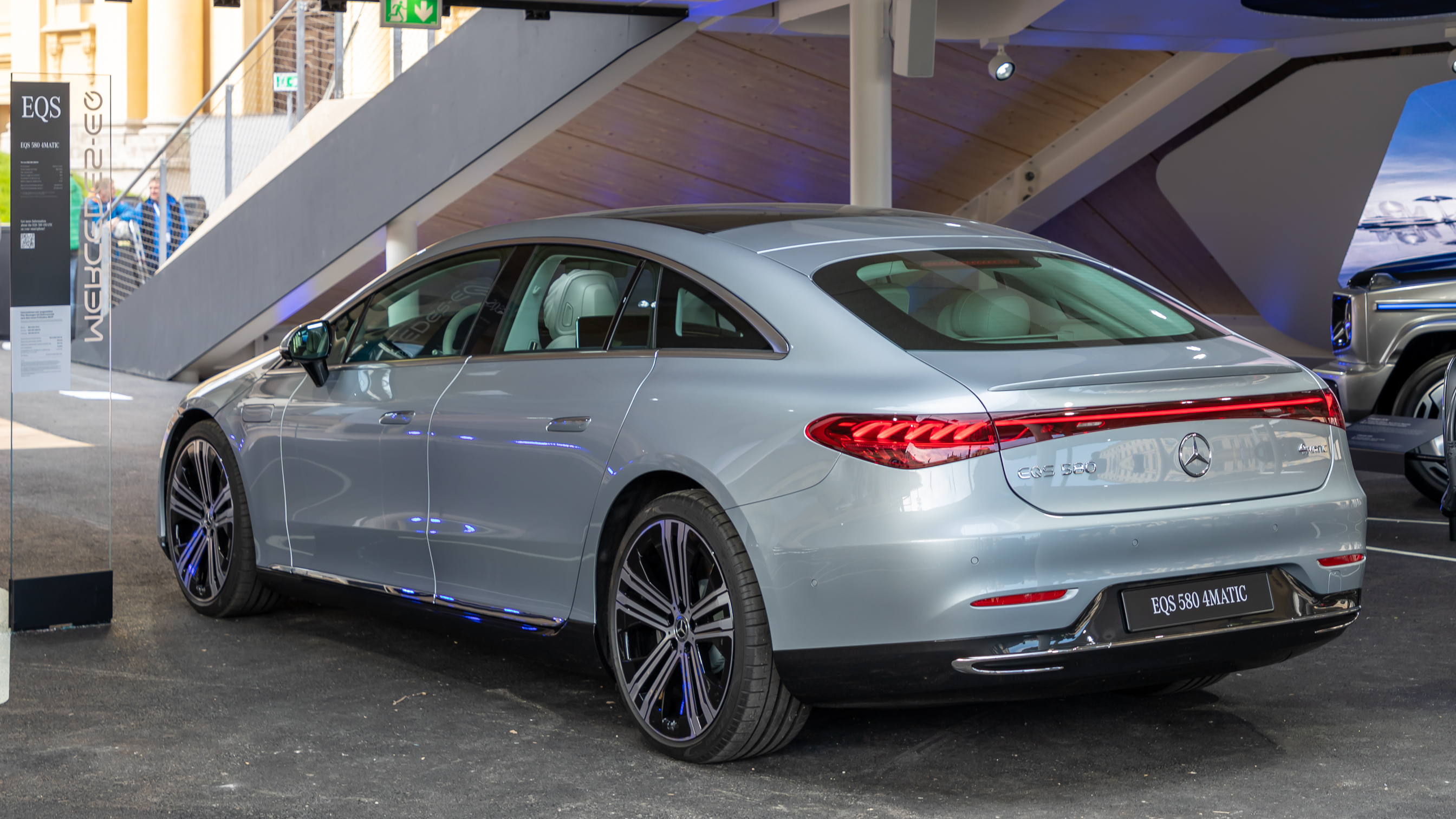
Mercedes-Benz EQS
"The updated Mercedes-Benz EQS was announced last night. It's the most comprehensively overhauled version since they launched it in 2021."
The Mercedes-Benz EQS is Mercedes’ main electric car. This update is a big refresh, including improvements that affect how the car charges and how far it can go.
The Mercedes-Benz EQS is the automaker’s flagship electric sedan. In this segment, the host says the updated EQS was announced and highlights major changes to its hardware and charging capability.
overhauled version
"It's the most comprehensively overhauled version since they launched it in 2021. More than a quarter of its components knew or reworked."
An “overhaul” usually means the update is a lot bigger than small changes. It often includes new or redesigned parts that can affect performance and charging.
An “overhaul” in EV updates usually means more than minor styling or software tweaks—it can involve new battery, motor, electronics, and charging hardware. The segment emphasizes that a large share of components were newly designed or reworked.
800-volt architecture
"800-volt architecture enables 350 kilowatt DC charging."
“800-volt” is how the car’s electrical system is set up. In general, higher voltage EVs can charge faster at DC fast chargers.
800-volt architecture refers to an EV electrical system designed to operate at a higher voltage than older 400-volt setups. Higher voltage can reduce current for the same power, enabling faster DC charging and improved charging performance.
WLTP range
"WLTP range goes up to 575 miles on the longest version."
WLTP range is a standardized test number for how far an EV can go on a full charge. Your real range may be different depending on driving conditions.
WLTP (Worldwide Harmonized Light Vehicles Test Procedure) is a standardized testing method used to estimate EV range. It helps compare vehicles consistently, but real-world range can vary with speed, weather, and charging habits.
steer by wire
"Also, steer by wire. First, for a German production car."
Instead of a direct mechanical connection from the steering wheel to the tires, the car uses electronics to control steering. That can allow more tech features, but it relies on sensors and computers to work correctly.
Steer-by-wire replaces the traditional mechanical linkage between the steering wheel and the wheels with electronic sensors and actuators. It can improve packaging and enable advanced driver-assistance features, but it also depends heavily on software and system redundancy.
silicon oxide
"Bidirectional charging, silicon oxide graphic and a graphite anode, pushing usable capacity up to 122 kilowatt hours."
Silicon-oxide is a material used inside the battery to help store more energy. It’s one way manufacturers try to get more range without making the battery much bigger.
Silicon-oxide is a battery material used in some EV anodes to increase capacity compared with traditional graphite. Using it alongside graphite can improve energy density, which helps extend range for a given battery size.
graphite anode
"Bidirectional charging, silicon oxide graphic and a graphite anode, pushing usable capacity up to 122 kilowatt hours."
The anode is part of the battery that helps move lithium during charging and driving. Graphite is the common material used there because it works reliably.
A graphite anode is the negative electrode material in many lithium-ion EV batteries. Graphite is widely used because it’s stable and well-understood, though newer chemistries often blend it with higher-capacity materials like silicon-based compounds.
122 kilowatt hours
"...silicon oxide graphic and a graphite anode, pushing usable capacity up to 122 kilowatt hours. Yes, this is a lucid competitor in every possible way."
kWh is how big the EV’s battery is—how much energy it can hold. Bigger usually means more potential range, but it’s not the only factor.
Kilowatt-hours (kWh) measure EV battery capacity—how much energy the battery can store. Higher kWh generally means more potential range, though real-world range also depends on efficiency, weight, and drivetrain.
CMF EV platform
"...based on the platform's CMF EV, same as the Nissan Leaf from the Renault Nissan Mitsubishi Alliance, of course."
A platform is the car’s main “building system.” CMF EV is a shared EV design that helps different models use similar parts and engineering.
CMF EV is Renault-Nissan-Mitsubishi’s modular EV platform strategy, designed to standardize EV components and architectures across multiple models. Using a shared platform can reduce development costs and speed up production.

Nissan Leaf
"...CMF EV, same as the Nissan Leaf from the Renault Nissan Mitsubishi Alliance, of course. They're going to keep the petrol version around..."
The Nissan Leaf is a well-known electric car. The host is saying the new electric Juke will be built on the same basic EV design as the Leaf.
The Nissan Leaf is one of the most established mass-market EVs, and the segment says the Juke EV will use the same CMF EV platform as the Leaf. That implies shared engineering choices that can affect packaging, efficiency, and cost.
386 miles of range
"...but this EV version will offer perhaps 386 miles of range, because that's the big battery we think that should come from the Nissan Leaf..."
Range is how far the car can go before it needs charging. The episode is saying the EV version should be able to drive around that distance on a full charge.
“Range” is how far an EV can travel on a full charge under a specified testing cycle. The segment ties the claimed range to battery sizing and suggests the larger pack is expected to come from the Leaf.
75 kilowatt-hour option
"...as well as the 75 kilowatt-hour option. Detailed specs yet to be confirmed."
This means there will likely be a bigger battery choice—75 kWh. A bigger battery usually means more range, but it can also cost more and add weight.
A 75 kWh battery option indicates a larger-capacity pack variant within the model lineup. Different battery sizes typically trade off cost, weight, and range, and may also affect charging behavior depending on the vehicle’s charging hardware.
European EV and plug-in hybrid registrations
"European EV and plug-in hybrid registrations hit a monthly, all-time high, of 540,000 units last month in March. That is up 37% year-on-year..."
Registrations tell you how many new electric and plug-in hybrid cars are being sold and registered. The host is saying Europe just hit a record high and sales are growing fast.
Registrations are a key market metric showing how many EVs and plug-in hybrids are newly registered in a region over time. The segment highlights a monthly all-time high and strong year-over-year growth, suggesting accelerating demand.
year-on-year
"That is up 37% year-on-year, from the same time in 2025. Driven partly..."
Year-on-year means “compared to the same time last year.” It helps you see if things are getting better or worse over time.
Year-on-year (YoY) compares performance in a given month to the same month one year earlier. It’s commonly used in auto market reporting to show whether growth is accelerating or slowing.
sharp fuel price rises
"Driven partly, speculation goes by the sharp fuel price rises, following the disruption of shipping routes..."
When gas prices jump, driving gets more expensive. That can push more people to consider electric cars because they can be cheaper to run.
Fuel price rises can shift consumer behavior toward EVs and plug-in hybrids by improving the relative cost of driving. When gasoline or diesel gets more expensive, the “cost per mile” advantage of electrification often becomes more compelling.
disruption of shipping routes
"...following the disruption of shipping routes after the US-Israel war on Iran. Global EV registrations rose 3%..."
If ships can’t travel normally, it can make fuel and other goods harder to get and more expensive. Higher fuel prices can then make electric cars look like a better deal.
Disruptions to shipping routes can affect the cost and availability of commodities like oil and refined fuels. That can feed into higher fuel prices, which then influences EV adoption rates and consumer demand.
Kia EV1
"Kia has confirmed the launch next year of its tiny EV1, the most affordable EV that it will make, targeting a segment with BYD's Dolphin..."
Kia is planning an affordable small electric car called the EV1. The point here is that it’s meant to be one of the cheaper EV options.
Kia’s EV1 is described as a “tiny” and highly affordable EV, with a launch planned for next year. The segment frames it as targeting a specific budget-focused EV segment and competing on price rather than just performance.

General Motors Ev1
"...ia has confirmed the launch next year of its tiny EV1, the most affordable EV that it will make,"
The General Motors EV1 is a small electric car GM says it will launch next year. It’s meant to be one of the cheapest EVs GM plans to sell. The main idea is to make electric driving more affordable for more people.
The General Motors EV1 (as referenced in the podcast) is a planned new, very small and affordable electric vehicle GM intends to launch next year. It’s being positioned as the most affordable EV GM will make, which makes it significant for buyers who want an entry point into EV ownership. The key discussion point is how a compact EV can lower purchase cost while still meeting everyday driving needs.

BYD Dolphin
"...targeting a segment with BYD's Dolphin,"
The BYD Dolphin is a relatively affordable electric car. The host is saying Kia’s EV1 is aiming at the same kind of buyers as the Dolphin.
The BYD Dolphin is a compact, value-oriented EV that has been popular in markets where affordable EVs are in high demand. Mentioning it here signals Kia’s EV1 will compete directly in the same budget segment.

5 Renault 5
"... BYD's Dolphin, and maybe a little bit below the Renault 5 EV. This is Kia Picanto Territory."
The 5 E-Tech Electric is a small electric car made by Renault. It’s aimed at everyday driving, especially in cities. The podcast mentions it because it’s in the same general class as other compact EVs.
The 5 E-Tech Electric is an electric small car from Renault, discussed in the context of competing in the same price-and-size space as other compact EVs. The podcast frames it as being around the level of the BYD Dolphin and possibly below the Renault 5 EV, which helps explain why it comes up in EV market coverage. It’s notable because it targets “city car” territory where efficiency and practicality matter most.

Kia Picanto
"This is Kia Picanto Territory. This is Leap Motor T03 Territory,"
The Kia Picanto is a tiny, affordable car meant for city streets. When someone says an EV is in “Picanto territory,” they mean it’s aiming to be similarly small and practical. It’s a way to describe the car’s category without getting technical.
The Kia Picanto is a small, budget-friendly city car. Saying an EV is “Kia Picanto territory” is shorthand for the same size/class and likely similar pricing and practicality. It helps listeners understand the target market for the EV being discussed.
Leap Motor T03
"This is Leap Motor T03 Territory, 400-volt version of EGMP, 42.2 kilowatt-hour, maybe the 61 kilowatt-hour pack if they can squeeze it in to that car."
The Leap Motor T03 is a small electric car. The host talks about different battery versions, which affect how far it can go and how it charges. Think of it as an entry-level EV competing in the same small-car space.
The Leap Motor T03 is a small electric car positioned against other entry-level city EVs. The segment discusses two battery options—“400-volt” architecture and different pack sizes—suggesting range and charging behavior will vary by version. It’s being used as an example of how manufacturers are trying to offer more capacity within the same vehicle class.
400-volt
"This is Leap Motor T03 Territory, 400-volt version of EGMP, 42.2 kilowatt-hour, maybe the 61 kilowatt-hour pack if they can squeeze it in to that car."
“400-volt” is the EV’s electrical system voltage. In general, higher-voltage EVs can be better at fast charging, because they can move more power efficiently. It’s one of the reasons some EVs charge quicker than others.
“400-volt” refers to the electrical system voltage used in the EV’s battery and power electronics. Higher-voltage architectures can enable faster charging and more efficient power delivery, depending on the charger and vehicle design. It’s a key spec when comparing charging speed potential across EVs.
EGMP
"This is Leap Motor T03 Territory, 400-volt version of EGMP, 42.2 kilowatt-hour, maybe the 61 kilowatt-hour pack if they can squeeze it in to that car."
EGMP is an EV “building system” used by Hyundai and Kia. It helps determine how the battery and electric parts fit together in the car. The host is using it to explain what kind of EV design this version is based on.
EGMP is Hyundai/Kia’s Electric-Global Modular Platform, a vehicle platform designed specifically for electric drivetrains. Platform choices affect battery packaging, motor integration, and charging capability. In this segment, it’s referenced to describe the architecture behind the EV being discussed.
social EV leasing
"France will launch its third version of its social EV leasing round in June. 50,000 contracts aimed at helping low-income households switch to EV."
Social EV leasing is a program that helps people with lower incomes get an electric car without paying the full price upfront. It usually works by lowering the monthly cost through subsidies or special terms. The goal is to get more EVs into everyday use.
“Social EV leasing” refers to government-backed or subsidized leasing programs aimed at making EVs affordable for lower-income households. Instead of requiring a large upfront purchase, leasing can reduce monthly cost and lower barriers to adoption. The segment describes France launching a third version of such a program with a specific contract target.
Stellantis
"Also, setting targets for Renault and Stellantis to make electric cars, and wean themselves off the temptation of buying cheap Chinese imports."
Stellantis is a big car company that makes lots of different brands. In Europe, it’s one of the major manufacturers that governments can pressure to build more EVs. Here, it’s mentioned as part of the EV production targets.
Stellantis is a major multinational automaker formed from the merger of Fiat Chrysler Automobiles and PSA Group. It owns many brands and is a key player in European vehicle manufacturing and EV plans. The segment mentions it in the context of government targets to increase electric car production.
wean themselves off the temptation of buying cheap Chinese imports
"Also, setting targets for Renault and Stellantis to make electric cars, and wean themselves off the temptation of buying cheap Chinese imports."
This describes a policy and industrial strategy to reduce reliance on low-cost imported vehicles—here, specifically Chinese EVs. It implies governments want domestic or EU-aligned manufacturing capacity to grow, often through targets, incentives, or procurement rules. The segment frames it as part of broader EV industrial planning.
Volvo Trucks
"And finally, Volvo Trucks has launched the FH Aero Electric with 700 kilometres of range, megawatt charging at 700 kilowatts."
Volvo Trucks makes commercial trucks used by businesses. The segment is saying Volvo is pushing electric trucks further, not just regular passenger EVs. That’s important because trucks need a lot of energy and planning.
Volvo Trucks is the heavy-truck division of Volvo, focused on commercial vehicles and fleet operations. The segment highlights Volvo Trucks launching an electric model, showing how electrification is moving beyond passenger cars into heavy hauling. This matters because trucking has different energy and duty-cycle requirements than cars.
700 kilowatts
"with 700 kilometres of range, megawatt charging at 700 kilowatts. That's a 50-minute stop, but that aligns with the kind of driver regulations"
700 kilowatts is how much power the charger can deliver to the truck. More power generally means faster charging, though the battery and charging conditions still matter. The point here is that the truck can recharge quickly enough for real schedules.
700 kilowatts (kW) is the charging power level cited for the truck’s megawatt-class charging setup. Charging power strongly influences how quickly a vehicle can refill energy, but actual time also depends on battery temperature, state of charge, and charging curve. The host uses this number to support the claim of a short charging stop.
driver regulations of downtime
"That's a 50-minute stop, but that aligns with the kind of driver regulations of downtime over here in Europe as Volvo Trucks pushes further into electric heavy hauling,"
The segment connects charging time to “driver regulations” that govern how long drivers can work and when they must take breaks. For heavy trucking, these rules shape route planning and how charging stops fit into duty cycles. The host implies megawatt charging is timed to match those mandated downtime windows.
Capital One
"That's technology at Capital One. Capital One's tech team isn't just talking about multi-agentic AI."
Capital One is a financial services company that’s using AI-driven tools to support car shopping workflows. In this segment, they’re positioning their technology as helping with tasks like scheduling, financing, and trade-in valuation.
multi-agentic AI
"Capital One's tech team isn't just talking about multi-agentic AI."
Multi-agentic AI means the AI isn’t one single brain—it’s more like a team of AI helpers working together. Each helper can handle a different part of the car-buying process.
“Multi-agentic AI” refers to systems where multiple AI components (agents) work together to complete tasks. In a car-shopping context, different agents can specialize in parts of the workflow—like answering questions, checking availability, or coordinating next steps—while sharing context.
layered reasoning
"Using self-reflection and layered reasoning with live API checks, it doesn't just help buyers find a car they love."
“Layered reasoning” describes an AI approach that breaks a problem into multiple steps or layers of analysis. In a shopping assistant, that can mean combining user preferences, constraints, and real-time data to produce better recommendations and next actions.
live API checks
"Using self-reflection and layered reasoning with live API checks, it doesn't just help buyers find a car they love."
“Live API checks” means the software looks up current information from other systems while you’re using it. That helps it avoid giving you stale or incorrect details.
“Live API checks” means the system queries real-time data through application programming interfaces (APIs). For car shopping, this can help confirm up-to-date details like availability, pricing, or eligibility rather than relying on outdated information.
Request an Explanation
Heard something you'd like explained? We'll add it to this episode.
Sign in to request explanations for terms you heard.
Want to learn more?
Browse our glossary for plain-English explanations of automotive terms, jargon, and concepts.
Help improve this episode
See something that's not quite right? Our annotations are AI-generated and can sometimes miss the mark. Click the flag icon on any annotation to suggest a correction.