BRIEFLY: Norway, Tesla Canada, Factorial & More | 05 May 2026
About this episode
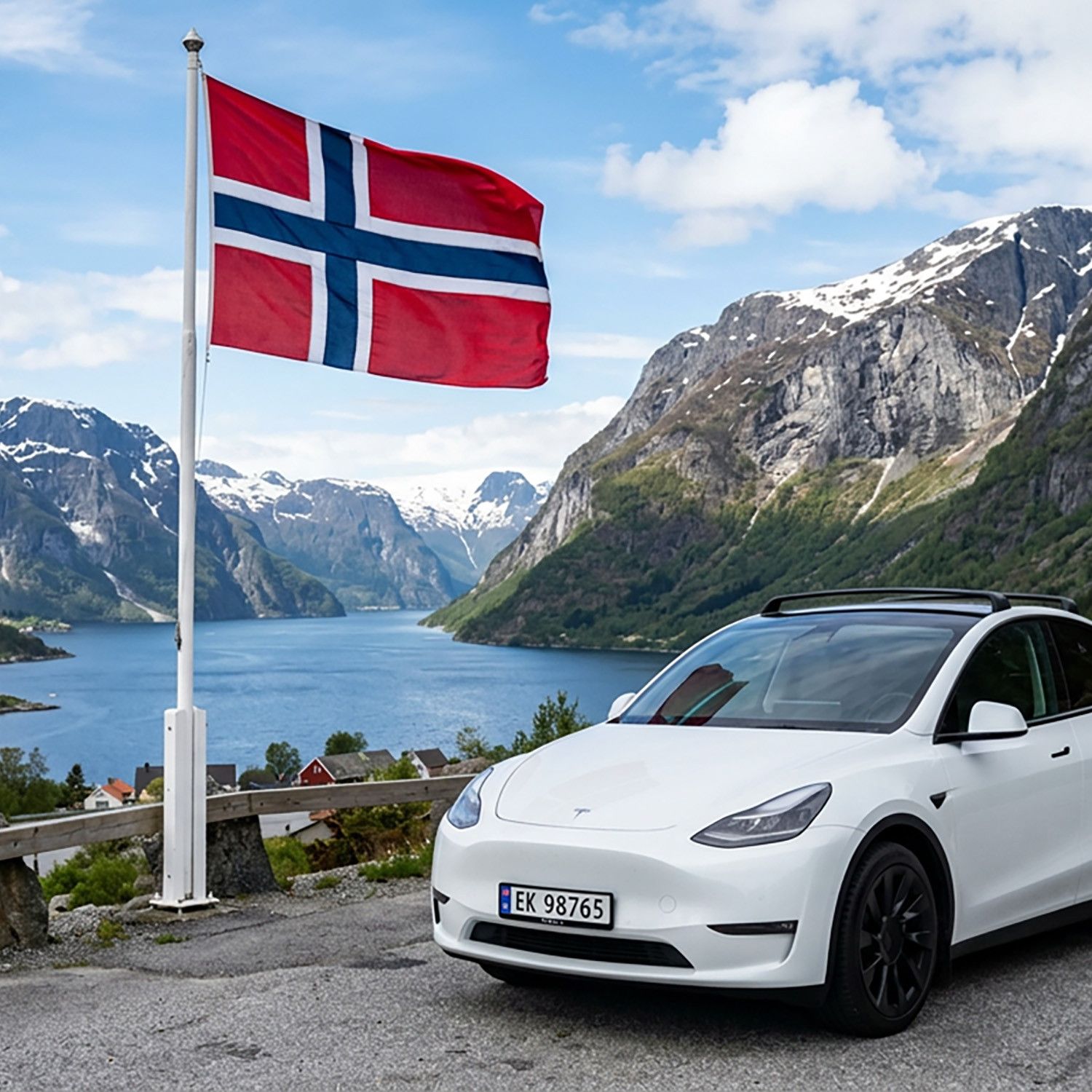
April brought another striking milestone in Norway, where battery electric vehicles reached 98.6% of new registrations. The episode also covers Tesla’s lower-priced Model 3 in Canada, including a sub-C$40,000 starting point and a big gap versus the US price. On the business side, Volkswagen deepened its Rivian commitment with a larger stake after another $1 billion tranche, underscoring how quickly EV partnerships and manufacturing strategies are shifting.
It's EV News Briefly for Tuesday 05 May 2026, everything you need to know in less than 5 minutes if you haven't got time for the full show.
Patreon supporters fund this show, get the episodes ad free, as soon as they're ready and are part of the EV News Daily Community. You can be like them by clicking here: https://www.patreon.com/EVNewsDaily
NORWAY BEV SHARE HITS 99% IN APRIL
Norway set a new monthly record in April 2026, with battery electric vehicles taking 98.6% of new passenger car registrations, up from the previous record of 98.4% in March. Of 11,103 new cars registered, 10,952 were fully electric, with diesel managing just 87 units and petrol a mere 31 units — making combustion-engine sales little more than a rounding error.
TESLA CUTS MODEL 3 PRICES IN CANADA
Tesla has slashed prices across its Canadian Model 3 line-up, introducing a new entry Premium RWD trim starting at C$39,490 — about 31% cheaper than the equivalent US price — after shifting production from its Fremont plant to its Shanghai factory to take advantage of Canada's new 6.1% Chinese-EV import tariff. The line-up now has just two trims after removing the Long Range mid-range, though Shanghai-built cars do not qualify for Canada's federal EVAP rebate of up to C$5,000.
FACTORIAL BETS SOLID-STATE CAN BREAK CHINA'S LEAD
Factorial Energy, a Massachusetts-based startup backed by Mercedes-Benz, Stellantis, and Hyundai/Kia, argues that solid-state batteries — which charge from 15% to 90% in 18 minutes and offer 20–50% more range than lithium-ion — are the West's best chance to leapfrog Chinese rivals rather than imitate them. The company plans to go public on Nasdaq in mid-2026 via a SPAC merger, and a Mercedes-Benz EQS prototype fitted with its cells drove 1,205 km non-stop in August 2025.
IONIQ 5 SALES HOLD UP AFTER US TAX CREDIT LOSS
Hyundai's IONIQ 5 held fifth place among US EV sellers in 2025 despite losing the federal EV tax credit, while rivals like the Ford Mustang Mach-E saw sales collapse 60% year-on-year in Q1 2026. Domestic production at Hyundai Metaplant America in Savannah, Georgia was credited as a key factor in shielding the IONIQ 5 from the impact of Trump administration trade policy changes.
VOLKSWAGEN RAISES RIVIAN STAKE TO 15.9%
Volkswagen has lifted its stake in Rivian to 15.9% after completing a further $1 billion investment tranche, triggered by the RV Tech joint venture clearing its winter testing milestones, bringing its total investment to $3 billion of a committed $5.8 billion. Volkswagen gains access to Rivian's software stack and zonal architecture, while Rivian retains full ownership of its motors, batteries, chassis, and autonomy framework.
VW TESTS 'GAMECHANGER' AT WOLFSBURG
Volkswagen has launched a pilot production process codenamed Gamechanger at its Wolfsburg headquarters, aimed at cutting costs and enabling profitable EV manufacturing in Germany through techniques expected to include megacasting and parallel modular assembly streams. The plant is expected to eventually produce an electric Golf and an SUV counterpart on the next-generation SSP platform, potentially under the names ID. Golf and ID. Roc.
TESLA LAUNCHES BASECHARGER FOR SEMI DEPOTS
Tesla has unveiled the Basecharger, a depot-focused DC fast charger for the Tesla Semi that tops out at 125 kW and can charge a truck from low to 60% in around four hours, using a 6-metre cable to accommodate yard layouts. The unit starts at $20,000, supports the open MCS (Megawatt Charging System) standard, and up to three units can share a single breaker — potentially serving future MCS-compatible trucks from Daimler, Volvo, and Scania.
MFG EV POWER ADDS PLUG&CHARGE
Motor Fuel Group has integrated its MFG EV Power network of around 2,000 rapid and ultra-rapid UK charging points with Hubject's Plug&Charge infrastructure, going live on 1 May 2026 after over a year of technical development. Compatible EVs can now begin charging automatically the moment they plug in, eliminating the need for RFID cards or apps.
ALLEGO APP ADDS EUROPE-WIDE CHARGING ROAMING
Allego has transformed its app into a pan-European roaming platform, giving drivers access to roughly one million charging points from competing networks under a single account with no additional roaming fees. The app also includes a Smart Route Planner to help EV drivers plan charging stops across longer cross-border journeys.
NEW AI VOICE ASSISTANTS FOR RIVIAN, POLESTAR AND VOLVO EVS
Rivian's AI voice assistant — first unveiled at its December 2025 Autonomy & AI Day — is now expected to reach customers in the coming weeks after slipping roughly four months behind its original early-2026 target, and will roll out to both R1 and R2 vehicles. Separately, Google has begun rolling out Gemini to Polestar and Volvo cars running Android Automotive OS, enabling conversational AI with multi-turn dialogue, trip planning, and a continuous hands-free mode called Gemini Live — with Volvo saying models dating back to 2020 are eligible for the upgrade.
multi-agentic AI
"Capital One's tech team isn't just talking about multi-agentic AI. They are already deployed one."
Multi-agentic AI is an AI approach where more than one AI “helper” works together. The segment says Capital One has already put this kind of capability into a car-shopping assistant.
Multi-agentic AI refers to systems where multiple AI “agents” work together toward a goal, often coordinating tasks and decisions. The segment contrasts general talk about it with Capital One’s claim that it has already deployed an AI assistant for car shopping.
Chat Concierge
"It's called Chat Concierge, and it's simplifying car shopping. Using self-reflection and layered reasoning with live API checks, it doesn't just help buyers find a car they love..."
Chat Concierge is an AI chat tool from Capital One meant to help people shop for cars. It’s described as helping with practical steps like planning a test drive and getting financing estimates.
Chat Concierge is Capital One’s AI shopping assistant described in the segment as simplifying car shopping. It’s presented as using self-reflection and layered reasoning plus live API checks to help with tasks like scheduling a test drive and estimating financing and trade-in outcomes.
live API checks
"Using self-reflection and layered reasoning with live API checks, it doesn't just help buyers find a car they love."
Live API checks mean the app looks up information in real time using other software systems. Here, it’s described as helping the car-shopping assistant give more up-to-date answers.
Live API checks mean the software queries external application programming interfaces in real time to pull up-to-date information. In this context, it’s used to support car-shopping tasks so the assistant can respond with current details rather than relying only on what it already “knows.”
pre-approved for financing
"It helps schedule a test drive, get pre-approved for financing, and estimate trading value."
Pre-approved financing means a bank has basically said, “Yes, we’ll lend you money for a car,” before you choose the exact vehicle. It can make buying faster and less stressful.
“Pre-approved for financing” means a lender has already reviewed your information and conditionally agreed to offer you a loan amount and terms before you pick a specific vehicle. In car shopping, this can speed up the purchase process and reduce uncertainty at the dealership.
trading value
"It helps schedule a test drive, get pre-approved for financing, and estimate trading value."
Trading value is what your current car is worth to the dealer if you trade it in. Knowing an estimate helps you figure out how much the new car will really cost.
Trading value is the amount a dealer (or buyer) offers for your current vehicle when you trade it in. Estimating it up front helps shoppers understand the net cost of the new car after the trade-in is applied.

Chevrolet Colorado
"Chevy Trucks have you covered when the road takes you from smooth sailing to... Chevy Colorado will eat up some of the toughest terrains with five available drive modes, and Silverado and Silverado HD have the muscle..."
The Chevrolet Colorado is a pickup truck. Here they’re talking about its selectable drive modes, which help the truck behave differently depending on the road or terrain.
The Chevrolet Colorado is a midsize pickup known for being offered with multiple drive modes that help it handle different road and terrain conditions. In this segment, it’s positioned as the Colorado that can tackle tougher terrain using those selectable modes.
drive modes
"Chevy Colorado will eat up some of the toughest terrains with five available drive modes, and Silverado and Silverado HD have the muscle..."
Drive modes are different settings you can choose in a truck. They adjust how the truck drives so it can handle different roads or conditions better.
Drive modes are selectable settings that change how a vehicle responds—typically throttle mapping, steering feel, traction control behavior, and sometimes transmission or drivetrain characteristics. This segment uses them to describe how the Chevrolet Colorado can adapt to different terrain.
Chevrolet Silverado
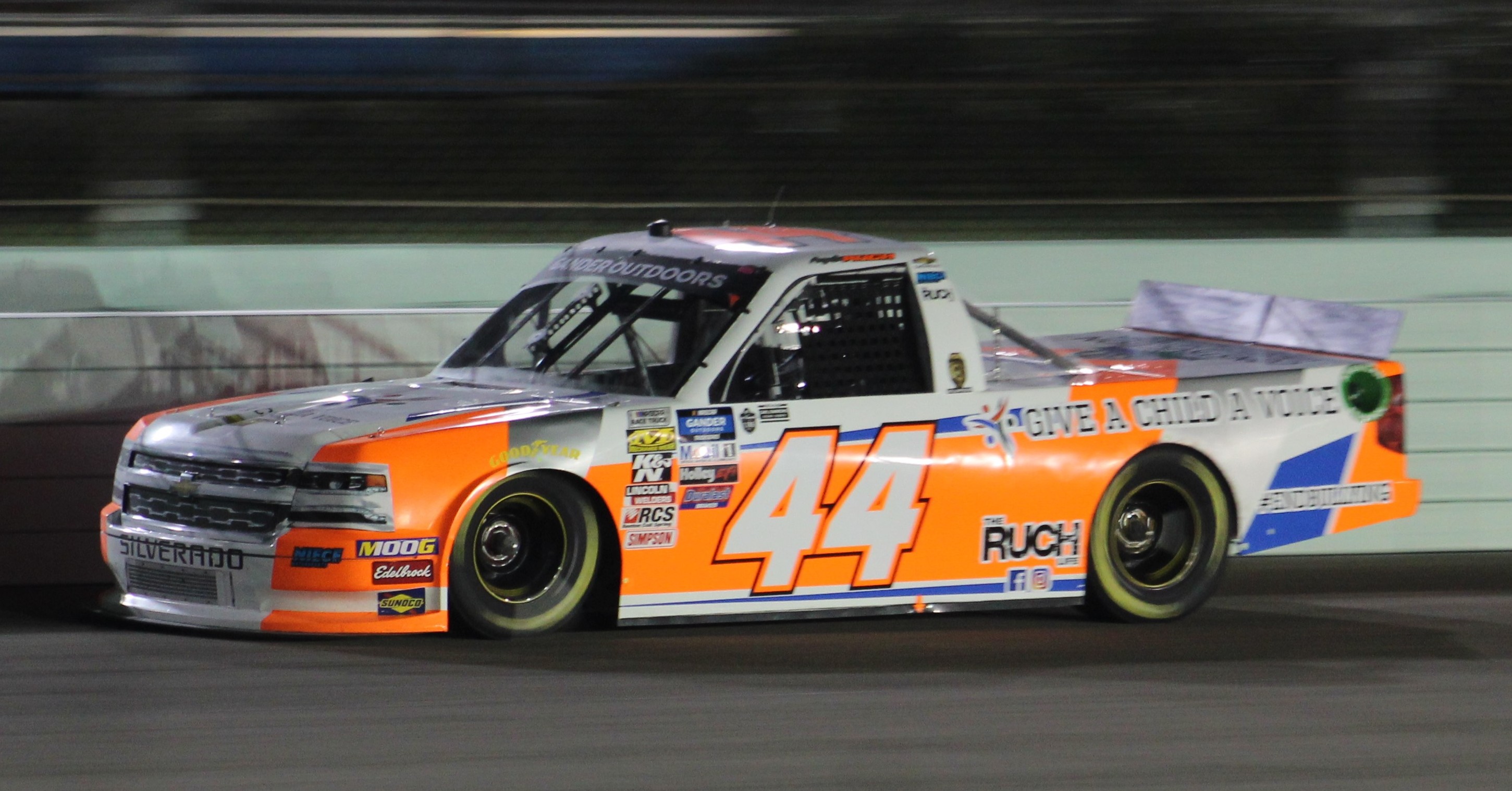
"Chevy Colorado will eat up some of the toughest terrains with five available drive modes, and Silverado and Silverado HD have the muscle to take you out for some serious, with multiple engine options and impressive towing..."
The Chevrolet Silverado is a big pickup truck. They’re saying it’s strong for towing—basically hauling heavier stuff.
The Chevrolet Silverado is a full-size pickup that’s commonly sold with multiple engine options and is built for towing and hauling. This segment highlights it as having the “muscle” for serious trips, tying the model to towing capability.

Chevrolet Silverado EV
"...while Silverado EV is the perfect combo of performance and capability, making it a snap to hitch up this electric truck and hit the road."
The Chevrolet Silverado EV is an electric pickup truck. They’re emphasizing that it’s not only quick—it’s also meant to be useful for real-world towing/hauling.
The Chevrolet Silverado EV is Chevrolet’s electric pickup, positioned here as combining “performance and capability.” The segment also mentions hitching up—highlighting that an EV truck is being marketed as practical for towing/hauling tasks, not just acceleration.
BEV
"[132.4s] Norway has had a new monthly record last month in April. [136.6s] It's 98.6% full BEV. [140.4s] That's not plug-in hybrids or anything."
BEV means battery-electric vehicle. It’s an EV that runs on electricity from a battery, not gasoline.
BEV stands for battery-electric vehicle. It means the car is powered only by an electric motor using energy stored in a battery, not by a gasoline engine.
plug-in hybrids
"[136.6s] It's 98.6% full BEV. [140.4s] That's not plug-in hybrids or anything. [141.8s] 98.6%, let's do some rounding. [145.0s] We'll call it 99% Norway, and you know what, if it ends there,"
Plug-in hybrids are cars that use both gas and electricity. You can charge them like an EV, but they also have a gas engine for longer driving.
Plug-in hybrids (PHEVs) combine a gasoline engine with an electric motor and a battery that can be charged from an external power source. They can run on electricity for short trips, but still rely on gasoline when the battery is depleted.
diesels
"[145.0s] We'll call it 99% Norway, and you know what, if it ends there, [148.6s] that's fine because there were just 87 diesels, [152.9s] 31 petrols, and some plug-in hybrids."
“Diesels” means cars that run on diesel fuel. They’re not electric, and they’re usually counted separately from EVs and plug-in hybrids.
Diesels here refers to vehicles powered by diesel fuel, typically using a compression-ignition engine rather than a spark-ignition gasoline engine. In EV news, diesel share is often tracked as a baseline against electrified powertrains.
petrols
"[148.6s] that's fine because there were just 87 diesels, [152.9s] 31 petrols, and some plug-in hybrids. [155.1s] The rest is really a rounding error."
“Petrols” means cars that run on gasoline. It’s the non-electric category in these EV adoption numbers.
Petrols refers to gasoline-powered vehicles. In the context of EV adoption stats, petrol share is the non-electrified baseline compared with BEVs and plug-in hybrids.

Tesla Model 3
"Well done, 99% Norway. Now, Tesla has cut Model 3 prices in Canada. In fact, the new entry premium..."
The Tesla Model 3 is a fully electric car that runs on a battery instead of gasoline. The podcast mentions it because Tesla lowered its price in Canada, which can make it easier for more people to buy. When prices change, it can also change how many cars get sold.
The Tesla Model 3 is an all-electric compact sedan aimed at being a high-volume entry point into Tesla’s lineup. In the podcast context, it’s discussed because Tesla cut Model 3 prices in Canada, which can affect demand, leasing/financing deals, and how quickly buyers move to EVs. Price changes like this are often a key business lever for EV makers competing on affordability.
rear-wheel drive
"In fact, the new entry premium rear-wheel drive. Personally, I expect that I would love. Many Canadians do need all-wheel drive, but the weather here is so moderate"
Rear-wheel drive means the car powers the back wheels. It can be cheaper and fine in milder weather, while all-wheel drive helps more when roads are slippery.
Rear-wheel drive (RWD) means the electric motor(s) send power to the rear axle. In EVs, RWD trims are often cheaper and can be sufficient for moderate climates, while all-wheel drive is preferred for traction in harsher weather.
tariffs
"which seems crazy, but that's because of the huge tariffs on Canadian US-made vehicles and 6.1% Chinese EV import tariffs."
Tariffs are taxes governments place on imported goods, which can raise the final price of vehicles and parts. Here, the host connects tariffs on Canadian vs. US-made vehicles and EV import tariffs to why Tesla can price differently by building in China and shipping to Canada.
Factorial
"Factorial, the Massachusetts-based start-up backed by Mercedes-Benz, Stellantis, Hyundai-Kia, and more, argues that solid-state batteries, offering more range and faster charging and more security, are the best chance to fight Chinese rivals."
Factorial is a company working on EV battery technology. They’re trying to convince investors that solid-state batteries will be the next big step for EVs.
Factorial is a Massachusetts-based EV battery startup that’s backed by major automakers. In this segment, it argues that solid-state batteries are the best path to longer range, faster charging, and improved safety/security versus competing approaches.
Mercedes-Benz
"Factorial, the Massachusetts-based start-up backed by Mercedes-Benz, Stellantis, Hyundai-Kia, and more, argues that solid-state batteries, offering more range and faster charging and more security, are the best chance to fight Chinese rivals."
Mercedes-Benz is mentioned because it’s investing in Factorial. That means Mercedes-Benz is interested in the company’s battery technology.
Mercedes-Benz is referenced here as one of the automakers backing the Factorial battery startup. That kind of backing typically signals strategic interest in future battery technology and supply partnerships.
Hyundai-Kia
"Factorial, the Massachusetts-based start-up backed by Mercedes-Benz, Stellantis, Hyundai-Kia, and more, argues that solid-state batteries, offering more range and faster charging and more security, are the best chance to fight Chinese rivals."
Hyundai-Kia is mentioned because it’s backing Factorial. That means they’re interested in the company’s battery technology for future EVs.
Hyundai-Kia is referenced as part of the backing group for Factorial. Their involvement suggests interest in solid-state battery technology as a competitive differentiator for future EVs.
Stellantis
"Factorial, the Massachusetts-based start-up backed by Mercedes-Benz, Stellantis, Hyundai-Kia, and more, argues that solid-state batteries, offering more range and faster charging and more security, are the best chance to fight Chinese rivals."
Stellantis is mentioned because it’s backing Factorial. That suggests big automakers are betting on new battery tech.
Stellantis is mentioned as an investor backing Factorial, the EV battery startup. This indicates major automaker involvement in next-generation battery development.
solid-state batteries
"backed by Mercedes-Benz, Stellantis, Hyundai-Kia, and more, argues that solid-state batteries, offering more range and faster charging and more security, are the best chance to fight Chinese rivals."
Solid-state batteries replace the liquid electrolyte found in many current lithium-ion packs with a solid electrolyte. The host claims they can improve EV range, enable faster charging, and offer better safety characteristics—key advantages in competing with lower-cost Chinese EVs.

Hyundais Ioniq
"Hyundai's IONIQ 5 has been around a long time now. It's a great vehicle, and it's held fifth place amongst US EV sellers for the last, well, the last year or so in 2025."
The Hyundai IONIQ 5 is an all-electric Hyundai crossover. The hosts are saying it’s still selling well in the US, even when other EVs drop after tax-credit changes.
The Hyundai IONIQ 5 is a battery-electric crossover built around Hyundai’s E-GMP platform, which helps it package the battery efficiently and support fast charging. In this segment, it’s discussed as a standout EV in the US market even as competitors struggled after changes to federal tax incentives.

Ford Mustang Mach-E
"But whilst its rivals like the Ford Mustang, Maki, have seen their sales fall off a cliff since the federal tax credit went, actually, IONIQ 5 is doing really well."
The Ford Mustang Mach-E is an electric Ford crossover. In this segment, it’s used as an example of an EV that lost sales after tax incentives changed.
The Ford Mustang Mach-E (often shortened to Mach-E) is Ford’s electric crossover based on the Mustang name. Here it’s mentioned as a rival to the Hyundai IONIQ 5 whose sales fell sharply after federal tax credit changes.
Hyundai Meta-Plant America
"They make the vehicle, a Hyundai Meta-Plant America in Savannah, Georgia. A key factor in shielding the IONIQ 5 from trade policy changes and its sales picking up again after the incentives have come."
This is Hyundai’s factory in the US that builds the IONIQ 5. The hosts are saying making the car in the US can help reduce the impact of trade policy changes.
Hyundai Meta-Plant America is Hyundai’s US manufacturing operation mentioned here as the place where the IONIQ 5 is made. The segment ties that production location to how the vehicle can better withstand trade-policy shifts.
Volkswagen
"Volkswagen has lifted its stake in Rivian to 16%... Volkswagen has launched a pilot production line, codenamed GameChanger, aimed at cutting costs and enabling profitable EV manufacturing within Germany."
Volkswagen is the automaker making moves in the EV business—investing money, partnering with Rivian, and planning new manufacturing to lower costs. The hosts are using these actions to explain why EV production economics are changing.
Volkswagen is described here as increasing its ownership in Rivian to 16% and as investing in EV manufacturing capacity. The segment also highlights Volkswagen’s plan to use a pilot production line to cut costs and make EVs profitably in Germany.
mega-casting
"New techniques like some mega-casting, which you see Volvo using with the new EX-60 and parallel modular assembly streams, for instance."
Mega-casting is a way to manufacture car parts by making bigger, fewer pieces instead of many smaller ones. It can reduce manufacturing time and cost.
Mega-casting is a manufacturing approach that uses very large castings—often for structural parts of an EV—to reduce the number of separate components and welding steps. The goal is lower cost and faster assembly while maintaining structural performance.

EX60
"New techniques like some mega-casting, which you see Volvo using with the new EX-60 and parallel modular assembly streams, for instance."
The EX60 is an electric car made by Volvo. The podcast talks about it in connection with how it’s built, including new factory methods that can make production faster or simpler. Those changes matter because they can affect how many cars can be made and at what cost.
The EX60 is Volvo’s electric vehicle model referenced in the context of new manufacturing methods. The podcast points to techniques like mega-casting and parallel modular assembly streams, which are production approaches intended to simplify the build process and improve efficiency. It’s discussed because manufacturing changes can influence cost, scalability, and how quickly EVs can be produced.
DC fast charger
"[310.9s] Tesla's unveiled base charger. [313.1s] That's a DC fast charger for the Tesla Semi, [315.5s] based on depots."
A DC fast charger is a high-speed EV charger. It charges the battery much faster than the slower chargers you might use at home.
A DC fast charger is a high-power charging station that sends direct current straight to the vehicle’s battery system. It’s designed for quick top-ups compared with slower AC charging, which is better suited for overnight charging.

Tesla Semi
"... charger. That's a DC fast charger for the Tesla Semi, based on depots."
The Tesla Semi is an electric truck used for transporting goods. It needs fast charging to keep working, and the podcast mentions DC fast chargers placed at depots. That setup helps trucks recharge quickly between routes.
The Tesla Semi is an all-electric heavy-duty truck designed for long-haul and high-mileage commercial use. The podcast context highlights DC fast charging infrastructure built around depots, which is important because charging speed and availability directly determine how the truck can be scheduled and operated. It’s a significant topic because trucking electrification depends as much on charging networks as on the vehicle itself.
MCS megawatt charging system standard
"[321.9s] It uses the MCS megawatt charging system standard, [325.9s] because that's what the new Tesla Semi's all use, [329.2s] and that means that they can potentially be sold to depots"
MCS is a charging standard meant for super-fast charging of big electric vehicles. It’s designed so different trucks and charging sites can work together more easily.
The MCS (Megawatt Charging System) is a standardized approach for very high-power charging—up to megawatt levels—for heavy-duty EVs. Using MCS helps ensure compatibility across participating charging networks and vehicle platforms.
Scania
"[331.4s] that also have Daimlers and Volvos and Scania electric trucks, [335.4s] also using MCS."
Scania is a truck company. They’re mentioned to show that the same fast-charging standard could work across multiple truck brands.
Scania is a commercial truck brand cited as using MCS-compatible charging. Including Scania alongside other brands reinforces the idea of a shared high-power charging standard across fleets.
Volvos
"[329.2s] and that means that they can potentially be sold to depots [331.4s] that also have Daimlers and Volvos and Scania electric trucks, [335.4s] also using MCS."
Volvo is another truck brand mentioned here. The idea is that different brands could charge using the same high-power standard.
Volvo is mentioned as another heavy-truck brand that could use the same MCS charging standard at shared depots. This is relevant to fleet operators because it reduces the risk of being locked into one charging ecosystem.
Daimlers
"[329.2s] and that means that they can potentially be sold to depots [331.4s] that also have Daimlers and Volvos and Scania electric trucks, [335.4s] also using MCS."
They’re talking about Daimler’s trucks. The point is that the charging setup could work for more than just one brand.
The speaker is referring to Daimler’s electric-truck ecosystem—i.e., Daimler-branded commercial vehicles that can use the same MCS charging standard. That matters because it suggests multi-brand charging compatibility at depots.
roaming platform
"[346.2s] ALEGO has transformed its app into a pan-European roaming platform [350.1s] to access a million charging points,"
A roaming platform means you can use one app to find and use chargers from many different networks. It helps you charge while traveling without needing a separate account everywhere.
A roaming platform lets EV drivers use one app or account to access charging networks across different countries or operators. It’s similar to mobile-phone roaming, but for charging access and payment.
AI voice assistant
"[352.7s] and two AI voice assistants around the corner, [355.9s] Rivian's AI voice assistant, [357.7s] is expected to reach customers in the coming weeks,"
An AI voice assistant is a voice-controlled system that can understand what you say. Here, it’s being used to make EV features easier to access without touching screens.
An AI voice assistant is software that uses natural-language speech to let drivers interact with the car or charging services hands-free. In this segment, it’s discussed as being integrated into EV infotainment/connected services for tasks like guidance and scheduling.
Android Automotive AOS
"[364.1s] to Polestar and Volvo cars running Android Automotive AOS, [369.0s] enabling conversational AI."
Android Automotive AOS is the software platform inside certain cars. It’s what lets the car run apps and support voice-based features.
Android Automotive AOS is the Android-based operating system used in some vehicles for the infotainment and connected-car experience. It provides the software foundation for apps and voice/cognitive features like conversational AI.
Capital One
"Capital One's tech team isn't just talking about multi-agentic AI. They are already deployed one. It's called Chat Concierge, and it's simplifying car shopping..."
Capital One is a company that provides financial services like loans. In this segment, they’re talking about using AI to help people shop for cars and handle financing steps.
Capital One is a financial services company that, in this segment, is describing an AI product used to support car shopping. The hosts frame it as an example of how lenders are using AI to streamline parts of the buying workflow.
Request an Explanation
Heard something you'd like explained? We'll add it to this episode.
Sign in to request explanations for terms you heard.
Want to learn more?
Browse our glossary for plain-English explanations of automotive terms, jargon, and concepts.
Help improve this episode
See something that's not quite right? Our annotations are AI-generated and can sometimes miss the mark. Click the flag icon on any annotation to suggest a correction.