In F1, teams sometimes have to decide how to support two teammates. “Equal opportunity” means the team tries to give both drivers a fair shot rather than helping one more than the other.
Mercedes is the Formula 1 team in this discussion. They run two drivers, and the team tries to treat them fairly with things like strategy and support during races.
“Out-qualified” means one driver was faster in qualifying and gets a better starting position on the grid. Starting ahead can make the race easier because you’re in cleaner air and have more options.
“Momentum” here means the driver seems to be building confidence and getting better results lately. When a team has momentum, they often make smarter calls and the car feels like it’s working more consistently.
Racecraft is how good a driver is at running the race itself. It includes smart moves like defending, choosing when to pass, and dealing with other cars—not just being fast.
Fred Vassar is mentioned as a person who helped support changes at Ferrari. The point is that having the right people backing you can help a driver get what they need from the team.
Nigel Mansel was a famous Formula 1 champion. The hosts are saying Hamilton’s recent performance reminds them of how Mansel made a big impression when he was at Ferrari.
Monaco is a famous Formula 1 race held on city streets. It’s a very tight track where braking and corner entry matter a lot because you don’t have much room for mistakes.
They’re talking about a special type of brake rotor made from carbon-ceramic materials. It’s designed to stop really hard and keep working even when the brakes get very hot, which matters a lot in racing.
Brembo is a major performance-brake manufacturer that supplies brake systems to many racing teams and road-car brands. In this segment, they’re mentioned as the established brake partner in the Ferrari ecosystem, which helps explain why the “chosen relationship” is understandable.
“Brake feel” is how the brakes respond when you press the pedal—how strong they are and how smoothly they slow the car down. Good brake feel helps a driver brake at the right moment and with the right pressure into a turn.
Corner entry is the moment you slow down and start turning into a corner. The hosts are saying that getting the braking right right before you turn is one of the hardest and most important parts of driving fast.
Modulating the brakes means squeezing the brake pedal in a smooth, controlled way instead of just stomping it. It helps you slow down more precisely and keep the car stable.
A simulator is a high-tech training setup that lets a driver practice without being on track. It can help with things like braking and car setup, and here they’re saying Lewis wasn’t using it.
Spain is where the qualifying session in the story takes place. The hosts are using it to set the scene for what Hamilton did (or didn’t do) that weekend.
Lewis Hamilton is a top Formula 1 race driver. In this segment, the hosts say he’s in a better position because his team has given him a car that can win.
“Sniffer victory” is racing slang for a situation where a driver is close enough to win that they can sense it’s within reach. In F1 commentary, it usually implies strong form and a realistic chance to convert opportunity into a win.
The “mental side” means how confident and focused a driver feels. The hosts are saying that when Hamilton is doing well in the standings, it can help him stay calm and perform better.
They’re talking about racing in Detroit, which can be rough and tiring because it’s often on city streets. The point is that the drivers were physically worn out in those conditions too.
Kimi Antonelli is a young F1 driver. They’re saying that in a race he got so physically strained—especially in his neck—that it affected him.
Term
neck went
It means his neck got too strained during the race. In racing, the driver’s body takes a lot of force and vibration, and the neck can be one of the first areas to feel it.
Term
sliding out of corners
When a car “slides out of corners,” it means the tires aren’t gripping the road as well as they should. Instead of turning cleanly, the car drifts wide, and the driver has to correct it to stay on line.
Term
rotate it in a different way
“Rotate it” is how the car turns and pivots through a corner. If they can “rotate it in a different way,” it means the car is easier to steer and set up for the turn instead of feeling stuck or unresponsive.
They’re comparing the F1 car’s feel to a go-kart because it’s quick to respond when you turn. The point is that it feels agile and controllable, especially when you’re pushing hard.
A “wheel-to-wheel battle” is when two cars race side-by-side, very close to each other. It usually means the racing is intense and the cars can stay close enough to fight for position.
“Aerodynamics” is how the car’s shape and wings interact with air. In racing, it can make the car stick to the track better (more grip) and help it handle when you’re close to other cars.
“Downforce” is the force that pushes the car toward the ground so the tires can grip better. More downforce usually means better cornering, but they’re saying the cars can still handle well even with less of it.
The master cylinder is what your brake pedal uses to push brake fluid through the brake system. If it’s a different size, the pedal can feel like it moves more or less, and the brakes can feel more or less “grabby.”
In F1, a diffuser helps push the car down to the track for grip. A “blown” diffuser uses extra airflow (often from exhaust) to make that downforce stronger—so if it stops working, the car can feel much less planted and harder to drive fast.
Ground effect is how an F1 car can make extra downforce by using the air under the car. When it’s working, the car feels more stuck to the road; when it’s disturbed, the handling can change a lot.
A Venturi-style design uses the shape of the car to speed up air under it, which helps create suction and downforce. In practice, it’s part of the ground-effect setup that can make the car feel very different when it’s behaving correctly.
Anti-dive is about stopping the car’s nose from dropping too much when you brake. That can make braking feel more controlled and help the car stay balanced instead of pitching forward.
Term
central pressure
It’s about how the air pressure around the car creates downforce (the force that pushes the tires onto the track). If the car squats or dives too much, the airflow changes and the car can feel different or less stable.
It means braking as late as possible, then braking firmly. The goal is to carry more speed into the turn without losing control.
Term
sharp front
“Sharp front” is about how well the front tires bite and help the car turn in. If the front feels sharp, the driver can steer into a corner more confidently.
This means the sport changes its rules. When that happens, teams have to redesign the cars, and it can take time before the new car suits a driver’s style.
Qualifying is the session where drivers set their fastest lap to decide the starting order for the race. Your qualifying result can make the race easier or harder because starting position affects track position. It’s usually a high-pressure time trial.
An apex is the spot in a turn where you aim to get closest to the inside of the track. Drivers try to hit it because it helps them carry speed through the corner and set up the next part of the lap. If you miss the apex, the car often feels awkward and harder to control.
In this context, a “reset” means taking a moment to clear your head and refocus before going back out. Racing is stressful, and a driver can perform better after a short break and a new approach. It’s more about mindset than changing the car.
Max Verstappen is a Formula 1 driver. The host is saying he’s mentally very strong and doesn’t question himself as much as some other drivers do. That confidence is presented as a reason he performs well.
Barcelona is being used as an example race location. The speaker is saying that in a race there, one driver was really close to another, showing how tight competition can be. It’s just a reference point for the argument.
LIVE
The Athletic
Coming up on this episode of Stay On Track, Lewis has come in and actually now got his
feet under the table.
It's almost like the teams say this is the best car, the fastest car that goes around
Barcelona and we're at a certain lap time.
Drive it.
Over to you, drive it.
Yeah.
But it doesn't work like that all the time because we have feelings and sensitivity.
Kimmy's unbelievable.
He just is one of these drivers who just imagines speed, doesn't he, out of thin air.
The raciness of George and Kimmy has been quite exciting actually.
I've been enjoying their little battles that they've had.
Lewis is going to be a part of this battle as well.
We said George is going to wipe the floor with Kimmy.
But many people did.
Many people did.
And we said that Lewis had to kind of pull his socks up or he's going to be toast.
Yeah.
And now we're wrong.
You've got to find a way of being able to get your mental power as in confident back.
Hello everyone and you are welcome to stay on track.
Johnny, stay on track.
Take ten.
That was take ten, that one.
That was a second take.
Anyway, it's lovely to have you back.
Cheers.
And it's great to be here, isn't it Johnny?
It is.
Because we've got, we had a great race.
Yes.
In Spain.
Didn't we?
It's not Spanish Grand Prix though, is it?
No, it was the Barcelona.
No, it was the Barcelona.
I mean, they're still fighting those people.
Yes.
That was an interesting one.
Fighting over Grand Prix.
But anyway, it was in Spain and it was a memorable historic victory from the great, the great.
The great seven times champion.
Can he be an eight times world champion?
That is inevitably going to come up as a cop, as he's now second in the championship.
Can he?
Absolutely can.
Can I just mention, before we get all euphoric and everything about Lewis Hamilton's victory
in the Ferrari.
Yes.
There was someone missing.
Can you guess who it was in that race?
It was someone we didn't hear about much.
What did you call him?
I don't know.
Max Verstappen.
It wasn't even in the race.
I don't mean, did he actually?
His name.
Wait, his name was not mentioned.
It's incredible, isn't it?
Yes, yes, yes.
So, but this is how quick things change in Formula One.
Yes.
Lewis Hamilton last year was down and out, wasn't he?
Yeah, he was.
Totally so.
He was lost.
Even by his own admission.
He was lost.
He was lost.
And then he's gone away.
I think he's banged a few heads together in Ferrari.
Yes, he has.
He stood up for what he believes in.
He's banged the table and he's got what he wanted from the car.
And the new reg seemed to be suiting him.
Yes.
And we've got a rejuvenated.
So, he likes the car and he likes what he can do with it
compared to the old ones.
And he's delivering.
Yeah, he very much is.
And I think part of it is, I'm sure he's had words behind the scenes
with Fred to make the changes that he needs to make the team stronger.
You do the engineer.
And my wife even said it during the race.
The relationship he seems to have now is exactly what enabled him
to win that race.
We go back a year.
It was all sort of disjointed.
This is Fred Vasseau.
I don't know.
Fred Vasseau obviously is the team principal at Ferrari now.
But he was also the guy that Lewis did his early races with.
Yes.
As a team manager of...
Was it Prema?
Yeah, I think it was.
Any...
ART.
ART.
Right.
So, we've got...
Hangy Johnny corrected.
But in the junior formulas, he had...
He was looked after by Fred.
So, he's got a relationship going back a long way, 20 years.
Yeah.
And it's important for...
It's very difficult for someone like Fred to back someone
if they are a crushed driver, which he was last year.
So, how does Fred within Ferrari say,
we've got to give Lewis what he wants?
So, something's been going on in Ferrari to be able to stand up for Lewis.
And it's now paying off.
And Lewis is able to stand up and go,
I told you, you just had to listen to me.
And I know I'm promising and I'm delivering.
And it's incredible.
Euphoria in that team now with Lewis winning.
I mean, they're paying a lot for him.
But I think the value that they're getting back now,
they've got back with confidence in Lewis.
The last couple of races have started to come together very, very strongly.
And then we have what we have in Barcelona.
At the expense of Charles, Charles has gone missing the last two...
I mean, can you believe it?
In Monaco, he was not only was he outdone by Lewis,
he had a moment and lost the car in Portiers and things.
And then had another moment.
He's in Barcelona as well.
So, it's one of those situations sometimes where you think it's all going to go one way.
And it's going to be one-way traffic.
And I would say when Lewis joined, I thought it was going to be Charles,
who was going to be the one who was going to lead it, control it.
And it was going to be tough for Lewis, which it was.
Now it's that swap around where someone who's got all the natural ability when he's in the car.
But now he's got that positive mental side at the same time,
probably the third and the most powerful thing.
He's got all the right ingredients within the team.
It's like it was Charles' team.
Back again.
Charles' team.
We can cut that out.
Yeah.
Let's keep it in.
Charles' team, but now it's Lewis' team.
By the way, if you're listening and you're not watching,
Johnny just had a microphone.
I'll do it for you again if you didn't hear it.
There you go.
And it's back again.
There you go.
So, yes, he seems to have turned the team into Lewis' team.
Yeah.
And that used to be, I mean, Charles had just signed for Ferrari,
re-signed for Ferrari.
I have to say, it was very early to re-sign for someone.
And then he's now got these issues.
And I mean, does that mean there's nowhere else for Charles to go?
That's the interesting thing.
I mean, because you'd think they would be after the years of frustration,
because there's a lot of frustration in his demeanor and also his comments with Charles.
But you wonder now whether that is partly due to the fact that
the guy who has been, you know, had the loving arms of Ferrari put around him
and he's said all these nice things about Ferrari,
Lewis has come in and actually now got his feet under the table.
Because this is what happens, guys.
In our sport, there's two drivers in the team.
And there's one who feels comfortable there
and has got all the people believing in him.
And then a new person arrives and suddenly they steal all your mates.
A strong character comes in.
He's come in and they go and everyone starts going, oh, we've got a new driver.
Let's see what he's like.
And it becomes very difficult emotionally to deal with that dynamic change.
But within racing, within Formula One teams,
I always think it's like there's an energy ball and it rolls from one side of the garage to the other.
It's like you're on a boat and the ship rolls.
And once it's rolled over to one side,
it's very difficult for the person on the other side to ride the ship, you know?
And so that you get this level.
Teams tend to be one driver heavy or the other driver heavy.
Very rarely is it an even keel.
Very, very, very rare.
Yes.
And I would say where that rareness comes into effect,
it's probably McLaren.
I have to give them a lot of credit with that.
I think Williams as well.
They always seem to try to give both drivers a chance.
But does that become a weakness when you're up against someone very, very special?
My main thing was always Michael.
When Michael, whatever team is with Benetton,
then obviously with all the success he had with Ferrari,
that ball you were talking about, it was his ball.
And he was never, ever going to let go of that ball.
And Max as well with Red Bull.
Yeah, Max, yes.
So that was part of it.
There's two ways of approaching it.
And now we've got a situation where we had the team that is trying to be even-handed
famously over the years, Mercedes, with their both drivers,
trying to give them equal opportunity.
And they may have lost that race because they were fighting.
So Toto said after that race, it's possible we lost four.
He went up from four, anywhere from three to six seconds.
He reckons they lost because Kimmy was closing up on George.
And George gave him a bit of a fight.
And now we've seen a couple of races where this has happened.
George has been, had the advantage, maybe out-qualified Kimmy.
Maybe he was leading the race, but Kimmy's unbelievable.
He just has, he just is one of these drivers who just imagines speed, doesn't he, out of thin air.
I think this is going to be very difficult for George.
And of course with the momentum as we were talking about.
Yeah, it's going to be massively difficult for George because Kimmy just seems to be getting stronger and stronger
and more at ease within the infrastructure of Mercedes,
but also with the infrastructure of his cockpit when he's driving on the circuit.
And from what he's doing from a racecraft situation, it's,
and everybody should be enjoying it because it's very, very special.
It is amazing what he's able to do.
Yes, he's at this young age and that's always something you get wild about,
but it's still that pure natural ability that he seems to know every lap of the race.
He knows where he's at, he knows what he's doing, he knows where he's going.
And that is a massive strength.
The moment, and I feel for George, it doesn't seem to be quite clicking for him.
He seemed to be happy at the beginning of the race and he was really sort of lost in the second part of the race.
But Kimmy seems to get stronger as the race go on.
Then I go over to Lewis, it's the same thing.
He was good at the beginning, wasn't quite sort of able to sort of hang on as much as maybe he wanted to,
but he got much stronger at the end.
Yeah, there's always the tires and the tires have got, you know, six lap different or whatever it may be,
but you've still got to be able produce that skill set with the tire that you've got
against arguably a car that is faster than yours.
So Kimmy's able to get the best out of the car and I think Lewis was doing exactly the same thing.
And that's where I'm a little bit worried for George because it's not quite happening at the moment.
I'm not sure if we qualify as critics.
Are we critics?
We've always been criticised when we were driving.
Is it something we have to deal with?
Well, you have to deal with as a driver.
I mean, criticism sounds like a negative, but actually you can be critical.
In other words, hopefully what we've been doing is trying to help people who listen to us understand with some insights.
But we have to say at the end of last year, or the start of this year, we said George is going to wipe the floor with Kimmy.
But many people did.
And we said that Lewis had to kind of pull his socks up or he's going to be toast.
And now we're wrong.
And I'm pleased.
I'm pleased that we've pulled his socks up.
But yes, but Kimmy is really really pulled them up.
It's so quick how things change and trends are a real thing in this sport.
I think with the drive, the interesting thing, getting back to Lewis, who is his moment, isn't it?
I mean, he's really fulfilled his promise and his expectation.
I mean, he's gone to Ferrari.
It was a big gamble leaving his home at Mercedes and it didn't look good last year.
And it looked like Charles had the measure of him.
And he said it himself.
He's doubted himself.
He's gone, am I really?
Is it true what they say?
I'm losing my edge and all the rest of it.
But what is incredible about Lewis is that he has an inner belief which won't go away.
It won't leave him alone.
Even when it's not coming, he knows it's still there.
And he's found it again.
I mean, part of it is hard work as I've heard mentioned quite a few times.
I mean, he has got the brakes that he prefers on these cars.
The way he hits the brakes and the control of the car under brakes.
Doesn't do the sim.
So he didn't do the sim.
So he's changed.
Yes, but he's doing it his way as he always has insisted on.
He's a very instinctive person and I think he's more of an artistic driver.
In other words, he knows in his guts what works for him.
If he follows a different route, that doesn't sit well with him.
And he did that I think last year.
We had to do it last year or going to a new team.
But that is he must be feeling enormous satisfaction from having.
So he should.
Pressed his, you know, made his points and also Fred Vassar perhaps backed him to get those changes in Ferrari.
Because Ferrari is not an easy place as a driver to get your way with.
No, you know that with your time at Williams.
You know, it was a difficult place because of the way that the team was run and how you were fitting into the team.
But you had to find a way of making it work for you as well.
And I think Lewis is in the same situation.
He's got all the all the ingredients have been there.
But it's just pulling them together.
Ferrari for many, many years.
I've always had a car and a team that should do better.
Then what it's whether it's been able to achieve as far as winning championships and they haven't done it for such a long time.
But it's having someone who can pull all the right ingredients in and it seems Lewis has that ability because of one of the experience that he's got.
But secondly, he seems to understand what he needs to get the best from himself, which only then aids the team.
I likened a performance recently of Lewis's to a bit like Nigel Mansel.
And I don't know why I make that comparison other than Nigel went to Ferrari clearly.
And because of his personality or whatever, I don't know what it was.
He injected some sort of buzz into Ferrari for him.
And he became Il Leone.
You know, he became to the Italian fans, the lion-hearted one, the one that inspired.
And I think definitely this race now has done that.
And I think before that, before the start of the season, I think in Ferrari, they were not totally convinced about Lewis, perhaps.
And now if he's managed to do this, the belief that you need in that team, because they are Ferrari and they'll have the attitude that people come and go, drivers come and go.
But the thing that is constant is Ferrari.
And that's the most important thing.
But it's always been that the real megastar drivers and Ferrari together create this energy, which is almost unstoppable.
Yeah, but it's taking control of your own destiny as well.
It's not leaving it to Ferrari and Fred Vassar and the rest of the team to sort of give you what you need.
You've actually got to give them the right messages to be able to get what you want.
And I think that's exactly what's Lewis.
Could I be critical on Charles and maybe say he's probably let them try and give him what he needs?
And I don't think he's worked as much as I see it.
And I know from Michael and I know from Ed and you mentioned Nigel.
They all worked damn hard to make sure that they got the team in the right mentality to produce the right car.
And then the support mechanism is just there blossoming.
Expand a little bit on what you said about Charles because there's something not right.
And I've always felt it's a bit odd that he seems to be the victim in that team.
And he seems to take on responsibility a lot.
He's apologising all the time. I made a mistake.
There's something that needs to change with Charles to get the talent that he has to work.
Because when Lewis joined, it was his team.
And I go back to when actually he joined Ferrari when Sebastian was there, Sebastian Vettel.
It was sort of Sebastian's team.
But he came in and actually took it away from Sebastian.
But that doesn't seem to be the situation that we've got now.
It's almost like he's allowed Lewis to take control of everything that's sort of happening underneath
to be able to get Lewis in the right mentality but having the belief.
Like you said, there was this disbelief probably last year that was definitely felt.
And that's something, as we've seen after Barcelona, before Barcelona, even going to Monaco,
where he started to get them on his side.
And that is such a powerful thing.
It doesn't matter what sport it is, but I think Formula One especially,
it's very important to have them on your side.
Because when they're on your side, they will do everything for you.
So a couple of interesting things on that, I think, was after he crashed in Monaco
and he was having a go about the brakes.
Well, Lewis has pushed to get the carbon industry brakes that he knows and loves.
Which, not as far as I know, in Italian or French, they're not an Italian manufacturer.
Brembo are the chosen, you know, relationship with Ferrari is understandable.
But you need brakes.
You need the feel.
The feel of brakes.
Let's try and explain it to somebody who's never had that experience.
Because braking is more than 50% of driving a racing car.
People think it's getting on the gas.
No.
That is important.
The ability to corner fast.
The most critical, the most difficult part of driving a racing car is how you enter a corner
on the brakes.
And that happens in a flash.
You get it right or you get it wrong.
Yes.
But it's also what the pedal does as well.
Because I always remember when I had Brembo AP.
And they were quite different.
Brembo was always sort of a longer pedal but softer so you didn't have to put as much pressure.
And I always remember the AP.
You had to stomp on the thing.
It was a very, very short movement in the pedal.
And you had to push really, really hard.
I prefer where you have to push really, really hard because then I feel I can modulate the braking
when it's something that's a bit softer and a bit longer as in the pedal movement is a little bit longer.
I find that quite difficult to modulate it.
And I think that's what Lewis was having a problem with.
Okay.
So you had two races now.
You had Monaco.
Lewis didn't go to the simulator.
He's dumped the simulator.
And also in this qualifying in Spain, he didn't stick around in the briefing after FP3.
He went off to his motome and tried to get his head in gear.
So he is reverting to what his guts are telling him to do.
And I think that Charles is doing what Ferrari tell him to do.
And that's, that I think is now something that's going to affect Charles' direction.
Because either if you just end up having to follow the other driver, what does that say about you?
That means that the experience that the other guy's got is more useful to the team because it's working and producing results.
Yes.
So this becomes the political game within a team.
And as a driver, it's very difficult that if you, if you think you're following the other guy and the team are supporting that.
So this is this dynamic.
And of course it's happening also at Mercedes.
But there's also, you know, Dama, for many, many years now, it's always been the team.
I'm probably a bit unfair when I say it.
It's almost like the team say this is the best car, the fastest car that goes around Barcelona at a certain lap time.
Drive it.
Over to you, drive it.
Yeah.
But it doesn't work like that all the time.
Because we have feelings, feelings and sensitivity.
We're human beings.
We are.
Exactly.
Yeah.
And they've got to think about that.
Well, I'm.
Well, I had little tears in my visor when the visor went down and everything else.
You're not.
You've got no feelings whatsoever.
You're quite heartless.
Well, I'm not.
Yeah.
I was going to say I'm not.
George has told me that a lot about you.
I managed to, I managed to put the psycho head in.
You need a little bit of psycho.
You do.
You do.
There is an element of that.
Yes.
There is a big element of that.
Well, I'm glad you said that.
Because I think it's a very powerful thing.
You know, you can't be sympathetic.
Can you?
Not at all.
I mean, I'd no sympathy for you.
As you know.
Don't worry.
I had it much earlier.
I found it in Formula Ford at Silverstone.
I do remember.
What would you do with that?
Clown.
I've just got one.
This is a bit of a staying on.
This is going off track here.
But you see these shoes, right?
You see those shoes?
I know they're covered in hair.
They're normal shoes.
They are.
Do you know what they're made of?
Do you know what they're made of?
No.
They're made of Charles Leclerc's tires.
Seriously.
It's a company called Compound.
They make these shoes that's made out of bits of old tire.
Brilliant idea.
Yeah.
I'm going to get some Lewis Hamilton ones.
I'm actually asked for some Williams ones.
Carl St. is Alex's album.
I don't mind.
Anyway, I'm at Williams Ambassador's, so I shouldn't be wearing these.
Anyway.
Okay.
I'm going to go Lewis Hamilton way.
I'm not going to be able to keep up with them.
They're going to be running away from me.
That's very impressive.
I don't get paid, by the way.
This is completely non-commercial.
I just got the shoes.
They're very comfortable.
Good.
Good.
I'm happy for you.
This is not a console Charles Leclerc in any way whatsoever.
No, it's not.
No, no, no, no, no.
But...
No, no, no.
I mean, we should maybe add it's too early to start talking about, you know, Lewis mounting
a title championship.
Is it?
Do you think so?
Do you think so?
After what I saw the last couple of races, I'm not so sure.
Their pressure is starting to build on Mercedes as a whole, but both of their drivers, because
they probably thought it was only going to be a fight between themselves, and it's not
that.
Who's second now on the championship?
Ferrari have...
Lewis.
...developed quickly and have taken what they've got, and they've improved it.
They've given a car that can win to Lewis, and I think that's always been the missing
ingredient for Lewis.
He will wake up, he'll deliver what he can if he's got a sniffer victory, and he's got
one now.
Yeah.
Yeah.
Because he's now second in the championship.
Yeah.
And the other thing that is going to be very powerful, and it doesn't matter who you are,
it's the mental side of it, it's going to be very powerful now.
He now can see he's maneuvered himself into a very positive place, and Ferrari seem to
be supplying that motivation with the car that he needs when he gets in the car.
So it's amazing how this twist has actually happened very, very quickly.
Exactly.
So in a casino situation metaphor, he's taken his money off of black and he's put it all
on red.
Yeah.
Do you like what I did there?
I like it.
Okay.
Very good.
Anyway, so yeah, he's put it on red, and it's now, it could be the massive Coaching's return
moment.
Yes.
We'll have to wait and see.
Yeah, exactly.
But it's very exciting, and the first time that three British drivers have been on the
podium.
Yeah.
Since 1968, with my old man and Jackie Stewart and John Surty's, but we've been on the podium
together, haven't we?
Together, yes.
It's been the two.
There was a Canadian.
There was a Canadian bloke.
He spoiled it.
He did spoil it.
This is part of the Commonwealth.
The race that he should have won, actually.
That's, we're talking about Hungary in 97.
97.
When...
You were leading.
I was leading, but it doesn't matter.
We're not talking about me.
Not much.
He was.
He was.
You led the whole damn race more or less, didn't you?
Two laps ago.
Oh, last one lap to go.
I really can't remember.
Anyway, you didn't slow down enough for me to finish second, which I thought was very
selfish.
I didn't slow down at all.
No, you did.
Well, I did.
Well, you did too.
You did.
I was sitting on tick over in the fifth gear, and you couldn't catch me up.
That's pathetic.
Right.
Okay.
Right, Herbert.
Stay on track.
You're very harsh with me.
I love you, really.
But with any opportunity to humiliate.
Yeah.
He's great.
You do that quite well.
So, yeah, that was great.
123
On these, just one thing was throwing, because we are distracted, and it's easy to be distracted.
But I noticed on social, someone posted a podium, which was from the Spanish Grand Prix
in 93, and it was Senna, Prost, and Schumacher, and they were saying, wow, what a podium.
But those guys, if you look it up, it's on there somewhere, it's the post-race interview.
They are knackered.
They're sitting there, and they're going, they're going, and Adam Prost is complaining
about being exhausted, and the cow was jumping.
It was very physical.
The most physical race I've ever had, and these guys have raced in Detroit and places
like that, where it was boiling hot in all the street, and Michael didn't look quite
as exhausted as the rest of them, but they were literally out of breath in the interview.
I don't know whether these drivers are now just so much super fitter, or whether the
cars are less physical to drive, but we'll say that Kimi Antonelli's neck went in that
race.
Did you see that?
Yeah.
Which I'm not surprised.
No, he's not.
As a youngster as he is.
No, he's nothing.
He's a tiny.
He's a tiny, tiny, tiny.
You don't start developing muscles until you're 16 anyway.
No, no.
But it won't be long before they develop in a full time.
Now we realize, I remember Ayrton when he did, I think it was one of his first races,
and he was absolutely run out of energy, completely out of the race, and then he worked massively
on his fitness.
And then that was, because I always remember Sir Jackie Stewart.
I think he was one of the very first ones who moved the level up of fitness.
Then I think it was Ayrton, then I think laterally, I think it was Michael.
But I do remember when you find that there is that weakness, you work on it and make
sure that you don't have those positions again.
But even Ayrton, I remember it, there was a Brazilian Grand Prix he won, and he had
a strap, a neck strap, because his neck gave out.
So he had a thing around his armpit and then he strapped attached to his helmet to help
him keep his head up.
Yeah, remember that.
And he cut the circulation off with his arm, so he only had one arm.
So he, that didn't work.
Nearly worked.
Well, nearly worked.
But he still won.
Anyway, yes, he won-handed.
But so hasn't times changed anyway, so fitness has gone up and science has changed.
But 41 years old, is he 41 or 42, Lewis?
I can't remember.
Anyway, 41.
He's over 40.
But he's still fit as a fitter.
Yeah, yeah, yeah.
And he's race-crafted.
I'll tell you what's going to be good.
We'll just go follow him now.
This is going to be very interesting now for all of us as well, because we can see where
the raciness of George and Kimmy has been quite exciting, actually.
I've been enjoying their little battles that they've had.
Lewis is going to be a part of this battle as well now.
Yeah.
And I'm really looking forward to how one of them is going to be able to out-sike the
other one.
So right now, they will be having meetings in Mercedes saying, guys, we don't want to
be in the situation that McLaren were last year with, no, with Max maybe splitting up.
So in other words, you've got two guys going for the title.
They get obsessed with that, absorbed with their own private ambitions, which to be fair,
as a driver, I think they've got every right to be.
But while you're doing that, there's another guy could slip in between you.
So Lewis is now the Max Verstappen from last year with Mercedes, isn't he?
And he could basically put pressure on them because of the points.
He could be putting pressure on George mounting a challenge.
It's going to be interesting.
And Formula One has, you know, gone in the right direction as far as providing the story.
Yes, the entertainment.
It's there on the table, isn't it?
It's all for the taking.
Because the cars themselves do look very racy.
It seems as if you can sort of get close to each other and sort of rate.
It's so much better, so, so, so much better.
One thing on that.
Can you just tell people more about what you mean by that?
Because I don't know if everybody listens, understands.
I mean, you and I have looked at these cars and have seen the way they're driving.
We can see them doing stuff.
Yeah.
Yeah.
We can see them sliding out of corners a bit.
Yes.
And being able to rotate it in a different way.
And before you couldn't do before.
No.
It was literally, it was just this big hole.
You went into the hole and the car just didn't respond to it, which we've been through in
various cars over the years, but now they do seem to be like a go-kart when you go
go-kart racing.
It's wheel-to-wheel battle.
We seem to have got that.
So the aerodynamics do seem to be working in a positive way because they can follow
close now.
Well, then we need to give some credit to the FIA and the Regulate and also the teams
for working on making a car that can deliver this.
It's got less downforce, but it's also able to tolerate a little bit of yore and also
a bit of following cars in front.
Yeah.
Yeah.
And it's good because I know the teams really don't really want that.
They want to sort of make it as dirty as possible for the car behind so we can't get close.
And then from the entertainment, yeah, brilliant works.
Yeah.
So you're right.
Give them credit because I think that a glider credit should be thrust on their doorstep
because they've, they've, they've really produced a car that is very racing for everybody.
I made it.
I put it at a post tweet X, whatever it's called, halfway through the race.
I just, I quite like these.
It's like the good old days with unreliability because it throws that random thing.
When we were racing, lots of cars fail to finish big time.
And this is the push for efficiency and also reliability has been great in that you can
tell the story that, oh my God, these cars can do the racing performance for five races.
You can, you'd have to change the power unit or anything.
It's incredible.
How reliable.
Well, come on.
It's racing.
You know, we want to waste a light seeing engines blowing up because the flames came
out the back and it was, it wasn't good for the guy who was, who's engine had blown up
or mine.
In fact, I would have won the Spanish Grand Prix.
I just talked about 93, but my engine blew up.
But anyway, it's, that was part of the random factor in a championship.
And we've got that Kimmy had suffered for the first time this year, a bit of bad luck.
As George did in Canada, as George, as George has had his more than his fair share of bad
luck.
And it's going to happen to all of them at some point, you know, we've had Max's car.
If I've got Mercedes, because Mercedes is, you see, you have the biggest problem, actually,
isn't it?
It's been a couple of teams that have all of them are vulnerable.
All of them are vulnerable.
Yes.
Yes.
So I hope that continues.
Yes.
I don't think that will be something that the teams will be trying to want to happen.
But anyway, but it's, yeah, it's very, very good.
And the cars are very good at the world.
So we know we've got a proper battle on our hands.
We've got a little twist that is coming to play, which is Ferrari and Lewis at the moment.
And I'm looking forward to seeing how the next races that are coming up, Austria is
obviously the next one where, how they'd, well, again, short track, it's going to be
mighty, mighty close as it always is, probably closer than it probably ever has as in the
closest of lap time between each car, because there's not, there's not many, no, it's almost
a minute.
I don't know how long it takes to get around.
It's literally an oval, isn't it, with a little kink.
Last lap time.
Yes, exactly.
It's not much in this.
It's like the brand's that short circuit, isn't it?
Do you remember?
Yeah.
Did you have a Tesla F1 car there?
Yes.
That's my first.
What was your lap time?
It was about 30 seconds.
It was 30 and a half.
I was like, I'm going to go around.
Yes, it was.
There's that one in, 1.1 miles.
It's an oval track in America, isn't it, where they go around in 20 seconds.
Oh, okay.
Is it telladay or something like that?
Is it telladay?
I don't know which one it is.
There is a short one.
Yes, massively short thing.
Anyway, it's quite difficult timekeeping and lapkeeping when you're getting that.
So that's what Austria would do.
Austria would really get the whole pack to be closer together.
And we have seen some brilliant races because the lap times aren't very different, but now
we've got cars you can actually race even more than we've seen before.
I don't like Austria.
I don't.
Well, it was never my cup of tea, but from an entertainment perspective, with the way
the cars are and the championship is at the moment, it might actually throw up a really
good race.
I mean, when you drove around Austria, it was like, you come out the last corner straight,
go up to turn one, brake turn, go up to the next one, brake turn, down to the next one,
brake turn, and there's a little bit in the middle, which is interesting.
A lovely setting.
Beautiful scenery.
Absolutely.
Yes, yes, yes, yes.
And if you ever want to have a little trip off to a Grand Prix, then I can recommend
going to the Austrian Grand Prix, get a camper, go out, and then drive around Austria afterwards.
It's beautiful.
This time of year.
Right.
Very good.
Very good.
Yes, exactly.
So you just like Austria and that shark.
He's usually good at Austria.
I don't know whether that's good or not.
All right, so that's interesting.
Our producer, Johnny.
Not you.
Our producer, Johnny.
I've just mentioned that Charles is good there, but it's the braking, right?
Yes.
This is a point that we've emphasised already.
Has Lewis got the measure now of his car and he likes it under braking?
You need to be good on the brakes in Austria, above all else, I think.
Yeah.
When you're confident.
Is Charles confident for a moment?
No, he doesn't like.
Unless he gets...
He might be going to a track he likes, but he's not confident, so he's not going to get
the best out of it.
Is he going to go to the same...
I think it sounds like he's going to get the same brakes, but then they'll have to learn
a new brake.
It may not suit him.
It may not suit him.
That's another thing as well.
It doesn't...
Not one thing suits everybody.
That's why there are different master cylinders.
We have a different master cylinder, bigger or smaller.
It makes a difference to how the pedal moves and everything else.
Not everybody has the same.
Everybody adapts to what they want and the feeling that they get back.
So, yes, you're right.
It may not work.
I mean, it can sound a bit...
A bit sort of too analytical for us to be talking about these things.
But as drivers, subtle things like that make a huge difference to your problems.
I mean, I never really shone in F3.
I got better when I got more power and more stuff under my right foot with the 3,000 cars
with that more power.
That style of car suited me better.
We've seen with people like Sebastian Vettel when he lost the blown diffuser.
It suddenly changed his competitiveness.
So, I always think it's like tennis, isn't it?
Some people are good on grass, some people are good on clay.
And if the car is the clay or the surface, you know that.
So, Lewis is enjoying these kind of cars.
He didn't enjoy the ones, the ground effect, Venturi cars, because you couldn't...
I don't think you could break...
Do you remember they had all that anti-dive?
Yeah.
It's because if it dives too much, it changes the central pressure so much.
And the whole floor, that way it works.
But now he can go back to the way he used to probably enjoy driving,
which is hit the brakes very late and hard.
And if that's not Charles' style...
Well, I'll throw one more thing in there as well,
because Lewis always likes a very sharp front,
like we've heard with Max, for example.
So, a sharper front end, I'm sure is what he's been wanting from the car.
Now, is that what Charles wants?
That's the thing.
It's who is actually taking hold of the reins
and moving it in a direction that is faster,
and it's obviously is faster.
But is it more front-ended?
I presume it is.
The point is you have to hang around long enough for them to change the regulations
to give you a car that you like.
As well.
If you can just stick it out until you get...
Yeah, yeah, yeah.
But, you know, with Lewis, his dad, the legend goes that his dad used to stand by the track
when he was carting and say,
break later, later.
It was all about breaking as late as possible.
And...
It worked.
It did.
It worked very well.
So, yes, it's going to be fascinating to see how that's going to work within the team,
but I think more powerfully it's how it's going to be working for Lewis as a whole.
One thing you just threw in their tennis.
I was watching Queens the other day,
and this is where confidence as a sportsman comes into play.
Are you interested?
I don't mind watching it.
I must admit.
I hate playing it because I'm absolutely useless at it.
Even when I know, even when I had feet, I wasn't particularly good at it.
You need to find a sport where you can't.
Yes, I know.
You don't have to move.
No, exactly.
What's that?
That's a swing ball.
Try a swing ball.
You know where the tennis ball goes round and round.
No, I still can't.
No, that still doesn't work either.
You still have to move.
My ankles don't move at all.
Anyway, so you mentioned ten of your ideas.
So there's confidence.
That's a sportsman.
You need confidence.
And they were talking about certain players that dropped down a level to be able to win
in the smaller tournaments to get a bit more confident and then go back into the big majors.
And Formula One and motorsport, you don't have that.
So when Lewis, just for example, is having all the tough time that he was having last year,
he can't drop into sports cars or drop into F2 and try and win some races, get a bit of confidence
and come back in again.
You've got to find a way of being able to get your mental power as in confidence back.
And how do you do that?
Did you have any...
You take control of the destiny in that team.
And that's what he's done.
What about when you...
Sorry, did you have moments where you doubted yourself?
I mean, because this is the phrase that Lewis has used.
He said, I forgot who I was and my fans helped me remember who I was.
And so he's mental, like you say, he's not been able to go off and race in F2 or F3
just to show how good he is and get his confidence back.
But this is what you're saying they do in tennis.
Yeah, that's what they do in tennis.
Yeah, they drop down and get confidence and come back again.
And also boxing, they do it.
So boxing, the whole thing is to have fights that you know you're going to win.
Oh, an easier fight, yes.
And so you get this mindset of I'm a conqueror.
But we don't have that.
No.
So did you have moments where you kind of thought the Johnny Herbert, obviously you had an accident.
Yeah.
So that must have been a massive blow to your mindset, if you like.
Yes.
Was it...
Were you frightened of it happening again?
No.
No, no, no.
Hurting your feet again?
Probably right near the end, maybe there was a bit of a thought about that one.
After it, no.
Before I had the accident, it was always, it was never going to happen to me.
It did.
Yeah.
But then after the accident, it was always, well, it won't happen to me again.
I knew it could.
But there was also...
Because you know, you can't think about the danger side of it because you'll never get
the best out of yourself.
So that never came into it.
During my career, there were always...
I always remember actually one thing, very similar in a way is the mental side of it.
I remember doing formula three, so it was done.
And I was quick in the practice.
We went into qualify, the 20 minute session or whatever it was.
And I couldn't hit me apexes and it was all a bit sort of disjointed and everything else.
Came back in, unclipped the belts, went at the back of the garage, had a little time
to myself for about five minutes, got back in the car, went out and got a pole position.
Which is...
So it was a reset.
Yes.
That's what Lewis did.
So I'm saying, yes, it's a reset, but it's just finding the right reset that works for
you.
And that was formula three.
Formula one is very different, obviously, but pressures that come with it.
But he has found a way within the team structure to get what he needs mentally.
I mean, I think there are some drivers who probably have never experienced it.
I mean, someone like Max Estappen, I would say, is so mentally strong.
And he doesn't need convincing of his own abilities.
But some drivers do.
Some drivers are more emotional beings, I'd say.
I think you still doubt yourself, because if you look at Hajar actually in Barcelona
against Max, he was mighty close.
After qualifying, I think it was only a couple of hundred.
He has depressed.
Yes.
So he'd be doubting himself and saying, well, he's a bit close, because he's never had that.
He's always been the one who's had a massive gap with all his team mates.
Suddenly, he's got someone who's not all right, not every single Grand Prix, but pretty much.
Well, he's not being buried, is he?
No, he's not being buried.
No, like all the others.
All the others.
Exactly.
He does wind a lot on the radio, I've noticed quite a bit.
I want to have a word with him and say, you know, just let it go, man.
Just constantly racing, but that's his personality.
His personality, yeah.
Same as Kimmy.
We've got the same thing with Kimmy.
Kimmy had the same thing.
It's Bono who's had to try and calm him down and make him focus on what he needs to focus on.
But that's part of the whole relationship.
But you're absolutely right about the going back and building confidence.
So this is, the human beings, I think there is a value.
I did that.
I was thrown in the deep end when I first started with car racing.
I knew I could win on bikes.
Yeah.
But I was thrown in the deep end at a wrong level to start with, and it completely crushed me.
And I had, I went back to Formula Ford.
If I'm going to do this, I'm going to start at the bottom and work my way up.
Because if you can't beat the people at the bottom, then you really, there's no way to progress.
So you shouldn't be doing it.
But, you know, that's, sometimes you can do that.
I mean, I think, I wonder if people like, you know, and Michael used to go and do karting and stuff and have races and just.
Reassure himself that he was Michael Schumacher.
Anyway, right.
Well, he found, well, he did find himself very, very well, actually.
Yes, exactly.
With the motorbikes he did, he'd be on motorbikes and stuff, drifting motorbikes on kart tracks and his karting as well.
He broke his neck on the motorbike.
Yes, indeed.
That was after he retired.
Yeah, that was after.
But he did do a lot of it during his career.
I'll tell you what, I'm going to do one shout out because I've actually been very impressed with him so far this season.
Lando.
Yeah.
I have to give him a real world on you because it is brilliant to see that he seems to be in a very, very good place where he's able to get the very best out of that McLaren.
It was great that he got that podium.
And after the world championship that he won last year deservedly so.
There was all that criticism with Oscar, lost it and that's where it gave it to Lando.
No, I think that's not fair.
He earned it big time and he's proving that he's, I think he's moved up that level again this year so far.
Or Oscar has felt like it's all slipped away.
But that's part of what we're discussing.
That's what Lando seems to be able to harness.
He's harnessed all the positivity of winning last year and he's using it very well at the moment.
So you know they have all these driver coaches, sports psychologists.
Do you think that you could impart to a young driver the kind of knowledge and insights that they would need to have to win?
Is it experience enough?
Or is it so complex now that people, you know, you have to have a professorship in sports psychology?
There are complexities to it.
But there's a couple of drivers that I've always said and one of them is NF1 at the moment.
And I said enjoy it.
And that, they went, I hadn't thought about that.
Because of all the other complexities that are there, it's something that they don't probably think of.
They don't think about as much.
And I know that was such a powerful thing.
As long as the enjoyment was there, everything will come for you.
And I think Lewis is proving that point.
What comes first?
The enjoyment.
I think the interesting thing is that if you're happy to be there, then you have to deliver.
But if you're not happy, I think it's much more difficult to perform.
Unless you use the kind of, you use the sense that your back is against the wall and you have to fight for everything.
But it's a challenge in that sense.
So you need a challenge, you need to fight, have this constant goal just in front of you.
The carrot just in front of you that you're trying to get to.
And maybe you kick yourself up the arse.
Maybe the stick is you.
But if it's someone else, it doesn't work.
Someone coming in and going, like, we have plenty of team managers when we were racing and we go, just go faster.
And you know, I'm not getting my one.
So I'm going to whip the driver.
I think the biggest thing is when you're in a bit of a sticky situation or things are not quite working out for you on the track, within a team or everything else.
That's where the enjoyment factor comes into play.
Because if you have the enjoyment factor, a lot of that baggage that you have can be pushed to the side.
I remember in Jordan in 98, there wasn't any obvious signs that we were going to win anything.
But we worked hard at trying to get some improvements in the car and everything.
Anyway, we went off on holiday.
And the first race after the holidays, you know, I spent time with my family.
I've been playing in the sea and all the rest of it.
And the first race is Belgium, which I won.
And I qualified.
And it's just like, I turned up with this, oh, this is just another play thing.
It was a kind of attitude that I had, which was, I'm enjoying driving the car.
The car felt good and I felt good.
And then this kind of snowball effect happened.
And we qualified, I think, third or something like that.
And then the race happened.
It was a famous catastrophe in the start.
But I mean, it was a great weekend.
And I do think that state of mind is so crucial for people in F1.
It's so easy to get dragged down.
I mean, Gazzly, you know, year in, year out, constantly trying to believe in yourself.
You get a podium and then they rob it and then they give it back to you.
But not, you won't get a chance to go on the podium.
You won't get the photograph on the podium.
It's no good.
The third place on its own was, it can be crushing.
Spirit, your spirit can get crushed.
You do Pierre very, very, very quickly.
You know, he's, a lot of people talk about him really positively at the moment.
But he remember that crushing year he had with Max.
He had to rebuild himself.
He had to find that enjoyment factor, which is why he's in a team that surrounds him
and gives him everything that he possibly can.
And then he's able to deliver, you know, these results that are sometimes a bit of a surprise.
But it's because of he's been able to find the right ingredients after that crushing stuff.
So this is, this is now, have we got a message for George here, Johnny?
Can we, are we talking about rebuilding someone's confidence?
What can he do in this situation?
Because the great comeback drivers who were written off.
There's something being teammates with Max or Senna or whatever.
You know, it is possible to come back.
Nigel Mansell did it.
He was ridiculed.
He was leading the Monaco Grand Prix.
He crashed at Lotus.
Yeah.
And the Lotus in the wet.
Yeah.
And then he never gave up.
Nigel is one of these people who is literally impossible to crush his self-belief.
Yeah.
Totally.
It's always that.
Like Lewis in a way.
Well, Lewis, last year, I mean, definitely, he goes up and down massively.
I think he's massive downs and then he bounces back up.
But Nigel is just, he's just unbelievable.
He's just full commitment.
Never a doubt.
All the time.
Never a doubt.
When he's at the race weekend, but then when he's at home, it's the same.
Yeah.
It's the energies that he puts into it.
It's like, I want a spoonful of what he's got.
Yeah.
When he goes on the golf course, as you do, he's out there to win.
Yeah.
To get the lowest score that he possibly can.
Everything that Nigel does is competition.
Yeah.
Every single thing.
And I think that's the key.
It's having that ability to just keep on getting the best out of yourself.
Now, I'm going to do George because I'm going to do Canada.
Yeah.
I think it was really, really good what he did in Canada.
I'm going to have one of these.
I'm going to have one of those.
Things are going to do it as well.
We can't talk a bit of chocolate.
If you hear smacking sounds.
And he was unlucky in Canada.
He did another great qualifying performance.
He had a great beginning of the race in Barcelona.
He didn't quite work out for him.
Maybe in the second pass and everything else.
That's classic.
You go down there.
He's looking for chocolate bits on the floor.
So he's got all the right ingredients that are there.
He's just got to knit them together that little bit more.
And I think that's that enjoyment factor.
Just go out there and enjoy it.
And the more you don't think about it in many respects, it will naturally just happen easier.
I'm trying to think of an example of someone who has done that.
I don't know what to do about this guy.
He's so fast, but I'm just going to enjoy it.
I mean, I remember they used to say that to teammates of Michael.
I think Ross used to say, you can't beat him.
Why don't you just enjoy it?
I don't think he really understands how racing drivers think.
I mean, you cannot think, I can't beat him.
You have to think I can beat him.
But the Kimmy thing with George, he literally is coming and he's stolen George's sweets, hasn't he?
Big time.
And his teddy bear.
And everything.
And everything, yeah.
And so now...
One guy who did that, Micka Hackner, actually.
I would say Micka was one who just went out there and enjoyed it every time he went on the trace track.
I think that's why he has...
Don't think too hard about it.
Is that a good bit of advice?
Yes, exactly.
Just literally reset.
You go, okay, there's no such thing as history.
There's no such thing as the future.
You go into every race.
You kind of go, okay, George, we're talking to George now.
Say, George, you can do this.
Yeah, you can.
But you just go to every race with a completely...
Open mind.
Don't think about what happened last time.
Don't think about what's going on.
No, no, no, no, no.
It's going to be...
There's an inner George that we haven't seen yet and he hasn't even seen.
No, we have seen bits of it.
We have seen it come out.
It's just having it.
But there needs to be a fully happening of race like it didn't quite in Barcelona.
And it's just got to be where it's...
He's got to be ruthless with himself, but he's got to have that enjoyment factor to be able
to push himself to a level where it will actually become very easy.
You know, sometimes there are races where it just becomes very, very easy.
And that's where generally...
When would you race with these?
Well, I remember your Japan one for one.
And I remember one in Malaysia.
It just became...
It was just very easy.
I wasn't thinking about it.
I wasn't thinking about all the strategies I need to do or the way the car is.
You feel what the tyre is doing and you adjust to the tyre.
But you enjoy the pure racing experience that you're having at that given time.
And just keep it.
Just keep it.
Don't sort of keep sort of flitting and going elsewhere.
Trying to think, well, how do I get better?
How do I get better?
Just keep it in that nice little window.
So your comfort factor.
I think he's done a good job of being stoic about things at the moment.
But it must be hard.
We know it must be hard when you start off with the idea.
And we certainly believe that George was going to...
He had the car to do it in Mercedes for the best equipment.
And he had the advantage in terms of experience over here.
He says there's a long way to go and he might get a bit of good luck.
He might close the gap.
Believe to George.
I'm sure you do.
But believe and that's probably the most powerful thing.
Right.
How much we in charge for that?
Well, let's see what happens at the end.
And the next contract negotiations.
Anyway, what are they called?
They were nice.
Yes, they were very nice.
I might take some home with me.
Have you enjoyed chatting to me?
I have.
It's been thoroughly enjoyable.
I've enjoyed chatting.
Yes.
We've enjoyed it, haven't we?
We have because you chat a lot, actually.
I didn't realise you chatted as much as you chat.
I'm a chat-a-box.
You are a chat-a-box.
You've turned into a chat-a-box.
The thing is, when I say something, you say something back.
And it goes like table tennis.
Yes.
Listen, if anyone's managed to follow what we've been saying, then thank you very much
and congratulations.
We will be offering a prize for anybody who can...
He's Cypher.
What the hell are we talking about?
Who can honestly say they've listened to every episode.
But, well, that's great.
I think we should just say goodbye for the minute.
Yeah, absolutely.
Because you never know what the future has in store, do you?
You don't.
So, until next time, stay on track.
About this episode
Lewis Hamilton’s Ferrari resurgence is framed as a confidence-driven turnaround: he’s pushed for the carbon brakes he “knows and loves,” stopped relying on the simulator, and even reset mentally in Spain. The panel links Ferrari’s rapid development to giving Hamilton the “missing ingredient” and notes he’s now “second in the championship.” Beyond Hamilton, they debate how Austria’s braking demands and a driver’s enjoyment-focused mindset can tighten racing and unlock performance.
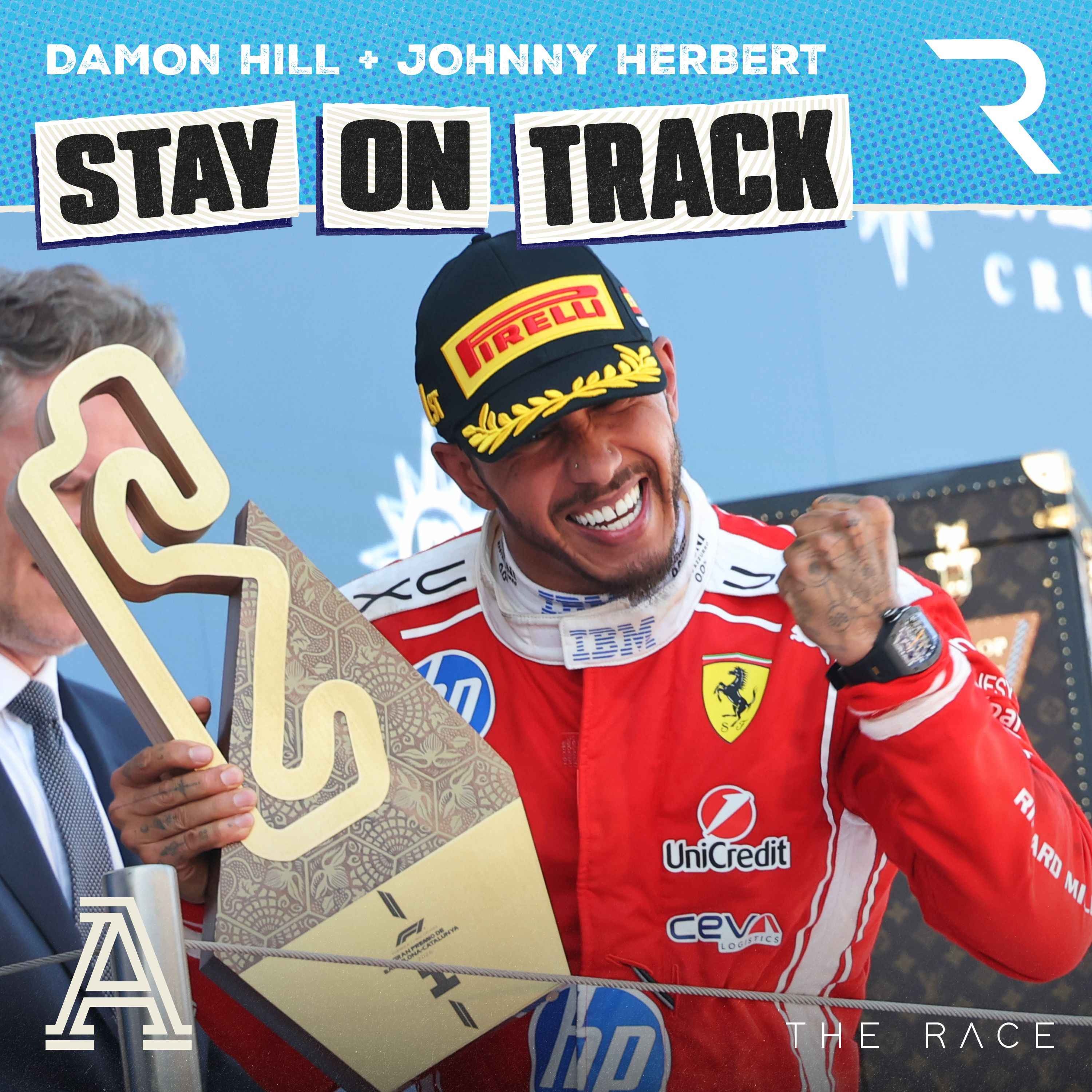
On the latest episode of Stay On Track, 1996 F1 world champion Damon Hill and grand prix winner Johnny Herbert discuss whether Lewis Hamilton should now be considered a contender for the 2026 world title after his thrilling victory in Barcelona.
They also ruminate on Hamilton's resurgence and how he's been able to regain his mojo and galvanise the Ferrari team around him, at the very time that team-mate Charles Leclerc is struggling to get results.
Damon and Johnny also offer high praise to Mercedes' championship leader Kimi Antonelli and some advice to George Russell in how he can fight back against the Italian.