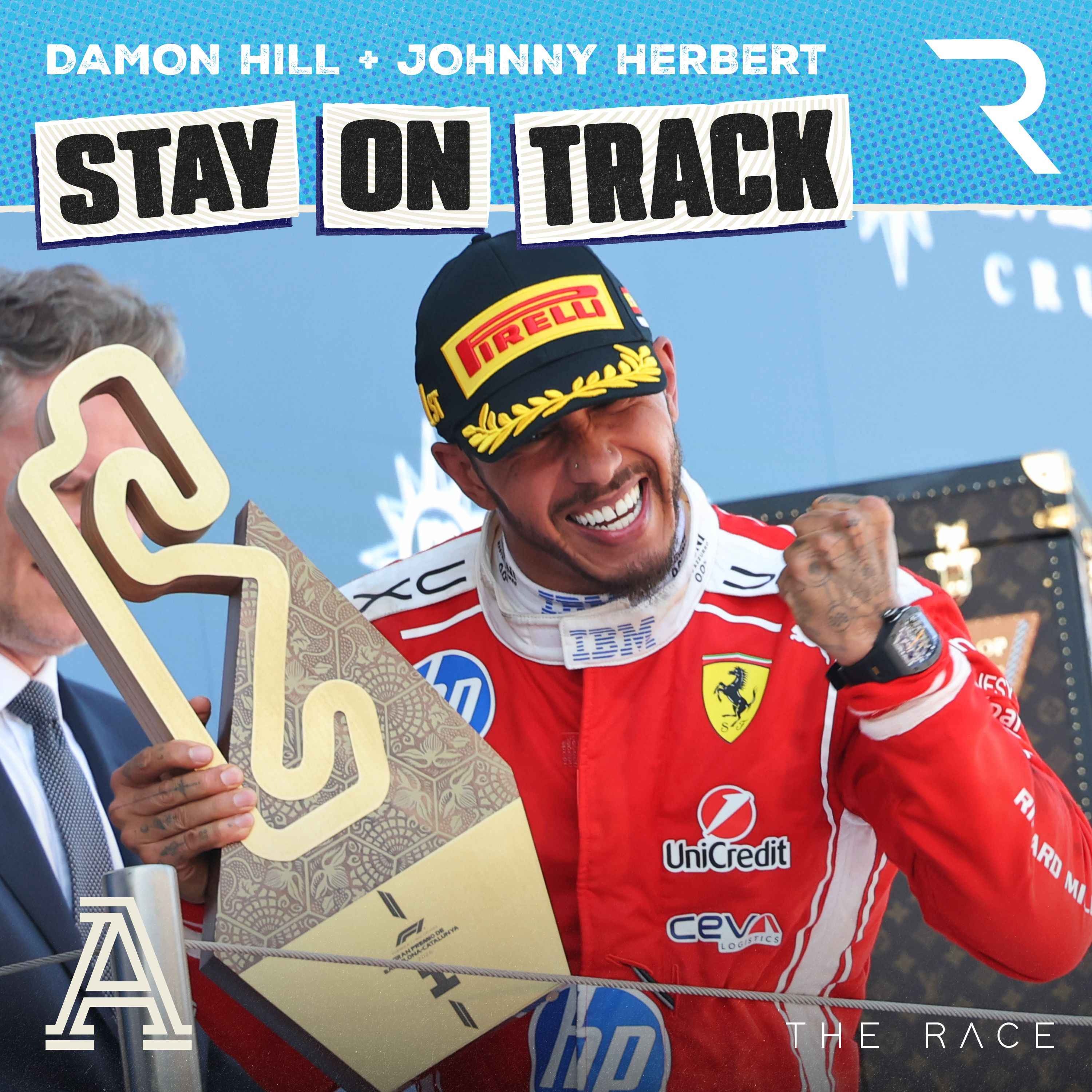
Can resurgent Lewis Hamilton finally win his eighth F1 title? Hill & Herbert have their say
About this episode
Lewis Hamilton’s Ferrari resurgence is framed as a confidence-driven turnaround: he’s pushed for the carbon brakes he “knows and loves,” stopped relying on the simulator, and even reset mentally in Spain. The panel links Ferrari’s rapid development to giving Hamilton the “missing ingredient” and notes he’s now “second in the championship.” Beyond Hamilton, they debate how Austria’s braking demands and a driver’s enjoyment-focused mindset can tighten racing and unlock performance.
On the latest episode of Stay On Track, 1996 F1 world champion Damon Hill and grand prix winner Johnny Herbert discuss whether Lewis Hamilton should now be considered a contender for the 2026 world title after his thrilling victory in Barcelona.
They also ruminate on Hamilton's resurgence and how he's been able to regain his mojo and galvanise the Ferrari team around him, at the very time that team-mate Charles Leclerc is struggling to get results.
Damon and Johnny also offer high praise to Mercedes' championship leader Kimi Antonelli and some advice to George Russell in how he can fight back against the Italian.
Help shape the future of The Race. Take our short survey today: https://theracemedia.typeform.com/to/a6U6EGps
Get bonus F1 podcasts, extra content and ad-free listening, sign-up to The Race Members' Club on Patreon today.
Hosted on Acast. See acast.com/privacy for more information.
equal opportunity
"And now we've got a situation where we had the team that is trying to be even-handed famously over the years, Mercedes, with their both drivers, trying to give them equal opportunity."
In F1, teams sometimes have to decide how to support two teammates. “Equal opportunity” means the team tries to give both drivers a fair shot rather than helping one more than the other.
“Equal opportunity” here refers to how an F1 team tries to avoid favoring one driver over the other. That can involve sharing development focus, giving similar strategy calls, and ensuring both cars have comparable chances to win.
Mercedes
"There's two ways of approaching it. And now we've got a situation where we had the team that is trying to be even-handed famously over the years, Mercedes, with their both drivers,"
Mercedes is the Formula 1 team in this discussion. They run two drivers, and the team tries to treat them fairly with things like strategy and support during races.
Mercedes is the Formula 1 team and constructor referenced here, known for running two drivers under the same organizational umbrella. In F1, teams manage car setup, strategy, and internal driver support to balance results between teammates.
out-qualified
"George has been, had the advantage, maybe out-qualified Kimmy. Maybe he was leading the race, but Kimmy's unbelievable."
“Out-qualified” means one driver was faster in qualifying and gets a better starting position on the grid. Starting ahead can make the race easier because you’re in cleaner air and have more options.
To “out-qualify” a teammate means one driver sets a faster qualifying lap and starts ahead on the grid. In F1, qualifying position strongly affects race strategy and track position, especially on circuits where overtaking is hard.
momentum
"I think this is going to be very difficult for George. And of course with the momentum as we were talking about. Yeah, it's going to be massively difficult for George because Kimmy just seems to be getting stronger and stronger"
“Momentum” here means the driver seems to be building confidence and getting better results lately. When a team has momentum, they often make smarter calls and the car feels like it’s working more consistently.
In racing commentary, “momentum” means a driver or team’s recent form and confidence—how strongly they’re performing and improving. It can influence decision-making, risk tolerance, and how well the car is being developed between races.
racecraft
"and more at ease within the infrastructure of Mercedes, but also with the infrastructure of his cockpit when he's driving on the circuit. And from what he's doing from a racecraft situation, it's,"
Racecraft is how good a driver is at running the race itself. It includes smart moves like defending, choosing when to pass, and dealing with other cars—not just being fast.
Racecraft is a driver’s skill at managing a race—things like timing overtakes, defending, choosing lines, and handling traffic. It’s broader than raw speed, and it often determines who converts qualifying and strategy into points.
Ferrari
"Fred Vassar perhaps backed him to get those changes in Ferrari. Because Ferrari is not an easy place as a driver to get your way with."
Ferrari is the famous Italian racing team in Formula 1. It’s not just a brand—how the team is run can affect how well the driver can win.
Ferrari is an Italian Formula 1 team and car manufacturer. In F1, the team’s culture, leadership, and technical direction heavily influence how drivers can translate speed into race wins and championships.
Fred Vassar
"Pressed his, you know, made his points and also Fred Vassar perhaps backed him to get those changes in Ferrari."
Fred Vassar is mentioned as a person who helped support changes at Ferrari. The point is that having the right people backing you can help a driver get what they need from the team.
Fred Vassar is referenced as someone who backed changes at Ferrari. In this context, the name functions as an example of internal support that can help a driver influence team decisions.
Nigel Mansel
"I likened a performance recently of Lewis's to a bit like Nigel Mansel. And I don't know why I make that comparison other than Nigel went to Ferrari clearly."
Nigel Mansel was a famous Formula 1 champion. The hosts are saying Hamilton’s recent performance reminds them of how Mansel made a big impression when he was at Ferrari.
Nigel Mansel (spelled in the transcript as “Mansel”) is a former Formula 1 World Champion known for his aggressive, high-confidence driving style. The hosts compare Lewis Hamilton’s recent performance to Mansel’s Ferrari-era impact, implying a similar ability to energize the team and fans.
Il Leone
"And he became Il Leone. You know, he became to the Italian fans, the lion-hearted one, the one that inspired."
“Il Leone” is Italian for “the lion.” In this segment, it’s used as a nickname for a driver who became a big inspiration to Ferrari fans.
“Il Leone” is an Italian nickname meaning “the lion,” used here to describe how a driver (referencing Nigel Mansel in the comparison) became a fan favorite at Ferrari. The phrase highlights the cultural side of F1—how drivers can become symbols for a team’s supporters.
Monaco
"And that's something, as we've seen after Barcelona, before Barcelona, even going to Monaco, [1037.3s] where he started to get them on his side. ... [1052.4s] So a couple of interesting things on that, I think, was after he crashed in Monaco"
Monaco is a famous Formula 1 race held on city streets. It’s a very tight track where braking and corner entry matter a lot because you don’t have much room for mistakes.
Monaco refers to the Monaco Grand Prix venue, a street circuit known for tight corners and limited overtaking opportunities. Because braking zones are so critical on a narrow track, changes in brake feel and confidence can strongly affect lap time and driver confidence.
carbon industry brakes
"So a couple of interesting things on that, I think, was after he crashed in Monaco [1057.5s] and he was having a go about the brakes. [1059.7s] Well, Lewis has pushed to get the carbon industry brakes that he knows and loves."
They’re talking about a special type of brake rotor made from carbon-ceramic materials. It’s designed to stop really hard and keep working even when the brakes get very hot, which matters a lot in racing.
“Carbon industry brakes” is referring to carbon-ceramic brake technology, which uses carbon-based materials for the brake rotors. In Formula One, these brakes can offer strong stopping power and fade resistance, but they also require the right operating temperature and feel to be consistent.
Brembo
"Which, not as far as I know, in Italian or French, they're not an Italian manufacturer. [1065.5s] Brembo are the chosen, you know, relationship with Ferrari is understandable."
Brembo is a major performance-brake manufacturer that supplies brake systems to many racing teams and road-car brands. In this segment, they’re mentioned as the established brake partner in the Ferrari ecosystem, which helps explain why the “chosen relationship” is understandable.
the feel of brakes
"But you need brakes. [1078.6s] You need the feel. [1081.4s] The feel of brakes. [1083.4s] Let's try and explain it to somebody who's never had that experience."
“Brake feel” is how the brakes respond when you press the pedal—how strong they are and how smoothly they slow the car down. Good brake feel helps a driver brake at the right moment and with the right pressure into a turn.
“The feel of brakes” is the driver-perceived feedback from the brake pedal and braking system, including how quickly and progressively the car slows. In racing, this feedback affects confidence and precision—especially for corner entry, where small timing errors can cost a lot of speed.
corner entry on the brakes
"The ability to corner fast. [1102.8s] The most critical, the most difficult part of driving a racing car is how you enter a corner [1108.8s] on the brakes. [1110.5s] And that happens in a flash."
Corner entry is the moment you slow down and start turning into a corner. The hosts are saying that getting the braking right right before you turn is one of the hardest and most important parts of driving fast.
“Corner entry on the brakes” describes the braking phase used to set up the car’s trajectory before turning in. The segment emphasizes that this is often the most critical and difficult moment in racing because it happens quickly and determines how fast you can carry through the corner.
modulate the braking
"I prefer where you have to push really, really hard because then I feel I can modulate the braking when it's something that's a bit softer and a bit longer as in the pedal movement is a little bit longer."
Modulating the brakes means squeezing the brake pedal in a smooth, controlled way instead of just stomping it. It helps you slow down more precisely and keep the car stable.
To modulate the braking means to smoothly vary brake pressure so the car slows in a controlled way rather than on/off braking. Drivers often prefer a pedal feel that lets them fine-tune pressure—especially when traction is limited or when they’re trying to balance the car through a corner.
simulator
"Lewis didn't go to the simulator. He's dumped the simulator. And also in this qualifying in Spain, he didn't stick around in the briefing after FP3."
A simulator is a high-tech training setup that lets a driver practice without being on track. It can help with things like braking and car setup, and here they’re saying Lewis wasn’t using it.
In F1, a simulator is a driver training tool that recreates car behavior and track conditions so the driver can practice setups, braking points, and race scenarios. The segment implies Lewis Hamilton’s approach changed because he “didn’t go to the simulator” and then “dumped the simulator,” suggesting a shift away from that feedback loop.
FP3
"And also in this qualifying in Spain, he didn't stick around in the briefing after FP3. He went off to his motome and tried to get his head in gear."
FP3 is the third practice session on an F1 weekend. Teams use it to test the car and figure out what to change before qualifying.
FP3 means “Free Practice 3,” the third on-track practice session of an F1 race weekend. It’s typically used to finalize setup direction and gather data before qualifying, which is why the discussion about not sticking around after FP3 matters.
Spain
"And also in this qualifying in Spain, he didn't stick around in the briefing after FP3. He went off to his motome and tried to get his head in gear."
Spain is where the qualifying session in the story takes place. The hosts are using it to set the scene for what Hamilton did (or didn’t do) that weekend.
Spain is mentioned as the location for the qualifying session being discussed. In F1 context, this points to how Hamilton’s weekend routine and feedback choices differed during that event.
Lewis Hamilton
"They've given a car that can win to Lewis, and I think that's always been the missing ingredient for Lewis. He will wake up, he'll deliver what he can if he's got a sniffer victory, and he's got one now."
Lewis Hamilton is a top Formula 1 race driver. In this segment, the hosts say he’s in a better position because his team has given him a car that can win.
Lewis Hamilton is a British Formula 1 driver and one of the sport’s most successful modern racers. The hosts are arguing that he’s finally getting the kind of car and momentum needed to contend for (and potentially win) an eighth world championship.
sniffer victory
"He will wake up, he'll deliver what he can if he's got a sniffer victory, and he's got one now. Yeah."
“Sniffer victory” is racing slang for a situation where a driver is close enough to win that they can sense it’s within reach. In F1 commentary, it usually implies strong form and a realistic chance to convert opportunity into a win.
mental side
"And the other thing that is going to be very powerful, and it doesn't matter who you are, it's the mental side of it, it's going to be very powerful now. He now can see he's maneuvered himself into a very positive place, and Ferrari seem to"
The “mental side” means how confident and focused a driver feels. The hosts are saying that when Hamilton is doing well in the standings, it can help him stay calm and perform better.
The “mental side” refers to the psychological momentum in motorsport—confidence, focus, and pressure management after results swing. The hosts argue that once Hamilton is in a strong championship position, the mental boost can make performance more consistent.
Spanish Grand Prix
"But I noticed on social, someone posted a podium, which was from the Spanish Grand Prix [1522.2s] in 93, and it was Senna, Prost, and Schumacher, and they were saying, wow, what a podium."
The Spanish Grand Prix is one of the main Formula 1 races. It’s in Spain, and drivers compete for points and podium finishes like in other F1 races.
The Spanish Grand Prix is a Formula 1 race held in Spain, traditionally at the Circuit de Barcelona-Catalunya. It’s a key stop on the F1 calendar, so podiums there are often discussed as meaningful season markers.
Prost
"in 93, and it was Senna, Prost, and Schumacher, and they were saying, wow, what a podium. [1530.6s] But those guys, if you look it up, it's on there somewhere, it's the post-race interview."
Prost is Alain Prost, a top Formula 1 driver from France. He was known for being smart and controlled during races.
This refers to Alain Prost, a French Formula 1 champion celebrated for tactical racing and race management. He’s often contrasted with other greats in discussions about how drivers approach tire and pace control.
Schumacher
"in 93, and it was Senna, Prost, and Schumacher, and they were saying, wow, what a podium. [1530.6s] But those guys, if you look it up, it's on there somewhere, it's the post-race interview."
Schumacher is Michael Schumacher, a famous German Formula 1 driver. He won championships and was known for being extremely competitive.
This refers to Michael Schumacher, the German Formula 1 driver who won multiple world championships and dominated the sport for years. His name is frequently used when talking about the most competitive eras and memorable podiums.
Senna
"in 93, and it was Senna, Prost, and Schumacher, and they were saying, wow, what a podium. [1530.6s] But those guys, if you look it up, it's on there somewhere, it's the post-race interview."
Senna is Ayrton Senna, a famous Formula 1 driver from Brazil. People still talk about him because he was extremely fast and skilled in races.
This refers to Ayrton Senna, the legendary Brazilian Formula 1 driver known for extraordinary qualifying pace and wet-weather skill. His name comes up often in discussions of iconic podiums and racecraft.
post-race interview
"But those guys, if you look it up, it's on there somewhere, it's the post-race interview. [1535.8s] They are knackered."
A post-race interview is what drivers do right after the race to answer questions. They usually talk about how the race went and how the car felt.
A post-race interview is the media session immediately after the race where drivers talk about what happened, how the car felt, and how they managed the race. In F1, these interviews are often where you hear details about physical strain and car behavior.
knackered
"[1535.8s] They are knackered. [1537.2s] They're sitting there, and they're going, they're going, and Adam Prost is complaining"
“Knackered” just means really, really tired. In this context, they’re saying the drivers were exhausted after the race.
“Knackered” is British slang meaning extremely tired or worn out. Here it’s used to describe how physically exhausted the drivers were after a particularly demanding race.
cow was jumping
"and Adam Prost is complaining [1541.2s] about being exhausted, and the cow was jumping. [1544.6s] It was very physical."
It’s slang for the car bouncing around a lot. The race conditions were rough enough that it felt really jarring and physical for the drivers.
“Cow was jumping” is a colorful way to describe a car that was bouncing or moving around a lot—typically due to rough track surfaces, bumps, or suspension behavior. It’s an informal description of how physically jarring the race conditions were.
Detroit
"The most physical race I've ever had, and these guys have raced in Detroit and places [1548.9s] like that, where it was boiling hot in all the street, and Michael didn't look quite"
They’re talking about racing in Detroit, which can be rough and tiring because it’s often on city streets. The point is that the drivers were physically worn out in those conditions too.
“Detroit” here refers to racing in the city, where street circuits can create a very physical driving experience due to bumps, tight corners, and heat. It’s mentioned as an example of places where the drivers were similarly exhausted.
Kimi Antonelli
"but we'll say that Kimi Antonelli's neck went in that [1569.7s] race. [1570.0s] Did you see that?"
Kimi Antonelli is a young F1 driver. They’re saying that in a race he got so physically strained—especially in his neck—that it affected him.
Kimi Antonelli is a young Formula 1 driver prospect discussed here in terms of how demanding races are physically. The host is specifically noting that his neck “went” in a race, highlighting the strain modern drivers still experience.
neck went
"but we'll say that Kimi Antonelli's neck went in that [1569.7s] race. [1570.0s] Did you see that?"
It means his neck got too strained during the race. In racing, the driver’s body takes a lot of force and vibration, and the neck can be one of the first areas to feel it.
“Neck went” is an informal way to say the driver’s neck couldn’t handle the physical load—often from sustained high g-forces, vibration, and heat. In racing, that kind of strain can show up as pain, stiffness, or fatigue that limits performance.
sliding out of corners
"We can see them doing stuff. We can see them sliding out of corners a bit. Yeah."
When a car “slides out of corners,” it means the tires aren’t gripping the road as well as they should. Instead of turning cleanly, the car drifts wide, and the driver has to correct it to stay on line.
“Sliding out of corners” describes a loss of grip where the car’s tires can’t hold the intended path, so the car drifts toward the outside of the turn. In racing, it’s a sign the car is near its traction limit and the driver may need to adjust braking, throttle, or steering to regain balance.
rotate it in a different way
"And being able to rotate it in a different way. And before you couldn't do before."
“Rotate it” is how the car turns and pivots through a corner. If they can “rotate it in a different way,” it means the car is easier to steer and set up for the turn instead of feeling stuck or unresponsive.
“Rotate it” is racing shorthand for how the car pivots into and through a corner—changing its yaw attitude so it turns more effectively. When they say “in a different way,” they’re implying the car’s balance and response allow a more controllable turn-in/rotation than before.
go-kart
"which we've been through in various cars over the years, but now they do seem to be like a go-kart when you go go-kart racing."
They’re comparing the F1 car’s feel to a go-kart because it’s quick to respond when you turn. The point is that it feels agile and controllable, especially when you’re pushing hard.
Calling the car “like a go-kart” is a common motorsport comparison for sharp, immediate steering response and predictable rotation. It usually means the car feels light and agile at the limit, rather than sluggish or dominated by aerodynamic effects.
wheel-to-wheel battle
"It's wheel-to-wheel battle. We seem to have got that."
A “wheel-to-wheel battle” is when two cars race side-by-side, very close to each other. It usually means the racing is intense and the cars can stay close enough to fight for position.
A “wheel-to-wheel battle” means two cars are side-by-side with their tires running close enough that they’re competing for the same racing line. It’s a key indicator of how well cars can follow each other without losing too much grip from aerodynamic effects.
aerodynamics
"So the aerodynamics do seem to be working in a positive way because they can follow close now."
“Aerodynamics” is how the car’s shape and wings interact with air. In racing, it can make the car stick to the track better (more grip) and help it handle when you’re close to other cars.
In F1, “aerodynamics” refers to how airflow over the car creates downforce and drag, affecting grip and stability. When they say aerodynamics are “working in a positive way,” they mean the car’s aero package helps it stay stable and follow other cars more effectively.
FIA
"Well, then we need to give some credit to the FIA and the Regulate and also the teams for working on making a car that can deliver this."
The FIA is the organization that makes the rules for motorsport. In F1, rule changes from the FIA can change how the cars behave on track.
The FIA (Fédération Internationale de l’Automobile) is motorsport’s governing body that sets the rules and regulations for Formula 1. When the speaker credits the FIA for changes, they’re referring to rule updates that affect car design and racing characteristics like how well cars can follow each other.
downforce
"Well, then we need to give some credit to the FIA and the Regulate and also the teams for working on making a car that can deliver this. It's got less downforce, but it's also able to tolerate a little bit of yore and also"
“Downforce” is the force that pushes the car toward the ground so the tires can grip better. More downforce usually means better cornering, but they’re saying the cars can still handle well even with less of it.
“Downforce” is the downward aerodynamic force that increases tire grip, letting the car corner faster and brake later. The speaker notes the cars have “less downforce” but still manage to stay controllable and follow closely, implying improved overall balance and tolerance.
master cylinders
"That's why there are different master cylinders. We have a different master cylinder, bigger or smaller. It makes a difference to how the pedal moves and everything else."
The master cylinder is what your brake pedal uses to push brake fluid through the brake system. If it’s a different size, the pedal can feel like it moves more or less, and the brakes can feel more or less “grabby.”
A master cylinder is the hydraulic pump that turns your brake pedal force into pressurized brake fluid. Different master cylinder sizes (bigger vs smaller) change the pedal travel and how quickly braking pressure builds, which is why drivers may prefer different setups.
blown diffuser
"We've seen with people like Sebastian Vettel when he lost the blown diffuser. It suddenly changed his competitiveness."
In F1, a diffuser helps push the car down to the track for grip. A “blown” diffuser uses extra airflow (often from exhaust) to make that downforce stronger—so if it stops working, the car can feel much less planted and harder to drive fast.
A blown diffuser is an F1 aerodynamic system where engine exhaust (or related airflow) is used to energize the airflow under the car, strengthening the diffuser’s downforce. If it fails or is lost, the car can suddenly generate less grip, which can drop a driver’s competitiveness.
ground effect
"He didn't enjoy the ones, the ground effect, Venturi cars, because you couldn't... I don't think you could break..."
Ground effect is how an F1 car can make extra downforce by using the air under the car. When it’s working, the car feels more stuck to the road; when it’s disturbed, the handling can change a lot.
Ground effect refers to aerodynamic downforce generated by shaping airflow under the car, typically using sidepods and a diffuser. When ground-effect cars are working well, they can feel very stable and “grippy,” but they can also be sensitive to ride height and airflow disruption.
Venturi cars
"He didn't enjoy the ones, the ground effect, Venturi cars, because you couldn't... I don't think you could break..."
A Venturi-style design uses the shape of the car to speed up air under it, which helps create suction and downforce. In practice, it’s part of the ground-effect setup that can make the car feel very different when it’s behaving correctly.
Venturi cars use the Venturi effect—accelerating airflow through a narrowing section—to create low pressure under the car and generate downforce. In F1, this is closely tied to ground-effect designs, where the underbody geometry and airflow determine how much grip the car produces.
anti-dive
"Do you remember they had all that anti-dive? Yeah."
Anti-dive is about stopping the car’s nose from dropping too much when you brake. That can make braking feel more controlled and help the car stay balanced instead of pitching forward.
Anti-dive is a suspension/geometry feature intended to reduce how much the front of the car dips under braking. By limiting front-end pitch, it can help braking feel more consistent and keep the aerodynamic balance (like ride height) more stable.
central pressure
"It's because if it dives too much, it changes the central pressure so much. And the whole floor, that way it works."
It’s about how the air pressure around the car creates downforce (the force that pushes the tires onto the track). If the car squats or dives too much, the airflow changes and the car can feel different or less stable.
In F1, “central pressure” refers to the aerodynamic pressure distribution under and around the car that helps generate downforce. If the car “dives too much,” the ride height changes and that pressure distribution shifts, which can reduce grip or change balance.
floor
"And the whole floor, that way it works. But now he can go back to the way he used to probably enjoy driving,"
The floor is the bottom of the F1 car, shaped to push the car down onto the track using airflow. A better floor shape usually means more grip.
The “floor” in an F1 car is the underside panel shaped to manage airflow and generate downforce. Together with the car’s aerodynamic devices, it helps create the low-pressure region that improves grip and stability.
hit the brakes very late and hard
"But now he can go back to the way he used to probably enjoy driving, which is hit the brakes very late and hard. And if that's not Charles' style..."
It means braking as late as possible, then braking firmly. The goal is to carry more speed into the turn without losing control.
“Hit the brakes very late and hard” describes a driving style where the driver delays braking until later into the corner, then applies strong braking to maximize corner entry speed. It’s often used to exploit tire grip and braking stability while keeping momentum.
sharp front
"because Lewis always likes a very sharp front, like we've heard with Max, for example. So, a sharper front end, I'm sure is what he's been wanting from the car."
“Sharp front” is about how well the front tires bite and help the car turn in. If the front feels sharp, the driver can steer into a corner more confidently.
A “sharp front” means the car responds quickly and predictably at the front end—typically translating to stronger front-end grip and turn-in. In F1 setup terms, teams often chase front-end balance so the driver can rotate the car into corners confidently.
change the regulations
"The point is you have to hang around long enough for them to change the regulations to give you a car that you like. As well."
This means the sport changes its rules. When that happens, teams have to redesign the cars, and it can take time before the new car suits a driver’s style.
“Change the regulations” refers to F1 rule updates that reshape what designers can build, often forcing major changes to car aerodynamics and performance characteristics. Drivers and teams may need time to adapt before the car matches a driver’s preferred driving style.
qualify
"We went into qualify, the 20 minute session or whatever it was. And I couldn't hit me apexes and it was all a bit sort of disjointed and everything else."
Qualifying is the session where drivers set their fastest lap to decide the starting order for the race. Your qualifying result can make the race easier or harder because starting position affects track position. It’s usually a high-pressure time trial.
“Qualify” refers to the timed session that sets the starting grid for the race. In Formula 1, qualifying performance determines where you start, which can heavily influence race strategy and track position. The transcript’s “20 minute session” matches the idea of a short, high-pressure qualifying format.
apexes
"We went into qualify, the 20 minute session or whatever it was. And I couldn't hit me apexes and it was all a bit sort of disjointed and everything else."
An apex is the spot in a turn where you aim to get closest to the inside of the track. Drivers try to hit it because it helps them carry speed through the corner and set up the next part of the lap. If you miss the apex, the car often feels awkward and harder to control.
In racing, an apex is the point in a corner where the driver aims to be closest to the inside. Hitting the right apexes is crucial for maintaining speed and setting up the car’s exit line. If you miss them, the car can feel “disjointed” because your trajectory and traction are off.
reset
"Which is... So it was a reset. Yes. That's what Lewis did."
In this context, a “reset” means taking a moment to clear your head and refocus before going back out. Racing is stressful, and a driver can perform better after a short break and a new approach. It’s more about mindset than changing the car.
Here, “reset” is a mental and routine reset between sessions—taking a short break to clear focus, then returning with a better mindset. The host links it to performance in motorsport, implying that composure and preparation can change how a driver executes laps. It’s not a mechanical reset; it’s about recalibrating mentally.
Max Estappen
"I mean, I think there are some drivers who probably have never experienced it. I mean, someone like Max Estappen, I would say, is so mentally strong. And he doesn't need convincing of his own abilities."
Max Verstappen is a Formula 1 driver. The host is saying he’s mentally very strong and doesn’t question himself as much as some other drivers do. That confidence is presented as a reason he performs well.
Max Verstappen (transcribed here as “Max Estappen”) is a Formula 1 driver noted for strong mental resilience and confidence. The speaker contrasts him with other drivers who may doubt themselves, suggesting Verstappen’s mindset helps him stay consistent. The segment uses him as an example of a driver who doesn’t need convincing of his abilities.
Barcelona
"Some drivers do. Some drivers are more emotional beings, I'd say. I think you still doubt yourself, because if you look at Hajar actually in Barcelona against Max, he was mighty close."
Barcelona is being used as an example race location. The speaker is saying that in a race there, one driver was really close to another, showing how tight competition can be. It’s just a reference point for the argument.
Barcelona is referenced as a specific racing venue context—likely the Circuit de Barcelona-Catalunya—where the speaker compares driver performance. The mention is used to support the idea that even confident drivers can be very close to others in pace. It’s a situational example rather than a deep technical explanation.
Request an Explanation
Heard something you'd like explained? We'll add it to this episode.
Sign in to request explanations for terms you heard.
Want to learn more?
Browse our glossary for plain-English explanations of automotive terms, jargon, and concepts.
Help improve this episode
See something that's not quite right? Our annotations are AI-generated and can sometimes miss the mark. Click the flag icon on any annotation to suggest a correction.