These are the rules a car company gives dealers for how their websites should work. In this case, Stellantis is checking whether dealers follow those website rules.
Stellantis is a big car company that makes lots of different brands. Here, they’re telling car dealers to update their websites so the online ads and tools match the rules.
Term
all links stay within the dealer site environment
This is a website compliance requirement that keeps users on the dealer’s own domain rather than sending them to external pages. The goal is to control tracking, lead handling, and advertising compliance.
These are outside software add-ons that can be installed on a dealer website. The rule here is that they can’t grab lead information or collect data that isn’t approved.
Non-certified tools are website add-ons that the automaker hasn’t approved. If you use them, you have to remove them within the deadline after being notified.
FTC scrutiny means the U.S. government watchdog is paying close attention to how companies advertise and collect information. In this context, it’s about dealer website practices and transparency.
All-in pricing means the price you see is closer to what you’ll actually pay, including the fees. CarGurus wants dealers to show that clearly so buyers aren’t surprised at checkout.
An inventory feed is the information a dealer sends to a website so it can show the cars for sale. CarGurus wants that data to include the full price with fees.
Auto parts shortages mean manufacturers can’t get enough parts to build cars. When that happens, production slows down and dealers may have fewer cars to sell.
The Hyundai Elantra HEV is a hybrid version of the Elantra. It’s the kind of car that uses both gas and electricity, and the hosts say it’s selling in high numbers.
The Sonata HEV is the hybrid version of the Sonata. The hosts mention it because it’s one of the big-selling hybrid models boosting Hyundai’s sales.
Term
port-free port
A “port-free port” is a special shipping zone that can make it faster to move goods through customs and into distribution. The idea is to get cars to dealers more quickly.
Tariffs are extra taxes on imported products. The hosts say tariffs hurt Mitsubishi’s profits because they can make cars more expensive to bring into the U.S.
These are ads that break the rules. For car dealers, that can mean they don’t clearly show the real price or required details, so the ad can be misleading.
“Fixed ops” means the dealership’s service and parts business. Instead of just selling cars once, it’s about keeping customers’ cars running and selling parts for repairs.
Here, “independents” means shops that aren’t the dealership—independent repair businesses. The point is that they’ve been getting customers’ service work instead of the dealership.
Lexus is Toyota’s luxury car brand. The host mentions a Lexus dealership in Florida to talk about how some dealers make sales through brokers instead of their normal local process.
“Broker business” means a dealer is earning money by helping a car get sold through a broker route, not just selling cars the usual way in their local area. It can involve cars being sold outside the dealer’s normal territory.
“Allocation” is how many new cars a brand sends to a particular dealer. Since the brand can’t send unlimited cars, getting more allocation can depend on whether the dealer follows the rules the manufacturer wants.
“OEMs” are the carmakers themselves—the companies that build the vehicles. They also control parts of the dealer system, like how many cars each dealer gets.
Honda is mentioned as a car brand the speaker thinks is doing things the right way with dealers. The discussion is about how the brand’s rules affect how cars get sold.
The “franchise system” is the official dealer network a car brand uses. Dealers are supposed to sell in their assigned area, and the speaker thinks breaking those boundaries hurts the system.
Toyota is the brand the speaker is about to discuss. They say Toyota reached out to its dealers to encourage support for a law that would restrict certain imported vehicles.
“Chinese vehicles” are cars made by Chinese car companies. The discussion here is about a proposed law that would block them from being sold in the U.S.
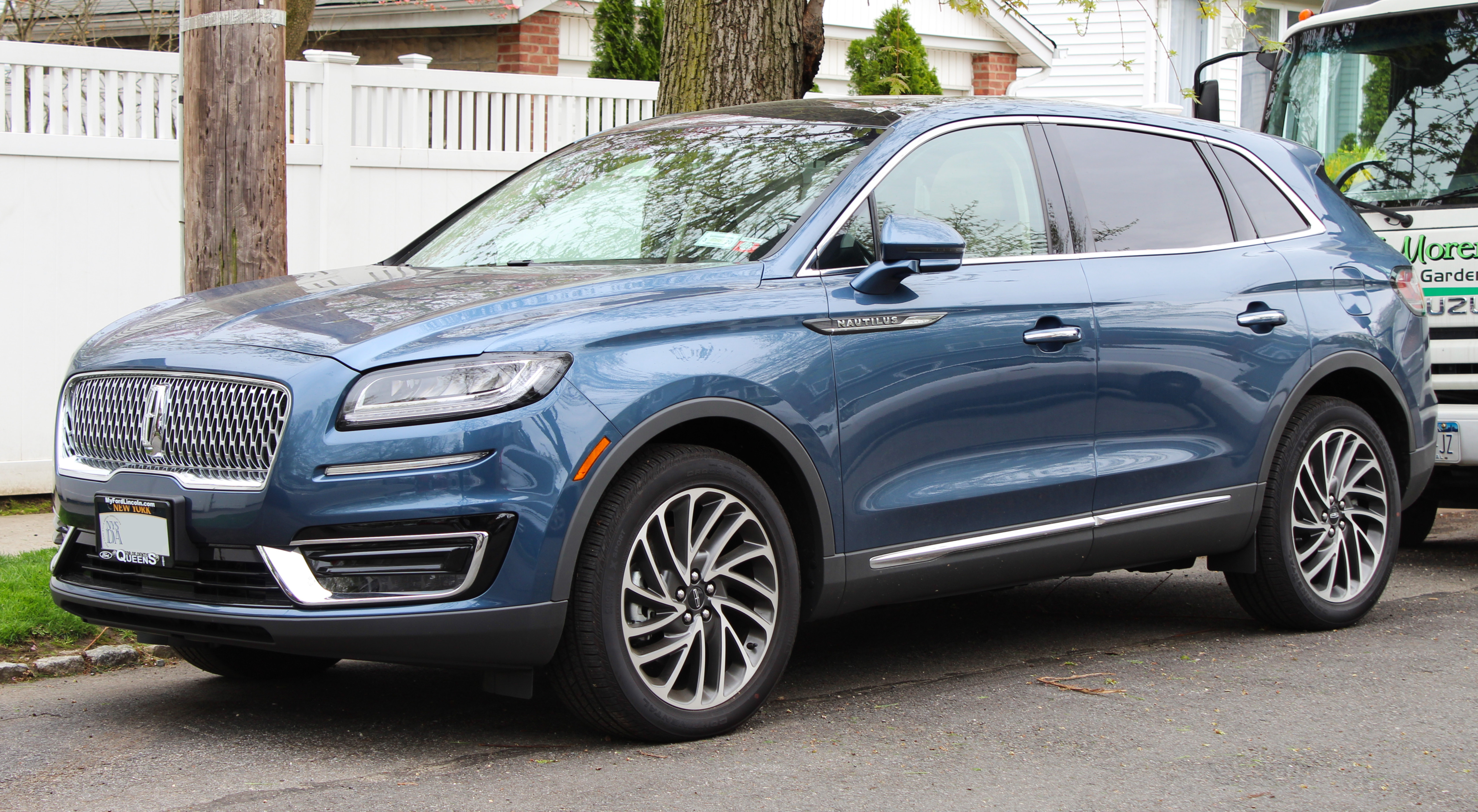
The Lincoln Nautilus is a luxury SUV, meaning it’s a larger family vehicle with more comfort-focused features. The podcast mentions that a specific “Nautilus 27” version can’t be sold there, which is about whether the car is allowed to be offered in that market. That’s why it comes up in a dealership-related conversation.
Term
broker issue
A “broker issue” is a dispute about middlemen who help arrange car deals. The speaker is saying people are still arguing about whether that practice is good or fair.
The “trade cycle” is how long people usually keep a car before trading it in for a newer one. If you can influence that timing, you can influence how often the dealership makes a sale.
A lease is like renting a car for a set time with monthly payments. At the end, you usually return it, and the lease length can affect when you’re ready to get a new one.
“84 months” means the car loan is paid back over 7 years. It can make the monthly payment smaller, but you typically pay more overall because you’re paying interest for longer.
“72 month extended terms” means you’re financing the car for 6 years. It can lower the monthly payment, but it usually costs more overall because the loan lasts longer.
The finance department is the part of the dealership that sets up the loan or lease paperwork. The host is saying their approach can stress customers out and make them less likely to come back.
Finance managers are the dealership people who help you get the loan or lease and handle the paperwork. The speaker is saying their approach can push customers too hard and hurt trust.
A trade-in is when you bring your current car to the dealer and use its value to help pay for the next car. It’s one way dealerships get you into a new deal sooner.
Concept
geometrically grow your business
The speaker means the dealership’s sales can increase faster over time, not just by one deal at a time. It’s based on the idea that once someone leases more than once, they’re more likely to keep coming back.
Customer satisfaction (often measured via industry surveys) is a score that reflects how happy customers are with their buying and service experience. In this segment, it’s tied to dealer performance and how manufacturers “struggle” when satisfaction is low.
CSI is an industry score that rates how satisfied customers are with a dealership. Higher CSI generally means customers had a better experience buying and/or getting service.
Residual value is what the car is expected to be worth at the end of a lease. If that number is higher, leases can often be cheaper and the deal can be more attractive.
Term
FMI driven store
This sounds like a dealership strategy where the store’s money-making depends a lot on a particular finance/manufacturer metric. The speaker’s claim is that it can boost short-term profit but may reduce long-term sales volume.
Presidio Group is a company that helps dealerships with advice and research. They’re described here as providing information about buying/selling dealership-related deals and market trends.
Topic
M&A Insights
“M&A Insights” means information about companies buying or merging with other companies. Here it’s tied to dealership-related transactions.
Concept
evolve
In this context, “evolve” is the dealership’s idea of adapting its business model to changing customer expectations and technology. The speaker frames it as adding specific capabilities (like digital, touchless purchasing) to keep the dealership competitive over the next decade.
A “touchless process” means you can do a lot of the car-buying steps online, without having to go into the dealership or meet someone face-to-face. The goal is to make buying simpler and faster using digital tools.
A “transparent dealer” is one that tries to be upfront about the important stuff—like pricing and what the buying process looks like—so you’re not surprised later. It usually means more information is available before you visit.
Hey everybody, welcome back to another episode of The Daily Dealer Live.
I'm your host, Sam Dark, and welcome to another show.
Thanks for choosing to be here with us this July 17th.
And guess what? You know it. We're not in studio and we're not at our normal time.
Not 1 p.m. Eastern. It's now 3 p.m. Eastern.
But it is 1 p.m. where we are here in Boulder, Colorado, over a mile high in the sky.
Let me tell you why we're here, because Card dealership guy just took a group of dealers
and literally put us on a mountain.
This is CDG in the wild with CDG experiences, the first ever such experience.
We pulled dealers out of their stores, comfort zones, and we brought them here to Boulder to climb, to connect,
to think differently about the business, because sometimes you got to get some altitude perspective.
And today's show, we've got a packed lineup. Some of it live here, some of it remote.
Coming up first today live, we've got Glenn Lundy, high performance, no excuses.
He's the guy who does more before 6 a.m. than most people do all day, as he did today.
Kyle Coleman's also here live talking growth, talking scale, talking what it takes to actually build something real in this industry.
And by the way, his COO, Jamie, is still on the mountain, but more about that in a moment.
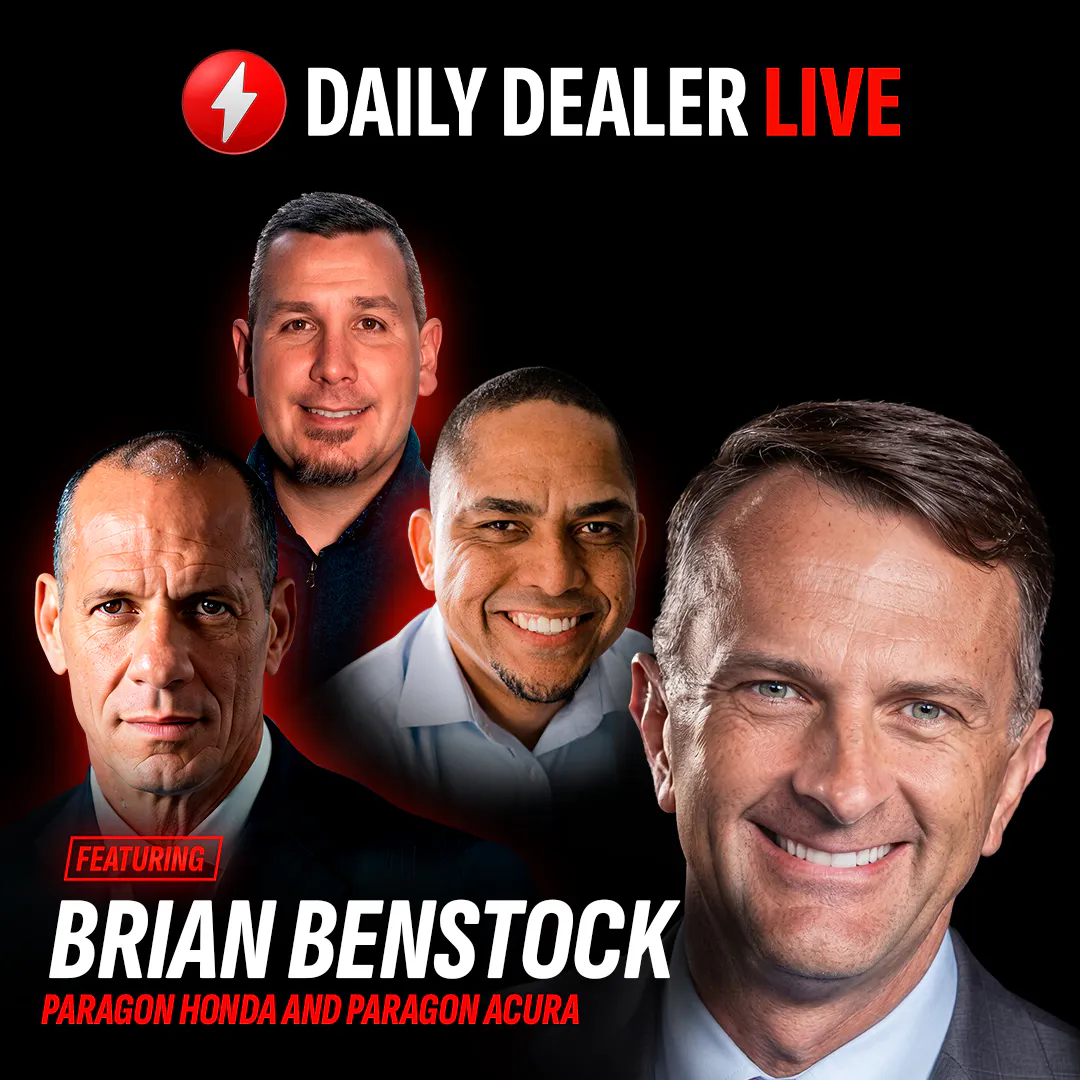
And joining us remote, because even mountains can't stop him, the one, the only Brian Benstock.
He's a retail icon, and he's dropping in from New York.
We've got three guests, one mountain, zero fluff, and a reminder.
We're streaming it live across all CDG social media platforms, as we always are.
Dale in progress comes in, says, aren't they live yet?
Yes, we're a bit late, couple hours plus some minutes.
Dan C says, hola, David, automotive retired guy from Florida coming in.
Hello, Sam. Dan C, fashionably late and eager K comes in with an auction update back from auction a few hours ago.
Got my glass of McCallan 18 single malt whiskey and punch short story Cuban cigar and ready to enjoy this live stream in my swimming pool.
Well, hopefully you're enjoying it in the swimming pool.
We're just fresh off of a hike.
We'll give you more on that shortly.
But first, let's hit today's automotive industry headlines.
Starting off today, Stellantis sent in fraction letters on July 10th to dealers whose websites are out of compliance with the manufacturer's digital program guidelines,
giving those stores until July 31st to get their sites in order.
No new rules were introduced.
The letters enforce existing standards, which include requirements that all links stay within the dealer site environment,
that third party plug-in tools don't collect leads or unapproved data,
and that non-certified tools be removed within 10 business days of notification.
If a dealer doesn't act, Stellantis digital support can remove the offending tools directly.
Stellantis frame the enforcement as part of its effort to deliver a consistent online shopping experience
and keep dealers aligned with local and federal advertising requirements.
For affected stores, the July 31st deadline is firm.
And with FTC scrutiny on dealer digital practices running hot,
this is a good moment for any Stellantis dealer to pull up those 27 pages and confirm that they're clean.
On a related note and in other news, CarGurus is reporting more than 90% of its listings now include disclosed fees,
following a July 14th deadline, the platform set for dealers to update their inventory
or risk losing deal ratings in search placement.
And as an aside, props to CarGurus for their forward thinking and their aggressive action on this.
Back to the news, dealers were required to either add fees directly to their listing
or use the platform's fees setup tool to confirm that their inventory feed already included all-in pricing.
Listings now display either price includes fees or no additional dealer fees with a clickable breakdown of charges.
CarGurus CEO Jason Treveson framed the move as expanding the platform's mission around trustworthy car shopping
and the dealer response rate, which is over 90% compliance in other three weeks,
signals that most operators understood the stakes.
For the dealers still outside that window, the rating and placement consequences are already in effect.
And next up in today's news from Boulder, Colorado, South Korea posted a record June for vehicle export value
with shipments rising nearly 6% driven by surging global demand for battery electric and hybrid vehicles.
Exports of eco-friendly vehicles in the U.S. alone surged more than 31%, reaching $2.9 billion,
while North America overall was up 12.3% and Europe climbed 13.7%.
The rebound follows a stretch of weaker output tied to auto parts shortages
with overall vehicle production recovering 12% year over year to nearly 400,000 units in June.
Hyundai's hybrid sales rose 74% in June and 67% on the year, led by high-volume models
like the Elantra HEV and Sonata HEV built in South Korea.
For Hyundai and Kia dealers in the U.S., the improving supply picture out of Korea,
particularly on hybrids, points towards more stable inventory availability heading into the second half of the year.
And closing out the news today on this Friday, Mitsubishi has added port-free port in Texas as a distribution hub,
expanding a relationship with the port that stretches back more than 40 years
and complementing existing operations of the ports of Baltimore and Jacksonville.
The partnership launched April 28th with more than 500 vehicles processed in the first month
and is designed to speed deliveries to dealer partners across the Gulf Coast and Midwest.
The logistics investment comes as Mitsubishi navigates significant headwinds in the U.S.
Namely, sales fell 14% in 25, the brand lost 56 dealerships since 2019,
and net income dropped 76% in the fixed fiscal year ended March 2026, largely due to tariffs.
For the dealers still in the Mitsubishi network, faster and more reliable vehicle flow from a Gulf Coast port
is a tangible operational improvement even as the broader band challenges remain unresolved.
And that, folks, from Boulder, Colorado, is a wrap on today's automotive industry headlines.
All right, we are making just a quick switch because we've got, you know, we've got all this cool tech.
And now we've got to make sure that the tech pivots right to our first guest.
And first up here live from Boulder, Colorado with us is Glenn Lundy, president,
800% Elite Automotive Club from Lexington.
You're not in Lexington, you're here live with us today.
What are we doing here in Boulder, Colorado on this Friday in July?
Mid-July, when most people are out, you know, hustling to sell cars.
Yeah, we're doing some crazy things like climbing massive mountains early in the morning.
You and I tethered to a rope hanging by our fingertips.
Yeah, it was nuts.
So we're doing a little bit of that.
We're also doing some great networking, having some amazing conversations.
Last night we sat around a fire pit and got to talk with incredible dealers from all over the country.
So yeah, man, we're here creating core memories.
Yeah, we're here doing.
So you do a lot of this in your business.
So part of your business with 800% Club, you do a show every single morning, Monday through Friday at 6 a.m.
I think it is Eastern.
5.30.
5.30 a.m.
So that's the tagline you do more before 6 a.m. than anybody else.
You focus on culture.
You focus on how do you build a strong, solid team?
You focus on activities like this.
How do activities like this create a strong team and automotive in 2026, Glenn?
Well, I think being a parent, one thing I've learned is that our children will follow what we do far more than they'll follow what we say.
So as a leader in an organization, you can talk about culture all day long.
You can talk about your people.
You can talk about how their family, like you can talk and talk and talk.
But if all everybody's doing is checking in at 8.30 in the morning and going home at 11 o'clock at night and working their tails off in between,
then it ends up being just that.
It's all talk.
So it's incredibly important, man, to act out the culture that you're ultimately trying to build in your business and show your people that they're more than just,
you know, some staff, some means to an end, but they're actually human beings that you want to do life with.
And so how do you do that?
What are some steps to doing?
How does it apply to what we're doing here this weekend?
Well, what's interesting, man, is culture is always a result of decisions, tiny decisions made daily.
Right?
So how do you do it?
Well, first you got to define what kind of culture it is that you want.
You might want a different culture than I want.
Kyle or Brian, if you've ever been to Brian Binstock's store.
He's coming up.
We're going to hear from him in just a minute.
How's his culture different?
How would you just define his culture?
Well, I mean, he's New York, baby.
He gets a word in here.
This is New York.
Yeah, I mean, these guys are suited in booty, right?
Yeah.
And they deliver a certain type of experience.
I'm in Kentucky.
It's a whole different deal.
So first you just got to get clear on what that culture is you're trying to develop and then understand that it's not big sleeping things done once a year.
It's the daily decisions made, you know, small incremental daily decisions made that ultimately determine.
All right.
So give me three decisions that you recommend a car dealer in 2026 implement that helps to establish culture.
First, if you change the way you start today and make a massive impact in your dealership.
Okay.
Right.
So I start super early in my business and in my life in general, but in your dealership 830 meeting, what does that meeting look like every day?
They should follow a very specific process.
What's that process?
Well, we're going to lead.
What does lead mean?
It's an acronym.
Listen, encourage, advise and develop.
We do that daily.
So every single meeting you should listen to your people.
You should start by encouraging the behaviors you want to see more of.
Advise them of the areas they can get better and then make sure they can walk out of that meeting knowing something they didn't know before.
So it starts there.
Then from there, the second thing you need to do is when you walk out of that meeting, now your leadership should be paired up with members of the team.
We're going to go out on a lot.
We're going to make sure that we do our trade walks.
We're going to post on social media together.
We're going to do all these things as a team to show that we care about their development and growth.
Not, hey, go out there and figure it out.
Yeah, good luck.
Good luck.
We're going to do it all together.
Then from there, we highly suggest that sales managers sit with the salespeople, hit the CRMs, help them make calls, have conversations.
What have they got going on in their life?
Like every great leader should know what's going on in the lives of the people that they lead.
So the first four hours of the day is really what you need to attack.
After that, you know, things kind of get a little wild, crazy customers, so on and so forth.
So if you had to guess what percentage of dealerships, dealer groups do that every single day, what would your guess be?
Well, in 800% club, it's a much higher percentage.
We preach it all the time.
It's probably 60 to 70%.
What do you think in the wild, in the broader population?
I'd say it's very rare.
So less than 10% maybe?
Oh yeah, for sure.
Yeah.
One thing Brian Benstock, and when I've traveled with him, I get a text from him at 5 o'clock, 5.30 in the morning.
Brian, thank you for that.
You'll get a word in on this shortly.
He encourages his guys to go work out that they're physically fit, that they engage.
He owns a gym.
Yeah.
How's that important in building culture?
Well, I think that there's eight pillars of life, right?
So with the eight pillars of life, you've got faith, fitness, family, finances, friends, career, education, mental health, right?
So I believe as leaders in your organization, if you want to draw a great culture, you don't just teach people how to sell more cars.
Teach them how to be a better parent.
Teach them how to be good with their money.
Teach them how to be good with their health.
Like, hit all eight pillars of their lives.
Help grow and develop them in all eight pillars.
And now you have a culture of growth.
And if your people are growing and developing, your store can't help but grow.
All right.
And then working out in the morning goes towards one of the pillars.
Goes to the fitness.
And thinking about the event that we did today, tell everybody what just happened a little bit ago.
If you're not physically fit, not mentally fit, not ready to attack something like we just did, it was hot outside.
And we didn't have a lot of warning.
By the way, for anybody that wants to know those shoes that I was breaking in Wednesday, it was complete BS.
Because those shoes, I ended up leaving them in the backpack and kept the sneakers on to climb.
But it, I mean, it wasn't an easy climb necessarily, right?
It challenged physical fitness of everybody.
In fact, the producers, I think we've got a video, one of our participants, COO, Kyle Coleman, COO.
And you may even hear someone.
The pop does this and enjoys it.
What are you doing?
I am not. That's what I'm doing.
Jamie, I got.
I'm proving it to all the men. I can do a hard thing.
By the way, how cool is that climb?
Bro, it's amazing.
And Jamie is an incredibly fierce warrior.
And Jamie sent me a text this morning before we ever got, because you and I met up here at 6 a.m.
Yeah, we got out early so we could be back for the show.
Jamie, by the way, is still on the mountain.
Yes, she is.
She sent me a message at 5.15 saying she was going to get a workout before she went to the hill, right?
Which I passed on.
And there's a reason that she's in the position that she's in.
And she's had the success that she's had is, I mean, she's fierce in all areas of her life.
And so it's really important, man. You got to take care of your health.
You got to be excellent in all areas.
Besides being excellent in health, actually, there's something with integrity.
I don't know if you've seen this before, but if you ever walked into a doctor that doesn't take care of their health,
that's a challenge, right?
It is a challenge.
You're about to give me medical advice. You don't take care of yourself.
It shows something to your team that you value that.
A bunch of comments coming in from online, drinking cars and talking coffee.
What's up, Glenn?
Coming into the chat.
Gloria Bond, 90-40-yay, let's grow.
Lionel Burns, 3287, hey, Glenn.
Glenn's the realest.
Even his voicemail greeting will inspire and motivate you.
Michelle, the Cardinalship guys own.
And then Donna Piperate, 181.
Hello, my friend, Glenn.
Thanks for all you and get the Morning 5 planner.
So a bunch of love coming in for Glenn online.
So what is, you do this show every single morning.
How can folks join that show if they want to start their morning that way?
Yeah.
If you just go to 800% about life, that is all my stuff.
So you can connect with me there, connect with all the socials.
But yeah, Monday through Friday, 5.30 a.m.
Eastern, bringing you motivation, education and inspiration.
I would love to have whoever's on here come join me.
So I think there's probably 20, 25 dealers, dealer groups that are represented here.
Last night we had a dinner at a farm around a huge table.
There was something that happened around fire pits.
I'm going to let Kyle share that during his segment, the third piece.
You talked bouldering with us.
It was an interesting experience.
It made probably some of us a little uncomfortable, myself included, right?
Because it was not what you normally do in a Cardinalship meeting.
And then we woke up, did the bouldering today and then tomorrow morning before everybody departs.
There's some conversation around financial, physical, and I forget what the third is.
But there's three speakers.
There's three speakers.
That's right.
Anyone that didn't get the opportunity to participate be part of the CDG experience.
What would you say to anybody that's kind of on the fence to join a future engagement like this?
Yeah, there's something powerful about shaking hands, man.
Shaking hands and climbing mountains and doing all kinds of incredible experiences,
especially with intimate groups.
We can go to big conferences like NADA and they have value.
Big conferences like that have value.
But the intimate settings, the opportunity to connect, like you said, what, 25 dealers that are represented here.
It's a different level.
So the next one will be coming around the mountain and everybody should be a part.
Yeah.
And it's interesting.
You know, I said this, I said this at a soda con.
You know, I quoted a Robbins quote that he says a lot, the quality of our conversations dictates the quality of our relationships, what we're able to get done.
There are some quality conversations that go on as dealers are trying to like compare challenges and try to figure out how to overcome those challenges together.
In fact, Liza last night made the comments.
She said, hey, you know, the older generation, they kind of kept expertise and best practices secret.
And our generation shares is a little bit more transparent.
I think as an industry, we understand that together we're stronger, we're better.
And it's not so much knowing that thing to do.
It's the speed to execution.
That's the difference maker in being successful and not so.
No doubt.
Glenn Lundy, a ton of praise again online, Lionel Burns.
We are so proud of Glenn.
His leadership has changed so many of our lives.
We appreciate you being here with us this week and look forward to enjoying you as we finish up today and then go tomorrow.
So thanks for being here live on Daily Dealer, Boulder, Colorado.
Glenn Lundy, everybody.
Thanks for having me.
All right.
And this is where a little bit of the transition art is going to happen because I'm going to switch back to this.
Like you can't do that.
I'm like, no, I think we can.
We're going to switch back to the other mic.
So all right.
Next up, joining the live event from his home in or from his dealership, Paragon Honda and Paragon Acura in New York, New York.
Brian Benstein, Vice President and General Manager.
Brian, welcome to the show.
Sam, how are you?
Good to be here.
Fantastic.
Good to have you here.
By the way, I'm used to being in a suit.
I'm used to being similarly attired and it was not right.
We only got off the mount moments ago and many are still out there climbing even in this incredible heat.
But Brian, you were going to be with us.
You ended up not being able to join.
We're super pumped to have you here joining us.
What do you look for in an event and an experience like this offsite where dealers gather together?
What do you look for, Brian?
You know, when you're in a different environment, the guards come down, right?
And you really get to know the person.
And I think, you know, I went on a trip with Liza Borges.
She was kicking and screaming.
It was a JMNA trip on the Gallant lady and she was telling me, I don't want to be pitched.
I don't want to be pitched.
I said, neither do I, but let's have a good time.
We had an amazing time with the people at JMNA.
And more importantly, I really got to know a different side of Liza and several of the other guests that were there on the trip.
And Liza is an amazing, amazing woman, an amazing dealer.
And frankly, I'm disappointed that I did not get to go on the trip because I wanted to spend some time with Liza.
I think she's up to 26 dealerships now.
And growing.
And growing.
It's what an incredible story.
And I'm still learning and, you know, to be around people like that that have done things that we do,
but done it at such incredible scale was an opportunity missed.
Sadly, or my ops manager, Murato Janin, had an opportunity to take a vacation.
And ordinarily we were quite a 30 days notice, but in the world that we're in, he said, boss, there's an opening.
I got to go.
Let's go.
And that's how it works.
You got to support that.
You got to support that.
The kid kills himself.
He's not a kid.
The guy kills himself in the store.
And so I said, I got you.
I got you.
And those are sometimes the best words you can give somebody in support.
I understand when the wife said home and the kids and hey, you don't take time for us.
And you've got to have that house, that home life balance to be able to perform the way he performs seven days a week.
So good to him.
Good on him.
I hardly contacted him at all during the trip.
And it's very rare for me.
I want to let him enjoy himself and hopefully he is.
That's awesome.
Well, Brian Benstock, you're getting a bunch of comments online.
Gloria Bond, 9040 says, hey, Brian, what's up?
You are incredible.
Your K comes in, says networking and learning from others so you can improve your own operations.
We do learn in that.
And Brian, you know, wanted to focus a little bit on culture development, culture building.
It seems to me a lot of these offside events are designed to create the connections that are the seeds of building culture.
How do you think about culture at Paragon Honda, Paragon Acre?
What are some of your non-negotiables, Brian?
Well, you know, I think we have a high performance culture.
It's not for everybody, you know, and we want to win.
And winning is not just selling cars and earning a good living, but really to have developed people to be the best that they can be to their highest potential,
whether it be financially, physically, mentally, culturally, every way that we can.
I think it's our responsibility to grow young men and women.
I think, you know, Glenn said a lot of things about being a family person.
And this is our extended family here at the dealership.
I believe that we can all succeed at the store.
And it's my obligation to make as many people as I can as successful as they can be.
And, you know, I think the culture at the dealership really encourages that.
We've had some great success.
We've had a number of people that have become dealers coming out of the store.
I look at what Jason Grasiano and Marat do every day.
Jason's up at White Plains Honda, just crushing it up there, destroying the competition.
No, I don't mean the other Honda dealers, because they're selling their cars, too.
But, I mean, Presky Toyota dealers and the Subaru dealers.
And we take a market share from them up there, and it's really exciting.
And, you know, nobody can play the playbook quite the way that Jason does up there.
And then, you know, Paragon.
Paragon's continually evolving.
We're sitting in second place in the nation behind my friend Rita Case up there.
We're not satisfied with second place.
Second place isn't for us, so we're at it every day.
And, you know, I think Glenn was my colleague.
We were on the clubhouse at five o'clock in the morning, many mornings for a long period of time.
I, too, believe in that the day starts early.
And that's, you know, part of the culture here at the dealership.
You know, the executive team is hearing from me between four and five o'clock in the morning, like it or not.
And a couple of guys complained about it.
But, you know, those very guys that complained about it later on in life said, hey, I missed those calls.
I missed those texts.
Yeah, yeah.
What are some of those messages look like, Brian, as you're communicating with your team?
And the goal is, obviously, I would assume, to create engagement.
It's create energy.
It's to make sure everybody starts the day right.
What do those messages include, Brian?
Well, it's awareness.
You know, again, what am I looking at?
You know, and I think you said something before where Liza said the old culture used to be keep the cards close to the chest.
Yes.
You know, treat them like mushrooms, keep them in the dark and feed them a bunch of poop.
But that's not what we do now.
You know, I've been very open about what we do because, you know, I don't think that anybody has a monopoly on information.
It's not the information.
It's what you do with it.
And so I try to make our guys, you know, get them off before everybody else gets out there.
Hey, here's what I'm seeing.
Here's what I've read.
Here's what's going on overnight.
Here's how we can benefit from that.
Here's how we're going to position ourselves to win.
And sometimes it's a pat on the back and sometimes it's a kick in the butt.
It depends on what.
And it's you go around the horn to the various people, but we are certainly a store that starts early and works late and we're proud of it.
Damn proud of it.
So Brian, share with us this July of 2026.
Were you here talking to us and being around the campfire with the dealers?
What concerns you most coming into the second half of 2026 when you communicate with your GM's?
What are you watching out for?
And then I'll ask the celebration question next.
You know, I think there's some volatility out there.
There's ups and downs.
You know, we have a couple of great days and a couple of really flat days.
I don't like that.
You know, we all thrive on regularity and consistency and that's not there.
So what has to be consistent is our actions are staying ahead of the game.
I still think it's a year of the horse.
There's a lot of good things going on in the economy.
You read off some of the things that are happening with some of the other brands and you got to try and drown out the noise of, you know, some of the Iran stuff, some of the stuff in Ukraine.
I am hopeful that we're going to get those two conflicts, the Iran conflict and the Ukraine conflict behind us and we're going to see an explosion in the market.
I think there's a lot of pent up demand out there.
I want to see our team win.
That's Team USA.
Regardless of your politics, I want our men and women to be safe.
I want the conflicts over there to end.
I'm not happy if Americans are dying.
Certainly not happy if Iranians are dying.
I want us to have peace and let's get those, the oil flowing energy prices down.
That impacts our economy.
It impacts everybody.
So, you know, I'm looking forward to getting those things behind us.
What's a move you're making the second half of 2026, Brian Benstock, to capitalize on those potential things happening?
Where do you see the biggest opportunity?
Is it fixed ops?
Is it used cars?
New cars?
Is it executional discipline?
Is it AI?
Where are you seeing that opportunity right now?
How can you focus on any one of those things?
All of those things are important.
You're going to see a very aggressive Team Paragon and Team White Plains Honda.
You're going to see a very aggressive approach towards the market.
We've got some situations here in New York.
The brokers are going crazy.
The broker jokers are going crazy.
Dealers are using these brokers to advertise non-compliant ads so that they can sell cars for the brokers.
And, you know, I'd like to see some regulatory oversight on that.
In addition to that, I think that fixed ops is going to continue to be an opportunity for us to take back some of that business
that the independents have been poaching for us.
And they haven't been poaching it.
We've forfeited that.
We've given it away.
Yeah.
We've actually rolled into security.
Gross went up.
Our account went down and it went to those independents.
Sam, it's an $800 billion industry.
Projected to go to $2 plus trillion by 2030.
And we're giving up 80% of it.
Do you think I want to take a deal from Hillside Honda or Plaza Honda?
I can care.
Let them have that.
Let's go get the service, the fixed ops business back from these independents that we forfeited it to.
So we're paying a lot of attention to that.
And we're also paying attention to the convenience factor for customers.
Customers always have to come first.
Let's start treating the customers and making it easy for them to do business with us.
And I think you'll see some very exciting things coming out of Paragon over the next 90 days
that we'll do just that on the fixed ops side and on the part side.
All right.
We want to hear that from you.
You need to break it here on Daily Deal Alive.
But you brought up two topics.
I just want to go back to briefly before you let you go.
You brought up the broker thing.
We've covered that much on this show.
OEMs have gotten aggressive.
Or at least they've written policy and policy letter reminders.
Toyota, I can think of as one example saying, hey, we're going to charge you back if brokers get involved.
And it does seem like there's gently increased oversight at a state level.
Are you seeing that trickle down or is broker still an issue, Brian?
Let me give you some data.
In this market, in my market, 440 some odd Honda's were retailed.
And 81 of those retail units came from dealers in New Jersey.
What nonsense this is that people cost two bridges to come over here and buy a car.
They're sending the deals to the brokers.
And I would say that the brokers are using advertising that's not compliant and that's helping dealers to retail a unit.
I think that's a really large issue and those dealers really need to be cautious about what they're doing.
I mean, it's clear that the OEMs are aware.
Will they have what it takes?
Will they have what it takes to protect their own franchise?
And that's the question I have.
Obviously, in some markets, it's not an issue.
It's not a national issue for a lot of the OEMs.
But I heard a statistic out of a Lexus dealership in Florida.
60% of this Lexus stores business was broker business.
Wow.
But dealers are complicit in it, Brian.
100%.
The dealer network needs to say no more.
They need to live by their own rules.
The OEMs are complicit too because they reward the dealers with additional allocation and trips and all that other stuff.
Honda's been really good with it.
But again, these brokers are fair weather friends.
They don't care about what happens to the customers.
And not all of them, but a majority of them.
And when other states are pumping into your market, I think we're undermining our own franchise system.
So hopefully there'll be some enforcement.
And by the way, I'm for free trade and for fair trade.
But if you're selling cars out of your market, you shouldn't earn more allocation.
You can sell them to whomever you want.
You just can't reward that behavior with more allocation.
That's my point.
So final topic.
Toyota this week earlier.
And we're going to get someone on the show to talk about it.
Called their dealers together and had a conversation about supporting this legislation.
That's now, I think, both in front of the house and the Senate that would forever ban Chinese vehicles from being in the U.S.
And a little bit of a vibrant discussion here about that.
One dealer's perspective, who's from Cuba.
I won't say his name because it's up to him to share the story.
He has an American tail.
He came here, rags to riches, created a dealership empire.
And he is inspirational about the American dream and how he made it here selling vehicles in the U.S.
And he said, look, we need to be concerned about Chinese vehicles here.
Brian, I'm going to be honest.
I've been split publicly in the past saying, hey, I think the U.S. government needs to come out and better articulate the reason why they're banning Polestar
and why they're saying the Nautilus 27 can't be sold here.
And I'm kind of becoming swayed that maybe there is a risk, Brian, your thoughts.
Well, it's not, again, I said I'm for free and fair trade.
And there can't be free and fair trade when they have slave labor over there.
We fought very hard to have benefits for our union workers here in the United States and our non-union workers in the United States.
And if we're talking about rolling that back to compete, well, nobody would support that.
We don't want to see that happen here.
The edge that the Chinese manufacturers have over the cost of manufacturing is unacceptable.
So until they get their workers better treatment and put their workers on the same level as ours, we're not going to have free and fair trade.
Therefore, there should be tariffs if not an outright ban until we level that playing field.
So in this particular case, again, I'm saying two different things.
I'm saying them for free and fair trade.
But I'm also saying there's such a gap in what they're paying their workers and the benefits that they don't have until those human rights issues are addressed.
I think keep the tariffs on and keep them at bay.
Yeah.
Lots of comments coming into the text.
Lionel Burns, 3287 saying one thing about Brian Ben-Stock, he always tells it like it is.
And then you've also got some folks questioning the whole broker issue, which that debate will continue.
One final thing, I know I already said one, but I'm going to slip one more thing in.
You've been a big voice in the industry on affordability.
You and I have shared a stage where we've talked about how, look, let's encourage the OEMs to create leases that help increase the trade cycle so that customers can come back in and buy more frequently.
I've actually seen some movement from some of the OEMs recently.
I would love to think it's in part due to your voice here on this show and some of the conversations we've been having.
And then I think a lot of dealers have been astonished by your policy on 84 months, you know, pay in finance and even 72 month extended terms.
What are your thoughts midyear 2026 about affordability and what OEMs are doing with regards to leasing to help make vehicles more affordable and increase that trade cycle, Brian?
I think leasing is really such a great opportunity for us to sell more cars more frequently.
You take a look at this iPhone, who does trade cycle management better?
Nobody does it better, right?
And when's the last time you put somebody in an 84 month loan for their iPhone?
It's preposterous.
This is being driven not by the dealers.
It's being driven by the finance departments and these finance managers who stress the customer out and basically terminate the relationship.
With the dealership and the OEM and the customer.
And I don't outsource or give that right to anybody in the dealership.
We want to sell frequency as such a great way to grow your business, bring them back every three years or less, get the trade in.
So over that 84 month period of time, we can sell four cars, get three trades, have seven transactions as opposed to one.
The other thing that people don't talk about is what are the chances that that customer in an 84 month loan is going to come back to that dealership?
It's like 7%.
If I've leased you two cars, if I've leased you two cars, I have a 70% chance of leasing you a third car.
That's trade cycle management.
That's how you geometrically grow your business.
Why are we not seeing this kind of support from other OEMs?
But this will require discipline in production because you can't flood the market to the broker piece and it will require discipline in financing to help with those lower term, lower cost leases.
Sam, one of the first rules I learned in the car business, control the money, control the customer.
We didn't, many years ago, we had poor customer satisfaction and the manufacturers struggled with, we had poor customer satisfaction, but we had higher retention because the length of the lease or the leash determines the customer coming back to you more than anything else.
Now, we've corrected the CSI, we have a return to market, over 50% of our customers come back and revisit us and do business again with us and we think that's a residual value of that short term trade cycle management.
We've got several other manufacturers and several other dealers in the market who have an FMI driven store and it looks like initially their profitability is higher but long term they're selling a lot less cars than we are here in the market.
So listen, I support whatever strategy a dealer wants to have.
It's his right or her right to manage your business as they see fit, but for us, we want to bring them back as often as we can, as often as it makes sense.
Honda's coming out with new products every year.
Why would I want to deprive somebody of the right to have that by putting them in a 84 month form?
It's just, I think, suicide for the business.
And on that, Brian Benstock, thank you so much for being on this special edition of Car Dealership Guy, Daily Deal Alive, here live from Boulder, Colorado.
Sam, get that woman off the hill.
Is Jamie still on the hill? Do we know? I've got Kyle next to me.
I have some dealer competitors you need to put up there on the hill.
You can send us a list and we'll send them up.
There you go.
Brian Benstock, thanks for being on Daily Deal Alive, sharing your perspective.
Good seeing you, Sam. Take good care.
Thank you. Good to see you as well.
And a ton of comments coming into the chat, including Pete Maria, who says Carvan is onto something with 998 new cars sold from one point, perhaps more on that at some point in the future.
But for now, let's talk Presidio.
Today's episode is brought to you by the Presidio Group.
You probably know Presidio as one of the top advisors in the dealership by CellSpace.
They've worked on some of the most significant transactions in the industry, but they're also producing some of the best market intelligence out there.
Facked by real-world investment baking experience and data, check out their new research and report portal at thepresidiogroup.com for M&A Insights, Blue Sky,
Multiple's exclusive benchmark data with NCM Associates, an analysis on the trends shaping all of automotive retail.
And if you need to, you can scan the QR code for more information on that.
Plus, props to Presidio for supporting today's content, including that elite conversation we just had with Brian Benstock and before him, Glenn Lundy.
And for now, we turn back to our live on site.
And I'm going to switch my mic back to the producer.
Back here live, we're back to back to Boulder here with Kyle Coleman, Presidio, Coleman Auto Group.
Kyle, welcome to the show.
Yeah, thanks for having me.
Kyle, first of all, I apologize for our listeners.
You weren't able to hear what Brian Benstock said, but we had a great conversation on all things, all different points.
And, you know, I made that comment in the beginning that the level of our conversation, our ability to challenge each other, to have unique and interesting conversations really heightens our ability to go to market, execute better.
And that's a little bit the power of what we're doing here in this group.
So first of all, you climbed today.
Tell us about the climb and what your experience was like, Kyle.
Yeah, the climb.
Let's just say that it was one of the tougher things I've ever done in my life.
I would say that, you know, I ranked by cells up there prior to that.
But, you know, after we got off the mountain, with our guide and a couple of the guys that we were with, I said, if someone was willing to offer me a free Metro store, but I had to recline the mountain.
You tell them no.
I would tell them no.
No, really?
Oh, yeah.
I'd say, hey, you know, I'll do it the hard way.
I'll buy it myself.
It was a legit tough climb and we were going straight up for much of it.
There was you're hanging behind one person and they're hanging behind you.
What made you have you ever rock climbed before?
I haven't.
What made you say yes to doing something like that with a group like this?
Is it peer pressure?
Is it a desire to see?
Can you do something you've never done before?
Why do that today?
I mean, for me, it's community, right?
You know, sometimes, you know, some of the things that we talked about is sometimes as, you know, dealers or executives in the automotive space, we can feel like we're on an island.
You know, being on an island, you know, is lonely for a lot of reasons.
You know, for this, it gave us a chance for everybody to get together, break bread, have incredible conversations about where we see the business going.
And there are a lot of incredible dealers here that have, you know, that I aspire to be like, you know, as far as the size and, you know, at the move, the movement that they're making.
So, you know, for me, it was community.
It was giving that opportunity.
Plus, I will say, you know, the ego and me said that I wanted to climb a mountain and, you know, I accomplished it.
Yeah.
And logically, you're like, well, hey, Cardiola ship guy, they can't kill us with some sort of an event.
Like, logically, like there has to be some sort of safeties and protections.
But it was fun to get all the way to the top and then, and then to be fair, we walked down the backside.
But your COO may or may not still be on the mountain.
Tell us about Jamie.
So she did one of the toughest climbs of the day.
What did she do?
Yeah.
So she did flat rock one, which is not only the toughest of all here in Boulder, but it's also the longest.
And one of the other things is we were on flat rock, second flat rock, and there's a lot of shade areas.
So we had the opportunity when we're, you know, you know, belaying up and going up on the mountain, you know, to rest while the others were getting the rope set up ahead of us.
She didn't have that opportunity.
So she was baking in the sun the entire time.
And it's hot here right now.
It's 90 degrees right now, which is hot for Boulder, Colorado.
You have the thin air.
You have the high altitude, which for us who are used to being in the Midwest at sea level or close to it, that creates an additional layer of challenge.
Well, yeah.
And there's a picture.
That's a picture of Glen and I with our guide once we'd popped down and and then there's Jamie.
So props to Jamie.
Wherever she is, hopefully she's watching daily dealer from the mountain and safely making her way back down.
So Kyle, let's turn to you.
And we got the practical parts for you and what you're up to.
By the way, Dan C comes into the chat says climbing is a great team event, especially when you're counting on your belayer.
And you definitely learn to rely on others.
You learn to make careful decisions about where you're grabbing and lifting and climbing and all those things.
So I think that's part of the value of the whole experience.
Let's talk about you.
You were recently on a pretty big show.
Tell us what the show was where our audience can go check that show out.
And what happened?
How did that come to be?
So, you know, had the opportunity to be on dropping bar dropping bar bombs with Bradley.
And I mean, you know, as far as podcast, I mean, you know, a lot of podcasters aspire for that that, you know, he's in the top 1% of all.
Not as big as daily deal.
Yeah, of course.
Of course, you know, he's close.
No, I'm kidding.
He's huge.
He's bigger.
So, you know, I reached out to him and, you know, he's seen some of the synergies.
I mean, he comes from the automotive space.
You know, he was, moved up the ranks car sales guy, general sales manager.
So, you know, he knows, you know, the business.
He wasn't just in it for, you know, a few, a few weeks.
And so I reached out and I said, Hey, I'd love it.
And he had a canceling and it kind of worked out perfectly.
And I filmed that actually about three months ago.
So, you know, they're, they're fairly well stocked up, you know, on their, how they do things in their production.
So it was exciting, you know, to go on there and talk about, you know, not only the growth that we've had in the automotive group,
but, you know, our fund, our private equity fund and how it's, you know, that that's really been able to give us a leg up on in some of our markets
and allow us to scale at a quicker speed than, you know, maybe just doing it by traditional cash flow of the automotive dealerships.
All right.
So let's do talk about your growth.
You've been on this show before you've shared it, but two years ago, you weren't a dealer principal.
You were a GM of a very high producing Toyota store in Fort Wayne, Indiana.
And you now are a dealer principal.
Tell us how many stores you're at today.
And one lesson that you've grown, learned over the last six to 12 months about growing and scaling at the speed you've scaled.
Yeah.
So we're at seven stores, seven stores in just over two years.
So it's, it's been an exciting, incredible journey that I wouldn't have changed anything.
You know, of course, there have been lots of sleepless nights, but those sleepless nights allow me to refocus.
You know, I don't need a lot of sleep to recharge.
So sometimes those moments by myself with the lights off, allow me to sit and think through the things that are going on in the business, not only globally, but at a store to store level.
You know, one of the things that, you know, I've really focused on over this time is just growing our people.
You know, like, I know I've talked about that.
Maybe I sound like a broken record, but I feel like that, you know, that's, that's the difference.
Like when I look at my stores that are executing at a high level and some of the ones that maybe you're struggling in certain areas, it's just, it's people.
It's right.
It's people buying into the things that we're asking to do.
It's just a game changer.
So I'm going to change that a little bit.
You've grown enormously fast.
How do you hire and grow and still kind of keep that culture and keep that, you know, what is the culture of your dealer group?
And how do you keep that consistently as you scale so quickly?
Because you've grown enormously fast.
And from one who's, you know, I've been a part of adding stores, part of the Ziggler Auto Group, Aaron grows extraordinarily fast.
He's got a good system for securing that culture through acquisition, but it's not easy unless you're intentional about it.
Kyle, what's your, what's your strategy and approach?
Yeah, I mean, our culture is hiring and training world class leaders.
I mean, that's really what we talk about on a daily basis.
It's what are we doing to help our teams?
You know, when someone comes aboard, it's not just about hiring.
And you know, when most of us a dealer principals or people that have been in the industry, you know, we start, they say, congratulations, you're hired.
And I remember my first day in sales.
It was literally, I walked up, I walked up to my sales manager and said, hey, what do I do?
And he says, well, actually, there's a guy out there.
He pointed out on the lot and he said, go talk him in to buy in a car.
I mean, that was the training that I initially got.
You know, so it was, it was trial by fire is what we're used to.
So, you know, my goal is to hire people that maybe we wouldn't have hired five years ago or 10 years ago.
Like though that's the future, we talk about being customer forward.
We see the things like Carvana is doing that's, you know, being disrupting the industry.
And we have incredible conversations about this last night.
Well, you know, I'm looking at changing, you know, how, how we do it at a store to store level.
If we can limit those touch points and we can give somebody, you know, we don't call ourselves people, we call product specialists.
All right, so let's talk that I'm with you.
I actually think that we in automotive, we've got to evolve in a way we've never evolved in the past.
And it is interesting.
There are seasons in every business's experience.
And you and I both know dealers that say, hey, they've been in it for a long time.
It's kind of like, hey, I'm tired of the change.
I'm ready to be done.
There's also people who are younger, newer to the business like you that are trying to figure out how do I win over the next two decades.
And by the way, I want you to tell us what your store goal is.
But looking at all the factors that are out there, brokers and interest rates and trade cycles and payments and Chinese threats and franchise threats direct to consumer,
all the things that are out there, give us one or two things that you think we've got to do an automotive to change to continue to thrive over the next, let's say, decade or so.
I mean, the first one that we talk about on a daily basis in our company is evolve.
We have to evolve.
And for us, we try to put specifics on that.
What does evolving mean?
What does it mean?
For us, it's being a transparent dealer that someone can hop on right now by the car, not have to come into the dealership, fully touchless point.
Yeah.
And I'll tell you right now, we're not there, but we're working on it and we're taking steps to do that.
We're working with a software company right now to build out that touchless process.
Who's that?
You don't have to say.
I can't say.
Secret, toxic.
But you'll tell us.
Yeah.
When we launch, it'll definitely be exciting.
We're working at the Silicon Valley tech company.
They're very well known, not necessarily in the automotive space.
And that's the thing is there's so many times I feel like the automotive space, we have this stigma where we say, oh, well, you don't understand.
It's the automotive space.
You know, I've had the opportunity.
You know, I have a personal coach, Ryan Blair.
I mean, he's a serial entrepreneur.
He's on social media.
Yeah.
Massive social media falling.
And one of the things that he talked about, you know, with me, I was actually just on a retreat a few months back with him is, you know, changing up how we look at the car business in the
sense of taking away that idea of it's the car business, right?
Like it's a business at the end of the day.
And we can decide that we want to succeed in a way and evolve or we can be the companies and, you know, the industry that starts to die and be the own demise to our industry solely because we don't want to evolve.
And, you know, that's, you know, with especially only two and a half years, you know, as a dealer principle and growing, you know, that's extremely important to make sure that we're on the cutting edge of evolution.
Yeah.
One of the things that does have to change an automotive is this idea of withholding things like price, making the process longer.
To your point, speed to transparency, speed to that final number, speed to executing for the customer.
That's going to ultimately win and technology is in a place where we can do that.
We just kind of figure out how to balance that experience with that speed execution and ultimately serve the customer.
So I appreciate how you're thinking about that.
Igor K comes into the chat says, I bought my first store back in 2004 and grew my first automotive dealer group to eight stores before sold it to Herb Chambers.
Later started another group with four partners and grew it to 42 stores.
So there is an automotive clearly that path to quickly scale, but keeping culture in that scaling truly is a challenge.
What's your goal?
Store wise, where do you want to end up being?
So 40 40 is my goal in the next seven years.
So I want 40 stores in the next seven years and I'm excited to announce today that so that that's the goal that I've publicized for a long time.
I've talked about 40 stores, but truly my internal goal is dramatically greater.
You know, my my internal goal is I want to be the largest privately held automotive group in the United States.
You have some stiff competition there, by the way.
So I think of Hendrick and some of the other big names.
So right now a hundred gets me that, you know, a hundred gets me that number.
So, you know, so I say, well, hey, if we can do 40 in seven, we can do 115.
Yeah.
So, you know, that's that's where I'm at.
And, you know, as scaling as you grow, like I will say that, you know, the first buy, sell after the first.
So I bought my first two stores and then we did a buy, sell, you know, a year later.
That was the toughest buy, sell that third store, right?
It's, you know, we're not big enough to have an executive team, you know, really for expense.
You know, but as we scale, we've been able to bring on some incredible people and hey, maybe I'll plug this a little bit.
Yeah.
Any automotive executives that's not happy, maybe an auto nation or Lithia.
If you want to come work for a group that's willing to give you some sweat in the game, put your nose down and build it to a hundred group store.
Like, hit me up because I'm ready to make it happen.
I'm ready to change your life and ways to give you freedom.
Actually, give us perspective on that.
What's the store number where you feel like scaling becomes easier?
Because to your point, I do believe it's tougher to run a smaller store.
Yeah.
It's tougher to fix a smaller store.
A larger organization actually begins to run more smoothly and you get diversification.
What's the store number?
So for me, it's 15.
You know, that's what my model shows.
I have like 30 models.
If you've seen that my desktop, it would be incredible.
Like all the different models that I have a build out, but it's all for different, you know, situations.
You know, so for me, it's 15, which by the end of 27 is our projected based off some buy cells that we have in the pipeline right now.
So, you know, by the end of 27, we'll be in a spot to where scaling just becomes easier because then it's not necessary about, you know, diluting our public, our private equity.
It's the cashflow of the entities allow us to scale even quicker and it just steamrolls.
Again, you got fans online.
947 days.
That cow guys, the real deal.
It says, wow, what an opportunity going to your offer that you've made out to the public there.
So, as we wrap up today, again, thanks for being on this special episode.
What do you see looking ahead to the next six months?
So, shorter term is the biggest threat that you're working to solve within Automotive today.
What's the biggest challenge you're looking to overcome these next six months?
Yes.
How are you doing it?
Yeah, for the next six months, I look at the business is we need to really dive in to our processes and our expenses.
You know, as real estate continues to increase, every one of them I buy sells, it feels like the real estate is more expensive.
The appraisals are, you know, getting more and more aggressive.
So, we're doing a deep dive in our full expenses right now.
So, to the level of, I look at it as ROI.
So, we look at our salespeople and we set parameters for our salespeople and we say, you know, at a minimum, you have to sell 12 cars a month to be on our team.
That's a minimum standard like congratulations, right?
And really doing the job is 20.
So, I look at it and I say, well, do we do that same thing with our vendors or tools that maybe even don't even sell cars.
So, right now we're going through an extensive deep dive in our fixed expenses and our variable expenses to be able to say, can we track a true ROI from this?
If we can't track a true ROI at a minimum of a 5X, it's a tool that, hey, I'm sorry if vendors are listening now.
If you can't show us an ROI, a true track of ROI, get ready to get a 30-day cancel because it's coming.
We have to start holding our, you know, we hold our people to this high level of standard, but we don't do it the same thing for our vendors.
So, I'm excited for that.
And how do you calculate the ROI? I suppose it's different for everyone.
Give us one thing as we wrap up today's show.
Is there one particular tool or lead provided that you feel has the biggest ROI the second half of 2026?
Well, I mean, the biggest one is, of course, our CRM.
Our CRM is the number one.
I feel like, you know, drive-centric.
Drive-centric, yeah.
We've got an incredible relationship with them.
And, you know, I think they're the future of CRMs unless you're effectively building your own CRM, which I know groups right now that are doing that.
You know, for us, it's, you know, we don't talk about some of the things that we used to talk about even three years ago.
Now we're talking about, you know, lead to engage and lead to visit, you know, so that are maybe, you know, have been around the industry for a long time.
But it's on a daily basis.
We're talking about of the leads that we got, how many actually did we get on the phone with and how many are set appointments for the day.
And that's a function of drive-centric.
The technology that I've been able to give you, which, well, Kyle Coleman, we appreciate you being here on, again, the special episode here live from Boulder, Colorado.
It's the CDG Retreat.
Kyle Coleman, thanks for being here.
Thank you.
And a ton of comments in the chat here.
Dan C comes in and says, interested in acquiring Sam's new without box green climbing shoes if he's interested in selling.
And by the way, yes, 100%.
Those shoes are yours.
I didn't use them.
They hurt.
So I never put them on.
Dan's our eager case.
I also don't rush to go public and become a publicity traded franchise dealer group.
Take your time and work smart.
So I think that's a comment to Kyle about his aspirations to be the largest privately held dealer group in the country.
And you know what?
Again, that's one of the cool parts of being together as a group like this.
Elite conversations leading to elite action to you, our daily deal live audience.
Thanks for being here.
Thanks for joining this special episode.
Thanks for joining us a little delayed.
Thanks for watching daily deal live.
We break down the biggest moves in the car businesses.
They happen.
Don't forget, we're here live every Monday, Wednesday, Friday, 1pm Eastern, except for today where we are a little done.
So if this is your world, hit like, hit subscribe, turn on those notifications so you never ever miss a beat.
And thanks for being here, everybody.
We'll see you next episode.
About this episode
Dealers gather in Boulder for “CDG in the wild,” described as “over a mile high in the sky,” blending mountain climbing, networking, and leadership talk. The show pivots into practical dealership operations: Stellantis website compliance deadlines, CarGurus fee disclosure rules, and how brokers and ad compliance can affect fixed-ops competition. Industry headlines cover EV/hybrid export strength and logistics moves. The hosts then connect culture to daily decisions—leadership meetings, “trade walks,” coaching in CRMs—and discuss scaling with transparency and touchless buying.
Today's show features:
- Glenn Lundy, President at 800% Elite Automotive Club
- Brian Benstock, Vice President & General Manager at Paragon Honda and Paragon Acura
- Kyle Coleman, President & CEO, Coleman Automotive Group
This episode is brought to you by:
The Presidio Group – Today’s episode is brought to you by The Presidio Group, one of the automotive industry’s leading buy-sell advisors. Visit Presidio’s new Research & Reports portal for M&A insights, blue sky multiples, exclusive benchmark data with NCM Associates, dealer sentiment, and analysis of the trends shaping automotive retail at https://thepresidiogroup.com/
Check out Car Dealership Guy’s stuff:
CDG Circles ➤ https://cdgcircles.com/
CDG News ➤ https://news.dealershipguy.com/
CDG Jobs ➤ https://jobs.dealershipguy.com/
CDG Recruiting ➤ https://www.cdgrecruiting.com/
My Socials:
X ➤ https://www.twitter.com/GuyDealership
Instagram ➤ https://www.instagram.com/cardealershipguy/
TikTok ➤ https://www.tiktok.com/@guydealership
LinkedIn ➤ https://www.linkedin.com/company/cardealershipguy/
Threads ➤ https://www.threads.net/@cardealershipguy
Facebook ➤ https://www.facebook.com/profile.php?id=100077402857683
Everything else ➤ dealershipguy.com