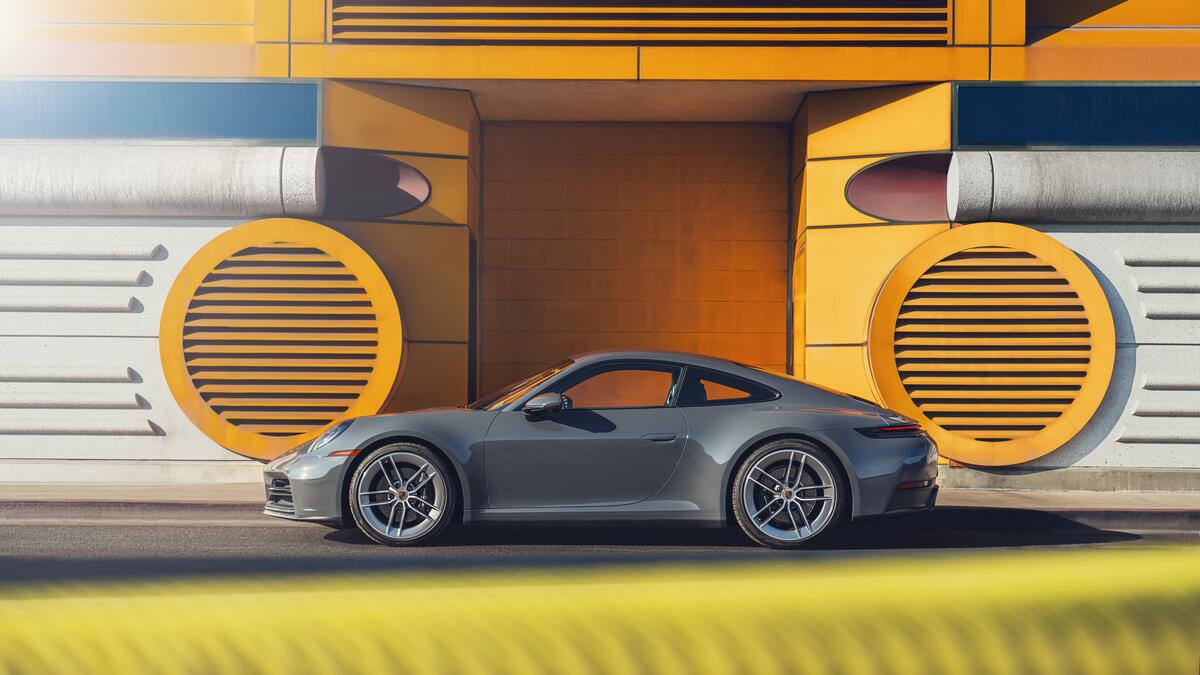
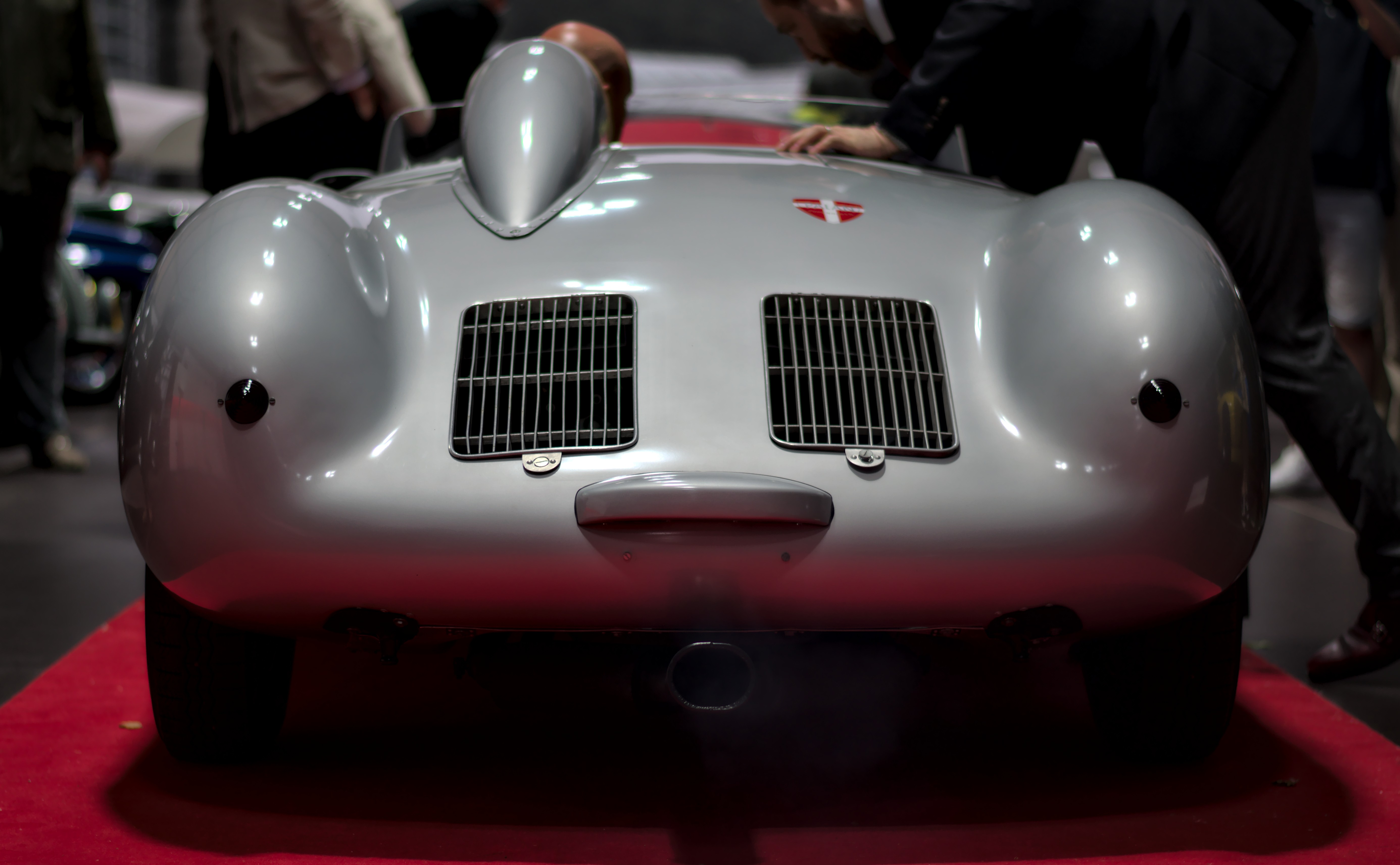
The Porsche 911 is one of the most famous sports cars ever made. It has a very recognizable shape, and the host is saying that even today, the basic body style still echoes older hand-built methods.
Coachbuilding is an old-school way of making car bodies, usually by hand and often for specific customers. The host is saying Runge Cars builds cars in that traditional, craft-focused style.
A flat eight-cylinder engine is an engine where the cylinders are arranged in two sides that sit opposite each other. It’s a layout that helps keep the engine low and can improve how the car feels when driving.
The Ford GT is a famous high-performance supercar from Ford. The host brings it up to describe the impressive mix of cars at the event where he first noticed a Runge car.
Car
Runge Speedsters
Runge Speedsters are the special sports cars Christopher Runge makes. They’re the exact kind of car Maurice saw at the event, and that’s what started his interest in Runge Cars.
Car
Helios
The Helios is a special coupe with a “Gullwing” look, and it’s meant to feel like it belongs to racing culture. The host is saying it looks old-school, but it’s also trying to capture a future design idea people once expected.
The Mercury Monterey is a mid-size car made by Mercury, which was part of Ford. It was typically built for comfortable everyday driving. In the episode, it’s mentioned because a special version or related project based on a Monterey is being discussed.
They’re using “unfinished business” to mean there were great ideas in the 1950s and 1960s that didn’t get finished or built. A lot of those concepts never made it beyond sketches.
Retro-futurism is when people picture what the future might look like using the style and imagination of the past. In this episode, they’re saying the builder didn’t just sketch the idea—he made cars that look like that vision.
This phrase points to German race cars from after World War II. The host is saying the builder draws inspiration from that time’s racing style and engineering.
Phase separation means the fuel and water don’t stay mixed. When water gets into ethanol-blended gas, it can separate out, making the fuel act “wrong” and potentially causing engine and fuel-system issues.
Octane rating is basically how “stable” the gasoline is inside the engine. If the fuel gets contaminated and changes, it can lose octane and cause knocking or other running problems.
A water separator is a fuel-system component that removes water from stored or delivered fuel. In ethanol-blended fuels, separating out water helps prevent phase separation and helps keep the fuel within specification.
An intrinsically safe camera is designed for hazardous environments where flammable vapors could be present. The electronics are engineered to limit electrical energy so they’re less likely to ignite fuel vapors during inspection or operation.
“Explosion proof” refers to equipment designed to contain an internal explosion and prevent it from igniting the surrounding flammable atmosphere. In fuel-tank or pump environments, this is used to reduce the risk of ignition from electrical or mechanical faults.
“Head pressure” means how much pressure comes from the height of a liquid. If the tank is buried deep, the liquid has more “push” to deal with, and the system has to be set up to move it correctly. It’s basically a fluid physics factor that changes how the pumping works.
A patent is a legal way to protect an invention so other people can’t copy it easily. In this story, the speaker says they didn’t bother trying to get that protection and instead tried to sell the technology quickly to customers. That’s a different strategy than licensing or exclusive rights.
The Mercedes SL 500 is a luxury roadster from Mercedes-Benz. It’s the kind of car people often buy to fix up because it’s a well-known model with lots of parts and support.
The Porsche 912 is an older Porsche sports car. It’s from the same general family as the 911 and has a similar recognizable Porsche shape. The podcast brings it up because the host found one listed for sale.
An English wheel is a workshop tool used to shape thin metal into smooth curves. Metalworkers use it to make body panels look “right” when they’re building or repairing custom car sheet metal.
Car
Lotus 7
The Lotus 7 is a very light, simple sports car that’s known for being fun and “connected” to the driver. It’s also a famous platform for people who build their own cars or kits.
The Chevrolet Corvair is an older Chevrolet car. It’s known for having its engine in the back, which is unusual compared with many cars. The podcast mentions it because there were lots of Corvair parts and related items around.
“Post-war German racers” means race cars from Germany after World War II. People were building and racing again, and many cars were creative experiments because resources were limited.
“Eigenbau” means a car that was built privately, often by individuals or small teams, not by a big factory. Glockler’s cars were part of that post-war scene—creative home-built race machines using VW-related ideas.
They’re talking about using a Volkswagen engine as the starting point for a race car. Instead of leaving it in a normal car setup, the builder modified it and used it in a more racing-focused layout.
“Formula V” is a type of racing category or rule set. The host is saying Glockler’s car was built in a style that later matched what people would call Formula V.
Term
350 sixes
“350 sixes” means a racing engine based on an inline-six design in the roughly 3.5-liter class. The point is that the builder was pushing that engine to its limits for speed.
“Porsche parts” means parts Porsche provided for a race car that wasn’t originally a factory Porsche. It’s an example of Porsche working with private builders to make the car faster.
The Porsche 550 is an early Porsche race car. It’s famous because it helped Porsche build credibility in racing, and this story says the early cars were made with help from a coach builder working on Glockler’s cars.
C.H. Feidenhausen is mentioned as the coach builder who helped build the early Porsche 550 race cars. A coach builder was a specialist shop that made the car’s body/chassis for special or racing projects.
Herman Ramelow is named as the person responsible for design and engineering in this Porsche-related story. The host is highlighting that specific engineers shaped these early race cars.
Term
private tears
The host is talking about “privateers”—small racing teams not run by the big factory. The idea is that Porsche (and Bugatti) learned from what these smaller teams were doing with their cars.
Bugatti is a famous old European car brand known for racing. Here it’s mentioned because the host says Bugatti also improved its cars based on what private racers were doing.
Walter Glockler is the person in this story who helped create early race cars. The host says he also ran a Volkswagen dealership in Frankfurt, which gave him access to parts.
“Bespoke” here means the race car was made to fit a specific person or plan. Instead of buying a standard race car, it was tailored for competition use.
“VW components” just means parts from Volkswagen. The host is saying Glockler built the first car using Volkswagen parts he could access through his dealership.
A “Porsche distributor” is basically a company/person responsible for getting Porsche cars to a region and selling them there. The host says Max Hoffman did this early on for the U.S. east coast.
Johnny von Neumann is the person who raced the Glockler Spider at Bridgehampton. The host also says he later started a competition-focused business and became a Porsche dealer.
Frank Lloyd Wright is a famous architect. Here, the host says he designed the Hoffman Motors showroom in Manhattan, linking the Porsche dealer story to a real building Wright worked on.
Vashik Pollak Jr. is the guest the host interviewed. The host says Pollak Jr. stayed close to Max Hoffman and helped him with day-to-day needs later in life.
Max Hoffman was an influential car dealer/importer in the U.S. who helped bring Porsche to American buyers. The host says he also helped Mercedes-Benz turn its race car ideas into a production car.
Car
Porsche Speedster
A Porsche Speedster is a more basic, lightweight Porsche roadster. Here, the host says it was created (in part) because Max Hoffman pushed Porsche to offer a cheaper Porsche option for the U.S.
The Mercedes-Benz 300 SL is a famous Mercedes sports car. In this story, it’s described as a production version of race-car ideas—pushed along by Max Hoffman.
“Romesh style” is a custom-car approach that uses a Beetle chassis as the base but reshapes it to look and feel like a Porsche. The host explains that the example car has a longer nose and changes the driver’s seating position.
Hamburg is a German city referenced here as the location of a prototype museum that houses a Romesh Porsche example. The host uses it to ground where the specific custom build is displayed.
A fan shroud is the ducting/cover around a cooling fan that helps direct airflow where it’s needed. In air-cooled designs, shroud shape strongly affects both cooling effectiveness and how the engine bay looks from the outside.
Car
Predator Formula V
They found a “Predator Formula V” race car/chassis to start their project. It was affordable enough for their budget, and they planned to build a custom body on top of it.
MIG welding is a common metal-joining method that uses a wire and shielding gas to make a weld. It’s widely used for fabrication, but aluminum often needs special equipment to do well.
A spool gun is a special MIG welding gun that feeds the welding wire more reliably, especially for aluminum. It makes it easier to get steady welds without the wire getting messed up.
Metal shaping is the process of bending and forming sheet metal into the right shape. Here it’s about getting the body panel to match the design before it gets welded on.
This is a way of building a car to be as light as possible. The idea is to use a strong frame and only as much material as needed, so the car doesn’t get heavy.
“Legetta” here means a lightweight skeleton inside the car. Instead of building a thick, heavy body, you build a thin frame and attach the body panels to it.
Running gear means the parts that make the car actually drive. If you change the body, you usually keep the running gear so the car still works the same underneath.
The Viper is a high-performance sports car made by Dodge. In the episode, they’re talking about a custom project that uses Viper mechanical parts, but with a special body and interior. That’s why the Viper name comes up in the context of a unique build.
“Cars and coffee” is a relaxed car meet where people show up with their cars, hang out, and talk about them—usually early in the day. The speaker brought the car because that’s where other enthusiasts would see it.
The Shelby Cobra is a legendary classic sports car known for being light and very fast. The guest mentions it because the person he’s talking about really loved that kind of classic roadster.
A jig is a tool that holds parts in the exact right spot while you work. They used it to keep the chassis aligned while they cut it and widened it for a two-person layout.
“Slab-sided” means the car’s sides are more flat than rounded. In aerodynamics, flat sides can still work well if the airflow and pressure around the body are shaped correctly.
The BMW 328 Mille Miglia is a famous old BMW race car. In this conversation, it’s used as an example of a streamlined car that still has flat-looking sides, which changes how air flows around it.
Airflow creates areas of higher and lower pressure on the car’s body. By watching yarn move, they could see how the air was flowing and then adjust the shape so the airflow stays smooth.
A canopy is the enclosed upper section over the cockpit or driver area on a streamlined race car. Here, the canopy wasn’t built yet initially, and once it was added, it corrected low-pressure areas to create steadier airflow over the whole car.
A ladder frame is a simple, strong car frame made of two main long beams with bars connecting them. It’s mentioned because the builder’s cars use this kind of structural approach (or something similar).
A tube frame is a car frame made from welded metal tubes. It can be lighter and stiffer than some other frame styles, which helps when you’re rebuilding the chassis for a new layout.
Bulkheads are internal structural walls inside the car. They help the car stay stiff and resist twisting, especially when the chassis is being modified.
Longitudinal refers to structures oriented along the length of the vehicle (front-to-back). The host contrasts longitudinal bulkheads with transverse ones, noting how both types can tie into the ladder frame to improve overall stiffness.
SCCA is a big U.S. group that organizes amateur and club car racing events. If a car is built for SCCA, it’s meant to be safe and eligible for those races.
This is a description of an older Volkswagen engine’s internal housing. It’s split into two main parts, and that design helps identify the exact engine generation.
The “912 engine” here refers to the Porsche 912 powerplant family, which is commonly discussed in air-cooled VW/Porsche hybrid builds. The speaker is describing using the “portion” of that engine’s components inside a VW-based case.
Term
iski 2J cam
The camshaft controls when the engine’s valves open and close. A specific cam “profile” like this one is chosen to make the engine pull harder in the RPM range you want.
These are special performance cylinder heads made for certain Volkswagen engines. They change airflow and can help an engine make more power, but the original parts are very hard to find.
Dual port means the engine has two intake pathways instead of one. That can help the engine breathe better and make more power when tuned correctly.
Term
36 horsepower case
This is an early VW engine type identified by the original “36 hp” rating. It matters because parts like cylinder heads must match the correct engine case design.
A flow bench is a tool that checks how easily air can pass through engine parts like cylinder heads. If the parts flow better, the engine can make more power.
Land speed records are attempts to drive as fast as possible over a measured stretch of land. The engine and airflow tuning matter because you need strong, steady power at high speed.
A gearbox is the part of the car that changes gears so the engine can stay in the right rev range. It helps the car accelerate smoothly and efficiently.
The Porsche 356 is an old-school Porsche sports car from the 1950s and 1960s. It’s famous for a simple, classic engine layout, and here they’re talking about building and having engines made for a 356.
Engine builders are mechanics who specialize in building and tuning engines. They can make sure the engine is put together correctly and performs the way you want.
A four-cam engine has more camshafts that control the engine’s valves. More precise valve timing can help the engine make power, especially at higher revs.
“36 horse” means the engine makes about 36 horsepower. In this story, they swapped to that smaller output engine for the land-speed attempt, likely to make it work reliably and predictably.
It’s an award/recognition for people who helped advance land-speed racing. That’s the kind of racing where cars or engines are pushed to set speed records on land.
Counterweighted means balancing the engine so it doesn’t shake as much. It’s like adding the right weight in the right spot to keep things steady at high speed.
CAD (computer-aided design) is software used to create precise digital models of parts and assemblies. The speaker contrasts CAD with “old school” methods like sketching and paper templates, and notes they still don’t use CAD in their own process.
CNC milling is a machine-cutting process guided by a computer. It’s used to make parts accurately by cutting metal (or other materials) to exact shapes.
“Coach built” means the car’s body was made or customized by hand, usually in small batches. Because it’s more custom, you may see more of the building process in the final details.
Tool marks are small scratches or impressions left by the tools used to shape and weld metal. They can show how much of the work was done by hand.
LIVE
This is Horsepower Heritage.
I'm Maurice Merrick, thanks for joining me once again and you may know that the first
Porsche was built in a barn, well an old sawmill actually, in Gamund Austria in 1948.
The body was hammered by hand over wooden bucks and that basic shape still endures today in the
newest 911. In another barn on the other side of the world, in rural Minnesota, Christopher
Runge began building his own sports car vision in 2011, just as Porsche did it in Gamund,
hand hammering aluminum panels over a wooden buck. And what began as a hobby inspired by
his love for Porsches, has become Chris's full-time career. Runge cars creates timeless
machines in the old European coach building tradition. Many of them, but not all, are Porsche
inspired, there's a few definite outliers that we're going to talk about, you're going to love that.
And it's now a father and son enterprise as you'll hear. With exciting new developments like a flat
eight-cylinder engine. So whether you're into Porsches, sports cars, metal fabrication,
cool engines, hot rods even, I promise you're going to love this episode. It's got so many great
elements. And now, here's my conversation with Christopher Runge. Enjoy. Well, Chris, thanks
for doing this. My pleasure. You know, it's been a long time coming. I think we've followed each
other on social media for a while. I finally met you in Monterey last summer, which was
terrific to finally meet you, by the way. Yeah, you as well. Thanks. And the first time I saw one
of your cars was in Santa Barbara, I think in about 2017 at a Cars and Coffee. Yep. And I think
you know the car I'm talking about. I got off my motorcycle and the parking lot is full of stuff
like coach-built Ferraris from the 50s, McLarens, a Ford GT, 356s and 911s, and even a
1929 Blower Bentley. And there was no one looking at those cars. Everyone was crowded around something
that I couldn't see. So I got off my motorcycle, walked over there to see what all the fuss was
about, and it was one of your cars. Wow. It was one of the Runge Speedsters, the Frankfurt Flyers,
as you like to call them. Yeah. And it was a pretty early car. You know the car I'm talking about,
right? Yeah. It was my second customer commission. Yep. And then the second time I saw one of your
cars was in Monterey last summer, the Helios. Yes. Which is this Gullwing Coupe. It is so race-inspired
and it's weird, Chris, because it's a future-past look. You know what I mean? It's vintage,
but it's not. It's the future we were promised. But nobody ever delivered on it.
Wow. That's really cool. That's very well said. I like that, because that's
kind of what you're pursuing when you make the cars, you know? Yeah. Something like,
I always think about this term unfinished business, you know? Like there was just so much good stuff
that we missed. Right. We weren't given. Right. There was that optimism in the 50s and 60s that
designers kind of ran wild with stuff. And some of it made it to the road or to
ordinary goods in the household or, you know, just industrial design in general. But a lot of it kind
of just remained on paper. So I really appreciate the Helios and a lot of your other builds for
that matter, just because of that. Because you've taken some retrofuturism and you've made it a
reality. But also a lot of your cars kind of are firmly planted in a certain era. And we'll get
into that. I know you have some very strong inspiration from, you know, post-war German
racing cars. But when you started, did you ever just take a piece of aluminum that you were working
and just throw it across the shop and like maybe utter some obscenities that like, was it frustrating?
Yeah. Oh yeah. There was times of frustration without doubt. I think that
that experience and that frustration may have come a little bit later on. Because in the beginning,
I was more forgiving of myself because I knew, I didn't know what I was doing. You know, I'm
learning and you're on this trajectory of absorbing all the information. The frustration comes when
you knew better and you screwed something up and you just knew better for whatever reason, you know,
whether you lost focus of what you were doing. That's when you're like, why did I let that
happen, you know? So that probably came a little later on, I think. Well, and after all, when you
started out, it was really just a hobby, right? Yep. I really, and I mean, it was like every chance
I got, I was in the garage hammering away, but I wasn't planning to do it for anyone other than
myself, you know? Well, your story is very unlikely because you went from professional snowboarder
to essentially coachbuilder in just a few years. Yes. So I was snowboarding professionally as a
paid professional. From 1996, I received my first paycheck with Burton snowboards until 2006. And
my career was primarily, I did a lot of competition, but I was more involved in design
of snowboard boots, bindings, clothing, and luggage. And I kind of had this
interesting path in snowboarding because in 2001, I was like, I was done. I was 21 years old. I was
going to get married and I just started coaching kids. And that was kind of like, that was what I
was doing to support my wife and I. I had snowboarding camps and training programs around
the Midwest where we had different coaches using a curriculum that I had developed. And
then we bring all these kids together and do camps. It was super fun for actually snowboarding,
skateboarding, and wake surfing. In, I think it was 2002, I took a crew of kids to New Hampshire to
the amateur, it's a pro-am nationals. So it's amateur series, but they do have a pro-am class.
And one of the parents really pushed me because I had competed a couple times that year and had
points that I could compete at the national level again, just for fun. So I entered the pro-am class
and I won it for the super pipe and won a spot for the X games. So with that, I ended up signing a
three-year contract with a company that most people had never heard of, but I knew very well
from my previous years in snowboarding. And with that company, I had a huge opportunity to design
snowboards, boots, bindings, and luggage. And what most people don't know is that in a roundabout way,
that company owned factories where many of the snowboards that are made, not all, but many of
the snowboards that are made, they're made in this factory. And so I was a much smarter businessman
than a 16-year-old when I was 22, 23. And so I negotiated ownership into the factories. So
that's smart. Yeah, when I got to the X games, I was an old guy. I mean, it was a weird
period in 2003, 2004, because it was a changing of the guards. Sean White, I can't remember how old
he would have been at that time, but he was the young guy, but he was beating the 22, 23, 24-year-olds,
Ross Powers, and the other guys that were at the top of the game. When I was at the X games,
I realized that very quickly. And I had a wife and a baby, and you could just see this shift
in the whole thing. Social media was very, very young. Let's see. Yeah, that was 03, I think.
Yeah, that was like my space days. Yeah, exactly. And early Facebook, I think.
Yeah, but the funny thing was, you're looking around, and of course, I never said anything, but
the other professional riders are on boards that I owned a percentage of the factory
where they were made. You know what I mean? So it was kind of like a win-win in a way.
Like I said, I've never said anything about that, and I really haven't talked much about it in
podcasts or anything like this, but you learned that snowboarding and action sports are very,
very fickle, very short-term. It's kind of a vicious industry, and I don't even know what it
would be like to be in it now. I can kind of imagine. But my contracts ended in 06,
and at that time, I was just looking for other things to do. I'd always loved cars,
so I thought about, man, I should open a little shop and fix up cars. But I ended up not doing that.
In 06, my dad told me about this technology that he had come across. My dad's an electrician,
and he was wiring a warehouse workshop space here in Minnesota where this inventor had
developed a technology for cleaning above ground and underground fuel tanks.
And my dad said, you should look into that and see if it's something you'd be interested in,
because it's kind of in the mechanical petroleum automotive space a little bit.
So I started researching it and realized that it could be a pretty good opportunity,
specifically on the eastern seaboard of the US, because they had mandated ethanol
to come into the eastern seaboard in 07. And so in my research, I realized that a good hub would
be Jacksonville, Florida. I ended up selling my house, went all in on one of these contraptions.
And my dad sold his business and went in. And that first contraption was a complete flop,
dangerous. I learned a lot, but it was either we pack up and just file bankruptcy,
or we figured out how to make the thing work. And so with the help of my uncle, who's an old
this system, it was housed in an enclosed trailer. And ultimately, it was a fiber OPTIQ camera housed
inside of a suction tube with a makeshift valve system that allowed you to go in and see the
contamination in the tanks and make an attempt at removing it. Well, my uncle and I went back
to the drawing board and redesigned this after like probably eight months of trying to use the
system. I literally threw it in a dumpster. I took everything out and just tossed it.
And we redesigned it and we made it work. We got the best of the best components.
And my dad and I went back to knocking on doors telling people what we were doing. They thought
we were crazy. And ultimately, when ethanol got to those gas stations and people started having
problems, because in the southeast, the water table is so high, there's a ton of moisture
that's just in the air, in the fuel. Right. And alcohol attracts water?
Yes. Yes. So you get phase separation. That's when, if you have E10 or E15, especially with
the lower alcohol volume in the fuel, when you get 68 10 inches of water in the bottom
of one of those 20,000 gallon tanks, with that lower amount of ethanol in it or alcohol, the water,
when they drop fuel, it gets blended in and you get phase separation and it drops the
octane rating of the fuel and it just gets out of spec and it can make a mess of things.
So with our new system, we used an intrinsically safe camera, explosion proof,
better valve system, water separator, and better holding tanks. And so on demand, I could go
into a tank with this camera and remove through a valve system and guide tools, sweep the bottom
of the tank, pull the contamination out, leave good fuel in while people were pumping at the pumps.
We didn't have to shut the station down. And a company called The Pantry, it's a publicly traded
company. They saw it. We showed up to give them a demonstration 20 minutes early. We swept the
parking lot and they just couldn't believe it. That's how I was raised. That's how we do business.
You know, and they were like, how long have you been here? They're usually sitting there waiting
around for people and we were on the ball and they wrote us a purchase order for a large number of
tanks. And we went from not being able to afford a hotel room over the course of a few months to
climbing out of that debt. And then we tried to sell the business when it was at its peak,
because we knew it was a bubble we were riding and we weren't able to. But that allowed me,
I built five of those systems and I had them going for nearly three years around the clock,
five crews. Wow. And that taught me a lot about business, I guess so. And all I can say, Chris,
is old school hot rodders to the rescue every damn time, right? Yeah, exactly. Yep. So the ingenuity,
you know, that hot rodders possess. Yeah. And I mean, with my uncle, actually his experience in,
he came to Minnesota and set up dairy operations for pumping dairy products on dairy farms. And
so with his understanding of pumping, head pressure, you know, when you get a tank 20 feet underground,
like there's a lot of challenges that you face in pulling contaminants off of it. And we figured
it out, man, and it worked. And he's since passed away, but he helped me build, paint
my first car, do the body work and paint on it. Nice. So yeah. What was your first car?
So before I was legal to drive was a 51 GMC three quarters on pickup. And yeah, that I love that
truck. I was 13 when we got that. That's a perfect Minnesota ride. Yeah, we're out in the middle of
nowhere. And you know, that that was the perfect like back roads gravel truck. It was it was a blast.
Absolutely. Hey, guys, I want to take a quick break to say if you enjoy horsepower heritage,
there are a few ways you can support the show. Go to buy me a coffee.com forward slash HP heritage
and become a patron. There's a link in the show notes, you can make a one time donation,
or you can support the show monthly. It's easy. And for the price of a latte, you can help me
continue to bring you more of the people and stories behind the machines. You can also leave
five stars and a review on Apple podcasts or Spotify, because that helps new listeners discover
the show. Thanks for your support. And now back to the show. So did you were you able to patent
the technology and all of that? I mean, no, didn't even try to we just were first to market,
treated our customers the best we could possibly treat them. And what what I did do with that
is we went after government contracts. So like Air Force bases, hospitals, municipalities,
airports, we had international private musicians, their jet fuel tanks, you
know, we would clean and yeah, it was so that's what we were. I was finally able to sell it at a
way less than than the peak. But that allowed me for three years to cover my mortgage on my house.
And so that gave me a buffer to at least have a little bit of wiggle room. And when I say mortgage
on my house, I'm talking about a foreclosure that I bought during the crash of 2009. That was
uninhabitable, you know, man. So well, and I understand that you kind of owe your coach building
career and your your your car creation career to a little old lady in South Dakota. Is that right?
Yeah, yeah. And that's, you know, when during the the fuel cleaning business,
we're on the road all the time. So my dad and I, he'd be driving, I'd be on Craigslist or vice
versa, looking for cars and parts because that my dad's always been a treasure hunter that so it's
like in my blood. So anything we could find that was interesting, we'd go on a run for two weeks
of cleaning tanks, and we'd come back with like a Mercedes SL 500 that we knew we could fix up,
you know, or all kinds of cars, VW buses, and we would always come back with something. So
I called this ad on Craigslist for a 67 Porsche 912. That would have been in 2010.
And it was like the proverbial little old lady, husband had passed away, sadly, from cancer.
And I learned to always ask, is there anything else you have for sale? And so in addition to
the 67 912, she said she took like gasped and she said, I have barns full of stuff. I don't even
know what all is out there, but there's tools. There's this English wheel that he was so proud of.
And so I was, you know, of course, by that time, I knew what what the English wheel was being in
the hobby for so many years. And I've always wanted to try one. So I told her I'd be interested in
buying those tools. And went out there with two, I think we had two 24 foot trailers, my uncle and I,
and made a deal with her. And she she said, as long as you if you're going to use this the tools
to build something, because she her husband is so proud of he built a Lotus, the low cost,
Lotus 7. Sure. Yeah. So she said, if you build something for yourself like that,
I'm happy to sell them to you. And that's, I told her I'd build, I was, I wanted to build my own
car. That was my goal. Yeah. And so you bought her out lock stock and barrel, huh? Well, I bought
probably one 20th. Oh, really? Oh, wow. There was, we're talking about
probably, I'm in 3200 square foot here. There was probably 20,000 square feet of like aisles
you could barely walk through. There was so many parts, Corvair stuff, Jeep stuff, just
tons and tons of stuff. Well, I can believe it. I mean, obviously her husband was elderly,
so it was a lifetime of collecting and building and yeah. Yep. Fantastic. Those kind of places
are so much fun to explore. I've, I've seen a few hordes like that. I've got some friends who,
they're, they're total toppers, you know, they could tell you stories all day long, but yeah,
that's always fun. So, so you, you had a spark of interest in metalworking because of this.
And then what did you do? Did you just kind of start messing around with the English wheel and?
Yeah. Well, I had, I had kind of developed a real fascination with the post war German
racers at about 15 years old. My mom and I stopped at a car museum. I just had knee surgery from
snowboarding. And, and on the way back from the Twin Cities, it's like a two hour drive,
we stopped at that's car museum and I hobbled around the library and found the book excellence
was expected. It's like the original Porsche Bible. And that's where I learned about the
Glockler post war German Eigenbau home built racers. And to me, in the whole Porsche story,
that was one of my favorite parts because Walter Glockler was really the guy that
he, he pushed the boundaries of the Volkswagen engine, set it up mid engine in very much like
a formula V race chassis or what would become formula V later on. And he went out and went
racing and he was really pushing the 350 sixes to their limit. Porsche saw the
potential in that they made a deal with him to put Porsche parts in that car. And one thing led
to another and ultimately Porsche had the first five fifties made by the same coach builder,
C.H. Feidenhausen. That's who Glockler had build his cars and Herman Ramelow was the designer,
the engineer behind it. So that story to me was so cool because Porsche relied early on,
on private tears and their feedback. And Bugatti did as well pre war Bugatti's
on what people were doing with the cars and how they were developing them
to make their production cars better. So with that in mind, that's kind of what I had in my head
because they were like built in barns. The I found so much beauty in, in just the raw
hammered out make it work scrappiness of those cars, you know. Yeah, you know,
it's exactly the opposite story of Ferrari, right? Ferrari was building competition cars first
and foremost, and he only built the road cars to finance the racing, whereas Porsche was
trying to race road cars. But then Walter Glockler
wanted to make these bespoke competition cars. And I think his cousin was,
he was like the driver for their. Yeah. Yeah. I have, I actually have a badge
from his cousins. It's here somewhere. I picked it up along somewhere along the way. But
yeah, he and his cousin, his cousin was, I think they were motorcycle racers as well.
Yes. And then Walter Glockler owned the VW franchise dealership in Frankfurt.
And that's why he had access to all these VW parts and built the first car using VW components.
And didn't Frankfurt also resonate with you because I think your family originally is from
the Frankfurt area? Yeah. At one period of time, they came through Frankfurt in our family history.
And my uncle showed me that history and I was, you know, I just thought that was pretty cool.
Yeah. No, it's a neat connection. In preparing for the interview, I was kind of reading about,
obviously about you and your career and Glockler figured into it. And I learned that Max Hoffman,
who was the Porsche distributor on the east coast of the United States very early,
Hoffman got ahold of a Glockler, Spider. And then Johnny von Neumann raced that car at Bridgehampton,
which is amazing history. And then of course, von Neumann became, he founded competition
motors in Los Angeles and was a Porsche dealer here. Yeah. I believe Hoffman brought over two
Glocklers. There's some interesting history, us being close to Wisconsin and the Frank Lloyd Wright,
where Frank Lloyd Wright kind of got his start. There's some history with Glockler,
Hoffman and Frank Lloyd Wright as well. I believe there are photos, a friend of mine has them,
of a Glockler in one of Frank Lloyd Wright studios. No, it makes perfect sense because
Frank Lloyd Wright designed the Hoffman Motors showroom in Manhattan.
Okay. Yeah. Yeah. And they were, I think Hoffman and Wright were fairly close.
There's quite a thread there. I have to tell you a little story. A few years ago,
I interviewed Vashik Pollak Jr. Oh, wow. And we got to talking about Max Hoffman because he was so
instrumental in Porsche's rise in the United States in the 1950s. It was Hoffman who persuaded
Porsche to build the Speedster as a low cost model for the US and all of that. And he persuaded
Mercedes-Benz to build the 300 SL as a production car after the race cars came out. But Vashik
Pollak Jr. told me that he and his father remained close to Max Hoffman up until the end. And I think
Hoffman might have died in something like 1980, but he was living in a high-rise condo in Santa
Monica right along the beach. And Vashik would bring him meals and kind of attend to errands for him
because Hoffman was more or less a shut-in at that point. He had lost his automotive empire.
All of the German manufacturers that he had represented for so long established their own
corporate distribution network in the US. And so he was just an elderly guy living in Santa
Monica and Vashik Jr. would visit him and kind of bring him what he needed. Wow. I never knew that.
Hoffman was an interesting guy. He was Viennese and he had raced, I think, prior to the war
and had been a car dealer in Vienna and then, of course, fled because he was Jewish and he saw
the writing on the wall. And then I think sold jewelry in New York to get by in 43, 44, that time
period. And then Hoffman Motors came after the war. So you got this Frankfurt connection you feel
and you're inspired by these Glocklers. And when did you put it all together and say,
I'm going to build something in this vein? In 2010 is when I really, I saw that it might be
possible. I originally bought a, I think it was a 54, 1954 beetle pan. And my plan was to do a
Romesh style. I don't know if you're familiar with the Romesh. Sure. There's a Romesh Porsche that
is at the prototype museum in Hamburg where they sliced the pan and they kind of shifted
the overall aesthetic of how the driver would sit in the pan. It's got a longer nose on it. It's a
beautiful car. And I was reading the story about that car being unearthed on the Samba. There was
a whole thread on it. And when I was reading about that and seeing how they built it, I'd already
had the idea that I wanted to try it. And that gave me the visual impact of what could be and
kind of the inspiration. I never really cared for cars that were built on the VW pan just because
of how and honestly with the 356 is when you get a low slung coach built body on that, the fan
shroud always sticks up too high. And so you have this weird, it's like, you have these cool cars,
a lot of the VW fiberglass kit cars are made that way. It's like, oh, that looks kind of interesting
from the front. And then you get to the back. It's like this big box, you know? And that always
drove me nuts, but they really pulled it off with that Romesh. And I just thought it was beautiful.
So I started looking into that. And then one thing led to another. And I realized that maybe a Formula
V, I looked at the dimensions of the original spiders and the Glockler. And the Formula V was
within like a quarter inch all the way around all four corners. And I started studying Formula
V chassis. And the cost of entry is super cheap on those. I was like, I will be, my real interest
is in designing this body. I could buy a great running Formula V race car. And if I could find
one with the title, that's a bonus. And make that my first build. And that's what I did. I found a
Predator Formula V in Virginia for like, I think it was about $2,800 or $3,000, if I remember right.
I think it was on eBay and the auction didn't sell. And I contacted the seller and bought it
from him. And that's what I got started with. And it was the perfect platform to build off of,
because I was on a shoestring budget at that point.
Well, and you were learning as you went. So what was the most frustrating thing about
like just beginning the metalworking process? Was it the planning? Was it, you know, getting the
dimensions right? Was it actually forming the panels?
The most frustrating part early on, I think was the welding. I didn't know, I knew how to
mig weld steel. And I had done, you know, building rails for skateboarding and snowboarding and
a little bit of fabrication on cars that I had over the years. But mig, I bought a spool gun.
I don't know if you're familiar with what that is. It's, yeah, I bought a spool gun to mig weld
50,000 aluminum. And it's just almost impossible. I would go an inch at a time, you know, and then
it wants to just blow through. But I got it. I got it to the point where I could, I could weld an
inch, inch and a half and then move on down the line, weld that. So bringing the body panels together
was pretty challenging. In my mind, shaping the metal, it made sense to me along the way as I
learned what metal does, what it doesn't want to do. It really, it just like, it made sense.
Some people, I've done a lot of classes over the years now and some people just can't wrap their
brain around it. So I find different ways to connect their, you know, their ability to work
with how the metal is moving. But it always made sense to me, metal did. I'm still, it's still
challenging and it's still a wrestling match at times, but that part wasn't that difficult. It was
the welding. Along the way, you didn't have any formal training, right? I mean, you were just
teaching yourself. No, I did with all the tools. There was a bunch of books. Oh. Yep. So I was
reading those books because I bought all the tools in 2010, probably around this time. We're
toward the end of May right now of 2010. And I got everything set up in our old barn where I grew
up at the hobby farm because that's where we'd work on cars and stuff, my dad and I would.
And then I didn't really start digging into working on it. I got that Formula V chassis
probably early, like maybe May of 2011. So I spent a lot of time reading those books
and just studying. I was online trying to understand metal shaping forums, you know,
reading and doing that sort of thing. I bought one DVD that was from a guy over in the UK.
And it was called, I think it's called metal shaping by hand or with basic hand tools.
I don't even think he makes the DVDs anymore, but I mean, just basic stuff like that most people
have in their garage. And he was making old Bentley wings and things like that beautifully.
So I realized that you don't have to have a ton of expensive tools to really do a high
standard of work, you know? So that's what I started with.
The Italian masters and probably some Germans and Englishmen too would shape panels over a
tree stump and a hammer and a tree stump. That's about what you needed, you know?
Yeah. And that's what I did. We had a giant maple tree go down at my house and I made a
shaping stump out of that. I still have it here in the shop. That's what I use a lot of times.
There's certain times you just... Wood is very interesting because it doesn't mar up the aluminum
and with a car that we're leaving finished raw, wood is really nice to work with. So that stump
has had all kinds of shapes ground into it, depending on what I need that day. You know,
come in with a grinder and make a dish or whatever and you hammer into it. It's a very
useful piece of wood in the shop. I think the reason many of us are attracted to this is because it
is so tactile and it is so simple in a way. It really is an art, less of a science than an art.
Obviously, science comes in, but yeah, it's fascinating to watch and it's fascinating to
learn about what the metal will do based upon your input and what tools you're using on it.
Absolutely. That's what fascinated me with it so much and I took a very, very artistic... I still
do... It's a bit more science now just because of where we're at as a business, but I've always taken
a very artistic approach to the work. There are guys who you'll look at the panel when they lay
out their patterns and it is a mathematical formula. I see that and like, it makes sense to me,
but my brain doesn't really work that way. I shape the bucks by hand. I shape the metal by hand
and it may be a half inch different because when I see it on the car and on the chassis,
I don't like how something looks. It needs more crown or it needs to be taken down in an area
and so I'll go in many times. I've modified the buck, I've ground it down, sanded it down,
to bring things in where to me they look better. I take a very artistic approach to the work.
My son who's involved now is very methodical and he's both an artist. He does beautiful,
artistic, freestyle work, but he's also very methodical and mathematical, so he has a balance
of the two. What's his name by the way? Finn. And how old is Finn? He's 21. Okay, all right.
So he's grown up around this and... Yeah, I mean, we homeschooled him and his sister
and so he was in the shop all throughout growing up, primarily making slingshots and
things to go fishing, fishing, hunting, you know what I mean? Because we, like I said,
we're out in the middle of nowhere, so that was always his passion was hunting and fishing, but
when he turned 16, he went all in on cars and he hadn't stopped since.
And one of your other inspirations obviously has been the super light construction or super
legetta, as the Italians call it, but it's a thin framework, an armature. Yes.
You lay the panels over that, but you also use a traditional wooden body buck.
Yeah, I've done it both ways. So I was making the wooden body bucks and then I would shape
the aluminum tubing over the buck and attach that to the chassis and then shape the panel work to that
and using the wood buck, but that would stay inside the car and then I would wrap the panel work,
weld it, rivet it, and it would become one with that aluminum tube buck. And then that would be
fixtured or fastened to the steel framework underneath as well. And I found that to be a very...
It sped things up for me, so it was a more efficient way to build and it combined a couple of different
artistic approaches to the design process and the build process that I really enjoyed. So
that's been a part of our work. I started my first customer commission with a partial super
light aluminum tube frame and I realized, wow, this really works well. And so I developed it
further and further and that's pretty much been the standard for most of our builds. Now,
like the viper rebody that we did, there was no wood buck ever for that car. That was all done
with tube. I did one half of the car longitudinally and I made notes on every tube because by this
time I had developed a tool for bending the radiuses and all of those identifiers that I marked the
tubes with correlated with the tooling that I had made. And then Finn came in, he would have been
14 years old. I had pictures of him and he, without any of my input, he matched every single tube
identically and shaped the other half of the car and then he and I welded it together.
Wow, fantastic. And that, just so people know, that is the, you called that car the Valeno.
Yes. Which means poison or venom in Italian.
Yes. So yeah, perfect name. And it's a, it's an SRT-10 viper chassis and running gear but with
a bespoke, rungy body. Yeah, and interior. And interior, of course, yeah. Was that,
I want to talk about that car but I think we should back it up a little bit and talk about your
first customer commission because how did that even come about? Like did someone see
your, the FF1 and go, wow, this is awesome. Build me one? Yeah, yeah, exactly. I brought the car,
I really, like I said, I had no intention of even showing the car but I had befriended a couple of
the Porsche guys here in Minnesota and through that, one of them, Lewis, he ran cars and coffee
in the Twin Cities area and he saw pictures of the car and I think he may have even come up
and visited my shop and he said, you got to bring this thing down, people would flip their lids,
you know, cars and coffee. So I did that and it was just, the car was swarmed all day long and I,
it was overwhelmed. You know, I did not expect that. It was really fun and a guy
sat there, a guy named Jason and I don't think he asked me at that show. I think that he saw it
and he went back to home, told his wife about it. He was a big Shelby Cobra fan, loved aluminum
bodied cars and the show after that, which would have been an October Fest, probably October of
2012, that's when he approached me and said, hey, would you build one of these things for me?
And at this time, I had a desk job working for a friend's company here in town doing
marketing and I had already built my first car, had no plans to build another one and,
you know, I had a steady paycheck in health care and all the things that I had never had before
in my life from a normal working job and I did not like working at that desk at all. So I told
my wife, I was like, I wonder if you could actually do this and make a living at it, you know.
Jason and I went back and forth and what it would take to build it. I really had no idea,
but we came up with a number and I knew if I could do it in a certain amount of time,
I knew what materials cost and we were going to use the Formula V basis
and I knew that I had a little bit of a cushion to cover the mortgage
and I had a way to buy groceries for a little while. So it took a while, I think it took like
eight months of my wife and I like back and forth, you know, don't do it, do it. And finally,
she's like, yeah, you know, might as well go for it, see if you can do it. So
that's when I pulled the trigger. That would have been 2013, early 2013, I think.
Okay, so that was Frankfurt Flyer 002, right?
Yep, so it was built on the Formula V chassis, very similar bodywork to 001. 001 was Monoposto,
so single seat dead center. I widened the chassis, so I started doing a lot more fabrication,
modified the chassis, suspension, a handful of other things. And I did that down at my uncle's
shop. So my uncle lived just a couple of miles down the road from our hobby farm and he kind of
guided me through, because like I said, he's the old school hot rodder, you know, and he gave me a
lot of input on how to approach things and how to fixture things, because we had to jig that whole
chassis up and fixture it and then cut it apart and widen it for two people, you know, and rework
the architecture of it. Again, old school hot rodders to the rescue.
You know, when I look at your early cars, a lot of them are kind of slab-sided.
Yes. They don't tuck under so much in contrast to your more recent builds. And it always makes me
think of cars like the BMW 328 Milimilia, which is an enclosed streamlined car, but it's got that
slab side. It also makes me think of the Bizzarini 3500 GT. Aerodynamically, this is a very efficient
shape, that slab side, which you may not have known at the time. No, I knew what I saw in the books
and in my mind, aesthetically, what would make sense. My uncle and I did put yarn all over 001
and we took, I think we had three leaf blowers, if I remember right, because he has a big,
big property and his grandsons help him clean it. So we had three leaf blowers aimed at it,
watching the yarn, you know, and seeing where the high and low pressure spots were.
Yeah, it's an interesting aerodynamic design for sure.
Did that exercise actually help you to kind of reshape and tweak things?
Yeah. So I didn't have the canopy built quite yet. When I built the canopy, that canopy came in
and corrected the low pressure areas to get good steady flow over the whole car.
Interesting. I want to delve into a little bit more of the underlying construction,
because of course, the bodies are beautiful, but we're talking about essentially ladder frames and
tube frames. And then there are also bulkheads all throughout the car, sort of transverse bulkheads.
Some of them are longitudinal, but those then tie into the, the ladder, I mean,
but those then tie into the tube frame that lies just under the skin, right?
Yeah, exactly. So I, with the first cars just kept it very simple, working off of the frame rails
and coming up, building the bulkheads and then riveting the bodywork to the aluminum bulkheads.
And then there would be framework inside of that as well at times. The third or the fourth car,
the fourth car I built was, he wanted to do SCCA, just club events with it. And so inside of those
bulkheads were additional structural framing, more of a, not a full on cage, but safety,
you know, tubing around the cockpit and things like that.
Well, that's awesome that some of your cars have actually been raced.
Yeah, that one was driven hard. Yeah, I mean, that is the true test, right?
Yeah. And that one was, what was so cool about that, and I know we're jumping ahead a little bit,
but it was the next one in line really. The, actually that would have been, let's see,
it was the third car. So it was the second customer commission. It was pretty, pretty well
dedicated to be SCCA. And it utilized the engine that my friend Tom Brooke, who was a
land speed racer, the engine that he set his first record with in 1967, same formula we used,
which was a VW two piece case. So it's a pre, what would that be, pre 58 VW case with the portion
912 engine that I bought in South Dakota, the guts of that inside of it. Very cool. Yeah,
and then an iski 2J cam. And I got to remember here, oh, we put Ocrasa heads on it. So dual port
heads that were made for the 36 horsepower case. Original Ocrasa heads. No, they're reproduction.
Okay. Well, I mean, their original ones are like chicken lips, right? Like good luck finding any.
Yeah, super rare. But it's cool that Wolfsburg West is continuing to remake them. Definitely.
Yeah. Yeah. And that engine, that's what he raced with. And the cam we put in it was the
original cam that Tom set the record with. I was in Tom's basement and he pulled it off the shelf,
and he's like, it'll still work. And you know, he's old school. His whole thing in his basement,
he had this beautiful flow bench. And that was his whole thing was just getting flow on the heads
and the intakes and doing all that work for for set and land speed records.
Well, that brings up another topic, which is obviously you are heavily focused on form and
shape and styling and the packaging and all that. But but then it comes down to power plant and
gearbox, transaxle, all that stuff. And obviously the customer wants a certain level of performance.
So how much how much of the engine building and all of the mechanicals is your hand versus
someone else along the way? Yeah. So I've relied heavily on other people
to do the engine work. I I'm now more fascinated. And I mean, I built my 356 motor for my my own
356 over the winter. Just this last year. But I relied on Tom, let's see, he built two different
motors across a type motors for me. And then we used John Randolph out in California,
who was building a little 2.3 liter for us in a bunch of the builds.
Tom also built a couple of 356 motors. So I've I've leaned heavily on engine builders,
because I've always kind of considered it just a whole like it takes so much
effort and in so many years to really master that. And I've always thought it was so fun to
let other people tell their story. Like Tom's story is incredible, you know, his that car that
he set the first land speed record with with was a speedster that he pulled the four cam engine
out of and put a 36 horse engine in. Wow, that's hilarious. A little wheezy little push rod 36 horse.
So those kind of story, I just I love that kind of stuff. And and with Tom's history,
to have him part of the program for those years was really fun. And he when he was building those
engines, he was he was in his 80s. I think he's 91 or 92 now. And he's he's slowing down quite a
bit. But I did get to take him out to Jay Leno's with me before he you know, slowed down a lot.
We took him out there. And that's to me, that's what's fun about it. So yeah, with the engines,
I've relied on other people now, you know, in today's world, we're developing and designing
our own engines from the ground up and still using other teams and engineers and engine builders.
But I have a lot more input, way, way, way more input. But how cool is it to have
had that relationship with Tom and and learn from his experience and and utilize his talents
because guys like that are I mean, as you say, they're they're they're getting old. There's
not that many of them left. No, there really isn't. And, you know, it's so interesting with Tom,
he was inducted into the Land Speed Racing Hall of Fame. He always gravitated towards
things that people would never even consider. He built a three cylinder 9146. So a 911
six cylinder engine, only using three cylinders on one bank. And the other bank was
counterweighted, like any went for a land speed record with that. It's just fascinating. That
old school ingenuity is what I love. I love the scrappy nature of it is that's kind of how I was
raised because my mom and dad had nothing when they got started. And I watched them work their way,
you know, fix up an old farmhouse and make everything they could just make it better and
better. And that's kind of the approach that Tom takes with his engine building. And now
I think it's good to possess that. Because when it comes down to it, you you you got to make
something happen if everything's not going right. Now we're in such a different place where
the engines were developing, we're using crazy software to run tests on them and get
all sorts of data before they're even built. And it's a whole different world, you know.
Yeah. And I want to get into some of the engine design and stuff because you have a very exciting
flat eight cylinder that I want to talk about. And I see that you've got one right behind you
in the shop there. Yep. I'm glad you mentioned software because getting back to the coach building,
you've never been a CAD guy. You've always sketched, right? And cut paper templates and laid them over
the frame. And are you averse to CAD in that regard? Or is it just like you just don't feel like you
need it? I was averse to it for a while. And I did everything the old school way. The the only
thing that I really got into or I shouldn't say really got into but the only thing that I really
used would be Photoshop to like overlay roof designs. And that was helpful for me and my
customers to get a visual of what something could look like. But I still to this day don't use CAD.
Now, the big change that has taken place in our shop in October, November of 2024
with my son coming in full time. And then my friend Jeff who does our CNC milling for like
door handles, badges, things like that. Jeff ended up teaching my son Finn CAD teaching him how to
use Fusion 360. And we got a 3D printer. I think that's kind of how it started. So we could do more
rapid prototyping. And immediately, and Jeff had done some 3D printing for me with door handles and
different things that I needed for test fit. And I saw the value in that. I realized this is
very helpful. Now, Finn is working on CAD every day. My old designs, he has entered into CAD.
He's designed our new chassis in CAD customer designs. He all all all in CAD. And that's been
a big shift for us. So he can design obviously a lot of guys know this maybe some don't but the
wood bucks, the two bucks, it's all in CAD. And, you know, I've got a 3D printed model of the car
that I just shaped that he he entered into CAD and surfaced it for me as a guide, you know.
Well, how exciting is it to see it come together quickly in a 3D print, right?
Yeah, it is super helpful. You know, one of the things I've always admired about
your cars is the the imperfection of them. And some of your cars, I've noticed there are slight
variations left to right. And whether it's intentional or not, it is in keeping with the
building tradition because even, you know, the master coach builders of Italy, you will see
those slight imperfections and repairing one of those cars after an accident has always been a
challenge because of the hand built nature. I mean, by definition, that's what it is. It's
hand built. That's what your customers want, right? I mean, you're meeting a need
in the marketplace. So but I'm sure that going forward, modern technology, you're you're going
to leverage it as well as possible. Yeah, yeah, it's there's still this balance that you have to
strike. And so you you have to stay true to yourself and your own convictions within the
work and the artistry. And you have to please the customer. And so I've had the best customers too,
which is awesome, because I mean, I have customers who the car we're doing right now,
he basically gave Finn free reign. He told Finn, you design it, you do it. And that that was Finn's
first solo design. So, you know, yeah, there's just there's always this this balance, though,
and it's, it's a fun, fun path to be on. I think in the future, just because of the precision
that we're able to accomplish, the cars will become more and more consistent, you know,
templates, patterns, everything gets gets better. Where I was, you know, back 23 years ago,
just freestyling, drawing stuff out. Things are just getting a lot, a lot more precise now than
they've ever been. And that that just makes the finished product that much better. I don't know
if I'd call it better, but I would just say more accurate, you know, because I love, I love the
imperfections. That's what I fell in love with. And that's why I left the first two cars were
painted, and then they've all been left raw after that. I think your cars look best in the raw.
Thank you. Yeah. And I have to say that I've seen a lot of hand built cars, coach built cars,
whether they're hot rods, or maybe Porsche specials, or what have you. And a lot of the
time you, you'll see the tool marks, and you'll see, you can see welds, all of the
hand finished nature, which I love. Well, let's take the Helios, for example, there's less of
that. It looks much more mature as a finished product. I agree. It's, Finn, Finn did the
tube buck on that one. He shaped the tube buck, and he took some own personal freedom, creative
freedom in it, and what he thought looked better, lowering the hood down. It gave deeper draws on
the front fenders. And then I shaped, I think he helped shape a few panels, but I shaped the
majority of the panels on that car. And I think I would agree, like the workmanship, or maybe not
in the workmanship, but the finish on the car is much more refined than previous cars. And, you
know, you learn as you're doing this, like the struggles in that car where I would face some
very large challenges in the past with those deep draws and those reverses, on the Helios,
I had no problem. Like it just came to me so easily. And that, I mean, I'm not like patting
myself on the back, but you just learned so much over the years, you know, that those panels that
would normally be challenging, they're pleasant to shape when you get to a certain point, you know.
Just to remind everyone, the Helios is a two-seater coupe, mid-engine, with gull wings,
and this amazing greenhouse. And I should have asked you if I could sit in it when we were in
for whatever reason I didn't, but I can imagine the view out of the windscreen
where the hood drops down, the fenders swoop up. I bet it's an incredible
front view from the driver's position or the passenger for that matter.
Yeah, it is really unique. You just see just the crown of the front left and right fender,
the hood pretty much disappears, and it's really a great car.
By the way, who did you sell that car to?
That was commissioned by Gary Oldman.
I thought so. Okay, so Gary Oldman, the incomparable English actor.
Yes, Sir Gary Oldman.
Yes, Sir Gary Oldman. I didn't know he was a car guy.
Yeah, he is. Always has been, and he's so much fun to work with. He's become a dear friend of ours,
and Finn and I just enjoyed working with him immensely. And he's had some pretty cool cars
and some fun stories with the cars that he's had. He loves plate photography,
and so that's one of the things that he really enjoys with the car that we built for him.
He does a lot of glass plate photography and some really cool stuff with it.
What was the process like with Gary planning this car out, like conceiving the car?
Yeah, so he saw a story that was published on my work, and it was funny because he said he was
just oohing and eyeing over the car, and it was the RS Coupe, like what he commissioned.
And his wife said, what is it? What are you looking at? And he showed her and she said,
well, you should order one for your birthday coming up. And he never does anything like that for
himself. She said, you got to do something for yourself like that. So he emailed me and we
got on the phone, and this is probably terrible. I had no idea who he was. I don't watch a lot of
TV or movies. After the fact, I realized, but had a great conversation with him.
You can tell if somebody's the right type of person for your work and for what we build,
and I felt really great about working with him. And I think he obviously did as well.
And so we got the ball rolling. We went back and forth on design ideas. And so throughout the
process, it's a multi-year process where you're communicating and sending photos and
progress updates. And because it takes a long time, sometimes there'll be a month between
updates where you've lowered the hood by an inch and it takes that long to just get those
proportions perfect. But that's what we did. We would go back and forth and get the details
worked out and choose all the trim and the finishing. And it was a lot of fun.
I'm sure. And he wanted a coupe that was the mandate like he didn't want an open car.
The challenge too with a car like that is ventilation because it's beautiful, but it
could also be really hot and uncomfortable inside. So it's like that kind of engineering
problem for you to solve. Yeah, absolutely. With the first coupe that I built, the Flyer
number seven Gullwing Coupe, I put these fresh air vents so you could pull aircraft levers and
vents would open. And if it's above 80 degrees, you're getting pretty stuffy in there. Every
coupe we've built after that has had air conditioning. And Gary's car, the air conditioner blew at
34 degrees Fahrenheit when it was 85, 87 degrees outside. And so it was very, very pleasant.
And we were up at thermal racetrack outside of Palm Springs with it. It was like 95, 96 degrees.
And we were on the track with that car running it with the AC on, pushing it hard. And it did.
Fine. It was incredible. If you could go back to Chris Runge in 1991 and say,
before this is over, you're going to be taking one of your own hand built cars to thermal
with Gary Oldman. I mean, can you imagine? Oh my gosh. I know, not at all. It's hard to even register
that. Yeah, 1991, I was interested in building skateboard ramps. I loved cars, loved hot rods
and stuff. But yeah, I would have never thought. It's such an awesome story. I mean, God, I admire
what you do so well. Chris, let me ask you about the ideal wheelbase for the Porsche-based cars,
because you've built other things that we mentioned, the Valeno and there are others. But
for a Porsche-based car, what do you think the ideal wheelbase is?
Well, I think that's where we're landed on now. And it is with the four cylinder,
that like 94 inch mid-engined, 94 inch wheelbase is about as tight as you can get with the four
cylinder. With the flat eight, we've got to add a good bit of length to that. And there's multiple
reasons for that. The earlier cars, these are like exotic vintage warbirds, almost aircraft that
happen to have wheels on them. They're not easy to get in and out of, but they're worth it. Every
aspect of ownership is worth it. And I tell my customers that it is like a vintage warbird. You
can treat the car like that and check everything on it. So with that, I've found as we continue to
build and we need to make it easier to use, it's cool to flip that door up and finagle your way
down into the car, but let's give a little more room so we can swing a leg over rather than having
to do yoga beforehand. But that's the charm, kind of what we touched on earlier, that a lot of
people love about the earlier cars is that charm and that challenge of using it and owning it.
But yeah, the new cars, we've redesigned doors so much easier to get in and out of.
There's that just a fine line that you strike for balance in handling with the wheelbase,
obviously the track width and weight distribution. And I would say that Gary's car,
I've said this before, I don't know if I've said it on a podcast, but it is the most refined
degree of that chassis that we were using. And that is the final version of that chassis. Now
we've gone to an entirely new setup since then. And I was proud to put my stamp on it as that
because it was such a pleasant experience to drive.
Yeah, and the reason I ask about wheelbase and for that matter, you mentioned track width,
which is equally important, is you want that sweet spot of handling and stability
and comfort. And I mean, you as a builder have to consider all this packaging, right? I mean,
you want them to be, I know you're a mid-engine guy, having that engine hanging out too far,
that's not what you're after. You want a sort of a predictability and a stability,
but also you have to think about servicing the car, how people fit in the car, the comfort of
getting in and out, as you say. Oh my gosh, yeah. I have a thought that reoccurs as I'm building,
and it's future me. What is future me? Am I going to be swearing at myself? And it could
be a future service shop that's working on it. And you want the next guy who opens up a panel,
a service panel on the car, to be able to open it and say, oh, gosh, that's nice.
And so everything that I've learned along the way, and some of the earlier cars are not,
it's not fun to add brake fluid on them. It's like, okay, come on, we've got to have a funnel
with a tube and rags underneath it. And now, knowing what I know, I make multiple panels so
you can actually have the car in a lift, put your head in, look at the master cylinder reservoir,
it's right there, easy to work on. Or do a remote reservoir, things like that. I just try
to make it better and better. And some of that has had to do, it goes back to that whole scrappy
thing, like the early cars, we had no budget. I overbuilt every car, it's been 16 years,
every single car, I overbuilt them anyways, beyond, because I've always had this thing in
my head, like if I build it better than expected, the customer's going to be happy,
I can show the world what we can do and we'll keep that pattern and just build better and better.
But you also run into not having any money left at the end of every build,
so that can get a little bit stressful too. So there's this tightrope that you're walking of
budget and expectation, sourcing parts. Yeah, there's a lot that goes into it.
Well, and don't be too hard on yourself either, because we're talking about
a sporting high-performance car and there are concessions to utility,
no matter what you do. I mean, look at a Pantera, Mura,
certain mid-engine Ferraris, whatever it is. Even basic off-the-shelf 911s,
there are some things that aren't necessarily very accessible and some service operations
that are more complicated than your average Econobox. It's just because of the nature of the car.
Yeah, and now the manufacturers are doing it on purpose, so you have to bring the car back.
They make more on dealer service than they do on selling the car.
Don't get me started. I have a BMW 535i that I just discovered has a valve cover
leak, an oil leak. And I thought, oh, no problem, you know, just replace the valve cover gasket.
Well, no, it's more, I got to remove a bunch of wiring, put it out of the way. I've got to take
off the fuel injection rail and it's way more complex than I would like. And this is, again,
another reason why I like old cars. They're much simpler to work on. So anyway, I got all the parts
sitting in the garage right now. They just deliver them and I'm going to be tackling that
service next week. Wow, yeah. I will say with that perspective, I think our cars
are fall into the much easier, much more accessible, easier to service, for sure.
And by the way, you don't have a lot of electronics in the cars,
although the more recent engines you've needed to bring the electronics in, right?
Yes. So up until the R2, which was the flat six powered kind of spaceship looking car,
that car used ITBs, MoTeX management, so it had a lot more electrical. That's the furthest
we've gone with electrical gizmos until the new engine that's sitting behind me here, which is
that is a deep dive into the electronics. The ECU that we're using is,
like, it's crazy how deep you can go into that ECU. The things that you should not be able to
adjust, you can adjust in that ECU. All right, well, let's talk about some of these engines.
I know that you had an early flat four that was 2.4 liters.
Yeah. So in 2016, there's a couple of different parts of this story. In 2016,
I started talking with Dean Pilopoulos, who builds the Polo 911-4. Dean and Chuck Beck of
Beck Spider fame. Both, I believe it was in the early, maybe mid-80s, around the same time,
had the idea to take a Porsche six-cylinder 911 engine and remove the two center cylinders
and shorten the case. And they both did this starting by welding the case, modifying crank,
modifying all the internals to make it a four-cylinder 911. And it proved to be,
both of them successfully did it, proved to be a very robust little engine.
I think Chuck did a total of two of them, if I'm not mistaken. And I had the opportunity to buy
his first one, I didn't, but a acquaintance of mine has it in his car and it's awesome.
But Chuck didn't pursue it any further, to my knowledge. Dean did, and he made a business of
this. And he started casting his own cases, the Polo 911-4, and has built, I don't know,
I think he told me it was somewhere around, I want to say it was around 100. I don't know for
sure of those engines over the years. So he and I started talking in 2016 about using his
engines. And that's, for me, that was a huge price leap. And I made sales brochures and flyers and
online put the word out that we wanted to work with him and do these engines. We didn't get
anyone to bite right away. Around that same time, I had an inquiry to do a flat 8 from a doctor in
Texas. And so Phil Schweitzer, who was working for me at the time, Phil and I started exploring,
designing a flat 8. We were looking at places in Brazil to do it. And ultimately, that project
never came to fruition either. But the individual who's interested, he still,
he might actually buy the current version of it. Now, he's still very interested in it.
But that's kind of where we got the ball rolling with these two different types of engines.
In 2020, let's see, 2023, I had a customer come on board. And we started talking about the
9114, and he pulled the trigger on having Dean build us one. So that was our first twin plug
2.4 liter. And that's in the car that I'm just finishing now. And it's sweet engine.
After that, I started exploring what is possible with this engine. Do you turbocharge it? And I
know Rod Emory has used Dean's engines in a bunch of his cars. And now Rod has gone on to further
develop that engine with some more modifications to make it even better. So I was trying to figure
out what could we do with this engine. And in that research, I got connected with an engine
builder in Chicago, Saul Snyderman. And Saul and I put our heads together and we started chatting
about the total car that achieves these crazy RPMs. And what on earth are they using for their top
end? And through a series of conversations, we realized that maybe we could contact the company
that made those and have them look at making us a version for the 9114. And so that's how we got
started with that. And I went to work with them negotiating and got them to give us and build
us, design us these four cylinder heads, cam chests and top end essentially, and make them exclusive
for Rungi cars. And we are selling those to the public as well. But that's what we did. We developed
that for the 9114. And then we started working with Jim Torres, who's kind of the mastermind behind
the 935 flat fans that are used on a lot of the 911 race cars. And the next thing we know,
two years later, we have this package that's finally come together. And we were just able to
finish up the initial wiring of that four cylinder over the last week and get it running. And I don't
know if you've seen the videos, it is bonkers. It is a little monster is what I call it.
Yeah, it is. It's really impressive. And that's a swindon powertrain that you're working with in
the UK, right? That is a good shout out to them. And Richard Tuttle, amazing stuff coming out of
their shops. Oh my gosh, yeah, he is he is a hero of mine. Yeah, incredible. So now this this flat
eight, it's four cam 32 valve, five and a half liters, five. Yes, 5.3 liter, the first three
are specced at 5.3 liters. Very similar to the four cylinder that we did, peak power at 8600 RPM.
And we have loose figures right now, the four cylinders slated, we're aiming for 300 horsepower
at 8600 RPM, 9200 RPM, red line, 10,000 RPM over rev limit. The flat eight, we're aiming for 600
horsepower at 5.3 liters, 8600 RPM, 9200, red line and 10,000 over rev limit.
But in the cars that you build, that is more than enough, like your cars are, again, super
light, right? You still hold to that standard. Yeah, it is going to be absolutely bonkers.
And like I said, we've redesigned, re-engineered our chassis, our suspension. I don't know if you
can see it behind me, we've got the the transaxle that will go with the flat eight. It's been rebuilt
and re regeared by Bill Rader in Las Vegas. He builds a great transmission. So with the
re-engineering of the chassis, Finn redesigned it and we sent it off to TJ Russell. Russell
built, he does the Baja 911s. And TJ and his team ran it through FEA testing to look at what
works, what doesn't work. And they gave us great feedback. Finn and Jeff, who helps out here in
the shop, designed our uprights, custom milled CNC milled uprights. Again, those were run through
FEA testing. So, man, over the past three years, a lot has gone into this to make it happen. And
now the engine, I just got pictures of the first casting of the case halves and our crank is just
now being machined. So we have parts coming in to be assembled over the next few weeks.
You know, Chris, we haven't talked much about brakes and suspension on the cars.
I have to imagine that the early cars were very much grounded in early Porsche design in those
regards. Yeah. So with the early cars, you basically had three options. 356 drums, usually we would
use B, a VW drum or a German newly manufactured disc brake setup. And the majority of our cars
had the German disc brakes on them. It's a really unique kit that a company named CSP
makes out of Germany. It's beautifully done. And they're just, they're foolproof. They work
awesome. They've got the wide five bolt pattern. So that's what we've used on the majority of the
cars. Only a handful of my customers have wanted the period drums, the 356 drums. I think we've
done three cars with those and all 356 components. When you get into that,
now they make reproduction from Porsche. You can buy brand new components, but we're restoring
most of these parts. And there is so much that goes into making all those old parts
come back to life and operate as new. It is huge undertaking.
What about suspension? Swing axles versus coils versus, you know.
Yeah. So the Formula V has a really unique zero roll. Are you familiar with that zero roll
swing axle? No, I'm not. So it has this pushrod system where the two swing axles
come up and have a single coil over connecting each axle above the trans axle.
So when you're in a hard left hand corner, the right axle is pushing up, across, and down on
the inside axle. And they handle beautifully. I really, really like that setup. From there,
we went, I actually had Chuck Beck build two chassis for me, which wore the torsion tube
chassis. So he had the extended spring plate so that it reached back beyond the mid-engine to
the axles. And the torsion tube was just at the bottom of the firewall in a traditional
torsion tube like 911 or 356 style. After that, I went with independent rear suspension.
So using coil overs. And that's what I used up until the most recent versions of that chassis.
Is that, sorry, is that like an A-arm configuration with a coil?
No. I used a coil over on the swing axle. Oh, okay. Yep. So I made it to the swing axle
and then added some adjustability for fine-tuning tow-in and camber and that sort of thing. The
front end was a VW beam, torsion beam, and then used just a shock absorber with adjustable dampening.
I am not a suspension aficionado, so I probably muddled that up a little bit, but I get what
you're saying. And I mean, it's important after all, you want to, again, it's another issue of
packaging, right? Getting everything settled underneath there and the car sits right, the car
handles right. What about steering? Do you use a porous steering box for most of the cars?
No. I was using, I used the Volkswagen, our TRW, I think, is a repop manufacture of the
steering boxes. That's what I had used up until, gosh, I think it was the ninth car. And then I
went with a steering rack that is used, it's like a, it's an aftermarket, it's a heavy-duty rack.
They use it in Baja Racing, but it's very small and compact. And it's made to work with the VW
beam. So that's what I used all the way up until number 16, our most recent car. The aftermarket
is awesome, isn't it? Yeah. And there's a ton of it in the VW realm. And now, and the Porsche realm,
obviously, now we're completely out of the VW realm. Part of me still wants to do a series of
flyers, just do a small run of them, going back to our roots, just like the Speedster of
version of our cars, completely stripped down, bare bones, old school style. But our newest chassis,
like I said, it's our own uprights, own suspension design. And then we're using 9-11 components
primarily, where it's off the shelf stuff, it's 9-11 stuff. Yeah, you've kind of had two iterations
of your cars, right? The Frankfurt Flyers and then the RS. Now we've got the 057 SL, that was Finns
first solo design. That's the one we're finishing up now. We've got the Hetzer, which is another car
that Finn designed. And we also had Alberto Hernandez. I should give a shout out to him,
because he's assisted in the design of... I would submit a sketch to Alberto, and then he would
really bring it to life and illustrate it and add ideas here and there. And so Alberto's done
some phenomenal work as well. But our newest designs, we've got a new version of the RS
with the flat eight. That's amazing. We've got the R3, which is ultimately the car that's built
around the flat eight. And that's more of a... It's a blend of like a 962-908, still has that same vein
of German aesthetic, but a whole new era of design and underpinnings. Are your customers
mostly Porsche people, or are they attracted to your unique thing?
No, they're not Porsche people. What I find interesting, the common thread with my customers
is, I would say they're art collectors. They're maybe not even collectors, but
appreciators might be the better word. One of my customers had a room built in his house. And I
think this was prior to him ordering my car, but this room that he had built was three stories,
and it had a giant aircraft wing. I can't remember what plane it was off of, but it was
like a 1940s, 50s warbird, giant wing that was polished and hanging in the room in the car sat
under it. And they're just really fascinating people. Every customer has a unique story,
and very inspirational stories, most of them. I will say there are people that contact me that
are not a good fit, and there are other cars that would be a better fit for them, for whatever
reason, and I'll point them in that direction. But yeah, that's the common thread that I see
with my customers is the artistic connection and to craft. And two out of the recent customers
have been actually three, I think, of my customers, and it may even be with all of them.
They're very concerned about the next generation, who's coming in to carry this on.
Well, that's been, of course.
Yeah, it is. And we're working with the Piston Foundation to find jobs for young people in
the craft and in auto body coach building. So that's a common thread with my customers too,
is getting young people into this. Well, I have to give a shout out to McPherson College.
A few of my friends are McPherson grads, and I've had a couple of them on the show before,
and we've talked a lot about how important that institution is to passing all of this on.
And there are amazing jobs in this niche of the automotive world
that are just waiting for young people like Finn or anyone of his generation.
It's so important. And so we're looking at creative ways to bring young people in.
There's still, like you said, the plates, that whole thing, just the balancing act or juggling
act of how to charge. And for the work we do, it's not easy to put a price on it,
and to try to put that price on it three years prior to it being finished with the economics
that we've experienced globally in the last five years. You quote a price three years ago,
and all of a sudden the dollar's value has dropped by 30% when you're completing the car.
It's very challenging, but I think that there's enough interest in it and having opportunities
like this to talk with you and share the story of it and just get more people understanding
how important it is to preserve the art and the craft of this is awesome.
Well, I wasn't going to ask, but since you brought it up, what does it cost to have a rungy car?
Right now, like our baseline cars, and this is 2026, I have to say that because sometimes people
will quote a five-year-old price, and I'm like, no, no, no, that times have changed. So at this
point in time, it's about 600,000 to get into a base car. Not surprising, but also not like
outrageous. I mean, I talked to a lot of builders, and that's just where it is right now for something
bespoke. Yeah, you know, being raised on a hobby farm, and like I said, just kind of being scrappy,
it's hard for me to even imagine spending that much money on a vehicle, and at the same time,
it's not difficult at all knowing what I've learned over the last 15 years in doing this.
It costs every bit of that to do what we do, and we always over deliver when that car goes out the
door. It's got two or three years of my life, my son's life, innovation, ideas, so much goes into
it, and it's a piece of art that no one else in the world will have the same one, you know?
And I think there will always be a demand for that. And in the day and age we live in with AI
and screens in our faces all the time, whether people are conscious of it or not, I think people
are so hungry for authentic connection with mechanical and tangible art, you know? And that
makes this, again, I think attractive to a lot of people and important to carry on.
Yeah, and I mean, if you were to buy kind of a tired old E-type Jaguar and have it restored,
you're going to be in it for at least a third as much. And again, at the end of the day,
you're going to have another E-type, which is going to blend into a sea of E-types. So
having something bespoke is really special. The other thing is, you know, you're kind of holding
the line. You and many other craftsmen are holding the line on a period of automotive design. The
larger industry has abandoned. I mean, you can't get a manual Ferrari now, right?
Everything's electronic. There's all this ADAS and everything in cars. And we're talking about a
visceral mechanical experience. So now that comes with a big premium.
Yeah, absolutely. And I mean, to do like, my mind goes to the flat eight,
the amount of money and effort that's gone into this to make an engine in this day and age when,
over the past five years, we've heard everything's going electric and then all of a sudden,
everyone's kind of backing off and reneging on some of the statements they've made. But
us, this small shop, me and Finn, and a few other guys that help out taking the risk to put
this money forward and learn everything we can learn and push the engineers and designers to
make an engine that, out of the box, is not going to pass emissions. It's, you know what I mean,
because they grenade themselves, they rattle themselves loose because of harmonic vibration.
That engine had so much going against it. But we believe with today's technology
and the developments that have been made in several other engines, we could bring together the best
of the best to make this thing work. But it still won't pass emissions out of the box. And we know
that. But we believe that the community, like we want it for our cars, but we designed that engine,
I didn't say this earlier, within two millimeters of the 911 architecture. So it'll bolt into a 911.
And the community, I think, deserves to have that option. Now, we still have to get the
thing running and make sure it all works. But we're going for it. We're committed to make it
happen. That's actually really smart because it doesn't necessarily have to go into a bespoke
rungy car. You can bring in your garden variety 964 and soup it up, right?
Yep, exactly. And that's one of the ways that we could swallow that pill of cost. We could say,
okay, maybe there's a way to get the return outside of building it into my cars.
Yeah, no, that's really smart. By the way, I want to circle back to the Voleno,
which is the Viper build. How did that come about? Because that's like,
when I think about a Viper, I certainly don't think Chris Rungy, but you did it.
Yeah. So I had a client, a young guy, it was him and his father, ultimately,
reach out, and he's a huge car enthusiast. And he said, we want something, we love what you build,
but we'd like something with a little bit more modern drivetrain under it, but still raw and
aggressive and dangerous. So we started out looking at Corvette underpinnings. And I just
got on Google and started looking at the bare bones of a Corvette, the bare bones of a Viper.
I can't remember. I looked at a few other ones. But when I saw the Viper, I was, I took a screenshot
of it and I had a sketch pad. And so I would print out a black and white screenshot of the Viper
underpinnings. And I would just sketch over it and see what kind of packaging would fit on it.
And it was very favorable. So I asked, I said, what about a Viper? And he's like, oh, man,
the death machine. He called it that several times. I got a kick out of it. So he knows how
dangerous it is. But he's like, he talked to his father and they said, yeah, let's see what we can
make of it. So I started drawing it up, worked with Alberto and he illustrated my drawings.
And we decided to go for it. So we found Viper's have gone up a lot in pricing since then. So this
was like, I want to say, this was probably 2018, 2019 when we found the donor car. It was like a
4,000 mile pristine Viper for very affordable. I think it was under $25,000 at that time.
And we pulled the trigger on it. They shipped it to me. And yeah, we stripped the body off and
Finn and I built that tube buck that I explained and brought it to life. It had its challenges
in packaging. We didn't have to do any major modification to the framework. But I was able
to reuse a lot of like the fender liners and inner components that can be a hassle to try to
fabricate. I was able to repurpose those. Did a custom suspension, custom headers,
working with the canvas system in that car, the electronics, because we wanted all old school
switch gear. That was new territory for me. So I'll say that that was challenging and doing power
windows made from polycarbonate was very challenging. Oh, yeah. That's interesting.
Peter Brock saw the car and he had his finger on the, I should say,
Peter Brock had his hand in the design. Obviously, it's very much inspired from the Daytona Coupe.
It was kind of like what I thought a Daytona Coupe should be if it was blended with the
Viper. And I showed it to Peter Brock and he loved it. He thought it was really cool.
No, I see that immediately. And Peter's a sweetheart, isn't he?
He's awesome.
He's such a great guy. I would like to have him on the show at some point.
Yeah, the Valeno is an interesting departure, but I think it's a great illustration of
what you can do outside the Porsche world. And I hope we see more of that. Not that I don't love
Porsches, you know, but yeah, it's interesting. I've had, I get a lot of inquiries for doing
builds. And I've had a few people ask about similar projects. Again, it's very hard to
put a price on it because you just, you almost, you just don't know what you're getting into.
I don't know if I would ever do another Viper. I really love it. I love how it turned out.
Finn and I went out last summer to New York where the car resides and we did a photo shoot
with the Viper driving it into the city. So driving a Viper in New York on those roads,
just any time of day, year is crazy. But we got into the city at midnight
and did a photo shoot from midnight to 9am all throughout the city. And it didn't miss a beat.
The car did incredibly well. I was pretty tired afterwards because it's a lot to drive that car
and do it all night long, but we had, we drove the car for nine hours straight through the city.
Yeah. And I bet you have some wild guesses from people as to what it actually is because it,
it's just, it's far enough away from a factory Viper that you don't, you don't really know.
Yeah, exactly. No, it was, we were in Times Square and there were two Bugatti Veyrons
and two Diablo VTs with us doing this photo shoot. And, you know, I built this car.
Part of it I built in my home garage and then I finished it in my workshop here after the
workshop got built and we're cruising through New York City with these cars and people see
the Veyrons and they're owing on and then they see the Viper and they're like, what is this? And
so the crowds gravitate around the Viper or the Valino. And it's so funny to hear people
trying to figure out what on earth it is and tapping on it, you know, everyone has to tap on it
to see if it's a wrap or plastic. It's crazy. If a flying saucer came down tomorrow, people
would tap on it. Yeah, exactly. Obviously, you've got the attention of the Porsche world.
But how about Porsche corporate? What's their response been to what you do?
Yeah, I've had a little bit of interaction through friends who are closely tied with the higher ups
at Porsche. And then I've had direct interaction with some of them. And I've, I've, I think I've
positioned myself in a very respectful way. And both with online statements, I've done everything
I could to respect that company because I have a huge respect for them. And I've always had a very
pleasant, very warm kind of cheering us on behind the scenes. You know, people who are working with
design will reach out from Porsche. They work, you know, in the design department and say,
oh man, that's so cool. So it's been very positive.
And you mentioned you're just finishing up a car right now. Can you maybe tell us a little bit
more about that car? Yeah, absolutely. So that's a really important car
as a milestone for our company and a transitional car from our previous chassis designs, which were
very much 550, like an evolution of the 550 to now, like I said, being our own suspension and
geometries and, and 911 hardware underneath. So the car I'm finishing now was actually,
the chassis started just outside of Detroit being built by a Porsche Restorer named Ted Dunham.
And Ted had Porsche 718 chassis 057 in his shop, undergoing restoration. It's an RS60, originally a
factory car. Ted got the permission of the owner at the time to blueprint the chassis and build
a second one. He started doing that. And Ted's son, Jim, who is an incredible engineer,
worked at Ford on the GT program for a long time. Ted and Jim designed their own rear suspension
for this chassis and, and kind of evolved it into something really special. They designed it to have
a flat six engine. And Ted dreamed of having an aluminum body on it, but the cost was out of
50 spider fiberglass body and fit it to it. Ted ended up getting ill and passed away and wasn't
able to finish the project. So through a chain of events, the chassis and all the components ended
up here and amazing, amazing boxes of parts, you know, date matched, drums all drilled out,
lightened B B drums, less, less than leather straps that I've never even seen before. I actually,
now the grandson of Les Leston has taken over the company. So I sent him full dimensions of the
straps so he can continue making them because he didn't he didn't have the the design for them.
But tons of bits that came with this package. And so it came to my shop, it sat here for about two
years. And a gentleman was coming through on a shop tour. And I started talking to him about it.
And he, he was the one who said, Oh, we got to, we got to carry on Ted's dream. We got to bring it
to life. And he said, I want Finn to do it. As much as Finn wants to be involved, I want Finn to do
it. And it was like a goosebumps moment, you know, so that's the car that Finn then blueprinted that
chassis, put it into CAD, redeveloped it for the flat eight. And Jim, who is Ted's son, I've been
sending him pictures the whole time of this process. And he's so excited about it. To see what Finn's
doing, see what I'm doing, and also see his dad's car coming to life. So it, it now has a Polo,
the 2.4 liter Polo twin plug engine. So it's probably around 190 to 200 horsepower. It has our flat
fan. It's the very first flat fan on one of those engines. It's got a little bit of Abarth GTL in the
rear shape. The nose has a little bit of 718. But also the type 645, that's the Mickey Mouse car,
the miracle of Avis, the car that flew off the bank. It's got some of that shape in the nose.
It's just, it's gorgeous. It's a, it's different from anything we've ever built. And I'm looking at
it off in the distance here from where I'm sitting. It, it's just beautiful. I love it.
And I'm so proud of Finn. The other cool thing about it is that, so Finn put the, the chassis
into CAD, but he also built that whole tube buck from scratch by eye, no plywood, you know, no,
no hard materials. He just shaped the tubes and welded them up. And then he, I got him a 3D scanner.
So he 3D scanned it and learned fusion and he modeled it in fusion. So that
was really a pivotal car for us going from the old school way to new school design and technology.
I cannot wait to see it. Yeah, it's, it's awesome.
You haven't released any photos of it or anything yet, have you?
No, I don't think I've posted anything other than just in like the Instagram stories or
things like that where it disappears after a day. We haven't posted any official,
hey, start to finish. This is it. But I have some great materials to tell the car's story
that I'll probably be putting together in the next month or so.
Good. I'm going to watch for that. I'm excited to see photos of that car. That's
for a guy in rural Minnesota. I can't tell you how much I admire what you do, Chris.
Chris Rungi, you can find more at RungiCars.com or your Christopher Rungi on Instagram.
Yeah. Yep. And RungiCars on YouTube as well.
Perfect. And also, people have to, if they haven't seen it, they've got to check out
your videos with Jay Leno on Jay Leno's garage on YouTube. And by the way, my friend,
one of these days, we need to get together and make a video of our own.
Oh, that would be awesome. I would love that.
Thank you, Chris. Once again, Chris Rungi, man, it's been such a pleasure.
Oh, thank you, Maurice. It's been an absolute pleasure for me as well. And I look forward to the next time.
That's all for this episode of Horsepower Heritage. Support the show by becoming a patron.
Go to buymeacoffee.com forward slash hpheritage and pitch in. Why not? For the price of a latte,
you'll help me to bring you more of the people and stories behind the machines.
And you can find more great stuff on the YouTube channel and on Instagram.
Just search for Horsepower Heritage on whatever platform.
And if you enjoy the podcast, leave me a five star rating and a review
that truly does help new listeners discover the show. And until next time, I'm Maurice Merri.
Thanks for listening.
About this episode
Rünge Cars’ Christopher Runge is traced from post-war German racing inspiration and Porsche coachbuilding roots to modern, coachbuilt “future-past” builds. The conversation moves through his path from pro-am snowboarding to fuel-tank cleaning tech, then back into metal shaping: English wheels, wooden bucks, and Formula V chassis work. They connect design choices to real-world packaging, serviceability, and airflow testing, before diving into high-RPM Porsche-based engines, CAD/CNC workflows, and bespoke pricing.
In the Northwoods of Minnesota, Christopher Runge hand-builds thrilling and beautiful sportscars inspired by the timeliness designs of early Porsche competition models like the 550 Spyder, 718 RSK and 904.
Runge is a self-taught coach builder and an advocate of "Superlicht" construction methods, shaping aluminum panels with traditional tools and techniques in the old European tradition. Only a precious handful or Runge cars exist, and each is unique.
Even as he honors the past, Chris is always looking to the future. In collaboration with Swindon Powertrain in the UK, he has now developed the "Hetzer" Flat 8, an air-cooled, normally aspirated flat eight cylinder engine developing over 600 horsepower, which will power coming project and will also be available to Porsche 964 owners who want a monster upgrade.